2019 International Conference on Computation and Information Sciences (ICCIS 2019) ISBN: 978-1-60595-644-2
Community Opinion Diffusion and Simulation
Research Based on Evolutionary Game
Yafei Qian, Xianyong Li and Senxin Hao
ABSTRACT
This paper introduces game theory into the BA scale-free network and constructs a multi-agent based perspective propagation model. From the perspective of game, the model analyses the interaction rules of users, opinion leaders and regulators, and analyses how regulators effectively guide opinions from the perspective of regulators. Finally, Simulation experiment shows that timing and intensity of supervision have a great influence on opinion guidance, the best countermeasure is timely and low-level supervision.
1. INTRODUCTION
With the emergence of new media such as online social networks, the cost of expressing opinions is getting smaller and smaller, and a flood of negative information in the media has caused us a lot of troubles. In order to better supervise and manage the network community, its diffusion rules become important research topics. In recent years, researchers mainly focus on the diffusion process and diffusion effect of some topics on the networks. Some studies analysed information diffusion on social networks based on research ideas and methods of infectious disease transmission models such as SI, SIS, SIR, and SIRS models [1-4]. Nekove introduced the correlation function into the propagation model to explore the impact of network topology on rumor propagation [5]. Zanette took the lead in introducing complex network theory into rumor analysis and constructed the SIR mean field equation. He believed that rumors have critical values in the process of propagation.
On this basis, through comparative analysis, rumors are different in small world networks and dynamic small world networks. The similarities and differences in the context of complex networks indicate that dynamic small world networks are more similar to real-world social networks [6, 7]. Moreno et al. constructed the basic model of rumor communication based on the BA scale-free network, and compared and analysed the results obtained by using random algorithm and computer simulation [8,9]. Xiong et al. first established the SCIR propagation model to study the information dissemination events in the microblog user information forwarding, and simultaneously simulated on the two aspects of the BA scale-free network and the rule network [10].
The law of the negative information dissemination of the network is studied, but it does not touch on the root cause of the evolution of information--the conflict of interest between related subjects including community users and regulators. Due to the diversification of information dissemination subjects on the network, its evolution result is produced by the optimal strategy of more than two multi-party subjects in multi-dimensional conflicts of interest. This paper constructs an evolutionary game model from the Internet community users, the community opinion leaders and the community regulators, and an opinion diffusion model from the regulators based on the BA scale-free network. The influence factors include supervision and intervention time on the stable development of the community.
2. GAME MODEL
2.1 Game Player Strategy and Payoff
User: In the process of opinion evolution on the online community, users can publish, retweet and diffusion information quickly through self-media platforms such as WeChat, QQ, and Microblog. Due to the anonymity and openness of the network, different emotions and opinions are expressed for some hot topics.
Opinion leader: In the online community network, there are many influential users with large degrees such as the V user in the Weibo network.
Regulators: In the online community, there exists some relevant departments who maintain the stable development of the network community.
TABLE I. GAME PLAYERS, STRAGEGY SETS AND PROBABILITY.
Strategy Probability
User (diffusion, non-diffusion) (p,1-p)
Opinion leader (retweet, non-retweet) (q,1-q)
Regulator (supervise, non-supervise) (r,1-r)
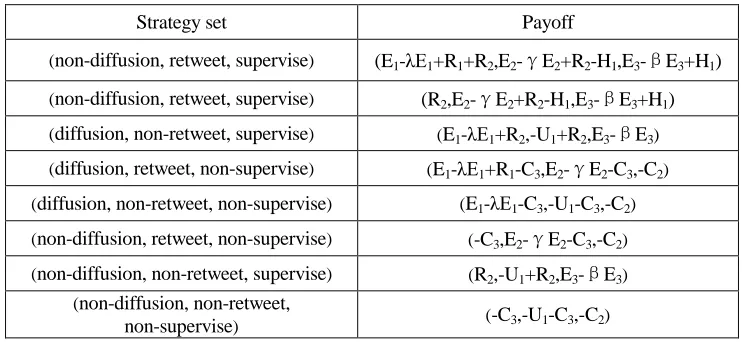
Game Payoff refers to the expected effect of players strategy selection in the network. When users choose a diffusion strategy, they will get psychological satisfaction and other benefits as E1. At the same time, they pay λE1 (0<λ<1). If you
don’t pay attention and don’t participate in the diffusion, you won’t pay the cost. Opinion leaders may retweet a topic in order to gain more popularity, denoting the benefit of rising popularity by E2. Meanwhile, they pay γE2 (0<γ<1), such as the
time overhead on the topic. At this time, if the users diffuse, they will get extra payoff R1 because they choose the same strategy. If the opinion leaders do not
retweet it, they will reduce U1 caused by the influence in society. When regulators
find that a large number of opinions gather, timely suppression will enhance their image in the users and bring social stability and other benefits E3, At this time, users
and opinion leaders will have additional benefits R2 due to social stability. And
regulators also need to pay βE3(0<β<1) for the energy, time and other costs of
supervision. When regulators adopt a supervisory strategy, users and opinion leaders will be penalized if they still spread, and they need to pay H1. If regulators don't
supervise, they will lose C2 because they lose the credibility. At the same time, users
and opinion leaders will lose C3 due to social turmoil. Table II shows different
strategy combinations and benefits.
TABLE II. DIFFERENT STRATEGY COMBINATIONS AND BENEFITS.
Strategy set Payoff
(non-diffusion, retweet, supervise) (E1-λE1+R1+R2,E2-γE2+R2-H1,E3-βE3+H1)
(non-diffusion, retweet, supervise) (R2,E2-γE2+R2-H1,E3-βE3+H1)
(diffusion, non-retweet, supervise) (E1-λE1+R2,-U1+R2,E3-βE3)
(diffusion, retweet, non-supervise) (E1-λE1+R1-C3,E2-γE2-C3,-C2)
(diffusion, non-retweet, non-supervise) (E1-λE1-C3,-U1-C3,-C2)
(non-diffusion, retweet, non-supervise) (-C3,E2-γE2-C3,-C2)
(non-diffusion, non-retweet, supervise) (R2,-U1+R2,E3-βE3)
(non-diffusion, non-retweet,
2.2 Nash Equilibrium
Since the game does not have a pure strategy Nash equilibrium, it can only find its mixed strategy Nash equilibrium. Combined with Tables I and II, the expected payoff of the users' choice of diffusion strategy is T1, and the expected payoff of the
non-diffusion strategy is T2, then the expected payoff of the users is T, then
𝑇1= 𝑞𝑟(𝐸1− λ𝐸1+ 𝑅1+ 𝑅2) + 𝑞(1 − 𝑟)(𝐸1− λ𝐸1+ 𝑅1− 𝐶3) + 𝑟(1 − 𝑞)(𝐸1− λ𝐸1+ 𝑅2)
+ (1
−𝑞)(1 − 𝑟)(𝐸1− λ𝐸1− 𝐶3)
𝑇2= 𝑞𝑟𝑅2+ 𝑞(1 − 𝑟)𝐶3+ 𝑟(1 − 𝑞)𝑅2+ (1 − 𝑞)(1 − 𝑟)𝐶3,𝑇 = 𝑝𝑇1+ (1 − 𝑝)𝑇2.
Similarly, the regulators and opinion leaders expected payoffs are M and S, respectively
M = 𝑟(𝐸3−β𝐸3+ 𝑞𝑅2− 𝐶3) + (1 − 𝑟)(𝑟𝐶3− 𝑞𝐶3),S = 𝑞(𝐸2−γ𝐸2+ 𝑞𝑅2+ 𝑟𝐶3− 𝐶3) +
(1 − 𝑟)𝑟𝐶3− 𝑞𝐶3
Then, we find the partial derivatives of T, M and S in p, q and r respectively, and let them equal to 0. Then, their solutions are as follows:
𝑝
∗=
[(𝐸1−𝜆𝐸1)𝑅2]−(𝐸3−𝛽𝐸3−𝐶3)𝑅1(𝐸3−𝛽𝐸3+𝐻1−𝐶3)+(𝐸1−𝜆𝐸1−𝑅1) (𝐸2−𝛾𝐸2)[𝑅1(𝐸1−𝜆𝐸1)−𝑅2(𝐸3−𝛽𝐸3)],
𝑞∗=𝐶3[(𝐻1−𝐸3+𝛽𝐸3)𝑅2]+(𝐸1−𝜆𝐸1−𝐶3)𝑅1(𝐸2−𝛾𝐸2)
(𝐸2−𝛾𝐸2)[(𝐸1−𝜆𝐸1)(𝑅2−𝐶3)−(𝐸3−𝛽𝐸3)𝑅1]
,
𝑟∗=[(𝐻1− 𝐸3− 𝛽𝐸3)𝑅2] − (𝐸1− 𝜆𝐸1− 𝐶3)𝑅1(𝐸2− 𝛾𝐸2)
(𝐸1− 𝜆𝐸1)(𝑅2− 𝐶3) − (𝐸3− 𝛽𝐸3− 𝐻1)𝑅1 .
When p>p*, opinion leaders will start to retweet highly. When q>q*, the regulators will start to supervise. When r>r*, users will choose non-spread the strategy, and then the probability of opinion leader retweeting will be reduced accordingly. It can be seen from S that the regulators' payoff is a function of the diffusion rate and the retweet rate. Therefore, the change of M can be analyzed by the variation analysis q* and r*. Next, the game model is introduced into the BA scale-free network to analyze the best timing of regulator intervention and the best strength of supervision.
2.2 Evolutionary model based on evolutionary game theory
can conclude that the optimal solution of the evolutionary stability strategy of the evolutionary game and the regulators' payoff existence function relationship. In the construction of the model, the step of data fitting to determine the parameters is omitted, and the interaction process of each players under different parameters is directly analyzed, and the results of the evolution of the attributes such as the time and intensity of the intervention of the supervisor are compared and analyzed, so as to obtain the best supervision timing and best strength
We know that BA scale-free networks have two very important features: (1) Growth model: The network size will increase as the number of nodes increases. (2) Priority connection characteristics: newly joined nodes can understand the policy information of neighbor nodes and are more willing to believe the strategy of most neighbor nodes as their own strategy, and then connect to the node.
Based on the above characteristics, construct a BA scale-free network model and propose a node update rule:
In each round of the game, the newly added nodes and the decisions of their neighbors in the next round can be learned. When the node is updated, it is updated according to the replication dynamics [11]. The update rule is as follows: node x randomly selects a node y from his neighbors, and uses the strategy of learning y described by the following equation:
W(𝑆𝑋 ← 𝑆𝑌) =max (𝑃𝐾𝑌−𝑃𝑋
𝑌,𝐾𝑋)𝐻 ,
where 𝑆𝑋 is the strategy of x, 𝑃𝑋 is the cumulative return of X according to its
neighbor game, 𝐾𝑋 and 𝐾𝑌 are the degrees of nodes x and y, and H is the
maximum difference of x and y returns. Because it is cumulative, it is normalized by dividing the degree to ensure that W is between 0 and 1. The general idea is: If the yield of y is higher than x, then the probability of x learning y strategy is greater.
Set the threshold L0, then it compares the growth rate F0 on the numbers of the
users with the diffusion strategy in the two adjacent round game. When the diffusion rate exceeds L0, the opinion leader chooses the retweeting strategy. If F0 is greater
than L0, it means that the incident leader will not retweet the incident.
After the opinion leader selects the strategy, the growth rate F1 of the opinion
leader node that selects the retweeting strategy is calculated, and the threshold L1 is
set. If F1 is greater than L1, the regulator will select the supervision strategy,
otherwise the election is not regulated.
After the regulator makes a decision. The newly added opinion leaders and users nodes in the next round of games will make their own decisions based on the choices of the regulators and the new ones, and then update the payoff matrix to maximize the benefits
3. EXPERIMENTAL ANALYSIS
total number of opinion leaders is M=200. The matlab software is used to establish the netizen node n0=50, the opinion leader m0=10, the initial test BA network, m,n is the
degree of new incoming nodes for each iteration, m=60, n=10, and the game process is introduced in each iteration.
The timing and intensity of regulators' involvement in management have a great influence on the evolution of opinions. The earlier the intervention time, the lower the probability of rumors. The greater the supervision, the more effective the normal order of the network. However, premature intervention will increase the cost and also reduce the freedom of the users to a certain degree. The time when the regulator is involved in the public opinion can be mapped to the user transmission rate L0 and the opinion leader
forwarding rate L1 in the model. The supervision intensity can be mapped to the
supervision rate r* in the model. The smaller the and L1, the earlier the regulator
intervenes. The greater the r*, the greater the regulator's supervision, and the regulator's guidance is measured by the proportion of various players in the network community.
[image:6.612.112.484.466.670.2]The parameter settings used in the experiment are shown in Table III.
TABLE III. DIFFERENT CONTEXT PARAMETERS.
L0 L1 𝑟∗
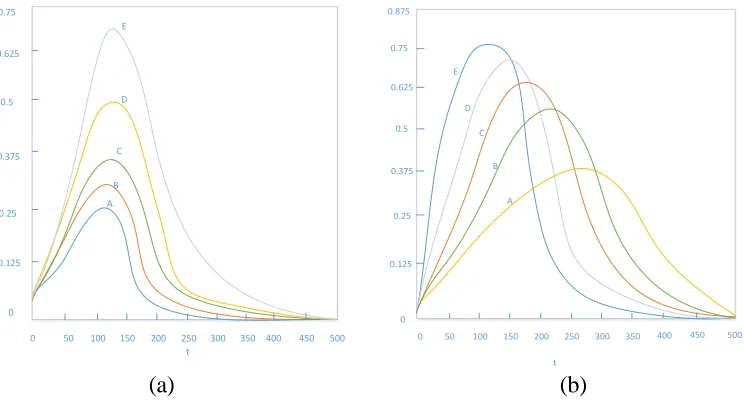
A 0.3 0.4 0.5
B 0.6 0.4 0.7
C 0.5 0.6 0.5
D 0.5 0.6 0.7
According to the data set in Table III, the game models are used to simulate the results as shown in the following figure.
(a) (b)
0 50 100 150 200 250 300 350 400 450 500 0.125
0.25 0.375
0.5 0.625 0.75
0
A B
C D E
t
0 50 100 150 200 250 300 350 400 450 500 0
0.125 0.25 0.375 0.5 0.625 0.75 0.875
A B C D E
(c) (d)
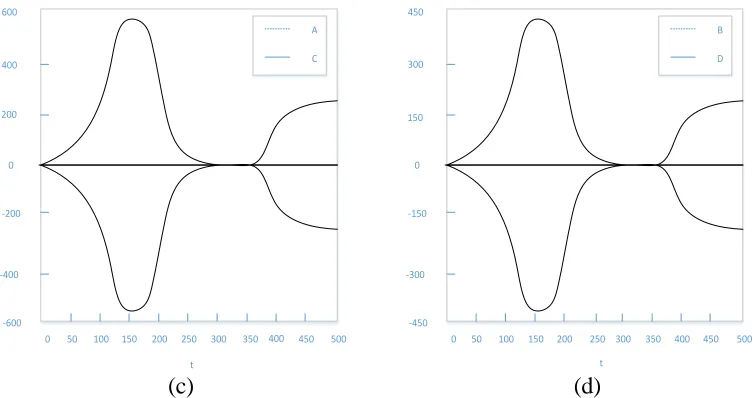
Figure 1. (a) And (b) show the rate of users choosing diffusion strategy and the rate of opinion leaders choose retweeting strategy, (c) and (d) show the regulator's payoff. changing with the evolutionary.
From Figure (c) and Figure (d), we can see that before the network reaches equilibrium, the growth rate of users and opinion leaders has been changing, and the strategy chosen by regulators has been changing, resulting in the instability of regulator's payoff. When premature intervention, the regulator’s payoff grew steadily at the beginning of the spread. With the intervention of users and opinion leaders, the regulator's payoff began to decline. Finally, after the network equilibrium, the regulator's payoff was negative. Although the regulators is involved in the late of the program C, the supervision is strong, and the impact on the network balance is not great. Program D regulators were late and the supervision was small. At the beginning, a large number of users and opinion leaders began to report. Although they faced high losses in the initial stage, they showed a slow upward trend. The comprehensive comparison plan B is dominant, and the number of users and opinion leaders can reach equilibrium earlier. Although the supervision is small, the long-term government returns are positive due to the timely intervention time, although the late regulators’ payoff is negative, but due to the supervision not large and long-term gains and social stability, so the losses are low.
In addition, through the comparison of the above several schemes, the high supervision intensity has a greater guiding effect on opinion leaders, which enables them to reach equilibrium quickly and reduce the retweeting frequency.
4. CONCLUSIONS
This paper combines game theory with BA scale-free network. Through the analysis of behavioral decisions of users, opinion leaders and regulators, a perspective diffusion model based on evolutionary game is constructed. From the
0 50 100 150 200 250 300 0
200 400 600
-200
-400
-600
A C
t
350 400 450 500 0 50 100 150 200 250 300 0
150 300 450
-150
-300
-450
B D
[image:7.612.105.482.84.283.2]beneficial to the stable development of the online community, and the high supervision of opinion leaders will make them reach a faster balance, thus reducing the reporting rate.
ACKNOWLEDGEMENTS
This work is partially supported by the National Natural Science Foundation (Nos. 61802316, 61872298, 61532009, 61472329, and 61602389), Chunhui Plan Cooperation and Research Project, Ministry of Education of China (No.Z2015109), "Young Scholars Reserve Talents" program of Xihua University, Scientific Research Fund of Sichuan Provincial Education Department (No.15ZA0130), Key Scientific Research Fund of Xihua University (No.z1422615), Open Research Subject of Key Laboratory of Security Insurance of Cyberspace, Sichuan Province (No.szjj2015-057), Open Research Subject of Key Laboratory of Grain and Oil Engineering and Food Safety, Sichuan Province (No.szjj2016-023), and Outstanding Young Scholar Development Scheme, School of Computer and Software Engineering, Xihua University.
REFERENCES
1. Liu W, Zhong S. 2018. “Modeling and analyzing the dynamic spreading of epidemic malware by
a network eigenvalue method,” Applied Mathematical Modelling, 2018, 63: 491-507.
2. Liu W, Wu X, Yang W, et al. 2019. “Modeling cyber rumor spreading over mobile social
networks: Acompartment approach,” Applied Mathematics andComputation, 2019, 343:
214-229.
3. Gruhl D, Guha R, Liben-Nowell D, et al. 2004. “Information diffusion through blogspace,”
Proceedings of the 13th international conference on World Wide Web. ACM, 2004.
4. Leskovec J, Mcglohon M, Faloutsos C, et al. 2007. “Patterns of Cascading Behavior in Large
Blog Graphs,” Minneapolis: Siam International Conference on Data Mining, 2007.
5. Isham V, Harden S, Nekovee M. 2010. “Stochastic epidemics and rumours on finite random
networks,” Physical A Statistical Mechanics & Its Applications, 2010, 389(3): 561-576.
6. Zanette D H. 2001. “Critical behavior of propagation on small-world networks,” Phys Rev E Stat
Nonlin Soft Matter Phys, 2001.
7. Damián H Z, Kuperman M, Centro A B, et al. 2002. “Effects of immunization in small-world
epidemics,” Physica A Statistical Mechanics & Its Applications, 2002, 309(3): 445-452.
8. Moreno Y, Nekovee M, Pacheco A F. 2004. “Dynamics of rumor spreading in complex
networks,” Physical Review E, 2004, 69(6): 066130.
9. Nekovee M, Moreno Y, Bianconi G, et al. 2007. “Theory of rumour spreading in complex social
networks,” Physica A, 2007, 374(1): 457-470.
10. Xiong F, Liu Y, Zhang Z J, et al. 2012. “An information diffusion model based on retweeting
mechanism for online social media,” Physics Letters A, 2012, 376: 30-31.
11. Hauert C, Doebeli M. 2004. “Spatial structure often inhibits the evolution of cooperation in the