Volume 2010, Article ID 182576,8pages doi:10.1155/2010/182576
Research Article
A New Projection Algorithm for Generalized
Variational Inequality
Changjie Fang
1, 2and Yiran He
11Department of Mathematics, Sichuan Normal University, Chengdu, Sichuan 610068, China 2Institute of Applied Mathematics, Chongqing University of Posts and Telecommunications,
Chongqing 400065, China
Correspondence should be addressed to Changjie Fang,[email protected]
Received 26 October 2009; Accepted 20 December 2009
Academic Editor: Vy Khoi Le
Copyrightq2010 C. Fang and Y. He. This is an open access article distributed under the Creative Commons Attribution License, which permits unrestricted use, distribution, and reproduction in any medium, provided the original work is properly cited.
We propose a new projection algorithm for generalized variational inequality with multivalued mapping. Our method is proven to be globally convergent to a solution of the variational inequality problem, provided that the multivalued mapping is continuous and pseudomonotone with nonempty compact convex values. Preliminary computational experience is also reported.
1. Introduction
We consider the following generalized variational inequality. To findx∗ ∈ Candξ ∈ Fx∗ such that
ξ, y−x∗≥0, ∀y∈C, 1.1
whereC is a nonempty closed convex set inRn, F is a multivalued mapping fromC into Rn with nonempty values, and·,· and · denote the inner product and norm in Rn,
respectively.
the literature; see 14–17 and the references therein. Recently, 15 proposes a projection algorithm for generalized variational inequality with pseudomonotone mapping. In 15, choosing ξi ∈ Fxi needs solving a single-valued variational inequality and hence is
computationally expensive; see expression2.1in15. In this paper, we introduce a different projection algorithm for generalized variational inequality. In our method, ξi ∈ Fxi can
be taken arbitrarily. Moreover, the main difference of our method from that of15 is the procedure of Armijo-type linesearch; see expression2.2in15and expression2.2in the next section.
Let S be the solution set of 1.1, that is, those points x∗ ∈ C satisfying 1.1. Throughout this paper, we assume that the solution setSof problem1.1is nonempty andF is continuous onCwith nonempty compact convex values satisfying the following property:
ζ, y−x≥0, ∀y∈C, ζ∈Fy, ∀x∈S. 1.2
Property 1.2 holds if F is pseudomonotone on C in the sense of Karamardian 18. In particular, ifFis monotone, then1.2holds.
The organization of this paper is as follows. In the next section, we recall the definition of continuous multivalued mapping, present the algorithm details, and prove the preliminary result for convergence analysis inSection 3. Numerical results are reported in the last section.
2. Algorithms
Let us recall the definition of continuous multivalued mapping. F is said to be upper semicontinuous at x ∈ Cif for every open set V containing Fx, there is an open setU containingx such thatFy ⊂ V for ally ∈ C ∩ U. F is said to be lower semicontinuous at x ∈ C, if we give any sequence xk converging to x and any y ∈ Fx, there exists a
sequenceyk ∈ Fxkthat converges toy.F is said to be continuous at x ∈ C if it is both upper semicontinuous and lower semicontinuous atx. IfFis single valued, then both upper semicontinuity and lower semicontinuity reduce to the continuity ofF.
LetΠCdenote the projector ontoCand letμ >0 be a parameter.
Proposition 2.1. x∈Candξ∈Fxsolve problem1.1if and only if
rμx, ξ:x−ΠCx−μξ0. 2.1
Algorithm 2.2. Choosex0∈Cand three parametersσ >0, 0< μ < min{1,1/σ}, andγ∈0,1.
Seti0.
Step 1. Ifrμxi, ξ 0 for someξ∈Fxi, stop; else take arbitrarilyξi∈Fxi.
Step 2. Letkibe the smallest nonnegative integer satisfying
ξi−yi, rμxi, ξi≤σrμxi, ξi2, 2.2
Step 3. Computexi 1: ΠCixi,whereCi:{x∈C:hix≤0}, and
hix:yi ηirμxi, ξi, x−xi ηiyi−μξi rμxi, ξi, rμxi, ξi. 2.3
Leti:i 1 and go toStep 1.
Remark 2.3. SinceFhas compact convex values,F has closed convex values. Therefore,yiin Step 2is uniquely determined byki.
Remark 2.4. If F is a single-valued mapping, the Armijo-type linesearch procedure 2.2 becomes that ofAlgorithm 2.2in14.
We show thatAlgorithm 2.2is well defined and implementable.
Proposition 2.5. Ifxi is not a solution of problem1.1, then there exists a nonnegative integerki
satisfying2.2.
Proof. Suppose that for allk, we have
ξi−yk, rμxi, ξi> σrμxi, ξi2, 2.4
where yk ΠFxi−γkrμxi,ξiξi. Since F is lower semicontinuous, ξi ∈ Fxi, and xi − γkrμxi, ξi → xi as k → ∞, for each k, there is uk ∈ Fxi − γkrμxi, ξi such that
limk→ ∞ukξi. Sinceyk ΠFxi−γkrμxi,ξiξi,
yk−ξi≤ uk−ξi −→0, ask−→ ∞. 2.5
So limk→ ∞yk ξi. Let k → ∞ in 2.4, we have 0 ξi −ξi ≥ σrμxi, ξi > 0. This
contradiction completes the proof.
Lemma 2.6. For everyx∈Candξ∈Fx,
ξ, rμx, ξ≥μ−1rμx, ξ2. 2.6
Proof. See15, Lemma 2.3.
Lemma 2.7. Let C be a closed convex set inRn, ha real-valued function on Rn, and K the set
{x∈C:hx≤0}. IfKis nonempty andhis Lipschitz continuous onCwith modulusθ >0, then
distx, K≥θ−1max{hx,0}, ∀x∈C, 2.7
wheredistx, Kdenotes the distance fromxtoK.
Proof. See14, Lemma 2.3.
Lemma 2.8. Letx∗solve the variational inequality1.1and let the functionhibe defined by2.3.
Thenhixi≥ηiμ−1−σrμxi, ξi2andh
Proof. It follows from2.3that
hixi ηiyi−μξi rμxi, ξi, rμxi, ξi
ηiyi, rμxi, ξi−μηiξi, rμxi, ξi ηirμxi, ξi2
≥ηi1−μξi, rμxi, ξi ηi1−σrμxi, ξi2
≥μ−1−ση
irμxi, ξi2,
2.8
where the first inequality follows from2.2and the last one follows from Lemma 2.6and μ <1. Ifrμxi, ξi/0, thenhixi>0 becauseμ <1/σ. It remains to be proved thathix∗≤0. Sincerμxi, ξi xi−ΠCxi−μξi, we have
rμxi, ξi−μξi, x∗−xi rμxi, ξi≤0, 2.9
on the other hand, assumption1.2implies that
μξi, x∗−xiμξi, x∗−xi ≤0. 2.10
Adding the last two expressions, we obtain that
rμxi, ξi, x∗−xi≤rμxi, ξi, μξi−rμxi, ξi. 2.11
It follows that
yi ηirμxi, ξi, x∗−xiyi, x∗−xi ηirμxi, ξi, x∗−xi ≤yi, x∗−xi ηirμxi, ξi, μξi−rμxi, ξi
yi, x∗−xi ηirμxi, ξi−ηiyi−μξi rμxi, ξi, rμxi, ξi ≤ −ηiyi−μξi rμxi, ξi, rμxi, ξi,
2.12
where the second inequality follows from assumption1.2andyi∈Fxi−ηirμxi, ξi. Thus
hix∗≤0 is verified.
3. Main Results
Proof. Letx∗be a solution of the variational inequality problem. ByLemma 2.8,x∗ ∈Ci. We
assume thatAlgorithm 2.2generates an infinite sequence{xi}. In particular,rμxi, ξi/0 for everyi. ByStep 3, it follows from Lemma 2.4 in14that
xi 1−x∗2≤ xi−x∗2− xi 1−xi2≤ xi−x∗2−dist2xi, Ci, 3.1
where the last inequality is due to xi 1 ∈ Ci. It follows that the squence {xi 1−x∗2} is
nonincreasing, and hence is a convergent sequence. Therefore,{xi}is bounded and
lim
i→ ∞dist 2x
i, Ci 0. 3.2
By the boundedness of{xi}, there exists a convergent subsequence{xij}converging tox. If x is a solution of problem 1.1, we show next that the whole sequence {xi} converges tox. Replacingx∗ byxin the preceding argument, we obtain that the sequence
{xi−x} is nonincreasing and hence converges. Sincexis an accumulation point of{xi},
some subsequence of {xi −x} converges to zero. This shows that the whole sequence {xi−x}converges to zero, hence limi→ ∞xi x.
Suppose now that x is not a solution of problem 1.1. We show first that ki in Algorithm 2.2cannot tend to∞. SinceFis continuous with compact values, Proposition 3.11 in19implies that {Fxi : i ∈N}is a bounded set, and so the sequence{ξi}is bounded.
Therefore, there exists a subsequence{ξij} converging toξ. SinceFis upper semicontinuous with compact values, Proposition 3.7 in19implies thatFis closed, and soξ ∈Fx. By the definition ofki, we have
ξi−ui, rμxi, ξi> σrμxi, ξi2, ∀ui ΠFxi−γki−1rμxi,ξiξi. 3.3
If kij → ∞, then xij −γkij−1rμxij, ξij → x. The lower continuity of F, in turn, implies
the existence of ξij ∈ Fxij − γkij−1r
μxij, ξij such that ξij converges to ξ. Since uij
ΠFx
ij−γkij−1rμxij,ξijξij, uij ∈ Fxij −γ
kij−1r
μxij, ξij, and uij −ξij ≤ ξij −ξij. Therefore
limj→ ∞uij ξand
ξij−uij, rμ
xij, ξij
> σrμ
xij, ξij 2
. 3.4
Lettingj → ∞, we obtain the contradiction
0≥σrμ
x, ξ2>0, 3.5
It follows from2.3that
hix−hi
yyi ηirμxi, ξi, x−y≤yi ηirμxi, ξix−y. 3.6
Since{xi}and {ξi}are bounded, we have the sequence{rμxi, ξi}and hence the sequence {Fxi−ηirμxi, ξi}is bounded. Thus, for someM >0,
yi ηirμxi, ξi≤ sup
ζ∈Fxi−ηirμxi,ξi
ζ ηirμxi, ξi≤M, ∀i. 3.7
Therefore, each functionhiis Lipschitz continuous onCwith modulusM. Noting thatxi/∈Ci
and applyingLemma 2.7, we obtain that
distxi, Ci≥M−1hixi, ∀i. 3.8
It follows from3.8andLemma 2.8that
distxi, Ci≥M−1hixi≥M−1
μ−1−ση
irμxi, ξi2. 3.9
Then3.2implies that
lim
i→ ∞ηirμxi, ξi 2
0. 3.10
By the boundedness of{ηi}, we obtain that limi→ ∞rμxi, ξi0.Sincerμ·,·is continuous
and the sequences {xi} and {ξi} are bounded, there exists an accumulation point x, ξ of
{xi, ξi} such that rμx, ξ 0. This implies thatx solves the variational inequality1.1.
Similar to the preceding proof, we obtain that limi→ ∞xix.
4. Numerical Experiments
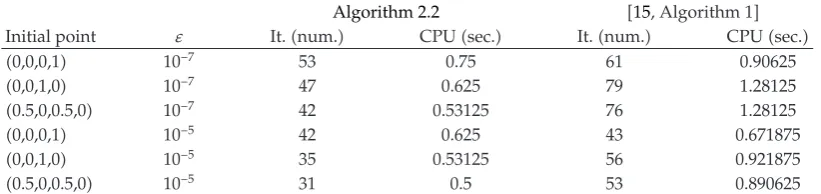
In this section, we present some numerical experiments for the proposed algorithm. The MATLAB codes are run on a PC with CPU Intel P-T2390 under MATLAB Version 7.0.1.24704R14Service Pack 1. We compare the performance of ourAlgorithm 2.2and15, Algorithm1. In the Tables1and2, “It.” denotes number of iteration, and “CPU” denotes the CPU time in seconds. The toleranceεmeans whenrx, ξ ≤ε,the procedure stops.
Example 4.1. Letn3,
C:
x∈Rn:n i1
xi1
, 4.1
and letF:C → 2Rn be defined by
Table 1:Example 4.1.
Algorithm 2.2 15, Algorithm 1
ε It.num. CPUsec. It.num. CPUsec.
10−7 55 0.625 74 0.984375
10−5 39 0.546875 51 0.75
10−3 23 0.4375 27 0.5
Table 2:Example 4.2.
Algorithm 2.2 15, Algorithm 1
Initial point ε It.num. CPUsec. It.num. CPUsec.
0,0,0,1 10−7 53 0.75 61 0.90625
0,0,1,0 10−7 47 0.625 79 1.28125
0.5,0,0.5,0 10−7 42 0.53125 76 1.28125
0,0,0,1 10−5 42 0.625 43 0.671875
0,0,1,0 10−5 35 0.53125 56 0.921875
0.5,0,0.5,0 10−5 31 0.5 53 0.890625
Then the setCand the mapping F satisfy the assumptions ofTheorem 3.1and0,0,1is a solution of the generalized variational inequality. Example 4.1is tested in 15. We choose σ 0.5, γ 0.8, andμ 1 for our algorithm;σ 0.8, γ 0.6, andμ 1 for Algorithm1in 15. We usex0 0.3,0.4,0.3as the initial point.
Example 4.2. Letn4,
C:
x∈Rn:n i1
xi1
, 4.3
andF:C → 2Rn be defined by
Fx {t, t 2x2, t 3x3, t 4x4:t∈0,1}. 4.4
Then the setCand the mappingF satisfy the assumptions ofTheorem 3.1and1,0,0,0is a solution of the generalized variational inequality. We chooseσ 0.5, γ 0.8, andμ 1 for the two algorithms.
Acknowledgments
References
1 E. Allevi, A. Gnudi, and I. V. Konnov, “The proximal point method for nonmonotone variational inequalities,”Mathematical Methods of Operations Research, vol. 63, no. 3, pp. 553–565, 2006.
2 A. Auslender and M. Teboulle, “Lagrangian duality and related multiplier methods for variational inequality problems,”SIAM Journal on Optimization, vol. 10, no. 4, pp. 1097–1115, 2000.
3 T. Q. Bao and P. Q. Khanh, “A projection-type algorithm for pseudomonotone nonlipschitzian mul-tivalued variational inequalities,” inGeneralized Convexity, Generalized Monotonicity and Applications, vol. 77 ofNonconvex Optimization and Its Applications, pp. 113–129, Springer, New York, NY, USA, 2005. 4 L. C. Ceng, G. Mastroeni, and J. C. Yao, “An inexact proximal-type method for the generalized variational inequality in Banach spaces,”Journal of Inequalities and Applications, vol. 2007, Article ID 78124, 14 pages, 2007.
5 S. C. Fang and E. L. Peterson, “Generalized variational inequalities,”Journal of Optimization Theory and Applications, vol. 38, no. 3, pp. 363–383, 1982.
6 M. Fukushima, “The primal Douglas-Rachford splitting algorithm for a class of monotone mappings with application to the traffic equilibrium problem,”Mathematical Programming, vol. 72, no. 1, pp. 1–15, 1996.
7 Y. He, “Stable pseudomonotone variational inequality in reflexive Banach spaces,” Journal of Mathematical Analysis and Applications, vol. 330, no. 1, pp. 352–363, 2007.
8 R. Saigal, “Extension of the generalized complementarity problem,” Mathematics of Operations Research, vol. 1, no. 3, pp. 260–266, 1976.
9 G. Salmon, J.-J. Strodiot, and V. H. Nguyen, “A bundle method for solving variational inequalities,”
SIAM Journal on Optimization, vol. 14, no. 3, pp. 869–893, 2003.
10 R. T. Rockafellar, “Monotone operators and the proximal point algorithm,”SIAM Journal on Control and Optimization, vol. 14, no. 5, pp. 877–898, 1976.
11 I. V. Konnov, “On the rate of convergence of combined relaxation methods,” Izvestiya Vysshikh Uchebnykh Zavedenii. Matematika, no. 12, pp. 89–92, 1993.
12 I. V. Konnov, Combined Relaxation Methods for Variational Inequalities, vol. 495 of Lecture Notes in Economics and Mathematical Systems, Springer, Berlin, Germany, 2001.
13 I. V. Konnov, “Combined relaxation methods for generalized monotone variational inequalities,” in
Generalized Convexity and Related Topics, vol. 583 ofLecture Notes in Econom. and Math. Systems, pp. 3–31, Springer, Berlin, Germany, 2007.
14 Y. He, “A new double projection algorithm for variational inequalities,”Journal of Computational and Applied Mathematics, vol. 185, no. 1, pp. 166–173, 2006.
15 F. Li and Y. He, “An algorithm for generalized variational inequality with pseudomonotone mapping,”Journal of Computational and Applied Mathematics, vol. 228, no. 1, pp. 212–218, 2009. 16 M. V. Solodov and B. F. Svaiter, “A new projection method for variational inequality problems,”SIAM
Journal on Control and Optimization, vol. 37, no. 3, pp. 765–776, 1999.
17 F. Facchinei and J. S. Pang,Finite-Dimensional Variational Inequalities and Complementary Problems, Springer, New York, NY, USA, 2003.
18 S. Karamardian, “Complementarity problems over cones with monotone and pseudomonotone maps,”Journal of Optimization Theory and Applications, vol. 18, no. 4, pp. 445–454, 1976.