R E S E A R C H
Open Access
A conjugate gradient algorithm and its
application in large-scale optimization
problems and image restoration
Gonglin Yuan
1, Tingting Li
1and Wujie Hu
1**Correspondence:
[email protected] 1College of Mathematics and
Information Science, Guangxi University, Nanning, P.R. China
Abstract
To solve large-scale unconstrained optimization problems, a modified PRP conjugate
gradient algorithm is proposed and is found to be interesting because it combines
the steepest descent algorithm with the conjugate gradient method and successfully
fully utilizes their excellent properties. For smooth functions, the objective algorithm
sufficiently utilizes information about the gradient function and the previous
direction to determine the next search direction. For nonsmooth functions, a
Moreau–Yosida regularization is introduced into the proposed algorithm, which
simplifies the process in addressing complex problems. The proposed algorithm has
the following characteristics: (i) a sufficient descent feature as well as a trust region
trait; (ii) the ability to achieve global convergence; (iii) numerical results for large-scale
smooth/nonsmooth functions prove that the proposed algorithm is outstanding
compared to other similar optimization methods; (iv) image restoration problems are
done to turn out that the given algorithm is successful.
MSC:
90C26
Keywords:
Conjugate gradient; Nonconvex and nonsmooth; Descent property;
Global convergence
1 Introduction
The concerned problem is given by
min
f
(
x
)
|
x
∈
n,
(1.1)
where the function
f
:
n→
and
f
∈
C
2. The above model is quite typical but a
difficult mathematic model and is seen throughout daily life, work, and scientific
re-search, thus being the focus of a great variety of careers. Experts and scholars have
conducted numerous in-depth studies and achieved a series of fruitful results (see, e.g.,
[
2
,
5
,
12
,
22
,
29
–
31
,
40
,
50
,
52
,
53
]). It is quite noticeable that the steepest descent method
is simple, and the computational and memory requirements are low. In the negative
gra-dient direction, the function’s value decreases rapidly, which makes it easy to think that
this is a suitable search direction, although the convergence rate of the gradient method
is not always fast. Later, experts and scholars modified this method and presented an
ef-ficient conjugate gradient method, which provides a simple form but high performance.
There are two aspects of optimization problems: the step length and the search direction.
In general, the mathematical formula for (
1.1
) is
x
k+1=
x
k+
α
kd
k,
k
∈ {
0, 1, 2, . . .
}
,
(1.2)
where
x
kis the current iteration point,
α
kis called the step length, and
d
kis the
k
th search
direction. The formula for
d
kis often defined by
d
k+1=
⎧
⎨
⎩
–
g
k+1+
β
kd
k,
if
k
≥
1,
–
g
k+1,
if
k
= 0,
(1.3)
where
β
k∈
. In addition, increasingly more efficient and successful conjugate gradient
algorithms have been proposed using a variety of expression for
β
kas well as
d
k(see, e.g.,
[
9
,
11
,
27
,
38
,
42
–
44
,
47
,
49
]). The well-known PRP algorithm [
26
,
27
] is of the following
form:
β
kPRP=
g
T
k+1
(
g
k+1–
g
k)
g
(xk)2,
(1.4)
where
g
k,
g
k+1and
f
kdenote
g
(
x
k),
g
(
x
k+1) and
f
(
x
k), respectively.
g
(
x
k+1) =
g
k+1=
∇
f
(
x
k+1)
is the gradient function of the objective function
f
at
x
k+1. It is remarkable that the PRP
conjugate algorithm is extremely effective for large-scale optimization problems. It is
re-grettable that it fails to achieve global convergence when addressing nonconvex function
problems under the so-called weak Wolfe–Powell (WWP) line search technique. Its
for-mula is as follows:
g
(
x
k+
α
kd
k)
Td
k≥
ρ
g
kTd
k(1.5)
and
f
(
x
k+
α
kd
k)
≤
f
k+
ϕα
kg
kTd
k,
(1.6)
where
ϕ
∈
(0, 1/2),
α
k> 0 and
ρ
∈
(
ϕ
, 1). To address the above exchanging problem, Yuan,
Wei, and Lu [
48
] developed the following innovative formula for the normal WWP line
search technique (called Yuan, Wei, and Lu line search (YWL)) and obtained numerous
rich theoretical results:
f
(
x
k+
α
kd
k)
≤
f
k+
ϕα
kg
kTd
k+
α
kmin
–
ϕ
1g
kTd
k,
δ
α
k2
d
k 2(1.7)
and
g
(
x
k+
α
kd
k)
Td
k≥
ρ
g
kTd
k+
min
–
ϕ
1g
kTd
k,
δα
kd
kd
k,
(1.8)
Armijo line search technique and proposed a modified Armijo line search technique as
follows:
f
(
x
k+
α
kd
k)
≤
f
(
x
k) +
λα
kg
kTd
k+
α
kmin
–
λ
1g
kTd
k,
λ
α
k2
d
k 2,
(1.9)
where
λ
,
γ
∈
(0, 1),
λ
1∈
(0,
λ
), and
α
kis the largest number of
{
γ
k|
k
= 0, 1, 2, . . .
}
. It is
in-teresting that some scholars not only focus on the expression of the coefficient
β
kbut also
attempt to modify the formula of the search direction
d
k+1. Nonlinear conjugate
gradi-ent methods are increasingly more interesting to scholars because of their simplicity and
lower equipment requirements for the calculation environment. Thus, HS (see [
13
,
16
,
33
]) and PRP algorithms (see [
35
,
51
]) are widely used to solve complex problems in
vari-ous fields. Currently, some experts focus on the three-term conjugate gradient because its
search direction sometimes has the descent and automatic trust region properties.
Moti-vated by the above discussion, a new modified three-term conjugate gradient algorithm
based on the modified Armijo line search technique is proposed. The algorithm has the
following properties:
• The search direction has a sufficient decrease and a trust region property.
• For general functions, the proposed algorithm under mild assumptions possesses
global convergence.
• The new algorithm combines the deepest descent method with the conjugate gradient
algorithm through the size of the coefficients, and the numerical results demonstrate
the method’s good performance compared with established algorithms.
• The corresponding numerical results prove that the discussed method is efficient as
well as successful at solving general problems.
• The paper successfully combines the mathematic theory with real-world application.
On the one hand, the proposed algorithm has a good performance in solving the
large-scale optimization problems, on the other hand, it is introduced in the image
restoration, which has wild application in biological engineering, medical sciences
and other areas of science and engineering.
The remainder of this paper is organized as follows: The next section presents the
moti-vation and the content of the algorithm to solve large-scale smooth problems includes the
important mathematical characters; the similar optimization algorithm was presented to
solve large-scale non-smooth optimization problems; the Sect.
4
presents the application
of the Sect.
3
in the problem of the image restoration; the paper’s conclusion and
algo-rithm’s characters was listed in Sect.
5
. Without loss of generality,
f
(
x
k) and
f
(
x
k+1) are
replaced by
f
kand
f
k+1, and
·
is the Euclidean norm.
2 New three-term conjugate gradient algorithm for smooth problems
The three-term conjugate gradient algorithm has seen extensive study and obtained
ex-tremely good theoretical results. In the light of the work by Toouati-Ahmed, Storey [
34
],
Al-Baali [
1
], Gilbert, and Nocedal [
17
] on conjugate gradient methods, the sufficient
de-scent condition is crucial for the global convergence. From this, a famous formula for the
search direction
d
k+1emerges. Zhang [
51
] proposed the following formula:
d
k+1=
⎧
⎨
⎩
–
g
k+1+
gT
k+1ykdk–dTkgk+1yk
gT
kgk
if
k
≥
1,
–
g
k+1,
if
k
= 0,
where
y
k=
g
k+1–
g
k. It is notable that the three-term conjugate gradient algorithm was
firstly introduced in solving optimization problems and the numeral results proves it is
competitive than similar methods, thus this paper choose it as the compared algorithm in
Sects.
2.3
and
3.2
. In [
23
], Nazareth proposed another variety of formula,
d
k+1= –
y
k+
y
T ky
ky
Tkd
kd
k+
y
T k–1y
ky
Tk–1d
k–1d
k–1,
(2.2)
where
y
k=
g
k+1–
g
k,
g
kis the gradient function value at the point
x
k, and
d
0=
d
–1= 0. In
[
14
], Deng and Zhong expressed a new three-term conjugate gradient formula as follows:
d
k+1= –
g
k+1–
1 –
y
T k
y
ky
T ks
ks
Tk
g
k+1y
Tk
s
k–
y
T k
g
k+1y
Tk
s
ks
k–
s
T kg
k+1y
Tk
s
ky
k,
(2.3)
where
s
k=
x
k+1–
x
k. Based on the above discussion, we express the new three-term
algo-rithm under the modified Armijo line search technique (
1.9
) as follows:
d
k+1=
⎧
⎨
⎩
–
g
k+1+
gTk+1y∗kdk–dTkgk+1y∗k
max{ξ2dTky∗k,min(ξ3gk2,ξ4dTkdk)}
if
k
≥
1,
–
g
k+1if
k
= 0,
(2.4)
where
ξ
2,
ξ
3,
ξ
4> 0. To gather more information about the objective function, we address
the corresponding gradient function as well as the initial point, let
y
∗k=
y
k+
ϕ
k(
x
k+1–
x
k),
where
y
k=
g
k+1–
g
k,
ϕ
k=
max
{
0,
B
k}
, and
B
k=
(gk+1+gk)Ts
k+2(fk–fk+1)
xk+1–xk2
. This plays an important
role in theory and numerical performance [
46
]. From the above discussion, we introduce
a new PRP algorithm (Algorithm
2.1
).
2.1 Algorithm steps
Algorithm 2.1
Step 1: (Initiation) Choose an initial point
x
0,
γ
∈
(0, 1)
,
ξ
2,
ξ
3,
ξ
4> 0
, and positive
con-stants
ε
∈
(0, 1)
. Let
k
= 0
,
d
0= –
g
0.
Step 2: If
g
k≤
ε
, then stop.
Step 3: Find the step length, where the calculation
α
k=
max
{
γ
k|
k
= 0, 1, 2, . . .
}
stems
from (
1.9
).
Step 4: Set the new iteration point of
x
k+1=
x
k+
α
kd
k.
Step 5: Update the search direction by (
2.4
).
Step 6: If
g
k+1 ≤ε
holds, the algorithm stops. Otherwise, go to next step.
Step 7: Let
k
:=
k
+ 1
and go to Step 3.
2.2 Algorithm characteristics
This section states the properties of the sufficient descent, trust region as well as global
convergence of Algorithm
2.1
.
Lemma 2.1
If the search direction d
kis generated by
(
2.4
),
then
and
d
k≤
(1 + 2/
ξ
2)
g
k,
(2.6)
where
σ
are positive constants
.
Proof
On the one hand, it is true that (
2.5
) and (
2.6
) are correct if
k
= 0.
On the other hand, from (
2.4
),
g
kT+1d
k+1=
g
kT+1–
g
k+1+
g
Tk+1
y
∗kd
k–
d
Tkg
k+1y
∗kmax
{
ξ
2d
kTy
∗k,
min(
ξ
3g
k2,
ξ
4d
kTd
k)
}
= –
g
k+12+
g
kT+1g
kT+1y
∗kd
k–
g
kT+1d
Tkg
k+1y
∗kmax
{
ξ
2d
Tk
y
∗k,
min(
ξ
3g
k2,
ξ
4d
Tkd
k)
}
= –
g
k+12and
d
k+1=
g
k+1+
g
Tk+1
y
∗kd
k–
d
Tkg
k+1y
∗kmax
{
ξ
2d
kTy
∗k,
min(
ξ
3g
k2,
ξ
4d
Tkd
k)
}
≤
g
k+1+
g
kT+1y
∗kd
k–
d
kTg
k+1y
∗kmax
{
ξ
2d
Tk
y
∗k,
min(
ξ
3g
k2,
ξ
4d
kTd
k)
}
≤
g
k+1+
g
k+1y
∗kd
k+
d
kg
k+1y
∗kξ
2d
T ky
∗k≤
g
k+1+ 2
g
k+1y
∗kd
kξ
2d
T ky
∗k= (1 + 2/
ξ
2)
g
k+1.
(2.7)
It is true that (
2.5
) and (
2.6
) demonstrate that the search direction has a sufficient descent
trait and a trust region property, respectively.
Aiming at achieving global convergence, we propose the following mild assumptions.
Assumption (i)
The level set of
Ω
=
{
x
|
f
(
x
)
≤
f
(
x
0)
}
is bounded.
Assumption (ii)
The objective function
f
(
x
)
∈
C
2is bounded from below, and its gradient
function
g
(
x
) is Lipschitz continuous, i.e., there exists a positive constant
τ
such that
g
(
x
) –
g
(
y
)
≤
τ
x
–
y
,
x
,
y
∈
R
n.
(2.8)
Based on the above discussion and established conclusion concerning the modified
Armijo line search of being reasonable and necessary (see [
48
]), the global convergence
algorithm is established as follows.
Theorem 2.1
If assumptions
(i)
–
(ii)
are true and the corresponding sequences of
{
x
k}
,
{
d
k}
,
{
g
k}
,
{
α
k}
are generated by Algorithm
2.1
,
then we arrive at the conclusion that
lim
Proof
Suppose that the conclusion of the above theorem is incorrect, i.e., there exist a
positive constant
σ
3and index number
k
such that
g
k≥
σ
3,
∀
k
≥
k
.
(2.10)
Based on (
1.9
) and (
2.5
),
f
(
x
k+
α
kd
k)
≤
f
(
x
k) +
λα
kg
Tkd
k+
α
kmin
–
λ
1g
kTd
k,
λ
α
k2
d
k 2≤
f
(
x
k) +
α
k(
λ
–
λ
1)
g
Tkd
k.
Then with the above formulas with
k
= 0 from
∞
and combining with Assumption
(ii)
, we
obtain
∞
k=0
α
k(
λ
–
λ
1)
g
Tkd
k≤
f
0–
f
∞<
∞
.
(2.11)
Based on the convergence theorem of sequences,
lim
k→∞
(
λ
–
λ
1)
α
kg
Tk
d
k= 0.
(2.12)
Then we have
lim
k→∞
α
kg
T
k
d
k= 0,
(2.13)
from the formula of (
2.5
), then
lim
k→∞
α
kg
k2
= 0.
(2.14)
This means that
{
α
k} →
0,
k
→ ∞
or
{
g
k} →
0,
k
→ ∞
. We then state two cases:
(i) If
{
α
k} →
0,
k
→ ∞
, consider the line search method, for every suitable parameter
α
k,
f
(
x
k+
α
k/
γ
d
k) >
f
(
x
k) +
λα
k/
γ
g
Tkd
k+
α
k/
γ
min
–
λ
1g
kTd
k,
λα
kd
k2/(2
γ
)
,
there thus exists a positive constant
λ
∗≤
λ
1, such that
f
(
x
k+
α
kd
k/
γ
) –
f
(
x
k)
≥
–
λ
–
λ
∗α
k/
γ
g
k2.
Using (
2.5
), Assumption
(ii)
and the continuity of
f
(
x
) and
g
(
x
), we have
f
(
x
k+
α
kd
k/
γ
) –
f
(
x
k) =
α
k/
γ
g
(
x
k+
η
kα
k/
γ
d
k)
Td
k=
α
k/
γ
g
(
x
k)
Td
k+
α
k/
γ
g
(
x
k+
η
kα
k/
γ
d
k) –
g
(
x
k)
Td
k≤
α
k/
γ
g
(
x
k)
Td
k+
η
kτ α
k2/
γ
2d
k2= –
α
k/
γ
g
(
x
k)
2
where
η
k∈
(0, 1). Comparing the above two expressions, we have
–
α
k/
γ
g
xk 2+
η
k
τ α
2k/
γ
2d
k2≥
–
λ
–
λ
∗/
γ α
kg
xk 2i.e.,
g
xk 2–
η
k
τ α
k/
γ
d
k2≤
λ
–
λ
∗g
(
x
k)
2.
Thus,
α
k≥
γ
1 –
λ
+
λ
∗/
η
kτ σ
2> 0,
where
σ
∈
(1 +
2ξ2
,
∞
). This contradicts the assumption of case (i).
(ii) Clearly,
{
g
k} →
0 if
α
kis a positive finite constant when
k
is a sufficiently large
con-stant from the formula of (
2.14
). This conclusion does not satisfy the assumption of (
2.10
);
this completes the proof.
2.3 Numerical results
Related content is presented in this section and consists of two parts: test problems and
corresponding numerical results. To measure the algorithm’s efficiency, we compare
Al-gorithm
2.1
with Algorithm 1 in [
51
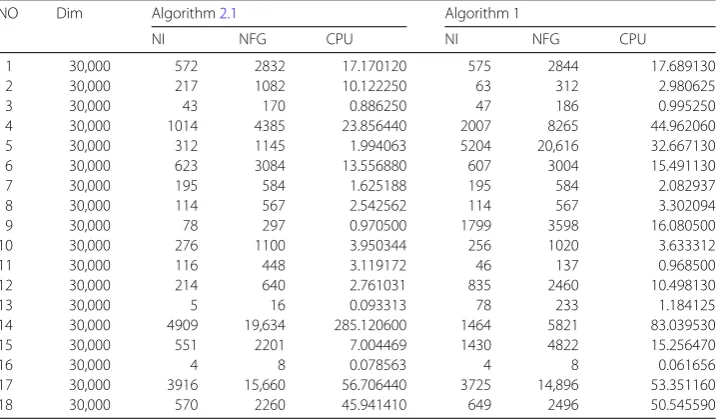
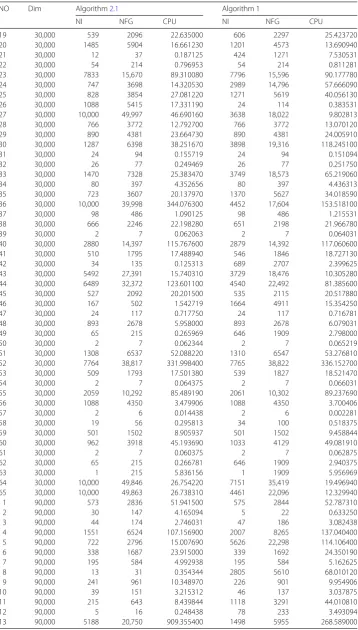
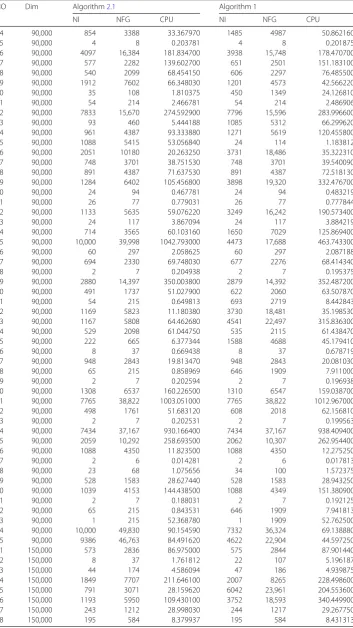
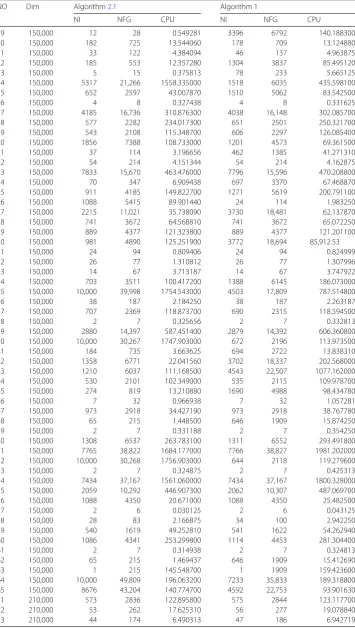
] in terms of NI, NFG, and CPU on the test problems
listed in Table
2
of Appendix
1
, which are from [
3
], where NI, NFG, and CPU indicate
the number of iterations, the sum of the calculation’s frequency of the objective function
and gradient function, and the calculation time needed to solve various test problems (in
seconds), respectively. Algorithm 1 is different from the objective algorithm in the
for-mula of
d
k+1that was determined by (
2.1
), and the remainder of Algorithm 1 is identical
to Algorithm
2.1
.
Stopping rule
: If
|
f
(
x
k)
|
>
e
1, let
stop
1 =
|f(xk|)–f(xfk(x)|k+1)|or
stop
1 =
|
f
(
x
k) –
f
(
x
k+1)
|
. If the
condition
g
(
x
)
<
or
stop
1 <
e
2is satisfied, the algorithm stops, where
e
1=
e
2= 10
–4,
= 10
–4. On the one hand, based on the virtual case, the proposed algorithm also stops if
the number of iterations is greater than 10,000 and the iteration number of
α
kis greater
than 5. On the other hand, ‘NO’ and ‘problem’ in Table
2
indicate the number of the tested
problem and the name of the problem, respectively.
Initiation
:
λ
= 0.9,
λ
1= 0.4,
ξ
3= 300,
ξ
2=
ξ
4= 0.01,
γ
= 0.01.
Dimension
: 30,000, 90,000, 150,000, 210,000.
Calculation environment
: The calculation environment is a computer with 2 GB of
memory, a Pentium (R) Dual-Core CPU [email protected] GHz, and the 64-bit Windows 7
op-erating system.
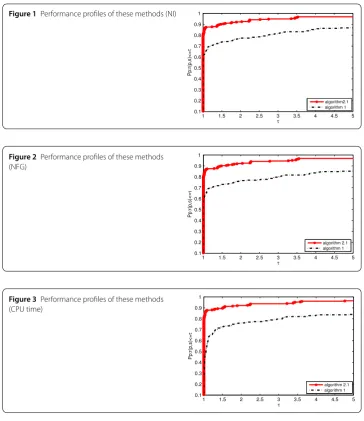
Figure 1Performance profiles of these methods (NI)
Figure 2Performance profiles of these methods (NFG)
Figure 3Performance profiles of these methods (CPU time)
red curve’s value of the initial point is close to 0.9, while Algorithm 1 only arrives at a
value of 0.6. This means that Algorithm
2.1
addresses complex problems fewer iterations.
In Fig.
2
, the red curve is above the left curve because the calculation number of the
ob-jective function is less than the left one when addressing practical problems, which is an
important aspect for measuring the performance of an algorithm. It is well know that the
calculation time (CPU time) is the most essential metric of an algorithm because the speed
of the algorithm is the most basic feature. The objective algorithm not only is well defined
because the curve seems more feasible and smooth but also can address most complex
problems because the largest value of the point on the curve is close to 0.98, which
in-dicates that the proposed algorithm is highly effective. Overall, the proposed algorithm
cannot only solve smooth problems but it also enriches the knowledge of optimization
and lays the foundation for further in-depth studies.
3 Algorithm for nonsmooth problems
pro-posed method to nonsmooth problems. It is interesting that the vast majority of practical
conditions are harsh; therefore, Newton’s series of methods are often unsatisfactory for
solving such problems because they require information about the gradient function [
37
,
39
,
46
]. Currently, most experts and scholars focus on bundled methods, which are
suc-cessful solutions to small-scale problems (see [
18
,
19
,
24
,
36
]) but fail to solve large-scale
practical problems. With the development of science and technology, it is becoming an
ur-gent need to design a simple but effective algorithm to solve large-scale nonsmooth
prob-lems. Based on the simplicity of the conjugate gradient method, some experts and scholars
have proposed relevant algorithms and made numerous fruitful theoretical achievements
(see [
20
,
28
]).
Consider the following problem:
min
θ
(
x
),
(3.1)
where
θ
(
x
) sometimes is nonsmooth and
x
∈
R
n. A famous technique is called ‘Moreau–
Yosida’ regularization, which calculates the equivalent solution of the previous problem
through a modified object function with the formula
min
t∈Rn
θ
(
t
) +
t
–
x
22
χ
,
(3.2)
where
χ
and
·
denote a positive constant and the Euclidean norm, respectively. Without
loss of generality, we denote
θ
M(
x
) as in (
3.1
) ‘Moreau–Yosida’ regularization, i.e.,
θ
M(
x
) =
min
t∈Rn
θ
(
t
) +
t
–
x
22
χ
.
(3.3)
The ‘Moreau–Yosida’ regularization technique was introduced because of its
outstand-ing properties such as differentiability (see [
21
,
25
]). Assume that the function (
3.1
) is
convex and that its ‘Moreau–Yosida’ regularization obtains the best solution of
ω
(
x
) =
argmin
θ
M(
t
). Based on the mathematic knowledge and the established conclusion, we
then have
∇
θ
M(
x
) =
ω
(
x
) –
x
χ
.
(3.4)
3.1 New algorithm and its necessary properties
We start with the following formula for
d
k+1, which is an important component of the
proposed algorithm in addressing complex problems:
d
k+1=
⎧
⎨
⎩
–
∇
θ
M(
x
k+1)
T+
∇θM(xk+1)ykdk–dTk∇θM(xk+1)yk
max{ξ2dkyk,min{ξ3∇θM(xk)2,ξ4dk2}}
,
if
k
≥
1,
–
∇
θ
M(
x
k+1),
if
k
= 0,
(3.5)
where
s
k=
x
k+1–
x
k,
y
k=
∇
θ
M(
x
k+1) –
∇
θ
M(
x
k), and
ξ
2,
ξ
3, and
ξ
4are positive constants.
The step length
α
kis determined by
θ
M(
x
k+
α
kd
k)
≤
θ
M(
x
k) +
λα
k∇
θ
M(
x
k)
Td
k+
α
kmin
–
λ
1∇θ
M(
x
k)
Td
k,
λα
kd
kTd
k/2
,
(3.6)
where
λ
,
γ
∈
(0, 1),
λ
1∈
(0,
λ
), and
α
kis the largest number of
{
γ
k|
k
= 0, 1, 2, . . .
}
. It is
well known from the case of smooth functions that the new search direction has
satisfac-tory descent and trust region properties; therefore, we merely list them without proof. We
have
∇
θ
M(
x
k)
Td
k= –
∇
θ
M(
x
k)
2
,
(3.7)
d
k≤
σ
∇
θ
M(
x
k)
,
(3.8)
where
σ
is the same as in (
2.7
). Now, manifesting specific algorithm steps, we
ex-press the cause of the existing
α
k∈
that satisfies the demands of the modified
Armijo line search formula and provides the global convergence of the proposed
algo-rithm.
Algorithm 3.1
Step 1: (Initiation) Choose an initial point
x
0,
γ
∈
(0, 1)
,
ξ
2,
ξ
3, and
ξ
4> 0
and positive
constants
ε
∈
(0, 1)
. Let
k
= 0
,
d
0= –
∇
θ
M(
x
0)
.
Step 2: If
∇
θ
M(
x
k)
≤
ε
, then stop.
Step 3: Find the step length, i.e., the calculation
α
k=
max
{
γ
k|
k
= 0, 1, 2, . . .
}
stemming
from (
3.6
).
Step 4: Set the new iteration point
x
k+1=
x
k+
α
kd
k.
Step 5: Update the search direction by (
3.5
).
Step 6: If
∇
θ
M(
x
k+1)
≤
ε
holds, the algorithm stops; otherwise, go to the next step.
Step 7: Let
k
:=
k
+ 1
and go to Step 3.
To express the validity of the step length
α
kin (
3.6
) and the global convergence of
Algo-rithm
3.1
, the following assumptions are necessary.
Assumption
(i) The level set
π
=
{
x
|
θ
M(
x
)
≤
θ
M(
x
0
)
}
is bounded.
From the ‘Moreau–Yosida’ regularization technique, the function
θ
M(
x
) is Lipschitz
con-tinuous, i.e., there exists a positive constant
κ
subject to
∇
θ
M(
x
) –
∇
θ
M(
y
)
≤
κ
x
–
y
.
(3.9)
Theorem 3.1
If Assumptions
(i)
–
(ii)
are true
,
then there exists a constant
α
kthat satisfies
the requirements of
(
3.6
).
Proof
We introduce the following function:
ϑ
(
α
) =
θ
M(
x
k+
α
d
k) –
θ
M(
x
k) –
λα
∇
θ
M(
x
k)
Td
k–
α
min
–
λ
1∇θ
M(
x
k)
dk
,
λα
d
Tkd
k/2
.
(3.10)
Based on the established theorem, following the sufficient decrease of (
3.7
), for sufficiently
small positive
α
, we have
ϑ
(
α
) =
θ
M(
x
k+
α
d
k) –
θ
M(
x
k) –
λα
∇
θ
M(
x
k)
Td
k–
α
min
–
λ
1∇θ
M(
x
k)
Td
k,
λα
d
Tkd
k/2
=
α
(1 +
λ
1–
λ
)
∇
θ
M(
x
k)
Td
k+
o
(
α
) < 0,
where the latter inequality holds since the objective function is continuous. Thus, there
exists a constant 0 <
α
0< 1 such that
ϑ
(
α
0) < 0; on the other hand,
ϑ
(0) = 0, and based on
the function’s continuous property, there exists a constant
α
1such that
ϑ
(
α
1) =
θ
M(
x
k+
α
1d
k) –
θ
M(
x
k) –
λα
1∇θ
M(
x
k)
Td
k–
α
1min
–
λ
1∇θ
M(
x
k)
dk
,
λα
1d
Tkd
k/2
< 0.
Thus,
θ
M(
x
k+
α
1d
k) <
θ
M(
x
k) +
λα
1∇θ
M(
x
k)
Td
k+
α
1min
–
λ
1∇θ
M(
x
k)
Td
k,
λα
1d
Tkd
k/2
is correct, and this means that the modified Armijo line search is well defined. From the
above discussion, Algorithm
3.1
has the properties of the sufficient descent and a trust
region, and we can now present the theorem of global convergence.
Theorem 3.2
If the above assumptions are satisfied and the relative sequences
{
x
k}
,
{
α
k}
,
{
d
k}
,
{
θ
M(
x
k)
}
are generated by Algorithm
3.1
,
then we have
lim
k→∞∇
θ
M(
x
k)
= 0.
We neglect the proof because its proof is similar to that of Theorem
2.1
.
3.2 Nonsmooth numerical experiment
addition, the problems are only different from Algorithm
3.1
in the formula for
d
k+1. The
relevant numerical data are listed in Table
5
of Appendix
2
, and we plot the corresponding
graphs based on these data, where ‘NI’, ‘NF’, and ‘CPU’ are the iteration number,
calcula-tion number of the objective funccalcula-tion and the algorithm’s run time (in seconds). The first
metric is determined by
d
k+1=
⎧
⎨
⎩
–
∇
θ
M(
x
k+1) +
∇θM(xk+1))Tykdk–dTk∇θM(xk+1)yk ∇θM(x
k)T∇θM(xk)
,
if
k
≥
1,
–
∇
θ
M(
x
k+1),
if
k
= 0.
(3.11)
In [
51
], without loss of generality, calling Algorithm 2, the other algorithm in [
4
] is
calcu-lated as
d
k+1=
⎧
⎨
⎩
–yTksk∇θM(xk+1)+yTk∇θM(xk+1)sk–sTkgk+1yk ∇θM(x
k)2
,
if
k
≥
1,
–
∇
θ
M(
x
k+1
),
if
k
= 0,
(3.12)
denoted as Algorithm 3.
Dimension
: 150,000, 180,000, 192,000, 210,000, 222,000, 231,000, 240,000, 252,000,
270,000.
Initiation
:
λ
= 0.9,
λ
1= 0.4,
ξ
3= 100,
ξ
2=
ξ
4= 0.01,
γ
= 0.5.
Stopping rule
: If NI is no greater than 10,000,
|
f
(
x
k+1) –
f
(
x
k)
|
< 1
e
– 7 and if the iteration
number of
α
kis no greater than 5, then the algorithm stops.
Calculation environment
: The calculation environment is a computer with 2 GB of
memory, a Pentium (R) Dual-Core CPU [email protected] GHz and the 64-bit Windows 7
op-erating system.
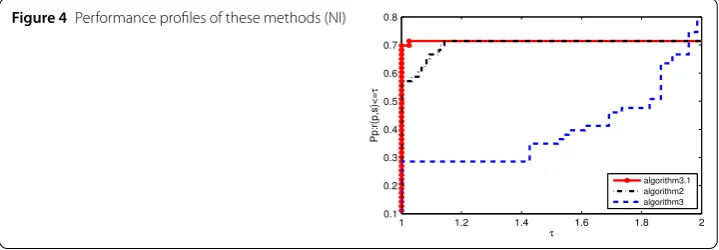
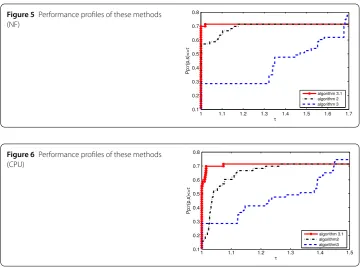
From Figs.
4
–
6
, the proposed algorithm is effective and successful to a large extent. First,
the computational data of the algorithm fully address complex situations. Second, the
al-gorithm in the design of the search direction carefully considers the corresponding
func-tion, gradient function and current direction. In Figs.
4
and
5
, the curve of Algorithm
3.1
[image:12.595.118.478.609.734.2]is above the other two curves because the number of iterations is much lower. Its initial
point is close to 0.75, which is much larger than the other algorithms. Note that the
pro-posed algorithm’s computation time is the best of the three algorithms because the curve
increases rapidly and is very smooth. In other words, its curve has a wonderful initiation
point, which results in a high efficiency in addressing complex issues.
Figure 5Performance profiles of these methods (NF)
Figure 6Performance profiles of these methods (CPU)
4 Applications of Algorithm
3.1
in image restoration
It is well known that many modern applications of optimization call for studying
large-scale nonsmooth convex optimization problems, where the image restoration problem
arising in image processing is an illustrating example. The image restoration problem plays
an important role in biological engineering, medical sciences and other areas of science
and engineering (see [
6
,
10
,
32
] etc.), which is to reconstruct an image of an unknown
scene from an observed image. The most common image degradation model is defined by
the following system:
b
=
Ax
+
η
,
where
x
∈
nis the underlying images,
b
∈
mis the observed images,
A
is an
m
×
n
blurring matrix, and
η
∈
mdenotes the noise. One way to get the unknown
η
is to solving
the problem
min
x∈nAx
+
b
2. This problem will not have a satisfactory solution since the
system is very sensitive to lack of information and the noise. The regularized least square
problem is often used to overcome the above shortcoming
min
x∈n
Ax
+
b
2
+
λ
Dx
1
,
where
· 1
is the
l
1norm,
λ
is the regularization parameter controlling the trade-off
between the regularization term and the data-fitting term, and
D
is a linear operator. It is
easy to see that the above problem is a nonsmooth convex optimization problem and it is
typically of large scale since the
l
1norm is nonsmooth.
4.1 Image restoration problem
Table 1
The CPU time of PRP algorithm and Algorithm
3.1
in seconds
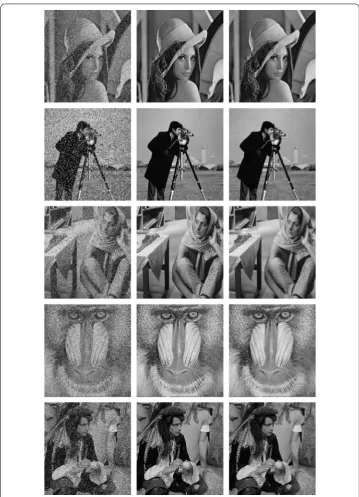
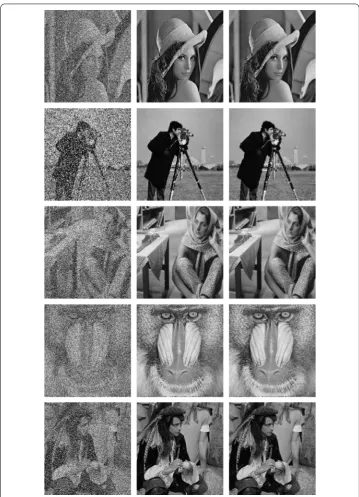
Lena Cameraman Barbara Banoon Man
20% noise
PRP algorithm 1.796875 9.6875 1.421875 1.375 3.375
Algorithm3.1 1.375 0.765625 1.46875 1.40625 3.328125
50% noise
PRP algorithm 1.98437 1.000 2.296875 1.71875 5.1875
Algorithm3.1 1.82812 0.921875 1.96875 1.8125 4.953125
parameters are the same as those of Sect.
3.2
different from
ξ
2=
ξ
3=
ξ
4= 1. All codes are
written by MATLAB r2017a and run on a PC with an Intel Pentium(R) Xeon(R) E5507
CPU @2.27 GHz, 6.00 GB of RAM, and the Windows 7 operating system. The stopped
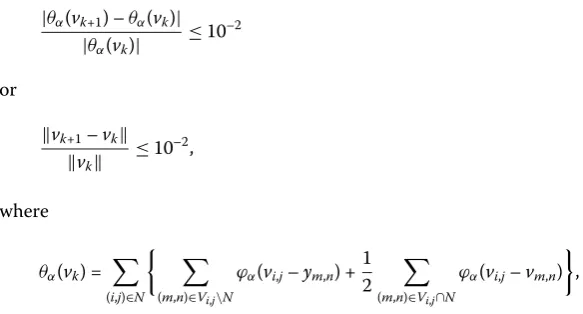
condition is
|
θ
α(
v
k+1) –
θ
α(
v
k)
|
|
θ
α(
v
k)
|
≤
10
–2or
v
k+1–
v
kv
k≤
10
–2,
where
θ
α(
v
k) =
(i,j)∈N (m,n)∈Vi,j\N
ϕ
α(
v
i,j–
y
m,n) +
1
2
(m,n)∈Vi,j∩N
ϕ
α(
v
i,j–
v
m,n)
,
the noise candidate indices set
N
:=
{
(
i
,
j
)
∈
A
| ¯
y
i,j=
y
i,j,
y
i,j=
s
minor
s
max},
s
maxis the
maxi-mum of the noisy pixel and
s
mindenotes the minimum of the noisy pixel,
A
=
{
1, 2, . . . ,
M
}×
{
1, 2, 3, . . . ,
N
}
,
V
i,j=
{
(
i
,
j
– 1), (
i
,
j
+ 1), (
i
– 1,
j
), (
i
+ 1,
j
)
}
is the neighborhood of (
i
,
j
),
y
de-notes the observed noisy image of
x
corrupted by the salt-and-pepper noise,
y
¯
is defined
by the image obtained by applying the adaptive median filter method to the noisy image
y
in the first phase,
x
is the true image with
M
-by-
N
pixels, and
x
i,jdenotes the gray level
of
x
at pixel location (
i
,
j
). It is easy to see that the regularity of
θ
αonly depends on
ϕ
αand there exist many properties as regards
θ
αand
ϕ
αthat are studied by many scholars
(see [
7
,
8
] etc.). In the experiments, Lena (256
×
256), Cameraman (256
×
256), Barbara
(512
×
512), Banoon (512
×
512), and Man (1024
×
1024) are the tested images. To
com-pare Algorithm
3.1
with other similar algorithm, we also test the well-known PRP
conju-gate gradient algorithm, where the Step 5 of Algorithm
3.1
is replaced by the PRP formula.
The tested performances of these two algorithms (Algorithm
3.1
and PRP algorithm) are
listed and the spent time is stated in Table
1
.
4.2 Results and discussion
Figure 7Restoration of the images Lena, Cameraman, Barbara, Banoon, and Man by PRP algorithm and Algorithm3.1. From left to right: the noisy image with 20% salt-and-pepper noise, the restorations obtained by minimizingzwith PRP algorithm and Algorithm3.1, respectively
5 Conclusion
Figure 8Restoration of the images Lena, Cameraman, Barbara, Banoon, and Man by PRP algorithm and Algorithm3.1. From left to right: the noisy image with 50% salt-and-pepper noise, the restorations obtained by minimizingzwith PRP algorithm and Algorithm3.1, respectively
Appendix 1
Table 2
Test problems
No. Problem
1 Extended Freudenstein and Roth Function 2 Extended Trigonometric Function
3 Extended Rosenbrock Function
4 Extended White and Holst Function
5 Extended Beale Function
6 Raydan 1 Function
7 Raydan 2 Function
8 Diagonal 1 Function
9 Diagonal 2 Function
10 Hager Function
11 Generalized Tridiagonal 1 Function 12 Extended Tridiagonal 1 Function
13 Extended Three Exponential Terms Function 14 Generalized Tridiagonal 2 Function
15 Diagonal 4 Function
16 Diagonal 5 Function
17 Extended Himmelblau Function 18 Generalized PSC1 Function
19 Extended PSC1 Function
20 Extended Powell Function
21 Extended Block Diagonal BD1 Function 22 Extended Maratos Function
23 Extended Cliff Function
24 Quadratic Diagonal Perturbed Function
25 Extended Wood Function
26 Extended Hiebert Function 27 Quadratic Function QF1 Function 28 Extended Quadratic Penalty QP1 Function 29 Extended Quadratic Penalty QP2 Function 30 A Quadratic Function QF2 Function
31 Extended EP1 Function
32 BDQRTIC (CUTE)
No. Problem
33 TRIDIA Function (CUTE)
34 ARWHEAD Function (CUTE)
35 NONDQUAR Function (CUTE)
36 DQDRTIC Function (CUTE)
37 EG2 Function (CUTE)
38 DIXMAANA Function (CUTE)
39 DIXMAANB Function (CUTE)
40 DIXMAANC Function (CUTE)
41 DIXMAANE Function (CUTE)
42 Broyden Tridiagonal Function 43 Almost Perturbed Quadratic Function 44 Tridiagonal Perturbed Quadratic Function
45 EDENSCH Function (CUTE)
46 STAIRCASE S1 Function
47 LIARWHD Function (CUTE)
48 DIAGONAL 6 Function
49 DIXON3DQ Function (CUTE)
50 DIXMAANF Function (CUTE)
51 DIXMAANG Function (CUTE)
52 DIXMAANH Function (CUTE)
53 DIXMAANJ Function (CUTE)
54 DIXMAANL Function (CUTE)
55 DIXMAAND Function (CUTE)
56 ENGVAL1 Function (CUTE)
57 FLETCHCR Function (CUTE)
58 COSINE Function (CUTE)
59 Extended DENSCHNB Function (CUTE)
60 DENSCHNF Function (CUTE)
61 SINQUAD Function (CUTE)
62 BIGGSB1 Function (CUTE)
63 Partial Perturbed Quadratic PPQ2 Function 64 Scaled Quadratic SQ1 Function
65 BDQRTIC Function (CUTE)
Table 3
Numerical results
NO Dim Algorithm2.1 Algorithm 1
NI NFG CPU NI NFG CPU
1 30,000 572 2832 17.170120 575 2844 17.689130
2 30,000 217 1082 10.122250 63 312 2.980625
3 30,000 43 170 0.886250 47 186 0.995250
4 30,000 1014 4385 23.856440 2007 8265 44.962060
5 30,000 312 1145 1.994063 5204 20,616 32.667130
6 30,000 623 3084 13.556880 607 3004 15.491130
7 30,000 195 584 1.625188 195 584 2.082937
8 30,000 114 567 2.542562 114 567 3.302094
9 30,000 78 297 0.970500 1799 3598 16.080500
10 30,000 276 1100 3.950344 256 1020 3.633312
11 30,000 116 448 3.119172 46 137 0.968500
12 30,000 214 640 2.761031 835 2460 10.498130
13 30,000 5 16 0.093313 78 233 1.184125
14 30,000 4909 19,634 285.120600 1464 5821 83.039530
15 30,000 551 2201 7.004469 1430 4822 15.256470
16 30,000 4 8 0.078563 4 8 0.061656
17 30,000 3916 15,660 56.706440 3725 14,896 53.351160
[image:17.595.119.478.522.732.2]Table 3
(
Continued
)
NO Dim Algorithm2.1 Algorithm 1
NI NFG CPU NI NFG CPU
19 30,000 539 2096 22.635000 606 2297 25.423720
20 30,000 1485 5904 16.661230 1201 4573 13.690940
21 30,000 12 37 0.187125 424 1271 7.530531
22 30,000 54 214 0.796953 54 214 0.811281
23 30,000 7833 15,670 89.310080 7796 15,596 90.177780
24 30,000 747 3698 14.320530 2989 14,796 57.666090
25 30,000 828 3854 27.081220 1271 5619 40.056130
26 30,000 1088 5415 17.331190 24 114 0.383531
27 30,000 10,000 49,997 46.690160 3638 18,022 9.802813
28 30,000 766 3772 12.792700 766 3772 13.070120
29 30,000 890 4381 23.664730 890 4381 24.005910
30 30,000 1287 6398 38.251670 3898 19,316 118.245100
31 30,000 24 94 0.155719 24 94 0.151094
32 30,000 26 77 0.249469 26 77 0.251750
33 30,000 1470 7328 25.383470 3749 18,573 65.219060
34 30,000 80 397 4.352656 80 397 4.436313
35 30,000 723 3607 20.137970 1370 5627 34.018590
36 30,000 10,000 39,998 344.076300 4452 17,604 153.518100
37 30,000 98 486 1.090125 98 486 1.215531
38 30,000 666 2246 22.198280 651 2198 21.966780
39 30,000 2 7 0.062063 2 7 0.064031
40 30,000 2880 14,397 115.767600 2879 14,392 117.060600
41 30,000 510 1795 17.488940 546 1846 18.727130
42 30,000 34 135 0.125313 689 2707 2.399625
43 30,000 5492 27,391 15.740310 3729 18,476 10.305280
44 30,000 6489 32,372 123.601100 4540 22,492 81.385600
45 30,000 527 2092 20.201500 535 2115 20.517880
46 30,000 167 502 1.542719 1664 4911 15.354250
47 30,000 24 117 0.717750 24 117 0.716781
48 30,000 893 2678 5.958000 893 2678 6.079031
49 30,000 65 215 0.265969 646 1909 2.798000
50 30,000 2 7 0.062344 2 7 0.065219
51 30,000 1308 6537 52.088220 1310 6547 53.276810
52 30,000 7764 38,817 331.998400 7765 38,822 336.152700
53 30,000 509 1793 17.501380 539 1827 18.521470
54 30,000 2 7 0.064375 2 7 0.066031
55 30,000 2059 10,292 85.489190 2061 10,302 89.237690
56 30,000 1088 4350 3.479906 1088 4350 3.700406
57 30,000 2 6 0.014438 2 6 0.002281
58 30,000 19 56 0.295813 34 100 0.518375
59 30,000 501 1502 8.905937 501 1502 9.458844
60 30,000 962 3918 45.193690 1033 4129 49.081910
61 30,000 2 7 0.060375 2 7 0.062875
62 30,000 65 215 0.266781 646 1909 2.940375
63 30,000 1 215 5.836156 1 1909 5.956969
64 30,000 10,000 49,846 26.754220 7151 35,419 19.496940
65 30,000 10,000 49,863 26.738310 4461 22,096 12.329940
1 90,000 573 2836 51.941500 575 2844 52.787310
2 90,000 30 147 4.165094 5 22 0.633250
3 90,000 44 174 2.746031 47 186 3.082438
4 90,000 1551 6524 107.156900 2007 8265 137.040400
5 90,000 722 2796 15.007690 5626 22,298 114.106400
6 90,000 338 1687 23.915000 339 1692 24.350190
7 90,000 195 584 4.992938 195 584 5.162625
8 90,000 13 31 0.354344 2805 5610 68.010120
9 90,000 241 961 10.348970 226 901 9.954906
10 90,000 39 151 3.215312 46 137 3.037875
11 90,000 215 643 8.439844 1118 3291 44.010810
12 90,000 5 16 0.248438 78 233 3.493094
Table 3
(
Continued
)
NO Dim Algorithm2.1 Algorithm 1
NI NFG CPU NI NFG CPU
14 90,000 854 3388 33.367970 1485 4987 50.862160
15 90,000 4 8 0.203781 4 8 0.201875
16 90,000 4097 16,384 181.834700 3938 15,748 178.470700
17 90,000 577 2282 139.602700 651 2501 151.183100
18 90,000 540 2099 68.454150 606 2297 76.485500
19 90,000 1912 7602 66.348030 1201 4573 42.566220
20 90,000 35 108 1.810375 450 1349 24.126810
21 90,000 54 214 2.466781 54 214 2.486906
22 90,000 7833 15,670 274.592900 7796 15,596 283.996600
23 90,000 93 460 5.444188 1085 5312 66.299620
24 90,000 961 4387 93.333880 1271 5619 120.455800
25 90,000 1088 5415 53.056840 24 114 1.183812
26 90,000 2051 10180 20.263250 3731 18,486 35.322310
27 90,000 748 3701 38.751530 748 3701 39.540090
28 90,000 891 4387 71.637530 891 4387 72.518130
29 90,000 1284 6402 105.456800 3898 19,320 332.476700
30 90,000 24 94 0.467781 24 94 0.483219
31 90,000 26 77 0.779031 26 77 0.777844
32 90,000 1133 5635 59.076220 3249 16,242 190.573400
33 90,000 24 117 3.867094 24 117 3.884219
34 90,000 714 3565 60.103160 1650 7029 125.869400
35 90,000 10,000 39,998 1042.793000 4473 17,688 463.743300
36 90,000 60 297 2.058625 60 297 2.087188
37 90,000 694 2330 69.748030 677 2276 68.414340
38 90,000 2 7 0.204938 2 7 0.195375
39 90,000 2880 14,397 350.003800 2879 14,392 352.487200
40 90,000 491 1737 51.027900 622 2060 63.507870
41 90,000 54 215 0.649813 693 2719 8.442843
42 90,000 1169 5823 11.180380 3730 18,481 35.198530
43 90,000 1167 5808 64.462680 4541 22,497 315.836300
44 90,000 529 2098 61.044750 535 2115 61.438470
45 90,000 222 665 6.377344 1588 4688 45.179410
46 90,000 8 37 0.669438 8 37 0.678719
47 90,000 948 2843 19.813470 948 2843 20.081030
48 90,000 65 215 0.858969 646 1909 7.911000
49 90,000 2 7 0.202594 2 7 0.196938
50 90,000 1308 6537 160.226500 1310 6547 159.038700
51 90,000 7765 38,822 1003.051000 7765 38,822 1012.967000
52 90,000 498 1761 51.683120 608 2018 62.156810
53 90,000 2 7 0.202531 2 7 0.199563
54 90,000 7434 37,167 930.166400 7434 37,167 938.409400
55 90,000 2059 10,292 258.693500 2062 10,307 262.954400
56 90,000 1088 4350 11.823500 1088 4350 12.275250
57 90,000 2 6 0.014281 2 6 0.017813
58 90,000 23 68 1.075656 34 100 1.572375
59 90,000 528 1583 28.627440 528 1583 28.943250
60 90,000 1039 4153 144.438500 1088 4349 151.380900
61 90,000 2 7 0.188031 2 7 0.192125
62 90,000 65 215 0.843531 646 1909 7.941813
63 90,000 1 215 52.368780 1 1909 52.762500
64 90,000 10,000 49,830 90.154590 7332 36,324 69.138880
65 90,000 9386 46,763 84.491620 4622 22,904 44.597250
1 150,000 573 2836 86.975000 575 2844 87.901440
2 150,000 8 37 1.761812 22 107 5.196187
3 150,000 44 174 4.586094 47 186 4.939875
4 150,000 1849 7707 211.646100 2007 8265 228.498600
5 150,000 791 3071 28.159620 6042 23,961 204.553600
6 150,000 1193 5950 109.430100 3752 18,593 340.449900
7 150,000 243 1212 28.998030 244 1217 29.267750
Table 3
(
Continued
)
NO Dim Algorithm2.1 Algorithm 1
NI NFG CPU NI NFG CPU
9 150,000 12 28 0.549281 3396 6792 140.188300
10 150,000 182 725 13.544060 178 709 13.124880
11 150,000 33 122 4.384094 46 137 4.963875
12 150,000 185 553 12.357280 1304 3837 85.495120
13 150,000 5 15 0.375813 78 233 5.665125
14 150,000 5317 21,266 1558.335000 1518 6035 435.598100
15 150,000 652 2597 43.007870 1510 5062 83.542500
16 150,000 4 8 0.327438 4 8 0.331625
17 150,000 4185 16,736 310.876300 4038 16,148 302.085700
18 150,000 577 2282 234.017300 651 2501 250.321700
19 150,000 543 2108 115.348700 606 2297 126.085400
20 150,000 1856 7388 108.733000 1201 4573 69.361500
21 150,000 37 114 3.196656 462 1385 41.271310
22 150,000 54 214 4.151344 54 214 4.162875
23 150,000 7833 15,670 463.476000 7796 15,596 470.208800
24 150,000 70 347 6.909438 697 3370 67.468870
25 150,000 911 4185 149.822700 1271 5619 200.791100
26 150,000 1088 5415 89.901440 24 114 1.983250
27 150,000 2215 11,021 35.738090 3730 18,481 62.137870
28 150,000 741 3672 64.568810 741 3672 65.072250
29 150,000 889 4377 121.323800 889 4377 121.201100
30 150,000 981 4890 125.251900 3772 18,694 85,912.53
31 150,000 24 94 0.809406 24 94 0.824999
32 150,000 26 77 1.310812 26 77 1.307996
33 150,000 14 67 3.713187 14 67 3.747922
34 150,000 703 3511 100.417200 1388 6145 186.073000
35 150,000 10,000 39,998 1754.543000 4503 17,809 787.514800
36 150,000 38 187 2.184250 38 187 2.263187
37 150,000 707 2369 118.873700 690 2315 118.594500
38 150,000 2 7 0.325656 2 7 0.332813
39 150,000 2880 14,397 587.451400 2879 14,392 606.360800
40 150,000 10,000 30,267 1747.903000 672 2196 113.973500
41 150,000 184 735 3.663625 694 2722 13.838310
42 150,000 1358 6771 22.041560 3702 18,337 202.568000
43 150,000 1210 6037 111.168500 4543 22,507 1077.162000
44 150,000 530 2101 102.349000 535 2115 109.978700
45 150,000 274 819 13.210880 1690 4988 98.434780
46 150,000 7 32 0.966938 7 32 1.057281
47 150,000 973 2918 34.427190 973 2918 38.767780
48 150,000 65 215 1.448500 646 1909 15.874250
49 150,000 2 7 0.331188 2 7 0.354250
50 150,000 1308 6537 263.783100 1311 6552 293.491800
51 150,000 7765 38,822 1684.177000 7766 38,827 1981.202000
52 150,000 10,000 30,268 1756.903000 644 2118 119.279600
53 150,000 2 7 0.324875 2 7 0.425313
54 150,000 7434 37,167 1561.060000 7434 37,167 1800.328000
55 150,000 2059 10,292 446.907300 2062 10,307 487.069700
56 150,000 1088 4350 20.671000 1088 4350 25.482500
57 150,000 2 6 0.030125 2 6 0.043125
58 150,000 28 83 2.166875 34 100 2.942250
59 150,000 540 1619 49.252810 541 1622 54.262940
60 150,000 1086 4341 253.299800 1114 4453 281.304400
61 150,000 2 7 0.314938 2 7 0.324813
62 150,000 65 215 1.469437 646 1909 15.412690
63 150,000 1 215 145.548700 1 1909 159.423600
64 150,000 10,000 49,809 196.063200 7233 35,833 189.318800
65 150,000 8676 43,204 140.774700 4592 22,753 93.901630
1 210,000 573 2836 122.895800 575 2844 123.117700
2 210,000 53 262 17.625310 56 277 19.078840
Table 3
(
Continued
)
NO Dim Algorithm2.1 Algorithm 1
NI NFG CPU NI NFG CPU
4 210,000 2053 8524 329.735100 2007 8265 363.818300
5 210,000 839 3263 42.105750 6047 23,976 318.768000
6 210,000 1385 6911 176.616000 3778 18,725 481.052400
7 210,000 195 972 32.574000 196 977 32.512590
8 210,000 195 584 11.812690 195 584 11.700880
9 210,000 10 25 0.636500 3828 7656 216.963400
10 210,000 151 601 15.601060 149 593 16.178340
11 210,000 35 133 7.425500 46 137 6.971656
12 210,000 159 475 14.729620 1457 4286 133.270000
13 210,000 7 21 0.690063 78 233 7.877844
14 210,000 5403 21,610 2218.623000 1531 6085 613.377000
15 210,000 1027 4086 95.329560 1527 5113 117.547900
16 210,000 4 8 0.469438 4 8 0.469063
17 210,000 4244 16,972 440.685700 4103 16,408 427.691300
18 210,000 578 2286 327.911200 651 2501 349.330900
19 210,000 543 2108 161.378500 606 2297 11,790.320000
20 210,000 2097 8332 171.760500 1201 4573 97.047560
21 210,000 41 129 5.103688 470 1409 58.391690
22 210,000 54 214 5.743125 54 214 5.820063
23 210,000 7833 15,670 654.266300 7796 15,596 652.518700
24 210,000 400 1997 55.551690 1261 6156 171.682500
25 210,000 1088 5415 125.671300 24 114 2.806562
26 210,000 2035 10,133 46.097440 3732 18,491 107.095900
27 210,000 686 3427 84.321690 686 3427 85.084120
28 210,000 872 4292 163.879400 872 4292 163.689200
29 210,000 1207 6011 219.317600 4992 24,796 874.306100
30 210,000 24 94 1.136250 24 94 1.203375
31 210,000 26 77 1.813437 26 77 1.918250
32 210,000 10 47 3.683844 10 47 3.776062
33 210,000 638 3187 127.252500 641 3202 127.119400
34 210,000 28 137 2.273625 28 137 2.449063
35 210,000 715 2393 169.418200 698 2339 164.307800
36 210,000 2 7 0.448313 2 7 0.455063
37 210,000 2880 14,397 825.603000 2879 14,392 829.216300
38 210,000 283 1131 7.781998 695 2725 20.372810
39 210,000 1240 6188 28.252000 3597 17,819 209.757800
40 210,000 1128 5627 145.184000 4559 22,590 1239.831000
41 210,000 371 1109 25.005980 1735 5125 127.223700
42 210,000 20 97 4.087996 19 92 4.170031
43 210,000 990 2969 49.404980 990 2969 49.341160
44 210,000 65 215 2.028015 646 1909 19.142310
45 210,000 2 7 0.452000 2 7 0.453688
46 210,000 1308 6537 368.925000 1311 6552 458.029900
47 210,000 7765 38,822 2364.621000 7766 38,827 3018.524000
48 210,000 10,000 30,268 2460.779000 676 2206 166.936300
49 210,000 2 7 0.467848 2 7 0.466844
50 210,000 7434 37,167 2191.087000 7434 37,167 3023.795000
51 210,000 2059 10,292 608.572100 2062 10,307 653.233600
52 210,000 1088 4350 28.642380 1088 4350 38.929310
53 210,000 2 6 0.030805 2 6 0.047719
54 210,000 34 102 3.696555 34 100 4.255938
55 210,000 548 1643 69.857270 549 1646 78.052220
56 210,000 1106 4421 360.469800 1130 4517 1023.525000
57 210,000 2 7 0.453117 2 7 0.492094
58 210,000 65 215 2.011992 646 1909 21.231910
59 210,000 1 215 285.122300 1 1909 318.237500
60 210,000 10,000 49,791 317.897200 7278 36,056 876.884300
Appendix 2
Table 4
Test problems
No. Problem
1 Generalization of MAXQ (convex) 2 Chained LQ (convex)
3 Number of active faces (nonconvex)
4 Nonsmooth generalization of Brown function (nonconvex) 5 Chained Mifflin 2 (nonconvex)
[image:22.595.117.486.266.715.2]6 Chained crescent (nonconvex) 7 Chained crescent 2 (nonconvex)
Table 5
Numerical results
NO Dim Algorithm3.1 Algorithm 2 Algorithm 3
NI NFG CPU NI NFG CPU NI NFG CPU
1 150,000 268 5592 27.595310 268 5592 27.707090 3 33 0.185438
2 150,000 67 173 1.497563 67 173 1.576625 137 312 2.091156
3 150,000 104 1808 24.912940 114 1836 25.536130 3 33 0.436469
4 150,000 75 185 20.279250 82 204 21.684970 137 313 35.800970
5 150,000 67 173 1.838000 67 173 1.873375 151 337 2.839188
6 150,000 55 205 1.859063 55 205 1.917375 137 312 2.385719
7 150,000 4 12 0.108688 4 12 0.108406 137 312 2.370000
1 180,000 271 5655 33.589060 271 5655 33.772090 3 33 0.218094
2 180,000 81 201 2.009625 81 201 2.059219 137 312 2.465594
3 180,000 109 1859 30.826380 116 1878 31.326120 3 33 0.483875
4 180,000 88 210 27.703250 93 225 28.768280 137 313 42.884500
5 180,000 81 201 2.465125 81 201 2.494750 151 337 3.402688
6 180,000 69 233 2.461375 69 233 2.510656 137 312 2.760719
7 180,000 5 15 0.172438 5 15 0.169938 137 312 2.776000
1 192,000 272 5676 36.939880 272 5676 37.251780 3 33 0.218531
2 192,000 72 176 1.889156 78 194 2.215563 137 312 2.744531
3 192,000 106 1850 34.069270 116 1878 35.289880 3 33 0.577375
4 192,000 90 216 30.327910 93 225 31.282190 137 313 45.879250
5 192,000 81 201 2.651781 81 201 2.855937 151 338 3.744344
6 192,000 69 233 2.651438 69 233 2.855469 137 312 3.040250
7 192,000 5 15 0.201094 5 15 0.187375 137 312 3.027188
1 210,000 273 5697 39.558750 273 5697 40.656190 3 33 0.249844
2 210,000 81 201 2.367750 81 201 2.449625 137 312 2.885844
3 210,000 109 1877 36.393310 117 1899 37.347190 3 33 0.578000
4 210,000 89 213 32.668690 96 232 34.631900 137 313 50.043880
5 210,000 81 201 2.836188 81 201 2.947094 151 338 3.995281
6 210,000 69 233 2.871250 69 233 2.946250 137 312 3.275187
7 210,000 5 15 0.198250 5 15 0.219938 137 312 3.246750
1 222,000 274 5718 41.885560 274 5718 42.759780 3 33 0.278094
2 222,000 70 170 2.013531 80 200 2.541594 137 312 3.026187
3 222,000 109 1877 38.548250 117 1899 39.467090 3 33 0.637906
4 222,000 96 232 37.098370 96 232 36.658720 137 313 53.057190
5 222,000 81 201 3.026719 81 201 3.106844 151 337 4.210594
6 222,000 69 233 3.041375 69 233 3.121375 137 312 3.478031
7 222,000 5 15 0.216406 5 15 0.218281 137 312 3.449469
1 231,000 275 5739 43.525590 275 5739 44.507000 3 33 0.265125
2 231,000 81 201 2.573875 79 197 2.604687 137 312 3.183219
3 231,000 118 1920 41.074940 118 1920 41.665530 3 33 0.625156
4 231,000 85 201 34.211090 96 232 38.190850 137 313 55.084160
5 231,000 81 201 3.151156 81 201 3.228437 151 337 4.366219
6 231,000 70 236 3.196813 70 236 3.324875 137 312 3.587406
Table 5
(
Continued
)
NO Dim Algorithm3.1 Algorithm 2 Algorithm 3
NI NFG CPU NI NFG CPU NI NFG CPU
1 240,000 275 5739 45.549500 275 5739 47.158840 3 33 0.279813
2 240,000 81 201 2.702625 81 201 2.777250 137 312 3.307688
3 240,000 107 1889 41.918190 118 1920 43.150280 3 33 0.655719
4 240,000 96 232 40.166310 96 232 39.578840 137 313 57.328840
5 240,000 81 201 3.278250 81 201 3.354719 151 337 4.555719
6 240,000 70 236 3.319375 70 236 3.431250 137 312 3.745031
7 240,000 4 12 0.171063 4 12 0.188563 137 312 3.727937
1 252,000 276 5760 47.984220 276 5760 51.422370 3 33 0.295813
2 252,000 72 176 2.386094 81 201 2.901656 137 312 3.430656
3 252,000 118 1920 44.880910 118 1920 45.349560 3 33 0.703563
4 252,000 96 232 42.087090 96 232 41.544910 137 313 60.076440
5 252,000 81 201 3.433156 81 201 3.526937 151 338 4.771313
6 252,000 70 236 3.478938 70 236 3.603594 137 312 3.901781
7 252,000 4 12 0.185469 4 12 0.185125 137 312 3.899437
1 270,000 277 5781 51.697340 277 5781 52.729160 3 33 0.327406
2 270,000 75 185 2.761375 80 200 3.089156 137 312 3.681875
3 270,000 110 1916 47.813940 119 1941 49.108690 3 33 0.733344
4 270,000 96 232 45.132440 96 232 44.506310 137 313 64.317340
5 270,000 81 201 3.681625 81 201 3.789500 151 337 5.117938
6 270,000 70 236 3.760937 70 236 3.869437 137 312 4.212750
7 270,000 4 12 0.202219 4 12 0.200344 137 312 4.197813
Acknowledgements
The authors would like to thank for the support funds.
Funding
This work was supported by the National Natural Science Foundation of China (Grant No. 11661009), the Guangxi Natural Science Fund for Distinguished Young Scholars (No. 2015GXNSFGA139001), and the Guangxi Natural Science Key Fund (No. 2017GXNSFDA198046).
Competing interests
The authors declare to have no competing interests.
Authors’ contributions
GY mainly analyzed the theory results and organized this paper, TL did the numerical experiments of smooth problems and WH focused on the nonsmooth problems and image problems. All authors read and approved the final manuscript.
Publisher’s Note
Springer Nature remains neutral with regard to jurisdictional claims in published maps and institutional affiliations.
Received: 30 January 2019 Accepted: 27 August 2019
References
1. Al-Baali, A., Albaali, M.: Descent property and global convergence of the Fletcher–Reeves method with inexact line search. IMA J. Numer. Anal.5(1), 121–124 (1985)
2. Al-Baali, M., Narushima, Y., Yabe, H.: A family of three-term conjugate gradient methods with sufficient descent property for unconstrained optimization. Comput. Optim. Appl.60(1), 89–110 (2015)
3. Andrei, N.: An unconstrained optimization test functions collection. Environ. Sci. Technol.10(1), 6552–6558 (2008) 4. Andrei, N.: On three-term conjugate gradient algorithms for unconstrained optimization. Appl. Math. Comput.
241(11), 19–29 (2008)
<