EVALUATION OF RELATIONSHIP BETWEEN ANTIOXIDANT
ACTIVITY WITH PHENOLIC AND FLAVONOID CONTENT IN SOME
SELECTED FRUITS.
Adhikarimayum Haripyaree1 Kshetrimayum Guneshwor 2
1
Department of Botany, Imphal College, Imphal, India
2Department of Zoology, Ideal Girls’ College, Akampat, Imphal-East, India.
ABSTRACT
Relationship between antioxidant activity with phenolic and flavonoid content of the
six selected fruits namely Prunus persica, Prunus domestica, Prunus armeniaca, Musa
paradisiaca Microcos peniculata and Averrhoea carambola were investigated. For phenolic
content and flavonoid content analysis, three solvents viz., distilled water, acetone and
methanol were used as extractants. The total phenolic content measured using a
Folin-Ciocalteu assay, ranged from 6.6 to 10.1 mg of gallic acid equivalents (GAE)/100g dry
weight when methanol is used as extractant. Methanol extracts of M. Paradisiaca contained
more flavonoids i.e., 7.7 mg of rutin equivalent/100gm dry weight, than the other remaining
fruits. The total antioxidant capacity was estimated by the following methods of DPPH
(1,1-Diphenyl-2-picryl hydrazyl) radical, O2- (superoxide radical), OH- (hydroxyl radical)
scavenging assay using methanol as the extractant since methanol extracts more flavonoids
than the other two extractants. The result shows a relationship of increase in the antioxidant
activity of the fruit extracts with increase of flavonoid and phenolic content of the fruits.
Key words: Antioxidant activity, phenolic, flavonoid, superoxide, DPPH, hydroxyl.
Introduction
Antioxidants are radical scavenging which protect the human body against free radicals that may cause pathological conditions such as ischemia, anaemia, asthma, arthritis, inflammation, nerve degradation, parkinson’s diseases, ageing process and perhaps dementias (Polterait, 1997). The natural defense of the human organs against free radicals is not always sufficient mainly due to the insignificant exposition to free radicals from external sources in International Research Journal of Natural and Applied Sciences
ISSN: (2349-4077) Impact Factor- 5.46, Volume 4, Issue 12, December 2017 Website- www.aarf.asia, Email : [email protected], [email protected]
the modern world (Buricova and Reblova, 2008). There is a trend towards replacement of widely synthetic antioxidants such as butylated hydroxyl anisole (BHA) and butylated hydroxyl toluene (BHT) with antioxidant from natural sources (Bauer, et al., 2001).
Fruits and vegetables contain many different antioxidant components. The majority of the antioxidant capacity of a fruit or vegetable may be from compounds other than Vit C, Vit E or β carotene. Some flavonoids including flavones, isoflavonones, anthocyanins, catechin and isocatechins that are frequently components of human diet demonstrated strong antioxidant activities (Bors and Saran, 1987; Bors et al., 1990; Hanasaki et al., 1994). Various classes of flavonoids differ in the level of oxidation and saturation, while individual compounds within a class differ in the substitution pattern. The differences in the structure and substitution will influence the phenoxyl radical stability and thereby the antioxidant properties of flavonoids. On the other hand, phenolics from edible fruits are effective in vitro antioxidants (Gracia-Alonso et al., 2004; Soong and Barlow, 2004.) The antioxidative properties of phenolics arise from their high reactivity as hydrogen or electron donors and from their ability to chelate transition metal ions (Rice-Evans et al., 1997). Therefore the analysis of antioxidant and radical scavenging agents is a subject of topical interest for modern analytical chemistry. While the antioxidant activity is defined as the rate of constant of the reaction between a unique antioxidant and a given free radical, antioxidant capacity is the number of moles of free radical scavenged by an antioxidant testing solution that can lead to a different result for the same radical (Pollyanna et al., 2014).
The objective of our research were the evaluation and comparison of the total antioxidant capacity of six selected fruits by using three common antioxidant activity methods viz., DPPH, superoxides and hydroxyl radicals scavenging assays; to find out the proper solvent to extract antioxidants of the selected fruits since the antioxidant activities could be affected by the extracting solvents (Moure et al., 2000; Sun and Ho, 2005); and to determine the relationship between antioxidant activity with phenolic and flavonoid content of six fruits to confirm that these constituents are responsible for the antioxidant activity.
2. Materials and Methods 2.1. Chemicals and reagents
from Sigma Aldrich Company (St. Louis, MO, USA). Other reagents were obtained from Merck (India).
2.2. Fruit material
All the fruits were collected from the local Orchard. Fresh materials were cleaned and ground into a fine powder by laboratory mill. No exported fruit is in the list.
2.3. Analysis of phenolic contents
Total phenolic content of the samples was measured using Folin-Ciocalteau reagent (Velioglu et al, 1998). Folin-Ciocalteau reagent wes diluted by 10 times using deionised water. The diluted reagent (0.75ml) was mixed with 0.1 sample and held at room temperature for 5ml. Then 0.75 ml of 2% sodium carbonate solution was added. After 15 min of incubation at room temperature, the absorbance of the solution was determined at 750 nm by UV-vis spectrometer (Systronic, India). Gallic acid was used as standard.
2.4. Analysis of total flavonoid content
Total flavonoid content of the samples was measured by using 1%, 2- amino ethyl diphenylborinate (Oomah and Mazza, 1996). 0.1 ml of the samples was mixed with 0.9 ml water and 0.1 ml of 1% 2-amino ethyl diphenylborinate. The absorbance of the solution was determined at 404 nm using a spectrophotometer. Rutin was used as standard.
Antioxidant activity
The antioxidant capacity of six fruit extracts were examined by scavenging of DPPH radical, superoxide anion radicals scavenging activity and hydroxyl radical scavenging activity.
2.5. DPPH radical scavenging activity
Phenolic compounds using DPPH was determined spectrophotometrically, according to the method described by Cuendet et al., 1997. The reaction mixture consisted of 125 µM DPPH with 5µg/ml, 10µg/ml, 15µg/ml and 20µg/ml of the pineapple phenolics. The stock solutions of 0.1mM ascorbic acid or 125 µg/ml of pyragallol are used as reference antioxidants. After a 30 min incubation period in the dark room temperature, the absorbance was read against a blank at 517 nm. Percentage inhibition was determined by comparison with a methanol treated control group.
DPPH decoloration (%) = (1– OD sample/OD control) × 100
2.6. Inhibition of superoxide radicals
Superoxide radical generated by hypoxanthine and xanthine oxidase system was determined spectrophotometrically by monitoring the product of NBT (nitroblue tetrazolium). Various concentrations of the extracts were added to the reaction mixture containing 100 µl of 25 mM EDTA, ethylene diamine tetra acetic acid (pH 7.4), 50 µl of 30mM hypoxanthine in 50 mM NaOH, 2 ml of 2 mM NBT and the final volume of 3 ml was made up by 50 mM PO4 buffer (pH 7.4). After adding 100 µl of 0.5 U/ml Xanthine Oxidase, the reaction mixture
was incubated for 30 min at 25ºC. The absorbance was read at 560 nm and compared with control sample in which the enzyme, xanthine oxidase was not included.
The percentage inhibition of superoxide radicals was calculated from the optical density of the treated and control sample.
Inhibitory effect (%) = [(Acontrol – Asample )/Acontrol] × 100
2.7. Hydroxyl Radical Scavenging activity
Hydroxyl radical scavenging activity was determined by measuring the competition between deoxyribose and the extracts for hydroxyl radicals generated from the Fe+3 ascorbate/EDTA/H2O2 system. The attack of the hydroxyl radical on deoxyribose leads to
TBRS formation (Kunchandy and Rao, 1990). Various concentration of the test sample and antioxidant compound were added to the reaction mixture containing 3.0 mM deoxyribose, 0.1 mM FeCl3, 0.1mM EDTA, 0.1 mM ascorbic acid, 1 mM H2O2, and 20 mM phosphate
buffer (pH 7.4) and made up to a final volume of 3.0 mL. The amount of TBRS formed following 1 h of incubation at 37°C was measured according to the method of Okhawa et al., 1979. One milliliter of thiobarbituric acid (TBA, 1%) and 1.0 mL of trichloroacetic acid (TCA, 2.8%) were mixed with the reaction mixtures in the tubes, and the mixtures were then incubated at 100°C for 20 min. After the mixtures were cooled to room temperature, their absorbances at 532 nm were measured against a blank containing deoxyribose and buffer. Percent inhibition of deoxyribose degradation was calculated with the equation
Inhibitory effect %=(A0–A1)/A0 × 100
Where A0 is the absorbance of the control reaction (containing all reagents except the
test compound) and A1 is the absorbance of the sample. The absorbances were the means of
triplicate measurements. The IC50 (inhibitory concentration) values of all the methods were
calculated by using linear regression analysis. IC50 is the amount of sample extracted into
2.8. Statistical Analysis
Each experiment was performed in triplicate. Student’s t-test was used to compare the significant difference for total phenolics content or total flavonoid content of these selected fruits. Two factor analysis of variance (ANOVA) was used to sample and for comparison of antioxidant activity of different fruit extracts. All the statistics were performed with SPSS. Confirmatory experiments were also carried out to validate the data.
3. Results
3.1. Total phenolics and total flavonoid content
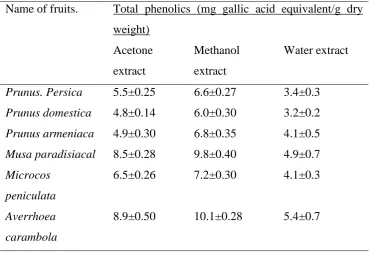
The phenolic contents of these selective fruits are shown in Table 1. The total phenolic content is highest in Averrhoea carambola. Methanol and acetone extracted more phenols than water. There was significant difference between the six samples of fruits or extracts using different extracting solvents (ANOVA, P<0.05). The phenolic content of the six fruit extracts are as follows.
Averrhoea carambola>Musa paradisiaca> Microcos peniculata>Prunus persica>Prunus
domestica>Prunus armeniaca.
Flavonoid content of Musa paradisiaca was higher than the other fruit extracts. Flavonoid contents of these six fruits are shown in Table 2. The flavonoid content of the six fruits are as follows:
Musa paradisiaca >Microcos peniculata>Averrhoea carambola>Prunus armeniaca>
Prunus persica> Prunus domestica. Methanol extracted more flavoloids followed by acetone
and water in the different fruit samples (ANOVA, P<0.05).
Since the methanol extracted more phenolics and flavonoids out of the three extracting solvent, we measure the antioxidant capacity by using methanol as the extracting solvent.
3.2. Antioxidant activity
The change in colorization from violet to yellow and subsequent fall in absorbance of the stable radical DPPH by using methanol as the extracting solvent at different concentration was evaluated. IC50 values of A, carambola is highest with 126.32 µg/ml among the six fruit
extracts. The scavenging of free radical by this method in order of IC50 value is Averrhoea
carambola>Musa paradisiaca >Microcos peniculata >Prunus armeniaca>Prunus persica>
Prunus domestica (Table 3).
carambola>Musa paradisiaca>Prunus persica>Microcos peniculata>Prunus armeniaca
>Prunus domestica (Table 4). In the above two methods, A. carambola shows significantly
higher antioxidant activity than the remaining fruit extracts (two factor ANOVA, P<0.05) While antioxidant activity was measured by superoxide radical scavenging assay, again A. carambola shows highest antioxidant activity with IC50 values of 40.43 µg/ml and
the trends are as follows Musa paradisiaca>Averrhoea carambola>Microcos peniculata>Prunus persica > Prunus armeniaca >Prunus domestic (Table 5). In this method, A. carambola shows no significant difference with M. peniculata, M. paradisiaca and P. armeniaca (two factor ANOVA, P>0.05).
Discussion
From the present experiment methanol extracts more flavonoids and phenolics than acetone and water possibly because these are more soluble in methanol. Therefore, we use methanol as the extractant in evaluating the antioxidant activity of these fruits. On one way, the properties of extracting solvent may affect the antioxidant activity.
Methods for determining antioxidant activity can be divided in to three types based on their chemical mechanism (1). Hydrogen atom transfer (HAT) based assay (2). Electron transfer (ET) based assay. (3). Other assays (Huang et al., 2005; Prior et al., 2005). DPPH method shows consistent results to measure the antioxidant activity of asparagus (Sun et al., 2005). The most effective way is to eliminate free radicals that cause oxidative stress with the help of antioxidant as they combat free radical induce tissue damage by preventing the formation of radicals, scavenging them thereby promoting their decomposition (Philips et al., 2017).
The DPPH radical scavenging activity assay has been used extensively for screening antioxidants from fruit and vegetable juices or extracts since DPPH is a free radical reagent relating stable and ready for use (Katalinic et al., 2006). DPPH can generate stable free radical in methanolic solution. Free radicals are well known to be able to induce lipid peroxidation. For antioxidant activities, there can be primary or secondary. Primary antioxidants, generally measured by DPPH assay and expressed as IC50 values, can scavenge
free radicals to inhibit chain initiation and chain break propagation (Yan et al., 2006). Secondary antioxidants suppressed the formation of radicals and protect against oxidative damage. The DPPH assay measures the ability of the fruit extract to donate hydrogen to DPPH radical resulting in bleaching of the DPPH solution. The greater the bleaching action the higher the antioxidant activity and this is reflected in a lower IC50 value. In our result A.
carambola shows higher primary antioxidant activity than M. paradiasiaca. It is an
agreement with the result that banana is a potent secondary antioxidant which contents active components that binds to metal ions strongly (Yan et al.,2006).
Superoxide anion radicals are produced by a number of cellular reactions, including various systems, such as lipoxygenases, peroxidase, NADPH oxidase and Xanthine oxidase. Superoxide anion plays as important role in plant tissue and is involved in the formation of other cell damaging free radicals (Bloknina et al., 2003). On the other hand hydroxyl radicals can be formed by the Fenton reaction in the presence of reduced transition metals such as Fe2+ and H2O2, which is known to be the most reactive of all the reduced form of dioxygen,
capable of damaging almost every molecule found in living cells. In addition, peroxidation process due to abstraction of hydrogen atoms from unsaturated fatty acids (Rollet-Labelle et al., 1998).
Hydroxyl radicals have the capacity to join the nucleotides in DNA and cause strand breakage, which contributes to carcinogenesis, mutagenesis and cytotoxicity (Moskovitz et al., 2002).
Our result showed that total flavonoid and phenolic content with antioxidant activity of six selected fruits had significant correlation.
Conclusion
The antioxidant activity of six selected local fruits by DPPH, OH- and O2- radical
extraction of phenolics and flavonoids when compare to acetone and water. It is better to use at least three methods to evaluate antioxidant activity as each assay has its own mechanism. Table 1. Total phenolics content of fruit extracts.
Name of fruits. Total phenolics (mg gallic acid equivalent/g dry weight)
Acetone extract
Methanol extract
Water extract
Prunus. Persica 5.5±0.25 6.6±0.27 3.4±0.3 Prunus domestica 4.8±0.14 6.0±0.30 3.2±0.2 Prunus armeniaca 4.9±0.30 6.8±0.35 4.1±0.5 Musa paradisiacal 8.5±0.28 9.8±0.40 4.9±0.7 Microcos
peniculata
6.5±0.26 7.2±0.30 4.1±0.3
Averrhoea
carambola
8.9±0.50 10.1±0.28 5.4±0.7
Values are mean ± S.E (n=3)
Table 2. Total flavonoid content of fruit extracts.
Values are mean ± S.E (n=3)
Name of fruits. Total phenolics (mg rutin equivalent/g dry weight) Acetone
extract
Methanol extract Water extract
Prunu persica 4.7±0.9 4.9±0.34 2.0±0.10 Prunus domestica 4.2±0.25 4.7±0.25 3.5±0.16 Prunus armeniaca 4.9±0.35 5.5±0.15 1.9±0.18 Musa paradisiaca 7.4±0.28 7.7±0.17 3.2±0.15 Microcos
peniculata
7.1±0.18 7.4±0.25 4.0±0.18
Averrhoea
carambola
Table 3. Scavenging activity of different methanolic fruit extracts on DPPH free radicals.
Name of fruits. Concentration of fruit extracts (Mean±S.E) IC50
values (µg/ml)
50 µg/ml 100 µg/ml 150 µg/ml 200 µg/ml 250 µg/ml
Prunus persica 16.4±0.12 28.1±0.15 40.5±0.16 57.5±0.18 75.1±0.24 172.02
Prunus domestica 12.5±0.14 26.2±0.14 37.5±0.18 54.0±0.15 70.1±0.28 184.78
Prunus armeniaca 20.4±0.12 32.1±0.18 43.1±0.15 60±0.12 72.1±0.15 167.99
Musa paradisiacal 23.4±0.18 36.5±0.11 52.5±0.18 71.4±0.28 92.5±0.48 136.11
Microcos peniculata 21.1±0.18 35.1±0.12 50.1±0.12 67.2±0.15 90.1±0.15 142.59
Averrhoea carambola 25.2±0.18 42.1±0.12 60.2±0.20 75.1±0.24 94.5±0.18 126.32
Values are mean ± S.E (n=3)
Table 4. Hydroxl radical scavenging activity of different methanolic fruit extracts. Name of fruits. Concentration of fruit extracts (Mean±S.E) IC50
values (µg/ml) 25 µg/ml 50 µg/ml 75 µg/ml 100 µg/ml
Prunus persica 35.4±0.48 42.5±0.88 68.4±0.35 72.5±0.54 55.91 Prunus domestica 22.4±0.35 31.2±0.18 40.2±0.30 52.5±0.50 92.22 Prunus armeniaca 32.4±0.28 38.5±0.40 46.1±0.35 50.4±0.32 86.06 Musa paradisiacal 35.6±0.45 47.5±0.50 68.2±0.60 80.4±0.98 54.73 Microcos peniculata 25.6±0.50 38.7±0.38 50.2±0.28 62.8±0.56 74.13 Averrhoea
carambola
44.5±0.25 66.7±0.48 77.5±0.95 89.4±0.38 43.37 Values are mean ± S.E (n=3)
Table 5. Superoxide radical scavenging activity of different methanolic fruit extracts.
Name of fruits. Concentration of fruit extracts (Mean±S.E) IC50
values (µg/ml)
15 µg/ml 30 µg/ml 45 µg/ml 60 µg/ml 75 µg/ml
Prunus persica 15.1±0.42 25.0±0.48 42.2±0.52 57.3±0.48 68.4±0.28 53.81
Prunus domestica 12.4±0.21 20.1±0.28 29.5±0.18 40.5±0.48 58.1±0.15 62.54
Prunus armeniaca 17.4±0.12 24.5±0.18 35.4±0.38 50.4±0.38 63.1±0.12 59.96
Musa paradisiacal 25.4±0.18 45.4±0.16 52.3±0.13 63.2±0.18 76.5±0.18 43.91
Microcos peniculata 21.1±0.18 38.4±0.12 44.3±0.18 59.1±0.60 71.4±0.12 49.55
Averrhoea carambola 27.1±0.16 49.4±0.45 56.2±0.18 67.2±0.18 82.1±0.15 40.43
Values are mean ± S.E (n=3)
References
2. Bloknina, O., Virolainen, E., Fagerstedt, K. V. Antioxidants oxidative damage and Oxygen deprivation stress: a Review. Annual. Botany. 91, 1979-1994. 2003.
3. Bors, W., Saran, M. Radical scavenging by flavonoid antioxidants free radical. Research communication. 2, 289-294. 1987.
4. Bors, W., Werner, H., Michel, C., Saran, M. Flavonoids as antioxidants: determination of radical scavenging efficiencies. Methods Enzymol. 186, 343-355. 1990.
5. Buricova, L., Reblova, Z. Czech Medicinal plants as possible sources of antioxidants. Czech Journal of Food Science. 26, 132-138. 2008.
6. Cuendet, M. K., Hostettmann, K., Potterat, O. Iridoid glucosides with free Radical scavenging properties from Fragarea blumei. Helvetica Chimica Acta. 80:1144-1152. 1987. 7. Gracia-Alonsa, M., De Pascual-Teresa, S., Santos-Buelga, C., Rivas-Gonzalo, J. C. Evaluation of antioxidant activity and phenolic content of selected fruit seeds. Food Chem. 84, 13-18. 2004.
8. Hanasaki, Y., Ogawa, S., Fukeri, S. The correction between active oxygen scavenging and antioxidative effects of flavonoids. Free Radical Biol Med.16:45-850. 1994.
9. Huang, D.J., Ou, B. X., Prior, R. L. The chemistry behind antioxidant capacity assays. Journal of Agricultural and Food Chemistry. 53(6), 1841-1851. 2005.
10. Katalinic, V., Milos, M., Jukic, M. Screening of 70 medicinal plant extracts for antioxidant capacity and total phenols. Food Chemistry. 94, 550-557. 2006.
11. Kunchandy, E., Rao, M. N. A. Oxygen radical scavenging activity of curcumin. International Journal of Pharmacognosy. 58: 237-240. 1990.
12. Leong, L.P., Shui, G. An investigation of antioxidant capacity of fruits in Singapore markets. Food Chemistry. 76, 69-75. 2002.
13. Martinez-Valverde, I., Periago, M. J., Provan, G., Chesson, A. Phenolic compounds, lycopene and antioxidant activity in commercial. 2002.
14. Moskovitz, J., Yim, K.A., Choke, Arch, B.P. Biochem. Biophys. 397, 354-359. 2002. 15. Moure, A., Franco, D., Sineiro, J., Dominguez, H., Nunez, M.J., Lema, J.M. Evaluation of extracts from Gevuina avellana Hulls. as antioxidant. Journal of Agriculture and Food Chemistry. 48(9), 3890-3897. 2000.
16. Okhawa, H. Ohoshi, N., Yagi, K. Assay of lipid peroxides in animal tissues by thiobarbituric acid reaction. Analytical Biochemistry. 95: 351-358. 1979.
18. Philips, O.A., Elizah, A.O. Phosphomolybdenum antioxidative power and scavenging activity of Moringa oleifera extract towards DPPH radical. Int. Res. J. Nat App Scs. 4,173 -189. 2017.
19. Polteriat, O. Antioxidants and free radical scavengers of Natural origin. Current Organic Chemistry. 1, 415-440. 1997.
20. Pollyanna A.S. White, Rita C. M. Oliveira, Aldeidia P. Oliveira, Mairim R. Serafini Adriano A. S. Araujo, Daniel P. Gelain, Jose C. F. Moreira, Jackson R. G. S. Almeida, Jullyyana S. S. Quintans, Lucindo J. Quintans-Junior, Marcio R. V. Santos. Antioxidant activity and Mechanisms of Action of Natural compounds Isolated from Lichens: A systemmatic Review. Molecules 19, 14496-14527. 2014.
21. Prior, R. L., Wu, X. L., Schaich, K. Standardized methods for the determination of antioxidant capacity and phenolics in foods and dietary supplements. Journal of Agricultural and Food Chemistry. 53(10), 4290-4302. 2005.
22. Rice-Evans, C. A., Miller, N. J., Panganga, G. Antioxidant activities of phenolic compounds. Trends in Plant Sci. 2: 152-159. 1997.
23. Rollet-Labelle, E., Grange, M.J., Elbem, C., Marquetty, C., Gougerot-Pocidalo, M.A., Pasquier, C. Hydroxyl radical as a potential intracellular mediator of polymorphonuclear neutrophil apoptosis. Free Radical Bio. Med. 24, 563-572. 1998.
24. Soong, Y.Y., Barlow, P.J. Antioxidant activity and phenolic content of selected fruit seeds. Food chem. 88, 411-417. 2004.
25. Sun, T., Ho, C.T. Antioxidant activities of buckwheat extracts. Food Chemistry. 90(4), 743-749. 2005.
26. Sun, T., Powers, J. R., Tang, J. Evaluation of antioxidant activity of Asparagus broccoli and their juices. 105, 101-106. 2007.
27. Yan, L. Y., Teng, L. T., Jhi, T.J. Antioxidant properties of guava fruits: Comparision with some local fruits. Sunway Academic Journal. 3, 9-20. 2006.