2019 International Conference on Computer Science, Communications and Multimedia Engineering (CSCME 2019) ISBN: 978-1-60595-650-3
Study on the Efficiency Evaluation Method of Command and Control
System via the Fuzzy Analytic Hierarchy Process
Chen HAN
1, Bing-bing LUO
2,*, Feng WANG
3, Xiao-bei LI
3and Dong SUN
41
Aviation Combat Service College, Naval Aviation University, China
2
Equipment Management and UAV Engineering College, Air Force Engineering University, China
3
Information and Navigation College, Air Force Engineering University, China
4
Vocational Education Center, Air Force Engineering University, China
*Corresponding author
Keywords: Efficiency evaluation, Command and control system, Fuzzy analytic hierarchy process.
Abstract. In this paper, the efficiency evaluation method of command and control system is presented via the Fuzzy Analytic Hierarchy Process (FAHP). The evaluation indicator system for command and control system is constructed in terms of the liveware, the software, the hardware and the environment on the efficiency of command and control system. The fuzzy evaluation model is proposed by using the FAHP procedures. This novel proposal can be used to evaluate the whole efficiency of command and control system based on the various factors effects of command and control in aviation operations. Meanwhile, some relative treatments could be presented to improve the efficiency and security of command and control system in terms of the efficiency evaluation results.
Introduction
The command and control system is one of the most important parts for air platform. With the development of science technology, the command and control system has been optimized, and the high-tech content of command and control system is getting higher and higher. With the wide application of command and control system, one question has been arose: How to evaluate the efficiency of command and control system? Wang SG et al studied the evaluational research of equipment support of command and control system[1]. Xu GJ et al explored the effectiveness evaluation by using the computer simulation of equipment command system[2]. With the aid of variable weight-projection gray target, Zhang Z et al investaged the dynamic effectiveness evaluation treatment of command and control system[3]. In order to evaluate the system effectiveness, Xu F et al
introduced fuzzy theory into the evaluation processes[4]. Yu JP explored how to evaluate the command automation system with the help of analytic hierarchy process[5]. For the purpose of effectiveness evaluation, Zhang P et al introduced the network performance analysis method[6]. Due to its potential applications, the efficiency evaluation method of command and control system has acquired lots of attention over the past decades.
The Evaluation Indicator Structure for Command and Control System
It should be emphasized that the command and control system has lots of parameters, which are correlative and uncertainty. What is more, the values of these parameters are obtained difficulty. Hence, we need to construct the evaluation indicator system for command and control system via effective scientific methods to evaluate the effectiveness. In this paper, the fuzzy analytic hierarchy process would be introduced into the evaluation indicator system for command and control system.
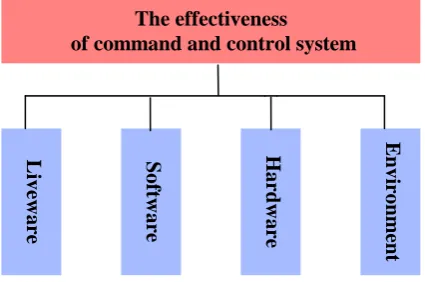
The evaluation indicator system includes two levels. The first level has only one indicator, which is total evaluation objective, i.e., the effectiveness of command and control system. It is noted that the whole indicator are determined by four parts: the liveware, the software, the hardware and the environment. The four sub-indicators are composed of the second level of the evaluation indicator system. We will introduce these four sub-indicators in detail as follow.
Liveware
The interaction of various factors influences the final system effectiveness. We would like to point out that the liveware are always at the core of command and control system, whatever the degree of automation and intellectualization is high or not. The manifestation of people is throughout the whole command and control process. The coordination between various types of personnel is the most important factor. The human factors mainly include the physical characteristics, cognitive level, technical level, and physiological and psychological status of various types of personnel. Due to individual differences including people's knowledge structure, thinking mode, technical ability, and physical and psychological conditions, the methods to deal with various situations are different, these would bring out different final results. These personal parameters would influence the whole system effectiveness.
Software
The software in the command and control process includes lots of factors, this sub-indicator includes the procedures, standard operating procedure, checklists, rules and regulations, as well as new technologies, new tactics, etc. As we know, the automation degree of command and control system becomes more and more, and the command and control mission has been transformed from the original direct-operated working mode to the monitor information. The management and utilization of software has become one of the most important task. By studying the standard command and control procedures during the training process, the mission could be simplified, the personnel workload can be reduced, and the error probability could be decreased. It should be noted that the more detailed the factors considered in the program production process, the more obvious the influence on the command and control system will be.
Hardware
Figure 1. The effectiveness evaluation indicator structure for command and control system.
Environment
The environment parameters, which will effect the command and control system environment, include the meteorological conditions, the lighting, electromagnetic interference and so on. Although many advanced equipments have been applied, the external environment changes would affect the performances of command and control system.
Based on the above analysis about the command and control system, the effectiveness evaluation indicator system for command and control system would be shown in Figure 1.
The Effectiveness Assessment Model
For the purpose of evaluating the system effectiveness, the fuzzy analytic hierarchy process has been introduced to obtain the effectiveness assessment model. Meanwhile, the evaluation process has four procedures:
Construct the evaluation indicator set; Establish the comment set;
Calculate the indicator weight;
Performing the comprehensive evaluation.
The concrete procedures for evaluating the effectiveness of command and control system could be expressed as follow:
Step 1. The effectiveness evaluation indicator structure for command and control system has been analyzed in Section 2. The indicator structure has one whole evaluation target indicator and four sub-indicators. The indicators relationship could be found in Figure 1. The evaluation indicator set is composed of the first- and second-level indicators.
Step 2. According to the actual situation of command and control system, this paper would choose three comment levels ‘excellent, qualified and unqualified’, and they are composed of the comment set. Assume that the evaluation of liveware indicator is excellent 70%, qualified 24% and unqualified 6%, and then the comment of liveware parameter could be given as
1 2 3 1
( ) [ , , ] [0.70 ,0.24,0.06] p Liveware p p p
(1) As same as the liveware indicator, the comments of other parameters (software, hardware, environment) could be obtained, and expressed below
1
1
1
( ) [0.65 , 0.30, 0.05];
( ) [0.74 , 0.14, 0.12];
( ) [0.56 , 0.40, 0.04].
Software
Hardware
environ p
men p
t p
(2)
It is noted that these comment data usually can be obtained by the questionnaire. The effectiveness
of command and control system
L
ivew
are
Soft
w
are
H
ardw
are
E
nvi
ronm
Step 3. On the fuzzy analytic hierarchy process, we need to calculate the indicator weight via the indicator discriminatation matrix, which could be got by using of the Satty scale method of 1-9 grades[7-9]. Assume that the indicator discriminatation matrix of command and control system is
1 3 1 / 3 1 / 5
1 / 3 1 2 3
3 1 / 2 1 3
5 1 / 3 1 / 3 1
D
(3)
Then, one can use the sum-product method[7-9] to calculate the indicator weights, which could be given by
1
( ) [ ( ), ( ), ( ), ( )] [0.47 , 0.20, 0.16, 0.17]
w Effictiveness w Liveware w Software w Hardware w Environment (4)
Step 4. Based on the evaluation criteria of fuzzy analytic hierarchy process and the indicator weight set with the corresponding fuzzy matrix, the final effectiveness evaluation result of command and control system can be obtained by using the follow formulas:
1 1
( ) 0.70 0.24 0.06
( ) 0.65 0.30 0.05
Re ( ) ( ) [0.47 , 0.20, 0.16, 0.17] 0.76 , 0.18, 0.16
( ) 0.74 0.14 0.12
( ) 0.70 0.24 0.06
p Liveware p Software sult Effictiveness w Effictiveness
p Hardware
p Environment
(5)
This final system effectiveness evaluation result means that: 76% , 18% and 16% people think this command and control system system is excellent, qualified and unqualified, respectively. In view of the above-mentioned factors affecting the system effectiveness, some suggestions can be proposed to improve the effectiveness.
Summary
The command and control system is a key component for air platform, and the performance of command and control system would directly influence the whole air platform. In order to evaluate the system effectiveness, the efficiency evaluation method is proposed by using the Fuzzy Analytic Hierarchy Process (FAHP). The main effect factors, which are the liveware, the software, the hardware and the environment, have been analyzed in detail. Furthermore, the evaluation indicator structure and the fuzzy evaluation model for command and control system are constructed according to the FAHP method. This novel proposal can be used to evaluate the whole efficiency of command and control system based on the various factors effects of command and control in aviation operations. In terms of the evaluation results, some suggestions could be proposed to improve the effectiveness of command and control system.
Acknowledgement
The authors thank J. Jiang, J.W. Luo and Y. Zhu for helpful discussions. This research was financially supported by Natural Science Basic Research Plan in Shaanxi Province of China (Program No. 2018JQ6020).
References
[1] Wang SG, Wang XH, An LL. Evaluational research of equipment support of command and control system[J]. Science technology and engineering, 2006, 6(9): 1252-1256.
[3] Zhang Z, Li LL, Wei ZH, et al. Dynamic effectiveness evaluation of command and control system based on variable weight-projection gray target [J]. Systems engineering and electronics, 2019, 41(4): 801-809.
[4] Qi F, Yang H, Xu F, et al. Effectiveness evaluation of communication and command control system based on fuzzy theory[J]. Modern electronics technique, 2010, 33(11): 44-46.
[5] Yu JP. Study on the comprehensive effectiveness evaluation of command automation system based on Analytic Hierarchy Process[J]. Electronic test, 2015, 8: 73-76.
[6] Zhang P, Zhang R, Wang ZH. Information countermeasure effectiveness evaluation technology based on network performance analysis[J]. Communications technology, 2016, 49(11): 1519-1523.
[7] Satty TL, The analytical hierachy process[M]. 1980, New York: McGraw-Hill.
[8] Satty TL, How to make a decision: The analytical hierachy process[J]. European journal of operational research, 1990. 48: 9-26.