Argo Data Mean Field Modeling
by
Han Wu
A thesis submitted in partial fulfillment of the requirements for the degree of
Bachelor of Science (Honors Statistics) in The University of Michigan
2018
Advisors:
c
Han Wu 2018
ACKNOWLEDGEMENTS
Thanks to all the people who made this thesis possible, in particular Professor
Tailen Hsing and Professor Stilian Stoev for their help, guidance and insights, my
brother for working with me together and my family on the other side of the ocean
TABLE OF CONTENTS
DEDICATION . . . ii
ACKNOWLEDGEMENTS . . . iii
LIST OF FIGURES . . . vi
ABSTRACT . . . vii
CHAPTER I. Introduction . . . 1
1.1 Introduction . . . 1
1.2 Roemmich-Gilson Argo Climatology . . . 2
II. Float Analysis . . . 4
2.1 Float Analysis . . . 4
2.2 Different ways of handling cycles . . . 5
2.2.1 Using one cycle . . . 5
2.2.2 Using half data . . . 5
2.2.3 New way of combining the data . . . 7
2.2.4 Miscellaneous . . . 7
2.3 Summary . . . 7
III. Mean Field Modeling . . . 9
3.1 Introduction . . . 9
3.2 B-Splines . . . 9
3.3 Models . . . 12
3.3.1 The data . . . 12
3.3.2 Introduction and motivation . . . 12
3.3.3 Model specification . . . 13
IV. Thermocline and Mixed Layer Depth . . . 19
4.1 Introduction . . . 19
4.2 Basic Concepts . . . 19
4.3 Identifying Thermocline . . . 20
4.4 Plots of derivatives and mean field curves . . . 21
4.5 Common methods in oceanology to determine MLD . . . 22
4.6 The merit of our approach . . . 24
V. Mean Plots of Gridded Files . . . 25
5.1 Introduction . . . 25
5.2 Mean Field Plots . . . 25
VI. Conclusion and Further work . . . 32
LIST OF FIGURES
Figure
2.1 Float Trajectory . . . 5
2.2 Cycle Variable Plots . . . 6
2.3 Cycle Time Series Plots . . . 6
3.1 B-spline basis functions . . . 11
3.2 One place for great variability . . . 15
4.1 Mixed layer depth and thermocline . . . 20
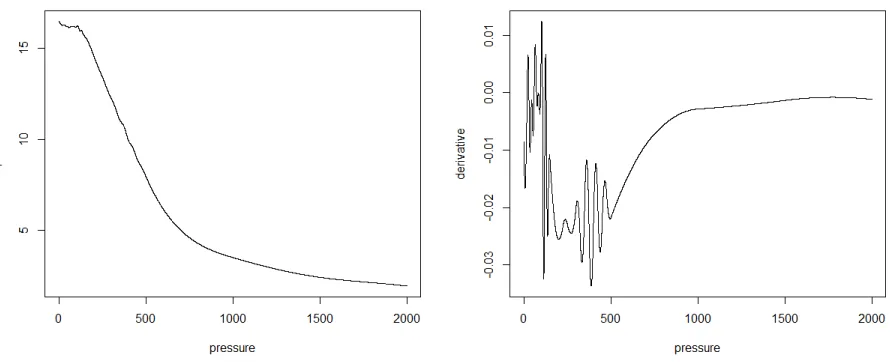
4.2 Mean field curve and derivative at (34.5N, 159.5E), January . . . . 21
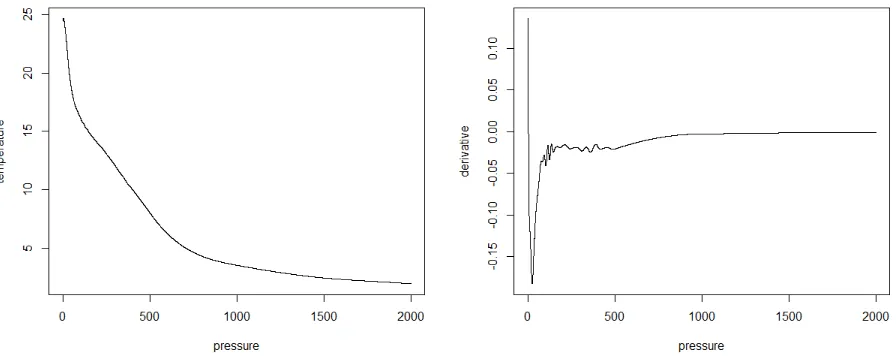
4.3 Mean field curve and derivative at (34.5N, 159.5E), April . . . 22
4.4 Mean field curve and derivative at (34.5N, 159.5E), July . . . 22
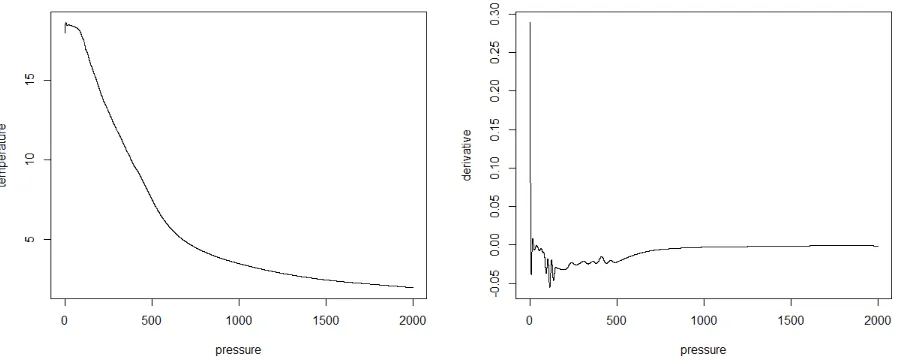
4.5 Mean field curve and derivative at (34.5N, 159.5E), October . . . . 23
4.6 Mean field curve and derivative at (34.5N, 159.5E), December . . . 23
5.1 Mean field plot for 50db, January . . . 26
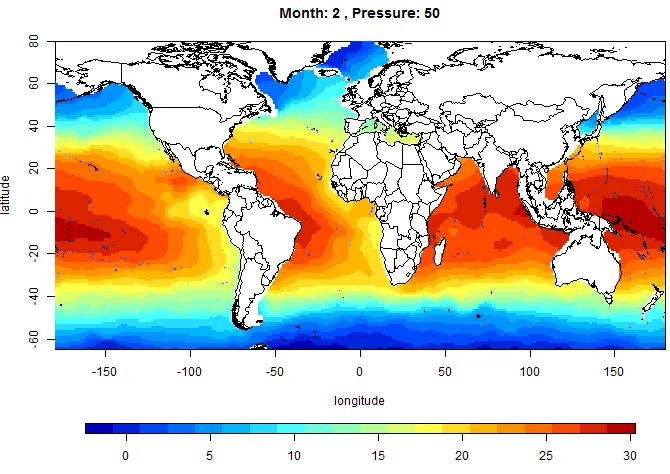
5.2 Mean field plot for 50db, February . . . 26
5.3 Mean field plot for 50db, March . . . 27
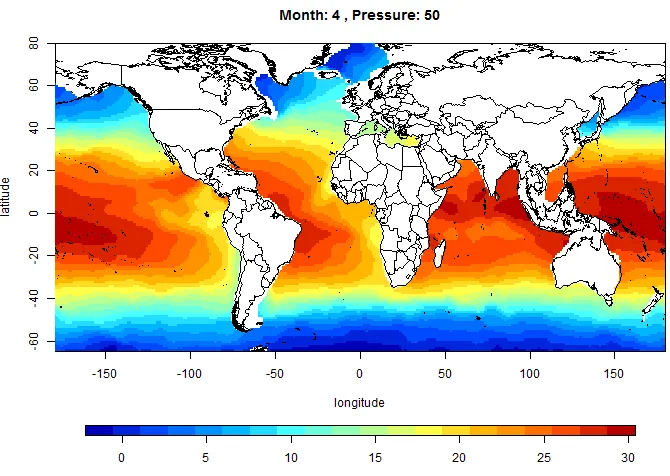
5.4 Mean field plot for 50db, April . . . 27
5.5 Mean field plot for 50db, May . . . 28
5.6 Mean field plot for 50db, June . . . 28
5.7 Mean field plot for 50db, July . . . 29
5.8 Mean field plot for 50db, August . . . 29
5.9 Mean field plot for 50db, September . . . 30
5.10 Mean field plot for 50db, October . . . 30
5.11 Mean field plot for 50db, November . . . 31
ABSTRACT
Argo Data Mean Field Modeling
by
Han Wu
Professor Tailen Hsing, Professor Stilian Stoev
In this thesis, we provide a new method for modeling the mean field of the Argo
data set. We use a non-parametric method which could take vertical dependence into
account and has a clear closed form solution. Existing mean fields suffer from the
drawback that they are not continuous and focus on specific pressure levels. We also
use the mean field to investigate the thermocline and mixed layer depth, which are
of great interests among oceanographers. They can be easily analyzed by existing
method if we have a closed form expression of the temperature-pressure curve. We
also illustrate how we did the computations and give some plots about the mean field.
CHAPTER I
Introduction
1.1
Introduction
Argo data set is collaboratively collected by many countries. It measures salinity,
temperature and pressure of the ocean by floats, which are deployed at certain location
and then start to drift randomly. The floats collect data in every 10 days. In each
cycle, the time information is also recorded when the float comes to the surface.
It collects data as deep as 2000 meters whereas traditional data sets only focus on
surface areas. Also, the resolution of the floats is getting finer. The current resolution
is 3◦×3◦ so on average there is one float in every 3◦×3◦ grid. There are still some
implementation issues scientists are trying to improve upon. For example, there are
fewer floats in the polar area and in the south hemisphere in general, partly because
there are fewer countries in these areas. Also, the current scheme of Argo measures
the time when the float comes to the surface so the temporal information is not
accurate for data collected in the deep ocean. The data set is of great interests to
1.2
Roemmich-Gilson Argo Climatology
In this section, we give an introduction to the Roemmich-Gilson (RG) mean field,
which is considered the gold standard for researchers interested in Argo. More details
about the RG project could be found in [Kuusela and Stein (2017)].
The website of the product http://sio-argo.ucsd.edu/RG_Climatology.html
provides a summary, “A basic description of the modern upper ocean based entirely on
Argo data is available here, to provide a baseline for comparison with past datasets
and with ongoing Argo data, to test the adequacy of Argo sampling of large-scale
variability, and to examine the consistency of the Argo dataset with related ocean
observations from other programs.” [Roemmich and Gilson (2017)].
According to their website of the product, “The RG Argo Climatology uses
weighted least-squares fit to the nearest 100 Argo profiles within a given month to
estimate the mean field.” They fit the model on some fixed pressure levels for each
lattitude-longitude grid point. The regression function includes first and second terms
of the latitude, longitude and pressure as well as fourier basis to account for the
sea-sonal cycle. Specifically, the regression function given in Kuusela and Stein (2017) is
as follows
m(xlat, xlon, z, t) =β0+ [first and second order terms of xlat,xlon and z]
+ 6 X
k=1 γksin
2πk t 365.25
+δkcos
2πk t 365.25
wherexlatis latitude,xlonis longitude,zis pressure andtis time in days within a year.
This function is fitted to the nearest 3× 12×100 neighbors, where 3 refers to the 3
nearby pressure levels and 12 refers to the calendar months. The nearest neighbors
are identified across the whole data set and are assigned with weights depending on
their distances with the grid point. “Once fitted, the regression function is evaluated
CHAPTER II
Float Analysis
This chapter describes a naive way of analyzing individual floats using time series.
However, as we will see this analysis can only serve as a way to explore the data.
The model cannot be generalized, and the analysis is not definitive. So, after this
preliminary attempt we will focus on modeling the mean field of temperature.
2.1
Float Analysis
We focus on one specific float. We try to model one typical cycle of the float.
Note that the website
http://www.argodatamgt.org/Access-to-data/Description-of-all-floats2 has descriptions of all the floats, both active and inactive. So we could
have a look to see what a typical cycle looks like. The basic idea of the analysis is to
estimate a time series model using one or several cycles and then use the estimated
model to predict the remaining cycles. The model we use is vector auto-regressive
(VAR) model. One thing to note is that this model is not perfectly suitable as the
movement of floats is non-stationary. We also tried VARMA model but it turned out
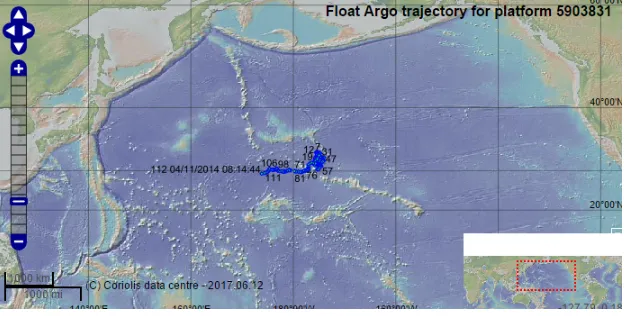
that this model improves nothing but complexity. The trajectory of one such float is
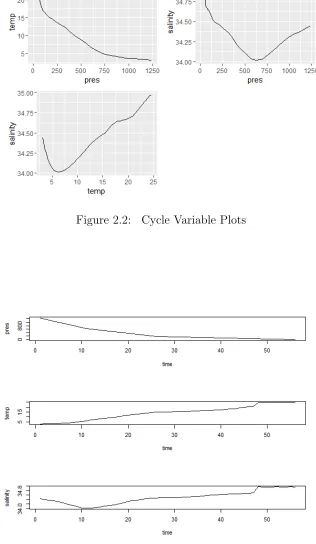
shown in figure 2.1. The typical cycle variable plots is figure 2.2. The typical time
series plot of each cycle is figure 2.3.
Figure 2.1: Float Trajectory
Figure courtesy of Argo data management site,
http://www.argodatamgt.org/Access-to-data/Description-of-all-floats2
the first p observations (corresponding to the deepestp pressure levels) in each cycle
since the model requires pprevious observations to make a prediction. The details of
the procedure are given below.
2.2
Different ways of handling cycles
2.2.1 Using one cycle
In this setting, we use the data from only one cycle to estimate the model. We first
perform an order selection. We should choose the last small p-value in the sequential
p-value list provided by the MST package. We also want AIC, BIC and HQ values
to be small. Order 3 is sufficient in most of the time. We fit the model and predict
the subsequent cycles. After getting models from each cycle, we compare the model
parameters and they are pretty different. However, the errors are quite similar.
2.2.2 Using half data
In this setting, we naively combine half of the data without any modification and
it turns out this approach has larger error rates than previous one, which suggests
Figure 2.2: Cycle Variable Plots
of the VAR model tells us that it uses least squares so the problem comes from the
first three observations of each cycle. Based on this observation, we tried a new way
of combining the data.
2.2.3 New way of combining the data
In this setting we do not omit the first three observations and use the function
in the package MTS. Instead, we perform the least square and treat every possible
group of four data points as an observation coming from the model. Using the first
half as training data, the performance is better than the method in last section.
2.2.4 Miscellaneous
We also looked at errors of the last five observations in each cycle. The predictions
are worse especially for pressure. This is expected since near the surface the changes
are more abrupt than in deep water. This phenomenon also suggests that we should
take a look at the plots of the cycles to visualize them and shift our attention to
smaller pressure area.
2.3
Summary
In summary we found that VAR model works very well for modeling salinity no
matter how many cycles we use as training data. The average prediction error of
temperature is around 10% for the float we chose. However, VAR model is not a
natural way to model all floats as there is no VAR model that works uniformly well.
There is no reason to assume that a float drifting near equator obeys the same model
as a float drifting near the pole. Also, for some floats that drifts for a very long
distance the analysis becomes problematic. However, one thing we get from this
terms of pressure, which means vertical dependence is crucial. This motivates us to
CHAPTER III
Mean Field Modeling
3.1
Introduction
In this chapter, we introduce a functional data approach to model the mean
tem-perature field across the entire ocean. Other existing methods for computing the
mean field involve a fixed given pressure level. We propose a nonparametric approach
using B-splines, which smoothly incorporates all pressure levels. The approach has
many advantages including: it has a closed form solution, it is relatively easy to
compute and it allows us to visualize the results.
3.2
B-Splines
We first give a short introduction to B-splines. B-splines are particularly useful
basis functions for the space of smooth piecewise polynomial functions referred to as
splines. Any spline function of given degree can be expressed as a linear combination
of B-splines of that degree. Also, we have closed form expression of the basis we
will use. The B-splines are defined as follows [Wasserman (2006)]. Let ξ0 = a and
ξk+1 =b. Define new knotsτ1, . . ., τM such that
and
ξk+1≤τk+1+M ≤ · · · ≤τk+2M (3.2)
The choices for knots beyond the boundary are arbitrary and could be chosen to equal
toa and b respectively.
B-spline basis functions are defined recursively, we first define
Bi,1(x) =
1, if τi ≤x < τi+1
0, otherwise
for i= 1, ..., k+ 2M −1.
Form ≥2 and m≤M, we define
Bi,m(x) =
x−τi
τi+m−1−τi
Bi,m−1(x) +
τi+m−x
τi+m−τi+1
Bi+1,m−1(x)
If the denominator is 0 then we define the function to be 0.
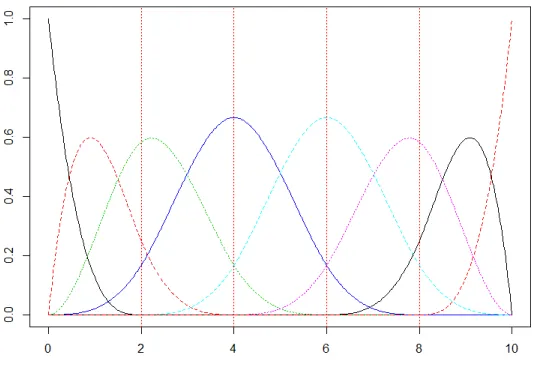
The following figure 3.1 shows examples of B-spline basis functions with order 4 and
knots at 0, 2, 4, 6, 8, 10.
Theorem
The functions {Bi,4(x), i= 1, ..., k+ 4} are a basis for the set of cubic splines. They
are called the B-spline basis functions.
A proof of this theorem can be found in Carl de Boor’s notes [de Boor (2017)].
Now suppose ˆf is the spline estimator. We have
ˆ f(p) =
N
X
j=1
βjBj(p)
where B1, . . .,BN are basis functions, we need to find β = (β1, . . . , βN). So we need
to minimize
Figure 3.1: B-spline basis functions
where B = (Bj(pi)) and Ωjk =
R
Bj00Bk00. Taking the derivative we have
ˆ
β = (BTB +λΩ)−1BTY
The above formula is used in the fda package. One thing to note is that using B-spline
basis functions could help us speed up the computation ofβ compared to using other
basis. This is because by induction we could show that Bi,4 = 0 for x /∈ [τi, τi+M],
so the support of B-spline basis functions is at most 5 knots [Hastie et al. (2009)].
Thus, theB matrix in the above formula is lower 4-banded. Consequently the matrix
(BTB +λΩ) is 4-banded and hence its Cholesky decomposition can be computed
3.3
Models
3.3.1 The data
The data we use comes from [Kuusela (2018)], it contains roughly one million
profiles from year 2007 to year 2016. There is a strict requirement for selecting the
data, namely all cycles with big gaps in pressure readings are discarded. Whether
this is sensible is yet to be determined with further evaluation. The profiles consist
of separate lists for Julian date, latitude, longitude, pressure and temperature. Note
that here we already ignored salinity. Each element in the first three lists is a single
scalar since as we said earlier, the location and time information are only assessed
once the float comes to the surface. Each element in the latter two lists is a vector
and its length varies according to the technical aspect of the float. Specifically, theith
profile consists of (JULDi,LATi,LONi,(Pi,j)jn=1i ,(Ti,j)nj=1i ). The data are in Matlab.
We used the R.matlab package in R to transform Matlab data structures to R.
3.3.2 Introduction and motivation
Besides what we present in the last chapter, the idea of modeling the mean comes
from two considerations. The first one is the intuition that in general the pattern of
temperature should roughly be the same across different years. The second one is the
fact that the data set is rather sparse, so modeling the mean is crucial for further
data analysis.
A natural idea is using regression for each pressure level which is what is done
by Roemmich and Gilson, but as explained in the introduction, it is hard to produce
a continuous mean field as a function of pressure. Also, the computation will be
challenging and the model is complicated which compromises interpretability. We
use the idea that we could borrow strength from nearby profiles to get information
interested in. We use nearby cycles in a way to produce the mean for a point where
all the cycles considered will lie in a circle with some radius centered at this point.
Depending on the degree of similarity with the point we consider, we should give
them different weights. Thus, the idea is to use two weights, one for time and one for
location. The overall weight is the product of the two.
We use a non-parametric approach here to model the pressure temperature curve
and take advantage in later sections of the closed form we have. One thing to note is
that this approach can be extended to predict at a location and time not covered by
any float. Thus, our methodology addresses the important issue of sparsity.
3.3.3 Model specification
In this section we elaborate on the smoothing methodology we developed.
Suppose we are given a point (time, s) wheretime∈[0,365.25) denotes the time
in the year, which is calculated as follows.
time= JULD−
JULD 365.25
×365.25
where JULD is the Julian Date in original data set. s is the location consisting of
latitude and longitude, i.e. s = (lat, lon). We will model the mean locally, i.e. all
the data from each year in a window have similar means. We produce the baseline
model locally using linear combinations of B-spline basis functions. So the model is
as follows:
T =f(p) +
where f is a linear combination of B-spline basis functions as well as a linear term
and intercept term, is the noise with mean zero (modeling this would be further
supported in the interval [0, p0] with order m. We have
f(p) =β1ψ1(p) +· · ·+βm+2ψm+2(p)
We want to minimize the residual sum of squares but for each profile we want to use
the average of residual sum of squares so that the result is not dominated by profiles
with much more pressure levels than others.
Now, given a window size ‘hspace’ for location and ‘htime’ for time, we consider
the profiles whose locations lie inside the circle centered at the given location point
(lat, lon) with radius ‘hspace’ and whose times are in the interval [time-htime, time
+ htime]. Specifically, suppose i = 1, . . . , N denote the index of profiles in a given
window and j = 1, . . . , ni denote the pressure levels of this profile (ni is the number
of data points in this profile), then for profile i we have the residual sum of squares
1 ni
ni
X
j=1
Ti,j− m+2 X
k=1
βkψk(pi,j)
!2
Now as mentioned above, the weight function is the product of weight of time and
weight of location. For time kernel we employed two in our later computation,
Epanechnikov kernel and box kernel. For the Epanechnikov kernel, we have
wt(time, t) =
3 4(1−(
|t−time| htime )
2), if |t−time|
htime ≤1
0, otherwise,
For the box kernel we simply put weight 1 for all time points in the interval i.e.
wt(time, t) =
1, if |t−time|htime ≤1
For the weight of space, we only use Epanechnikov kernel parametrized by ‘hspace’,
i.e. for two locations s1 = (lat1, lon1) ands2 = (lat2, lon2), we have
ws(s1, s2) = 3 4(1−(
(lat2−lat1)2+(lon1−lon2)2
hspace2 )), if
(lat2−lat1)2+(lon1−lon2)2
hspace2 ≤1
0, otherwise,
The reason for this is that from our empirical analysis, space variability is huge for
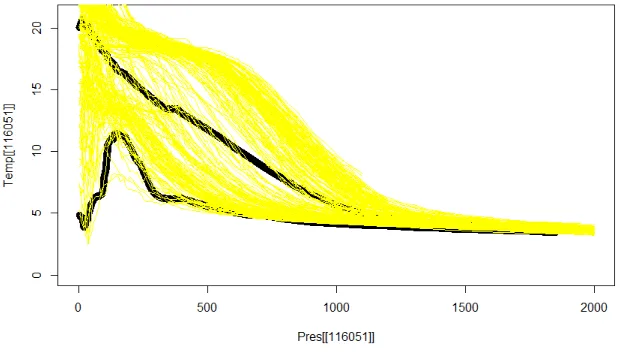
some places and time variability has less influence on the result. For illustration, see
[image:23.612.163.476.309.485.2]figure 3.2. The lower thick black line is the true curve, and the upper black one is the
Figure 3.2: One place for great variability
Upper balck line is the mean curve and the lower black line is the curve plotted using raw data. Yellow lines are cycles used to produce the mean curve
mean we produced. We see huge variability here. So it is better to model the mean
in a smaller region and not using uniform kernel.
We will weight the average of the residual sum of squares from different profiles
by its weight. We want to find the best parameter β, so
ˆ
β = argmin
β∈Rm N X i=1 1 ni ni X j=1
Ti,j − m
X
k=1
βkψk(pi,j)
!2
where
wi =wt(time, ti)ws((lati, loni), s)
and β depends on the location s= (lat, lon), time, hspace and htime.
The value for hspace is subject to our own choice. We tried 5 for producing the
mean field and also 3 to see how well our mean field prediction will be compared to
Roemmich-Gilson mean field. The reason to choose radius of 5 is because we want to
include more data and empirically this is a pretty decent choice. The reason for using
the radius 3 is twofold. First, Argo is roughly distributed at a resolution of 3 by 3
grid. Second, because of the huge variability it is better to choose a smaller radius
if we want a better mean field in pure prediction point of view. We use a month as
time window because Rommeich Gilson mean field focuses on monthly mean. One
thing to note is that these are just hyper-parameters so we could change them and
rerun our code to get a different mean field. If we write
β = [β1,· · ·, βm]T,Ψi =
ψ1(Pi,1) · · · ψm(Pi,1) ..
. . .. ...
ψ1(Pi,ni) · · · ψm(Pi,ni)
, Ti = [Ti,1,· · · , Ti,ni]
T (3.4)
Then we can write the above minimization problem in a compact form
ˆ
β(lat,lon,time; hspace,htime) = argmin
β∈Rm
N
X
i=1
kTi−Ψiβk2
wi
ni
(3.5)
Taking the gradient of right hand side of (3.5) we have
∂ ∂β
N
X
i=1
kTi−Ψiβk2
wi
ni
= ∂
∂β(Ti−Ψiβ)
T(T
i−Ψiβ)
wi ni = N X i=1
(−2ΨTi Ti+ 2ΨTi Ψiβ)
wi
Setting the above expression to zero we have N X i=1 wi ni
ΨTi Ψ ! β= N X i=1 wi ni
ΨTi Ti
so ˆ β = N X i=1 wi ni
ΨTi Ψi
!−1 N X
i=1 ΨTi Ti
wi
ni
!
(3.6)
To predict the temperature we simply use
ˆ
Ti = Ψiβˆ (3.7)
Remark
We have investigated some variations of the model.
• We tried to add the seasonal cycles into the model as Rommiech and Gilson did.
Recall that RG method involves such terms for each fixed pressure level. Since
we are considering different pressure levels together, given the large number of
parameters it is hard to incorporate the seasonal consideration in the model.
Also, given the performance of our mean field, we think it is unnecessary to
increase the complexity of the mean field model.
• We also tried to incorporate time of the day into the model, i.e. giving more
weight to profiles that have similar time of the day with the target profile.
This is feasible. We used the triweight kernel and also considered the influence
of pressure. When the pressure is low there should be stronger influence on
temperature coming from time of the day. Although this does improve the fit
a little bit for the first few observations having small pressures, it has virtually
3.4
Producing the mean field
One advantage for using the B-spline basis function approach is that we have a
closed form solution of ˆβ. However, to calculate ˆβ we need to sum over i, which
involves a loop and its implementation in R is prohibitively slow. We overcome this
bottleneck by using the package Rcpp, which allows us to implement the loop in C++
and integrate the function in R. We also take advantage of the fda package in R that
is very convenient for B-splines. We use the fda package mainly for producing the Ψ
CHAPTER IV
Thermocline and Mixed Layer Depth
4.1
Introduction
In this chapter, we introduce the concept of thermocline and mixed layer depth.
These are very important concepts in oceanology research. Having computed the
mean field, we can use it to do some basic explorations of the thermocline and mixed
layer depth at various locations and times of the year.
4.2
Basic Concepts
Informally, Figure 4.1 depicts the concepts of mixed layer depth and thermocline.
We give the definitions of these terms presented in the website of University of Illinois
WW2010 Project, http://ww2010.atmos.uiuc.edu/(Gh)/wwhlpr/thermocline.rxml.
“The thermocline is the transition layer between the mixed layer at the surface
and the deep water layer. The definitions of these layers are based on temperature.
The mixed layer is near the surface where the temperature is roughly that of
surface water. In the thermocline, the temperature decreases rapidly from the mixed
layer temperature to the much colder deep water temperature.
The mixed layer and the deep water layer are relatively uniform in temperature,
Figure 4.1: Mixed layer depth and thermocline
Image from the University of Illinois WW2010 Project, http://ww2010.atmos.uiuc.edu/(Gh)/wwhlpr/thermocline.rxml
4.3
Identifying Thermocline
There are several ways to identity the thermocline region. Basically, we need
to find both the upper bound (aka mixed layer depth) of the thermocline and the
lower bound of the thermocline. Holte and Talley [Holte and Talley (2009)] give a
comprehensive review of the existing methods to determine mixed layer depth and
posit a new algorithm. We find those methods tedious and difficult to implement.
Rather, we find the approach inJiang et al. (2017) more interesting. The basic idea
is as follows.
They first define the concept of the thermocline strength, which refers to the
quotient of temperature difference divided by depth difference. They use 0.2C/m
as the threshold value to judge thermocline. If the maximum regional strength is
smaller than 0.2C/m, they will claim that there is no thermocline in this region
Jiang et al. (2017). In our case, we focus on 1-m interval, i.e. pressure level vector
(0,1,2,· · · ,2000). For each pressure level, we have the derivative calculated from the
than or equal to 0.2, we tag it as thermocline. Following this method, we can have
several preliminary thermocline regions. We first throw away all the regions with
thickness less than 5m. Then we merge all the thermoclines with distance less than
5m.
This method is easy to implement and avoids some hard to understand technical
details.
4.4
Plots of derivatives and mean field curves
In this section, we provide some plots of both derivatives and original mean field
[image:29.612.115.560.349.530.2]curves.
Figure 4.2: Mean field curve and derivative at (34.5N, 159.5E), January
Observations
1. It is hard to capture the fluctuations or stability sometimes near the surface,
which will make determining the upper bound of the thermocline (also called Mixed
Layer Depth or MLD) harder.
2. When our mean field estimate looks very different from the real curve, most of
Figure 4.3: Mean field curve and derivative at (34.5N, 159.5E), April
Figure 4.4: Mean field curve and derivative at (34.5N, 159.5E), July
4.5
Common methods in oceanology to determine MLD
From the introduction part of Holte and Talley (2009), the most widely favored
and simplest scheme for finding the MLD is the threshold method. “Threshold
meth-ods search for the depth at which the temperature or density profiles change by a
[image:30.612.113.561.346.524.2]Figure 4.5: Mean field curve and derivative at (34.5N, 159.5E), October
Figure 4.6: Mean field curve and derivative at (34.5N, 159.5E), December
threshold value is still an open problem. Some scientists discovered that larger
thresh-old values might overestimate the MLD of individual profiles and similarly smaller
value of 0.1 degree celsius underestimates the MLD. In de Boyer Montgut et al. 0.2
was suggested as the optimal value (reference level at 10m to avoid diurnal heating).
Gradient methods work like threshold methods. They assume that there is an abrupt
[image:31.612.112.561.344.525.2]values. Commonly used value is 0.025 C/m. Note that, density could also be used
for both methods.
Threshold and gradient methods have limitations because their performances
de-pend largely on the reference and threshold values. Also, it is difficult to find a value
that is uniformly well for all the profiles in the ocean. In general, some scientists have
argued that density criterion is more reliable for finding MLD than a temperature
criterion [Holte and Talley (2009)].
4.6
The merit of our approach
One thing to note is that most of the literature and research on MLD and
thermo-cline have to rely on raw data. They will apply existing methods to the raw data and
estimate the MLD and thermocline region. This is a significant limitation because
it confines the methods to the data collecting technology. However, if we use the
functional data approach to get a closed form solution of the mean as a function of
pressure, we could do our analysis at locations where data are not even collected. By
CHAPTER V
Mean Plots of Gridded Files
5.1
Introduction
Based on the method we described in Chapter 3, we produced a grided mean field.
We used the grid offered by Roemmich and Gilson. Namely, we divided the whole
world into 1◦ ×1◦ grid and compute a mean temperature curve for each grid as a
function of pressure and time. We set the time window to 30 days and space window
to 5 degrees with box kernel on time and Epanechnikov kernel on space. The mean
field we calculated is for all the Argo data up to 2016. For each month and for each
spatial grid, we have a vector of coefficients in the B-spline basis as well as a mean
vector. Therefore, the final product we got is a multi-dimensional array.
5.2
Mean Field Plots
In this section, we show some mean field plots for pressure level 50 db. Each plot
represents a mean temperature field of the ocean in a given month. The plots are
Figure 5.1: Mean field plot for 50db, January
[image:34.612.151.486.436.673.2]Figure 5.3: Mean field plot for 50db, March
[image:35.612.151.486.435.673.2]Figure 5.5: Mean field plot for 50db, May
[image:36.612.151.486.434.673.2]Figure 5.7: Mean field plot for 50db, July
[image:37.612.151.485.434.673.2]Figure 5.9: Mean field plot for 50db, September
[image:38.612.150.486.441.675.2]Figure 5.11: Mean field plot for 50db, November
[image:39.612.151.486.438.674.2]CHAPTER VI
Conclusion and Further work
We have demonstrated the convenience of having a closed form expression of our
estimated mean field and its power in other areas of analysis of Argo data. The mean
field is pretty flexible and careful choice of parameters could certainly improve the
prediction accuracy even if we only use mean field to predict the temperature. There
are some further works that can be done in the future. For example, how we could pick
location dependent bandwidths for the kernels and carefully cross validate the choice
of knots, order of basis functions on such a large scale. In terms of prediction, how
we could carefully model the residuals. We have looked at some empirical covariances
but have not proceeded with further analysis. The choice of covariance function is
crucial for successfully modeling the residuals. One challenge is the high-dimensional
feature of the data. For each window if we regard data points from each year as an
iid realization from the same process then the dimension is too large to use existing
method to estimate the model parameters. Further work on residual modeling would
BIBLIOGRAPHY
de Boor, C. (2017), B(asic)-spline basics, ftp://ftp.cs.wisc.edu/Approx/ bsplbasic.pdf.
de Boyer Montgut, C., G. Madec, A. S. Fischer, A. Lazar, and D. Iudicone (), Mixed layer depth over the global ocean: An examination of profile data and a pro-filebased climatology, Journal of Geophysical Research: Oceans, 109(C12), doi: 10.1029/2004JC002378.
Hastie, T., R. Tibshirani, and J. Friedman (2009),The Elements of Statistical Learn-ing: data mining, inference and prediction, 2 ed., Springer.
Holte, J., and L. Talley (2009), A new algorithm for finding mixed layer depths with applications to argo data and subantarctic mode water formation,Journal of Atmospheric and Oceanic Technology, 26(9), 1920–1939.
Jiang, Y., Y. Gou, T. Zhang, K. Wang, and C. Hu (2017), A Machine Learning Approach to Argo Data Analysis in a Thermocline, Sensors (Basel, Switzerland), 17(10), 2225.
Kuusela, M. (2018), https://github.com/mkuusela/PreprocessedArgoData.
Kuusela, M., and M. L. Stein (2017), Locally stationary spatio-temporal interpolation of Argo profiling float data,ArXiv e-prints.
Roemmich, and Gilson (2017), Roemmich-Gilson Argo Climatology, http:// sio-argo.ucsd.edu/RG_Climatology.html.