Cover Photo:
Democratizing Manufacturing:
Bridging the Gap between Invention and Manufacturing
Released for Public Comment September 2016
Final Version December 2016
Report Number: MF-RR-2016-0104
MForesight: Alliance for Manufacturing Foresight serves as the voice of the national advanced manufacturing community, providing government, academia and industry with information and analysis about emerging technologies, workforce training, and opportunities for public-private partnerships that strengthen U.S. competitiveness. MForesight is funded by the National Science Foundation (NSF) and the National Institute for Standards and Technology (NIST)
TABLE OF CONTENTS
1.0EXECUTIVE SUMMARY ... 4
2.0INTRODUCTION ... 4
2.1 About This Report ... 4
3.0DEMOCRATIZING MANUFACTURING –WORKSHOP DETAILS ... 4
4.0OUTCOMES ... 5
4.1DEMOCRATIZING MANUFACTURING KNOWLEDGE ... 5
4.1.1 Key Challenges... 6
4.1.2 Observations ... 6
4.1.3 Current Practices ... 7
4.1.4 Actionable Recommendations ... 8
4.2PATHWAYS TO MANUFACTURING CAREERS ... 9
4.2.1 Key Challenges... 10
4.2.2 Observations ... 11
4.2.5 Actionable Recommendations ... 12
4.3PROCESS INNOVATION AND LOW-VOLUME MANUFACTURING ... 13
4.3.1 Key Challenges... 15
4.3.2 Observations ... 16
4.3.3 Current and Best Practices ... 17
4.3.4 Actionable Recommendations ... 18
4.4ENCOURAGING THE FORMATION AND GROWTH OF MANUFACTURING BUSINESSES ... 19
4.4.1 Actionable Recommendations ... 23
4.5IMPROVED ACCESS TO THE U.S.SUPPLY CHAINS ... 23
4.5.1 Key challenges ... 24
4.5.2 Observations ... 24
4.5.3 Actionable Recommendation ... 24
5.0CONCLUSION ... 25
APPENDIX A:COMPETITIVE PRACTICES IN A GLOBAL MANUFACTURING ENVIRONMENT ... 26
APPENDIX B:EXAMPLES OF EMERGING PROCESS TECHNOLOGIES ... 29
Democratizing Manufacturing:
Bridging the Gap between Invention and Manufacturing
Rapid Response Report
Glenn Daehn, Mars G. Fontana Professor of Metallurgical Engineering, Department of
Materials Science and Engineering, The Ohio State University
James Ervin, Technical Expert, Ford Motor Company
Sridhar Kota, Executive Director, MForesight: Alliance for Manufacturing Foresight
Michael Russo, U.S. Corporate Lead Government Relations, Regulatory Affairs & Strategic
Initiatives, GLOBALFOUNDRIES
Charles Wessner, Professor, Global Innovation Policy, Georgetown University
MForesight Staff
Dr. Joshua Bishop-Moser, Technical Lead
Sara Samuel, Research Analyst
Democratizing Manufacturing
1.0 Executive Summary
Entrepreneurs and small firms in the U.S. face significant challenges as they scale up their innovations to volume production. Despite innovative new technologies such as 3D printers, the transition to cost-competitive, large-scale manufacturing can be difficult for domestic firms. To assist small U.S. companies to more effectively ramp up production, MForesight assembled more than 30 experts in manufacturing at a workshop on “Democratizing Manufacturing.” The goal of the workshop was to evaluate the gaps and barriers in technology and education that prevent the competitive design and production of engineered components by small businesses in the U.S.
This effort is both timely and important because a large fraction of high-value products are now manufactured outside of the U.S. Companies in Europe and Asia are winning bids to manufacture products designed in the U.S. for a host of reasons, including a willingness on the part of their own governments to consistently invest in manufacturing (both infrastructure and human capital). To successfully compete in the global manufacturing marketplace, the U.S. needs to adopt new strategies for education, technology development, and industrial policy.
The following questions guided the workshop conversation to identify barriers and opportunities:
Democratizing Manufacturing Knowledge: How can small firms gain the requisite
manufacturing knowledge to successfully transition their functional prototypes into cost-competitive, volume production?
Enhanced Pathways to Manufacturing Careers: How can the U.S. support a career
path for a skilled manufacturing workforce at all levels — from skilled production workers to talented engineers?
Development of Intelligent Design Tools and Process Innovations: Are there
technology areas where additional research and development (R&D) funding would result in manufacturing processes that enable cost-effective, low-volume manufacturing?
Support for Manufacturing Businesses Formation and Growth: What strategies can
U.S. entrepreneurs use to successfully compete with offshore manufacturers?
Improved Access to the U.S. Supply Chain: How can access to the current supply
chain for raw materials and intermediate parts be improved for small manufacturers? Similarly, how can small manufacturers become part of the supply chain, selling to original equipment manufacturers (OEMs) and other businesses?
Based on the workshop discussions, the following recommendations were developed for each topic area to guide policy makers, educators, and industrial partners as they develop initiatives to support small to mid-sized US manufacturers.
1. Democratizing Manufacturing Knowledge:
Educate hardware entrepreneurs about basics of design for manufacturability methods and engage manufacturing experts to provide hands-on training. The suggested training format (M-Corps) should be modeled after the successful NSF I-Corps program.
2. Pathways to Manufacturing Careers:
Establish programs to expose middle school students to technology and manufacturing through field trips and mobile demonstrations.
Integrate proven hands-on programs such as FIRST Robotics directly into the mainstream K-12 curriculum rather than as after-school activity.
Encourage private sector to collaborate with local high schools to develop targeted vocational training classes to tap into the pool of non-college-bound students.
Embrace apprenticeships and industrial internships as a proven method for training a skilled manufacturing workforce.
3. Process Innovations:
Federal science and technology agencies are urged to increase their focus on engineering research related to design synthesis and manufacturing process innovations
Additional R&D investment is needed to support manufacturing processes for low-volume manufacturing.
Promote the creation of intelligent software design tools that detect design aspects that are not manufacturable and suggest alternate solutions.
Support the development of process compilers for common manufacturing processes (such as injection molding, stamping, pressure die casting, etc.) to automatically generate process steps from a CAE design.
4. Manufacturing Business Formation and Growth:
Develop a comprehensive matchmaking site to link inventors, entrepreneurs with suppliers and customers. It is especially important that the site include the procurement needs of Department of Defense.
Leverage the resources (hardware and software) and expertise at local universities to lower barriers to access to digital design and manufacturing tools by small and medium-sized manufacturers (SMMs).
Promote the formation of manufacturing businesses (job-shops for CNC machining or injection molding) using a franchise model, leveraging existing products and services from U.S.-based manufacturers of equipment, federal and state level business equipment loans guarantees, and community-college based skills training for the public.
Promote reshoring and on-shoring of manufacturing through programs that train manufacturers on Total Cost of Ownership tools that calculate true cost of off-shore manufacturing.
5. Improved Access to the U.S. Supply Chain:
An in-depth study is recommended to identify the strategies used to increase participation by small to mid-sized manufacturers in the supply chain. Topic areas can include:
An examination of purchasing practices typically found at OEMs that strengthen their relationship with small to mid-sized suppliers while meeting performance and financial metrics
A review of successful efforts that have leveraged existing federal technology assets (such as the MEP and Manufacturing USA Institutes) to promote innovation throughout the supply chain.
2.0 Introduction
New hardware and software tools make it easier than ever to turn a creative idea into a functional prototype. Desktop 3D printers were an initial part of this trend, but innovative software and integration tools have further simplified the creation of complex parts. Intuitive, easy-to-use computer aided engineering (CAE) software can share design files directly with desktop 3D printers. In addition, shared makerspaces provide access to hardware tools that are otherwise cost prohibitive for individuals or small teams. Furthermore, these shared spaces create opportunities for mentoring and sharing knowledge among entrepreneurs. Virtually anyone with a creative idea can become a “maker” within this new, accessible environment.
There is, however, a critical distinction between making a handful of prototypes and true volume manufacturing. Clearly, the creation of a functional prototype requires creativity, innovation, and a willingness to experiment with different shapes and materials. However, scaling up a prototype to volume production requires that the designer understand the nuances of manufacturing in order to produce an item cost-effectively while meeting consistent performance requirements.
The transition from prototype to volume production is a substantial challenge for most small firms. As a result, new innovations are often moved to low-wage countries where a given design is optimized into a manufacturable part and then mass-produced for export. For the U.S.to recover manufacturing capacity, the creativity and innovation of the maker community needs to be combined with existing expertise in the manufacturing community. Ideally, entrepreneurs and small firms will learn to work side by side with domestic manufacturers in a collaborative relationship, where entrepreneurs bring new innovations into manufacturing processes, and manufacturers share their expertise with a new generation of designers and engineers.
2.1 About This Report
The insights presented in this report will inform policy makers, funding agencies, industry leaders, and private investors about barriers and opportunities for entrepreneurs and small firms seeking to transition from building prototypes to low-volume manufacturing. Covering topics such as manufacturing education, R&D, business models, and supply chain access, this report will help federal program managers, investors, and technologists to better understand the range of issues to consider when scaling up to low-volume manufacturing.
3.0 Democratizing Manufacturing – Workshop Details
To identify key barriers and solutions to help makers more easily ramp up production, a workshop was held in Washington, DC, on August 8-9, 2016. The goal of the workshop was to identify the key topics that will assist entrepreneurs and small firms to design and manufacture their products cost-effectively in the U.S. The discussion space included, but was not limited to, approaches to manufacturing education, intelligent design tools, process innovations, new business models, and leveraging of the U.S. supply chain.
The key objectives of the workshop were to:
Identify the range of educational approaches to increase the technical skills for entrepreneurs.
Describe a set of best practices to train for a career in advanced manufacturing.
Describe the process innovations in hardware and software necessary to support low-volume manufacturing (defined to be 500-10,000 units).
Describe opportunities and barriers to business formation for small firms seeking to move from prototype to pilot-scale or at scale production.
Identify the typical supply chain barriers facing smaller companies (both technical and nontechnical). What solutions can be put in place so that smaller manufacturers can easily gain access to the existing supply chain?
4.0 Outcomes
The outcomes below are organized by the five key topic areas:
Democratizing Manufacturing Knowledge.
Pathways to Manufacturing Careers.
Process Innovations for cost-effective low-volume manufacturing.
Manufacturing Businesses Formation.
Improved Access to the Supply Chain.
The discussion of each area addresses motivation and significance, as well as key challenges, observations, current practices, and actionable recommendations gathered from the workshop.
4.1 Democratizing Manufacturing Knowledge
A major barrier to manufacturing at scale is a limited grasp of manufacturing principles on the part of many makers and entrepreneurs. Many start-ups are very strong in the first stages of product creation: quickly designing and building an operational prototype that demonstrates functionality. However, small firms often do not have a good understanding of the realities of how products are mass produced. While their product may be technically feasible, a small firm may not have access to the existing manufacturing know-how that is spread across tradespeople, books, suppliers, engineers, manufacturing firms, and many other sources. Without this knowledge, makers can struggle to transition their product to an economical design that can be produced at scale.
4.1.1 Key Challenges
Sharing the fundamentals of manufacturing with a new generation of start-ups and entrepreneurs faces several challenges:
1. Many entrepreneurs do not appreciate the value of a good understanding of manufacturing principles, especially in the early design process. Not only do entrepreneurs need to develop an awareness of the technical challenges in manufacturing, they also need to understand concepts such as Manufacturing Readiness Levels,1 as well as an appreciation of the variety and importance of Design for X principles2 and a basic understanding of how manufacturing supply chains operate.
2. A wide variety of excellent resources already exists in the form of printed materials, videos, and presentations, but there is currently no system that collates and organizes these resources. Ideally, manufacturing information and educational materials would be available in a readily accessible and centralized location.
3. While general manufacturing knowledge is valuable to the entrepreneur as a technical foundation, at some point they will need expert guidance to assist in choosing a manufacturing process that is tailored to their unique product. Collaborative relationships between entrepreneurs and manufacturing experts will result in the optimum manufacturing solution.
4. A new generation of software can inform users of manufacturability problems or constraints during the design phase, but the user needs adequate knowledge of manufacturing processes to take advantage of the software’s capabilities.
4.1.2 Observations
A number of barriers stand in the way of sharing manufacturing knowledge to a new generation of design engineers and entrepreneurs:
Manufacturing education programs lack standardization, skills assessments, and credentials certification.
Virtual resources that teach about manufacturing are difficult to discover.
New innovations often need a specific manufacturing tool or technology for optimized production, but it is difficult for inexperienced entrepreneurs to identify the most useful technology for their product.
Manufacturing experts need appropriate incentives to share their experience and know-how with the maker and start-up communities.
Manufacturing education is a broad and diverse curriculum. Core subjects range from materials, design strategies, and regulations to cost estimation and intellectual property. Each subject can be applied uniquely to a given product under development, so
1
The Manufacturing Readiness Level (MRL) describes the different levels of manufacturing readiness for a given product.
2
entrepreneurs and small firms need helpful guidance to identify the most appropriate subject for their particular need.
Powerful software packages can assist engineers to create manufacturable designs, but this presupposes that the engineer truly understands the nuances of different manufacturing methods.
4.1.3 Current Practices
Educational Resources: Manufacturing education in the U.S. is often fractured with multiple
organizations providing pieces of a full solution.
Trade Associations: The Society of Manufacturing Engineers (SME) has videos and short courses to teach manufacturing principles and practices.3 This content can be leveraged (with appropriate permissions) for a more open and accessible knowledge sharing program. Other societies and NGOs, such as the Society of Automotive Engineers, the American Welding Association, the Society of Plastic Engineers, and many others, provide additional manufacturing education programs and content.
Makerspaces and Incubators: Incubators such as Greentown Labs in Somerville, Massachusetts, offer prototyping space, shared machine shop tools, office space, and an event space to entrepreneurs.4 In addition, experienced personnel act as mentors to start-up firms, helping with design optimization and selecting the best manufacturing option. Makerspaces such as TechShop5 provide access to instruction, tools, software and space.
Higher Education: Universities and community colleges provide courses on select areas of manufacturing.
Web Content: Websites such as Instructables6 provide a medium for crowdsourcing manufacturing educational content. These sites mostly focus on prototype and one-off fabrication, rather than in-depth manufacturing. YouTube has a wide variety of tutorials and overviews of manufacturing.7 Massive open online courses (MOOCs) have some content on manufacturing.8
Federal and State Resources: Local MEPs provide some matchmaking to assist with maker-expert connections in manufacturing.9 Manufacturing USA institutes provide training opportunities across many skill levels.10
Private Companies: Some service providers, such as Dragon Innovation,11 provide manufacturing education as part of a manufacturing sourcing service, with some content made available to the public. Companies such as Munro & Associates offer
3
Society of Manufacturing Engineers (SME) Tooling U – extensive online manufacturing training, http://www.toolingu.com/. SME Manufacturing Insights® videos http://www.sme.org/mi/. SME Fundamental Manufacturing Processes (FMP) - 44 video program on major manufacturing processes http://www.sme.org/fmp/. SME DFMA training
http://www.toolingu.com/ilt/915101/Design-for-Manufacturability-and-Assembly-DFMDFA
4
Greentown Labs, http://greentownlabs.com/
5
http://www.techshop.ws/
6
http://www.instructables.com/howto/manufacturing/
7
For examples, see https://www.youtube.com/watch?v=WsJR7hoZRRE (plywood manufacturing) or https://www.youtube.com/watch?v=WMLlstn09f0 (glass bottle manufacturing).
8
See https://www.mooc-list.com/tags/manufacturing
9
Manufacturing Extension Partnership programs http://www.nist.gov/mep/
10
Manufacturing USA institutes, http://manufacturing.gov/nnmi/institutes.html
11
manufacturing optimization software to assist manufacturers in improving the quality of their product.12 Ricardo offers day-courses that combine manufacturing education with overall design/optimization instruction.13
Software Tools: Many software tools are available for designers to create detailed 3D virtual
models of their products. Programs such as AutoCAD and Solidworks offer unparalleled ability to design and simulate hardware designs in high fidelity. Of course, a virtual model does not have to follow real-world constraints, so an inexperienced designer can easily create a design that is not manufacturable.
To address this problem, software extensions are in development to assist the designer in creating a manufactuable design. These include:
1. Process Specific Simulations: Extensions to computer-aided engineering analysis
software can optimize a design by incorporating details on the manufacturing process. Examples include AutoDesk’s MoldFlow14 for injection molding and MSC’s Simufact15
packages, which provide the user detailed simulations of selected manufacturing processes.
2. Design for Manufacturability: Software can guide makers to create manufacturable
designs, and one approach is to merge existing design tools with knowledge on the manufacturing process. In this approach, the design software can analyze and flag features and properties that are not manufacturable in a user’s design, or it can generate designs based on goals and constraints. An example of the latter is AutoDesk’s Dreamcatcher16
project.
Enhanced Access: Gaining access to powerful design and simulation software programs is
becoming simpler via cloud-based applications, subscription models and software-as-a-service (SaaS). These innovations not only make the software physically accessible (from virtually any PC), but have also decreased the cost to the small firm substantially.
In the case of a SaaS, coordination with a design and manufacturing expert is simplified through a virtual interface. Assuming that the entrepreneur has a good foundation of manufacturing knowledge, the designer can work with a contract manufacturer to refine the design and produce the engineered component.
It is essential that the entrepreneur have, at a minimum, a basic understanding of manufacturing to fully benefit from features offered by new software tools such as MoldFlow, Simufact or Dreamcatcher. Tutorials for commercially available codes are readily available, which are another method to learn details of different manufacturing processes.
4.1.4 Actionable Recommendations
1. Centralized Web Portal: A web portal should be created to act as a “one-stop shop” for
manufacturing information. An existing website maintained by a government entity such as
12
Munro & Associates – Lean Design manufacturing optimization training http://leandesign.com/lean-design/, Design Profit manufacturing costing software http://www.designprofit.com/
13 Ricardo – Product development, engineering and manufacturing training and consulting http://www.ricardo.com/en-GB/What-we-do/knowledge/Training/
1414 http://www.autodesk.com/products/moldflow/overview 15 http://www.simufact.com/
http://manufacturing.gov may be a good portal. The portal should allow the user to find specific information and resources using a key-word search tool or recommender tool based on location, skill level, or technology sector. Important resources on the portal include:
a. Manufacturing Self-Assessment: For makers and entrepreneurs to learn the
fundamentals of manufacturing, they first need to assess their own level of understanding. A self-assessment helps entrepreneurs and small to mid-sized manufacturers to better understand their own skill set, and also to understand the different stages of the manufacturing cycle (typically described by the Manufacturing Readiness Levels, or MRLs).
b. Open-Source Content and “Crowdsourcing”: Educational content should be made
open by a range of potential content creators, both private and public, including manufacturers, service providers, professors, tradespeople, experts, manufacturing societies, etc. Ideally, the content can be ranked by users, ensuring that the portal continually hosts high quality content that is meeting the platform’s educational goals.
c. Matchmaker System: In most cases, entrepreneurs will need to be matched with an
expert in order to identify the optimum manufacturing solution for their specific product. A web-portal is the ideal mechanism for a “matchmaking” system for both experts and the makers.
2. Development of a manufacturing training program: Technical education programs such
as the NSF’s I-Corps have demonstrated that technical education is best delivered through a combination of coursework and personal interaction with technical experts.17 An M-Corps
training program would combine lectures, videos and tutorials on the web portal (described above) with one-on-one interaction with potential manufacturing partners.
The recommended M-Corps program combines:
Presentation of educational modules on manufacturing topics in a classroom setting.
Collaborating with an experienced mentor who guides the entrepreneur in learning about and selecting manufacturing options for their specific product.
Visiting potential manufacturing partners to help entrepreneurs to fully grasp specific manufacturing processes and issues.
For more details on this topic, see MForesight’s companion report on “Manufacturing 101: Education and Training Curriculum for Hardware Entrepreneurs.”18 Note that the Department of
Energy has begun to implement many of the curriculum recommendations contained in the Manufacturing 101 report as part of their new Build4Scale program.19
4.2 Pathways to Manufacturing Careers
Any future expansion of U.S.-based manufacturing will be made possible, in part, by encouraging and training students who are passionate about innovation, invention, and entrepreneurship. However, in 2009 only 18 percent of new college graduates in the U.S.
17
NSF Innovation Corps, https://www.nsf.gov/news/special_reports/i-corps/
18
Manufacturing101: An Education and Training Curriculum for Hardware Entrepreneurs, available for download at: http://mforesight.org/publications/
19
completed a bachelor’s degree in a technical field such as engineering, compared to 24 percent in 1989. Coupled with the retirement of baby boomers in technical fields, this decline reveals an urgent need for new talent and energy.
In the past, talented mechanics and passionate engineers grew up repairing farm machinery or fixing their cars, but today’s high-tech products limit the opportunities for children to tinker with and repair them. It is, therefore, critical that K-12 students be provided with opportunities to experience how things work and how they can be improved and perfected. It is simply impossible to acquire and be inspired by that experience in any way other than through hands-on experience.
Preparing for a future career in advanced manufacturing includes both formal education and plenty of hands-on training. A diverse skill set is essential because advanced manufacturing is a world apart from the traditional production line, requiring workers to show creativity, adaptability, and inventiveness as they produce highly complex, evolving products. Careers in advanced manufacturing are diverse and financially rewarding, ranging from production workers, systems analysts, test engineers, manufacturing engineers and C-suite executives.
If there is one general rule for inspiring the next-generation manufacturing workforce, it is this:
high school is too late. It is essential to introduce students to manufacturing competencies, skills, and career prospects as early as possible. Programs such as FIRST Robotics provide a good model for early exposure and technical awareness.20
FIRST (For Inspiration and Recognition of Science and Technology) is a national nonprofit organization that operates after-school robotics programs for young people ages 6-18 in the U.S. and internationally. The mission of FIRST is to inspire young people to be science and technology leaders by engaging them in exciting mentor-based programs that build science, engineering and technology skills, that inspire innovation, and that foster well-rounded capacities including self-confidence, communication, and leadership. In 2014, FIRST reported that over 367,000 young people participated in its programs on more than 34,000 teams and competing in more than 1,800 tournaments worldwide.
Students engaged in FIRST Robotics programs are twice as likely to major in STEM fields – 41% major in engineering, 33% of women major in engineering. Over 90% improved their problem solving skills, management skills and conflict resolutions skills.21 Given the success of the FIRST program in inspiring K-12 students about technology and engineering, we need to bring this type of education and experience into mainstream K-12 curriculum.
Such exposure to real-world engineering will inspire youth to attend a four-year degree college to become an engineer or to pursue vocational training and master the advanced manufacturing trades (e.g. CNC machining) that are desperately needed in industry.
4.2.1 Key Challenges
Several challenges impede the ability to share manufacturing fundamentals with a new generation of start-ups and entrepreneurs:
1. School-aged children in the U.S. have limited opportunities to explore how things work and how they are made.
20
See http://www.firstinspires.org/robotics/frc
21
2. Few millennials have an interest in a career in manufacturing or even the awareness that advanced manufacturing can be a stimulating and well-paying career.
3. Current technical education does not provide the diverse skillset required for advanced manufacturing careers. Workers in advanced manufacturing need the ability to solve problems in real time and both formal and hands-on training to contribute in an ever-changing production area.
4.2.2 Observations
K-12 Manufacturing Education: Technical education for children should ideally start as early
as elementary and middle school. A young child’s inherent curiosity about technology can be nurtured through exploration of different technologies. The traditional school field trip can be expanded to include trips to local manufacturers,22 which offers an excellent opportunity to expose children to potential careers in manufacturing.23 Another option is to demonstrate advanced manufacturing technology (such as laser cutters and 3D printers) to students via mobile learning labs.
Originally focused on high school and college students, programs such as FIRST Robotics are now being adapted for students in elementary school.24 The approach is to build small technical teams (both boys and girls) to explore real-world engineering problems such as food safety, recycling, or energy. A team-based strategy is ideal for delivering technical awareness and developing critical thinking skills and collaborative problem-solving.
In middle school and high school, the decline in shop class offerings must be reversed. These classes not only provide students with critical tangible skills for use in the workplace, but also socialize students to the notion that they can become designers, inventors, and entrepreneurs— or simply earn good wages by building and repairing products. Restoring shop class in middle and high schools is critically important to restoring America’s manufacturing competitiveness.
Apprenticeships: As a student ages, the educational model changes. Many high school and
community college students participate in apprenticeships at local companies. Students can work up to four hours a day for a partial wage while gaining classroom knowledge. Apprenticeships offer real, bankable knowledge and skill as well as a clear pathway to a career—without the debt load inherent in pursuing a degree.
Local community colleges are the key component for apprenticeships, but it is essential to recruit students in high school to generate interest. Germany provides a good apprenticeship model to emulate: at ages 14-15, students start to study mistake proofing, math for print reading, and other factory skills. Replicated in the U.S. with considerable success by companies
22 Michigan’s MacArthur Corporation recently organized and implemented a “manufacturing day” field trip
event, bringing together 75 young students to visit its campus. The event was not only participatory but also directly linked to the Common Core curriculum. Students produced art that they then developed with machine tools to take home. The entire operation cost fewer than $500—not including staff time.
23
Field trips can provide benefits to both children and parents. Children get the opportunity to see what different manufacturing careers look like, and parents are exposed to a career path for their child that may otherwise have not been considered.
24
such as Siemens and Toyota, this model highlights the value of engaging students as early as possible.
German-style apprenticeships work relatively well for large firms, but—with a minor public subsidy—can also work for smaller firms. Recently the Federal Government has released grants for apprenticeship programs in building trades as well as industrial arts, but industry buy-in will be essential to success.
Manufacturing Internships: Students from high school onward can benefit from manufacturing
internships. Typically, an industrial company and an educational institution (high school, community college, or four-year institution) collaborate to train students for a specific industry. This stepping stone to a full career in manufacturing usually serves as a recruitment tool for sponsoring companies. Siemens Energy Inc. launched an apprenticeship program at its Charlotte, North Carolina, gas-turbine plant for local high school students. The company is investing $165,000 to train each apprentice, who will have jobs waiting for them when they complete the program. Toyota has developed collaboration with University of Mississippi to offer interdisciplinary training for modern manufacturing.25 Other innovative internship programs have been developed at the University of Louisville26 and Texas Tech University.27 Additional information on new approaches to manufacturing education can be found in the report:
America’s Next Manufacturing Workforce: Game Changing Practices in Education and Skills Building.28
4.2.5 Actionable Recommendations
1. Expose students early to engineering and technology programs: It is important to
engage students with technical information early in their schooling. Programs such as (and especially) FIRST Robotics can inspire students who are already motivated to sign up for technology-related after-school activities.29 It is important to bring successful programs like
FIRST Robotics into mainstream K-12 curriculum. Only when the U.S. starts to generate a new pipeline of talented engineers and skilled production workers will the country regain its position at the forefront of innovation and high-tech manufacturing.
2. Establish shop classes: Federal science and technology agencies (such as the
Department of Energy and the National Science Foundation) should provide the resources to encourage and enable the establishment of shop classes at all middle schools and high schools. In addition, thought-leaders in academia and industry should collaborate with agencies such as the Department of Education to develop effective curriculum to prepare students for careers in engineering which in turn will lead to careers in advanced manufacturing.
25
Haley Barbour Center for Manufacturing Excellence (CME) is a co-op program at the University of Mississippi. The CME program combines traditional learning modes with hands-on opportunities designed specifically for local industry. Toyota Motor Company is a partner with the CME.
26
The J. B. Speed School of Engineering at the University of Louisville offers students a co-op program that combines a formal technical education with practical training opportunities at a manufacturing company. See http://louisville.edu/speed/co-opCareerDev/co-op
27
The Texas Tech University (TTU) Manufacturing-Centered Project Based Framework (MCPBF) establishes manufacturing as the focal point of Industrial Engineering, presenting undergraduates in their middle years with real-world problems developed by the program’s industrial partners. See www.depts.ttu.edu/ieweb/department/welcome.php
28
Available for download at: http://mforesight.org/publications/
29
Process Innovation
Many industries are fundamentally based on process innovations. For example, one could argue that the computer industry is based on a series of highly complex processes. The process of manufacturing an integrated circuit involves refinement of silicon to very high purity, creation of single crystals, and finally deposition of doping elements with nanometer precision. The combination of unique equipment with highly-skilled personnel is at the very heart of the production of almost any high-value physical item. Other process innovations include the development of porcelain in China more than 2000 years ago, the Hall process to refine aluminum, and many other unheralded processes that are used to create our physical world.
3. Offer more manufacturing internships: The U.S. private sector should consider offering
manufacturing internships to high-school students and paid apprenticeships to students in community colleges and four-year institutions. Universities should be encouraged to offer practical hands-on manufacturing courses by collaborating with local community colleges for access to and skills training on specialized equipment. These actions would inspire youth to pursue more broad-based careers in engineering and serve as a recruitment tool for sponsoring companies.
4. Establish partnerships for educational programming: Federal S&T agencies, such as
NSF through its Advanced Technical Education program, should partner with the private sector (including manufacturing trade organizations) to launch vocational training programs and to also ensure that high school counselors are well informed about career opportunities for non-college-bound students.
5. Create manufacturing certificate programs: Many universities have a variety of digital
design tools on-site for their engineering students. It is recommended that these same tools can be used to introduce digital tools to local SMMs through a Master’s level certificate program in modeling and simulation. Ideally, the certificate program would be combined with a three-month industry project in which students, under the guidance of a faculty advisor, will perform digital analysis, simulation, and optimization using proven CAE tools on a real-world engineering task of interest to a local SMM.
4.3 Process Innovation and Low-Volume Manufacturing
Low-volume manufacturing is a particular challenge for domestic manufacturers. While mass production can justify the development of specialized tooling, low-volume production (500-10,000 units) simply does not have the requisite
economies of scale. Production of parts for high-performance or safety-critical applications is especially difficult because of challenges in standardization, inspection, and the need for specialized high-quality materials.
New processes are currently being developed and scaled to market under the banner of additive manufacturing (AM). While AM offers advantages in terms of rapid turnaround of small numbers of complex parts, it is simply not cost-effective when scaling up to even modest production quantities. A new generation of software and hardware based on process innovation
needs to be developed for commercially viable, low-volume production.
Process innovation is the maturation, scaling, and commercialization of enabling new processes. Process innovation has a number of positive attributes, including:
It offers broad-based benefits that can be connected to a region through a skilled workforce.
Regional Benefits of Process Innovation
Process innovation can provide unusually large, broad, and sustained economic rewards to an entire region. Regions around cities such as Pittsburgh and Sheffield (in England) became wealthy by mastering the art of making steel. They developed the infrastructure and supply chains needed to create a range of steel alloys, forms, and products. Analogous stories come from many great Midwestern cities such as Akron in processing rubber and plastics, Cincinnati in fabricating machine tools, Toledo in making glass, and Detroit in vehicle assembly. These cities provided equipment and specialized technical skills (ranging from top scientists to specialized mid-skilled workers) to the automobile industry.
despite long development times.
New process innovations are a foundation upon which other types of technical innovations can be matured.
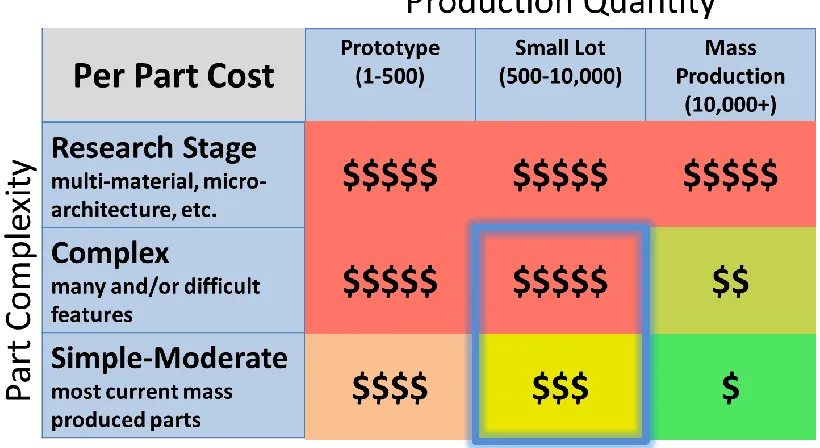
[image:20.612.106.516.197.421.2]Figure 1 highlights the manufacturing challenge inherent in low-volume production. As the figure shows, cost-competitive production is only possible when the part is mass produced. Low-volume production of both simple and complex parts presents the greatest challenge when transitioning from maker to manufacturer (shown in the bold box in Figure 1).30
Figure 1: Per part cost versus part complexity and production volume
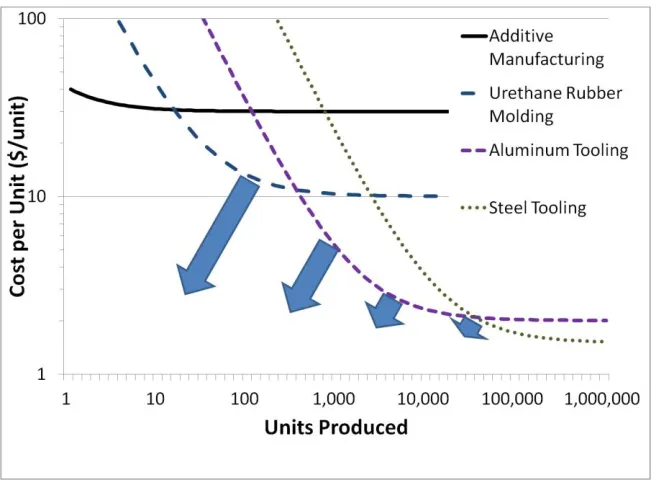
Figure 2 provides an example of how the manufacturing method impacts the per-unit cost of an item. In this case, four different processes for the production of plastic parts are compared. As expected, the per-unit cost drops as quantity is increased, but the final per-unit cost depends on the manufacturing approach. Each manufacturing method has a range of units produced that is the lowest cost option. The challenge for makers is that no manufacturing method currently exists that can provide low per-unit cost at low volumes.
30
Because manufacturing equipment for low-volume production does not yet exist, production is often carried out by hand, in prototyping labs or low-wage countries. Predictably, processes carried out by hand result in high variation and, in turn, a low quality product. Process innovation is needed to bring the cost per unit down for the critical 500 to 10,000-unit range, which is shown by the arrows in Figure 2.
Figure 2: Economies of scale for different manufacturing methods
Novel process innovations and improvements on existing manufacturing processes can form a foundation for more cost-effective, low-volume manufacturing. The hybridization of sensing, actuating, data collecting, and computing has enabled much more flexible forming, casting, molding, assembly, and other manufacturing processes. These advances can be combined to increase the flexibility and capability of automated systems or specialized robots to bridge the gap between maker and manufacturer. This advancement in flexibility offers benefits for both makers and large-volume manufacturers. High-quality goods can be precisely produced in a range of quantities using highly automated and interconnected agile systems.
4.3.1 Key Challenges
Six manufacturing process challenges impede domestic low-volume production.
1. There is a lack of manufacturing processes for economical, low-volume manufacturing, especially for metals and plastics. Current processes suitable for low-volume production often have high per-unit costs, resulting in a cost-prohibitive product. At the lowest volumes, 3D printing has high per-unit costs and low cycle times, making a scaled manufacturing system economically infeasible for most applications. The range of materials is also limited, and validation methods are not mature.
custom-made machine. Compared to low-volume production, manual production typically results in high part-variability. Quality control processes present the same set of challenges.
3. Process integration needs to be improved. Manufacturing, including assembly, is often a multi-stage process, with multiple machines creating, refining, combining, and testing multiple parts. To transition from making individual parts to manufacturing products, these machines need to work together by seamlessly transferring and sharing both material and information. This integration needs to be affordable and accessible to makers.
4. Tool/machine changeover is difficult and costly. When production volumes are low and part variety is high, changing a machine to produce another part involves a larger portion of the cost and machine time. Manufacturers are hesitant to take smaller jobs, because changeover often requires cleaning, changing jig configurations, inserting fixtures, molds, or dies, and sometimes changing materials. This problem is further exacerbated if new jigs need to be manufactured. A streamlined and automated changeover process would enable manufacturers to cost-effectively accept more small jobs.
5. Manufacturing software (especially analysis software) is complex, difficult, and costly. software, especially analysis software. A small manufacturer is usually not familiar with sophisticated general purposed analysis tools let alone the underlying math. These firms would benefit from easy to use interfaces and product-specific apps that are of interest for a narrow industry, part type, and/or manufacturing process. For instance, a small manufacturer can quickly select from a library of product variations, specify half-a-dozen parameters and quickly simulate the performance of a novel design.
6. Firms find the transition to fully-digital files complex. Manufacturing requires tolerances, local strength or microstructure, surface finish, and many other part features beyond the geometry of a new product. An industry-wide, standardized file format (a common file format) is needed to streamline digital communication of this information between manufacturers, makers, and if possible, machine tools.
4.3.2 Observations
Three important observations emerged from the workshop:
There is a need for consistent standards and educational pathways. There is strong
consensus that agility, speed to market, quick iterations in response to customers, and estimation of important properties such as cost and strength are important drivers for almost all industries and process types. Many software packages provide solutions to all of these issues and offer manufacturing simulations for process and product optimization. The key bottlenecks are the many choices available, the lack of comprehensive and uniform standards, and the barriers related to the knowledge and training in the several sub-domains that may be required to design and build a product and its related processes.
Process innovations are usually shared across a geographic area. Process innovations are
fundamentally different from product innovations in that they are usually too broad for a single company to control or derive profit. As a result, successful process innovations provide unusually large, broad, and sustained rewards to a region.
Current models for federal funding do not support process innovation from concept
products and is often the foundation for broad-based product innovation that can be sustained in a region.
The adage “Science is not Engineering” is a critical distinction to apply to the funding model.
Process innovation is firmly in the realm of engineering discovery, with progress achieved through creativity and synthesis. Additional support for engineering synthesis in manufacturing over the full range of MRL/TRLs (Technology Readiness Levels) can further enhance existing strong programs in fundamental and novelty-based research.
4.3.3 Current and Best Practices
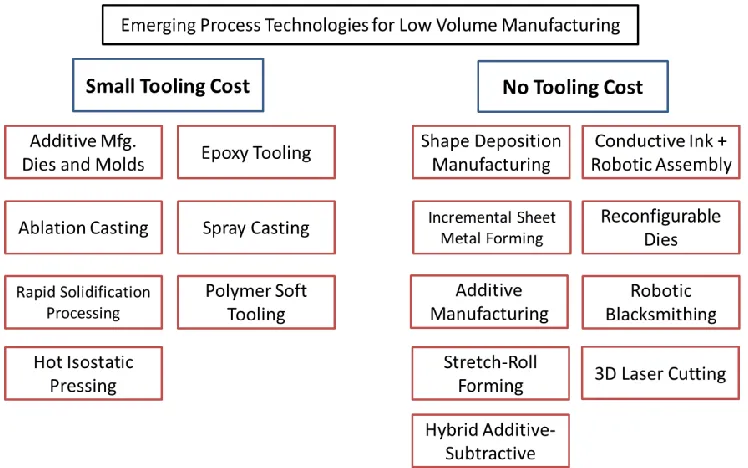
[image:23.612.119.493.259.493.2]A number of new technologies are under development to address the need for cost-competitive, low-volume production. In most cases, there is low or no tooling cost associated with these technologies (unlike large-volume production technologies.)
Figure 3: Emerging process technologies for low-volume manufacturing
Innovations in Hardware: Figure 3 shows a selection of emerging process technologies that
have low or no tooling cost and are thus well suited for low-volume manufacturing. Some technologies, such as robotic blacksmithing, are in the nascent stages. Other techniques, such as hot isostatic pressing, are established processes that are evolving toward new applications in low-volume manufacturing. All of these process innovations seek to solve the challenges presented in Figures 1 and 2 by providing low per-unit cost at low production volumes.
Emerging process technologies include the following:
Incremental sheet metal forming uses one or two CNC styluses to incrementally
deform a piece of sheet metal (see Appendix B).
Shape deposition manufacturing is a reiterative additive-subtractive process, in
Robotic blacksmithing uses a multi-axis robot arm, a heat source such as a laser, sensors, a force generating tool, and an integrated intelligent feedback system to incrementally forge a part (see Appendix B).
Additive manufacturing (AM) is used to create dies and molds for a range of
traditional manufacturing processes, such as stamping, blow molding, and hydroforming. The use of 3D printing lowers the time and often the cost of creating dies and molds, which enables low-volume manufacturing in traditionally high-volume methods and machines.
Epoxy tooling uses epoxy or a metal-filled epoxy to form the pattern of a mold or
die, often using 3D printed objects to shape the molds. Similar to tooling created by an additive manufacturing process, epoxy tooling has a lower capital cost, and thus the per-unit cost is decreased for low-volume production runs.
Polymer soft tooling uses machined polymer for the tooling (rather than traditional
metal) to lower capital costs for low-volume production.
Ablation casting uses liquid to ablate (remove) the sand casting material and
solidify the part in the process, providing a high-quality cast at high speeds.
Spray casting and rapid solidification processing produces metal near-net
shapes with superior material properties.
Hot isostatic pressing uses high pressures and temperatures to form metal
shapes; lower cost molds can be created for this process using modern prototyping methods.
Conductive ink and robotic assembly of electronics will enable assembled
printed circuit boards to be created within minutes on a desktop.
Reconfigurable dies can be transformed into a multitude of desired shapes, thus
eliminating tooling cost.
Advances in massively parallel printing and improved metal printing will
transform AM machines from prototyping tools to manufacturing equipment.
Stretch-roll forming uses rollers to stretch and bend sheet metal into a desired final
shape, eliminating the need for stamping dies.
3D laser cutting uses one or more lasers in a full 3D motion path to create 3D
shapes. Simple applications exist commercially, but complicated parts and user-friendly software are active challenges.
4.3.4 Actionable Recommendations
The following initiatives can help make the U.S. a world leader in process innovation:
1. Improve the funding and R&D model: Federal funding agencies should be
incentivized to support the development of engineering synthesis (as opposed to pure analysis). Federal science and technology agencies are urged to increase their focus on engineering research related to design synthesis and manufacturing process innovations.
2. Invest in R&D to develop and mature technologies that support low-volume
a. Automated artisan processes: Robotic systems that duplicate hand production for blacksmith processes,31 painting, surface finishing, and composite lay-up have the clear advantages of machine-based reproducibility, strength, and sensing that dramatically exceed human capability. These systems will enable low-volume production using traditionally high-volume processes by removing the tooling cost. In addition, if properly configured, these systems can collect data to form a foundation for verification, validation, and meeting standards.
b. Massively parallel and/or higher throughput 3D printing: 3D printing is
currently economically not feasible for most low-volume manufacturers. A large-scale R&D effort should focus on massively parallel 3D printing, where entire layers and/or large regions are printed together. Furthermore, integrated quality control and in situ monitoring needs to be incorporated into 3D printing systems.
c. System integration and changeover: Technologies for manufacturing system
integration and changeover need to be developed. These include novel jig design, interchangeable elements with standard connections and communication protocols, reconfigurable tools, and robotic automation of changeover tasks.
3. New generations of manufacturing software: Another opportunity exists in the
integration of product design with manufacturing constraints in software, which can be accomplished in two primary ways:
a. “Autopilot”: The software does the design itself, with manufacturing constraints
built in to the design software process, so that every design will be fully manufacturable. In this way, the user is relieved of the task of designing for manufacturability.
b. “GPS”: The software informs the user when it identifies a manufacturing issue in
the design and suggests solutions. This approach guides the user toward a manufacturable design.
4. Customized manufacturing apps: Apps should be developed that are tailored for
manufacturing processes, product categories, and/or specific industries. These apps can be built on existing CAE, FEA, and other software and should simplify the design tools for the maker, while providing enhanced functionality.
4.4 Encouraging the Formation and Growth of Manufacturing Businesses
Entrepreneurs who have found success with prototype production often wish to become full-scale manufacturers. However, it is difficult for a domestic manufacturing firm to grow and thrive when off-shore manufacturing services are readily accessible and cost-competitive. During the workshop, several participants described the competitive advantages offered by contract manufacturing firms in China based on their first-hand experience. This valuable information illuminates a number of very logical reasons why U.S companies choose to contract for manufacturing off-shore.
Table 1 lists a number of factors that make contract manufacturing in China appealing to U.S. companies. These factors illustrate that Chinese firms offer much more than low-cost production
31
capacity. Instead, these firms provide their customers with a comprehensive service model that addresses all aspects of manufacturing, including capital investments, logistics/supply chain, and the availability of skilled labor. Low-wage labor is only one of many competitive advantages.
Competitive Advantages offered by Offshore Manufacturers
Capital Contract manufacturers (CM) will often provide needed-capital for tooling and NRE32
CM firms are more risk-tolerant, but frequently require an ownership fraction
Ease CMs offer “One-stop-shopping” with a single point-of-contact for services and
systems integration
CMs are typically willing to modify tooling for revisions
Cost Parts are often 30% cheaper by using plastics and tooling
Transport costs are not a significant fraction of total cost Energy costs are modest
Labor CMs have ready-access to a large, low-cost, technically-skilled workforce
On-site manufacturing staff are available during production runs
Technical specialists can be brought in to solve critical manufacturing problems
Table 1: Reasons to manufacture products off-shore
To compete against the formidable competition from off-shore manufacturers such as China, America’s smaller manufacturers need to look at specialized markets and acquire new skillsets. Specifically, companies should:
Target specialized markets that require products that are ill-suited for the off-shore, high-volume production model. For example, domestic firms are often given preference by the Department of Defense (DoD) and other federal agencies with set-asides often in place for small businesses. Production of low-volume or IP-sensitive parts is another specialized market.
Adapt innovative new business practices to more effectively compete with off-shore production. For example, collaborative manufacturing partnerships allow smaller firms to blend their complementary capabilities in order to win specialized manufacturing jobs.
Compete for production contracts that require specialized skills. Smaller firms can compete for high-value manufacturing jobs more effectively by upgrading their digital design and manufacturing skillset and investing in digital design tools.
Specialized Markets
Tap into Federal Markets: The DoD purchases more than $200 billion of manufactured goods each year and is becoming increasingly reliant on foreign suppliers for parts. Approximately 32,000 businesses make up the DoD supplier base—about one-eighth of the number of U.S. manufacturers. Ideally, DoD should have efficient access to all U.S. manufacturers to find a supplier with the right capability and the capacity at the right time. However, communicating with the Federal Government can be difficult because many government regulations can hinder the smooth flow of information.
Low-Volume Production: U.S. manufacturers can successfully compete with off-shore producers by focusing on low-volume manufacturing contracts, especially those jobs that may
32
require frequent changes and modifications. This situation is best served when the manufacturer and the customer can meet and collaborate in-person (which is difficult when the parties are separated by an ocean and multiple time zones). A collaborative partnership also allows the manufacturer to innovate new manufacturing processes to meet the customer’s unique needs.
Corporate Guaranteed Orders (Made in USA Initiatives): U.S. corporations such as Wal-Mart are adapting policies to purchase more domestically manufactured products, and to re-shore goods currently manufactured outside the U.S. These initiatives offer an excellent opportunity for American manufacturers to partner with a large corporate customer. Walmart has established a web-based manufacturing portal (JUMP) to propose products for sale in stores, and to network with other manufacturers.33
Intellectual Property (IP) Protection: For IP-sensitive products, domestic manufacturing offers the advantage of a strong legal system designed to protect innovative designs and processes. Intellectual property concerns have consistently placed among the top handful of issues raised by businesses that contract for manufacturing in China. U.S. manufacturers can meaningfully differentiate themselves from off-shore competition by offering a production environment that protects the customer’s IP.
New Business Practices
Collaborative Manufacturing: To successfully compete with low-wage, off-shore manufacturing, companies can enter into collaborative manufacturing relationships. These collaborations are established with a group of (10-20) companies with interlocking business relationships so that they can bid competitively on large complex projects, which none could act on alone.
Total Cost of Ownership: Many companies make acquisition decisions based on price alone, and omit other cost factors such as acquisition, shipping costs, shipping time, storage costs, inventory costs currency fluctuations, intellectual property risk, financing costs and risks of interruptions to a stretched supply chain34. This can result in a 20-30% miscalculation of the true cost of purchasing off-shore. To educate potential customers about the true cost of purchasing products produced off-shore, domestic SMMs can use on-line Total Cost of Ownership tools for cost-data35.
Manufacturing Franchises: Forming a successful business requires both technical and business skills, but a vision for the business niche and a passion to succeed is essential. Several resources should be put in place to promote formation of industrial support enterprises. Resources might include:
a) Classes on CNC machining at a local community college.
b) Engaging with a local MEP to understand the customer demand.
33
http://engage.walmart-jump.com/
34
This point recommendation echoes a similar recommendation provided in a White House Report “Supply Chain Innovation: Strengthening America’s Small Manufacturers”, March 2015.
See also the Department of Commerce’s Assess Costs Everywhere (ACE) tool at: http://acetool.commerce.gov/ and Terry Weiner, “The Importance of Total Cost of Ownership (TCO),” CMTC Manufacturing Blog, January 21, 2014, available at: http://www.cmtc.com/blog/bid/156131/The-Importance-of-Total-Cost-of-Ownership-TCO.
35
c) Teaming with a U.S-based CNC manufacturer to identify appropriate machinery (hardware and software).
d) Securing a business loan from the Federal and/or State government to acquire space and equipment needed.
Such an effort could take the form of a “franchise model”, where candidate entrepreneurs attend training to help them understand business fundamentals and get medium-term support to progress towards sole proprietorship.
Hypothetical example: A high-school graduate is not interested in pursuing college but has some basic math and science acumen along with a passion for business. Over the course of a relatively short educational term and apprenticeship (6 mo. – 2 years), an individual could work in a variety of skilled manufacturing jobs such as injection mold operator, CNC operator, welder, millwright, etc. Such an individual could be granted a franchise within an MEP-sponsored job shop, where they are given advice on the market’s appetite for various forms of trade support, access to capital for machine purchase, low rent in a shared space with supporting resources, outreach and bid/proposal support, technical support, and inclusion in a collaborative community of complementary trade support. As jobs are worked, a fraction of the revenue would go towards repaying the equipment cost. After this is repaid, the individual would be free to re-locate to a space of their choosing to grow/and manage their own business.
As awareness to such a program might grow, the curriculum portion of the preparation could be steadily shifted into middle school and high school to allow students to explore and build passion in their formative years with a greater expectation that it could progress into a career. The private sector job-shop system in the U.S. does provide access to some of these aspects, but in a very ad-hoc way. That is, the quality of experience and access to opportunity varies widely from one shop to the next. In addition, individual job shops may not be positioned to understand emerging market opportunities. Ideally, regional MEP resources will be informed on local industrial needs and provide feedback to aspiring business owners. This model could be applied to other types of fabrication services such as 3D printing or engineering services such as CAD/CAE or manufacturing services such as injection molding.
Skills Enhancement for Business Growth
U.S. firms can successfully grow into new markets by acquiring specialized skills. This is a good strategy for the vast majority (greater than 85%) of the nation’s 250,000 SMMs that do not currently use digital design and manufacturing tools (typically because of cost and expertise constraints). A SMM that uses digital design and manufacturing tools can more effectively compete for high-value manufacturing jobs.
The benefits of advanced digital design and manufacturing tools were demonstrated in 2011 with the National Design Engineering and Manufacturing Consortium (NDEMC). Initiated by the Office of Science and Technology Policy (OSTP) and funded by the Department of Commerce, P&G, John Deere, GE, Lockheed Martin, and Boeing, NDEMC paired SMMs with existing computational resources and support provided by the Ohio Supercomputing Center.
4.4.1 Actionable Recommendations
1. The DoD, in collaboration with NIST-MEPs, should explore ways to lower barriers for U.S.-based SMEs to bid on manufacturing services. An easy-to-search national database of manufacturing capabilities would allow manufacturers to quickly identify potential manufacturing jobs based on their specific capabilities. Procurement by other U.S. government agencies should be included in the bidding site as well.
2. The Federal Government and state governments, in collaboration with the private sector, should encourage the formation of manufacturing services businesses that can be franchised to freelance makers and manufacturers. Information on existing federal loan guarantees that are specific to manufacturing should be provided to potential franchisees.36
3. It is recommended that on-line educational seminars or classes be developed to teach sales personnel at domestic manufacturers the benefits of Total Cost of Ownership calculations, and to use the results persuasively during negotiations with customers.
4. Programs such as NDEMC should be replicated, pairing SMMs with available digital tools (hardware and software) at local colleges and universities in order to increase the technical skillset of SMM employees.
4.5 Improved Access to the U.S. Supply Chains
The benefits of a strong domestic manufacturing sector reach far beyond the creation of manufacturing jobs at lead firms. The manufacturing supply chain (both direct and indirect) is woven throughout the economy and the communities in which we all work, live, and play. The greater manufacturing community consists of a diverse group of entities: OEMs at the top, SMMs that support the OEMs as mid-tier suppliers, the education and workforce development community, universities, unions, national labs involved with R&D, transportation infrastructure, and the cultural, arts, recreation, and food-related businesses. Close-knit relationships among firms in a supply chain offer advantages that result in improved products, processes, and services. These advantages include joint R&D projects, continuous improvement of products and processes, and reduced inventory.
For the U.S. to grow and sustain its manufacturing base in the face of international competition, a greater focus must be placed on supply chain development. Key challenges include providing better access to supply chains for new firms, and improved ability to collaborate and innovate among firms already participating in supply chains. An important best practice is a two-way value chain where all parties work collectively, regardless of size, to better understand each other’s needs and business dynamics (and work to address them).
36
Many Federal programs exist to support small manufacturers, but these programs can be difficult for a small firm to identify. An initial listing of available federal resources is provided in the AMP2.0 report in the Supplement Annex 32.
See the section titled: Federal Financing Programs Relevant to Manufacturing Scale‐Up at: