2018 International Conference on Information, Electronic and Communication Engineering (IECE 2018) ISBN: 978-1-60595-585-8
Bidirectional Analysis for XQuery Incremental Computation Program
Automatic Generation
Xue-yun JIN
Beijing University of Technology, Beijing, China
Keywords: Incremental computation, Code automatic generation, Bidirectional analysis, XQuery.
Abstract. Incremental computation needs complex algorithm design and tough software maintenance. A bidirectioanal analysis technique is proposed to implement XQuery incremental computation program automatic generation based on the syntax of XQuery language. It can implement program transformation by bottom-up upward modification propagation analysis and top-down downward structure analysis, generate incremental computation program code automatically in light of the input data modification of the computation to obtain new result. The execution performance of the incremental computation program is better than that of recomputation.
Introduction
Incremental computation has been broadly applied in computer software field. The result of a computation may change when its input data is modified. Recomputation may result in unnecessary overload. Tiny changes in input data always have small influence on its result, so if incremental computation technique can get the influence of the change in input data on the original result, then a part of the original result can be updated to get the new reseult. On the other hand, XML data is semistructure data; it supports document order and axis operation, and XQuery is a functional, Turning-Complete programming language. Therefore, traditional query optimization technique on relational data can not be used in this senario. In order to solve this problem, a bidirectional Analysis technique for XQuery increamnetal computation program automatic generation is proposed in this paper. It performs program transformation for XQuery program, generates XQuery incremental program code automatically according to the change in the input data without index and schema information, and doesn’t need to store auxiliary data in the process of generation.
The formal description of incremental computation is: given computation f, input data d, the result of f(d) is r. That is f(d)=r. When there is a data modification Δd in d, it causes a change Δr in
r to make it becomes r’. That is f(d⊕Δd)=r’ where a⊕b means operating b on a. If Δr can be obtained and know how to operate it on r, then r’ can be obtained by r⊕Δr. That is, r’= r⊕Δr.
In this paper, an incremental computation method INC is proposed to deal with f, d, Δd and r to obtain r’. Here f is written in XQuery language, and d is XML data. That is, INC(f, d, Δd, r)=r’. In order to achieve this aim, an incremental computation program automatic generation method IA is proposed based on bidirectional analysis for generating an incremental computation program pinc to
implement operating Δr on r. That is, IA(f, d, Δd)= pinc, and pinc (r) = r’.
The contributions of this paper are: (1) XQuery incremental computation method. As a general-purpose method, it generates incremental computation program pinc automatically; (2)
Bidirectional analysis technique for incremental compuation code generation. Bottom-up upward modification propagation analysis and top-down downward structure construction analysis are used to generate incremental computation program automatically for an XQuery computation with branching and user-defined function, without index, schema and auxiliary data.
Preliminaries
Figure 1. XQuery/XPath Core Syntax.
Here x is variable, c is constant, e is expression, op is binary operator, p is program. expath is an
XPath expression which has several XPath test steps s. s is consist of an axis test at (child test “/” or
descendent test “//”), a name test nt (XML element or attribute label) and an optional predication test pt. “*” is wild-card. ep can be null because it is an optional predication expression.
FXQL language is a functional XML query language based on λ calculus as intermediate language used to describe the query plan of XQuery computation. Every XQuery computation will be translated to an FXQL program at first. It provides enormous primitive functions to implement data process and program logic controll. The core syntax of FXQL is shown in Figure 2.
Figure 2. Core Syntax of FXQL.
Modification region reg is a tuple (i, k, rnew) used to describe the influence on XQuery
computation result caused by data modification where i and k are integers and rnew is an XML node
sequence. It means the influence range caused by data modification is k items from the ith item, and the new result can be obtained by update these k items by rnew. Modification region group regs is a
collection which consists of one or more modification region reg.
Bidirectional Analysis Rule
Bidirectional analysis rule is the core of XQuery incremental computation automatic generation method based on bidirectional analysis. Except downward analysis rule and upward analysis rule, there is a start rule used as the first rule to invoke incremental algorithm.
Γ, Γd and Γu represent the context environment of start rule, downward analysis rule (called IncDown) and upward analysis rule (called IncUp). These environments store expression closure, function closure, modification region group and modification operation. The format of start rule is “Γ├e:p”, and the format of IncDown rule is “Γd├e:p”, they mean that under specific context Γ or Γd, the transformation result of expression e is incremental computation program p. The format of IncUp rule is “Γu╞e:regs”, it means under specific context Γu, modification region group regs for expression e can be found. d is input data, Δd is input data modification. Some helper functions are used to describe these rules. These helper functions are shown in Table 1.
Table 1. Helper Fucntion.
Helper Function Function Description
v=eval(e,Γ,d) Under Γ, evaluate e on d, the result is v.
v=n-eval(e,Γ,Δd,d) Under Γ, evaluate e after data modification Δd takes place on d, the result is v.
p=gen(regs) Generate Incremental Computation program p according to regs.
p’=p-create(p) Package incremental computation p to a complete XQuery program p’.
regs=IA-REGS(e, Δd, d) Generate regs according to e, d and Δd. IA-REGS is modification region group capture algorithm.
reg=c-reg(i, k, rnew) Generate new reg according to i, k and rnew.
reg’=u-reg(reg, i, k, rnew) Update an original reg to a new one reg’ according to the value of i, k, and rnew.
n=| s | Count number of items in a sequence s.
When generating incremental update code, the first called rule is start rule START (shown in
Fig.7). It copys Γ to Γd, and calls IncDown rule to deal with FXQL expression e to obtain incremental computation program p. Then p is packed according to XQuery syntax, to get a program p’ which can incrementally maintain the result r of an expression e.
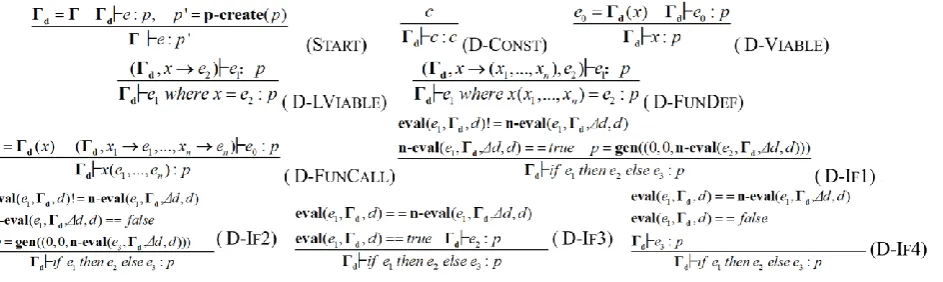
constructing procedure of the computation value top-downly, and generate incremental computation program according to the regs obtained by upward analysis rule IncUp. Part of IncDown rules are shown in Figure 3.
Figure 3. Start Rule and IncDown Rules.
Here D-CONST,D-VIABLE,D-LVARIABLE,D-FUNDEF and D-FUNCALL deal with const expression,
variable expression, local variable expression, function definition expression, function call expression respectively. For conditional expression e::=if e1 then e2 else e3, the value of it depends
on the value of e1. If the data modification doesn’t affect the value of e1, just maintain the original
result. Otherwise, e2or e3 should be computed. Therefore, there are 4 rules D-IF1,D-IF2,D-IF3and
D-IF4. Rule D-UN is responsible for the primitives that we can not deal with.
IncUp rule generate and maintain modification region group according to d, Δd and e. Parts of IncUp are shown in Figure 4.
Figure 4. IncUp Rules.
Here, U-CONST, U-VIALBLE1, U-LVIABLE, U-FUNCALL and U-FUNDEF are used to deal with
const expression, variable expression, local variable definition expression, function definition expression, function calling expression. For conditional expression e::=if e1 then e2 else e3, there
are still 4 rules U-IF1,U-IF2,U-IF3 and U-IF4. Rule U-UN is responsible for the primitives that we
can not deal with. It just calls n-eval to obtain a modification region to replace the original result.
Experiments
The hardware of the experiment is: the CPU is Intel(R) T6670 @2.20GHz, RAM is 3.00GB, Windwos7 professional. It uses 13 use cases which overlaps all kinds of XQuery syntax. bib.xml
provided by W3C is used as XML data source. 5 data sources of size 10M, 20M, 40M, 100M and 400M have information of 32768, 66536, 131072, 327680, and 131070 books respectively.
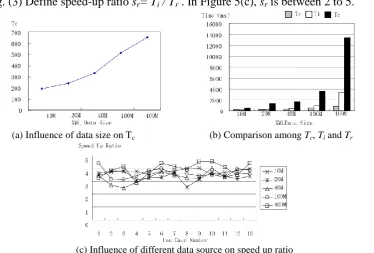
Generation time Tc, incremental maintenance time Ti and recomputation time Tr are recorded.
Tc denotes the time period to generate an incremental computation program. Ti denotes the time
period of executing the incremental computation program. Tr denotes recomputation time period.
[image:3.595.87.511.399.555.2]bigger the Tc; (2) According to Figure 5(b), when the size of XML data increases, the distance
between Ti, Tc and Tr increase too. Therefore, this method has advantage when the size of data
source is big. (3) Define speed-up ratio sr= Ti / Tr. In Figure 5(c), sr is between 2 to 5.
(a) Influence of data size on Tc (b) Comparison among Tc, Ti and Tr
[image:4.595.115.490.104.357.2](c) Influence of different data source on speed up ratio
Figure 5. Experiment Result.
Relative Works
Nowadays, incremental computation is acknowledged as a technique which can improve performance in various fields [1]. XML data is semi-structure data, and the standard language of XML data query XQuery is functional language which has notable difference from SQL language. Therefore, the relative technique in relational database field can not be used on XML data query optimization, and new technique and method should be studied to implement incremental computation. Relative works [2,3] all study the incremental maintenance of XML materialized view. Paper [2] use XAM (XML Access Modules) to represent XML storage, index or materialized view, use select to implement join operation on Cartesian product in tree pattern algebra. Because there are lots of items need to be maintained, some pruning operation should be done according to the data modification, and incremental maintenance is implemented by computing updated parts of materialized view according to data modification and the tree pattern algebra. Paper [3] uses Tree algebra of Galax which is established on tuple. It translates XQuery program into Tree algebra of Galax in order to avoid the complexity of XQuery syntax, and only deal with the computation with simple operator with combined semantics. It provides update propagation rule according to every algebra operation. In query phase, it stores auxiliary data for every operator. In update propagation phase, all algebra operators in Tree algebra are processed recursively, and stores auxiliary data to promise the execution of the propagation rule. Paper [4] tries to develop an incremental maintenance method for XQuery materialized view, but not with this bidirectional method. Paper[5] uses the theory of incremtnal computation andproposes a dynamic scheduling for online integration plans, which employs data increment monitoring system which is able to dynamically change the data integration plans whenever it is necessary.
Conclusion
and generate incremental computation program code automatically for this computation. It can obtain new result according to the original result of the comuptation before data modification. The executing performance of the incremental computation code is better than that of recomputation.
References
[1] G.Ramalingam and T.Reps. A categorized bibliography on incremental computation. Conference Record of the 20th Annual ACM Symposium on POPL, Charleston, South Carolina, January 1993: pp. 502-510.
[2] K. Dimitrova, M. El-Sayed, and EA Rundensteiner: Order-sensitive view maintenance of materialized xQuery views. In ER, Oct. 2003: pp.144–157.
[3] J. Nathan Foster, Ravi Konuru, Jerome Simeon, and Lionel Villard. An algebraic approach to XQuery view maintenance. In ACM SIGPLAN Workshop on Programming Language Technologies for XML (PLAN-X), San Francisco, CA, January 2008: pp. 31-42.
[4] Jin, Xueyun, and Husheng Liao. "An incremental maintenance method for XQuery materialized view." international conference on mechatronic science electric engineering and computer (2011): 797-801.