2018 2nd International Conference on Modeling, Simulation and Optimization Technologies and Applications (MSOTA 2018) ISBN: 978-1-60595-594-0
A Module Layout Method of Emergency Rescue Equipment Box
Based on Layer Space
Yong-ming BIAN
*, Fei GAO, Qiao LI,
Meng YANG,
An-hu LI and Guang-jun LIU
College of Mechanical Engineering, Tongji University, Shanghai 201804, China
*Corresponding author
Keywords: Emergency rescue equipment box, Layer space, Evaluation index, Module layout, Genetic algorithm.
Abstract. Module layout of emergency rescue equipment box is a special three-dimensional (3D) bin-packing problem, whose mathematical description is that under the condition of fixed capacity, the corresponding value of equipment in the box is maximized. Through the analysis of the characteristics of the emergency rescue equipment box, three evaluation indexes, including the average height of centroid, the average distance of access and the functional distance of equipment, were proposed first. In order to obtain a more ideal 3D packing scheme, a module layout method based on layer space using genetic algorithm was also proposed. These equipments to be arranged were encoded in decimal. According to the fitness function and the objective function, the selection, crossover and mutation operations of decimal sequence were conducted. After the iteration, the value of objective function gradually approached to the optimal solution. To evaluate the performance of the proposed method, some simulations under the MATLAB were performed. Finally, the experimental results show that the proposed method can achieve a better optimization effect, proving its effectiveness and feasibility.
Introduction
This paper designs a module layout method of emergency rescue equipment box. According to the spatial structure, the emergency rescue equipment box is subdivided into area, layer and belt. A module layout method based on layer space using genetic algorithm is offered with three evaluation indexes, including the average height of centroid, the average distance of access and the functional distance of equipment. At last, some simulations under the MATLAB software were carried out to evaluate the effectiveness of the module layout method.
Module Layout of the Equipment Box
Analysis of Module Layout Problem. As a 3D bin-packing problem, module layout of the equipment box has great speciality. Mainly reflected in the following points:
(1)The overall structure of the equipment box is not a standard cube. It can't be directly described in the algorithm with simple data of length, width and height.
(2)The internal structure of the equipment box is complicated. Hence, it is very hard to optimize the access route, and it is necessary to define the access rate in combination with the actual rescue situation[9].
(3)So as to improve space utilization, varieties of conditions are required, such as limited space, equipment and so on. Therefore, improving space utilization under various constraints has become an indispensable part of the algorithm.
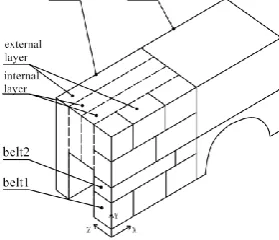
[image:2.595.226.366.402.522.2]Evaluation Indexes Based on Layer Space. From the analysis of equipment box characteristics in the previous section, the structure of the equipment box is unique. In order to describe the structure of the equipment box, the concept of area, layer and belt is introduced, as showed in Figure 1.
Figure 1. The structure of the equipment box.
The layer space Bi is taken as the research object, and the evaluation indexes of the module layout
method are defined.
(1) the average height of centroid Ci
Ci describes the average centroid height of all equipments in any layer space. The centroid height
and weight of equipment Ei is defined as ci and mi. Ci is defined as follows:
1
1
n
i i
i
i n
i i
c m C
m
(1)
(2) the average distance of access Ti
Ti describes the average distance when any equipment is removed from a typical rescue scenario.
The session of equipment Ei is defined as fi and its value range is {1,2,…,10}. Define hb as the
optimum height for equipment and its value is based on ergonomic principles[10]. Definition of Ti is
as follows:
1
1
n
i i i b
i
i n
i i
f m c h T
m
(3) the functional distance of equipment Fi
Fi describes the average distance between equipments with similar functions. Define the equipment
relationship as matrix R to describe the degree of functional similarity between equipments[11]. The relationship matrix R is defined as follows:
1 11 12 2 21 22 1 2 n n
n n nn
R R R
R R R
R R R
R (3)
The functional similarity of the equipment Ei and Ej is represented as Rij. The larger the value, the
higher the similarity of the equipment functions. When Rij =0, it indicates that the two equipments
have no functional association.
Define the equipment distance matrix A to describe the physical distance between the equipment. The equipment distance matrix A is defined as follows:
1 11 12 2 21 22 1 2 n n
n n nn
A A A
A A A
A A A
A (4)
Aij indicates the distance between the centroids of the equipment Ei and Ej. The equipment
functional distance Fi is defined as follows:
1 1
2 1
n
nij ij j i i i
R A F
n n (5)
Design of the Module Layout Method
According to the characteristics and requirements of emergency rescue equipment box module layout, the genetic algorithm is utilized to design the module layout method based on layer space.
Coding. The solution of the module layout is a layout scheme. Firstly, according to the genetic algorithm, the layout scheme is coded to generate an optimization chromosome and initial population[12]. Make the following definitions for the module layout rules: An equipment group is defined as Eo. All equipments in the group are arranged in the layer space Bi in an orderly manner.
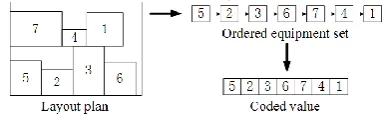
Any layer space can be divided into n belt space, which are named as belt a, b until n from the bottom to the top. Equipments are placed in the horizontal direction until belt a can't store the next equipment. At this time, find the highest point in the vertical direction of belt a, and use it as the starting point of belt b in the vertical direction. Repeat the operation and cycle through the process until equipments are completely placed.
[image:3.595.199.393.665.725.2]Depending on the above rules, there is a unique layout scheme for any equipment group Eo. It is coded by sequence coding, and the code number of the equipment is formed by the series decimal number[13]. The encoding process is illustrated in Figure 2.
Figure 2. The coding process of equipment layout scheme.
definite relationship with the objective function. Before designing the fitness function, we should firstly determine the objective function of the optimization.
In previous section, three evaluation indexes of the module layout method are proposed: the average height of centroid, the average distance of access and the functional distance of equipment. The smaller the value of these evaluation indexes, the better the optimization of the module layout. In other words, optimizing properties and directions of these indexes are identical. Thus, the method of weighted linear combination is used to combine the various indexes into the objective function:
i kcfc Ci kt f Tt i kf ff Fi (6) In the formula: Ci, Ti and Fi are the average centroid height, the average access distance and the
functional distance of equipment of the i-th layer space. fc, ft and ff are the normalized function of the
average centroid height, the average access distance and the equipment's functional distance. kc, kt and
kf are the weighting factor of the average centroid height, the average access distance and the
equipment's functional distance.
Since each index has a large difference in value, these indexes are normalized by fc, ft, and ff. If the
upper limit of the optimization index is α and the lower is β, the index is converted into a range of 0~1.
,
x
f x x (7)
The weighting factors kc, kt, and kf reflect the weight of the three evaluation indexes, and their
values depend largely on experience. When the weighting factor satisfies equation 8:
1
c t f
k k k (8) i
is in the range of 0~1, at which time i can be used as a fitness function.
Selection, Crossover and Mutation Operator. The module layout scheme is mapped to a set of decimal sequences by encoding. Therefore, the design of selection, crossover and mutation is the key of the genetic algorithm[15]. Selection operator takes into account the degree of individual adaptation to the environment. Generally speaking, the probability of being selected to reproduce the next generation is as follows:
1
s m
k
i P i
k
(9)
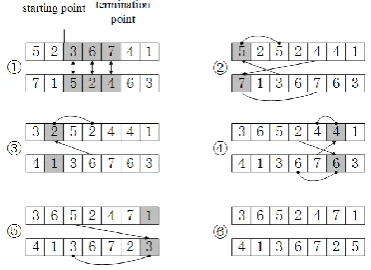
The crossover operator obtains new offspring by exchanging partial genes of parents. For a set of decimal sequences, The example of two individuals crossing process is shown in Figure 3.
The mutation operator is a mutation of a gene on an individual chromosome[16]. There is an example of an individual variation process in Figure 4.
[image:4.595.75.261.605.740.2]Figure 3. The example of two individuals crossing
Simulations of the Module Layout Method
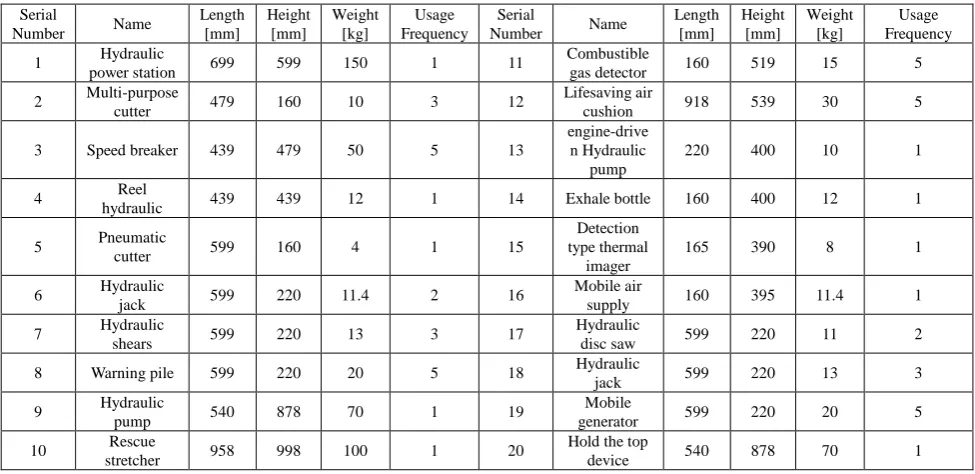
Select a certain equipment box and several equipments to verify the evaluation model and module layout method which are proposed in this paper. The size of a layer space in the equipment box is
Li=2500mm, Hi=3000mm. Choose 20 equipments as test objects, and the parameter information of
the equipment modules is shown in Table 1. For the convenience of research, the center of mass is the geometric center of the equipment.
The functional similarity between pending equipments is shown in Table 2. The others which are not included in the table are 0.
Determine the population number N=50, the initial layout scheme is randomly generated by the algorithm, the mating probability Pc=0.8, and the mutation probability Pm=0.1.
[image:5.595.54.542.301.538.2]In order to ascertain the approximate range of the average height of centroid, the average distance of access and the functional distance of equipment, these indexes are optimized for optimization targets. The optimization process is illustrated in Figures 5.
Table 1. The parameters of pending equipments.
Serial
Number Name
Length [mm] Height [mm] Weight [kg] Usage Frequency Serial
Number Name
Length [mm] Height [mm] Weight [kg] Usage Frequency
1 Hydraulic
power station 699 599 150 1 11
Combustible
gas detector 160 519 15 5
2 Multi-purpose
cutter 479 160 10 3 12
Lifesaving air
cushion 918 539 30 5
3 Speed breaker 439 479 50 5 13
engine-drive n Hydraulic
pump
220 400 10 1
4 Reel
hydraulic 439 439 12 1 14 Exhale bottle 160 400 12 1
5 Pneumatic
cutter 599 160 4 1 15
Detection type thermal
imager
165 390 8 1
6 Hydraulic
jack 599 220 11.4 2 16
Mobile air
supply 160 395 11.4 1
7 Hydraulic
shears 599 220 13 3 17
Hydraulic
disc saw 599 220 11 2
8 Warning pile 599 220 20 5 18 Hydraulic
jack 599 220 13 3
9 Hydraulic
pump 540 878 70 1 19
Mobile
generator 599 220 20 5
10 Rescue
stretcher 958 998 100 1 20
Hold the top
device 540 878 70 1
Table 2. Functional similarity between pending equipments.
Serial number Serial number Similarity
11 12 4
9 10 3
1 9 2
13 14 2
14 15 3
[image:5.595.147.452.556.739.2]15 16 4
Figure 5. The optimization process of three indexes.
From the results we can see, when the average centroid height Ci is the only target of the algorithm,
the approximate range of values is 896.3-1508.5 mm. When the average access distance Ti is the only
function distance Fi is the sole target of the algorithm, the approximate range of values is 25.9-115.0
mm.
According to the above results, three evaluation indexes are normalized by using equation 7. Combine these indexes by using the weighted linear combination method, for kc=0.4, kt=0.3, kf=0.3.
[image:6.595.223.370.176.284.2]The comprehensive evaluation index function is obtained by equation 6, and the method is used again for optimization. The result is presented in Figure 6. The comprehensive evaluation index value reduced from 0.64 to 0.31, a decrease of 51.6%.
Figure 6. The optimization process of comprehensive evaluation index.
[image:6.595.98.457.309.412.2]The optimization process of each sub-index is showed in Figure 7.
Figure 7. The optimization process of each sub-index.
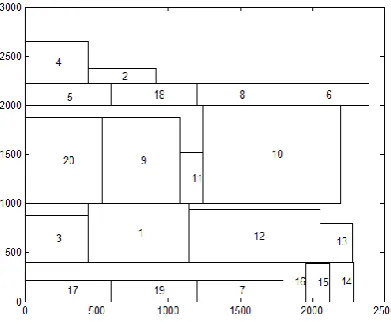
Among them, the average height of centroid reduced from 1249.2mm to 1098.6mm, a decrease of 12.1%. The average distance of access reduced from 1299.7mm to 1107.5mm, a decrease of 14.8%. The functional distance of equipment reduced from 122.4mm to 40.36mm, a decrease of 67.0%. The result of the module layout method is shown in Figure 8.
Through the analysis of the above results, the average height of centroid, the average distance of access and the functional distance of equipment have different reduced degrees in the optimization process of the module layout. As we analyze in the design of the module layout method, when the average height of centroid is decreased, the stability of the equipment box is improved. When the average distance of access is reduced, the time for taking the equipment is reduced in the rescue environment. When the functional distance of equipment is reduced, equipment with higher similarity is arranged in the same range of accessibility and the rescue efficiency is improved. The effectiveness of the module layout method is proved by the layout results and the data analysis of each index.
[image:6.595.198.394.607.768.2]Summary
This paper proposes a module layout method of emergency rescue equipment box based on layer space. Through the analysis of the module layout problem, the average height of centroid, the average distance of access and the functional distance of equipment are taken as three evaluation indexes. According to the genetic algorithm, the pending equipments are firstly encoded in decimal coding. After establishing the fitness function and the objective function, selecting, mating and mutating the decimal encoded sequence based on the target. Finally, an ideal 3D packing solution was compiled and checked by simulations.
Acknowledgement
This research was financially supported by National Key R&D Program of China (Grant No. 2016YFC0802900).
References
[1] Zhang Defu, Peng Yu, Zhang Lili. A Multi-layer heuristic search algorithm for three dimensional container loading problem[J]. Chinese Journal of Computers, 2012, 35(12):2553-2561.
[2] Tony Wauters, Jannes Verstiche, Greet Vanden Berghe. An effective shaking procedure for 2D and 3D strip packing problems[J]. Computers & Operations Research, 2013, 40(09): 2662-2669.
[3] Fanslau T, Bortfeldt A. A tree search algorithm for solving the container loading problem[J]. Informs Journal on Computing, 2010, 22(2): 222-235.
[4] Junqueira L, MorabitoR, Yamashita D S. Three-dimensional container loading models with cargo stability and load bearing constraints[J]. Computer & Operations Research, 2012, 39(1): 74-85.
[5] Li Suncun, Shi Xinling, Zhang Songhai et al. Multi-variant optimization algorithm for three dimensional container loading problem[J]. Acta Automatica Sinica, 2018, 44(01): 106-115.
[6] Cui Huifen, Xu Jiayu, Zhu Hongguo et al. Study on three dimensional single box packing based on improved genetic algorithm[J]. Industrial Engineering and Management, 2018, 23(01): 86-89.
[7] Liao Xing, Yuan Jingling, Chen Mincheng. Parallel PSO container packing algorithm with adaptive weight [J]. Computer Science, 2018, 45(03): 233-236.
[8] Lei Yang. The reserch and application of the dynamic and multi-objective 3-D packing problem[D]. Northeast Electric Power University, 2017.
[9] Gai Wenmei, Jiang Zhong’an, Deng Yunfeng et al. Multi-objective route optimization of transporting emergency goods and materials for rescue[J]. Journal of University of Science and Technology Beijing, 2014, 36(10): 1384-1393.
[10] Wang Weiwei, Jin Xin, Yu Suihuai et al. The instrument layout design and optimization of rescue vehicles[J]. Machinary Design & Manufacture, 2013(8): 51-53.
[11] Yao Lan, Wang Xiaoping, Chen Xiaoran et al. Research on equipment layout design of special vehicle based on system analysis[J]. Science Technology and Engineering, 2012, 64(4): 743-748.
[12] Yang Meng. Research of reheating furnace modeling based on genetic algorithm and artificial neural network[D]. University of Science and Technology of China, 2017.
[14] Yu Yingying, Chen Yan, Li Taoying. Improved genetic algorithm for solving TSP[J]. Control and Decision, 2014, 29(08): 1483-1488.
[15] Zhuang Jian, Yang Qingyu, Du Haifeng et al. High efficient complex system genetic algorithm[J]. Journal of Software, 2010, 21(11): 2790-2801.