THE LONDON SCHOOL OF ECONOMICS AND POLITICAL SCIENCE
The Four Faces of Power in
Sovereign Debt Restructuring:
Explaining Bargaining Outcomes Between Debtor
States and Private Creditors Since 1870
Deirdre Shay Kamlani
A thesis submitted to the Department of International Relations of The London School of Economics and Political Science for the degree of Doctor of Philosophy, London
February, 2008
UMI Number: U615260
All rights reserved
INFORMATION TO ALL USERS
The quality of this reproduction is dependent upon the quality of the copy submitted.
In the unlikely event that the author did not send a complete manuscript and there are missing pages, these will be noted. Also, if material had to be removed,
a note will indicate the deletion.
Dissertation Publishing
UMI U615260
Published by ProQuest LLC 2014. Copyright in the Dissertation held by the Author. Microform Edition © ProQuest LLC.
All rights reserved. This work is protected against unauthorized copying under Title 17, United States Code.
ProQuest LLC
789 East Eisenhower Parkway P.O. Box 1346
■m &5eS
FW io
I
'Library
j
DECLARATION
I certify that the thesis I have presented for examination for the MPhil/PhD degree of the London School of Economics and Political Science is solely my own work other than where I have clearly indicated that it is the work of others (in which case the extent of any work carried out jointly by me and any other person is clearly identified in it).
The copyright of this thesis rests with the author. Quotation from it is permitted, provided that full acknowledgment is made. This thesis may not be reproduced without the prior written consent of the author.
ABSTRACT
This thesis examines four discrete periods of sovereign default and restructuring over the past 135 years and seeks to explain the observed variation in aggregated bargaining outcomes between debtor states and private creditors. Utilizing a power-based analytical framework borrowed from Barnett and Duvall (2005), the study assesses the relative impact of four principal regime components on distributional results: the private creditor representative body (institutional power); the degree and orientation of creditor country govemment/IFI intervention (compulsory power); the structure and condition of the capital markets (structural power); and, the discursive practices surrounding sovereign default (productive power). The analysis suggests that the key private creditor institutions - the British Corporation o f Foreign Bondholders, the American Foreign Bondholders
ACKNOWLEDGEMENTS
While this thesis examines sovereign debt restructuring over the past one hundred and thirty-five years, it is important that I first acknowledge some important debts of my own. I wish to thank my supervisor, Dr. Daphne Josselin, who has guided this project since its inception as a master’s thesis at the London School of Economics. I can only hope that every PhD student has a supervisory experience like mine. It has been both a privilege and a pleasure to work with Dr. Josselin, whose dedication to my progress, intellectual rigour and unerring judgment have all contributed much to the pages which follow.
I would also like to acknowledge the advice and counsel I received from other members of LSE’s International Relations Department: Drs. Andrew Walter, Mark Duckenfield, Razeen Sally, and Jeffrey Chwieroth, in addition to Professors Michael Cox and Margot Light. It is most fortunate that LSE is a place where the walls between departments are permeable. This afforded me the opportunity to engage with scholars in other disciplines and seek their counsel, like Dr. Ken Shadlen of the Development Institute and Dr. Cheryl Schonhardt-Bailey of the Government Department. I especially appreciated the many cups of coffee that Dr. Gus Van Harten of the Law Department agreed to have with me. During our meetings, he would inevitably (and patiently) explain some of the more esoteric legal concepts that I confronted in my research. Also, Robert Kissack (now Dr. Kissack) deserves special recognition for helping me put my analytical framework to much better use.
Moving outside the confines of LSE, there are an equal number of people to mention. In what may have been a case of e-mail serendipity, Dr. Eric Helleiner connected me with Matthew Tubin, a PhD student at the University o f Pennsylvania. Matthew is one of the few people who share my keen interest in bondholder councils, and his encyclopaedic knowledge o f matters relating to sovereign debt allowed him to give me much in the way of specific feedback on my case study chapters. I am not only grateful for his critical input, but also for his continued friendship. Through Matt, I had the great pleasure of meeting Tom Callaghy, his faculty advisor and someone whose prolific scholarship in the field o f sovereign debt management has enlightened all o f us.
I owe a rather large debt to Dr. Christian Suter for sharing his historical data sets on settlement periods and bargaining outcomes. Without Dr. Suter’s early, painstaking work, my research would not have been possible. I am especially thankful for the time he spent locating his original spreadsheets and for his willingness to review them with me in Switzerland. His kindness even extended to translating some of the key text for a non- German speaker.
and his helpful suggestions, my next academic endeavour might be a more complete study o f the FBPC.
During the time I spent at the Centre for Global Economic Governance at University College, Oxford, I had the good fortune to meet Dr. Louis Pauly. I wanted to thank him for his time, his words o f encouragement, and his advice regarding potential avenues for publication.
This dissertation also required me to impose on the good offices of two research libraries - the Guildhall Library in the City of London and the Green Library at Stanford University. I cannot thank the curators of those institutions enough for their patience as they arranged for hundreds of dusty (and heavy) boxes to be pulled from storage. Special thanks go to Stephen Freeth at the Guildhall Library, and Tony Angiletta, Robert Trujillo, and Bill O’Hanlon at Stanford. While at Stanford, I also had the pleasure of meeting Professor Michael Tomz, who took the time to discuss my research project and offered me some valuable suggestions regarding methodology.
The many market practitioners who agreed to interviews have added both colour and depth to my analysis. While most of them preferred to keep their participation anonymous, I am able to publicly thank Mr. John Petty, President of the FBPC. It should become evident to any reader that, absent the cooperation and candour of all the interviewees, I would only have been able to tell part of the story.
TABLE OF CONTENTS
1. Sovereign Default Through the Ages... 12
1.1. The Cycles o f Sovereign Default ... 12
1.2. Private Creditors vs. Sovereign States - The Ad Hoc Machinery... 14
1.3. Private Creditor Representative Bodies as a Regime Component...17
1.4. Bargaining Outcomes in Sovereign Debt Restructuring Since 1870...18
1.5. The Research Agenda...21
1.5.1. A Power-Based Analytical Framework... 21
1.5.2. The Four Faces o f Power... 22
1.5.3. Methodology...25
1.5.4. The Relevance of the Research Project and Proposed Original Contributions... 26
2. Why Sovereigns Repay and Creditors Settle: An Assessment of
Economic Theories of Debt... 29
2.1. Economic Theory: Why Do Sovereigns Repay?...29
2.1.1. Reputation vs. Sanctions...;... 30
2.1.2. Cases from Economic History: Shortcomings of the Reputation-Sanctions Debate...33
2.2. Economic Theory: Why Do Creditors Settle - A Zero-Sum or Positive-Sum Game?... 35
2.3. Debt Strategies in Practice...38
2.4. Economic Theory and International Law: The Illiquidity-Insolvency Debate.... 40
3. The Four Faces of Power and Regime Theory: Building the
Analytical Framework... 43
3.1. Theoretical Explanations for Sovereign Debt Restructuring Regimes...43
3.1.1. Realists and the Power-Based Framework... 44
3.1.2. Neo-Liberal Institutionalists and the Interest-Based Framework...45
3.1.3. Realists vs. Neo-Liberal Institutionalists: Locating Sovereign Debt Regimes in the Literature...47
3.1.4. Constructivists and the Ideas-Based Framework... 50
3.2. IPE Theory: Hegemony and the Pattern of Sovereign Debt Settlements...51
3.3. The Four Faces of Power in Sovereign Debt Restructuring Regimes...52
3.3.1. Compulsory Power...53
3.3.2. Structural Power...56
3.3.3. Productive Power...58
3.3.4. Institutional Power...60
4. An Institutional Counterweight to Sovereign Power? The
Corporation of Foreign Bondholders and Sovereign Debt Workouts
in the 19th Century... 65
4.1. T he C orporation o f F oreign B ondholders and the F o u r Faces o f P o w e r...65
4.2. T he W orld B efore the C F B H ... 67
4.3. T he C reation o f the C F B H and Institutional P o w er...69
4.3.1. The CFBH: The Progeny of British Bankers and Politicians... 70
4.3.2. Institutional Form and Funding of the CFBH...73
4.3.3. The Operational Rules of the CFBH... 77
4.3.3.1 .The Negotiation and Default Management Process... 77
4.3.3.2.Bondholder Meetings...78
4.3.3.3.The Role of the Financial Press and the CFBH Library...78
4.3.3.4.Answering Bondholder Queries...79
4.3.3.5.Rules for Preventing Inter-creditor Inequity... 80
4.3.3.6.CFBH Ethics... 80
4.3.4. Bondholder Incentives to Accept CFBH Settlement Offers... 80
4.3.5. Assessing Institutional Power... 82
4.4. Structural P o w er...83
4.4.1. Withholding Credit... 85
4.4.2. Coordination Among British, Continental and U.S. Exchanges... 89
4.5. C om pulsory P o w er...91
4.5.1. Leveraging the British Consular Network and Government Institutions... 94
4.5.2. Super-Sanctions: Economic Control and Military Intervention...97
4.6. Productive P o w er... 101
4.6.1. Productive Power and the Evolution of International Law... 102
4.6.2. Productive Power and U.S. State Defaults... 105
4.7. P ow er and the P roduction o f B argaining O utcom es in th e 19th C e n tu ry ... 108
5. Pushing on a String? The Foreign Bondholders Protective Council
and Sovereign Debt Restructuring from the 1930s to the
1950s...121
5.1. T he Foreign B ondholders Protective C ouncil and th e F our Faces o f P o w er...121
5.2. T he Perform ance o f the FB PC: D efault C ases and B argaining O u tc o m e s... 124
5.3. The A m erican D ebate: A G overnm ent o r P rivate Institution for B ondholders?... 128
5.4. T he C reation o f the FB PC and Institutional P o w e r... 129
5.4.1. Institutional Form and Operating Rules of the FBPC...130
5.4.2. Staffing of the FBPC...133
5.4.3. CFBH Impression of FBPC Staff... 137
5.4.4. Institutional Funding of the FBPC...138
5.4.5. The S.E.C. Investigation... 139
5.4.6. The Accomplishments of the FBPC... 145
5.4.7. Assessing Institutional Power Against Structural and Compulsory Power... 147
5.5. Structural P o w er...148
5.5.1. The Collapse of the Private Capital Markets in the 1930s... 149
5.5.3. Disciplined Cooperation between the CFBH and the London Stock Exchange... 152
5.5.4. The Lending into Arrears Policy of the U.S. Government and World Bank...153
5.5.4.1.Bolivi a... 156
5.5.4.2.Yugoslovi a... 156
5.6. C om pulsory Pow er: U .S ... 158
5.6.1. The Absence of Super-Sanctions in the 1930s...158
5.6.2. State Department Intervention in Bondholder Negotiations...160
5.6.3. Undermining the FBPC with Official Public Statements...163
5.7. C om pulsory Pow er: U K ... 166
5.7.1. Clearing Arrangements... 166
5.7.2. Linkage of Trade and Debt Policies... 169
5.7.3. Linkage Between British Consular Offices and the CFBH...170
5.8. Productive P o w er... 171
5.9. P ow er and the P roduction o f B argaining O utcom es in th e Interw ar and Post-W ar P e rio d s... 175
6. When Creditors Were King: The “London Club” Bank Advisory
Process, the Creditors’ Cartel and Sovereign Debt Restructuring in
the 1980s... 177
6.1. T he London C lub and the F our Faces o f P o w e r...177
6.1.1. Parallels Between The London Club and the CFBH... 181
6.1.1.1 .Institutional Power...181
6.1.1.2.Compulsory Power... 181
6.1.1.3 .Structural Power...182
6.1 .1 .4.Productive Power... 182
6.2. T he P erform ance o f the L ondon C lub: D efault C ases and B argaining O utcom es... 183
6.3. T he C reation o f the L on d o n C lub and Institutional P o w er... 188
6.3.1. The Onset of the 1980s Debt Crisis...188
6.3.2. The London Club as a Negotiating Body...189
6.3.3. The London Club Economic Sub-Committees...192
6.3.4. London Club Guiding Principles and Negotiations...193
6.3.5. London Club Legal Conventions... 194
6.3.6. The Weaknesses of the London Club Bank Advisory Process.... :...196
6.3.6.1 .The Principle of Consensus...196
6.3.6.2.Debtor Confusion: The Lack of Coordination Among Classes of Creditors...196
6.3.6.3.London Club Fatigue: Negotiation Without End... 197
6.3.7. W hy D id It T ake So Long? W as the London C lub the R ight P rocess?... 198
6.4. C om pulsory P o w er...200
6.4.1. The Coercion of Regional Banks... 201
6.4.2. The Coercion of Non-U.S. Banks... 205
6.4.3. The Coercion of Debtor States... 207
6.4.4. Why Debtor States Didn’t Organize into a Negotiating Cartel... 212
6.4.5. Coercive Role of the IMF...215
6.5. Structural P o w er... 216
6.6. Productive P o w er... 219
6.6.2. The Changing Characterization of Sovereign Default in International Law... 222
6.6.3. The Persistence of the Idea of Honour... 223
6.7. P ow er and the P roduction o f B argaining O utcom es in the 1980s... 224
7. Better a Debtor? The Institutionless Regime of the “Market-Based
Exchange” and the Evolution of Sovereign Debt Restructuring Since
1998...
227
7.1. Sovereign L ending in the 1990s and B ey o n d ... 227
7.1.1. The Institutionless Regime and Bargaining Outcomes: 1998-2005... 229
7.1.2. The Four Faces of Power: Explaining Regime Formation and Outcomes Since 1998...231
7.2. Structural P ow er and the R egim e D eb ate... 233
7.2.1. The Rise of Debtor-Designed Collective Action Clauses... 234
7.2.2. CACs: A Reflection of Sovereign Debtor Preferences... 23 8 7.2.3. CACs: Majority Representation... 240
7.2.4. CACs: Majority Amendment...244
7.2.5. CACs: Majority Enforcement... 245
7.2.6. The Shift from Bank Debt to Bonds and the Myth of Bondholder Collective Will 247 7.2.7. Capital Market Promiscuity...249
7.2.8. Debtor Control Over the Text of Bond Indentures...251
7.2.9. Revision of IMF “Lending into Arrears” Policies...251
7.2.10. Creditors Fight Back: The IIF and the Principles - Re-opening the Regime Debate?... 253
7.3. C om pulsory P ow er and th e A rgentine D e fa u lt... 256
7.3.1. Argentina: To Intervene or Not?... 257
7.3.2. “W” Meets the Argentine Debt Crisis...258
7.3.3. U.S. Promotes IMF Mid-Crisis Loan to Argentina... 259
7.3.4. The IMF and the Power of the Debt Sustainability Model...261
7.3.5. Argentina to the IMF: “Ciao”... 261
7.3.6. Creditor Governments and the IMF Ignore Bondholder Concerns...263
7.3.7. The Reaction of Holdout Creditors and Possible Remedies... 264
7.4. P roductive P o w e r...265
7.5. P ow er and th e P roduction o f B argaining O utcom es in T o d a y ’s M arkets... 269
8. Sovereign Debt Management: Implications for Theory and
Policy... 275
8.1. T heoretical Im plications: B eyond the S anctions-R eputation D eb ate...275
8.1.1. The 19th Century and the 1980s: Outcomes Favour Creditors... 276
8.1.2. The Interwar/Post-War Periods and 1998-2005: Outcomes Favour Debtors... 277
8.2. P olicy Im plications: T he E fficacy o f B ondholder C o u n c ils... 278
8.3. A reas for F urther R e se a rc h ...280
8.4. Sovereign D eb t M anagem ent a nd the Im plications for G lobal Financial G o v ern an ce ... 282
9. Primary Sources... 287
LIST OF TABLES AND APPENDICES
TABLES
Table 1A: Private Creditor Representative Bodies... 15
Table IB: Debt Forgiveness and Settlement Times... 19
Table 1C: Negotiating Outcomes Between States and Private Creditors...20
Table ID: The Four Faces o f Power in Sovereign Debt Restructuring...25
Table 2A: Commercial Bank Negotiating Strategies in the 1980s... 39
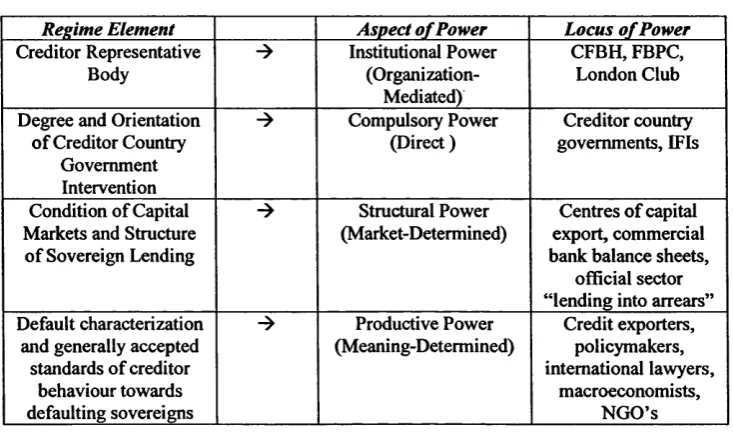
Table 3 A: The Four Faces o f Power in Sovereign Debt Restructuring [Expanded]... 62
Table 4 A: Bargaining Outcomes in Sovereign Debt Restructuring... 66
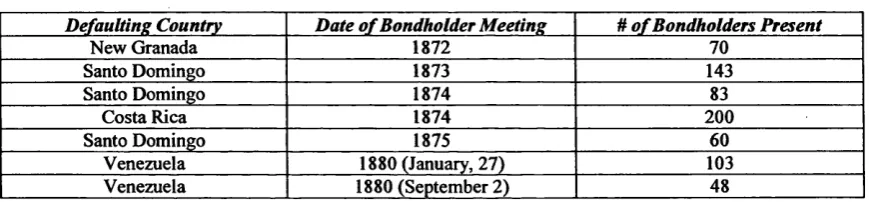
Table 4B: Sample Size o f CFBH Bondholder Meetings... 78
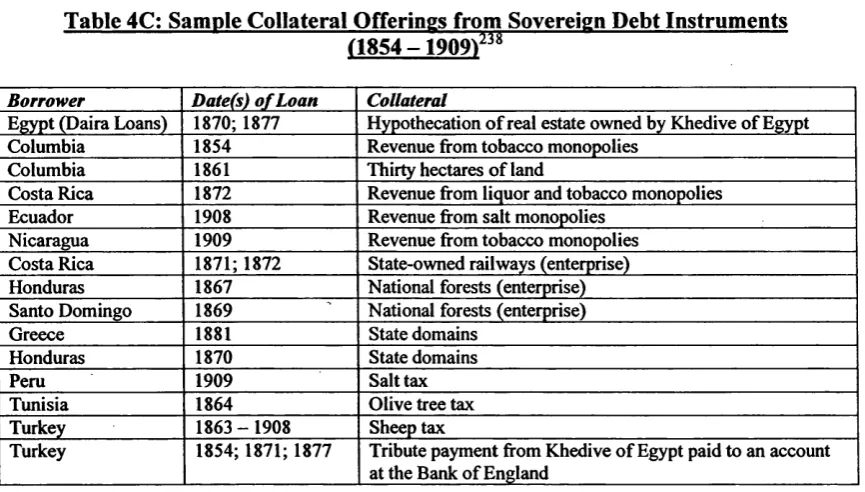
Table 4C: Sample Collateral Offerings from Sovereign Debt Instruments (1854-1909)... 82
Table 4D: Pre-World War I British Foreign Investment... 83
Table 4E: European and US Shares of Foreign Investment Stocks (1870-1913)...84
Table 4F: Number o f Sovereign Defaults (1821-1975)... 84
Table 4G: Creditor Country Government Intervention (1821-1975)... 100
Table 5A: Bargaining Outcomes (1871-1975)... 125
Table 5B: Internal Rates of Return for Dollar and Sterling Bonds Issued 1923-1930... 126
Table 5C: Internal Rates of Return for Dollar and Sterling Bonds Issued 1920-1929... 126
Table 5D: Bargaining Outcomes for FBPC vs. CFBH on German Government Bonds... 127
Table 6A: Bargaining Outcomes (1871-1975)... 184
Table 6B: Bargaining Outcomes (1926-1997)... 184
Table 6C: Bank Exposure to Sovereign Debtors as a Percentage o f Bank Capital (1982-1992)...185
Table 7A: Debt Restructuring Outcomes (1998-2005)... 230
Table 7B: Net External Borrowings by Emerging Markets Countries - Official, Bank and Non-Bank Flows...247
Table 7C: National Interest Rates in Selected Developed and Emerging Market Countries...250
Table 8 A: Power and the Production of Bargaining Outcomes... 276
APPENDICES Appendix 4 A: Sample Periodicals and Journals from CFBH Archives... I l l Appendix 4B: Compulsory Power Case Studies... 112
Appendix 7 A: Proponents o f a Statutory Approach to Sovereign Debt Restructuring... 271
LIST OF ABBREVIATIONS
ABRA Argentine Bond Restructuring Agency
BAC Bank Advisory Committee
BIS Bank for International Settlements
CACs Collective Action Clauses
CEO Chief Executive Officer
CFBH Corporation of Foreign Bondholders
EMBI Emerging Markets Bond Index
EXIM Export-Import
FBPC Foreign Bondholders Protective Council
FSIA Foreign Sovereign Immunities Act
G-5 Group of Five (US, Germany, France, UK, Japan)
G-7 Group of Seven (Group of Five + Canada, Italy)
G-10 Group of Ten (Group of Seven + Belgium, Netherlands, Sweden, Switzerland)
GCAB Global Committee of Argentina Bondholders
GDP Gross Domestic Product
HIPC Highly Indebted Poor Countries
HM His/Her Majesty
IBA International Bankruptcy Agency
IBRD International Bank for Reconstruction and Development
ICSID International Centre for the Settlement of Investment Disputes
IFI International Financial Institution
IIF Institute of International Finance
IMF International Monetary Fund
IPE International Political Economy
IR International Relations
LDC Less Developed Country
LIBOR London Inter-bank Offer Rate
LOLR Lender of Last Resort
MP Member of Parliament
NGO Non-Governmental Organization
PSI Private Sector Involvement
ROSC Reports on Observance of Standards and Codes
SDDS Special Data Dissemination Standards
SDRM Sovereign Debt Restructuring Mechanism
SEC Securities and Exchange Commission
SIA State Immunities Act
US United States
UK United Kingdom
WWI World War I
Chapter 1
Sovereign Default Through the Ages
We stop this recital with misgiving, fo r our prophetic soul tells us what will happen in the future. Adjustments will be made. Debts will be scaled down and nations will start anew...And the process known fo r more than two thousand years will be continued. Defaults will not be eliminated Investors will once
again be found gazing sadly and drearily upon foreign promises to pay.1
Max Winkler
1.1 The Cycles o f Sovereign Default
In the fourth century B.C., ten Greek city-states walked away from their debt obligations to the Delos Temple.2 A little over two millennia later, Argentina ceased payment on 178 foreign bonds with a face value totalling $81.8 billion dollars.3 While ancient Greece may have brought us the first recorded act o f sovereign default, and Argentina, the largest, the intervening years have witnessed consistent and disruptive episodes of sovereign bankruptcy.
At the centre of international bond finance in the 19th century, London witnessed two periods of large-scale sovereign lending and default. The first began in 1822, when Latin American states borrowed heavily to finance their wars of liberation. In most cases, default followed shortly on the heels of initial bond floatations, with some rescheduling negotiations lasting sixty years.4 But troubled Latin American debtors were hardly alone in their predicament. Beginning in the late 1830s, nine U.S. states, including Maryland, Pennsylvania, Mississippi and Louisiana, all suspended debt service. Investor outcry in London and Paris was so loud that London-based Barings took it upon itself to finance the political campaigns of state candidates who would prioritize raising new taxes in order to settle the defaulted obligations. This strategy was largely successful with one
‘ Winkler (1933), p. 179. 2 Dammers (1984).
notable exception: the state of Mississippi refused to negotiate with British representatives and remains in default to European bondholders to this day.5
The second lending boom of the 19 century began in 1860, with capital flowing back into Latin America, Egypt and Turkey. Euphoria swept the London bond market from 1870 to 1873 during which time it seemed that “any government which claimed sovereignty over a bit o f the earth’s surface and a fraction of its inhabitants could find a financial agent in London and purchasers for her bonds.”6 Unscrupulous underwriters even managed to sell bonds to an eager but unsuspecting public on behalf of fictitious countries.7 The first Great Depression of 1873 brought this cycle of lending to an abrupt halt, and defaults ensued once again. Although the Bank o f England was successful in its efforts to save Barings, one of Britain’s leading merchant banks, from its near fatal exposure to Argentina in 1890, investor enthusiasm for sovereign bonds predictably waned.
The end o f World War I marked the ascendance o f American power and the rise of New York as the world’s financial centre. Despite this shift, boom and bust lending cycles continued just as they had in 19th century London. By 1933, in the depths o f the Great Depression, twelve Latin American and nine European countries, including Germany, curtailed at least part of their debt servicing. Some defaults remained uncured into the 1950s.8
The post-World War II era seemed to usher in a new, and seemingly more stable, era o f sovereign financing. While defaults had historically been followed by renewed bond market access in the 19th century, the experience o f the Great Depression had the effect of closing the bond market to sovereigns. And, with capital controls enshrined in the Bretton Woods regime, the early post-war period saw bi-lateral and multilateral official lending replace private bonds as the primary source of financing.
5 McGrane (1935); Dammers (1984), p. 78; The Corporation o f Foreign Bondholders (1873-1987), Report of 1987. Note that Florida, although counted as one of the nine states, was technically a territory at the time of default.
6 Aggarwal (1996), p. 27.
7 Tomz (2001) identifies the fictitious state as Poyais, a country invented by a Scottish adventurer named Gregor MacGregor who devised the fraud on a trip to the Mosquito Coast, o ff modem day Nicaragua. See also Lipson (1985b), p. 44.
This era o f official lending reigned until the 1970s, when the growth o f the offshore Eurodollar market enticed commercial banks to recycle large surplus deposits from oil-exporting Middle Eastern countries as loans to developing countries. Such direct financing by financial institutions had last been attempted by the Bardi, Peruzzi, and Medici banks o f medieval and Renaissance Italy. However, the lessons o f history were lost on the commercial bankers of the 1980s. Just as the Bardi and Peruzzi banks failed in 1327, when Edward III of England repudiated his debts, major money centre banks in the 1980s stood on the precipice of insolvency when the Latin American debt crisis began.9 The decade-long restructuring process that followed Mexico’s default in 1982 was ultimately resolved with the adoption o f the Brady Plan, in which banks offered partial debt forgiveness and exchanged their bank loans for collateralized bonds. The Brady Plan had the effect of returning defaulted sovereign debtors to the bond markets for the first time since the 1920s, ironically sowing the seeds for the next round of sovereign debt troubles. Beginning in 1994 with Mexico, contemporary sovereign financial crises once again circled the globe, extending to Asia, Russia, Brazil, Turkey and Argentina.10
1.2 Private Creditors vs. Sovereign States - The A d Hoc Machinery
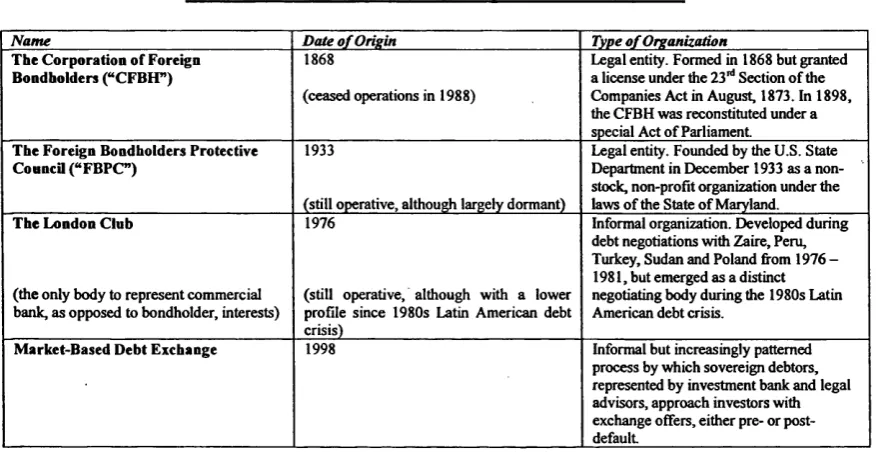
Despite this long history o f sovereign default, no formal sovereign bankruptcy framework has ever evolved at the international level. So, how have private creditors and sovereign states negotiated mutually acceptable settlements following a default? Most would say that it was through a series o f ad hoc representative bodies that emerged in different historical periods with two principal purposes: to consolidate the interests o f a disparate group of private creditors and act as a focal point for negotiation with sovereign states.11 Since the 19th century, we have seen the emergence of three such bodies in major centres of capital export: The British Corporation of Foreign Bondholders (“CFBH”), The American Foreign Bondholders Protective Council (“FBPC”), and the “G5-centric”
9Dammers (1984), p. 77; Cline (1995).
10 “Default” shall be taken to mean the cessation o f principal and/or interest payments as required under the debt contract. “Restructuring” will refer to any instance in which debtors and creditors come together to renegotiate the terms of a debt contract, either pre- or post-default. “Sovereign debt management” will have a meaning that is equivalent to “restructuring” . Debt held by official creditors is excluded from this analysis.
London Club. The table below provides a brief overview of each entity along with the market-based debt exchange, a practice which has emerged since 1998 to partially compensate for the lack of a bondholder representative:12
Table 1A: Private C reditor Representative Bodies
Name Date o f Origin Type o f Organization
T he C orporation of Foreign Bondholders (“CFB H ”)
1868
(ceased operations in 1988)
Legal entity. Formed in 1868 but granted a license under the 23 rd Section o f the Companies Act in August, 1873. In 1898, the CFBH was reconstituted under a special Act o f Parliament.
The Foreign Bondholders Protective Council (“ FBPC”)
1933
(still operative, although largely dormant)
Legal entity. Founded by the U.S. State Department in December 1933 as a non stock, non-profit organization under the laws o f the State o f Maryland. The London Club
(the only body to represent commercial bank, as opposed to bondholder, interests)
1976
(still operative, although with a lower profile since 1980s Latin American debt crisis)
Informal organization. Developed during debt negotiations with Zaire, Peru, Turkey, Sudan and Poland from 1976 - 1981, but emerged as a distinct negotiating body during the 1980s Latin American debt crisis.
M arket-B ased Debt Exchange 1998 Informal but increasingly patterned process by which sovereign debtors, represented by investment bank and legal advisors, approach investors with exchange offers, either pre- or post default.
Sources: The Corporation o f Foreign Bondholders Annual Report (1873); Foreign Bondholders Protective Council Annual Report (1936); Rieffel (2003).
The fact that today’s markets lack a bondholder representative remains the subject of intense debate, and there has been no shortage of recommendations to revive one. For instance, after the International Monetary Fund failed in its bid to create the functional equivalent o f a supra-national bankruptcy court, the Institute of International Finance (“IIF”), a group acting on behalf of large financial services firms, redoubled its efforts to mandate bondholder representative committees, albeit on a voluntary, case-by-case basis. In so doing, the IIF built on recommendations made by other market practitioners and academics since the mid-1990s.13
12 The Corporation o f Foreign Bondholders (1873-1987), Report o f 1873, pp. 6-7; Foreign Bondholders Protective Council (1941-1944), Reptirt of 1941-1944, p. xiv; Rieffel (2003), p. 97; Foreign Bondholders Protective Council (1936-1977).
13 Krueger (2002); Institute o f International Finance, International Primary Markets Association et al. (2003); Institute o f International Finance (2006); Institute o f International Finance (2007). The IIF strongly encourages sovereign debtors to fund bondholder committees at the time of a default as part of its
Why should we attempt to reconstitute a bondholder council in the 21st century? The IIF argues that such a body would markedly improve the fairness o f the sovereign debt management process.14 Without them, bondholders since 1998 have been subjected to an increasingly patterned process called the Market-Based Debt Exchange.15 This practice offers debtors and creditors limited scope for communication through investment bank and legal advisors, and it falls far short of the negotiating model o f previous eras. Since its goal is simply to determine the lowest market-clearing price at which a successful exchange will take place, investors have described it as “aggressive” and “non-consensual.”16 This is largely because, absent negotiation, sovereign debtors make unilateral, one-time, “take-it-or-leave-it” offers to bondholders.17 Creditors - and those who represent their interests - see the bondholder council as a way to counteract the perceived one-sidedness of the current exchange process.
It is important to point out that bondholder councils are not only being recommended as an antidote to unfairness; they are also seen as a way to improve efficiency. At the moment, when a sovereign defaults, there is a great deal of uncertainty as to how the process will unfold. How will debtor states communicate with creditors? How can information be shared between debtors and creditors and among creditors themselves? In previous eras, bondholder councils were the focal point for bargaining and information dissemination. For these reasons, MacMillan (1995a, 1995b) and Portes (2004) highlight the efficiency gains that could be reaped from the creation of a more formal bondholder representative today: enhanced information flows, reduced uncertainty, and more coordinated decision-making across different bond issues and different classes o f debt.18 While the goals o f sovereign debt reformers to improve the fairness and efficiency of the process are worthy, the question remains: how much have private creditor representative bodies actually contributed to the sovereign debt management process in the past? What can an investigation into their historical operation tell us about their impact on negotiations between debtor states and private creditors? Did
14 Author Interview O.
15 The Market-Based Debt Exchange has taken shape since 1998, after the Russian debt crisis. 16 Author Interview D.
17 Bulow and Klemperer (1996). The authors argue that auctions are more favorable than negotiations; the debt-exchange process is more closely aligned to an auction process than a negotiation.
these entities make such important contributions - either by improving the speed o f the negotiations or the fairness of distributional results - to warrant their resurrection today?
In seeking answers to these questions, this thesis has endeavoured to make both empirical and theoretical contributions to the existing sovereign debt literature. From an empirical perspective, fresh insights are offered into the operation, staffing, and funding o f the CFBH, FBPC and London Club, and the role these institutions played in sovereign debt management. In the case of the American FBPC, we have been able to draw upon newly available archival sources to supplement the limited secondary literature. Theoretically, the analytical framework that will be developed in this study attempts to bridge two sides of the debate in economic theory regarding sovereign repayment incentives.19 In so doing, the thesis makes the following key arguments: i) that private creditor representatives were not as critical in the production of bargaining outcomes as previously thought; and, ii) that the two sovereign repayment incentives that have been characterized in economic theory as competing - sanctions and reputations- instead operate concurrently and have reinforced one another in debt restructurings since 1870. The relevance o f the research project and its contributions will be discussed in more detail in Section 1.5.4. In the next section, the focus returns to the sovereign debt restructuring regime and the development o f our analytical framework.
1.3 Private Creditor Representative Bodies as a Resime Component
While we are interested in assessing the independent effects of private creditor bodies on sovereign debt restructurings, we maintain that the focus o f the current policy debate on these entities has construed the process of sovereign debt management much too narrowly. Drawing from economic theory as well as primary and secondary empirical sources, we would argue that it is more accurate to portray the private creditor representative body as simply one element in a much larger regime for sovereign debt restructuring.20 This gives us the scope to examine not only the more institutionalized aspects of the process - like the CFBH, FBPC and London Club - but also the variables 19 Eaton and Gersovitz (1981); Bulow and Rogoff (1989a); Bulow and Rogoff (1989c).
outside the creditor representative body which have impacted the efficiency and fairness o f sovereign debt management. Therefore, for the purposes o f this analysis, we will
91 define a sovereign debt restructuring regime to include the following four elements:
• Creditor Representative Body: Depending upon the historical period, the dominant organization would be the CFBH, the FBPC or the London Club. We intend to give the Market-Based Debt Exchange the same analytical standing as its more formal counterparts, remaining mindful of the fact that it is a patterned process, not a legal entity or recognized organization.
• Degree and Orientation of Creditor Country Government Intervention: We are interested in examining the willingness of creditor country governments to intervene directly in the negotiation process between defaulting states and private creditors. This intervention has taken many forms throughout history, from military campaigns to subtler forms o f moral suasion. And, the orientation of this intervention is also important. During certain periods it has worked to benefit private creditors while at other times it has worked to their detriment.
• Structure and Condition of the Global Capital M arkets: The structure and condition of the capital markets has historically exerted an influence on sovereign debt negotiations. For example, centralized control of the markets provides creditors with greater leverage, while market collapse or a high degree o f market liquidity tends to work in favour of debtors.
• Characterization of the Act of Default: It is important to consider that all episodes of sovereign default take place in distinct historical eras, each o f which ascribes a unique meaning to the act of default. These meanings, in turn, help define the permissible array o f remedies available to creditors, many o f which are enshrined in an evolving framework of international law.
1.4 Bareainins Outcomes in Sovereign Debt Restructuring Since 1870
Now that we have more accurately identified the components of sovereign debt restructuring regimes, we can look at the outcomes produced by those regimes across
time. In our study, we intend to use two key variables to measure outcomes: the average length o f time from default to settlement (an efficiency measurement) and the amount of debt forgiven (a distributional/fairness measurement). Time measurement is important because it has customarily been the case that the longer the negotiation process, the more punitive it is to the debtor. This is because defaulting countries are generally unable to access the capital markets until they have reached an acceptable settlement with their
0 0
[image:21.595.32.459.429.487.2]creditors. The level o f debt forgiveness is important since it represents the result of the redistributive bargaining process. If private creditors forgive thirty percent of the contractual debt, this thirty percent becomes a gain which accrues to the benefit o f the sovereign debtor. However, if the thirty percent level is agreed after two years, it is much more valuable to the debtor state than if it is agreed after twelve years. For this reason, the two variables must always be examined in tandem. The table below helps to illustrate this point.
Table IB: Debt Forgiveness and Settlement Times
Settlement Period (Years) Debt Forgiven (%) Outcome
Long Low Punishes Debtors
Long High Balanced
Short Low Balanced
Short High Favours Debtors
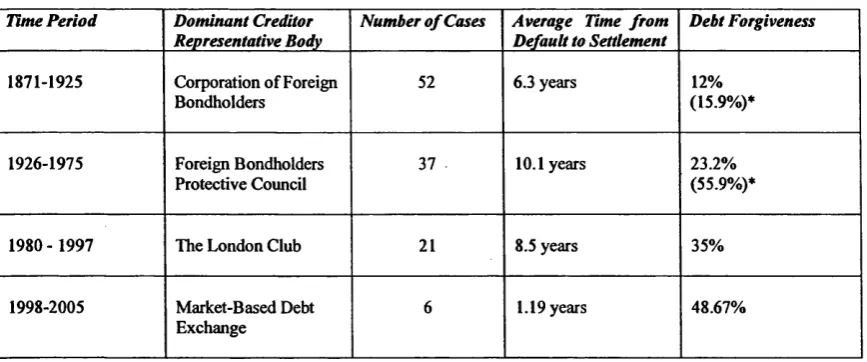
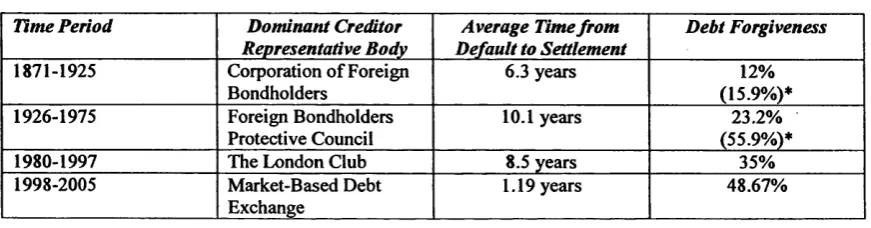
We have aggregated a number of separate econometric studies over these four historical periods to provide a starting point for assessing the variance in outcomes across eras. The data show that both settlement periods and levels o f debt forgiveness were dramatically different under the auspices of each regime:23
22 Tomz (2001). The only exception in Tomz’ model was Greece, which secured a loan in 1833 while in default. He attributes this to the loan guarantee offered by England, France and Russia.
Table 1C: Negotiating Outcomes Between States and Private Creditors
Time Period Dominant Creditor
Representative Body
Number o f Cases Average Time from
Default to Settlement
Debt Forgiveness
1871-1925 Corporation of Foreign Bondholders
52 6.3 years 12%
(15.9%)*
1926-1975 Foreign Bondholders Protective Council
37 • 10.1 years 23.2% (55.9%)*
1980 - 1997 The London Club 21 8.5 years 35%
1998-2005 Market-Based Debt Exchange
6 1.19 years 48.67%
Sources: Suter (1992); Cline (1995); Bowe and Dean (1997); Singh (2003); Sturzenegger and Zettelmeyer (2005a); Roubini and Setser (2004a); Dhillon, Garcia-Fronti et al. (2006); Miller and Thomas (2006b); Rieffel (2003).
*Bracketed results for the periods beginning in 1871 and 1926 also take into account the forgiveness of accrued interest and reductions in contractual interest rates. They were calculated using data sets provided by Christian Suter which are also available in Suter’s Schuldenzyklen in der Dritten Welt (1990). These recalculations help to put the earlier debt forgiveness figures on a more comparable basis with those beginning in 1980. Also, the average time from default to settlement in the period 1980-1997 does not account for interim accords under the multi-year rescheduling agreements; in this era, settlement dates are taken to mean the dates on which debt forgiveness was finally agreed under the Brady Plan.
The data account for all cases of sovereign debt restructuring in each period, and suggest that the relative capabilities of states and private creditors in the negotiation process were different depending on the operative regime.24 Sovereigns clearly paid more to investors in some periods than in others. For instance, British bondholders in the last quarter of the 19th century and commercial banks in the 1980s fared better than their Depression era and 1990s counterparts. Also, it is important to reiterate that that we are not ascribing these results solely to the workings of the creditor representative body. As we stated earlier, these organizations are part of the larger regime of debt restructuring, and their impact needs to be evaluated in context.
1.5 The Research Agenda
The history of sovereign debt restructuring therefore presents us with an important puzzle. How do we explain the historical variation in bargaining outcomes between debtor states and private creditors? For instance, is there a single aspect of the regime that is critical in producing the outcome? Or, do the various regime components work together such that they offset or reinforce one another to produce the observed results? How much independent impact does the private creditor representative body have? The research agenda of this thesis has been to devise an analytical framework that will help answer these questions.
Bargaining outcomes will not be measured by looking at individual cases of negotiation, but rather at aggregated outcomes in each of the four historical periods that correspond to the principal operation of the private creditor representative bodies cited above. While we acknowledge that variation can occur in individual instances of negotiation, we maintain that the regime’s performance can best be judged by measuring outcomes for the largest number of cases in each historical period. Additionally, we have excluded debt held by the official sector - governments and multilateral financial institutions - from this study. However, we remain keenly interested in how the actions of the official sector influence outcomes for private creditors. As a result, the undertakings of bi-lateral and multi-lateral players in sovereign debt restructurings will be a key focus of this study. Although we will not be examining bi-lateral, Paris Club bargaining results, we will seek to isolate the ways in which official actors either promote or hinder the bargaining prospects of private creditors.
1.5.1 A Power-Based Analytical Framework
along the Pareto frontier should be chosen.25 In other words, it is not generally the case that two parties to a debt negotiation can jointly improve their outcomes through cooperation. In fact, any improvement to the outcome of one party will most likely result in an injury to the second. That is because once the decision is taken to negotiate, each party knows that any concession on his part translates into a gain for the opposing side. 26 Also, sovereign debt management is always and everywhere a political phenomenon. This is not only because one party to the negotiation is by definition a state; it is also because creditor country governments have often inserted themselves into the process. These considerations lead us to conclude that power and bargaining leverage are more salient when trying to explain regime design and outcomes across time.
1.5.2 The Four Faces o f Power
We have chosen to use the particular power-based framework developed by Barnett and Duvall (2005b) since it is well-suited to an analysis of a process as multi faceted as sovereign debt restructuring. Barnett and Duvall generate a taxonomy of four types o f power which captures the different aspects of the sovereign debt management regime discussed earlier: i) the private creditor representative body; ii) the degree and orientation of creditor country government intervention; iii) the structure and condition of the capital markets; and, iv) the evolution of the meaning o f default. They define power more generally as “the production of effects...that shape the capacities of actors to determine their circumstances and fate.”27 Within this context, they consider power to have a polymorphous character, identifying the distinct types as institutional, compulsory, structural, and productive.
25 Krasner (1992), p. 336. A Nash equilibrium is said to exist whenever two or more players in a game are unable to gain by a change in their strategies given the strategies being pursued by others. Such a non- cooperative equilibrium is not Pareto-optimal and could therefore be improved upon by some form of cooperation. Pareto-optimality is said to exist when there is no feasible way for one party to improve his/her welfare without lowering the welfare o f someone else.
26 We have borrowed the famous phrasing from Milton Friedman, who said that inflation was “always and everywhere a monetary phenomenon.”
Institutional power is taken to mean “the control that actors exercise indirectly over others through diffuse relations of interaction.” For our purposes, institutional power will correspond to the bargaining process mediated by the private creditor representative body. In other words, it is the power that unified creditors can exercise through the CFBH, the FBPC and the London Club, permitting us to offer some assessment of the independent effect of these bodies on negotiated outcomes.
Compulsory power refers to “relations of interaction of direct control by one actor over another actor.”29 In a sovereign debt restructuring context, this type of power would normally be exercised by creditor country governments or other official sector actors. It can either help or frustrate the interests of private creditors, depending upon its orientation. In the 19th century, we saw Britain intervene on behalf o f private creditors in a number o f sovereign default cases, thereby strengthening the position of bondholders and improving their bargaining outcomes.30 In the interwar period, by contrast, the U.S. government tended to undermine private creditor interests by inserting itself into the negotiation process and routinely pressing bondholders to accept sub-standard settlements.31
Structural power is defined as “the production and reproduction of positions of domination and subordination that actors occupy.”32 Barnett and Duvall used the examples of capital-labour and master-slave as structural positions. In our analysis, we will be interested in the structural positions of capital exporters and capital importers (which are roughly similar to core and peripheral countries) and how those roles generate unequal capacities and privileges in a debt restructuring exercise. More specifically, we will want to examine the benefits that credit exporters have traditionally enjoyed in designing the rules of debt management regimes and controlling the supply of credit to developing countries. We will also consider that structural power accrues in certain periods to impersonal market forces, making the market another distinct “actor” in the
28 Barnett and Duvall (2005), p. 43.
29 Barnett and Duvall (2005), p. 43. Private creditors have not generally been able to exercise compulsory power in the sense their remedies tended to be limited to those that could be exercised through joint action. Even today, when private creditors are able to bring a suit directly against a sovereign state, this type of remedy has proved to have limited value in practice.
30 Suter (1992), p. 93. 31 Adamson (2002).
sovereign debt restructuring process. We therefore need to inquire about the condition of the markets in each historical period. Are they highly liquid and permissive, highly controlled, or have they collapsed? During the Great Depression of the 1930s, the condition of the capital markets provided defaulted sovereigns with little incentive to repay, since regaining market access was seen as largely impossible, even if debt obligations were fully honoured. And, when markets were highly centralized, as they were in the 19th century and the 1980s, creditors had much greater bargaining leverage, since they effectively controlled the supply of new credit to sovereign borrowers.
Finally, productive power is taken to mean “the socially diffuse production of subjectivity in systems of meaning and signification.”33 In other words, it is the power to create and fix meanings. Barnett and Duvall point out how basic categories of classification, including “civilized,” “rogue,” or “democratic” state, are all examples of productive power since they create meanings that are taken for granted in the world of politics. Such processes can be readily observed in the issue-area of sovereign debt management. Policymakers before the Great Depression routinely referred to sovereign default as an “uncivilized” act or a breach of international and moral law.34 In the 1930s, we see a shift in perception as both Britain and Germany found themselves facing serious debt problems. The old stigma placed on developing countries did not suit western industrialized countries very well, and soon default was seen more as a calculated policy response to external economic and political shocks, including war. By the 1980s, sovereign default became a technocratic problem, one that was best managed by macroeconomists and “remedied” through a debtor’s enactment of Washington Consensus directives.35 While historical changes in the meaning of default did coincide with adjustments in regime design, we have also been attentive to their source. For example, where these pronouncements and prescriptions came largely from capital exporting countries, their basis was identified as material and not the manifestation of some universal normative code.
This framework has helped us to better analyze the outcomes in complex negotiations between private creditors and sovereign debtors across time, by highlighting 33 Barnett and Duvall (2005), p. 43.
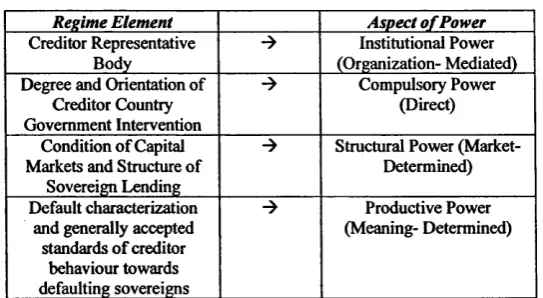
how power capabilities are accorded to different aspects o f process. The schematic below illustrates this approach:
Table ID: The Four Faces of Power in Sovereign Debt Restructuring
Regime Element Aspect o f Power
Creditor Representative Body
-» Institutional Power (Organization- Mediated) Degree and Orientation of
Creditor Country Government Intervention
-> Compulsory Power (Direct)
Condition of Capital Markets and Structure of
Sovereign Lending
Structural Power (Market- Determined)
Default characterization and generally accepted
standards of creditor behaviour towards defaulting sovereigns
-> Productive Power
(Meaning- Determined)
1.5.3 Methodology
Our research has included an examination of archival material for both the Corporation of Foreign Bondholders and the Foreign Bondholders Protective Council. The CFBH produced detailed annual reports for each year o f its operation, as well as over five hundred volumes o f clippings and three hundred volumes of original
• 36
correspondence, all of which are housed at the Guildhall Library in the City o f London. A similar record of close to one hundred boxes of original, unprocessed material has been preserved in the annual reports of the FBPC and the Council’s archives which are held at Stanford University.37 These archives had not yet been researched since they were only recently moved by the FBPC to Stanford. We were fortunate to have been the first researcher granted permission to examine the original source material for the FBPC.
More relevant to an analysis of the post-1982 period will be nearly twenty interviews with a wide range of market practitioners, including sovereign debt advisors, capital markets professionals, bank creditor officers, central bankers, IMF staff, bank lobbying organizations, lawyers, rating agency professionals, and finance and treasury
36 The Corporation o f Foreign Bondholders (1873-1987).
[image:27.595.96.368.202.351.2]ministers from emerging markets countries. A list of completed interviews appears in Appendix 7B.
1.5.4 The Relevance o f the Research Project and Proposed Original Contributions
Sovereign debt restructuring is an issue-area that exhibits some of the main tensions that are of interest to political economists: those between developed and developing countries, state and non-state actors, and states and markets.
In the case study chapters which follow, we have used the “four faces of power” model to isolate those elements of debt restructuring regimes that are most responsible for producing bargaining outcomes. Our findings have both theoretical and practical significance, and also refute some of the longstanding conventional wisdom held about the CFBH, FBPC and London Club.
In Chapter 2, we assess the shortcomings of economic theories that seek to identify sovereign repayment incentives. We present evidence that makes us question the efficacy of the “sanctions-reputation” debate, which we see as artificial and unproductive when trying to account for the variation in bargaining outcomes in different historical periods.38 We establish an alternative theoretical basis for analyzing sovereign debt regimes in Chapter 3 and argue that if “sanctions” and “reputation” are analyzed instead as “compulsory” and “structural” power, it becomes clear that is not necessary to choose between them. They are both factors in the sovereign default calculus and tend to work in tandem to produce bargaining outcomes. In fact, our findings in our case studies (Chapters 4 though 7) indicate that since 1870, the compulsory power exercised by creditor governments in conjunction with structural (or credit-export) power, have been key drivers of negotiating results between debtor states and private creditors, reinforcing one another in the bargaining process. So, rather than debate the relative merits of sanctions vs. reputation, it appears to be far more useful to examine how compulsory and structural power interact to amplify one another in the same way across time. We maintain that these two forms of power have been principally responsible for the observed variation in bargaining outcomes in sovereign debt restructuring over the past
135 years, meaning that the impact of private creditor representative bodies has been overestimated.
From a practical perspective, we believe that this research project will make a ♦contribution to the public policy debate concerning reforms to the international financial architecture. As we noted earlier, the IIF has been extremely active in attempting to shape ;a new regime for sovereign debt management. The thrust of its agenda has been to improve communication and transparency on the part of sovereign debtors, but also to institute a debtor-funded private creditor representative body at the outset of each restructuring. Along with the IIF, other market practitioners and academics have called for the resurrection of bondholder councils.39 This thesis argues that private creditors - even those that purportedly had capable representation - were much less powerful in a sovereign debt restructuring exercise than previously believed. Upon closer examination, the CFBH - the bondholder council viewed most favourably by economic historians - was highly dependent upon the sympathetic disposition of the British government toward its interests and the discipline o f the London exchanges in restricting defaulters from accessing British capital markets. While the presence of the CFBH may have helped with administrative matters, bargaining results were not institutionally driven. Even the London Club, routinely praised as a model of effective creditor coordination, would not have held together as a negotiating body were it not for the coercion and control exercised by G-7 governments and the IMF. The cause of creditors in the 1980s was also advanced by the fact that private banks had been the principal suppliers of loans to emerging market countries since the 1960s. So, there was no alternative bond market for developing countries to tap. In short, the bargaining outcomes achieved by the commercial banks during the Latin American debt crisis flowed principally from the structure o f the world credit markets and the active role played by the official sector, and not from the organizational features of the London Club. Given this analysis, it becomes clear that although we can establish a new bondholder council today, its results will not necessarily replicate those of the late 19th century or 1980s. Contemporary outcomes will be more dependent upon the attitudes of creditor governments and the configuration of modem global capital markets, neither of which bode well for today’s investors.
In terms of the broader sovereign debt management literature, most of it has tended to focus on a single period, country or region, while there are occasional examples of scholars seeking to compare two historical periods - for example, the 1980s and the 1930s or the 19th century and the 1990s.40 Ours is the first study to investigate all four periods, beginning in 1870 and ending with the Argentine debt exchange in February, 2005. Also, since the early 1980s, the literature on financial crises has accorded a privileged position to the IMF. There is no doubt that the IMF has played a critical role in debt restructurings over the past twenty-five years, but the fact remains that private capital flows to developing countries dwarf official IMF lending 41 We therefore intend to redress this imbalance in coverage by highlighting the importance o f private banks and bondholders in the debt restructuring process.
We also believe that there is an important gap in the literature relating to the Foreign Bondholders Protective Council. This organization has been the least understood of the historical creditor institutions and also the least examined. Our research project addresses this gap by contributing a more robust picture o f the FBPC (Chapter 5) through a careful review of its unprocessed archives and interviews with the Council’s current President and former Deputy Treasury Secretary. We take issue with those who have branded it as an institutional failure, preferring instead to demonstrate how the FBPC was hampered by the same compulsory and structural regime elements that worked to benefit its predecessor, the CFBH 42
Our analysis begins in the next chapter with a review of the relative merits and shortcomings of economic theories related to sovereign repayment incentives. We will point out the important gaps that exist between formal economic models of debt and restructuring negotiations in practice, and suggest how our proposed analytical framework might help to bridge those gaps.
40 Eichengreen and Lindert (1989); Bordo, Eichengreen et al. (1998). 41 IMF World Economic Outlook, April 2007.
Chapter 2
Why Sovereigns Repay and Creditors Settle: An Assessment of
Economic Theories o f Debt
Since sovereign loans are owned by the governments o f countries, repayment is not constrained by the net worth o f the country, but by that component o f net worth that the government can (or is willing to) appropriate.43
Eaton, Gersovitz and Stiglitz
2.1 Economic Theory: Why Do Sovereisns Repay?
In the absence o f any formal, international bankruptcy framework, private creditors and sovereign states have had no choice but to negotiate mutually acceptable, post-default settlements through the ad hoc regimes that have emerged over time. Many economists consider these regimes to be “woefully inadequate” insofar as they lack the efficiency, fairness and predictability that we normally associate with well-designed domestic bankruptcy systems.44 Yet, despite the aspirations of those contributing to the considerable body of prescriptive debt management literature, very little of what they have proposed has been implemented.45 Supra-national bankruptcy schemes have never been adopted, and, as we will discuss later, only a diluted version of the collective action clauses (“CACs”) first advanced by Eichengreen and Portes (1995) found their way into sovereign bond issues beginning in 2003. In fact, the way in which CACs were ' implemented fell far short of the standards advocated by Eichengreen and Portes and the
G-10 (1996,2002).46
If the machinery that has evolved over time to deal with sovereign debt crises has been less than optimal, then it is probably useful to ask: Why do sovereigns ever repay? After all, under conditions of anarchy in the international system, in which there exists no
43 Eaton, Gersovitz et al. (1986), p. 500. 44 Sachs (2002), p. 257.
generally accepted supra-national authority to uphold or enforce the sovereign debt contract, what is it that compels states to honour their obligations to creditors?47 The answer to this question is part of an ongoing theoretical debate in the economic literature, a debate that has been largely defined by Eaton and Gersovitz (1981) and Bulow and Rogoff (1989a, 1989c). While the former prioritize the importance of reputation, the latter privilege the potentially damaging effects of sanctions 48
2.1.1 Reputation vs. Sanctions
Eaton and Gersovitz argue that sovereign debtors repay because the act of default affects their reputation, thereby limiting or even prohibiting their access to capital markets.49 Since the ability to borrow offers them consumption smoothing benefits in the future - permitting them to finance a balance of payments deficit and avoid domestic adjustment - they will refrain from default in order to maintain the entitlement of market access. Following this logic, Eaton and Gersovitz claim that lenders do not furnish sovereigns with an unlimited amount of credit; instead, a ceiling is reached at the level of indebtedness which makes a state indifferent between the loss of borrowing access in the future and the one-time gain associated with debt repudiation.
Eaton, Gersovitz and Stiglitz (1986) expand on this model by appealing to game theory. They argue that lenders infer the future behaviour of sovereign debtors according to their past behaviour. And, since states have an infinite time horizon, “their identity is remembered by their opponents” meaning that their “reputation as cooperative players can succeed in enforcing some degree of cooperation” regarding repayment.50 In addition, the authors maintain that in order for the loss of market access to be seen as a credible sanction, not only do existing lenders need to withdraw credit; potential new creditors must abstain as well. Taking the 1980s Latin American debt crisis as their reference point, they assert that syndicate banks were successfully able to coordinate their 47 The term “anarchy” is employed by international relations scholars to refer to the state o f affairs between polities in which “unilateral power or cooperation may provide order” but where there is “no generally accepted authority or world government to settle disputes and enforce law.” This differs from the
commonly understood definition o f the term “anarchic” which implies disorder. (Definition taken from The Concise Oxford Dictionary o f Politics (2003), p. 15.) This is in part the reason that international law has never been able to match the precision of domestic law.
responses to troubled debtors by withholding credit, since punishment within the syndicate would be meted out to any bank that did not play by the rules.51 Also, whenever existing lenders refused to make incremental loans to a sovereign debtor, their informed refusal acted as a signal to potential new lenders to shun the debtor too.52
Kaletsky (1985) looks at debtor incentives to default from a cost-benefit perspective.53 He maintains that since the enforcement of private legal sanctions by creditors is so difficult, they often do not represent the most significant costs of non payment. He goes on to say that incentives to repay are driven more by a borrower’s desire to enjoy the benefits that come from “advanced nation status, with...low risk premiums and full integration into international goods and capital markets.”54 Cline (1995) agrees and adds that many of the formal economic models do not sufficiently account for elements like “honour or national pride in the commitment to international rules o f the game.”55 However, both Kaletsky (1985) and Eaton and Gersovitz (1981) are challenged to explain how, in the 1990s, the sovereign restructuring cases of Mexico, South Korea and Russia were all met with prompt renewal of market access.
In the competing theoretical camp, Bulow and Rogoff (1989c) claim that evidence in favour of a pure reputational argument is weak; they contend that industrialized country creditors can impose real, direct costs on borrowing countries, the most important being the blockage of trade credit. By interfering in the international goods market, creditors can force countries to conduct trade without letters of credit and in secret, roundabout ways to avoid the seizure of goods. So, by forcing a sovereign debtor to forego the gains from trade, creditors can incentivize recalcitrant states to repay. Although Bulow and Rogoff use trade interference as an example, direct sanctions could also include things like withholding international aid or even war. The authors find the reputational model to be so inadequate, that they argue in favour debt forgiveness whenever possible, since “debt that is forgiven is forgotten.”56
51 For additional support from the perspective of market practitioners, see Mudge (1984); Gibbs (1984); and, Hurlock (1984).
52 Eaton, Gersovitz et al. (1986), p. 493. 53 Kaletsky (1985).
54 Cline (1995), p. 141. 55 Cline (1995), p.141.
Those who found the sanctions argument compelling did not have to look far for empirical support During the 1980s debt crisis, political pressure from creditor country governments, and most especially from the United States, carried the “implicit message that sanctions of a non-financial kind” would be imposed on any sovereigns that failed to service their debt.57 The U.S. Treasury Secretary gave a grim description of what would happen in the event of default:
The foreign assets of a country would be attacked by creditors throughout the world; its exports would be seized by creditors at each dock where they landed; its national airlines would be unable to operate, and its sources of desperately needed capital goods...virtually eliminated. In many countries, even food imports would be curtailed.58
In fact, the literature is replete with empirical studies that privilege either reputation or sanctions as the principal incentive for sovereign repayment. Arguing in favour of reputational incentives we find Cole, Dow et. al. (1995), English (1996), and Tomz (2001, 2004), among others.59 Those finding strong evidence in favour of sanctions include Fernandez and Rosenthal (1990), Krugman (1989b), Lipson (1985b), O’Brien (1993), Ozler (1993), Klimenko (2002), and Weidenmier (2004).60 Finally, when looking at the 1930’s, Cardoso and Dombusch (1989), Jorgenson and Sachs (1989), and Lindert and Morton (1989) all argue that defaulting sovereigns eventually settled with their private creditors in the absence o f either sanctions or reputational considerations, undercutting the explanatory power o f either model.61 In Chapter 5, we will address this specific case and demonstrate how both structural and compulsory regime elements worked in tandem to produce the bargaining outcomes unique to the interwar and post war periods. While sanctions and concerns about market access appear to have been absent from the sovereign default calculus in the 1930s and 1940s, this was not in fact the case. There was a market for capital; it was simply that this market was controlled by the official sector. Both the US government and its agencies, and later the multi laterals,
57 Krugman (1989b), p. 292. 58 O'Brien (1993), p. 100.
59 Cole, Dow et al. (1995); English (1996); Tomz (2001); Tomz (2004).
60 Fernandez and Rosenthal (1990); Krugman (1989b); Lipson (1985b); O'Brien (1993); Ozler (1993); Klimenko (2002); Weidenmier (2004).