FABRIC
FORMWORK
© Alan Chandler and Remo Pedreschi, 2007 Published by RIBA Publishing
15 Bonhill Street London EC2P 2EA
ISBN 978 1 85946 284 3
Stock Code 61862
The right of Alan Chandler to be identifi ed as the Author of this Work have been asserted in accordance with the Copyright, Design and Patents Act 1988.
All rights reserved. No part of this publication may be reproduced, stored in a retrieval system, or transmitted, in any form or by any means, electronic, mechanical, photocopying, recording or otherwise, without prior permission of the copyright owner.
British Library Cataloguing in Publications Data
A catalogue record for this book is available from the British Library.
Publisher:Steven Cross Project Editor: Susan George
Editors: Alan Chandler and Remo Pedreschi Design and typesetting byKneath Associates Cover image by Julia Hartman
Printed and bound byCambridge University Press
We make every effort to ensure the accuracy and quality of information when it is published. However, we can take no responsibility for the subsequent use of this information, nor for any errors or omissions that it may contain.
RIBA Publishing is part of RIBA Enterprises Ltd www.ribaenterprises.com
CONTENTS
FOREWORD
V
Raoul Bunschoten
INTRODUCTION
01
Alan Chandler and Remo Pedreschi
1: CONCRETE AS EQUIPMENT
05
Aan Chandler2: DIALOGUES IN PROCESS AND FORM
21
Remo Pedreschi studies in fabric cast concrete3: FORM FOLLOWS FABRIC
35
Fiona McLachlan4: JIGGING WITH CONCRETE
42
Katie Lloyd Thomas matter and form in the making of Wall One5: FABRIC FORMWORK
55
Ilona Hay the beautiful, the sublime and the ugly
6: SOME TECHNICAL ASPECTS
73
OF THE USE OF FABRIC FORMWORK
Daniel S.H. Lee
BIBLIOGRAPHY
80
FOREWORD
On a recent car ride with Remo Pedreschi at the wheel to an away-day of the University of Edinburgh and the Edinburgh College of Art the two of us got into an intimate and very animated discussion about concrete casting. I did not even realise how passionate I still can get about that. But in the eighties I spent years casting concrete (mostly black) in various forms for installations such as Apeiron in the Netherlands, or the Skin of the Earth in Moscow. This was work that forecast, metaphorically moulded, the long term urban project I am now involved in. Concrete has that capacity to move quickly from functional object to poetic model. Remo the structural engineer was as passionate, but about the casting work that is now happening in his laboratory in Edinburgh University and in the University of East London. We were like two birds in a dance above the beautiful Scottish hills, full of joy about this murky material that hurts your hands. I had seen by then the experiments he is conducting with students. But like this away-day that took place in these softly veiled hills and addressed the tricky issues of prototypical fusion projects between two schools, the formwork we discussed,
shown here in this beautiful book put together by Alan Chandler and Remo, is equally a fusion between the veils of fabric and the deep matter of the earth, and is quintessentially prototypical.
The research on fabric formwork pursued by the two universities, with the injections of workshops by Mark West, is beautiful, as the images here demonstrate, but also highly experimental and materially and conceptually challenging. It transfers the physical propensities of stretched fabric and its anthropomorphic characteristics and transforms these into the structural properties of fi bre concrete. The result, an extremely seductive and surreal form language, mediates between the skin of the earth as a natural environment and the second skin of construction and inhabitation. This work intertwines the intuitive choreography of the hand that forms matter and the logical mind that constructs, assembles and imagines structural complexity.
PREFACE
Concretes are twenty-fi rst century materials,1 possessing metamorphic qualities demanded by modern construction and capable of being produced from a huge and increasing variety of recipes and methods of making. Close inspection of the fabric formed concrete pieces by Alan Chandler and Remo Pedreschi provokes an immediate response to the materiality of the pieces, which challenges Adrian Forty’s theory that concrete is a process rather than a material. In these constructions the materiality is revealed as we engage in the form, structure, surface, colour and texture, and also sense the direct relationship between the makers and the making of these concrete artefacts.
‘Hand built’ is a mark of distinction, whether it applies to cars or clothing, and the reason for this is not hard to fi gure out – individuality, specifi city and the connection to makers and their methods are attractive characteristics of bespoke products. At a time when a machine made world threatens to dominate every aspect of our existence, the demand for crafted artefacts remains high and Pedreschi’s fabric forming process illustrates perfectly how concrete can be used in a way which responds to these demands (as shown in the fi sh bellied beam
elements), and results in a product that can be reproduced with considerable accuracy.
Good architecture is relevant and connected to people and places through appropriate functionality coupled with an effi ciency of means, where the whole possesses a psychological satisfaction. Fabric formed concrete provides relatively simple means to achieve individual solutions, employing forms with echoes of effi ciency found in nature that achieve high levels of desirability.
The principal authors are to be congratulated on this publication which brings together two related research programmes and four supporting pieces which serve to locate and examine the work as becoming architecture.
The Concrete Centre is pleased to have been associated with the development of this research work from the early beginning and wishes the continued programmes at University of East London and Edinburgh University every success in the next stage of this exciting journey.
Allan Haines
Head of Education,
The Concrete Centre, September 2007
1.
INTRODUCTION
The work described in this book is the product of collaboration: of ideas, attitudes and philosophy. It further represents a genuine and continuing collaboration between the schools of architecture at two quite different academic institutions: the University of Edinburgh, one of the four ancient universities of Scotland, and the University of East London, a new Docklands university in the Thames Gateway, one of the largest urban development areas in Europe. The strengths and traditions of both institutions can be easily seen in the projects described herein. A combination of academic rigour and creative endeavour, with paradoxically neither institution dominating in either fi eld. The genesis of the collaboration helps to explain the background and underlying interest in a series of fabric formed concrete studies that forms the basis for this work. A shared interest in Eladio Dieste, the Uruguayan engineer, whose work sought for what he called ‘Cosmic economy’, led to an initial collaboration in the construction of one of his structures at UEL. There are many similarities in the underlying rationale of Dieste’s work that are suggested by the use of fabric as formwork for concrete: the economy of means and materials, the use of structure as surface, the aesthetic of the doubly curved surface and perhaps more importantly, that
which may appear irrational being deeply rational. As an engineer and as a contractor, Dieste owned the risk of his ideas working, therefore achieving the apparently improbable through physical means. This mode of working has inspired the projects described here: setting broad criteria and then allowing the technology and design to evolve through the process of making.
As Schools, we are responsive to the ideas and innovations of the students who participate in the research. In 2002 Julia Hartmann at UEL and Francesca Crosby at Edinburgh both began experimenting with fabric formwork, drawing inspiration from the work of Mark West at the Centre for Architectural and Structural Technology (CAST) in the University of Manitoba. Shared interests in expressive economy and the value placed on constructive process led to a natural collaboration between UEL, EU and CAST, extending a shared interest in Dieste’s work to the elaboration of new areas of fabric formwork investigation. This led to a joint invitation from both institutions to Mark West to be involved in workshop projects based on the theme of fabric cast concrete.
drawn from, ideas that sought to expand the vocabulary of the process and challenge the limits of the technique, and that were complementary to the work of CAST. The template was then set for further projects. Different approaches were adopted to cover a range of objectives, with each institution contributing to the other’s programme in a series of reviews and refl ective studies. What is common to both is a shared attitude, a commitment to cross-disciplinary working and a desire to research through ‘creative play’. Creative play is the process that Heinz Isler describes to develop an almost limitless variety of free-form shells whose geometry could not be readily defi ned mathematically, but which were nevertheless structurally correct, effi cient and pragmatic. The rewards for mastering non orthogonal, ‘natural’ structures are huge, but require a new mindset – physical making now setting the agenda for analytical research, not the other way around. The improbability of taming, restraining and accurately controlling a mass of liquid concrete with a textile membrane becomes a technique with multiple advantages, acting as an effective critique of conventional methods of building, working with natural forces rather than expending energy and material suppressing those forces. Indeed one only has to refer to Nervi (1956) for an opinion on conventional casting techniques:
It may be noted that although reinforced concrete has been used for over a hundred years and with increasing interest during the
last few decades, few of its properties and potentialities have been fully exploited thus far. Apart from the unconquerable inertia of our minds, which do not seem able to adopt freely new ideas, the main cause of this delay is a trivial technicality: the need to prepare wooden forms. (Nervi 1994)
Visitors to both institutions have a common reaction to the work. They are drawn immediately to the sensuous qualities of the concrete: the surfaces, the textures, the contours. When the process is explained, and furthermore that the farms were constructed by inexperienced students, then the sense of, as Dieste would put it, cosmic economy becomes apparent. To paraphrase Mark West, ‘they get it’.
The general level of interest in the work has encouraged the creation of this book, whose aims are to present the work to date and to provide a critique from a number of contrasting positions. The six essays explain the nature of the research in different ways, considering practice and theory, aesthetics and the pragmatic.
discussing the nature of the dialogue between the process of construction and the development of form, considering the control of the geometry needed to ensure the connection between the elements.
The next two chapters present contrasting viewpoints from the position of the practitioner and the theorist. Fiona McLachlan tells the story from the position of the practising architect designing fabric cast components in a project for social housing, in the fi rst application in the United Kingdom of the technique, where neither the builders nor the consultants had any prior experience of fabric cast concrete. The process of design and adaptation from prototype to installation is analysed. Katie Lloyd Thomas uses the projects at East London to explore the theoretical implications for the architect allowing material to participate in its own form, and the issues of control and authorship that arise from this.
The fi nal two chapters again provide a contrast between the aesthetic and the pragmatic qualities of the technique. Ilona Hay discusses the nature of the forms produced by the surfaces, establishing a set of criteria which condition our responses to fabric cast concrete. Daniel Lee, a PhD student currently researching fabric formwork, provides a review of the technical benefi ts of the casting techniques themselves.
The projects themselves have taken much
from and given much back to the senior architectural students at both institutions. Using contemporary jargon the learning outcomes are manifest not only in the benefi ts of ‘learning by doing’ but also by the refl ection on the processes, by the documentation and by the re-evaluation of the fi nished work. To this end the contribution of the architect and photographer Colin Fraser Wishart as tutor has been considerable and can be seen in many of the photographs in the publication.
Thanks are also due to the technicians at both institutions: Alastair Craig and Alan Ramsay at EU and Raphael Lee at UEL. The contribution of the workshop staff is direct to the ethos of both schools – a creative approach to making.
We are grateful also to Allan Haines of The Concrete Centre for providing support and encouragement for this publication, and to Messrs Don and Low for providing copious quantities of their most excellent fabrics. The senior students at both universities have been a delight to work with. Their energy, enthusiasm and creativity has been a powerful tonic for the tutor. It is not practical to name here but to each one we are grateful for the involvement. The fi nal thanks are reserved for Mark West for opening our eyes to the potential of this work and for his enthusiasm and generous encouragement to pursue the particular paths we have chosen.
technique of constructing which allows the
behaviour of material to engage with and
infl uence the building process itself.
If the interaction of material and technique are
allowed to infl uence the resultant form and
performance, then the entire decision making
process within the construction sequence comes
under scrutiny.
This chapter explores the nature of architectural
research through the fabric formwork research
programme at the University of East London
and the University of Edinburgh, and its role
in the critical re-evaluation of the construction
of architecture. Through the reinvention of the
casting discipline, concrete becomes capable of
new levels of formal and technical manipulation
– capable of technical, intellectual and emotional
refi nement as equipment, with all the specifi city
of purpose that the term implies.
concrete
as
equipment
Fig 1
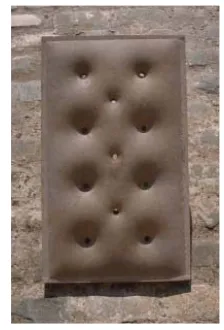
The ‘Wall One’ project sought to address the embodied energy issues of the concrete itself through the specifi cation of recycled, manufactured aggregate. A partner in the workshop research programme at UEL is the MARC programme, based in the School of Computing and Technology. Under the direction of Darryl Newport the MARC programme, funded by the ENTRUST Landfi ll Tax Credit Scheme, recycles industrial waste, reclaimed granular material and organic sewage residues to create aggregates with specifi able size, density and colour. This ‘smart’ aggregate uses selected and metered dry powder resource material which is mixed at 1450 rpm, then mechanically pelletised using minimal water content.
As with the constituent mix, the size of pellets is also specifi able. Following the drying of the green pellets, they are heated in a trefoil kiln to vitrify the pellet surface, using the combustible potential of the organic matter in the blend to generate an internal honeycomb within each pellet. The greater the internal void, the lighter the aggregate, and owing to Wall One being situated within the main AVA building at UEL, cast onto the existing fl oor slab, it was the lightest specifi cation, containing waste paper sludge, which was chosen. Further recycled materials were incorporated within the Wall in the form of shredded recycled plastic to act as an anti-crack reinforcement that has the capacity to fl ow around the dynamic curved interior of the formwork.
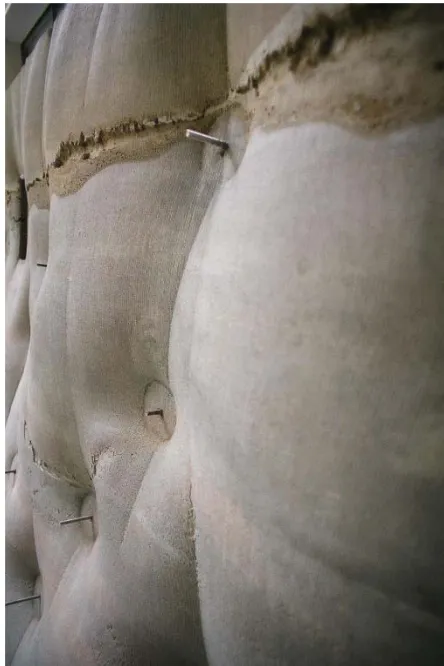
[image:13.621.314.536.385.718.2]Fig 2
Wall One top edge detail.
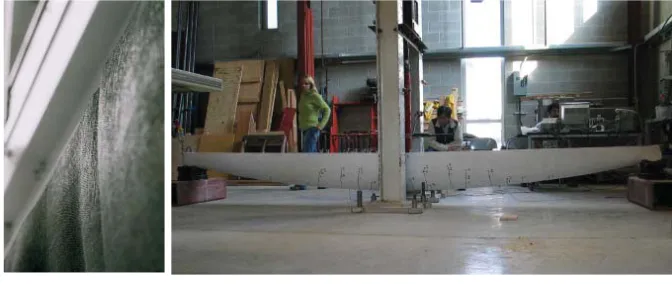
Fig 3
Load testing a fabric cast beam at the CAST facility, Canada.
Fig 4
The pressure of liquid concrete at the base of the fabric formwork of Wall One.
Fabric formwork is a language developed as a consequence of a consideration of edges. It is the antithesis of De Stijl inspired modernism where interpenetrating planes frame an ambition for architectural form. When casting with fabric, the textile and the concrete combine to deliver surface and form, and it is the restraint and constraint of edges and pressure points that articulate the language. In this sense fabric casting is akin to vernacular forms of incremental construction – brick and stone that is able through pixellated assembly to articulate both surface depth and structural mass, not simply a surface pattern.
In pursuing the performative limits of the fabric through analogue, rather than digital, research it will be possible to understand the predictive behaviour of the textile, and open the possibility for digital specifi cation according to computational criteria. Work at the Centre for Architectural and Structural Technology at the University of Manitoba (CAST) and Edinburgh has established both the repeatability and accuracy of form making and the re-usability of the fabric itself.
There is an ambition for the establishment of a dialogue between materiality and purpose through developing techniques that synthesise material and programmatic constraints. Establishing an economy of means allows for the resolution of multiple, often confl icting, criteria in effective, refi ned technique, re-establishing a material intelligence belonging to vernacular construction within contemporary, often compromised, conditions of building: modern concrete operating as both passive and active, structural and environmental material – concrete as equipment.
‘Fabric formwork’ is a research programme that seeks to establish techniques that address complex issues of technical production, risk management and advanced passive energy control, but also accept the legitimate responsibility to be comprehensible
and relevant to everyday construction and everyday use.
Innovators in fabric formwork looked for opportunities to develop a technique that has the capacity to re-establish the dynamic relationship between making and thinking. The establishment of this relationship has taken a number of directions for these innovators – for Felix Candela and Christopher Alexander fabric acted as a permanent shutter for parabolic shells to create dignifi ed, economic single spans for a school and as vaulting as part of the pattern language for self build worker housing, both in Mexico. For Miguel Fisac fl exible formwork was a catalyst for elaborate surface claddings, from restrained textural treatments to blatant exhibitionism in buildings ranging between a single studio to vast hotels. Latterly Mark West has developed clarity and precision in structural elements such as beams (Fig 3) and columns, utilising the ‘give’ of the fabric to achieve constructed bending moment diagrams, mastering a structural economy. As a technique, in the bringing together of lightweight, inexpensive tensile fabrics with dense, compressive materials such as concretes, earth and lime a dialogue of opposites is set up, and resolved through the play of complex fl uid dynamics and equilibrium. The resolution of tensile and compressive forces induces behaviour that in itself provides a fertile territory for technical laboratory based investigation.
Financial economy, an expressive form language, structural economy and ‘emergent’ behaviour are inherent within the potential of fabric casting. This chapter seeks to determine that the real value of architectural research is to consciously deal not with some, but with all of these aspects within the fi eld of investigation. In identifying a multiplicity of readings within the potential of a technique, the unique integrated structure of architectural thought has distinct operational advantages
[image:14.621.199.535.584.726.2]over the binary, ‘black and white’ approach of conventional scientifi c method, valuing instead ‘the grey’. The science of research – the paring down of the issues and the incremental, monocular approach to technical development – easily denies the possibilities that intuition and tactile experience can bring to developing the act of building. In closing in on the measurable, the intangible and the political are easily excluded. The nemesis of medical research is the issue of ethics, the human emotional response to scientifi c possibility clouding the factual advance of technique. This situation must not be so for architectural research. To ‘economy’ and ‘form’ we will now consciously add ‘ethics’, addressing as part of the development of technique the disenfranchisement of people from processes which build the physical realm. The development of responsive formworks is a conscious attempt to recognise and actively deal with technical, social and poetic issues within the act of building, insistent that the implication of ethics needs to be inherent in the work of building.
This ethical dimension requires defi nition in order to establish validity. Fabric formwork clearly displays a contemporary concern with ‘emergence’ – plasticity, indeterminacy and formal behaviour arising out of material characteristics. The fabric formwork research programme is also a critique of emergence as a current practice, and through the construction of this research distinct and important overlapping concerns are developed, clarifying how a research practice founded in material engagement and an architectural understanding of relativity can critique and extend the relevance of emergent study into wider, more valuable social and poetic concerns.
Ostensibly, responsive formwork shares much with the now common currency of emergence. The use of a textile formwork that responds to the hydrostatic pressure of concrete sets up a condition whereby the fabric describes curves between restraints that are a direct result of the interaction of pressure and resistance. The dialogue of pressure and resistance creates surfaces that belong to the family of membrane research undertaken by Frei Otto, but is manifest in mass ‘hydrostatic’ structures that are distinct from lightweight ‘pneu’ or tensile systems. The family of fabric construction includes tensile membranes, pneumatic structures, hydrostatic fabric formwork and shells derived from membrane form fi nding. The points of divergence within this family should be noted: tensile membranes, the development of which is Frei Otto’s primary legacy, utilise the fabric as a
tensile fi eld within defi ned parameters yielding optimal form between fi xed points. Here, the fabric has a self organisation, but requires manipulation to render the tensile fi eld uniform. Pneumatic structures are air pressure vessels requiring precise tailoring to orchestrate forms ranging from pure domes to cartoon characters depending upon the pattern. The work of Heinz Isler typifi es the use of fabric as form-fi nder, using catenary principles inverted to determine the geometry of pure compressive shells achieved in concrete – the formwork for which is highly complex but rigid. Here the fabric dictates form through its own behaviour, but elaborate and costly means are required to achieve the constructed full scale version. By contrast hydrostatic fabric formwork is both form-fi nder and formgiver.
The contribution made by the inherent properties and contingencies of the fabric and the concrete make fabric formwork a technique and a form making process that properly demonstrates emergent behaviour. It is ironic that the minimal surface, associated emphatically with cable-nets, gridshells and canopies, is actually far more important to a mass structure such as stone or concrete – saving self weight through optimum geometry is vital with massive construction. With lightweight structures snow or wind loads are often as great as the self weight, so dynamic load considerations are then more applicable. The use of textile as formwork actually begins to unite the properties of mass and surface, tension and compression in a new relationship. (Fig 4)
Emergence as a practice in architecture has a relatively new legitimacy (Hensel, Menges and Weinstock 2004), drawing from scientifi c disciplines where the self organisation of matter and processes has been studied with increasing accuracy as computational techniques have matured: ‘the concept of self organisation has been used in biology and computer science for many years. The question for us was, can its interpretation as an architectural metaphor or as a model for solving engineering problems expand the process of generating spatial effects through material means?’
The potential for the research process itself to begin to affect and construct multiple outcomes, using digital tools to generate increasingly elaborate design mechanisms, is effectively a new formal territory for architectural research: ‘Rather than fabricating a teleology of research, then conclusions and fi nally designs based on those conclusions, the work consisted of following an open ended series of paths leading to an accumulation of ideas’ (Wu and Roe 2005).
Emergence derives its open ended, path-work methodology from an understanding of the implications of relativity. The principle of relativity sets out the scientifi c confi rmation that all frames of reference are wholly equivalent regardless of their states of motion. With the single, prioritised viewpoint now obsolete, it is the specifi c relation between observer and observed which maintains validity, this validity shifting when the viewpoint shifts, with even the gaze itself conditioning and altering the dynamics of the viewer/ viewed relationship. From this shifting pattern of relations, emergence as an idea develops the mathematical and by extension formal consequences of algorithmic development, the shifts in meaning and value through a process able to generate formal extension. When allied to material performance or techniques of adjustable repetition, complex structures are possible. The relationship of part – or component – to the mathematically developed whole is genetic in its origin, so holding to the reciprocal nature of relativity. The chosen viewpoint in relation to the genetic modelling process gives a prime role to the ‘designer’ of the emergent form; however the mathematical fl uctuations through the chain of computations and algorithmic progressions enhance the ‘errors’ and feedbacks to allow unexpected or self generated form to emerge. Drawing from sub atomic physics, where the infl uence of the means of measurement has to be mitigated through the calculus of probabilities, or the ‘uncertainty principle’ of Heisenberg,1 this play of errors constitutes a
gateway into radical form making.
As with all process based, scientifi cally inspired research, the framing of criteria and the ultimate application of the work have to be carefully realised so as to avoid problematic conditions which compromise the clarity of the outcome. Where the subject of the research is relatively un-contentious, this editing of context in order to clarify criteria is acceptable and inevitable; the issue is less comfortable however when the ultimate goal of that research is the human environment (there is the apocryphal story of the emergent architect noting with pride how his research had benefi ted hugely by removing the ‘problematics of site and user’). The generation of a fi eld of ideas from the elaboration of a single process immediately poses a question about how that fi eld is critically appraised in order to refi ne the result, and what is eliminated in order to arrive at a reduced set of manageable criteria. In the study of biological or physical behaviour this is not a negative characteristic; in architectural discourse however this limitation has serious
implications for the relevance of the work to the community of interests that architecture serves. In order to question and expand the relevance of emergent research, the architectural potential of relational processes needs to be re-examined.
The most fascinating area of relativity is redundant absent from ‘emergent’ text and discussion to date – that relativity as a concept was developed by thinkers who commonly held an abhorrence of unilateral compulsion and hierarchy either politically, socially or scientifi cally, and therefore the relevance of relative concepts has obligations to confront those aspects of our lives, and not simply the formal aesthetic language of our surroundings.2 Emergent behaviour
ought to be self evident, a material fact that everyone can recognise and experience, not an exclusive domain of specialised intellectual and computational endeavour. The ethical question is not simply how far digital form generation can interact with digital production, but also how the actual, not assumed, computational behaviour of material under use can contribute to economic, social and political situations.
Ironically, there was a distinct radical agenda common to early emergent researchers,3 for
whom form was not the goal of computational potential. The anti author impulse was a characteristic of radical post-war architectural practice: ‘for a short period, … it looked as is if an “other architecture” might indeed emerge, entirely free of the professional pre-conceptions and prejudices that have encrusted architecture since it became “an art”’ (Banham 1966, p.134). Here Reyner Banham outlined the radicalism he sought in The New Brutalism, but the intention to efface the random subjective of architecture was embedded within the work of early emergent behaviour researchers, for whom the intention was to devise design processes with ‘an ambition to create a new vernacular’.4 Such
work was anti mannerist, anti individualist, and with hindsight harboured almost Maoist concerns for collective egalitarianism without the privilege of ‘the profession’. For architecture to truly re-invent itself, a means of determining the built environment had, according to Banham, to accept the notion that ‘the relationship of parts and materials of a building are a working morality.
His assessment of the demise of this radical moment in modern architecture concerns what he believes to be architecture’s inherent aestheticism, thwarting the development of a truly technological, and by extension digital,
1
The concept that the very act of measurement interrupts the state of that which is being measured, disabling the ‘truth’ of how it is recorded and understood.
2
Strauven cites the primary intellectual contributors to the concept of relativity as Blake, Mach, Bergson, Husserl and of course Einstein, all of whom undertook to develop tools to understand phenomena as dynamic fi elds, not linear cause and effect.
3
Cedric Price (Potteries Think-Belt project), Archigram (plug in City project), Constant Niewenhuys (New Babylon project), Bill Hillier (Space Syntax 1976), Gordon Pask (Cybernetics).
4
practice: ‘every reformist trend in architecture, back through Adolf Loos and William Morris, and Carlo Lodi and Colin Campbell, is backward looking’ (1966, p.135).
The valuable question for current emergent practice, which operates with a distinctively radical written and formal discourse, is to assess how far the current use of digital processes operates within the ‘encrustation’ of artistic ambition, or exceeds the formal and subjective impulse within the historical practice of architecture. The relationship of the will to the form has not been severed in current emergent practice. The idea of a ‘new vernacular’ implies a common currency of knowledge, material competence and shared values without hierarchy of production of ideas. It is the ownership of ‘the idea’ that truly constitutes an architecture of common currency, and that the avant-garde in architecture has always protected. In this sense, emergent architecture remains fi rmly within ‘the profession’, and through a continually shifting visually inventive output maintains the architect’s traditional role as formal tastemaker.
It could be argued that ‘vernacular’ now resides in the DIY superstore, with its melange of solar powered water features, carbon fi bre patio doors, SatNav wristwatches and LED chandeliers, the aesthetic idea belonging to tradition, rather than reinvention. To accept that architecture ought to develop a deeper awareness of how its production of ideas can interact with its end users, and how the users can begin to own the ideas of architecture, requires that the immediacy of material sensation, simplicity of technique and practical sustainability are the focus of invention and attention, not the generation of form.
Architectural form is inevitably predetermined by the medium of graphic, not tectonic, expression. Despite procedural differences and formal preoccupations, there is little to distinguish between the classicist’s pen and ink wash and the digitally derived model as a basis for building – both outputs are material-less, and must be passed to the master mason or CNC machine to duplicate, in either stone or styrofoam formwork. The severance of architectural conception and material engagement is the same, the practice of architecture less about intention, more about translation, with materials used because they are the nearest to the rendering, rather than because of a more holistic, generous set of considerations. What is at stake is integrity.
The fabric formwork research programme presents its inherent familiarity, ease of
manipulation, economy and availability as an egalitarian starting point. The interaction between its own textile nature, its support and organisation according to need and necessity, and the characteristics of the material – be that earth, cement or lime based concretes – sets up a dynamic relativity that needs to be worked through on the ground before the digital becomes relevant. Relativity is an immensely fertile concept, elaborated by Aldo Van Eyck in architectural terms through intellectual and architectural explorations of the ‘in-between’ (see Strauven 1998). In fully embracing the tactile, emotional role of the observer – or maker – within the process of production, the social and political agenda of Einstein, Mach and other originators of relativity can be reinvested. The physical expression of relativity through material interaction with the maker is reintroduced into the process, which as a whole is understandable, provable and focussed, yet in its detail can respond to local conditions, specifi c emergent phenomena, and emotional intervention. It is worth recounting how the structural engineers at Buro Happold used software to determine the thickness of timber in the development of the ‘gridshell’ structure at Windsor Great Park in 2005, only to be told by the carpenter contractor that wood that thick does not bend. The engineers then constructed 1:5 timber models to adjust the software.5
The practice of form manipulation through computational processes demonstrates a clear tendency to treat material as inert, a simple recipient of imposed form. The question is how far factors of safety or formal preoccupation enhance or mask the physical work that materials undertake within architectural construction. Material practice does not need to be predicated on overt materiality. A material’s properties of stiffness, texture, strength or colour can be rendered mute, suppressed or exacerbated according to the wider matrix of responsibilities that the architecture adopts. It is the conscious understanding of the choices that are made in elaborating architectural proposals which is required, the limitations as well as the possibilities of an intellectual process dealt with critically.
Emergent phenomena cannot be reduced to formal and structural concerns alone without risking a separation from the core purpose of architecture, which is the construction of social relations. The fabric formwork project consciously addresses wider architectural interests in the development of its research agenda.
5
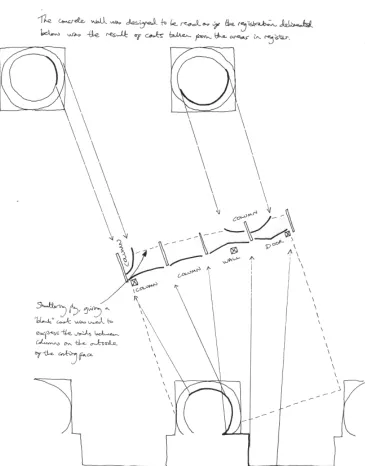
Fig 5
Diagram to show compression of space to be achieved in the concrete wall
3-way relativity –
the poetic, social and economic
If architecture is to actively deal with a matrix of possibilities and responsibilities, the relativity principle, which Van Eyck began to appropriate for the discipline, needs to inform how material, spatial and social construction is conceived, elaborated and used. The poetic, the social and the economic are not peripheral to architectural research; they are core within the elaborate matrix, and their constant redefi nition and circumstances are as follows.
Poetics
Beyond [concrete’s] mythology as a machine age material lies the wish for its construction to be responsive to its inherent qualities – its ability to run and slump, its weight. No matter how precise and rigid the formwork, it always defl ects as the material is poured and settled. If only that defl ection could be worked with a skilled eye, the bowing of the wall as an imprint of the formwork would not have to be disguised, it could take part in the spatial dynamics of the building. (Salter 1989, p.62)
[image:18.621.161.526.256.722.2]Fig 6
The paper and bitumen cast of the portico door and architrave, pierced by registration rods used to link the eight concrete panels as one piece. ‘A fl attening out of the deeply recessed façade of the church took place in the paper and bitumen due to its nature as a fl exible material’, Luisa Auletta.
An essential characteristic of poetry is that it can elaborate an understanding of the passing of time and the inscription of the human condition within material or spatial circumstances. What Salter is discussing is the opportunity inherent in technical processes for the discovery and articulation of a human response within a constructed materiality. Articulated by Le Corbusier as ‘Beton Brut’, the tactility and apparent nature of the rough work was elevated beyond the immediate ‘disadvantage’ of imperfection to an
appreciation of the revelation of the process of
construction, its textural qualities in light, and its advantages of economy. The use of fabric is similarly frank in its expression, and similarly challenging to the received notions of the perfect construction and ‘building as product’.
The poetics of deformative casting was in response to a research project instigated with great foresight by Michael Weinstock at the Architectural Association in the early 1990’s (fi g 5,6,7). Hessian, bitumen and paper pulp was used as a means of recording, reproducing and through the results fl exible
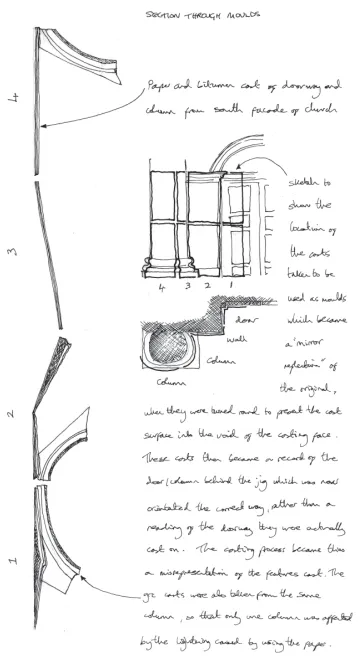
[image:19.621.69.380.235.704.2]Fig 7
Horizontal section through formwork showing location of each cast on the façade of St Georges, Bloomsbury
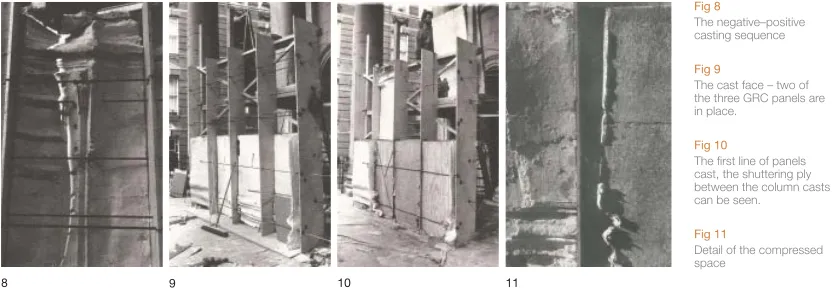
[image:20.621.181.543.66.724.2]formwork, manipulating from the space via the casting process. Concerned with spatial effect and intellectual elaboration, the exercise more importantly allowed the process of construction and the evidence of decision making to become enfolded in the work, to have the action and therefore human presence intrinsic to the technical accomplishment. Rachel Whiteread’s ‘House’ in Bow several years later posed similar questions, but was overwhelmingly about loss and a domestic poignancy of family space. Titled ‘Editing the Total Room’ (after a response to the work of Norwegian architect Sverre Fehn), the project was concerned more with establishing an intellectual protocol for casting, useful in the elaboration of future propositions – in that sense ‘architecture’ rather than ‘art’. The ‘Total Room’ project aimed to realise in concrete a fi ctitious compression of space within the portico of the Nicholas Hawksmoor church ‘St Georges’, in Bloomsbury, London. Using the process of casting in a literal and metaphorical way, the duplication of ‘real’ surfaces into ‘false’ cast surfaces was a muse on how material and technique mediate ideas and ideals.
The act of duplication inevitably copies only some aspects of the original: how those aspects are selected, how the process of duplication itself begins to dictate the consequences beyond the initial intention, became the main purpose of the project. Respect for the listed stonework of the church led via experimentation to the use of 100 per cent cotton linter paper pulp as a vehicle for taking the registration of the surface, applied using a deckle as an appliqué of the papermaking technique. This was reinforced with layers of hot bitumen and hessian to
bind the cast together, and to allow the hydrostatic pressure of the fi nal concrete cast to participate in the consequent fi nal form through a controlled deformation.
The second face of the concrete – the free-standing columns of the portico – was converted from paper negative to a positive in glass fi bre reinforced cement. Shuttering ply, which is the common parlance for concrete walling, was used to ‘stand in’ for the space between the columns – a conceptual fl aw foisted on the work by the reality of creating a cast, and one which Whiteread’s work also fails to overcome.
The paper left the stone unharmed, but ironically, and in a manner Heisenberg would appreciate, lifted from it the actual surface of accumulated soot and grime, depositing it onto the concrete cast. The fi ctitious compression of space actually presented the ‘real’ surface to the viewer. The idealisation of the concept is far richer when the ‘ideal’ is not fi xated on the result, but on the rigour of the process. To accommodate the inherent nature of a technique and a material allows space for these elements to contribute to the work, to lend an authenticity to the result which, like vernacular architecture, achieves a form of humanity through its accumulated growth and sense of inevitability. The accidental, the circumstantial and the blemish are not weaknesses; they are aspects that are inherently human, and if handled intellectually become an advantage. In this project there is a belief that human presence in the physicality of the built work is important, that this readability creates a dialogue with the viewer or user, and that in some way this form of communication and empathy is an inherent quality of architectural expression.
Fig 8
The negative–positive casting sequence
Fig 9
The cast face – two of the three GRC panels are in place.
Fig 10
The fi rst line of panels cast, the shuttering ply between the column casts can be seen.
Fig 11
Detail of the compressed space
[image:21.621.85.503.587.731.2]We defi ne the act of making as a constitution through improvisation with found objects and materials. The architectural process as event, responsive to the accident and implication of juxtaposing materials and objects, the act of making and use. Assemblage is the wilful manipulation of both associations with materials and of the reading of the history of events within objects, allowing the incident of construction to generate its own references. Adjustment is inherent within assemblage and is the means by which these disparate associations are combined. The result of physical adjustment – informed by intention – is a re-inscription of the meaning deduced between proximate objects providing new fi elds of resonance.6
Fabric formwork actively incorporates the direct actions of its makers upon the material being worked. A challenge in developing construction techniques with the required
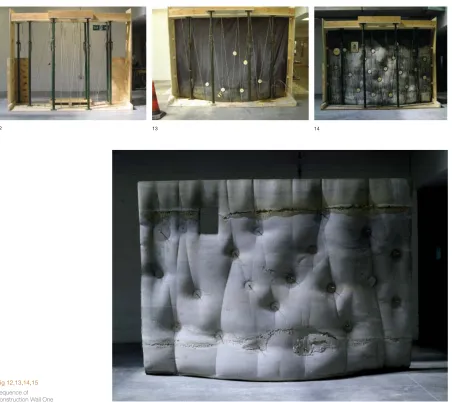
[image:22.621.89.541.319.721.2]thresholds of safety and predictability is that the spontaneous and the contingent become edited out of the activity. With much of architectural production focussed on one-off buildings for particular users and locations, it is key to address the issues surrounding bespoke production, of architects being equipped to exercise judgement and dexterity both at the design stage and production stage of building. David Pye, in his book The Nature and Art of Workmanship, makes a distinction between the ‘workmanship of risk’ and the ‘workmanship of certainty’. He clarifi es the role of the individual maker with regard to either being involved with the determination of the result, or being placed outside a predetermined mechanical (or digital) process. Clearly the ‘workmanship of risk’ refl ects the ambiguities surrounding the reality of architectural practice, to quote: ‘In the workmanship of risk, the result of
Fig 12,13,14,15
sequence of construction Wall One
6
Extract from ‘Manifesto: Jig’, unpublished study by Luisa Auletta and Alan Chandler.
15
every operation during production is determined by the workman as he works and its outcome depends wholly or largely on his care, judgement and dexterity‘ (1968, p63). In other words, can one determine the accuracy of a built result more confi dently by using techniques that do not prescribe the outcome entirely, but rather incorporate adjustment and judgement within their operation?
The frame for ‘Wall One’ was an elaboration of the idea of a jig, developing the term as a device for holding a piece to be worked in dialogue with the piece, not simply a means of predetermining and re-producing that piece exactly (as with conventional shuttering). This is an important distinction, if the relationship between the constructor and the material is to yield an element of the unforeseen and is a means of determining a systematic construction that retains a tactility of craft. In framing an activity, rather than predetermining it, a jig is a conceptually looser and more open ended mechanism than a simple formwork. Its precision lies in the clarity with which it enables a range of operations to happen. Casting is no longer a process of replication; rather it becomes, with the use of textile, a fi eld of possible outcomes within a fi xed set of parameters.
Social
On one hand, then, is a rich attitude linked by osmosis to the system’s sophisticated tools and wealth of information, an attitude that imitates and mediates reality, that determines the dichotomy between art and life, public behaviour and private life. But contrary to this is a ‘poor’ inquiry that aims at achieving an identity between man and action, between man and behaviour and thus eliminates the two levels of existence.
Germano Celant, ‘Arte Povera: Note for a Guerilla War’ (in Christov-Bakargiev 1999)
It is therefore essential for an object and also for the world to present themselves to us as ‘open’ … and as always promising future perceptions.
Umberto Eco
‘The Open Work’ (in Christov-Bakargiev 1999)
The work of Christopher Alexander in developing processes of making architecture as a collective act is particularly relevant to the ambition of the fabric formwork programme. The invention of ‘new vernacular’ building techniques establishes a commonly held and understood pattern language which develops from the material engagement of participants, circumstance and material properties. Construction practice emerges from that interrelationship – a relativity of practice and the practice of relativity. Alexander’s use of fabric
16
formwork as part of the Mexicali development was one of many techniques which in their direct simplicity reinforced the project ambition for a common practice, adding an elevated, ambitious geometry to a rectilinear form language as vaulted connecting colonnades (1985, p.30).
The network of constraints and criteria which exists in actual constructed situations establishes a fertile ground for problem solving, the exercise creating in one event a series of follow up scenarios for investigation. With the interaction of details understood, the research can determine a sequence of follow up work that develops interaction to an optimum. Without that initial overview, the strategic clarity is absent, and the interaction of elements is unexplored. There is clearly huge potential in the computational elaboration of ideas, but it is suggested as part of a wider matrix of research that is purpose driven, and in its elaboration maintains the working morality alluded to by Reyner Banham.
The drawing and its abstraction normally precede the making of structures with material. Within the Workshop, this is not so, and the line loses its pre-eminence. Workshops rely on both verbal and manual exchange in order to generate the constructed situation between the participants and their task. The architect should be taught not to assume that the mastery of matter in order to achieve form is always the responsibility of others. In the very conception of a design the qualities and properties of materials must be grasped and understood in order to make.
Knowledge acquisition and application can be embedded within the same activity. The concept that thinking is a singular and cerebral activity is actively countered by workshop practice. Jean Prouve’s method of thinking through making engages the tactile fabricator in the act of refi nement – his drawing board was adjacent to the metal press and allowed for the building of an idea before a drawing was made. This creates a situation whereby manual labour becomes valued in the creation of new form and function, with the interaction of material, structural performance, form and production technique addressed in one operation. The engagement of the manual and conceptual in the same moment embraces the value of fabricator and originator within the production of objects and architecture. The non-hierarchical, profi t sharing workshop structure of Jean Prouve’s manufacturing organisation reinforced the conviction that material progress can only be achieved by social progress. The context and structure of
fabrication is rarely a factor in the elaboration of research; however within the discipline of architecture it is a valid consideration, and within the fabric formwork project informs the development of technique and application.
Economic
An economy of means is more from less, not simply same for less. The development of a material research culture needs to prioritise investigation that understands issues at a number of simultaneous levels. When examined from a sustainable perspective, the economy of highly engineered and materially effi cient components may achieve low monetary unit costs but may never pay back the energy investment made in their manufacture, and may be so lean of purpose as to be redundant for future re-use or adaptation. Material research has to deal with future potentials as well as current economic imperatives, and there are clear advantages to developing lean techniques rather than lean products. The materiality of vernacular building traditions not only offers us economically derived, circumstance specifi c architectural responses, but leaves a rich material legacy or reservoir for future use, re-use or adaptation. It is often a material abundance that allows environmental, structural and cultural advantage to co-exist within buildings. This unitary conception of ‘vernacular’ can be applied to non-derivative research, with the fabric formwork research consciously working towards solutions that deliver simultaneous advantages – thermal mass, acoustic specifi city, effi cient construction processes and carbon sinks utilising recycled or carbon rich waste as constituent materials. (Fig 18) Formal economy is not by defi nition always fi nancial or sustainable economy, and the advantages of emergent material behaviour can fi nd expression in broader and more diverse areas than simply intricate geometry.
The structural clarity and simplicity of the Crown Hall at MIT by Ludwig Mies van de Rohe achieves its ‘truth’ and ‘simplicity’ through the downplaying of the ‘truth’ of the bending moment diagram, thereby elevating the status of the fact of industrial production. The ‘I beam’ maintains a consistent depth from bearing to mid-span owing to its extrusion-like manufacture on a rolling mill, thereby wasting its own weight in non-structural material. In addition the external placement of the roof beams expresses their iconic, industrial signifi cance but invites atmospheric attack to a reckless degree. Here the logic of an undifferentiated industrial production (of steel) and the desire
Fig 18
for expression (of industry as art form) clearly overrides the logic of natural structural economy, and it is precisely this interaction of production, material performance and formal preoccupation which actually expresses the true fi eld of ideas which architectural processes need to negotiate. The same pre-occupation with a logic of formal and iconic expression to the detriment of actual logical construction could equally be applied to architectural form generated from the skin of a custard apple, where digital elaboration delivers a superabundance of form requiring correspondingly highly developed techniques of production and energy inputs to become realised as surface active architecture. If one understands Otto’s reservations about the application of form fi nding to buildings, where for him such ‘work can only be seen in relationship to the complexity of a building task and the integration of the building into its surroundings and into society’ (1990, p.5), the counter to this might be to employ lean techniques that deliver a generosity of performance. Fabric formwork is one means of achieving such a technique, having distinct advantages in producing concrete over rigid formwork, chiefl y in its responsiveness and adaptability during the pour through a readability of the liquid concrete’s behaviour.
The jig to hold the textile and to allow it to remain responsive must be designed to minimise material use: in developed economies to minimise the unnecessary production of carbon, in developing economies as a response to a potentially restricted ‘economy of means’. An interest in Buckminster-Fuller’s notion of ‘tensegrity’ as the resolution of forces within the structure itself, converting dynamic loads into dead weight, informed the research into the opposition of cables and tension props resisting the fl uid concrete weight and fabric deformation. The use of rigs to transfer the downward pull of the concrete onto the upward thrust of acro props via cabling uses tensile containment where possible in preference to wholly compressive elements of containment – limiting the formwork weight wherever possible. Side panels can defi ne precise vertical edges to a cast, allowing it to be continued in sections to create the whole. The constructional variety available through the use of the catenary nature of pressure structures is both a structural advantage (greater endurance for less material), and formally liberating.
Techniques for casting walls and beams are now empirically established. The extension of fabric formwork research into structural, thermal and acoustically active structural slabs
commenced in 2006–7. This area of research seeks to minimise the potential dead weight of concrete as it swells below the horizontal datum of the reinforcement. The proven use of sleeved, grouted tendons which can follow the major undulations of the slab, set at metre centres, signifi cantly reduces steel use, and with the fabric’s ability to create high points within the underside of the slab, thicknesses and weight of material between the major undulations (acting as beams) reinterprets the waffl e slab not as a repetitious grid but as a variable fi eld of datum levels – the fabric forming a connective terrain. The advantages of this form of construction are multiple: reinforcement can be minimised; materially concrete can be minimised; acoustically a full scale surface can be achieved which corresponds to a required sound modulation developed digitally or through models; thermally the surface area for absorption of heat can be enlarged without compromising weight or setting up undesirable acoustic conditions; services, including fi bre optics, can be accommodated; visually the soffi t can be a surface open to the designer’s ambition. This multiple effi ciency goes some way to establishing concrete as ‘equipment’.
Establishing architecture as a material culture
The practice of prototyping is a proper domain for architectural research. Constructive processes and material inertia need to be thought of not as impediments to formal invention, but rather as active participants in innovation. As educators and as architects, the compulsion should be to build, learn and build again, a mode of operations at odds with traditional, non-architectural research practice. Conventionally a discrete series of operations would be defi ned which, through systematic and linear processes, became understood and evaluated according to pre-set criteria. Building at 1:1, informed with a limited but effective body of intuition and understanding, provides a broad platform from which signifi cant areas of study – materiality, of process, of technique, can be tested simultaneously. It is only after the prototype is built that the scientifi c model of analysis becomes vital in refi ning the opportunities that full scale making has generated. The prototype tests the interaction of materials and events, not merely their constituent parts. In building a prototype, one discovers how to build, and where to focus the activity of risk, the value of team consciousness, and the consequences of theoretical decision making.
of a process of thought. Simultaneously it is an enactment of that process. The power of a prototype is its ability to embody a fi eld of ideas and the means of testing the interrelationship of those ideas in a single moment. A prototype accelerates the proposition.
Meaningful form is the result of thoughtful, disciplined integration of the written and the improvised. The reinvigoration of a practice, be it the jazz of Miles Davis or advancing architectural construction, has to question any singularity of approach, and to recognise the variables inherent in each different situation in order to devise strategies that, through the interplay of confl icting concerns, create new coherence.
Developing thematic concerns and work through a clear structure allows for a succession of improvisations: ‘the building process … is a culture: a system of rules, and knowledge, and processes which spreads by word of mouth and hand to hand practice’ (Alexander 1985, p.347).
DIALOGUES
IN PROCESS
AND FORM
Even the most convincing techniques
of representation do not correspond fully
to the experience of the built reality.
Picon 2004, pp.114–121
studies in fabric cast concrete Remo Pedreschi
Trying to describe the idea of fabric formwork to cast concrete without the use of an image or example could possibly result in mild amusement, but almost certainly in mis-understanding. The use of fabric formwork, as the studies in this chapter endeavour to illustrate, is a viable, practical and expressive construction technique that raises questions about what informs the nature and the experience of material and process.
Materials that form buildings can be classifi ed in many ways, depending on the point of view. A chemist or a scientist, thinking about materials, may consider the order of materials in terms of atomic structure; for example the structures that separate metals from polymers. The technologist is more concerned with properties at a macro-scale and how these might control the application and the utility of materials, the physical characteristics that determine strength and stiffness. The builder is concerned with process. Imagine the stone mason as he studies a piece of stone, considering the best way to work it, being more concerned about the manner in which its geological history infl uences the way it can be cut, dressed and used. The perception of a material, its materiality, in building and architecture, is continually
under discussion. What are the intrinsic characteristics that inform its utility, process and expression? ‘Materials derive neither from nature alone nor from mere progress in science and technology’ (Picon 2006). The question posed by these studies in fabric cast concrete is at the heart of what the intrinsic material nature of concrete is. The question itself is, to a large extent, conditioned by viewing position. In education and research it is particularly important to bear in mind these viewing positions and to re-evaluate and re-appropriate the objects that are created from different perspectives. The true sense of a material comes from the ability of the observer to understand its nature from a series of different perspectives. Jean Prouvé understood this and expressed exasperation at both architects and engineers when they studied his work:
I noticed two things, one of these was the intense interest by technicians in the purely technical aspects of my projects, regardless of their content. The other was the equally intense interest shown by architects and users who saw in my projects an opportunity to modernise solely for appearances’ sake (Huber and Steinegger 1971).
Designers and makers often approach the use of materials from different positions. The process used to form an object can be declared or denied. In some of the works of Calatrava for example, or the Guggenheim by Gehry, the process may be said to be denied; it is clearly the fi nal form that controls the making and the means to construct are determined but not always infl uential. The form is not conditioned by its making. On the other hand it is clear that the work of Prouvé was heavily informed by the processes and materials available, with a close relationship between design and manufacture. The integration of process, materials and form is also seen throughout the works of Eladio Dieste. In many of his buildings there is a complexity of form, deliberately non-orthogonal, that at fi rst may appear irrational but becomes truly rational when its form and construction process are understood: ‘there can be no architecture without construction’ (Dieste, Architecture and Construction 2004, pp.182–190).
All his buildings arise from the synthesis of structural form, its expressiveness, construction process and materials. The church at Atlantida can be appreciated and interpreted from these differing positions (Figure 1 (Pedreschi 2000)). The undulating surfaces of the wall and roof, if viewed from the position of the planar orthogonal orthodoxy associated with frame, may indeed appear irrational. However his buildings are actually very effi cient structurally, simpler to construct than concrete and were built under conditions of severe economic stringency. Similarly many traditional forms of concrete construction have confused simplicity of form with rationality of process. The
temporary formwork often costs more than the material with which it is fi lled and form itself is conditioned by the means of making the formwork. The planar geometry of the formwork inevitably bends when resisting the pressure of the concrete and therefore requires substantial bracing to maintain its shape, to avoid leakage at the joints and to limit surface imperfections. Non-planar surfaces, following this process, are inherently more diffi cult and require more effort to make. When assessed against the orthodoxy of conventional formwork, non-orthogonal forms are immediately perceived as less practical. The use of fabric formwork suggests the opportunity to develop complexity of form using a rational process. Minimal use of material that requires minimal bracing, whose shape is dictated by its response to the forces it is intended to resist, will lead to a more expressive construction. To paraphrase Dieste, there is nothing more noble and elegant than to ‘resist through form’. The studies in fabric cast concrete initiated by Mark West and CAST challenge the orthodoxies of concrete, where anything that deviates from the planar is regarded as complex, less rational and costly. The idea of fabric as formwork gains particular strength when seen from the position of conventional construction.
This chapter describes a series of studies that further develop the potential of fabric formwork and its inherent differences from more conventionally cast concrete. There is a great concern for the pragmatic and a particular consideration of this work is the nature of the connection between fabric cast concrete elements and a rationalisation of the processes needed to achieve the form and connection in a consistent and repeatable way.
Fig 1
The Church of Jesus Christ the Worker,
Fig 2
Fabric concrete-twisted form (R. Pedreschi)
[image:30.621.199.298.553.720.2] [image:30.621.342.537.556.719.2]In conventional construction, once concrete has been selected its form is often predetermined by the nature of the formwork. The doubly curved, hyperbolic paraboloid surfaces of Felix Candela were developed, to a large extent, by the need to make curved surfaces from planar material (see Faber 1963). Fabric formwork raises other challenges. How can the fabric be controlled to produce interesting surfaces while maintaining the inherent rationality of the process?
The process reveals a synergy between the fabric and the fresh concrete. The concrete gives shape to the fabric by its weight and then receives the form and surface the fabric produces in return. The research must deal with the dichotomy of form and process. Additionally we must refl ect and continually refi ne the results, exploring the nature of the forms and surfaces given by the process. The research methodology requires a particular approach, somewhat different from empirically based methods most often associated with materials research, of isolating the variable and sequential analysis. It is one that endeavours to continually shift perspective between form and process, between expressiveness and rationality.
Methodology
Initial studies have revealed the beautiful forms and textures that can be produced with appropriate care and attention; however to fully understand the rational qualities the ideas have to be tested against practical issues such as accuracy of construction, repeatability and connection (Figure 2).
A series of projects was undertaken to consider the nature of the form and construction process. From these projects further strands of investigation have developed that study certain applications in much more detail. The studies were undertaken with senior architectural and engineering students of the University of Edinburgh. Through a series of seminars and demonstrations architecture students were exposed to the potential of the technique from a variety of perspectives:
> form – as appropriate architectural elements
> process – understanding appropriate techniques
> surface – the qualities of the form produced and its representation in terms of refl ectivity and texture.
Working in small groups over a period of fi ve weeks the architecture students
were encouraged to experiment through a sequence of prototypes leading to the design and production at full scale of a series of objects with a clear architectural or building application. Important criteria were:
> rational use of fabric
> minimal use of materials
> consistency and control of the process
>the connection between elements.
Other projects were part of a broader research programme including post-graduate engineering students and academic staff. All the projects were carried out in the Architecture workshop at the University of Edinburgh.
Physically and chemically the concrete studied in this work is almost identical to conventional concrete.1 Generally for the casts the
same mix was used throughout, modifi ed occasionally by using white cements or adding pigments.2 No additives, for example
plasticisers, were used.
Many different types of fabric were used including dressmaking cottons and polyester textiles. Various forms of geotextile fabric were also used. Geotextiles are strong, stiff and have good tear resistance. Virtually all the fabrics tested stripped easily from the hardened concrete.
Some fabrics with loosely woven yarns would leave traces on the concrete. Some dyed fabrics would leave colour traces on the concrete. Non-woven fabrics such as felts do not work so well and they can be diffi cult to strip.
Initially the studies focussed on generic architectural forms: beam, column, panel and wall. These terminologies gave direction to the studies. However a different classifi cation developed more concerned with the process rather than the object produced. The classifi cation relates to the interaction of the fabric and the concrete in its fresh or plastic state. The defi ning physical force in architecture is gravity. Gravity creates structure. Natural structures evolve that are conditioned by both their materials and the effect of gravity. Likewise the fresh concrete will generate downward, sideways and possibly upward pressure on formwork. Fabric can only resist these forces by tension and thus the form produced relies on controlling the reactions of the fabric to the forces produced by the concrete. Gravity then becomes a tool to be exploited in the generation of form rather than something that is resisted, as in conventional formwork systems. The overall geometry of the object is
1
In terms of mix proportions and materials used fabric cast concrete is identical to conventional concrete; however the permeability of the fabric alters the water content during casting, changing the hydration rate and curing regime and hence altering the properties of the hardened concrete; see Chapter 6.
2
determined by a patterning of the fabric and the arrangement of the formwork.
The surface can be further manipulated by careful stretching and pre-tensioning of the fabric prior to casting.
The projects have now taken place over three academic years. The results of each project are carefully documented and contribute to the brief for subsequent projects. The following results are broadly classifi ed by their form although they are explained in terms of process.
Panels
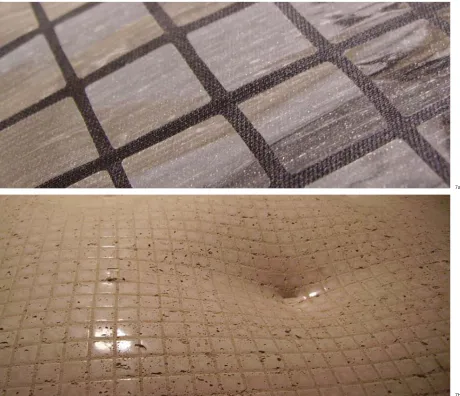
These are the simplest to construct and provide a great opportunity to study surface and texture (Figure 3). Fabric is stretched across a normally rectangular frame onto which a second frame is attached. The second frame forms the edge of the panel. The assembly is suspended in a horizontal position (Figure 4). If concrete is cast onto the fabric at this stage a doubly curved surface running to the straight edged sides will be produced. The degree of curvature depends on the stiffness of the fabric and the pre-tension induced by stretching the fabric. Further tension can be induced by deforming the fabric upwards using projecting forms placed underneath the fabric, producing counter curvature to the surface. Many studies have been carried out using this technique.
It is also possible to manipulate the surface using multiple layers of fabric of varying stiffness. In one example a layer of stiff, geotextile fabric was stretched and a series of cuts was made in the fabric. A second layer of very fl exible Spandex3 was stretched over the
geotextile (Figure 5).
The weight of the concrete causes the Spandex to be pushed through the geotextile
layer,