http://dx.doi.org/10.4236/jmp.2015.68121
How to cite this paper: Kaeen, D., Korek, M., Abdulal, S.N. and Awad, R. (2015) Theoretical Calculation of the Low-Lying Electronic States of the Molecule PbO. Journal of Modern Physics, 6, 1171-1183.
http://dx.doi.org/10.4236/jmp.2015.68121
Theoretical Calculation of the Low-Lying
Electronic States of the Molecule PbO
Diana Kaeen
1, Mahmoud Korek
1*, Saleh Nabhan Abdulal
2, Ramadan Awad
11
Physics Department, Faculty of Science, Beirut Arab University, Beirut, Lebanon
2Physics Department, Lebanese International University, Beirut, Lebanon
Email:
*[email protected]
Received 8 June 2015; accepted 27 July 2015; published 30 July 2015
Copyright © 2015 by authors and Scientific Research Publishing Inc.
This work is licensed under the Creative Commons Attribution International License (CC BY).
http://creativecommons.org/licenses/by/4.0/
Abstract
The potential energy curves of the lowest 20 electronic states in the representation
2s+1Λ
(±)of the
molecule PbO have been investigated via
ab initio
CASSCF and MRCI (single and double excitations
with Davidson correction) calculations. The spectroscopic constants such as vibrational harmonic
frequency
ω
e, the internuclear distance at equilibriumR
e, the rotational constantB
e, and theelec-tronic transition energy
T
e with respect to the ground state have been calculated along with thepermanent dipole moment for the different bound investigated electronic states. By using the
ca-nonical functions approach, the eigenvalues
E
v, the rotational constantB
v and the abscissas of theturning points
R
minand
R
maxhave been calculated. The comparison of these values with those
available in the literature shows a very good agreement.
Keywords
Ab Initio
Calculation, PbO Molecule, Potential Energy Curves, Spectroscopic Constants, Dipole
Moment, Rovibrational Calculation
1. Introduction
The lead metal monoxide was the subject of many experimental investigations
[1] [2]
and several theoretical
studies
[3]-[7]
. It is one of the most technologically important oxide materials which is used in the manufacture
of different ceramics products. Because of its electrical and electronic properties, it is used in capacitors and
electrophotographic plates, as well as in ferromagnetic and ferroelectric materials. It is also used as an activator
in rubber, in oil refining, as an oxidation catalyst in several organic chemical processes, in the production of
many lead chemicals, dry colors, soaps, and driers for paint. Moreover it is used in the production of lead salts,
particularly those used as stabilizers for plastics, notably polyvinyl chloride materials.
There is a rapid increase and concern in studying the spectra of this molecule which is shown in the different
papers written on its low lying electronic states. It has been experimentally proven that the ground state of the
molecule PbO is
1Σ
+[8]-[10]
. This result has been theoretically confirmed in a number of studies that used
dif-ferent methods
[3]-[14]
. The three excited electronic states B
3Π
, A
3Π
, and a
3Σ
+have been investigated by
Ol-denborg
et al.
[9]
while the electric-dipole moment of (1)
3Σ
+state of PbO molecule has been measured by
Hunt-er
et al.
[15]
. By using the CASSCF/CASPT calculation the six electronic states
3Σ
±,
1Σ
−,
1,2∆
, and
3Π
of this
molecule have been investigated without
[12]
and with spin orbit coupling
[16]
.
In the present work 20 low-lying singlet and triplet electronic states of PbO molecule have been investigated
by using the
ab initio
method using two basis sets. The potential energy curves (PECs) together with the
transi-tion energy with respect to the minimum energy for the ground state
T
e, the equilibrium internuclear distance
R
e,
the harmonic frequency
ω
e, the rotational constant
B
e, and the permanent dipole moment (DMCs)
µ
have been
obtained for the considered electronic states. Nine and eleven electronic states have been investigated here for
the first time using respectively the first and the second basis sets. Taking advantage of the electronic structure
of the investigated electronic states of the molecule PbO and by using the canonical functions approach, the
ei-genvalue
E
v, the rotational constant
B
v, and the turning points
R
minand
R
maxhave been calculated for several
vi-brational levels of the considered singlet and triplet electronic states.
2. Method of Calculations
2.1. Ab Initio Calculation
In the present work we study the low-lying singlet and triplet electronic states of the molecule PbO using state
averaged complete active space self consistent field (CASSCF) procedure followed by a multireference
confi-guration interaction (MRDSCI+Q with Davidson correction) treatment for the electron correlation. The entire
CASSCF configuration space was used as the reference in the MRDSCI calculations, which were done via the
computational chemistry program MOLPRO
[17]
taking advantage of the graphical user interface GABEDIT
[18]
. Since we noticed large discrepancies between the calculated values of
ω
ein literature, two different ways
have been used in the present theoretical study of the PbO molecule. In the first and the second ways the 82
electrons of the lead atom are considered using the effective core potential ECP78MWB basis set for s, p, and d
functions. While the oxygen species is treated as a system of 8 electrons by using, for the s, p, and d functions,
the 6-311++G** and the DGauss-a2-X fit basis sets respectively for the first and the second ways respectively.
For these 2 ways of calculation the potential energy curves and the static dipole moments of the low-lying
elec-tronic states of the molecule PbO were generated using the MRSDCI+Q for 350 internuclear distances
calcula-tions in the range 1.5 Å
≤
R
e≤ 5.0 Å in the representation
2s+1Λ
(±)where we assumed that, the PbO molecule is
mainly ionic around the equilibrium position.
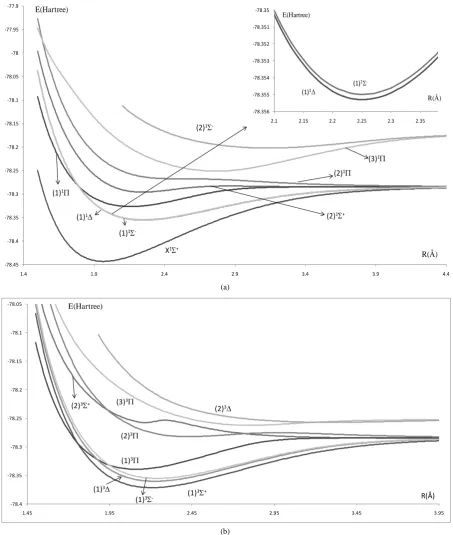
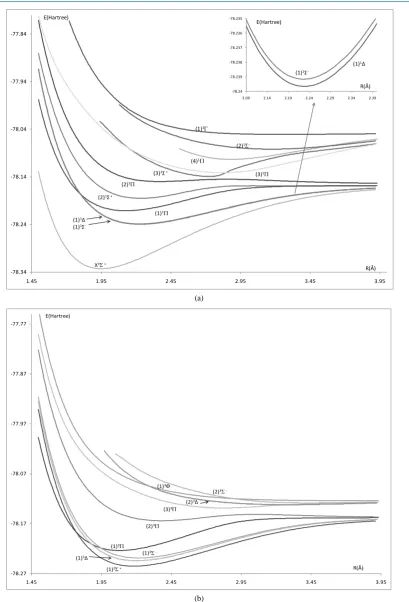
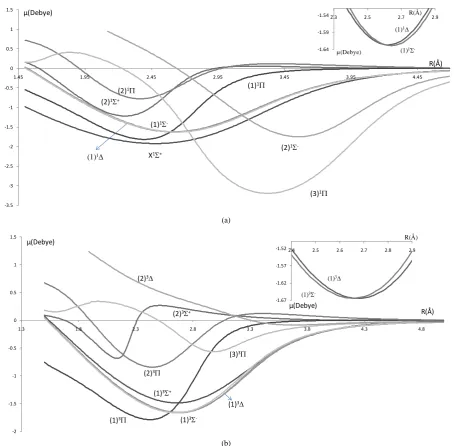
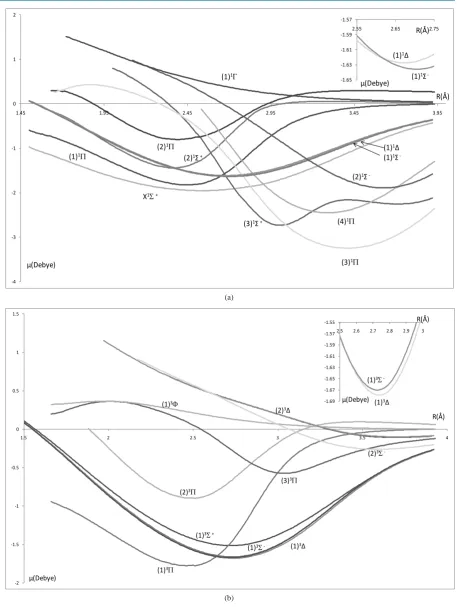
These PECs and the DMCs for the different symmetries are given
in
Figures 1-4
.
The electric dipole moment is a fundamental electrostatic property, it is useful in finding the strength of the
long-range dipole-dipole forces, and the understanding of the macroscopic properties of imperfect gases, liquids
and solids. Our MRCI calculation of the DMCs produces smooth and continuous curves even close to the
avoided crossings. At large internuclear distances, the dipole moment of all the investigated electronic states
smoothly approaches zero which is theoretically the correct behavior for a molecule that dissociates into natural
fragments. It is quite common for the molecular electronic states of the potential energy curves to make
cross-ings or avoided crosscross-ings known as conical intersections (
Figure 3
and
Figure 4
).
These points of the potential energy curves of a diatomic molecule are important in photochemistry. In fact,
the avoided crossing regions are likely to be a leakage channels along which the molecules flow from the higher
down to the lower potential energy curves. Such crossings or avoided crossings can dramatically alter the
stabil-ity of the molecules. If these crossings are overlooked, then low barrier transitions can be missed and an
incor-rect chemical picture will arise. In the range of R considered, several avoided crossings have been detected in
the potential energy curves of the excited electronic states of the molecule PbO.
(a)
[image:3.595.87.541.84.620.2](b)
Figure 1. Potential energy curves of the lowest electronic states of the molecule PbO using the first basis set: ECP78MWB and 6-311++G** for Pb and O atoms respectively. (a) Singlet electronicstates 1Σ±, 1∆, 1Π; (b) Triplet electronicstates 3Σ±, 3∆, 3Π.
with the positions of the crossing of the corresponding DMCs at the points 2.5 Å (
Figure
3
) and 2.8 Å (
Figure
4
)
respectively can be considered as confirmation of the accuracy of the present results. In the present calculation
of the DMCs we considered the lead atom at the origin. One can notice that, some parts of the DMCs are
posi-tive where the lead atom is charged negaposi-tively and the other main parts are negaposi-tive where the charges of the 2
-78.45 -78.4 -78.35 -78.3 -78.25 -78.2 -78.15 -78.1 -78.05 -78 -77.95 -77.9
1.4 1.9 2.4 2.9 3.4 3.9 4.4
(1)1Σ
-(1)1∆
(1)1Π
(2)1Σ+
(2)1Π
(3)1Π
(2)1Σ
-E(Hartree)
X1Σ+
R(Å) -78.356
-78.355 -78.354 -78.353 -78.352 -78.351 -78.35
2.1 2.15 2.2 2.25 2.3 2.35 (1)1∆ (1)
1Σ
-R(Å) E(Hartree)
-78.4 -78.35 -78.3 -78.25 -78.2 -78.15 -78.1 -78.05
1.45 1.95 2.45 2.95 3.45 3.95
(1)3Σ+ (1)3∆
(1)3Σ -(1)3Π (2)3Π (3)3Π (2)3Σ+
(2)3∆
(a)
[image:4.595.113.523.76.679.2](b)
Figure 2. Potential energy curves of the lowest electronic states of the molecule PbO using the second basis set: ECP78MWB and DGauss-a2-X fit for Pb and O atoms respectively. (a) Singlet electronicstates 1Σ±, 1∆, 1Π
; (b) Triplet electronicstates 3Σ±, 3∆, 3Π. -78.34
-78.24 -78.14 -78.04 -77.94 -77.84
1.45 1.95 2.45 2.95 3.45 3.95
X1Σ +
(1)1Γ
(1)1Δ (1)1Σ
-(1)1Π (2)1Σ +
(2)1Π
(3)1Σ + (3)1Π (4)1Π
(2)1Σ− E(Hartree)
R(Å)
-78.24 -78.239 -78.238 -78.237 -78.236 -78.235
2.09 2.14 2.19 2.24 2.29 2.34 2.39
E(Hartree)
R(Å) (1)1Δ (1)1Σ
--78.27 -78.17 -78.07 -77.97 -77.87 -77.77
1.45 1.95 2.45 2.95 3.45 3.95
(1)3Σ+ R(Å)
E(Hartree)
(1)3Δ (1)3Σ -(1)3Π
(2)3Π
(3)3Π (2)
3Δ (1)3Φ
-(a)
[image:5.595.86.541.80.526.2](b)
Figure 3.Dipole moment curves of the lowest electronic states of the molecule PbO using the first basis set: ECP78MWB and 6-311++G** for Pb and O atoms respectively. (a) Singlet electronicstates 1Σ±, 1∆, 1Π; (b) triplet electronicstates 3Σ±, 3∆, 3Π.
atoms are reversed.
By fitting the calculated energy values around the equilibrium position to a polynomial in terms of the
inter-nuclear distance, the spectroscopic constants
ω
e,r
e,B
e, andT
ehave been calculated by using the PECs obtained
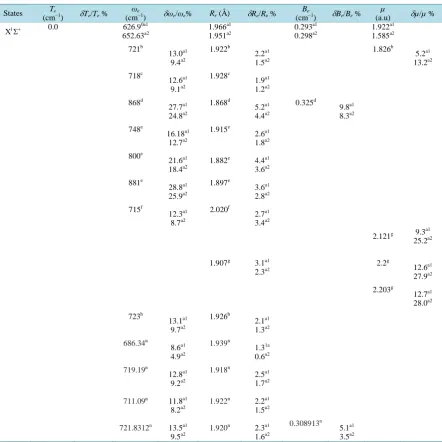
by the 2 different ways of calculation. These values are given in
Table 1
along with the available data given in
the literature. The comparison of our results with the calculated values for
R
e by different techniques in literaturefor the ground state shows a good agreement with the relative differences 1.3% (Ref.
[26]
)
≤
∆
R
e/
R
e≤ 5.2% (Ref.
[5]
) and 0.61% (Ref.
[26]
)
≤
∆
R
e/
R
e≤ 4.4% (Ref.
[5]
)
using the first and second way of calculation respectively.
For
B
e, the comparison of our calculated values with those of Schwenzeret al.
[5]
, f
or the ground state, showed
the relative differences 9.8% and 8.4% for the first and the second way respectively, while these relative
differ-ences showed the good agreement 3.5% and 2.5% by comparing our values with those of Jalbout
et al.
[26]
.
For
ω
e, the comparison of our results with the fourteen values calculated by different techniques in literature for theground state show the relative differences 8.6% (Ref.
[26]
)
≤
∆
ω
e/ω
e≤ 28.8% (Ref.
[4]
)
and 4.9% (Ref.
[26]
)
-3.5 -3 -2.5 -2 -1.5 -1 -0.5 0 0.5 1 1.5
1.45 1.95 2.45 2.95 3.45 3.95 4.45
(3)1Π (2)1Σ -X1Σ+
(1)1Π
(1)1Σ -(2)1Σ+
(2)1Π
R(Å) µ(Debye)
-1.64 -1.59
-1.54 2.3 2.5 2.7 2.9
(1)1∆
(1)1∆
(1)1Σ
-R(Å)
µ(Debye)
-2 -1.5 -1 -0.5 0 0.5 1 1.5
1.3 1.8 2.3 2.8 3.3 3.8 4.3 4.8
(1)3Π (1)3Σ
-(1)3∆ (1)3Σ+
(2)3Π
(3)3Π (2)3Σ+
(2)3∆
R(Å) µ(Debye)
-1.67 -1.62 -1.57
-1.52 2.4 2.5 2.6 2.7 2.8 2.9
(1)3∆
(1)3Σ
-R(Å)
(a)
[image:6.595.83.541.77.685.2](b)
Figure 4. Dipole moment curves of the lowest electronic states of the molecule PbO using the second basis set: ECP78MWB and DGauss-a2-X fit for Pb and O atoms respectively. (a) Singlet electronicstates 1Σ±, 1∆, 1Π; (b) Triplet electronicstates 3Σ±,
3∆
, 3Π. -4
-3 -2 -1 0 1 2
1.45 1.95 2.45 2.95 3.45 3.95
X1Σ +
-1.65 -1.63 -1.61 -1.59 -1.57
2.55 2.65 2.75
(3)1Π
(4)1Π
(1)1Π (2)
1Π
µ(Debye)
(3)1Σ +
(2)1Σ + (1)
1Δ
(1)1Σ
-(1)1Σ
-(1)1Δ
R(Å)
R(Å) µ(Debye)
(1)1Γ
(2)1Σ
--2 -1.5 -1 -0.5 0 0.5 1 1.5
1.5 2 2.5 3 3.5 4
-1.69 -1.67 -1.65 -1.63 -1.61 -1.59 -1.57 -1.55
2.5 2.6 2.7 2.8 2.9 3
µ(Debye)
R(Å)
R(Å)
µ(Debye) (1)
3Π
(1)3Δ (1)3Σ
-(1)3Σ+ (2)3Π
(3)3Π (1)3Φ
(2)3Σ -(2)3Δ
(1)3Σ
≤
∆
ω
e/
ω
e≤ 25.9% (Ref.
[4]
)
for the first and second way respectively
. This comparison shows that our values
for
ω
eare in disagreement with those given in Ref.
[4]
, while there is a good agreement for the theoretical values
of
R
e,
B
eand
ω
eof
Jalbout
et al.
[26]
and our calculated values for these constants. The comparison of our
cal-culated values
of
T
e, using the 2 different ways of calculation, for the two states (1)
3Σ
+and (1)
3Π
with those
calculated in literature
[9]
shows a good agreement with the relative difference 1.6%
≤
∆
T
e/
T
e≤ 7.9%.
[image:7.595.93.536.277.720.2]One can notice that the use of 2 ways of calculation for
R
eand
T
ehave no influence on the calculated values
of these constants, but there is an influence on the value of
ω
eand large influence on the calculated value of the
dipole moment. Moreover our calculated values of dipole moment by using the second way are not in good
ac-curacy with those calculated in literature, while our calculated values by using the first way of calculation are in
good agreement with the experimental data of Huber and G. Herzberg
[1]
. These values are given in
Table 1
.
From this over all agreement between our investigated values of the spectroscopic constants and those found in
literature, we can pretend the validity of the used technique of calculation and the accuracy of our calculation for
the new investigated electronic states. The future experimental investigation for these new electronic states may
confirm our results.
Table 1. Spectroscopic constants for the lowest singlet and triplet electronic states of the molecule PbO.
States Te
(cm−1) δTe/Te % (cmωe−1) δωe/ωe% Re (Å) δRe/Re %
Be
(cm−1) δBe/Be %
µ
(a.u) δµ/µ %
X1Σ+ 0.0 626.9
0a1 652.63a2 1.966a1 1.951a2 0.293a1 0.298a2 1.922a1 1.585a2 721b 13.0a1 9.4a2 1.922b 2.2a1 1.5a2 1.826b 5.2a1 13.2a2 718c 12.6a1 9.1a2 1.928c 1.9a1 1.2a2 868d 27.7a1 24.8a2 1.868d 5.2a1 4.4a2 0.325d 9.8a1 8.3a2
748e 16.18a1
12.7a2
1.915e 2.6a1
1.8a2
800e
21.6a1
18.4a2
1.882e 4.4a1
3.6a2 881e 28.8a1 25.9a2 1.897e 3.6a1 2.8a2 715f 12.3a1 8.7a2 2.020f 2.7a1 3.4a2
1.907g 3.1a1
2.3a2 2.121g 2.2g 2.203g 9.3a1 25.2a2 12.6a1 27.9a2 12.7a1 28.0a2 723h 13.1a1 9.7a2 1.926h 2.1a1 1.3a2 686.34n 8.6a1 4.9a2 1.939n 1.31a 0.6a2 719.19n 12.8a1 9.2a2 1.918n 2.5a1 1.7a2
711.09n 11.8a1
8.2a2 1.922
n 2.2a1
1.5a2
721.8312n 13.5a1
9.5a2
1.920n 2.3a1
1.6a2
0.308913n 5.1a1
Continued 725.5854n 13.6a1 10.1a2 1.93n 1.8a1 1.1a2 0.30572n 4.1a1 2.5a2
724.6454n 13.4a1
9.9a2 2.263k 2.2484k 15.1a1 29.9a2 14.5a1 29.5a2 2.439l 2.425l 2.438l 2.421l 21.1a1 35.0a2 20.7a1 34.63a2 21.1a1 34.9a2 20.5a1 34.5a2 2.138m 10.1a1 25.8a2
(1)3Σ+ 15767.4
a1
17058.7a2
16029o 1.6a1
6.4a2
449.72a1 454.63a2
478.7o 6.4a1
5.0a2
2.207a1
2.182a2 0.233
a1
0.238a2 1.17
a1
1.064a2
(1)3Δ 18181.7a1
19458.7a2 441.80a1 447.99a2 2.222a1 2.200a2 0.229a1 0.234a2 1.353a1 1.189a2
(1)1Δ 19247.9a1
20470.9a2 421.29
a1
419.06a2 2.250
a1
2.227a2 0.224
a1
0.228a2 1.385
a1
1.293a2
(1)1Σ- 19313.0a1
20579.2a2 420.04
a1
419.83a2 2.250
a1
2.226a2 0.224
a1
0.229a2 1.379
a1
1.268a2
(1)3Σ- 19315.9a1
20633.0a2 431.54a1 427.45a2 2.237a1 2.215a2 0.226a1 0.231a2 1.353a1 1.24a2
(1)3Π 22826.3
a1
23945.4a2
22175p 2.9a1
7.9a2
468.00a1
476.12a2 2.111
a1
2.079a2 0.254
a1
0.262a2 1.554
a1
1.449a2
(1)1Π 25581.1a1 26707.5a2 442.82a1 438.19a2 2.159a1 2.125a2 0.243a1 0.251a2 1.634a1 1.536a2
(2)1Σ+ 32296.4a1
32448.3a2 437.78a1 442.93a2 2.244a1 2.231a2 0.225a1 0.227a2 1.217a1 1.35a2
(2)3Π 35349.4a1
37028.3a2 306.02
a1
341.56a2 2.431
a1
2.379a2 0.191
a1
0.200a2 0.842
a1
0.857a2 (3)3Π 39719.1a1
42633.4a2 255.76
a1
252.86a2 2.799
a1
2.819a2 0.144
a1
0.142a2 0.441
a1
0.439a2
(2)1Π 40154.7a2 354.54a2 2.366a2 0.202a2 0.798a2
(2) 3Σ+ 40781.3a1 708.26a1 2.161a1 0.242a1 0.66a1
(2)3Δ 40837.0
a1
44061.9a2 130.84
a1
134.91a2 3.280
a1
3.287a2 0.105
a1
0.105a2 0.007
a1
0.009a2 (3)1Π 42086.7a1
44212.0a2 352.09a1 350.81a2 2.769a1 2.818a2 0.148a1 0.1428a2 1.824a1 1.815a2
(3)1Σ+ 42523.3a2 510.08a2 2.722a2 0.153a2 1.853a2
(2)3Σ− 44847.4a2 129.57a2 3.431a2 0.963a2 0.239a2
(4)1Π 50404.3a2 402.62a2 2.872a2 0.137a2 1.721a2
(2)1Σ− 52886.3a1
55112.9a2 217.35a1 218.76a2 3.130a1 3.174a2 0.115a1 0.112a2 1.193a1 1.253a2
a1Present work using, for the 82 electrons of the Lead atom, a contracted ECP78MWB basis set for s, p, and d functions. While the oxygen species is
treated as a system of 8 electrons by using the 6-311++G** basis set for s, p, and d functions. a2Present work using, for the 82 electrons of the Lead
atom, a contracted ECP78MWB basis set for s, p ,and d functions ,while the oxygen species is treated as a system of 8 electrons by using the DGauss-a2-Xfit basis set for s, p, and d functions. bRef. [1], cRef [12], dRef. [5], eRef [4], fRef. [7], gRef. [3], hRef. [19], kRef. [20], lRef. [21], mRef.
2.2. The Vibration-Rotation Calculation
By using the canonical functions approach
[23]-[25]
and the cubic spline interpolation between each two
con-secutive points of the PECs obtained from the
ab initio
calculation of the PbO molecule, the eigenvalue
E
v, the
rotational constant
B
v, and the abscissas of the turning point
R
minand
R
maxhave been calculated for the
consi-dered electronic states up to the vibrational levels
v
= 41
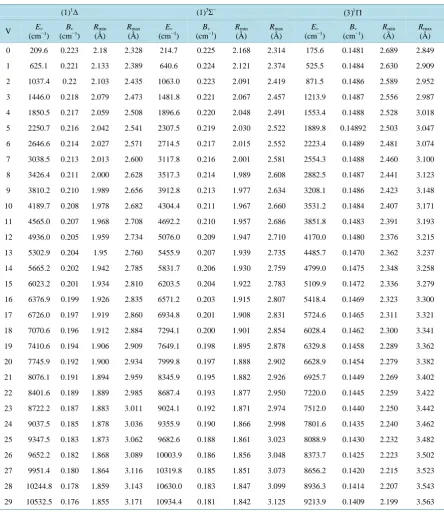
. These values for the different electronic states are
given in
Table 2
. The absence of the comparison with other results is because of the calculation of these values
[image:9.595.93.538.209.722.2]here for the first time.
Table 2. Values of the eigenvalues Ev, the rotational constants Bv and the abscissas of the turning points for the different
vi-brational levels of the singlet and triplet electronic states of the molecule PbO.
(1)1Δ (1)3Σ− (3)1Π
V Ev
(cm−1)
Bv (cm−1)
Rmin
(Å)
Rmax
(Å)
Ev (cm−1)
Bv (cm−1)
Rmin
(Å)
Rmax
(Å)
Ev (cm−1)
Bv (cm−1)
Rmin
(Å)
Rmax
(Å)
0 209.6 0.223 2.18 2.328 214.7 0.225 2.168 2.314 175.6 0.1481 2.689 2.849
1 625.1 0.221 2.133 2.389 640.6 0.224 2.121 2.374 525.5 0.1484 2.630 2.909
2 1037.4 0.22 2.103 2.435 1063.0 0.223 2.091 2.419 871.5 0.1486 2.589 2.952
3 1446.0 0.218 2.079 2.473 1481.8 0.221 2.067 2.457 1213.9 0.1487 2.556 2.987
4 1850.5 0.217 2.059 2.508 1896.6 0.220 2.048 2.491 1553.4 0.1488 2.528 3.018
5 2250.7 0.216 2.042 2.541 2307.5 0.219 2.030 2.522 1889.8 0.14892 2.503 3.047
6 2646.6 0.214 2.027 2.571 2714.5 0.217 2.015 2.552 2223.4 0.1489 2.481 3.074
7 3038.5 0.213 2.013 2.600 3117.8 0.216 2.001 2.581 2554.3 0.1488 2.460 3.100
8 3426.4 0.211 2.000 2.628 3517.3 0.214 1.989 2.608 2882.5 0.1487 2.441 3.123
9 3810.2 0.210 1.989 2.656 3912.8 0.213 1.977 2.634 3208.1 0.1486 2.423 3.148
10 4189.7 0.208 1.978 2.682 4304.4 0.211 1.967 2.660 3531.2 0.1484 2.407 3.171
11 4565.0 0.207 1.968 2.708 4692.2 0.210 1.957 2.686 3851.8 0.1483 2.391 3.193
12 4936.0 0.205 1.959 2.734 5076.0 0.209 1.947 2.710 4170.0 0.1480 2.376 3.215
13 5302.9 0.204 1.95 2.760 5455.9 0.207 1.939 2.735 4485.7 0.1470 2.362 3.237
14 5665.2 0.202 1.942 2.785 5831.7 0.206 1.930 2.759 4799.0 0.1475 2.348 3.258
15 6023.2 0.201 1.934 2.810 6203.5 0.204 1.922 2.783 5109.9 0.1472 2.336 3.279
16 6376.9 0.199 1.926 2.835 6571.2 0.203 1.915 2.807 5418.4 0.1469 2.323 3.300
17 6726.0 0.197 1.919 2.860 6934.8 0.201 1.908 2.831 5724.6 0.1465 2.311 3.321
18 7070.6 0.196 1.912 2.884 7294.1 0.200 1.901 2.854 6028.4 0.1462 2.300 3.341
19 7410.6 0.194 1.906 2.909 7649.1 0.198 1.895 2.878 6329.8 0.1458 2.289 3.362
20 7745.9 0.192 1.900 2.934 7999.8 0.197 1.888 2.902 6628.9 0.1454 2.279 3.382
21 8076.1 0.191 1.894 2.959 8345.9 0.195 1.882 2.926 6925.7 0.1449 2.269 3.402
22 8401.6 0.189 1.889 2.985 8687.4 0.193 1.877 2.950 7220.0 0.1445 2.259 3.422
23 8722.2 0.187 1.883 3.011 9024.1 0.192 1.871 2.974 7512.0 0.1440 2.250 3.442
24 9037.5 0.185 1.878 3.036 9355.9 0.190 1.866 2.998 7801.6 0.1435 2.240 3.462
25 9347.5 0.183 1.873 3.062 9682.6 0.188 1.861 3.023 8088.9 0.1430 2.232 3.482
26 9652.2 0.182 1.868 3.089 10003.9 0.186 1.856 3.048 8373.7 0.1425 2.223 3.502
27 9951.4 0.180 1.864 3.116 10319.8 0.185 1.851 3.073 8656.2 0.1420 2.215 3.523
28 10244.8 0.178 1.859 3.143 10630.0 0.183 1.847 3.099 8936.3 0.1414 2.207 3.543
Continued
30 10814.1 0.174 1.851 3.199 11232.6 0.179 1.838 3.152 9489.0 0.1403 2.191 3.583
31 11089.8 0.172 1.847 3.229 11524.5 0.176 1.834 3.180 9761.7 0.1397 2.184 3.604
32 11359.1 0.169 1.843 3.259 11809.7 0.174 1.830 3.209 10031.9 0.1390 2.177 3.624
33 11622.0 0.167 1.840 3.289 12087.9 0.172 1.827 3.239 10299.6 0.1384 2.170 3.645
34 11878.6 0.165 1.836 3.320 12358.7 0.169 1.823 3.269 10564.6 0.1377 2.163 3.665
35 12128.2 0.162 1.833 3.353 12621.8 0.166 1.820 3.302 10827.1 0.1370 2.156 3.686
36 12371.1 0.160 1.830 3.387 12876.6 0.164 1.817 3.335
37 12606.7 0.157 1.827 3.422 13122.9 0.161 1.814 3.371
38 12835.2 0.154 1.824 3.458 13360.0 0.158 1.811 3.408
39 13056.2 0.152 1.821 3.496 13587.4 0.154 1.808 3.448
40 13269.3 0.149 1.818 3.535 13804.7 0.151 1.806 3.495
41 13474.4 0.146 1.816 3.576
(1)1Π (1)3Δ (1)3Σ+
0 220.5 0.242 2.09 2.234 214.8 0.228 2.154 2.299 81.9 0.231 2.097 2.333
1 658.3 0.241 2.043 2.293 641.2 0.227 2.107 2.360 243.3 0.227 2.027 2.439
2 1092.7 0.240 2.013 2.337 1063.8 0.226 2.076 2.404 401.2 0.223 1.983 2.520
3 1523.3 0.238 1.989 2.374 1482.8 0.224 2.053 2.442 555.4 0.220 1.950 2.591
4 1949.3 0.237 1.970 2.407 1898.0 0.223 2.033 2.476 705.7 0.216 1.923 2.658
5 2371.2 0.235 1.953 2.438 2309.4 0.221 2.016 2.507 852.1 0.212 1.900 2.722
6 2788.4 0.234 1.937 2.468 2716.9 0.220 2.000 2.537 994.4 0.208 1.880 2.784
7 3200.7 0.232 1.924 2.496 3120.6 0.219 1.987 2.566 1132.7 0.204 1.862 2.845
8 3607.9 0.230 1.911 2.524 3520.4 0.217 1.974 2.593 1266.6 0.200 1.847 2.906
9 4009.7 0.229 1.900 2.551 3916.4 0.216 1.963 2.619 1396.2 0.195 1.833 2.968
10 4405.6 0.227 1.889 2.578 4308.4 0.214 1.952 2.645 1521.1 0.191 1.820 3.031
11 4795.3 0.225 1.879 2.604 4696.5 0.213 1.942 2.670 1641.1 0.186 1.809 3.096
12 5178.5 0.223 1.870 2.631 5080.8 0.211 1.933 2.695 1756.0 0.181 1.798 3.163
13 5554.4 0.221 1.862 2.658 5461.0 0.210 1.924 2.720 1865.3 0.176 1.789 3.234
14 5922.6 0.218 1.854 2.686 5837.3 0.208 1.916 2.744 1968.7 0.170 1.780 3.310
15 6282.4 0.216 1.846 2.714 6209.5 0.207 1.908 2.768
16 6632.6 0.213 1.839 2.744 6577.7 0.205 1.900 2.792
17 6972.2 0.210 1.833 2.774 6941.8 0.204 1.893 2.816
18 7299.8 0.206 1.827 2.807 7301.8 0.202 1.886 2.839
19 7613.8 0.202 1.821 2.842 7657.5 0.201 1.880 2.863
20 7912.1 0.198 1.816 2.881 8009.0 0.199 1.874 2.886
21 8192.5 0.192 1.811 2.925 8356.1 0.198 1.868 2.910
22 8451.9 0.186 1.807 2.975 8698.7 0.196 1.862 2.934
23 8686.5 0.178 1.803 3.035 9036.8 0.194 1.857 2.957
24 8891.9 0.168 1.799 3.110
Continued
(3)3Π (2)1Σ+ (2)3Π
0 126.6 0.144 2.71 2.899 216.2 0.223 2.176 2.321 150.9 0.19 2.351 2.525
1 375.1 0.143 2.649 2.981 638.4 0.221 2.132 2.387 444.9 0.188 2.299 2.605
2 614.6 0.141 2.61 3.046 1044.7 0.218 2.104 2.439 726.2 0.184 2.267 2.669
3 843.6 0.139 2.579 3.105 1433.1 0.214 2.083 2.486 991.6 0.181 2.243 2.731
4 1060.3 0.137 2.554 3.165 1800.8 0.211 2.065 2.534
5 1262.8 0.134 2.533 3.227 2143.5 0.206 2.051 2.584
6 1449.8 0.131 2.516 3.295 2454.3 0.199 2.039 2.642
7 1619.3 0.127 2.501 3.371
X1Σ + (1)3Π
0 312.000 0.292 1.908 2.029 233.600 0.253 2.044 2.183
1 928.700 0.291 1.869 2.08 698.000 0.252 1.998 2.241
2 1540.50 0.289 1.843 2.116 1158.30 0.251 1.969 2.283
3 2146.20 0.287 1.824 2.147 1615.60 0.249 1.945 2.318
4 2747.30 0.286 1.807 2.175 2068.70 0.248 1.926 2.350
5 3344.60 0.284 1.793 2.201 2519.60 0.246 1.910 2.380
6 3936.90 0.282 1.780 2.225 2966.60 0.245 1.896 2.408
7 4524.20 0.281 1.768 2.248 3411.00 0.243 1.883 2.435
8 5107.40 0.279 1.758 2.27 3852.00 0.242 1.870 2.460
9 5685.90 0.278 1.748 2.292 4288.80 0.240 1.859 2.485
10 6259.50 0.276 1.739 2.313 4721.60 0.239 1.849 2.509
11 6828.60 0.274 1.731 2.333 5149.50 0.237 1.839 2.533
12 7393.20 0.273 1.723 2.353 5573.10 0.236 1.830 2.556
13 7952.90 0.271 1.716 2.373 5992.80 0.234 1.822 2.579
14 8507.90 0.269 1.709 2.392 6408.20 0.232 1.813 2.602
15 9058.30 0.267 1.702 2.411 6819.20 0.231 1.806 2.625
16 9603.90 0.266 1.696 2.43 7225.00 0.229 1.799 2.648
17 10144.7 0.264 1.690 2.448 7624.90 0.227 1.792 2.671
18 10680.7 0.262 1.684 2.467 8018.80 0.225 1.785 2.694
19 11212.0 0.261 1.678 2.485 8406.70 0.223 1.779 2.718
20 11738.4 0.259 1.673 2.504 8787.50 0.221 1.773 2.742
21 12260.0 0.257 1.668 2.522 9160.60 0.218 1.768 2.768
22 12776.8 0.256 1.663 2.54 9524.80 0.215 1.763 2.794
23 13288.8 0.254 1.659 2.558 9878.70 0.212 1.758 2.822
24 13795.8 0.252 1.654 2.576 10220.8 0.209 1.753 2.851
25 14297.9 0.251 1.650 2.594 10549.4 0.205 1.748 2.884
26 14795.3 0.249 1.646 2.612 10862.0 0.200 1.744 2.920
27 15287.7 0.247 1.642 2.63 11154.8 0.194 1.741 2.962
28 15775.2 0.245 1.638 2.648 11423.2 0.186 1.737 3.013
29 16257.8 0.244 1.634 2.666 11660.7 0.176 1.734 3.078
3. Conclusion
In the present work, the
ab initio
investigation for the low-lying singlet and triplet electronic states of the PbO
molecule has been performed via CASSCF/MRCI method using 2 different basis sets. The potential energy and
the dipole moment curves have been determined along with the spectroscopic constants
T
e,
R
e,
ω
eand the
rota-tional constant
B
efor these electronic states. The comparison of our results with those obtained theoretically in
literature showed an overall good accuracy. By using the canonical functions approach
[23]-[25]
, the eigenvalue
E
v, the rotational constant
B
v, and the abscissas of the turning points
R
minand
R
maxwere calculated up to the
vi-brational level
v
= 41. New electronic states have been investigated in the present work for the first time (nine
new for first basis and fourteen new for second basis).
References
[1] Huber, K.P. and Herzberg, G. (1979) Constants of Diatomic Molecules. Van Nostrand Reinhold, New York.
[2] Drowart, J., Colin, R. and Exsteen, G. (1965) Transactions of the Faraday Society, 61, 1376-1383. http://dx.doi.org/10.1039/tf9656101376
[3] Dyall, K.G. (1993) The Journal of Chemical Physics, 98, 2191-2197. http://dx.doi.org/10.1063/1.464198
[4] Matsuoka, O., Pisani, L. and Clementi, E. (1993) Chemical Physics Letters, 202, 13-17. http://dx.doi.org/10.1016/0009-2614(93)85343-M
[5] Schwenzer, G.M., Liskow, D.H., Schaefer III, H.F., Bagus, P.S., Liu, B., McLean, A.D. and Yoshimine, M. (1973) The Journal of Chemical Physics, 58, 3181-3184. http://dx.doi.org/10.1063/1.1679639
[6] Basch, H., Stevens, W.J. and Krauss, M. (1981) The Journal of Chemical Physics, 74, 2416-2418. http://dx.doi.org/10.1063/1.441363
[7] Balasubramanian, K. and Pitzer, K.S. (1983) The Journal of Physical Chemistry, 87, 4857-4861. http://dx.doi.org/10.1021/j150642a019
[8] Horiai, K. and Uehara, H. (1989) Journal of Molecular Spectroscopy, 136, 56-61. http://dx.doi.org/10.1016/0022-2852(89)90218-X
[9] Oldenborg, R.C., Dickson. C.R. and Zare, R.N. (1975) Journal of Molecular Spectroscopy, 58, 283-300. http://dx.doi.org/10.1016/0022-2852(75)90114-9
[10] Bredohl, H., Breton, J., Dubois, I., Esteva, J.M. and Remy, F. (2000) Journal of Molecular Spectroscopy, 199, 1-4. http://dx.doi.org/10.1006/jmsp.1999.7980
[11] Wu, Z.J. (2003) Chemical Physics Letters, 370, 39-43. http://dx.doi.org/10.1016/S0009-2614(03)00067-8
[12] Roos, B.O. and Malmqvist, P.-Å. (2004) Advances in Quantum Chemistry, 47, 37-49. http://dx.doi.org/10.1016/S0065-3276(04)47003-8
[13] Bernhard, M., Hermann, S. and Michael, D. (2000) Journal of Chemical Physics, 113, 2563-2569. http://dx.doi.org/10.1063/1.1305880
[14] Ilias, M., Jensen, H.J.A., Kellӧ, V., Roos, B.O. and Urban, M. (2005) Chemical Physics Letters, 408, 210-215. http://dx.doi.org/10.1016/j.cplett.2005.04.027
[15] Hunter, L.R., Maxwell, S.E., Ulmer, K.A., Charney, N.D., Peck, S.K., Krause, Jr., D., Ter-Avetisyan, S. and DeMille, D. (2002) Physical Review A, 65, Article Title: 030501. http://dx.doi.org/10.1103/PhysRevA.65.030501
[16] Malmqvist, P.Å., Roos, B.O. and Schimmelpfennig, B. (2002) Chemical Physics Letters, 357, 230-240. http://dx.doi.org/10.1016/S0009-2614(02)00498-0
[17] Werner, H.J., Knowles, P.J., Lindh, R., Manby, F.R., Schütz, M., Celani, P., Korona, T., Rauhut, G., Amos, R.D., Bernhardsson, A., Berning, A., Cooper, D.L., Deegan, M.J.O., Dobbyn, A.J., Eckert, F., Hampel, C., Hetzer, G., Lloyd, A.W., McNicholas, S.J., Meyer, W., Mura, M.E., Nicklaß, A., Palmieri, P., Pitzer, R., Schumann, U., Stoll, H., Stone, A.J., Tarroni, R. and Thorsteinsson, T. (2012) Wiley Interdisciplinary Reviews: Computational Molecular Science, 2, 242-253. http://dx.doi.org/10.1002/wcms.82
[18] Allouche, A.R. (2011) Journal of Computational Chemistry, 32, 174-182. http://dx.doi.org/10.1002/jcc.21600
[19] Liu, W., van Wüllen, C., Han, Y.K., Choi, Y.J. and Lee, Y.S. (2001) Advances in Quantum Chemistry, 39, 325-355. http://dx.doi.org/10.1016/S0065-3276(05)39019-8
[20] Hay, P.J. and Wadt, W. R. (1985) The Journal of Chemical Physics, 82, 270. http://dx.doi.org/10.1063/1.448799
[22] Kobeissi, H., Korek, M. and Dagher, M. (1989) Journal of Molecular Spectroscopy, 138, 1-12. http://dx.doi.org/10.1016/0022-2852(89)90092-1
[23] Korek, M. and Kobeissi, H. (1992) Journal of Computational Chemistry, 13, 1103-1108. http://dx.doi.org/10.1002/jcc.540130909
[24] Korek, M. (1999) Computer Physics Communications, 119, 169-178. http://dx.doi.org/10.1016/S0010-4655(98)00180-5
[25] Jalbout, A.F., Li, X.-H. and Abou-Rachid, H. (2007) International Journal of Quantum Chemistry, 107, 522-539. http://dx.doi.org/10.1002/qua.21159