http://dx.doi.org/10.4236/ojsst.2015.52007
Microcontroller Based Home Security
System with GSM Technology
Raqibull Hasan, Mohammad Monirujjaman Khan, Asaduzzaman Ashek, Israt Jahan Rumpa
Department of Electrical and Electronic Engineering, Primeasia University, Dhaka, Bangladesh Email: [email protected]
Received 5 February 2015; accepted 11 June 2015; published 15 June 2015
Copyright © 2015 by authors and Scientific Research Publishing Inc.
This work is licensed under the Creative Commons Attribution International License (CC BY).
http://creativecommons.org/licenses/by/4.0/
Abstract
In this paper, design and implement of a microcontroller based home security system with GSM technology have been presented and analyzed. Two microcontrollers with other peripheral de-vices which include Light Emitting Diode (LED), Liquid Crystal Display (LCD), Buzzer and Global System for Mobile Communication (GSM) Module are responsible for reliable operation of the proposed security system. In addition, a mobile phone is interfaced with microcontroller through a Bluetooth device in order to control the system. Moreover, a manual keypad is another way to lock or unlock the system. A Compiler Code Vision AVR is used to design a program that controls the system along with maintaining all security functions. The designed program is applied in Pro-teus Software for simulation. At last, the results of practical circuit show the proper functions and also verify the reliable security within reasonable cost.
Keywords
Home, Securıty, System, Control, Microcontroller, Bluetooth, GSM
1. Introduction
Inte-grated Circuit), DSP (Digital Signal Processing), and MCU (Microcontroller Unit) [2]. In [3] [4], home automa-tion system has been explained using FPGA, GSM, Internet and Speech Recogniautoma-tion. In this system, the home gateway is internet which requires personal computer (PC). However, it is difficult to manage PC and keep it ON all the time which also consumes more power. The system presented in [5] is an internet-based intelligent system for home power management aiming to reduce energy consumption. This system also uses internet cloud as a home gateway having the same limitations as described earlier. A java equipped mobile based home auto-mation system is described in [6]. Although the research proposes an embedded home server but it still requires internet connectivity for GPRS. In [7], authors proposed a zigbee based home network configuration which con-trolled all home appliances through zigbee-infrared combination and zigbee power adapter. Lee et al. in [8] proposed a wireless network protocol providing a bidirectional communication channel between a gateway and the control device, highlighting the significance of wireless sensors network in controlling home appliances. In [9], PIC18F452 microcontroller based home security system has been designed without GSM technology. In this paper, ATMEGA16 microcontroller based home security system with GSM technology has been described. In addition, Bluetooth application has been used to control the system. Consequently, the proposed system provides reliable security within reasonable cost and also removes the circuit complexity.
In this work, firstly proposed system will be described in section 2 which includes software design process and implementation of practical circuit. Moreover, Section 3 will present the results along with discussing the functional sequence of practical circuit. Finally, section 4 will summarize the whole research.
2. Proposed System
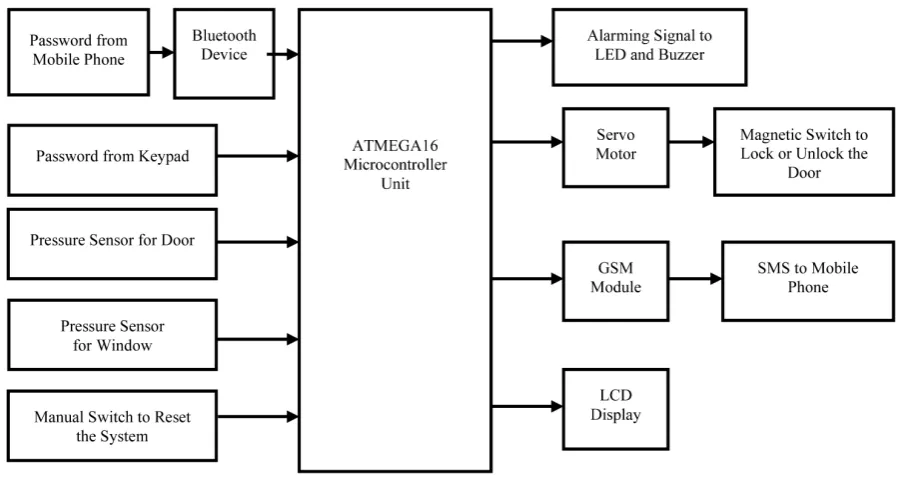
General block diagram of the proposed microcontroller based home security system has been shown in Figure 1. It consists of three sections. Those are input, controller and output sections. At first the controller section re-mains at waiting state for receiving a signal from input section which includes Bluetooth, 4 × 4 Keypad, Pres-sure sensors and a mobile phone. In input section, a mobile phone through a Bluetooth device has been used for interfacing with microcontroller to lock or unlock the door of the system. Consequently, a manual keypad per-forms the similar function without communication with Bluetooth device. On the other hand, pressure sensors have been placed both at door and window to protect the system.
[image:2.595.86.538.464.704.2]If anyone tries to unlock the system without authority, then those sensors will activate and controller will re-ceive a suitable pulse. According to the pulse of input devices, the controller section takes decision and activates the output section which includes LCD display, GSM Module, Servo Motor, LED and Buzzer. However, the ac-
tivation of output device depends on the activity of input section that indicates user unlock the system either au-thoritative or without auau-thoritative way. For auau-thoritative way, controller sends a pulse signal to the servo motor that is also connected with a magnetic switch placed with a door. After 90 degree rotation of servo motor acti-vates the magnetic switch which is used to lock or unlock the system. At the same time, a message is displayed at LCD. Conversely, at without authoritative way controller sends signal to the LED, Buzzer and GSM Module simultaneously. LED has been placed surrounding the home which indicates something wrong events that have occurred within the system. Consequently a Buzzer produces sound signal and GSM module throws a message towards the owner’s mobile phone. Those activities are easily aware both the owner and security guard. As a result they will detect the mal operation within the system. At last a reset switch is used to regain the whole sys-tem at normal condition.
The proposed system includes two parts such as: software and hardware. At software part, a program has been designed in Code Vision AVR Software according to the functional sequence of block diagram. In accordance to software instruction a suitable circuit diagram has been designated for hardware implementation.
2.1. Software Design
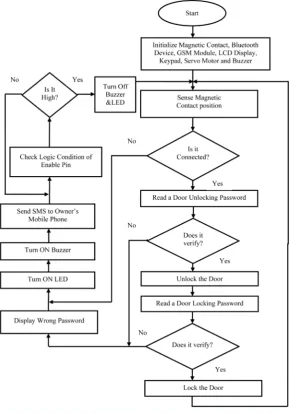
[image:3.595.154.445.296.710.2]The program flow chart of the proposed home security system has been shown in Figure 2 which explains the
whole software design procedures. Software Code Vision AVR is used as a compiler for designing the program in C-Language. The proper instructions perform the desired function sequentially according to the flow chart. At first, the program initializes all peripheral devices (Magnetic Contact, Bluetooth Device, GSM Module, LCD Display, Keypad, Servo Motor and Buzzer). This is the precondition for interfacing between microcontroller and peripheral devices. Then the program examines the magnetic contact’s position either it is connected or sepa-rated. If it is connected with door or window, then the program will give the authority to enter a password that will lock the door. Otherwise program instructions have been mentioned for mal-operation resulting it sends signal to the LED, Buzzer and GSM Module for their individual function sequentially. On the contrary, after re-ceiving a password program verifies the password with the door unlocking password. If the result is affirmative, the program will give the authority to unlock the door. Otherwise mal-operation indicates in LCD by displaying an error message and also the previous functions remain unchanged. However, program remains at waiting state for receiving a door locking password after getting the permission to access the system. Similarly program veri-fies the password resulting it locks the door. Otherwise it sustains the mal-operation until reset pin is high.
However, the instructions in program flow chart have been represented in Figure 2 which maintains the fol-lowing procedure for the proper operation of proposed home security system.
1) Start;
2) Initialize Magnetic Contact, Bluetooth, GSM module, LCD display, Keypad, Servo Motor and Buzzer; 3) Sense the magnetic switch position;
4) If the magnetic switch is connected, the system will remain at waiting state for receiving a password. Oth-erwise, the system will turn on the alarming signal and send SMS to the owner’s mobile;
5) Receive a password from keypad due to unlock the system;
6) Verify the password with the unlocking password which is mentioned in program. If the input password is exactly equal to the system password, a pulse signal will send to the servo motor which will pressurize the door resulting the system will be unlocked. Otherwise, LCD display will show wrong password and the system will follow the similar procedure which is mentioned in step 4 for the false condition, and the system will jump to step 7.
7) Receive a password from keypad due to lock the system. After opening the door, the system will remain at waiting state for receiving a number which is designated for locking the door.
8) Verify the password with the locking password which is mentioned in program. If the input password is exactly equal to the system password for closing the door, the system will be locked and return to step 3. Other-wise, the system will operate at false mode and follow the similar procedure mentioning in step 5.
9) Check the logic condition of enable pin. If it remains at low state, the system will sustain the mal-operation and remain at waiting state until it will obtain high logic condition. On the contrary, the system will start again from step 2 for the high logic condition of enable pin.
2.2. Hardware Design
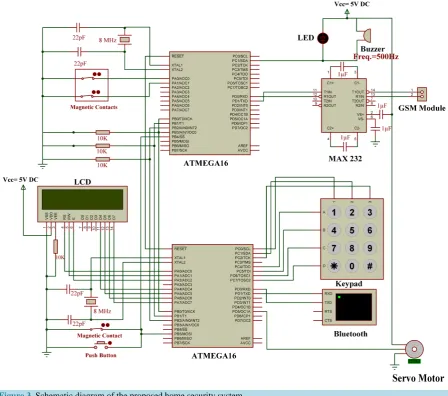
Figure 3. Schematic diagram of the proposed home security system.
(ETSI) to describe protocols for second generation (2G) digital cellular networks used by mobile phones. So, GSM Module makes a strong wireless communication network between owner and security system.
However, the system receives signal from input devices (Magnetic Contact, Bluetooth Device, Keypad) and sends signal to the output devices (LCD Display, Servo Motor, LED and Buzzer) in order to maintain security.
3. Results
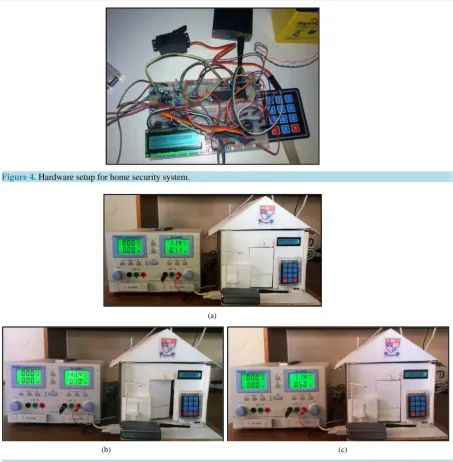
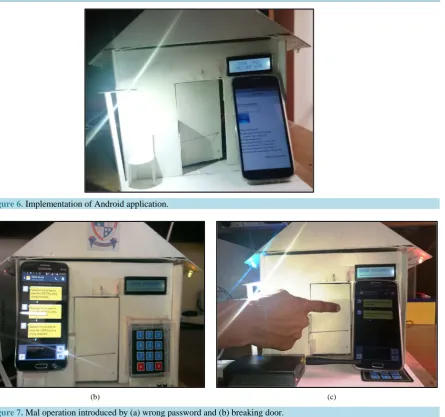
In this section, firstly Figure 5 & Figure 6 describe the overall procedures in order to lock or unlock the system using Keypad or Mobile Phone. Then the result from mal-operation is also presented in Figure 7.
Figure 5(a) shows a practical implementation of home security system which is receiving a password from physical environment to unlock the door. This function is accomplished by interfacing with keypad and micro-controller. Moreover, the password is displayed at LCD and the system remains at waiting state until password is conformed from user end.
Figure 5(b) shows that the system has been unlocked by the rotation of servo motor and separation of mag-netic contacts after verifying the password. At the same time, a conformation message “DOOR OPEN” is dis-played at LCD. This indicates someone is accessing the system in proper way. However, the system again re-turns at initial mode for receiving another password in order to lock the system. This password is also displayed at LCD until the password is verified from controller section.
Figure 4. Hardware setup for home security system.
(a)
[image:6.595.85.539.78.541.2](b) (c)
Figure 5. Interfacing between Keypad and Microcontroller resulting the system (a) receives password, (b) open and (c) close
the door.
function, microcontroller sends a signal to the servo motor and magnetic contacts so that servo motor rotates at reverse order resulting it pressurizes the door along with connecting the magnetic contacts. Moreover, the sys-tem also ensures the functions by displaying a conformation message “DOOR CLOSED” at LCD. This message also indicates that the system has been locked without any mal-operation.
Figure 6. Implementation of Android application.
[image:7.595.91.539.281.484.2]
(b) (c)
Figure 7. Mal operation introduced by (a) wrong password and (b) breaking door.
Figure 7(a) shows the practical implementation of mal-operation which has been occurred by pressing wrong password. As a result the system activates all the security system. This includes an alarming message to owner mobile phone, turn on the Buzzer and LED. The system sustains the hazardous condition until the whole system is become reset.
In Figure 7(b), another mal-operation is introduced by breaking the door without authentication. In this case, microcontroller activates GSM Module, LED and Buzzer. Consequently, the system follows the similar proce-dure described in previous wrong condition in order to maintain security. Moreover, the system performs the similar security functions in order to protect windows.
4. Conclusion
practical home security system which requires considerable effort to install it. Consequently, the system is also applicable for commercial purposes due to versatile ways of security and controllability.
References
[1] Rana, G.M.S.M., Khan, A.A.M., Hoque, M.N. and Mitul, A.F. (2013) Design and Implementation of a GSM Based Remote Home Security and Appliance Control System. Proceedings of the 2nd International Conference on Advances in Electrical Engineering, Dhaka, 19-21 December 2013, 291-295.
[2] Ahmad, A.W., Jan, N., Iqbal, S. and Lee, C. (2011) Implementation of ZigBee—GSM Based Home Security Monitor-ing and Remote Control System. IEEE 54th International Midwest Symposium on Circuits and Systems, Seoul, 7-10 August 2011, 1-4. http://dx.doi.org/10.1109/mwscas.2011.6026611
[3] El-Medany, W.M. and El-Sabry, M.R. (2008) GSM-Based Remote Sensing and Control System using FPGA. Pro-ceedings of International Conference on Computer and Communication Engineering, Kuala Lumpur, 13-15 May 2008, 1093-1097.
[4] Yuksekkaya, B., Kayalar, A.A., Tosun, M.B., Ozcan, M.K. and Alkar, A.Z. (2006) A GSM, Internet and Speech Con-trolled Wireless Interactive Home Automation System. IEEE Transactions on Consumer Electronics, 52, 837-843. http://dx.doi.org/10.1109/TCE.2006.1706478
[5] Golzar, M.G. and Tajozzakerin, H.R. (2010) A New Intelligent Remote Control System for Home Automation and Reduce Energy Consumption. 4th Asia International Conference on Mathematical/Analytical Modelling and Computer Simulation, Kota Kinabalu, 26-28 May 2010, 174-180.
[6] Van Der Werff, M., Gui, X. and Xu, W.L. (2005) A Mobile-Based Home Automation System. Proceedings of the 2nd International Conference on Mobile Technology, Applications and Systems, Guangzhou, 15-17 November 2005, 1-5. [7] Hwang, I.-K., Lee, D.-S. and Baek, J.-W. (2009) Home Network Configuring Scheme for All Electric Appliances
us-ing ZigBee-Based Integrated Remote Controller. IEEE Transactions on Consumer Electronics, 55, 1300-1307. http://dx.doi.org/10.1109/TCE.2009.5277992
[8] Lee, H.-B., Park, J.-L., Park, S.-W., Chung, T.-Y. and Moon, J.-H. (2010) Interactive Remote Control of Legacy Home Appliances through a Virtually Wired Sensor Network. IEEE Transactions on Consumer Electronics, 56, 2241-2248. http://dx.doi.org/10.1109/TCE.2010.5681096
[9] Islam, M.S. (2014) Home Security System Based on PIC18F452 Microcontroller. Proceedings of 2014 IEEE Interna-tional Conference on Electro/Information Technology, Milwaukee, 5-7 June 2014, 202-205.