
Solving Sudoku with Boolean Algebra
Abu Sayed Chowdhury
Faculty, Department of Computer Science & Engineering Dhaka University of Engineering & Technology (DUET), Gazipur
Gazipur-1700, Bangladesh
Suraiya Akhter
Faculty, Department of Computer Science & Engineering Uttara University
Dhaka-1230, Bangladesh
ABSTRACT
Sudoku is a very popular puzzle which consists of placing sev-eral numbers in a squared grid according to some simple rules. In this paper, we present a Sudoku solving technique named Boolean Sudoku Solver (BSS) using only simple Boolean algebras. Use of Boolean algebra increases the execution speed of the Sudoku solver. Simulation results show that our method returns the solution of the Sudoku in minimum number of iterations and outperforms the existing popular approaches.
Keywords:
Sudoku, Boolean algebra, Memory representation
1. INTRODUCTION
Sudoku, English pronunciation: (/su:’do U ku:/ soo-doh-koo) is a logic-based, combinatorial number placement puzzle [2, 4, 11]. The word “Sudoku” is short forSu-ji wa dokushin ni kagiru, which means “the numbers must be single”. The objective is to fill a9×9grid with digits so that each column, each row, and each of the nine3×3sub-grids that compose the grid (also called “boxes”, “blocks”, “regions”, or “sub-squares”) contains all of the digits from 1 to 9. Fig. 1 shows an example of Sudoku puzzle. On July 6, 1895, Le Siecle’s rival, La France, refined the puzzle so that it was almost a modern Sudoku. It simplified the9×9 magic square puzzle so that each row, column and broken di-agonals contained only the numbers 1-9, but did not mark the sub-squares. Although they are unmarked, each3×3sub-square does indeed comprise the numbers 1-9 and the additional con-straint on the broken diagonals leads to only one solution [4]. The number of valid Sudoku solution grids for the standard9×9 grid is 6, 670, 903, 752, 021, 072, 936, and 960. We can express a9×9Sudoku by putting 25-30 values in a9×9grids. It can be used in data compassion, in error checking and correction, in data encryption and deception etc.
Boolean algebra which deals with two-valued (true / false or 1 and 0) variables and functions find its use in modern digital com-puters since they too use two-level systems called binary sys-tems. Boolean algebra, as developed in 1854 byGeorge Boolein his book, “An Investigation of the Laws of Thought”, is a variant of ordinary elementary algebra differing in its values, operations, and laws. Instead of the usual algebra of numbers, Boolean al-gebra is the alal-gebra of truth values 0 and 1, or equivalently of subsets of a given set.
[image:1.595.329.526.262.478.2]A Boolean function (or switching function) is a function of the formf : Bk → B, whereB = {0,1}is a Boolean domain and k is a non-negative integer called the arity of the function. In the case wherek= 0, the “function” is essentially a constant element of B. A Boolean function describes how to determine a Boolean value output based on some logical calculation from Boolean inputs.
Fig. 1. Example of Sudoku puzzle.
Fig. 2. Various representations of Boolean operations.
negation mod 2 (since +1 = -1 mod 2), and SWAP, correspond-ing to logical negation.
Using negation, we can formalize the notion that conjunction is dual to disjunction via De Morgan’s laws,¬(x∨y) =¬x∧ ¬y and¬(x∧y) =¬x∨ ¬y. These can also be construed as def-initions of conjunction in terms of disjunction and vice versa: x∨y=¬(¬x∧ ¬y)andx∧y=¬(¬x∨y). Fig. 2 shows the symbols used in digital electronics for conjunction and disjunc-tion; the input ports are on the left and the signals flow through to the output port on the right. Inverters negating the input signals on the way in, or the output signals on the way out, are repre-sented as circles on the port to be inverted.
In this paper, we provide a strategy to solve the Sudoku puzzle using the concepts of Boolean algebra.
2. RELATED WORK
The connection between decoding and Sudoku has been previ-ously noted. In [7], Moonet al.give an explicit formulation of the BP algorithm for solving Sudoku. BP appears to work only for easier puzzles, with the probable cause being the “loopy” nature of the Tanner graph associated with the puzzle (all cells are in cycles of length four). The author of [6] also discusses BP. Other related works such asSinkhornbalancing [8, 14] is a means of obtaining a unique doubly stochastic matrix from a (nearly) arbitrary matrix. Extensions to produce matrices with ar-bitrary row and column sums appear in [13]. Sinkhorn balancing (sometimes called Sinkhorn scaling) has been widely studied, and makes its appearance in a variety of applications (See [3]). The Sudoku is solved with genetic operations in [1, 10]. Solution of the Sudoku puzzle with membrane computing is discussed in [5]. The authors of [12] introduced solution of the Sudoku using graphs with deriving Constraint Satisfaction Problem (CSP). In this paper, we present a solution algorithm based on basic Boolean algebra, which has both lower computational complex-ity (per iteration) than BP and does not apparently suffer from cycles in the graph.
3. PUZZLE DESCRIPTION AND
REPRESENTATION
In this paper, we consider the most popular format of Sudoku puzzle. It is a9×9grid with nine rows and nine columns and the9×9grid is divided into nine3×3sub-grid.
3.1 Memory Representation
Bitwise operation is much faster than arithmetic operation. We use Boolean operation to determine the possible value of a cell. For this reason, we use a new approach to represent the values of
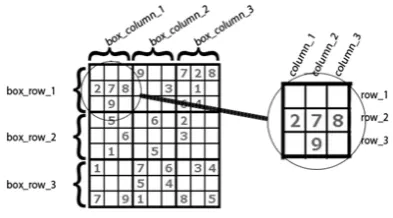
[image:2.595.63.273.105.259.2]Fig. 3. Memory representation.
Fig. 4. Primary initialization.
the Sudoku. We use 9 variables that represent the values required in a sub-grid, 9 variables to represent the rows and 9 variables to represent the columns.
In our proposed method, we use3×3×3×3integer type vari-able,Sudoku[3][3][3][3]to store the values of the Sudoku puz-zle. We represent the Sudoku in a 4D (four dimensions) view and divide the Sudoku into 9 boxes. Each box has 3 box-row, 3 box-column and two suffix calledbox row number(BR) and box column number(BC). Each box has3×3matrix, 3 rows and 3 columns. Fig. 3 shows the memory representation of a 9×9 Sudoku. We consider 27 integer type variables named row[3][3],column[3][3] and box[3][3] to store the values re-quired in every row, column and box respectively in Boolean form.
3.2 Indexing
The indexes used for suduko[I][J][K][L] are Box indexing (box[3][3]), Row indexing (row[3][3]) and Column indexing (column[3][3]). As each integer variable takes 2 bytes of mem-ory, total allocated memory to solve a9×9sudoku is3×3× 3×3×2 + 3×9×2= 216 bytes. Space complexity isO(n2)
for an×nSudoku puzzle.
3.3 Solving Technique
At first, we need initialization to the arrays row[I][K], column[J][L]andbox[I][J]. Primarily initialization with value 1 for 9 x 9 Sudoku is shown in Fig. 4. We calculate all the values of each array using the following equations.
Forbox[I][J]:
box[I][J] = box[I][J]−
2
X
I,J,K,L=0
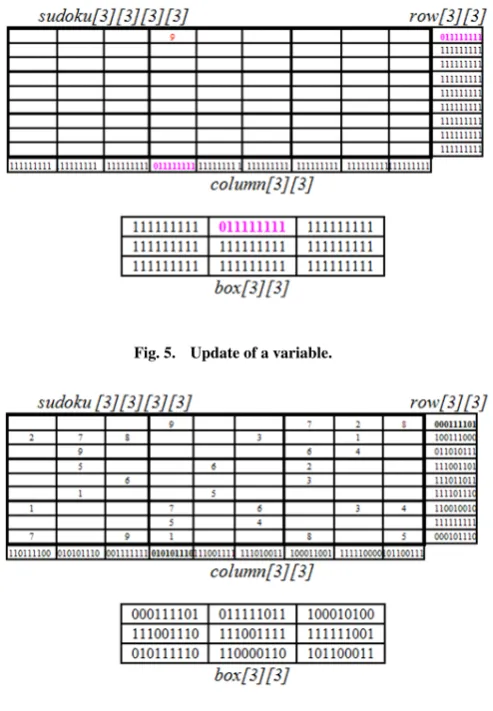
[image:2.595.316.557.229.392.2]Fig. 5. Update of a variable.
Fig. 6. Update of all variables.
Forrow[I][K]:
row[I][K] = row[I][K]−
2
X
I,J,K,L=0
2suduko[I][J][K][L]−1(2)
Forcolumn[J][L]:
column[J][L] = column[J][L]−
2
X
I,J,K,L=0
2suduko[I][J][K][L]−1
(3)
When a value is entered as input, changes are shown in Fig.s 5 and 6.
4. SOLVING TECHNIQUES
Two basic techniques are used in solving Sudoku described as follows.
4.1 Technique 1: Naked Single
We select a blank cell randomly and count from 1 to 9. Reject the value which are available in that sub-grid plus row and column, where it is situated. In this approach, the arraysbox[][],row[][] andcolumn[][]represent the values between 1 to 9 which can be set along with their related rows, columns, and boxes for any cell ofsuduko[I][J][K][L]. We have to find out what can be set in row[I][K],column[J][L]andbox[I][J]. So, the required value
for cellsuduko[I][J][K][L]
is-Rv = row[I][K] &column[J][L] &box[I][J] (4)
Iflog2Rvis an integer value, it indicates that the possible
num-ber for the cellsuduko[I][J][K][L] have only one and it is log2Rv+1As for example, referring Figure 1, 1st value is found
in 6th iteration whenRv= 32. Hence,log232= 5 andI= 0,J
= 1,K= 1,L= 0. In this situation, thesuduko[I][J][K][L] up-dated as
follows-suduko[0][1][1][0]= 5 + 1 = 6.
4.2 Technique 2: Hidden Single
During playing Sudoku, sometime we may have no such a blank cell and we can not define a value. In that case, we try to find out a blank cell and a value, which is not suitable for the other blank cells either in the row or in the column or in the box. Using Boolean algebra, we can implement such a technique. We can determine the required value of a cell (except for a selected cell in a row or in a column or in a box) using OR operation basis on the blank cell requirements. If the requirement of our selected cell is A, the requirement of other cells that are also blank and in a same row or in a same column or in a same box isBthenA.B is either 0 orlog2A.Bis a integer number between 0 to 8 and
log2A.B+ 1is the value for our selected cell.
•For a box:
Letsuduko[3][3][3][3]is9×9Sudoko puzzle. Possible value forsuduko[I][J][K][L]is Equation 4. Required value for other blank cell is
-Rv = Rv&∼(box[I][J]&((row[I][K]&(column[J][(L+ 1) %3]∗!(sudoku[I][J][K][(L+ 1)%3])|column[J][(L +2)%3]∗!(sudoku[I][J][K][(L+ 2)%3])))|(row[I][(K +1)%3]&(column[J][(L+ 1)%3]∗!(sudoku[I][J][(K +1)%3][(L+ 1)%3])|column[J][(L+ 2)%3]∗!
(sudoku[I][J][(K+ 1)%3][(L+ 2)%3])|column[J][L]∗! (sudoku[I][J][(K+ 1)%3][L])))|(row[I][(K+ 2)%3]& (column[J][(L+ 1)%3]∗!
(sudoku[I][J][(K+ 2)%3][(L+ 1)%3])| column[J][(L+ 2)%3]∗!
(sudoku[I][J][(K+ 2)%3][(L+ 2)%3])|column[J][L]∗! (sudoku[I][J][(K+ 2)%3][L]))))) (5)
•For a column:
Letsuduko[3][3][3][3]is9×9Sudoko puzzle. Possible value forsuduko[I][J][K][L]is Equation 4. Required value for other blank cell is
-Rv = Rv&∼(column[J][L]&((box[I][J]&(row[I][(K+ 1) %3]∗!(sudoku[I][J][(K+ 1)%3][L])|row[I][(K+ 2) %3]∗!(sudoku[I][J][(K+ 2)%3][L])))|(box[(I+ 1) %3][J]&(row[(I+ 1)%3][(K+ 1)%3]∗!(sudoku[(I+ 1)%3][J][(K+ 1)%3][L])|row[(I+ 1)%3][(K+ 2)%3] ∗!(sudoku[(I+ 1)%3][J][(K+ 2)%3][L])|row[(I+ 1) %3][K]∗!(sudoku[(I+ 1)%3][J][K][L])))|(box[(I+ 2) %3][J]&(row[(I+ 2)%3][(K+ 1)%3]∗!(sudoku[(I +2)%3][J][(K+ 1)%3][L])|row[(I+ 2)%3][(K+ 2) %3]∗!(sudoku[(I+ 2)%3][J][(K+ 2)%3][L])|row[(I +2)%3][K]∗!(sudoku[(I+ 2)%3][J][K][L]))))) (6)
•For a Row:
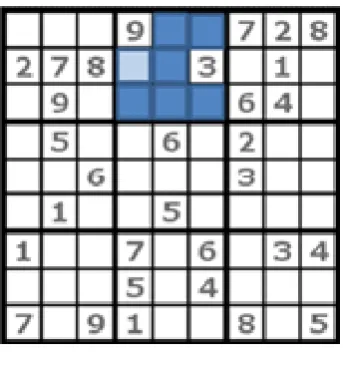
Fig. 7. A typical scenario.
blank cell is
-Rv = Rv&∼(row[I][K]&((box[I][J]&(column[J][(L+ 1) %3]∗!(sudoku[I][J][K][(L+ 1)%3])|column[J][(L+ 2) %3]∗!(sudoku[I][J][K][(L+ 2)%3])))|(box[I][(J+ 1) %3]&(column[(J+ 1)%3][(L+ 1)%3]∗!(sudoku[I][(J +1)%3][K][(L+ 1)%3])|column[(J+ 1)%3][(L+ 2) %3]∗!(sudoku[I][(J+ 1)%3][K][(L+ 2)%3])|column[ (J+ 1)%3][L]∗!(sudoku[I][(J+ 1)%3][K][L])))| (box[I][(J+ 2)%3]&(column[(J+ 2)%3][(L+ 1)%3] ∗!(sudoku[I][(J+ 2)%3][K][(L+ 1)%3])|column[(J +2)%3][(L+ 2)%3]∗!(sudoku[I][(J+ 2)%3][K][(L +2)%3])|column[(J+ 2)%3][L]∗!(sudoku[I][(J+ 2)
%3][K][L]))))) (7)
Considering the fig. 7, Possible values
are-sudoku[1][2][1][2] = 000001001 (8) sudoku[1][2][1][3] = 000010001 (9) sudoku[1][2][2][2] = 100001000 (10) sudoku[1][2][3][1] = 010000010 (11) sudoku[1][2][3][2] = 011000011 (12) sudoku[1][2][3][3] = 011010011 (13) sudoku[1][2][2][1] = 000101000 (14)
Using equations 8-13, we get,
(Eqn.(8)∨Eqn.(9)∨Eqn.(10)∨Eqn.(11)∨Eqn.(12)∨ Eqn.(13) = 111011011(15)
Now by AND-ing the value of Equation 14 and complement value of equation 15, we find the value-000100000 = 32(10)
andlog232 = 5. Therefore,sudoku[1][2][2][1] = 5 + 1 = 6.
5. BOOLEAN SUDOKU SOLVER (BSS)
The algorithm, Boolean Sudoku Solver (BSS), for solving Su-doku with Boolean algebra is given in Algorithm 1. Let us ex-plain how the algorithm works.
The Sudoko is inputted to the arraySudoku[][][][]and initial-ization is done forbox[][],row[][]andcolumn[][]. Then, the al-gorithm looks for the empty cell. If any empty cell found then it checks whetherTechnique 1orTechnique 2will be applied. Otherwise, the algorithm is terminated.
Algorithm 1Boolean Sudoku Solver (BSS)
Input:Sudoku[BR][BC][R][C], box[BR][BC], row[BR][R]andcolumn[BC][C].
Jump1:
Find a empty cell;
ifnot foundthen
go toJump3;
end if
Check forTechnique 1;
iffoundthen
go toJump2;
end if
Check forTechnique 2;
ifno value foundthen
go toJump1;
end if
Jump2: Set the value;
Updatebox[BR][BC],row[BR][R],column[BC][C]; Go toJump1;
Jump3: Terminate;
6. SIMULATION RESULTS AND ANALYSIS
[image:4.595.316.539.499.698.2]The objectives of the experimental work are to verify the feasi-bility and efficiency of Boolean Sudoku Solver (BSS). The ex-perimental evaluation has been performed with 200 Sudoku puz-zles. Our aim is to find out the solving rate, number of itera-tions and execution time, and compare BSS with other existing popular techniques. The BSS has been implemented over Bor-land c++ 5.02, 32 bit compiler, running on 2.13 GHz Core-i3 2nd generation processor with 2GB main memory. The operat-ing system used is windows 7 ultimate. The results for various solving techniques are compared at the same hardware config-uration. We have chosen Sudoku from newspaper. There are 4 categories of Sudoku- Very difficult level Sudoku, Difficult level Sudoku Medium level Sudoku, and Easy level Sudoku.
Fig. 8. No. of blank cells remaining with No. of iterations.
Fig. 9. Number of Iteration vs. number of empty cell for a very difficult Sudoku using BSS and SSS.
Fig. 10. The number of iteration vs. difficulty level between different methods of Sudoku solver.
Fig. 11. Average solving rate of BSS, SSS and BP.
difficult Sudoku takes about 140 iterations to find out first 15 val-ues and takes more 40 iterations to find out 37 valval-ues.
We solve a very difficult Sudoku using our proposed BSS, and the existing popular approach- Sinkhorn Sudoku Solution (SSS) [8] and count iterations and number of empty cells as shown in Fig. 9. BSS solves that Sudoku in 179 iterations, but SSS takes 234 iterations. Therefore, BSS takes less number of iterations than SSS.
Fig. 10 shows the number of iteration vs. difficulty level between different methods of Sudoku solver. Sudoku solved by Genetic Algorithm (GA) [1] can solve very difficult level Sudoku by tak-ing 400 (average) iterations and SSS can solve it by taktak-ing 190 (average) iterations but BSS can solve it by taking only 140 (av-erage) iterations. This also indicates the superiority of our ap-proach.
Fig. 11 shows the solving rate of Sudoku using BSS, SSS and Belief Propagation (BP) [7]. The solving rates of BSS, SSS and BP are 97%, 95% and 40% respectively for our given Sudoku.
7. CONCLUSION AND FUTURE WORK
We present a new strategy to solve Sudoku using Boolean alge-bra. The main contribution of this paper is the solution of Su-doku with a reduction in consumption of memory and execution time. Our Boolean Sudoku solver (BSS) outperforms the existing popular approach with better accuracy. Simulation results depict that BSS is more faster in solving Sudoku due to usage of bit-wise operation instead of arithmetic operation. The implemented strategy is enough to find the solution of many Sudoku problems. Parts of our future works are adding features of artificial intelli-gence to solve super difficult level Sudoku.
8. REFERENCES
[1] J. Almog, “Evolutionary Computing Methodologies for Constrained Parameter, Combinatorial Optimization: Solv-ing the Sudoku Puzzle,” in Proc. of IEEE AFRICON, pp. 1-6, September 2009, Nairobi, Kenya.
[2] B. Arnoldy, “Sudoku Strategies,” The Home Forum (The Christian Science Monitor), Schaschek, Sarah, March 2006. [3] H. Balakrishnan, I. Hwang and C. J. Tomlin, “Polynomial approximationalgorithms for belief matrix maintenance in identity management,” in Proc. of IEEE Conf. Decision Con-trol, pp. 4874-4979, December 2004.
[4] C. Boyer,“Sudoku’s French ancestors,” http://web.archive.org. Retrieved on 3 August 2009. [5] D. Diaz-Pernil, C. M. Fernandez-Marquez, M.
Garcfa-Quisrnondo, M. A. Gutierrez-Naranjo and M. A. Martinez-del-Arnor, “Solving Sudoku with Membrane Computing,” in Proc. of IEEE BIC-TA, pp. 610-615, Changsha, November 2010.
[6] S. Kirkpatrick, “Message-passing and Sudoku,” Available in http://www.www.cs.huji.ac.il/ kirk/Sudoku.ppt.
[7] T. K. Moon and J. H. Gunther, “Multiple constraint satis-faction by belief propagation: An example using Sudoku,” in Proc. of SMCals/IEEE Mountain Workshop on Adaptive and Learning System, pp. 122-126, Logan, UT, July 2006. [8] T. K. Moon, J. H. Gunther and J. J. Kupin , “Sinkhorn Solves
Sudoku,” Transactions On Information Theory, Vol. 55, No. 4, pp. 1741-1746, April 2009.
[9] Pegg, The Mathematical Association of America, http://www.maa.org/editorial/mathgames/mathgames 09 05
05.html. Retrieved on October 3, 2006.
[10] Y. Sato and H. Inoue, “Solving Sudoku with Genetic Oper-ations that Preserve Building Blocks,” in Proc. of IEEE CIG, pp. 23-29, Dublin, September 2010.
[11] S. Schaschek, “Sudoku champ’s surprise victory”. The Prague Post. Retrieved on August 13, 2006.
[12] P. S. Segundo and A. Jimnez, “Using graphs to derive CSP heuristics and its application to Sudoku,” In Proc. of IEEE ICTAI, pp. 538-545, Newark, NJ, November 2009. [13] R. Sinkhorn, “A relationship between arbitrary positive
ma-trices and oubly stochastic mama-trices,” Ann. Math. Statist., vol. 35, pp. 876-879, June 1964.
[image:5.595.57.283.451.566.2]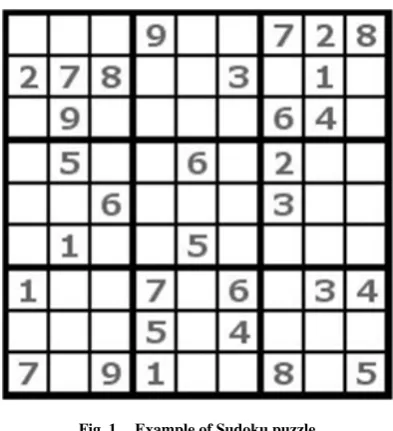
![Fig. 11 shows the solving rate of Sudoku using BSS, SSS andBelief Propagation (BP) [7]](https://thumb-us.123doks.com/thumbv2/123dok_us/8105629.789330/5.595.56.281.97.247/fig-shows-solving-rate-sudoku-using-andbelief-propagation.webp)
