http://dx.doi.org/10.4236/jss.2014.29033
Index Fund Factor: The View beyond the
Wall
Joseph Ojih
Stratford University, Baltimore, Maryland, USA Email: [email protected]
Received June 2014
Abstract
Index funds are those funds that seek to track the returns of the market benchmarks, such as the Wilshire 5000 and S & P 500 Index. Although many fund managers claim to outperform the market through experience and forecasting, a combination of cost savings, diversification and longevity had helped to keep index funds’ returns float to the top rankings. By using simple quantitative evidence, this paper explained in plain language how investing in index funds can help investors get ahead of the majority of fund managers in terms of consistent returns. The paper equally ex-plained why index funds are likely to continue to outperform not only the average mutual funds but also the conventional stocks and bonds, both in the bull and bear markets.
Keywords
Index Fund, Diversification, Portfolio, Volatility, Actively-Managed Fund
1. Introduction
United States, where GDP rose at a mere 1.8% annual pace between January and March [4], and unemployment still remained high despite all the reforms and bailouts implemented by Congress.
The effects of these developments are clear: many people are still out of work, consumer confidence is low, and with the value of savings, retiree pensions, and other forms of investments severely eroded by the wide fluctuations in the stock market, investors are jittery. The logical deduction from these developments is that, for the modern day investors, the gold standard would be to put their money in those securities that would provide capital preservation as well as ensure predictable steady returns. In this paper, I will argue, with evidence, how investing in index funds (that is, a collection of stocks in a particular sector of the market that tracks an index and are not managed by an individual [5]) can help investors keep investment costs down as well as reap signif-icant investment returns over time via a combination of cost savings, low risk and longevity—the key factors that make index fund returns float to the top in rankings. Before presenting the theoretical groundwork that showcase the potency of index funds (with respect to providing investors with low-cost exposure to a wide range of asset classes that has solid long-term track records), it may be worthwhile to describe the performance of these funds over time.
2. The Index Fund Effect: Evidence from Performance
Broadly speaking, even though many super star fund managers fly around the world crunching reams of data and dissecting industries with the ultimate intention of beating the market, the available evidence had continued to show that index funds deliver higher returns than comparable actively managed funds. Independent studies suggests that over the past 10 years, large-company index funds that track the S & P 500 and small company in-dex funds that mimic the Russell 2000 over-performs the average gain for comparable actively managed fund by as much as two percentage points a year. This important point may be clarified by the following two examples: According to the available published evidence, when we look at mutual fund performance data over the past two years, it would be observed that the S & P Composite 1500 beat 89.84 percent of all actively managed domestic stock funds. In addition, over the past three and five years, those numbers, which continues to depict a clear trend of S & P Composite 1500 over-performing actively-managed funds, were 73.24 percent and 67.72 percent, respectively. This fact about actively-managed funds underperforming the index funds also holds true for the bond funds, with the majority of active equity and bond managers in most categories lagging behind comparable benchmarks. For example, over the past five years, 93.62 percent of actively managed long government bond funds trailed the Barclays Long Government index [6].
There four main reasons for this. The first reason is related to the efficient market hypothesis, which states that all markets are efficient in digesting information about individual stocks or about the stock market in gener-al. This implies that when information arises, the news spreads quickly and is immediately incorporated into the prices of stocks thereby making it impossible for investors to use technical and fundamental analyses to gain above normal returns. Thus both the uniformed investors buying diversified portfolios at the tableau of prices given by the market and the expert fund managers cannot always beat the market since they equally have access to security prices that fully reflect all known information about the market. In other words, a novice investor can obtain a rate of return that is as good as that achieved by fund managers [7].
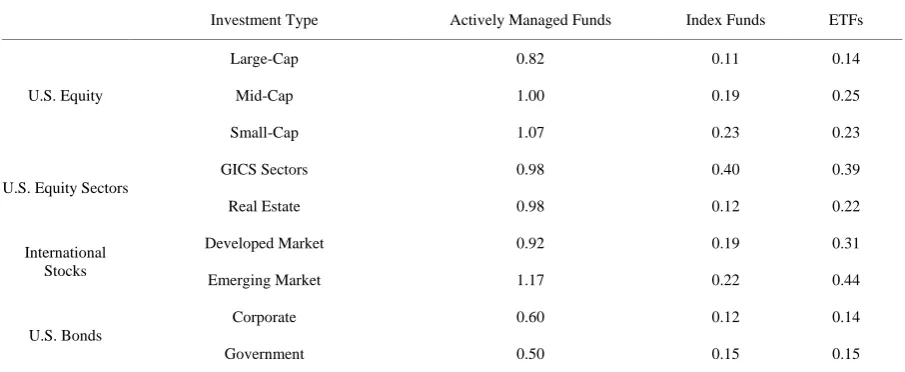
The second reason that indexing works is due to low expense ratio-the annual fee that all funds managers charge their shareholders [8]. Broadly speaking, the typical range of expense level for managing public index funds is around 0.2% - 0.5%, which is much lower than the 1.3% - 2.5% (see Table 1) often charged by the ac-tively managed funds [9]. Besides, index funds do not have the sales charges known as loads, which a common fee is charged by many mutual funds. As a practical matter, shelling out less in costs this way is a huge advan-tage because keeping expenses down is a priority for every investor as every dollar of expenses is one less dollar of gross return that goes to them. It should be stated here that these ratios are not as noticeable for investors in bull markets when returns are. However, the higher expense ratios become more conspicuous in bear markets because they are directly deducted from the meager returns. For instance, if the return on a mutual fund is 8% and the expense ratio is 3%, then the real return to the investor is only 5%.
Table 1. Average dollar-weighted expense ratios as of December 2012.
Investment Type Actively Managed Funds Index Funds ETFs
U.S. Equity
Large-Cap 0.82 0.11 0.14
Mid-Cap 1.00 0.19 0.25
Small-Cap 1.07 0.23 0.23
U.S. Equity Sectors
GICS Sectors 0.98 0.40 0.39
Real Estate 0.98 0.12 0.22
International Stocks
Developed Market 0.92 0.19 0.31
Emerging Market 1.17 0.22 0.44
U.S. Bonds
Corporate 0.60 0.12 0.14
Government 0.50 0.15 0.15
Note: GICS = Global Industry Classification System. Source: Vanguard.
of them that prefer small cap stocks can simply buy a fund that tracks the Russell 2000 index or any similar benchmark for small companies. In a similar vein, getting all U.S. stocks—comprising of large, small, value, growth, all industries—in a single fund will require making an investment in a total U.S. stock market index fund. Furthermore, investors can make things really simple and invest a fully diversified portfolio with just two funds by adding a total international stock index and a total U.S. bond market index fund into their existing portfolio. The significant point to remember here is that even though investors can build a portfolio using ac-tively managed funds, it would require more initial work and ongoing vigilance, for one important reason: While an investor can get an idea of how an actively managed fund will invest based on its prospectus and its Mor-ningstar category, past experience had revealed that the fund managers has wide leeway to stray from their spe-cified strategies, of which many of them often do. Hence, from a realistic perspective, investors can have a much easier time building a portfolio that they can be certain that it will have specific types of stocks and bonds in specific proportions with index funds.
The fourth and the biggest advantage of indexing for the investor can be summarized in three words: High tax efficiency. My contention here is that many actively managed fund managers often switch from security to secu-rity too frequently in an attempt to deliver loftier capital gains to shareholders. Unfortunately, such capital gains are subject to tax. Index funds tend to avoid capital gains tax since they track a specific benchmark (such as the S & P 500 or Russell 2000) and their selling is largely limited to getting rid of securities that leave the index or, in some cases, providing cash to redeeming shareholders, of which their managers can apply some legally ap-proved techniques to limit taxable capital gains [10].
The balance of evidence presented in the forgoing discussion clearly indicates that index funds are better op-tions for the average mutual fund investor for the simple reason that they are a highly diversified portfolio and hence are very difficult for actively managed funds to beat after factoring in costs and fees. In addition, because investors tend to pile into the good funds only after their managers have beaten their relative indices, the market is even getting harder to beat year after year. Besides, outperformance of the index funds is made more difficult to achieve in the future by another important factor: Once new money flows into these funds, costs tend to rise and the funds can get too large and cumbersome for the managers [11]. I will point out here, as a cautionary ob-servation, that there are some exceptions to the general trend of outperformance as, even over a relatively long period, some actively managed funds have survived and even outperformed their benchmarks. It would be logi-cal, therefore, to suggest that including such outperformers in a portfolio could also be the investment strategy of investors who use index funds.
3. Index Fund and Diversification versus Low Risk: An Empirical and Quantitative
Analysis
Perhaps the best way to gain an understanding of why index funds perform better than actively manage funds is to state emphatically that the former is more diversified than the latter. The basic insight here is that, except for index funds that tracks narrow market segments, a by-product of the way indexes are constructed is that most of them hold a broad range of securities to accurately track their target benchmarks. My contention here is thus that the broad range of securities derived from index funds is the prima facie evidence to suggest that indexing pre-vents epre-vents that affect one sector from affecting an entire portfolio—a situation that dampens the risks asso-ciated with specific securities as well as removes a component of return volatility [12].
This power of diversification is largely confirmed in 1952 by Harry Markowitz [13] via his modern portfolio theory (MPT) which embodied the view that investors have the opportunity to go beyond the usual benefits of diversification when they have a portfolio of stocks or funds that move in different ways, that is, a portfolio of stocks that are not correlated. He predicted that the lower the correlation among the investor’s portfolio, the higher the benefits of diversification and the least the portfolio risk for a given level of return. Given that Mar-kowitz model of MPT is based on expected returns (means) and the standard deviations (variance) of various portfolios it shows investors (who are risk averse) how reduce their risk by choosing securities that has low cor-relation. Carried to its logical conclusions, Markowitz model (that is, the MPT) is the hallmark of index funds: when investors choose funds and stocks that tracks a broad stock market index they could significantly decrease the correlation among their portfolio and hence enlarge their nest eggs—an increase that can make a large enough difference to change the kind of house they live in, the college they can afford for their children, the kind of lifestyle they can lead when they retire, or, simply put, their overall quality of life.
Drawing inspiration from Markowitz model, I will now present the empirical groundwork for validating the power of index fund vis-à-vis diversification. Broadly speaking, the key factor in whether a diversified portfolio of index fund can reduce risk is the correlation coefficient (ρ)—a measure of the degree to which two variables move together. Given that index funds includes all (or a valid sample) of the securities in the index they re- present, the risk of an index portfolio (δp) is thus a combination of the weighted average of the standard devia-tions of the individual assets in the fund plus the correlation coefficients of these assets. According to the avail-able published evidence, the numerical value of the correlation coefficients ranges from −1 (that is, negative correlation) and +1 (positive correlation) [14]. Hence in two sets of index portfolios that track different indices, the portfolio risk would be defined as follows [14]:
2 2 2 2
2
A A B B A B AB A B
p w w w w
δ = δ + δ + ⋅ρ δ δ
where δA and δB = standard deviations of funds A and B, respectively
wA and wB = weights, or fractions of the total funds invested in funds A and B. ΡAB = the correlation coefficient between index funds A and B.
As I previously noted, portfolio risk can be minimized by diversification, which involves the combination of assets in an appropriate manner. For the sake of this analysis, this implies that the degree to which risk is mini-mized is dependent on the correlation of the assets being combined. For instance, by combining two perfectly negative correlated assets (ρ = −1), an investor can eliminate the overall portfolio risk completely because the diversification that results will smooth out portfolio fluctuations. In contrast, combining two perfectly positive correlated assets (ρ = +1) does nothing to reduce risk because diversification will not smooth out portfolio fluc-tuations [14]. Fortunately for the investor, in real life sifluc-tuations negative correlation is not required for diversifi-cation to help them reach their long-range financial goals while minimizing their risk. In a practical sense, all the investor need is for the individual securities to be less than perfectly correlated. The good news for investors is thus that index funds offers optimal diversification because the correlations between the index funds of various national markets are sufficiently low that the overall risk is considerably minimized. These important facts may be clarified by the following hypothetical example.
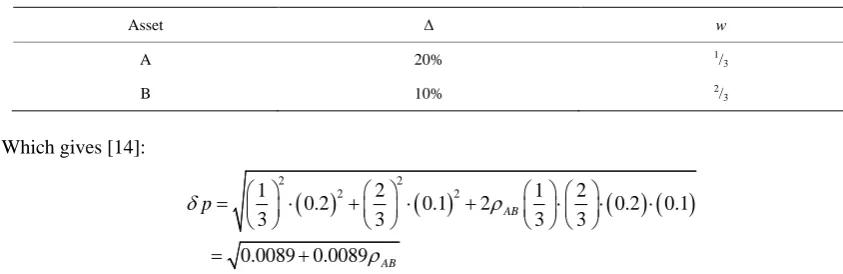
Suppose an investor have a portfolio (δp) that consist of the two index funds (A and B) shown on Table 2, with the given weights (w) and standard deviations (δ). Then the portfolio risk will be computed as follows:
2 2 2 2
2
A A B B A B AB A B
p w w w w
Table 2. Portfolio consisting of index funds A and B.
Asset Δ w
A 20% 1/
3
B 10% 2/
3
Which gives [14]:
( )
( )
( ) ( )
2 2
2 2
1 2 1 2
0.2 0.1 2 0.2 0.1
3 3 3 3
0.0089 0.0089
AB
AB p
δ ρ
ρ
= ⋅ + ⋅ + ⋅ ⋅ ⋅
= +
Given the above results, three outcomes may be possible from these portfolios. First, if we assume that the correlation coefficient between index funds A and B is +1 (that is, a perfect correlation), it means that when the value of A goes up in response to market conditions, the value of B also goes up, and vice versa. It equally means that B will go up at exactly the same rate as A. Thus the above portfolio risk when ρ = +1 can be mathe-matically stated as follows [14]:
( )
0.0089 0.0089 1 0.0178 0.1334 13.34%
P
δ = + = = =
Second, if ρ = 0, then the assets (index funds) lacks correlation. In this case the risk of the portfolio will con-sist of the risk of the expected returns on the assets, which is simply the weighted average of the standard devia-tions of the individual assets in the portfolio. Simply put, when ΡAB = 0
( )
0.0089 0.0089 0 0.0089 0.0943 9.43%
P
δ = + = = =
Third, when ρ = −1, it implies that the two index funds have a perfect correlation. In this case, as the value of asset A rises, the value of asset B declines at the very same rate, and vice versa. The result of these movements is clear: the risk of investing in assets A and B will be completely eliminated. Hence when ΡAB = ω1, the portfo-lio risk would become:
( )
0.0089 0.0089 1 0.0089 0.0089 0 0%
P
δ = + − = − = =
Given the above computations, it can be inferred with considerable confidence that, while times of distress are likely to affect all markets for a short period of time, over a longer run the correlations between index funds can significantly decrease the risks of a portfolio. Thus, with fair justification, a portfolio that consists of different types of index funds will definitely serve investors far better than the actively managed funds.
4. Conclusion
In this paper I have presented and explored reliable evidence that support the use of indexing in investor portfo-lio. Given the analysis made in this paper, my proposal is thus that index funds should be the cornerstone of every investor’s portfolio. I must, however, tamper this assertion with two important observations. First, from an entirely practical standpoint, an investor should not assume that all index funds will perform similarly since they are not all created equal. Second, it is clear beyond any shadow of doubt that the indexed strategies will not al-ways outperform 100 % of actively managed funds in a particular period. In spite of these plausible arguments, consistent outperformance of any one active manager has been rare due to management fees and trading costs, capital gains tax and the general efficiency of the financial markets. Hence from a realistic perspective, it would be reasonable to conclude that investors need to follow a simple mantra: Don’t try to beat the market. Buy and hold a diversified portfolio of index funds that is balanced to suit their personal investment plan.
References
[1] The Economist (2013) The Spanish Economy.
s-new-sources-growth
[2] The Economist (2013) Cyprus.
http://www.economist.com/news/leaders/21576676-outlook-cyprus-dire-time-think-again-about-reunification-divided-t hey-fall
[3] The Economist (2013) European Economy Guide.,
http://www.economist.com/blogs/graphicdetail/2013/07/european-economy-guide
[4] Kurtz, A. (2013) U.S. Economy Looks Weaker as GDP Is Revised. CNN Money. http://money.cnn.com/2013/06/26/news/economy/gdp-revisions/index.html
[5] Pareto, C. (2009) Investment Facts: What Is an Index Fund? Comment on the U-Tube. http://www.youtube.com/watch?v=h9pwCfPdRMI
[6] Silverblatt, R. (2012) Index Funds Still Beat Most Managers. U.S. News Money.
http://money.usnews.com/money/personal-finance/mutual-funds/articles/2012/10/12/study-active-funds-consistently-fa il-to-beat-benchmarks
[7] Evans, E.R. and Malkiel, B. (1999) The Index Fund Solution: A Step-By-Step Investor’s Guide. Simon & Schuster, New York.
[8] Morningstar (2013) Morningstar Investing Glossary. http://www.morningstar.com/InvGlossary/expense_ratio.aspx
[9] Bogle, J. (2007) The Little Book of Common Sense Investing. Wiley, Hoboken. [10] Wild, R. (2009) Index Investing for Dummies. Wiley, Hoboken.
[11] Schoenfeld, S. (2011) Active Index Investing: Maximizing Portfolio Performance and Minimizing Risks. Wiley, Ho-boken..
[12] Vanguard Research (2013) The Case for Index Fund Investing. https://personal.vanguard.com/pdf/s296.pdf