Contents lists available atScienceDirect
Signal Processing
journal homepage:www.elsevier.com/locate/sigpro
Joint sparse model-based discriminative K-SVD for hyperspectral image
classi
fi
cation
Ziyu Wang
a,c, Jianxiong Liu
b, Jing-Hao Xue
c,⁎aDepartment of Security and Crime Science, University College London, London WC1E 6BT, UK bIntel Programmable Solutions Group, Buckinghamshire HP12 4XF, UK
cDepartment of Statistical Science, University College London, London WC1E 6BT, UK
A R T I C L E I N F O
Keywords:Dictionary learning Classification
Hyperspectral images (HSI) Joint sparse model (JSM) Discriminative K-SVD SOMP
A B S T R A C T
Sparse representation classification (SRC) is being widely investigated on hyperspectral images (HSI). For SRC methods to achieve high classification performance, not only is the development of sparse representation models essential, the designing and learning of quality dictionaries also plays an important role. That is, a redundant dictionary with well-designated atoms is required in order to ensure low reconstruction error, high discriminative power, and stable sparsity. In this paper, we propose a new method to learn such dictionaries for HSI classification. We borrow the concept of joint sparse model (JSM) from SRC to dictionary learning. JSM assumes local smoothness and joint sparsity and was initially proposed for classification of HSI. We leverage JSM to develop an extension of discriminative K-SVD for learning a promising discriminative dictionary for HSI. Through a semi-supervised strategy, the new dictionary learning method, termed JSM-DKSVD, utilises all spectrums over the local neighbourhoods of labelled training pixels for discriminative dictionary learning. It can produce a redundant dictionary with rich spectral and spatial information as well as high discriminative power. The learned dictionary can then be compatibly used in conjunction with the established SRC methods, and can significantly improve their performance for HSI classification.
1. Introduction
Sparse representation classification (SRC), proposed in[1], is being widely investigated on hyperspectral images (HSI). It is based on the assumption that high-dimensional data from the same class lie in a low-dimensional subspace. Therefore a signal can be represented by a linear combination of a small number of redundant bases (so-called dictionary atoms). In[2], Chen et al. apply SRC and propose a joint sparse model (JSM) to HSI classification. JSM assumes that all HSI pixels in a small spatial neighbourhood can be jointly approximated by sparse linear combinations of a few common training samples, which can be solved by the simultaneous orthogonal matching pursuit (SOMP) algorithm[3]. However, in JSM all neighbouring pixels make equal contributions to the sparse recovery of the central pixel. To determine more effective neighbours for JSM, several appealing ideas have been proposed[4–8]. In[4], Zhang et al. introduce a non-local approach [5], which assumes that a candidate has its weight deter-mined by the similarity between its neighbourhood and the central pixel's neighbourhood, termed non local weighting (NLW). Tang et al. propose two manifold-based l1-norm methods, using locally linear embedding and Laplacian eigenmap to regularise local structures of
pixels[6]. In[7,8], Fang et al. and Li et al. propose to adopt superpixel methods[9,10]to integrate the spatial structures for JSM. The super-pixel is regarded as a small spatial local region which is adaptive in shape and size.
To achieve high classification performance, not only is the devel-opment of sparse representation models essential, the designing and learning of quality dictionaries also plays an important role. A well-designed dictionary would have good representation power over a certain sparsity, as well as to support optimal discrimination of classes [11]. Previous literatures have shown that dictionary learning is beneficial to signal representation as well as to classification [12,11,13,14]. In[12], Aharon et al. propose SVD, a generalised K-means method, to minimise the signal reconstruction error. It alter-nates between sparse coding by orthogonal matching pursuit (OMP) [15]and dictionary updating by singular value decomposition (SVD). For face recognition, Zhang et al. introduce into sparse representation a constraint to model classification error[11]. A K-SVD algorithm is then adopted to minimise the sum of reconstruction error and classification error, named as discriminative K-SVD (D-KSVD). In[13], Jiang et al.
propose label consistent K-SVD, which incorporates a label-consistent term intoD-KSVD, leading to an explicit correspondence between the
http://dx.doi.org/10.1016/j.sigpro.2016.10.022
Received 31 December 2015; Received in revised form 28 August 2016; Accepted 27 October 2016
⁎Corresponding author.
E-mail addresses:[email protected](Z. Wang),[email protected](J. Liu),[email protected](J.-H. Xue).
Available online 05 November 2016
0165-1684/ © 2016 The Author(s). Published by Elsevier B.V. This is an open access article under the CC BY license (http://creativecommons.org/licenses/BY/4.0/).
dictionary atoms and labels. It also adopts the K-SVD algorithm to solve the optimisation problem. Mairal et al. propose task-driven dictionary learning (TDDL)[14], which is a general formulation for learning sparse representations tuned for specific tasks. TDDL not only can be designed for classification, but also can be designed for regression and compressive sensing.
There have been a limited number of works on developing the dictionary learning algorithms specifically for HSI classification pro-blems. In[7], Fang et al. propose to use a modified class-labelled OMP algorithm in D-KSVD to learn a dictionary of better discriminative power. In [16], Soltani-Farani et al. partition given pixels into contextual groups, and jointly model pixels inside the same contextual group to be in a common subspace. Both methods endeavour to make a better use of the limited amount of labelled training data. Taking one step further, Wang et.al. utilise spatial context of a test pixel within its local neighbourhood to develop a learning vector quantization (LVQ)-based dictionary learning method[17]. In[18], Sun et al. introduce the use of structure information into dictionary learning. They argue that the requirement of a redundant dictionary in sparse coding can be lessened if simultaneous sparse approximation is employed. Therefore they aim to produce a compact dictionary by using a joint or Laplacian sparsity prior and the TDDL framework [14]. Wang et al. follow the same TDDL framework and introduce a more explicitly formulated semi-supervised problem to the compact dictionary learning[19].
In this context, we believe that, in order to develop a dictionary with high discriminative power for HSI classification but from only a limited number of labelled training samples, it is a promising direction to utilise the structure information as much as possible. Considering the discriminative nature of D-KSVD and its imperfection of exploiting spectral signatures only, we think D-KSVD has substantial room to be explored for improvement. Furthermore, we are highly impressed by the recent progress in HSI classification made by the JSM-based algorithms from its leveraging both spectral and spatial information in the representation of HSI pixels. All these factors inspire us to develop a new dictionary learning approach for HSI classification, by enforcing the JSM assumption, of local smoothness and joint sparsity around the limited number of training sample, into D-KSVD through a semi-supervised fashion. In this paper, we propose a new approach called JSM-DKSVD. It is able to capture and organise the rich spectral and spatial information into the learned dictionary, thus offering higher discriminative power for HSI classification tasks.
Experiment results show that, when used in conjunction with established SRC methods, the JSM-DKSVD-trained dictionary can significantly improve the SRC methods' classification performance, and can also outperform state-of-the-art dictionary learning methods for HSI classification.
The main contribution of this research is that we introduce the structure information around a limited number of training pixels into the dictionary learning for HSI, establish a new discriminative optimi-sation function to jointly model the enriched information, and develop a JSM-constrained D-KSVD algorithm to solve the optimisation
pro-blem and produce a desired discriminative dictionary.
2. Joint sparse models for HSI classification 2.1. Sparse Model (SM)
Suppose aB-dimensional pixel, denoted byx∈B, can be
approxi-mated by a linear combination ofNDtraining pixels:
α
x≈D , (1)
whereD∈B N× Ddenotes a dictionary constructed by theN
Dtraining
pixels (also termed atoms), and α is the ND-dimensional vector of
coefficients in the linear combination.
In a sparse model,xcan be approximated by only a few (e.g. at most
LC) atoms inD. That is, the coefficient vectorαis sparse. The values of
αcan be estimated by solving the following optimisation problem:
l α= argmin x−Dα , s t. . α ≤L , α C 2 2 0 (2)
where α0 denotes a l0-pseudo-norm (i.e. the number of non-zero elements) of α, LC (LC⪡ND) is defined as the upper bound of the
sparsity level of the model. The problem in(2)is NP-hard, but it can be approximately solved by greedy pursuit algorithms such as orthogonal matching pursuit (OMP)[15]or be relaxed by replacing thel0 -pseudo-norm with the l1-norm. When the problem is solved by OMP, the dictionaryDis column-wise normalised to have unitl2-norm. 2.2. Joint Sparse Model (JSM)
In HSI, neighbouring pixels in a small area often consist of similar materials and the classes of these materials are few. Hence, local smoothness and sparsity can be assumed for HSI. In JSM [2], it is assumed that all neighbouring pixels around a central pixel share a common sparse pattern. The modelling, learning and labelling for JSM can be described as follows.
LetX= [ , …,x1 xTC], a B×TC matrix, denote a small window
con-sisting ofTCpixels and centring on a test pixelxc, with each pixelxt
represented by aB-dimensional vector forBspectral bands. TheTC
pixels are approximated by sparse linear combinations of atoms from a given dictionary:
α α
X= [ , …,x1 xTC] ≈D[ , …,1 TC] =DA, (3)
whereD∈B N×D is a dictionary withN
Dknown and labelled atoms,
and A∈ND×TC is the matrix of unknown coefficients [ , …,α αT] 1 C. Because of the local smoothness and sparsity, we can assume that there are onlyLC(LC⪡ND) non-zero rows inA. This leads to the
so-called joint sparse model (JSM), where the non-zero rows form the support shared by coefficient vectors{ }αt tT=1C. That is,{ }α
t tT=1C are sparse vectors andAis a sparse matrix.
The learning of JSM is to estimateA, which can be achieved by solving a joint sparse recovery problem:
l s t L A= argmin‖X−DA‖ , . . A ≤ , row C A 2 2 ,0 (4)
where Arow,0, the row-wisel0-norm, is the number of non-zero rows of A. As with(2), problem(4)is NP-hard and it can be approximately solved by greedy algorithms such as the Simultaneous Orthogonal Matching Pursuit algorithm (SOMP)[3]or the Simultaneous Subspace Pursuit algorithm (SSP) [2]. When solved by SOMP or SSP, the dictionaryDis column-wise normalised to have unitl2-norm.
Once the sparse coefficient matrixAis obtained, we can calculate the residual (distance) of windowXfrom its class-wise approximation, which is obtained from using the sub-dictionary of each class, as follows: l rm( ) = ‖X X−D Am m‖ , m= 1, …,M, 2 2 (5) whereMis the total number of classes,lAmconsists ofNmrows inlA
that are associated with sub-dictionary Dm of the mth class, with
ND= ∑m N
M m
=1 . The label of the central pixelxcin windowXis then determined by the minimal residual ofXover allMclasses:
Class( ) = argminxc r ( ).X
m M
m
=1, …, (6)
3. Discriminative dictionary learning algorithms
JSM-based classification methods have achieved improved classifi -cation performance over the traditional (individual) sparse model, but most of these methods leaveDsimply as a stack of raw labelled pixels
[2,4,6]. On the other hand, the focus of this work is on the learning of
D. Specifically, we propose to develop a new dictionary learning algorithm, termed JSM-constrained discriminative K-SVD (JSM-DKSVD), to incorporate both the spectral and spatial information into dictionary learning and to improve the performance of HSI classifi ca-tion in the end.
3.1. K-SVD
In K-SVD [12], signals are also represented by their sparse coefficients. It aims to learn a dictionaryDwith unit atoms (bases), which minimises the reconstruction error:
l l s t α L
p P
D A X DA
{ , } = argmin‖ − ‖ , . . ‖ ‖ ≤ ,
= 1, …, ,
train train train
p train D D A, 2 2 0 train (7) where D= [ , …,d1 dND] ∈B N× D is a dictionary withNDatoms to be
learned; Xtrain= [xtrain, …,x ] ∈
P
train B P
1 × is a training sample set of P training samples;Atrain= [αtrain, …,α ] ∈
Ptrain N P
1 D× is the corresponding
sparse coefficient matrix ofXtrain; andL
D(LD⪡ND) is upper bound of
the sparsity level of the model. K-SVD consists of a sparse coding stage and a dictionary updating stage: it first solves (7) with D fixed to
compute sparse coefficient matrixAtrain by the OMP algorithm. Once
Atrainis obtained, a second stage is performed to update each dictionary
atom by SVD one at a time,fixing all other atoms. The two stages are carried out iteratively till certain stopping criteria are met.
3.2. Discriminative KSVD (D-KSVD)
The discriminative K-SVD[11]is proposed to incorporate classifi -cation error into the optimisation problem (7), allowing a linear classifier and a dictionary with discriminative power to be learned at the same time.
Specifically, a classification constraint with loss function β H WA W ‖ train− train‖ + ‖ ‖ 2 2 2 2 is considered, where W= [w1, …,wND] ∈ M ND×
is an M-classes linear classifier in the atom space,
Htrain= [htrain, …,h ] ∈ P
train M P
1 × is the class matrix ofPtraining pixels in Xtrain, and ‖W‖
2
2 is the regularisation term. Each class vector
htrainp = [0, 0, …, 1, …, 0, 0] ∈T M corresponds to the labelling of one
training samplexptrainand the non-zero position inhtrainp represents the
class ofxp train
. The dictionaryDand the linear classifierWare jointly learned by solving the following optimisation problem:
m l l α γ β s t L p P D A W X DA H WA W { , , } = argmin {‖ − ‖ + ‖ − ‖ + ‖ ‖ }, . . ‖ ‖ ≤ , = 1, …, ,
train train train train train
ptrain D D A, ,W 2 2 2 2 2 2 0 train (8) whereγandβcontrol the relative contributions of the corresponding terms. As described in[11], problem(8)can be rewritten as
m l l ⎪ ⎪ ⎪ ⎪ ⎧ ⎨ ⎩ ⎛ ⎝ ⎜ ⎞ ⎠ ⎟ ⎛ ⎝ ⎜ ⎞ ⎠ ⎟ ⎫⎬ ⎭ α γ γ β s t L p P D A W X H D W A W { , , } = argmin ‖ − ‖ + ‖ ‖ , . . ∥ ∥ ≤ , = 1, …, . train train train train p train D D A, ,W 2 2 2 2 0 train (9) Following[11], the constraintβ‖W‖22is omitted because during the K-SVD process the joint matrix⎛
⎝ ⎜ ⎞ ⎠ ⎟ γ D
W is always column-wise
normal-ised, i.e. thel2-norm constraint is implicitly enforced. Now we use the following notation: ⎛ ⎝ ⎜ ⎞ ⎠ ⎟ ⎛ ⎝ ⎜ ⎞ ⎠ ⎟ γ γ X X H D D W * = , * = ; train train (10) and problem (9) is approximated by the following optimisation problem:
l l s t α L p P
D A X D A
{ *, train} = argmin‖ * − * train‖ , . . ‖ ‖ ≤ , = 1, …, , p train D D A*, 2 2 0 train (11) which can then be solved by the K-SVD algorithm[12].
We note that the obtained matrixlD*from K-SVD is not the actual dictionary we are looking for. To extract the actual dictionaryD′and the classifierW′, afinal normalisation is needed. The dictionaryD′is to be extracted fromlD* and column-wise normalised to have unit l2 -norm; the rest of the matrixlD*, namely classifierW′, is scaled by using the same normalisation constants accordingly:
⎡ ⎣⎢ ⎤⎦⎥ ⎡ ⎣⎢ ⎤⎦⎥ D W ′ = , , …, , ′ = , , …, , d d d d d d w d w d w d ND ND ND ND 1 1 2 2 2 2 2 1 1 2 2 2 2 2 (12)
wheredkandwkdenote thek-th column ofDandW, respectively. 3.3. Classification approach
Given the dictionaryD′ and the linear classifier W′, the sparse coefficient vectorαtestof a test HSI pixelxtestis computed by solving the
following problem:
l
αtest= argminα ‖xtest−D′αtest‖ , s t. . ∥αtest∥ ≤L . C
2 2
0
test (13)
By applying the linear classifierW′tolαtest, the class label vector
h h htest= [ test, …, ] Mtest T 1 ofxtestis obtained as l αl htest=W′ test, (14)
and the class label ofxtestis determined by the position of the maximum
value withinlhtest:
l
class(xtest) = argmaxh .
m M
m test
=1, …, (15)
4. JSM-DKSVD
Dictionary learning by K-SVD and D-KSVD only considers spectral signatures of the HSI pixels. Recent developments in JSM-related algorithms show promising results of using not only spectral but also spatial structure information in the representation of pixels. Inspired by this progress, we propose to incorporate the HSI structure informa-tion into the dicinforma-tionary learning process and extend D-KSVD to HSI classification. Specifically, we enforce the assumption of local smooth-ness of images as well as sparsity of the representations of training HSI pixels into dictionary learning. We name this new dictionary learning approach as JSM-DKSVD.
4.1. Motivation of JSM-DKSVD
The core idea of JSM-DKSVD is to embed the structure information into the representation of dictionary training pixels by joint modelling. The sparse coefficients of a pixel are determined jointly with those in its local neighbourhood, which is a collection of pixels located in a small window centred on the pixel in question. Therefore the training set
Xtrain= [xtrain, …,x ] ∈ P train B P 1 × is extended as follows: X X XJSM= [ JSM, …, ] ∈ , P JSM B T P 1 ×(D× ) (16) whereXp ∈ ,p= 1, …,P
JSM B T×D , denotes a small window consisting of
TD pixels and centred on the training pixel xp train
. Each of these neighbourhoods XJSM
p is now as a whole to be jointly modelled,
replacing the pixelxp train
in dictionary learning. Note that, although the training sample size is effectively increased fromPtoTD×P, as JSM-DKSVD is working in a semi-supervised fashion, we only need P
labelled training pixels, which are those central pixels; that is, our JSM-DKSVD method does not require more labelled training samples than
K-SVD and D-KSVD.
The spectral and spatial structure information of a training pixel is therefore exploited by enforcing local smoothness of natural signals, i.e. nearby pixels share a common pattern. In our case, a certain degree of similarity is enforced on the sparse representation patterns of the neighbouring pixels. This forms a new constraint, and will be reflected by expanding the class matrixHtrain in D-KSVD correspondingly to a
larger matrixHJSM.
If, for example, the central pixelxp train
in the neighbourhoodXJSM p is
labelled class #4 out offive classes, its class vectorhpin D-KSVD is
hp= [0, 0, 0, 1, 0] ,T (17)
where the non-zero position is at the 4th element. In our JSM-DKSVD, by assuming that the neighbouring pixels share the same class label, the class matrix of the 3×3 window centred onxpis as follows:
⎡ ⎣ ⎢ ⎢ ⎢ ⎢ ⎤ ⎦ ⎥ ⎥ ⎥ ⎥ H = 0 0 0 0 0 0 0 0 0 0 0 0 0 0 0 0 0 0 0 0 0 0 0 0 0 0 0 1 1 1 1 1 1 1 1 1 0 0 0 0 0 0 0 0 0 , pJSM 5×9 (18)
where the the class vector of each pixel in the window shares the same non-zeros row, i.e. the 4th row of the class matrix HJSMp. Naturally,
by concatenating the class matrices of all training pixels XJSM, the
overall class matrixHJSMis
H H HJSM= [ JSM, …, ] ∈ . P JSM M T P 1 ×(D× ) (19) 4.2. Formulation of JSM-DKSVD
In the proposed JSM-DKSVD, signals in a small neighbourhood are jointly represented by a common sparsity pattern, as in JSM. Meanwhile, a classification constraint with a new class matrixHJSMis
reconstructed, leading to the following optimisation problem:
m l l γ β s t A L p P D A W X D A H WA W { , , } = argmin {‖ − ‖ + ‖ − ‖ + ‖ ‖ }, . . ‖ ‖ ≤ , = 1, …, , JSM JSM JSM JSM JSM JSM JSM pJSM row D D ,A ,W 2 2 2 2 2 2 ,0 JSM JSM (20) where XJSM and HJSM are defined in (16) and (19), respectively;
α α
ApJSM = [ pJSM,1 , …, p TJSM,D] ∈ ND×TD is the corresponding joint sparse
coefficient matrix of a small window XpJSMas defined in(16), and
therefore AJSM= [AJSM, …,A ] ∈
P
JSM N T P
1 D×(D× ) is the corresponding sparse coefficient matrix of XJSM; DJSM∈B N× D and W∈M N×D are the dictionary and classifier to be learned by JSM-DKSVD. This problem can be solved by the K-SVD algorithm. Again, due to the column-wise normalisation through the K-SVD process, the constraint
β‖W‖22can be omitted to simplify the problem.
Similarly to(10) and (11), the optimisation problem(20)can be rewritten as l l s t A L p P D A X D A { *, } = argmin ‖ * − * ‖ , . . ‖ ‖ ≤ , = 1, …, , * JSM JSM JSM JSM JSM p JSM row D D ,A 2 2 ,0 JSM JSM (21) where ⎛ ⎝ ⎜ ⎞ ⎠ ⎟ ⎛ ⎝ ⎜ ⎞ ⎠ ⎟ γ γ X X H D D W * = , and * = . JSM JSM JSM JSM JSM (22) Therefore, XJSM* is a (B+M) × (T ×P) D matrix and DJSM* is a B M N ( + ) × Dmatrix. 4.3. Algorithm of JSM-DKSVD
The objective function (20) of JSM-DKSVD can be solved by
adopting the original K-SVD algorithm in[12], more specifically, by adopting the iterative updating process forDJSM*andAJSM*.
4.3.1. Initialisation
It is required that the dictionaryDJSMand the classifierWare given
initial values to enable the iterative updating process to follow. Their initial values can be as simple as randomised matrices; in this work we follow the initialisation process of D-KSVD[11]which is explained as follows.
The initial dictionary matrix is denoted byD(0). As with in[11],D(0) should havel2-normalised columns. Given the number of atomsND,
D(0)is designed to be aB×N
Dmatrix, and it can be initialised by the
original K-SVD algorithm with only a couple of iterations.
As a result, the coefficient matrix ofXJSMfor initialisation, denoted
byA(0), is computed by solving thefirst objective term of(20):
A(0)= (D(0)TD(0) −1) D(0)TXJSM, (23)
whereA(0)is anN × (T ×P)
D D matrix.
The initial classifier, denoted byW(0), is computed by solving the problem ofargmin{‖HJSM−W A ‖ + ‖W ‖ } W (0) (0) 2 2 (0) 2 2 (0) : W(0)= ((A A(0) (0)T+ )I−1 (0)A HJSM T T) , (24) whereW(0)is anM×N Dmatrix.
After initialisation, we compose the objective function(21) with
XJSM* ∈ ( +B M)×(TD× )P andDJSM* ∈( +B M)×ND, and the iterative updating process ofDJSM*andAJSM*can start.
4.3.2. Iterative updating - sparse coding stage
Fixing the dictionaryDJSM*, we compute the joint sparse coefficient matrix Ap ∈
JSM ND×TD for each training window X * ∈
p
JSM ( +B M)×TD, wherep= 1, …,P, by approximating the following solution:
l Ap = argmin‖X * −D *A ‖ , s t. . ∥A ∥ ≤L , JSM A p JSM JSM p JSM p JSM row D 2 2 ,0 p JSM (25) which can be solved by the SOMP algorithm[2,3,20]. Then the sparse coefficient matrix AJSM of all training windowXJSM*(16) is
concate-nated as α α A A AJSM= [ JSM, …, ] = [ , …, ]. P JSM JSM T P JSM 1 1 D× (26)
4.3.3. Iterative updating–dictionary updating stage
Following the similar idea of SVD in[12], the dictionary is updated atom by atom.
In thejth iteration, for thekth atomdkJSM* ∈B M+ in the dictionary
DJSM*( −1)j , wherej= 1, …,J andk= 1, …,N
D;DJSM*( −1)j is the
diction-ary obtained from the previous iteration j− 1, the atom dkJSM* is updated to a new one, denoted byd∼k *
JSM
, by the following steps: a. define a group of the instances that use atomdkJSM*,
ωk= { |1 ≤p p≤TD×P,AJSM( , ) ≠ 0},k p (27) whereAJSM( , )k p denotes thekth row andpth column ofAJSM;
b. compute the overall representation errorEkwithout using the atom
dkJSM*,
∑
i Ek=XJSM* − d *A ( , ·), i k i JSM JSM ≠ (28)whereAJSM( , ·)i denotes theith row ofAJSM andi= 1, …,N D;
c. restrictEk by choosing only the column corresponding toωk, and
obtainEkR:
ω
EkR=Ek(·, k) (29)
whereEk(·,ωk)denotes the columns ofEkcorresponding toωk;
d. apply SVD decompositionEkR=UΔVT. The updated atomd * ∼
k JSM
and its corresponding sparse coefficients in the updated coefficient
matrixA͠JSM*are solved by k ω Δ d * = (·,1)U A *( , ) = (1, 1) (·,1)V ∼ ͠ k JSM JSM k (30)
where U(·,1)and V(·,1) denotes thefirst column ofU and the first column ofV, respectively.
AfterJiterations, the desired dictionaryD′and the classifierW′
learned by JSM-DKSVD should also be re-normalised as in(12). Details of the proposed JSM-DKSVD are summarised inAlgorithm 1.
Algorithm 1.JSM-DKSVD algorithm to solve(21).
Input:
Training HSI pixelsXtrain∈B P× . Window sizeTDfor training.
Control parameterγ. Sparsity levelLD.
Number of atomsNDof the dictionary to be learned.
Maximum iteration numberJ.
Output: D′,W′.
Initialisation:
•
Generate training sample setXJSMby(16).•
Compose class matrixHJSMby(19).•
Initialise dictionary matrixD(0)withl2-normalised columns.
•
Compute coefficient matrixA(0)by(23).•
Initialise classifierW(0)by(24).•
ComposeXJSM*andDJSM*by(22). whilej≤J doSparse coding stage:
Compute the sparse coefficient matrixAJSM
p for each training
windowsXpJSM*by(25).
Concatenate the sparse coefficient matrixAJSMfor all training
windowsXJSM*by(26).
Dictionary updating stage:
fork=1:NDinDJSM*( −1)j do
Define the group of instances that use atomdkJSM*by(27). Compute the overall representation errorEkby(28).
RestrictEktoEkRby(29).
Apply SVD decomposition toEkRand solve the updated atom
d * ∼
k JSM
and its corresponding sparse coefficientsA͠JSM*( ,k ωk)by (30).
end for
Setj=j+ 1.
end while
Compute the desired dictionaryD′and classifierW′by(12).
4.4. Classification approach of JSM-DKSVD
Same as theD-KSVD, the dictionaryD′and the classifierW′learned by JSM-DKSVD can be used together with many established HSI classification methods. By embedding richer structure information from HSI in the dictionary and the classifier, the proposed JSM-DKSVD aims to improve the overall classification accuracy when used with these dictionary-based classification methods for HSI.
Specifically, when JSM-DKSVD is used in pair with the JSM-based SRC method, given a test matrix Xtest= [xtest, …,x ]
T test
1 C with TCpixels centred on the test pixel xtest, the JSM coefficient matrix
α α
Atest= [ test, …, ]
Ttest
1 C is computed by solving the following problem:
l s t L
Atest= argmin‖Xtest−D A′ test‖ , . . ∥Atest∥ ≤ .
row C A 2 2 ,0 test (31)
Then, the classifierW′ is applied tolAtest to create the estimated
class label matrixlHtestforXtest: l
l
Htest=W A′ test. (32)
Finally, each row oflHtest∈M T×Cis summed together as a new class label vectorhltest∈M, and the class label of the central test pixel is
determined by(15).
5. Experimental studies
The experiments are carried out on two real hyperspectral datasets: the AVIRIS Indian Pines dataset and the ROSIS University of Paiva dataset, both of which are publicly available [21]. We evaluate the proposed JSM-DKSVD and compare the learned dictionary with two other types of dictionaries. The first comparison is against the dictionary constructed by original labelled training pixels, denoted by
Draw, such as in[2,4,6]. The second comparison is against the direct
application ofD-KSVD[11]. Dictionaries acquired fromDraw, D-KSVD
and the proposed JSM-DKSVD are used with three different SRC methods: 1) SM (referred to as OMP), 2) JSM [2] (referred to as SOMP), and 3) NLW[4].
We employ three standard performance measures for HSI classifi-cation: the overall accuracy (OA), the average accuracy (AA) and kappa coefficient κ [22]. The overall accuracy is defined as the ratio of correctly-classified test pixels over all classes; the average accuracy is defined as the average value of theMaccuracies of individual classes, whereMis the total number of classes; and the kappa coefficientκis defined as the percentage of classified test pixels corrected by the number of agreements that would be expected purely by chance. The OA, AA andκare defined as follows:
∑
OA N N AA M N N κ OA p p = , = 1 , = − 1 − , corr test i M icorr i class e e =1 (33)whereNcorris the number of the correctly-classified test pixels,Ntest
is the total number of test pixels; Ncorr
iis the number of the
correctly-classified test pixels of classi, Nclass
iis the total number of test pixels
of class i; and pe= ∑i (P×P) M
i i
t
=1 , in which Pi is the ratio of data
assigned to class iby the classifier and Pitis the ratio of data that
belong to classi.
The SPAMS toolbox[20] is used to execute the sparse recovery process, i.e. OMP and SOMP. MATLAB codes from[11] are used to perform the K-SVD andD-KSVD algorithms, and MATLAB codes from [4]are used to perform the NLW algorithm.
5.1. Parameter settings
The parameters involved in the whole evaluation process include those for both the SRC methods and the dictionary learning methods. For the SRC methods, the parameters include the sparsity levelLCand
the window sizeTCfor SOMP and NLW. For the dictionary learning
methods, the parameters include the sparsity levelLD, the number of
atomsND, the regularisation parameterγ, the iteration numberJ, and
finally the window sizeTDfor the proposed JSM-DKSVD method. It is
too costly to cross-validate through the entire design space. To simplify the problem, we break it down into two steps:
•
When the three SRC methods (OMP, SOMP and NLW) useDraw, weperform the leave-one-out-cross-validation (LOOCV) to tune their parameters LC and TC. Then the parameters of the three SRC
methods arefixed and decoupled from dictionary learning, provid-ing a relatively fair testprovid-ing platform for the dictionary learnprovid-ing methods.
•
For the D-KSVD and JSM-DKSVD dictionary learning methods which produce dictionaries that are independent of and universally applicable to different SRC methods, we define their parameters in the following way. ParameterNDby the nature cannot be tuned bycross-validation. Therefore, we setNDto be the maximum possible
number of atoms, which is dataset-dependent (see details in the following sections). Empirically and for simplicity, the regularisation parameterγis set to be 1 and the iteration numberJis set to be 30. The sparsity levelLDfor the matching pursuit algorithms is set to be
5 and 30 respectively for DKSVD and JSM-DKSVD due to the difference between OMP and SOMP. Finally, we evaluate JSM-DKSVD with two training window sizes, 3×3 and 5×5, for illustrative purposes.
5.2. AVIRIS dataset: Indian Pines
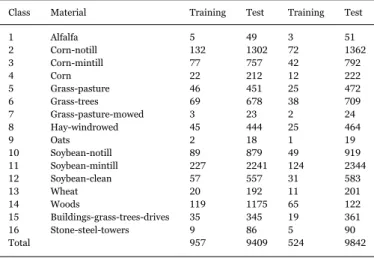
The AVIRIS Indian Pines dataset consists of 145×145 pixels from 224 spectral bands with sixteen ground-truth labels. Similarly to[2,4], we use its 200 bands after removing the water absorption bands. Following[4], wefirst randomly choose 957 labelled pixels (9.23% of all pixels) for training, i.e.Xtrain∈200×957. The rest pixels are used for testing, i.e.Xtest∈200×9409. A summary of the numbers of training and test pixels for individual classes is given in the middle two columns in Table 1. The sixteen ground-truth classes, the training set as well as the test set are shown inFigs. 1(a)–(c).
For the three SRC methods, OMP, SOMP and NLW usingDraw, the
optimal parameters obtained by LOOCV areLC=5 for OMP,LC=30 and
TC= 7 × 7for SOMP andLC=30 andTC= 9 × 9for NLW.
Regarding the number of atoms, we setND=957 for D-KSVD. For
the JSM-DKSVD dictionary learning method, due to the possible overlapping of the extended neighbourhoods, its training set XJSM,
which is the extendedXtrain, may not be full rank and as a result the
K-SVD algorithm cannot be executed. The maximum possible number of atoms for JSM-DKSVD is therefore defined to be the maximum unique columns of XJSM. For the training window T = 3 × 3
D , the unique
number of atoms is 5,145; and forTD= 5 × 5, the unique number of
atoms is 8,764. Therefore we set ND= 5, 145and ND= 8, 764 under
TD= 3 × 3andTD= 5 × 5, respectively.
To have a reliable evaluation and fair comparison, we repeat the experiments for 20 times under these parameter settings through performing 20 random training-test splits. For each of the 12 combina-tions of four dictionary learning schemes and three SRC methods with their optimal parameters, all of its 20 overall classification accuracies are recorded and box-plotted in Fig. 2(a). Moreover, for illustrative purposes, the classification results for one experiment randomly selected from the 20 experiments are given inTable 2and depicted inFigs. 3(a)–(l), respectively.
It can be observed that, firstly, the D-KSVD method does not improve the classification performance significantly, compared with those simply usingDrawfor HSI classification. Secondly, in contrast to D-KSVD, JSM-DKSVD is capable of producing a dictionary-classifier
combination of much better performance than the other two dictionary learning methods in both cases ofTD= 3 × 3andTD= 5 × 5. InTable 2,
for OMP, the overall accuracy (OA) is improved the most, with an 11% (78.63–89.94%) increase underTD= 3 × 3and with a 14% (78.63–
92.99%) increase underTD= 5 × 5. For SOMP and NLW, OAs are also
improved, by around 4% (93.85–97.95% and 95.00–98.68%) under TD= 3 × 3. JSM-DKSVD combined with NLW reaches the highest
accuracies, 98.68%.
To further demonstrate the benefit of using the JSM-DKSVD-trained dictionary, the same test is performed again but with even fewer training pixels. For this test, only around 5% of the total pixels are chosen as training pixels, i.e.Xtrain∈200×524, and the rest of the pixels are used for testing, i.e.Xtest∈200×9842. The summarised dataset is shown in the rightmost two columns inTable 1. The number of atomsNDis set by the same process as that in the case of 9% training
pixels, and the results are 2,919 underTD= 3 × 3 and 5,831 under
TD= 5 × 5, respectively. Parameters LC, TC, LD, TD, γ and J are
remained the same as those in 9% pixels for training.
We randomly split the dataset into training-test pairs for 20 times. All of the 20 overall classification accuracies are shown inFig. 2. The classification results for one experiment randomly selected from the 20 experiments are shown inTable 3, excluding the classification accura-cies of individual classes and the classification maps to save space. Once again, JSM-DKSVD-trained dictionaries are still capable of improving the performance of the reference SRC methods to a high standard, and can be much superior to the SRC methods with DKSVD-trained dictionaries.
We also compare our proposed JSM-DKSVD method with state-of-the-art method proposed in[18], which also incorporates the structure Table 1
The Indian Pines dataset: Ground-truth labels, class material, the training set and the test set. The middle two columns are for the case of 957 training pixels (9% of all pixels) and 9409 test pixels; the rightmost two columns are for the case of 524 training pixels (5% of all pixels) and 9842 test pixels.
Class Material Training Test Training Test
1 Alfalfa 5 49 3 51 2 Corn-notill 132 1302 72 1362 3 Corn-mintill 77 757 42 792 4 Corn 22 212 12 222 5 Grass-pasture 46 451 25 472 6 Grass-trees 69 678 38 709 7 Grass-pasture-mowed 3 23 2 24 8 Hay-windrowed 45 444 25 464 9 Oats 2 18 1 19 10 Soybean-notill 89 879 49 919 11 Soybean-mintill 227 2241 124 2344 12 Soybean-clean 57 557 31 583 13 Wheat 20 192 11 201 14 Woods 119 1175 65 122 15 Buildings-grass-trees-drives 35 345 19 361 16 Stone-steel-towers 9 86 5 90 Total 957 9409 524 9842 1#. alfalfa 2. corn-notill 3. corn- mintill 4. corn 5. grass-pasture 6. grass-trees 7. #grass-pasture-mowed 8. hay-windrowed 9. oats 10. soybean-notill 11. soybean-montill 12. soybean-clean 13. wheat 14. woods 15. buildings-grass-trees-drives 16. stone-steel-towers
information into their dictionary learning processes. Referenced directly from [18], the test environment is slightly different in that 997 pixels (10.64% of all 16-classes pixels) are used for training (comparing to the 957 pixels in our case). Under the two similar test settings, our proposed JSM-DKSVD outperforms (98.68% as shown in Table 2) the best performance in[18] which is 94.20%. It is worth noting though: the method proposed in [18] aims to train compact dictionaries and therefore is still expected to have an edge on the computational cost.
The two parametersLDandNDin the dictionary learning process
are essential to the quality of the resultant dictionary. To better investigate this matter for the proposed JSM-DKSVD, a sweep of the parameter space of ND and LD is performed, using 5% pixels for
training and the training windowTD= 3 × 3, for example. The
classi-fication accuracies of OMP, SOMP and NLW with JSM-DKSVD-trained dictionaries are depicted inFig. 4.
In all OMP (Fig. 4(a)), SOMP (Fig. 4(b)) and NLW (Fig. 4(c)) settings, it can be seen that the performances of the learned dictionary
are consistently maximal when the number of atomsNDis
approach-ing the maximum value. In these cases, the dictionary is large and flexible enough to store the rich information provided by the extended training neighbourhoods in JSM-DKSVD.
WhenNDdrops below 1800, the performance becomes unstable,
with local maximal observed in different places depending onLD. This
is because: although the dictionaries in these cases are not big enough to support excellent representation of the training neighbourhoods themselves, when the sparsity levelLDis appropriately matched, the
resultant dictionary can still achieve a relatively good performance. Summarising all the LD dimensions, Fig. 5 shows the best
performance that the dictionary can achieve under different ND. It
can be seen that despite of the local maximum mentioned above, the best performance remains at the places where ND is close to the
number of unique columns ofXJSM.
Moreover, we can observe that the performance of the learned dictionary is not sensitive toLDwhenNDis approaching the maximum
value. Therefore, based on the above discussion we can take the
1 2 3 4 5 6 7 8 9 11 0.75 0.85 0.95 methods o ver
all classification accur
acy 1 2 3 4 5 6 7 8 9 11 0.75 0.85 0.95 methods o ver
all classification accur
acy
Fig. 2.Boxplots of the overall classification accuracies for the Indian Pines dataset, for 12 combinations indexed by the horizontal axis: (1)Draw-OMP, (2) DKSVD-OMP, (3)
JSM-DKSVD-OMP underTD= 3 × 3, (4) JSM-DKSVD-OMP underTD= 5 × 5, (5)Draw-SOMP, (6) DKSVD-SOMP, (7) JSM-DKSVD-SOMP underTD= 3 × 3, (8) JSM-DKSVD-SOMP under TD= 5 × 5, (9)Draw-NLW, (10) DKSVD-NLW, (11) JSM-DKSVD-NLW underTD= 3 × 3, and (12) JSM-DKSVD-NLW underTD= 5 × 5. Each boxplot is constructed from the results of
20 experiments, with panel (a) for the case that 9% pixels are randomly chosen to train the dictionary; and panel (b) for the case that 5% pixels are randomly chosen to train the dictionary.
Table 2
The classification accuracy (%) for the Indian Pines dataset with 957 training pixels (9% of all pixels) and 9409 test pixels, of four dictionary learning methods (Draw, DKSVD,
JSM-DKSVD (3×3), and JSM-JSM-DKSVD (5×5)) for three SRC methods (OMP, SOMP, NLW).TD: training window size;ND: number of atoms; OA: overall accuracy (%); AA: average accuracy (%);κ: kappa coefficient.
Draw DKSVD JSM-DKSVD
TD N/A N/A 3×3 5×5
ND 957 957 5145 8764
OMP SOMP NLW OMP SOMP NLW OMP SOMP NLW OMP SOMP NLW
1 61.22 79.59 93.88 63.27 77.55 91.84 87.76 91.84 97.96 95.92 100.00 97.96 2 70.35 92.93 94.62 70.28 92.32 94.01 87.17 97.85 98.31 96.08 98.62 98.77 3 65.65 85.73 87.71 65.39 86.79 88.38 86.92 97.62 98.55 91.94 98.02 97.49 4 54.25 89.15 85.38 53.77 89.62 84.43 73.11 99.06 98.58 84.43 97.17 97.64 5 94.24 96.45 98.45 94.46 96.67 98.67 98.23 99.78 99.78 98.89 98.23 100.00 6 94.99 99.26 99.85 94.99 99.85 99.85 97.20 99.56 99.71 97.79 98.53 99.56 7 56.52 56.52 30.43 56.52 56.52 26.09 91.30 82.61 86.96 78.26 73.91 43.48 8 96.62 100.00 100.00 96.40 100.00 100.00 99.32 100.00 100.00 99.77 100.00 100.00 9 55.56 16.67 16.67 55.56 16.67 16.67 77.78 44.44 50.00 61.11 0.00 5.56 10 63.82 77.82 82.48 63.82 79.64 82.82 85.89 93.86 96.36 86.58 94.43 94.65 11 79.43 95.67 98.39 79.70 96.97 98.62 86.93 98.30 99.06 89.60 97.72 98.88 12 72.53 93.00 97.13 72.35 96.23 97.85 86.54 97.49 99.10 91.92 95.69 97.13 13 99.48 98.96 99.48 99.48 100.00 99.48 98.96 99.48 98.96 85.94 84.90 95.31 14 94.47 97.19 97.45 94.47 97.36 97.36 97.62 99.15 99.23 98.30 99.40 100.00 15 57.39 97.68 97.97 57.68 98.55 99.71 85.22 100.00 99.71 93.91 99.71 98.84 16 82.56 98.84 98.84 83.72 98.84 98.84 89.53 93.02 97.67 81.40 83.72 87.21 OA 78.58 93.05 94.89 78.63 93.85 95.00 89.94 97.95 98.68 92.99 97.28 98.02 AA 74.94 85.97 86.17 75.12 86.47 85.91 89.34 93.38 95.00 89.49 88.75 88.28 κ 0.755 0.921 0.943 0.756 0.923 0.943 0.885 0.977 0.985 0.920 0.969 0.978
strategy of settingNDto be close to the number of unique columns in
XJSMand givingL
Dcertainflexibility.
5.3. ROSIS dataset: University of Pavia
The ROSIS University of Pavia dataset consists of 610×340 pixels
from 103 spectral bands, with nine ground-truth labels. We randomly choose only 1% of labelled samples for training, i.e.Xtrain∈103×432and the rest for testing, i.e.Xtest∈103×42344. A summary of this dataset is given inTable 4. The nine ground-truth classes, the training set as well as the test set are shown inFigs. 6(a)–(c).
For the three SRC methods, OMP, SOMP, NLW usingDraw, the Fig. 3.The classification maps of the Indian Pines dataset with 9% pixels randomly chosen for training: (a)Draw-OMP; (b) DKSVD-OMP (c) OMP (3×3); (d)
JSM-DKSVD-SOMP (5×5); (e)Draw-SOMP; (f) DKSVD-SOMP (g) JSM-DKSVD-SOMP (3×3); (h) JSM-DKSVD-SOMP (5×5); (i)Draw-NLW; (j) DKSVD-NLW (k) DKSVD-NLW (3×3); (l)
JSM-DKSVD-NLW (5×5).
Table 3
The overall classification accuracy (%) on the Indian Pines dataset with 524 training pixels (5% of all pixels) and 9842 test pixels. The notation is as forTable 2.
Draw DKSVD JSM-DKSVD
TD N/A N/A 3×3 5×5
ND 524 524 2919 5831
OMP SOMP NLW OMP SOMP NLW OMP SOMP NLW OMP SOMP NLW
OA 75.75 90.46 92.35 75.67 91.15 92.48 85.17 96.08 96.97 88.41 95.74 97.02
AA 70.12 82.37 84.04 70.28 82.33 83.46 83.56 93.31 91.52 87.01 93.46 93.47
optimal parameters obtained by LOOCV areLC=5 for OMP,LC=10 and
TC= 3 × 3for SOMP andLC=20 andTC= 5 × 5for NLW.
For the D-KSVD and JSM-DKSVD algorithms, we set the number of atomsND=432 for D-KSVD. For the JSM-DKSVD, the unique number
of atoms is 3,604 under the training windowTD= 3 × 3, and 9,344
under the training windowTD= 5 × 5. ThereforeNDis set as 3,604 and
9,344 underTD= 3 × 3andTD= 5 × 5, respectively.
As withSection 5.2, we randomly split the dataset into training-test pairs for 20 times. All of the 20 overall classification accuracies are box-plotted inFig. 7. The classification results for one experiment random selected from the 20 experiments are shown inTable 5andFigs. 8(a)– (l). Once again, we can observe that the JSM-DKSVD-trained diction-ary combined with the three SRC methods outperforms the other two methods (Drawand D-KSVD) in both cases ofT = 3 × 3
D andTD= 5 × 5.
Again, we compare our results against those in[18]which is a state-of-the-art dictionary learning method. Even with only 1% of the pixels used for training, the proposed JSM-DKSVD method achieves higher OA (92.77% as shown inTable 5) than that reported (85.70%) in[18], which is evaluated with 10% pixels as training pixels.
5.4. Discussion
JSM-DKSVD utilises the JSM constraint in a fundamentally different way from JSM-based classification methods (SOMP and NLW): JSM-DKSVD applies its constraint to dictionary learning while SOMP and NLW apply their constraints to classification. Moreover, the JSM constraint in classification is used to ensure stable sparse representation for the test pixels when they are classified, while the JSM constraint in JSM-DKSVD is used to ensure richer spectral and spatial information incorporated into the learned dictionary.
Fig. 4.The overall classification accuracies of using JSM-DKSVD with different numbers of atomsNDand training sparsity levelsLD. The 5% pixels randomly chosen from the Indian Pines dataset are used to train dictionaries underTD= 3 × 3. The three SRC methods for testing are (a) OMP, (b) SOMP, and (c) NLW.
Number of atoms ND 200 400 524 750 1000 1250 1500 1600 1700 1800 2000 2919 Classification accuracy (%) 50 55 60 65 70 75 80 85 90 95 100 JSM-DKSVD-OMP JSM-DKSVD-SOMP JSM-DKSVD-NLW
Fig. 5.The optimal classification accuracies of OMP, SOMP, and NLW using the JSM-DKSVD-trained dictionary with different numbers of atomsND. The 5% pixels randomly chosen from the Indian Pines dataset are used to train the dictionaries underTD= 3 × 3.
Table 4
The Pavia University dataset: Ground-truth labels, class material, the training set and the test set.
Class materials Training Test
1 Asphalt 67 6564
2 Meadows 187 18462
3 Gravel 21 2078
4 Trees 31 3033
5 Painted metal sheets 14 1331
6 Bare soil 51 4978 7 Bitumen 14 1316 8 Self-blocking bricks 37 3645 9 Shadows 10 937 Total 432 42344 1. asphalt 2. meadows 3. gravel 4. trees
5. painted metal sheets 6. bare oil 7. bitumen 8. self-blocking bricks 9. shadows
As dictionary learning can be treated as a pre-processing step for the subsequent classification process and the learned dictionary can be utilised by any sparse representation-based classifiers, JSM-DKSVD can be compatibly utilised in conjunction with existing JSM-based or non-JSM-based classification methods, such as SOMP, NLW and OMP. Because of the difference in the use of the JSM constraint, such a combination of dictionary learning and classification will not introduce undesirable over-smoothness.
Nevertheless, it is worth noting that the JSM constraint itself, be it executed in the dictionary learning or classification process, is based on the grand assumption of signal continuity in natural images. This assumption may be violated in certain part of an image in practice. The violation might be caused by the low resolution of capturing devices, by the very existence of pixels near the border of object regions, or simply by the effect of random noises. This limits the performance of all dictionary learning/classification methods that are based on this assumption.
For example, as is shown inTable 2for class 7 and class 9 of the Indian Pine dataset, the OMP method, which is not based on the JSM assumption, in fact achieves higher classification accuracies than SOMP and NLW, which are JSM-based. We note that both class 7 and class 9 are small regions with only 26 and 20 pixels in total, respectively (shown inTable 1).
In fact, such a small class is prone to violate the smoothness
assumption and may prefer a small window for dictionary learning and classification. As we can observe, applying a stronger JSM-constraint during dictionary learning by switching fromTD= 3 × 3to a larger
windowTD= 5 × 5actually results in a drop of performance of all three
classification methods (OMP, SOMP, and NLW) for class 7 and class 9. The optimal choice of the window size (e.g.TD) can be data-dependent,
as is the case for SOMP and NLW where the JSM-constraint is employed for classification and for JSM-DKSVD where the constraint is employed for dictionary learning. It is indeed of our research interests to further investigate and make the window selection process data-adaptive for JSM-DKSVD.
Finally for reference purposes, we discuss the time cost for training dictionaries. All experiments are performed on Xeon E5-1650 CPU (single thread).Table 6lists the execution time of training dictionaries by D-KSVD, JSM-DKSVD (3×3) and JSM-DKSVD (5×5) conducted at their optimal parameters for the Pavia dataset with 1% pixels randomly chosen for training. The execution time (sec/atom) is normalised by the
numbers of trained atoms, i.e. 432 in D-KSVD and 3604 in JSM-DKSVD, respectively. Firstly, it should be noted that there is no training phase onDrawsince the atoms of the dictionary are constructed
directly from the training pixels. Secondly, JSM-DKSVD spends more time than D-KSVD for both window sizes, i.e.TD= 3 × 3and 5×5, and
JSM-DKSVD (5×5) spends the most. These are expected, as the extra cost comes from the neighbours involved with JSM in the training phase. This time/dictionary quality trade-off is often preferred for offline training, which is not uncommon in the literature of the HSI classification.
6. Conclusion
In this paper, we have proposed a novel dictionary learning method called JSM-DKSVD for hyperspectral image classification. Based on the concept of joint sparse modelling, we incorporate spectral and spatial structure information into the process of discriminative K-SVD, which results in a more informative and discriminative dictionary. Experiment results demonstrate that the proposed JSM-DKSVD achieves better classification performance than those using established dictionary construction methods, even when only a very small fraction (1% for example) of the pixels from the benchmark HSI are used for training. 1 2 3 4 5 6 7 8 9 10 11 12 0.75 0.85 0.95 methods o ver
all classification accur
acy
Fig. 7.Boxplots of the overall classification accuracies the University of Pavia dataset: (1)Draw-OMP, (2) DKSVD-OMP, (3) JSM-DKSVD-OMP underT = 3 × 3
D , (4)
JSM-DKSVD-OMP underTD= 5 × 5, (5)Draw-SOMP, (6) DKSVD-SOMP, (7) JSM-DKSVD-SOMP underTD= 3 × 3, (8) JSM-DKSVD-SOMP underTD= 5 × 5, (9)Draw-NLW, (10)
DKSVD-NLW, (11) JSM-DKSVD-NLW underTD= 3 × 3, and (12) JSM-DKSVD-NLW underTD= 5 × 5. Each boxplot is constructed from the results of 20 experiments and 1% pixels are randomly chosen to train the dictionary.
Table 5
The classification accuracy (%) on the University of Pavia dataset with 432 training pixels (1% of all pixels) and 42344 test pixels. The notation is as forTable 2.
Draw D-KSVD JSM-DKSVD
TD N/A N/A 3×3 5×5
ND 432 432 3604 9344
OMP SOMP NLW OMP SOMP NLW OMP SOMP NLW OMP SOMP NLW
1 74.21 78.63 83.27 78.47 86.11 90.65 83.68 90.33 93.19 85.33 90.36 93.95 2 92.32 97.82 98.02 91.12 97.36 98.02 91.63 98.00 98.44 92.40 98.34 98.40 3 52.21 63.72 61.50 51.68 61.79 56.79 65.69 76.23 77.33 71.22 79.79 83.16 4 84.54 88.39 88.99 83.42 86.84 84.01 85.86 89.45 89.55 89.28 92.78 92.09 5 99.55 100.00 100.00 95.94 99.02 99.25 98.42 99.85 99.62 98.87 99.92 99.47 6 58.54 63.00 60.81 58.28 64.34 62.56 68.74 74.93 74.89 74.21 81.86 82.74 7 73.25 88.83 89.21 72.64 88.15 86.85 72.64 88.91 87.84 77.20 90.58 91.19 8 65.54 76.19 75.23 59.34 72.18 69.66 67.54 80.80 76.87 71.22 81.59 78.68 9 81.00 81.75 81.96 92.53 97.01 94.77 95.73 98.40 98.51 92.32 97.55 97.65 OA 80.10 85.97 86.39 79.68 86.83 86.86 83.66 90.72 91.04 85.81 92.20 92.77 AA 75.69 82.04 82.11 75.94 83.65 82.51 81.10 88.54 88.47 83.56 90.31 90.82 κ 0.734 0.811 0.816 0.729 0.823 0.822 0.783 0.876 0.880 0.812 0.896 0.903
Fig. 8.The classification maps of the University of Pavia dataset with 1% pixels randomly chosen for training: (a)Draw-OMP; (b) DKSVD-OMP (c) DKSVD-OMP (3×3); (d)
JSM-DKSVD-SOMP (5×5); (e)Draw-SOMP; (f) DKSVD-SOMP (g) JSM-DKSVD-SOMP (3×3); (h) JSM-DKSVD-SOMP (5×5); (i)Draw-NLW; (j) DKSVD-NLW (k) JSM-DKSVD-NLW (3×3);
(l) JSM-DKSVD-NLW (5×5).
Table 6
Execution time (sec/atom) spent on the University of Pavia dataset with 432 training pixels (1% of all pixels) for training dictionaries.
Draw D-KSVD JSM-DKSVD (3×3) JSM-DKSVD (5×5)
Acknowledgements
The authors would like to thank Dr. Hongyan Zhang and Dr. Qiang Zhang for providing the software for the non-local weighting (NLW) method and the discriminative K-SVD method, respectively. This work was partially supported by University College London's Security Science Doctoral Training Centre under Engineering and Physical Sciences Research Council (EPSRC) grant EP/G037264/1.
References
[1]J. Wright, A.Y. Yang, A. Ganesh, S.S. Sastry, Y. Ma, Robust face recognition via sparse representation, IEEE Trans. Pattern Anal. Mach. Intell. 31 (2) (2009) 210–227.
[2]Y. Chen, N.M. Nasrabadi, T.D. Tran, Hyperspectral image classification using dictionary-based sparse representation, IEEE Trans. Geosci. Remote Sens. 49 (10) (2011) 3973–3985.
[3]J.A. Tropp, A.C. Gilbert, M.J. Strauss, Algorithms for simultaneous sparse approximation. Part I: greedy pursuit, Signal Process. 86 (3) (2006) 572–588. [4]H. Zhang, J. Li, Y. Huang, L. Zhang, A nonlocal weighted joint sparse
representa-tion classification method for hyperspectral imagery, IEEE J. Sel. Top. Appl. Earth Obs. Remote Sens. 7 (6) (2014) 2056–2065.
[5] J. Mairal, F. Bach, J. Ponce, G. Sapiro, A.Zisserman, Non-local sparse models for image restoration, in: Computer Vision, 2009 IEEE Proceedings of the 12th International Conference on, IEEE, 2009, pp. 2272–2279.
[6]Y.Y. Tang, H. Yuan, L. Li, Manifold-based sparse representation for hyperspectral image classification, IEEE Trans. Geosci. Remote Sens. 52 (12) (2014) 7606–7618. [7]L. Fang, S. Li, X. Kang, J.A. Benediktsson, Spectral-spatial classification of
hyperspectral images with a superpixel-based discriminative sparse model, IEEE Trans. Geosci. Remote Sens. 53 (8) (2015) 4186–4201.
[8]J. Li, H. Zhang, L. Zhang, Efficient superpixel-level multitask joint sparse representation for hyperspectral image classification, IEEE Trans. Geosci. Remote Sens. 53 (10) (2015) 5338–5351.
[9] M.-Y. Liu, O. Tuzel, S. Ramalingam, R. Chellappa, Entropy rate superpixel
segmentation, in: Computer Vision and Pattern Recognition (CVPR), 2011 IEEE Conference on, IEEE, 2011, pp. 2097–2104.
[10] R. Achanta, A. Shaji, K. Smith, A. Lucchi, P. Fua, S. Susstrunk, SLIC superpixels compared to state-of-the-art superpixel methods, IEEE Trans. Pattern Anal. Mach. Intell. 34 (11) (2012) 2274–2282.
[11] Q. Zhang, B. Li, Discriminative K-SVD for dictionary learning in face recognition, in: Computer Vision and Pattern Recognition (CVPR), 2010 IEEE Conference on, IEEE, 2010, pp. 2691–2698.
[12] M. Aharon, M. Elad, A. Bruckstein, K-SVD: an algorithm for designing over-complete dictionaries for sparse representation, IEEE Trans. Signal Process. 54 (11) (2006) 4311–4322.
[13] Z. Jiang, Z. Lin, L.S. Davis, Label consistent K-SVD: learning a discriminative dictionary for recognition, IEEE Trans. Pattern Anal. Mach. Intell. 35 (11) (2013) 2651–2664.
[14] J. Mairal, F. Bach, J. Ponce, Task-driven dictionary learning, IEEE Trans. Pattern Anal. Mach. Intell. 34 (4) (2012) 791–804.
[15] J. Tropp, A.C. Gilbert, et al., Signal recovery from random measurements via orthogonal matching pursuit, IEEE Trans. Inf. Theory 53 (12) (2007) 4655–4666. [16] A. Soltani-Farani, H. Rabiee, S. Hosseini, Spatial-aware dictionary learning for
hyperspectral image classification, IEEE Trans. Geosci. Remote Sens. 53 (1) (2015) 527–541.
[17] Z. Wang, N.M. Nasrabadi, T.S. Huang, Spatial-spectral classification of hyper-spectral images using discriminative dictionary designed by learning vector quantization, IEEE Trans. Geosci. Remote Sens. 52 (8) (2014) 4808–4822. [18] X. Sun, N.M. Nasrabadi, T.D. Tran, Task-driven dictionary learning for
hyper-spectral image classification with structured sparsity constraints, IEEE Trans. Geosci. Remote Sens. 53 (8) (2015) 4457–4471.
[19] Z. Wang, N.M. Nasrabadi, T.S. Huang, Semisupervised hyperspectral classification using task-driven dictionary learning with laplacian regularization, IEEE Trans. Geosci. Remote Sens. 53 (3) (2015) 1161–1173.
[20] M. Julien, SPAMS toolbox,〈http://spams-devel.gforge.inria.fr/〉.
[21] P.R. Foundation, A freeware multispectral image data analysis system,〈https:// engineering.purdue.edu/biehl/MultiSpec/hyperspectral.html〉, [Online;( accessed 22-July-2014) (2014).
[22] J.A. Richards, X. Jia, Remote Sensing Digital Image Analysis: an Introduction, Springer-Verlag, New York, 2006.