Large-scale Virtualization in the Emulab Network Testbed
Mike Hibler
Robert Ricci
Leigh Stoller
Jonathon Duerig
Shashi Guruprasad
†Tim Stack
†Kirk Webb
†Jay Lepreau
University of Utah, School of Computing
www.emulab.net
www.flux.utah.edu
Abstract
Network emulation is valuable largely because of its abil-ity to study applications running on real hosts and “some-what real” networks. However, conservatively allocating a physical host or network link for each corresponding virtual entity is costly and limits scale. We present a system that can faithfully emulate, on low-end PCs, vir-tual topologies over an order of magnitude larger than the physical hardware, when running typical classes of distributed applications that have modest resource re-quirements. This version of Emulab virtualizes hosts, routers, and networks, while retaining near-total applica-tion transparency, good performance fidelity, responsive-ness suitable for interactive use, high system throughput, and efficient use of resources. Our key design techniques are to use the minimum degree of virtualization that pro-vides transparency to applications, to exploit the hierar-chy found in real computer networks, to perform opti-mistic automated resource allocation, and to use feed-back to adaptively allocate resources. The entire system is highly automated, making it easy to use even when scaling to more than a thousand virtual nodes. This paper identifies the many problems posed in building a practi-cal system, and describes the system’s motivation, de-sign, and preliminary evaluation.
1
Introduction
Network experimentation environments that emulate some aspects of the environment—network testbeds— play an important role in the design and validation of dis-tributed systems and networking protocols. In contrast to simulated environments, testbeds like Emulab [28] and PlanetLab [20] provide more realistic testing grounds for developing and experimenting with software. Emulated environments implement virtual network configurations atop real hardware: this means that experimenters can use real operating systems and other software, run their
†Currently at Cisco Systems, VMware, and Morgan Stanley, re-spectively. Work done at the University of Utah.
applications unmodified, and obtain actual (not simu-lated) performance measures.
A primary challenge for future emulation environ-ments is scale. Because emulated environenviron-ments are sup-ported by actual hardware, an emulated system that is “larger” than the underlying physical system requires the careful allocation and multiplexing of a testbed’s physi-cal resources. To avoid experimental artifacts, the orig-inal Emulab used strictly conservative resource alloca-tion. It mapped virtual network nodes and links one-to-one onto dedicated PCs and switched Ethernet links. We have four motivations for relaxing this constraint, allow-ing controlled multiplexallow-ing of virtual onto physical re-sources. First, some applications such as peer-to-peer systems or dynamic IP routing algorithms require large topologies or nodes of high degree for evaluation, yet are not resource-hungry. Second, much research and edu-cational use simply does not need perfect performance fidelity, or does not need it on every run. Third, such multiplexing provides more efficient use of shared hard-ware resources; for example, virtual links rarely use their maximum bandwidth and so waste the underlying phys-ical link. Fourth, it makes small-scale emulation clusters much more useful.
In this paper we present a collection of techniques that allow network emulation environments to virtualize re-sources such as hosts, routers, and networks in ways that preserve high performance, high fidelity, and near-total transparency to applications. Our primary motiva-tion is scale: i.e., to support larger and more complex emulated environments, and to allow a single testbed to emulate more such environments at the same time. Our techniques allow a testbed to better utilize its physical resources, and allow a testbed to emulate kinds of re-sources that it may not have (e.g., hosts with very large numbers of network interfaces). One goal of our tech-niques is to preserve the performance fidelity of emu-lated resources, but our approach can also be used in cases where users do not require high fidelity, e.g., dur-ing early software development, in education, or in many
kinds of reliability studies. Our techniques provide ben-efits to both testbed operators, who can provide better services with fewer hardware resources, and users, who have improved access to testbeds and their expanded ser-vices.
Our goal is that the overall systemscales wellwith in-creasing size of virtual topologies. Scalability is not only about speed and size, but also concerns reliability and ease of use. We are concerned with (i) the time to reliably instantiate an experiment, which affects system through-put and Emulab’s interactive usage model; (ii) the num-ber of physical machines and links required for a partic-ular virtual topology; (iii) monitoring, control, and vi-sualization of testbed experiments, both by the user and the system; and (iv) the user’s time spent in customiz-ing instrumentation and management infrastructure. In achieving good scalability, however, we require two con-straints to be met. One is that the emulation system be, as much as possible, transparent to applications. Even if they deal with the network or OS environment in an idiosyncratic manner, we should not require them to be modified, recompiled, relinked, or even run with magic environment variables. Second, we must provide good (not perfect)performance fidelity, so that experimenters can trust their results.
To meet our goals, our enhanced testbed multiplexes virtual entities onto the physical infrastructure using four key design techniques. First, it uses the minimum degree of virtualization that will provide sufficient transparency to applications. Second, it exploits the hierarchy found in the logical design of computer networks and in the phys-ical realization of those networks. Our resource allocator relies on implicit hierarchy in the virtual topology to re-duce its search space; our IP address assigner infers hier-archy to provide realistic addresses; and our testbed con-trol system exploits the hierarchy between virtual nodes and their physical hosts. Third, our system employs op-timistic automated resource allocation. The system or the user makes a “best guess” at the resources required, which are fed into a resource assigner that uses com-binatorial optimization. Fourth, our testbed uses feed-back to allocate resources adaptively. In training runs and in normal use, system-level and optional application-specific metrics are monitored. The metrics are used to detect overload or underload conditions, and to guide re-source re-allocation. Emulab can automatically execute this adaptive process.
This paper makes the following contributions: • It describes levels of virtualization that are
appropri-ate for this domain, and discusses the design trade-offs.
• It shows how to solve the NP-hard resource assign-ment problem for networks of thousands of entities, and describes how to support flexible specification
of arbitrary resources.
• It presents a new feedback-directed technique to support virtualization and scaling.
• It outlines a new algorithm for efficiently assigning realistic IP addresses.
• It provides a preliminary experimental evaluation of various aspects of the system.
• The system it describes provides a useful new facil-ity and is proven in production use.
One of the lessons of our work is that, in practice, achieving such a scalable system requires a collection of techniques covering a wide range of issues. The chal-lenge is more broad and difficult than simply virtual-izing an OS or virtualvirtual-izing network links. It includes solving difficult problems in IP address assignment, in allocating node and network resources, in performance feedback, and in scalable internal control systems. We believe that this fact—that a host of problems must be solved to achieve scalable network experimentation in practice—is not widely recognized.
2
Testbed Context
The Emulab software is the management system for a network-rich PC cluster that provides a space- and time-shared public facility for studying networked and dis-tributed systems. One of Emulab’s goals is to transpar-ently integrate a variety of different experimental envi-ronments. Historically, Emulab has supported three such environments: emulation, simulation, and live-Internet experimentation. This paper focuses on our work to ex-pand it into a fourth environment, virtualized emulation. An “experiment” is Emulab’s central operational en-tity. An experimenter first submits a network topology specified in an extendedns[6] syntax. This virtual topol-ogy can include links and LANs, with associated char-acteristics such as bandwidth, latency, and packet loss. Limiting and shaping the traffic on a link, if requested, is done by interposing “delay nodes” between the end-points of the link, or by performing traffic shaping on the nodes themselves. Specifications for hardware and software resources can also be included for nodes in the virtual topology.
Once the testbed software parses the specification and stores it in the database, it starts the process of “swapin” to physical resources. Resource allocation is the first step, in which Emulab attempts to map the virtual topol-ogy onto the PCs and switches with the three-way goal of meeting all resource requirements, minimizing use of physical resources, and running quickly. In our case the physical resources have a complex physical topology: multiple types of PCs, with each PC connected via four 100 Mbps or 1000 Mbps Ethernet interfaces to switches that are themselves connected with multi-gigabit links.
The testbed software then instantiates the experiment on the selected machines and switches. This can mean con-figuring nodes and their operating systems, setting up VLANs to emulate links, and creating virtual resources on top of physical ones. Emulab includes a synchroniza-tion service as well as a distributed event system through which both the testbed software and users can control and monitor experiments.
We have seven years of statistics on 2000 users, do-ing 69,000 swapins, allocatdo-ing 806,000 nodes. An im-portant observation is that people typically use Emulab
interactively. They swap in an experiment, log in to one or more of their nodes, and spend hours running evalua-tions, debugging their system, and tweaking parameters, or sometime spend just a few minutes making a single run. When done for the morning, day, or run, they swap out their experiment, releasing the physical resources.
This leads to two points: speed of swapin matters, and people “reuse” experimental configurations many times. These points are important drivers of our goals and de-sign.
3
Minimal Effective Virtualization
Multiplexinglogical nodes and networks onto the physi-cal infrastructure is our approach to sphysi-caling. Virtualiza-tion is the technique we use to make the multiplexing transparent. Our fundamental goal for virtual entities is that they behave as much like their real-life counterparts as possible. In the testbed context, there are three impor-tant dimensions to that realism: functional equivalence, performance equivalence, and “control equivalence.” By the last, we mean similarity with respect to control by the testbed management system (enabling code reuse) and by the experimenter (enabling knowledge reuse and scripting code reuse). This paper concentrates on the first two dimensions, functional realism, which we call trans-parency, and performance realism.
Our design approach is to find the minimum level of virtualization that provides transparency toapplications
while maintaining high performance. If a virtualization mechanism is transparent to applications, it will also be transparent to experimenters’ control scripts and to their preconceived concepts. We achieve both high per-formance and transparency by virtualizing using native mechanisms: mechanisms that are close to identical to the base mechanisms.
For virtual nodes, we implement virtualization within the operating system, extending FreeBSD’s jail abstrac-tion, so that unmodified applications see a system call in-terface that is identical to the base operating system. For virtual links and LANs, we virtualize the network inter-face and the routing tables. That allows us to provide key aspects of emulated networks using native
switch-supported mechanisms such as broadcast and multi-cast. These mechanisms give us high—indeed native— performance, while providing near functional equiva-lence to applications. In our current virtual node im-plementation we give up resource isolation, but we are saved by our higher-level adaptive approach to resource allocation and detection of overload.
3.1
Virtual Nodes
There are many possible ways to implement some no-tion of a “virtual node.” The available technologies and the trade-offs are well documented in the literature (e.g., [19]). When choosing the technology for Emulab virtual nodes, we evaluated each against four criteria, two from an application perspective, two from a system-wide perspective:
Application transparency. The extent to which
vir-tual node name spaces (e.g., process, network, filesys-tem) are isolated from each other. (Can the application run unchanged?)
Application fidelity. The extent to which virtual node resources (e.g., CPU, memory, IO bandwidth) are iso-lated from each other. (Does the application get the re-sources it needs to function correctly?)
System capacity. The amount of virtualization
over-head. (How many virtual nodes can we host per physical node?)
System flexibility. The level at which virtualization takes place (can we run multiple OSes?) and the degree of portability (can we run on a wide range of hardware?)
3.1.1 Emulab Virtual Nodes
Application transparency is important in the Emulab en-vironment, requiring at least namespace isolation to be present. On the other hand, we anticipated that the ini-tial network applications run inside virtual nodes would have modest CPU and memory requirements, making resource isolation—except for the network, which we already handle—less important. We do at least pro-vide inter-experiment resource isolation since physical nodes are dedicated to experiments, hosting virtual nodes only for that experiment. Finally, we hoped to achieve at least a ten fold multiplexing factor on low-end PCs (850 MHz, 512 MB memory), necessitating a lightweight virtualization mechanism. Considering these require-ments, a process-level virtualization seemed the best match. Given our BSD heritage and expertise, we opted to design and implement our virtual nodes by extending FreeBSD jails. In the following discussion, we refer to an instance of our virtual node implementation as a vn-ode.
Jails.Jails provide filesystem and network namespace isolation and some degree of superuser privilege restric-tion. A jailed process and all its descendents are re-stricted to a unique slice of the filesystem namespace us-ingchroot. This not only gives each jail a custom, virtual root filesystem but also insulates them from the filesys-tem activities of others. Jails also provide the mecha-nism for virtualizing and restricting access to the net-work. When a jail is created, it is given a virtual host-name and a set of IP addresses that it can bind to (the base jail implementation allowed a single IP address with a jail, we added the ability to specify multiple IP ad-dresses). These IP addresses are associated with net-work interfaces outside of the jail context and cannot be changed from within the jail. Hence, jails are implicitly limited to a set of interfaces they may use. We further extended jails to correctly limit the binding of the IN-ADDR ANY wildcard address to only those interfaces visible to the jail and added restricted support for raw sockets. Finally, jails allow processes within them to run with diminished root privilege. With root inside a jail, applications can add, modify and remove whatever files they want (except for device special files), bind to privi-leged ports, and kill any other processes in the same jail. However, jail root cannot perform operations that affect the global state of the host machine (e.g., reboot).
Virtual disks. Our design of virtual disks made it
easy not only to be efficient in disk use, but also to sup-port inter-vnode disk space separation. Jails provide lit-tle help: even though each jail has its own subset of the filesystem name space, that space is likely to be part of a larger filesystem. Jails themselves do nothing to limit how much disk space can be used within the hosting filesystem.
Our design uses the BSDvddevice to create a regu-lar file with a fixed size and expose it via a disk inter-face. Filesystem space is only required for blocks that are allocated in a virtual disk, thus this method is space-efficient for the typical case where the virtual disk re-mains mostly empty. These fixed-size virtual disks con-tain a root filesystem for each jail, mounted at the root of each jail’s name space. Since the virtual disks are con-tained in regular files, they are easy and efficient to move or clone.
Control of vnodes.While enhancing the Emulab
sys-tem with node types other than physical cluster nodes, we worked to preserve uniformity and transparency be-tween the different node types wherever possible. The result is that the system is almost always able to treat a node the same, regardless of its type, except at the layers that come in direct contact with unavoidable differences between node types, or when we aggregate expensive ac-tions by operating through the parent physical node.
An example of the transparency is the state machines
Host C Host A Host B vlink5−C0 vlink3−A2 vlan4−B2 vlan4−B1 vlan4−C0 vlink1−A1 vlink1−B0 vlink5−C1 plink0−A vlink0−A0 vlink2−A1
plink0−B plink1−B plink1−C
vlink0−B0 vlink2−B1 vlink3−B2 A0 C0 B2 B1 B0 A2 A1 C1
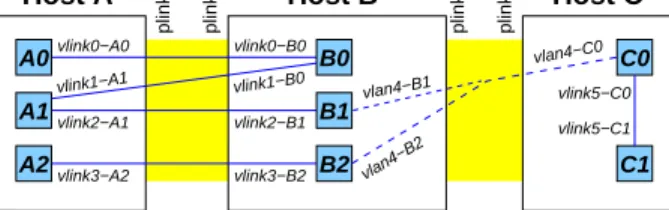
Figure 1: A network topology illustrating routing issues due to the multiplexing of virtual nodes and links. Large boxes represent physical nodes and links, while small boxes and lines (withitalic labels) represent virtual nodes and links. Virtual network interfaces (vlinks), virtual LANs (vlans), and physical links (plinks) have names as shown.
used to monitor and control nodes of all types. While non-physical nodes have significant differences from physical nodes, the state machines used to manage them are almost identical. In addition, the same machine is used for Emulab vnodes as well as PlanetLab virtual servers. Reusing—indeed, sharing—such complex and crucial code contributes to the overall system’s reliabil-ity.
3.2
Virtual Networks
Virtualizing a network includes not only multiplexing many logical links onto a smaller number of physical links, but also dealing with network namespace isolation issues and the subtleties of interconnecting virtual nodes within, and between, physical nodes. As with virtual-izing nodes, there is a range of techniques available for virtualizing networks. When choosing the technology for Emulab, the criteria we evaluated against were:
Level of virtualization. A virtual network
imple-mentation can present either a virtual layer 2 (e.g., Eth-ernet) or a virtual layer 3 (e.g., IP).
Use of encapsulation. Virtual network links may
(e.g., 802.1Q VLANs) or may not (e.g., “fake” MAC ad-dresses) encapsulate their packets when traversing phys-ical links.
Sharing of interfaces. The end point of a virtual net-work link as seen by a virtual node may be either a shared physical interface device or a private virtual one. This may affect whether interface-centric applications like tcpdump can be used in a virtual node.
Ability to co-locate virtual nodes. Can there be
more than one virtual node from a given network topology on the same physical host? If so, there are additional requirements for correct virtualization.
3.2.1 Emulab Virtual Networks
The Emulab virtual node implementation uses unshared, virtual Ethernet devices in order to maintain transparency with the “bare machine” model which presents dedicated physical Ethernet devices to applications. By default, these virtual devices are configured to use a custom 16-byte encapsulation format, allowing use of the virtual devices with any switching infrastructure. There is also an option to allow rewriting the source MAC address in outgoing packets with the virtual MAC address. Since any physical host is dedicated to a single experiment, whether using virtual nodes or not, it is necessarily the case that virtual nodes for a topology will be co-located. This raises two issues related to forwarding packets that are addressed in the next sections.
Virtual network interfaces. While the FreeBSD jail
mechanism does provide some degree of network virtu-alization by limiting network access to specific IP ad-dresses, it falls short of what we need. In particular, though jails have their own distinct IP addresses, those IP addresses are associated directly with shared physical in-terfaces, and thus have problems with interface-oriented applications such astcpdump. Moreover, because we al-low co-location, it is possible that two virtual nodes in the same LAN could wind up on the same physical host, for example B1 and B2 in Figure 1. FreeBSD does not allow two addresses in the same subnet to be assigned to one interface.
To solve these problems, we developed a virtual Eth-ernet interface device (“veth”). The veth driver is an unusual hybrid of a virtual interface device, an encap-sulating device and a bridging device. It allows us to create unbounded numbers of Ethernet interfaces (virtu-alization), multiplex them on physical interfaces or tie them together in a loopback fashion (bridging) and have them communicate transparently through our switch fab-ric (encapsulation). These devices also provide the han-dle to which we attach the IPFW/Dummynet rules nec-essary for doing traffic shaping. Veth devices can be bridged with each other and with physical interfaces to create intra- and inter-node topologies and ensure the correct routing of packets at the link level. For example, this bridging prevents “short-circuit” delivery of traffic between co-located nodes A0 and A2 in Figure 1, which might otherwise occur when FreeBSD recognized that both interfaces are local. Since multiple veth devices may be bridged to the same physical device, incoming packets on that device are demultiplexed based on the virtual device’s MAC address, which is either contained in the packet (encapsulation) or is exposed directly as the packet’s MAC address (no encapsulation).
Virtual routing tables. While virtual Ethernet
de-vices are sufficient to enable construction of virtual
Eth-ernet topologies, they are not sufficient to support arbi-trary IP topologies. This is due to FreeBSD jails sharing the host’s IP infrastructure, in particular, the routing ta-ble. In the routing table, it is only possible to have one entry per destination. But with a physical node hosting multiple jails representing different virtual nodes at dif-ferent points in the topology, we need to be able to sup-port multiple routes to (next hops for) a single destina-tion. This is known as the “revisitation” problem [24]. For example, in Figure 1, packets sent from A0 to C0 will pass through host B twice. B0’s next hop for C needs to be A (for A1) while B1’s needs to be C (for C0). Thus there need to be separate routing tables for B0 and B1. Further, even with separate routing tables, incoming packets to B need context to determine which routing table to use.
For Emulab, we have adopted and extended the work of Scandariato and Risso [22] which implements multi-ple IP routing tables to support multimulti-ple VPN end points on a physical node. Routing tables are identified by a small integer routing table ID. An ID is the glue that binds together a jail, its virtual interfaces, and a routing table. Incoming packets for different jails on a physical node can thus be differentiated by the ID of the receiv-ing interface and can be routed differently based on the content of the associated routing table.
3.2.2 IP Address Assignment
A subtle aspect of implementing virtual networks is as-signing addresses, in particular IPv4 addresses, to the potentially thousands of links which make up a topol-ogy. The topologies submitted to Emulab typically do not come annotated with IP addresses; most topology generators do not provide them, and it is cumbersome and error-prone for experimenters to assign them manu-ally. We thus require an automated method for producing “good” IP address assignments, and it must scale to the large networks enabled by virtualization. A desirable ad-dress assignment is one that is realistic—that is similar to how addresses would be allocated in a real network. In the real world, the primary (though not only) factor that influences address assignment is the underlying hi-erarchy of the network. Hierarchical address assignment also leads to smaller routing tables and thus better scal-ing. Since real topologies are not strictly hierarchical, the challenge becomes identifying a suitable hierarchical embedding of the topology. Our work on IP address as-signment centers on inferring hierarchy in this practical setting.
We developed and evaluated three different classes of algorithms: bottom-up, top-down, and spectral methods, described in detail elsewhere [8]. The approach we ul-timately deployed in production, called recursive
parti-tioning, creates the IP address tree in a top-down man-ner. At the top level, the root of the tree contains every node in the graph. Then we partition it into two pieces using a graph-partitioner [17], assigning each half of the graph to a child of the root. By applying this strategy re-cursively, we create a tree suitable for IP address assign-ment. The result is a fast algorithm that produces small routing tables: for example, it can assign addresses to networks of 5000 routers—comparable to today’s largest single-owner networks—in less than 3 seconds.
4
Automated Resource Assignment
When an experimenter submits an experiment, Emulab automatically chooses a set of physical nodes on which to instantiate that experiment. This process of map-ping the virtual topology to a physical topology is called the network testbed mapping problem [21], and virtual nodes add new challenges to an already NP-hard prob-lem. The needs of this mapping are fundamentally sim-ilar to other virtualized networking environments, such as the planned GENI facility [10] (where such mapping will be done by a Slice Embedding Service), and Model-Net [26].
For an experiment with virtual nodes, a good mapping is one that “packs” virtual hosts, routers, and links on to a minimum number of physical nodes without overload-ing the physical nodes. This means, for example, plac-ing, when possible, nodes that are adjacent in the virtual topology on the same physical node, so that the links be-tween them need not use physical interfaces or switch capacity. This is particularly difficult because the virtual nodes may not have uniform resource needs, and physi-cal nodes may not have identiphysi-cal capacities. Since Emu-lab is a space-shared testbed, it is also important that bot-tleneck resources, such as trunk links between switches, are conserved, since they may be needed by other con-current experiments. Finally, experimenters may request nodes with special hardware or software, and the mapper must satisfy these requests.
Emulab finds an approximate solution to the network testbed mapping problem by taking a combinatorial op-timization approach. It uses a complex solver called assign [21]. assignis built around a simulated an-nealing core: it uses a randomized heuristic to explore the solution space, scoring potential mappings based on how well they match the experimenter’s request, avoid overloading nodes and links, and conserve bottleneck resources. We found, however, that Emulab’s existing assignwas not sufficient for mapping virtual node ex-periments, and enhanced it accordingly.
First, we needed new flexibility in specifying how vir-tual nodes are to be multiplexed (“packed”) onto physical nodes. To get efficient use of resources, we found it
nec-essary to add fine-grained resource descriptions, and to relaxassign’s conservative resource allocation policies. Second, because virtualization allows for topologies that are an order of magnitude larger than one-to-one emulation, we ran into scaling problems with assign. Since it must be run every time an experiment is swapped in or re-mapped as part of auto-adaptation, runtimes in the tens of minutes were interfering with the usability of the system and making auto-adaptation too cumbersome. To combat this, we made enhancements toassignthat exploit the natural structure of the virtual topologies it is given to map.
4.1
Flexible Resource Specification
assignmust use some criteria to determine how densely it can pack virtual nodes onto physical nodes. assign already had the ability to use a coarse-grained packing, in which each physical node has a specified number of “slots,” and each virtual node is assumed to occupy a sin-gle slot. Thus, it can be specified thatassignmay pack up to, for example, 20 virtual nodes on each physical node. It became clear that this would not be sufficiently fine-grained for many applications, including our auto-adaptation scheme, because different virtual nodes will have different roles in the experiment, and thus consume different amounts of resources.
To address this, we added more packing schemes to assign. In the first, virtual nodes can fill more than one slot; experimenters can use this when they have an intu-itive knowledge, for example, that servers in their topol-ogy will require more resources than clients by an integer ratio: 2:1, 10:1, etc.
The second packing scheme models multiple indepen-dent resources such as CPU cycles and memory, and can be used when the experimenter has estimated or mea-sured values for the resource needs of the virtual nodes. Each virtual node is tagged with the amount of each re-source that it is estimated to consume, and assign en-sures that the sum of resource needs for all virtual nodes assigned to a particular physical node does not exceed the capacity of the physical node. This scheme builds on assign’s system of “features and desires”: virtual nodes can be identified as having “desires” which must be matched by “features” on the physical nodes they are mapped to. Features and desires are simply opaque strings, making this system flexible and extensible. We have enhancedassignto allow features and desires to also express capacities, which are then enforced as de-scribed above. While we use this scheme for relatively low-level resources (CPU and memory), it could also be used for higher-level metrics such as sustainable event rate for discrete event simulators such asns.
for feedback-based auto-adaptation. The values used for CPU and memory consumption of a virtual node can simply be obtained by taking measurements of an ear-lier run of the application. The maximum or steady-state usage can then be used as input to the mapping process. The coarse-grained and resource-based packing criteria can be used in any combination.
In addition to packing nodes, virtual links must be packed onto physical links. Though the two types of packing are conceptually similar, a different set of issues applies to link packing. Some of these issues exist for one-to-one emulation, but there are also some new chal-lenges that come with virtual emulation.
Link mapping issues that one-to-one and virtual
emulation have in common. First, physical nodes in
a Emulab-based testbed have multiple interfaces onto which the virtual links must be packed. Second, the topology of the experimental network is typically large enough that it is comprised of multiple switches. These switches are connected with links that become a bottle-neck, so the mapping must be careful to avoid over-using them.
Link mapping challenges that arise with virtual
emulation. When mapping virtual-node experiments,
links between two virtual nodes that are mapped to the same physical node become “intra-node” links that are carried over the node’s “loopback” interface. It is advan-tageous to use intra-node links, as they do not consume the limited physical interfaces of the physical node. Al-though the bandwidth on a loopback interface is high, there are practical limits on it, and for some experiments that use little CPU time but large amounts of bandwidth, loopback bandwidth can become the limiting factor for packing virtual nodes onto physical ones. We have ex-tendedassignto take this finite resource into account.
One of the guiding principles of assignhas histor-ically been conservative resource allocation; when as-signing links, it ensures that the full bandwidth specified for the link will always be available. While this makes sense for artifact-free emulation, is at odds with our goal of using virtualization to provide best-effort, large-scale emulation. For example, an experimenter may have a topology containing a cluster of nodes connected in a LAN. Though the native speed of this LAN is 100 Mbps, the nodes in this LAN may never transmit data at the full line rate. Thus, ifassignwere to allocate the full 100 Mbps for the LAN, much of that bandwidth would be wasted. To make more efficient resource utilization possible, we have added a mechanism so that estimated or measured bandwidths can be passed toassign. As with node resources, this bandwidth can be measured as part of auto-adaptation.
4.2
Improving
assign
’s Scaling
assignhas been designed and tuned to run well on Em-ulab’s typical one-to-one workload, consisting of topolo-gies with at most a few hundred nodes. In order to make assignscale to topologies of the scale enabled by vir-tual nodes, we developed several new techniques.
4.2.1 Searching the Solution Space
Our first techniques for tackling scaling issues are aimed at improving the way in whichassignsearches through the solution space of possible mappings. assignfinds sets of homogeneous physical nodes and combines them into equivalence classes; this allows it to avoid large por-tions of the solution space which are equivalent, and thus do not need to be searched. However, this strategy breaks down with the high degree of multiplexing that comes with virtual-node experiments, because a physical node that has been partially filled is no longer equivalent to an empty node. We have addressed this problem by mak-ing these equivalence classes adapt dynamically at run time, with physical nodes entering and leaving classes as virtual nodes are assigned or unassigned to them.
Another improvement to the search strategy came from the observation that, in a good solution, nodes that are adjacent in the virtual topology will tend to be placed on the same physical node. So, we made an enhancement to the wayassignselects new virtual-to-physical map-pings to try, as it moves through the search space. To conduct this search, assigntakes a potential solution, selects a virtual node, selects a new physical node to map it to, and determines whether or not the resulting map-ping is better than the original. This process is repeated, typically hundreds of thousands or millions of times, un-til a no better solutions are found. In our modified version, rather than selecting a random physical node, with some probability, assignselects a physical node that one of the virtual node’s neighbors has already been mapped to. This improvement made a dramatic differ-ence in solution quality, leading to much tighter packing and exhibiting much better behavior in clustering con-nected nodes together.
4.2.2 Coarsening the Virtual Graph
Though these changes to the search strategy improved assign’s runtime and solution quality, runningassign on very large topologies could still take more than an hour, much too long for our purposes. To make the prob-lem more tractable, we exploit topological features of the virtual topology.
We expect that most large virtual topologies will be based on the structure of the Internet; these may come
from actual Internet “maps” from tools like Rocket-fuel [23] or from topology generators designed to create Internet-like networks, such as GT-ITM [33], inet [29], and Orbis [15]. The key realization is that such networks tend to have subgraphs of well-connected nodes, such as ISPs, ASes, and enterprises. In addition, we expect that many topologies will have edge-LANs that represent clusters, groups of workstations, etc.
We exploit the structure of the input topology by ap-plying a heuristic coarsening pre-pass to the virtual graph before runningassign. By givingassigna smaller vir-tual topology, we reduce the solution space that it must search, in turn reducing the time required to find a good solution. The goal of this pre-pass is to find sets of vir-tual nodes that, in a good mapping, will likely be placed on a single physical node. A new virtual graph is then generated, with each of these sets combined into a sin-gle node. These “conglomerates” retain all properties of their constituent nodes; for example, the CPU needs of each constituent are summed together to produce the CPU required for the conglomerate.
We have implemented two coarsening algorithms. The first stems from the realization that many topologies con-tain LANs representing groups of clients or farms of servers. An optimal mapping will almost always place as many members of these LANs onto a single physical node as possible. So, we find leaf nodes in LANs (that is, nodes whose only network interface is in that LAN), and combine all leaf nodes from the same LAN into a conglomerate.
The second algorithm uses a graph partitioner, METIS [17], to partition the nodes in the virtual graph. We choose a number of partitions such that the aver-age partition will fit on the “smallest” available physical node. We then combine the virtual nodes in each parti-tion into a single conglomerate node. The quality of the partitions returned by the partitioner is dependent on the extent to which separable clusters of nodes are present in the graph. Since we are focusing on Internet-like topolo-gies with some inherent hierarchy, we expect good re-sults from this method.
The coarsening algorithms (particularly METIS) do not know the intricacies of the network testbed mapping problem, such as constraints on node types, resource us-age, and link bandwidths; this is one reason they are able to run much faster thanassignitself. This leaves us with the problem that they may return sets of nodes to cluster that cannot be mapped onto any physical resources; for example, they may require too much CPU power or have more bandwidth than a single node can handle. Once the coarsening algorithm has returned sets of nodes, we use a multidimensional bin-packing approximation algo-rithm to pack these into the minimum number of map-pable conglomerates. 0 1000 2000 3000 4000 5000 6000 7000 100 200 300 400 500 600 700 800 900 1000 Runtime (s)
Number of Virtual Nodes Median Runtime Without Prepass
Median Runtime With Prepass
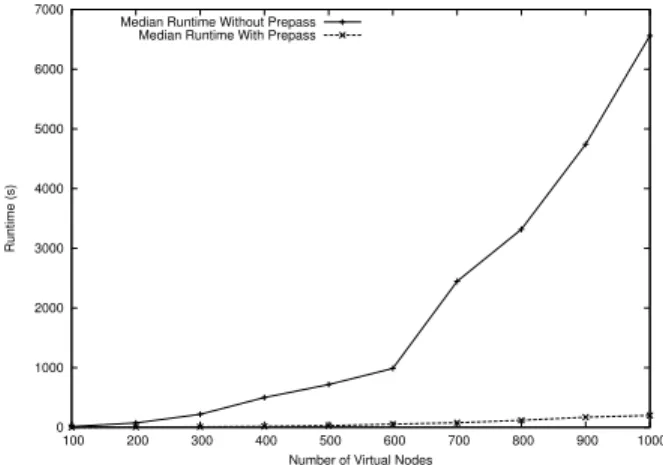
Figure 2: Median runtime ofassignwith and without a coars-ening pre-pass.
Both coarsening algorithms helpassignto run faster by making heuristic decisions that limitassign’s search space, but could, in turn, make clustering decisions that result in sub-optimal mapping. However, in our domain obtaining a solution in reasonable time is more impor-tant than obtaining a near-optimal solution. The map-pings obtained by assignwill always be valid, but it is possible that some topologies are coarsened in such a way the mapping does not make the most efficient use of resources. The biggest potential problem is fragmenta-tion, in which the coarsening pass makes conglomerates whose sizes do not pack well into the physical nodes. We take measures to try to avoid this circumstance, by care-fully choosing our target conglomerate size. In practice, the worst fragmentation we have seen caused only a 13% increase in physical resources used.
To evaluate our new resource mapper as well as to un-derstand the effects of the coarsening pre-pass, we com-pared runs of assignwith and without the pre-pass. These runs mapped transit-stub topologies generated by GT-ITM [33] onto Emulab’s physical topology. Each test was run ten times. In all cases, the runtime of the pre-pass itself was negligible compared to the runtime of assign.
Figure 2 presents the median runtimes for these tests on a 1.5 GHz Pentium IV, showing the greatly significant time savings from the pre-pass. As we scale up the num-ber of virtual nodes the improvement goes from a factor of 15 at 100 nodes (12.0 to 0.78 seconds), to a factor of 32 at 1000 nodes (6560 to 200 seconds). The absolute result is also good: it takes just 200 seconds to map 1000 nodes.
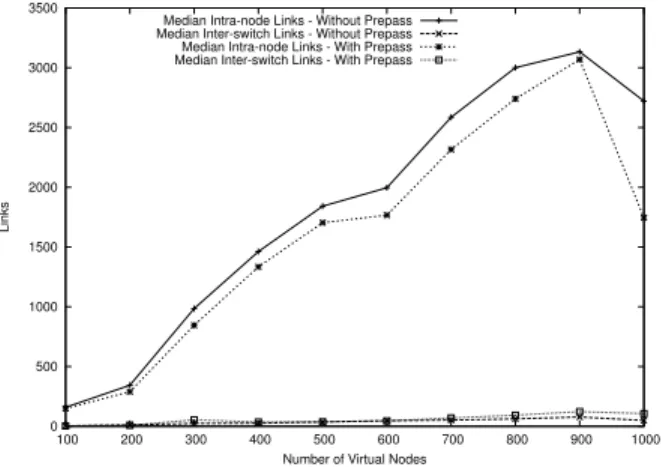
This speedup, of course, does not come without a cost. Figure 3 shows the decrease in solution quality, in terms of the quality of link mappings. Intra-node links con-nect two virtual nodes mapped to the same physical node;
0 500 1000 1500 2000 2500 3000 3500 100 200 300 400 500 600 700 800 900 1000 Links
Number of Virtual Nodes Median Intra-node Links - Without Prepass Median Inter-switch Links - Without Prepass Median Intra-node Links - With Prepass Median Inter-switch Links - With Prepass
Figure 3: Number of intra-node and inter-switch links found byassign. Larger numbers of intra-node links are better, and smaller numbers of inter-switch links are better.
they do not use up shared switch resources, so having a large number of them is an indicator of a good mapping. Inter-switch links, on the other hand, are an indicator of a poor mapping, because they consume the shared re-source of inter-switch links. Though the pre-pass does causeassignto find somewhat worse mappings, the dif-ferences are tolerable, and the speedup is a clear win. In over 70% of the test cases, the number of intra-node links found when using the pre-pass was within 10% of the number found byassignby itself. The worst run was within 16%.
5
Exploiting Physical Hierarchy
In addition to the previously described IP assignment and mapping problems, a number of more general but severe “system” scaling issues arose, which prevented us from reaching large size until we addressed them. Some are system-wide issues that are the byproducts of the order of magnitude increase in the potential size of an exper-iment. Others are per-node issues that are the result of increasing the resource consumption on a node. In both cases, we devise solutions that exploit the physical struc-ture and realities of the physical testbed infrastrucstruc-ture.
Most system-wide problems have to do with accessing centralized services and the use of unreliable protocols, primarily during initial experiment setup. The system-wide scaling problems encountered here are essentially the same issues faced when increasing the number of physical machines in the testbed. For example, sharing a single NFS filesystem does not scale well. We are con-stantly addressing these types of issues as we expand into larger virtual node experiments. Ultimately, virtual node growth will continue to outpace physical resource growth by 1–2 orders of magnitude. However, by leveraging the close relationship between virtual nodes and their host
we significantly reduce the burden on the central infras-tructure as highlighted by the following examples.
There are a number of situations in which we use the physical host as a caching proxy for its hosted virtual nodes. Nodes in Emulab “self configure” when they boot, after obtaining the necessary configuration infor-mation from a central server. Since the physical host nec-essarily boots before its virtual nodes, it downloads con-figuration information for all virtual nodes in a single op-eration, pre-loading a cache for each, and in some cases, performing configuration operations itself in a more ef-ficient manner. Similarly, the physical host acts as an Emulab event system proxy, using a single connection to the master event server to collect and distribute control events for all its virtual nodes.
One of the most compute-intensive parts of instan-tiating an experiment is calculating routing tables for all of the nodes. Though Emulab supports dynamic routing through the use of a routing daemon such as gated or zebra, most experimenters prefer the con-sistency and stability offered by computing routing ta-bles off-line before the experiment begins. Typical al-gorithms for doing this, however, have runtimes ranging fromO(V2
·lg(V) +V ·E)(Dijkstra’s algorithm with a Fibonacci heap) to O(V3
) (Dijkstra’s algorithm with a linear-array priority queue), with respect to the num-ber of vertices (nodes) and edges (links) in the topology graph. To solve this problem, we parallelize route com-putation across all of the physical nodes in the experi-ment, with each physical node responsible for the rout-ing tables of the virtual nodes it hosts. We distribute one copy of the topology to each physical host, and run Di-jkstra’s algorithm sourced from each virtual node hosted on that physical node. Thus the route calculation time becomes O(V2
·n), where n is the number of virtual nodes hosted on each physical node. In practice, with the size of virtual topologies that are feasible to run on Emulab and the level of virtual-to-physical multiplexing possible, this time never exceeds a few seconds.
The original Emulab system could not reliably instan-tiate an experiment larger than about 100 nodes. Our improvements in Emulab allow experiments of up to at least two thousand nodes to be reliably instantiated. A fundamental limitation on speed of instantiation is that vnode construction is not parallelizable within a unipro-cessor host. However, virtual nodes on distinct physical hosts can be setup in parallel. To demonstrate the degree to which this parallelism can be successfully exploited, we performed a simple test in which an experiment con-sisting of a single LAN was repeatedly instantiated, each time adding to the LAN one physical node hosting 10 virtual nodes. In the base case of one physical node with 10 virtual nodes in the LAN, setup, including topology mapping, node configuration and startup, required 194
seconds. At 80 virtual nodes on 8 physical nodes, it took 290 seconds, a 50% increase in time for an 800% in-crease in size.
6
Feedback-Directed Resource Allocation
Maximum scalability is achieved when Emulab’s physi-cal nodes and networks can be divided as finely as possi-ble, each physical resource providing support to as many emulated and/or simulated entities as possible. How-ever, for these emulated and simulated environments to be worthwhile to most Emulab users, they must be ac-curate recreations of devices in the real world. Meet-ing our scalability goal and our realism constraint at the same time means making virtual nodes that are “just real enough” from the point of view of the software systems under test.
Finding the proper balance between scalability and fi-delity is not easy: the ideal tradeoff that is “just real enough” is inherently specific to the software being tested. Therefore, to find the appropriate resource map-pings for a user’s experiment, our technique is to au-tomatically search for a mapping that minimizes phys-ical resource use while preserving fidelity according to application-independent (provided by the system) and/or application-dependent (provided by the user) feedback.
Testbed users have two options for adapting their ex-periments: executing a single-stage “training” run that requires little effort, or running a multi-stageautomatic experiment adapterthat requires additional effort.
The first option does not require the experiment to be fully automated, so is suitable for an interactive style of experimentation. In this model, the user creates an ex-periment and swaps it in on virtual nodes mapped one-to-one on physical nodes to ensure adequate resources. Users can then login to the nodes, run their programs, and, when they have determined that the experiment is in a representative state, click a button to record a pro-file. This profile is then used in subsequent runs to drive the resource mapping. Of course, because of the one-to-one initial mapping, this simplistic manual approach will not work for large topologies. For those topologies we will necessarily need to start out with some virtual nodes multiplexed many to one on physical nodes and thus we cannot gather an accurate resource requirements profile with a single run. For these situations we offer the sec-ond option.
In the multi-stage approach, an experiment is automat-ically run multiple times, each time adjusting the map-ping to account for any resource overloads noted in the previous run. To do this, the user must automate the ex-ecution of the experiment. Each run of the experiment starts up a representative workload, monitors resource usage once that workload reaches a steady state, invokes
a script to gather the monitor output and create a profile, and then remaps and reinstantiates the experiment based on that profile. This process continues until there is a run in which no resource overload is detected.
Our feedback-driven adaptation technique automati-cally finds virtual-to-physical mappings that provide the user’s required level of emulation fidelity while allowing Emulab to make maximally efficient use of its resources. There is a risk, however, that the mappings set up by the adapter will fail to provide sufficient fidelity to the user’s software during “production” testbed runs, e.g., because the user modifies the software or is driving it in a differ-ent way. Emulab relies on run-time feedback to detect such cases and signal the user about possible problems with his or her experiment.
6.1
Implementation
Ensuring application fidelity when multiplexing virtual nodes can be achieved quickly and accurately through monitoring the application’s steady state resource us-age and feeding this data back into assign. Utilizing application-independent metrics, like CPU and memory usage, we can automatically adapt the packing of virtual resources on to physical hosts. This is done in a way that minimizes physical resource use while leaving sufficient headroom for the vnode’s steady state resource consump-tion. Any available application-specific metrics can then be used to refine the mapping to account for lack of pre-cision in the low level data.
On each physical node Emulab gathers a number of application-independent resource usage statistics to feed back to the adaptation mechanism. These include CPU use, interrupt load, disk activity, network traffic rates, and memory consumption. CPU and memory informa-tion are also gathered at vnode granularity, which is how we determine the resource demand of individual vnodes. The other global statistics allow us to ensure that the physical node as a whole is not overloaded.
The multi-stage adaptation technique requires that an experiment be automated, running a particular sequence of actions. This is easily done using Emulab’s event sys-tem, which allows for executing operations in parallel, in sequence, or at specific times relative to the start of the experiment. The user only needs to create an event se-quence to perform the steps described earlier. There are built-in events for two feedback specific activities. One allows for running the application-independent resource monitor on all nodes for a fixed length of time. The other performs the remap itself, a process which includes gath-ering the log files from all nodes, analyzing the data to detect overloads and produce new per-node resource us-age estimates, and finally invoking assign and recon-figuring the experiment to reflect the new virtual node
layout.
The mechanism for supporting application-dependent metrics and providing user-directed feedback based on those metrics is a prototype and likely to change. In the current implementation, the user must provide three components. First, he or she provides one or more re-source monitors that gather and log appropriate rere-source usage data. These could be separate programs, or they could just be the applications themselves, logging rele-vant information. Second, the user provides a “baseline summary” file describing the expected behavior of the system when not constrained by node resources. This summary file can be in any format, as it is interpreted by a user-supplied script. That script is the third com-ponent. The script is automatically invoked at the end of each run of the experiment, with the log files from the monitors and the baseline summary as inputs. Its job is to aggregate the log file information into a new sum-mary and compare that sumsum-mary with the baseline to de-termine if there is a resource overload. If the answer is “yes,” then the experiment will be remapped.
6.2
Usage Scenarios
We see three common ways in which the auto-adaptation mechanism can be used. In the first, the user starts with a one-to-one mapping of virtual nodes to physical nodes and “packs” the experiment into fewer physical nodes. Starting with the one-to-one mapping we gather boot-strap resource data in the first pass. The system then runs successive passes, increasing or decreasing the packing until it arrives at a maximally dense packing factor with virtual node resource use that is consistent with the one-to-one mapping. At this point, the user will probably want to increase the size of her or her topology. The sim-plest approach is to use the bootstrap data for nodes that will remain in the experiment and perform a bootstrap on the newly added nodes. Alternatively, the user can divide nodes into resource classes (e.g., client/server), which are initialized using data derived from previous runs.
A second style of adaptation, using the same mech-anism, is to start with a dense mapping of a topology and then expand it. A dense mapping is achieved by providing no initial feedback data, allowingassign to map strictly on the basis of available physical node and link characteristics. In this configuration, there can be no training run to gather clean resource usage data. In-stead, feedback data are provided by the application-independent metrics (pushing the experiment away from obvious overload conditions) or with interactive guid-ance from the user. This form of adaptation is used with large topologies where there are not enough physical re-sources to map it one-to-one.
Finally, in the third scenario, an Emulab experiment can incorporate purely simulated nodes and networks, using a modified version ofnse[9]. As described in de-tail elsewhere [12, 13], these simulated entities can be transparently spread across physical nodes, just as vn-odes are dispersed. Since these simulated nvn-odes inter-act with real traffic, the simulator must keep up with real time. Detecting when virtual time has significantly fallen behind real time gives us a way to detect overload that is more straightforward than with vnodes, although there are subtleties with synchronizing the two that must be taken into consideration, as described in the above ref-erences. Our infrastructure can adaptively remap simu-lated networks similarly to the way it handles virtualized nodes and links.
7
Results
In the following sections we present a preliminary evalu-ation of the Emulab virtual node implementevalu-ation in three areas: application fidelity, application transparency, and performance and fidelity of the adaptation mechanism. All results were gathered on Emulab’s low-end “pc850” machines, 850 MHz PCs with 512 MB of RAM and four 100 Mb Ethernet interfaces.
7.1
Application Fidelity
Microbenchmarks. To get a lower-level view of
fi-delity with increasing co-location, we performed an ex-periment in which we ran thepathrate[7] bandwidth-measurement tool between pairs of nodes co-located on the same physical host. Each pair of nodes was connected with a T1-speed (1.5 Mbps) link. We mea-sured the bandwidth found bypathrateas we increased the number of node pairs from one to ten. Across all runs,pathratemeasured the correct bandwidth to within 1 Kbps, with a standard deviation across runs of pathrateof 0.004.
Applications. We ran a synthetic peer-to-peer file
sharing application calledKindex, which is modeled after a peer music file sharing network such as KaZaa. Kindex maintains a distributed peer-to-peer index of file contents among a collection of peer servers. It also keeps track of replicas of a file among peers and their proximity, to expedite subsequent downloads of the same file. In our simplified experiment, we start a series of 60 clients se-quentially. Each of 60 clients uploads a single file’s infor-mation to the global index, and starts randomly searching for other files, fetching those not previously fetched into its local disk. Each client generates between 20 to 40 requests per minute for files, whose popularity follows a Zipf distribution. Each client has sufficient space to hold all 60 files. Hence after the experiment has run for
0 1e+06 2e+06 3e+06 4e+06 5e+06 6e+06 7e+06 8e+06 0 100 200 300 400 500 600 700 800 Cumulative bytes/sec
Elapsed time (seconds) Kindex aggregate downloaded bytes/sec pack-00
pack-10 pack-15 pack-20 all peers online
Figure 4: Cumulative system bandwidth for co-location factors of 0, 10, 15 and 20. “All peers online” is the point in time where all 60 peers are running and downloading files.
a while, all clients end up caching all files, at which time we stop the experiment.
The network topology consists of six 10 Mbps cam-pus LANs connected to a core 40 Mbps LAN of routers with 100 ms roundtrip between themselves. Each cam-pus LAN is connected to a router via a 3 Mbps, 20 ms RTT link.
We plotted the aggregate bandwidth delivered by the system to all its users as a time line. For this, we mea-sured the total size of files downloaded by all users in every 10-second interval. We expect that initially down-loads are slow, but as popular files are cached widely, subsequent downloads are more likely to be satisfied from a peer within the same campus, driving up the ag-gregate bandwidth due to the higher speed links. How-ever, due to the fetch-once behavior of clients, as more files are downloaded by all users, downloads become less frequent, driving down the aggregate bandwidth.
We ran the experiment in four configurations. First, we emulated the topology on just physical nodes to es-tablish a base line. We then repeated the experiment us-ing virtual nodes with co-location factors of 10, 15 and 20 virtual nodes per physical node. Figure 4 shows the results. The base line (pack-00) shows the expected be-havior, aggregate bandwidth increasing to a peak and then tapering off. At a co-location factor of 10, one campus LAN mapped per physical node, the behavior is indistinguishable for the base line. However, as we in-crease the co-location to 15 and 20, since peers have to supply files over the faster LAN links, the load on the local disk rises. This is the reason for the reduced peak bandwidth and its shift to the right, causing the curve to be flattened.
While this example shows that we can achieve an order of magnitude scaling improvement with an IO intensive
application on low-end PCs, it also illustrates the utility of feedback data for driving virtual node multiplexing. In this example, some node disks hit 100% busy in both the pack-15 and pack-20 cases, an event easily detected by application-independent metrics. However, the user might also decide that the results from pack-15 were ac-ceptable, but those in pack-20 were not. In this case they might construct a custom metric saying that remapping is only necessary if the disk were saturated for three con-secutive measurements.
7.2
Application Transparency
Correctly achieved transparency is difficult to rigorously demonstrate; only failures of transparency are obvious. Our most compelling evidence is that experimenters have run thousands of diverse virtual node experiments, yet generated only a handful of requests for “missing fea-tures” such as support for multicast routing and IPFW firewall rules. We did perform one empirical stress test, running a routing daemon in a complex virtual network topology. By causing a series of link failures within the topology, we verified that the routing daemons were functioning as expected. In that test, we ran unmodified gatedrouting daemons on all nodes in a 416 vnode hier-archical topology on 22 PCs and automatically generated OSPF configuration scripts. Once we verified the con-nectivity between some leaf nodes across the diameter of the topology, we caused a link failure in the interior to see how OSPF would route around the failure. Be-fore the failure, a route between two leaf nodes was sym-metric with 11 hops. We found a 5 second downtime in one direction and 9 seconds in the reverse direction, after which alternate 12 hop paths were established. The for-ward and reverse paths were different in one hop. When we removed the link failure, it took 22 and 28 seconds respectively for the route paths to be restored. Finally, we rebooted two interior nodes in the topology. gated restored all the routes in a little over a minute.
7.3
Adaptation Results
We evaluated our feedback system in three scenarios: a Java-based web server and clients, the BitTorrent peer-to-peer file distribution system, and the Darwin Stream-ing Server [2].
We first ran a Java-based web server on one host with 69 clients continually downloading a 64 KB file. The clients were separated into three different types based on their link characteristics. Nine clients were evenly spread across three links on a single router using 2 Mb LANs to emulate cable modem clients. Forty clients were di-rectly connected to a single router using 2 Mb multi-plexed links to emulate DSL modems. Finally, 20 clients
Metric 2 Mb 2 Mb 56 Kb
LAN Link Link
74 vnodes on 74 physical nodes
Avg. Transaction Rate 1.19 2.29 0.09
Avg. Response Time (s) 0.84 0.43 10.67
Packed onto 7 phys. nodes after first iteration
Avg. Transaction Rate 1.10 1.85 0.09
Avg. Response Time (s) 0.91 0.53 10.77
Packed onto 7 phys. nodes after second iterations
Avg. Transaction Rate 1.19 2.29 0.09
Avg. Response Time (s) 0.84 0.43 10.70
Table 1: Performance of clients continually downloading a 64 KB file in different vnode mappings.
were directly connected to a single router using 56 Kb multiplexed links, to emulate phone modem clients. The feedback loop required three iterations to reach accept-able application fidelity; the results are shown in Taccept-able 1. The first iteration is a one-to-one mapping that allows the system to get a clean set of feedback data. The sec-ond iteration packed the 74 vnodes onto 7 physical nodes and resulted in a drop in performance because the CPU intensive server node was co-located with several client nodes. The final iteration amplifies the feedback data (i.e., increases the CPU and memory requirements) by 20%, which is enough to isolate the server and return the application metrics to their original one-to-one values, without allocating any more physical nodes. It should be noted that the bad mapping found in the second iteration could have been avoided with higher precision monitor-ing. However, in our context a bad initial remapping is a benefit because it denotes the lower bound on the num-ber of required nodes and we always wish to minimize the number of physical nodes required for a topology.
To demonstrate scaling a real application to large topologies that cannot fit in a one-to-one mapping, we ran the BitTorrent p2p file distribution program on a 310-node network packed onto 74 physical 310-nodes. The topol-ogy consisted of 300 clients communicating over 2 Mb LANs or links, a single “seed” node with a 100 Mb link, and nine routers that formed the core. To bootstrap the mapping we used feedback data from a smaller topology for the clients, since their resource usage was dependent on the link constraints and not the number of clients in the system. However, the resource use of the seed node and routers is tied to the size of the network, so they were left one-to-one. In total, it took 19 minutes to instantiate the topology: seven minutes forassignto map the vir-tual topology onto the physical topology and twelve min-utes to load disks onto the machines, reboot, and setup the individual virtual nodes. This should be compara-ble to the length of time it would take to setup the same
Mapping Video gap (ms) Audio gap (ms)
Min Max Min Max
One to one 0.93 90.99 48.23 210.96
Phys. Link Shared 0.04 470.3 0.07 531.27 Phys. Link Unshared 0.54 91.99 30.88 232.10 Table 2: Interpacket gap of clients receiving a 100 Kbps video and audio stream in different configurations where the physical link is shared and not shared. The values are the median of five runs.
topology on physical machines (if Emulab had sufficient nodes). On physical nodes, theassigntime would be less, but the time to setup switch VLANs would exceed the time required to setup virtual links.
The adaptation mechanism can also accommodate ap-plications that have throughput constraints as well as tim-ing sensitivity. We tested the Darwin Streamtim-ing Server sending a 100 Kbps video and audio feed to 20 clients. When packed densely to 2 physical nodes, the inter-packet gap variance is high, but if we set the estimated bandwidth for the client links to 100 Mb, sparser virtual to physical link mapping results. This in turn forces vir-tual nodes to relocate onto other physical nodes, raising the total number physical nodes to 6 (see Table 2). The oversubscription of network bandwidth thus clears a path for time sensitive packets.
8
Related Work
The ModelNet network emulator [26] achieves ex-tremely large scale by foregoing flexibility and option-ally abstracting away detail in the interior of a network topology. Edge hosts run the user’s applications on generic OSes, using IP aliasing and a socket interposition library to give a weak notion of virtual machine, called a VN. The VNs route their traffic through one or more physical “core” machines that emulate the link charac-teristics of the interior topology. ModelNet has emulated topologies in excess of 10,000 links. However, it can-not emulate arbitrary computation in the core of a topol-ogy, which excludes simple applications like traceroute as well as more complex services like user-configurable dynamic routing, unless support for each feature is hard-wired in (as has been done for DSR) [25].
Compared to Emulab, ModelNet is less transparent to applications and it is harder to provide performance mon-itoring, because it currently uses only a very weak no-tion of virtual machine. For example, it does not virtu-alize filesystem namespace, VNs cannot be multihomed, and it provides no network bandwidth isolation between VNs on the same physical host. ModelNet and the new Emulab are clearly complementary—ModelNet is per-fect for generic network interiors, while the new Emulab
is strong in other ways.
Building on ModelNet and the Xen [3] virtual machine monitor, DieCast [11] uses time dilation to run large vir-tual experiments. In DieCast, time is “slowed down” in-side of the virtual machines by an amount equal to the multiplexing factor, resulting in an experiment that takes much longer to execute, but which provides the illusion that the full capacity of the host CPU, network band-width, and other “time-scalable” resources are available to each virtual node. As a result of this time dilation, each DieCast virtual node has more of these resources available to it than ours do, but the overall efficiency of the testing facility is not improved. Thus, our virtual nodes are more appropriate for a shared facility. DieCast represents an alternative approach to scale up experimen-tation resources, bringing with it a different set of chal-lenges to solve.
The Virtual Internet architecture [24] is a partially im-plemented model targeted to deploying virtual IP net-works as overlay netnet-works on the live Internet. The VI work identified most of the issues with link virtualiza-tion at the IP layer that we encountered at the Ether-net level. It focuses on correct implementation of vir-tual links when nodes can simultaneously participate in multiple topologies (concurrence), as multiple nodes in a single topology (revisitation) and when nodes in a vir-tual topology can themselves act as base nodes for other topologies (recursion). It does not virtualize other node resources.
Virtual machineshave a long history, but we discuss only a few recent examples that have been used specif-ically to implement network emulation environments. This related work generally concentrates on node and/or network virtualization, but we provide a complete sys-tem including experimenter control, automated resource assignment and feedback directed virtualization.
IMUNES [32] is an integrated network emulation en-vironment using FreeBSD jail-based virtual nodes and the “vimage” virtual network infrastructure work [30, 31] (which is now part of FreeBSD-CURRENT, but was not available when we started). Rather than virtualize pieces of the network stack, the authors virtualize the en-tire stack and associate an instance with each jail. While conceptually cleaner, the complete duplication of all net-work resources raises issues of kernel memory fragmen-tation. Their implementation provides some basic con-trol over CPU usage that ours currently does not. Al-though IMUNES topologies can span multiple physical machines, they do not have the automation support to layout and control such topologies.
The node virtualization facility added to the Network Emulation Testbed (NET) [16] provides a lightweight virtual node mechanism in Linux based on virtual rout-ing tables and custom Linux modifications. Their
en-vironment provides wireless as well as wired network emulation. The NET virtual networking implementation is analogous to ours, with their “vnmux” virtual inter-face and bridge taking the place of our “veth” device and the “NETshaper” replacing our Dummynet usage. Some degree of application transparency is achieved by using chvrf, a Linux chroot-like utility, to separate process and network name spaces. The NET work is highly comple-mentary to ours in that it provides a Linux virtual node implementation as well as wireless network emulation that could be integrated with Emulab.
PlanetLab [20] is a geographically distributed network testbed, with machines time-shared among mutually un-trusting users. PlanetLab uses Linux vservers [14] hanced with a custom kernel module that provides en-hanced resource isolation, including CPU and network bandwidth. Node virtualization is constrained by the fact that the nodes are subject to the restrictions of the site at which they reside. For example, since they cannot as-sume more than a single routable IP address is available per node, IP name space is not virtualized.
VINI [4] is a virtual network infrastructure designed to allow multiple, simultaneous experiments with arbitrary network topologies to run on a “real” shared physical net-work infrastructure. Specifically, PL-VINI is an imple-mentation of VINI on PlanetLab nodes. It builds on top of PlanetLab vservers, adding virtual routers connected by virtual point-to-point links along with the ability to di-rect real Internet traffic through the resulting virtual net-work. The absolute performance of PL-VINI was poor due to the need to implement forwarding infrastructure in user mode on the PlanetLab Linux kernel. It also of-fers only rudimentary traffic shaping and topology setup mechanisms.
A new implementation of VINI called Trellis [5] im-proves the performance and capabilities of PL-VINI by moving the virtual networking into the Linux kernel, en-abling faster packet forwarding and traffic shaping via standard Linux tools. We are currently collaborating with the VINI developers to bring VINI nodes under Em-ulab control, enabling the full power of EmEm-ulab’s exper-iment creation and control infrastructure.
Auto adaptation, using an automated iterative
pro-cess to best match a workload to available resources, is also not a new idea. One example is Hippodrome [1], a tool for optimizing storage system configurations. Hip-podrome uses storage-relevant metrics (e.g., IOs/sec) to analyze a target workload. It feeds that information into a “solver” which uses modeling to find a good candi-date storage architecture, then reconfigures the underly-ing storage subsystem accordunderly-ingly. This process is re-peated until a configuration is found that satisfies the workload’s IO requirements.
a much narrower set of resources. They are concen-trated on IO bandwidth where we must consider a work-load’s CPU, memory and network resource requirements as well as storage requirements. As a result, they can use more sophisticated and specialized analysis and design tools (e.g., storage system models), allowing quicker convergence on a suitable resource configuration.
9
Discussion and Conclusion
Our resource allocation and monitoring techniques do not assure thetimelinessof events. In general, assured timeliness is expensive to provide, requiring real-time scheduling of CPU and links. However, we do provide two ways to address the issue, with another planned. First, the user’s application-specific metrics, if they can be gathered on unmultiplexed nodes, serve as a safety mechanism to catch arbitrary performance infidelities. Second, the user can specify a shorter time period (the default is 1 second) over which the monitoring daemon will average, as it looks for overload. Finally, we may add a kernel mechanism that will detect if any resource use over very fine time scales, e.g., 1–10 msecs, has ex-ceeded a user-settable threshold. Given this mechanism and typical Internet latencies, users can be quite confi-dent that timing effects regarding network I/O have not affected their experiments.
Evaluation of packet timeliness and CPU schedul-ing effects remain to be done, but by offerschedul-ing the user application-level metrics directing adaptation, that is not essential. Exhaustive validation of the link emulation fidelity should be done, similar to the inter-packet ar-rival and time-variance analysis we do for mixed sim-ulated/emulated resources [13]. Another issue is that our default mode of encapsulation decreases the MTU by a few bytes, which could affect some applications. In this case we support two other techniques that require no loss of MTU size: the virtual network devices can be configured to use fake MAC addresses in place of en-capsulation, or to use 802.1Q VLAN tagging. We may add well-known OS resource isolation mechanisms such as proportional-share scheduling and resource contain-ers. In a completely different but important area, some aspects of Emulab’s Web-based user interface,