Generating Java Unit Tests with AI Planning
Eddie Dingels
[email protected]
Timothy Fraser
[email protected]
Alex Quinn
[email protected]
Department of Computer Science, University of Maryland College Park, College Park, Maryland, USA
ABSTRACT
Although several efforts have applied search-based approaches to the generation of unit tests, none have demonstrated that these approaches scale beyond small programs. Our experi-ment compares the ability of three general-purpose AI plan-ners to generate unit tests for Java classes with varying sizes and semantics. Although the GraphPlan planner handled most of our test classes, none of our planners could handle them all. We suggest a number of alternate search-based approaches and conclude that further experiments are needed to evaluate them.
Categories and Subject Descriptors
D.3.3 [Sofware Engineering]: Testing and
Debugging—Test-ing tools (e.g., data generators, coverage testDebugging—Test-ing).
General Terms
Reliability, Experimentation, Verification
1.
INTRODUCTION
Unit testing is an effective way to find bugs in programs. Automating the generation of unit tests greatly decreases the difficulty of applying unit testing to software with many com-plex components. Many approaches to automation have been tried. Some approaches rely on a directed search through the space of potential test plans. These include the work of Howe and others [4] and Memon and others [6] using AI Planning and the work of Purdom [9] and Maurer [5] using formal gram-mars. Other approaches rely on random or exhaustive search, such as Pacheco and others’ feedback method [7] and Visser and others’ model-checking method [13].
Our work focuses on the use of AI planning. While previous efforts have shown that general-purpose AI planners are appli-cable and feasible on small problems, they have not demon-strated that this approach scales to larger programs.
Permission to make digital or hard copies of all or part of this work for personal or classroom use is granted without fee provided that copies are not made or distributed for profit or commercial advantage and that copies bear this notice and the full citation on the first page. To copy otherwise, to republish, to post on servers or to redistribute to lists, requires prior specific permission and/or a fee.
WEASELTech’07, November 5, 2007, Atlanta, Georgia, USA.
Copyright 2007 ACM 978-1-59593-880-0/07/0011 ...$5.00.
We have conducted a controlled experiment to compare the time taken for three general-purpose AI planning algorithms: forward-search, GraphPlan [3], and UCPOP [8], to automat-ically generate unit tests for Java classes. We have designed our test classes to represent a range of semantic patterns com-monly found in real Java programs. During the experiment, we increased the size and semantic complexity of our classes until the planners failed to produce a unit test plan for a class within a time bound of 5 minutes—the time in which a pro-grammer might reasonably be expected to produce a unit test manually.
Our results show that, although all three planners were suit-able for generating unit tests for trivially small classes, none were capable of handling all of the larger classes within our time bound. GraphPlan seemed the most suitable planner of the three, but even it was unable to generate unit test plans for seemingly reasonably-sized classes whose semantics required callers to perform explicit locking.
We conclude that similar experiments are needed to com-pare other search-based solutions. Interesting approaches might include AI planning algorithms that make use of domain-specif-ic knowledge encoded as control rules [1] or some form of HTN planning [11, 10], as well as approaches beyond AI plan-ning such as simulated annealing [12].
2.
RELATED WORK
There have been a number of explorations of the use of AI Planning to generate unit tests. Howe and others [4] used UCPOP to generate test plans for a procedural control library for a tape library robot. They tested only a subset of the li-brary’s functions in order to reduce their domain to a size that was feasible for UCPOP. We have included UCPOP in our ex-periment to compare its limitations in the Java domain to that of the newer GraphPlan. Memon and others [6] represented user-visible GUI events as planning operators instead of func-tions or methods in order to generate GUI unit tests.
Purdom [9] and Maurer [5] explored another directed ap-proach that required testers to describe the semantics of com-mand languages as formal grammars. Automated test gen-erators then generated their test plans by choosing produc-tions from these grammars. While our AI planning approach does not require programmers to define grammars, it does re-quire them to encode method preconditions and postcondi-tions using specially-formatted Javadoc comments above each method. The planners use these pre- and postconditions to de-termine how each method effects the state of class instances as
A: /** * @after:opened=true */ void open() { opened = true; } /** * @before:opened=true * @after:hasread=true */ void read() { hasread = true; } B:
public void testRead() { file.open(); file.read(); assert(file.hasread); } C: Translate to planner− specific input format Invoke measure performance planner, JUnit test (1) Java, Javadoc and test goal
(2) case JUnit test plan to Translate (3) Planner
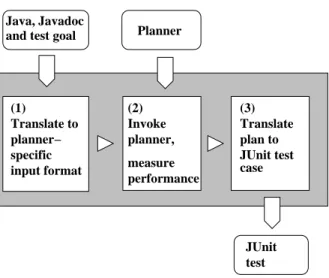
Figure 1: A: fragment of class under test, B: fragment of unit test, C: experimental framework.
they search the state space for a sequence of method invoca-tions that reaches the goal desired by the tester. Just as there are a variety of AI planning strategies for exploring the state space, there are a variety of strategies for steering the choice of grammar productions to improve test plan generation.
Pacheco and others [7] automated Java unit test generation without planning; they built their plans by choosing methods randomly and ran the plans against the program under test to eliminate invalid plans. Their approach generates a set of ar-bitrary unit tests quickly, but in contrast to the planning ap-proaches, the analyst cannot direct their generator to produce a test that will reach a specific goal.
Visser and others [13] used the Java Path Finder model check-er to gencheck-erate method call sequences for testing Java containcheck-er classes. They used the model checker to exhaustively enu-merate semantically-correct method invocation sequences of a given length. Because this enumeration could lead to in-tractably large numbers of sequences, they developed abstrac-tions that could detect when the container state reached by one sequence was similar to a state already reached by some pre-vious sequence, and explored redundant sequences no further. This sequence explosion is similar to the explosion in the num-ber of possible states in an AI planning search space and their solution is similar to search space pruning strategies used by automated planners.
3.
UNIT TESTS FOR JAVA CLASSES
Semantics complicate the problem of unit test generation for Java classes. For example, to generate a unit test that exercises some method read, the semantics of the class under test may require that the unit test program first call some other method
open to reach a state where the semantics of the class permit
an invocation of read. Consequently, automated unit test gen-eration in this domain boils down to finding an effective au-tomated approach to discovering semantically valid sequences of method invocations. The first method in the sequence must be one that is legal to invoke on instances of the class in their initial state. The last method in the sequence must be the one that the testers desire to exercise.
For our test cases, we encoded a specification of each meth-od’s semantics as pre- and post-conditions using Javadoc for-matted comments. Figure 1A contains an example of this markup for the above open/read example. In order to keep our state spaces small, we restricted our classes to boolean programs, using only boolean variables and operators [2]. Al-though this boolean restriction is far too limiting for real-world programming, we were still able to represent the method se-mantics we desired for our tests, including constraints on in-vocation order and locking discipline. Figure 1B shows a frag-ment of the resulting unit test for the read method.
Figure 1C contains a diagram of our experimental frame-work. For each of our planners, it takes a Java class with method specifications in Javadoc and a desired unit test goal as input and (Step 1) translates that input into the notation ex-pected by our planner, (Step 2) invokes the planner and mea-sures its performance, and (Step 3) translates the resulting plan into a Java unit test program. The framework generates a test oracle for the unit test directly from the plan’s goal conditions. We implemented our experimental framework as a Java plug-in plug-integrated plug-into the popular Eclipse development environ-ment.
4.
CONTROLLED EXPERIMENT
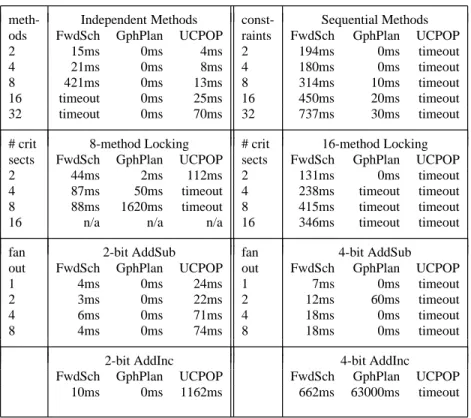
We hypothesized that it should be possible to use AI plan-ning to generate unit test plans for Java classes, and that the newer GraphPlan would handle larger and more complex class-es than the older UCPOP. To tclass-est this hypothclass-esis, we created a collection of test classes that featured five semantic patterns found in real Java programs. For each pattern, we increased the size of the test classes until neither UCPOP nor GraphPlan could produce a plan in the alloted time of 5 minutes. Ta-ble 1 presents our experimental measurements from test runs on a typical laptop PC with a 2GHz Intel Pentium IV CPU and 778MB of RAM. We implemented a forward-search plan-ner that chooses actions in a pseudo-random fashion mainly to test initial versions of our framework. The table includes its measurements, as well.
4.1
Semantic patterns
The first “Independent Methods” pattern has the least com-plex semantics: each version represents a class with a number of methods that must all be invoked, but can be invoked in any order. The second “Sequential Methods” pattern is like the first except the unit test must invoke the methods in a total or-der. Constraints on invocation order are not uncommon in real programs. For example, file classes often insist that a file must be “opened” before it can be “read.”
The next two patterns involve “Locking”. One uses classes with 8 “task” methods, the other 16. The unit test must invoke all these task methods. It may do so in any order, except that some of them require it to explicitly get a lock before the in-vocation and release it afterwards. The table shows results for a series of versions of the 8 and 16 method classes, each ver-sion requiring the unit test to acquire a lock for 2, 4, 8, or 16 of the task methods. These classes represent the less common but still significant semantic pattern of classes that require the caller to explicitly get and release locks to enforce mutual ex-clusion.
The remaining classes are based on the “AddInc” and “Add-Sub” patterns. They perform arithmetic on binary numbers. Each number is represented by a series of boolean variables. Each class tries to change a 2, 4, or 8-bit binary number’s value from all-zeroes to all-ones using a very limited collection of arithmetic operations (+1, -3, and so on). The “AddSub” classes come in a series of versions, each one with an increasing num-ber of available arithmetic operations, as shown by the “fan out” count in the table. These domains are meant to examine cases where an automated planner might fail to produce a unit test plan in time while a human analyst, aided by the insight that the individual booleans and methods represent numbers and arithmetic, might succeed.
4.2
Test bias
In all of the cases shown in Table 1, the goal of the unit test was to take a set of boolean variables from an all-zeroes state to an all-ones state. Table 2 shows the maximum time taken to solve versions of three of the problems with randomly-genera-ted boolean states as goals. (For the other problems, random-ized goals are not always reachable.) The maximum times for forward-search and UCPOP show that the all-1’s goals in Ta-ble 1 do not represent the hardest version of the proTa-blem; some of the randomized goals were harder. On the other hand, the randomized 4-bit AddInc results seem to indicate that the
all-1’s goals are in fact the hardest for GraphPlan. Despite this disadvantage, our results still favor GraphPlan.
5.
DISCUSSION
The Independent Methods measurements in Table 1 show that the UCPOP planner can produce effective unit test plans for Java classes with a large number of methods provided that those methods are independent—that they have no ordering or locking constraints. However, the Sequential, Locking, and arithmetic-oriented measurements show that when ordering or locking constraints are added, UCPOP can only handle classes with a very small number of methods. Of the three planners tested, UCPOP is the least suitable for generating Java unit test plans.
GraphPlan generates effective unit test plans for classes who-se methods have few ordering or locking constraints, even when these classes have a large number of methods. It can han-dle many constrained cases that UCPOP cannot, including all of our sequential and arithmetic classes. However GraphPlan could not generate a test plan for most of the 16-method lock-ing classes within the given time limit.
We did not expect our forward-search to be a serious con-tender. However, our results show that, unlike UCPOP and GraphPlan, forward-search’s performance improves rather than degrades when faced with the more highly-constrained classes. Their constraints limit fanout, allowing forward-search to pro-duce effective unit test plans even in the locking cases that de-feat GraphPlan. However, in classes with many independent methods, our forward search produces plans that are far longer than those produced by the other planners. Furthermore, in the largest Independent Methods examples it cannot complete its plans within the 5 minute time bound.
Based on GraphPlan’s generally excellent performance, we conclude that it is the most suitable of the three planners we examined. However, its inability to handle what seems to be a reasonable locking class leads us to imagine that there may be a better solution (see section 6). Although our results con-firm that AI planning can be used to generate unit tests for Java classes, none of the planners we tested were capable of handling all of our semantic patterns.
6.
CONCLUSION AND FUTURE WORK
Our experimental results confirmed that it is possible to use AI planning to generate unit tests for Java classes and showed that of the planners tested, GraphPlan fared the best. How-ever, GraphPlan was unable to handle a reasonable case with locking semantics.
In addition to size, the semantics of a Java class are also a factor in determining performance. For example, GraphPlan was unable to solve the 16-method Locking class with 4 crit-ical sections even though that class had fewer methods and variables than the 32-method Independent Method class it had solved earlier. Furthermore, different semantics favor differ-ent planners. Forward-search’s behavior was the opposite of GraphPlan; it solved the same Locking class but failed on the Independent Methods class. No single planner fared well on all semantic patterns.
Is there a single planner that might handle all of our seman-tic patterns? One could imagine another experiment. For ex-ample, a serious attempt to implement a forward-search plan-ner guided by control rules or some form of HTN planning
meth- Independent Methods const- Sequential Methods ods FwdSch GphPlan UCPOP raints FwdSch GphPlan UCPOP 2 15ms 0ms 4ms 2 194ms 0ms timeout 4 21ms 0ms 8ms 4 180ms 0ms timeout 8 421ms 0ms 13ms 8 314ms 10ms timeout 16 timeout 0ms 25ms 16 450ms 20ms timeout 32 timeout 0ms 70ms 32 737ms 30ms timeout
# crit 8-method Locking # crit 16-method Locking sects FwdSch GphPlan UCPOP sects FwdSch GphPlan UCPOP 2 44ms 2ms 112ms 2 131ms 0ms timeout 4 87ms 50ms timeout 4 238ms timeout timeout 8 88ms 1620ms timeout 8 415ms timeout timeout 16 n/a n/a n/a 16 346ms timeout timeout
fan 2-bit AddSub fan 4-bit AddSub out FwdSch GphPlan UCPOP out FwdSch GphPlan UCPOP 1 4ms 0ms 24ms 1 7ms 0ms timeout 2 3ms 0ms 22ms 2 12ms 60ms timeout 4 6ms 0ms 71ms 4 18ms 0ms timeout 8 4ms 0ms 74ms 8 18ms 0ms timeout
2-bit AddInc 4-bit AddInc FwdSch GphPlan UCPOP FwdSch GphPlan UCPOP
10ms 0ms 1162ms 662ms 63000ms timeout
Table 1: Elapsed wall-clock time for planning. 0ms indicates elapsed time less than 1ms. FwdSch entries are the average of 20 actual runs.
8-bit Independent Methods 2-bit AddSub fanout 2 4-bit AddInc FwdSch GphPlan UCPOP FwdSch GphPlan UCPOP FwdSch GphPlan UCPOP avg: 88ms 0ms 8ms 3ms 0ms no 124ms 171ms no med: 40ms 0ms 7ms 1ms 0ms result: 77ms 180ms result: stdev: 107ms 0ms 2ms 4ms 0ms timeouts 134ms 153ms timeouts min: 3ms 0ms 5ms 0ms 0ms in 11 of 32ms 0ms in 19 of max: 348ms 0ms 11ms 12ms 0ms 20 trials 616ms 610ms 20 trials
might enable the tester to apply domain-specific knowledge to direct a search more effectively. For example, an HTN solu-tion that decomposed the Locking problems into a series of get-lock, do-task, release-lock subtasks might produce effec-tive test plans quickly.
7.
REFERENCES
[1] F. Bacchus and F. Kabanza. Using temporal logics to express search control knowledge for planning.
Artificial Intelligence, (116), 2000.
[2] T. Ball and S. K. Rahamani. Bebop: A symbolic model checker for Boolean programs. (LNCS 1885):113–130, August/September 2000.
[3] A. Blum and M. Furst. Fast Planning Through Planning Graph Analysis. Artificial Intelligence, (90):281–300, 1997.
[4] A. E. Howe, A. von Mayrhauser, and R. T. Mraz. Test Case Generation as an AI Planning Problem. Automated
Software Engineering, 4(1):77–106, January 1997.
[5] P. M. Maurer. Generating Test Data with Enhanced Context-Free Grammars. IEEE Software, 7(4), 1990. [6] A. M. Memon, M. E. Pollack, and M. L. Soffa.
Hierarchical GUI Test Case Generation Using Automated Planning. IEEE Transactions on Software
Engineering, 27(2):144–155, 2001.
[7] C. Pacheco, S. K. Lahiri, M. D. Ernst, and T. Ball. Feedback-directed Random Test Generation. In
Proceedings of the 29th International Conference on Software Engineering, May 2007.
[8] J. S. Penberthy and D. Weld. UCPOP: A Sound, Complete, Partial-Order Planner for ADL. In
Proceedings of the Third International Conference on Knowledge Representation and Reasoning (KR-92),
October 1992.
[9] P. Purdom. A sentence generator for testing parsers. BIT
Numerical Mathematics, 12(3), September 1972.
[10] E. Sacerdoti. The nonlinear nature of plans. In
Proceedings of the International Joint Conference on Artificial Intelligence (IJCAI), 1990.
[11] A. Tate. Generating Project Networks. In Proceedings of
the International Joint Conference on Artificial Intelligence (IJCAI), 1977.
[12] N. Tracey, J. Clark, and K. Mander. Automated program flaw finding using simulated annealing. In Proceedings
of the 1998 ACM SIGSOFT international symposium on Software testing and analysis, 1998.
[13] W. Visser, C. S. Pˇasˇareanu, and R. Pelánek. Test input generation for java containers using state matching. In
ISSTA ’06: Proceedings of the 2006 international symposium on Software testing and analysis, pages