TITLE 4. PROFESSIONS AND OCCUPATIONS CHAPTER 29. OFFICE OF PEST MANAGEMENT
(Authority: A.R.S. § 32-2301 et seq.)
Chapter heading amended from Structural Pest Control Commission to Office of Pest Management by A.R.S. § 32-2302 as amended by Laws 2008, Ch. 309 (Supp. 09-4).
ARTICLE 1. GENERAL AND ADMINISTRATIVE PROVISIONS
Article 1, consisting of Sections R4-29-101 through R4-29-107 and Table 1, made by final rulemaking at 13 A.A.R. 623, effective April 7, 2007 (Supp. 07-1).
Article 1, consisting of Sections 101 through R4-29-107, adopted effective December 24, 1992 (Supp. 92-4).
Article 1, consisting of Sections R4-29-01 through R4-29-06, repealed effective December 24, 1992 (Supp. 92-4).
Section
R4-29-101. Definitions
R4-29-102. Certification Categories; Scope R4-29-103. Fees; Charges; Exemption
R4-29-104. Pest Management Advisory Committee R4-29-105. Renumbered
R4-29-106. Renumbered
R4-29-107. Licensing Time-frames Table 1. Time-frames (Calendar Days) R4-29-108. Repealed
ARTICLE 2. CERTIFICATION, REGISTRATION AND LICENSURE; CONTINUING EDUCATION
Article 2, consisting of Sections 201 through R4-29-216, made by final rulemaking at 13 A.A.R. 623, effective April 7, 2007 (Supp. 07-1).
Article 2, consisting of Sections 201 through R4-29-213, adopted effective December 24, 1992 (Supp. 92-4).
Article 2, consisting of Sections R4-29-14 through R4-29-26, repealed effective December 24, 1992 (Supp. 92-4).
Section
R4-29-201. Activities that Require a License; Exemption R4-29-202. Business License
R4-29-203. Applicator Certification
R4-29-204. Qualified Applicator Certification
R4-29-205. Qualifying Party Registration; Temporary Qualify-ing Party Registration
R4-29-206. Branch Office Registration; Branch Supervisor Reg-istration
R4-29-207. Applicator Registration
R4-29-208. License, Certification and Registration Renewal R4-29-209. Change in Business Licensee
R4-29-210. Certification Broadening R4-29-211. Certification Examination R4-29-212. Reciprocity
R4-29-213. Political Subdivision Responsible Individual R4-29-214. Renumbered
R4-29-215. Continuing Education
R4-29-216. Continuing Education Approval ARTICLE 3. PEST MANAGEMENT
Article 3, consisting of Sections 301 through R4-29-320, adopted effective December 24, 1992 (Supp. 92-4).
Article 3, consisting of Sections R4-29-35 through R4-29-38, repealed effective December 24, 1992 (Supp. 92-4).
Section
R4-29-301. Using Pesticides and Devices
R4-29-302. Storing and Disposing of Pesticides and Devices R4-29-303. Pesticide and Device Storage Area
R4-29-304. Devices Exempt From Licensure and Registration; Advertising
R4-29-305. Equipping a Service Vehicle R4-29-306. Providing Notice to Customers
R4-29-307. Performing a Wood-destroying Insect Inspection; WDIIRs
R4-29-308. Performing Wood-destroying Insect Management R4-29-309. Termite Warranties and Retreatments
R4-29-310. Business Management R4-29-311. Repealed R4-29-312. Repealed R4-29-313. Repealed R4-29-314. Repealed R4-29-315. Repealed R4-29-316. Expired R4-29-317. Expired R4-29-318. Expired R4-29-319. Expired R4-29-320. Expired ARTICLE 4. SUPERVISION
Article 4, consisting of Sections 401 through R4-29-418, adopted effective December 24, 1992 (Supp. 92-4).
Article 4, consisting of Sections R4-29-40 through R4-29-47, repealed effective December 24, 1992 (Supp. 92-4).
Section
R4-29-401. Supervising an Applicator
R4-29-402. Qualifying a Business or School District R4-29-403. Qualifying Party Management
R4-29-404. Branch Supervisors
R4-29-405. Supervision of Qualifying Party R4-29-406. Responsible Individuals R4-29-407. Joint Responsibility R4-29-408. Repealed R4-29-409. Repealed R4-29-410. Repealed R4-29-411. Expired R4-29-412. Repealed R4-29-413. Repealed R4-29-414. Repealed R4-29-415. Repealed R4-29-416. Expired R4-29-417. Repealed R4-29-418. Repealed
ARTICLE 5. RECORDKEEPING AND REPORTING Article 5, consisting of Sections 501 through R4-29-505, made by final rulemaking at 13 A.A.R. 623, effective April 7, 2007 (Supp. 07-1).
Article 5, consisting of Sections 501 through R4-29-504, adopted effective December 24, 1992 (Supp. 92-4).
Section
R4-29-501. Applicator Recordkeeping R4-29-502. Qualifying Party Recordkeeping
R4-29-503. Business Licensee and Political Subdivision Record-keeping and Retention
R4-29-504. Reporting Incidents and Bulk Releases R4-29-505. Groundwater Protection List Reporting Appendix A. Repealed
ARTICLE 6. INSPECTIONS; DISCIPLINARY PROCEDURES
Article 6, consisting of Sections 601 through R4-29-609, made by final rulemaking at 13 A.A.R. 623, effective April 7, 2007 (Supp. 07-1).
Section
R4-29-601. Inspection of Licensee Records R4-29-602. Compliance with OPM Monitoring R4-29-603. Corrective Work Orders
R4-29-604. Disciplinary Action R4-29-605. Consent Agreements R4-29-606. Penalties R4-29-607. Renumbered R4-29-608. Renumbered R4-29-609. Renumbered ARTICLE 7. RENUMBERED
Article 7, consisting of Sections 701 through R4-29-708, made by final rulemaking at 13 A.A.R. 623, effective April 7, 2007 (Supp. 07-1). Section R4-29-701. Repealed R4-29-702. Repealed R4-29-703. Repealed R4-29-704. Renumbered R4-29-705. Repealed R4-29-706. Repealed R4-29-707. Repealed R4-29-708. Renumbered
ARTICLE 1. GENERAL AND ADMINISTRATIVE PROVISIONS
R4-29-101. Definitions
In addition to the definitions provided in A.R.S. § 32-2301, the fol-lowing terms apply to this Chapter:
“Administratively complete” means an application contains all components required by statute or this Chapter to be submitted to the OPM to enable the OPM to determine whether to grant a license or approval.
“Advertisement” means a written or oral notice, including a business card, website, or telephone directory listing, which is intended, directly or indirectly, to induce a person to enter into an agreement for pest management services.
“Applicator” means an individual who provides pest manage-ment services. Applicator does not include a laborer.
“Applicator certification” means a certified applicator license. “Broadening” means to add another category of work to an existing certification.
“Certified applicator” means an individual who is licensed by the OPM to provide pest management services, including a QA.
“CEU” means continuing education unit.
“Continuing education unit” means 50 minutes of participation in continuing education.
“Control” or “manage” means, with respect to pests, to exter-minate, eradicate, destroy, kill, repel, attract, sterilize, miti-gate, remove, or a combination of these activities.
“Department” means the Arizona Department of Agriculture. “Disassociate” means to die, become disabled, resign, retire, be ill or take leave for more than 14 days, be terminated, or be called to active military duty.
“Entire structure” means all critical areas as defined in this Chapter and as specified on product labeling for both the inte-rior and exteinte-rior of a structure.
“EPA” means the U.S. Environmental Protection Agency. “EPA registration number” means the actual EPA registration number of a product or the federal provision exempting the product from EPA registration.
“Final grade treatment” means establishment of a complete vertical barrier at the exterior of foundation walls in stem wall or monolithic construction.
“Fog or fogging” means applying a pesticide by a flammable, aerosolizing thermal or other generator that forms particles less than 10 microns in diameter.
“Food-handling establishment” means a place, other than a private residence, in which food is received, served, stored, packaged, prepared, or processed.
“Fumigant” means a chemical substance with a vapor pressure greater than five millimeters of mercury at 25 degrees Centi-grade that is used to destroy plant or animal life.
“Fumigation” means a method of pest management that com-pletely fills an area with a fumigant to suffocate or poison pests within the area.
“Fungi” means saprophytic and parasitic organisms that lack chlorophyll such as molds, rusts, mildews, smuts, and yeast, except those on or in living people or animals or processed foods, beverages, or pharmaceuticals.
“Health care institution” means a health care institution licensed pursuant to Title 36, Chapter 4 and includes doctor and dental offices.
“Label” means a written, printed, or graphic document that is approved by the EPA and on or attached to a pesticide con-tainer, the wrapper of a pesticide concon-tainer, or a device. “Labeling” means a written, printed, or graphic document that is authorized by the manufacturer or a state or federal agency to accompany a pesticide or device, or is referred to on the label or in literature accompanying the pesticide or device. “Laborer” means an individual who performs physical labor necessary for an applicator to provide pest management ser-vices, including drilling and trenching, but who does not han-dle any pesticide container that has ever been opened, identify infestations, make inspections, make inspection reports or rec-ommendations with respect to infestations, or use any device for the purpose of eliminating, exterminating, controlling or preventing infestations, except that laborer includes an indi-vidual who assists with the use of a tarp on a structure for a fumigation performed by an applicator.
“New-construction treatment” means a treatment to all cellu-lose components of a structure as prescribed by the pesticide label to protect the structure from subterranean termites and is performed after a permanent concrete slab foundation is installed or footings and supports for a raised foundation are
installed, but before the structure or a final grade treatment is completed.
“OPM” means the Office of Pest Management.
“Pest” means a vertebrate or invertebrate insect, bird, mam-mal, or other animal or organism, or a weed or plant pathogen that is in an undesirable location.
“Pesticide,” as defined in A.R.S. § 32-2301, includes but is not limited to an insecticide, fungicide, rodenticide, termiticide, fumigant, larvicide, piscicide, adulticide, herbicide, nemati-cide, avinemati-cide, or molluscicide.
“Pest management services” means identifying infestations or making inspections for the purpose of identifying or attempt-ing to identify infestations, makattempt-ing written or oral inspection reports or recommendations with respect to infestations, and the application of pesticides or the use of devices not exempt by section 32-2304, subsection B, paragraph 18, for the pur-pose of eliminating, exterminating, controlling or preventing infestations.
“Post-construction treatment” means a treatment to control wood-destroying insects in or around an existing structure per-formed after all soil disturbance associated with construction is complete and after an applicator has completed an inspec-tion of the structure and a treatment proposal under A.R.S. § 32-2332(A) and (B).
“Pretreatment” means a termite treatment that protects all cel-lulose components of a structure from subterranean termites, is performed before a permanent concrete slab foundation is installed or in conjunction with establishing footings and sup-ports for a raised foundation, and establishes thorough and complete horizontal and vertical treated barriers.
“Primary service,” as used in A.R.S. § 32-2311.02(B)(3), means applying an herbicide as the only or predominant ser-vice under a verbal or written contract to maintain a property. “Project” means an individual address or a privately owned or individually owned dwelling.
“QA” means certified qualified applicator. “QP” means qualifying party.
“Qualified applicator certification” means a certified qualified applicator license.
“SDS” means safety data sheet, which is a written communi-cation regarding a hazardous chemical that meets the standards at 29 CFR 1910.1200(g).
“Service container” means a receptacle that is used to hold, store, or transport a pesticide concentrate or use-dilution preparation other than the original labeled receptacle provided by the manufacturer, a measuring instrument, or application equipment.
“Service vehicle” means a motor vehicle, including a trailer attached to the motor vehicle, used regularly to transport an applicator and equipment or pesticides used to provide pest management services.
“Signal word” means a word printed on a label that indicates the toxicity level of the pesticide in the container to which the label is affixed.
“Special Local Need registration” means an authorization from the Department to use a pesticide, which meets an Ari-zona-specific need, in Arizona according to the terms of the registration.
“Specimen label” means a label other than the label attached to a pesticide container that contains the same information as the labeling.
“Structure” means all parts of a building, whether vacant or occupied, in all stages of construction.
“Subterranean termites” means the several species of termites that usually maintain contact with the soil, including those in the families Rhinotermitidae and Termitidae.
“Supplemental wood-destroying insect inspection” means a re-examination made by an applicator of the business licensee that conducted a previous wood-destroying insect inspection and within 30 days of the previous examination to determine whether corrective treatment has been performed or conditions conducive to wood-destroying insects have been corrected. “Tag” means a written document that is required under this Chapter to be posted conspicuously at a pretreatment or new-construction treatment site.
“TARF” means termite action report form.
“Termiticide” means a chemical registered by the EPA and the Department and used for control of termites.
“Water-retention basin” means an area to temporarily hold water run-off until the water dissipates.
“WDIIR” means wood-destroying insect inspection report, which is a written report on a form approved by the OPM that is prepared in connection with the sale or refinancing of real property regardless of whether the report is used as part of the sale or refinancing.
“Wood-destroying insect inspection” means an inspection for the presence or absence of wood-destroying insects.
Historical Note
Adopted effective December 24, 1992 (Supp. 92-4). Sec-tion repealed by final rulemaking at 13 A.A.R. 528, effec-tive April 7, 2007 (Supp. 07-1). New Section made by
final rulemaking at 13 A.A.R. 623, effective April 7, 2007 (Supp. 07-1). Amended by final rulemaking at 19 A.A.R. 2967, effective September 13, 2013 (Supp. 13-3). R4-29-102. Certification Categories; Scope
The name and scope of each certification category are as follows: 1. Industrial and institutional: pest management in, on,
around or adjacent to a structure not covered by another category; pest management in or on asphalt, concrete, gravel, rocks and similar surfaces, including man holes, not covered by another certification category; pest man-agement of health related pests wherever found other than in water; and pest management of insects (in all life stages) in water limited to using pesticide briquettes; but excluding anti-microbial pest management and fungi inspection.
2. Wood-destroying organism management.
a. Wood-destroying organism treatment: inspecting for the presence or absence of wood-destroying organ-isms and treating for wood-destroying organorgan-isms in or about a residential or other structure by a means other than use of a fumigant.
b. Wood-destroying insect inspection: inspecting for the presence or absence of wood-destroying insects only and excluding preparing treatment proposals. 3. Ornamental and turf: pest management, including weeds,
in the maintenance of turf not covered by the right-of-way category and ornamental trees, shrubs, and flowers by a means other than use of a fumigant.
4. Right-of-way: pest management of pests, including weeds, in the maintenance of public roads, electric pow-erlines, pipelines, railway rights-of-way or other similar areas by a means other than use of a fumigant, but excluding pest management in the maintenance of orna-mental trees, shrubs and flowers.
5. Aquatic: pest management, including weeds, in standing or running water.
6. Fumigation: pest management using fumigants. 7. Wood preservation: application of pesticides directly to
structural components of wood or wood products, which are not part of an existing structure normally habitable by persons, to prevent or manage wood degradation by wood-destroying organisms including fungi and bacteria.
Historical Note
Adopted effective December 24, 1992 (Supp. 92-4). Sec-tion repealed by final rulemaking at 13 A.A.R. 528, effec-tive April 7, 2007 (Supp. 07-1). New Section made by
final rulemaking at 13 A.A.R. 623, effective April 7, 2007 (Supp. 07-1). Amended by final rulemaking at 19 A.A.R. 2967, effective September 13, 2013 (Supp. 13-3). Amended by exempt rulemaking at 20 A.A.R. 717,
effec-tive, effective February 7, 2014 (Supp. 14-1). R4-29-103. Fees; Charges; Exemption
A. A person shall pay the following application and renewal fees for licensure, certification, and registration:
1. For an applicator:
a. Applicator certification, $100.
b. Applicator certification broadening application, $50. c. QA certification, $200.
d. QA certification broadening application, $100. 2. For a qualifying party:
a. Registration at same time as application for or renewal of the business license, $0.
b. Registration at a different time than application for or renewal of the business license, $100.
c. Registration broadening, $50.
d. Temporary qualifying party registration, $100. 3. For a business:
a. Business license, $300.
b. Business license for federal entity, $0. c. Applicator registration, $25 per applicator. 4. For a branch:
a. Branch office registration, $100 per branch. b. Branch supervisor registration at same time as
branch office registration, $0.
c. Branch supervisor registration at a different time than branch office registration, $50.
B. In addition to the fees listed in subsection (A), a person shall pay a $10 handling fee for each application or renewal form not submitted electronically when OPM allows electronic sub-mission.
C. A person shall pay a late fee equal to half of the renewal fee for any license, certification, or registration that is not renewed timely. If a business license remains expired for more than 30 days, to renew the license, a person shall also pay an additional late fee of $15 per month that the license remains expired, not to exceed $165. Late fees are in addition to the renewal fee. D. A business licensee shall pay the following TARF fees:
1. Electronic submissions, $2;
2. Electronic final grade treatment TARF submissions, $0; 3. Electronic TARF submissions for a pretreatment or
new-construction treatment of an addition that abuts the slab of an originally treated structure, $0, if the business licensee:
a. Performed the pretreatment or new-construction treatment of the main structure,
b. Filed a TARF regarding the pretreatment or new-construction treatment,
c. Has the structure under its original pretreatment or new-construction warranty, and
d. Treats the abutting addition under the terms of the site warranty;
4. All paper submissions, $8; and
5. Late fee equal to the original TARF fee for any TARF submission more than 30 days after the due date, except that the late fee for an electronic final grade treatment TARF submission more than 30 days after the due date shall be $2.
E. If the OPM administers a certification examination, an appli-cant shall pay $50 to take the examination. If an examination service or testing vendor administers a certification examina-tion, an applicant shall pay the examination service or testing vendor the examination cost established in the vendor’s con-tract with the OPM.
F. OPM employees are exempt from the applicator and examina-tion fees listed in this Secexamina-tion.
G. An applicant who makes a payment for a fee due under this Section that is rejected by a financial institution will be subject to all of the following:
1. The OPM shall void any approval of the application or renewal.
2. The applicant shall pay any financial institution fee incurred by the OPM.
3. The OPM may require the applicant to pay all fees due using a method other than a personal or business check. 4. An application for renewal will be considered untimely if
the substitute payment is not received by the OPM by the original due date, and the applicant will be subject to a late fee based on the date of receipt of the substitute pay-ment.
H. The OPM may reject an application or request for service that is submitted with the incorrect fee and not process the applica-tion or provide the service. An applicaapplica-tion for renewal will be considered untimely if the substitute payment is not received by the OPM by the original due date, and the applicant will be subject to a late fee based on the date of receipt of the substi-tute payment.
I. In addition to the fees listed in this Section, the OPM may col-lect service charges from persons who pay with alternative payment methods, including credit cards, charge cards, debit cards and electronic transfers.
Historical Note
Adopted effective December 24, 1992 (Supp. 92-4). Sec-tion expired under A.R.S. § 41-1056(E) at 7 A.A.R. 1483, effective January 31, 2001 (Supp. 01-1). New Section made by final rulemaking at 13 A.A.R. 623, effective April 7, 2007 (Supp. 07-1). Section R4-29-103 repealed;
new Section R4-29-103 renumbered and amended by final rulemaking at 19 A.A.R. 2967, effective September
13, 2013 (Supp. 13-3). Amended by exempt rulemaking at 20 A.A.R. 717, effective, effective February 7, 2014
(Supp. 14-1).
R4-29-104. Pest Management Advisory Committee
A. A five-member Pest Management Advisory Committee is established to assist and make recommendations to the director regarding the administration and implementation of A.R.S. Title 32, Chapter 22.
1. Three members shall be business licensees or qualifying parties and shall each have a minimum of five years of pest management experience.
a. At least one of these three members shall be a busi-ness licensee who has five or fewer applicators. b. For one of these three members, first priority shall
be given to a business licensee or QP based outside of Maricopa and Pima Counties and secondary pri-ority shall be given to a business licensee or QP who is not based outside of those counties but is associ-ated with a business that has an office in Arizona outside of those counties. If there are no qualified first or secondary priority applicants, the Director may appoint any business licensee or QP with a min-imum of five years of pest management experience. 2. One member shall be a representative of a political
subdi-vision.
3. One member shall be a public member who does not pro-vide pest management services or work for a business licensee.
C. Members shall serve three year staggered terms. Members shall not serve consecutive terms, except that a member who is appointed to fill a vacancy may serve the unexpired term that fills the vacancy plus one regular term. A member shall be ineligible for reappointment for three years.
D. The office of a member shall be deemed vacant under any of the following circumstances:
1. The member no longer satisfies the qualification in sub-section (B).
2. The member is unable to perform the duties of the office. 3. The absence of the member from three consecutive Com-mittee meetings if the absences have not been excused by the Committee.
E. The Committee shall annually select a chairman and vice-chairman from among its members.
Historical Note
Adopted effective December 24, 1992 (Supp. 92-4). Sec-tion repealed by final rulemaking at 13 A.A.R. 528, effec-tive April 7, 2007 (Supp. 07-1). New Section made by
final rulemaking at 13 A.A.R. 623, effective April 7, 2007 (Supp. 07-1). Section R4-29-104 repealed; new Section R4-29-104 made by final rulemaking at 19 A.A.R. 2967, effective September 13, 2013 (Supp. 13-3). Amended by exempt rulemaking at 20 A.A.R. 717,
effec-tive, effective February 7, 2014 (Supp. 14-1). R4-29-105. Renumbered
Historical Note
Adopted effective December 24, 1992 (Supp. 92-4). Sec-tion expired under A.R.S. § 41-1056(E) at 7 A.A.R. 1483, effective January 31, 2001 (Supp. 01-1). New Section made by final rulemaking at 13 A.A.R. 623, effective April 7, 2007 (Supp. 07-1). Section amended by emer-gency rulemaking at 15 A.A.R. 1835, effective October 15, 2009, for 180 days (Supp. 09-4). Emergency expired;
Section amended by exempt rulemaking at 16 A.A.R. 290, effective November 30, 2009 by Laws 2009, 4th Spec. Sess., Ch. 3, § 28 (Supp. 10-1). Amended by exempt rulemaking at 18 A.A.R. 626, effective July 20, 2011 (Supp. 12-1). Amended by exempt rulemaking at 18 A.A.R. 2068, effective August 2, 2012 (Supp. 12-3).
Sec-tion R4-29-105 renumbered to R4-29-103 by final rulemaking at 19 A.A.R. 2967, effective September 13,
2013 (Supp. 13-3).
R4-29-106. Renumbered
Historical Note
Adopted effective December 24, 1992 (Supp. 92-4). Sec-tion expired under A.R.S. § 41-1056(E) at 7 A.A.R. 1483, effective January 31, 2001 (Supp. 01-1). New Section made by final rulemaking at 13 A.A.R. 623, effective April 7, 2007 (Supp. 07-1). Section R4-29-106 renum-bered to R4-29-407 by final rulemaking at 19 A.A.R.
2967, effective September 13, 2013 (Supp. 13-3). R4-29-107. Licensing Time-frames
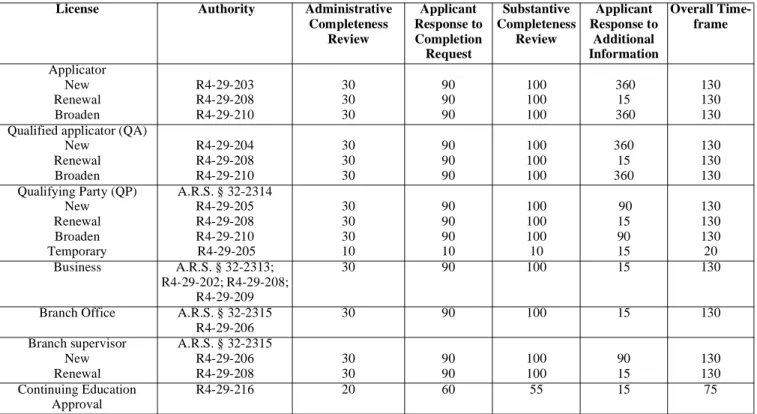
A. Overall time-frame. The OPM shall issue or deny a license within the overall time-frames listed in Table 1. The overall time-frame, which is the total number of days provided for both the administrative completeness and substantive review time-frames, begins when the OPM receives an application. B. Administrative completeness review time-frame.
1. During the administrative completeness review time-frame, the OPM shall notify the applicant in writing whether the application is complete or incomplete. If the application is incomplete, the OPM shall specify in the notice what information is missing. If the OPM does not provide notice to the applicant within the administrative completeness review time-frame, the OPM shall deem the application complete.
2. An applicant with an incomplete license application shall supply the missing information within the completion request period listed in Table 1. The administrative com-pleteness review and overall time-frames are suspended from the postmark date of the notice of missing informa-tion until the date the OPM receives the informainforma-tion. 3. If an applicant fails to submit the missing information
before expiration of the completion request period, the OPM shall consider the application withdrawn and close the file. An applicant whose file is closed may apply for a license by submitting a new application and application fee.
C. Substantive review time-frame.
1. The substantive review time-frame listed in Table 1 begins when an application is administratively complete or at the end of the administrative completeness review time-frame in Table 1, whichever occurs first. If the OPM determines during the substantive review that additional information is needed, the OPM shall send the applicant a comprehensive written request for additional informa-tion.
2. Both the substantive review and overall time-frames are suspended from the date of the OPM’s request until the date that the OPM receives the additional information. The applicant shall submit the additional information within the additional information period listed in Table 1.
3. If the applicant fails to provide the additional information within the additional information period in Table 1, the OPM shall consider the application withdrawn and close the application. An applicant whose file is closed may apply for a license by submitting a new application and application fee.
D. Within the overall time-frame listed in Table 1, the OPM shall: 1. Deny a license or approval to an applicant if the OPM determines that the applicant does not meet all the sub-stantive criteria required by the OPM’s statutes and this Chapter; or
2. Grant a license or approval to an applicant if the OPM determines that the applicant meets all the substantive cri-teria required by the OPM’s statutes and this Chapter.
E. If the OPM denies a license or approval under subsection (D)(1), the OPM shall provide a written notice of denial to the applicant that explains:
1. The reason for the denial, with citations to supporting statutes or rules;
2. The applicant's right to seek a fair hearing to challenge the denial; and
3. The time for appealing the denial.
Historical Note
Adopted effective December 24, 1992 (Supp. 92-4). Sec-tion repealed by final rulemaking at 13 A.A.R. 528, effec-tive April 7, 2007 (Supp. 07-1). New Section made by
final rulemaking at 13 A.A.R. 623, effective April 7, 2007 (Supp. 07-1). Amended by final rulemaking at 19 A.A.R. 2967, effective September 13, 2013 (Supp. 13-3).
Table 1. Time-frames (Calendar Days)
Historical Note
Table 1 adopted effective December 2, 1998 (Supp. 98-4). Table 1 repealed by final rulemaking at 13 A.A.R. 528, effective April 7, 2007 (Supp. 07-1). New Table 1 made by final rulemaking at 13 A.A.R. 623, effective April 7, 2007 (Supp. 07-1). Amended by
final rulemaking at 19 A.A.R. 2967, effective September 13, 2013 (Supp. 13-3). R4-29-108. Repealed
Historical Note
Adopted effective December 2, 1998 (Supp. 98-4). Sec-tion repealed by final rulemaking at 13 A.A.R. 528,
effec-tive April 7, 2007 (Supp. 07-1).
ARTICLE 2. CERTIFICATION, REGISTRATION AND LICENSURE; CONTINUING EDUCATION R4-29-201. Activities that Require a License; Exemptions A. Business license. A person doing an activity defined as the
business of pest management shall first possess a valid busi-ness license, unless the person is:
1. A political subdivision;
2. Acting on behalf of a business licensee or political subdi-vision; or
3. Otherwise exempt by this Chapter or the OPM’s statutes. B. Qualifying party registration. A business licensee or school district shall only do an activity defined as the business of pest management if the business licensee or school district has a registered qualifying party. The business licensee or school district shall only provide pest management services in a
certi-fication category if the qualifying party is registered in that certification category.
C. Applicator licensure.
1. An individual who provides pest management services shall be a certified applicator and only provide pest man-agement services in a certification category for which the applicator is currently certified except as provided under subsections (C)(2) and (C)(3) or as otherwise exempt by this Chapter or the OPM’s statutes.
2. A certified applicator desiring to work in a category for which the applicator is not certified shall become certi-fied in the category within 30 calendar days after begin-ning work in that category and shall be supervised as provided in subsection (C)(3)(c) while working in that category.
3. An individual may provide pest management services on behalf of a business licensee without being a certified applicator if the individual:
a. Is registered as an applicator of the business licensee under R4-29-207;
License Authority Administrative
Completeness Review Applicant Response to Completion Request Substantive Completeness Review Applicant Response to Additional Information Overall Time-frame Applicator New Renewal Broaden R4-29-203 R4-29-208 R4-29-210 30 30 30 90 90 90 100 100 100 360 15 360 130 130 130 Qualified applicator (QA)
New Renewal Broaden R4-29-204 R4-29-208 R4-29-210 30 30 30 90 90 90 100 100 100 360 15 360 130 130 130 Qualifying Party (QP) New Renewal Broaden Temporary A.R.S. § 32-2314 R4-29-205 R4-29-208 R4-29-210 R4-29-205 30 30 30 10 90 90 90 10 100 100 100 10 90 15 90 15 130 130 130 20 Business A.R.S. § 32-2313; R4-29-202; R4-29-208; R4-29-209 30 90 100 15 130
Branch Office A.R.S. § 32-2315 R4-29-206 30 90 100 15 130 Branch supervisor New Renewal A.R.S. § 32-2315 R4-29-206 R4-29-208 30 30 90 90 100 100 90 15 130 130 Continuing Education Approval R4-29-216 20 60 55 15 75
b. Has been registered as an applicator of the business licensee for not more than 90 calendar days out of the last 365 days; and
c. Is supervised by a certified applicator who: i. Is certified in the category for which
supervi-sion is provided;
ii. Provides immediate supervision when the indi-vidual performs pest management services in the wood-destroying organism treatment, aquatic, or fumigation category, uses a restricted use pesticide, or uses a pesticide under an experimental use permit; and iii. Provides direct supervision when the individual
performs pest management services not cov-ered by subsection (C)(3)(c)(ii).
4. An individual may not provide pest management services at a school, child care facility, health care institution, or food-handling establishment unless the individual is a certified applicator in the certification category for which services are being provided.
5. An individual using an animal to assist with identifying infestations or making inspections for the purpose of identifying or attempting to identify infestations shall be a certified applicator in the certification category for which services are being provided.
D. Applicator registration. An applicator may not provide pest management services on behalf of a business licensee or polit-ical subdivision unless the applicator is registered as an appli-cator of the business licensee or political subdivision pursuant to R4-29-207.
E. Exemptions. A person is not required to be licensed who: 1. Provides general information about a label or labeling,
the identification or management of a pest, integrated pest management or the use of a registered pesticide; does not directly or indirectly charge for the information; and does not make an on-site recommendation.
2. Performs sales work that does not include:
a. Identifying on-site infestations or making inspec-tions for the purpose of identifying or attempting to identify infestations;
b. Making written or oral inspection reports or on-site recommendations with respect to infestations; or c. The application of pesticides or the use of devices
for the purpose of eliminating, exterminating, con-trolling or preventing infestations.
3. Is an authorized representative of any educational institu-tion engaged in research in the study of pest management and does not provide pest management services for hire. 4. Is a certified home inspector and documents evidence of
wood-destroying organisms on a home inspection, but does not prepare a WDIIR, prepare a treatment proposal, make treatment estimates, bids, or recommendations, apply pesticides, or use devices.
5. Only uses, applies or installs home improvement articles, such as insulation, caulk and paint, that are pre-incorpo-rated with a pesticide.
Historical Note
Adopted effective December 24, 1992 (Supp. 92-4). Sec-tion repealed by final rulemaking at 13 A.A.R. 528, effec-tive April 7, 2007 (Supp. 07-1). New Section made by
final rulemaking at 13 A.A.R. 623, effective April 7, 2007 (Supp. 07-1). Amended by final rulemaking at 19 A.A.R. 2967, effective September 13, 2013 (Supp. 13-3). Amended by exempt rulemaking at 20 A.A.R. 717,
effec-tive, effective February 7, 2014 (Supp. 14-1).
R4-29-202. Business License
A. An applicant for a business license shall submit the following information on a form obtained from the OPM:
1. About the business: a. Business name;
b. Name and form of business organization;
c. Names of the following persons authorized to act on behalf of the business:
i. Owner if a sole proprietorship;
ii. Managing or general partner if a partnership; iii. President and other authorized officers if a
cor-poration;
iv. All the managers or members if a limited liabil-ity company; or
v. Person authorized to make decisions for the business if any other type of business form; c. Telephone number;
d. Fax number; e. Physical address;
f. Mailing address, if different from physical address; g. E-mail address; and
h. Chemical storage address;
2. Daytime telephone number of individuals identified under subsection (A)(1)(c);
3. Name of the qualifying party; and
4. The dated signature and title of an authorized representa-tive of the business affirming that the information pro-vided is true and correct.
B. In addition to the form required under subsection (A), an applicant shall submit:
1. The fee specified in R4-29-103;
2. The proof of financial security required by A.R.S. § 32-2313;
3. The names of all principals of the business as defined in subsection (G);
4. The name and physical address of the statutory agent of the business; and
5. A copy of the Articles of Incorporation or Organization, Certificate of Limited Partnership, trust, trade name cer-tificate, partnership agreement, or other evidence of the form of business organization.
C. A business cannot be licensed without a registered qualifying party.
D. If the OPM determines there may be cause to deny a license to an applicant, the OPM may send a written notice to the appli-cant requiring the appliappli-cant to appear at a specific location, date and time to answer questions.
E. A business license expires on May 31, and is:
1. Issued with an expiration in the following calendar year as an initial licensure; and
2. Renewable for one or two years, depending on the renewal period selected by the applicant.
F. A business license may not be transferred except in accor-dance with R4-29-209 and may not be renewed beyond the expiration of the registration for the business’s qualifying party.
G. For the purposes of this Section, principal means a person who owns at least a 10 percent interest in a business. Principal includes an owner that is itself a business as well as owners of a principal.
Historical Note
Adopted effective December 24, 1992 (Supp. 92-4). Sec-tion repealed by final rulemaking at 13 A.A.R. 528, effec-tive April 7, 2007 (Supp. 07-1). New Section made by
final rulemaking at 13 A.A.R. 623, effective April 7, 2007 (Supp. 07-1). Section R4-29-202 repealed; new
Section R4-29-202 renumbered from R4-29-206 and amended by final rulemaking at 19 A.A.R. 2967,
effec-tive September 13, 2013 (Supp. 13-3). R4-29-203. Applicator Certification
A. Application. An applicant for applicator certification shall submit the fee specified in R4-29-103 and the following infor-mation on a form obtained from the OPM:
1. Full name;
2. Applicator certification number, if any; 3. Home address;
4. Mailing address, if different from the home address; 5. Telephone number;
6. E-mail address; 7. Date of birth;
8. Social Security number;
9. A statement whether the applicant has ever had a license or permit to practice pest management denied, revoked, or suspended and if the answer is yes, the date, jurisdic-tion taking the acjurisdic-tion, nature of the acjurisdic-tion, and explana-tion of the circumstances;
10. Name of employer, if any;
11. Employer’s business license number, if applicable; 12. Employer’s telephone number, if applicable; and 13. The applicant’s dated signature affirming that the
infor-mation provided is true and correct.
B. An applicator shall be of good moral character. A conviction for a felony or a misdemeanor involving moral turpitude may demonstrate a lack of good moral character. A conviction for any of the following offenses shall be considered to demon-strate a lack of good moral character:
1. Murder involving the death of a law enforcement officer. 2. An offense described in A.R.S. § 13-2308.01 related to
terrorism.
3. A sexual offense of any type where the victim is a minor that is a class 4 or higher felony.
C. Examination. An applicant shall take and pass the certification examinations as provided in R4-29-211 in order to become certified.
D. An applicant for initial certification shall be at least 18 years of age.
E. If the OPM determines there may be cause to deny certifica-tion to an applicant, the OPM may send a written notice to the applicant requiring the applicant to appear at a specific loca-tion, date and time to answer questions.
F. Certification. Applicator certification is not transferable, expires on May 31, and is:
1. Issued with an expiration in the following calendar year as an initial certification,
2. Renewable for one or two years, depending on the renewal period selected by the applicant, and
3. Renewed for all certification categories for the same renewal period.
Historical Note
Adopted effective December 24, 1992 (Supp. 92-4). Sec-tion repealed by final rulemaking at 13 A.A.R. 528, effec-tive April 7, 2007 (Supp. 07-1). New Section made by
final rulemaking at 13 A.A.R. 623, effective April 7, 2007 (Supp. 07-1). Amended by final rulemaking at 19 A.A.R. 2967, effective September 13, 2013 (Supp. 13-3). R4-29-204. Qualified Applicator Certification
A. Before applying for QA certification, an applicant shall have applicator certification in each category for which the appli-cant seeks QA certification and fulfill the experience require-ment for each category.
B. Application. An applicant for QA certification shall submit the fee specified in R4-29-103 and the following information on a form obtained from the OPM:
1. Full name;
2. Applicator certification number, if any; 3. QA certification number, if any; 4. Home address;
5. Mailing address, if different from the home address; 6. Telephone number;
7. E-mail address; 8. Date of birth;
9. Social Security number;
10. A statement whether the applicant has ever had a license or permit to practice pest management denied, revoked, or suspended and if the answer is yes, date, jurisdiction taking the action, nature of the action, and explanation of the circumstances;
11. Name of employer, if any;
12. Employer’s business license number, if applicable; 13. Employer’s telephone number, if applicable;
14. Certification categories for which application is made; and
15. The applicant’s dated signature affirming that the infor-mation provided is true and correct.
C. Experience. An applicant shall possess one of the following qualifications:
1. Certification as an applicator for 24 months within the ten years preceding the application in the category applied for.
2. Certification as an applicator for 12 months within the ten years preceding the application and either:
a. Successful completion of 12 semester hours or its equivalent within the 10 years preceding the applica-tion in pest management courses directly related to each category applied for; or
b. A Bachelor’s degree in agricultural sciences, biolog-ical sciences, or pest management with 12 semester hours or its equivalent in pest management courses directly related to each category applied for. 3. Twenty four months of verifiable experience in the
busi-ness of pest management, in another State where licen-sure was not required, within the ten years preceding application directly related to the category applied for. D. For an individual who applies for QA certification within one
year of honorable separation from active military duty, the time periods “preceding the application” in subsection (C) are tolled during the term of active military duty.
E. A QA shall be of good moral character. A conviction for a fel-ony or a misdemeanor involving moral turpitude may demon-strate a lack of good moral character. A conviction for any of the following offenses shall be considered to demonstrate a lack of good moral character:
1. Murder involving the death of a law enforcement officer. 2. An offense described in A.R.S. § 13-2308.01 related to
terrorism.
3. A sexual offense of any type where the victim is a minor that is a class 4 or higher felony.
F. OPM review.
1. After notification by the OPM that the applicant is eligi-ble for certification, the applicant may schedule and take the certification examinations described under R4-29-211.
2. If the OPM determines there may be cause to deny certifi-cation to an applicant, the OPM may send a written notice to the applicant requiring the applicant to appear at a spe-cific location, date and time to answer questions.
G. Examination. An applicant shall take and pass the certification examinations as provided in R4-29-211 in order to become certified.
H. Certification. QA certification is not transferable, expires on May 31, and is:
1. Issued with an expiration in the following calendar year as an initial certification,
2. Renewable for one or two years, depending on the renewal period selected by the applicant, and
3. Renewed for all certification categories for the same renewal period.
I. For the purposes of this Section, pest management courses means courses in entomology, zoology, vertebrate manage-ment, plant pathology, agronomy, general horticulture, plant biology or botany, biochemistry, organic or inorganic chemis-try, the eradication or management of weeds, toxicology, the environmental impact of pesticides, or any combination thereof.
Historical Note
Adopted effective December 24, 1992 (Supp. 92-4). Sec-tion repealed by final rulemaking at 13 A.A.R. 528, effec-tive April 7, 2007 (Supp. 07-1). New Section made by
final rulemaking at 13 A.A.R. 623, effective April 7, 2007 (Supp. 07-1). Amended by final rulemaking at 19 A.A.R. 2967, effective September 13, 2013 (Supp. 13-3). R4-29-205. Qualifying Party Registration; Temporary Qual-ifying Party Registration
A. An applicant for registration as a QP shall submit the fee spec-ified in R4-29-103 and the following information on a form obtained from the OPM:
1. Name;
2. QA certification number;
3. Certification categories to be registered;
4. Name, and license number if applicable, of the business or school district for which the applicant will act as the QP; and
5. Dated signature of the applicant affirming that the infor-mation provided is true and correct;
B. An individual may only register as a QP in categories for which the individual possesses QA certification.
C. A certified applicator who is the representative of a business licensee or school district may register as a temporary QP if the QP has become disassociated with the business licensee or school district within the last 45 days. A certified applicator may only register as a temporary QP in the categories for which both the former QP was registered and the certified applicator is certified.
D. An applicant for registration as a temporary QP shall submit the fee specified in R4-29-103 and:
1. The information required in subsection (A), except sub-section (A)(2);
2. The applicant’s applicator certification number;
3. Written confirmation signed by the business licensee, school district, or former QP indicating that the former QP has become disassociated with the business licensee or school district; and
4. A written statement signed by the business licensee or school district that:
a. The business licensee or school district has not oper-ated in the business of pest management for more than five business days since the disassociation in the categories for which the disassociated QP was registered; and
b. The business licensee or school district wants the certified applicator to act as a temporary QP.
E. A business licensee or school district shall not use a temporary QP to qualify the business or school district in a category for more than 180 days in any 12 month period.
F. Registration.
1. QP registration is not transferable, expires on May 31, and is:
a. Issued with an expiration in the following calendar year as an initial registration,
b. Renewable for one or two years, depending on the renewal period selected by the applicant, and c. Renewed for all registration categories for the same
renewal period.
2. Temporary QP registration is not transferable, is valid for 90 calendar days and may be renewed once.
3. A QP or temporary QP may only register to qualify one business licensee or school district except as provided in subsection (F)(4).
4. A QP for school districts shall separately register as a QP for each school district served, but may not register as a QP for more than one school district without approval from the director pursuant to R4-29-402(C).
Historical Note
Adopted effective December 24, 1992 (Supp. 92-4). Sec-tion repealed by final rulemaking at 13 A.A.R. 528, effec-tive April 7, 2007 (Supp. 07-1). New Section made by
final rulemaking at 13 A.A.R. 623, effective April 7, 2007 (Supp. 07-1). Section 29-205 renumbered to
R4-29-211; new Section R4-29-205 made by final rulemak-ing at 19 A.A.R. 2967, effective September 13, 2013
(Supp. 13-3).
R4-29-206. Branch Office Registration; Branch Supervisor Registration
A. A business licensee may not do business from a branch office unless the branch office and a branch supervisor are registered with the OPM.
B. To register a branch office, the business licensee shall submit the fee specified in R4-29-103 and the following information on a form obtained from the OPM:
1. The business licensee’s name and licensee number. 2. About the branch office:
a. Name of branch supervisor;
b. Branch supervisor’s applicator certification number;
c. Telephone and fax numbers; d. Physical address;
e. Mailing address, if different from physical address; f. E-mail address; and
g. Chemical storage address; and
3. The dated signature of an authorized representative of the business licensee.
C. A branch office shall do business in the name of the business licensee only.
D. To register as a branch supervisor, the applicant shall submit the fee specified in R4-29-103 and the following information on a form obtained from the OPM:
1. Name,
2. Applicator certification number, 3. Business name and license number,
4. Physical and mailing address of branch office where the applicant will be the supervisor,
5. Branch office telephone and fax numbers,
6. Dated signature of the applicant affirming that the infor-mation provided is true and correct, and
7. Dated signature of an authorized representative of the business licensee.
E. A branch supervisor may only register to supervise a branch office at one physical location.
F. Registration. Registration as a branch office or branch supervi-sor is not transferable, expires on May 31, and is:
1. Issued with an expiration in the following calendar year as an initial registration, and
2. Renewable for one or two years, depending on the renewal period selected by the applicant.
Historical Note
Adopted effective December 24, 1992 (Supp. 92-4). Sec-tion repealed by final rulemaking at 13 A.A.R. 528, effec-tive April 7, 2007 (Supp. 07-1). New Section made by
final rulemaking at 13 A.A.R. 623, effective April 7, 2007 (Supp. 07-1). Section 29-206 renumbered to 202; new Section 206 renumbered from R4-29-213 and amended by final rulemaking at 19 A.A.R. 2967,
effective September 13, 2013 (Supp. 13-3). R4-29-207. Applicator Registration
A. Every applicator of a business licensee or political subdivision shall be registered with the OPM as an applicator for that busi-ness licensee or political subdivision before providing pest management services for the business licensee or political sub-division. This requirement is in addition to applicator certifica-tion requirements.
B. To register an applicator, a person shall submit the fee speci-fied in R4-29-103 and the following information about the applicator on a form obtained from the OPM:
1. Full name;
2. Name, and license number if applicable, of the business licensee or political subdivision;
3. For an applicator of a business licensee, identification of the primary or branch office where the applicator’s pest management records will be kept;
4. For a certified applicator, the applicator’s certification number;
5. For an uncertified applicator, the applicator’s: a. Home address;
b. Mailing address, if different from the home address; c. E-mail address;
d. Telephone number; e. Date of birth;
f. Social Security number; and
g. Information and documentation concerning lawful presence required by A.R.S. § 41-1080; and 6. Dated signature of the applicant affirming that the
infor-mation provided is true and correct.
C. There is no fee to register an applicator of a political subdivi-sion.
D. An uncertified applicator shall be at least 18 years of age. E. Applicator registration is valid from the date the OPM receives
all the information required under subsection (B) and the reg-istration fee.
F. Applicator registration is non-transferable and expires on May 31.
G. A business licensee and QP are jointly responsible for ensur-ing compliance with this Section.
H. The director shall assess a business licensee with a $150 civil penalty for each unregistered applicator.
Historical Note
Adopted effective December 24, 1992 (Supp. 92-4). Sec-tion repealed by final rulemaking at 13 A.A.R. 528, effec-tive April 7, 2007 (Supp. 07-1). New Section made by
final rulemaking at 13 A.A.R. 623, effective April 7, 2007 (Supp. 07-1). Section R4-29-207 repealed; new Section R4-29-207 made by final rulemaking at 19
A.A.R. 2967, effective September 13, 2013 (Supp. 13-3). R4-29-208. License, Certification and Registration Renewal A. An application to renew a business license, applicator or QA
certification, or qualifying party, branch office, branch super-visor, or applicator registration is due May 1 of the year the license, certification, or registration expires. Failure to receive a renewal application does not justify a failure to timely renew. B. An applicant for renewal shall submit the following
informa-tion on a form obtained from the OPM: 1. All renewals:
a. A change in physical address and mailing address, if any;
b. E-mail address; c. Telephone number;
d. Dated signature of the applicant affirming that the information provided is true and correct; and e. License specific information described in this
sub-section, if applicable. 2. Business license:
a. Name of the qualifying party in each category for which the business provides pest management ser-vices, and
b. Proof that the licensee still meets the financial secu-rity requirement in A.R.S. § 32-2313; and
c. A change in the chemical storage address, if any. 3. Applicator and QA certification:
a. Name of employer, if any;
b. A statement whether the applicant has had a license or permit to practice pest management denied, revoked, or suspended during the last 12 months and if the answer is yes, the date, jurisdiction taking the action, nature of the action, and explanation of the circumstances; and
4. Applicator registration: The names and if applicable cer-tification numbers of all of the business licensee’s current applicators.
C. An applicant for renewal shall select a one or two year renewal period and shall pay the renewal fee listed in R4-29-103 for each year of renewal.
D. CEU requirements. The director shall not renew a certification unless, prior to the expiration of the current certification, the applicator obtains the CEUs required by R4-29-215.
E. Expired license, certification, or registration.
1. An applicant who submits a complete renewal applica-tion, including the renewal fee, after the expiration of the license, certification, or registration shall pay the late fee listed under R4-29-103 as a penalty in addition to the renewal fee.
2. An applicant may renew an expired applicator or QA cer-tification without retaking the written examinations pro-vided the applicant:
a. Has satisfied the CEU requirements, and
b. Submits a complete renewal application, including the renewal fee, and the late fee by June 30. 3. An applicant seeking to renew an expired applicator or
QA certification who does not meet the requirements in subsection (E)(2) shall apply as a new applicant and shall retake and pass the applicable certification examinations. 4. A business license that has been expired for more than one year may not be renewed. The former licensee may apply as a new applicant.
5. Notwithstanding subsections (E)(1)-(4), an applicant who fails to renew because the applicant is on active military duty may apply for renewal within one year of honorable separation from active military duty without paying a late fee.
F. Renewal effective date.
1. If an applicant submits a complete application for renewal, including the renewal fee, before the expiration of the license, certification, or registration, then the license certification, or registration does not expire until: a. The renewal has been approved; or
b. In the case of denial or new limits on the license, certification, or registration, the last day for seeking review of the OPM order or later date fixed by a court.
2. If an applicant fails to submit a complete application for renewal, including the renewal fee, before the expiration of the license, certification, or registration, then the license, certification, or registration expires as provided in this Article and is not valid until the OPM has approved the renewal application. A business, branch office, or applicator with an expired license, registration, or certification may not provide pest management ser-vices or otherwise engage in the business of pest manage-ment. A qualifying party with an expired registration may not qualify a business licensee or school district. A branch supervisor with an expired registration may not supervise a branch office.
Historical Note
Adopted effective December 24, 1992 (Supp. 92-4). Sec-tion repealed by final rulemaking at 13 A.A.R. 528, effec-tive April 7, 2007 (Supp. 07-1). New Section made by
final rulemaking at 13 A.A.R. 623, effective April 7, 2007 (Supp. 07-1). Section R4-29-208 repealed; new Section R4-29-208 made by final rulemaking at 19 A.A.R. 2967, effective September 13, 2013 (Supp. 13-3). R4-29-209. Change in Business Licensee
A. Transfer to spouse. A business license may be transferred to the licensee’s spouse without a fee by submission of a Busi-ness License Entity Change Application if the licensee’s spouse submits evidence of marriage to the licensee, keeps the same business name for the remainder of the licensee period and agrees to honor all of the licensee’s customer contracts and warranties.
B. Transfer to new entity. A person may request a transfer of a business license to a new entity without a fee by submitting a Business License Entity Change Application if:
1. The owners of the current business licensee own a major-ity of the new entmajor-ity,
2. The new entity keeps the same business name as the cur-rent business licensee for the remainder of the licensing period,
3. The new entity agrees to honor all customer contracts and warranties provided by the current business licensee, and 4. The current business licensee and the new entity are not
the same form of entity.
C. When a business license is transferred under subsection (A) or (B), the new licensee shall be responsible for any outstanding fees or penalties owed to the OPM and for any disciplinary action taken by the OPM as a result of violations of this Chap-ter or the OPM’s statutes by the former licensee.
D. Except as provided in subsections (A) and (B), a change in ownership of a licensed sole proprietorship requires a new business license.
E. If, through a change in ownership, a licensed business’s office becomes a branch office of another licensed business, the new owner shall notify the OPM and comply with R4-29-206. F. A business licensee shall report any change in the principals of
the business to the OPM within 30 days. Principal means a person who owns at least a 10 percent interest in a business.
Principal includes an owner that is itself a business as well as owners of a principal.
G. If a business licensee changes the name of the business, the licensee shall provide the following information on a Business Name Change Application submitted to the OPM prior to the change:
1. Name of business entity; 2. Current business name; 3. Business license number; 4. New business name requested;
5. Copy of the Registered Trade Name Certificate, amended Articles of Organization or Incorporation, amended Cer-tificate of Limited Partnership, or amended Statement of Partnership Authority or Qualification showing the new name; and
6. Dated signature of the authorized representative of the business licensee affirming that the information provided is true and correct.
H. If a business licensee changes the form of the business, the licensee shall provide the following information on a Business Entity Change Application submitted to the OPM within 30 days of the change:
1. Name of licensed business entity; 2. Business name and license number; 3. Name and form of new business entity;
4. Names of the following persons authorized to act on behalf of the new business entity:
a. Owner if a sole proprietorship,
b. Managing or general partner if a partnership, c. President and other authorized officers if a
corpora-tion,
d. All the managers or members if a limited liability company, or
e. Person authorized to make decisions for the business if any other type of business form;
5. Copy of the new business entity’s Articles of Organiza-tion or IncorporaOrganiza-tion, Certificate of Limited Partnership, trust, trade name certificate, partnership agreement, or other evidence of the form of business organization; 6. As applicable, the Articles of Merger or Consolidation,
Statement of Merger, or approved partnership conver-sion; and
7. Dated signature of the authorized representative of the business licensee affirming that the information provided is true and correct.
Historical Note
Adopted effective December 24, 1992 (Supp. 92-4). Sec-tion repealed by final rulemaking at 13 A.A.R. 528, effec-tive April 7, 2007 (Supp. 07-1). New Section made by
final rulemaking at 13 A.A.R. 623, effective April 7, 2007 (Supp. 07-1). Section expired under A.R.S. § 41-1056(E) at 17 A.A.R. 1421, effective May 31, 2011 (Supp. 11-3). New Section R4-29-209 renumbered from
R4-29-214 and amended by final rulemaking at 19 A.A.R. 2967, effective September 13, 2013 (Supp. 13-3). R4-29-210. Certification Broadening
A. To broaden an applicator certification, the applicant shall: 1. Submit the application described in R4-29-203, 2. Submit the fee required under R4-29-103, and
3. Take and pass the certification examination for the spe-cific category in which broadening is sought.
B. A QA is eligible to broaden a QA certification only if, in the category in which broadening is sought, the QA has a valid applicator certification or a qualification listed in R4-29-204(C).
C. To broaden a QA certification, the QA shall:
1. Submit the application described in R4-29-204 and indi-cate on the application the indi-category in which broadening is sought,
2. Submit the fee required under R4-29-103,
3. Submit the evidence of experience required under R4-29-204(C) for the category in which broadening is sought except as provided in subsection (D) of this Section, and 4. Take and pass the certification examination for the
spe-cific category in which broadening is sought.
D. Experience exemptions. A QA may become certified without meeting the experience requirement of R4-29-204(C) in the categories of:
1. Right-of-way or ornamental and turf if the individual has QA certification in the category of industrial and institu-tional, wood-destroying organism treatment, ornamental and turf, or right-of-way.
2. Wood-destroying organism management if the individual has QA certification in the industrial and institutional cat-egory.
3. Wood preservation if the individual has QA certification in the wood-destroying organism treatment category.
Historical Note
Adopted effective December 24, 1992 (Supp. 92-4). Sec-tion expired under A.R.S. § 41-1056(E) at 7 A.A.R. 1483, effective January 31, 2001 (Supp. 01-1). New Section made by final rulemaking at 13 A.A.R. 623, effective April 7, 2007 (Supp. 07-1). Section R4-29-210 repealed; new Section R4-29-210 renumbered from R4-29-212 and amended by final rulemaking at 19 A.A.R. 2967,
effec-tive September 13, 2013 (Supp. 13-3). R4-29-211. Certification Examination
A. An applicant for applicator certification or QA certification shall make arrangements to take the certification examinations by contacting the OPM or the examination service or testing vendor with which the OPM has contracted.
B. The core and category-specific examinations may measure knowledge and understanding of the following content areas: 1. Pesticide label and labeling and pesticide types and
for-mulations;
2. Pest identification, life cycles, and habits;
3. Safety and environmental factors relating to the use, han-dling, storage, and disposal of pesticides;
4. Application techniques, calibration and dilution, and equipment types, uses, and maintenance; and
5. Laws and rules.
C. To be certified, an applicant shall score at least 75 percent on the general standards (“core”) examination and on the cate-gory-specific examination in each category for which the applicant seeks certification.
D. An applicant who fails an examination may not retake the examination for at least seven days or more than two times in a 6-month period.
E. An examination score is only valid for the earlier of 12 months from the date of application for certification or 12 months from the examination date.
F. The OPM shall void the examination score and deny the appli-cation of an applicant that the OPM determines cheated on an examination. The applicant may not reapply for one year.
Historical Note
Adopted effective December 24, 1992 (Supp. 92-4). Sec-tion repealed by final rulemaking at 13 A.A.R. 528, effec-tive April 7, 2007 (Supp. 07-1). New Section made by
final rulemaking at 13 A.A.R. 623, effective April 7, 2007 (Supp. 07-1). Section R4-29-211 repealed; new
Section R4-29-211 renumbered from R4-29-205 and amended by final rulemaking at 19 A.A.R. 2967,
effec-tive September 13, 2013 (Supp. 13-3). R4-29-212. Reciprocity
Notwithstanding the examination requirements in R4-29-203(C), R4-29-204(G), and R4-29-211, the director may waive the exam-ination requirements in whole or in part for an individual who is certified as an applicator pursuant to A.R.S. Title 3, Chapter 2 or by another state.
Historical Note
Adopted effective December 24, 1992 (Supp. 92-4). Sec-tion repealed by final rulemaking at 13 A.A.R. 528, effec-tive April 7, 2007 (Supp. 07-1). New Section made by
final rulemaking at 13 A.A.R. 623, effective April 7, 2007 (Supp. 07-1). Section 29-212 renumbered to
R4-29-210; new Section R4-29-212 made by final rulemak-ing at 19 A.A.R. 2967, effective September 13, 2013
(Supp. 13-3).
R4-29-213. Political Subdivision Responsible Individual A. A political subdivision that uses pesticides to conduct pest
management on property that is owned, leased or managed by the political subdivision, including easements, shall designate an individual or individuals responsible for the following: 1. Responding to inquiries or concerns by the Director or
the Director’s designee regarding compliance with A.R.S. Title 32, Chapter 22.
2. Identifying for the Director or the Director’s designee where records required by this Chapter are maintained, where personal protection equipment is located, and where pesticides are stored.
3. Demonstrating that all applicators are properly certified. B. The political subdivision shall annually submit the following
information about the responsible individual(s) during the month of May on a form obtained from the Director or the Director’s designee:
1. Full name; 2. Physical address;
3. Mailing address, if different from the physical address; 4. E-mail address;
5. Telephone number;
6. Dated signature of the responsible individual(s) affirming that the information provided is true and correct. C. If the political subdivision changes its responsible
individ-ual(s), the political subdivision shall provide the information about the new responsible individual(s) listed in subsection (B) to the Director within 30 days.
D. School districts are exempt from this Section. Historical Note
Adopted effective December 24, 1992 (Supp. 92-4). Sec-tion repealed by final rulemaking at 13 A.A.R. 528, effec-tive April 7, 2007 (Supp. 07-1). New Section made by
final rulemaking at 13 A.A.R. 623, effective April 7, 2007 (Supp. 07-1). Section 29-213 renumbered to
R4-29-206; new Section R4-29-213 made by final rulemak-ing at 19 A.A.R. 2967, effective September 13, 2013
(Supp. 13-3). R4-29-214. Renumbered
Historical Note
New Section made by final rulemaking at 13 A.A.R. 623, effective April 7, 2007 (Supp. 07-1). Section R4-29-214
renumbered to R4-29-209 by final rulemaking at 19 A.A.R. 2967, effective September 13, 2013 (Supp. 13-3).
R4-29-215. Continuing Education
A. A certified applicator who is not a QA shall, during the current certification period, obtain six CEUs in order to renew the cer-tification for one year or 12 CEUs in order to renew for two years.
B. A QA shall, during the current certification period, obtain 12 CEUs in order to renew the certification for one year or 24 CEUs in order to renew for two years.
C. For an individual who holds both a certified applicator license and a QA license, obtaining the units required in subsection (B) satisfies the requirement in subsection (A).
D. CEUs earned during a certification period that are in excess of the requirements in this Section do not carry forward for use in a subsequent certification period.
E. An applicator who teaches a continuing education course may earn one unit of continuing education for each hour taught, not more than once during a calendar year.
F. No CEU credit will be earned by an attendee of a continuing education course who does not complete the cour