WO R K I N G PA P E R S E R I E S
ISSN 1561081-0 9 7 7 1 5 6 1 0 8 1 0 0 5N O. 5 9 3 / F E B R UA RY 2 0 0 6
ROBUSTIFYING
LEARNABILITY
by Robert J. Tetlow
In 2006 all ECB publications will feature a motif taken from the €5 banknote.
W O R K I N G PA P E R S E R I E S
N O. 5 9 3 / F E B R U A RY 2 0 0 6
This paper can be downloaded without charge from http://www.ecb.int or from the Social Science Research Network electronic library at http://ssrn.com/abstract_id=874074
ROBUSTIFYING
LEARNABILITY
1by Robert J. Tetlow
2and Peter von zur Muehlen
3© European Central Bank, 2006
Address
Kaiserstrasse 29
60311 Frankfurt am Main, Germany
Postal address
Postfach 16 03 19
60066 Frankfurt am Main, Germany
Telephone +49 69 1344 0 Internet http://www.ecb.int Fax +49 69 1344 6000 Telex 411 144 ecb d
All rights reserved.
Any reproduction, publication and reprint in the form of a different publication, whether printed or produced electronically, in whole or in part, is permitted only with the explicit written authorisation of the ECB or the author(s).
The views expressed in this paper do not necessarily reflect those of the European Central Bank.
The statement of purpose for the ECB Working Paper Series is available from the ECB website, http://www.ecb.int.
C O N T E N T S
Abstract 4
Non-technical summary 5
1 Introduction 7
2 Theoretical overview 9
2.1 Expectational equilibrium under
adaptive learning 9
2.2 Structured robust control 13
3 Two examples 21
3.1 A simple univariate example 22
3.2 The canonical New Keynesian model 28
3.3 Simple interest-rate feedback rules 30
3.4 Results 31
4 Concluding remarks 41
References 43
Abstract
In recent years, the learnability of rational expectations equilibria (REE) and de-terminacy of economic structures have rightfully joined the usual performance criteria among the sought-after goals of policy design. Some contributions to the literature, including Bullard and Mitra (2001) and Evans and Honkapohja (2002), have made significant headway in establishing certain features of monetary policy rules that facil-itate learning. However a treatment of policy design for learnability in worlds where agents have potentially misspecified their learning models has yet to surface. This pa-per provides such a treatment. We begin with the notion that because the profession has yet to settle on a consensus model of the economy, it is unreasonable to expect private agents to have collective rational expectations. We assume that agents have only an approximate understanding of the workings of the economy and that their learning the reduced forms of the economy is subject to potentially destabilizing per-turbations. The issue is then whether a central bank can design policy to account for perturbations and still assure the learnability of the model. Our test case is the stan-dard New Keynesian business cycle model. For different parameterizations of a given policy rule, we use structured singular value analysis (from robust control theory) to
find the largest ranges of misspecifications that can be tolerated in a learning model without compromising convergence to an REE.
In addition, we study the cost, in terms of performance in the steady state of a central bank that acts to robustify learnability on the transition path to REE. (Note: This paper contains full-color graphics)
• JEL Classifications: C6, E5.
Non-technical summary
Since the catalyst of John Taylor’s 1993 article, there have been a ‡ood of papers on the design of simple monetary policy rules. Much has been learned about how such rules perform in various models for a variety of economies. More recently, the issue of model uncertainty and its normative e¤ects on policy design has come to the forefront of consideration. Nowhere is this issue more important than in Europe where assumptions about economic structure in decades past have come under critical scrutiny as some of Europe’s key economies sputter economically, and where the advent of the European Union, with its goal, in part, of inducing economic change having the inevitable e¤ect of producing uncertainty along the transition path. It is no longer considered su¢ cient that a proposed rule perform well in a given model; rather that rule must exhibit a wider range of attributes.
Among these attributes, the learnability of rational expectations equilibria (REE) and determinacy of economic structures have rightfully joined the usual performance criteria. An economy is said to be determinate if it supports a unique rational expectations equilibrium. An economy is said to be learnable (or equivalently, E-stable) if agents that must learn the model’s structure will arrive upon a REE as the outcome of the process of learning. However, neither determinacy or learnability is entirely straightforward to achieve. The satisfaction of the so-called Taylor principle— setting the feedback coe¢ cient on in‡ation in a Taylor-type rule to a value greater than unity— is neither necessary nor su¢ cient for determinacy for a number of arguably sensible macroeconomic models.
Some contributions to the literature, including Bullard and Mitra (2001) and Evans and Honkapohja (2002), have made signi…cant headway establishing certain features of monetary policy rules that facilitate learning. At the same time, however, in all contributions of which we are aware the method by which agents are assumed to learn is taken as given, with the assumed method–usually either least-squares or constant-gain learning–chosen more for its analytical tractability than its plausibility or empirical foundation. An treatment of policy design for learnability in worlds where agents’ learning rules are potentially misspeci…ed seems overdue. This paper provides such a treatment.
model of the economy, it is unreasonable to expect private agents to have collective rational expectations. We assume that agents have only an approximate understanding of the work-ings of the economy and that their learning the reduced forms of the economy is subject to potentially destabilizing perturbations. The issue is then whether a central bank can design policy to account for perturbations and still assure the learnability of the model. We provide two test cases. The …rst is Cagan’s very simple model of hyperin‡ation, a choice that allows us to work out some analytical results. However, since one of our goals is the provision of practical tools, our second test case is the standard New Keynesian business cycle (NKB) model, which despite its small size requires numerical solutions. Here we compare and contrast three kinds optimized Taylor-type rules— lagged data rules, contemporaneous data rules, and forecast-based rules— against their robust counterparts. For di¤erent parameteri-zations of a given policy rule, we use structured singular value analysis (from robust control theory) to …nd the largest ranges of misspeci…cations that can be tolerated in a learning model without compromising convergence to an REE. In addition, we study the cost, in terms of steady-state performance of a central bank that acts to robustify learnability on the transition path to REE.
Our …nding con…rm the Bullard-Mitra result that persistence in policy setting in the NKB model— as captured by a coe¢ cient somewhat above unity on the lagged policy rate in an extended Taylor-type rule— is useful for ensuring learnability, in rules that feedback on lagged or current data. At the same time, however, we also …nd that it is possible to go too far; as the coe¢ cient on the lagged funds rate climbs well above unity, the robustness of the resulting rule deteriorates. For in‡ation-forecast based policy rules, the answers are quite di¤erent. A robust rule is not very persistent at all. Moreover, the regions of indeterminacy are sometimes large and not very intuitive in terms of their locations.
Lastly we show that robustifying learnability comes at a small price in terms of forgone performance in the rational expectations equilibrium. (Note: This paper contains full-color graphics and is best viewed and printed in color.)
1
Introduction
It is now widely accepted that policy rules–and in particular, monetary policy rules–should not be chosen solely on the basis of their performance in a given model of the economy. There is simply too much uncertainty about the true structure of the economy to warrant taking the risk of so narrow a criterion for selection. Rather, policy should be designed to operate "well" in a wide range of models. There has been substantial progress in a relatively short
period of time in the literature on robustifying policy. The first strand of the literature
examines the performance of rules given the presence of measurement errors in either model
parameters or unobserved state variables.1 The second strand focuses on comparing rules in
rival models to see if their performance spanned reasonable sets of alternative worlds.2 The third considers robustifying policy against unknown alternative worlds, usually by invoking robust control methods.3
At roughly the same time, another literature was developing on the learnability (or E-stability) of models.4 The learnability literature takes a step back from rational expectations and asks whether the choices of uninformed private agents could be expected to converge on a rational expectations equilibrium (REE) as the outcome of a process of learning. Important early papers in this literature include Bray [5], Bray and Savin [6] and Marcet and Sargent [33]. Evans and Honkapohja summarize some of their many contributions to this literature in their book [17].
The question arises: could monetary policy help or hurt private agents learn the REE? The common features of the robust policy literature include,first, that it is the government that does not understand the true structure of the economy, and second, that the govern-ment’s ignorance will not vanish simply with the collection of more data.5 By contrast, in the 1 Brainard [4] is the seminal reference. Among the many, more recent references in this large literature
are Sack [40], Orphanides et al. [38], Soderstrom [42] and Ehrmann and Smets [16].
2 See, e.g., Levinet al. [28] and [29].
3 Hansen and Sargent [26] and [27], Tetlow and von zur Muehlen [46] and Coenen [13]. These strands of
the robustness literature are named in the text in chronological order but the three methods should be seen as complementary rather than substitutes.
4 In this paper, as in most of the rest of the literature, the terms learnability, E-stability and stability
under learning will all be used interchangeably. These terms are distinct from stable—without the "E-" or "under learning" added—which should be taken to mean saddle-point stable. The term saddle-point stable, determinate and regular are taken as equivalent adjectives describing equilibria.
5The concept of "truth" is a slippery one in learning models. In some sense, the truth is jointly determined
by the deep structural parameters of the economy and what people believe them to be. Only in steady state, and then only under some conditions, will this be solely a function of deep parameters and not of beliefs.
learning literature it is usually the private sector that is assumed not to have the information necessary to form rational expectations, but this situation has at least the prospect of being
alleviated with the passage of time and the collection of more data. In this paper, we take
the robust policy rules literature and marry it with the learnability literature.
Since the profession has been unable to agree on a generally acceptable workhorse model of the economy, it is unreasonable to expect private agents to have rational expectations
at all points in time. The most that one can expect is that agents have an approximate
understanding of the workings of the economy and that they are on a transition path toward learning the true structure. And as Evans and McGough [21] show, designing policy as if the process of learning has already been completed can result in indeterminacy or unstable
equilbria. So we retain the assumption of adaptive learning that is common with most
contributions to this literature.
If the presumption of rational expectations is questionable, and the hazards of learning cannot be ignored, then from a policy perspective, it follows that the job of facilitating the transition to REE is logically prior to the job of maximizing the performance of the economy
once the transition is complete. In this paper, we consider two issues. The first is how a
policy maker might choose policy to maximize the set of worlds inhabited by private agents that are able to learn the REE. The second is an assessment of the welfare cost of assuring
learnability in terms of forgone stability in equilibrium. Or, put differently, we measure
the welfare cost of learnability insurance. Each of these questions is important. In worlds of model uncertainty, an ill-chosen policy rule—or policy maker—could lead to explosiveness or indeterminacy. At the same time, excessive concern for learnability will imply costs in terms of forgone welfare.
Ours is not the first paper to consider the issue of choosing monetary policies for their
ability to deliver determinacy and learnability. Bernanke and Woodford [2] argue that
inflation-forecast-based (IFB) policy rules—that is, rules that feed back on forecasts of future
output or inflation—can lead to indeterminacy in linear rational expectations (LRE) models.
Clarida, Gali and Gertler [11] show that violation of the so-called Taylor principle in the
Nevertheless, in this paper, when we refer to a "true model" or "truth" we mean the REE upon which successful learning eventually converges.
context of an IFB rule may have been the source of the inflation of the 1970s.6 Bullard and Mitra [8] in an important paper show that higher persistence in instrument setting— meaning a large coefficient on the lagged instrument in a Taylor-type rule—can facilitate determinacy in the same class of models. Evans and Honkapohja [19] note similar problems in a wider class of rules and argue for feedback on structural shocks, although questions regarding the observability of such shocks leave open the issue of whether such a policy is implementable. Evans and McGough [21] compute optimal simple rules conditional on their being determinate in rival models. Each of these papers makes an important contribution to the literature, but all are special cases within broader sets of policy choices. In this paper, we follow a somewhat different approach and consider the design of policies to maximize learnability of the economy.
The remainder of the paper is organized as follows. The second section lays out the theory, beginning with a review of the literature on least-squares learnability and determinacy, and following with methods from the robust control literature. Section 3 introduces the models with which we work, beginning with the case of the very simple Cagan model of money
demand in hyperinflations and then moving on to the New Keynesian business cycle (NKB)
model. For the NKB model, we study the design of time-invariant simple monetary policy rules to robustify learnability of three types: a lagged-information rule, a contemporaneous
information rule and a forecast-based policy rule. We close the section by covering the
insurance cost of robustifying learnability. A fourth andfinal section sums up and concludes.
2
Theoretical overview
2.1
Expectational equilibrium under adaptive learning
The theory of E-stability or learnability in linear rational expectations models dates back
more than 20 years to Bray [5] who showed that agents using recursive least squares would,
if the arguments to their regressions were properly specified, eventually converge on the
correct REE. This convergence property gave a considerable shot in the arm to rational 6 Levin et al. [29] and Batini and Pearlman [1] study the robustness properties of different types of
expectations applications since proponents had an answer to the question "how could people come to have rational expectations?" The theory has been advanced by the work of Marcet
and Sargent [33] and Evans and Honkapohja [various]. Our rendition follows Evans and
Honkapohja [17], chapters 8-10.
Begin with the following linear rational expectations model:
yt=A+M Etyt+1+N yt−1 +P vt, (1)
whereytis a vector ofnendogenous variables, including, possibly, policy instruments, andvt
comprises allmexogenous variables. Equation (1) is general in that both non-predetermined
variables, Etyt+1,and predetermined variables, yt−1, are represented. By defining auxiliary
variables, e.g., ytj = yt+j, j 6= 0, arbitrarily long (finite) lead or lag lengths can also be
accommodated. Finally, extensions to allow lagged expectations formation; e.g., Et−1yt,
and exogenous variables are straightforward to incorporate with no significant changes in
results. Next, define the prediction error for yt+1, to be ξt+1 = yt+1 − Etyt+1. Under
rational expectations,Etξt+1 = 0, a martingale difference sequence. Evans and Honkapohja
[17] show that for at least one rational expectations equilibrium to exist, the stochastic process, yt, that solves (1), must also satisfy:
yt+1 =−M−1A+M−1yt−M−1N yt−1−M−1P vt+ξt+1 (2)
We can express (2) as a first-order system:
∙ yt+1 yt ¸ = ∙ −M−1A 0 ¸ + ∙ M−1 −M−1N In 0 ¸∙ yt yt−1 ¸ + ∙ −M−1 0 ¸ P vt+ ∙ 1 0 ¸ ξt+1 or, rewriting: Yt+1 =F +BYt+Cvt+Dξt+1, (3)
where Y = [yt, yt−1]0. Then we can easily show when (3) satisfies the Blanchard-Kahn
[3] conditions for stability, namely, that the number of characteristic roots of the matrix
B of norm less than unity equal the number of predetermined variables (taking yt to be
scalar, this is one), then the model isdeterminate, and there is just one martingale difference sequence, t+1, that will render (2) stationary; if there are fewer roots inside the unit circle
martingale difference sequence that will satisfy the system; and if there are more roots inside the unit circle than there are predetermined variables, the model is said to be indeterminate,
and there are infinite numbers of martingale difference sequences that make (2)
saddle-point stable. The roots ofB are determined by the solution to the characteristic equation: λ2−M−1λ+M−1N = 0.
Determinacy is one thing, learnability is quite another. As Bullard and Mitra [8] have emphasized, determinacy does not imply learnability, and indeterminacy does not imply
a lack of learnability. We can address this question by postulating a representation for
the REE that a learning agent might use. For the moment, we consider the minimum
state variable (MSV) representation, advanced by McCallum [34]. Let us assume that vt is observable and follows a first-order stochastic process,
vt =ρvt−1+ t,
where t is an iid white noise process. The ρmatrix is assumed to be diagonal.
Under these assumptions, we can write the following perceived law of motion (PLM):
yt=a+byt−1 +cvt. (4)
Rewrite equation (1) slightly, and designate expectations formed using adaptive learning
with a superscripted asterisk on the expectations operator, E∗
t:
yt=A+M Et∗yt+1+N yt−1+P vt. (5)
Then, leading (4) one period, taking expectations, substituting (4) into the result, andfinally
into (5), we obtain the actual law of motion, (ALM), the model under the influence of the
PLM :
yt=A+M(I+b)a+ (N +M b2)yt−1+ (M(bc+cρ) +P) t. (6)
So the MSV solution will satisfy the mapping from PLM to ALM: A+M(I +b)a = a,
N +M b2 = b, M(bc+cρ) +P = c.
Learnability depends then on the mapping of the PLM on to the ALM, defined from (6):
T(a, b, c) = [A+M(I+b)a, N +M b2, M(bc+cρ) +P] (7)
The fixed point of this mapping is a MSV representation of a REE, and its convergence is
given by the matrix differential equation: d
dτ(a, b, c) =T(a, b, c)−(a, b, c). (8)
Convergence is assured if certain eigenvalue conditions for the following matrix differential equations are satisfied.
da dτ = [A+M(I+b)]a−a, (9) db dτ = M b 2+N −b, dc dτ = M(bc+cρ) +P −c.
As shown by Evans and Honkapohja (2001), the necessary and sufficient conditions for E-stability are that the eigenvalues of the following matrices have negative real parts:
DTa−I = M(I+b)−I,
DTb−I = b0⊗M +I⊗M b−I, DTc−I = ρ0⊗M +I⊗M b−I.
The important points to take from equations (9) are that the conditions are generally
multivariate in nature–meaning that the coefficients constraining the intercept term,a, can
be conflated with those of the slope term,b, and that the coefficients of both the PLM and the
ALM come into play. Learnability applications in the literature to date have been confined
to very simple, small-scale models where these problems rarely come into play.7 In the kind
of medium- to large-scale models that policy institutions use, these issues cannot be safely
ignored.8 Without taking away anything from the important contributions of Bullard and
7 A notable exception is Garratt and Hall [22], but even then the learning problem was constrained to
exchange rate determination. The rest of the London Business School model that they used was taken as known.
8 At the Federal Reserve Board, for example, the staffuse a wide range of models to analyze monetary
policy issues, including a variety of reduced-form forecasting models, a calibrated multi-country DSGE model called SIGMA, a medium-scale DSGE U.S. model, and the FRB/US model, a larger-scale, partly micro-founded estimated model.
Mitra [8] and Evans and Honkapohja [19], the choice of monetary policy rules must not only consider how they foster learnability in a given model but whether they do so for the broader class of models within which the true learning model might be found. Similarly, taking as given the true model, the initial beliefs of private agents can affect learnability both through the inclusion and exclusion of states to the PLM and through the initial values attached to parameters. In the context of the above example, values ofa,b, andcthat are initially "too far" from equilibrium can block convergence. The choice of a particular policy can shrink or expand the range of values for a, b, and c that is consistent with E-stability.9 This is our concern in this paper: how can a policy maker deal with uncertainty in agents’ learning mechanisms in the choice of his or her policy rule and thereby maximize the prospect that the economy will converge successfully on a rational expectations equilibrium? For this, we work with perturbations to the T-mapping described by equations (8) or systems like it. We take this up in the next subsection.
2.2
Structured robust control
In the preceding subsection, we outlined the theory of least-squares learning in a relatively
general setting. In this subsection we review some useful methods from robust control
theory. Recall that our objective is to uncover the conditions under which monetary policy can maximize the prospect that the process of learning will converge on a REE–that is, to robustify learnability–so the integration of the theories of these two subsections is what will provide us with the tools we seek.
The argument that private agents might have to learn the true structure of the economy takes a useful step back from the assumption of known and certain linear rational expecta-tions models. However, what the literature to date has usually taken as given is,first, that agents use least-squares learning to adapt their perceptions of the true economic structure, and second, that they know the correct linear or linearized form of the REE solution.10 Both of these assumptions can be questioned. It is a common-place convenience of macroecono-9 In fact, in this example, the intercept coefficient,a,turns out to be irrelevant for the determination of
learnability, although this result is not general.
10 Evans and Honkapohja [17] survey variations on least-squares learning, including under- and
over-parameterized learning models and discounted (or constant-gain) least squares learning. Still, in general, either least-squares learning or constant gain learning is assumed. An exception is Marcet and Nicolini [32].
mists to formulate a dynamic stochastic general equilibrium model and then linearize that
model. It is certainly possible that ill-informed agents use only linear approximations of
their true decision rules. But it is hard to argue that the linearized decision rule is any more valid than some other approximation. Similarly, least-squares learning is the subject of re-search more because of its analytical tractability than its empirical plausibility. The utility of tractable, linear formulations of economic forms is undeniable; at the same time, however, the risk in over reliance on such forms should be just as apparent. There would appear to be a least aprima facie case for retaining the simplicity of linear state-space representations and linear rules, while taking seriously the consequences of such approximations.
With this in mind, we retain the assumption of a linear reference model, and least-squares learning on the part of agents, but assume that the process of learning is subject
to uncertainty. Such uncertainty may arise because agents take their decision rules as
simplifications of truly optimal decision rules due to the complexity of such rules. Attributing model uncertainty to agents can also be justified if we assume that least-squares learning is untenable in worlds where agents pick and choose the information to which they respond
in forming and updating beliefs. The point is that from the perspective of the monetary
authority, there are good reasons to be wary of both the assumed learning rules and the underlying models, and yet there is very little guidance on how to model those doubts. We motivate the present approach by positing a central bank that is concerned about ensuring learnability of the true model when learning is to subject errors, the distributions of which
are unknown. Accordingly, we analyze these doubts using only a minimum amount of
structure, drawing on the literature on structured model uncertainty and robust control.
For the most part, treatments of robust control have regarded model uncertainty as unstructured, that is, as uncertainty not ascribed to particular features of the model but instead represented by one or more additional shock variables wielded by some "evil agent"
bent on causing harm.11 The approach taken here differs in that we consider a central
bank worried about how large agents’ learning errors can be before learning fails to drive the economy towards eventual equilibrium. The central bank will employ techniques of robust 11 See, in particular, Sargent [41], Giannoni [24], Hansen and Sargent ([26], [27]), Tetlow and von zur
control to set the parameters of her policy rule in a way that makes room for the largest
degree of estimation errors by agents without rendering the true model unlearnable. To
develop strategies for setting policies that determine maximum allowable misspecifications
in agents’ learning models while keeping the economy just shy of becoming unlearnable, we
need to consider structured model uncertainty. Structured model uncertainty shares with
its unstructured sibling a concern for uncertainty in the sense of Knight–meaning that the uncertainty is assumed to be nonparametric. But structured robust control differs in that
it associates the uncertainty with perturbations to particular parts of the model. More
importantly, to such perturbations we can assign a variety of structures, including time-series specifications. Work in this field was initiated by Doyle [15] and further developed
in Dahleh and Diaz-Bobillo [52] and Zhou et al. [51], among others. Recent applications
of this strand of robust control to monetary policy can be found in Onatski and Stock [36], Onatski [35], and Tetlow and von zur Muehlen [45].
While most contributions to the literature on monetary policy have been concerned with maximizing economic performance, our concern is maximizing the prospects for learnability. Thus our metric of success is not the usual one of maximized utility or a quadratic approxi-mation thereof, although we will have a look at the "insurance premium" for robustness.
Boiled down to its essence, the five steps to designing policies subject to the constraint that agents must adapt to those policies and a learning model that may be misspecified are: 1. Write down a structural model of the economy and compute the conditions necessary
for the model to attain a unique saddle-point stationary equilibrium.
2. Given the structural model, formulate the central bank’s depiction of the perceived law of motion used by agents to learn the structural model. Substitute this into the structural model to arrive at the actual law of motion. We refer to this as the reference model. While the reference model is the central bank’s best guess of the ALM, the bank understands that the reference model is only an approximation of the true ALM,
and doubts remain about its local accuracy.12
12 It is sometimes argued that robust control–by which people mean minmax approaches to model
uncertainty–is unreasonable on the face of things. The argument is that the worst-case assumption is too extreme, that to quote a common phrase, "if I worried about the worst case outcome every day, I
3. Specify a set of perturbations to the reference model structured in such a way as to
isolate the possible misspecifications to which the reference model is regarded to be
most vulnerable.
4. For a given policy, use structured singular value analysis to determine the maximum allowable perturbations to the ALM that will bring the economy up to, but not beyond, the point of E-instability.
5. Finally, compute the policy for which the allowable range of misspecifications is the
largest.
When, in the agents’ learning model–the MSV-based PLM described in (4)–the
pa-rameters a, b, and c or Π, have been correctly estimated by agents, this model should be
considered to be the true reduced form of the structural model in (1). Note, however, that even if individuals manage to specify their learning model correctly in terms of included vari-ables and lag structures, the expectations of future output and inflation they base on these
estimates are (at best) in a period of transition towards being truly rational. The model
that agents actually estimate may differ from (1) in various ways that may be persistent.
We want to determine how far offthe true model agents’ learning model can become before
it becomes in principle unlearnable.
To begin, we rewrite the ALM from (6) and vectorize the disturbance, t, to emphasize
the stochastic nature of the estimating problem faced by agents, Yt+1 =ΠYt+et,
where Yt= [1, yt−1, vt]0 is of dimension n+ 1,et = [ 0 0 t ]0 and
Π= " 1 0 0 A+M(I+b)a (N+M b2) M(bc+cρ) +P 0 0 ρ # .
Notice that by using the ALM, we are modeling the problem from the policy authority’s point of view. The authority is taken as knowing, up to the perturbations we are about to
wouldn’t get out of bed in the morning". Such remarks miss the point that the worst-case outcome should be thought of as local in nature. Decision makers are envisioned as wanting to protect against uncertainties that are empirically indistinguishable from the data generating process underlying their reference models.
add to the model, the structure of private agents’ learning problems. As a consequence, the authority is in a position to influence the resolution of that problem.
Potential errors in parameter estimation are then represented by aperturbation block,∆. In principle, the ∆ operator can be structured to implement a variety of misspecifications, including alternative dynamic features. Robust control theory is remarkably rich in how it allows one to consider omitted lag dynamics, inappropriate exogeneity restrictions, missing nonlinearities, and time variation. This being thefirst paper of its kind, we keep our goals
modest: in the language of linear operator theory, we will confine our analysis to linear
time-invariant scalar (LTI-scalar) perturbations. LTI-scalar perturbations represent such events as one-time shifts and structural breaks in model parameters, as agents perceive them. Such perturbations have been the subject of study of parametric model uncertainty; see, e.g.,
Bullard and Euseppi [7].13 With this restriction, the perturbed model becomes:14
et = Yt+1−[Π+W1∆W2]Yt,
= [Q−W1∆W2]Yt, (10)
where Q = InL−1 −Π, L is the lag operator, ∆ is a k ×k linear, time-invariant
block-diagonal operator representing potentially destabilizing learning errors, andW1 andW2 are,
respectively,(n+ 1)×k andk×(n+ 1)selector matrices of zeros and ones that select which
parameters in which equations are deemed to be subject to such errors. Either W1 or W2
can, in addition, be chosen to attach scalar weights to the individual perturbations so as to reflect relative uncertainties with which model estimates are to be regarded. The second line is convenient for analyzing stability of the perturbed model under potentially destabilizing
learning errors. Using this construction, the perturbation operator, ∆, and the weighting
matrices can be structured so that misspecifications are focused on particular features of the model deemed especially susceptible to learning errors involving the model’s variables for any chosen lag or lags.
The essence of this paper is to find out how large, in a sense to be defined presently, the misspecifications represented by the perturbations in (10)–called theradius of allowable
13 See Evans and Honkapohja [17] for some treatment of learning with an over-parameterized PLM. 14 Multiplicative errors in specification would be modeled in a manner analagous to (10):
t = [A(1−
perturbations–can become without eliciting a failure of convergence to rational expectations equilibrium. Any policy that expands the set of affordable perturbations is one that allows
the widest room for misspecifications committed by agents and thus offers an improved
chance that policy will not be destabilizing. To do this we bring the tools of structured
robust control analysis mentioned earlier.
Let D denote the class of allowable perturbations to the set of parameters of a model
defined as those that carry with them the structure information of the perturbations. Let
r > 0 be some finite scalar and define Dr as the set of perturbations in (10) that obey
||∆||< r, where||∆||is theinduced norm of ∆considered as an operator acting in a normed
space of random processes15. The scalar, r, can be considered a single measure of the
maximum size of errors in estimation. A policy authority wishing to operate with as much room to maneuver as possible will act to maximize this range. For the tools to be employed
here, norms will be defined in complex space. In what follows, much use is made of the
concept of maximum singular value, conventionally denoted by σ16. For reasons that will
become clearer below, the norm of ∆that we shall use will be the L∞ norm of the function
∆(eiω), defined as the largest singular value of∆(eiω) on the frequency range ω∈[−π, π]:
||∆||∞={sup
ω
maxeig[∆0(e−iω)∆(eiω)]}1/2, (11)
where max·eig denotes the maximum eigenvalue. The choice of ||∆||∞ as a measure of
the size of perturbations conveys a sense that the authority is concerned with worst-case outcomes.
Imagine two artificial vectors, ht = [h1t, h2t, ..., hkt]0 andpt = [p1t, p2t, ..., pkt]0, connected 15 Induced norms are defined as follows. LetX be a vector space. A real-valued function|| · || defined on X is said to be a norm onX if it satisfies: (i) ||x||≥0, (ii) ||x||= 0only ifx= 0, (iii)||αx||=|α| ||x||for any scalarα, (iv)||x+y||≤||x||+||y||for any x∈X andy ∈X. Forx∈Cn, the L
p vector p-norm onx
is defined as||x||p = (Pni=1|xi|p)1/p, where1≤p≤ ∞. Forp= 2,L2=||x||2=pPni=1|xi|2, that is, the
quadratic problem. Corresponding toL2,we also haveL1=Pni=1|xi|, andL∞= max1≤i≤1|xi|. Finally, let
A= [aij]∈Cm×n in an equationyt=Atxt, wherext may some random vector. The matrix norminduced
by a vector p-norm, ||x||p, is ||A||p ≡ supx6=0||
Ax||p
||x||p . Note that for p = 2, ||A||2 =
p
maxeig(A·A)and
||A||1= max1≤j≤nPni=1|aij|. More details are given in Tetlow and von zur Muehlen [45].
16 As is apparent from the expression in (11), the largest singular value, σ(X), of a matrix, X, is the
to each other and toYt via17
pt = W2Yt ht = ∆·pt.
Then we may recast the perturbed system (10) as theaugmented feedback loop18
∙ Yt+1 pt ¸ = ∙ Π W1 W2 0 ¸∙ Yt ht ¸ , (12) ht = ∆·pt. (13)
A reduced-form representation of this loop (fromht toYt andpt) is the transfer function
∙ Yt pt ¸ = ∙ G1 G2 ¸ ht, (14)
whereG1 = (InL−1−Π)−1W1, and G2 =W2(InL−1−Π)−1W1 is an×k matrix, wherek is
the number of diagonal elements in∆. As we shall see, the stability of the interconnection
betweenhtandpt, representing a feedforwardpt =G2htand a feedbackht=∆·pt, is critical.
Notefirst that, together, these two relationships imply the homogenous matrix equation
0 = (Ik−G2∆)pt. (15)
An E-stable ALM is also dynamically stable, meaning that Π has all its eigenvalues inside
the unit circle. To make this link, the following theorem is critical.
Theorem 1 The Small Gain Theorem.
Let Re(s) denote the real part of s ∈ C, where C is the field of complex numbers, and
let H∞ denote the set of L∞ functions analytic in Re(s) > 0. Furthermore, let RH∞
designate the set of real, rational values in theH∞-normed space. SupposeG2 ∈RH∞and
r >0. Then the interconnected system in (12)-(13) is well posed and internally stable for
all∆(s)∈RH∞ with
(a)||∆||≤1/r, if and only if ||G2(s)||∞< r,
(b)||∆||<1/r, if and only if||G2(s)||∞ ≤r. 17 See Dahleh and Bobillo [14], chapter 10.
Proof: See Zhou and Doyle,[52] p. 137. ¤
By assumption, Q, defined in (10), is invertible on the unit circle, allowing us to write19 det(Q)det(Ik−G2∆) = det(Q)det(Ik−W2Q−1W1∆)
= det(Q)det(Ik−Q−1W1∆W2)
= det(Q−W1∆W2).
The preceding expressions establish the link between stability of the interconnection, G2,
and stability of the perturbed model: if det(Ik−G2∆) = 0, then the perturbed model (10)
is no longer invertible on the unit circle, hence unstable, and vice versa. Thus, any policy
rule that stabilizes the G2 also stabilizes the augmented system (12)-(13). The question
to be asked then is how large, in the sense ||.||∞, can ∆ become without destabilizing the feedback system (12)-(13).
The settings we consider involve linear time-invariant perturbations, where the object is tofind the minimum of the largest singular value of the matrix,∆, from the class ofDr such
that I −G2∆ is not invertible. The inverse of this minimum, expressed in the frequency
domain, is thestructured singular value20 ofG
2 with respect toDr, defined at each frequency, ω ∈[−π, π], μ[G2(eiω)] = 1 min{σ¯[∆(eiω)] :∆∈D r, det(I−G2∆)(eiω) = 0} , (16)
with the provision that if there is no∆such thatdet(I−G2∆)(eiω) = 0, thenμ[G2(eiω)] = 0.
The small gain theorem then tells us that, for some r > 0, the loop (12)-(13) is well posed and internally stable for all ∆(.)∈Dr with||∆||< r, if and only ifsupω∈Rμ[G2(eiω)]≤1/r.
Letφ denote a vector of policy parameters.
Thus we can now formally state the problem that interests us as seeking a best φ = φ∗
byfinding a maximum value of μ=μ, satisfying
μ(φ∗) = inf
φ ωsup∈Rμ[G2(e iω)]
19 The small gain theorem links the stability of the loop between p and h under perturbations to the
full system subject to model uncertainty. For some sufficiently large number r, such that ||∆||∞ < r, the determinant det(Ik−G2∆) 6= 0. Now raise r to some value r such that det(Ik −G2∆) = det(Ik−
W2Q−1W1∆) = 0.
20 The singular value is said to be "structured" in recognition of structure built into the perturbation
matrix, ∆. Through selection of the structure, ∆ can encompass uncertainties about one-time shifts in selected parameters, unmodeled dynamics in parts of the model, and nonlinearities, among other things.
subject to the satisfaction of the saddle-point stability condition for the relevant model. The solution to this problem is not amenable to analytical methods, except in special cases, an example of which we explore in the next section. Instead, we will employ efficient
numerical techniques tofind the lower bound on the structured singular value. The minimum
of μ−1(G
2) over ω ∈ [0, π] is exactly the maximal allowable range of misspecification for a
given policy. A monetary authority wishing to give agents the widest latitude for learning errors that nevertheless allow the system to converge on REE selects those parameters in its policy rule that yield largest value of r.
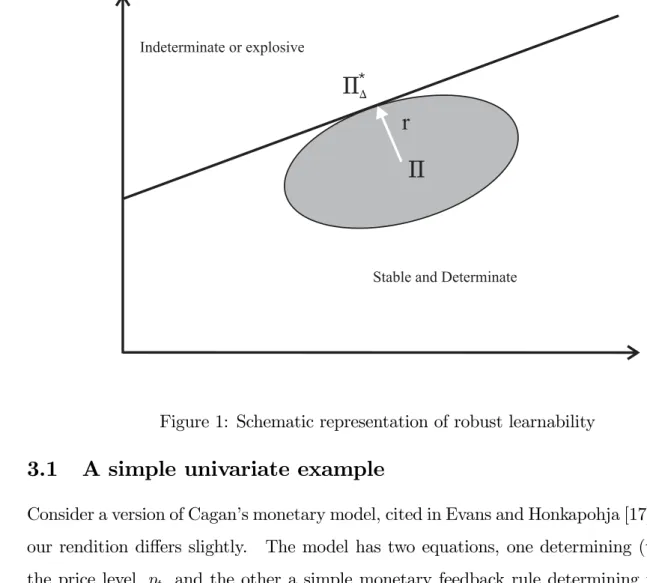
Figure 1 below provides a schematic representation of what is done. Given a policy rule,
the ALM (and hence the reference model) is represented by the transition matrix, Π. By
assumption it is in the stable and determinate region of the space. The central bank chooses
perturbation, ∆, to Π. The largest feasible perturbation, Π∗∆—the one that renders the
largest radius, r, defines a region shown by the ellipse within which any ALM, including
but not restricted to the reference model ALM, will converge on a rational expectations
equilibrium. The weights, W1 and W2, determine the shape of the ellipse. Perturbations
larger (in norm) than r will push the ellipse over the line into indeterminate or explosive
regions; smaller perturbations provide less robustness than the optimal one.
3
Two examples
We study two sample economies, one the very simple model of money demand in hyperinfl
a-tions of Cagan [10], the other the linearized neo-Keynesian model originated by Woodford ([48], [49]), Rotemberg and Woodford [39] and Goodfriend and King [25]. Closed-form solu-tions forμ, being non-linear functions of the eigenvalues of models, are not generally feasible. However, some insight is possible through considering simple scalar example economies like the Cagan model. The second has the virtue of having been studied extensively in the lit-erature on monetary policy design. It thus provides some solid benchmarks for comparison.
Indeterminate or explosive
Stable and Determinate
A
)A
*
r
Figure 1: Schematic representation of robust learnability
3.1
A simple univariate example
Consider a version of Cagan’s monetary model, cited in Evans and Honkapohja [17], although
our rendition differs slightly. The model has two equations, one determining (the log of)
the price level, pt, and the other a simple monetary feedback rule determining the (log of
the) money supply, mt:
mt−pt=−κ(Etpt+1−pt)
mt=χ−φpt−1.
Normally, all parameters should be greater than zero; forκthis means that money demand is
inversely related to expected inflation. We will relax this assumption a bit later. Combining the two equations leads to:
pt=α+βEtpt+1−γpt−1, (17)
whereα =χ/(1 +κ), β =κ/(1 +κ), andγ =φ/(1 +κ). To set the stage for what follows, let us consider the conditions for a unique rational expectations equilibrium. First off, we
will clearly want to assume that β, γ 6= 0 to avoid degenerate models. We will go a bit
assume that κ 6= 0 and κ 6= −1. Finally, for simplicity we will focus on the case where solutions are real. Standard methods then reveal:
βλ2i −λi−γ = κ 1 +κλ 2 i −λi− φ 1 +κ = 0 (18) where λi, i = 1,2 are the eigenvalues of the quadratic equations associated with (17). As is well known from Blanchard and Kahn [3], among other sources, Equation (18) is the
key to establishing existence and uniqueness of saddle-point equilibruim. Letting λ1 ≥λ2,
without loss of generality, if 1 < λ2 ≤ λ1,then the model is explosive, meaning that there
are no initial conditions which can establish a saddle-point equilibrium; if λ2 ≤ λ1 < 1,
then the model is said to be irregular, meaning that every set of initial conditions leads to a different equilibrium. Putting the same thing in different words, the equilibrium is said to be indeterminate (or non-unique). Finally, the condition λ2 < 1 < λ1 is the condition
for saddle-point stability; that is, the condition by which all (local) sets of initial conditions converge, in expectation, on the same equilibrium. In this instance, the equilibrium is said
to be determinate (or regular, or unique). Inspection of the equation to the right of the
first equality in equation (18) shows that the determinacy of the model is governed by the
interaction between the structural money-demand parameter, κ, and the policy feedback
parameter, φ.
Proposition 1 Assume that κ 6= −1. For κ > −1, determinacy requires: φ > −1 and
φ < 1 + 2κ. For κ <−1, determinacy requires φ <−1 and φ >1 + 2κ.
Proof: Equation (18) means that | β −γ |=| (κ − φ)/(1 +κ) |< 1 is the condition for exactly one eigenvalue to be above unity. There are two cases. Assume first that κ > −1, which means that the denominator is always positive. Then simple arithmetic shows that
{φ, κ}∈©R :¯¯κ1+−φκ¯¯<1ª={φ > −1}∪{φ <1 + 2κ} is implied. Now consider κ <−1. In this instance,{φ, κ}∈©R :¯¯κ1+−φκ¯¯<1ª={φ <−1}∪{φ >1 + 2κ} . ¤
Now let us assume that agents form expectations employing adaptive learning, and desig-nate expectations formation in this way with the operator,Et∗. The perceived law of motion for this model is assumed to be pt =a+bpt−1—the minimum state variable (MSV) solution,
implyingE∗
tpt+1 = (1 +b)a+b2pt−1. The actual law of motion is found by substituting the
PLM into the structural model:
pt= [α+βa(1 +b)] + (βb2−γ)pt−1. (19)
Following the steps outlined earlier, the ALM ispt=Ta(a, b) +Tb(a, b)pt−1 where T defines
the mapping( a b ) =T( a b ). This is Ta: a = α+βa(1 +b) (20) Tb: b = βb2−γ. (21)
It is equation (21) that is key for the learnability of the model. But notice that (21) is
identical to equation (18) with b= λi. This means that the conditions for learnability and
determinacy are tightly connected in this particular model, as we shall discuss in detail below. The solutions to equations (20) and (21) are:
a = α/[1−β(1 +b)] (22)
b = .5[1±p1 + 4βγ]/β. (23) Equation (23) is quadratic with one root greater than or equal to unity, and the other less than unity. Designate the larger of the two values for b as b+ and the smaller as b−.
Existence of the REE requires us to choose the smaller root; otherwise,b+ 1 b− >1. The ordinary differential equation system implied by this mapping is
d( a b ) dτ =T( a b )−( a b ),
for which the associated DT matrix is derived by differentiating [ Ta Tb ]0 with respect to a andb: DT = ∙ β(1 +b) aβ 0 2βb ¸ .
The eigenvalues of DT −I are,
ψ1 = 2βb−1 (24)
ψ2 =β(1 +b)−1. (25)
Proposition 2 Determinate solutions of the Cagan model that are real are also E-stable. Proof: Substitute the expression for b− into (24) to get ψ
1 =−[1 + 4κφ/(1 +κ)2]1/2and do the same for (25) to arrive at ψ2 = κ/(1 +κ)− 21 +ψ1. Substitute ψ1into b− to arrive at: b− = 1+2κκ[1 +ψ1]. A necessary and sufficient condition for ψ1 < 0, ψ1 ∈ < is (P1): φ > (1 +κ)2/(4κ)
≡S. Proposition 1 imposes restrictions on φ as a function of κ to ensure determinacy. For κ > −1, these are φ > −1 and φ < 1 + 2κ. Substituting these into the expression for ψ1 gives ψ1 < −[(1 + 3κ)/(1 +κ)]2 which readily yields ψ
1 < 0 and is real whenever |b− |<1 provided the solution is real. Simple substitution of ψ1into ψ2 shows that ψ2 is also negative. For κ <−1, a similar proof applies. ¤
Having outlined the connection betweenbandβ (orκ) for E-stability, let us now consider
unstructured perturbations to the ALM. Let Xt = [1 pt]0. The reference ALM model is
then written as Xt=Π Xt−1, where
Π= ∙ 1 0 α+βa(1 +b) βb2 −γ ¸
is the model’s transition matrix. For simplicity, let us focus on bas the object of concern to
policy makers, and let the policy maker apply structured perturbations to Π, scaled by the
parameter, σb. The scaling parameter can be thought of as a standard deviation, but need
not be. Letting W1 = [ 0 σb ]0 and W2 =
£
0 1¤, write the perturbed matrix Π as:
Π∆= ∙ 1 0 α+βa(1 +b) βb2 −γ+∆ ¸ .
As in (14), the relevant matrices are defined in complex space. Accordingly, let z =
eiω, ω
∈[−π, π]. To find the maximal allowable perturbation, write
G= ∙ z−1−1 0 −α−βa(1 +b) z−1 −βb2+γ ¸ =I·z−1−Π, which, defining W1 = [ 0 σb ]0 and W2 =
£ 0 1¤, is used to form G2: G2 = W2G−1W1 = £0 1¤ " z 1−z 0 (α−βa(1+b))z (1−z)(1−(βb2−γ)z) z 1−(βb2−γ)z # [ 0 σb ] = σbz 1−(βb2−γ)z.
It is for this expression that we seek the smallest structured singular value, μ, as indicated by (16).
In the multivariate case, the scaling parameter σb, can be parameterized as the standard deviation of brelative toa, although other methods of parameterization can be entertained. Doing so would reflect a concern for robustness of the decision maker and thus could also be thought of as a taste parameter. Since it is arelativeterm, it will turn out to be irrelevant in this scalar case, and so from here we set it to unity without loss of generality. The structured
norm of G2–equal to the absolute value of this last expression (see footnote 15)–is μ. It
is also easily established that the maximum of μ over the frequency range {−π, π}, let us call it μ is μ =||∆||∞ = |G2| arises at frequency π. Also, since at frequency π, z = −1, it
follows that |G2|=μ= 1+1b, or equivalently, theallowable perturbation is:
∆ = 1 μ = 1 +b (26) = 1 +βb2−γ = 1 + 1 2β[1− p 1 + 4βφ/(1 +κ)],
which depends inversely on the policy parameter, φ.21 Note also that while we have derived
this expression for∆by applying perturbations to the ALM, we would have obtained exactly
the same result by working with the PLM.
If equation ∆is the allowable perturbation, conditional on a givenφ, then we can define a φ∗ as the policy maker’s optimal choice of φ, where optimality is defined in the sense of choosing the largest possible perturbation to b–call it∆∗–such that the model will retain
the property of E-stability. Let us call this the maximum allowable perturbation. It is the
∆∗ and the associated φ∗ that is at a boundary where∆ is just above
−1:
φ∗ = 1 + 2κ− , (27)
where φ <1 + 2κ maintains stable convergence toward a REE and is an arbitrarily small
positive constant necessary to keep b+∆ off the unit circle. Note that this expression
for φ∗ indicates that the monetary authority will always respond more than one-for-one to
21 Note that at frequencyπ,1−G
deviations in lagged prices from steady state, with the extent of that over-response being a positive function of the slope of the money demand function. Substituting these expressions back into our perturbed transition matrix,
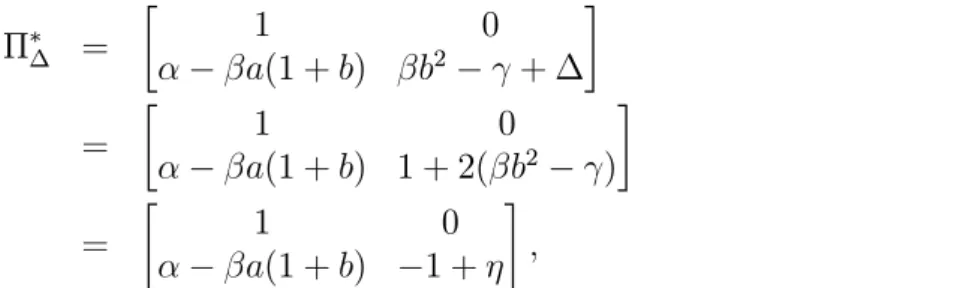
Π∗∆ = ∙ 1 0 α−βa(1 +b) βb2 −γ+∆ ¸ = ∙ 1 0 α−βa(1 +b) 1 + 2(βb2 −γ) ¸ = ∙ 1 0 α−βa(1 +b) −1 +η ¸ , (28)
where η is an arbitrarily small number, as determined by in (27). The preceding confirms
that the authority’s policy is resilient to a perturbation in the learning model that pushes the transition matrix is to the borderline of instability. In other words, setting a φ that allows for the maximal stable misspecification of the learning model is one that permits convergence to the REE.
Figure 2 shows the regions of dynamic stability and learnability for the Cagan model as functions of the structural parameters: the absolute interest elasticity of money demand,
κ, and the monetary policy feedback parameter, φ. As noted in the legend to the right,
the determinate regions of the structural model are the blue areas, to the northeast and
southwest of the figure. Proposition 1 above, warns the monetary authority to stay out of
the indeterminate regions, the sliver of purple toward the southeast of the chart, that is possible for some κ > 0 when φ < −1, and the larger region of purple to the west. Also to be avoided are the orange regions of explosive solutions to the north and south.
The E-stable region is the large area between the two dashed lines. The first thing to
note is that E-stability does not imply determinacy: convergence in learning on indeterminate equilibria in the area where both−1< κ <−1/2and−1< φ <0, is possible, corroborating a point made by Evans and McGough [20] in a different context. In addition, learnability of unstable equilibria is also possible as shown by the orange regions between the two dashed
lines. Indeed, even if one were to accept a priori that κ > 0, as Cagan assumed, there
are unstable equilibria that are learnable. At the same time, the figure clearly shows what
Proposition 2 noted: for this model, determinate models are always E-stable; the blue region is entirely within the area bordered by the two dashed lines. It follows that in the special
N
0 -1 -2 2 16
0 -1 -2 1 2Not E-stable
Not E-stable
E-
sta
ble
E-
sta
ble
N
o
tE
-s
ta
ble
N
o
tE
-s
ta
ble
Determinate Indeterminate Explosive Complex roots N* = 1 + 26Figure 2: Regions of determinacy and E-stability in the Cagan model
case of the Cagan model, robustifying learnability is equivalent to maximizing the basin of attraction for the rational expectations equilibrium of the model. The loci of robust policies, φ∗, conditional of values of κ, is shown by the thick diagonal line running from the south
west to north east of the chart, and marked φ∗ = 1 + 2κ. The line shows that contrary to
what unguided intuition might suggest, the robust policy does not choose a rule that is in the middle of the blue determinate and E-stable region, but rather chooses a policy that might be quite close to the boundary of indeterminacy for the REE. Doing so increases the region of E-stable ALMs—something that cannot be seen in the chart—and thereby enhances the prospects for convergence on an REE.
3.2
The canonical New Keynesian model
We now turn to an analysis of the canonical New Keynesian business cycle model of Rotem-berg and Woodford [39], Goodfriend and King [39] and others. Clarida, Gali, and Gertler [12] used this model to derive optimal discretionary as well as optimal commitment rules. Their
version includes a specified process for exogenous natural output. Evans and Honkapohja [18] study this model to explore issues of determinacy and learnability for several optimal
commitment rules. Bullard and Mitra [9] likewise use the Woodford model to examine
determinacy and learnability of variants of the Taylor rule.
The behavior of the private sector is described by two equations. The aggregate demand (IS) equation is a log-linearized Euler equation derived from optimal consumer behavior,
xt =Et∗xt+1−σ[rt−Et∗πt+1−rnt], (29)
and the aggregate supply (AS) equation–indeed, the price setting rule for monopolistically competitive firms is,
πt =κxt+βEt∗πt+1, (30)
where x is the log deviation of output from potential output, π is inflation, r is a
short-term interest rate controlled by the central bank, and rn is the natural interest rate. For
the application of Bullard and Mitra’s [8] (BM) example, we assume that rn
t is driven by a
first-order autoregressive process,
rnt =ρrrnt−1+ r,t, (31)
0 ≤|ρr|<1, and r,t∼ iid(0, σ2r). This is essentially Woodford’s [48] version of this model, which specifies that aggregate demand responds to the deviation of the real rate, rt−Etπt+1
from the natural rate, rn t.
We need to close the model with an interest-rate feedback rule. We study three types of policy rules. In the first set of experiments described in Section 3.3, a central bank chooses an interest rate setting in each period as a reaction to observed events, such as inflation and the output gap, without explicitly attempting to improve some measure of welfare. Instead, the policy authority is mindful of the effect its policy has on the prospect of the economy reaching REE and designs its rule accordingly. Bullard and Mitra [8] study such rules for their properties in promoting learnable equilibria and consider that effort as prior to one of
finding optimal policy rules consistent with REE. We take this analysis further by seeking
to find policy rules that maximize learnability of agents’ models when policy influences the outcome.
The information protocol in these experiments is as follows. The central bank knows
the structural model and has access to the data. Economic agents see the data, which
change over time, and formulate the perceived law of motion. Agents form expectations
based on recursive (least-squares) estimation of a reduced form. The data are regenerated each period, subject to the authority having implemented its policy and agents’ having made investment and consumption decisions based on their newly formed expectations.
We assume that agents mistakenly specify a vector-autoregressive model in the endoge-nous and exogeendoge-nous variables of the model. That means we assume the learning model to
be overparameterized in comparison with the model implied by the MSV solution. The
scaling factors used inW1 to scale the perturbations to the PLM are the standard errors of
the coefficients obtained from an initial run of a recursive least squares regression of such a VAR with data being updated by the true model, given an arbitrary but determinate parameterization of the policy rule being studied. As noted earlier, an alternative approach would be to revise the scalings with each trial policy, given that the VAR would likely change with each parameterization of policy. We leave this for a revision.
3.3
Simple interest-rate feedback rules
This section describes two versions of the Taylor rule analyzed by Bullard and Mitra [8].
The complete system comprises equations (29)-(32), and the exogenous variable, rn
t. The
policy instrument is the nominal interest rate, rt. The first policy rule specifies that the
interest rate responds to lagged inflation and the lagged output gap. In their paper, BM
study the role of interest-rate inertia and so include a lagged interest rate term.
rt=φππt−1+φxxt−1 +φrrt−1 (32)
McCallum has advocated such alagged data rule because of its implementability, given that
contemporaneous data are generally not available in real time to policy makers.
Some research suggests that forward-looking rules perform well in theory (see, e.g., Evans and Honkapohja [18]) as well as in actual economies, such as Germany, Japan, and the US (see Clarida, Gali, and Gertler [11]). Accordingly, BM propose the rule
The expectations operator E∗ has an asterisk to indicate that expectations need not be
rational.
Finally, the most popular rules of this class are contemporaneous data rules, of which the following is our choice:
rt=φππt+φxxt+φrrt−1 (34)
where as before, we allow the lagged federal funds rate to appear to capture instrument-smoothing behavior by uncertainty averse decision makers.
3.4
Results
We adopt BM’s calibration for the New Keynesian model’s parameters,σ = 1/.157,κ=.024, β =.99, and ρ=.35, the same calibration as in Woodford [49]. We also set σr = 0.01. For reference purposes, it is useful to compare our results against those of rules that are not parameterized with robust learnability in mind. To facilitate this, we employ a standard quadratic loss function:
Lt = 1000 2 ∞ X j=0 βj[(πt+j −π∗)2+λxx2t+j +λr(rt+j −r∗)2]. (35)
Walsh [47] shows that with the valuesλx =.077andλi =.027, equation (35) is the quadratic approximation to the social welfare function of the model. Rules that are computed to
maximize the prospect of convergence to REE under the greatest possible misspecification
of the ALM model in the manner described above will be referred to as "robust" or "robust
learnable" rules. A credible benchmark against which to compare these robust rules, are
what we shall refer to asoptimized rules. These are rules that minimize (35) subject to (29), (30), (31) and one of either (32), (34) or (33). Such rules can be optimized using a standard hill-climbing algorithm using methods well described in the appendix to Tetlow and von zur Muehlen [44] among other sources.
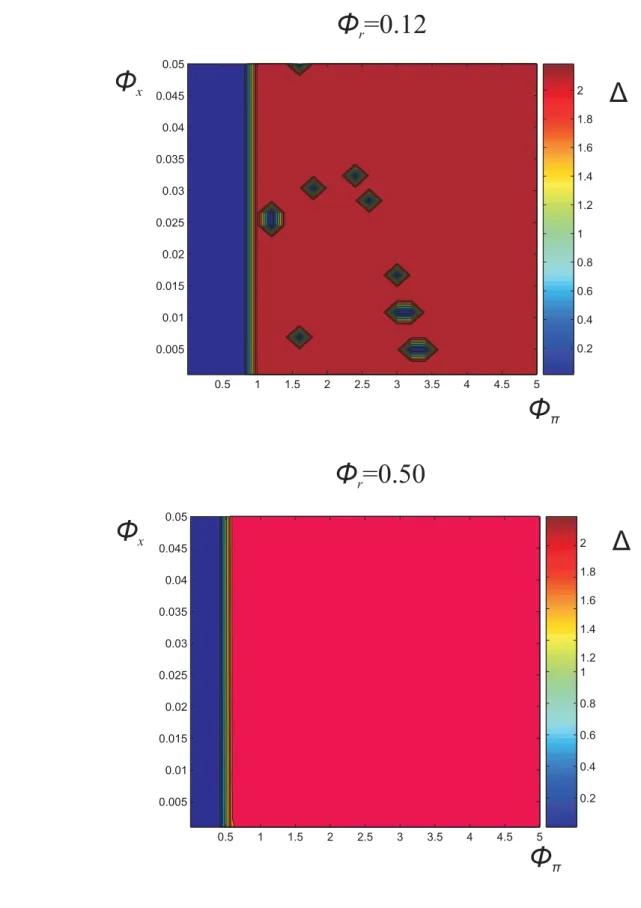
Let us consider the lagged-data rulefirst. BMfind that the determinacy of a unique ra-tional expectations equilibrium, as well as convergence toward that equilibrium when agents learn adaptively, is extremely sensitive to the policy parameters, φr, φx, and φπ. Without some degree of monetary policy inertia, (φr > 0), this model is determinate and learnable,
with the above calibrations, only if the Taylor principle holds, (φπ >1),andthe response to the output gap is modest, (φx≤0.5). Insufficient or excessive responsiveness to either infl a-tion or the output gap can in some instances lead to explosive instability or indeterminacy. Through simulation, BM establish the regions for the parameters that lead to determinacy as well as E-stability.
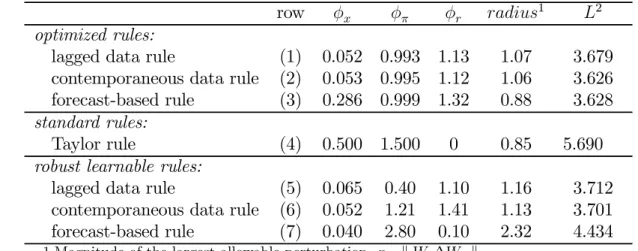
Table 1 shows our results. The table is broken into three panels. The upper panel—the rows marked (1) to (3)—shows optimized rules. The second panel, contains some results for
the generic Taylor rule. Finally, the third panel shows our robust learnable rules. The
next-to-last column of the table gives a measure of the total uncertainty that the PLM can tolerate under the cited policy. It is a measure of the maximal allowable deviation embodied
in 1/μ. 22 The last column shows the loss as measured by (35).
Table 1 : Standard and robust learnable rules
row φx φπ φr radius1 L2
optimized rules:
lagged data rule (1) 0.052 0.993 1.13 1.07 3.679
contemporaneous data rule (2) 0.053 0.995 1.12 1.06 3.626
forecast-based rule (3) 0.286 0.999 1.32 0.88 3.628
standard rules:
Taylor rule (4) 0.500 1.500 0 0.85 5.690
robust learnable rules:
lagged data rule (5) 0.065 0.40 1.10 1.16 3.712
contemporaneous data rule (6) 0.052 1.21 1.41 1.13 3.701
forecast-based rule (7) 0.040 2.80 0.10 2.32 4.434
1.Magnitude of the largest allowable perturbation. r=kW1∆W2k∞
2. Asymptotic loss, calculated according to eq. (35) in REE under the reference model.
Let us concentrate initially on our optimized rules along with the Taylor rule to provide some context for the robust learnable rules. The lagged data rule, shown in row (1), and
the contemporaneous data rule, (2), are essentially the same. They both feature very
small feedback on the output gap, and strong responses to inflation. Moreover, they also
feature funds rate persistence that amounts to a first-difference rule; that is, a rule where
the dependent variable is ∆r rather than r. The forecast-based rule, in line (3), has much
stronger feedback on the output gap, although proper interpretation of this requires noting that in equilibrium the expectation of future output gaps will always be smaller than actual 22 For comparison of the trials with each other and also to give a sense of natural units related to the
scalings we employed, the radius is calculated as the H∞ norm of the scaled perturbations to the PLM model: radius =||W1∆W2||∞.
gaps because of the absence of expected future shocks and the internalization of future policy in the formulation of that expectation. Thus, the response of the funds rate to the expected future gap will not be as large as the feedback coefficient alone might lead one to believe.
These three rules confirm the received wisdom of monetary control in New Keynesian
models, to wit: strong feedback on inflation, comparatively little on output, and strong
persistence in funds rate setting. These rules are chosen to minimize the loss shown in the right-hand column of the table; the losses for all three are very similar, at a little over 3.6.
The results for the Taylor rule demonstrate, indirectly, the oft-discussed advantages of persistence in funds rate setting for monetary control. Without such persistence, the Taylor rule produces losses that are substantially higher than those of the optimized rules.
Now let us turn to the robust learnable rules in the bottom panel of the table, concentrat-ing for the moment on the lagged data and contemporaneous data rules shown in lines (5) and (6). The first thing to note is that the results confirm the efficacy of persistence in in-strument setting. The robust learnable rules are at least as persistent—if persistence greater
than unity is a meaningful concept—as the optimized rules. At the same time, while
per-sistence is evidently useful for learnability, our results do not point to the hyper-perper-sistence
result, (φr À 1), that BM hint at. To understand this outcome, it is important to realize
that while our results are related to the BM results, there are conceptual differences. BM describe the range of policy-rule coefficients for which the model is learnable,taking as given the model. We are describing the range of policy coefficients that maximizes the range of models that are still learnable. So while large values for φr are beneficial to learnability
holding constant the model and its associated ALM, at some point, they come at a cost in terms of the perturbations that can be withstood in other dimensions.
Now let us look at the costs and benefits of these two rules in comparison with their
optimized counterparts. We measure the benefits by comparing the radii of robustness
from the column second from the right, for various rules. For the optimized,
outcome-based rules, shown in the first two rows of the table, the radii are about 1.06 or so, while
those of their robustified couterparts range from 1.13 to 1.16. Thus the improvement in
robustness of learnability would appear to be moderate. Costs are inferred by comparing the losses shown in the right-hand column of the table. The results show that the cost of
maximizing learnability measured in terms of foregone performance in the REE is very small. Evidently, learnability can be robustified, to some degree, without much of any concomitant loss in economic performance, at least in the canonical NKB model.
Before moving on to forecast-based rules, let us consider the classic Taylor rule shown in the fourth row. Recall that the Taylor rule has been advocated as a policy that is at least reasonably robust across a fairly wide range of models. Here, however, the radius associated with the Taylor rule is shown to be quite small at 0.85. At the same time, the performance of the rule in terms of loss is relatively weak. Thus, to the extent that we can take claims of the robustness of the Taylor rule with its original parameterization as applying to the issue of learnability, the rule would appear to come up a bit short.
Now let us examine the results for the forecast-based policy shown in the seventh row. Here the prescribed robust learnable policy is much different from the optimized rule shown
in line (3). The robust rule essentially removes the policy persistence that the optimized
policy calls for. The policy performance in the rational expectations equilibrium of the
forecast-based robustly learnable rule is somewhat worse than its optimized counterpart, but notice that the radius of learnability is nearly triple that of the optimized rule.
While the super