Procedia Computer Science 32 ( 2014 ) 429 – 436
1877-0509 © 2014 The Authors. Published by Elsevier B.V. Open access under CC BY-NC-ND license. Selection and Peer-review under responsibility of the Program Chairs.
doi: 10.1016/j.procs.2014.05.444
ScienceDirect
5
thInternational Conference on Ambient Systems, Networks and Technologies (ANT-2014)
Semantic Annotation Tool for Annotating Arabic Web Documents
Saeed Al-Bukhitan, Tarek Helmy
*,
Mohammed Al-Mulhem
Information and Computer Science Department, College of Computer Science & Engineering, King Fahd University of Petroleum & Minerals,
Dhahran 31216, Mail Box 413, Saudi Arabia,
* On leave from College of Engineering, Department of Computers & Automatic Control, Tanta University, Tanta, Egypt {g199128790, helmy, mulhem}@kfupm.edu.sa
Abstract
The vision of semantic Web is to have a Web of data instead of Web of documents in a form that can be processed by machines. This vision could be achieved in the existing Web using semantic annotation. Due to exponential growth and huge size of the Web sources, there is a need to have a fast and automatic semantic annotation of Web documents. Arabic language has received less attention in semantic Web research compared to Latin languages especially in the field of semantic annotation. In this p aper, we present an automatic annotation tool that supports the semantic annotation of Arabic language Web documents. The tool takes a URL of Web document and the corresponding ontology then produces an external annotation of the Web document using Resource Description Framework (RDF) language. The annotation tool's output could be used by semantic search engines to achieve higher recall and precision. To evaluate the performance of the tool, three domain ontologies of food, nutrition and health were used with manually annotated documents related to those domains. The initial results show a promising performance which will support the research in the semantic Web with respect to Arabic language.
© 2014 The Authors. Published by Elsevier B.V.
Selection and peer-review under responsibility of Elhadi M. Shakshuki. Keywords: Semantic Web; Semantic Annotation; Arabic Language; Ontology
1. Introduction
The semantic Web extends the current Web content with meta-data that can be understood by machines. To achieve successfully the goal of semantic Web, it is required to have adequate quantity of related semantic with content in high-quality. Semantic annotation of the exiting Web is one way to generate such content. Semantic annotation of Web sources is a process that adds machine-understandable content to the natural language textual data. Semantic annotation of Web contents manually is not feasible or scalable due to the huge amount and the rate © 2014 The Authors. Published by Elsevier B.V. Open access under CC BY-NC-ND license.
of emerging Web content. For semantic Web application to make use of a Web data source, data needs to be transformed into a machine understandable format. Semantic Web technologies provide different means to represent the information for machine processing. The most common format is RDF for the extracted information and Web Ontology Language (OWL) for ontological representation of concepts, their relationship and semantic rules that could be applied on the knowledge. Most of Web semantic annotation tools only support Latin languages and very hard to adapt for Arabic language. The amount of research and work done for annotating Arabic content in Web is very limited and non-scalable. One of the biggest challenges facing Arabic research is the availability and accessibility of Arabic resources, such as ontologies, corpora, named list, dictionaries, and NLP tools. This shortage makes collection, analyzes and investigation of such resources laborious especially if the semantic annotation techniques depend on such resources. In this paper, we present an automatic system that can annotate the Arabic textual content of Web resources and produces annotation in different formats such as RDFa and RDF. The system supports ontology stored in different format including RDF, OWL and N-TRIPLE. The rest of this paper is organized as follows. Section 2 reviews the existing related work on semantic annotation of Arabic Web sources. Section 3 presents the proposed methodology. Section 4 presents the detailed specification and prototype development of the proposed tool. Section 5 discusses the experiments and analyses the results. Finally, we summarize the paper and highlight the future work directions in Section 6.
2. Related Work
A survey of some semantic Web technologies supporting Arabic could be found in Beseiso et al. in [4]. Four mostly used semantic Web tools were investigated, namely Protégé, Jena, Sesame, and KOAN. Their investigation focuses in the tool’s functionality, type of standards supported and support level of Arabic language. Their conclusion is that those tools do not support Arabic language completely as compared to Latin languages. The most supporting tool for Arabic language was Jena with some limited support for query processing. Arabic language is a complex in comparison to Latin languages. Abdel Rahman et al. [8] identified five challenges of Arabic language with respect of NLP tasks. It is does not important feature such as case-sensitivity which is an importance feature used by Latin languages to detect proper names. Arabic words could have more than one affix and can be expressed as combination of affix such as prefixes, lemma and suffixes which make it more difficult for stemming. Arabic words also have diverse types of ambiguities associated to typographic forms and spelling.
The first Arabic semantic annotation tool was presented by Bin Saleh and Alkhalifa in [1]. The presented tool was named AraTation to annotate Arabic news in the Web. The tool is capable of extracting named entities using Arabic location ontology built for this purpose. The tool reported an achievement in average precision of 67% and recall of 82% on a set of ten locations over 25 Web documents. We were not able to test the tool since the tool is not publicly available. Another work on Arabic language annotation was presented by Zaidi et al. in [2] using GATE [3] NLP toolkit. Their system used crescent Quranic Corpus as an input. The system is capable to extract named entities through predefined patterns that use tokenized and morphology analyzed corpus with Part Of Speech (POS) features. Motasem et al. in [12] presented semantic annotation tool for Arabic language and tested on news article corpus of Arabic language collected from two sources. Semantic annotation could be based on named entities recognition (NER) systems, there were several Arabic (NER) systems purposed in the literature [5]~[10]. Most of NER systems are domain independent with a goal to recognize generic entities like person, location, organization, etc. Those survey tools are not publicly available for download and testing. We can only compare our tool with those tools based on the reported features and performance. Table 1 summaries the comparison between those tools and ours. As a result of this literature review, we concluded that there are limited resources publicly available to semanticall y annotate Arabic Web sources using arbitrary ontology. This shortcoming motivates us to perform this research work.
Table 1. Comparison of Arabic Semantic Annotation Tools
Tool Ontology Domain Input Output NLP
AraTation[1] OWL Generic domain HTML RDF Shallow processing
Zaidi et al. [2] OWL Quranic Text RDF POS, morphology
Motasem et al. [12] None News Text Text POS, morphology
3.Proposed Annotation Architecture
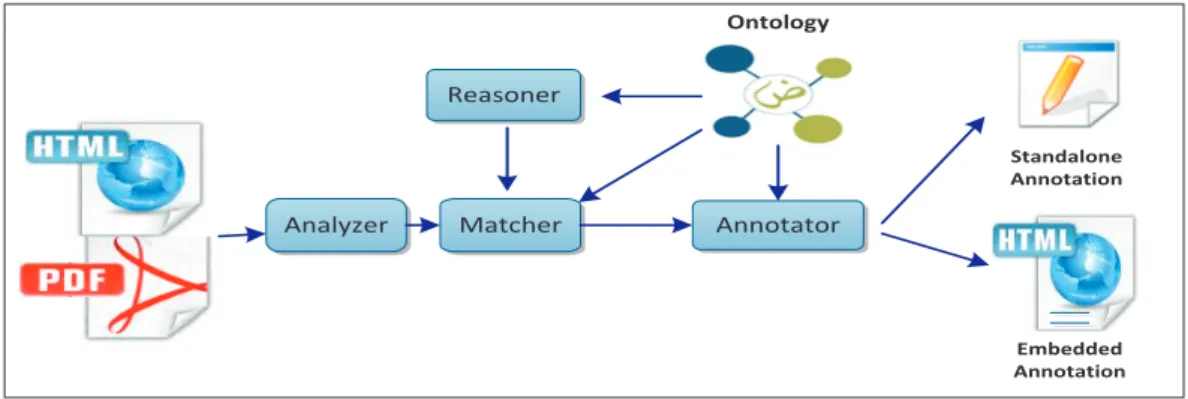
This tool is a part of a project that aims to build a framework with purpose to assist Web users finding health and nutrition information in a semantic manner that fits to their specific needs. This annotation tool is complemented with additional two components in the framework. The other two components are (1) the user interface component which takes care of representing the user’s profile, understating the user’s queries semantically and personalizes the retrieved health and food information and (2) the ontology management component which handles the ontologies integration. In this section, we will present the architecture of the proposed Arabic semantic Web annotation tool. The annotation process; as shown in Figure 1; it takes a Web document and produces two types of RDFa embedded annotation and RDF annotation file for the same Web document. The RDF annotation file could be then stored in a repository such as Sesame which could then be used by the semantic application for further processing.
3.1.Architecture Overview
Considering the difficulties and limitations offered by the annotation tools that support Arabic language, we propose an effective approach based on domain ontologies. This approach compares the phrases in a document to the ontology resource such as concepts and instances, then annotating them with the possibility to explore the implicit knowledge about each of these resources. Figure 1 shows the proposed architecture for automatic annotation system, which is described briefly below.
Figure 1. Architecture of the Proposed Semantic Annotation System
The Analyzer module is responsible of parsing and extracting the textual data from the Web document. The Matcher module is responsible for identifying the similarities between the phrases in the document’s text and the terms of ontology resources. The Matcher module interacts with the Reasoner component in order to identify the correspondence between the ontology resources. The Annotator module is responsible of generating annotation in the original document as embedded annotation and standalone annotation document. The annotated documents can be made available on the Web for users and intelligent information retrieval agents.
3.2.Functions of Annotation Components
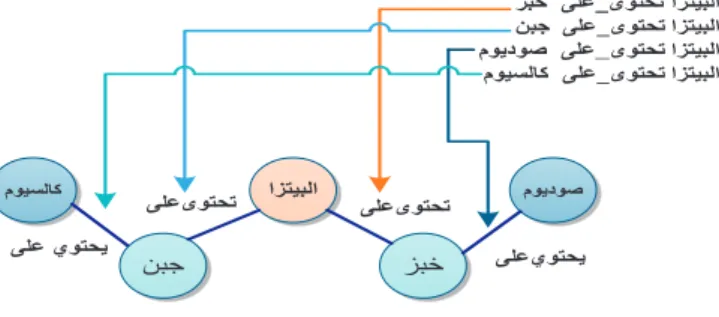
The automatic annotation aims to provide semantic annotations through a set of descriptors, relating the terms of the document with the concepts and instances of the ontology. To illustrate the functionality of each module in the context of the proposed architecture, a textual document and part of the ontology (Figure. 2) related to food and recipe will be used as input items. Figure 2 shows small part of food and recipe ontologies. For demonstration, we consider a sentence (“Pizza contains cheese and bread”) "ﺰﺒﺨﻟﺍ ﻭ ﻦﺒﺠﻟﺍ ﻰﻠﻋ ﻱﻮﺘﺤﺗ ﺍﺰﺘﻴﺒﻟﺍ". In this example, ﺍﺰﺘﻴﺒﻟﺍ (Pizza), ﻦﺒﺠﻟﺍ (cheese) and ﺰﺒﺨﻟﺍ (bread) are eligible terms for annotation. According to the definition of ontological annotation defined in [11], where information is expressed by the tuple <as,ap,ao>. The term (as) is equivalent to the subject of the tuple, the (ao) stands for to the annotation object and the predicate annotation (ap) corresponds to the
Matcher Annotator Ontology Reasoner Embedded Annotation Analyzer Standalone Annotation
relationship between (as) and (ao). Once the eligible terms are identified, the Annotator module is activated in order to perform the annotation.
Figure 2. Part of ontology for food and recipe
The following modules of the architecture are described according to their main features:
x Analyzer: The main objective of this module is to parse, preprocess and extract the textual content from different formats of Web documents including common formats such as HTML, XML, PDF and MS Office files. The Analyzer module handles all Arabic language challenges, i.e. vocalization, tokenization, POS and stemming [8].
x Matcher: The main objective of this task is to identify the eligible terms (as) in the document that can be annotated. Each concept of the ontology can have a set of predicates and objects [ap,ao]. Every resource in the ontology is compared with the terms in the text (via iteration with Analysis component) and in case of (count > 0), the term will be marked with reference URI of its equivalent resource in the ontology. Algorithm 1 shows the details of the matching process. Note that the algorithm involves a call to the annotation procedure, which corresponds to another module in the tool. In this example, the eligible terms "ﺍﺰﺘﻴﺒﻟﺍ", "ﻦﺒﺠﻟﺍ" and "ﺰﺒﺨﻟﺍ" were identified in the text of the input document with instances of the ontology.
Annotator: Once the Annotator module is enabled, for each eligible identified term (s) by the previous module, an analysis is performed for the retrieval of explicit and implicit relationships in the ontology using the two procedures getHierarchies () and getRelations () through the Matcher and Reasoner components respectively. In the example of Figure 2, after identifying a subject annotation (in the example, the term "ﺍﺰﺘﻴﺒﻟﺍ"), the Matcher identifies two explicit relations of the ontology on these subjects, which correspond to two predicates annotation: ﻰﻠﻋ_ﻱﻮﺘﺤﻳ (contains) ﻦﺒﺠﻟﺍ (Cheese) and ﻰﻠﻋ_ﻱﻮﺘﺤﻳ ﺰﺒﺨﻟﺍ (bread). Then, the Reasoner component kicks in and extracts two implicit relationships: ﻰﻠﻋ_ﻱﻮﺘﺤﻳ (contains) ﻡﻮﻴﺴﻟﺎﻛ (Calcium) and ﻰﻠﻋ_ﻱﻮﺘﺤﻳ (contains) ﻡﻮﻳﺩﻮﺻ (Sodium), which correspond to two other predicates annotation. Thus, for a single subject, four statements are generated as indicated in Figure 3. Following the proposed formalism of [11], annotations on the matched phrase are intrusively inserted in the document in the form of tuples of type <ai,as,ap,ao> where ai is the added element that is a numerical identification of the annotation. The annotated text is shown in Figure 4(a). Predicates (ap) described as "is-a" represent a categorization of subject (as) and type in (ao). Then annotated relations are inferred by the Reasoner module as described in Figure 4(b).
Algorithm1 Matching
Input: Ontology O, Document D
Output: Annotated Document AD 1 2 3 4 5 6 7 8 9 10 11 12 Predicate ap; Object ao;
for each (resource R in O) do
count = search_resouce_in_document(R, D); if (count>0) then
annotations [ap, ao] = Matcher.getHierarchies(O,R); annotations [ap, ao] + = Matcher.getRelations(O,R); annotations [ap, ao] + = Reasoner.getHierarchies(O,R); annotations [ap, ao] + = Reasoner.getRelations(O,R); annotate (annotations, R, D); end if end for ﺍﻟ ﺒ ﻴ ﺘ ﺰ ﺍ ﺧ ﺒ ﺰ ﺻ ﻮ ﺩ ﻳ ﻮ ﻡ ﺟ ﺒ ﻦ ﻛ ﺎﻟ ﺴ ﻴ ﻮ ﻡ ﻳ ﺤ ﺘ ﻮ ﻱ ﻋ ﻠ ﻰ ﻳ ﺤ ﺘ ﻮ ﻱ ﻋ ﻠ ﻰ ﻳ ﺤ ﺘ ﻮ ﻱ ﻋ ﻠ ﻰ ﻳ ﺤ ﺘ ﻮ ﻱ ﻋ ﻠ ﻰ
Figure 3. Illustration of the operation of Annotator that generates annotations to the term "ﺍﺰﺘﻴﺒﻟﺍ" a ﻦﺒﺠﻟﺍ ﻰﻠﻋ ﻱﻮﺘﺤﺗ <ﺔﺒﺟﻭ ، ﻉﻮﻧ ،ﺍﺰﺘﻴﺒﻟ ﺍ، 1 > ﺍﺰﺘﻴﺒﻟﺍ > 2 > <ءﺍﺬﻏ ، ﻉﻮﻧ ، ﻦﺒﺠﻟﺍ , 3 , ﺍ ﺍﺰﺘﻴﺒﻟ ، ﻰﻠﻋ_ﻱﻮﺘﺤﻳ ، < ﻦﺒﺠﻟﺍ ﺰﺒﺨﻟﺍ ﻭ > 4 > <ءﺍﺬﻏ ، ﻉﻮﻧ ، ﺰﺒﺨﻟﺍ , 5 , ﺍ ﺍﺰﺘﻴﺒﻟ ، < ﺰﺒﺨﻟﺍ ، ﻰﻠﻋ_ﻱﻮﺘﺤﻳ b ، ﻉﻮﻧ ، ﻦﺒﺠﻟﺍ ,2>ﻦﺒﺠﻟﺍ ﻰﻠﻋ ﻱﻮﺘﺤﺗ <ﺔﺒﺟﻭ ، ﻉﻮﻧ ،ﺍﺰﺘﻴﺒﻟ ﺍ، 1 > ﺍﺰﺘﻴﺒﻟﺍ > <ءﺍﺬﻏ 3 , ﺍ ﺍﺰﺘﻴﺒﻟ ، ﺗ < ﻦﺒﺠﻟﺍ ، ﻰﻠﻋ_ﻱﻮﺘﺤ > 4 ﻡﻮﻴﺴﻟﺎﻛ ، ﻰﻠﻋ_ﻱﻮﺘﺤﻳ ، ﻦﺒﺠﻟﺍ , < > 5 ﻡﻮﻴﺴﻟﺎﻛ , ﻲﺋﺍﺬﻏ_ﻥﻮﻜﻣ ، ﻉﻮﻧ ، > < 6 , ﺍ ﺍﺰﺘﻴﺒﻟ ﻡﻮﻴﺴﻟﺎﻛ ، ﻰﻠﻋ_ﻱﻮﺘﺤﻳ ، < ﻭ ﺰﺒﺨﻟﺍ > 7 > <ءﺍﺬﻏ ، ﻉﻮﻧ ، ﺰﺒﺨﻟﺍ , 8 , ﺍ ﺍﺰﺘﻴﺒﻟ ، ﺗ < ﺰﺒﺨﻟﺍ ، ﻰﻠﻋ_ﻱﻮﺘﺤ > 9 , ، ﻰﻠﻋ_ﻱﻮﺘﺤﻳ ، ﺰﺒﺨﻟﺍ ﻡﻭﻳﺩﻭﺻ < > 10 , ﻡﻭﻳﺩﻭﺻ ﻲﺋﺍﺬﻏ_ﻥﻮﻜﻣ ، ﻉﻮﻧ ، < > 11 , ﺍ ﺍﺰﺘﻴﺒﻟ ، ﺗ ، ﻰﻠﻋ_ﻱﻮﺘﺤ ﻡﻭﻳﺩﻭﺻ <
Figure 4. (a) Annotated Document (b) Annotated Document Enriched with implicit information
4.AMASAT: Specification and Prototyping
This section presents the annotation tool called AMASAT (AutoMatic Arabic Semantic Annotation Tool), built as a mechanism for semantic annotation platform and multi-interface (Command Line and Graphic Window), to perform from single annotation to batch annotations for Arabic Web documents. Throughout this section, we will show a detailed specification and prototype development of AMASAT and its modules, algorithms and third party libraries used. In Section 4.1, an overview of the prototype will be presented and Section 4.2 details the development environment tool will be shown.
4.1.General Overview of AMASAT Tool
As the architecture described in the previous section, the features implemented in AMASAT tool aimed to provide mechanisms for:
x Semantic annotation of Arabic documents for the Web environment;
x Automatic and semi-automatic annotation of a text document with the aid of an arbitrary ontology (user-defined);
x Rich visualization of annotation in RDFa;
x RDF representation of semantic annotations of a web document.
As described before, the tool adopts the formalism AMASAT annotation with tuples of type <ai, as, ap, ao>. In general, the style of AMASAT annotation follow parent record, which basically involves the annotations resulting predicate such as "is-a" relation. It includes what we call tuples descendants which involve the remaining predicates found for the subject annotation included in the ontology. The semantic annotations generated by the tool follow this annotation format in order to comply with RDFa format, as detailed below:
<ai, asi , T[ao1..aom] ><ai, apm+1, aom+1/>..<ai, apn..aon/> Terms </>
- The first tuple <ai, asi , T[ao1..aom] is called "parent" or "root" annotation, with subsequent tuples considered their descendants;
- Each tuple contains a unique identifier to reference each annotation;
- The asi element represents the subject of the "parent" annotation, as well as the subject of each descending
annotation;
- The T[] is the categorization of the whole subject asi implicitly being considered as a predicate ap type "is-a"
, and each aoj term is a class that defines the type of the subject asi , where 0 ≤ j ≤ m ; ﺍ ﻟ ﺒ ﻴ ﺘ ﺰ ﺍ ﺧ ﺒ ﺰ ﺻ ﻮ ﺩ ﻳ ﻮ ﻡ ﺟ ﺒ ﻦ ﻛ ﺎ ﻟ ﺴ ﻴ ﻮ ﻡ ﻳ ﺤ ﺘ ﻮ ﻱ ﻋ ﻠ ﻰ ﺗ ﺤ ﺘ ﻮ ﻯ ﻋ ﻠ ﻰ ﺗ ﺤ ﺘ ﻮ ﻯ ﻋ ﻠ ﻰ ﻳ ﺤ ﺘ ﻮ ﻱ ﻋ ﻠ ﻰ ﺍ ﻟ ﺒ ﻴ ﺘ ﺰ ﺍ ﺗ ﺤ ﺘ ﻮ ﻯ _ ﻋ ﻠ ﻰ ﺧ ﺒ ﺰ ﺍ ﻟ ﺒ ﻴ ﺘ ﺰ ﺍ ﺗ ﺤ ﺘ ﻮ ﻯ _ ﻋ ﻠ ﻰ ﺟ ﺒ ﻦ ﺍ ﻟ ﺒ ﻴ ﺘ ﺰ ﺍ ﺗ ﺤ ﺘ ﻮ ﻯ _ ﻋ ﻠ ﻰ ﺻ ﻮ ﺩ ﻳ ﻮ ﻡ ﺍ ﻟ ﺒ ﻴ ﺘ ﺰ ﺍ ﺗ ﺤ ﺘ ﻮ ﻯ _ ﻋ ﻠ ﻰ ﻛ ﺎ ﻟ ﺴ ﻴ ﻮ ﻡ
- Each tuple <aik,apik,aoik>, identified by aik implicitly refers to the subject of asi tuple "parent" , where each <apik ,aoik> corresponds to pairs of predicates and their values (objects) matching , where 0 ≤ k ≤ m ;
- Term is a free text, previously contained in the document text before annotation. This term is explicitly considered as the subject asi annotation.
Thus, according to Figure 5(a), AMASAT annotation would generally as follows: a <span id="ai " about="asi" typeof="ao1 .. aon">
<span id="ai+1"rel="api+1"resource="aon+1"></span> …
<span id="ai+m"property="pi+m"content="aon+m"></span> Terms
</span>
b <span id="am-1"about="ﺍﺰﺘﻴﺒﻟﺍ" typeof="ﺔﺒﺟﻭ:ﻲﺟﻮﻠﺘﻧﺍ"> <span id="am-2" rel="ﻰﻠﻋ_ﻱﻮﺘﺤﺗ"resource="ﻦﺒﺠﻟﺍ"></span> <span id="am-3"rel="ﻰﻠﻋ_ﻱﻮﺘﺤﺗ" resource="ﺰﺒﺨﻟﺍ"></span> ﺍﺰﺘﻴﺒﻟﺍ
</span>
Figure 5. (a) Annotation formalism, (b) RDFa Annotation generated by AMASAT tool
The id attribute is used to represent the identifier of the subject ai; asi refers to subject; typeof refers to T[] set; rel
property refers to apk predicate, and resource refers to the matched aok object. As shown in Figure 5(b), the use of this formalism is illustrated using RDFa as small part from a document annotated automatically using the AMASAT tool. It is worth noting that, with respect to markers (tags) used by the tool; we chose the label "<span>" since it does not have any effect on the visual formatting of the document. In the next section, we present some details of specification and implementation of the tool.
4.2. Implementation Details
The proposed tool has been developed in the Java. To provide the necessary resources to the system requirements, the Java OWLAPI*, semantic analyzer packages libraries that enable the viewing and manipulation of classes, properties and instances of the ontology as Java objects, having as main characteristic the support resources of OWL 2.0.For reasoning module, we have used Java version of Pellet Reasoner†, which is used in conjunction with OWLAPI for obtaining the implied relationships in the ontology. For visual interface that allow the syntax highlight and auto complete, the RSyntaxeTextArea library‡ was used for RDF and RDFa tabs.
4.3. Interfaces
To allow better interaction with the user, the tool AMASAT has two types of use: in text mode in form of the CLI (Command Line Interface) and graphics mode in using GUI (Graphical User Interface) which is built using the Swing API interfaces. The interface via text mode offers the advantage of access to the tool with greater simplicity, and using the least amount of hardware resources. To use the CLI interface, the user must use the java -jar AMASAT.jar called with the several parameters such as ontology, documents folder, output path, and several flags. Figure 6 shows the initial screen of AMASAT tool that allows the user to start annotation operation. This interface aims to assist the user in the use of the main functions of the tool, making intensive use of graphics, such as buttons, tables, and text boxes. The main features are available: Toolbar "Action Toolbar", where are the buttons for key features such as: automatic annotation of shares (ﻲﺗﺍﺬﻟﺍ ﺡﺮﺸﻟﺍ), the tab related to the source text (ﺺﻨﻟﺍ), through which you can view and edit the document noted, the panel semantic extraction (triples), which allows to display triple the annotated document, where subject is the subject (as), the predicate property (ap) object and the object (ao).
4.4. Features of the Tool
The main function of AMASAT’s is to identify and annotate the terms of the ontology present in a text document. To perform this procedure in the GUI interface, the user can load a text document by using the " ﻞﻴﻤﺤﺗ * http://owlapi.sourceforge.net/
† http://clarkparsia.com/pellet/
ﺪﻨﺘﺴﻤﻟﺍ" button as shown in Figure 6 or enter new text in the "ﺺﻨﻟﺍ". Optionally the user can choose to use the Reasoner through the selection "ﺮﻜﻔﻤﻟﺍ" box. After loading or creating a new document, the user must use the " ﺡﺮﺸﻟﺍ
ﻲﺗﺍﺬﻟﺍ" button on the toolbar to complete the procedure. It is noteworthy that this procedure can also be used by the
CLI interface using the parameters for batch processing of documents. The annotations are presented in a table at the bottom of the GUI interface of the tool, as illustrated in Figure 6. Each annotation is represented by triplets of <ﺔﻤﻴﻘﻟﺍ-ﻦﺋﺎﻜﻟﺍ،ﺔﻤﺴﻟﺍ-ﺔﻗﻼﻌﻟﺍ،ﻉﻮﺿﻮﻤﻟﺍ> <Subject (as), Property (ap), Object (ao)>.
Figure 6. AMASAT GUI Interface 5. Result and Discussion
To assess AMASAT effectiveness, we have used an existing reference set of documents related to three domains: Food, Nutrition and Health. We have developed three ontologies for those three domains containing 8012 food concepts, 146 nutrition concepts and 4516 health concepts. The documents set contain 150 HTML files and annotated by hand according to domain ontologies. Then, we compared the annotated information by the AMASAT tool to the reference set to evaluate the performance of the extraction process using the Precision, Recall and F-Measure metrics
x Precision is the percentage of correctly recognized information from the total number recognized
information
x Recall is the percentage of information in the reference set that were recognized.
x F-measure is a harmonic mean of precision and recall, given by:ܨ െ ݉݁ܽݏݑݎ݁ ൌଶככ௦ା௦
The summary of the results obtained by AMASAT is shown Table 2. We have incorporated the precision, recall, and f-measure values for each named entity category. Nutrition concept annotation had the lowest performance in
both precision and recall. This could result from the complexity of this type of named entities representation in Arabic language. Base on this evaluation, the results demonstrate a promising precision and recall. Our future target plan is to include a larger evaluation corpus to check the accuracy and comprehensiveness of our annotation tool (AMASAT).
Table 2. Annotation Performance for the Three Domains
Total Phrases Extracted Correct Wrong Precision Recall F-Measure
Food 98 82 71 11 86.6% 72.4% 78.9%
Nutrition 187 147 123 24 83.7% 65.8% 73.7%
Health 200 163 137 26 84.0% 68.5% 75.5%
6. Conclusion and Future Work
This paper presents the development of an Arabic semantic annotation tool for arbitrary food, health and nutrition domains. The novelty of this work resides in leveraging semantic Web technologies to serve the Arabic language, and producing semantically annotated Web documents for any domains in an automatic manner. The achieved performance is promising. There are still many potential extensions that can enhance the tool’s performance and output. We are planning to improve the performance by integrating the tool with additional lexical resources such Wikipedia and DBpedia. We would like to test with deeper levels ontologies. We are planning to study the influence of NLP tools on the overall performance of the annotation tool then integrating it to the main framework.
7. Acknowledgments
This research is supported by King Abdulaziz City for Science and Technology (KACST) through King Fahd University of Petroleum & Minerals (KFUPM) Science & Technology Unit under the project No. 10-INF1381-04 as part of the National Science, Technology and Innovation Plan.
References
1. L. M. Bin Saleh and H. S. Al-khalifa, “AraTation : An Arabic Semantic Annotation Tool,” Proc. Int. Conf. Inf. Integr. Web-based Appl. Serv., pp. 447–451, 2009.
2. S. Zaidi, M.-T. Laskri, and A. Abdelali, “Arabic Collocations extraction using Gate,” Int. Conf. Mach. Web Intell., pp. 473–475, 2010. 3. H. Cunningham, D. Maynard, K. Bontcheva, V. Tablan, N. Aswani, I. Roberts, G. Gorrell, A. Funk, A. Roberts, D. Damljanovic, T . Heitz, M.
A. Greenwood, H. Saggion, J. Petrak, Y. Li, and W. Peters, Text Processing with GATE (Version 6). The University of Sheeld, Department of Computer Science, 2010.
4. M. Beseiso, A. R. Ahmad, and R. Ismail, “A Survey of Arabic language Support in Semantic web,” Int. J. Comput. Appl., vol. 9, no. 1, pp.
35–40, Nov. 2010.
5. W. Zaghouani, “RENAR: A Rule-Based Arabic Named Entity Recognition System,” ACM Trans. Asian Lang. Inf., vol. 11, no. 1, pp. 1–13,
Mar. 2012.
6. S. Abdallah, K. Shaalan, and M. Shoaib, “Integrating Rule-Based System with Classification for Arabic Named Entity Recognition,” Int. J.
Comput. Sci. Issues, pp. 311–322, 2012.
7. A. Elsebai, “Extracting Person Names from Arabic Newspapers,” Int. Conf. Innov. Inf. Technol., pp. 87–89, 2011.
8. S. AbdelRahman, M. Elarnaoty, and M. Magdy, “Integrated Machine Learning Techniques for Arabic Named Entity Recognition,” Int. J.
Comput. Sci. Sci., vol. 7, no. 4, pp. 27–36, 2010.
9. Y. Benajiba, I. Zitouni, M. Diab, and P. Rosso, “Arabic named entity recognition: using features extracted from noisy data,” Proc. ACL 2010
Conf. Short Pap., pp. 281–285, 2010.
10. A. Abdul-hamid and K. Darwish, “Simplified feature set for Arabic named entity recognition,” Proc. 2010 Named Entities Work., pp. 110–
115, 2010.
11. E. Oren, K. Möller, and S. Scerri, “What are semantic annotations,” Relatório técnico. DERI, 2006.
12. Alrahabi Motasem, Ibrahim Amr Helmy, Desclés Jean-Pierre , "Semantic Annotation of Reported Information in Arabic", FLAIRS 2006, Melbourne, Floride