Knowledge Management Services as a basic concept for
Enterprise Knowledge Management System
Robert Woitsch BOC ITC GmbH Bäckerstrasse 5/3 1010 Vienna, Austria Tel:(0043) 01-5132736-0 E-mail: [email protected]
Jose María Lorente Candelas BOC Ibérica S.A
Calle Velázques 71 1° Izda 28006 Madrid, Spain Tel:(0034) 091-781 18 8-0 E-mail: [email protected]
Karagiannis Dimitris University of Vienna
Dept. of Knowledge Engineering Bruennerstraße 72
1210 Vienna, Austria Tel: (0043) 01-4277-38481 E-mail: [email protected] Abstract:
This article depicts the idea of service based Knowledge Management and introduces a method to design an Enterprise Knowledge Management System (E-KMS). We assume that each organisation already uses an E-KMS but only few organisations are aware of it and even less organisations design their E-KMS properly to manage their internal processes. These internal processes of an E-KMS are seen as Knowledge Management Processes (KMP) that describe the knowledge exchange between knowledge workers in a process-oriented manner. This article introduces the concept of KM-Services to manage heterogeneous KM-tools based on Web-Service that are organised by KMPs. The design process of such KMPs is discussed introducing a method that derives KM-Services out of knowledge goals and briefly mentions an evaluation framework using the Balanced Scorecard concept (BSC).
1 INTRODUCTION:
Knowledge Management became a wide field of researchers, consultants and tool providers within the last seven years (Despres et.al. 99). Consultants and tool providers often use methods and tools for document management or similar topics and “re-sale” them under the name of “knowledge management”. To complete the confusion, KM is defined from different sciences and different focuses. In this text knowledge is seen as “humanized information” (slogan from Karagiannis) and KM is seen as the support of humans during their daily work in knowledge oriented way.
Following the estimations of Delphi Group (Delphi Group 02) where due to lack of information a company loses up to $20 per day and per employee, the cost of information lack per employee per year adds up to $5000. Estimating the cost of lack of information of big companies with more than 3000 employees leads to a potential of greater than $15 million due to lack of information (Kemal 02). Knowledge management can reduce these costs that rise due to lack of information that is the basis of calculating the return on investment within KM. The overall goal within KM is to support the daily work of employees, in a process-oriented view this means to support the execution of business processes. The assumption is that efficient KM only supports the execution of a business processes while there is no distinction between well-structured processes and ad-hoc processes.
Successful KM projects spend 80% in design and implementation and 20% in maintenance and operation whereas failed KM projects have the opposite cost structure (Kemal 02). The aim of this paper is to focus on the design of an E-KMS and to introduce a method that assists the design phase of such an E-KMS and enables a mapping to IT-based and human based KM-tools.
First the principle of a service based Enterprise KMS (KMS) is introduces whereas the E-KMS is seen as a socio- technological system (Schneider 01) within an organisation that is realised by Knowledge Management tools (KM-tools) that are either IT-based or human based. The design of such an E-KMS in a process-oriented manner is realised by introducing so-called Knowledge Management Processes (KMPs).
Second the modelling language is briefly introduced that describes such KMPs to define the knowledge exchange between knowledge worker in a process oriented manner and link the KM approach to the business process. Modelling the whole E-KMS and the interaction to all business processes is an impossible task. The real world is just too complex to be modelled in detail and the effort of maintenance would be far too high, therefore only the relevant aspects have to be described. This leads to an important task at the very beginning of the implementation of an E-KMS, the definition of the knowledge goals.
Before starting a detailed discussion on service based knowledge management the three layer architecture of the E-KMS PROMOTE is briefly depicted to enable a proper separation of the application area within the knowledge layer, the used concepts like KM-Services within the organisational memory layer and the technological layer where e.g. Web-Services are implemented.
During the EC-project PROMOTE® (IST-1999-11658) (Karagiannis et.al. 02a), (Karagiannis et.al. 02b), (Karagiannis et.al. 00), (Stefanidis et.al. 02), (Woitsch et.al. 02a), (Woitsch et.al. 02b) that had the goal to develop an overall framework for E-KMS’ the following three layers are defined:
Knowledge layer: The knowledge layer is seen as the application layer of the E-KMS. It defines the application scenario of knowledge management. The selection of the right scenario, the risk analysis and the focus of the E-KMS are critical success factors. The selection of the application scenario is a strategic decision and often seen as knowledge management strategy.
Organisational memory layer: This layer describes the organisational memory that is defined by (Hedberg81) as “The Organisational Memory defines the cognitive structure of information proceeding processes of the whole organisation, the Theory of Action” (translated from German) (Lehner 00). For an efficient management of the organisational memory these cognitive structures and information proceeding processes have to be defined, analysed and documented in an explicit way. To describe the cognitive structure there are modelling languages such as Ontologies (Ontology), Topic Maps (TM) (Topic Maps) or Mind Maps (Mind Maps), that describe the static view of the organisational memory. There are different approaches to describe the information proceeding processes based on process chains (Abecker et.al.01). PROMOTE® defines a modelling language, that includes both the static view of TM and the dynamic view of KMPs. The aim was to embed the new knowledge management models into already existing working environment, business processes and resource models to enable a reference from KM-Services to the above mention concepts.
Technological-Layer: This layer describes the Solution of the E-KMS that is mainly IT-based. The PROMOTE® approach defines categories of Knowledge activities to associate functionalities according to these activities to define a service based framework. This leads to a service based architecture of the E-KMS. The idea of this concept is to enable a model based integration of KM-Services, that can be provided from several tools, whereas the PROMOTE® models are used for co-ordinating and integrating these services. PROMOTE® can be seen as a knowledge based application integration platform, managed by models. Using the above terminology, this text focuses on the organisational memory and discusses the interface to the underlying technological layer. In this context a KM-Service belongs to the organisational memory layer whereas a Web-Service is only an implementation of such a KM-Service at the technological layer. The next section discusses the service-based paradigm adapted into the field of knowledge management, and briefly discusses the terms Web Services, Semantic Web and KM-Services in the context of knowledge management.
2 SERVICE BASED E-KMS
In today’s literature the term “Knowledge Management Service” is used differently ranging from knowledge management service as a synonym for “product in the area of Knowledge Management” to an implemented Web Service in the context of knowledge management like a search engine.
In this text “Knowledge Management Service” is seen as a semantic framework to categorize functionality (that do not need to be implemented as a Web-Service) of an E-KMS. In this context the range of services is not only limited to IT-Services but addresses the whole range of KM-functions. The following discussion depicts a vision of a service based knowledge community and introduces the different types of services.
2.1 Vision of a Service-based Knowledge community
Organizations have to consider dramatic changes driven by service-based technology. Platform dependent applications that are installed on a computer and have a limited range of functionality will most likely be exchanged by service-based software that is accessed through the Internet. Service based software is not limited to functionalities, as operations (similar to functionality) are exchanged by dynamic service calls using semantic description. These changes will influence the way of knowledge work, as both the technological platform and the human platform have to change for this new flexible way of working.
The future scenario might be that a user accesses services on demand through the Internet. In order to select the required service manually an intelligent agent can support the service selection, whereas the agent is configured for the special needs of the user. To adapt this scenario into the field of knowledge management, the search process (interpreted as KMP) that supports a knowledge intensive task is defined as a sequence of services. A detailed discussion about services is depicted in the next sections.
2.2 Web Services
“A Web service is a software system identified by a URI (W3C RFC 239), whose public interfaces and bindings are defined and described using XML. Its definition can be discovered by other software systems. These systems may then interact with the Web service in a manner prescribed by its definition, using XML based messages conveyed by Internet protocols. ” (W3C Glossary).
Web-services are seen as loosely coupled reusable software components that semantically encapsulate discrete functionality and are distributed and programmatically accessible over standard Internet protocols (Brent 01). The basic idea of Web-services is, that the application code runs on a certain platform and gets accessed by a web-service that runs on a Web-server. This service can be accessed from any application on any platform using the Web-technology. To establish a communication between the application code and the web service a platform and language specific protocol has to be used.
This architecture enables the access of platform independent web-services but does not provide a semantic framework.
2.3 Semantic Web
“The Semantic Web is the abstract representation of data on the World Wide Web, based on the RDF standards and other standards to be defined. It is being developed by the W3C, in collaboration with a large number of researchers and industrial partners”. (W3C Semantic Web)
Semantic Web is defined by Meta information that describes a service or a resource using formats like RDF, OWL as well as DAML+OIL. The term Semantic Web-Service is not defined but is often interpreted as an integration of Semantic Web and Web-Services that tries to enhance the definitions of Web-Service using a semantic framework. The semantic framework is implemented as meta-data that are attached to services in order to describe the semantic context. Meta-data are also used to describe the accessed resources to provide context information.
2.4 Knowledge Management Service
“A Knowledge Management Service is an atomic functionality that changes the organisational memory.”
Web-Services are a technical concept to realise distributed portals, whereas KM-Services are a logical concept to define key behaviour of an E-KMS. The framework of KM-Services therefore belongs to the organisational memory layer and not to the technical layer like the Web-Services and the Semantic Web. These core behaviours defined by KM-Services are platform independent – there are no differences in the concept between social and IT-based services. It has to be expressed that the concept of KM-Services is also applicable without the use of Web-Services, e.g. when implementing social services but following the above vision of a service based way of working, Web-Services are seen as a logical realisation of KM-Services. These KM-Services are categorized using a KM-Service framework to define the required functionality and to define the available services for building an E-KMS.
2.5 Semantic Framework for KM-Services
The semantic framework to classify KM-Services is defined by KM-Dimensions that have been extracted from today’s literature. The five most important dimensions have been selected:
Medium of Knowledge:
Set of knowledge medium is defined as MedKM with MedKM = {h,e}, vm∈ MedKM, where h is
human and e is electronic.
Knowledge User
Set of user types defined as UseKM with UseKM = {i, ec, e, c}, vu∈ UseKM, where i is
individual user, ec is enterprise community user, e is enterprise user and c is inter-organisational communities.
Origin of Knowledge
The set origin of knowledge is defined as OriginKM with OriginKM = {i,e,c}, vo∈ OriginKM
where the origin of knowledge is distinguished between internal knowledge that is generated within the organisation, external.
Knowledge action
The set of knowledge action is defined as ActKM with ActKM = {m,i,a,s,d,e}, vact∈ ActKM,
where m is modelling knowledge, i identification, a access, s storage, d distribution and e the evaluation of knowledge.
Knowledge structure
The set of knowledge structure is defined as StrucKM with StrucKM = {ns,ss,ws}, vstr ∈ StrucKM, where ns is non structured, ss is semi structured and ws well structured of
knowledge.
The vector: v = (vm,vu,vo,vact,vstr) describes the whole E-KMS.
This vector can be used to define the required functionality of an E-KMS and to define the actual E-KMS. The difference between the desired vector and the actual vector represents the E-KMS- Gap. The generation of such a requirement vector and the selection of the services used in the E-KMS are depicted in the following chapter.
3 METHOD TO DESIGN A SERVICE-BASED E-KMS
The clear definition of knowledge goals is an essential task in realising an E-KMS. This section depicts a method that analyses the business processes and defines the KM goals in such a way that KM-Services can be selected on the base of these goals.
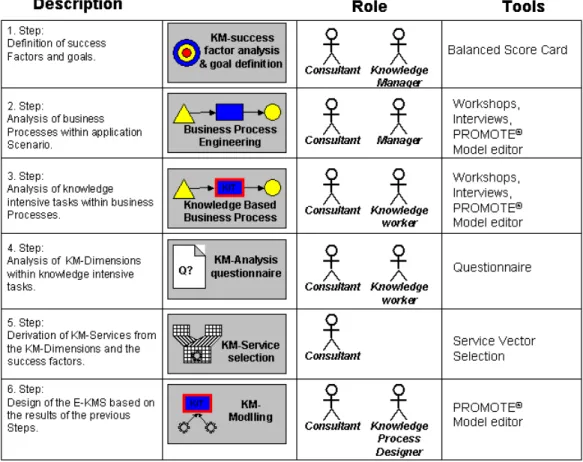
Figure 1 depicts an overview of the method starting by defining knowledge goals in conjunction with a business processes analysis, the transformation to knowledge based processes to focus on knowledge critical activities. These knowledge critical activities are the starting point for a knowledge management analysis that serves as an input for the KM-Service selection process, which defines a portfolio of KM-KM-Services. The sixth step makes this KM-Service portfolio and the relation to knowledge critical tasks explicit using knowledge models. An example of making these knowledge models operational is depicted in chapter 4 that describes a user trial of the EC-Project PROMOTE where a prototype of a model based E-KMS has been implemented.
This method is an organisational-based method in contrary to the human based or technological based methods and therefore uses business processes as a starting point for the analysis.
3.1 KM success factor analysis and goal definition
The starting point of the implementation of an E-KMS is a cost-benefit analysis that starts with the financial balance in conjunction with the knowledge balance. There are no direct links between knowledge - and financial balances available to date. To raise the difficulties, the benefit of knowledge management is hard to be evaluated and the direct link to monetary criteria in most cases impossible (Schneider 02). Our approach suggests a “Knowledge Score Card” that is a “Balanced Score Card” adapted to the needs of knowledge management. First the critical success factors of the companies are selected and strategic as well as operative goals are derived within workshops. “Knowledge goals” and “Knowledge criteria” are defined to set up a framework of an E-KMS. Such knowledge goals can be defined, like “Enhancing the support of implicit knowledge to a satisfaction rate to 80%” whereas a knowledge evaluation criterion could measure hard factors like “E-mail traffic of experts”, “Telephone traffic of experts” or “Work report, classified as ‘KM-Support’”. Based on such models the goals and evaluation criteria are set in relation using a “cause and effect model” within the Knowledge Score Card. Such a cause and effect model influences the service selection process described in section 3.5, by weighted KM-Dimensions.
3.2 Business Process Engineering:
The second step for designing an E-KMS is business process modelling, which is well known in the field of Business Process Management (Karagiannis et.al. 96). During the EC-project PROMOTE (IST-1999-11658) the business process “Software Development” of an application development department has been selected in the context of knowledge management as a starting point for the analysis of the E-KMS.
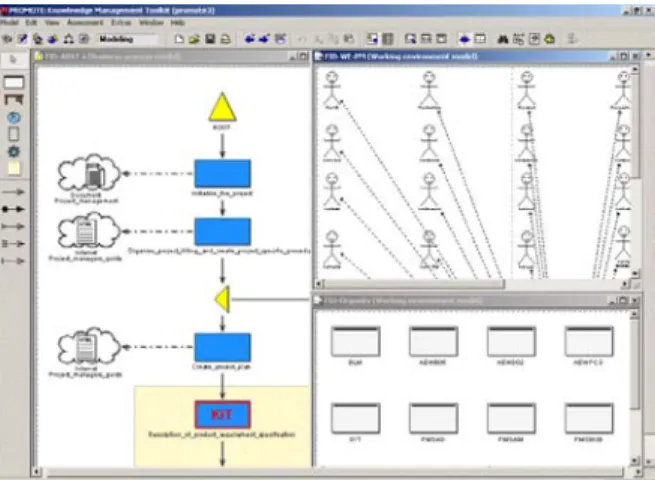
The first step was to collect the existing BP-model “Software Development” that was already modelled in an event-process-chain format, whereas the description of the working environment only existed in a Lotus Notes Database. The existing BP-model “Software Development Process” was imported into PROMOTE® and the working environment model
has been imported from Lotus Notes using an Adapter.
Figure 2 depict the BP “Software Development Process” where three critical activities were marked as “Knowledge Intensive Tasks” (KIT) and important Knowledge Resources
(represented as clouds) have been linked to these activities. The Working Environment model representing employees and organisational units was imported using Lotus Notes Adapters.
3.3 Knowledge Based Business Processes
The above mentioned Business Process engineering phase ends with defined business processes. In most cases these business processes are already defined, as the business process management is a well-known and often used concept. Knowledge management is then seen as an improvement of business process management. (Abecker et.al. 02)
The organisational driven business process models turned out to be insufficient for a detailed analysis. In most cases a knowledge based business process has to be modelled on the basis of the business processes to focus on knowledge management aspects. Some activities that are in an organisational aspect not so interesting become more important in the context of knowledge management and therefore need to be re-designed. Some aspects that are interesting on an organizational aspect do not influence knowledge management at all and should therefore be removed. Each “Knowledge Based Business Processes” (KBBP) is linked to the according “Business Process” (BP) and describes knowledge intensive aspects in more detail. Within a KBBP knowledge intensive tasks (KIT) are detected and analysed. The main problem is to rate the difficulty of the knowledge intensive task, as each knowledge worker tends to under estimate the difficulty of his colleague’s activity.
This analysis is performed for each activity in the KBBP during a pre-analysis phase; the result is the distinction between KITs and non KITs. The detailed analysis of services and requirements are depicted in detail in the following sections.
3.4 KM Analysis Questionnaire:
Once the KITs are depicted the requirements for each activity are analysed using a questionnaire. The questionnaire asks for the requirements on the basis of the KM-Dimensions and derives indicators for the services selection.
The general structure of the questionnaire depends on the selected KM-Dimensions, and it has to be adapted depending to the activity of interest.
Question regarding the Medium of Knowledge, the Knowledge User the Origin of Knowledge, the Knowledge action and regarding the Knowledge structure are formulated and analysed. The result of this questionnaire is the so-called requirement vector that defines the requirement for each critical activity and serves as a basis for the selection procedure depicted in section 3.5.
3.5 KM-Service Selection
This chapter depicts briefly the selection process to generate a KM-Service portfolio that depends on the requirement vector and the strategic influence. To simplify the explanation only three dimensions are depicted rather than the previously mentioned five dimensions.
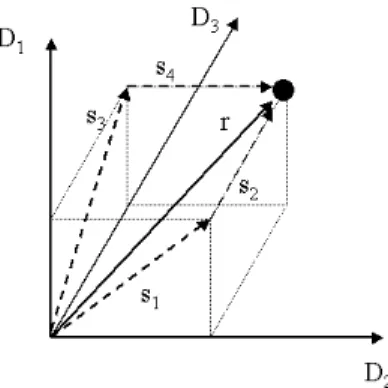
Figure 3 depict requirement vector r within the three dimensions D1 – D3 that is defined by
the questionnaire. The following algorithm depicts a method to build a collection of service vectors that add up to the requirement vector and therefore defines the E-KMS.
In this example a sufficient E-KMS can be generated by either adding s1 and s2 or by using the services s3 and s4. The selection procedure uses backwards chaining by starting from the requirement vector and subtracting one service by the other till the end condition either “no services left” or “all dimensions sufficiently covered” is matched.
Therefore the transformed requirement vector r’ is introduced as r’=r’-sx, for x=1..n
In the above example the procedure is the following: 1:r’ = r
2:r’ = r’-s1
3: r’ = r’-s2
4: No dimensions left or all dimensions sufficiently covered.
The first step is to find s2 that is the first service to subtract from the requirement vector. To find the best service for the first subtraction, the service distance is calculated to find the most similar service vector to the requirement vector sd = √(r-s)2.
The service with the minimum distance is depicted and subtracted from the requirement vector to eliminate the already covered dimensions. Then the service distance is calculated again for the transformed requirement vector. This procedure is repeated till the transformed requirement vector is sufficiently close to 0, or no services are left to be subtracted.
To calculate the Euclid distance from service vectors to the requirement vector of the E-KMS requires transformed values of the KM-dimensions into decimal numbers. According to
mapping functions for each dimension the service vector is transformed into a decimal representation of the vector. These mapping functions are either equally spread like at the “origin of knowledge”, or have to consider a conceptual difference like the “users of knowledge”, where a distortion spread has to be used.
There are some challenges that have to be considered using such a service selection approach:
Flexibility: The program has to be highly flexible as new dimensions could be added to the framework and services changes their vector continuously.
Transparency: As the realisation of an E-KMS is a strategic and highly critical procedure, each step of the decision has to be transparent. This approach tries to make the actual implicit recommendations of knowledge management consultant more transparent.
Independency: Building such a system strongly depends on cultural aspects and special needs of departments. The selection process has to enable customization.
Service dependencies: An application like a document management system offers more than only one service. Therefore there is a strong service dependency between these services of the document management system. These dependencies have to be taken into account when calculating the selection process.
Strategic influence: The strategic goals influence the requirement vector of an E-KMS. This means that strategic goals of the E-KMS change the requirement vector.
Tool mapping: The service pool depicts KM-Services that have to be integrated into the E-KMS. Actual tools on the market cover these KM-Services differently. A service tool mapping is the final step in generating a product portfolio for an E-KMS.
The result of this service selection process is a KM-Service portfolio that has to be integrated into the knowledge models where the E-KMS can be simulated and analysed.
3.6 Modelling the E-KMS
This section is concerned with the design of an E-KMS and the transformation of the previously selected KM-services to KM-tools. The PROMOTE model language uses four layer to describe the E-KMS, and uses the business process as the starting point.
Layer 1 is called Business layer where business process models and the organisational structure is depicted. Layer 2 is the knowledge layer where knowledge management processes are linked to business processes and competence profiles are attached to the organisational structure. Layer 3 is the knowledge structure like Mind Maps (Mind Maps), Topic Maps (Topic Maps) or Ontologies (Ontology) that categorises the content of the E-KMS. Layer 4 is the content and service layer, that describes the static aspect of an organisational memory with knowledge resources and the dynamic aspects of an organisational memory using knowledge management services.
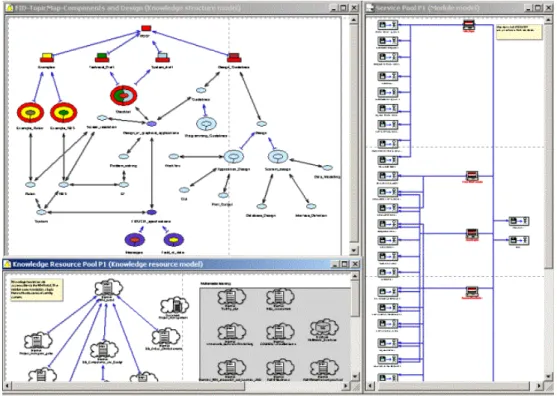
Figure 4 depicts a screen shot of the PROMOTE® model editor displaying the static aspects of the OM as knowledge resources at the bottom, the dynamic aspect of the OM as knowledge management services at the right and the categorisation of the content using Topic Maps at the top.
These models describe the architecture of the E-KMS and enables:
an analysis of knowledge intensive tasks within business processes that strongly influence time, quality and cost of an process.
the definition of Knowledge management processes that defines the knowledge interaction between knowledge worker in a process-oriented manner. Knowledge management tools are then used according to theses processes and the management of knowledge interaction is possible.
an integration of knowledge models with business process models, organisational models and evaluation models to support an overall management view with consistent analysis, evaluation and coordination.
the definition of a tool and method independent knowledge management approach.
evaluation models like Balanced Score Card to evaluate the Knowledge management approaches, successful approaches are able to be distributed through
knowledge model documentation.
The next section depicts how these knowledge models have been made operational to configure a knowledge management portal.
4 EXAMPLE OF THE IMPLEMENTATION OF A SERVICE-BASED E-KMS
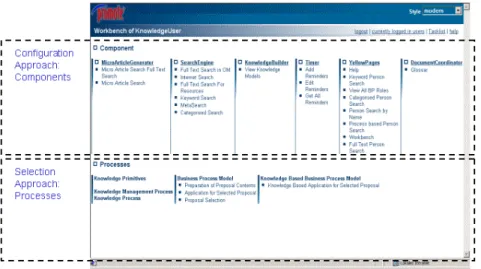
The implementation of the E-KMS is a combination of installing IT-based tools, under consideration of organisational aspects. This section depicts a scenario that has been realised as a user trial in the EC-project PROMOTE. A service-based integration platform has been realised to bridge the gap between the service based E-KMS and traditional functional oriented KM-tools, that implements the modelled KM-Services via Web-Services of traditional tools.
Figure 5 depicts a screen shot of the PROMOTE®-Workbench, where KM-Services are displayed in the Browser according to the modelled services and the defined user rights. The KM-Services are proxy objects for the underlying application code. This means that this integration platform, displays the model information, and enables the access to application code from various vendors.
In the mentioned trial scenario “Software development” of the EC-project PROMOTE an E-KMS has been realised to support the application development department. Activities like “Development of functional specifications”, “Generation of Program draft” and “Generation of System draft” have been supported using KM-Services.
In the following the realisation of the model-based concept using KM-Services is listed:
Process documentation via HTML:
The process models are exported to HTML-Pages and can be viewed via Internet Explorer. The Processes are visualised, and documents are attached at each critical task. Microsoft Office Documents, and Lotus Notes Databases can be accessed by clicking on the Models and by following the HTML-Links. This has been realised with the “Knowledge Management Handbook” – service, that is an extended version of an organisational handbook.
Meta Search Engine for Information retrieval:
A powerful information retrieval will be realised through the interaction of PROMOTE® and the U.S.U. Knowledge Miner (Knowledge Miner 02). This Meta Search engine exchanges Topic Maps on the ISO/IEC 13250 standard with PROMOTE and enables access to log data of the search engine to evaluate the tool. The search engine can be integrated in the PROMOTE Web portal. Several KM-Service have been used to implement this scenario like “Meta-Search”, “TM-Input” and “Ontology transformation”.
Yellow Pages:
This concept will be realised by the PROMOTE® Web-Component called “Yellow Pages” that accesses the previously described Skill Models through the model database. The skill information can be accessed either by a KM-Service “full text search”, “processes-search” or “semantic-search” using PROMOTE® -Services.
Best Practice Database:
The Best practice Database in this Trial Case is implemented as a Lotus Notes Database that stores short articles generated by the PROMOTE® Web-Component “Micro Article Generator”. These short articles are defined at the model base and using the service “Micro Article Generator” a Web Page is generated combining the model information, the information of the expert and defined links.
The above scenario depicts the PROMOTE® prototype of a service-based process-oriented E-KMS that has been tested within the EC-project PROMOTE. The future scenario is to enable the access of Web-Services and to integrate the Semantic Web.
5 OUTLOOK OF KNOWLEDGE MANAGEMENT SERVICES
This service based method for implementing an E-KMS has been developed during the successfully finished EC-project PROMOTE. During this project the mentioned method has been developed and tested at two user sites, the modelling language has been defined and implemented via an online model editor and a prototype of an service based integration platform has been implemented. Due to project restriction, there are only two external tools that have been integrated into the platform all other services are self-written. The challenges are to implement web-services of major KM-tools that run under the integration platform of PROMOTE® to enable a model oriented service based knowledge management system.
The author strongly believes in the scenario, where software is distributed via the Internet either open source, when consultant effort or trainings effort can be sold, or using a virtual market. Legal issues like contracting, payment and reliability is point of research at the moment. Currently the development of Semantic Web frameworks and implementations of Service platforms are pushed by software vendors. Knowledge Management is strongly involved in the Semantic Web-Technology. To manage the huge amount of future services a management view on knowledge has to be established and strategies how to deal with such services have to be generated.
References
Abecker A., Mentzas G., Legal M., Ntioudis S., Papavassiliou G., (2001). “Buisness-Process Oriented Delivery of Knowledge through Domain Ontologies, In Proceedings of the second Workshop on Theory and Applications of Knowledge Management (TAKMA 2001), 3-7 September 2001, Munich, Germany
Abecker A., Hinkelmann K., Maus H., Müller H.J., (2002) Geschäftsprozess-orientiertes Wissensmangement, Springer Verlag, Berlin, Germany
Brent S., (2001) “Defining Web Services”, the Stencil Group, June 2001, access: 10.11.2002
http://www.stencilgroup.com/ideas_scope_200106wsdefined.html, access: 10.11.2002
Delphi Group (2002) white paper, „Taxonomy and Content Classification: Market Milestone Report“, April 2002, www.delphigroup.com/research/whitepapers/WP_2002_TAXONOMY.PDF, access 01.10.2002
Despres C., Chauvel D., (1999) “A Thematic Analysis of the Thinking in Knowledge Management”, white paper accessable from: Graduate School of Business, Marseille-Provence and The Theseus Institute, Sophia Antipolis, France
Karagiannis D., Junginger S., Strobl R. (1996), “Introduction to Business Process Management Systems Concepts”, in Scholz-Reiter B., Stickel E.(Eds) Business Process Modelling. Springer, Berlin, Germany
Karagiannis D., Woitsch R.,(2002a) “Modelling Knowledge Management Processes to describe organisational knowledge systems”, In Proceedings of 15th European conference on Artificial Intelligence, WS Knowledge Management and Organizational Memories, 21-26 July 2002, Lyon, France
Karagiannis D., Woitsch R., (2002b) “The PROMOTE Prototype: A meta2Model Based Process Oriented
KMS”, In Proceedings of the Theory and Application of Knowledge Management (TAKMA 2002) in conjunction with Database and Expert Systems Application (DEXA 2002), September 2-6 2002, Aix-en-Provence, France Karagiannis, D., Telesko, R., (2000) “The EU-Project PROMOTE: A Process-oriented Approach for Knowledge Management”, In Proceedings of the Third International Conference on Practical Aspects of Knowledge Management (PAKM 2000), October 30-31 2000,Basel, Switzerland
Kemal A. Delic (2002), “Serving Knowledge, Seven insights about knowledge management in the IT service industry”, appeared at intelligentKM, http://www.intelligentKM.com, access: 10.10.02
Knowledge Miner (2002) from U.S.U. http://www.usu.de/Produkte/KnowledgeManagement, access: 03.05.02
Lehner F. (2000), Organisational Memory – Konzepte und Systeme für das organisatorische Lernen und das Wissensmanagement, Hanser Verlag, München 2000, Germany
Mind Maps, http://www.mind-maps.com, access 08.08.02 Ontology, http://www.ontology.org, access 08.08.02
Schneider, U., (2001) „Die 7 Todsünden im Wissensmanagement“, Frankfurter Allg. Buch, 2001, Frankfurt am Main, Germany
Stefanidis G., Karaginnis D., Woitsch R. (2002), “The PROMOTE approach: Modelling Knowledge Management Processes to describe knowledge management systems”, In Proceedings of the third European Conference on Organizational Knowledge, Learning, and Capabilities (OKLC 02), 5-6 April 2002, Athens, Greek
Topic Maps, http://www.topicmap.com, access 08.08.02
W3C Glossary, http://www.w3.org/TR/2002/WD-ws-gloss-20021114, access:15.02.2003 W3C RFC 2396, http://www.ietf.org/rfc/rfc2396.txt, access:15.02.2003
W3C Semantic Web, http://www.w3.org/2001/sw, access: 15.02.2003
Woitsch R., Karagiannis D., Renner T., „Model-Based Process Oriented Knowledge Management, the PROMOTE Approach“, In Proceedings of the I-Know, 18-19. July 2002, Graz, Austria
Woitsch R., Karagiannis D., „Process-Oriented Knowledge Management Systems Based on KM-Services: The PROMOTE® Approach“, In Proceeding of the fourth International Conference on Practical Aspects of Knowledge Management (PAKM 02), 2-3 December 2002, Vienna, Austria