AIS Electronic Library (AISeL)
AIS Electronic Library (AISeL)
WHICEB 2019 Proceedings
Wuhan International Conference on e-Business
Summer 6-26-2019
Understanding the Values of Blockchain Based Games from
Understanding the Values of Blockchain Based Games from
Users’ Perspectives: A Value-focused Thinking Approach
Users’ Perspectives: A Value-focused Thinking Approach
Ying Li
College of business administration, Zhongnan University of Economics and Law, China, [email protected]
Shang Gao
School of business, Örebro University, Sweden
Follow this and additional works at: https://aisel.aisnet.org/whiceb2019
Recommended Citation
Recommended Citation
Li, Ying and Gao, Shang, "Understanding the Values of Blockchain Based Games from Users’ Perspectives: A Value-focused Thinking Approach" (2019). WHICEB 2019 Proceedings. 58.
https://aisel.aisnet.org/whiceb2019/58
This material is brought to you by the Wuhan International Conference on e-Business at AIS Electronic Library (AISeL). It has been accepted for inclusion in WHICEB 2019 Proceedings by an authorized administrator of AIS Electronic Library (AISeL). For more information, please contact [email protected].
Understanding the Values of Blockchain Based Games from Users’
Perspectives: A Value-focused Thinking Approach
Ying Li
1*,
Shang Gao
21
College of business administration, Zhongnan University of Economics and Law, China
2
School of business, Örebro University, Sweden
Abstract: This study aims to explore the values of blockchain based games from users’ perspectives in China. To address this, we employed the Value-Focused Thinking (VFT) approach to derive the values of blockchain based games with users in China. Eleven active users of blockchain based games were interviewed in China. Based on the data collected from the interviews, we developed a means-ends objective network describing the values of blockchain based games from users’ perspectives in China. According to the results, maximize enjoyment, maximize profit, maximize blockchain beliefs, and minimize risk of holding cryptocurrency were derived as the fundamental objectives to maximize values of blockchain based games from users’ perspectives.
Keywords: blockchain based games, value-focused thinking (VFT) approach, means-ends objective network, value
1. INTRODUCTION
Today, new waves of scientific and technological revolution and industrial transformation, such as big data, cloud computing and artificial intelligence are changing the world. But the most controversial technology is the Blockchain. The blockchain is an information technology but not just an information technology, which is essentially a public ledger with potential as a worldwide, decentralized record for the registration, inventory, and transfer of all assets [1]. The decentralized record has also stimulated the creativity of the game industry. The blockchain based video games have gained more and more attention. Cryptokitties is one of the world’s first blockchain based video games. After the Cryptokitties, lots of blockchain based video games emerged and made blockchain based video games increasingly popular.
At the same time, it has been observed in the past decades that the online games make a great process and become an important source of profits for Internet companies, like Activision Blizzard, Nintendo and Tencent. Many studies focus on the virtual reality and augmented reality technology used in the game. Besides the blockchain technology, the game industry is also combined with other new technology. But it is doubtful whether blockchain based games can draw the attention of game players.
Previous research tended to focus on blockchain based games from the technical perspective (e.g., (Graux et al., 2018))[2]. To our knowledge, the issue with the value of blockchain based games has not been explored. Therefore, we try to explore the values of blockchain based games from users’ perspectives in the study. To address this, we employed the value-focused thinking approach to derive the values of blockchain based games from users in China.
2. THEORETICAL BACKGROUND 2.1 Traditional game
The first game, Spacewar was born in 1962, designed by Steve Russell [3]. Because of the high price of mainframe computer at that time, it was limited both in user number and user experience. The game came into the public consciousness is not long ago with the computer technology development dating back to the
*
early 1980s when the computer entered the civilian market which was also named video game [4]. The early video games needed a professional hardware console, for example, Nintendo. The popularity of these devices was not high until the common platform come into being. PCs and smartphones as the common platform have greatly reduced the barriers to people’s exposure to games and greatly increased the number of game users [5]. And the game becomes a significant component of entertainment industry to this day.
The development of games is the product of technological development and also promotes the development of science and technology. The first is the technical upgrade of the hardware device, followed by the upgrade of the user experience brought by the hardware device upgrade. After decades of development, there are too many games in the game market which indicates the basic technology of game has matured. The game practitioners hope to seek greater breakthroughs from the technical field. The VR (virtual reality) and AR (augmented reality) are the new technology applied into the game industry in recent year [6]. In addition, blockchain technology injects new elements into the gaming industry.
2.2 Blockchain
Many people get to know blockchain by bitcoin, which is an application of the blockchain technology. Bitcoin, which was born in 2008 like a ghost that have attracted the attention of countless followers and skeptics in recent years in the global financial and Internet world [7]. Bitcoin is the first application of the blockchain when currency is the symbol of the blockchain 1.0 era.
Until the emergence of the Ethereum smart contract, the blockchain enter the 2.0 era. The concept of smart contracts was proposed by Nick Szabo as “a series of promises specified in digital form, including agreements for parties to fulfill those commitments” [8]. In 2013, as part of the Ethereum Smart Contract System, smart contracts were first known to the public [9]. Smart contracts address the obligations of the participants, and once the pre-set conditions in the contract are triggered, the contract automatically performs an anonymous and traceable transaction. Each contract is copied and stored in a distributed ledger, so all information cannot be tampered with or destroyed. Smart contracts remove any third-party interference and further enhance the decentralization of the network. Macrinici, Cartofeanu and Gao (2018) conducted a systematic mapping study on blockchain based smart contract and found that the most commonly discussed problems and solutions in the literature were related to the security, privacy and scalability of blockchain and the programmability of smart contracts[10].
With the smart contract, Ethereum believes that the blockchain and bitcoin is separable, and it has a set of the open-source code helping the developers set up the own currency with the smart contract using the blockchain as the underlying technology and supporting platform, which is generally called crypto currency. What’s more, blockchain technology has more application scenarios, such as digital authentication, games and so on.
3. BLOCHCHAIN BASED GAMES
All the design of the game mechanics and game trading data of the traditional games controlled by game developers, which pose a threat to game players’ digital assets risk. Blockchain replaces the centralized function of traditional gaming platforms, making games more transparent and fair. Once game developers design the smart contracts of game rules and put them into use, players can query the rules and the transaction data by themselves, thus avoiding the potential cheating risks of the game platform in traditional games.
Cryptokitties is an electronic pet-based blockchain game based on Ethereum and it also is the first blockchain based game. Users can adopt, buy, and breed cats. Each crypto cat has 256 genomes, and different combinations of gene sequences, which determine the cat's coat color, pattern, beard and other attributes. Different attributes have different levels of rarity. The number of cats is limited to 50,000 and all cats are unique and can hardly find the same two cats in the market, so the cat's intergeneration and cat's rare attributes can affect the cat's trading price in
the market. What is striking is that the Cryptokitties has significantly improved the transactions of the Ethereum which has once led to congestion in the Ethereum network. Users need to buy Ethereum on the exchange, download the google chrome MetaMask plugin, and then create an account at website of CryptoKitties to play. The generation, breed and the whole trade are operated by smart contract ensuring fairness.
Because the Cryptokitties is the first blockchain game and at that time there are rarely applications in Ethereum, this game has attracted a great number of fans. Lots of imitators, like Cryptodogs, Region chain rabbit and different crypto animals spring up. Another type of blockchain based games which is also popular after Cryptokitties is the game of gambling. The same with Cryptokitties, gambling games also base on smart contracts which avoid artificial manipulation of cheating unlike the traditional games and increase transparency. Players can review every round of the game through the open transaction records.
4. METHODOLOGY 4.1 Value Focus Thinking
Value focus thinking (VFT) is a decision analysis method for solving multi-objective problems proposed by Keeney in 1992, which could emphasis value is the significant part in the decision-making process [11]. Values are defined as principles used for evaluation by customers. VFT is designed to focus the decision-maker on the essential activities that must occur prior to solving a decision problem [12]. In this study, we aim to explore why and why not use the blockchain based games and get insights of the essential activities that must occur to maximize the value of blockchain technology in game from users’ perspectives. And the blockchain based games are a niche system with insufficient foundation for large-scale surveys. But there are many undefined value from the users. Therefore, it is believed that VFT is an appropriate approach to address the research question.
The VFT approach has been applied to the research in information systems, such as creativity in understanding the values of live game streaming[13], users’ privacy and security concerns with social networking services[14], and strategic implications of mobile technology[15].
In this article, we employed a simplified and adaptive three-step VFT approach by Sheng et al.[15] as follows: (1) Develop an initial list of objectives and convert them into a common form. ‘Wish list’, problems and shortcomings, alternatives, and consequences can help identify possible objectives.
(2) Structure the relationship of objectives, including fundamental objectives and means objectives. Fundamental objectives indicate what the value or ‘the ends’ decision makers think highly of whereas means objectives is the way to achieve ‘the ends’. Asking the question, ‘Why Is That Important?’, can help to distinguish mean objectives from fundamental objectives and structure the relationship. The essential reason for interest is the fundamental objective and the objective whose important is based on its implication for some other objectives is the mean objective.
(3) Build means-ends objective network. The network depicts the relationship between the fundamental objectives and the means objectives which helps to make the final decision.
4.2 Data collection
We invited users of blockchain based games in China to participate in this research. As a result, a total of 11 users agreed to participate in this research. 72.7% of interviewees are male and the number of respondents below 40 years old is 90.9%. Over 90% of participants possess a bachelor’s degree or above. All of them have experienced one or more blockchain based games and were with some knowledge of the blockchain based game. It was assured that they understand and can answer questions formulated in this study. All the interviews have been recorded with an audio recording device. Each interview lasted around 30 minutes. During the interviews, we asked the interviewees ‘why is that important’ until they find the fundamental objectives.
5. RESULTS AND SYNTHESIS
Organize and identify the value objectives recorded during the interview process, and finally summarize them as fundamental objectives and means objectives.
By following VFT approach, we collected an initial list of value objectives of blockchain based games from users’ perspectives. On the base of this initial list, we used the question “why is that important” to further explore and distinguish fundamental objectives and means objectives. For example, when interviewees said "I think the gaming graphics are beautiful", then the researchers questioned "why the gaming graphics are important to you?" Interviewees continued to say "good game pictures can lead to great game experience." The researchers then asked, "Why is a good game experience important to you?" And respondents answered, "A good game experience makes me happy." So in this case, good-looking pictures intend to bring good experience that can also produce happiness. In this example, after coding the interview content, the means-end chain is as follows: “Attractive gaming graphics”, “Better game experience”, and “Maximize enjoyment”. In the chain, the last objective “Maximized enjoyment” will be recognized as the basic fundamental objective, and other value objectives are means objectives which use to achieve the fundamental objective.
Two researchers firstly conducted coding of three interviews, and identified fundamental objectives and means objectives from the interview material independently. Then the coding results had been compared, with 90% of the coding in the same. Some ambiguities caused by oral and written expression had been discussed. The rest interview materials were coded based on the agreement. Once the interview material coding in the previous step has been completed, three researchers reviewed all the coding results, merging duplicate values and removing the extra values. As a result, 4 fundamental objectives and 12 means objectives are derived from interviews. The derived fundamental objectives and means objectives are described in the following two sub-sections.
5.1 Fundamental objectives
Table 1. The fundamental objectives Fundamental objectives Evidence from interviews
Maximize enjoyment Blockchain game can make me happy just like traditional game.
I gain gratification from the Cryptokitties
Maximize profit The popularity of blockchain based game has raised the price of Ethereum.
My friends have made a profit from one blockchain game.
Maximize the blockchain beliefs I have faith that blockchain will be successful and the game is just a small application.
Blockchain based games make me more confident about blockchain technology. Minimize risk of holding
cryptocurrency
I don’t worry about the useless of the cryptocurrency.
By playing games, I have lowered the risk of my cryptocurrency.
Maximize enjoyment. Alzahrani et al. conduct an empirical study in which perceived enjoyment is found as important drivers of actual use of online game [16]. The optimal experience of the online game can be attained if the player has effective personal interaction in the game or pleasant social interactions with other people connected to the Internet [17]. Gao, Krogstie, Zang (2016) defined flow experience as an extremely enjoyable experience in which a user was engaged in a mobile game and found that flow experience had a direct positive effect on users’ intention to play a mobile game[18]. It is believed that players can also get entertainment in the blockchain based game the same as the traditional game.
Maximize profit. Unlike traditional gamesunder the strict supervision of government policies, blockchain based games provide players more chances and risks in the game. It is possible for game players get rewards. Potential income will influence perceived usefulness while perceived usefulness has a significant effect on user
adoption behavior. Rezaei and Ghodsi find that price-value for money not only has positive effects on repurchase intention but also influences willingness to pay a premium price in the game which shows virtual currency in the game will have an effect to players’ behavior in real life [19]
. The perceived benefit is one of the factors that would finally predict usage intention of mobile payments [20].
Maximize the blockchain beliefs. Historians believe that early modern man have a shared belief in something powerful and intangible during development for example the gods. At the early time the beliefs were the gods while now are different currencies [21]. Bitcoin is one of the cryptocurrency and the blockchain technology behind the cryptocurrency gains many supporters. Blockchain beliefs means that someone believes that blockchain have a bright future just like Internet have changed our life, which can be regard as the loyalty. The better user experience like increasing customization and satisfying gamers’ needs regarding immersion can better foster gamer loyalty [22].
Minimize risk of holding cryptocurrency. Blockchain is still a controversial technology and the cryptocurrency has its own risk different with real money especially with the potential government regulation [23]. Thus, people want to take measures to decrease the risk of holding cryptocurrency by broadening trading channels and increasing cryptocurrency penetration. Engaging more people to play blockchain games might be an effective way to realize the objective.
5.2 Means objectives
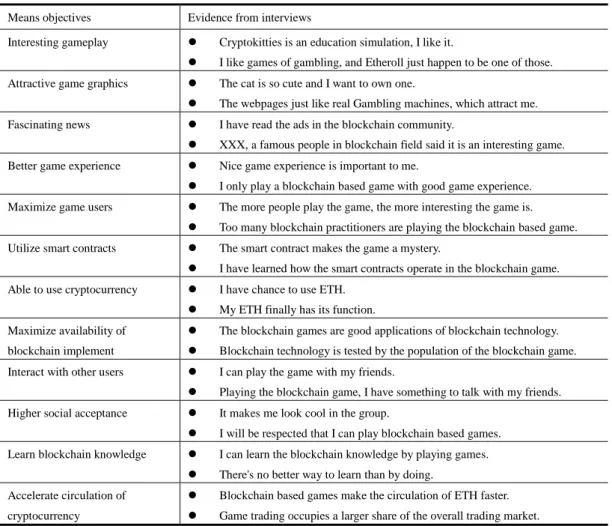
The means objectives are the ways to achieve the fundamental objectives. From the initial means objectives, we do another code to assure the result is detailed and without any redundancy. Table 3 summarizes 12 means objectives and cites evidence from interviewees.
Table 2. The means objectives Means objectives Evidence from interviews
Interesting gameplay Cryptokitties is an education simulation, I like it.
I like games of gambling, and Etheroll just happen to be one of those. Attractive game graphics The cat is so cute and I want to own one.
The webpages just like real Gambling machines, which attract me. Fascinating news I have read the ads in the blockchain community.
XXX, a famous people in blockchain field said it is an interesting game. Better game experience Nice game experience is important to me.
I only play a blockchain based game with good game experience. Maximize game users The more people play the game, the more interesting the game is.
Too many blockchain practitioners are playing the blockchain based game. Utilize smart contracts The smart contract makes the game a mystery.
I have learned how the smart contracts operate in the blockchain game. Able to use cryptocurrency I have chance to use ETH.
My ETH finally has its function. Maximize availability of
blockchain implement
The blockchain games are good applications of blockchain technology.
Blockchain technology is tested by the population of the blockchain game. Interact with other users I can play the game with my friends.
Playing the blockchain game, I have something to talk with my friends. Higher social acceptance It makes me look cool in the group.
I will be respected that I can play blockchain based games. Learn blockchain knowledge I can learn the blockchain knowledge by playing games.
There's no better way to learn than by doing. Accelerate circulation of
cryptocurrency
Blockchain based games make the circulation of ETH faster.
5.3 Means-ends network
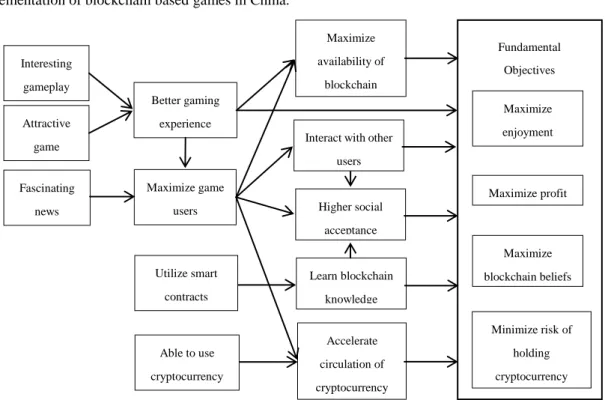
Based on the fundamental objectives and means objectives structured in this study and the relationship between the two types of objectives, a means-ends objective network was constructed. From the means-ends network, we can find that the gaming experience and the game user number are the important elements according to the interviewees. There are two points making the blockchain based game like Cryptokitties successful. The first point is the game experience. “Online game experience” and “Web browsing on mobile phones experience” have disturbance effect on consumer intention combined with UTAUT model [24]. Game Experience Questionnaire (GEQ) has ever been designed to measure the game enjoyment [25]. Because the Cryptokitties is the first blockchain game and at that time there were rarely applications in Ethereum. The rare and cute cats in the game attract many players. Though the game made a big fuss, the game itself is not as exquisite and fun as the traditional game. The technology limits the multiply game types. The gameplay and the graphics of the blockchain game are still in its infancy with huge improvement space.
The other point is the number of the users including the speculative power on the behalf of the global crazy speculators who are interested in obtaining potential profits. This is in line from the previous research finding that the number of peers will influence the people’s continued use of social networking services together with enjoyment and usefulness [26]. Metcalfe Law has pointed out that the benefits of the network grow exponentially as the number of network users increases, and the value of the network for each person is proportional to the number of others in the network, which is called network effect [27]. Blockchain based games help educate the mass market and have great value for the overall ecology of the blockchain.
Users also want to gain higher social acceptance by learning more knowledge about blockchain technology and interacting with other users. Social identity will influence collective intention to use a social networking site and are affected by cognitive, evaluative and affective components [28]. Many blockchain initiatives are shared through various communities and groups. Key point leaders do have great impacts on the development and implementation of blockchain based games in China.
Figure 1. the Means-ends Network
Maximize enjoyment Maximize profit Maximize blockchain beliefs Minimize risk of holding cryptocurrency Fundamental Objectives Maximize availability of blockchain implement Accelerate circulation of cryptocurrency Interact with other
users Higher social acceptance Learn blockchain knowledge Attractive game graphics Fascinating news Interesting gameplay Maximize game users Able to use cryptocurrency Utilize smart contracts Better gaming experience
6. CONCLUSION
In the study, we explore what are the values of using of blockchain based games in terms of VFT approach. As a result, 4 fundamental objectives and 12 means objectives are derived based on the 11 interviews of the blockchain based game end users. Maximize enjoyment, maximize profit, maximize blockchain beliefs, and minimize risk of holding cryptocurrency are the identified fundamental objectives. And through the means objectives like, improving game experience and user number, can help realize the fundamental objectives. And learning more blockchain knowledge by playing the blockchain games is also recommended by many interviewees.
The finding in this study also provides some practical and theoretical implications. Previous studies major focused on the use of blockchain technology in finance, supply chain, governance, etc. To our knowledge, the issue with the value of blockchain based games has not been explored in the previous studies. We explore the values of blockchain based games from users’ perspectives, which has not been explored before. We find enjoyment and profit are similar with perceived useless, which will promote users’ adoption of blockchain based games similar to traditional games. Because blockchain technology adds new elements to games, the risk of holding cryptocurrency become another factor influencing users’ adoption behaviors. The developers of blockchain based games can pay additional attention to these factors to better develop games. What’s more, the blockchain belief is the interesting finding of this study. It has more the psychological basis. Furthermore, our study enriches the current literature on the application of blockchain technology and the study of user behavior in the field of games.
Our research also has important implications for blockchain based games and even the blockchain applications. Although the exploration of blockchain based systems has begun in many fields, the implementation of the blockchain based systems is still in the early stage of development and has not been put into practical use. The blockchain based game is one example of blockchain based systems with a largest number of users, which is relatively easy in terms of both the technical threshold and the user's threshold. Therefore, the industrialization of blockchain based games is possible. Study of this perspective helps practitioners better understand users’ value, so they can design and complete their products to meet users’ needs.
There are also some limitations of this study. First, the blockchain based game is not as popular as the traditional game. We only did a qualitative study of 11 samples and the result can not reflect all the users’ viewpoints. Second, all the interviews are from China, but lots of blockchain based game players are over the world. Therefore, the generalizability of the results to other countries remains to be determined.
We plan to conduct our study with a large sample in the future. Blockchain based gamers from different age groups and different countries are planned to be recruited for the future study. Furthermore, a quantitative research can be conducted in further study.
REFERENCES
[1] Swan, M. (2015). Blockchain: Blueprint for a new economy. " O'Reilly Media, Inc.".
[2] Graux, D., Sejdiu, G., Jabeen, H., Lehmann, J., Sui, D., Muhs, D., & Pfeffer, J. (2018). Profiting from Kitties on Ethereum: Leveraging Blockchain RDF Data with SANSA. Paper presented at the SEMANTiCS Conference 2018, Vienna, Austria.
[3] Myers, B. A. (1998). A brief history of human-computer interaction technology. interactions, 5(2), 44-54. [4] Guins, R. (2014). Game after: A cultural study of video game afterlife. MIT Press.
[5] Zackariasson P, Wilson T L. Paradigm shifts in the video game industry[J]. Competitiveness Review: An International Business Journal, 2010, 20(2): 139-151.
[7] Nakamoto, S. (2008). Bitcoin: A peer-to-peer electronic cash system.
[8] Szabo, N. (1996). Smart contracts: building blocks for digital markets. EXTROPY: The Journal of Transhumanist Thought,(16).
[9] Buterin, V. (2013). Ethereum white paper-a next generation smart contract and decentralized application platform. [10] Macrinici, D., Cartofeanu, C., & Gao, S. (2018). Smart contract applications within blockchain technology: A systematic
mapping study. Telematics and Informatics, 35(8), 2337-2354.
[11] Keeney, R. L. (1992). Value focused thinking - a path to creative decisionmaking. Cambridge, US: Harvard University Press.
[12] Keeney, R. L. (1994). Creativity in decision making with value-focused thinking. Sloan Management Review, 35(4), 33. [13] Yang, X., & Gao, S. (2017). Understanding the Values of Live Game Streaming: a Value-Focused Thinking Approach.
Paper presented at the 16th Wuhan International Conference on E-Business (WHICEB 2017), Wuhan, China, May 26-27, 2017
[14] Barrett-Maitland, N. , Barclay, C. , & Osei-Bryson, K. M. . (2016). Security in social networking services: a
value-focused thinking exploration in understanding users’ privacy and security concerns. Information Technology for Development,22(3), 464-486.
[15] Sheng, H., Nah, F., & Siau, K. (2005). Strategic Implications of Mobile Technology: A Case Study Using Value-Focused Thinking. Journal of Strategic Information Systems, 14(3), 269-290.
[16] Alzahrani, A. I. , Mahmud, I. , Ramayah, T. , Alfarraj, O. , & Alalwan, N. . (2016). Extending the theory of planned behavior (tpb) to explain online game playing among malaysian undergraduate students. Telematics & Informatics. [17] Choi, D., & Kim, J. (2004). Why people continue to play online games: In search of critical design factors to increase
customer loyalty to online contents. CyberPsychology & behavior, 7(1), 11-24.
[18] Gao, S., Krogstie, J., & Zang, Z. (2016). The Effect of Flow Experience and Social Norms on the Adoption of Mobile Games in China. International Journal of Mobile Human Computer Interaction (IJMHCI), 8(1), 83-102.
[19] Rezaei, S., & Ghodsi, S. S. (2014). Does value matters in playing online game? An empirical study among massively multiplayer online role-playing games (MMORPGs). Computers in Human Behavior, 35, 252-266.
[20] Gao, L., & Waechter, K. A. (2017). Examining the role of initial trust in user adoption of mobile payment services: an empirical investigation. Information Systems Frontiers, 19(3), 525-548.
[21] Brandon, D. (2016). The blockchain: The future of business information systems. International Journal of the Academic Business World, 10(2), 33-40.
[22] Teng, C. I. (2010). Customization, immersion satisfaction, and online gamer loyalty. Computers in Human Behavior, 26(6), 1547-1554.
[23] Peters, G., Panayi, E., & Chapelle, A. (2015). Trends in cryptocurrencies and blockchain technologies: a monetary theory and regulation perspective.
[24] Chen, L. S. L., Kuan, C. J., Lee, Y. H., & Huang, H. L. (2011, June). Applicability of the UTAUT model in playing online game through mobile phones: Moderating effects of user experience. In Technology Management Conference (ITMC), 2011 IEEE International (pp. 625-629). IEEE.
[25] IJsselsteijn, W., Poels, K., & De Kort, Y. A. (2008). The Game Experience Questionnaire: Development of a self-report measure to assess player experiences of digital games. TU Eindhoven, Eindhoven, The Netherlands.
[26] Lin, K. Y., & Lu, H. P. (2011). Why people use social networking sites: An empirical study integrating network externalities and motivation theory. Computers in human behavior, 27(3), 1152-1161.
[27] Katz, M. L., & Shapiro, C. (1994). Systems competition and network effects. Journal of economic perspectives, 8(2), 93-115.
[28] Cheung, C. M., & Lee, M. K. (2010). A theoretical model of intentional social action in online social networks. Decision support systems, 49(1), 24-30.