Financial System Inquiry
Submission
March 2014
CONTENTS
Introduction 4
Chapter one: The superannuation environment 7
1.1. Where have we come from?
1.2. Interconnectedness with the financial system 1.3. The impact of changes in technology
1.4. Legal and governance structure 1.5. How has superannuation performed?
8 13 14 16 17
Chapter two: Regulatory policy recommendations 21
2.1. Regulatory framework
2.1.1. The rise in individual decision making 2.1.2. Emerging regulatory gaps
2.1.3. Systemic risk
2.1.4. Connectivity to social security and the tax system 2.1.5. Post-retirement products
2.1.6. Globalisation 2.1.7. Cost sharing
2.1.8. Systemic risk in the superannuation payments system 2.1.9. Competition
2.2. Regulatory response to an ageing population
Box A: Seven impediments to retirement income-stream products
23 23 24 27 27 28 28 29 30 30 32 33
Appendix A: The growth of heterogeneous decision making 35
A.1. Choice during the accumulation phase A.2. Choice in retirement: drawdown phase
36 38
Chapter 3: Investment and funding 41
3.1. Helping stabilise financial markets 3.1.1. Banking-style liquidity problems Box B: Liquidity risk around benefit payments 3.2. Participation in the equity markets
3.3. Contributing to national saving
3.3.1. Measuring the impact of compulsory superannuation on national saving 3.3.2. The importance of national saving
3.4. Supporting long-term fiscal sustainability 3.5. Providing finance to the economy
3.5.1. How do superannuation funds invest? 3.5.2. Emerging trends in investments 3.5.3. Specific asset class trends
3.5.4. Small and medium enterprises, corporate bonds and infrastructure Box C: case study: corporate bonds
42 43 46 47 48 48 49 53 55 55 58 60 61 63
ASFA submission to Financial System Inquiry | 3 of 74
Appendix B: Superannuation, concentration and the ASX 65
B.1. Diversification of the ASX B.2. Australian equities ESG risks
B.3. Australian equities international exposure B.4. Importance of the ASX to superannuation
67 67 68 68 Appendix C: Infrastructure 71 C.1. Infrastructure liquidity C.2. Pipeline of projects C.3. Recycling of capital C.4. Greenfield assets
C.5. Broadening funding base C.6. Small-scale infrastructure C.7. Infrastructure debt markets C.8. Taxation
C.9. Infrastructure and economic growth
72 72 73 73 73 73 73 74 74
Australia has a three-pillar retirement system made up of:
• a mandatory contribution (made by employers), which is currently 9.25 per cent of wages, and gradually increasing to 12 per cent by July 2019
• voluntary contributions, many of which receive tax or other incentives
• a government means-tested Age Pension commencing at age 65 for men (64 and a half for women) but increasing to age 67 for both men and women from 2017.
All three elements have been, and continue to be, subject to change.
The result is a unique, if complex, superannuation system, which is rated amongst the highest- performing pension schemes in the world. And, as a significant participant, the superannuation system will be positively impacted by improvements in the efficiency and competitiveness of the Australian financial system.
Figure 1: Superannuation assets in Australia ($bn)
Source: APRA.
The Australian superannuation pool is one of the largest in the world, and will continue to grow for decades to come. It will become increasingly important to the goal of providing Australians with adequate income in retirement, and the impact of superannuation on the financial system and the economy will increase as a result. The pool of superannuation funds is expected to quadruple within 25 years; Treasury estimates suggest that assets held within superannuation will rise to around $6 trillion by 2037, about 145 per cent of GDP.
Of all superannuation assets, Australians bear the investment risk on around $1.6 trillion through their defined
contribution (DC) superannuation plans and, using Rice Warner and APRA estimates, we can say that roughly $1 trillion of these assets are chosen by the investor – through SMSF, through choice driven by a relationship with a financial planner, or through the investor’s own decisions.
1800 1600 1400 1200 1000 800 600 400 200 0 1997 ($bn) Superannuation assets ($bn) 1999 2001 2003 2005 2007 2009 2011 2013 Year
INTRODUCTION
ASFA submission to Financial System Inquiry | 5 of 74 Table 1: estimated MySuper assets by market segment (as at June 2013)
Market segment
Pre-retirement assets Retirement Total market
Choice MySuper Choice All MySuper
$ million $ million % $ million $ million %
Not-for-profit
Corporate funds 9,621 54,521 85 3,661 67,804 80
Industry funds 45,397 257,248 85 27,034 329,678 78
Public sector funds 28,696 162,608 85 54,272 245,576 66
Total not-for-profit 83,714 474,377 85 84,967 643,058 74
Commercial funds 202,967 103,903 34 158,632 465,503 22
Self-managed super funds 258,672 - - 248,528 507,200
-Total superannuation
market 545,353 578,281 52 492,128 1,615,761 36
Source: Rice Warner.
Recommendations
ASFA sees this Financial System Inquiry as an opportunity to make recommendations in two key areas: regulation and the financing of the Australian economy.
Our recommendations are based on the overarching theme that, as the system is compulsory and funded by taxpayers, it must be regulated to ensure that it delivers the retirement outcomes framed by public policy and that all monies are invested in a prudent manner.
Regulation
Of the developments in the superannuation and financial sector since Wallis, the most significant is the rise of fund members making their own investment decisions. We now have two large pools of money within the system: one pool with SMSF investors and the other with APRA-regulated collective investment vehicles. We also have a growing pool of post-retirement monies. The system has also evolved from one where the standard superannuation product was a balanced diversified fund; we now have many diverse products being offered to consumers. We also have a wider range of service providers which perform various functions within the system.
These developments mean that we need to re-assess the current framework and to determine how to address gaps, issues and emerging trends that prevent the efficiency and competitiveness of the superannuation industry. In this submission, ASFA highlights the need to:
• acknowledge the impact of the rise of individual decision making and how that applies to a high duty of care on retirement monies
• identify and address emerging regulatory and consumer protection gaps and overlaps due to structural and participant changes
• identify any systemic risks across all three pools of money (pooled, SMSF, retirement), both separately and collectively
• respond to the increasing linkages between superannuation and other parts of the social security and tax systems • assist future retirees looking for a wider selection of income stream products by removing impediments and
promoting innovation and competition in the market
• anticipate any regulatory requirements for the growing globalisation of regulation and the global movement of people pre and post retirement
• address inconsistencies in the application and methodology of the funding of regulatory oversight and regulation • focus on the needs of the developing electronic payments system
• enable effective and transparent competition within the industry
• put in place a framework that provides incentives for the purchase of income stream products as well as develop an appropriate governance framework.
Funding
Our submission is based on an overarching principle with respect to superannuation investments. This principle is that the primary purpose of superannuation is to provide income in retirement. While incentives may help to maximise the economic impact of superannuation capital, directing investments into particular assets or investments classes has the potential to move away from that purpose. Market forces will determine that capital will flow where it is most valued. This obviates the need for any specific interventions mandating asset allocation of superannuation fund investment strategies, as this is an invitation for poor performance and lower returns.
That said, we note that there are several areas where impediments could be removed and funding needs could be better matched with the risk and return objectives of superannuation investors. These are:
• to reassess the ways in which we require pooled superannuation funds to manage liquidity risk, potentially exploring innovative solutions to this issue. For example:
» considering some regulatory relaxation of the liquidity requirements in products that are mainly invested in by younger members with longer investment horizons
» looking at whether product disclosure statements could explicitly lengthen redemption terms to allow pooled funds greater exposure to less liquid assets
» exploring the potential for liquidity limits to be based on some historical assessment of the behaviour of members’ redemptions over time
• to ask state governments and other infrastructure developers to be more flexible in the structuring of funding and financing of infrastructure projects to better match the risk and reward preferences of superannuation investors. For example, to follow the NSW Government approach of seeking superannuation funding after the initial development risks have been mitigated.
CHAPTER ONE
1.1 Where have we come from?
In 1997, the Wallis Inquiry was established to examine the outworking of the deregulation of the Australian financial system, which had been underway since the early 1980s. In particular, its remit was to make recommendations on the nature of the regulatory arrangements that would best ensure an efficient, responsive, competitive and flexible financial system. By this time, compulsory superannuation – in the form of the Superannuation Guarantee – had been in place for around five years, although superannuation in the broader sense had been operating for some decades.
Although firmly established, in 1997 superannuation represented a fairly small part of the financial system as a whole, with assets totalling around $321 billion, or 37 per cent relative to GDP. In the following 16 years, the system has grown substantially with compulsory and voluntary contributions, combined with compounding returns, driving the growth of superannuation assets to in excess of $1.8 trillion, and the ratio of super to GDP rising to over 100 per cent of GDP. This means that, since Wallis, growth in superannuation assets has tripled that of Australia’s GDP growth.
Superannuation was not a key concern for Wallis. Rather, it was considered a part of the system that needed to be sensibly incorporated in the context of larger scale adjustments to the philosophy and implementation of financial system regulation. Wallis noted, however, that:
“Compulsory superannuation has seen a greater share of household assets shift from capital certain investments, such as bank deposits, into market linked investment classes. A growing proportion of the nation’s financial wealth is being invested in superannuation and the level of risk being directly borne by households is increasing.”
The recommendations and the underpinning regulatory philosophy that emerged from Wallis, however, would be key in shaping the superannuation industry over the next decade and a half.
The release of the Wallis Report cemented an evolving philosophy, first catalysed in 1979 by the Fraser Government’s rejection of the Hancock Inquiry’s recommendations. This philosophy was that superannuation should be privately funded, and that the investment risk of assets held within superannuation should not be borne by the government. The final Wallis Report advocated greater superannuation choice for members, alongside other recommendations including an increased need for disclosure and the separation of the regulation of public-offer superannuation funds from self-managed superannuation funds (SMSFs). Under the heading of ‘Promoting Increased Efficiency’, Wallis also recommended harmonising the regulation of collective investments and public-offer superannuation funds.
In 1986, the introduction of three per cent award superannuation through the Wages Accord meant that many workers who had not previously had access to retirement benefits through their workplace began to have money set aside for retirement. The cost of these contributions was, effectively, funded by the worker and that money, generally, was not being contributed towards a defined benefit (DB) scheme run by their employer or the government. Rather, the money was invested in a defined contribution (DC) scheme, where members would receive the full profits, and also wear all of the losses from their investments.
A ‘paternalistic’ approach, where the employer was responsible for the retirement experience of their employees was gradually disappearing for a number of reasons. Firstly, the employment patterns of individuals were changing. It was no longer typical for an employee to remain with one organisation for their working life, which meant issues regarding the transfer of post-employment benefits were emerging. Secondly, the credit risk associated with the DB plans
provided by employers was significant. Employees were exposed to the risk of their corporate superannuation plan being mismanaged, or the default of obligations under the plan if the organisation went into liquidation. As Australia faced recessionary times, this issue was very real. Thirdly, and perhaps most importantly, many employers were no longer willing to bear the liability to the defined benefit scheme on their balance sheet. These same issues with DB schemes are now emerging globally.
In the period since Wallis, the vast majority of DB plans have closed, either altogether or to new members. Some offered
The superannuation environment
ASFA submission to Financial System Inquiry | 9 of 74 their members incentives to shift their balances from a DB scheme to a DC scheme to remove the liability from the employer and shift the investment risk of their superannuation benefits to the member. As Figure 3 shows, the number of corporate superannuation plans has declined significantly since 1997. Where corporate funds have closed, the members and assets, in most cases, have moved to retail or industry funds rather than any formal mergers occurring.
Defined benefit (DB) plans are pension benefits provided by an employer or sponsor. The employer or
sponsor promises a regular income benefit on retirement that is calculated using the employee’s salary, their tenure of service, and their age. DB’s are not directly related to investment returns. In the OECD, 18 countries have DB plans provided by the government and private occupational schemes are mandatory (or effectively mandatory) in the Netherlands, Switzerland and Iceland.
Defined contribution (DC) plans are those where contributions are paid into an individual account for each
member. The contributions are invested and the returns on the investment – either positive or negative – are credited to the individual’s account. On retirement, the balance of the account is used to support the member in retirement, sometimes through the purchase of an annuity that then provides a regular income. DC plans are compulsory in 10 OECD countries.
While problematic in many respects, DB schemes do have one key advantage over DC plans in that they seamlessly manage the transition from working income to retirement income. Therefore, their demise has created an unintentional gap in our superannuation system, which poses a key challenge for future public policy around superannuation: how do we ensure that the lump-sum benefits of superannuation are sensibly converted into an income stream or capital source that can finance an individual’s needs during retirement, for the whole of their retirement? This issue is discussed further in Section 2.2.
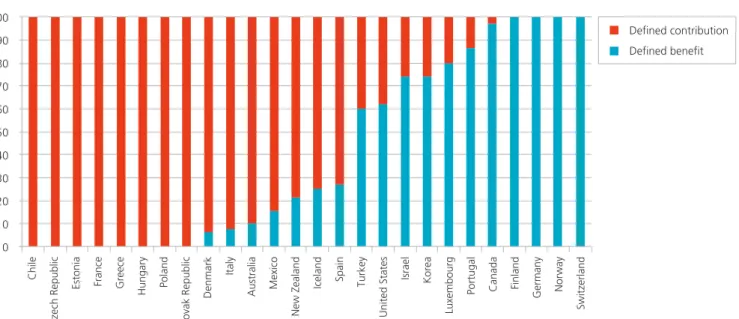
Today, almost 90 per cent of Australia’s superannuation funds under management (FUM) are invested in DC schemes. This is relatively high compared to many advanced countries, including the United Kingdom, Canada and the United States and, when considered alongside the relative immaturity of the Australian superannuation scheme, perhaps explains the greater weighting to equities in the Australian pension market, relative to our global peers. The share of superannuation fund assets that are in DB schemes has remained around 10 per cent since 2005, after declining over the previous decade (RBA, 2011). We note, however, that the liabilities to members across DB schemes in Australia are somewhat higher than this data suggests, because many public sector schemes are partially unfunded.
Figure 2: asset shares of different pension fund types (%)
100 90 80 70 60 50 40 30 20 10 0 % Defined contribution Defined benefit Chile Czech Republic
Estonia France Greece Hungary Poland
Slovak Republic
Denmark
Italy
Australia Mexico
New Zealand
Iceland Spain Turkey
United States
Israel Korea
Luxembourg
Portugal Canada Finland Germany Norway
Switzerland
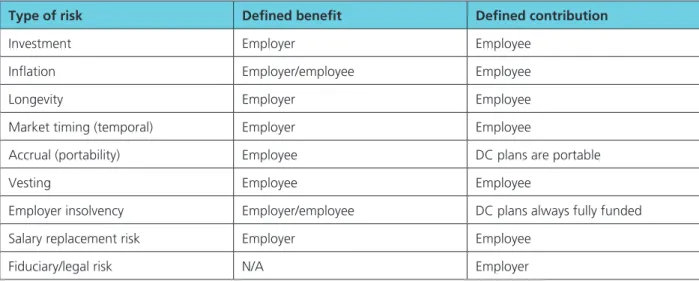
Table 2: Risk distribution by superannuation fund type
Type of risk Defined benefit Defined contribution
Investment Employer Employee
Inflation Employer/employee Employee
Longevity Employer Employee
Market timing (temporal) Employer Employee
Accrual (portability) Employee DC plans are portable
Vesting Employee Employee
Employer insolvency Employer/employee DC plans always fully funded
Salary replacement risk Employer Employee
Fiduciary/legal risk N/A Employer
(Broadbent, 2006).
Figure 3: Number of corporate superannuation funds in Australia
Source: APRA.
Alongside the reduction in the number of corporate superannuation funds, we have seen two other significant structural shifts in the superannuation landscape. These are: firstly, a reduction in the number of superannuation players in the market; and secondly, the extraordinary growth in self-managed super funds (SMSFs).
As corporate funds have closed or consolidated, so too have the number of other larger players in the superannuation industry. The number of not-for-profit industry funds has reduced by more than two-thirds from 176 funds in 1997, while the number of retail funds has also decreased by around 50 per cent. This is largely the result of mergers, as players have looked to increase scale to help drive operating efficiencies. There are many examples of this occurring, including the merger of AMP with AXA Asia, Health Super with First State Super and AGEST with AustralianSuper. AustralianSuper has been involved in more than 15 mergers.
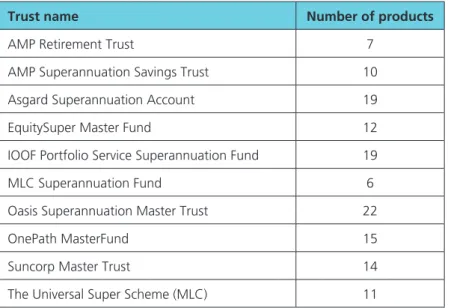
While the number of corporate funds and retail superannuation providers has reduced, the number of products have not necessarily followed suit. Across 10 of the largest providers, there are 135 separate products, each of which will offer a range of different risk and return options.
4,500 4,000 3,500 3,000 2,500 2,000 1,500 1,000 500 0
ASFA submission to Financial System Inquiry | 11 of 74
Table 3: Number of products within selected retail superannuation trusts
Trust name Number of products
AMP Retirement Trust 7
AMP Superannuation Savings Trust 10
Asgard Superannuation Account 19
EquitySuper Master Fund 12
IOOF Portfolio Service Superannuation Fund 19
MLC Superannuation Fund 6
Oasis Superannuation Master Trust 22
OnePath MasterFund 15
Suncorp Master Trust 14
The Universal Super Scheme (MLC) 11
Source: SuperRatings.
Further, the assets held on master trust and wrap platforms have also increased markedly. Data provided by Chant West has $376 billion in assets held on these platforms. This compares to $306 billion managed by industry funds.
Table 4: Structure of the Australian superannuation industry (as at June 2013)
Fund type Number AUM ($b) Members (milion)
Retail – master trusts 72 305 8.2
Retail – wraps 38 71 0.4
Industry 53 306 11.3
Source: Chant West.
While the number of large superannuation funds has been reducing, the number of small funds, more specifically SMSFs, has been rising at a rapid rate (refer Figure 5). It is not likely that this phenomenon was expected in 1997 when the recommendations of the Wallis Inquiry were being finalised.
The rise of SMSFs cannot be easily ascribed to one, or even two specific reasons. While our research indicates that some members want to feel more in control of their assets than possible, or perceived to be possible, through an institutional fund framework, there are many other reasons cited for the rise in SMSF numbers including:
• lower management fees, actual when the SMSF is large and perceived at lower levels of FUM
• effective tax management of investment income, including no capital gains tax when a member moves from accumulation to pension phase
• loss of confidence in collective investments following the GFC • aggressive marketing of SMSFs.
The data shown in the graph on the next page shows that, across all SMSFs, cash (including term deposits), listed shares and non-residential real property are the most popular assets for SMSF trustees to invest in. Institutional funds have responded to this pattern by introducing standalone options for term deposits and offering individual shares on their investment menu, in an attempt to retain would-be SMSF holders.
Figure 4: SMSF asset allocation by size of fund (as at December 2012)
Source: ATO.
While the absolute number of APRA-regulated superannuation funds is quite large – more than 300 in total as at end December 2013, the holding of assets is concentrated. Australia’s largest 20 superannuation funds, in combination with SMSF accounts, control around 70 per cent of all superannuation assets. The residual 30 per cent of assets are managed by 180 large super funds (those with assets greater than $50 million) and a further 110 or so smaller super funds. Outside SMSFs, around 80 per cent of new contribution flows go to just over 20 funds.
Figure 5: Number of funds by type (as at December 2013) 400 350 300 250 200 150 100 50 0 97 99 01 03 05 07 09 11 13 Year Industry Public sector Retail Small (RHS) 600,000 500,000 400,000 300,000 200,000 100,000 0 % 100 80 60 40 20 0 Other
Non-residential real property Unlisted shares
Listed shares Loans Cash
Other managed investments Unlisted trusts Listed trusts $1-50k $50-100k $100-150k $150-200k $200-500k $500k-$1m $1-2m $2-5m $5-10m >$10m
ASFA submission to Financial System Inquiry | 13 of 74
1.2 Interconnectedness with the financial system
At the time of Wallis, the focus was on banks, insurers and capital markets, largely due to their scale in the financial system. However, with the growth of superannuation assets and the consolidation of players within the superannuation industry, there are now significant and complex linkages between superannuation and other parts of the Australian financial system.
• Banks: superannuation is heavily invested in the banking sector. Firstly, as deposit holders in Australian deposit taking institutions (ADIs) such as banks and building societies, and secondly, as holders of bank equity. As of December 2013, superannuation funds had invested about $217 billion in deposits accepted by banks. A further $22 billion was invested in the bonds of financial corporations (bank and non-bank), and $159 billion invested in the equity of financial corporations (bank and non bank). This means a total of around $398 billion of superannuation funds are invested in Australia’s banking sector, representing 22 per cent of total superannuation (ABS). This is an important source of liquidity for Australian banks and it reduces the need for them to source wholesale funding from overseas (Levine).
• The Australian Stock Exchange (ASX): superannuation funds hold a substantial portion of Australian shares by market capitalisation and this relationship has grown over time. The ASX estimates that the proportion of Australian equities held by superannuation funds grew from 8.5 per cent in 1998 to 16.5 per cent in 2007 (ASX 2007). Based on the latest available data, ASFA estimates that direct holdings of shares by superannuation funds accounted for around 33 per cent of the total ASX market capitalisation as at January 2014.
• Insurance companies: superannuation relationships continue to be key to the business model for life insurance companies, with around 50 per cent of annual in-force premiums linked to superannuation services either through a superannuation fund, or a financial adviser (Rice Warner)).
• Managed funds: superannuation funds are the largest contributor to managed funds. As at the December quarter 2013, superannuation funds accounted for 78 per cent of all consolidated assets in managed funds, with public unit trusts, life insurance funds and other funds comprising the remaining 29 per cent (ABS 2013). Recognition of the opportunities created by the growth in funds under management has driven significant global interest in establishing and building funds management operations in Australia. The size of the domestic industry, together with the availability of a highly skilled, multilingual workforce, a strategically-advantaged time zone, and access to world class infrastructure, have proven critical factors in the decision by global investment houses and service providers to establish operations in Australia.
• Service providers such as administrators and custodians: as the size of the superannuation market has increased, so too has the reliance on the services of third-party providers such as custodians. Of the $4 trillion custodian market in Australia, $1.1 trillion assets are held on custody on behalf of not-for-profit and retail
superannuation funds (Rainmaker). Administrators already manage the pension payments for much of the system’s retirement assets, and the size of pension payments out of superannuation accounts will only increase as the system matures.
• The broader payments system: the payments system is the plumbing through which around $125 billion in contributions were made in 2012-13 and the means by which transfers of money are effected from one superannuation fund to another when a member changes their active fund.
1.3 The impact of changes in technology
Over the past decade and a half, technology has moved at a surprisingly rapid pace. This technology shift has been particularly evident in the rapid uptake of mobile technology: tablets and mobile phones. Most sectors of the economy have been affected by this change, for example, the impact of online shopping on the retail sector. The combination of computational speed and the ready access to vast amounts of data means that data-intensive processes that were once uneconomic or unwieldy are now easily managed.
Financial service providers are adjusting to this new environment by offering an online experience to their customers. For example, nearly all banks now offer online personal banking services, many of which are accessible via mobile or tablet devices.
While many superannuation funds offer a similar online experience, fund-implemented technology solutions for receiving superannuation contributions have, at least until recently, focused on delivering a bespoke solution for each individual fund. While this delivers benefits to the individual fund, such solutions have provided limited productivity gains for employers who are often required to deal with multiple funds. This has led to the rise of clearing house service providers, who offer a better service to employers than that which is offered by the funds. However, in order to increase efficiencies further, a single industry-wide technology solution could be developed using the smart application of technology. At present, no such system exists.
For superannuation providers, there are four key client groups, who each have unique challenges when it comes to dealing with them electronically:
• those making contributions on behalf of superannuation fund members (generally employers) • superannuation fund members themselves
• providers of insurance services to funds and their members • providers of investment and custodial services to funds.
As discussed previously, the general approach has been for individual funds to develop and implement their own bespoke electronic solutions. For contributions, the focus of these solutions was to link the banking system payment transaction with the associated data describing the purpose of the payment. While this approach ’solves’ the problem from the superannuation provider’s perspective, from the client’s (contributing employer or member) perspective it only solves the problem of communicating with that superannuation entity and not the other superannuation entities with which it also needs to interact.
Similarly, with the other three groups, where electronic interactions occur, they do so under bespoke solutions. Additional challenges with the existing system include the limited amount of data that can be sent with a payment and flaws in the inter- and intra-bank processes for dealing with the data. In particular, for employers, the shift from paying contributions to a single fund of their choice to multiple funds under multiple payment arrangements has created administrative complexity.
Since 1998, the superannuation industry has endeavoured to standardise the process for interactions between employers and funds with respect to contributions, and between funds with respect to the rolling over of superannuation benefits. Technological advances have largely removed the need for people to deal face to face. The increasing move to electronic transactions, and particularly to the electronic and remote initiation of transactions, is not without its risks. One such risk is the increasing prevalence of cyber-crime.
In establishing the SuperStream transaction network, particular attention has been paid to requiring the encryption of data as it moves from gateway to gateway to prevent the interception and alteration of this data. Connections between originating parties and the gateway network, and the gateway network and end points have login code and password protection. However, where transactions are passed through a chain of players, the overall security strength must be
ASFA submission to Financial System Inquiry | 15 of 74
measured by the strength of the weakest link in the chain.
Identity theft is also a growing concern in the superannuation industry due to the increasing size of member account balances. The problem is exacerbated due to the new member enrolment process for those being enrolled by an employer into the employer default fund. For these members, a fund receives no member-completed documentation. While there are some protections offered under the new arrangements as a result of SuperStream (for example, use of the ATO’s SuperTick service to validate the member details against the ATO’s records of taxpayers), the process remains open to fraud.
1.4 Legal and governance structure
While corporate superannuation funds have become a smaller part of the superannuation industry, they have left their legacy in the legal structure under which all superannuation funds now operate. Most superannuation funds today are structured as trusts, following the pattern established by the earlier employee sponsored pension plans. The directors of these trusts have a fiduciary obligation to members by virtue of the trust structure in which they operate, but also through legislation which looks to provide more certainty around the roles and responsibilities of the trustees than would be the case if the system were to rely on the judicial interpretation of Australian Trust Law. This provides considerable efficiency and equity gains because disputes relating to superannuation trust arrangements are not required to be determined through the judicial system.
The statutory obligations of superannuation funds, which are set out in the Superannuation Industry (Supervision) Act 1993 (the SIS Act) as well at tax legislation and the Corporations Act amongst other legislation, allow effective regulation of the superannuation industry, and have provided government with the opportunity to ensure that superannuation meets the long-term needs of Australians. In combination with the control of public policy relating to superannuation – as determined in the 1960s – government is able to balance protecting the interests of Australians invested in the compulsory superannuation system, with the impact on the public purse of the Age Pension arrangements.
The purpose of superannuation assets meeting retirement income objectives is set out in legislation. Under the SIS Act, a superannuation trustee is responsible for formulating an investment strategy that has regard to the whole of the circumstances of the fund. While not restricting the investment universe, this requires superannuation funds, including SMSFs, to operate according to the ‘sole purpose test’ with the retirement income objective paramount. In particular, Section 62 of the SIS Act requires that a trustee of a regulated superannuation fund must ensure that a fund is maintained for the core purpose of providing benefits after a member’s retirement. The sole purpose test does clarify that certain kinds of investments are regarded as inconsistent with the government’s superannuation policy objectives, including lending funds to a member of a superannuation fund or investing in an asset that is not on an ‘arm’s length basis’ and specific restrictions are placed on investing in ‘in-house assets’.
As part of the SIS Act legislative framework for superannuation, a superannuation fund trustee is also required to: • ensure that investments are diverse and that the super fund is not exposed to risks from inadequate diversification • manage the liquidity of a fund’s investments to meet expected cash flow requirements
• have regard to the risk involved in making, holding and realising the investments, as well as the likely return from the investments meeting fund objectives
• justify and document how all investments made under an investment strategy are consistent with that strategy and the safeguards, if any, that will be used to enable both the objectives of the strategy and the requirements contained in the investment covenant to be met.
In February 2001, APRA provided further clarification on its interpretation of the SIS Act outlining a set of principles in a superannuation circular. The principles state that a trustee should exercise care when considering investments to ensure that the provision of retirement benefits for members is the overriding consideration behind the investment decision. “However, the situation may arise where a properly considered and soundly based investment provides ‘incidental’ advantages to members or other persons which could suggest that the fund is maintained, in whole or part, for an improper purpose.” The principles go on to describe that “such incidental advantages would not necessarily, in isolation, amount to a breach of the sole purpose test”. For example, “investment in a well-researched and commercially sound project might incidentally create employment opportunities for members; and it is open to trustees to develop features of their fund which add value to, or differentiate it from, other funds.”
There has been little focus on the concept of ‘incidental advantage’ in the broader debate about fiduciary duties. However in the context of a legislative environment that does not restrict investment, there is no legislative and regulatory restrictions that have for instance prevented the development of traditional forms of ethical investment, so long as investments are made for the purpose of providing retirement benefits.
ASFA submission to Financial System Inquiry | 17 of 74
1.5 How has superannuation performed?
In international comparisons, Australia’s retirement incomes system has consistently been ranked favourably compared to other countries. As early as 1993, the World Bank endorsed Australia’s three-pillar system for the provision of retirement income as world’s best practice. This was supported by the 2012 Mercer Global Pension Index, which ranked the Australian system third out of the eighteen countries assessed, noting that it has a “sound structure, with many good features” (Mercer, 2012).
While globally acknowledged as a leading pension system, Australia does not operate to a standard model. It is neither a standard DB nor DC market. In its survey, Mercer referred to Australia as a hybrid model, but even this term does not do justice to the unique nature of the Australian superannuation system. It has components of ‘compulsion’, of ‘choice’ and of ‘defined contribution’ but is not any one of these alone. So while international comparisons are useful, there is a limit to the relevance these comparisons.
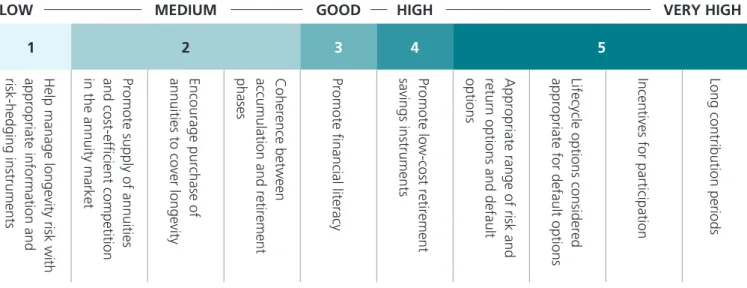
OECD roadmap for the good design of defined contribution pension plans – Australia’s scorecard
A well-structured defined contribution superannuation system should:
Score
out of 5 ASFA assessment
1 Have coherence between accumulation
and retirement phases 3
Regulatory and tax environments between the accumulation phase and retirement phase of an Australian’s life are significantly different. However, good transfers to allocated pensioners and TTRs.
2 Have long contribution periods 5 Compulsory superannuation for all working Australians and advantageous tax arrangements promote participation.
3 Provide incentives for participation 5 Taxation arrangements incentivise contributions.
4 Promote low-cost retirement savings
instruments 4 MySuper regime supports low-cost default plans.
5 Appropriate range of risk and return
options and default options 5
Australian super funds have provided a range of risk/return options for many years.
6 Consider lifecycle options deemed as
appropriate for default options 5
Many super funds have life stages defaults. A large number have adopted a lifecycle approach as their MySuper default.
7 Encourage the purchase of annuities to
cover longevity 2
Some tax issues. No positive incentive over higher alternatives.
8
Promote the supply of annuities and cost-efficient competition in the annuity market
2 Low demand for annuities and many providers have abandoned this product line.
9
Develop appropriate information and risk hedging instruments to help manage longevity risk
1 Still some way to go.
10 Promote financial literacy 3
Mixed scorecard. ASFA has undertaken financial education initiatives. However, there is still evidence of a limited understanding of risk and reward trade-offs across investment products.
LOW MEDIUM GOOD HIGH VERY HIGH
1 2 3 4 5
Help manage longevity risk with
appropriate information and
risk-hedging instruments in the annuity market and cost-efficient competition Promote supply of annuities annuities to cover longevity Encourage purchase of phases accumulation and retirement Coherence between Promote financial literacy savings instruments Promote low-cost retirement options return options and default Appropriate range of risk and appropriate for default options Lifecycle options considered Incentives for participation Long contribution periods
The OECD, through its roadmap for the good design of defined contribution pension plans (as approved and endorsed by the OECD working party on private pensions in June 2012), has provided a useful benchmark against which to assess Australia’s defined contribution pension scheme.
As the box on the previous page shows, overall our superannuation system rates well against these internationally recognised criteria. Indeed, ASFA assessed the Australian superannuation system as meeting five of the ten criteria to a high or very high level. Those criteria where Australia could be seen as not meeting the highest standard include the provision of post-retirement products and the coherence of the accumulation to retirement phases of investment. These themes are picked up in Section 2.2, which sets out ASFA’s ratings against the criteria. For members, superannuation’s performance can be measured by its ability to provide a reasonable level of capital growth over the accumulation years and a sustainable income stream through retirement. In superannuation, where funds are set aside for the long term, the emphasis should be on the long-term returns that are achieved. Shorter term fluctuations in valuations are usually the cost a long term investor pays for better long term performance. As a consequence, most default funds for entry level members, where investors assets will be squirrelled away for their retirement, some 50 years away, will hold a greater proportion of growth assets to improve the probability of a better investment outcome.
The financial performance of a private pension system is vital to its adequacy. Stronger returns lead to higher accumulations at retirement for the same contribution. Australian superannuation funds have delivered returns well above inflation over the long term.
Table 5: Investment returns to June 2013
Time horizon Fund returns Real returns
years % p.a. vs AWE vs CPI
10 6.8 2.4 4.0 15 6.0 1.4 3.1 20 7.2 2.7 4.5 25 7.9 3.3 4.8 30 9.7 4.6 5.8 35 10.8 4.7 6.0 40 10.3 3.1 4.5 50 10.0 2.7 4.5 Source: Superfunds.
The data is for funds with growth assets in the range of 60 per cent to 80 per cent, which is representative of the average default investment arrangement.
ASFA submission to Financial System Inquiry | 19 of 74
These returns are ultimately reflected in retirement incomes. Mercer (2012) suggests that replacement rates – the percentage of final salary that a member receives as income in retirement – for median income earners are a key determinant of the overall performance of a retirement incomes system. The OECD recommends a target replacement rate of 70 per cent of final earnings (OECD, 2009). Similarly, in assessing the adequacy of international pension
arrangements, Mercer (2012) gives the highest scores to countries with replacement rates between 70 per cent and 100 per cent.
Currently, the gross replacement rate (including the Age Pension) for median income earners in Australia is
approximately 60 per cent (OECD Pensions at a Glance, 2013). This replacement rate is slightly above the OECD average. The Australian Government has published figures with higher replacement rates but these are not consistent with the methodology used by the OECD in its international comparisons. For an individual on 1.5 times average earnings, the OECD estimates a replacement rate of 39.4 per cent for Australia, somewhat below the average for the OECD countries of 48.4 per cent.
The current “three pillar” retirement income arrangements have led to higher retirement incomes than under previous systems. In particular, the superannuation system, and the superannuation guarantee is providing a significant boost to retirement incomes and will help maintain retirement incomes at a level that would otherwise not occur.
CHAPTER TWO
Regulatory policy recommendations
Chapter one sets the scene for the policy recommendations provided in this chapter.
Current superannuation regulatory philosophy is driven by the fact that the system is mandatory, taxpayer-funded and reduces the burden of the Age Pension on current and future governments. The resulting philosophy is to ensure that retirement outcomes are maximised to increase the rate of self-funded retirees, and taxpayers receive value for money. That is, the tax incentives provided within the superannuation system delivers a better result for the economy than they would in other vehicles or consolidated revenue. Additionally, money saved for retirement needs to be used for retirement purposes only.
Whilst there have been continuing changes to the regulation of the superannuation system and industry, the overall regulatory framework is still fundamentally based upon the traditional structure of a superannuation provider. That is, a standalone trust with only a few investment options and a trustee board. This assumption is no longer valid, as outlined in Chapter one.
Going forward, regulatory philosophy and framework must have the flexibility to respond to the significant changes that are occurring, and will continue to occur. By far the biggest driver of the need to change the regulatory approach is the increase in the availability of choices for individuals in relation to their superannuation and the continued growth in individual decision making pre and post retirement.
Tax incentives promote savings in the system. Over the long term, this policy initiative will prevent the blow out of liabilities for the government that would otherwise occur under a universal Age Pension system. We have seen this problem emerge in other economies. Having foregone tax revenue in the form of incentives, it is reasonable for the government to expect that recipients of these incentives invest their money in a manner which is consistent with supporting their long-term retirement needs for income.
In order to get the balance between consumer protection and choice right, the following regulatory philosophy should be applied:
• at the whole-of-system level, there should be monitoring in place to ensure that the super system is delivering against its retirement objectives. This means that the regulatory framework that governs the superannuation system supports public policy in relation to retirement
• at the product and service provider level, oversight is required to ensure that they are meeting their obligations with respect to delivering retirement outcomes
• at an individual level, choice should be encouraged within a framework where the ability to invest in an
unregulated environment is limited. This will ensure that the system delivers the overarching retirement outcomes objectives, by putting parameters around risk-taking and providing consumer protections.
While there are a myriad of regulatory challenges for super, four main gaps within the current regulatory framework: • it does not cover all structures, products and entities that are now part of the system
• the superannuation pool is now so large that it requires a regulator to look at issues and, particularly, risks, across the whole system
• it has not kept pace with the rise in individuals making choices and the resulting range of structure options
• there are impediments to developing post-retirement products and the requirements for the drawdown phase need to be further developed.
We have addressed the first three points in section 2.1. The last dot point in relation to post-retirement is covered in section 2.2.
In reviewing these issues, we believe it is too early to determine whether or not we should change the ‘twin peaks’ model. The remit of APRA and ASIC should be reviewed in the context of the highlighted issues. Over time, it may be considered that a specialist superannuation and retirement regulator is appropriate. The growing complexity of retirement incomes policy may also drive a decision to implement a centralised government policy agency as the
connection with other health and age care public policy areas grows. In our view, however, it is important to understand the regulatory gaps and challenges, and agree on those before we tackle the framework at the regulator level.
ASFA submission to Financial System Inquiry | 23 of 74
2.1. Regulatory framework
Of the developments in the superannuation and financial sector since Wallis, the most significant is the rise of fund members making their own investment decisions. We now have two large pools of money within the system; one pool with SMSF investors and the other with APRA-regulated collective investment vehicles. The system has also evolved from one where the standard superannuation product was a balanced diversified fund; we now have many diverse products and platforms being offered to consumers. We also have a wider range of service providers which perform various functions within the system.
These developments mean that we need to re-assess the current framework and determine how to address gaps, issues and emerging trends which prevent the efficiency and competitiveness of the superannuation industry. In this submission, ASFA highlights the need to:
• Acknowledge the impact of the rise of individual decision making
• Identify and address emerging regulatory gaps and overlaps due to structural and participant changes
• Identify any systemic and regulatory risks across the two significant pools of money (SMSF and pooled) as well as the growing third pool of retirement monies
• Respond to the increasing linkages between superannuation and other parts of the social security and tax systems • Assist future retirees looking for a wider selection of income stream products
• Anticipate any regulatory requirements for the growing globalisation of financial services • Address inconsistency in the way regulation and oversight is funded and the funding calculated • Focus on the development of the superannuation payments system
• Ensure effective and transparent competition within the industry.
2.1.1. The rise in individual decision making
One of the biggest changes since Wallis has been the rise in individuals making their own choices. These choices have included which superannuation provider they use, what structure they invest in (for example, SMSF or pooled fund), the products they use, their investment allocations, even down to which individual shares they wish to hold in superannuation. This increase in choice has spanned both the accumulation and drawdown phases. The detail of how this is played out is provided in Appendix A.
Of superannuation assets, Australians bear the investment risk on $1.62 trillion through their DC superannuation plans. Using the Rice Warner estimates, we can say that roughly $1 trillion of these assets are chosen by the investor, through a SMSF, through choice driven by a relationship with a financial planner or accountant, or through the investor’s own decisions. It is probably fair to say that Wallis did not fully anticipate the extent of growth in DC superannuation which would occur in the next decade and a half. It is even less likely that Wallis would have anticipated the alacrity with which people would embrace self-managing their super.
The emergence of choice, together with the rise in the different ways you can invest your superannuation, means that we need to consider the regulatory philosophy and how it applies across all the methods by which superannuation is invested.
In dealing with this issue, we first need to ask the question: is there the same duty of care across all superannuation monies, regardless of how they are invested?
ASFA believes there is the same duty of care and that the duty is to invest in such a way as to deliver the required retirement outcomes. This means the government does have a role in protecting the retirement wellbeing of its people, through ensuring that their superannuation investments are well managed and invested in such a way as to promote the likelihood of delivering a reasonable retirement outcome. In today’s world of individual choice, this is challenging because the products in which people invest and the investment risks they take are very diverse. Further, the system is taxpayer-funded and there is a government imperative to reduce the cost of the ageing population on the public purse.
In 1997, investment in superannuation was done mainly through a diversified fund, which had a trustee fiduciary obligation to make sure the investor’s interests were looked after. APRA was set up to monitor and oversee that the trustees met their obligations. Conversely, those who invested directly were likely to be doing it outside super, or with the help of a financial planner, and therefore needed to make sure that the information upon which decisions were made was clear, accurate and managed scrupulously. Investment in superannuation is now not only through a diversified fund, but via many different wrap accounts and platforms, as well as through SMSFs into both regulated and unregulated products.
Accordingly, ASFA recommends that where superannuation members have chosen their own investment strategy (through an SMSF, a wrap platform, or a master trust menu, with or without a financial planner), there needs to be some benchmark duty of care that ensures this investment is appropriate for retirement, in order to be eligible for tax incentives.
2.1.2. Emerging regulatory gaps
The regulatory approach needs to be adjusted:• to ensure consumer protection gaps are identified and addressed as appropriate
• to create regulatory efficiency of implementation whilst ensuring consistency of regulation and limiting regulatory arbitrage.
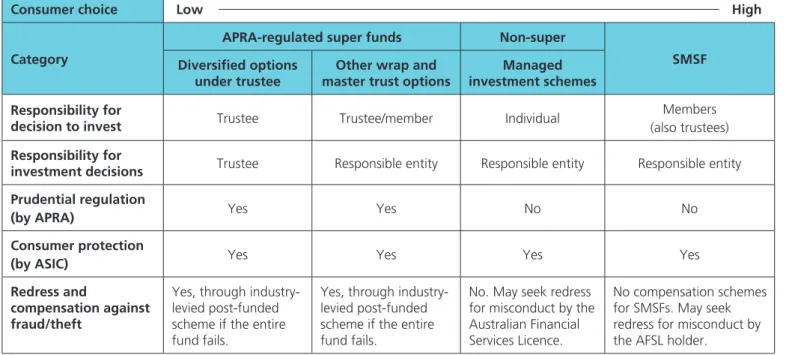
A review of the regulatory framework is made even more crucial because the compensation is different between a) a superannuation investor within an APRA-regulated fund who suffers a loss as a result of the failure of that fund and b) an SMSF trustee who selects a related product for their SMSF portfolio. The compensation available to each fund member reflects the fact that APRA regulated funds are prudentially supervised and SMSFs are not. Reflecting this, APRA regulated funds pay a higher supervisory levy than SMSFs, and there is a financial compensatory levy mechanism in place for APRA-regulated funds.
Consumer protection gaps
Across the various investment superannuation structures and opportunities, there are different oversight and consumer protection arrangements. Individuals who are bearing the investment risk on their superannuation investments should be able to make decisions that are appropriate for their own financial circumstances and reflect their personal risk appetite. They should also expect the same level of protection across the different ways in which they can make these investments.
While the level of protection needs to be consistent with the investment risk taken by the investor, it is vital that:
• regardless of the choice of vehicle and the way superannuation and retirement monies are invested, the regulator is able to ‘follow the money’ through underlying investment vehicles to ensure it is invested as disclosed
ASFA submission to Financial System Inquiry | 25 of 74 The table below highlights some of the current regulatory differences:
Table 6: Consumer choice, regulatory oversight and consumer protection
Consumer choice Low High
Category
APRA-regulated super funds Non-super
SMSF Diversified options
under trustee
Other wrap and master trust options
Managed investment schemes Responsibility for
decision to invest Trustee Trustee/member Individual
Members (also trustees)
Responsibility for
investment decisions Trustee Responsible entity Responsible entity Responsible entity Prudential regulation
(by APRA) Yes Yes No No
Consumer protection
(by ASIC) Yes Yes Yes Yes
Redress and
compensation against fraud/theft
Yes, through industry-levied post-funded scheme if the entire fund fails.
Yes, through industry-levied post-funded scheme if the entire fund fails.
No. May seek redress for misconduct by the Australian Financial Services Licence.
No compensation schemes for SMSFs. May seek redress for misconduct by the AFSL holder.
Source: Department of Treasury, ASFA.
In the scenario where the member has exercised no choice, the fiduciary oversight is very high. For MySuper products, the trustee is effectively asked to stand in the shoes of the member and make a decision about their investments. Similarly, where a member chooses an investment option that is not the default, say, for example, another diversified product, which has a strategic asset allocation and objectives approved by the trustee, there are still very onerous requirements on the trustee to ensure that the investment governance process is sound. These requirements are set out in the Superannuation Industry (Supervision) Act 1993 (SIS) and regulations and the APRA Prudential Standard SPS 530. Once the member choice moves beyond these diversified options, the oversight of the investments, even within superannuation, effectively becomes the remit of ASIC, rather than APRA, even though APRA still has regulatory
obligations with respect to these assets. Here, members may be investing directly into the underlying investment strategy of a stand-alone product offered by an external fund manager. The superannuation trustee’s control is mainly focused on whether or not to include the option, on the superannuation platform. The responsibility for ensuring the interests of unit holders of the Managed Investment Scheme (MIS) are met sits with the responsible entity (RE). There is a significant difference in the investment governance required from a superannuation trustee – regulated by APRA – versus the RE of a managed investment scheme – regulated by ASIC.
While Wallis recommended the harmonisation of the regulatory treatment of managed funds investments inside and outside superannuation (recommendation 89), this has not occurred. The fiduciary responsibility and regulatory oversight across direct investments, SMSFs, platform investments and superannuation investments has evolved to be quite
different. However, it is still important that there is a high level of regulatory power so that the money can be ‘followed’, no matter what the investment vehicles is. At this time, it is not clear whether ASIC or APRA, or even the ATO have this responsibility across all superannuation structures.
This notion can be extended to how far consumer protection should be applied to the assets and products invested in by SMSFs. For example, ASFA has previously advocated that consumer protection be increased in relation to SMSFs by mandating that asset classes such as investment property and limited recourse loans only be provided through licensed financial planners. This enables SMSF trustees to have access to industry and consumer dispute resolution bodies.
Uneven and inefficient regulatory burden and scope for regulatory arbitrage
Today, the number of entities supervised by APRA and products that are regulated by ASIC is considerably larger than it would have been when the various responsibilities were mapped to APRA and ASIC in 1997. Over the past 16 years, we have also seen a rise in regulation by other regulatory agencies with a broader remit than just the financial services sector or superannuation. Examples include AUSTRAC (anti-money laundering) and the Office of the Australian Information Commissioner (privacy).
As a minimum, ASFA recommends:
• regulation should be principles based rather than rules based so that it is flexible enough to apply to various structures and promote innovation
• an assessment should be carried out of the cost/benefit impact of any regulation or standards on different structures
• consistent application of regulation in order to remove the opportunity for regulatory arbitrage • that relief powers for regulators are broad.
The framework of the regulation of superannuation post-Wallis has been focused on the specific needs and responsibilities of regulators. The introduction of MySuper is a good example. This regulation has been applied at a product level and has involved substantial effort on the part of the industry and all related service providers. The full public benefit is yet to be determined. Should the regulation prove to be ineffective, for whatever reason, in the first few years of implementation, the time delay before sensible, necessary changes can be made is years, rather than months. In a fast-moving market, this is not conducive to market efficiency.
‘One size fits all’ legislation may, on occasions, have an inconsistent and possibly unfair impact, given the diversity and complexity of superannuation structures. One of the fundamental duties of a superannuation trustee is to act in the best interests of members and, as such, it is a sub-optimal outcome if complying with the legislation leads to outcomes where members are worse off. Further, strict compliance may cause a trustee to incur costs, or face risks, which are considerably in excess of those which would be necessitated by complying with a slightly modified provision, while still achieving substantially similar policy outcomes. These costs are usually borne by the investor.
It is important to note in this context that ASIC has considerable powers to exercise relief where legislation has had an adverse effect. This includes: unintended consequences, inappropriate scope and ambiguities that necessitate clarification or to grant transitional relief.
In ASFA’s submission to the Parliamentary Joint Committee on Corporations and Financial Services on the
Superannuation Legislation Amendment (Service Providers and Other Governance Measures) Bill 2012 dated 17 January 2013, we considered it important that the exemptions and modification power in the SIS legislation be extended. Part 29 of the SIS Act empowers APRA to grant exemptions and make modifications to specified provisions of the SIS Act. We consider it important that the exemptions and modification power in SIS be extended to empower APRA to exempt classes of trustees, or individual trustees, from full compliance with any SIS provisions or to modify how the SIS law applies, subject to any conditions which APRA may impose. This would have the protection of being administered by APRA, while having the flexibility to accommodate specific circumstances.
ASFA submission to Financial System Inquiry | 27 of 74
2.1.3. Systemic risk
Currently, there is no system-wide view of superannuation available to a regulator or public policy maker. There is: • no aggregate data on superannuation investments across the whole super pool
• no clear visibility of the significant role of other parties such as: administrators, custodians, clearing houses and gateways
• no high level view by a single regulator to monitor the whole of the system given we have two significant pools of money (SMSFs and pooled funds) and an emerging third pool of retirement assets.
The strong performance of Australia during the GFC and the role that superannuation funds were able to play in stabilising markets has been noted earlier, as has the generally unleveraged nature of superannuation investment; and its naturally longer investment horizon, which encourages investors to think of investment returns over a period of 10 years or more. These characteristics help provide stability to the financial system in times when investors with leverage or shorter-term objectives are in crisis. However, as the system matures, the level of short-term liabilities in the form of benefit payments, which our superannuation providers will be expected to deliver, will increase significantly. While there is expected to be far less leverage in the system than in, say, banking, the liquidity profile of superannuation providers will become increasingly important. At the moment, cash flows into the aggregate superannuation market exceed benefits paid. In years to come, the reverse will be the case and with that shift, liquidity risks will increase.
It will be critical to be able to estimate the size of different exposures in the system in order to assess the systemic market risk that such concentrations may create. Currently, we have no overarching collection of data on investments that sit within superannuation. While data collection across APRA-regulated funds has increased considerably, the ATO is not at this time able to provide the same level of information on SMSFs. As such, aggregate data across the whole system which would be useful for public policy makers is not available. Without this data, it is difficult to assess the extent of any of the risks emerging in the system.
There may be no large concentrations of exposures across the superannuation industry today, but over coming decades, we expect changes in technology and increases in investment choices to result in larger amounts of money moving faster. With this comes the potential for systemic risk.
Related to this is the potential exposure to a single counterparty providing longevity risk mitigation in the Australian market. As post-retirement products develop, and much-needed annuity and income-stream style products are taken up in the market, it will make sense to have visibility of the extent of system-wide counterparty risk to the issuers of these products and control this if necessary.
Further, with the rise in funds under management and mergers of third-party service providers, we are building up concentration risk exposures to key partners, such as custodians and administrators. The failure of any one of these would present issues for their superannuation fund clients. At present, each superannuation trustee is responsible for managing the risk of their outsourced service providers. A time may come when the system-wide exposure to any one custodian or any one administration company is very high. While assets may not be at risk, their failure to deliver services may have a significant short-term impact on the economy and on those Australians waiting for their regular benefit payments to be made.
2.1.4. Connectivity to social security and the tax system
Over the coming years, there will be an increasing interaction of retirement income policy with tax and social security policy and systems. Accordingly, it will be important to understand all of the structures and relationships relating to the retirement income industry. Critical to all of this is striving to ensure the interoperability of the various systems used to store and report data, including achieving consistency in the use of terminology format of data storage and transmission, and security protocols.
2.1.5. Post-retirement products
Later in this chapter, we will explore how to respond to the ageing and longer-living Australian population. It will be very important that an appropriate legislative and regulatory framework is established before the post-retirement product market is further developed.
While superannuation funds are able to provide account-based pensions; life offices are able to provide annuities; and defined benefit funds can provide a lifetime pension; there is scope both to improve the flexibility of the pension standards in the SIS regulations and the tax and social security treatment of various pensions, in order to facilitate product innovation and competition in this space.
Further, it would be desirable to see the extension of the MySuper concept, which currently only applies to members in the accumulation phase, to the retirement or drawdown phase. In particular consideration should be given to
streamlining a member’s transition from accumulation to drawdown, including the possibility of members being entitled to automatically receive an account-based income stream in retirement, which they can opt out of at any time.
2.1.6. Globalisation
Increasingly, there are rules and regulations affecting private pensions and superannuation that involve extra-territorial or international application.
Extra-territorial measures include the FATCA legislation of the United States of America. While superannuation funds in Australia have largely been carved out from the coverage of the FATCA provisions in regard to reporting to the US tax authorities, US citizens are subject to reporting and tax requirements on their interests in Australian super funds. International accounting standards also impact on how superannuation funds are required to report their financial accounts and how companies report any defined benefit liabilities in regard to fund members. International agreements have also led to extensive domestic legislation containing reporting requirements for superannuation funds and other entities in regard to anti-money laundering and counter-terrorism financing.
International harmonisation will continue to increase, which will impose its own challenges as countries globally move to protect their revenue base and allow for the global movement of funds.
Basel III capital adequacy arrangements directly impact on banks and deposit-takers but they have implications for superannuation funds given their impact on the interest rates that can be offered to various depositors. APRA-regulated superannuation funds, regarded as wholesale investors, are paid a lower interest rate on deposits with banks, reflecting the higher level of capital adequacy required relative to deposits made by households and SMSFs.
While there are merits in international consistency in regulation, ASFA considers that Australia should have a strong voice in international and bilateral negotiations in regard to any laws or agreements that impact on superannuation funds and other financial institutions. Policies developed in the context of circumstances in other countries, which may differ markedly from Australia, should not necessarily automatically be applied to Australia. There should be scope for international requirements to make allowance for the specific circumstances of superannuation funds in Australia. We also may see in coming decades an increase in the number of retirees who would like to live abroad, and may want to take their pension with them, as opposed to receiving payments from Australia. We may also see a greater number of overseas retirees looking to move to Australia.
A current example of this phenomenon is the two-way movement between Australia and New Zealand. There are also arrangements that allow for the transfer of pension benefits from pension schemes in the United Kingdom, but no equivalent arrangements to allow transfers from Australia to the United Kingdom. This is becoming an issue that is receiving increasing international attention with, for instance, moves to bring about pension portability between countries in the European Union.