Fast Automatic Security Protocol Generation
Hongbin Zhou Simon N. Foley∗Department of Computer Science University College, Cork, Ireland
{zhou,s.foley}@cs.ucc.ie
Abstract
An automatic security protocol generator is described that uses logic-based heuristic rules to guide it in a backward search for suitable protocols from protocol goals. The approach taken is unlike exist-ing automatic protocol generators which typically carry out a forward search for candidate protocols from the protocol assumptions. A pro-totype generator has been built that performs well in the automatic generation of authentication and key exchange protocols.
“In solving a problem of this sort, the grand thing is to be able to reason backward.”
—Sir Arthur Conan Doyle (Sherlock Holmes),
A Study in Scarlet, 1887.
1
Introduction
Security protocols are widely used in distributed systems for authentication, key exchange and other security requirements. Building security protocols can be a challenge since it is relatively easy to introduce subtle design-flaws that are difficult to find. While many approaches for analyzing security protocols have been developed [7, 13, 14, 28, 31, 36], relatively little work has been carried out on systematic approaches to thedesignandimplementation
of security protocols.
Abadi and Needham [4] set out ten principles to help designers avoid classes of known protocol flaws. The principles represent best practice and, however, are neither necessary nor sufficient: designers do not necessar-ily design new protocols by obeying only these principles. Formal design
∗
approaches for security protocols have also been proposed. A weakest-precondition-based approach is proposed in [5] that can be used to syn-thesise protocols from authentication goals. The Simple (BSW) logic [8] is a BAN-like logic that provides synthesis rules to guide the protocol designer in the manual systematic calculation of a protocol from its goals.
Guttman [16] proposes a manual protocol design methodology that is based on authentication tests [17]. For different goals, individual subproto-cols are generated that are combined together to form the final protocol. It is a manual design process and relies on the skill of the protocol designer. Saidi [32] proposes a semi-automatic design tool based on BAN logic. It provides several commands for human intervention during the generation process. While it may simplify the protocol design process, it does not fully automatically genereate protocols, and still relies on the skill of the protocol designer.
We are interested in the automatic generation of security protocols from their protocol goals and assumptions. Existing research on this topic in-cludes Clark and Jacob’s evolutionary search [10, 12], Perrig and Song’s Automatic Protocol Generator (APG) [30], and the authors’ Automatic Se-curity Protocol Builder (ASPB) [38]. All the above approaches automati-cally construct and search a large space of candidate protocols that is far larger than could be considered via a manual design.
Starting from a set of assumptions, [12] uses the original inference rules of the BAN logic to systematically test whether candidate protocols uphold all protocol goals. A fitness function is used in their evolutionary approach to guide the application of BAN inference rules in a forward manner until a valid protocol is arrived. Their subsequent work [10] is based on the SVO logic [35], on the basis that the SVO logic is more suitable for describing and analysising key agreement protocols than the BAN logic.
Protocols that are generated using [10, 12] are implicitly verified, within their corresponding logic, to meet their goals. Perrig and Song’s Automatic Protocol Generator (APG) [30] uses syntactic restriction rules to select ran-dom candidate protocols that are in turn checked for validity using the Athena [33] security protocol checker.
The above approaches can be regarded as generating candidate protocols in a forward manner: protocol messages are generated in the same order as their eventual execution in the protocol. Intuitively, a candidate first message is selected, along with its resulting inferences, and a recursive search for subsequent messages for the protocol. This forward search is bounded by a predefined maximum number of protocol messages, and terminates when the protocol goal is satisfied is met for the current sequence.
When a protocol fragment (an incomplete protocol) is generated in a forward manner, it is hard and potentially impractical, to determine whether the protocol fragment may result in a validate protocol which meets all protocol goals. Therefore, all generated protocol fragments should be kept before they extend to complete candidate protocols for further verification. It may be impractical to keep all generated protocol fragments especially for protocols that have more than four messages due to the large number of generated protocol fragments. For example, even with fitness functions [10,12] or cost functions [30], these forward searching approaches must verify a large number of unlikely protocols and may not meet all goals. Moreover, providing an accurate fitness function for a protocol is very difficult, and in some cases potentially impossible [10, 12].
In this paper we consider the automatic generation of security protocols from requirements. This paper is an extended and significantly revised ver-sion of [38], and makes a number of contributions. A technique for efficient protocol generation based onbackwardsearch is proposed. Heuristic rules— based on an extended version of the BSW logic [8] to provide a ‘first cut’ definition of protocol security—are used to guide the search for potentially secure protocols. Unlike the original BSW-logic, the BSW-ZF logic used in this paper supports reasoning about message secrecy, fresh channels, and component holding statements. The backward search approach results in an efficient search of the protocol space since the heuristics—derived from the logic axioms—guide the search and quickly eliminate regions of the search space than could not be synthesized from the protocol goals.
These heuristic rules generate sub-protocol fragments based on indi-vidual protocol goals and these are, in turn, composed into collections of candidate protocols using a novel strategy based on shortest common sub-sequence. The heuristics are also augmented by extending protocol selec-tion/design strategies [16, 21, 22] in order to restrict the generated protocols to a collection of candidate protocols that are likely to be secure. While the collection of candidate protocols are secure under the BSW-ZF logic, the in-tention is that more sophisticated protocol analysis tools, such as [20,23–25], are then used to select appropriate protocols from the collection.
The paper is organized as follows. The BSW-ZF logic, a modified and extended BSW logic, is outlined in Section 2. This section also describes how the synthesis rules are used as heuristics to guide the automatic backward search for protocols within the logic. The high-level architecture of ASPB is outlined in Section 3. Section 4 describes how the BSW-ZF heuristics are used to generate sub-protocols from single goals. The sub-protocols of multiple goals are composed into candidate protocols using the algorithm
described in Section 5. Section 6 outline a number of additional strategies used by ASPB to further refine and the candidate protocols to a collection of valid protocols. ASPB is evaluated and compared to other approaches in Section 7. Appendix A provides a complete list of the BSW-ZF Heuristic rules and Appendix B provides provides samples of generated protocol.
2
The BSW-ZF logic
The BSW-ZF logic improves and extends the BSW logic [8] to support reasoning about message secrecy, fresh channels, and ‘holding’ statements. While the inference rules of the BSW-ZF logic can be used to verify prop-erties of security protocols [38], it is their corresponding heuristic rules that are used in ASPB as the core technique to guide the automatic backward search for candidate subprotocols from their goals. Therefore, for reasons of space we do not provide the inference rules of BSW-ZF as they can be inferred from the definitions of the heuristic rules, which are provided in Appendix A.
2.1 Syntax
The BSW-ZF logic uses abstract channels that are similar to the Spi Calcu-lus [3] in order to represent keyed communication between principals. The capability to write into (for example, using the encryption key) and to read from (e.g., using the decryption key) a channel C is denoted by w(C) and
r(C), respectively. The formulaP 3r(C) means that principalPhas the ca-pability to receive messages from channelC, and correspondingly,P 3w(C) means that principalP has the capability to send messages to channelC.
Letσ(X) denote the set of principals that share a secretX. The secret
X can be a temporary secret that is held during several protocol steps, or a long term secret. We assume that the secret X is never leaked to any principal outside σ(X), other than to those principals that are trusted by the members of σ(X). For example, P |≡ (σ(X) = {P, Q}) means that
P believes X is a secret shared between P, Q, and any third parties who (trusted byP and/orQ) may be privy toX. In this case, it is assumed that a trusted principal will neither useXas a proof of identity nor as a channel to communicate with. With this assumption, only two principals, P and
Q, may use X as a proof of identity or as a channel to communicate with. When either of them receivesX in a message, the principal may determine whether the message was sent by itself or by the other party. Thus, the message origin can be safely determined. Also note that this assumption
implies that principals trusted by other protocol participants will not attack the current protocol.
The set of principals that can receive and can send messages via a chan-nel C is denoted by its reader set σ(r(C)) and its writer set σ(w(C)), respectively. For example, if Ω represents the set of all principals, then
σ(r(C)) = Ω andσ(w(C)) ={P}represents an authentic channel, whereby any principal can authenticate messages signed by the private key of prin-cipalP.
In the following, P,Q range over principals; C represents a channel; X
represents a message which can be data or formulae or both; φ represents a formula. Data, such as principal identities, nonces, and read and write channel properties, are atomic messages that may be held by principals. The BSW-ZF logic uses the following basic formulae.
P / X: PrincipalP sees messageX. Someone has sentX via a channel that
P can read.
P / C(X): P sees X on channel C. Someone has sent a message X via
channelC. IfP can not read C then P can not discover the contents ofX.
P |∼X: P once said X. P sent a message containing X at some point in the past. We do not know exactly when the message was sent.
P k∼X: P says X. P sentX in the current run of the protocol.
](X): MessageX is fresh. X has never been said before the current run of the protocol. This is usually true for messages containing fresh nonces or messages sent using a fresh session key (channel).
P |≡φ: P believes thatφis true. It does not mean that φis actually true, rather,P believes it.
P 3X: P holds X, and therefore, may freely combine X with other mes-sages and send the resulting combinations out to other principals.
Un-likeP / Xrequires thatXis obtained byP during a round of protocol,
P 3X can be obtained as an assumption before a round of protocol.
P 7→X: P generates X. This formula represents the origin of message X. The messageX is used to represent constants or the atomic messages that are generated by the principal. Examples include nonces and principal identifiers.
Protocol steps, goals and assumptions are each expressed as formulae within the logic in the usual way. The logic also uses the conventional logic operators∧(conjunction),∨(disjunction) and→(implication) from propo-sitional logic and some basic notation from set theory, such as = (equality), and ∪(union).
2.2 Inference Rules
To verify a security protocol, an idealised protocol and initial principal as-sumptions are initially given. The inference rules are used to guide the search from initial assumptions to further beliefs in the order of protocol execution. Belief logics verify whether expected protocol goals are covered by initial assumptions and these further derived beliefs.
2.3 Heuristic Rules
To synthesise (design) a security protocol, only protocol goals and initial principal assumptions are given beforehand. A number of well-ordered pro-tocol steps are derived from given propro-tocol goals and given assumptions using a heuristic as template. Intuitively, the heuristic rules of the BSW-ZF logic are a more prescriptive form of the synthesis rules of the BSW logic, for the purposes of automation in ASPB.
While the inference rules of the BSW-ZF logic are used to verify security protocols, the BSW-ZF logic can also be used for synthesising security proto-cols. The heuristic rules can be used as synthesis rules to guide thebackward construction for candidate subprotocols from their goals. In this case, the backward construction means that the protocol steps are constructed by the backward order of protocol execution. The reason for this is that the last required protocol step for a given protocol goal is naturally derived from applying heuristic rules to the protocol goal.
Our heuristic rules take the general form of a rooted treeof temporally ordered goals. A rooted tree is a directed acyclic graph (DAG) with a vertex
that is singled out as the root. GOO C1 o o ` ` W W // // // // // // // // // G1 ... Gi+1 Gi
This is interpreted to mean that in order to reach the goal G, all sub-goals G1, ..., Gi, have to be established without any conditions or in any
particular temporal order. SubgoalGi+1 is an optional conditional subgoal
under conditionC1, with the interpretation that if condition C1 is satisfied,
thenGi+1 has to be established before the goalG can be established.
Oth-erwise, Gi+1 does not need to be considered. Arcs indicate the temporal
relationship between a goal and its subgoals.
In some scenarios, subgoals have to be established in a particular tempo-ral order. For example, before a principal receives a message via a channel, there must be another principal who first sent the message in that channel. Therefore, we use the following form to illustrate the ordered subgoals.
GOO C1 o o G1 O O aaoo B B B B B B B B G5 G2 G3 G4
This is interpreted to mean that in order to establish the goal G, all subgoals G1, ..., G5, have to be reached in a particular temporal order.
Here,G3,G4, andG5 must be established before G1. However,G3,G4, and
G5 do not need to be reached in any temporal order relative to each other.
The goals are expressed in the heuristic rules using a composed form
G0;G00, as follows, G0 ; G00OO oo__ ? ? ? ? ? ? ? ? G1 G3 G2
This is an abbreviated form of two heuristic rules and means that these rules have the same subgoals but different goals. They can be rewritten as
GOO0aaoo B B B B B B B B G1 G3 G2 and GOO00aaoo B B B B B B B B G1 G3 G2
RulesHeur1andHeur11illustrate the heuristic rules of the BSW-ZF logic. Appendix A provides the full set of heuristic rules derived from the inference rules of the BSW-ZF logic.
Heur1 To see messageX,P must receive X on channel C and be able to readC. Before P receivesX fromC, some principalQshould holdX
and may write in channelC. In addition, if the honesty assumption is present, thenQ is required to believeX before it can hold X.
P / XOO oo P / COO (X)oo Q3OO X
P|≡((Qk∼X)→(Q|≡X))
P 3r(C) Q3w(C) Q|≡X
ThatP /X can be synthesised fromP 3r(C) andP /C(X) is justified by the Seeing AxiomS1of the BSW-ZF logic [38]:
P / C(X), P ∈r(C)
P / X
For the purposes of this paper we do not consider the BSW-ZF Axioms, other than to note that they were used to inform our selection of the heuristic rulesHeur1 through Heur16(Appendix A).
Note that a heuristic (more general thanHeur1) that is directly based on the S1 rule—whereby P / X is synthesized from P 3 r(C) and
P / C(X)— is inadequate in practice. In particular, when there are no
given protocols, the origin of the message C(X) is unknown. There-fore, we require that some principalQholds X and thatQmay write inC before P may receive X from channelC, as reflected in Heuristic
Heur1. This is similar in intent to the ‘required precondition’ that is used in [5].
Heur11 To believeφ1,P must believeφ2 and φ2 →φ1.
P |≡OO φ1gg O O O O O O O O O O O O P |≡φ2 P |≡(φ2→φ1) 8
3
ASPB Architecture
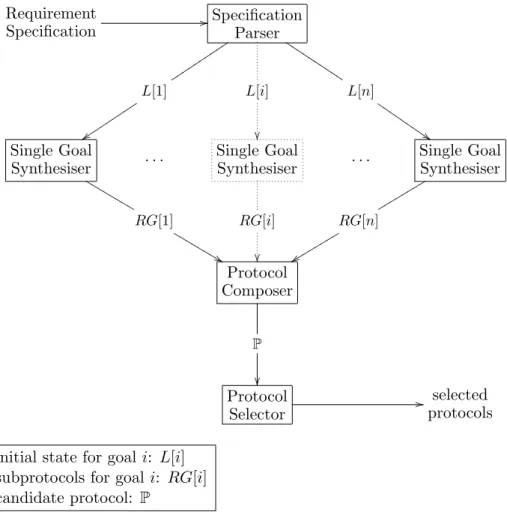
Figure 1 outlines the architecture of the Automatic Security Protocol Builder (ASBP). A protocol specification is parsed and decomposed into a series of single goal protocol requirements using the Specification Parser. From these single goal protocol requirements, a collection of subprotocols are syn-thesised to satisfy the individual goals using the Single Goal Synthesiser (Section 4). The Protocol Composer (Section 5) merges these subprotocols to form complete candidate protocols. The Protocol Selector (Section 6.3) selects what are considered the most suitable protocols from the candidate protocols. Requirement Specification // Specification Parser tttttt tttt J J J J J J J J J J L[1] z z tttttt ttt L[i] L[n] $ $ I I I I I I I I I Single Goal Synthesiser RG[1] L L L L L L L L & & L L L L L L L L . . . Single Goal Synthesiser RG[i] . . . Single Goal Synthesiser RG[n]rrr rrrrr y y rrrrrr rr Protocol Composer P Protocol Selector // selected protocols initial state for goali: L[i]
subprotocols for goal i: RG[i] candidate protocol: P
Figure 1: Overview of Automatic Security Protocol Builder
context of the principals. It reflects the keys that principals know, the trust relationships between principals, and any other assumptions that they may hold. Our protocol requirement specification defines the terms that are used in the specification, initial known assumptions, and goals for the protocol to be designed. These are represented using the BSW-ZF logic.
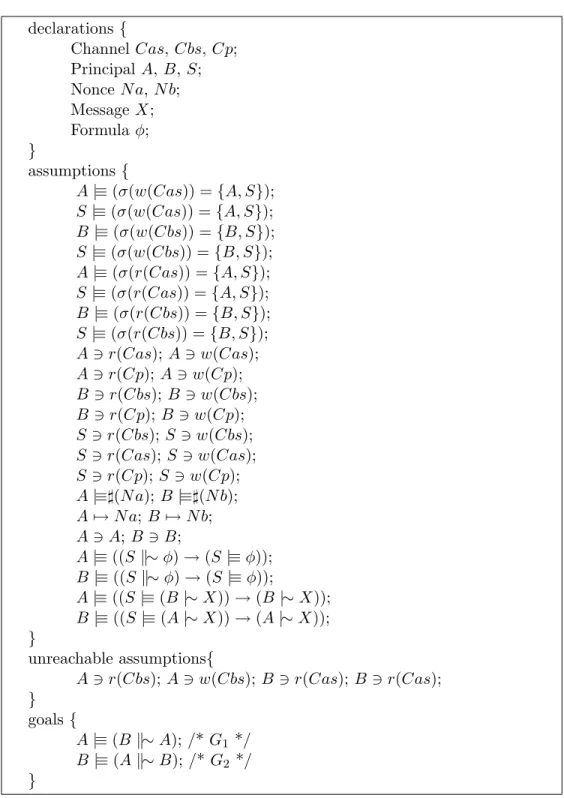
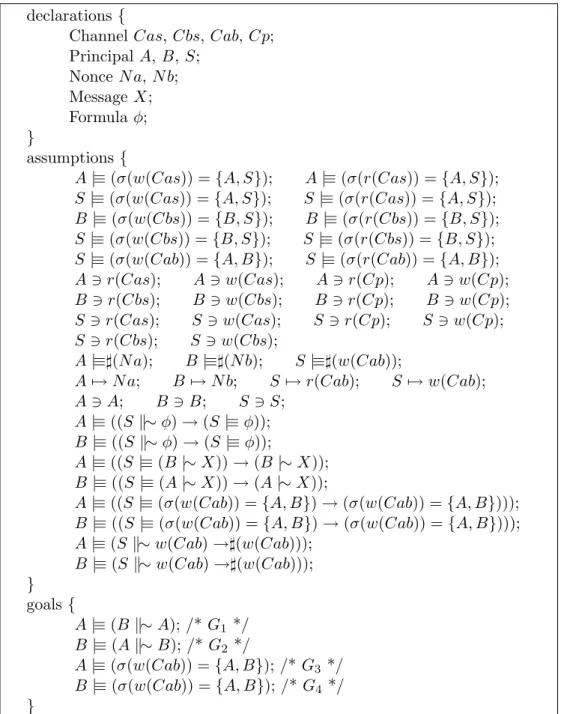
Example 1 Figure 2 gives a complete requirement specification for a mu-tual authentication protocol using symmetric keys with a Trusted Third Party (TTP). Note that unreachable assumptions may also be included in the requirement specification. These do not affect the logic, but are used to direct the synthesis during pruning, and will be explained in Section 4.1. 4
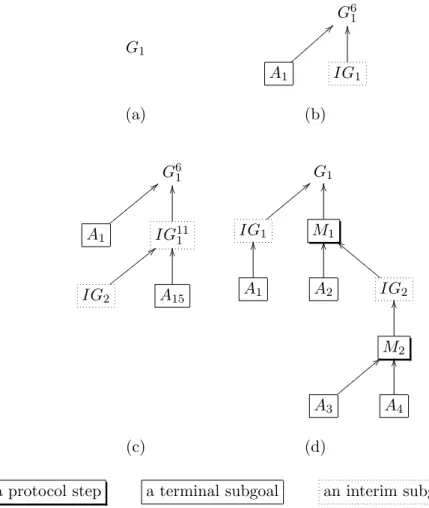
The Requirement Specification Parser parses the specification and checks whether all the formulae are valid based on the logic syntax and the types defined in the ‘declarations’ section of the specification. For each goal to be proven, the parser generates a single-node (root) formula tree (of that goal) as an initial synthesis state. This single-node rooted tree is regarded as a initial formula tree for synthesis, such as Figure 3(a). These provide the inputs to the Single Goal Synthesiser.
4
The Single Goal Synthesiser
The Single Goal Synthesiser accepts an initial synthesis state from the Re-quirement Specification Parser, automatically synthesises its goal using the heuristic rules of the BSW-ZF logic, and builds complete formula trees from the goal. The BSW-ZF heuristic rules define how this tree may be expanded, and a snapshot of this tree (rooted at that goal), represents a synthesis state. The single (root) node of an initial formula tree is the goal that any synthe-sised protocol must uphold.
Since the heuristic rules of the BSW-ZF logic are also defined in terms of rooted trees, the synthesis of a one-way authentication protocol can be illustrated bytree grafting, whereby instantiations of suitable heuristic rules are grafted intoincomplete formula trees that are extended from the initial formula tree until a complete formula tree is held. An incomplete formula tree has one or more leaves that are not assumptions from the requirement specification, such as (a), (b) and (c) in Figure 3. All the leaves of a complete formula tree correspond to assumptions from the requirement specification, such as Figure 3 (d).
If a protocol goal is not an assumption from the requirement specifica-tion, then the corresponding initial formula tree is an incomplete formula
declarations{ Channel Cas,Cbs,Cp; PrincipalA,B,S; Nonce N a,N b; MessageX; Formulaφ; } assumptions{ A|≡(σ(w(Cas)) ={A, S}); S|≡(σ(w(Cas)) ={A, S}); B|≡(σ(w(Cbs)) ={B, S}); S|≡(σ(w(Cbs)) ={B, S}); A|≡(σ(r(Cas)) ={A, S}); S|≡(σ(r(Cas)) ={A, S}); B|≡(σ(r(Cbs)) ={B, S}); S|≡(σ(r(Cbs)) ={B, S}); A3r(Cas); A3w(Cas); A3r(Cp); A3w(Cp); B3r(Cbs);B 3w(Cbs); B3r(Cp);B 3w(Cp); S3r(Cbs); S3w(Cbs); S3r(Cas);S 3w(Cas); S3r(Cp);S 3w(Cp); A|≡](N a); B|≡](N b); A7→N a;B 7→N b; A3A;B 3B; A|≡((S k∼φ)→(S |≡φ)); B|≡((S k∼φ)→(S |≡φ)); A|≡((S |≡(B |∼X))→(B |∼X)); B|≡((S |≡(A|∼X))→(A|∼X)); } unreachable assumptions{ A3r(Cbs);A3w(Cbs); B3r(Cas); B3r(Cas); } goals{ A|≡(B k∼A); /*G1 */ B|≡(Ak∼B); /*G2 */ }
Figure 2: A complete requirement specification for mutual authentication protocols using symmetric keys with TTP
tree. If a protocol goal is an assumption from the requirement specifica-tion, then the corresponding initial formula tree is a complete formula tree. The fact that an initial formula tree can be a complete formula tree, re-flects that complete formula trees may contain no protocol steps, since the corresponding protocol goals do not require the cooperation of principals.
By distinguishing complete formula trees from incomplete complete for-mula trees, the end-point of a synthesis process is determinable. More specif-ically, the synthesis for the root of the complete formula tree is finished, when a complete formula tree is generated. Figure 3(b) and (c) describe two grafting steps from initial formula trees. Algorithm 1 describes this process.
Algorithm 1 StateSet syn(StateinitState) State s; StateSet S0,R =φ; StateSet L={initState}; while ¬empty(L) do s =choose(L); L =L \s; if hasGoal(s) then S0 = subsyn(s); L= add(L,S0); else R =add(R,s); end if end while returnR;
Operation choose(L) picks an arbitrary synthesis state sfrom the set of current statesL.
If the given statesis an incomplete formula tree, then operationsubsyn(s) selects a leaf node that is not an assumption, and applies the currently ap-plicable heuristic rules to this leaf node. A number of new formula trees are generated by appending the subgoals of the applicable heuristic rules to the formula tree. Operation subsyn(s) returns these new formula trees as a collection of synthesis states. For example, the different formula trees in Figures 3(b) and (c) could be generated and returned by subsyn(s) for the formula tree in Figure 3(a).
If no heuristic rule can be applied to a leaf node (terminal subgoal) then the Single Goal Synthesiser tests whether this leaf matches an assumption.
G1 G61 = = {{{{{{ {{ OO A1 IG1 (a) (b) G61 < < yyyyyy yyy OO A1 IG<< 111 xxxxxx xx OO IG2 A15 G1 < < zzzzzz zz OO IGOO 1 MOO1bb D D D D D D D D A1 A2 IG2OO M2 < < zzzzzz zz OO A3 A4 (c) (d)
a protocol step a terminal subgoal an interim subgoal
If so, then it is considered reachable. If all leaves of a tree are reachable, then the tree is a complete formula tree, and represents a candidate protocol for the goal. It is added to the set of complete formula trees R for the given goal.
An automatic verification tool [26] for the original BSW Logic has been implemented using Theory Generation [18]. This tool [26] also supports (manually guided) synthesis of protocols using the synthesis rules described in [8]. The Single Goal Synthesiser described in this section builds on and extends this manual tool in [26] by automatically carrying out the synthesis process for the BSW-ZF logic.
4.1 Improving Performance
To improve the performance of the Single Goal Synthesiser, a number of ad-hoc strategies are used as part of the operation subsyn(s), including early pruning, variable instantiation, and tree pruning.
Early Pruning. Having applied a heuristic rule, consider generated for-mulae that are of the form of P 3 r(C), P 3 w(C), or P |≡](Y). To speed up the judgement process, the operation subsyn(s) checks whether leaves of this form in generated formula trees match the initial assumptions or specify unreachable assumptions of the requirement specification. If a leaf matches an assumption, then the leaf is reach-able and the search terminates at this point. For example,A3r(Cp) and B3w(Cp) in Figure 4(d) match specified assumptions, then the search terminates at this point. OnlyB 3(A, N a) remains for further synthesis. If any leaf matches a specified unreachable assumption, then the corresponding formula tree is also unreachable, and the formula tree is simply discarded. For example, ifB 3w(Cas) in Figure 4(b) or
A 3 r(Cbs) in Figure 4(c) match specified unreachable assumptions, then the corresponding formula trees are simply discarded. Otherwise, the formula tree is kept for further synthesis. The rationale for early pruning is that formulae of this form are frequently generated using the heuristic rules, such asHeur1,Heur5–10, andHeur12–14, and it is straightforward to immediately determine whether they are reachable by this approach.
Variable Instantiation. Some heuristic rules introduce new variables that do not appear in the goal, but appear in the subgoals. For example,
Heur1, andHeur6–10. If the type of the variable is known (for exam-ple, variableQ is a principal, and variableC is a channel inHeur1),
A /(A, N aOO )oo A / C(A, N aOO )oo B 3A, N a
A3r(C) B 3w(C)
(a) ApplyingHeur1on A /(A, N a) with variable Qinstantiated as B
A /(A, N aOO )oo A / CasOO(A, N a)oo B3A, N a
A3r(Cas) B3w(Cas)
(b) Instantiated variable C by Cas
A /(A, N aOO )oo A / CbsOO(A, N a)oo B3A, N a
A3r(Cbs) B 3w(Cbs)
(c) Instantiated variable C by Cbs
A /(A, N aOO )oo A / Cp(OOA, N a)oo B 3A, N a
A3r(Cp) B3w(Cp)
(e) Instantiated variable C by Cp
A|≡OO φ1oo A|≡(φ2OO →φ1)oo A|≡(φn→(. . .→(φ2 →φ1)))
A|≡φ2 A|≡φn
(d) A Formula Tree for Recursively Applying Heur11 onA|≡φ1
then the heuristic rule is repeatedly applied for all possible instantia-tions of the variable from the ‘declarainstantia-tions’ section of the requirement specification. As a result of this, a number of independent states that have no variables are generated. For example, Figure 4(a) introduces channel variableC. Assuming channel declarations Cas, Cbc and Cp
and applying all possible instantiations of variableCin the example in Figure 4 then variable-free independent states Figure 4(b), (c), and (d) are generated. Operation subsyn(s) then applies the ‘early pruning’ strategy to these instantiated states.
Some heuristic rules introduce variables of unknown type. For exam-ple, in theory, variable φ2 in Heur11 could be bound to any logical formula, resulting in an infinite state space. In practice, we consider that in order to reach Heur11’s goal, both of its two subgoals must be reached beforehand. In order to determine whetherHeur11 is ap-plicable to P |≡ φ1, where φ1 has no unbound variables, a search is
made for a pattern P |≡ (φ2 → φ1) for some arbitrary φ2 in the
as-sumptions of the requirement specification. If matched, the heuristic rule is applied. If no match occurs, then a search is done to test if it is possible to synthesise a formula of the form P |≡(φ2 → φ1), from
existing assumptions in the requirement specification. In practice, this search is relatively straightforward as onlyHeur11 can be applied to
P |≡(φ2 →φ1), whereupon it recursively searches for formulae of the
form P |≡(...(...→ φ1)) in assumptions, such as the formula tree in Figure 4(d).
To further minimise the search space,Heur11disregards higher order belief formulae [7] of the form P |≡ (Q k∼ (Q k∼ X)) and P |≡
(Q |≡ (Q |≡ X)), etc., on the basis that they do not provide any additional information than the first order beliefs P |≡(Qk∼X) and
P |≡(Q|≡X), etc.. With these strategies, we restrict the state search space, and generate a wide range of useful protocols.
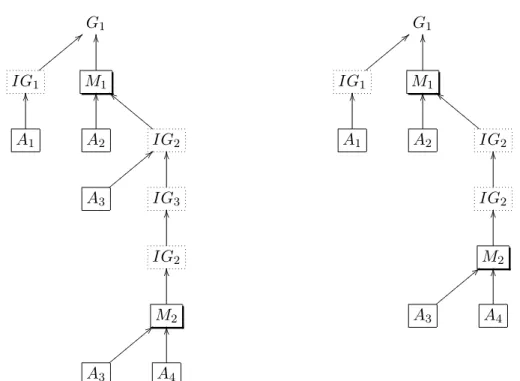
Tree Pruning. The Single Goal Synthesiser does not allow any formula as its own direct or indirect parent in a formula tree. The reason for this is that the Single Goal Synthesiser terminates the extension for any branch of a formula tree as early as possible. If a goal can be achieved, then the simplest subtree does not involve itself as a subgoal. Otherwise it involves an infinite search for this goal, since any branch for this goal in a formula tree requires itself as a subgoal, such as the formula tree in Figure 5(c). For a goal to have itself as its own
direct or indirect parent in a formula tree, the high level subtree for this goal can be safely replaced by the low level subtree for the same goal. The replacing formula tree is already in the state set since the Single Goal Synthesiser extends a formula to all possible formula trees without any formula as its own direct or indirect parent. For example, formula trees in Figure 5(a), (b) can be simplified to the formula tree in Figure 5(d).
Example 2 Two subprotocols are automatically synthesised from GoalG1
in the requirement specification of Figure 2. Subprotocol 1.1 corresponds to the protocol messages from the search tree in Figure 4. Further synthesis generates an additional search tree with corresponding Subprotocol 1.2.
Subprotocol 1.1 Subprotocol 1.2
A, A,
B / Cp(A, N a), S / Cas(A, N a),
S / Cbs(A, N a), B / Cbs(A, N a),
A / Cas(B |∼(A, N a)). A / Cp(A, N a).
Note that the first line of a subprotocol indicates the subprotocol initiat-ing principal (initiator) that generates the first message of the subprotocol. The synthesis of the symmetrically similar goal G2 generates two similar search trees from which symmetrically similar subprotocols 2.1 and 2.2 are obtained. Subprotocol 2.1 Subprotocol 2.2 B, B, A / Cp(B, N b), S / Cbs(B, N b), S / Cas(B, N b), A / Cas(B, N b), B / Cbs(A|∼(B, N b)). B / Cp(B, N b). 4
5
The Protocol Composer
The Single Goal Synthesiser is used to generate subprotocols from a single goal. While not considered in the original paper [8], it is possible, in theory, to use the original BSW synthesis rules to synthesise multiple goals. In the same way, the heuristic rules of the BSW-ZF logic could be used to synthe-size a protocol from multiple goals. However, in practice, building a search
G1 < < zzzzzz zz OO IG1OO M1OO bb D D D D D D D D A1 A2 IG<< OO 2 zzzzzz zz A3 IGOO 3 IG2OO M2 < < zzzzzz zz OO A3 A4 G1 < < zzzzzz zz OO IG1OO M1OO bb D D D D D D D D A1 A2 IGOO 2 IGOO 2 M2 < < zzzzzz zz OO A3 A4
(a) SubgoalIG2 as Its Own Indirect Parent (b) SubgoalIG2 as Its Own Direct Parent
G1 < < zzzzzz zz OO IGOO 1 MOO1bb D D D D D D D D A1 A2 IG2OO IGOO 2 IG2 G1 < < zzzzzz zz OO IGOO 1 MOO1bb D D D D D D D D A1 A2 IG2OO M2 < < zzzzzz zz OO A3 A4
(c) Infinite Search for SubgoalIG2 (d) No Subgoal as Its Own Parent
a protocol step a terminal subgoal an interim subgoal
Figure 5: Self-Parent Formula Trees and Infinite Search 18
tree for multiple goals results in a potential state explosion as each step must consider the application of all possible combinations of heuristic rules that could be applied in the current state. ASPB avoids this problem by first synthesising only single goal protocols and it then uses the Protocol Com-poser to, in turn, merge these single goal protocols into a single candidate protocol that meets the composition of goals.
A feasible candidate protocol for a requirement specification must achieve all of the goals described in the requirement specification, otherwise the can-didate protocol does not satisfy the requirement specification (within the logic). For this reason, the Protocol Composer generates a feasible candi-date protocol by composing a number of subprotocols. Each of these sub-protocols is selected from the generated subprotocol set for each goal in the requirement specification, and the composition of these subprotocols satis-fies all the goals. There can be many possible ways to merge subprotocols. The easiest way to merge two subprotocols is to append one to the end of the other. However, this may lead to lengthy and inefficient protocols. In addition, such protocols are certainly not fail-stop [15], since an attacker may run part of the protocol (achieving one goal) without completing the other subprotocol.
5.1 Merging Principal sequences
A security protocol is a sequence of messages exchanged between principals in order to achieve a number of security goals. At an abstract level, these message exchanges can be described just in terms of a principal sequence. A principal sequence is a sequence of principal identities based on the order of message exchanges between the principals in a protocol. For example, Subprotocol 1.1 implementing goal G1 (Example 2) has principal sequence
A → B → S → A; Subprotocol 2.2 implementing goal G2 has principal
sequence B→S →A→B.
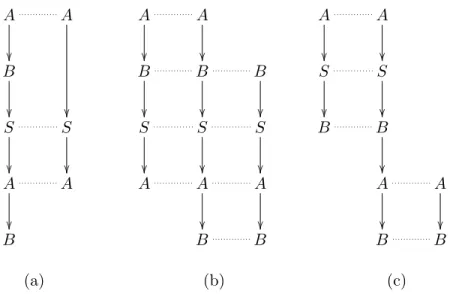
Given principal sequencesXandY, then we say that sequenceX covers
sequence Y if Y appears as a fragmented subsequence of X. For example,
Figure 6(a) illustrates that A → B → S → A → B covers A → S → A.
The Protocol Composer uses principal sequences to guide the construction of new protocols when merging subprotocol messages.
Given a collection of subprotocolsP1. . .Pnthat meet goalsG1. . . Gnof
a protocol specification, respectively, the Protocol Composer tests whether a given principal sequence covers the principal sequences of the
subproto-cols P1. . .Pn. This is done using a variation of the shortest subsequence
se-A A B S S A A B A A B B B S S S A A A B B A A S S B B A A B B (a) (b) (c)
Figure 6: Sequence Covering Examples
quences of the subprotocolsP1. . .Pn, then it is a possible principal sequence
of a candidate protocol. For example, in Figure 6(b), principal sequence
A → B → S → A → B covers both principal sequence A → B → S → A
for Subprotocol 1.1 and principal sequence B → S → A → B for Subpro-tocol 2.2, then principal sequence A → B → S → A → B is a possible principal sequence of a candidate protocol that satisfies both G1 and G2.
The candidate protocol is generated by merging the messages of the individ-ual subprotocols according to the generated (covering) principal sequence. The behaviour of the Protocol Composer is specified by Algorithm 2.
The Protocol Composer accepts two parameters: the protocol initiator
prinand an arrayRG. Each elementRG[i] ofRGis the state set for theith goal of the given requirement specification. The state sets are generated by the Single Goal Synthesiser and correspond to the possible subprotocols for a given goal. The Protocol Composer generates candidate protocols based on the rule of shorter first, so that principal sequences (protocol patterns) are generated from the shortest to the longest.
Operation sP attern(RG) returns the shortest length of all the possible candidate protocols inRG. If a candidate protocol is composed of a num-ber of subprotocols, then the principal sequencing of the candidate protocol must cover all the principal sequences of these subprotocols. Thus, the can-didate protocol is not shorter than the longest of these subprotocols. Note
Algorithm 2 ProtocolSet compose(Principalprin, Array RG) Array RS =φ;
ProtocolSet P0,P =φ; PatternSet T; Pattern t;
fori =sPattern(RG) to lPattern(RG) do
T =genPatterns(prin,i); while ¬empty(T) do t=choose(T); T =T \t; RS =match(t,RG); P0 = subCompose(t,RS); P=add(P,P0); end while end for returnP;
that the shortest pattern only guarantees that possible candidate protocols are not shorter than the shortest pattern. It does not means that a can-didate protocol as the length of given shortest pattern can be generated. The reason for this is that the principal sequence of a candidate protocol is a common principal sequence that covers the principal sequences of its composing subprotocols. If the principal sequence of any subprotocol may not cover all other subprotocols, then a common principal sequence should be longer than all of its composing subsequences. For example, the length of all subprotocol principal sequences in Example 2 is 4, then the principal sequence length of a candidate protocol may not be shorter than 4. Oth-erwise, the principal sequence of candidate protocols may not cover any subprotocol. It follows that no protocol can be composed by given principal sequence length and subprotocols. On the other hand, the length of the shortest principal sequence that may cover subprotocols for all goals is 5. Figure 6(b) presents a possible covering example. This principal sequence length is longer than the length returned by operationsP attern(RG).
Operation lP attern(RG) returns the longest possible pattern length of all the possible candidate protocols in RG. Given n goals, where li is the
length of the longest subprotocol for theith goal, then the longest pattern length is Pn
i=0(li−1) + 1. The motivation here is to generate a category
of protocols such that the message receiver of a protocol step is the mes-sage sender of the next protocol step. Since the first line of a subprotocol only indicates the subprotocol initiator that generates the first message of
the subprotocol, when merging subprotocols into a candidate protocol, all of the subprotocol initiators should be a receiver of the previous protocol step, except for one initiator that is the candidate protocol initiator. The length of the longest pattern of a candidate protocol should be the sum of the number of steps of all the subprotocols plus the candidate protocol initiator. Note that the number of steps in a subprotocol is the length of the associated principal sequence minus one (which is used to indicate the subprotocol initiator). For example, principal sequence of the given can-didate protocol in Figure 6(c) is A → S → B → A → B. It covers its subprotocol principal sequences A → S → B and A → B. If a candidate protocol is composed as Figure 6(c) by the subprotocols corresponding to the given subprotocol principal sequences. No message is sent at the step
B→A of the generated candidate protocol. Therefore the last stepA→B
of the generated candidate protocol can be executed without executing the previous protocol steps. In this case, it is possible for an intruder to gen-erate and send a message to B in this protocol step without participating previous protocol steps of the same round.
OperationgenP atterns(prin,i) generates all of the principal sequences, that are initiated by principal prinand with length i, as possible protocol patterns.
Operation match(t, RG) returns an array RS such that each element
RS[i] is a subset of the corresponding state set RG[i] that is covered by the principal sequences of all RS[i]’s states that are, in turn, covered by the given principal sequence t. This is done by using the longest common subsequence algorithm [19].
Operation subCompose(t,RS) returns all possible candidate protocols that follow principal sequence t, composed from the subprotocols of array
RS. A candidate protocol is generated by composing combinations of sub-protocols fromR[i] (i∈[0, . . . , n]).
If a goal G1 is a subgoal of another goal G2 in the same requirement
specification thenG1is consideredrelevanttoG2. In this case, it is not
nec-essary to further synthesiseG1 as doing so will simply generate subprotocols that will also be generated as parts of the subprotocols forG2.
5.2 Merging Subprotocols
The Protocol Composer merges subprotocols according to the following rules.
Merg1 (Early appearing rule) A message from a subprotocol Pi should
appear in the candidate protocol P as early as possible, constrained only by the principal sequencings.
Merg2 By the inference ruleS2 of the BSW-ZF logic
P /(X, Y)
P / X, P / Y
we get the following rule
P / X, P / Y
P /(X, Y)
which means that the messages, that are received byP from the dif-ferent subprotocols, may be composed by one message in the final protocol.
Merg3 Messages on common channels in the subprotocols should be merged in the candidate protocol, subject to the constraints of the princi-pal sequences. For example, messageC1(X1), C2(X2, Y1) and message C1(X3), C2(X2, Y2) from two subprotocols merge into a resulting
mes-sageC1(X1, X3), C2(X2, X2, Y1, Y2).
Merg4 (Reducing rule) Any redundant message components should be re-duced. For example, messageC(X2, X2) should be reduced toC(X2).
Example 3 The synthesis of goalsG1andG2generate subprotocols 1.1 and
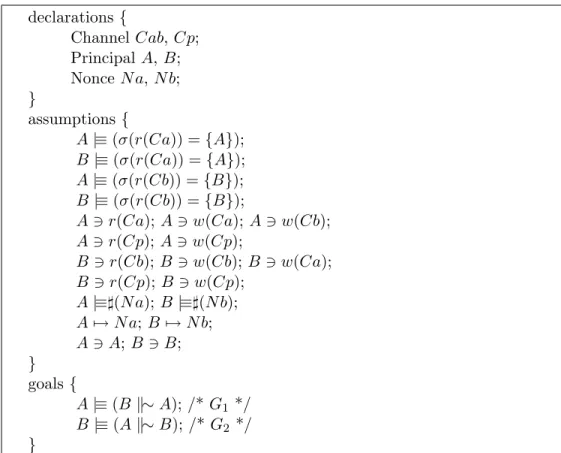
1.2 and subprotocols 2.1 and 2.2, respectively (Example 2). Thus there are 2×2 possible combinations of the subprotocols to be considered for merging. Furthermore, for each pair of subprotocols, we must find the shortest merge of the two subprotocols. ASPB generates the following ‘best’ protocol that corresponds to the merge of subprotocols 1.1 and 2.2 from Example 2 (in 3.1 seconds): A , B / Cp(A, N a), S / Cbs(A, B, N a, N b), A / Cas(B, N a, N b, A), B / Cp(N b, B). 4
6
Further Refining the Candidate Protocols
6.1 Realising Idealised protocolsThe Single Goal Synthesiser generates messages expressed as formulae within the BSW-ZF logic. The final implementation of these protocols is given in terms of conventional protocol message steps. For example, both mes-sage Cas(A |∼ N a) and Cas(A / N a) are expressed by the same notation
Cas(A, N a). To minimise the potential for replay attacks where ‘similar’
messages appear in different parts of a protocol, the messages are modified to make them distinct from one another [6]. For example, Cas(A, N a,0)
and Cas(A, N a,1) or Cas(A, N a) and Cas(N a, A). In ASPB, we
distin-guish ’similar’ messages by the latter approach, that is, exchanging message component order.
Since the message receiver of a protocol step is the message sender of the next protocol step, the above protocol in Example 3 can be rewritten in the following format:
A→B : Cp(A, N a),
B →S : Cbs(A, B, N a, N b),
S→A: Cas(B, N a, N b, A),
A→B : Cp(N b, B)
Each protocol step means that a principal sends a message and another principal receives this message. For example, the first step of the above protocolA→B :Cp(A, N a) means thatA|∼Cp(A, N a) andB /Cp(A, N a).
6.2 Removing Redundant Components
The Protocol Composer may use a redundancy removing strategy to further remove redundant components of protocol messages. This is inspired by Mao’s protocol idealisation process [22], that is used to transform protocol messages into BAN-like formulae via a context-sensitive syntactic analysis of the protocol syntax. Our redundancy removing process is used to transform BSW-ZF formulae into protocol messages using a similar analysis of the protocol syntax as follows.
Let the relevant principal set NP(N) represent a set of principals to which principal P currently believes that the fresh nonce N is uttered as a reference. P should remember this reference wherever P sees N. At the beginning of a protocol, the relevant principal sets for all principals are initialised to empty.
The Protocol Composer uses the following relevancy rules to calculate the relevant principal set for every principal at each protocol step.
RR1 IfP believes that onlyP andQ may write in channelC, and P sees nonceN together with principalR from C, then P believes thatN is uttered as a reference to the principalsP,Q, and R.
P |≡(s(w(C)) ={P, Q}), P 3r(C), P / C(N, . . . , R)
NP(N) =NP(N)∪ {P, Q, R}
RR2 IfP believes that only Qmay write in channel C, and P sees nonce
N with principal R from C, then P believes that N is uttered as a reference to the principalsQ andR.
P |≡(s(w(C)) ={Q}), P 3r(C), P / C(N, . . . , R)
NP(N) =NP(N)∪ {Q, R}
RR3 If P believes that only P and Q may read from channel C, and P
writes nonceN with principalR inC, then thenP believes that N is uttered as a reference to the principalsP,Q, and R.
P |≡(s(r(C)) ={P, Q}), P 3w(C), P |∼C(N, . . . , R)
NP(N) =NP(N)∪ {P, Q, R}
RR4 If P believes that only Q may read from channel C, and P writes nonceN with principalRinC, then thenP believes thatN is uttered as a reference to the principalsQand R.
P |≡(s(r(C)) ={Q}), P 3w(C), P |∼C(N, . . . , R)
NP(N) =NP(N)∪ {Q, R}
Generally, if NP(N)∩ NQ(N) = ψ1 before a protocol step P → Q :
(N, ψ2), then the protocol step is rewritten by P → Q:C(N, ψ2/ψ1) This
is done in reverse order of protocol execution. If a message may not be dis-tinguished from other messages after applying a relevancy rule, then further principal identifiers fromψ2 are kept in that message, until the message can be distinguished from other messages. In addition, if ψ2/ψ1 = {} in the first encrypted message of a protocol, then at least one principal identity of that message is kept to stop principals misusing that message. If we remove all principal identities from the first encrypted message, the protocol may subject to reflection/oracle attacks. The reason for this is that the message
receiver may not judge who generates this message (another principal in the current protocol run, or itself in a previous run). This is because it is not practical for principals to keep messages from previous protocol runs. An example that illustrates this problem is given in Appendix B.
Example 4 The messages in the generated protocol from Example 3 are reduced and then simplified using above rules to give:
M essage 1 A→B: A, N a,
M essage 2 B→S : {A, N a, N b}Kbs,
M essage 3 S →A: {N a, N b, B}Kas,
M essage 4 A→B: N b.
4
6.3 The Protocol Selector
In general, given subprotocols P1 and P2 that uphold goals G1 and G2,
respectively, then the monotonicity of the BSW-ZF logic ensures that the resulting merged candidate protocol as outlined above also upholds the goals
G1 and G2 within the logic. Therefore, all the protocols generated by the
Protocol Composer are valid within our logic.
However, belief logics do have weaknesses. Regardless of whether we deal with type flaw attacks by assuming that component types can be recognised by principals, the logic is still vulnerable to other classes of attacks. For example, the Protocol Composer generates the following simple mutual au-thentication protocol.
M essage 1 A→B : A, N a,
M essage 2 B →A: B, N b,{A, N a}Kab
M essage 3 A→B : {B, N b}Kab
While secure within the BSW-ZF and many other belief logics, this protocol is subject to a reflection/oracle attack:
M essage 1 A→B :A, N a,
M essage 2 B →I(A) :B, N b,{A, N a}Kab,
M essage 20 I(B)→A :B, N b0,{A, N a}Kab,
M essage 3 A→B :{B, N b0}Kab.
Here, N b0 is generated by the intruder. There are many examples of secure protocols, which when composed are vulnerable to attack [37]. If the unsuitable protocol is identifiable then it can be discarded following verification by the Protocol Selector. For example, when a subprotocol P1
does not merge any message with any other subprotocols in the merging process, we consider that the resulting candidate protocol is an unsuitable protocol and discarded by the Protocol Selector. The reason for this is that the subprotocolP1could be executed independently. An intruder is possible
to participate the subprotocol without participating the rest protocol of the same round.
It is useful to further consider verification of additional ad-hoc proper-ties. For example, the non-injective agreement property [21]: “For certain data items ds, if each time a principal B completes a run of the protocol as responder usingds, apparently with A, then there is a unique run of the protocol with the principal A as initiator usingds, apparently with B.” The generated protocols could be re-analysed using more sophisticated protocol analysis tools, such as the NRL Analyzer [23], the Interrogator model [24], FDR [20], Murϕ [25], Athena [33]. In this case, the Protocol Selector of ASPB would be used to narrow down the set of candidate protocols to be verified. However, we point out that many existing protocol checkers are also limited and also include ad-hoc strategies, they do not guarantee the correctness of verified protocols.
We also suggest that practical techniques such as [6] may prove useful in making candidate protocols robust against such attacks. For example, by ensuring that the initiator challenge looks different to the respondent challenge.
7
Discussion and Evaluation
In this section, we evaluate ASPB and compare it with existing approaches, including, the Automatic Protocol Generator (APG) [30], and the Evolu-tionary approach [10].
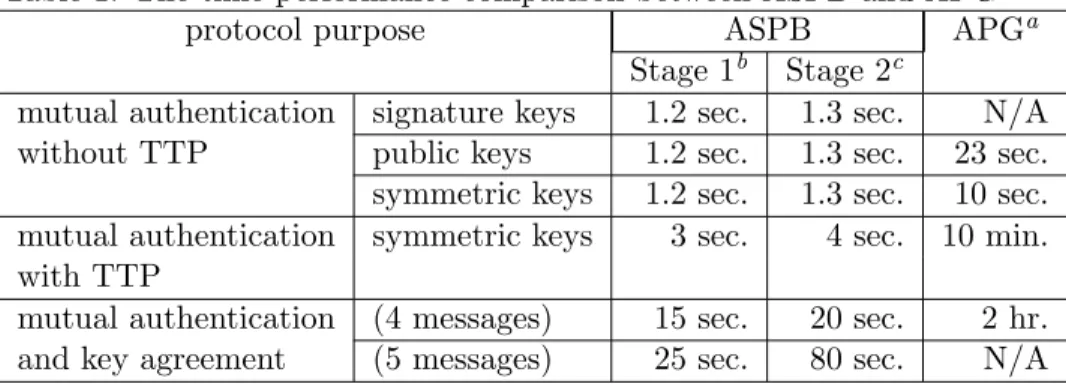
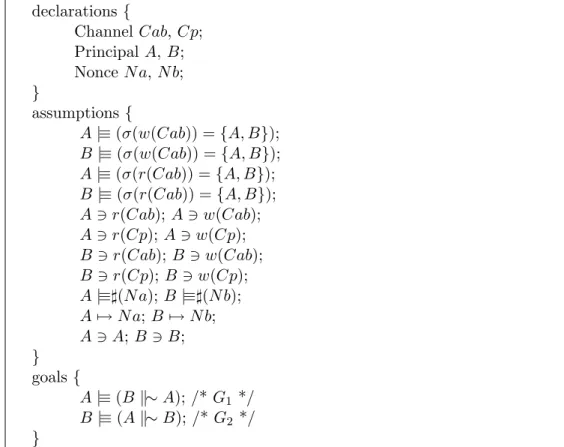
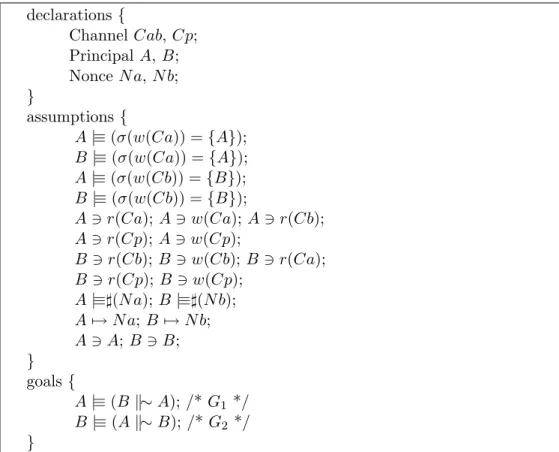
Table 1 provides a time performance comparison between ASPB and APG [30]. The first three rows give the performance results for generating the mutual authentication protocol without TTP described in Sec B (and specified in Figures 7, 8, and 9 ). The fourth row gives the performance re-sults for generating the mutual authentication protocol with TTP described in Figure 2. The other experiment was for mutual authentication and key agreement with TTP described in Figure 10. The fifth row gives the result
Table 1: The time performance comparison between ASPB and APG
protocol purpose ASPB APGa
Stage 1b Stage 2c
mutual authentication signature keys 1.2 sec. 1.3 sec. N/A
without TTP public keys 1.2 sec. 1.3 sec. 23 sec.
symmetric keys 1.2 sec. 1.3 sec. 10 sec.
mutual authentication symmetric keys 3 sec. 4 sec. 10 min.
with TTP
mutual authentication (4 messages) 15 sec. 20 sec. 2 hr.
and key agreement (5 messages) 25 sec. 80 sec. N/A
a
APG timing is based on generating the best protocol result running on a 400MHz Intel Pentium III [30].
b
Time to synthesise, compose, and generate all candidate protocols running on a 1.8GHz Intel Pentium IV.
c
Estimated time that the Athena [33] checker would take to further validate the ASPB generated candidate protocols.
for four message protocols. The last row gives the result for five message protocols. The results of similar experiments were reported in [30]. While ASPB was tested on a faster computer than that used to test APG, given the marked difference in speed, it is nevertheless reasonable to conclude that ASPB runs significantly faster than APG.
ASPB generates approximately 500 valid five-message candidate proto-cols in 25 seconds. However, on manual inspection, many of these protoproto-cols are similar, containing minor textual and redundant variations. On man-ual inspection, we estimate that in this set there are 24 reasonably distinct four-message candidate protocols and 76 reasonably distinct five-message protocols. We selected several protocols from each category to demonstrate our results in Section B.
APG has not been tested for five message protocols; in this case we conjecture that direct application of the forward search approach of APG would result in a very large and potentially infeasible search space. Perrig and Song’s estimate [30] is based on the average number of messages that a principal can generate in a given round of the protocol and is explained as follows. In a given principal sequence four-message three-party authentica-tion and key agreement protocol (as the requirement described in Figure 10 and, for example, the given principal sequence isA→B→S →B →A),A
generates over 100 different messages toB, then B in turn generates about 28
500 different messages and sends them toS. Scan generate 30,000 messages and sends to B. B can generate around 500 messages in the final round. The combination of this number of messages is on the order of 1012. If these
four-message protocols extend to five-message versions by one message that is sent from A toB, there are around 500 different messages generated by
Awhen using Perrig and Song’s estimation approach in [30]. We conjecture that the search space for a given principal sequence five-message three-party authentication and key agreement protocol is over 500×1012 The search space for all possible principal sequences is 500×1012×25 (based on the limitation that one does not send messages to itself, and therefore there are 2 possible message receivers at each protocol step).
APG [30] generates the ‘best’ protocol for each protocol requirement in the entire protocol search space with respect to its metric functions. The metric function of APG [30] gives each message operation a cost value. For example, the cost value of a message decryption/encryption is 3; the cost value of generating a nonce is 1. The cost value of a protocol is the total cost of all the protocol operations. The minimal cost protocol that meets all of the protocol goals is APG’s ‘best’ protocol. Compared with APG, the evolutionary approach [10] only searches a part of the entire protocol space. Its goal is to find a ‘good’ solution for each protocol requirement in a given protocol search space with respect to its fitness function. Unlike APG, the evolutionary approach does not guarantee that the ‘best’ protocol in the entire search space can be found in the selected part of the search space. On the other hand, because the evolutionary approach searches a smaller protocol search space than APG, it may find a ‘good’ protocol in a shorter time than APG. For example, APG generates the ‘best’ protocol for mutual authentication and key exchange protocol in two hours; Chen, Clark, and Jacob generate a ’good’ protocol for the same set of protocol goals only in 3 minutes using an evolutionary approach [10] based on the SVO logic.
Since variable instantiation in ASPB’s single goal synthesiser disregards higher order belief formulae, and it is possible to use these higher order belief formulae to generate some protocols that are different to protocols generated using the first order beliefs, then ASPB does not search the entire protocol space to generate all possible protocols that satisfy requirement specifications. When compared to the above approaches, ASPB generates a number of ‘good’ protocols, including the ‘best’ protocol, in a shorter period. For example, ASPB generates a number of four message mutual authentication and key exchange protocols for the same set of protocol goals and assumptions within 20 seconds. The reason for this is that the Single Goal Synthesiser uses the heuristics to direct its backwards search for valid
protocols from a protocol goal. Unlike [12] and [30] which compose random messages, our strategy ensures that all candidate protocols obtained from the search tree are valid in that they uphold the goal within the logic. This contrasts with the forward searching approaches that may process many invalid candidate protocols before encountering a valid protocol.
Athena [33] is used to guarantee that APG generates correct protocols. However, fine grained distinctions between honesty and dishonesty cannot be made, since the underlying analysis model of APG, the strand space model, does not consider the concepts of honesty and dishonesty. Sometimes, an improper trust relationship may lead to some principals being cheated by others. With the BSW-ZF Logic, it is possible to distinguish honest (and competent) from dishonest (and incompetent) principals. This fine-grain distinction is useful for a protocol designer.
Since the Single Goal Synthesiser is completely independent of the Pro-tocol Composer, our approach does not depend on the BSW-ZF logic. In future research, we could extend the logic (or change the basic logic to an-other) to suit more complex requirements.
Finally, increased performance could be achieved by parallelising the single goal synthesis and composition steps across separate processors.
8
Conclusion
In this paper we describe how the synthesis process of the BSW-ZF logic can be used to guide the automatic generation of security protocols. It uses a backward search approach: searching for suitable protocols from the protocol goals. This is unlike existing approaches which typically search in a forward manner from protocol assumptions for protocols that meet the required goals. This backward search approach limits the size of the search space and results described in this paper indicate a better performance than existing forward search techniques.
This backwards search forms the heart of the ASPB protocol generating tool. Single goals are synthesised to subprotocols, which are in turn com-posed to form the final protocols. Various heuristics are used to guide the selection and design of candidate protocols.
However, the approach does have some limitations. Firstly, by binding free variables only to formulae from known assumptions, the set of potential candidate protocols is reduced. Whether this is a significant constraint is a topic for future research. Secondly, the BSW logic is based on a belief logic and, as such, does have limitations when compared with other techniques
such as [28, 31]. Nevertheless, ASPB could be used narrow down the set of candidate protocols to be verified by a more sophisticated checker.
9
Acknowledgements
Acknowledgements. This research has been supported, in part, by Sci-ence Foundation Ireland grant 08/SRC/11403.
References
[1] ISO/IEC 9798-2. Information technology - security techniques – en-tity authentication part 2: Mechanisms using symmetric encipherment algorithems (second edition), 1999.
[2] ISO/IEC 9798-3. Information technology - security techniques – entity authentication part 3: Mechanisms entity authentication using digital signature techniques (second edition), 1998.
[3] M. Abadi and A. D. Gordon. A calculus for cryptographic protocols: The spi calculus. In Proceedings of Fourth ACM Conference on Com-puter and Communications Security, pages 36–47, Zurich, 1997. ACM Press.
[4] M. Abadi and R. Needham. Prudent engineering practice for cryp-tographic protocols. In Proceedings of 1994 IEEE Computer Society Symposium on Research in Security and Privacy, pages 122–136, Los Alamitos, CA, 1994. IEEE Computer Society Press.
[5] J. Alves-Foss and T. Soule. A weakest precondition calculus for analysis of cryptographic protocols. In Proceedings of the DIMACS Workshop on Design and Formal Verification of Security Protocols, 1997.
[6] T. Aura. Strategies against replay attacks. In Proceedings of the 10th IEEE Computer Security Foundations Workshop (CSFW’97), pages 59–68, Washington, DC, USA, 1997. IEEE Computer Society Press. [7] M. Burrows, M. Abadi, and R. Needham. A logic of authentication.
ACM Transactions on Computer Systems, 8(1):18–36, February 1990. [8] L. Butty´an, S. Staamann, and U. Wilhelm. A simple logic for
Security Foundations Workshop, pages 153–162. IEEE Computer Soci-ety Press, 1998.
[9] U. Carlsen. Optimal privacy and authentication on a portable com-munications system. SIGOPS Operating Systems Review, 28(3):16–23, 1994.
[10] H. Chen, J. A. Clark, and J. L. Jacob. Synthesising efficient and ef-fective security protocols. Electronic Notes in Theoretical Computer Science, 125(1):25–41, 2005.
[11] J. A Clark and J. L Jacob. A survey of authentication protocol litera-ture, version 1.0., 1997. URL http://www.cs.york.ac.uk/~jac/. [12] J. A Clark and J. L Jacob. Searching for a solution: Engineering
trade-offs and the evolution of provable secure protocols. In Proceedings of the 2000 IEEE Symposium on Security and Privacy, pages 82–95. IEEE Computer Society Press, May 2000.
[13] D. Dolev and A.C. Yao. On the security of public key protocols. IEEE Transactions on Information Theory, 29(2):198–208, 1983.
[14] L. Gong, R. Needham, and R. Yahalom. Reasoning about belief in cryp-tographic protocols. In Proceedings of the IEEE 1990 Symposium on Security and Privacy, pages 234–248, Oakland, California, May 1990. IEEE Computer Society Press.
[15] L. Gong and P. Syverson. Fail-stop protocols: An approach to designing secure protocols. InProceedings of the 5th International Working Con-ference on Dependable Computing for Critical Applications (DCCA-5), pages 44–55, 1995.
[16] J. D. Guttman. Security protocol design via authentication tests. In
Proceedings of 15th IEEE Computer Security Foundations Workshop, pages 92–103. IEEE Computer Society Press, April 2002.
[17] J. D. Guttman and F. J. Thayer. Authentication tests. InProceedings of the 2000 IEEE Symposium on Security and Privacy, pages 96–109. IEEE Computer Society Press, 2000.
[18] D. Kindred. Theory Generation for Security Protocols. PhD thesis, Carnegie Mellon University, 1999. Also available as Carnegie Mellon University, Computer Science Report No. CMU-CS-99-130.
[19] D. E. Knuth. The art of computer programming, volume 3. Addison-Wesley, Reading, 2nd edition, 1998. sorting and searching.
[20] G. Lowe. Breaking and fixing the Needham-Schroeder public-key pro-tocol using FDR. In Proceedings of the Second International Work-shop on Tools and Algorithms for Construction and Analysis of Systems (TACAS), volume 1055 of Lecture Notes In Computer Science, pages 147–166. Springer-Verlag, Berlin Germany, 1996.
[21] G. Lowe. A hierarchy of authentication specifications. InProceedings of the 10th Computer Security Foundations Workshop (CSFW’97), pages 31–43, Los Alamitos, 1997. IEEE Computer Society Press.
[22] W. Mao. An augmentation of BAN-like logics. In Proceedings of the Eighth IEEE Computer Security Foundations Workshop (CSFW’95), pages 44–57. IEEE Computer Society Press, 1995.
[23] C. Meadows. The NRL protocol analyzer: An overview. Journal of Logic Programming, 26(2):113–131, 1996.
[24] J. K. Millen. The interrogator model. InProceedings of the 1995 IEEE Symposium on Security and Privacy (SP’95), pages 251–260, Washing-ton, DC, USA, 1995. IEEE Computer Society.
[25] J. C. Mitchell, M. Mitchell, and U. Stern. Automated analysis of crypto-graphic protocols using murφ. InProceedings of the 1997 IEEE Sympo-sium on Security and Privacy, pages 141–151. IEEE Computer Society Press, May 1997.
[26] D. O’Crualaoich. Theory generation for the Simple Logic, Bachelor Thesis, University College Cork, 2002.
[27] L. Paulson. Relations between secrets: Two formal analyses of the Yahalom protocol. Journal of Computer Security, 9(3):197–216, 2001. [28] L.C. Paulson. The inductive approach to verifying cryptographic
pro-tocols. Journal of Computer Security, 6(1, 2):85–128, 1998.
[29] A. Perrig and D.X. Song. A first step towards the automatic generation of security protocols. InProceedings of Network and Distributed System Security Symposium, February 2000.
[30] A. Perrig and D.X. Song. Looking for diamonds in the desert: Extend-ing automatic protocol generation to three-party authenticatoin and
key agreement protocols. In Proceedings of 13th IEEE Computer Se-curity Foundations Workshop, pages 64–76. IEEE Computer Society Press, July 2000.
[31] A.W. Roscoe. Using intensional specifications of security protocols. InProceedings of the Computer Security Foundations Workshop, pages 28–38. IEEE Press, 1996.
[32] H. Saidi. Towards automatic synthesis of security protocols. In Pro-ceedings of the Logic-Based Program Synthesis Workshop, AAAI 2002 Spring Symposium, Stanford University, California, March 2002. [33] D. X. Song. Athena: a new efficient automated checker for security
protocol analysis. In Proceedings of the 12th IEEE Computer Security Foundations Workshop, pages 192–202. IEEE Computer Society Press, June 1999.
[34] P. Syverson. A taxonomy of replay attacks. InProceedings of the IEEE Computer Security Foundations Workshop, pages 187–191. IEEE Press, 1994.
[35] P. Syverson and P.C. van Oorschot. On unifying some cryptographic protocol logics. InProceedings of IEEE Computer Security Foudations Workshop, pages 14–28. IEEE Computer Society Press, 1994.
[36] F. J. Thayer, J. C. Herzog, and J. D. Guttman. Strand spaces: Why is a security protocol correct? InProceedings of the 20th IEEE Symposium on Security and Privacy, pages 160–171. IEEE Computer Society Press, 1998.
[37] W. Tzeng and C. Hu. Inter-protocol interleaving attacks on some au-thentication and key distribution protocols. Information Processing Letters, 69(6):297–302, 1999.
[38] H. Zhou and S. N. Foley. Fast automatic synthesis of security protocols using backward search. Inproceedings of the ACM Workshop on Formal Methods for Security Engineering (FMSE), pages 1–10, Washington DC, October 2003.
A
The BSW-ZF Heuristic Rules
The following heuristic rules have their origins in the synthesis rules of the BSW logic.
Heur1 (explained in main paper)
P / XOO oo P / COO (X)oo Q3OO X
P|≡((Qk∼X)→(Q|≡X))
P 3r(C) Q3w(C) Q|≡X
Heur2 To hold a compound message (X, Y),P may hold the message com-ponentsX and Y separately.
P 3(X, YOO ff ) N N N N N N N N N N P 3X P 3Y
Note that this rule does not require that P must hold the message components X and Y separately. The reason for this is that P may obtain the compound message (X, Y) from the same message that he received. For example, when principal B sees a compound message
(A, N a), it is not necessary for B to hold A and N a separately in
order to hold the compound message.
Heur3 To hold a messageX,P may see X.
P 3Xoo P / X
Heur4 To hold a messageX,P may generateX.
P 3Xoo P 7→X
This rule is used to track the origin of all message components in a protocol on the basis that even if a principal holds all components of a message, he may not be willing to send out the message, unless he receives some request to do so or as the protocol initiator.
Heur5 To believeQsays X,P may believe that Qsaid X and X is fresh.
P |≡QOO k∼gg X O O O O O O O O O O O P |≡Q|∼X P |≡](X)
Sometimes a principal may believe another principal says something when it was once said with something fresh. This is reflected byHeur6.
Heur6 To believe Q says X, P may believe that Q said (X, Y) and Y is fresh. P |≡QOO k∼hhX Q Q Q Q Q Q Q Q Q Q Q Q P |≡Q|∼(X, Y) P |≡](Y)
When the subgoalP |≡](Y) is reached, byF2thenP |≡](X, Y) is also reached. Thus, together with P |≡Q|∼(X, Y), and by rulesF1 and
F4,P |≡Qk∼(X, Y) and P |≡Qk∼X are reached.
Heur7 To believe QsaysX,P may believe thatQsaid X onC and w(C) is fresh. P |≡QOO k∼Xhh R R R R R R R R R R R R R P |≡Q|∼C(X) P |≡](w(C))
Heur8 To believe that Q said X, Q said X on channel C, and Q holds
w(C), P has to receive X via a channel C that he can read and that he believes that it can be written to only byQ. Furthermore,Q must holdX and w(C). IfX is a formula and P believes thatQis honest, then Q must also believe X.
P |≡Q|∼X; P |≡Q|∼C(X); P |≡Q3OO w(C) hh Q Q Q Q Q Q Q Q Q Q Q Q Q Q o o P |≡(σ(w(C)) ={Q}) P 3r(C) P / COO (X)oo Q3OO X P|≡((Qk∼X)→(Q|≡X)) Q3w(C) Q|≡X 36
Heur9 To believe that Q said X, Q said X on channel C, and Q holds
w(C), P has to receive X via a channel C that he can read and that he believes it can be written to only by P and Q. Furthermore, Q
must hold X and w(C). If X is a formula and P believes that Q is honest, then Q must also believeX.
P |≡Q|∼X; P |≡Q|∼C(X); P |≡Q3OO w(C) hh R R R R R R R R R R R R R R R o o P |≡(σ(w(C)) ={P, Q}) P 3r(C) P / COO (X)oo Q3OO X P|≡((Qk∼X)→(Q|≡X)) Q3w(C) Q|≡X
Heur10 To believe thatQsaidX,P has to receiveXvia a channelC that he can read and that he believesX is a secret betweenQand himself before he sees it. Furthermore,P must believe thatQis able to write toC, and that Qmust believe that he sees X.
P |≡Q|∼X; P |≡Q|∼C(X); P |≡Q3OO w(C); hh Q Q Q Q Q Q Q Q Q Q Q Q Q Q P |≡(σ(X) ={P, Q}) P 3r(C) P / COO (X)oo Q3OO X P|≡((Qk∼X)→(Q|≡X)) Q3w(C) Q|≡X
Heur11 (explained in main paper)
P |≡OO φ1gg O O O O O O O O O O O O P |≡φ2 P |≡(φ2→φ1)
Heur12 To believe a compound message X is fresh, P must believe some partX0 ofX is fresh.
P |≡](X)oo P |≡](X0)
Heur13 To believew(C) is fresh,P must believer(C) is fresh.
P |≡](w(C))oo P |≡](r(C))
Heur14 To believer(C) is fresh,P must believe w(C) is fresh.
P |≡](r(C))oo P |≡](w(C))
Heur15 To believe a message X is a shared secret only between P and
Q, P must believe some part of the message is a shared secret only betweenP and Q.
P |≡(σ(X) ={P, Q})oo P |≡(σ(X0) ={P, Q})
Heur16 To see a compound message (X, Y),P may see the message com-ponentsX and Y separately.
P /(X, YOO ff ) M M M M M M M M M M P / X P / Y
Proposition (Provable Synthesis) A protocol synthesised using the BSW-ZF heuristic rules can be proven to uphold its protocol goal using the BSW-ZF inference rules.
Proof Outline The validity of the heuristic rules is justified by their cor-responding inference rules, except forHeur1, 8, 9, 10. The heuristic rules
Heur1, 8, 9, 10 require additional subgoals to ensure valid temporal or-dering of the subgoals of generated protocols, as discussed inHeur1.
These heuristic rules require that necessary subgoals are satisfied before a protocol goal is achieved. Any protocol synthesised using these heuristic rules guarantees that all of the subgoals for the protocol goals are satisfied. To verify a protocol, its subgoals serve as the premises of the inference rules. It is sufficient to deduce protocol goals from these subgoals using the corresponding inference rules.