Artificial Intelligence Advances
https://ojs.bilpublishing.com/index.php/aia
ARTICLE
School Debit Transaction Using Fingerprint Recognition System
Wai Kit Wong
*Thu Soe Min Shi Enn Chong
Faculty of Engineering and Technology, Multimedia University (MMU), Jalan Ayer Keroh Lama, Melaka, 75450, Ma-laysia
ARTICLE INFO ABSTRACT
Article history
Received: 11 September 2019 Accepted: 22 October 2019 Published Online: 30 October 2019
This paper proposed a fingerprint based school debit transaction system us -ing minutiae match-ing biometric technology. This biometric cashless
trans-action system intensely shortens the luncheon line traffic and labour force
compared to conventional cash payment system. Furthermore, contrast with card cashless transaction system, fingerprint cashless transaction system
with benefit that user need not carry additional identification object and re -member lengthy password. The implementation of this cashless transaction
system provides a more organize, reliable and efficient way to operate the
school debit transaction system.
Keywords: Fingerprint recognition Biometric Authentication Image processing *Corresponding Author: Wai Kit Wong,
Faculty of Engineering and Technology, Multimedia University (MMU), Jalan Ayer Keroh Lama, Melaka, 75450, Malaysia; Email: [email protected]
1. Introduction
N
owadays, parents need not to give cash directly to their primary/secondary schools' children. Some schools already practice to use their own debit card system, whereby students or their parents just need to bank in/ deposit the money to the school treasury department, the school treasury department will issue a debit card to students for purchasing food in canteen, stationaries, fees etc. This debit card system in favour by parents because they can monitor their children better due to the reason no cash for students to be get lost/stolen or purchasing outside drugs, tit-bit or unhealthy entertain-ment.However, parents still have concerns, such as debit cards being stolen or misplaced by their children. There were a lot of wasteful resources for the system maintain-er, as a new card had to be made for them who losing it. Besides that, students would also share their cards among
friends, and sometimes the card can be scanned twice, lead to a double charged for a single transaction. Another concerning issue is if students forgot their identification number and PIN number of their card upon transaction, it might lead to a longer queuing time for other students, as primary and secondary students normally have 15-20
min-utes’ break, the heavy traffic might lead to a waste of food
and time. Therefore, a higher level of security and reliable system should be implemented to replace the conventional debit card transaction system, in order to create a conve-nient and safer environment for the children. Thus, bio-metric based debit transaction system is being proposed by researchers to overcome the above issues [1,2].
Biometric authentication is a method of recognizing
a human being according to the physiological measure-ments or physically features and traits [3]. The human
physical characteristics such as fingerprints, face, hand geometry, voice and iris are known as biometrics. Bio-metric technologies are becoming the foundation of an
extensive array of highly secure identification and person -al verification solutions. Since biometric identifiers are associated permanently with the user, it is more reliable than the conventional authentication methods such as PIN and password. Thus, biometric based authentication can
provide extra confidential in transactions by securing the
personal information and privacy data.
In fact, there are many methods for biometric authen-tication. The most commonly used methods for biomet-ric authentication are iris scanning [4], hand scanning [5],
fingerprint recognition [6], face recognition [7], and voice
recognition [8]. The biometric information will never ever
match with another individual because everyone has their own unique biometric features. Researchers [9,10,11] had
conducted numerous analysis and comparison among dif-ferent types of biometric recognition methods. The com-parison of biometric methods is mainly based on charac-teristics such as universality, uniqueness, performance, permanence, and measurability.
Based on the researchers’ results [9,10,11], fingerprint
recognition has the highest market share among the tech-nologies of biometric security system in the market. The
preference of fingerprint recognition in the current market
is mostly due to its high accuracy, performance and
sta-bility. Besides that, fingerprint recognition has a moderate
pricing compare to iris scan which required a high capital cost and level of skills to operate and maintain. Moreover, it also has a relatively low percentage of False Acceptance Rate (FAR) and False Reject Rate (FRR) [12] which make
it more reliable to use either in police or industrial area.
Thus, fingerprint biometric recognition is widely accept
-able and prefer-able compare to the other biometric securi-ty systems.
In this paper, a fingerprint recognition system will be
proposed for replacing the debit card in business trans-action system. This can provide an even more secure studying environment for students, since debit card can be
stolen and use within the school too. With the fingerprint
recognition system, the student's fingerprint itself is the debit card. Nobody can steal it. Fingerprint scanning de-vices in hardware and recognition algorithm in software will be developed to verify and identify the identity of a
student’s debit account through fingerprint scan. This will enable the student to do transaction by fingerprint scan in
the school and does not need to go through the hassle of showing the debit card or paying by cash.
The paper is organized in the following way: Section II will be briefly comments on the fingerprint recognition
school debit transaction system. Section III presents the proposed Hough Transform Minutiae Pairing Fingerprint Matching (HTMP) technique applies in identifying the
correct person and section IV reports some experimental results. Finally, in section V, some conclusion and envi-sion future developments is drawn.
2. Fingerprint Recognition School Debit
Transaction System Design
This section outlines the system design for the fingerprint
recognition school debit transaction system. It consists of the hardware architecture and software modules of the system as discuss in section 2.1 and section 2.2 below.
2.1 Hardware Architecture
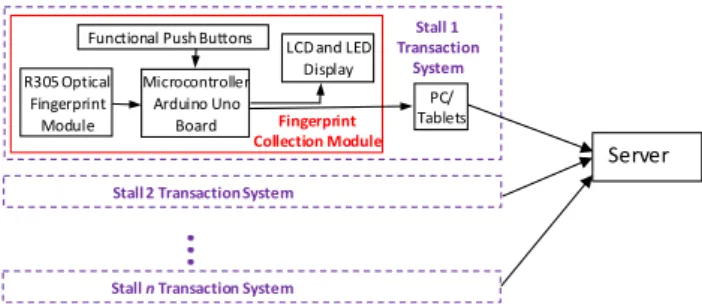
Figure 1 shows the hardware architecture for the proposed fingerprint recognition school debit transaction system.
The overall system consists of fingerprint collection mod
-ule and PC/tablets placed at each shop/stall, all linked to a centre hub (server) with students’ information database for info matching and business transaction.
R305 Optical Fingerprint Module Microcontroller Arduino Uno Board LCDand LED Display Functional PushButtons Fingerprint Collection Module PC/ Tablets Stall 1 Transaction System Stall2 TransactionSystem
…
StallnTransaction System
Server
Figure 1. Fingerprint Recognition School Debit Transac-tion System
2.1.1 R305 Optical Fingerprint Module
It is an optical biometric fingerprint sensor with a TTL UART interface for direct connection to the PC. The user
is allowed to store fingerprint data and verify identity with
the module. The module consists of two main function which are enrolment and matching of fingerprint. How-ever, in this project, only the enrolment of fingerprint function is in used. The build in fingerprint matching function of R305 is slow when datasets achieving 1000 or more. There is an advance algorithm, namely the Hough
Transform Minutiae Pairing (HTMP) fingerprint matching
technique is proposed in the computing side (PC/tablet) to
run the fingerprint matching task. Besides that, the optical fingerprint module will capture the image of a finger by
utilizing the light ray. However, the image of the finger
-print can be affected by external environment such as dirt, wet, quality of skin and humidity. It will be more easy to study and trouble shoot the fingerprint mismatch in the proposed external matching algorithm (HTMP), rather than using the R305 build in matching algorithm.
Figure 2. R305-optical fingerprint module
2.1.2 Arduino UNO
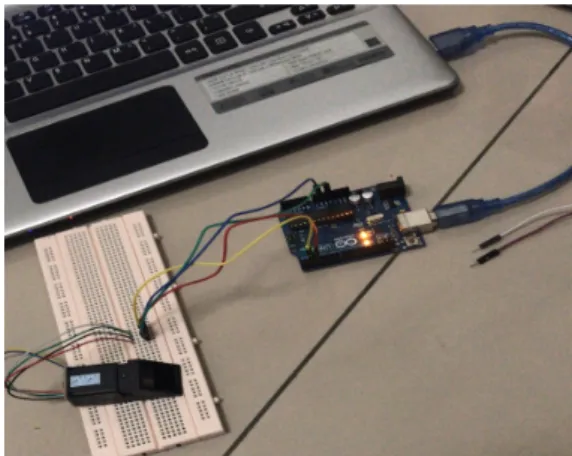
The R305 fingerprint module is interfacing by Arduino UNO board. There are several types of Arduino board such as Uno, Mega, Nano, and etc. However, Arduino Uno which based on ATmega328 microcontroller was se-lected due to its inexpensive cost, cross platform, simple and clear programming environment, with open source and extensive software, together with large support of community. The proposed Arduino UNO board is supplied with multiple sets of digital and analog input/output pins. The operating voltage of the Arduino Uno will be 9Vby connecting to the power supply of PC/tablet. The four
dig-ital pins (TXD, RXD, VIN and GND) of the R305 finger
-print module are connected to the Arduino UNO board, as shown in Figure 3 below. The Transmit Data (TXD) pin is connected to pin D3 of Arduino UNO board for data out-put, the Receive Data (RXD) pin is connected to pin D2 of Arduino UNO board for data input. The Input Voltage (VIN) pin is connected to pin 5V of Arduino UNO board for a constant 5V supply to fingerprint module, and the Ground (GND) pin is connected to pin GND of Arduino UNO board for ground.
Figure 3. Fingerprint module connected to Arduino UNO board
Figure 4. Push buttons for Enrolment, Verification and
Delete
2.1.3 Functional Push Buttons
There will be three push buttons as shown in Figure 4,
placed on the fingerprint collection module for three im
-portant functions, namely: Enrolment, Verification and
Delete. The three buttons are connected each with a 1kΩ
pull up resistor to the Arduino UNO board.
2.1.4 LED and LCD Display
One red LED, one green LED and three yellow LEDs are used as indicators on the fingerprint collection module. The three yellow LEDs are connected to pin number 12, 10 and 4, as shown in Figure 5, indicate the mode
selec-tion of Enrolment task, Verificaselec-tion task and Delete task
respectively. The red LED is connected to digital pin 13 to indicate task failure, the green LED is connected to digital pin 11 to indicate task successful. The (I2C) LCD display
is used to display the short messages to the shopkeepers
about the task execution of the fingerprint collection mod
-ule, as shown in Figure 6 below.
Figure 5. Circuit Diagram of the LED Indicators and Arduino UNO Board
Figure 6. A working (16*2) LCD Display
2.1.5 PC/Tablet
The PC, laptop or tablet will read in fingerprint signals trans -ferred from the Arduino UNO and perform the fingerprint image processing for users’ identity matching. It comes with Graphic User Interface to registration page, selling products menus, purchase histories etc. Other than that, it can display the product database, and allow other operations such as viewing employees clock in-out times, sales report, etc.
2.1.6 Server
The server work as a centre hub which manages the access
of multiple stall stations to a centralized resource (users’
personal information, databases of selling products name lists, price, credit balance, top-up and purchase histories etc.)
2.2 Software Implementation
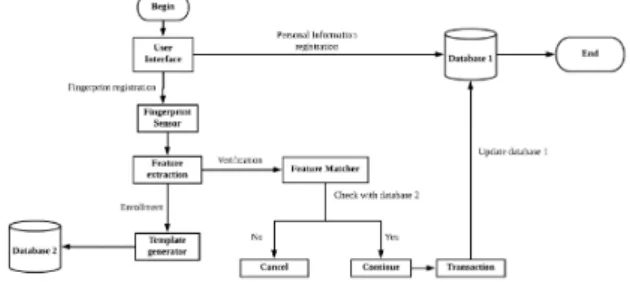
The fingerprint based school debit transaction system begin with a graphical user interface that authorize the users to
register their personal information into the database 1. After
that, user is required to enrol their fingerprint into the sys
-tem for future verification purpose. When the user wishes
to proceed for credit transaction (top-up credit or purchase items/services), a verification of fingerprint is needed.
There are only two possibilities for the verification results:
Successful or Fail. Only the user with a valid fingerprint stored in the database can proceed to further operations such as top-up credit or purchase items/services. After the transactions being performed, the system will update the latest account balance into the database. The overall
soft-ware architecture for fingerprint based school debit transac
-tion system is shown in Figure 7 below.
Figure 7. Software Architecture for Fingerprint based school debit transaction system
2.2.1 Activity Diagrams
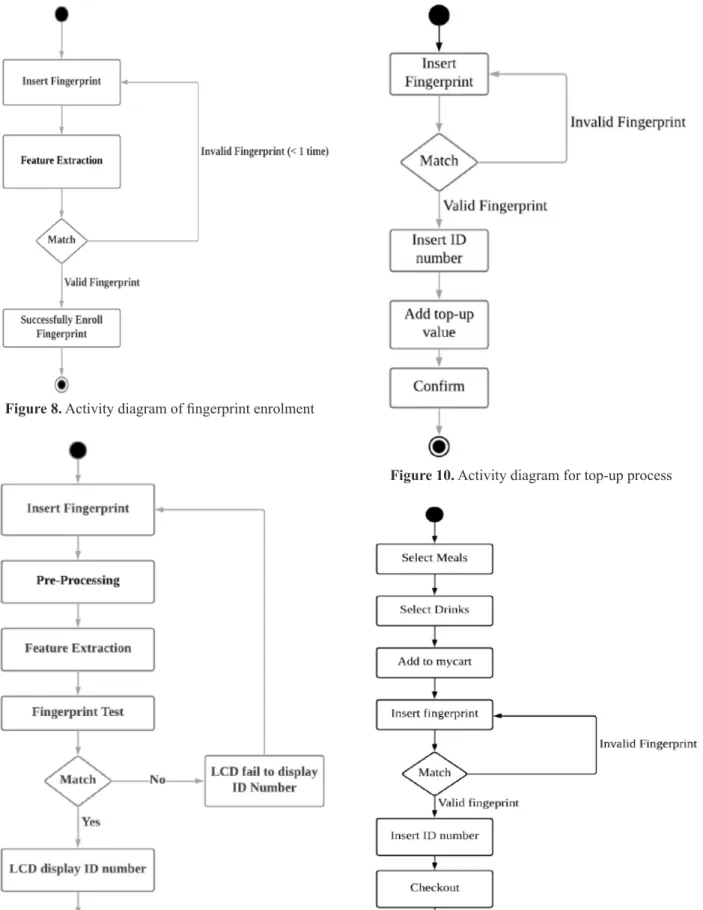
Activity diagrams are used to demonstrate the processes carried out in the system. Generally, there are five ac-tivity diagrams used in the proposed fingerprint based school debit transaction system: (1) Activity diagram of fingerprint enrolment, (2) Activity diagram for fin-gerprint verification, (3) Activity diagram for top-up process, (4) Activity diagram of transaction process (5) Activity diagram for checking purchase history.
The fingerprint enrolment needs at least two
identi-cal fingerprint inputs for the sake of wipe out potential
errors during the feature extraction process. The image
processor (PC/laptop/tablet) will match the fingerprints
to determine whether the two inputs are from the same
user’s finger. If yes, the template will be saved. Else, if the second fingerprint input is not match with the initial
one, the system might not generate the template. The
complete fingerprint enrolment process is shown in Fig
-ure 8.
For fingerprint verification process, the quality of the
fingerprint will be enhancing by some pre-processing
steps like classifying fingerprint image into the 8 ma
-jor pattern categories, identify the essence point in the
fingerprint image and crop the core region concentrat
-ed in the essence point, so that the important features like minutiaes, ridges and bifurcation points can be
extracted for future matching. The fingerprint matching
algorithm will further discuss in Section 3. If the input
fingerprint matches with the template stored in the da
-tabase, the LCD screen will display the user identity for shopkeeper to further verify with user. However,
if the input fingerprint does not match any of the tem
-plate stored in the database, the LCD will not display any user identity, and perhaps will show message “Not
found in database”. The whole fingerprint verification
process is shown in Figure 9.
If the input fingerprint is successfully matched with
the template stored in the fingerprint database, the user
can carry out functions like topping up their debit ac-count, paying for their meals, groceries, stationaries, services etc. and checking their top-up and purchase history. The whole process for the functions above is graphically illustrated in Figure 10, Figure 11 and Figure 12 respectively.
Figure 8. Activity diagram of fingerprint enrolment
Figure 9. Activity diagram for fingerprint verification
Figure 10. Activity diagram for top-up process
Figure 12. Activity diagram for checking purchase history
2.2.2 GUI Design and Database Software
In this sub-section, the software implementation and procedures for designing a user interface is discussed. The Graphical User Interface (GUI) will be created on Microsoft Visual Studio 2017 as it can be easily created by clicking and dragging the desired components such as label, text box, buttons, check box and data grid into the GUI layout form. Figure 13 (a) shows a blank Microsoft Visual Studio 2017 GUI layout form and Figure 13 (b) shows its corresponding Toolbox. The component param-eters and properties such as appearance, data and layout can be checked and changed by double clicking on the components. Furthermore, the database connection can be checked from the server explorer. This assures that all the data is entered into the database table. Figure 13 (c) shows the Microsoft Visual Studio 2017 Properties box and Fig-ure 13 (d) shows the Microsoft Visual Studio 2017 Server Explorer. The completed design of the GUI will be shown in Section 4.
(a) (b)
(c) (d)
Figure 13. Microsoft Visual Studio 2017 (a) Blank tem-plate of GUI layout form (b) Toolbox (c) Properties box (d)
Server Explorer
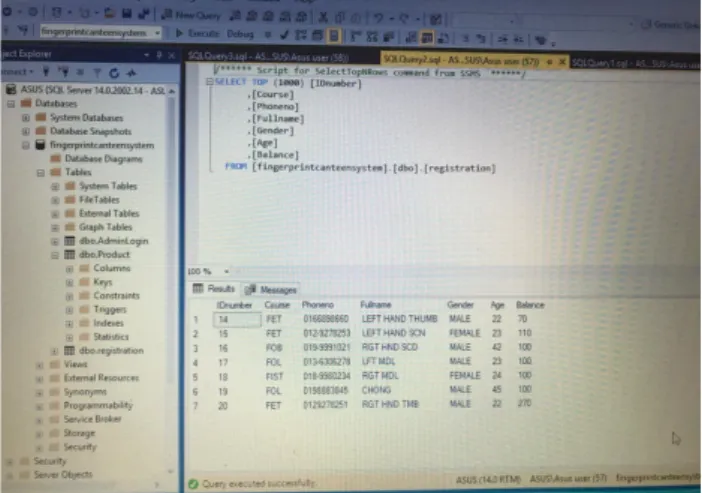
The database of the proposed fingerprint based school
debit transaction system is built by Microsoft SQL Server Management Studio. The database of this project is to store and retrieving data such as personal information and the account balance. There will be total four tables of the product. Each of the tables is used to store and manage the collected data that are inserted from the GUI application, and it will be retrieved when it is requested by users. The connectivity of the database of the database is explained below. First, thee relational database management system is connected to the ASUS server host after the SQL Server Management Studio has been assessed. Then, a new da-tabase from the Object Explorer is created. The tables in the database can be used to assign and manage different input data directing from the GUI application. After a new table has been created, a name is assigned to each of the column in that table. Figure 14 shows an example of the created database.
Figure 14. An example of database built by Microsoft SQL Server Management Studio
3. Hough Transform Minutiae Pairing
Fin-gerprint Matching (HTMP) Technique
fin-gerprint matching technique is proposed to the develop
fingerprint based school debit transaction system and it is
run by the following six steps:
Step 1: Scan Live Fingerprint: Retrieve user’s finger
-print image using R305-optical finger-print module.
Step 2: Classify Fingerprint Image: Classify the fin-gerprint image into any of the below eight categories: (i) Plain Arch (ii) Tented Arch (iii) Ulnar Loop (iv) Radial Loop (v) Plain Whorl (vi) Central Pocket Loop Whorl (vii) Double Loop Whorl and (viii) Accidental Loop Whorl, as depicted in Figure 15.
Step 3: Identify Region of Interest: identify the essence point in the fingerprint image and crop the core region concentrated in the essence point.
Step 4: Enroll Fingerprint Minutiae: extract two minutiae spot sets M and N from two fingerprint im-ages (database and inquiry) with undisclosed scale, rotation and translations by the following notations:
(
) (
)
{
P P}
y P x y xm
m
m
m
M
=
1,
1,
γ
1,...,
,
,
γ
,(
) (
)
{
Q Q}
y Q x y xn
n
n
n
N
=
1,
1,
δ
1,...,
,
,
δ
where P and Q arethe total number of minutiaes in set M and set N respec-tively.
(
m
ix,
m
iy,
γ
i)
and(
n
ix,
n
iy,
δ
i)
are those threefeatures (x-position, y-position, orientation) correlated with the i-th minutiae in set M and set N respectively.
Figure 15. Fingerprint patterns [13]
Step 5: Determine Rotation and Translation Pa-rameters: the transformation orientation function:
2 2 , , ,
:
R
R
G
sθ∆x∆y→
is given by [14]:
∆
∆
+
−
=
∆ ∆y
x
y
x
s
y
x
G
s x yθ
θ
θ
θ
θcos
sin
sin
cos
, , , (1)where s, θ,
(
∆
x
,
∆
y
)
are the scale, rotation andtrans-lation parameters correspondingly. For fingerprint authen
-tication/identification, the scaling factor s is set to unity,
due to the reason that the same device is used to capture fingerprint images for both the offline processing stage
and online authentication stage. The generalized Hough
Transform [15] is applied to determine those parameters.
The entry
E
(
l
,
p
,
q
)
sum up the verification of the orien -tation transformationG
θl,∆xp,∆yp, where(
θ
l,
∆
x
p,
∆
y
p)
are the quantized values of
(
θ
,
∆
x
,
∆
y
)
correspondingly.The normalized
E
(
l
,
p
,
q
)
in the range from 0 to 1 isrepresented by
f
(
θ
,
x
,
y
)
and is treated as theprobabil-ity densprobabil-ity function for θ, x, y transformation parameters.
(
θ
,
x
,
y
)
are independent from each other and can be es-timated separately, hencef
(
θ
,
x
,
y
)
can be re-structured as:(
x
y
)
f
( )
f
( )
x
f
( )
y
f
θ
,
,
=
θθ
*
x*
y (2)(1) Rotation Parameter: Let
(
Pd)
d dd
O
O
O
=
1,...,
be theorientation field from the database fingerprint image and
(
Pi)
i i
i
O
O
O
=
1,...,
be the orientation field from thein-quiry fingerprint image, where
P
d andP
i are the lengthsof the
O
d andO
i arrays respectively. The generalizedHough Transform based method to estimate the rotation
parameter (θ) consists of following 2 main steps:
(a) Estimate the probability density function of the ro-tation parameter
f
θ( )
θ
(b) Search the correct rotation parameter of the two
transformation among the two fingerprint images based on
the results obtain in (a.)
An accumulator array
E
( )
l
is used to gather thever-ification for each possible rotation by l degree, whereby
q i P
d
O
O
l
=
−
degree which mapO
iqtoO
dp. The correct rotation transformation among two fingerprint images is computed by mass center [14]:( )
∑
∑
( )
( )
∈ ∈×
=
l
f
l
f
l
l l θ l θ l θ lm
(3)where λ is the densest interval among the extracted mi
-nutiaes from the collected fingerprint images
(2) Translation Parameter: the computation of the trans-lation parameters
( )
t
x,
t
y can be done with the rotationset M and N are extracted from the database and inquiry
fingerprints correspondingly, utilizing the determined rota
-tion transforma-tion
G
θupon the minutiae in set N, a newrotated version of the N point set,
N
rcan be acquired.The following notation are in used:
(
) (
)
{
rQ rQ}
y Q r x r r y r x rn
n
n
n
N
=
,1,
,1,
δ
,1,...,
,,
,,
δ
,where
(
n
rx,i,
n
ry,i,
δ
r,i)
are the three features (spatial, position, orientation) related to the i-th minutiae in setr
N
. It can be calculated by [14]:
+
−
=
θ
δ
θ
θ
θ
θ
δ
0
0
1
0
0
0
cos
sin
0
sin
cos
, , , i i y i x i r i r y i r xn
n
n
n
(4)where
(
n
ix,
n
iy,
δ
i)
is the i-th minutiae in set N, θ isthe estimated rotation angle. Two minutiae points sets M and
N
rare used to calculate the translation parameters( )
t
x,
t
y . The steps for calculating x-translation,t
x:(a) Estimate the probability density function of the x-translation parameter
f
x( )
x
(b) Calculate the x-translation,
t
xwithf
x( )
x
.An accumulator array
E
( )
p
is used to gather the verification for each possible x-translation, wherebyj r x i x
n
m
p
=
−
, is the x-translation which map r j xn
,to
m
ix.m
ixis the x-coordinate for the i-th minutiae in set M andn
xr,j is the x-coordinate for the j-th point in setr
N
. The correct x-translation transformation among twofingerprint images is computed by mass center [14]:
( )
∑
∑
( )
( )
∈ ∈×
=
p
f
p
f
p
x p x p x l l lm
(5)where λ is the densest interval among the extracted mi
-nutiaes from the collected fingerprint images.
The steps for calculating y-translation,
t
yareidenti-cal with that of identi-calculating x-translation,
t
x. The correcty-translation transformation among two fingerprint images
is computed by mass center [14]:
( )
∑
∑
( )
( )
∈ ∈×
=
q
f
q
f
q
y q y q y l l lm
(6)whereby
q
=
m
iy−
n
ry,j is the y-translation which map jr y
n
, to i ym
.m
iyis the y-coordinate for the i-th minutiae in set M andn
ry,j is the y-coordinate for the j-th point in setr
N
.Step 6: Set Threshold to Compute Matching Score:
Pair up the minutiae set if the two fingerprint images’ fea
-tures or components (
m
l( )θ ,m
l( )x ,m
l( )y ) are identical orwithin a range of tolerance. A tolerance box is generated throughout each minutiae feature for coping with the shifting in the minutiaes pairs. The minutiaes pairs are
gathered among the pairs that fulfil the below geometric
constraints [14]:
(a) The two minutiaes’ Euclidean distance does not ex-ceed a certain value
∆
d
.(b) The two minutiaes directions’ angular difference below a certain tolerance
∆
θ
(c) Supposing that in excess of one pairs situate in the same bounding box, the two minutiaes with the minimum Euclidean distance opt as the matched pair.
Concerning to weight out the similarity among two fin
-gerprints, a similarity level measurement method applying
the matching score ψs is adopted, with the below formula
[14]:
{ }
P
Q
N
pair s=
max
,
ψ
(7)where
N
pairis the number of matched minutiae pairs,P and Q are the total number of minutiaes extracted from the database and inquiry fingerprint images
correspond-ingly. ψs is with value ranging from 0 to 1. If ψs is tends
to 0 implies that the two fingerprints are non-matching,
else if ψs is tends to 1 implies that the two fingerprints are
good match.
4. Experimental Results
In this section, the application of the proposed fingerprint
school debit transaction system will be illustrated. It will cover the product overview, test run results and the
prod-uct survey analysis. The fingerprint school debit transac
-tion system was tested in an institu-tion of higher learning within Malaysia, who wants to remain anonymous.
4.1 Product Overview
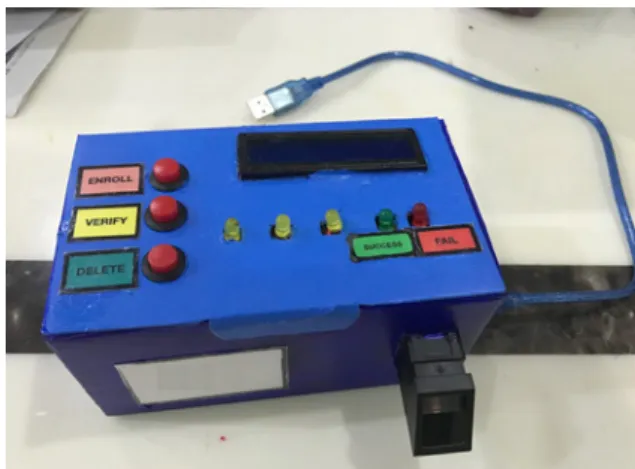
The final prototype of the fingerprint school debit transac
-tion system is shown in Figure 16. The circuit board and Arduino UNO microcontroller module are stored inside an external custom made casing. The function of all the but-tons are clearly labelled with laminated instruction signs. The LCD and LED will begin to operate once the USB cable is connected to PC/laptop/tablet. When the
finger-print verification process is successful, the green LED will
light up, whereas if unsuccessful fingerprint verification process detected, the red LED will be light up.
Figure 16. Final Prototype of the Fingerprint School Deb-it Transaction System (Fingerprint Collection Module)
The Admin Login GUI page is shown in Figure 17. This is the main page of the fingerprint school debit transaction system. Only the related school shopkeepers (Canteen, Cafeteria, Mini Mart, Printing shop, laundry shop, computer shop etc.) have their own username and password to login to the server to perform the business transaction (transfer students deposited money into their
account). This is to ensure the privacy and confidentiality
of every shopkeeper.
Figure 17. Admin Login GUI page
The first important step for the system to work is to
enrol the students’ (users’) fingerprint and personal infor
-mation into the system. The registration page is shown in
Figure 18. The basic information to insert is course, phone number, full name, gender and age. After inserting all the relevant information, the “ADD” button is pressed to en-rol in the system. In this case, the system will generate an ID number for that particular student. Moreover, the sys-tem can be used to update the latest information or delete the student’s previous account.
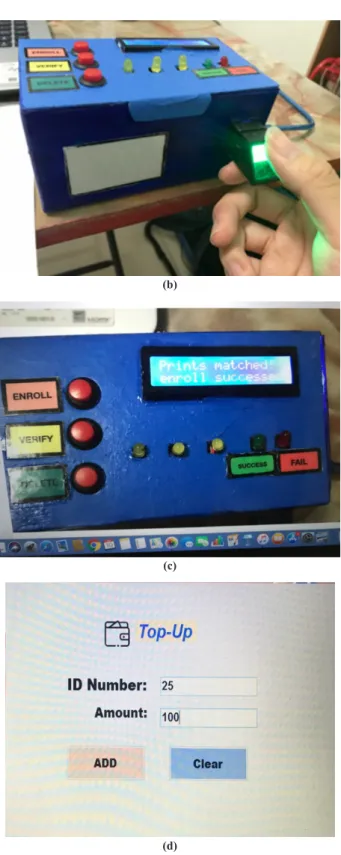
Next, students are instructed to enrol their fingerprint with the assigned identification number in the fingerprint collection module. The “Enrol” button must press to enrol a
fingerprint, the message “Please insert your ID” will be dis
-played on LCD screen, as shown in Figure 19(a). Once the ID number has been inserted, the student may place his/her finger on the fingerprint module to scan fingerprints. The
student must place his/her finger twice in each registration process, because the second fingerprint input is required to
compare and check with the initial template to ensure that
both fingerprint inputs are matched. The system will then
display “Print Matched, Enrol successful” to indicate a success case (as shown in Figure 19(c). Else it will display “Error” in the LCD screen for fail case. Students who have
successfully enrolled their fingerprint into the database sys
-tem may now start deposit /top up credit into the database. The top-up page is shown in Figure 19d.
Figure 18. Registration Page at Server
(b)
(c)
(d)
Figure 19. Enrolment (a) Message shown after Enrol Button Pressed (b) Scanning Fingerprint (c) Enrolment
successful (d) Top-Up Credit page
Students may start purchasing meals, goods, services within the school after enrolled and deposited credit into the database. A canteen case is chosen for further studies. Figure 20a shows the Meal GUI page and Figure 20b
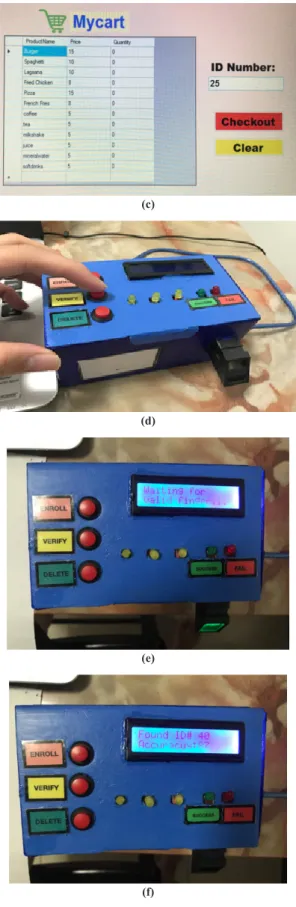
shows the Drinks GUI page of the canteen menu page. The meals and drinks selected by the students are later added to their shopping list, under Mycart GUI page, as shown in Figure 20c. This page shows the price and quan-tity of items ordered by students.
In order to check out the items, students must
authenti-cate their identity by evaluating their fingerprint for mak
-ing payment. Students are required to press the “Verify”
button on the fingerprint collection module, as shown in
Figure 20d. After the “Verify” button pressed, the LCD screen will display the message “Waiting for valid fin-gerprint”, as shown in Figure 20e, while processing the
fingerprint to seek for the correct students’ ID. The LCD
screen will display the message “Found ID #..” for
suc-cessful verification attempt, as shown in Figure 20f. On the fingerprint collection module, the red LED will initially illuminate to indicate that there is no finger place
on the sensor. The green LED will light up once the
stu-dents’ fingerprint had been identified. The LCD screen will display the students’ identification number and the accuracy
of the matching fingerprint. Only student who has
suc-cessfully obtained his/her identification number can make
transaction. The canteen operator will insert the students’
identification number to complete the payment process.
(a)
(c) (d) (e) (f)
Figure 20. Menu Selection and Authentication for Pay-ment (a) Meals GUI page (b) Drinks GUI page (c) Mycart
GUI page (d) Identity Verify Button Pressing (e) Identity
Verify Process On-going (f) Results of Verification
4.2 Test Run Results
The fingerprint school debit transaction system was test run in the canteen of the institution of higher learning. The experiment tested between 1,000 different students and staff. Each person must contribute 2 fingerprint
in-puts, which are thumb and index finger during the experi
-ment. Moreover, each fingerprint entry will be tested with
total number of 5 times. There will be a total of 10,000 attempts in this experiment. The main experiment
objec-tive is to test the reliability of this fingerprint recognition
system by calculating the successful authentication rate between 10,000 attempts. The rate of accuracy will be cal-culated with the below formula:
Rate of Accuracy = ×100%
Successful Attempt
Total Attempt (8)
Table 1 below shows the number of successful authen-tication in each of the thumb and index finger attempts. The total number of successful attempts in this authenti-cation experiment is 9,090. Therefore, the accuracy rate for this system is 90.9% by using equation (8). Figure 21a
shows the failure rate between the thumb and index finger and Figure 21b shows the failure rate between the (<2)
attempts and (>2) attempts.
The pie chart in Figure 21a shows clearly that index
finger has higher unsuccessful attempt rate (60.55%) com
-pare to thumb finger (39.45%). The pie chart in Figure 21b shows that most of the unsuccessful attempts took place in the first two attempts of the experiment. It has
failure rate up to 79.23% in the first two attempts of the
authentication process. However, there is a drastic drop
after the first two attempts (20.77%).
There are several reasons that could affect the accuracy of the authentication process such as the finger pressure
exerted on the sensor and the immobility and fixed posture
of finger during verification. Besides that, finger’s skin conditions such as dry, moisture and dirt may also affect the authentication result. Thus, it can conclude that the initial failure rate was solely caused by human factor.
Table 1. Results of Fingerprint Authentication Attempts
Finger Types No. of Authentication Attempts
1 2 3 4 5 Total
Thumb 761 960 979 971 970 4,641
Index Finger 679 879 972 960 959 4,449
Total Successful
At-tempts 1,440 1,839 1,951 1,931 1,929 9,090 Total Unsuccessful
(a)
(b)
Figure 21. Pie Chart on Unsuccessful Attempt (a) Be-tween Thumb and Index Finger (b) Number of attempts
4.3 Product Survey Analysis
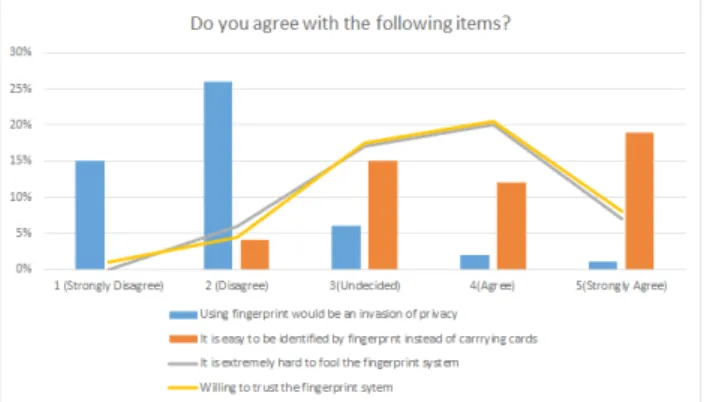
For the 1,000 participated students and staff in testing the fingerprint collection module, a survey was conducted onto them to determine the awareness and market value of the fingerprint based school debit transaction system. The questionnaire and the results are shown in Figure 22. Generally, majority of the respondents agreed that all schools should have a cashless future and 40% of them
have heard about biometric identification, particularly in
fingerprint technology. In addition, 98% of them agreed
that a fingerprint based debit transaction system can elim
-inate the need for a student to carry cards and remember
their password/identification numbers. Most of them are
willing to replace the conventional payment method with
this new fingerprint based debit transaction system. Fur
-thermore, 82% of the respondents believe that the
appro-priate time taken to identify the fingerprints should be less
than 1 minute (our proposed system current achievement
is 30 second plus). Furthermore, most respondent do not
believe that the use of fingerprints would be an invasion
of privacy and are willing to trust the fingerprint based debit transaction system if it is introduced in the school business area.
Figure 22. Questionnaire and the results surveying finger -print based school debit transaction system
5. Conclusion
A fingerprint-based school debit transaction system is
developed to promote a smooth flow and cashless transac
-tion environment within the school. In this case, it makes all the procedures and step become more convenient and
efficient. Furthermore, the implementation of fingerprint
-based transaction system can totally avoid using cash money as well as prevent issues like debit card get lost or stolen. All of the transactions made within the school will be independent of PIN and cards. Therefore, with this cashless payment system, all the money can be safely se-cured in the student’s account. Moreover, one of the high-lights of this system is able to trace back all the purchase history. This function can help the parent to monitor and restrict their children from consuming any unhealthy diet and junk foods. Thus, parent can ensure that their chil-dren’s money is being spent on the right intention. In addi-tion, a survey was conducted with 1,000 students and staff in the corresponding institution of higher learning, and majority of them agreed that all schools should be
pursu-ing a cashless future and willpursu-ing to use fpursu-ingerprint-based
transaction system.
The proposed fingerprint-based school debit transaction
system does have some limitation. It depends critically on the quality of the fingerprint’s image. The resolution of
the fingerprint’s image has a vital influence on the accura
-cy of the matching system. The current optical fingerprint
module might not be able to extract the important features
from the fingerprint if the input is in extremely low quali
-ty (blur user’s fingerprint surface). Therefor it can lead to
rejection or acceptance. Furthermore, the pressure exerted
and the finger’s skin condition are also constraints to the
current system.
The current fingerprint collection module is powered by electricity from the PC/laptop/tablet by each shop with the school. However, if there is a power failure occurs, the system will stop working. In this case, it will restrict the
registration and verification process, and may stop other
users from making payment with the system. An indepen-dent power source will be developed in future to prevent such incidents cause by power failure occurs. At this mo-ment, the system only works in an offline mode within school. For instance, it does not allow parents to check the purchase history and credit balance via online. In addi-tion, the proposed system does not support online banking yet. Parents have to come to the finance department to transfer or deposit funds to their children’s debit account. In future, the debit transaction system will be integrated and corporates with several banks to allow online banking transaction.
References
[1] D. Thaktar. Biometric Solution for Schools- Fin-gerprint lunch line. Bayometric, 2018. From:
https://www.bayometric.com/biometric-solu-tion-schools-fingerprint-lunch-line/
[2] J. Trader. Why School Districts Should Implement
Cashless Fingerprint Payment System, M2SYS Tech
-nology, 2016. From:
h t t p : / / w w w. m 2 s y s . c o m / b l o g / e d u c a t i o n /
why-school-districts-should-implement-cashless-fin
-gerprint-payment-system/
[3] C. Kalyani. Various Biometric Authentication Tech-nique: A Review. Journal of Biometrics & Biostatis-tics, 2017, 08(05).
[4] S. Hashemi, H. Tann, F. Buttafuoco and S. Reda. Approximate Computing for Biometric Security Sys-tems: A Case Study on Iris Scanning. 2018 Design, Automation & Test in Europe Conference & Exhibi-tion (DATE), 2018: 319-324.
[5] N. Charfi. Biometric recognition based on hand schape and palmprint modalities. Image Processing [eess.IV]. Ecole nationale supérieure Mines-Télécom Atlantique, 2017.
[6] M. M. H. Ali, V. H. Mahale, P. Yannawar and A. T.
Gaikwad. Overview of fingerprint recognition sys-tem. 2016 International Conference on Electrical,
Electronics, and Optimization Techniques (ICEEOT),
Chennai, 2016: 1334-1338.
[7] R. Mansoor & B. Parisa. A Review Of Face Rec-ognition Methods. International Journal of Pattern
Recognition and Artificial Intelligence, 2013, 27(4):
1356005(1 -35).
[8] M. K. Sharma & O. Kumar. Speech Recognition: A Review. Special Conference Issue: National Confer-ence on Cloud Computing & Big Data, 2014: 62-71. [9] J. Choudhary. Survey of Different Biometric
Tech-niques. International Journal of Modern Engineering Research (IJMER), 2012.
[10] M. N. Anjana Doshi. Biometric Recognition Tech-niques. International Journal of Advanced Research in Computer Networking, Wireless and Mobile Com-munications, 2015, 2(1): 143-152.
[11] D. Thaktar. Acceptance Rate (FAR) and
Recogni-tion Rate (FRR). Bayometric, 2017. From:
https://www.bayometric.com/-acceptance-rate-far--recognition-rate-frr/
[12] W. Yang, S. Wang, J. Hu, G. Zheng and C. Valli.
Security and Accuracy of Fingerprint-Based Biomet-rics: A Review. Symmetry, 2019, 11(141): 1-19. [13] "Intergalactic Vault," [Online]. Available:
http://www.intergalacticvault.com/if-you-have-a-spi-ral-whorl-fingerprint-pattern-this-iswhat-it-means/
[14] J. Qi, Z. Shi, X. Zhao and Y. Wang. A Novel Finger
-print Matching Method Based On The Hough
Trans-form Without Quantization Of The Hough Space.
Proceeding of the Third International Conference on Image and Graphics (ICIG’ 04) Hong Kong, China, 2004: 262-265.
[15] N. Saroha and N. S. Gill. Hough Transform Based Fingerprint Matching Using Minutiae Extraction. International Journal of Advanced Research in Com-puter Science, 2013, 4(10): 117-120.
![Figure 15. Fingerprint patterns [13]](https://thumb-us.123doks.com/thumbv2/123dok_us/1413354.2689132/7.892.86.436.624.839/figure-fingerprint-patterns.webp)