2018
Host managed storage solutions for Big Data
Pratik Mishra
Iowa State University
Follow this and additional works at:
https://lib.dr.iastate.edu/etd
Part of the
Computer Engineering Commons, and the
Computer Sciences Commons
This Dissertation is brought to you for free and open access by the Iowa State University Capstones, Theses and Dissertations at Iowa State University Digital Repository. It has been accepted for inclusion in Graduate Theses and Dissertations by an authorized administrator of Iowa State University Digital Repository. For more information, please [email protected].
Recommended Citation
Mishra, Pratik, "Host managed storage solutions for Big Data" (2018).Graduate Theses and Dissertations. 16522.
by
Pratik Mishra
A dissertation submitted to the graduate faculty in partial fulfillment of the requirements for the degree of
DOCTOR OF PHILOSOPHY
Major: Computer Engineering
Program of Study Committee: Arun K. Somani, Major Professor
Akhilesh Tyagi Olafsson Sigurdur
Chinmay Hegde Anuj Sharma
The student author and the program of study committee are solely responsible for the content of this dissertation. The Graduate College will ensure this dissertation is globally accessible and will
not permit alterations after a degree is conferred.
Iowa State University Ames, Iowa
2018
DEDICATION
I would like to dedicate this dissertation to Late Mr. Vidya Sagar Sharma, my first formal education teacher, who has instilled in me the urge to reason and the faith to believe in hard work right from a very young age. This has always kept me motivated and inspired me to pursue
re-search. My parents, sister, wife, andKudzie have constantly supported, encouraged and provided
me strength along my doctoral odyssey. Their sacrifices cannot be measured. I would also like to thank my friends and extended family for their suggestions during the writing of this work. All the teachers, staffs, and people who have taught me lessons in and about life have a vital contribution directly or indirectly. I cannot thank any of you enough in words or action.
TABLE OF CONTENTS
Page
LIST OF TABLES . . . vi
LIST OF FIGURES . . . vii
ACKNOWLEDGEMENTS . . . ix
ABSTRACT . . . x
CHAPTER 1. THE PROBLEM . . . 1
1.1 Introduction: Broader Issue . . . 1
1.2 Big Data: Associated Issues . . . 2
1.3 Host Managed Storage Solutions: Our Contributions . . . 5
1.3.1 Contention Avoidance: OS optimizations . . . 7
1.3.2 Contention Avoidance: Multi-tier solutions . . . 9
1.3.3 Workload Specific Optimizations: Exploring Lineage . . . 11
1.4 Dissertation Organization . . . 13
CHAPTER 2. LITERATURE REVIEW . . . 15
2.1 Our Problem scope . . . 15
2.1.1 Block I/O Optimizations . . . 15
2.1.2 Multi-tier solutions . . . 17
CHAPTER 3. CONTENTION AVOIDANCE FOR DISK BASED BIG DATA STORAGE . 24
3.1 The Problem . . . 24
3.2 Background . . . 27
3.2.1 Linux I/O Stack . . . 27
3.2.2 HDD characteristics . . . 30
3.2.3 Hadoop MapReduce: Working and Workload characteristics . . . 31
3.3 Requirements from block I/O scheduling in Big Data deployments . . . 32
3.4 Issues with current I/O schedulers . . . 33
3.5 BID-HDD: Contention Avoiding I/O Scheduling for HDDs . . . 41
3.6 Experiments and Performance Evaluation . . . 46
3.6.1 Testbed: Emulating Cloud Hadoop workloads and capturing block layer ac-tivities. . . 47
3.6.2 System Simulator . . . 48
3.6.3 Performance Evaluation: Results and Discussions . . . 50
3.7 Conclusion . . . 60
CHAPTER 4. CONTENTION AVOIDANCE USING MULTIPLE TIERS . . . 61
4.1 The Problem . . . 61
4.2 Storage Class Memory (SCM) characteristics . . . 63
4.3 OS Block Layer: Additional Features and Need for Hybrid-Awareness . . . 65
4.4 Our Approach totiering: BID-Hybrid . . . 68
4.4.1 Architecture . . . 69
4.4.2 Data Location Filtering . . . 71
4.4.3 Tier Classification and Placement . . . 72
4.5 Experiments and Performance Evaluation . . . 74
4.5.1 Hybrid System Simulator . . . 75
4.5.2 Performance Evaluation: Results and Discussions . . . 77
CHAPTER 5. LINEAGE-AWARE DATA MANAGEMENT IN MULTI-TIER SYSTEMS . . 83
5.1 The Problem . . . 84
5.1.1 Motivation . . . 87
5.1.2 Broader Impact and Goals of LDM . . . 88
5.2 LDM . . . 89
5.2.1 LDM framework . . . 92
5.2.2 Matching Storage capabilities . . . 98
5.2.3 Dependency Mitigation . . . 102
5.3 Experiments and Performance Evaluation . . . 107
5.3.1 Testbed setup . . . 107
5.3.2 Performance Evaluation . . . 111
5.4 Conclusion . . . 116
CHAPTER 6. CONCLUSION AND FUTURE WORK . . . 117
6.1 Operating System Block Layer Optimizations: BID-HDD . . . 118
6.2 Multi-tier Operating System optimizations: BID-Hybrid . . . 118
6.3 Data Management for Lineage based Applications: LDM . . . 119
BIBLIOGRAPHY . . . 121
LIST OF TABLES
Page
Table 2.1 Related Works Categorization. . . 23
Table 3.1 I/O request Submission Order to the Block Layer. . . 34
Table 3.2 Cloud Emulating Hadoop Benchmarks: I/O characteristics. . . 48
Table 3.3 Block Device Parameters in use for Performance Evaluation. . . 51
Table 4.1 I/O request Submission Order to the Hybrid-aware Block Layer. . . 71
Table 4.2 Block Device Parameters for Hybrid storage systems evaluation. . . 77
LIST OF FIGURES
Page
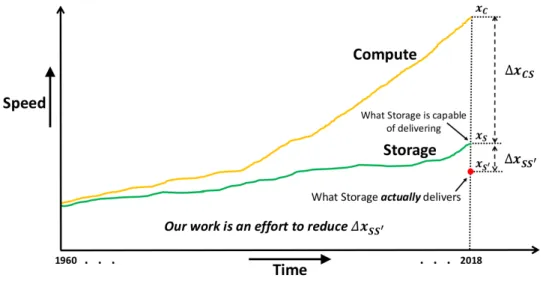
Figure 1.1 Compute and Storage speed progression with time (not to scale). . . 1
Figure 1.2 Multi dimensional forms of data. . . 3
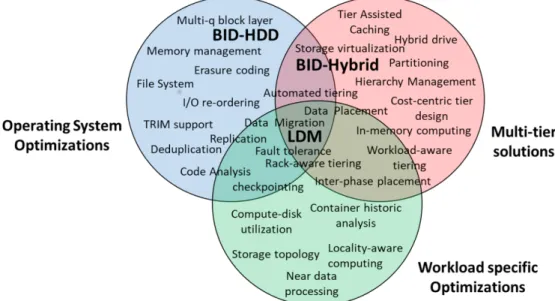
Figure 1.3 Our Contributions in Host Managed Storage. . . 5
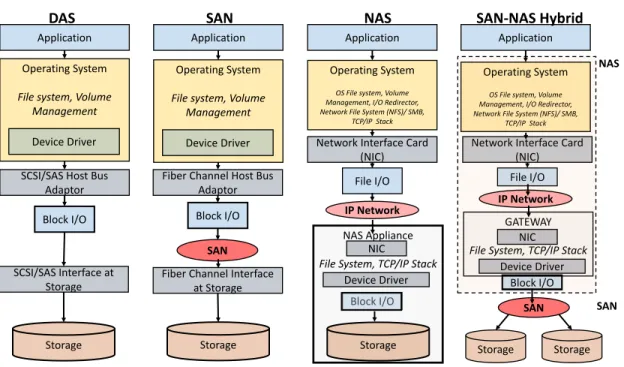
Figure 3.1 Networked Storage Architecture. . . 26
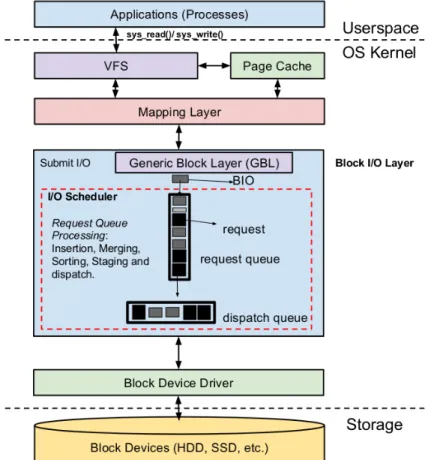
Figure 3.2 Architecture of Linux Kernel I/O Stack. . . 28
Figure 3.3 Geometry of the HDD with 1 platter, 100 sectors/track and 100 tracks/platter. 34 Figure 3.4 Working ofNoop Scheduling Algorithm.. . . 35
Figure 3.5 Working ofDeadline Scheduling Algorithm.. . . 36
Figure 3.6 Working ofCompletely Fair Queuing (CFQ) . . . 38
Figure 3.7 Working ofan Ideal Scheduling Algorithm. . . 40
Figure 3.8 Working ofBID-HDD . . . 42
Figure 3.9 Experimental Testbed: Hadoop cluster & capturing block layer I/O activity using blktrace. . . 47
Figure 3.10 Simulator Components. . . 49
Figure 3.11 Cumulative I/O Completion Time. . . 51
Figure 3.12 Disk arm movements forWordStandardDeviation workload. . . 53
Figure 3.13 Disk head movements for Noop, CFQ and BID-HDD between timestamps t1 and t2 for WordStandardDeviation. . . 54
Figure 3.14 Total number of disk arm movements. . . 55
Figure 3.15 Avg distance (no. of cylinders or tracks) per disk arm movement. . . 56
Figure 3.16 Cumulative disk head movement distance. . . 56
Figure 3.18 Mean Write I/O time. . . 59
Figure 4.1 Working architecture ofBID-Hybrid. . . 70
Figure 4.2 Simulator Components for Hybrid Aware Storage Systems. . . 75
Figure 4.3 Cumulative I/O Completion Time. . . 78
Figure 4.4 Total number of disk arm movements. . . 79
Figure 4.5 Avg distance (no. of cylinders or tracks) per disk arm movement. . . 80
Figure 4.6 Cumulative disk head movement distance. . . 81
Figure 5.1 Large Data Movement. . . 84
Figure 5.2 Components of LDM. . . 89
Figure 5.3 LDM Knowledge mining to aid data management policies. . . 93
Figure 5.4 Job pipelining and data-task associations. . . 94
Figure 5.5 Dataflow representations (a) Task graphs- workflow; (b) Block graphs: Data-task associations. . . 96
Figure 5.6 MapReduce Job: DAGs of tasks. . . 97
Figure 5.7 Multi-tier (a) Storage Hierarchy: descending order in performance and cost, and ascending in capacity (top-down); (b) Storage design objectives. . . 98
Figure 5.8 Advantages of replication. . . 101
Figure 5.9 Data Center Workload Emulation. . . 109
Figure 5.10 Total Time taken by HDFS and LDM (Workload 1 and 2). . . 111
Figure 5.11 Time taken by Chained Applications. . . 112
Figure 5.12 Anatomy of Job completion time of Chained MapReduce Applications. . . . 113
Figure 5.13 Total Read and Write Time of TeraSort job to show the difference between LDM for lineage applications LDMw1 andLDMw2. . . 113
Figure 5.14 Dependent and Non-Dependent blocks. . . 114
Figure 5.15 Impact of LDM on other concurrent applications running at the same time. 115 Figure A.1 Request queue processing structures. . . 134
ACKNOWLEDGEMENTS
First and foremost, I would like to express my gratitude towards my doctoral advisor, Dr. Arun K. Somani, for his guidance, patience, and support throughout this research and the writing of this dissertation. Right from my undergraduate junior year in India I have been associated with Dr. Somani. He provided me the opportunity to visit ISU and explore the possibilities to conduct research. His insights and words of encouragement have often inspired me and revived my hopes for completing my doctoral dissertation. He has constantly provided me with personal and professional support during the ups and downs of life. I always had the confidence that I can rely on him for anything and he was always there. The most important lesson from Dr. Somani which I would be carrying throughout life are the values to with-hold as a researcher. These have also made me a better human being. The amount of hard work you have put in is not tangible and words cannot express my indebtedness.
I would like to thank my committee members for their efforts and valuable contributions to this dissertation: Dr. Akhilesh Tyagi, Olafsson Sigurdur, Anuj Sharma, and Chinmoy Hegde. I have had endless hours of discussions and your suggestions which have channelized my thoughts. The guidance you have provided have made my ideas turn into reality. There is no doubt that without your constant support and selfless will, this doctoral research would not have been in the form in which it is today. I take extreme pride that I have been associated to all of you.
I would like to express my special gratitude towards Dr. Mayank Mishra for his valuable
suggestions and discussions. In the end, I would also like to thank my lab-mates, the interactions with them, both intellectual and personal were a constant source of encouragement.
ABSTRACT
The performance gap between Compute and Storage is fairly considerable. With multi-core computing capabilities, CPUs have scaled with the proliferation of Big Data but storage still remains the bottleneck. The physical media characteristics are mostly blamed for storage being slow, but
this is partially true. The full potential of storage device cannot be harnessed till all layers of
I/O hierarchy function efficiently. Despite advanced optimizations applied across various layers along the odyssey of data access, the I/O stack still remains volatile. The problems associated due to the inefficiencies in data management get amplified in multi-tasking Big Data shared resource environments. Its clearly evident that, there is an urgent need to re-think and re-design the system software to address the needs of Big Data.
Software defined storage (SDS) is the means of delivering storage services for a plethora of data
center applications and environments. Our effort is to deliver near-ideal performance of
storage systems, by identifying issues, designing, and, developing software defined stor-age capabilities with minimal or no infrastructural change for Data Centers processing Big Data. Thereby, making changes feasible. We do not intend to change application char-acteristics or improve storage devices or network infrastructures, but only the way data is managed. Therefore, this research aims to improve the layers along the odyssey of data access environment by understanding the I/O hierarchy and the application needs from storage.
Our contributions have been in three major fields, discussed as follows which are designed and developed specifically to suit multi-tenant, multi-tasking shared Big Data environments.
1) Operating System optimizations, deals with optimizing the OS and extending its
compe-tency; 2) Multi-tier solutions focuses on systems design to incorporate heterogeneous tiers of
3) Workload specific optimizations are full-stack data center storage solutions designed and developed to suit workload characteristics.
The Linux OS (host) block layer is the most critical part of the I/O hierarchy as it orchestrates the I/O requests from different applications to the underlying storage. The key to the performance of the block layer is the Block I/O scheduler, which is responsible for dividing the I/O bandwidth amongst the contending processes as well as determines the order and size of requests sent to storage device driver. Irrespective of the data center storage architecture (SAN, NAS, DAS), the final interaction with the physical media is in blocks (sectors in HDD, page in SSD) and the functioning of the block I/O scheduler is highly critical for system performance. Unfortunately, despite its significance, the block layer, essentially the block I/O scheduler hasnt evolved much to meet the needs of Big Data. Due to contention amongst different processes submitting I/O to a storage device and the working of the current I/O schedulers, the inherent sequentiality of MapReduce tasks is lost. This contention causes unwanted phenomenon such as interleaving and/or multiplexing, thereby adversely affecting system performance (CPU wait times, etc.) and increasing latency in disk based (Hard Disk Drive HDDs) storage devices.
First, we develop solutions, BID-HDD, from the core of the operating system, i.e. block I/O scheduling scheme to avoid contentions which tries to maintain the sequentiality in I/O access in order to provide performance isolation to each I/O submitting process and improve individual hard
disk drives (HDDs), the details are discussed in Chapter3. Through trace driven simulation based
experiments with cloud emulating MapReduce benchmarks, we show the effectiveness of BID-HDD which results in 28 to 52% lesser time for all I/O requests than the best performing Linux disk schedulers. BID-HDD is essentially a contention avoidance technique which can be modeled to cater different objective functions (storage media type, performance characteristics, etc.). The algorithms developed can be applied to other fields of engineering and science which have time-varying nature of incoming requests and scheduling of events is a challenge (which is the case most often).
HDDs form the back-bone of storage. The physical limitations of HDDs have led to Data
Centers organize data in multiple heterogeneous tiers1 of storage such as those having HDDs and
SSDs (Solid State Drives) coupled with workload-aware tiering2 to achieve cost, performance and
capacity trade-offs have become extremely popular. Second, we manage multiple devices and
develop methodologies, BID-Hybrid, to automated tiering using the information obtained at the
block interface using SSDs for improving disk performance (discussed in Chapter 4). BID-Hybrid
exploits SSDs random performance to further avoiding contention at disk based storage (using BID). The existing literature tiers based on heuristics or predictions (popularity, frequency, and deviation of logical locations). This may or may not be beneficial and can causes unnecessary deportations to SSD in skewed workload characteristics. BID-Hybrid is a deterministic approach. This enables BID-Hybrid to make judicious decisions and provide a holistic approach to tiering using I/O
data-structure information (development of the concepts of packing fraction). In our work, we define
randomness of blocks usage based on profiling the processes and provide decision metrics based on anticipation and I/O size, in-order to define the correct candidates for tiering. Those blocks are
offloaded to SSD which belong to a process causing interruptions (which create non-bulky I/Os)
and, therefore giving BID-Hybrid the dynamic adaptability based on changing I/O patterns. We demonstrate the effectiveness of BID-Hybrid by using our in-house developed system simulator, with enhanced OS features (VFS and Hybrid-block layer) to realize multiple tiers of storage used together. BID-Hybrid results in performance gain of 6 to 23% for MapReduce workloads when compared to BID-HDD and 33 to 54% over best performing Linux scheduling scheme.
We believe that in a large scale shared production cluster, the issues associated due to data management can be mitigated way higher in the hierarchy of the I/O path, even before requests to data access are made. The current data management techniques fail to capture the syntax and semantics of jobs and the associations of data in various stages of jobs. Moreover, they are mostly reactive and/or based on heuristics or prediction, thereby adding uncertainty. The goals of current
1Storage media across all nodes with similar physical and I/O characteristics. 2
Tiering refers to orchestrating data between heterogeneous tiers of storage by leveraging individual strengths of each to maintain balance between Cost, Performance and Capacity.
efforts have been to make read operations faster as they are believed to be the biggest bottleneck. This problem gets amplified for chained applications which exhibit lineage, where intermediate data during computation must be written and read back later on. Chained Jobs are a popular class of applications that are executed on clusters. Essentially, the jobs are pipelined and the output of a job forms the input (or a part of the input) of the next job. Such jobs are common in several business and scientific applications. The inconsiderate placement of intermediate results (writes) for reuse may affect the read performance adversely. Under this scenario, the gains derived by deploying multiple tiers in storage can be nullified easily by improper replica allocations to tiers, handling of memory resources, and avoidable data movement [Iliadis et al. (2015); Zaharia et al. (2012); Li et al. (2014)]. Therefore, in such data processing pipelines, its imperative to capture lineage or relationships across tasks and their dependency with data, i.e. data-task associations. Lastly, we design and develop data management solutions for the complete data center ecosystem using multiple tiers of storage for mitigating the impact of data-dependency in lineage class of applications. LDM, our data management solution, is designed to cater to a class of applications
which exhibit lineage, i.e. the current writes are future reads. In such class of applications, slow
writes significantly hurt the over-all performance of jobs, i.e. current writes determine the fate of next reads. The concepts developed can be extended to a wide variety of applications. LDM amalgamates the information from the entire data center ecosystem, right from the application code, to file system mappings, the compute and storage devices topology, etc. to make
oracle-like deterministic data management decisions. These policies include, Data Placement, Replica
Management, and Data Migration. With trace-driven experiments, LDM (Algorithms 4 and 5) is able to achieve 29% to 52% reduction in over-all data center workload (lineage as well as other concurrent non-lineage applications) execution time. We believe that LDM will have a huge impact on the performance and resource management of data processing platforms. We discuss briefly the
With theoretical and experimental evaluations, our host managed storage solutions, namely, BID-HDD, BID-Hybrid, and LDM, fulfils our objective of narrowing the gap between what storage is capable of delivering and what it actually delivers in a Big Data environment.
We conclude our contributions in Chapter 6 followed by brief discussions on the future
direc-tions of work in the field of Host Managed Storage Solutions for Big Data. In future, we
would like to further investigate and develop the field of “Data assisted systems engineering”.
Throughout this research, we have utilized the information gathered by various layers of the I/O hierarchy to develop storage solutions. Therefore, the data generated from the various components of the system assist in making the performance of Big Data storage systems faster.
Our research would aid Data Centers to achieve their Service Level Agreements (SLAs) as well as to keep the Total-Cost of Ownership (TCO) low. From the Green Computing perspective, our solutions will decrease energy footprint, due to much reduced work to process data across all tiers of computing, i.e. storage, compute (required on storage servers), and network.
CHAPTER 1. THE PROBLEM
1.1 Introduction: Broader Issue
Figure1.1represents the progression of computation and storage devices (in terms of speed) over
time. Processors have consistently improved and scaled at a steady pace with CPUs processing data at extremely high rates [Nanavati et al. (2015)]. While performance of storage devices remained roughly unchanged for a long time due to physical limitations of mechanical drives. Recently, there have been efforts to reduce the performance gap, right from innovations in the semiconductor industry such as the development of solid state drives to re-inventing faster interconnects such as
PCIe to replace the legacy SATA/SAS bus. Despite the best efforts, storage was, is and will (in
the foreseeable future) remain a bottleneck in the system.
Figure 1.1: Compute and Storage speed progression with time (not to scale).
It is clearly evident that the performance gap (∆xCS) between compute and storage is still
fairly considerable. This results in a mismatch between the application needs from storage and
100% of what they are capable of, but practically it never happens. Therefore,actual performance difference is much more, i.e. ∆xCS+ ∆xSS0. The additional delay (∆xSS0) is attributed to what
the storage is capable of delivering and what storageactually delivers (represented by the red dot).
The physical media characteristics and interface technology are mostly blamed for storage
be-ing slow, but this is only partially true. The full potential of storage devices (or system) cannot
be harnessed till all layers of I/O hierarchy function efficiently. Despite advanced optimizations applied across various layers along the odyssey of data access, the I/O stack still remains volatile. There have been a plethora of solutions to reduce the performance difference, right from OS op-timizations like caching, virtualization, pre-fetching, to partitioning of databases, etc., developed to manage data. These solutions have proven to be beneficial for legacy applications with low re-source footprint. All these assumptions appear to collapse in Data Centers experiencing Big Data workloads. The problems associated due to the inefficiencies in data management get amplified in multi-tasking, and shared Big Data environments. There is an urgent need to re-think and re-design the system software to address the needs of Big Data.
Our effort is to deliver near-ideal performance of storage systems, i.e. reduction of ∆xSS0, by identifying issues and designing storage solutions with minimal or no
infras-tructural change for Data Centers experiencing Big Data.
In the next section, we briefly discuss the problems associated to data management for Big
Data environments, followed by our contributions in Section 1.3.
1.2 Big Data: Associated Issues
Data is growing in an unprecedented rate along all dimensions. Three of the most important
V’s which create data-intensive workloads is shown in Figure 1.2 [Mishra et al. (2017)]. The
sudden spurt in data-driven sciences has put tremendous pressure on the system architecture which was designed for legacy applications with low resource (namely, storage, network and compute)
footprint. For example, to reduce additional seeks to storage, keeping the working set sizes of application small was the key to caching and pre-fetching mechanisms, such that the data could easily fit in RAM. Such techniques and assumptions are now being invalidated due to the current working set sizes and the difficulty in profiling workloads [Harter et al. (2014)].
Figure 1.2: Multi dimensional forms of data.
Data centers today cater to a wide diaspora of applications which process multiple data sets for multiple jobs in a multi-user environment concurrently. They also deploy storage systems organized
in multiple heterogeneous tiers1, which is necessary to achieve cost-performance-capacity trade-off
[Zhou et al. (2016); Kakoulli and Herodotou (2017)]. Each application can have different syntax and semantics, with varying I/O needs from storage. With highly sophisticated and optimized data processing frameworks, such as Hadoop and Spark, applications are capable of processing large amounts of data at the same time. Dedicating physical resources for every application is not economically feasible [Krish et al. (2014a)]. In cloud environments, with the aid of server and storage virtualization, multiple processes contend for the same physical resource (namely, compute, network, and storage). This causes contentions. In-order to meet their service level agreements (SLAs), cloud providers need to ensure performance isolation guarantees for every application. With multi-core computing capabilities, though CPUs have scaled to accommodate the needs of “Big Data”, but storage still remains a bottleneck.
Given the operating ecosystem, the physical limitations of storage devices and the insatiable needs of applications to process data, the storage layer and the I/O path need to be extremely efficient in-order to minimize delay. The performance of storage devices depend on the order in which the data is stored and accessed. This order is multiplexed due to interferences from other contending applications. Therefore, in large scale distributed systems (“cloud”), data management plays a vital role in processing and storing petabytes of data among hundreds of thousands of storage devices [Zhou et al. (2016)]. Few changes in data-management with proliferation of Big Data is inevitable:
1. The transition to Big Data was sudden and the system software stack was and is not prepared
to cope up with the needs of applications from storage. The techniques and schemes used by traditional enterprise infrastructure are being invalidated in highly multiplexing environments such as data centers experiencing Big Data.
2. The current data management techniques fail to capture the syntax and semantics of jobs and
the associations of data in various stages of jobs. Under this scenario, the gains derived by deploying multiple tiers in storage can be nullified easily by improper replica allocations to tiers, handling of memory resources, and avoidable data movement. The storage layers needs to be dynamically adaptable to changing time-varying application I/O characteristics.
3. The focus needs to be on Workload-aware tiering2 coupled with fault-tolerance and data-center
topology-awareness to reduce the over-all resource and energy footprints.
4. With so many software and hardware designs, and devices being employed in the data processing
infrastructure, a lot of information is generated such as system utilization, device characterization, etc. All such informations should be harnessed to understand the way applications will access data. This could aid data management to dictate deterministic policies and pave the path towards
development of “Data assisted systems engineering”.
5. Therefore, the entire storage software stack needs to be re-designed with striping up of inefficient layers along the odyssey of data access and adding of new features right from the data center design
2
Tiering refers to orchestrating data between heterogeneous tiers of storage by leveraging individual strengths of each to maintain balance between Cost, Performance and Capacity.
to operating system kernel I/O sub-structures and network interfaces for matching the application needs from storage with storage capabilities.
Our motivation is based on these assumptions and observations, i.e. the deficiencies of the current storage systems to mitigate the impact of Big Data workloads. In the next section, we briefly outline our contributions in the field.
1.3 Host Managed Storage Solutions: Our Contributions
Software defined storage (SDS) is the means of delivering storage services for a plethora of data center applications and environments. Our major effort has been in developing software defined storage capabilities to manage data with minimal costs and infrastructural changes, thereby making any improvements feasible.
Figure 1.3: Our Contributions in Host Managed Storage.
Our focus is to develop host managed storage solutions by understanding the I/O hierarchy and the application needs from storage for narrowing the gap between what storage is capable of
delivering and what it actually delivers in a Big Data environment (refer to Figure1.1). We do not
but only the way data is managed. Therefore, this research aims to improve the layers along the odyssey of data access environment. Host Managed Storage solutions is a sub-set of software defined solutions which deals with identifying issues, developing and designing software-based data-management storage solutions in the host (operating) side with minimal or no changes to the hardware infrastructure.
Figure 1.3 represents the different areas of research in Host Managed Storage and outlines our
contributions in the field. We have three major contributions as outlined below and described in three chapters in this dissertation.
1) Operating System optimizations deal with optimizing the OS and extend its competency. We develop solutions, BID-HDD, from the core of the operating system, i.e. a block I/O schedul-ing scheme to avoid contentions and improve individual storage device (Hard Disk Drives HDDs) capabilities. The details are discussed in Chapter 3.
2) Multi-tier solutions focuses on systems design to incorporate heterogeneous tiers of storage together coupled with value propositions of data being scattered over multiple devices.. We manage multiple devices and develop methodologies, BID-Hybrid, to automate tiering utilizing the informa-tion obtained at the block interface to use Solid State Drives SSDs for improving disk performance (discussed in Chapter4).
3)Workload specific optimizationsare full-stack data center storage solutions designed and de-veloped to suit workload characteristics.We design and develop data management solutions, LDM, for the complete data center ecosystem using multiple tiers of storage to mitigate the impact of data-dependency in lineage class of applications. LDM amalgamates the information from all the
strata, devices, and layers in the I/O path (refer to Chapter 5).
All these three categories impact and/or are dependent on each other and many solutions lie in the common areas. Our contributions in each of these chapters are enumerated in the following sections.
1.3.1 Contention Avoidance: OS optimizations
The prime objective of the operating system is to manage data across the I/O hierarchy and relegate the requests from the user-space (or applications) to the storage device. In cloud environ-ments, with the aid of server and storage virtualization, multiple processes contend for the same
physical resource (namely, compute, network, and storage). This causes contentions. In-order to
meet their service level agreements (SLAs), cloud providers need to ensure performance isolation gaurantees for every application. The performance of storage devices depend on the order in which the data is stored and accessed. This order is multiplexed due to interferences from other contend-ing applications. Therefore, in such systems, data management plays a vital role in processcontend-ing and storing petabytes of data among hundreds of thousands of storage devices. Therefore, optimizing the operating system is extremely critical for the over-all system performance.
We enumerate our contributions in optimizing the operating system as follows.
• Identifying the major source of contention in the I/O subsystem, i.e. “request queue
process-ing” (refer to Appendix A).
The Linux OS (host) block layer is the most critical part of the I/O hierarchy, as it orchestrates the I/O requests from different applications to the underlying storage. Unfortunately, despite its significance, the block layer, essentially the block I/O scheduler has not evolved to meet the needs of Big Data.
• Identification of the requirements of a block I/O scheduler suited for Big Data environments.
The data access time in HDDs is majorly governed by disk arm movements, which usually occurs when data is not accessed sequentially. Big Data applications exhibit evident sequen-tiality but due to the contentions amongst other I/O submitting applications, the I/O accesses get multiplexed which leads to higher disk arm movements. The requirements are laid down in Section3.3.
• We have developed and designed a contention avoidance scheme for disk based storage devices known as “BID-HDD: Bulk I/O Dispatch” in the Linux block layer, specifically to suit multi-tenant, multi-tasking and skewed shared Big Data deployments.
• BID-HDD extends the capabilities of the current block layer to adapt with changing Big Data
workloads.
The efficient pipelining of large data blocks groups from adjoining locations in the disk leads to reduction in disk arm movements (leveraging sequentiality performance). The development
of staging queues as well as the scheduling algorithms (Algorithms1 and 2) has enabled the
block layer to make judicious decisions of dispatching requests to the device driver. The dynamic need-based anticipation time ensures performance isolation to each I/O contending processing following system constraints without compromising the SLAs.
• We have designed and developed a System Simulator using Python v2.7.3 to replicate the
working of the System level components (Host OS, Storage devices, etc.).
We use the trace file (as discussed in Section3.6.1) for application I/O submission order for
evaluating our system design. The OS simulator is designed to work right from the kernel I/O data-structures and development of these units. While the storage simulator is accurately developed to emulate the working of the storage devices as per device characteristics and specifications.
• Through trace driven simulation based experiments with cloud emulating MapReduce
bench-marks, we show the effectiveness of BID-HDD which results in 28 to 52% lesser time for all I/O requests than the best performing Linux disk schedulers.
BID-HDD is essentially a contention avoidance technique which can be modeled to cater different objective functions (storage media type, performance characteristics, etc.). The algorithms devel-oped can be applied to other fields of engineering and science which have time-varying nature of incoming requests and scheduling of events is a challenge (which is the case most often). BID-HDD
1.3.2 Contention Avoidance: Multi-tier solutions
Due to physical limitation of HDDs, there have been recent efforts to incorporate flash based high-speed, non-volatile secondary memory devices, known as Storage Class Memories (SCMs) in data centers. Despite superior random performance of SCMs (or SSDs) over HDDs, replacing disks with SCMs completely for data center deployments does not seem to be economically feasible. With recent developments in NVMe devices, with supporting infrastructure and virtualization techniques, a hybrid approach of using heterogeneous tiers of storage together such as those having HDDs and SSDs coupled with workload-aware tiering to balance cost, performance and capacity have become increasingly popular.
Data centers consists of many tiers of storage devices. All storage devices of the same type form a tier. For example, all HDDs across the data-center form the HDD tier and all SSD form SSD tier, and similarly for other SCMs. Based on profiling of workloads, balanced utility value of data usage, the data is managed between the tiers of storage for improved performance. Workload-aware
storage tiering, or simply tiering is the automatic classification of how data is managed between
heterogeneous tiers of storage in an enterprise data-center environment [Mishra and Somani (2017)]. It is vital to develop automated and dynamic tiering solutions to utilize all the tiers of storage. Our contributions in multi-tier OS contention avoidance storage solutions are described below.
• We develop and design a hybrid scheme, BID-Hybrid, to exploit SCMs (SSDs) superior
ran-dom performance to further avoid contentions at disk based storage to suit such multi-tasking, multi-user shared Big Data environments. BID-Hybrid aims to deliver the capability of dy-namic and judicious automated tiering in the block layer as a SDS solution.
• BID-Hybrid lies in the “initial tier placement” class of problem in tiering. The main objective
function of “initial tier placement” problem is the balanced decision of which tier the data is to be initially written in-order to reap the maximum performance benefits.
• Contrary to the tiering approach of defining SSD candidates based on deviation of LBAs, BID-Hybrid profiles process I/O characteristics by utilizing dynamic anticipation and I/O packing of kernel data-structures.
• BID-Hybrid is able to efficiently offload non-bulky interruptions from HDD request queue to
SSD queue using BID-HDD for disk request processing and multi-q FIFO architecture for SSD.
• We design the system architecture to support a “hybrid OS block layer” (see Section4.4) and
develop system simulators to evaluate BID-Hybrid.
• BID-Hybrid results in performance gain of 6 to 23% for MapReduce workloads when compared
to BID-HDD and 33 to 54% over best performing Linux scheduling scheme. BID schemes as a whole is aimed to avoid contentions for disk based storage I/Os following system constraints without compromising SLAs.
BID-Hybrid (refer to Chapter 4) uses similar concepts of staging as BID-HDD. Due to the
staging capabilities in the Host (OS) block layer, bulkiness of processes can be calculated and verified on-the fly in-order to avoid unnecessary deportations to SSD. The key idea is to offload I/O blocks belonging to non-bulky processes to SSD (managed by multi-q block layer architecture [Bjørling et al. (2013)]) and the bulky I/Os to HDD (handled by BID-HDD). This serves multi-fold: (1) maximal sequentiality in HDD is ensured, i.e “HDD request queue” is made free from unnecessary contention and interruption causing blocks; (2) the future references to the non-bulky blocks are prevented from causing contentions for HDD disk I/O, as the semantic blocks have a high probability to appear in the same pattern. Therefore, BID-Hybrid aims to further reduce contention (more than BID-HDD) at disk based storage by offloading interruption causing blocks to SSD, while ensuring uninterrupted sequential access to HDDs.
1.3.3 Workload Specific Optimizations: Exploring Lineage
Data centers today cater to a wide diaspora of applications which process multiple data sets for multiple jobs in a multi-user environment concurrently. They also deploy storage systems organized in multiple heterogeneous tiers, which is necessary to achieve cost-performance-capacity trade-off [Mishra and Somani (2017); Iliadis et al. (2015); Kim et al. (2011)]. Dedicating physical resources for every application is not economically feasible. Resource sharing causes contention affecting the efficiency and performance [Mishra and Somani (2017); Mishra et al. (2016); Hindman et al.
(2011)]. Data are scattered over multiple files located at multiple storage nodes3 and replicated for
performance, availability and reliability reasons.
We believe that in a large scale shared production cluster, the issues associated due to data management can be mitigated at a much higher level in the hierarchy of the I/O path, even before requests to data access are made. The current data management techniques fail to capture the syntax and semantics of jobs and the associations of data in various stages of jobs. Moreover, they are mostly reactive and/or based on heuristics or prediction, thereby adding uncertainty. Moreover, the goals of current efforts have been to make read operations faster as they are believed to be the biggest bottleneck. This problem gets amplified for chained applications which exhibit lineage, where intermediate data during computation must be written and read back later on. For example, Chained Jobs are a popular class of applications that are executed on clusters. Essentially, the jobs are pipelined and the output of a job forms the input (or a part of the input) of the next job. Such jobs are common in several business and scientific applications.
The inconsiderate placement of intermediate results (writes) for reuse may affect the read per-formance adversely. It is now becoming clearer that dealing with large amounts of current “writes”, which are future “reads” is equally important to achieve good performance. Under this scenario, the gains derived by deploying multiple tiers in storage can be nullified easily by improper replica allocations to tiers, handling of memory resources, and avoidable data movement [Iliadis et al. (2015); Zaharia et al. (2012); Li et al. (2014)]. Therefore, in such data processing pipelines, it
is imperative to capture lineage or relationship across tasks and their dependency with data, i.e. data-task associations.
LDM is designed to cater to a class of applications which exhibit lineage, i.e. the current
writes are future reads. In such class of applications, slow writes significantly hurt the over-all performance of jobs, i.e. current writes determine the fate of next reads. The concepts developed can be extended to a wide variety of applications. We discuss briefly the contributions of LDM in
workload specific optimization (refer to Chapter5).
• We develop and design a novel framework, calledLDM, to address the challenges in
lineage-aware data management to effectively utilize multi-tier storage hierarchy. LDM captures the inherent lineage information and reduce the data movement via network by placing them appropriately to enable maximal processing nearer to the storage locations as well as in appropriate storage tiers.
• LDM amalgamates the information from the entire data center ecosystem, right from the
application code, to file system mappings, the compute and storage devices topology, etc. to take oracle-like deterministic data management decisions.
• LDM captures the inherent data dependency by analyzing the metadata associated with
application code and extract semantic knowledge of the computational workflow logic coupled with the file system information to build task and block graphs.
• We develop block-graphs, which uses file-system information about the block to device
map-pings to associate blocks of data with tasks (using task blocks). Block graphs are designed to deterministically capture all the data block-task associations and data lineage across tasks. LDM uses this knowledge to mitigate the impact of delays associated to writing and then subsequently reading intermediate results.
• LDM utilizes all tiers of storage to reduce data access delays in conjunction with workload
the storage device current and future utilization along with its characteristics and match them to “lineage-quotient” of blocks to dictate policies.
• LDM performsInitial Data Placement, Replication Placement, andData Migration tasks for
dependency mitigation which are described using Algorithm 4, 5 and 6, respectively. They
determine the storage device(s) to place the data and if, when, and where to move data blocks dynamically.
• With trace-driven experiments, we show LDM (Algorithms 4, and 5) is able to achieve 29%
to 52% reduction in over-all data center workload execution time.
We believe that LDM will have a huge impact on the performance and resource management of data processing platforms.
From the Green Computing perspective, our solution will decrease energy footprint, due to much reduced work to process data across all tiers of computing, i.e. storage, compute (required on storage servers), and network.
1.4 Dissertation Organization
In Chapter 1, we have briefly described the problems associated to storage and deficiency of
the traditional (current) system architecture to brave with the requirements of Big Data. This is followed by the description of the problem and our major contributions in the field. Chapter
2 categorizes the relevant literature in our problem scope, and provides an overview of the work
done in developing these areas, namely, OS optimizations, Multi-tier OS solutions, and Workload specific optimizations, respectively.
The next three chapters are organized based on our specific contributions. Chapter3 describes
our novel contention avoidance technique, BID-HDD, which essentially is a block I/O scheduler for disk based storage suited for multi-tenant, multi-user, and multi-tasking Big Data shared resource environments. We discuss right from the details of the operating system basics and develop the
discuss the working architecture of our novel multi-tier (HDDs and SCMs) OS contention avoidance scheme, BID-Hybrid, which further reduces contentions for disk based storage devices using solid
state devices. Chapter 5 describes the working of our data management solution, LDM, designed
to cater a class of applications which exhibit lineage, i.e. the current writes are future reads. In
such class of applications, we mitigate the impact of slow writes which significantly hurt the over-all performance of jobs, i.e. current writes determine the fate of next reads.
We conclude our research in Chapter6, followed by brief discussions on the future directions of
CHAPTER 2. LITERATURE REVIEW
The journey to store and utilize data from cave drawings to developments in exascale storage has fueled various innovations over time. The main research focus for a long time has been in improving physical media characteristics like increasing areal density of hard drives, read/write technology, etc., semiconductor storage devices (SSDs, DVIMMs, RAMDisks, etc.), and their interconnects (SAS, SATA, PCIe, NVMe, FCoE etc.). The developments in the field of storage can be broadly divided into application-space, networking and storage-devices. We limit our discussion to our
problem scope, i.e. Host Managed Storage Solutions for Big Data.
2.1 Our Problem scope
Our effort is to provide software defined storage capabilities by identifying and eliminating the deficiencies along the software layers of the I/O path for data-centers experiencing Big Data workloads. We have categorized the relevant literature according to the specific areas of our problem scope, as shown in Table 2.1.
2.1.1 Block I/O Optimizations
In this section, we discuss the developments in the block layer, concentrating mostly on I/O Scheduling. I/O Scheduling has been around since the beginning of disk drives [Ruemmler and Wilkes (1994)]. We limit our discussion to those approaches which are relevant to recent devel-opments. Despite advanced optimizations applied across various layers along the odyssey of data access, the Linux I/O stack still remains volatile. The block layer hasn’t evolved [Bjørling et al. (2013); Riska et al. (2007)] to cater the requirements of Big Data. Riska et al. (2007) evaluates the effectiveness of block I/O optimization at the application layer by quantifying the effect of request merging and reordering at different I/O layers (File System, Block Layer, Device driver) have on
overall system performance. One of the major findings were in establishing relationships between performance and block I/O scheduler. Our work on BID-HDD is an effort in this domain especially for rotation based recording drives. BID is essentially a contention avoidance technique which can be modeled to cater different objective functions (storage media type, performance characteristics, etc.).
Axboe (2004) provides a brief overview of the Linux block layer, basic I/O units, request queue processing, etc. Ibrahim et al. (2011) proposes a framework which studies the VM interference in Hadoop virtualized environments with the execution of single MapReduce job with several disk pair schedulers. It divides the MapReduce job into phases (i.e. Map, Shuffle, and Reduce) and executes series of experiments using a heuristic to choose a disk pair scheduler for the next phase in a VM Environment. Bhadkamkar et al. (2009) is a self-optimizing HDD based solution which re-organizes blocks in the block layer by forming sequences via calculating correlation amongst LBA (logical block address) ranges with connectivity based on frequency distribution and temporal locality. It makes weighted graphs and relocation of blocks happens to most needed vertex first. The goal is to service most requests from dedicated zones of a HDD.
Bjørling et al. (2013) is an important piece of work which extends the capabilities of the block layer for utilizing internal parallelism of SSDs to enable fast computation for multi-core systems. It proposes changes to the existing OS block layer with support for multiple software and hardware queues for a single storage device. Multi-q involves a software queue per CPU core. Similar lock-contention scheme can be used for BID, as it also involves multiple queues. Malladi et al. (2016) mentions about NVMe I/O scheduling having separate I/O queues for each core, therefore using Multi-q concepts. In BID-Hybrid, we use Multi-q for serving I/Os in SSD as it would ensure performance as well as allow proportional sharing.
Yi et al. (2017) is an SSD extension of CFQ scheduler in which each process has a FIFO request queue and the I/O bandwidth is fairly distributed in round robin fashion. Park et al. (2016) and Kim et al. (2016) propose to ensure diverse SLAs, including reservations, limitations, and proportional sharing by their I/O Scheduling schemes in shared VM environment for SSDs.
While Park et al. (2016) uses an opportunistic goal oriented block I/O scheduling algorithm, Kim et al. (2016) proposes host level SSD I/O schedulers, which are extensions of state-of-the-art I/O scheduling scheme CFQ. Wang et al. (2013) tries to utilize the parallelism in SSDs, by dividing the entire SSD into sub-regions, each having a different queue for dispatching requests. Wang et al. (2013) might be good in applications which have more random I/Os otherwise, leading to increasing wait queues for popular sub-regions & bias in performance.
2.1.2 Multi-tier solutions
There is a huge industrial and academic focus to incorporate NVMe’s (SSDs) into data-centers, with developments such as NVMe Express utilizing PCIe bus technology and NVMe over RDMA Fabrics for point-to-point interconnect [Nanavati et al. (2015); Malladi et al. (2016)]. Though hard drives will not be replaced by NVMe devices (SSDs) in the near future, more prominently due to SSD’s high TCO (Total Cost of Ownership- cost/GB, write amplification, lifespan) [Yang and Zhu (2016b)], lack of consistent software stack (fabrics, interface and media characteristics) as well as non-uniform workload performance characteristics [Nanavati et al. (2015); Mittal and Vetter (2016); Krish et al. (2016)]. A hybrid approach with heterogeneous tiers of storage such as those having HDDs and SCMs coupled with workload aware tiering to balance cost, performance and capacity have become increasingly popular [Zhou et al. (2016); Harter et al. (2014)]. Multi-tier storage environment deal with how data is managed between heterogeneous tiers of storage in enterprise data-center environment.
The underlying foundation of multi-tier storage has been adopted from the concepts of caching mechanisms such as LRU, LFU, etc., as well as partitioning of databases. Partitioning of databases, more specifically vertical partitioning has been an active field of research since the 70’s and 80’s [Galaktionov et al. (2016); Li and Patel (2014)]. The key idea is to develop an optimization model to satisfy one or more criteria to improve the I/O performance of databases. Partitioning of databases, similar to physical design problems has been proven to be NP-Hard due to the estimation errors in both system and workload parameters [Galaktionov et al. (2016); Li and Patel (2014); Agrawal
et al. (2004)], therefore extensive work has been done by the database community [Navathe et al. (1984); March and Rho (1995); Chu (1969); Cornell and Yu (1990); Alagiannis et al. (2014); Curino et al. (2010); Jindal and Dittrich (2011); Jindal et al. (2013); LeFevre et al. (2014)].
Navathe et al. (1984), Cornell and Yu (1990), March and Rho (1995) & Chu (1969) have been one the earliest studies in the filed of partitioning of databases. Navathe et al. (1984) proposed algorithms and physical system designs to vertically partition databases to reorganize data in two level memory hierarchy such that highly active data is stored in the fastest memory. This is done to minimize the access to secondary storage, thereby improving performance. Chu (1969) developed an optimization model for minimizing overall costs by constricting response time and capacity with fixed number of copies of each file fragment. Cornell and Yu (1990) proposes a data allocation strategy to optimize performance of distributed databases. Their solution has a major limitation as they assume the network to be fully connected with each link having equal bandwidth. March and Rho (1995) proposed a comprehensive genetic algorithm based model to allocate operations to nodes taking into consideration replication and operation allocation costs.
All these previous studies by the database community were based on static workloads, which restricts their use for constantly changing workloads [Galaktionov et al. (2016); Li and Patel (2014)]. Dynamically adaptive variations of these concepts have been explored thoroughly in the design of modern datastores [Galaktionov et al. (2016); Li and Patel (2014); Curino et al. (2010)]. These methods are used in online data partitioning such as O2P, H20 [Alagiannis et al. (2014)], etc., and disk based analytical databases [Li and Patel (2014); He et al. (2011); Jindal et al. (2013)]. In the Big Data ecosystem, most prominently the concepts of Navathe et al. (1984); Cornell and Yu (1990); Chu (1969); March and Rho (1995) have laid strong footing for the data layout design on HDFS [Li and Patel (2014); He et al. (2011); Jindal et al. (2011)]. Another use case has been in tuning of data stores [Galaktionov et al. (2016); Guo et al. (2012)], such as a multi-store with HDFS and RDMS together, where every parameter of the datastore is not known apriori. Integration of both horizontal and vertical partitioning together [Agrawal et al. (2004)] have led to the design of modern Column stores and NoSQL datastores, most popularly, Hbase [Harter et al. (2014)], WideTable [Li
and Patel (2014)], RCFile [He et al. (2011)], etc. There has been a lot of prior work done on caching and partitioning, which are the predecessors of multi-tier storage. We focus our attention towards recent developments in multi-tier storage solutions which involve data management between storage devices such as HDDs and SSDs.
Most of the literature in multi-tier storage solutions has concentrated on finding the temperature of data, and migrating “hot data” form slower HDD tier to SSD tier and vice versa for “cold” data. The effects of caching in enterprise platforms in negligible due to the data set size and skewed workload characteristics [Harter et al. (2014); Krish et al. (2013)], therefore faster SCMs (SSDs) are used as cache. Zhang et al. (2010) proposes an adaptable data migration model based on the heat of data to determine the next hot data. Lin et al. (2011) migrates or allocates files to SSD based on hotness (access frequency), randomness and profit-value based on read/write-intensiveness and recency of file access. Chang et al. (2015) keeps blocks in SSD with highest hit frequency. Migration is based on utility value associated with every block in SSD in last time slot based on read/write counts, known as profit caching. Hybrid-disk Aware CFQ scheduling proposed is an extension of CFQ in which the I/O’s to SSD are serviced immediately. Ye et al. (2015) proposes a time-decay regional popularity replacement algorithm for blocks with high probability of being popular and migrate them from HDD to SSD. Regions are adjacent blocks in HDD. Though multiple efficient techniques have been proposed, in shared Big Data cloud deployments due to the highly skewed, non-uniform and multiplexing workloads [Ibrahim et al. (2011)], prediction of utility value of blocks for tiering based on heat of data might not be a viable option.
Our proposed solution BID-Hybrid, however, lies in the “initial tier placement” problem, in which the goal is to decide which tier the data is to be written in-order get maximum performance benefits. While BID-Hybrid works on the principle of making judicious, anticipated and dynamic tier placement decision based on bulkiness of processes, non-bulky data is offloaded to SSD and bulky in HDD. This serves multi-fold, first ensuring uninterrupted sequential data access on HDDs. Secondly, preventing performance critical future interruptions in HDDs. These semantic blocks
which are non-bulky are offloaded to SSDs have a high probability to appear in the same pattern [Bhadkamkar et al. (2009); Ibrahim et al. (2011); Chen et al. (2011)].
In the existing literature tiering is based on randomness in I/O, and is defined as mere deviation of LBA (logical block addresses). An application could be sequential but due to contention at the request queue to submit requests may appear as random in such a case. This might thereby causes
unnecessary deportations to SSD in skewed workload characteristics. In BID-Hybrid, we take
care of such cases and define randomness for blocks based on profiling the processes and provide decision metrics based on anticipation and I/O size, in-order to define the correct candidate for tiering. Therefore, BID-Hybrid uses the notion of randomness of process characteristics to make dynamic and judicious tier-placement decisions.
PASS involves high cost due to retiring SSDs (limited write/erase cycles) with lack of workload-aware tiering, i.e. SSD is used as absorption layer, which wont be suitable for skewed workloads like MapReduce. Iliadis et al. (2015) determines data-to-tier assignments for Data-Centers based on cost-function (based on chunk size/request size, rate, volume of storage) to reduce mean response time. It simulates the inter-arrivals as a M/G/1 single server queue and processing is done as per chunk size. Kim et al. (2011) proposes a tool for improving capacity planning within cost-budgets & performance guarantees during deviations from expected workloads. Krish et al. (2016) studies HDFS characteristics to place intermediate data of MapReduce in SSD to improve performance and cost-optimization. Many MapReduce workloads have large and sequential intermediate data sets, SSDs could be a bottleneck.
Shi et al. (2012) computes optimal data file by creating a multi-choice 0/1 Knapsack problem to reduce number of transfers between tiers for data allocation. I/O information from clients are used to distinguish sequential and random. Random and hot objects are allocated to tiers according to the Knapsack problem. In Liu et al. (2010), SSD is split into Read and Write cache. The I/O operations are monitored in the OS Kernel. The Dispatcher module detects sequentiality from the “request queue” by the number of continuous LBAs. The random blocks are recorded in a table and data is cached in read cache of SSD. When a page is evicted from Page Cache, its LBA is
checked in the table and if a hit is found, it caches data in read cache. Migration follows LFU, when the utilization rate of read cache is 90%. Krish et al. (2014b) redesigns HDFS for a multi-tiered hybrid storage based on tier characteristics and capacity. It logically groups all storage devices in a tier across all nodes and manages them individually. It increases utilization of HPC storage by forwarding greater number of I/Os to faster tiers and exploits tier information to decide where to place replicas of a block. Islam et al. (2015) designs a hybrid storage for HPC including RAM disks, SSDs, HDD and utilize Lustre FS and HDFS. It deals with tri-replication of blocks ensuring fault tolerance. The data placement decision is based on storage space available and migration from layer to layer is based on the priority of usage.
2.1.3 Workload Specific Optimizations: Exploring Lineage
Most studies have focused on studying data center operations to consolidate the computing needs and organize and optimize computing for multiple applications. Computing resources are believed to be abundant, but without appropriate attention, they are mostly waiting for data and wasting cycles [Mishra and Somani (2017); Bjørling et al. (2013); Bhadkamkar et al. (2009); Choi et al. (2017); Bu et al. (2010); Afrati and Ullman (2010)]. Moreover, for lineage based applications, the impact is more severe due to data-dependency between tasks. Keeping all the data in memory (as done in Spark) may not be a wise choice either. We believe that the focus needs to shift from computing to data. What makes this shift relevant is the availability of oracle-like deterministic workload and data center storage topology aware data management. Datum access from storage and copying in memory is expensive. Therefore, we believe that studying data utilization patterns and developing strategies to optimize computing paths are the greatest needs at the current time [Zaharia et al. (2010)].
There have been efforts [Li et al. (2014); Zaharia et al. (2012)] to understand lineage for in-memory computation for improving job recovery time in-case of fail-overs and performance in Data Centers with nodes having large memory. Zaharia et al. (2012) forms distributed data-sets for in-memory computations (production and computation in-memory), which inherently improves
performance. Li et al. (2014) proposes an in-memory fault tolerant mechanism which leverages lineage to recover lost outputs by re-executing the steps which formed the data-sets. In-memory computations and storing of results in memory are infeasible for Big Data workloads as the working sets are huge to fit in RAM, along-with the time-varying nature of applications for production and consumption of data blocks [Harter et al. (2014)]. Issues such as ensuring reliability and cost-effectiveness are other major challenges in such frameworks. Therefore, cost simulations in Harter et al. (2014) that adding small SCM tier and efficient orchestrating data between tiers can lead to enhanced performance than equivalent spending on RAM or disks. Multi-tier storage offers multiple dimensions, such as device type, network connectivity, and replication management, which allows to explore to explore the issues associated with data access differently.
Multiple solutions [Kakoulli and Herodotou (2017); Grund et al. (2010); Islam et al. (2016); Krish et al. (2014b); Lee et al. (2016); Gunda et al. (2010); Olson et al. (2017); Zhang et al. (2010); Mihailescu et al. (2012); Ananthanarayanan et al. (2012); Iliadis et al. (2015); Islam et al. (2015); Grund et al. (2010)] have been proposed in literature to exploit multi-tier storage, but none addresses the issues associated with lineage or chained jobs.
Islam et al. (2015) designs a heterogeneous storage engine for HPC including RAMdisks, SSDs and HDDs, and Lustre FS to benefit HDFS. The data placement engine in Islam et al. (2015) deals with tri-replication of blocks to ensure fault tolerance and the decisions of placement of replicas in a tier is based on storage space available with a usage-priority based tier migration model. Krish et al. (2014b) proposes a model with an intent to remove performance bottlenecks by placing every block belonging to file in all tiers of storage.
In the following chapters, we discuss our host managed storage solutions, namely, HDD, BID-Hybrid, and LDM.
Table 2.1: Related Works Categorization.
Block I/O Optimizations Multi-tier Solutions Workload Specific Bjørling et al. (2013), Yi et al.
(2017) , Park et al. (2016),
Axboe (2004), Xu et al.
(2015), Chen et al. (2011), Chang et al. (2015), Wang et al. (2013), Ji et al. (2017), Mandal et al. (2016), Valente and Andreolini (2012), Mal-ladi et al. (2016), Ibrahim
et al. (2011), Bhadkamkar
et al. (2009), Galaktionov
et al. (2016), Alagiannis et al. (2014), Olson et al. (2017),
Iyer and Druschel (2001),
Vangoor et al. (2017), Zheng
et al. (2013), Bisson and
Brandt (2007), Yang and Zhu (2016a), Riska et al. (2007),
Mittal and Vetter (2016),
Roussos (2007), Pfefferle et al. (2015), Lee et al. (2017) Yang and Zhu (2016b), Koller and Rangaswami (2010), Joo et al. (2017), Kim et al. (2016), Ma and Xu (2016), Aghayev et al. (2017), Park and Shen (2012).
Zhang et al. (2010), Zhou et al. (2016), Krish et al. (2016), Islam et al. (2016), Krish et al. (2014b), Chang
et al. (2015), Lin et al.
(2011), Ye et al. (2015), Liu
et al. (2010), Xiao et al.
(2012), Islam et al. (2015), Ti-wari et al. (2012), Herodotou (2016), Iliadis et al. (2015),
Kim et al. (2011), Krish
et al. (2013), Krish et al. (2014a), Chen et al. (2011),
Khasnabish et al. (2017),
Bisson and Brandt (2007), Moon et al. (2015), Anantha-narayanan et al. (2012), Kak-oulli and Herodotou (2017), Xu et al. (2015), Olson et al. (2017), Borba and Tavares (2017), Kang et al. (2013), Shi et al. (2012), Lu et al. (2017), Spivak et al. (2017), Jindal et al. (2013), Ma and Xu (2016), Curino et al. (2010), Krish et al. (2016).
Li et al. (2014), Zaharia et al.
(2012), Ananthanarayanan
et al. (2012), Bu et al. (2010), Gunda et al. (2010), Lu et al. (2017), Jahani et al. (2011) , Choi et al. (2017), Hindman et al. (2011), Lee et al. (2016), Joo et al. (2017), Gkantsidis et al. (2013), Kakoulli and
Herodotou (2017), Curino
et al. (2010), Guo et al.
(2012), Jindal et al. (2011), Ferdaus et al. (2017), Gao et al. (2017), Krish et al.
(2013), Mihailescu et al.
(2012), Zaharia et al. (2010), Grund et al. (2010), Xie et al.
(2011), Shi et al. (2012),
Li and Patel (2014), Tiwari et al. (2012), Islam et al. (2016), Riedel et al. (1998), Lee et al. (2016), Afrati and Ullman (2010), Abad et al. (2012), LeFevre et al. (2014), Moon et al. (2015), Harter et al. (2014)
CHAPTER 3. CONTENTION AVOIDANCE FOR DISK BASED BIG DATA STORAGE
In this chapter, we discuss the details and impact of our work on managing I/O contentions in the operating system for disk based storage devices deployed in data centers experiencing Big Data workloads.
The chapter is organized as follows. First, we discuss contentions and the associated issues in
Section3.1. Section3.2provides a brief overview of the working of the I/O stack, HDD
character-istics and its inefficiencies in shared large data processing infrastructure. Section3.3lays down the expectation from a block I/O scheduler in Big Data deployments as well as points out the issues
with the current Linux scheduling schemes. In Sections 3.5 and 3.6, we present our Contention
Management scheme i.e. block I/O scheduler, BID-HDD [Mishra et al. (2016)] followed by our
design of experiments and performance evaluation, respectively. Section2.1.1discussed in Chapter
2 provides an in-depth survey of related literature. We conclude the chapter in Section3.7with a
discussion on future work.
3.1 The Problem
Data Centers today cater to a wide diaspora of applications, with workloads varying from data science batch and streaming applications to decoding genome sequences. Each application can have different syntax and semantics, with varying I/O needs from storage. With highly sophisticated
and optimized data processing frameworks, such as Hadoop and Spark, applications are capable
of processing large amounts of data at the same time. Dedicating physical resources for every application is not economically feasible [Krish et al. (2016)]. In cloud environments, with the aid of server and storage virtualization, multiple processes contend for the same physical resource (namely,
Service Level Agreements (SLAs), cloud providers need to ensure performance isolation gaurantees for every application [Nanavati et al. (2015)].
With multi-core computing capabilities, CPUs have scaled to accommodate the needs of “Big
Data”, but storage still remains a bottleneck. The physical media characteristics and interface
technology are mostly blamed for storage being slow, but this is partially true. The full potential
of storage devices cannot be harnessed till all the layers of the I/O hierarchy function efficiently. The performance of storage devices depend on the order in which the data is stored and accessed. This order is multiplexed due to interferences from other contending applications. Therefore, in large scale distributed systems (“cloud”), data management plays a vital role in processing and storing petabytes of data among hundreds of thousands of storage devices [Zhou et al. (2016)]. The problems associated due to the inefficiencies in data management get amplified in multi-tasking, and shared Big Data environments.
Big Data applications use data processing frameworks such asHadoop MapReduce, which access
storage in large data chunks (64/128 MB HDFS blocks), therefore exhibiting evident sequentiality. Due to contentions amongst concurrent I/O submitting processes and the working of the current I/O schedulers, the inherent sequentiality of Big Data processes is lost. These processes may be instances of the same application (Map, shuffle or reduce tasks) or belong to other applications. The contentions result into unwanted phenomenons such as multiplexing and interleavings, thereby breaking of large data accesses [Joo et al. (2017); Yi et al. (2017); Park et al. (2016)]. The increase in latency of storage devices (HDDs) adversely affects overall system performance (CPU wait time increase) [Bhadkamkar et al. (2009)].
Despite advanced optimizations applied across various layers along the odyssey of data access, the I/O stack still remains volatile. The Linux OS (Host) block layer is the most critical part of the I/O hierarchy as it orchestrates the I/O requests from different applications to the underlying
storage. The key to the performance of the block layer is the Block I/O scheduler, which is
responsible for dividing the I/O bandwidth amongst the contending processes as well as determines