Full Length Research Paper
Knowledge-intensive innovation management: A
multiple case-study of local computer services
companies
Ettore Bolisani* and Enrico Scarso
Department of Management and Engineering, University of Padua – Stradella San Nicola, 3 – 36100 VICENZA – Italy.
Accepted 14 November, 2012
Managing innovation is increasingly considered a question of managing knowledge. A paradigmatic case is that of knowledge-intensive business services (KIBS) which, acting as intermediaries between external knowledge sources and final business users, can boost and spread innovation. A better understanding of the ways KIBS companies work can help to clarify the mechanism that governs the diffusion of innovations into large scattered markets, and provides insights into the possible approaches to the management of these companies. This paper investigated the computer services sector, seen as a knowledge-intensive industry. Based on a comparative analysis of 21 companies located in the Northeast of Italy, it examined how the management of cognitive processes by KIBS can lead to the development of innovative services and, by this way, can facilitate the transfer of innovations to local business users.
Key words: Innovation management, knowledge management, knowledge intensive business services, computer services, small companies, multiple case-study.
INTRODUCTION
The present study integrates two important perspectives on innovation management. The first can be referred to as a “knowledge-based view of innovation management”, which can be traced back to Drucker’s (1985) works and has been recently recalled in the literature many other times. In accord with this viewpoint, managing innovation becomes a question of managing knowledge (du Plessis, 2007; Leiponen, 2006a; Tödtling et al., 2009; Martín de Castro et al., 2011), and concerns not only high-tech industries (which are, by nature, based on the continuous creation and delivery of fresh technological knowledge),
*Corresponding author. E-mail: [email protected]. Tel: +39 3346957510. Fax: +39 0444998888.
Abbreviations: KIBS, Knowledge-intensive business services; IT, information technology; P-KIBS, pure professional knowledge-intensive business services; T-KIBS, Technology-based knowledge-intensive business services; C-KIBS, computer and software-related knowledge-intensive business services; KM, knowledge management.
but also traditional sectors (e.g., Textiles, Wood, Ceramics). Consequently, an essential issue for scholars is the recognition and understanding of possible models and approaches of innovation management seen as knowledge management (KM) practices.
The second perspective is that of open innovation (Chesbrough, 2003; Chesbrough et al., 2006), which stresses the use of purposive inflows and outflows of knowledge both to accelerate the production of internal innovations and to expand their trading. In the modern economies, the innovation process tends to be distributed among several players specialising in different activities (that is, R&D laboratories, large international tech suppliers, small local providers, final users), which helps to face the growing complexity and the associated risks of innovative projects. The production and management of innovation implies an extreme subdivision of cognitive tasks among various economic players, and can lead to the formation of new businesses. Among these, the literature particularly emphasises the crucial role played by “intermediating” agents (Howells, 2006), which prove to be essential especially to facilitate the spread of
innovation to small firms not having resources to gene-rate or acquire all the knowledge needed to undertake innovative efforts (Spithoven et al., 2011).
The paper aims to analyse the functions of cognitive intermediation performed by these companies and the innovation processes that are implied, by means of an exploratory study of a particular sector, the computer services industry, whose innovation processes are invest-tigated by using a knowledge management perspective.
The term “computer services” is generally used to designate companies that provide software and related services to other businesses (e.g., IT technical consulting and support services, IT design and development services, IT infrastructure and network management services, hosting and IT infrastructure provisioning services - OECD, 2007). While this category includes completely different firms – from the large multinational vendors to the smallest software houses – here we explicitly refer to local computer services companies, namely companies that on the one hand have a structured managerial organisation and a defined business specialisation, but on the other hand focalize their business on a local market.
Several are the reasons that justify the interest in this sector. First, the main value-added activity of computer service companies consists of acquiring, creating, accumulating and disseminating knowledge, with the ultimate purpose to develop customised IT products and innovative solutions for meeting specific requirements of individual clients. Thus, this sector can be properly considered a knowledge-intensive industry (Aurum et al., 2008) that bases its competitiveness on the exploitation of specialised expertise and competencies of highly qualified professionals.
Second, local computer services companies can be regarded as knowledge intensive business services (KIBS) firms, and can be investigated in accordance with that interpretative concept. The notion of KIBS was introduced to study the role of companies that assume an intermediate position between external sources of knowledge and final users (den Hertog, 2000; Leiponen, 2006b; Miles, 2006; Smedlund, 2006). These companies therefore act as interfaces and mediators between the knowledge generally available in the economy, and the specific knowledge that is needed for the daily practice by business users. But this “knowledge brokering” function (Hargadon, 2002) entails more than just locating and capturing available knowledge and transferring it to the end users: it generally means to radically transform such knowledge and combine it with the one already possessed, with the ultimate purpose to resolve new problems or fit new conditions. Hence, for KIBS companies, the source of competitive advantage and innovative potential resides in the capability to manage knowledge assets effectively and efficiently, with the aim of continuously offering new or improved services.
Third, thanks to this role of mediators, KIBS give a key
contribution to the regional growth through the creation and diffusion of innovative knowledge (Thomi and Böhn, 2003; Doloreux et al., 2008). In the current knowledge-based economy, the connection of small and scattered local economic actors (e.g., regional manufacturers, small suppliers and subcontractors) to global sources of knowledge becomes crucial (Smedlund and Toivonen, 2007). The local enterprises, in fact, may face difficulties to access these sources directly; thus, the bridging functions of service companies are essential to preserve the capability of a territory to keep up with the technological progress and hence to maintain the competitive position (Bolisani and Scarso, 2009). The impact of local computer services on the innovation activities of their clients is twofold: first, they can facilitate the adoption of advanced Information Technology (that is IT applications such as: enterprise resource manage-ment systems, customer relationship managemanage-ment systems, web-based communication platforms, cloud services); secondly, they also favour the processes of business re-engineering and the application of good managerial practices that the use of IT generally brings about.
To sum up, the paper examines and discusses how knowledge and knowledge processes are managed by local computer service companies, how these activities affect and are affected by their innovative capability, and how they contribute to the transfer of new technologies from the external global sources to the local clients. It also contributes to the research about KIBS, in particular to fill the current lack of an explicit focus on the implications of knowledge management activities for innovation (Leiponen, 2006a; Strambach, 2008).
A clearer understanding of those processes can give useful contributions both in conceptual and practical terms. From a conceptual viewpoint, it can help to under-stand the mechanisms that govern the diffusion of complex innovations represented by IT systems among large scattered markets of small businesses, and the essential role played by KIBS in these processes. From a managerial viewpoint, it may provide insights into the possible approaches that can be adopted by executives of local computer services and, more generally, KIBS companies for dealing with their key competitive asset, that is knowledge.
The study focuses on particular area, the Northeast of Italy, which is characterised by both a significant number of local computer services, and a rich market of small manufacturers or service firms – which represent the final users of IT innovations. The empirical investigation, which involved 21 small and medium sized computer service companies, analysed the practices of knowledge management used by those companies, and the relevant systems, methods, and tools. Some issues raised by current approaches are also discussed, in terms of both their impact on production and delivery of innovative services, and the adequacy of the associated managerial
solutions.
The paper is articulated as follows: a summarised picture of the computer services sector is given, and recalls on the KIBS nature of those companies. Also, the KIBS sector as a knowledge-processing and innovation-producing industry is discussed, and the conceptual framework used in the empirical investigation is illustrated. Detailed description of the data sources and the methodological approach adopted in the study are presented. Furthermore, the main results of the empirical investigation are discussed. Then, finally, some con-cluding remarks on the ways innovation and knowledge processing activities are performed by small computer services companies and the main knowledge-related challenges that IT (and KIBS in general) companies have to deal with are drawn.
BACKGROUND AND LITERATURE REVIEW Computer services: An overview
As mentioned, computer service companies are characterised by highly intellectual value-added activities since their job consists of applying the skills and competencies of employees for delivering a solution to the specific problems of their clients. This is the reason why their competitiveness strongly relies on the cognitive resources they are able to mobilize (Rajala et al., 2008). Efforts have been made to structure and formalise the design of new software and the management of IT services (e.g., the practices of Computer Aided Software Engineering, the “software factory” organisation, or the approaches of Information Technology Infrastructure Library), or to reduce the cost of human resources by outsourcing tasks to low-cost but qualified professionals (e.g., Indian or Eastern Europe firms). However, this remains a very labour-intensive and time-spending industry, and it is not surprising that while the price of hardware has progressively fallen, this has not happened to software and services that currently represent the major portion of any new IT investment.
Furthermore, it must be remembered that, in the sector, innovation is an everyday occurrence, because IT is subjected to a continuous and substantial progress. The pace of technological change is mostly dictated by the big multinationals (e.g., Microsoft, Oracle) that can invest considerable amounts in R&D activities, and (with some remarkable exceptions) is out of the control of medium and small sized providers, which are forced to “run after” the technological advancements in order to remain competitive.
It is also worth to note that the ideation of innovative solutions is generally not sufficient. The supply of new IT services to business customers raises special problems, since the design and implementation of any new information system implies a set of critical and inter-
related activities such as: careful preliminary analysis of each user’s requirements; selection of appropriate technologies and relevant vendors; proper design and implementation of the whole system; training of end-users; maintenance and updating of the system, and so on. All these activities call for strict and mutual interactions between the service provider and the client firm, marked by continuous bidirectional exchanges of information and ideas (Martinez-Fernandez and Miles, 2006). In particular, a computer services company has to access and understand the client’s business processes – and its perception of them – and to integrate this knowledge with its own knowledge of the possible technological and/or organisational solutions. In addition, today’s information systems combine standard and basic technologies (generally developed and supplied by global vendors) with modules designed or adapted specifically by the provider.
Hence, a subdivision of competences can be found in the industry, which involves a need for interactions between the various players. Beyond the conventional difference between hardware, software, and service suppliers, there is also a pronounced distinction of activities in the same category, as they can considerably vary from a supplier to another. Although some vertically integrated companies can offer a variety of services, firms often have a distinct specialisation, generally related to their market. As regards business software, it is possible to distinguish between:
(i) big multinationals providing standard solutions or modules (such as Microsoft and Oracle). They are often the “sources” of mainstream technological concepts, and normally produce the “bricks” used by others to build specific systems;
(ii) integrated companies providing specific applications, partly based on standard modules (as in (i) ) and partly representing new systems (an example is the German company SAP);
(iii) small or medium sized software houses that develop (at least in part) customised solutions for smaller or local customers. Such products can be completely original but, more often, are built on available technologies and modules;
(iv) companies (generally, small software houses) that customise standard products or integrate modules produced by others;
(v) pure resellers of standard software.
In all these companies, the way software and IT services (and the relevant knowledge) are developed and delivered to the client firms clearly differs. Proximity can be a decisive factor here (Weterings and Boschma, 2009), since strict and recurring face-to-face interactions with final users are essential for the effective design and implementation of specific solutions. In point of fact, the “localised” nature of business needs requires that in most
cases the client firm is serviced through a direct relation. In turn, the provider can exploit this interaction with the purpose to learn from the customer, especially as regards its business and organizational features. Very often a solution experimented or implemented for a client is then adapted and transferred to other firms.
To sum up, various companies operating at different levels compose the computer services sector. At one extreme, we can place large multinationals, offering standard technologies and platforms; at the other extreme, there are local computer services providers (that constitute the object of our research), which elaborate and combine standard technologies to supply solutions that fit the specific needs of end users.
As initially said, the source of competitive advantage of local computer services companies is grounded on their capability of externally acquiring, internally developing, integrating and assimilating, processing and trans-forming, accumulating and storing, retrieving and finally transferring a specific bundle of knowledge under the ultimate form of an applicative solution or service. Delivering an IT service means to provide an answer to a problem, while the material supply of a product is often a secondary aspect. Hence, the crucial issue is placing a set of different skills and competencies at the disposal of the client, and arranging them in the form of a business solution.
Consequently, since knowledge is both the “key input” and the “main output” of the business, computer services firms can be considered KIBS in all respects (Aslesen and Isaksen, 2007; Martinez-Fernandez and Miles, 2006; Miozzo and Grimshaw, 2005; Rajala and Westerlund, 2007). This is the reason why we adopted the notion of KIBS, and related conceptual tools, to investigate the innovation processes of computer services companies.
KIBS as innovation agents
The notion of KIBS was introduced by Miles et al. (1995) to denote private companies whose job consists of collec-ting, generacollec-ting, analysing, and distributing knowledge, with the aim to provide competencies and solutions that their client firms are not able or willing to develop by themselves. KIBS companies rely on highly educated professionals, which are experts on specific technical disciplines or functional domains, and supply knowledge resources or other knowledge-based services to clients. KIBS include a great variety of sectors (Thomi and Böhn, 2003): business consultancy and human resource management, marketing and advertising, research and development services, computer and IT-related services, legal services, technical services, etc. A well-known and widely used distinction is between P-KIBS (Pure professional KIBS) and T-KIBS (Technology-based KIBS, such as R&D services (Miles et al., 1995)), which also include the additional category of C-KIBS (computer and
software-related services), as suggested by Martinez-Fernandez et al. (2004).
The main characteristics of this kind of business are directly derived from the definition of KIBS. Muller and Doloreux (2009) affirm that the acronym itself under-scores the following elements:
(i) the term “business services” denotes that they are delivered to other firms or public organisations, and are not produced for private consumption;
(ii) the term “knowledge intensive” denotes that KIBS firms undertake complex activities of intellectual nature, where human capital is the dominant resource. Further-more, it refers not only to the high qualification of the workforce but also to the nature and content of economic exchanges between service provider and client.
Strambach (2008) mentions three other core features that denote all KIBS companies:
(i) knowledge is not only a key production factor of those firms, but also the kind of “goods” they sell;
(ii) the provision of these services requires an in-depth interaction between supplier and user, who are both involved in cumulative learning processes. This is the reason why the use of knowledge-intensive services cannot simply be equated to the acquisition of standardised services;
(iii) all KIBS firms perform activities of consulting, under the form of a process of problem solving in which they adapt their expertise and knowledge to the specific requirements of the individual client.
Lastly, Ojanen et al. (2009) note that most KIBS firms are project-based, but they do not generally have a dedicated R&D team or department.
The complex nature of knowledge as key input of the delivered service reflects on the structure of KIBS sectors, because the “useful” knowledge is not as generic and mobile as is frequently considered. Consequently, rather than isolated KIBS firms, some scholars deem more appropriate to speak of “KIBS sectors” or “KIBS chains”, or in other words combinations of different companies whose cognitive specialisations integrate with each other (Miles, 2005). Normally, together with some large trans-national KIBS companies, that “lead the way” with new innovative services, a larger number of small firms operate, that deal with specific areas and/or market niches. This reflects the characteristics of the computer services industry, as illustrated earlier.
KIBS in innovation and innovation in KIBS
The relevance of KIBS as an explicit object of analysis has been especially underlined in relation to their key role in innovation. In point of fact, KIBS are not only
innovators by themselves (Muller and Zenker, 2001; Ojanen, 2007), but they also promote the innovative development of other industries (Miozzo and Grimshaw, 2005). Particularly important is the contribution that KIBS can give to local industrial clusters and regional innovation systems (Smedlund and Toivonen, 2007; Strambach, 2008). Since they “shuttle” between various clients, KIBS can carry new ideas and best practices from one firm to another, thus becoming a “vehicle” for new knowledge. As mentioned, a typical trait of KIBS firms is that they develop and deliver innovative services in strict contact with the clients, who are directly committed to giving a substantial support to the production of new knowledge and are involved in interactive learning processes (Bettencourt et al., 2002; Leiponen, 2006b). Given that clients directly contribute to the success of the delivery and provide ideas for improvements or new services, their selection is a critical decision for a KIBS company, and impacts on the development of its pool of knowledge (Skjølsvik et al., 2007). For a KIBS firm, a balance should be generally pursued between the projects that allow to exploit the current knowledge base, and those that allow to re-generate and extend it.
KIBS can play a range of functions in the innovation processes of client firms (den Hertog, 2000; Smedlund and Toivonen, 2007). Thus, their impact on the clients’ innovative activities can vary, depending on the kind of relationship that is established and the peculiar role they can play (Hyypiä and Kautonen, 2005). In particular, as facilitators, they help customers to develop their own products or processes. But they can also act as innovation sources, by elaborating innovative solutions for the clients. While both these functions are important, a third one seems to be even more essential, that is when KIBS occupy an intermediate position between external sources of knowledge and local recipients, thus acting as innovation brokers (Figure 1) or “bridges for innovation” (Muller and Zenker, 2001; Leiponen, 2006b). In cognitive terms, this means operating as interfaces and mediators between the more tacit and specific knowledge buried in the daily practice of client firms, and the more generic knowledge which is available in the economic environ-ment as a whole. As brokers, they are containers and dynamic sources of “quasi-generic knowledge” extracted from repeated interactions with customers and other actors, including the producers of new scientific know-ledge. Therefore, they are complementary to the public R&D sector as well, by serving as a tie or conduit between research centres or global suppliers, and firms that lack internal resources (human, financial, etc.) to conduct or exploit R&D directly.
The cognitive brokering function of KIBS is not dissimilar from the notion of “technology brokering” introduced by Hargadon and Sutton (1997) to denote organisations that fill the flow of information inside a network and can thus transfer resources among organi-sations. Technology brokering involves more than just
“transferring ideas”: it means transforming, some-times radically, those ideas to fit new environments and new business requirements. It can be described as a four step process, that mainly involves the capability of processing knowledge: (1) access – filling the gap between the available knowledge and the one that could be useful to provide solutions to the end users’ problems; (2) acquisition - absorption of externally acquired knowledge and its combination with the possessed one; (3) storage – memorisation of the new knowledge so it can be applied when needed; (4) retrieval – locating and using the stored knowledge to provide new services. The first activity depends on the position occupied by the broker inside the innovation system, as well as on the nature of the interactions with the various players. The other three activities (which are also indicated as “knowledge manipulation” or “management”) mainly focus on the capability to elaborate, organise, and apply the broker’s knowledge assets to solve the problems of a client. In addition to the Hargadon and Sutton’s framework, a fifth activity should be added: the delivery of knowledge to the clients. This is a crucial step that involves complex cognitive interactions with clients, and more generally a process of knowledge co-production. To sum up, the KIBS brokering function can be considered as consisting of the five cognitive processes described in Figure 2, where the “internal” activities are joined together in the central box.
Given that the brokering function brings about the development of novel services, we used it and the related cognitive processes to make a knowledge-based analysis about the ways followed by KIBS to manage innovation.
Existing literature states that service innovation can occur in different forms that call for specific approaches to the management of the involved knowledge. Two are the main aspects implied.
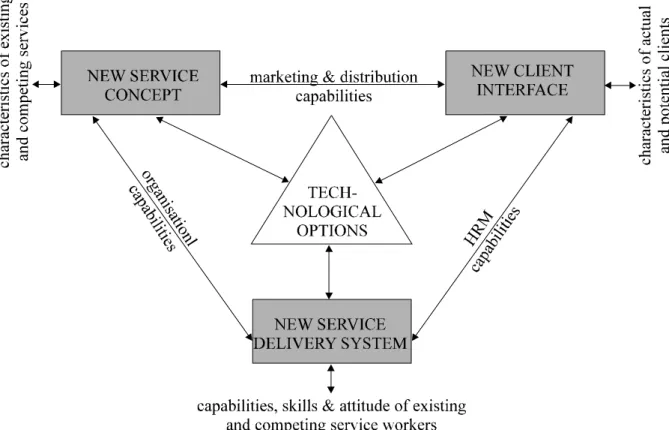
Firstly, the process of innovation brought about by service companies, and KIBS in particular, can be conceived in terms of four dimensions of novelty (den Hertog, 2000; Miles, 2008; Ojanen 2007), which are strictly related to cognitive factors (Figure 3):
(i) Service concept, thatrefers to content and features of new or renewed services. Novelties can concern their intangible characteristics, or a new way of organising them, or novel applications of an existing service concept in a particular market;
(ii) Client interface, this is typical of the service sector and involves the way providers interact with their customers and, by this way, exchange knowledge. Novelties here can also concern the use of IT systems to communicate; (iii) Service delivery system, that refers to changes in the ways service workers perform their jobs. Again, much innovation relates to the electronic delivery of services; (iv) Technology: used to improve the service level. Even if service innovation is possible without technological innovation, the latter is often an enabling factor,
Universities Laboratories Governments Other KIBS Clients Suppliers External (generic) knowledge resources Client’s absorption of knowledge KIBS synthesising and
translating generic knowledge
Figure 1. The intermediating role of KIBS (adapted from: Miles, 2006).
Figure 2. The cognitive processes that characterise the KIBS brokering function.
especially in the case of IT.
Service innovations can involve different combinations of the previous four dimensions, which are mutually dependent. For example, a totally new service generally requires a new delivery system, a novel mode of interacting with the clients, and so on.
Secondly, the ways service innovations are developed by companies can vary, since new services can result from (Toivonen and Tuominen, 2006; Miles, 2008): (i) Internal processes without a specific project: innovation emerges in an unintentional and incremental way, during the day by day activity and in the learning processes that are activated;
(ii) Internal innovation projects: innovation comes from efforts carried out deliberately within the firms. In this case, daily business usually tends to precede planned innovations;
(iii) Innovation projects with a pilot customer: a specific customer collaborates for the development of a new idea, providing resources, sponsorship, critical evaluation and information;
(iv) Innovation projects tailored for a customer: the service provider seeks an innovative solution to a specific problem of a particular client;
(v) Externally funded innovation projects: this is the case of formal and research-oriented projects involving several collaborators and intended to generate new useful knowledge for the benefit of the whole sector. In general those projects do not produce immediate business benefits.
METHODOLOGY
In this study, the concepts illustrated in the previous section were used to investigate and discuss the practices adopted by computer services companies when they develop and deliver innovative services. In particular, the purpose was to link the innovative efforts of those companies with their knowledge management activities, in accordance with a view of innovation in KIBS as a knowledge management activity and a learning process (Ojanen, 2007; Ojanen et al., 2009).
Given its exploratory aim, the research was carried out using a multiple case-study methodology (Yin, 2003). This approach well fits the nature of the study and the complexity of the phenomenon under examination (Leedy and Omrod, 2005). In particular, the research deeply analysed the business processes of 21 small firms (Table 1) in a specific area (Northeast of Italy, and specifically the Veneto Region). These firms were mainly identified with the help of representatives of the local industry association: in particular, most of the surveyed companies are members of “ICT Lab”, a working group involving IT service companies and promoted by the trade association of local IT firms.
In the investigated area, the number of IT firms amounts to some thousands (around 7,200 in 2010), and represents about 9% of Italian IT companies. The firms’ average size is very small: more than one half of them have a turnover that does not reach the million Euros with less than 10 employees. Also, in Veneto there is no large firm operating at an international level, and the general picture of the local computer service sector consists, for the most
part, of: a) small vendors of standard products, b) small application developers specialising in the customisation, commercialisation and servicing of standard suites, and c) small software houses or service firms that work in collaboration with big international IT vendors. Considered the issue under investigation, the pure resellers (as well as the micro software houses) were excluded from the sample, while the focus was on suppliers capable of (partly) producing fresh knowledge based on existing technological streams, and of interacting with customers effectively.
In detail, the collection of data included the following activities.
Sample selection
This was done with the help of representatives of the local industry association. Companies that may have been willing to collaborate were selected, which was reputed to be essential for the success of the investigation. The sample included companies different in size, technical specialisation, and market, in order to have a broad picture.
Design of data collection
It was decided to make semi-structured interviews with company executives. For smaller companies one executive was selected, and two executives in the case of larger companies. Preferably, people having direct experience with customers (that is commercial directors, or project managers) were selected. Interviews were based on a framework previously sent to the interviewees: this was done to make respondents aware of the questions in advance. Prior to making interviews, the framework was tested by means of a pilot interview with executives of two companies. This allowed to adjust it, especially in relation to language and terms used. For example, terms such as “knowledge exchange” or “cognitive processes” (that may be clear for researchers but may be misunderstood by business people) were paraphrased into terms that are more understandable in business. The questions of each interview were mainly related to the “cognitive content” of the innovation processes performed by computer services companies, their “intermediary role” between the sources of knowledge and the final users, the combination of external and internal knowledge for service innovations, the managerial issues. The survey was also intended to discover whether and to what extent the investigated companies are conscious of the value of their knowledge assets, and what processes they activate to preserve and exploit those assets. The interviewed managers were very interested in the topic, because they fully agreed that knowledge can be a primary source for innovation and competitiveness of their companies. Each interview aimed to examine how the single company is able to generate economic value through external acquisition, internal processing (creation/elaboration, storage and retrieval) and transfer of the elements of knowledge that are incorporated in computer services and/or are needed to supply these services to the clients. Although, each interview was flexible and open (meaning that it was possible to collect specific details in each case), the use of a common framework made the comparison between the different situations possible, and allowed to highlight similarities and common approaches.
Data collection
All interviews were completed between mid 2008 and early 2009. So, the findings are presumably not influenced by the economic crisis that hit the industry starting from the end of 2009. To check the data collected and reduce bias, all interviews were made by the same team of two people, and the information collected, as well
Table 1. Outline of the cases examined.
Company Technical specialisation Main markets Size
Array System IT Infrastructure SMEs 7
ASI ERP Retailing, Manufacturing 50
Eniac ERP SMEs, Beverage 60
Eurosystem ERP; Business Intelligence Manufacturing SMEs 110
IKS IT Infrastructure Finance; Insurance 50
Infonet IT Infrastructure SMEs 20
ICM.S ERP Manufacturing SMEs 100
IRS Test and measuring systems Manufacturing; Laboratories 22
Lantech Network management Large enterprises; Public org. 53
MBM Italia Software applications Large manufacturing firms 40
Miriade Security; Business Intelligence Manufacturing firms 26
Mycroft IT Infrastructure Public Administration; Medium firms 30
Ne-T IT Services; Connectivity Public Administration; Private firms 60
Netek ERP; Consulting Manufacturing SMEs 10
SanMarco Informatica ERP Manufacturing 250
SEC Servizi MIS Finance 273
Serenissima Informatica Information Systems SMEs; Retailing; Hospitality 140
SIPE ERP; MIS Large Distributors 70
Soluzioni software ERP Manufacturing SMEs 50
Tria BPR Large distributors 15
Visionest Consulting Public Administration; Large firms 9
as the possible different perceptions of each interviewer, were shared and discussed to reach a consensus. Significant answers and issues raised by a respondent during an interview were also discussed with the subsequent interviewees. This made it possible to check similarities or explain differences in the different distinct companies.
Analysis
The data about the single companies were compared and contrasted, with the main purpose to identify recurring issues and regularities between companies as regards the problems of innovation and knowledge exchange, and related mechanisms. To improve the validity of the analysis (Yin, 2003), the information gathered though the survey was integrated with secondary sources, such as company documents, company web sites, industry literature, and additional interviews with observers and informed experts (namely: clients or suppliers of the sampled firms, representatives of public agencies, and trade associations).
RESULTS
This section summarises the main empirical findings of the study. After describing the general features of computer service companies as KIBS, their business processes and managerial issues are illustrated in accordance with the framework depicted in Figure 2. Hence, the following are described in this paper:
(1) the way KIBS locate and access external knowledge sources;
(2) the activities by which both external and internal knowledge are combined and manipulated to develop innovative services:
(3) the way new knowledge, through the delivery of innovative services, is provided to customers and the nature of bilateral interactions with them.
The presentation is organised in such a way to highlight the peculiar knowledge management issues that the innovative activities of KIBS appear to raise.
Overall cognitive characteristics of the sample
To understand the functioning of the companies analysed, it is firstly useful to depict their general features in cognitive terms. A crucial point is that, despite their small size, the investigated companies are rich of technical and applicative competencies, which allow them to fully meet the local demand for computer services. This confirms that, for these companies, knowledge is really the core resource.
More precisely, it is not just the knowledge possessed but also that exchanged with trading partners which is a valuable asset. The typical company of our sample supplies highly customised solutions, generally designed in accordance to the requirements of the individual client. As affirmed by the interviewed managers, companies’ key competitive factor is the capability to understand (That is, to completely identify and correctly analyse) the
clients’ needs, and to find and mix up proper answers based on the available technical tools, often invented elsewhere. This makes the knowledge exchanged with clients vital: as stated in the literature, customers are not only the final users of these services, but also the source of new ideas and knowledge that the IT companies can use for future projects and innovative services.
All this underlines an important point that also explains the relevance of local KIBS companies. It is a widespread opinion that the global nature of the current economic environment and the intrinsic characteristics of IT services (that can, in principle, be carried by telecom-munications networks), tend to reduce the importance of proximity between suppliers and customers. The case-studies appear to deny this statement: in substance, all the interviewed managers confirm that the small distance between their company and the clients favour the knowledge interactions and exchanges that are required in the delivery of new services. Although this distance should be seen in cognitive or relational terms (e.g., the use of common languages, the capability to understand practical local problems, similar ways of working), it is clearly affected by the spatial proximity.
Most of the innovative work carried out by the sampled companies regards the service concept, and is the result of the efforts carried out “on the field” to solve specific problems of individual clients, rather than of deliberate R&D programmes. Relatively infrequent are internal inno-vation projects planned and carried out independently from marketing activity; it is also rare to find projects with a “pilot customer”, used for making experience of new applications or solutions. Also, the resort to external financial resources for R&D (for instance, EU funds) is quite rare.
As regards the knowledge pool used by companies, since any application is an “ad hoc” solution (That is, developed or personalised in a partially innovative manner for each individual customer), it is generally impossible to simply replicate “old” projects in a standard way. However, this does not mean that the design and provision of a solution is a completely new activity, because the business requires a combination of past experience and routine activities with new applications and ideas.
The use of systematic KM programmes to store and retrieve documentation of past projects can be very important, since those projects represent a possible source of knowledge for innovative implementations. However, due to the small dimension, only few of the investigated firms affirm that they are able to devote human or financial resources to this complementary but essential activity. This is one of the reasons why the experience and capability of people still remain the very competitive assets, and training and recruiting are fundamental activities (although they can be hindered, again, by lacking resources).
The interaction with international vendors (and, more
generally, with the source of generic technological knowledge) appears to be really crucial. This interaction can vary depending on the kind of product or service delivered, which calls for specific relational capabilities. Especially for the companies that are “certified partners” of large multinationals (e.g., SAP, IBM), the relationship often bases on bi-directional flows: the computer service firm “learns” new technical knowledge from the big vendor and transmits it to the customers, and at the same time it collects elements of knowledge from the final markets and carries them to the international provider.
Access to external knowledge sources
As said, technology is continuously progressing in the IT sector, and this makes the capability to drive (or, at least, to rapidly follow) these advancements vital. A key competitive factor of local KIBS is, therefore, their capacity to manage knowledge pertaining to techno-logical advancements. It appears virtually impossible to develop innovations in a narrow context and for a restricted market: even smaller customers need IT applications that are compatible with the international standards. Hence, the connection with and the access to the “places” where big innovations are produced become absolutely essential for computer services companies.
The companies of our sample are able to deliver, at most, customizations or small incremental innovations, while the “main technological streams” of innovation are generally produced in the big laboratories. But this activity is important to diffuse innovations in the local economy: there is the need to adapt locally produced solutions to the technological trends coming from outside. All this requires the capability to find, assimilate and manipulate external knowledge, and involves, for the IT companies, the capability to join in a network of relationships with the global sources of “generic” technological knowledge.
Kinds of external knowledge and their sources
For providing their IT services, the knowledge that the companies need to acquire from outside is not only technical but involves several dimensions and areas. The different kinds of knowledge and the forms that this knowledge can assume are described as follows:
Technological knowledge that can be subdivided into two categories: a) “general” techno-scientific competencies (for instance, the notions of software programming) and b) knowledge of applicative elements. The latter regards the knowledge of the “predefined modules” or standard components that are available in the market and can be used as “bricks”: they can be configured, adapted, and combined to build the specific local IT product or service;
Commercial knowledge, which is necessary to adjust technologies to the market. Commercial knowledge mainly regards: a) the prospective markets of a particular technology (that is, what clients, how many, where they are, etc.), b) the specific application fields (that is, what business solutions can be developed based on a technology, for what business processes or needs, etc.), and c) the capability to sell and market it to specific clients or segments; Managerial knowledge, that includes the appropriate modalities for managing the computer services business. In addition to the general management aspects (e.g., accounting), particularly important here are the elements of project management applied to IT projects.
As can be noted, these kinds of knowledge are radically different, but they are all essential and have to be combined together. In addition, the various kinds of knowledge can come from distinct sources, which implies a capability to interact with different partners and economic players, namely:
Universities and public research laboratories: In
principle they are the original source of technical and scientific knowledge, but, for IT companies, they generally represent only an indirect source. For example, the survey confirms that local universities are the main source of qualified personnel, but are less important as sources of applied knowledge. The large majority of respondents claim that universities are perceived to be “distant” from the world of local computer companies, and the outcomes of university research projects are generally considered too abstract for being applied directly in the field. There is a problem of innovation transfer, which has not been completely resolved despite various actions have been taken by both public and private agencies (note that these findings appear completely in line with what affirmed in other studies - e.g. Miles, 2008).
Global IT vendors: They really represent the main
providers of the technological components that are used by local providers to build and deliver specific applications and services. There is often a very strict relationship between local companies and multinational vendors, but these relationships can take different forms (e.g., direct long-term partnership, certifications, market relationships, etc.) depending on various aspects such as the particular nature of the technology, the target market, the contractual power, etc. Very often the single IT provider has relationships with distinct vendors, which implies the capability to manage various kinds of interactions. The big vendors are not only an important source of technical innovations but also of managerial knowledge (for instance, the principles of project management) and commercial knowledge (that is, concerning potential customers, markets, application areas, in some cases marketing leads).
Open source communities: They are sources of
important knowledge about the new trends in software development; however, the interviewed managers affirm that they are generally little exploited for two main reasons. First, the participation in an open source community requires investing resources that few companies can afford. Secondly, the use of open source technologies is still considered less important for the local market than proprietary software components.
Business clients: As mentioned before, they are the
final receivers of the software services, but at the same time they also represent an important source of knowledge. In particular, all the surveyed companies believe that understanding the specific needs of a customer is essential to design and deliver a successful IT solution. Therefore, any useful element that comes from the interaction with customers (for instance: the way business processes are designed and function in the specific companies, the specific managerial problems, the nature of products and processes treated by client firms, the ways IT is seen and used, etc.) can be precious not only for ongoing projects but also as valuable experience for future jobs.
Issues in managing external knowledge
The empirical analysis clarified that the different kinds of knowledge and sources mentioned before call for specific activities and capabilities. IT companies have first to locate and select the proper sources of knowledge, which is no easy task due to their limited size. In many cases, the establishment of trustworthy relationships with external partners is considered essential. Secondly, companies need to integrate the different components of knowledge to produce and deliver any particular IT solution to the market. Thirdly, such components are different in nature. In particular the knowledge acquired from laboratories and universities is usually in an explicit form, while the specific local knowledge is mostly tacit, being embedded in experience, routines, and ways of working by local companies. Consequently, there is the need for different knowledge management approaches. The awareness of these problems (and, possibly, a strategy to face them) appears to be an essential ingredient of the business of a small computer services provider.
Internal knowledge manipulation
As mentioned, the function of a KIBS company is to acquire external knowledge and carry it to the clients in the form of services delivered. But in the case of IT services the knowledge acquired from outside can not be simply “transferred” to the end user (incidentally, this would not justify the presence of an intermediary).
There is the need to internally manipulate the elements of knowledge before they can be embedded and delivered together with the services and the other artefacts that the computer services companies sell. Here, some specific aspects emerged from the survey and deserve to be mentioned point by point.
Type of service and level of innovativeness
The surveyed companies seem to differ in relation to the category of product/service, and its degree of novelty. Three main cases can be singled out here. The first concerns the provision of standard solutions that can be sold as incorporated in a software license: this is, however, an infrequent situation for the companies of our sample, and generally characterises just the sale of accessories or complementary components for larger software systems. The second situation regards customised solutions obtained by configuring standard platforms or combining a set of pre-defined components or modules. In this case, the core role of the IT company is to develop a project for tailoring and integrating the various components so that they fit the customer’s specific needs (a classical example is local implementations of an international ERP system). A third case regards completely new implementations or systems for a particular customer, which generally requires an “ad hoc” project.
As for the degree of innovativeness – and the way to deal with it – in the first situation the innovation effort has been entirely completed before the software is sold; in general, the local computer firms are excluded from this activity. The internal cognitive activity is therefore restricted to the capabilities to handle the product, to connect it to other modules, to explain its functions to the customer and, more generally, to market it properly. The commercial know-how can be particularly important (e.g., how to sell the facility properly), even more than specific technical capabilities.
In the latter two situations the local KIBS is more directly involved in the production of innovations, at least partially and locally. As a matter of fact, the survey showed that the companies working with these categories of product/service generally resort to a sequenced project activity to handle the specific cognitive problems that arise.
Project-based generation of new knowledge and balance between innovativeness and repetitiveness
Although each company acts differently, there are some typical project steps that are usually performed:
(i) first contacts with the customer;
(ii) preliminary analysis, requirement identification; (iii) feasibility study, formulation of an offer;
(iv) negotiation, contract; (v) technical development;
(vi) release, test, and implementation; (vii) post-sale assistance.
According to the interviewed managers, each step shows characteristic cognitive aspects and involves different capabilities. The most complex stages are probably the first ones (from the preliminary analysis to the negotiation and contract). To carry out these activities, the provider’s employees need to be highly qualified for both technical and business aspects.
Furthermore, these steps raise several cognitive issues and dilemmas. As mentioned, the most crucial point is the reach of a balance between innovativeness and repetitiveness. Like in any other industrial business, the computer services need to combine two contrasting goals. On the one hand, there is the necessity to propose and deliver new and personalized products or services: in this way, the company can meet the requests of each specific client and can also differentiate its offer from the competitors. But at the same time, the search for efficiency requires that the activities to develop a new IT solution become an established routine.
The attempt to combine innovativeness and repetitive-ness raises peculiar difficulties. Companies need to adopt a highly structured method to carry out processes and projects, and an effective system to keep a record of project documentation which has to be easily retrieved in the case of new projects with the same or similar customers. This is essential to avoid “reinventing the wheel” at any new job, but also to prevent the loss of knowledge that may be caused by the employees’ turnover. Our research showed that companies are aware and concerned with this necessity, but their painful efforts reveal that a satisfactory result is not easy to achieve. Actually, small computer service companies lack internal resources for project management activities or for implementing systematic knowledge management practices. Also, the attitude towards flexibility and creativity sometimes leads the companies to neglect the need for structuring and to focus on more immediate and “intuitive” approaches.
Knowledge domain and market strategies
The capability to combine a high degree of innovativeness with a structured project management approach depends not only on the products/services traded but also on the history of the company and the path dependency phenomenon. Very often the creation of the company rested on some distinctive competences of the founder (for instance, a good knowledge of an IT platform or a specific kind of software) that have been further developed and expanded with a rather typical pattern: the original products and services have been progressively extended to new clients or applications.
In our sample, this very frequent growth path has enabled many companies to exploit their original knowledge domain and to gain a strong competitive position in a specific niche, without facing the high costs of learning and cognitive conversions. The main risk is that, in the case of radical changes in technological paradigms or demand needs, it may be impossible to remain in the same market or industry without significant efforts. For instance, there are cases of companies that have needed to rewrite their software applications to fit new Java platforms, which required high investments in tangible and intangible resources.
Other companies have moved from an initial core of clients and then extended their services to meet “all the needs” of the same customer base; by doing this they have achieved a broader competence of several applications and technologies to serve a relatively stable pool of clients. A typical example is that of ERP providers that have integrated their offer with Business Intelligence packages. All this required an extension of the original pool of technical knowledge possessed by the organi-zation. In the case of the investigated companies this has been achieved by recruiting new personnel, or by M&A actions, or through alliances with other providers. All these actions are however costly, and require a learning process to integrate different products and services, and to sell them to the market.
Other ways (that include for instance a big leap to completely new areas) are generally harder for small companies, which may find it difficult to convert their whole knowledge base into new paradigms and marketing strategies. These approaches are the most expensive in terms of resources needed to put them into practice, and the most risky concerning the learning processes that need to be implemented. None of the company analysed seems to adopt this approach.
Human resources and the generation of new knowledge
The human capital is perceived to be the crucial resource, which confirms the nature of the sampled companies as KIBS. All the interviewed managers have declared that the recruiting policies are one of their major concerns. In the industry, the most important background of workforce is still the technical qualification, but there is no much time to train the people internally: learning is generally done “on the job” thanks to the interaction with senior employees. This means that companies are highly dependent on the quality of the State education system and, especially, local universities. In any case, while junior employees are generally more skilled at new platforms and languages, there is often the need to keep knowledge of “old” technologies (for instance, the COBOL programming language) that are still used in the local market. Here, the senior employees remain precious. On the whole, the survey confirmed that a
combination of experienced people (who keep the company’s core business) with new employees (who help the company to keep up with the pace of change) is necessary.
Equally important is continuous training, but due to the lack of resources (and, especially, of time), this process generally occurs in a non-systematic way, and mainly depends on the willing and professionalism of the single employee. There are courses available, for instance those proposed by the multinational vendors, but they can be costly, or too narrowly specialised. Very often the courses are just ways to obtain a quality certification that enables a company to associate its name to those of a famous brand (Microsoft, SAP, Oracle, Hewlett-Packard, etc.).
As said, in most cases the production of new know-ledge is associated with a specific market opportunity, according with the fourth way of developing innovation as previously described. For instance, employees elaborate novel ideas when they are involved in a new project with a specific client: as recalled, it is the interaction with customers that enables a company to produce fresh knowledge and solutions, and these can be used later in future projects. Therefore, the capability to interact with customers, as well as the marketing skills, are becoming increasingly important not only for the sales force but also for the technical staff, which raises an additional problem of training. Sometimes IT companies use their clients as pilot customers, to directly and actively involve them in the development of innovative solutions. The service providers assume part of the project costs as a way to re-pay the contribution given by the client especially in cognitive terms.
Many firms declare to feel the necessity to generate fresh knowledge in an independent way, for instance to develop new applications that can be brought out to the market, but this requires additional resources. Due to the limited size, only few firms are able to carry out internal research and development with a systematic and planned approach (which corresponds to the second way of developing innovation illustrated earlier).
Service delivery and knowledge transfer to clients
Although the cognitive interactions of local KIBS are rich, the innovative knowledge handled or produced by com-puter service companies is mainly targeted and delivered to their business clients, which are “those that pay” for the service. The interaction with clients deserves the analysis of some specific points.
Commercial approach and marketing techniques
The way firms organise their commercial activity depend, again, on the product/service provided. There are two typical situations here. The first concerns standard
products sold in big quantities and with efficient channels: these products need little adaptation for being imple-mented and used. In that case, the sales force requires a minimal knowledge of the product sold, but a good knowledge of the marketing techniques for the specific customers. This situation is, however, quite uncommon in the investigated area, where personalized projects (which call for a totally different approach) are more frequent: a deep knowledge of the technical features and applicative characteristics of the products is necessary for the sales force as well, and this is why in the sampled companies the sales activities often involve the senior levels or the owners directly.
An issue that most companies face at the beginning of the commercial relationship with a new customer is the necessity to provide a general knowledge of what is offered. From a cognitive viewpoint, this raises important questions. First, there is the need to illustrate the product in a way that can enable the client to understand and appraise its value: this is difficult especially for projects that entail specific adaptations. Good marketing capability is needed on the providers’ side, and a good knowledge of products, client’s information needs, and possible solutions, as well as of technical and managerial language. There is also a problem of communication: the sales force and the clients need to share a language, and this often requires frequent interactions for a mutual learning. This is one of the reasons why both parts tend to favour long-term relationships. The other essential ingredient is certainly trust (Scarso and Bolisani, 2012) that makes communication easier.
A second problem is that any communication about the product that the sales force provides to the customer implies that a piece of knowledge is substantially “given away” for free. Here, the sales force has to understand what the clients can be told to illustrate the product, and what should remain private, being the competitive core of the company.
The surveyed firms generally use some typical marketing techniques to approach customers. One is to show a demo of the product that illustrates its main functions. Sometimes, this demo is configured using preliminary information that the sales force collects about the specific needs of the customer, so that a sort of initial prototype of the main product functionalities is built. The provider’s team incorporates standard elements of knowledge into the demo, and leaves the rest to direct explanations by interacting with the client’s buyer. Of course, this approach can be done with products or services that have some variations but remain substantially similar from one project to another, while it is much more difficult with jobs that vary largely from a case to another. Again, the necessity of a balance between repetitiveness and innovativeness arises.
Completely different is the case of companies that work with the public administration. In such a situation, the relationship with the client organisation depends on
specific laws and regulations, and is generally more formal. The provider’s sales staff has to develop a specific knowledge of these rules and procedures to participate in public bids.
Cognitive interaction with client firms
Once the project has started, a continuous interaction with the customer is required to complete it successfully. During those interactions, knowledge flows in two direc-tions: from providers to customers and from customers to providers. As the research clearly shows, these interactions are so essential that it is possible to affirm that computer service companies deliver knowledge well before services or products. Especially for new systems or new implementations (for instance, a new application of an information system), the company has to give several pieces of knowledge to the clients: technical knowledge (e.g., how the system will work), organisa-tional knowledge (e.g., how to use the system effectively in the client’s processes), managerial knowledge (e.g. how to use the new system for economic purposes), etc. This is necessary even before the sale: as mentioned, to let the client understand the offer and sign the contract, the provider has to explain much.
Even when companies provide tangible artefacts (e.g., a software package), this can not be done without a big amount of consulting services, which, again, consist of knowledge. Therefore, it is the knowledge transferred to the client that adds value to the IT product or service, and can constitute its really innovative part. This has an important business implication: the client should be able to assess this embedded knowledge to understand the real value (and the price) of the service or software provided. But this is much more difficult than the case of a tangible product (e.g., a piece of equipment) whose value and price can be valuated more easily by the client.
Also, there are some specific risks for the provider during this interaction. For example, as many interviewed executives affirmed, it is not infrequent that clients collect ideas by interacting with a computer service company, and then develop those ideas on their own or use them to compare the offers of other suppliers.
Since cognitive exchanges with clients are bi-directional, it can also be affirmed that a service company learns from the interaction with clients as much as it teaches to them: working on a project with a customer enables the provider’s staff to learn how the client works, what its core business processes are, what solutions can be proposed to other clients, etc. Executives are aware that this experience is of great help for their business, even regardless that the contract is signed and the project really starts. This confirms that the selection of the right client (that is one that will collaborate, that has challenging problems, or with a proper knowledge of the business or the technical aspect, etc.) is a critical