PEACH TREE SHORT LIFE
Thomas G. Beckman Andrew P. Nyczepir
USDA-ARS
Southeastern Fruit & Tree Nut Research Laboratory
Byron, GA 31008
USDA-ARS
Southeastern Fruit & Tree Nut Research Laboratory
Byron, GA 31008
In the southeastern United States, peach tree short life (PTSL) refers to the sudden spring collapse and death of young peach trees. Generally, trees 3 to 7 years old are affected. PTSL is not caused by a single specific factor, but rather by a complex of cold damage and bacterial canker, caused by Pseudomonas syringae pv. syringae, which act together in some years and independently in other years. In any case, the final result is the same (i.e., tree death). Many other factors contribute to the PTSL complex, including time of pruning, rootstocks, orchard floor management, fertilization practices, and rapid fluctuation in late winter/early spring temperatures. The primary biotic factor responsible for predisposing peach trees to bacterial canker or cold injury or both is the ring nematode, Mesocriconema xenoplax (see “Nematodes” section). Cytospora canker often moves into and finally kills trees badly damaged by cold and/or bacterial canker. The role of Cytospora canker in PTSL is, however, considered secondary.
Other problems such as Armillaria root rot, stem pitting, and borers have at times been thought to be associated with PTSL, but these problems have distinct symptoms and control measures, and are discussed elsewhere in this book.
SYMPTOMS
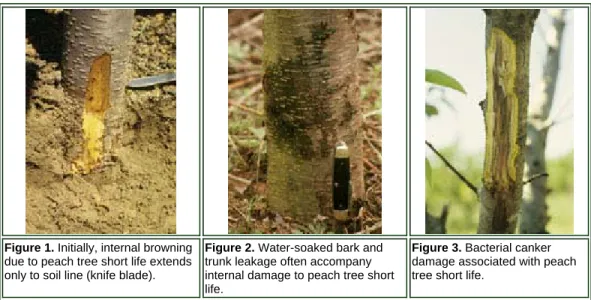
The classic symptom of PTSL is the sudden spring collapse of peach trees that were apparently healthy the previous fall. Symptoms are similar to those of any plant deprived of an adequate root system. Cutting into the bark of these trees reveals internal browning extending to, but not below, the soil line (Figure 1). A distinct sour sap odor is often present. Water soaking of bark, or leakage, sometimes occurs in association with this internal browning (Figure 2). Individual bacterial cankers may or may not occur (Figure 3). It is usually necessary to examine trees very early in the spring (i.e., at or shortly before bud break) to determine the specific involvement of bacterial canker.
Figure 1. Initially, internal browning due to peach tree short life extends only to soil line (knife blade).
Figure 2. Water-soaked bark and trunk leakage often accompany internal damage to peach tree short life.
Figure 3. Bacterial canker damage associated with peach tree short life.
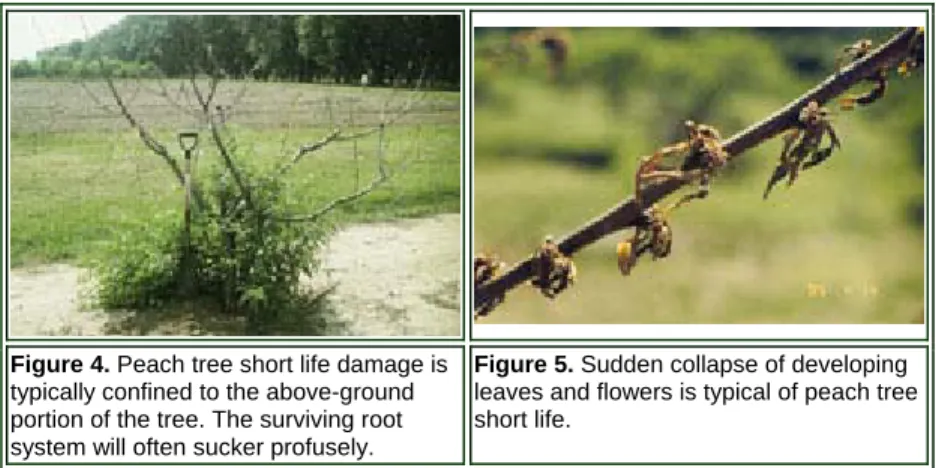
Bacterial canker of peach is generally associated with delay of bloom or leaf out of individual limbs, with such limbs usually dying by the end of summer. If the infection is severe, entire trees may collapse, with branches exhibiting alternate zones of darkened and healthy tissue having a sour sap odor. Dead trunk tissue usually does not extend beneath the soil line, thus leaving the primary root system alive. As a result, root suckers are usually produced at the base of the tree during summer (Figure
4). When cold injury is present, trees will begin to leaf out until additional water is required by the tree. At that time, leaves collapse (Figure 5) and the bark may crack and separate from the scaffold limbs and trunk (Figure 6). Trees killed or severely damaged by PTSL are frequently invaded by Cytospora species.
After trees have been dead for several weeks, it may not be possible to specifically separate bacterial canker from cold damage. If trees have been dead one month or more, it may not be possible to diagnose any specific cause.
DISEASE DEVELOPMENT
Bacterial canker can cause sudden spring collapse of peach and other stone fruit trees if the trees have been weakened by factors such as ring nematode or cold damage. Even in the absence of cold damage, trees grown on Nemaguard rootstock are much more susceptible to bacterial canker than trees grown on Lovell, which in turn are more susceptible than trees grown on Guardian (BY520-9) rootstock. In the Southeast, the specific importance of bacterial canker as a factor independent of cold damage is difficult to determine. Cold damage is known to predispose trees to death from bacterial canker. Cold damage alone can also kill trees with similar symptoms. How many trees would have died without invasion of P.syringae, or how many would have been killed sooner or later by P.syringae without cold damage, cannot be determined and is of little practical importance. The important point is that PTSL is a disease complex, and the control program to be discussed later is aimed at this complex. Observations indicate that the sudden spring-wilt syndrome of PTSL is related to vascular cambial death. In healthy trees the older wood of the xylem, the water-conducting tissue, becomes nonfunctional through time. This
nonfunctionality is marked by build-up of gum in the vessel elements. Peach trees are dependent upon the yearly production of new water-carrying vessel elements. New xylem tissue is the tree’s main route of water movement. New water-conducting elements are generated annually each spring from a layer of cells called the vascular cambium. The vascular cambium lies just outside the xylem, immediately beneath the spongy bark or phloem. If production of new water-carrying vessels is prevented by cold injury to the vascular cambium, the sudden increase in water consumption due to bloom and/or leaf emergence may place the tree in an overwhelming water deficit that results in collapse and death.
Some injured trees in a PTSL site do not collapse immediately but are weakened and decline slowly during the summer. In these trees, injury to the vascular cambium results in loss of vessel element production insufficient to cause death, but sufficient to impair the tree’s water-carrying capacity. This condition results in a weakened tree that undergoes a summer-long decline. Cytospora canker often kills PTSL-weakened trees and is usually very common 1 or 2 years after an injurious winter.
The following different theories of disease development have evolved over the years.
Hormone Theory
Figure 4. Peach tree short life damage is typically confined to the above-ground portion of the tree. The surviving root system will often sucker profusely.
Figure 5. Sudden collapse of developing leaves and flowers is typical of peach tree short life.
Figure 6. Typical peach tree short life cold injury with cracking and separation of bark from trunk and scaffold limbs.
Death of the vascular cambium and the resulting failure of that tissue to produce water-carrying vessel elements in the spring appears to be due largely to cold injury. Normally, during winter the vascular cambium is dormant and highly resistant to cold damage. After the chilling requirement of the tree has been satisfied and dormancy is broken, growth and production of newvessels begin with the return of warm weather. The growing, active cambium becomes very sensitive to cold damage and can be injured by temperatures that would not have affected it earlier.
The fact that tree death from cold injury is not uniform in PTSL sites suggests that certain trees are protected from cold injury and/or bacterial canker. In many plants, the best adaptive protection mechanism from cold injury is the dormant condition. It is widely accepted that dormancy is controlled by naturally occurring growth hormones, including auxins. The auxin theory of cambial growth states that renewed cambial activity in the spring is initiated by auxin produced in the expanding portion of the crown (tips of peach branches, for example) and transported to the stem. A loss in cold hardiness accompanies the termination of dormancy. If the cambium is stimulated to become prematurely active during the time of year when cold temperatures are present, cold injury is likely. The question then becomes, what factor or factors influence dormancy?
Nematode feeding and fall pruning are factors known to be injurious to peach trees. Both nematode feeding and pruning are wounds that stress the tree. Classically, a wound stress response is seen as an increase in cambial auxin level. Fall pruning stimulates auxin levels more than winter pruning. Indeed, winter pruning does not affect auxin levels at all. Trees growing in fumigated soil showed an immediate auxin increase after fall pruning but not after winter pruning. In nonfumigated soil, auxin levels were high initially, and subsequent early pruning did not further stimulate auxin levels in these trees. The shift toward higher auxin levels may have resulted in later entry of the vascular cambium into dormancy, earlier release from dormancy, or both. Either situation would predispose trees to cold injury. Nematode injury alone can cause elevated auxin levels. It should be recognized that each tree and tree site varies in terms of vigor, nematode population, soil type, drainage, severity of pruning, and other factors. Such differences can affect hormone levels and release from dormancy. If the nondormant trees are then subjected to the fluctuating cold-warm-cold temperature patterns common to the Southeast in late winter, cold injury to the vascular cambium may result. Many of the most severe occurrences of PTSL take place when the completion of the chilling requirement and release from dormancy are followed by a period of warm weather, which is subsequently followed by a bout of subfreezing temperatures. Further evidence of hormonal disruption within peach trees was shown when levels of cytokinines, another group of plant hormones, were elevated in trees grown in ring nematode-infested soil as compared with noninfested soil. The trees in the ring nematode soil eventually exhibited characteristic PTSL symptoms and died.
Carbohydrate-Partitioning Theory
It has been demonstrated that Nemaguard peach rootstock (susceptible to ring nematode and PTSL) is more sensitive to ring nematode feeding than Guardian (tolerant to ring nematode and PTSL) peach rootstock. Recent work indicates that Nemaguard permits more carbohydrate reserves to be transmitted from shoot to root in response to ring nematode parasitism than does Guardian. This, in turn, depletes carbohydrate levels in the above-ground portion of trees on Nemaguard rootstocks. High carbohydrate reserves have been shown to be positively correlated with superior cold hardiness and stress resistance. Above-ground depletion of nutrients observed in trees on Nemaguard rootstock subjected to ring nematode feeding is believed to result in tree injury or death at levels of environmental and biological stresses that are innocuous to healthy trees.
Tree loss due to PTSL varies widely from year to year in the Southeast. Losses, sometimes catastrophic, may be localized (Figure 7) or widespread; for example, nearly 200,000 peach trees were reported to have died in Georgia in the spring of 1962. It has been estimated that peach growers in South Carolina alone experience over $6 million loss per year as a result of this disease.
CONTROL
Control of PTSL in the Southeast and bacterial canker in California has been the subject of considerable research. Several practices have been shown to lessen the occurrence of this disease, and a program for control of PTSL tree losses has been developed. The various aspects of this program can be grouped into three phases of orchard management as follows: (A) site preparation, (B) planting stock selection, and (C) sound cultural practices.
Site Preparation
PTSL control should begin during site preparation. Losses due to PTSL are commonly more severe on old peach land than on land newly planted to peaches. The factors that predispose virgin orchard sites to PTSL are not clear. However, root zone nutrient depletion, low pH, hardpan development, and ring nematode buildup all contribute to the occurrence of PTSL, and one or more of these factors occur in any orchard during its life. Ring nematode buildup seems to be an extremely important factor. The time to assess the need for corrective measures is before planting. Soil sampling will determine the need for nutrients and lime. Enough lime should be added to raise the soil pH to 6.5 at a depth of 16 to 18 inches. Nutrients can be incorporated during liming.
Subsoiling to break hardpans is a second practice that improves tree survival. Sandy soils and/or dry soils will respond best to subsoiling. Wet clay soils will respond poorly, if at all.
The ring nematode, M. xenoplax,greatly increases severity of PTSL. Any land scheduled for planting to peaches should be tested for presence of ring nematode, and, if necessary, pre-plant fumigation should be carried out. Consult current local sources of information for updated recommendations. Pre-plant crop rotation with wheat has been shown to be comparable to methyl bromide fumigation in suppressing the ring nematode population prior to establishing a peach orchard (see “Nematode” section). Any site that cannot be sampled and prepared properly should not be planted to peaches.
Planting Stock Selection
Good trees alone cannot assure a good orchard, but bad trees almost always assure a bad orchard. Buy trees only from nurseries with a good reputation for producing vigorous, true-to-type, disease-free trees grown in fumigated soil. The major consideration in planting stock will be rootstock selection. Trees grown on Nemaguard rootstock are much more susceptible to PTSL than trees grown on Guardian or Lovell rootstock. Nemaguard rootstock should never be used on any site where ring nematode, M.
xenoplax,ispresent. Sites with a history of PTSL or old orchard sites where nematode samples were not taken should not be planted with trees on Nemaguard rootstock. Nemaguard rootstock should be used with extreme caution in Georgia in the band between U.S.
Highway 280 and the fall line. Nemaguard should never be used north of the fall line. It can be used safely south of U.S. Highway 280 in Georgia in the absence of ring nematodes, where there is a commitment to proper time of
Figure 7. A mixed orchard on Nemaguard (green leaf) and Nemared (red leaf) seedling rootstocks that has been severely afflicted by peach tree short life.
Figure 8. On severe peach tree short life sites, Guardian (center) provides superior performance compared with Lovell (flanking left - dead), Boone Co. (flanking right - dead), and other tested commercial rootstocks in background.
pruning. Guardian rootstock has significantly better resistance to PTSL than Lovell (Figure 8) and especially
Nemaguard. Its use is recommended on sites prone to PTSL. However, Guardian is not immune to PTSL and will only perform satisfactorily in conjunction with the best management practices for suppressing the disease. Guardian has root-knot nematode resistance comparable to that of Nemaguard and can be considered as an alternative to Nemaguard in those areas of the coastal plain where this nematode is a problem. In addition, it should provide superior resistance to PTSL, which appears to be a growing problem in this area as peach land is replanted.
Sound Cultural Practices
Time of pruning is a major cultural practice affecting the incidence of PTSL. Pruning directly affects the susceptibility of trees to cold damage. Trees pruned during October, November, December, and January are more susceptible to PTSL than trees pruned during any other time of the year. Pruning during these months should be avoided. If any pruning must be done during this period, select blocks least likely to have problems with PTSL. Choose blocks over 7 years old, blocks known to be free of M. xenoplax,and blocks on sites with no PTSL history. Do not prune trees on Nemaguard rootstock from October through January.
Another practice that affects the occurrence of PTSL is orchard floor management. Harrowing contributes to PTSL by damaging root systems. Use of herbicides in the tree row and sod between the rows reduces PTSL.
A sound nutrition program based on annual soil and tissue sampling will help maintain a vigorous orchard and help reduce losses from PTSL.
Weak, dying, or dead trees should be removed from the orchard. Several insects and diseases that may become a general nuisance can build up on dead or dying trees.
Obviously, PTSL has no single specific cause and control does not involve a single direct control practice. Rather, the whole package of sound, proven effective cultural practices, the details of which should make up any good orchard management program, must be considered.
REFERENCES
Brittain, J. A. and R. W. Miller, eds. 1978. Managing peach tree short life in the Southeast. South Carolina Extn. Circ. 585.
Carter, G. E., Jr. 1976. Effect of soil fumigation and pruning date on the indoleacetic acid content of peach trees in a short life site. Hortscience 11: 594-595.
Carter, G. E., Jr. 1978. Effect of soil fumigation and pruning date on the resumption of growth of the vascular cambium of peach trees in a short life site. Hortscience 13: 156-158.
Chandler, W. A., J. H. Owen and R. L. Livingston. 1962. Sudden decline of peach trees in Georgia. Plant Dis. Reptr. 46: 831-834.
Clayton, C. E. 1977. Peach tree survival. Fruit South 1: 53-58.
Daniell, J. W. 1973. Effects of time of pruning on growth and longevity of peach trees. J. Amer. Soc. Hort. Sci. 98: 383-386.
DeVay, J. E., B. F. Lownsberry, W. H. English and H. Lembright. 1967. Activity of soil fumigants in relation to increased growth and control of decline and bacterial canker in trees of Prunus persica. (Abstr.) Phytopathology 57: 809.
Dowler, W. M. and D. H. Petersen. 1966. Induction of bacterial canker of peach in the field. Phytopathology 56: 989-990.
Ferree, M. E. and N. E. McGlohon. 1975. You can prevent peach tree short life. Fruit Grower, Aug. 1975, 20: 27. Lownsberry, B. F., H. English, G. R. Noel and F. J. Shick. 1977. Influence of Nemaguard and Lovell rootstocks and Macroposthonia xenoplax on bacterial canker of peach. J. Nematol. 9: 221-224.
Miller, R. W. 1994. Estimated peach tree losses 1980 to 1992 in South Carolina: Causes and economic impact. Pages 121-127 in: Proc. 6th Stone Fruit Tree Decline Workshop, Oct. 26-28, 1992, Ft. Valley, GA.
Mojtahedi, H., B. F. Lownsberry and E. H. Moody. 1975. Ring nematodes increase development of bacterial canker in plums. Phytopathology 65: 556-559.
NeSmith, W. C. and W. M. Dowler. 1976. Cultural practices affect cold hardiness and peach tree short life. J. Amer. Soc. Hort. Sci. 101: 116-119.
Nyczepir, A. P. and B. W. Wood. 1988. Peach leaf senescence delayed by Criconemella xenoplax. J. Nematol. 20: 595-589.
peach rootstock for the southeastern United States that increases scion longevity. HortScience 29:705-706. Olien, W. C., C. J. Graham, M. E. Hardin and W. C. Bridges, Jr. 1995. Peach rootstock differences in ring nematode tolerance related to effects on tree dry weight, carbohydrate and prunasin contents. Physiol. Plant. 94: 117-123.
Perkins, H. H., J. E. Giddens and J. W. Daniell. 1979. Effect of lime and fertilizer and peach root residues on peach trees in a decline area. Univ. Ga. Res. Bull. 246.
Prince, V. E. 1966. Winter injury to peach trees in Georgia. Proc. Amer. Soc. Hort. Sci. 88: 190-196.
Prince, V. E. and B. D. Horton. 1972. Influence of pruning at various dates on peach tree mortality J. Amer. Soc. Hort. Sci. 97: 303-305.
Ritchie, D. F. and C. E. Clayton. 1981. Peach tree short life: A complex of interacting factors. Plant Dis. 65: 462-469. Savage, E. E. and F. F. Cowart. 1954. Factors affecting peach tree longevity in Georgia. Proc. Amer. Soc. Hort. Sci. 64: 81-86.
Savage, E. E., R. A. Hayden, and W. E. Ward. 1968. The effect of subsoiling on the growth and yield of peach trees. Univ. Ga. Res. Bull. 30.
Zehr, E. I., R. W. Miller and E. H. Smith. 1976. Soil fumigation and peach rootstocks for protection against peach tree short life. Phytopathology 66: 689-694.