Technological University Dublin
Technological University Dublin
ARROW@TU Dublin
ARROW@TU Dublin
Conference papers
School of Computing
2017-11
On Demonstrating the Impact of Defeasible Reasoning via a
On Demonstrating the Impact of Defeasible Reasoning via a
multi-Layer Argument-based Framework (Doctoral Consortium)
Layer Argument-based Framework (Doctoral Consortium)
Lucas Middeldorf Rizzo
Technological University Dublin, [email protected]
Follow this and additional works at: https://arrow.tudublin.ie/scschcomcon Part of the Artificial Intelligence and Robotics Commons
Recommended Citation
Recommended Citation
Rizzo, L. (2017) On Demonstrating the Impact of Defeasible Reasoning via a multi-Layer Argument-based Framework (Doctoral Consortium). 16th International Conference of the Italian Association for Artificial Intelligence, Bari, Italy, November 2017.
This Conference Paper is brought to you for free and open access by the School of Computing at ARROW@TU Dublin. It has been accepted for inclusion in Conference papers by an authorized administrator of ARROW@TU Dublin. For more information, please contact
[email protected], [email protected], [email protected].
This work is licensed under a Creative Commons Attribution-Noncommercial-Share Alike 3.0 License
On Demonstrating the Impact of Defeasible
Reasoning via a multi-Layer Argument-based
Framework
Lucas Rizzo
Dublin Institute of Technology Dublin, Ireland
Abstract. Promising results have indicated Argumentation Theory as a solid research area for implementing defeasible reasoning in practice. However, applications are usually domain dependent, not incorporating all the layers and steps required in an argumentation process, thus limit-ing their applicability in different areas. This PhD project is focused on the development of a multi-layer defeasible argument-based framework which is in turn used across different applications in the fields of decision making and knowledge representation and reasoning. The inference pro-duced is compared against the inference of different quantitative theories of reasoning under uncertainty such as expert systems and fuzzy logic. The main contribution expected in this doctoral research is the demon-stration of the inferential capacity of defeasible reasoning, implemented through computational Argumentation Theory.
Keywords: Argumentation theory, Decision-making, Knowledge Representa-tion, Defeasible reasoning.
1
Introduction
Argumentation theory (AT) is an important area of logic-based artificial intelli-gence, which present the basis for computational models of defeasible reasoning. Despite promising progresses have been made in several areas, demonstrating AT as a solid theoretical research discipline for implementing defeasible reasoning in practice, there are issues for applied research [2]. State-of-the-art models of AT are usually domain dependent, not often built upon the layers of an argumen-tative process as proposed in [16]. Due to this diversity, a clear structure that can be replicated and that allows models to be designed, built, evaluated and compared has not emerged yet. The aim of this research is to design an argument-based framework (ABF), from the construction of arguments, to the resolution of possible inconsistencies arising from their interactions and the computation of a justifiable conclusion or claim. This ABF is proposed to be evaluated across prac-tical applications in the fields of knowledge representation and decision-making. In this study it is believed that since AT is a relatively new field the proposal of
a more generally applicable solution, in the form of a computational framework, might facilitate comparisons across applications end enable the demonstration of the impact of defeasible reasoning.
2
Overview on defeasible reasoning and argumentation
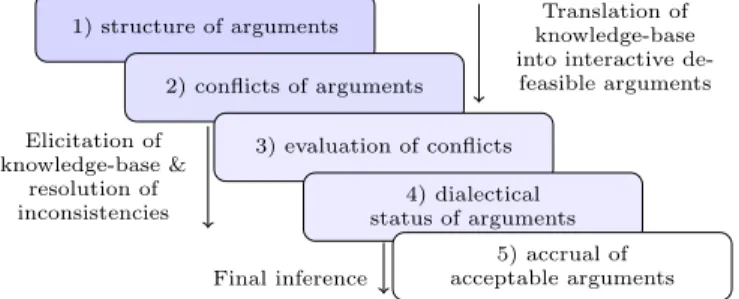
In formal logics a defeasible concept is built upon a set of interactive pieces of ev-idence that can become defeated by additional reasons. In other words, reasoning is defeasible when the relationship between argument’s premises and conclusions is a tentative one, that can be retracted in the light of new information. Efforts have been made within the field of Artificial Intelligence to perform and anal-yse the act of reasoning defeasibly. Argumentation Theory is a computational approach that investigates how arguments can be represented, supported or dis-carded in a reasoning process and at the same time examines the validity of the conclusion reached. It has been widely employed in the field of Artificial Intelli-gence for modelling defeasible and non-monotonic reasoning [8]. The process of argumentation towards the achievement of a justifiable conclusion, as emerged from theoretical works of AT, can be broken down into different layers [16] as depicted in figure 1. Table 1 summarizes the possible works and configurations for this 5-layer schema.
1) structure of arguments 2) conflicts of arguments 3) evaluation of conflicts 4) dialectical status of arguments 5) accrual of acceptable arguments Translation of knowledge-base into interactive de-feasible arguments Elicitation of knowledge-base & resolution of inconsistencies Final inference
Fig. 1: Five layers upon which argumentation systems are generally built Table 1: Possible works and configurations for each layer. Layer 1 Layer 2 Layer 3 Layer 4 Layer 5
Toulmin’s model [24] undermining, rebutting and undercutting [21] Strength of Arguments [9]
Dung’s semantics [7] Accrual of arguments Standard
logic Preferentiality [18]
Eager and Ideal
semantics [4, 1] Selection of extensions Reed and Walton [25] Strength of attacks [17, 18] Semi-stable [3]
AT has been used in several areas such as negotiation logic programming and practical reasoning [2] as well as for knowledge representation and decision-making [23, 16]. In this research we specifically focus on the application of AT
in the the fields of decision-making and knowledge representation and reason-ing. Examples include the decision-making under uncertainty that often occur in health-care and medicine, where medical diagnosis, treatment efficacy or out-comes need to be evaluated [12, 5] and the formal representation of ill-defined constructs such as mental workload [15] and computational trust [6, 19].
3
Quantitative theories of reasoning under uncertainty
Uncertainty is unavoidable in many real-world domains. Sources of this uncer-tainty might include incomplete, imprecise and unreliable knowledge. Besides defeasible reasoning, many formalisms exist in the field of Artificial Intelligence for dealing with quantitative reasoning under uncertainty, such as Probabil-ity calculus and its variations: PossibilProbabil-ity Theory and Imprecise Probabilities, Dempster-Shafer Theory and Multi-values Logics like Fuzzy Logics. In order to demonstrate the impact of defeasible reasoning in real-world data, as many as possible comparisons with such formalisms should be carried out [2]. However, having in mind our research constraints with data and time, two approaches were selected for comparison purposes:expert systems [10] andfuzzy logic [14]. These are likely suited for the proposed domains of application (section 2), which are knowledge-base driven, and can indicate whether or not defeasible reasoning is a promising avenue for dealing with decision-making and knowledge representation and reasoning under uncertainty.
4
Problem statement
The aim of this doctoral research is to design, develop and evaluate a multi-layer argument-based framework that includes the stages for knowledge repre-sentation, its elicitation, and final inference as suggested in [15] (figure 1). The particular research question is:To what extent can a multi-layer argument-based framework, built upon Argumentation Theory, offer enhancements in the do-mains of decision-making and knowledge representation when compared to other approaches for reasoning under uncertainty? In order to answer the RQ a set of objectives are defined:
1. To review and evaluate the state-of-the-art on argumentation theory and the works that make use of some of the 5-layers schema proposed.
2. To design a multi-layer defeasible argument-based framework that includes the layers suggested in the literature [15] and depicted in figure 1;
3. To implement such a framework employing modern web-based technologies to facilitate its use across different fields by different practitioners;
4. To adopt the framework for building and evaluating models for a selection of decision-making and knowledge representation problems, including medical diagnosis, mental workload modelling and trust inferences;
5. To evaluate the inferences generated by the framework and compare them against the ones produced by some of the existing approaches for handling uncertainty.
The research hypothesis is that the inferences produced by models built upon this framework can enhance decision-making and knowledge representation as compared to a selection of techniques for representing, reasoning over and han-dling uncertainty, in this case, fuzzy logic and expert systems. Furthermore, since the 5-layer schema has to be defined for each argument model, it is also expected that different models will indicate not only if an enhancement is possible but also which step in the argumentation process is likely responsible for these results.
Comparative metrics have to be defined to enable the comparison among different reasoning models. Some applications might provide a ground truth, for instance in the medical diagnosis domain when the correct treatment or outcome is already known or in the computational trust domain when the trustworthiness of an entity is previously known. In this case it is possible to compare the ac-curacy of the inference made by distinct models. Other subjective comparative metrics are borrowed from the fields of psychology and statistics. These include sensitivity, validity, diagnosticity and others [11, 22]. The use of a reasonable range of metrics is expected, however, some of them rely on the available data and field of application, thus are not guaranteed to be employed.
5
Current state and future work
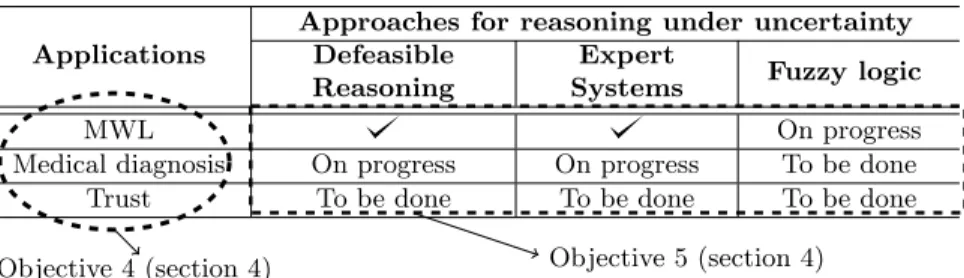
Many studies indicated AT potential for supporting decision-making, enhancing knowledge representation and performing defeasible inferences. For instance, in the the domain of health-care there are several papers which make use of argu-mentation [12, 20]. Some of them tackle all the 5 layers described in section 2, suggesting available approaches for each step in the situation being solved [13]. In the case of knowledge representation and reasoning, more specific mental workload and computational trust, little work exists that applies AT as solution approach [6, 19, 15]. To the best of our knowledge, it was not possible to find a study capable of evaluating the practical impact of defeasible reasoning and AT on different domains of application. In fact, Bench-Capon and Dunne [2] suggests the application of AT in practical fields as one of the challenges in respect to the general deployment of argumentation technology. Thus, the design and im-plementation of a multi-layer defeasible argument-based framework was carried out. Table 2 lists experiments performed and to be performed. The goal is to cover three different domains under three different approaches. So far objectives 1 to 3 (section 4) have been concluded while objectives 4 and 5 are expected to be achieved at the end of the experiments. Datasets for MWL measurement have been collected in the Dublin Institute of Technology for master and PhD students for tasks of varying difficulty. Under the medical diagnosis domain a knowledge-base is being constructed in conjunction with an expert in the field for the inference of mortality risk in an elderly population. Finally, experiments on computational trust have been planned with the Wikipedia database available athttps://dumps.wikimedia.org/.
Table 2: Set up of experiments to be performed Applications
Approaches for reasoning under uncertainty Defeasible
Reasoning
Expert
Systems Fuzzy logic
MWL On progress
Medical diagnosis On progress On progress To be done Trust To be done To be done To be done Objective 4 (section 4) Objective 5 (section 4)
6
Concluding remarks and expected contributions
Some of the theoretical factors that make defeasible reasoning appealing are the lack of statistics or probability for inference, being this close to the way humans reason under uncertainty and the capacity to lead to explanatory rea-soning. The major problem of implementing defeasible reasoning through AT is the lack of applications for abstract argumentation, mainly because it is a tool for symbolic reasoning, rather than quantitative, and research trying to add quantitative approaches to argumentation semantics are still at early stage. The main contribution expected in this doctoral research is the demonstration of the inferential capacity of defeasible reasoning, implemented through computational Argumentation Theory, when compared to other techniques for inference in the field of Artificial Intelligence.
Acknowledgements
Lucas Middeldorf Rizzo would like to thank CNPq (Conselho Nacional de Desen-volvimento Cient´ıfico e Tecnol´ogico) for his Science Without Borders scholarship, proc n. 232822/2014-0 and Dr. Luca Longo for his assistance and feedback.
References
1. Alferes, J.J., Dung, P.M., Pereira, L.M.: Scenario semantics of extended logic pro-grams. In: LPNMR. pp. 334–348 (1993)
2. Bench-Capon, T.J., Dunne, P.E.: Argumentation in artificial intelligence. Artificial intelligence 171(10), 619–641 (2007)
3. Caminada, M.: Semi-stable semantics. COMMA 144, 121–130 (2006)
4. Caminada, M.: Comparing two unique extension semantics for formal argumen-tation: ideal and eager. In: Proceedings of the 19th Belgian-Dutch conference on artificial intelligence (BNAIC 2007). pp. 81–87. Utrecht University Press (2007) 5. Craven, R., Toni, F., Cadar, C., Hadad, A., Williams, M.: Efficient argumentation
for medical decision-making. In: KR (2012)
6. Dondio, P., Barrett, S.: Presumptive selection of trust evidence. In: Proceedings of the 6th international joint conference on Autonomous agents and multiagent systems. p. 166. ACM (2007)
7. Dung, P.M.: On the acceptability of arguments and its fundamental role in non-monotonic reasoning, logic programming and n-person games. Artificial intelligence 77(2), 321–357 (1995)
8. Dung, P.M., Mancarella, P., Toni, F.: Computing ideal sceptical argumentation. Artificial Intelligence 171(10), 642–674 (2007)
9. Dunne, P.E., Hunter, A., McBurney, P., Parsons, S., Wooldridge, M.: Weighted argument systems: Basic definitions, algorithms, and complexity results. Artificial Intelligence 175(2), 457–486 (2011)
10. Durkin, J., Durkin, J.: Expert systems: design and development. Prentice Hall PTR (1998)
11. Eggemeier, F.T.: Properties of workload assessment techniques. Advances in Psy-chology 52, 41–62 (1988)
12. Glasspool, D., Fox, J., Oettinger, A., Smith-Spark, J.: Argumentation in decision support for medical care planning for patients and clinicians. In: AAAI Spring Symposium: Argumentation for Consumers of Healthcare. pp. 58–63 (2006) 13. Hunter, A., Williams, M.: Argumentation for aggregating clinical evidence. In:
Tools with Artificial Intelligence (ICTAI), 2010 22nd IEEE International Confer-ence on. vol. 1, pp. 361–368. IEEE (2010)
14. Klir, G., Yuan, B.: Fuzzy sets and fuzzy logic, vol. 4. Prentice hall New Jersey (1995)
15. Longo, L.: A defeasible reasoning framework for human mental workload repre-sentation and assessment. Behaviour and Information Technology 34(8), 758–786 (2015)
16. Longo, L.: Argumentation for knowledge representation, conflict resolution, defea-sible inference and its integration with machine learning. In: Machine Learning for Health Informatics, pp. 183–208. Springer (2016)
17. Martınez, D.C., Garcıa, A.J., Simari, G.R.: An abstract argumentation framework with varied-strength attacks. In: Proceedings of the Eleventh International Con-ference on Principles of Knowledge Representation and Reasoning (KR08). pp. 135–144 (2008)
18. Modgil, S.: Reasoning about preferences in argumentation frameworks. Artificial Intelligence 173(9), 901–934 (2009)
19. Parsons, S., Atkinson, K., Haigh, K.Z., Levitt, K.N., McBurney, P., Rowe, J., Singh, M.P., Sklar, E.: Argument schemes for reasoning about trust. In: COMMA. pp. 430–441 (2012)
20. Patkar, V., Hurt, C., Steele, R., Love, S., Purushotham, A., Williams, M., Thom-son, R., Fox, J.: Evidence-based guidelines and decision support services: a discus-sion and evaluation in triple assessment of suspected breast cancer. British Journal of Cancer 95(11), 1490 (2006)
21. Prakken, H.: An abstract framework for argumentation with structured arguments. Argument and Computation 1(2), 93–124 (2010)
22. Rizzo, L., Dondio, P., Delany, S.J., Longo, L.: Modeling mental workload via rule-based expert system: a comparison with nasa-tlx and workload profile. In: IFIP International Conference on Artificial Intelligence Applications and Innovations. pp. 215–229. Springer (2016)
23. Toni, F.: Argumentative agents. In: Computer Science and Information Technology (IMCSIT), Proceedings of the 2010 International Multiconference on. pp. 223–229. IEEE (2010)
24. Toulmin, S.E.: The use of argument. Cambridge University Press (1958)