On the motivation and attractiveness scope of the
virtual reality user interface of an educational game
Maria Virvou, George Katsionis & Konstantinos Manos
Department of Informatics, University of Piraeus, 80 Karaoli & Dimitriou Str., 18534 Piraeus, Greece
{[email protected], [email protected], [email protected]}
Abstract. Software games are very popular among children and adolescents and thus they have often been used in educational software research projects to increase motivation of students. However, before educational software games are designed to be targeted to real classroom students there are many questions to be answered concerning the scope of motivation and attractiveness of these games. This paper investigates the extent to which learning can be combined with pleasure and vice versa so that the end users of an educational virtual real-ity game may gain an enjoyable learning experience. For this reason the like-ability of an educational virtual reality game interface has been evaluated both in the school environment and in the home environment of student-users.
1 Introduction
There is a fast growing industry of software games that are targeted to children and adolescents who are fascinated by these games. Such games are mainly created for pleasure. However, the attractiveness of software games has often been considered as a promising means for the creation of attractive educational software. Indeed, there are many researchers and educators that advocate the use of software games for the pur-poses of education. Papert [7] notes that software games teach children that some forms of learning are fast-paced, immensely compelling and rewarding whereas by comparison school strikes many young people as slow and boring. As a result, many researchers have developed games for educational purposes (e.g. [5], [1], [3]).
However, there are criticisms about the quality of the existing educational games. For example, Brody [2] points out that the marriage of education and game-like enter-tainment has produced some not-educational games and some not very-entertaining learning activities. Indeed, educational software games aim at serving two distinct aims, which are often conflicting each other: education and entertainment. Both these aims have to be obtained to a satisfactory extent; otherwise the existence of such software becomes pointless. If an educational game is not entertaining then it is neither motivating nor attractive. On the contrary the game environment may become distractive and educationally less effective than other kind of educational software. Thus the likeability of these games has to be examined before one may say that such
software can be targeted to large masses of students and be included in school class-rooms.
On the other hand, the prevailing preoccupation of students with computers at home is playing games. In contrast, games are not played at school. Mumtaz [6] points out that this has created an enormous gap between home and school perceptions and use of computers by students and that further research needs to examine how to close this gap. Indeed, it would be useful if this gap was closed. Students would have a more positive attitude towards computers at all times both in the school environment and at home. Moreover, education would not look so hard or boring to them. In this respect, educational games can provide a means for closing this gap. However, in order to say that an educational software game serves this purpose well, the likeability of the educational game has to be examined both in school and leisure time condi-tions.
In view of the above, we have examined the scope of motivation and attractiveness of a virtual reality educational game both in classroom and leisure time conditions. The game is called VR-ENGAGE [8] and teaches students geography.
2 Description of the educational game and its VR interface
ENGAGE is an educational virtual reality game. The environment of VR-ENGAGE is similar to that of the popular game called “DOOM” [4], which has many virtual theme worlds with castles and dragons that the player has to navigate through and achieve the goal of reaching the exit. Similarly with DOOM, VR-ENGAGE has also many virtual worlds where the student has to navigate through. There are mediae-val castles in foreign lands, castles under the water, corridors and passages through the fire, temples hiding secrets, dungeons and dragons. The main similarity of VR-ENGAGE with computer games like DOOM lies in their use of a 3D-engine.
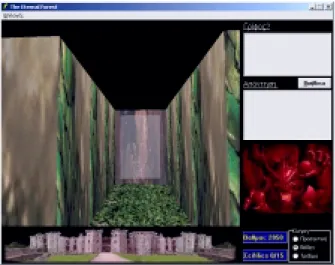
The story of VR-ENGAGE incorporates a lot of elements from adventure games. The ultimate goal of a player is to navigate through a virtual world and find the book of wisdom, which is hidden. To achieve the ultimate goal, the player has to be able to go through all the passages of the virtual world that are guarded by dragons and to obtain a score of points, which is higher than a predefined threshold. The total score is the sum of the points that the player has obtained by answering questions. In particu-lar, while the player is navigating through the virtual world, s/he finds closed doors, which are guarded by dragons as illustrated in the example of Figure 1. A guard dragon poses a question to the player from the domain of geography. If players give a correct answer then they receive full points for this question and the dragon allows them to continue their way through the door, which leads them closer to the “book of wisdom”.
As part of the adventure of the game the player may come across certain objects or animated agents. These objects or animated agents appear at random and give hints to students or guide them to tutoring places respectively. In tutoring places, students are encouraged to read a new part of the domain being taught.
Fig. 1. Closed door in a virtual woods world
The user interface of VR-ENGAGE involves the navigation of the player through the virtual worlds using the mouse and the keyboard. In case players are lost in the virtual world they may use a map, which is provided on line.
3 Aims, settings and parts of the empirical study
For the purposes of finding out the extent to which students would like the educa-tional game, we conducted an empirical study which consisted of two parts and in-volved students from schools. Both parts inin-volved the same students. The first part was conducted in the environment of school classrooms whereas in the second part students had to use software in the environment of their own homes at leisure time.
More specifically, the empirical study involved in total 50 school children of 11-12 years old from 5 geography classes. The students that participated were selected from each geography class on the basis of their game-playing expertise. For this purpose, all the students of the five classes were interviewed concerning their experience in game playing. For example, they were asked to estimate how long they spend weekly on playing virtual reality computer games. Moreover, they were asked how long they have been familiar with such games, and they were requested to navigate for 5 minutes in the virtual worlds of the commercial game we provided them. As a result, the stu-dents were divided into three groups: experienced, intermediate and novice players. Then, some students from each group were selected at random to participate so that there was sufficient representation of all three categories. Indeed, among the partici-pants there were 15 novice, 20 intermediate and 15 expert game players. The novice players were given a short training before they used the game on their own.
School children usually have a preconception of educational means as being totally different from entertainment. In this respect, the first part of the empirical study aimed at finding out how school children would react to an educational game in the settings
of a real classroom where an entertaining aspect of education is rather unexpected. Therefore the first experiment took place in school-classrooms. The experiment aimed at estimating the likeability of the VR-ENGAGE interface in comparison to the like-ability of educational software that had a simple user interface with no virtual reality and no game at all. This program was a simple window application with forms, menus, buttons, and edits which gave the student the opportunity to read questions and answer them. Also it provided help about the theory examined. The comparison was made in terms of the attractiveness of each of these applications for their end-users.
In particular, all students were asked to play the game at school for about 2 hours. Then, after the 2 hours that all students had used VR-ENGAGE, they were asked to use for another 2 hours an educational software application that had a simple user interface with no virtual reality and no game at all. Then, all the students were given the choice to use for 1 hour either of the two applications (VR-ENGAGE or the sim-ple UI application) to repeat the lessons. We measured the time that the students had spent using each of the applications. Students who had spent more time with VR-ENGAGE were considered to have preferred it over the other kind of educational application. At a first glance, one might consider it obvious that school children would prefer VR-ENGAGE since it would be more amusing. However, in reality it could not be foreseen whether the students who were novice game-players would find playing the game amusing and whether the expert game-players would find VR-ENGAGE interesting enough to bother to play. Finally, students might find the game distractive and thus might prefer the other kind of software for their learning purposes.
The second part of the empirical study aimed at finding out the extent to which VR-ENGAGE could be used by children and adolescents at their leisure time. The under-lying rationale of this part of the empirical study was to find out whether VR-ENGAGE could replace other computer games, which did not have any educational value, in the children’s preferences for their entertainment. In this way, the children’s game culture could be enriched with educationally beneficial games. Moreover, the educational game could be used both at work time and leisure time and thus would have a greater educational impact on children.
In view of the above aims, the likeability of the educational software game interface was compared to the likeability of a popular commercial game that had no educational content. Thus, after the 3 hours that students had spent with VR-ENGAGE in the classroom (2 hours of compulsory use and 1 hour where they had free choice) the same students were given the opportunity to play VR-ENGAGE at home during the weekend. They were also given a popular commercial game to play with. Students were encouraged to play both of these games for as much as they liked but it was also made clear that they did not have to play if they did not want to. After the weekend they were interviewed about how they liked VR-ENGAGE and were asked to state how many hours they had spent for each game.
For each phase of the empirical study we performed 4 t-tests to compare the time spent on VR-ENGAGE and on the respective application that VR-ENGAGE was compared to by: 1) Novice game-players (students), 2) Intermediate game-players (students), 3) Expert game-players (students) and 4) All the students.
4 Results of the comparative study in classrooms
In the first phase of the empirical study that was conducted in classrooms we per-formed 4 t-tests to compare the time spent on VR-ENGAGE and on the application with the simple user interface.
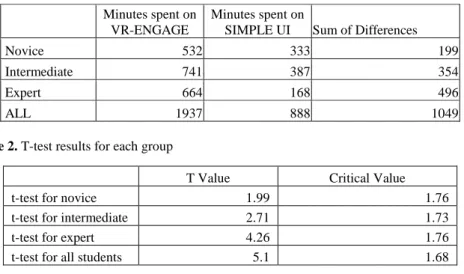
The null hypothesis, H0, was that there was no difference between the time spent for each of the two applications. The research hypothesis, H1, was that there was a differ-ence between the time spent for each of the two applications. A summary of the results of the 4 t-tests for correlated samples in classroom comparing the use of VR-ENGAGE and the application with the simple user interface is illustrated in Table 1 and Table 2. Table 1 illustrates the total minutes spent on each application by each group. Table 2 illustrates the t-values found and the critical values for each t-test. The t-value of each t-test is calculated by performing a t-test for correlated samples for the time spent on each of the applications [9]. The critical value for each t-test is the value taken from Table T for a one-tailed research hypothesis depending on the sample number.
Table 1. Time spent by each group on VR-ENGAGE and on the educational application with the simple UI
Table 2. T-test results for each group
The results of the t-test for the novice game-players have shown that t, 1.99 is greater than the critical value 1.76. Thus, we can reject H0 and accept H1. Therefore novice students prefer to play VR-ENGAGE than to use the simple UI educational application for leisure time at school or to repeat lessons. However, we can see that the difference is not great. This is expected to some extent because novice users have more operating difficulties with a virtual reality system than experienced users and thus they may be put off from the use of the game for this reason. In the case of in-termediate game-players t is 2.71, which is much greater than the critical value 1.73. Thus again we can reject H0 and accept H1. Therefore intermediate students strongly prefer to play VR-ENGAGE than use the simple UI application. In the case of expert
Minutes spent on VR-ENGAGE
Minutes spent on
SIMPLE UI Sum of Differences
Novice 532 333 199
Intermediate 741 387 354
Expert 664 168 496
ALL 1937 888 1049
T Value Critical Value
t-test for novice 1.99 1.76
t-test for intermediate 2.71 1.73
t-test for expert 4.26 1.76
game players t is 4.76 which is extremely greater than the critical value 1.76. There-fore experienced students almost all the time use VR-ENGAGE. Indeed, the fact that they are expert game players means that they are used to the culture of games and they like it a lot. These users were very pleased to see the games introduced in the class-room. The t-test for the total of game-players (students) showed that the t value is 5.10, which is extremely greater than the critical value 1.68. Therefore students prefer to play VR-ENGAGE than use the simple UI educational application.
5 Results of the comparative study during users’ leisure time
The second phase of the empirical study was based on students’ interviews after they had used VR-ENGAGE and a commercial game at their homes. The students’ answers to the questionnaires for the interviews were used for t-tests that aimed at showing what the comparison results were. However, the students’ answers were also analysed to reveal how students had liked or disliked VR-ENGAGE irrespective of its comparison with a commercial game.Similarly with the first phase, in the second phase, which was based on the stu-dents’ likeness of the software when it was played at home, we performed 4 t-tests to compare the hours spent for each kind of software (VR-ENGAGE and a popular com-mercial game).
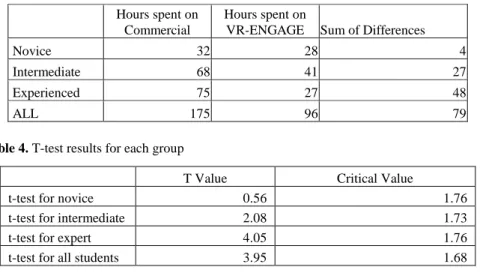
The null hypothesis, H0, was that there was no difference between the time spent for each of the two applications. The research hypothesis, H1, was that there was a differ-ence between the time spent for each of the two applications. A summary of the results of the 4 t-tests for correlated samples between use of a Commercial Game or VR-Engage in leisure time at home is illustrated in Table 3 and Table 4. The t-value and the critical value of each t-test are calculated similarly to section 4 [9].
Table 3. Time spent by each group on VR-ENGAGE and the commercial game
Table 4. T-test results for each group
Hours spent on Commercial
Hours spent on
VR-ENGAGE Sum of Differences
Novice 32 28 4
Intermediate 68 41 27
Experienced 75 27 48
ALL 175 96 79
T Value Critical Value
t-test for novice 0.56 1.76
t-test for intermediate 2.08 1.73
t-test for expert 4.05 1.76
The results of the t-test for the novice game-players have shown that t, 0.56 is much smaller than the critical value 1.76 we can accept H0. Therefore novice students do not prefer to play a commercial game more than VR-Engage for leisure time at home. This can be explained because novice users have operating difficulties with virtual reality systems. Thus, they do not enjoy a commercial game more than VR-ENGAGE because the commercial game has a more sophisticated virtual environment, which is more difficult for them to handle. Also the time spent by novice users was the smallest as compared to the other two groups of users as a consequence of these difficulties. The t-test for the intermediate student “game players” has shown that t, 2.08 is greater than the critical value 1.73; thus H0 is rejected and H1 is accepted. Therefore interme-diate students prefer to play a commercial game more than VR-Engage at home. The t-test for the experienced student “game players” has shown that the t value of 4.05 is extremely greater than the critical value 1.76. Thus we can reject H0 and accept H1. Therefore experienced students almost all the time played commercial games for lei-sure time at home. We can understand this because commercial games have a more sophisticated gaming environment than VR-ENGAGE and thus seem more amusing to experienced users who seek adventure and amusement. The t-test for all students re-sulted in a t-value of 3.95, which is extremely greater than the critical value 1.68. Thus, we can reject H0 and accept H1. Therefore students prefer to play a commercial game more than VR-Engage for leisure time at home.
The above t-tests’ results were expected to some extent. Indeed, it was almost cer-tain that the commercial game would be more appealing than VR-ENGAGE. This is so because commercial games have very sophisticated virtual environments and can be more challenging in terms of adventure since they do not have to care about educa-tional content. However, we wanted to find out whether our VR-ENGAGE application was anywhere close to the commercial for each of the 4 categories. In this respect VR-ENGAGE needs a lot of improvement so that it may be more competitive to commer-cial games.
The results from this experiment were quite different from the first one. Since chil-dren were not given the game to work with it as an assignment, they considered it merely as a game similar to the commercial games they were familiar with. Therefore their judgment on it focused on the game environment. The students’ interviews re-vealed many interesting comments about what they expected and what they would like. Most of the students (62%) pointed out that the game would be better if it had more virtual objects, more background sounds and more adventure. These comments came to a large extent from experienced game players rather than novice ones. This was due to the fact that most of them were familiar with commercial virtual reality games therefore they compared VR-ENGAGE with them and had higher expectations in this aspect. Some of the students (8%) criticised it for being non-violent. Again, this was probably due to the fact that the culture of commercial VR-games has penetrated the world of adolescents and children in a way that they expect all games to be similar even if this is not good for them. However, although most children had given com-ments for the enhancement of the entertaining aspect of the game, a very large per-centage of them (84%) said that they would like to have this game at their homes and play it at their leisure time together with other computer games they had. This was a very encouraging result.
6 Conclusions
This paper has described and discussed the evaluation of an educational virtual re-ality game for geography, VR-ENGAGE in terms of the attractiveness and motivation scope that it may have on students. The results from the evaluation showed that stu-dents in classrooms would be quite happy to work with a computer game, which represents a more amusing teaching fashion than that of conventional educational software. On the other hand, during their leisure time students would prefer to play a popular commercial game instead of VR-ENGAGE. It was shown that the game envi-ronment of the educational game has to be very competitive with commercial games to make the most of its motivation and engagement effects on students. This is so be-cause children are quite familiar with commercial games and therefore they have high expectations from the game environment.
The results from the evaluation have provided some important guidelines for the improvement of educational games. First, the virtual reality environment of VR-ENGAGE has to be enhanced, so that the game is more competitive with other com-mercial games. Moreover, there has to be more automatic help for the game, so that novice players can play more easily and thus have a more enjoyable experience.
References
1. Amory, A., Naicker, K., Vincent, J. & Claudia, A. (1998). “Computer Games as a Learning Resource.” Proceedings of ED-MEDIA, ED-TELECOM 98, World Conference on Educa-tion Multimedia and EducaEduca-tional TelecommunicaEduca-tions, 1, pp. 50-55.
2. Brody, H. (1993) “Video Games that Teach?”. In Technology Review, November/December 1993, pp. 51-57.
3. Conati, C. & Zhou, X. (2002) “ Modeling students’ emotions from cognitive appraisal in educational games”. In S. A. Cerri, G. Gouarderes and F. Paraguacu (Eds.) : Intelligent
Tu-toring Systems 2002, LNCS, 2363, pp. 944-954, Springer-Verlag Berlin Heidelberg 2002.
4. ID-software 1993.
5. Inkpen, K., Upitis, R., Klawe, M., Lawry, J., Anderson, A., Mutindi, N., Sedighian, K., Leroux, S. & Hsu, D. (1994). “We Have Never-Forgetful Flowers In Our Garden: Girl’s Re-sponses to Electronic Games”. Journal of Computers in Math and Science Teaching, 13(4), pp. 383-403.
6. Mumtaz, S. (2001) “ Children’s enjoyment and perception of computer use in the home and the school” In Computers & Education, 36 (2001), pp. 347-362.
7. Papert, S. (1993). “The Children’s Machine: Rethinking School in the Age of the Com-puters”. Basic Books, New York, 1993.
8. Virvou, M., Manos, C., Katsionis, G. & Tourtoglou, K.(2002): “VR-ENGAGE: A Virtual Reality Educational Game that Incorporates Intelligence” In Proceedings of IEEE
Interna-tional Conference on Advanced LearningTechnologies (2002), Kazan, Russia, September
16-19, 2002.