Chromium Plating: The past, the present and the future
This paper presents a summary of chromium electroplating from its earliest days and traces its development to the present. A look at the future of chromium plating is also presented from the perspective of non - chromium plating processes and how these processes compare with chromium plating. This months article deals with the past and present.
Electroplating, at its simplest, is the application of a metallic coating to a substrate (which can be metallic or non-metallic) by the use of an electrolyte as a conducting medium (the plating solution) and a source of electrical power (direct current) which acts on a pair of electrodes (the anode and the cathode).
For chromium plating, the metallic coating on the substrate is elemental chromium, which is obtained from a hexavalent chromium solution (the electrolyte, which is
chromic acid) and a source of direct current which supplies an electromotive force to the cathode (the part which is to be plated with chromium).
However, to get to this point in the development of industrial electroplating technology (which includes chromium plating and all the other metals which can be electroplated from chemical solutions) means that one must also understand the various and separate factors that needed to be “put in place” before we reached this point. And the starting point of any understanding of plating process is chemistry and the fathers of modern chemistry – The Alchemists.
The Alchemists and Alchemy operated several thousand years ago and in virtually all cultures. Their goal was the transmutation of base metals (mainly lead) to gold via the Philosophers Stone. Modern Alchemy saw its greatest evolution into a true science during the Industrial Revolution in England (which was from about 1760 to 1830) with advances in, to name a few sectors, manufacturing technology, chemistry, metallurgy, transportation, health, sanitation, the understanding of science, and the “scientific method”.
Geology (which is the study of rocks and an attempt to understand how the earth was formed beyond the religious interpretation) was one of the well known older sciences at this time and there were several metallic discoveries also at this time.
One important metal was called “chromium” which was discovered by Vauquelin in 1779 in a Siberian red lead called Crocoite (a lead chromate ore PbCrO4)). Chromium was first isolated in 1798 by the reduction of the chromate with charcoal at high temperature.
At this time there were also several key developments that needed to be made before electroplating could be established:
• Michael Faraday’s laws of electrolysis (which govern all electroplating reactions) and the basics of electrochemistry
• The electric pile was developed in the early 1800’s by Alessandro Volta • Humphry Davy’s work on electrolysis and the discovery of new elements from
electrolysis, acid-base reactions, the theory of “chemical affinity” (which we now refer to Free Energy). Davy is also known for the miners’ safety lamp.
By the 1850’s, just 50 years after Volta’s electric pile, electroplating was already an established industry while the electrowinning of metals was introduced in the late 1880’s following the work of Davy and Faraday. (Ref: Fleet, et al, ESE Magazine, 1992). For chromium plating, the earliest work was done by Junot de Bussy who in 1848 was issued a French patent on the electrodeposition of chromium. In 1854 Bunsen published the first scientific paper on chromium electrodeposition. However more credit is due to Geuther who in 1856 in Gottingen, Germany, publishes the first detailed account of chromium electroplating. In this paper, Guether uses a chromic acid solution which may have contained residual sulphuric acid. To verify the work of Geuther, Dr. H. Buff of Giessen tried to repeat the work without success and casts doubt on the results. Due to the expressed doubts, for the next 40 years many researchers concentrated research on trivalent chromium salts* for chromium deposition with no real success (Placet and Bonnet, France; LeBlanc, France).
*(Footnote: It is somewhat ironic that the “search” for trivalent chromium as a
replacement for hexavalent chromium in hard chromium plating applications continues to this day - without much success).
LeBlanc found that he could not electroplate any chromium from solutions of chromium sulphate and there was much controversy about depositing any chromium from any solution.
In 1905, Carveth and Curry working under Dr Bancroft at Cornell University concluded that the findings of Placet and Bonnet were in fact correct and they also produced chromium plate from chromic acid solutions.
This led Bancroft to state in 1906:
“The real solution from which to deposit chromium is not chrome alum nor sulphate, it is chromic acid”.
In 1909, Salzer in Budapest, Hungary showed the benefits of adding chromium sulphate to chromic acid to improve the chromium plate.
From 1912 to 1914, Sargent at Cornell University carried out a systematic study of the electrolysis of various mixtures of chromic acid and chromium sulphate but did not publish the results until 1920.
By the early 1920’s (after WW 1) in Berlin, Liebreich was studying the same subject as Sargent. This led to Liebriech in 1924 taking a patent on the ready electrodeposition of chromium and the first commercial procedures for chromium plating from chromic acid.
In the U.S. work was also going ahead on a commercial chromium plating process. Building on the work of Sargent, Fink and co-workers Schwartz, Eldridge and Dubpernell did highly valuable work at Columbia University.
This results in the commercial deposition of chromium simultaneously in the USA and Germany. The year is 1924, which is noteworthy because this is only 15 years before the start of WW2.
In 1928, following on from work in the early 1920’s by Fletcher, Ollard and
MacNaughton, chromium plating processes were marketed commercially in the UK. So, by the late 1920’s chromium plating had been commercialized in the USA, the UK and Germany.
The first chromium deposits were plated from a cold solution and were thick, dull
deposits which had to be polished to obtain a high luster. It was also found that chromium could not be used as a complete replacement for nickel plating but as a thin top layer over the nickel*.
*(Footnote: The electrodeposition of nickel was first described in 1837. In 1840 the first patent for commercial nickel plating was given to Shore. Nickel plating, from the
conventional chloride solution, was developed around 1866 by Adams. The development of nickel electroplating predates that for chromium).
One of the greatest advances in chromium plating was with the introduction in 1932 of silicofluoride ions as catalysts in addition to sulphate ions. This solution has a cathodic efficiency of between 18 – 20 %, compared with the 12 – 15% cathodic efficiency of chromic acid and sulphate only solutions.
At the start of WW2 (from 1939 – 1945), chromium plating was a well established process which allowed real advances in engine and armaments technology. It is thought that WW2 would have been very different had it not been for chromium plating. In the early 1930’s Rolls Royce broke the world air speed record with an internal combustion engine that would eventually power the Spitfire fighter. Chromium plated internal combustion engine components (pistons, piston rings, cylinder heads, etc…) also allowed better oil lubrication and oil retention in the engine which allowed fighters to fly much faster (over 400 mph) and the long range bombers to carry greater payloads greater distances and return. Long range cannons (and rifles) had the interior of their barrels plated with chromium. This conferred hardness to the internal diameter substrate metal which allowed higher temperature explosives to be used so that projectiles could be fired greater distances.
Chromium plating has not changed very much from these early commercial solutions patented in the 1920’s. The electrolyte (plating solution) is chromic acid with sulphate as
a catalyst present at 1/100 of the chromic acid concentration. The two types of chromium plating are hard (also called functional or industrial) chromium plating and decorative chromium plating.
The plating solution is the same for both processes in that the same chemistry is used (chromic acid and a sulphate catalyst) but the plating times are very different. Hard chromium plating can be up to 24 hours whereas decorative plating is up to 5 minutes. The source of power for plating is the rectifier which converts alternating current (AC) to direct current (DC). There can be no commercial plating without rectifiers, which are the modern day equivalent of Volta’s electric pile.
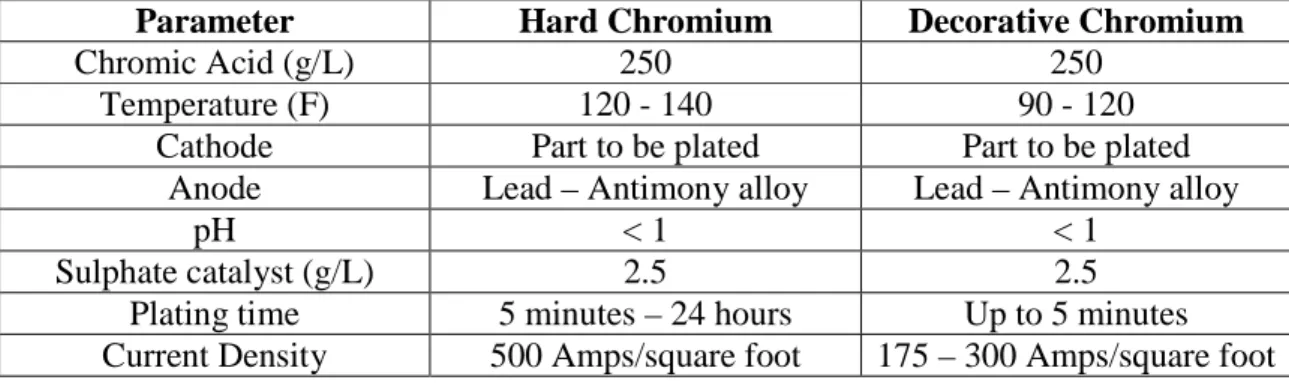
A summary of the representative conditions for hard and decorative chromium plating is presented in Table 1.
Table 1: A summary of the parameters involved in chromium plating*
Parameter Hard Chromium Decorative Chromium
Chromic Acid (g/L) 250 250
Temperature (F) 120 - 140 90 - 120
Cathode Part to be plated Part to be plated Anode Lead – Antimony alloy Lead – Antimony alloy
pH < 1 < 1
Sulphate catalyst (g/L) 2.5 2.5
Plating time 5 minutes – 24 hours Up to 5 minutes Current Density 500 Amps/square foot 175 – 300 Amps/square foot * Reference: Metal Finishing Guidebook, 2001
Chromium plating is an integral part of industrial manufacturing and many industrial parts are chromium plated. A list of the industrial sectors where chromium plating is necessary, and an integral part of, is shown below.
• Agricultural implements (plows, spades, hoes) • Armature shafts for motors
• Automotive shock absorbers and struts
• Automotive parts (bumpers, door handles, interior trim) • Ball valves
• Crankshafts • Cutting saw blades
• Cutting, milling, turning tools • Engine cylinders and piston rings • Engine valve stems
• Gauges and pins • Gun Barrels
• Hydraulic pistons and cylinders • Jet engine components
• Aircraft landing gear • Machine parts • Moulds and Dies • Railroad wheel bearings
• Rolls for the steel, paper, aluminum and plastic industries • Rotogravure cylinders for the printing industry
• Seals
• Textile guides
The chromium plating industry is well established in Canada with the industry found in all provinces (except Prince Edward Island and the Territories). The province with the largest concentration of chromium plating is Ontario which has about 45% of the industry and which is also evenly split between hard and decorative chromium plating.
Quebec has approximately 24 % of the industry.
In Ontario the split between hard and decorative plating is fairly even. Quebec has a large aerospace sector with hard chromium plating and also chromic acid anodizing.
Due to the requirements of energy sector in western Canada, many of the chromium platers in Alberta and Saskatchewan are hard chromium platers.
Chromium plating or the electrodeposition of chromium from a chromic acid solution (with sulphate as a catalyst and chromic acid as the electrolyte), two electrodes (a cathode which is the part to be plated and an anode made of lead-antimony) and a source of power (the rectifier which supplies a direct current and which replaces Volta’s pile) has become an essential part of the industrialized world and contributes to a very important industrial sector in Canada.
Peter J Paine, B.A.Sc., M. Eng., P. Eng Environment Canada
Ottawa, Ontario, Canada,