PUTNAM TRAINING PROBLEMS, 2020 (Last updated: January 18, 2021)
Remark. This is a list of problems discussed during the training sessions of the NU Putnam
team and arranged by subjects. The document has three parts, the first one contains the problems, the second one hints, and the solutions are in the third part. —Miguel A. Lerma
Exercises
1. Induction.
1.1. Prove thatn!>2n for all n≥4.
1.2. Prove that for any integern ≥1, 22n−1 is divisible by 3.
1.3. Leta and b two distinct integers, and n any positive integer. Prove that an−bn is divisible by a−b.
1.4. The Fibonacci sequence 0,1,1,2,3,5,8,13, . . . is defined as a sequence whose two first terms are F0 = 0, F1 = 1 and each subsequent term is the sum of the two previous ones: Fn=Fn−1+Fn−2 (forn ≥2). Prove that Fn<2n for every n ≥0.
1.5. Let r be a number such that r+ 1/r is an integer. Prove that for every positive integer n, rn+ 1/rn is an integer.
1.6. Find the maximum numberR(n) of regions in which the plane can be divided by n
straight lines.
1.7. We divide the plane into regions using straight lines. Prove that those regions can be colored with two colors so that no two regions that share a boundary have the same color.
1.8. A great circle is a circle drawn on a sphere that is an “equator”, i.e., its center is also the center of the sphere. There are n great circles on a sphere, no three of which meet at any point. They divide the sphere into how many regions?
1.9. We need to put n cents of stamps on an envelop, but we have only (an unlimited supply of) 5/c and 12/c stamps. Prove that we can perform the task if n ≥44.
1.10. A chessboard is a 8×8 grid (64 squares arranged in 8 rows and 8 columns), but here we will call “chessboard” anym×msquare grid. We calldefective a chessboard if one
of its squares is missing. Prove that any 2n×2n(n ≥1) defective chessboard can be tiled (completely covered without overlapping) with L-shaped trominos occupying exactly 3 squares, like this .
1.11. This is a modified version of the game of Nim (in the following we assume that there is an unlimited supply of chips.) Two players arrange several piles of chips in a row. By turns each of them takes one chip from one of the piles and adds at will as many chips as he or she wishes to piles placed to the left of the pile from which the chip was taken. Assuming that the game ever finishes, the player that takes the last chip wins. Prove that, no matter how they play, the game will eventually end after finitely many steps.
1.12. Call an integer square-full if each of its prime factors occurs to a second power (at least). Prove that there are infinitely many pairs of consecutive square-fulls.
1.13. Prove that for everyn≥2, the expansion of (1 +x+x2)ncontains at least one even coefficient.
1.14. We define recursively the Ulam numbers by setting u1 = 1, u2 = 2, and for each subsequent integer n, we set n equal to the next Ulam number if it can be written uniquely as the sum of two different Ulam numbers; e.g.: u3 = 3, u4 = 4, u5 = 6, etc. Prove that there are infinitely many Ulam numbers.
1.15. Prove Bernoulli’s inequality, which states that if x >−1,x6= 0 and n is a positive integer greater than 1, then (1 +x)n>1 +nx.
1.16. Prove that two consecutive Fibonacci numbers are always relatively prime.
1.17. Letan be the following expression with n nested radicals:
an= s 2 + r 2 +· · ·+ q 2 +√2.
Prove thatan= 2 cos2nπ+1.
2. Inequalities. 2.1. Ifa, b, c >0, prove that (a2b+b2c+c2a)(ab2+bc2+ca2)≥9a2b2c2. 2.2. Prove thatn!< n+ 1 2 n , forn = 2,3,4, . . .,
2.3. If 0< p, 0< q, and p+q <1, prove that (px+qy)2 ≤px2+qy2.
2.4. Ifa, b, c≥0, prove that p3(a+b+c)≥√a+√b+√c.
2.6. Show that q a2 1+b21+ q a2 2+b22+· · ·+ p a2 n+b2n ≥ p (a1+a2+· · ·+an)2+ (b1+b2+· · ·+bn)2
2.7. Find the minimum value of the functionf(x1, x2, . . . , xn) = x1+x2+· · ·+xn, where
x1, x2, . . . , xn are positive real numbers such thatx1x2· · ·xn = 1.
2.8. Letx, y, z ≥0 with xyz = 1. Find the minimum of
S = x 2 y+z + y2 z+x+ z2 x+y.
2.9. Ifx, y, z >0, and x+y+z = 1, find the minimum value of 1 x + 1 y + 1 z .
2.10. Prove that in a triangle with sides a, b, cand opposite angles A, B, C (in radians) the following relation holds:
a A+b B+c C a+b+c ≥
π
3 .
2.11. (Putnam, 2003) Leta1, a2, . . . , an andb1, b2, . . . , bn nonnegative real numbers. Show that
(a1a2· · ·an)1/n+ (b1b2· · ·bn)1/n ≤((a1+b1)(a2+b2)· · ·(an+bn)) 1/n
2.12. The notation n!(k) means take factorial of n k times. For example, n!(3) means ((n!)!)! What is bigger, 1999!(2000) or 2000!(1999)?
2.13. Which is larger, 19991999 or 20001998?
2.14. Which is larger, log23 or log35?
2.15. Prove that there are no positive integers a, bsuch that b2+b+ 1 =a2.
2.16. (Inspired in Putnam 1968, B6) Prove that a polynomial with only real roots and all coefficients equal to ±1 has degree at most 3.
2.17. (Putnam 1984) Find the minimum value of (u−v)2+ √ 2−u2− 9 v 2 for 0< u < √2 andv >0. 2.18. Show that √1 4n ≤ 1 2 3 4 · · · 2n−1 2n < √1 2n.
2.19. (Putnam, 2004) Letm and n be positive integers. Show that (m+n)! (m+n)m+n < m! mm n! nn.
2.20. Let a1, a2, . . . , an be a sequence of positive numbers, and let b1, b2, . . . , bn be any permutation of the first sequence. Show that
a1 b1 + a2 b2 +· · ·+ an bn ≥n .
2.21. (Rearrangement Inequality.) Leta1, a2, . . . , anandb1, b2, . . . , bnincreasing sequences of real numbers, and let x1, x2, . . . , xn be any permutation of b1, b2, . . . , bn. Show that n X i=1 aibi ≥ n X i=1 aixi.
2.22. Prove that thep-mean tends to the geometric mean as papproaches zero. In other other words, if a1, . . . , an are positive real numbers, then
lim p→0 1 n n X k=1 apk !1/p = n Y k=1 ak !1/n
2.23. Ifa,b, and care the sides of a triangle, prove that
a b+c−a + b c+a−b + c a+b−c ≥3.
2.24. Here we use Knuth’s up-arrow notation: a ↑b =ab, a↑↑ b =a↑(a↑(. . .↑a))
| {z }
bcopies ofa
, so e.g. 2↑↑3 = 2↑(2↑2)) = 222
. What is larger, 2↑↑2011 or 3 ↑↑2010?
2.25. Prove thate1/e+e1/π ≥2e1/3.
2.26. Prove that the function f(x) = n
X
i=1
(x−ai)2 attains its minimum value at x=a=
a1+· · ·+an
n .
2.27. Find the positive solutions of the system of equations
x1+ 1 x2 = 4, x2+ 1 x3 = 1, . . . , x99+ 1 x100 = 4, x100+ 1 x1 = 1.
2.28. Prove that if the numbersa,b, andcsatisfy the inequalities|a−b| ≥ |c|,|b−c| ≥ |a|,
|c−a| ≥ |b|, then one of those numbers is the sum of the other two.
2.30. Letai >0, i= 1, . . . , n, and s=a1+· · ·+an. Prove a1 s−a1 + a2 s−a2 +· · ·+ an s−an ≥ n n−1.
2.31. Find the maximum value of f(x) = sin4(x) + cos4x for x∈
R
2.32. Leta, b, cbe positive real numbers. Prove that 2a+b2 −√ab≤3a+b+c3 −√3 abc. When is equality attained?
2.33. (Generalization of previous problem.) Let an, n = 1,2,3, . . . be a sequence of positive real numbers. Prove that bn =a1+· · ·+an−nn
√
a1· · ·an is an increasing sequence of non-negative real numbers.
2.34. Letf : [0,∞)→R a function with the following properties:
(a) f is subadditive, i.e., f(x+y)≤f(x) +f(y), for every x, y ∈[0,∞). (b) f is (right) differentiable at 0.
(c) f(0) = 0.
Provef(x)≤xf0(0) for every x∈[0,∞).
2.35. Let P(x) = a0 +a1x+· · ·+an−1xn−1 +xn, with ai ∈ R, i ∈ {0,1, . . . , n−1},
be a polynomial with roots x1, x2, . . . , xn ∈ R, and let xi0 = max
1≤i≤nxi. Prove that if
x≥xi0, then P
0(x)≥npn (P(x))n−1.
2.36. Prove that ifa, b, c, dare positive real numbers, then√ab+√cd≤p
(a+d)(b+c).
2.37. LetN be a positive integer and let SN be the sum
SN = 1 2 N2 X k=1 1 √ n. Prove thatN −1< SN < N. 2.38. Prove Z π2 0 esinxdx≥ π 2(e−1). 3. Number Theory.
3.1. Show that the sum of two consecutive primes is never twice a prime.
3.2. Can the sum of the digits of a square be (a) 3, (b) 1977?
3.3. Prove that there are infinitely many prime numbers of the form 4n+ 3.
3.4. Prove that the fraction (n3+ 2n)/(n4+ 3n2+ 1) is in lowest terms for every possible integer n.
3.5. Letp(x) be a non-constant polynomial such thatp(n) is an integer for every positive integern. Prove thatp(n) is composite for infinitely many positive integersn. (This proves that there is no polynomial yielding only prime numbers.)
3.6. Show that ifa2+b2 =c2, then 3|ab.
3.7. Show that 1 +1 2 +
1
3 +· · ·+ 1
n can never be an integer for n ≥2.
3.8. Letf(n) denote the sum of the digits of n. Let N = 44444444. Find f(f(f(N))).
3.9. Show that there exist 2020 consecutive numbers, each of which is divisible by a cube greater than 1.
3.10. Find all triples of positive integers (a, b, c) such that
1 + 1 a 1 + 1 b 1 + 1 c = 2. 3.11. Find all positive integer solutions to abc−2 =a+b+c.
3.12. (USAMO, 1979) Find all non-negative integral solutions (n1, n2, . . . , n14) to
n41+n42+· · ·+n414= 1599.
3.13. The Fibonacci sequence 0,1,1,2,3,5,8,13, . . . is defined by F0 = 0, F1 = 1, Fn =
Fn−1+Fn−2 for n ≥2. Prove that for some k >0,Fk is a multiple of 1010
1010
.
3.14. Do there exist 2 irrational numbers a and b greater than 1 such that bamc 6=bbnc for every positive integers m, n?
3.15. The numbers 22005 and 52005 are written one after the other (in decimal notation). How many digits are written altogether?
3.16. Ifp and p2+ 2, are primes show that p3+ 2 is prime.
3.17. Suppose n >1 is an integer. Show that n4+ 4n is not prime.
3.18. Letmand nbe positive integers such that m <b√n+12c. Prove thatm+12 <√n.
3.19. Prove that the function f(n) =bn+√n+ 1/2c (n = 1,2,3, . . .) misses exactly the squares.
3.20. Prove that there are no primes in the following infinite sequence of numbers: 1001, 1001001, 1001001001, 1001001001001, . . .
3.21. (Putnam 1975, A1.) For positive integers n define d(n) = n−m2, where m is the greatest integer with m2 ≤ n. Given a positive integer b0, define a sequence bi by takingbk+1 =bk+d(bk). For what b0 do we havebi constant for sufficiently large i?
3.22. Letan = 10 +n2 for n≥1. For each n, let dn denote the gcd ofan and an+1. Find the maximum value ofdn asn ranges through the positive integers.
3.23. Suppose that the positive integersx, y satisfy 2x2+x= 3y2+y. Show thatx−y, 2x+ 2y+ 1, 3x+ 3y+ 1 are all perfect squares.
3.24. If 2n+ 1 and 3n+ 1 are both perfect squares, prove that n is divisible by 40.
3.25. How many zeros does 1000! ends with?
3.26. For how many k is the binomial coefficient 100k odd?
3.27. Letnbe a positive integer. Suppose that 2nand 5nbegin with the same digit. What is the digit?
3.28. Prove that there are no four consecutive non-zero binomial coefficients nr, r+1n , n
r+2
, r+3n in arithmetic progression.
3.29. (Putnam 1995, A1) Show that every positive integer is a sum of one or more numbers of the form 2r3s, where r and s are nonnegative integers and no summand divides another.
3.30. (Putnam 2003, A1) Let n be a fixed positive integer. How many ways are there to write n as a sum of positive integers, n = a1 +a2 +· · ·+ak, with k an arbitrary positive integer and a1 ≤ a2 ≤ · · · ≤ ak ≤ a1+ 1? For example, with n = 4 there are four ways: 4, 2+2, 1+1+2, 1+1+1+1.
3.31. (Putnam 2001, B-1) Letnbe an even positive integer. Write the numbers 1,2, . . . , n2 in the squares of an n×n grid so that the kth row, from right to left is
(k−1)n+ 1,(k−1)n+ 2, . . . ,(k−1)n+n .
Color the squares of the grid so that half the squares in each row and in each column are read and the other half are black (a chessboard coloring is one possibility). Prove that for each such coloring, the sum of the numbers on the red squares is equal to the sum of the numbers in the black squares.
3.32. How many primes among the positive integers, written as usual in base 10, are such that their digits are alternating 1s and 0s, beginning and ending with 1?
3.33. Prove that if n is an integer greater than 1, then n does not divide 2n−1.
3.34. The digital root of a number is the (single digit) value obtained by repeatedly adding the (base 10) digits of the number, then the digits of the sum, and so on until obtaining a single digit—e.g. the digital root of 65,536 is 7, because 6+5+5+3+6 = 25 and 2 + 5 = 7. Consider the sequence an = integer part of 10nπ, i.e.,
and letbn be the sequence b1 =a1, b2 =aa12, b3 =a aa3 2 1 , b4 =a aa a4 3 2 1 , . . . Find the digital root of b106.
3.35. (IMO, 1988) Let a, bpositive integers such that ab+ 1 divides a2+b2. Prove that
a2+b2
ab+ 1 is the square of an integer.
3.36. Prove that there are no positive integers x, y, such thatx2y+y2−x =x+y. 4. Polynomials.
4.1. Find a polynomial with integral coefficients whose zeros include √2 +√5.
4.2. Let p(x) be a polynomial with integer coefficients. Assume that p(a) = p(b) =
p(c) = −1, wherea,b,care three different integers. Prove thatp(x) has no integral zeros.
4.3. Prove that the sum
√
10012+ 1 +√10022+ 1 +· · ·+√20002+ 1 is irrational.
4.4. (USAMO 1975) IfP(x) denotes a polynomial of degreensuch thatP(k) =k/(k+1) for k= 0,1,2, . . . , n, determine P(n+ 1).
4.5. (USAMO 1984) The product of two of the four zeros of the quartic equation
x4−18x3+kx2+ 200x−1984 = 0 is −32. Find k.
4.6. Letn be an even positive integer, and letp(x) be ann-degree polynomial such that
p(−k) = p(k) for k = 1,2, . . . , n. Prove that there is a polynomial q(x) such that
p(x) = q(x2).
4.7. Letp(x) be a polynomial with integer coefficients satisfying that p(0) andp(1) are odd. Show that phas no integer zeros.
4.8. (USAMO 1976) If P(x), Q(x),R(x), S(x) are polynomials such that
P(x5) +xQ(x5) +x2R(x5) = (x4+x3+x2+x+ 1)S(x) prove thatx−1 is a factor of P(x).
4.9. Leta, b, cdistinct integers. Can the polynomial (x−a)(x−b)(x−c)−1 be factored into the product of two polynomials with integer coefficients?
4.10. Letp1, p2, . . . , pn distinct integers and letf(x) be the polynomial of degree n given by
f(x) = (x−p1)(x−p2)· · ·(x−pn). Prove that the polynomial
g(x) = (f(x))2+ 1
cannot be expressed as the product of two non-constant polynomials with integral coefficients.
4.11. Find the remainder when you divide x81+x49+x25+x9+x byx3−x.
4.12. Does there exist a polynomial f(x) for which xf(x−1) = (x+ 1)f(x)?.
4.13. Is it possible to write the polynomialf(x) = x105−9 as the product of two polyno-mials of degree less than 105 with integer coefficients?
4.14. Find all prime numbersp that can be writtenp=x4+ 4y4, where x, y are positive integers.
4.15. (Canada, 1970) Let P(x) = xn+a
n−1xn−1 +· · ·+a1x+a0 be a polynomial with integral coefficients. Suppose that there exist four distinct integers a, b, c, d with
P(a) =P(b) = P(c) =P(d) = 5. Prove that there is no integerk with P(k) = 8.
4.16. Show that (1 +x+· · ·+xn)2−xn is the product of two polynomials.
4.17. Letf(x) be a polynomial with real coefficients, and suppose that f(x) +f0(x)>0 for all x. Prove that f(x)>0 for all x.
4.18. Evaluate the following determinant:
1 1 1 1 w x y z w2 x2 y2 z2 w3 x3 y3 z3
4.19. Evaluate the following determinant:
1 1 1 1 w x y z w2 x2 y2 z2 w4 x4 y4 z4
4.20. Do there exist polynomialsa, b,c,d such that 1 +xy+x2y2 =a(x)b(y) +c(x)d(y)?
4.21. Determine all polynomials such that P(0) = 0 and P(x2+ 1) =P(x)2+ 1.
4.22. Consider the lines that meet the graph
in four distinct points Pi = [xi, yi],i= 1,2,3,4. Prove that
x1+x2+x3+x4 4
is independent of the line, and compute its value.
4.23. Letk be the smallest positive integer for which there exist distinct integers a, b, c,
d, e such that
(x−a)(x−b)(x−c)(x−d)(x−e)
has exactlyk nonzero coefficients. Find, with proof, a set of integers for which this minimumk is achieved.
4.24. Find the maximum value off(x) =x3−3xon the set of all real numbersxsatisfying
x4+ 36≤13x2.
4.25. (Putnam 1999, A1) Find polynomials f(x), g(x), and h(x) such that
|f(x)| − |g(x)|+h(x) = −1, if x <−1, 3x+ 2, if −1≤x≤0, −2x+ 2, if x >0. 4.26. Suppose that α, β, and γ are real numbers such that
α+β+γ = 2, α2+β2+γ2 = 14, α3+β3+γ3 = 17.
Find αβγ.
4.27. Prove that (2 +√5)1/3−(−2 +√5)1/3 is rational.
4.28. Two players A and B play the following game. A thinks of a polynomial with non-negative integer coefficients. B must guess the polynomial. B has two shots: she can pick a number and ask A to return the polynomial value there, and then she has another such try. Can B win the game?
4.29. Letf(x) a polynomial with real coefficients, and suppose thatf(x) +f0(x)>0 for allx. Prove that f(x)>0 for all x.
4.30. If a, b, c > 0, is it possible that each of the polynomials P(x) = ax2 +bx + c,
Q(x) =cx2+ax+b,R(x) =bx2+cx+a has two real roots?
4.31. Let f(x) and g(x) be nonzero polynomials with real coefficients such that
f(x2+x+ 1) =f(x)g(x). Show that f(x) has even degree.
4.32. Prove that there is no polynomial P(x) = anxn+an−1xn−1+· · ·+a0 with integer coefficients and of degree at least 1 with the property that P(0), P(1), P(2),. . . , are all prime numbers.
4.33. Prove that ifm is a positive integer not a multiple of 3 then the polynomial p(x) =
x2m+xm+ 1 is a multiple ofq(x) = x2+x+ 1, i.e., there is a polynomial with real coefficients r(x) such that p(x) =q(x)r(x).
5. Complex Numbers.
5.1. Letmandn two integers such that each can be expressed as the sum of two perfect squares. Prove that mn has this property as well. For instance 17 = 42 + 12, 13 = 22+ 32, and 17·13 = 221 = 142+ 52. 5.2. Prove that n X k=0 sink = sin n 2 sin n+1 2 sin1 2 .
5.3. Show that ifz is a complex number such thatz+ 1/z = 2 cosa, then for any integer
n, zn+ 1/zn= 2 cosna.
5.4. Factor p(z) = z5+z+ 1.
5.5. Find a close-form expression for n−1
Y
k=1 sinkπ
n .
5.6. Consider a regular n-gon which is inscribed in a circle with radius 1. What is the product of the lengths of alln(n−1)/2 diagonals of the polygon (this includes the sides of then-gon).
5.7. (Putnam 1991, B2) Suppose f and g are non-constant, differentiable, real-valued functions on R. Furthermore, suppose that for each pair of real numbers xand y
f(x+y) =f(x)f(y)−g(x)g(y)
g(x+y) =f(x)g(y) +g(x)f(y) Iff0(0) = 0 prove that f(x)2 +g(x)2 = 1 for allx.
5.8. Given a circle of n lights, exactly one of which is initially on, it is permitted to change the state of a bulb provided that one also changes the state of every dth bulb after it (where d is a divisor of n strictly less than n), provided that all n/d
bulbs were originally in the same state as one another. For what values of n is it possible to turn all the bulbs on by making a sequence of moves of this kind?
5.9. Suppose that a, b, u, v are real numbers for which av − bu = 1. Prove that
a2+b2+u2+v2+au+bv ≥√3.
5.10. Let Pn be a regular polygon inscribed in a unit circle. Denote by Sn the set of all chords whose endpoints are vertices of Pn, and let An be the average length of all chords in Sn. Write a closed form expression for An in terms of n, and compute limn→∞An.
6. Generating Functions.
6.1. Prove that for any positive integern
n 1 + 2 n 2 + 3 n 3 +· · ·+n n n =n2n−1,
where ab= b!(aa!−b)! (binomial coefficient).
6.2. Prove that for any positive integern
n 0 2 + n 1 2 + n 2 2 +· · ·+ n n 2 = 2n n . 6.3. Prove that for any positive integersk ≤m, n,
k X j=0 n j m k−j = m+n k .
6.4. LetFnbe the Fibonacci sequence 0,1,1,2,3,5,8,13, . . ., defined recursivelyF0 = 0,
F1 = 1, Fn=Fn−1+Fn−2 for n ≥2. Prove that
∞
X
n=1
Fn 2n = 2.
6.5. Find a recurrence for the sequence un= number of nonnegative solutions of 2a+ 5b =n .
6.6. How many different sequences are there that satisfy all the following conditions: (a) The items of the sequences are the digits 0–9.
(b) The length of the sequences is 6 (e.g. 061030) (c) Repetitions are allowed.
(d) The sum of the items is exactly 10 (e.g. 111322).
6.7. (Leningrad Mathematical Olympiad 1991) A finite sequence a1, a2, . . . , an is called
p-balanced if any sum of the form ak + ak+p + ak+2p +· · · is the same for any
k = 1,2,3, . . . , p. For instance the sequence a1 = 1, a2 = 2, a3 = 3, a4 = 4,
a5 = 3, a6 = 2 is 3-balanced because a1 +a4 = 1 + 4 = 5, a2 +a5 = 2 + 3 = 5,
a3 +a6 = 3 + 2 = 5. Prove that if a sequence with 50 members is p-balanced for
p= 3,5,7,11,13,17, then all its members are equal zero. 7. Recurrences.
7.1. Find the number of subsets of{1,2, . . . , n}that contain no two consecutive elements of {1,2, . . . , n}.
7.2. Determine the maximum number of regions in the plane that are determined by n
“vee”s. A “vee” is two rays which meet at a point. The angle between them is any positive number.
7.3. Define adomino to be a 1×2 rectangle. In how many ways can an n×2 rectangle be tiled by dominoes?
7.4. (Putnam 1996) Define aselfish set to be a set which has its own cardinality (number of elements) as an element. Find, with proof, the number of subsets of{1,2, . . . , n}
which areminimal selfish sets, that is, selfish sets none of whose proper subsets are selfish.
7.5. Let a1, a2, . . . , an be an ordered sequence of n distinct objects. A derangement of this sequence is a permutation that leaves no object in its original place. For example, if the original sequence is 1,2,3,4, then 2,4,3,1 is not a derangement, but 2,1,4,3 is. Let Dn denote the number of derangements of an n-element sequence. Show that
Dn= (n−1)(Dn−1+Dn−2).
7.6. Let α, β be two (real or complex) numbers, and define the sequence an =αn+βn (n = 1,2,3, . . .). Assume that a1 and a2 are integers with the same parity (both even or both odd). Prove that an is an integer for every n ≥1.
7.7. Let t1, t2, t3 be integers, and let λ1, λ2, λ3 be real or complex numbers. Define the sequence an = λ1tn1 +λ2tn2 +λ3tn3 for n = 0,1,2. Prove that if a0, a1, and a2 are integers then an is an integer for every n≥0.
7.8. Suppose that x0 = 18, xn+1 = 10xn
3 −xn−1, and that the sequence {xn} converges to some real number. Find x1.
7.9. (Putnam 2015-A2) Leta0 = 1, a1 = 2,and an= 4an−1−an−2 for n≥2. Find an odd prime factor of a2015.
8. Calculus.
8.1. Believe it or not the following function is constant in an interval [a, b]. Find that interval and the constant value of the function.
f(x) =
q
x+ 2√x−1 +
q
x−2√x−1. 8.2. Find the value of the following infinitely nested radical
s 2 + r 2 + q 2 +√2 +· · ·.
8.3. (Putnam 1995) Evaluate 8 v u u t2207− 1 2207− 1 2207− · · ·
Express your answer in the form (a+b√c)/d, wherea, b, c, d, are integers.
8.4. (Putnam 1992) Let f be an infinitely differentiable real-valued function defined on the real numbers. If
f(1 n) =
n2
n2+ 1, n= 1,2,3, . . . compute the values of the derivativesf(k)(0), k= 1,2,3, . . ..
8.5. Compute lim n→∞ 1 n + 1 n+ 1 + 1 n+ 2 +· · ·+ 1 2n−1 . 8.6. Compute lim n→∞ ( n Y k=1 1 + k n )1/n . 8.7. (Putnam 1997) Evaluate Z ∞ 0 x−x 3 2 + x5 2·4 − x7 2·4·6 +· · · 1 + x2 22 + x4 22·42 + x6 22·42·62 +· · · dx . 8.8. (Putnam 1990) Is √2 the limit of a sequence of numbers of the form √3 n− √3 m
(n, m = 0,1,2, . . .)? (In other words, is it possible to find integers n and m such that √3n−√3m is as close as we wish to √2?)
8.9. (Leningrad Mathematical Olympiad, 1988) Let f : R → R be continuous, with
f(x)·f(f(x)) = 1 for all x∈R. If f(1000) = 999, findf(500).
8.10. Let f : [0,1]→R continuous, and suppose that f(0) =f(1). Show that there is a valuex∈[0,1998/1999] satisfying f(x) =f(x+ 1/1999).
8.11. For which real numbers cis (ex+e−x)/2≤ecx2 for all realx?
8.12. Does there exist a positive sequence an such that P
∞ n=1an and P∞ n=11/(n 2a n) are convergent? 9. Pigeonhole Principle.
9.1. Prove that any (n+ 1)-element subset of {1,2, . . . ,2n} contains two integers that are relatively prime.
9.2. Prove that if we select n+ 1 numbers from the setS ={1,2,3, . . . ,2n}, among the numbers selected there are two such that one is a multiple of the other one.
9.3. (Putnam 1978) LetA be any set of 20 distinct integers chosen from the arithmetic progression {1,4,7, . . . ,100}. Prove that there must be two distinct integers in A
whose sum if 104.
9.4. LetAbe the set of all 8-digit numbers in base 3 (so they are written with the digits 0,1,2 only), including those with leading zeroes such as 00120010. Prove that given 4 elements from A, two of them must coincide in at least 2 places.
9.5. During a month with 30 days a baseball team plays at least a game a day, but no more than 45 games. Show that there must be a period of some number of consecutive days during which the team must play exactly 14 games.
9.6. (Putnam, 2006-B2.) Prove that, for every set X = {x1, x2, . . . , xn} of n real num-bers, there exists a non-empty subset S of X and an integerm such that
m+X s∈S s ≤ 1 n+ 1.
9.7. (IMO 1972.) Prove that from ten distinct two-digit numbers, one can always choose two disjoint nonempty subsets, so that their elements have the same sum.
9.8. Prove that among any seven real numbers y1, . . . , y7, there are two such that 0≤ yi−yj
1 +yiyj
≤ √1
3.
9.9. Prove that among five different integers there are always three with sum divisible by 3.
9.10. Prove that there exist an integern such that the first four digits of 2n are 2,0,0,9.
9.11. Prove that every convex polyhedron has at least two faces with the same number of edges. 10. Telescoping. 10.1. Prove that 1 1 +√2+ 1 √ 2 +√3+· · ·+ 1 √ 99 +√100 = 9.
10.2. LetN be a positive integer and let SN be the sum
SN = 1 2 N2 X k=1 1 √ n. Find bSNc.
10.3. Find a closed form for N X n=1 n·n! 10.4. (Putnam 1984) Express ∞ X k=1 6k (3k+1−2k+1)(3k−2k) as a rational number.
10.5. (Putnam 1977) Evaluate the infinite product
∞
Y
n=2
n3−1
n3+ 1.
10.6. Evaluate the infinite series:
∞ X n=0 n n4+n2+ 1. 10.7. Forn ≥0 prove: P(n, x) = n Y k=0 (x+ 2 + 4k)4+ 4 (x+ 4k)4+ 4 = (x+ 4n+ 3)2+ 1 (x−1)2+ 1 . 11. Symmetries.
11.1. A spherical, 3-dimensional planet has center at (0,0,0) and radius 20. At any point of the surface of this planet, the temperature is T(x, y, z) = (x+y)2 + (y−z)2 degrees. What is the average temperature of the surface of this planet?
11.2. (Putnam 1980) Evaluate Z π/2 0 dx 1 + (tanx) √ 2. 11.3. Evaluate Z 4 2 p ln (9−x)dx p ln (9−x) +pln (x+ 3).
11.4. Consider the following two-player game. Each player takes turns placing a penny on the surface of a rectangular table. No penny can touch a penny which is already on the table. The table starts out with no pennies. The last player who makes a legal move wins. Does the first player have a winning strategy?
12. Inclusion-Exclusion.
12.2. Imagine that you are going to give n kids ice-cream cones, one cone per kid, and there are k different flavors available. Assuming that no flavor gets mixed, find the number of ways we can give out the cones using all k flavors.
12.3. Leta1, a2, . . . , an an ordered sequence of n distinct objects. A derangement of this sequence is a permutation that leaves no object in its original place. For example, if the original sequence is {1,2,3,4}, then {2,4,3,1} is not a derangement, but
{2,1,4,3}is. LetDndenote the number of derangements of ann-element sequence. Show that Dn=n! 1− 1 1!+ 1 2!− · · ·+ (−1) n 1 n! .
13. Combinatorics and Probability.
13.1. Prove that the number of subsets of {1,2, . . . , n} with odd cardinality is equal to the number of subsets of even cardinality.
13.2. Find the number of subsets of{1,2, . . . , n}that contain no two consecutive elements of {1,2, . . . , n}.
13.3. Peter tosses 25 fair coins and John tosses 20 fair coins. What is the probability that they get the same number of heads?
13.4. From where he stands, one step toward the cliff would send a drunken man over the edge of a cliff. He takes random steps, either toward or away from the cliff. At any step his probability of taking a step away isp, of a step toward the cliff 1−p. Find his chance of escaping the cliff as a function of p.
13.5. Two real numbers X and Y are chosen at random in the interval (0,1). Compute the probability that the closest integer to X/Y is odd. Express the answer in the formr+sπ, where r and s are rational numbers.
13.6. On the unit circle centered at the origin (x2 +y2 = 1) we pick three points at random. We cut the circle into three arcs at those points. What is the expected length of the arc containing the point (1,0)?
13.7. In a laboratory a handful of thin 9-inch glass rods had one tip marked with a blue dot and the other with a red. When the laboratory assistant tripped and dropped them onto the concrete floor, many broke into three pieces. For these, what was the average length of the fragment with the blue dot?
13.8. We pick n points at random on a circle. What is the probability that the center of the circle will be in the convex polygon with vertices at those points?
14.1. (Putnam 1986) What is the units (i.e., rightmost) digit of 1020000 10100+ 3 ?
14.2. (IMO 1975) Prove that there are infinitely many points on the unit circlex2+y2 = 1 such that the distance between any two of them is a rational number.
14.3. (Putnam 1988) Prove that if we paint every point of the plane in one of three colors, there will be two points one inch apart with the same color. Is this result necessarily true if we replace ”three” by ”nine”?
14.4. Imagine an infinite chessboard that contains a positive integer in each square. If the value of each square is equal to the average of its four neighbors to the north, south, west and east, prove that the values in all the squares are equal.
14.5. (Putnam 1990) Consider a paper punch that can be centered at any point of the plane and that, when operated, removes precisely those points whose distance from the center is irrational. How many punches are needed to remove every point?
14.6. (Putnam 1984) Let n be a positive integer, and define
f(n) = 1! + 2! +· · ·+n!.
Find polynomials P(x) and Q(x) such that
f(n+ 2) =P(n)f(n+ 1) +Q(n)f(n) for all n ≥1.
14.7. (Putnam 1974) Call a set of positive integers “conspiratorial” if no three of them are pairwise relatively prime. What is the largest number of elements in any con-spiratorial subset of integers 1 through 16?
14.8. (Putnam 1984) Prove or disprove the following statement: If F is a finite set with two or more elements, then there exists a binary operation∗ onF such that for all
x, y, z inF,
(i) x∗z=y∗z implies x=y (right cancellation holds), and (ii) x∗(y∗z)6= (x∗y)∗z (no case of associativity holds).
14.9. (Putnam 1995) For a partitionπ of{1,2,3,4,5,6,7,8,9}, letπ(x) be the number of elements in the part containingx. Prove that for any two partitions π andπ0, there are two distinct numbers x and y in {1,2,3,4,5,6,7,8,9} such that π(x) = π(y) and π0(x) = π0(y). [A partition of a set S is a collection of disjoint subsets (parts) whose union is S.]
14.10. LetS be a set ofn distinct real numbers. Let AS be the set of numbers that occur as average of two distinct elements of S. For a given n ≥ 2, what is the smallest possible number of distinct elements in AS?
14.11. Suppose that a sequence a1, a2, a3, . . . satisfies 0 < an ≤ a2n+a2n+1 for all n ≥1. Prove that the series P∞
n=1an diverges.
14.12. On a table there is a row of fifty coins, of various denominations (the denominations could be of any values). Alice picks a coin from one of the ends and puts it in her pocket, then Bob chooses a coin from one of the ends and puts it in his pocket, and the alternation continues until Bob pockets the last coin. Prove that Alice can play so that she guarantees at least as much money as Bob.
14.13. Letf :R→Rbe a continuous function such thatf◦f has a fixed point, i.e., there is some real numberx0 such that f(f(x0)) = x0. Prove thatf also has a fixed point.
14.14. Prove that tan 1◦ is irrational.
14.15. Prove that the integer part of (5√5 + 11)2n+1, n= 0,1,2, . . ., is even.
14.16. Consider a set X and a binary operation ∗, i.e., for each x, y ∈ X, x∗ y ∈ X. Assume
(1) (x∗y)∗y =x for all x, y ∈X, and (2) x∗(x∗y) = y for all x, y ∈X. Prove thatx∗y =y∗x for all x, y ∈X.
14.17. (Ilan Vardi, Mekh-mat entrance examinations problems, No. 21) A circle is inscribed in a face of a cube of side 2. Another circle is circumscribed about a neighboring face of the cube. Find the least distance between points of the circles.
Hints 1.1. —
1.2. For the induction step, rewrite 22(n+1)−1 as a sum of two terms that are divisible by 3.
1.3. For the inductive step assume that step an−bn is divisible by a−b and rewrite
an+1−bn+1 as a sum of two terms, one of them involvingan−bn and the other one being a multiple of a−b.
1.4. Strong induction.
1.5. Rewritern+1+ 1/rn+1 in terms ofrk+ 1/rk with k ≤n.
1.6. How many regions can be intersected by the (n+ 1)th line?
1.7. Color a plane divided with n of lines in the desired way, and think how to recolor it after introducing the (n+ 1)th line.
1.8. How many regions can be intersected the by (n+ 1)th circle?
1.9. We have 1 = 5·(−7) + 12·6 = 5·5 + 12·(−2). Also, prove that ifn= 5x+ 12y ≥44, then either x≥7 or y≥2.
1.10. For the inductive step, consider a 2n+1 ×2n+1 defective chessboard and divide it into four 2n ×2n chessboards. One of them is defective. Can the other three be made defective by placing strategically an L?
1.11. Use induction on the number of piles.
1.12. The numbers 8 and 9 form one such pair. Given a pair (n, n+ 1) of consecutive square-fulls, find some way to build another pair of consecutive square-fulls.
1.13. Look at oddness/evenness of the four lowest degree terms of the expansion.
1.14. Assume that the first m Ulam numbers have already been found, and determine how the next Ulam number (if it exists) can be determined.
1.15. We have (1 +x)n+1 = (1 +x)n(1 +x).
1.16. In the induction step use the recursive definition of the Fibonacci numbers.
1.17. Find a recursive definition of an.
2.1. One way to solve this problem is by using the Arithmetic Mean-Geometric Mean inequality on each factor of the left hand side.
2.2. Apply the Arithmetic Mean-Geometric Mean inequality to the set of numbers 1,2, . . . , n.
2.3. Power means inequality with weights p+qp and p+qq .
2.4. Power means inequality.
2.5. —
2.6. This problem can be solved by using Minkowski’s inequality, but another way to look at it is by an appropriate geometrical interpretation of the terms (as distances between points of the plane.)
2.7. Many minimization or maximization problems are inequalities in disguise. The solution usually consists of “guessing” the maximum or minimum value of the func-tion, and then proving that it is in fact maximum or minimum. In this case, given the symmetry of the function a good guess is f(1,1, . . . ,1) = n, so try to prove
f(x1, x2, . . . , xn) ≥ n. Use the Arithmetic Mean-Geometric Mean inequality on
x1, . . . , xn.
2.8. Apply the Cauchy-Schwarz inequality to the vectors (√x
y+z, y √ z+x, z √ x+y) and (u, v, w), and choose appropriate values foru, v, w.
2.9. Arithmetic-Harmonic Mean inequality.
2.10. Assume a≤b ≤c, A≤B ≤C, and use Chebyshev’s Inequality.
2.11. Divide by the right hand side and use the Arithmetic Mean-Geometric Mean in-equality on both terms of the left.
2.12. Note thatn! is increasing (n < m =⇒ n!< m!)
2.13. Look at the functionf(x) = (1999−x) ln (1999 +x).
2.14. Use the definition of logarithm.
2.15. The numbers b2 and (b+ 1)2 are consecutive squares.
2.16. Use the Arithmetic Mean-Geometric Mean inequality on the squares of the roots of the polynomial.
2.17. Think geometrically. Interpret the given expression as the square of the distance between two points in the plane. The problem becomes that of finding the minimum distance between two curves.
2.18. Consider the expressions P = 12 34· · · 2n−1 2n and Q = 23 45· · · 2n−2 2n−1 . Note that k−k1 < k+1k , for k= 1,2, . . ..
2.19. Look at the binomial expansion of (m+n)m+n.
2.20. Arithmetic Mean-Geometric Mean inequality.
2.21. Try first the cases n= 1 andn = 2. Then use induction.
2.22. Take logarithms and use L’Hˆopital.
2.23. Set x=b+c−a, y=c+a−b, z =a+b−c.
2.24. We have 222
= 16<27 = 33.
2.25. Show thatf(x) =e1/x forx >0 is decreasing and convex.
2.26. Prove thatf(x)−f(a)≥0.
2.27. By the AM-GM inequality we have x1 + x12 ≥ 2
q
x1
x2 , . . . Try to prove that those
inequalities are actually equalities.
2.28. Square both sides of those inequalities.
2.29. Rearrangement inequality.
2.30. Rearrangement inequality.
2.31. Note that|sinx| ≤1, so what which is smaller, sin2xor sin4x? (Same with cosx.)
2.32. Arithmetic Mean-Geometric Mean inequality.
2.33. Arithmetic Mean-Geometric Mean inequality.
2.34. Look at the limit of f(x/n)x/n asn → ∞.
2.35. Factor the polynomial, differentiate it, and use the AM-GM inequality.
2.36. Trigonometric substitution.
2.37. Telescoping.
2.38. Concavity.
3.1. Contradiction.
3.2. Ifs is the sum of the digits of a numbern, thenn−s is divisible by 9.
3.3. Assume that there are finitely many primes of the form 4n+ 3, callP their product, and try to obtain a contradiction similar to the one in Euclid’s proof of the infinitude of primes.
3.4. Prove thatn3+ 2n and n4+ 3n2+ 1 are relatively prime.
3.5. Prove thatp(k) divides p(p(k) +k).
3.6. Study the equation modulo 3.
3.7. Call the sumS and find the maximum power of 2 dividing each side of the equality
n!S = n X k=1 n! k . 3.8. f(n)≡n (mod 9).
3.9. Chinese Remainder Theorem.
3.10. The minimum ofa, b, c cannot be very large.
3.11. Try changing variablesx=a+ 1, y =b+ 1, z =c+ 1.
3.12. Study the equation modulo 16.
3.13. Use the Pigeonhole Principle to prove that the sequence of pairs (Fn, Fn+1) is even-tually periodic moduloN = 10101010
.
3.14. Try a=√6,b =√3.
3.15. —
3.16. Ifp is an odd number not divisible by 3, then p2 ≡ ±1 (mod 6).
3.17. Sophie Germain’s identity: a4 + 4b4 = (a2+ 2b2+ 2ab)(a2+ 2b2−2ab).
3.18. The number √n is irrational or an integer.
3.19. Ifm 6=bn+√n+ 1/2c, what can we say about m?
3.20. Each of the given numbers can be writtenpn(103), wherepn(x) = 1+x+x2+· · ·+xn,
n= 1,2,3, . . ..
3.21. Study the cases bk = perfect square, and bk = not a perfect square. What can we deduce about bk+1 being or not being a perfect square in each case?
3.22. gcd(a, b) = gcd(a, b−a).
3.23. What is (x−y)(2x+ 2y+ 1) and (x−y)(3x+ 3y+ 1)?
3.24. Think modulo 5 and modulo 8.
3.25. Think of 1000! as a product of prime factors and count the number of 2’s and the number of 5’s in it.
3.26. Find the exponent of 2 in the prime factorization of nk.
3.27. IfN begins with digit a then a·10k ≤N <(a+ 1)·10k.
3.28. The desired sequence of binomial numbers must have a constant difference.
3.29. Induction. The base case is 1 = 2030. The induction step depends on the parity of
n. If n is even, divide by 2. If it is odd, subtract a suitable power of 3.
3.30. If 0< k ≤n, is there any such sum with exactly k terms? How many?
3.31. Interpret the grid as a ’sum’ of two grids, one with the terms of the form (k−1)n, and the other one with the terms of the form 1, . . . , n.
3.32. Each of the given numbers can be writtenpn(102), wherepn(x) = 1+x+x2+· · ·+xn,
n= 1,2,3, . . ..
3.33. If n is prime Fermat’s Little Theorem yields the result. Otherwise let p be the smallest prime divisor ofn. . .
3.34. The digital root of a number is its reminder modulo 9. Then show that an 1 (n = 1,2,3,· · ·) modulo 9 is periodic.
3.35. Vieta-jumping.
3.36. The given equation is equivalent to x(2y−1) =y(1−2−x).
4.1. Call x=√2 +√5 and eliminate the radicals.
4.2. Factor p(x) + 1.
4.3. Prove that the sum is the root of a monic polynomial but not an integer.
4.4. Look at the polynomialQ(x) = (x+ 1)P(x)−x.
4.5. Use the relationship between zeros and coefficients of a polynomial.
4.6. The (n−1)-degree polynomial p(x)−p(−x) vanishes at n different points.
4.7. For each integer k study the parity of p(k) depending on the parity of k.
4.8. We must prove that P(1) = 0. See what happens by replacingx with fifth roots of unity.
4.9. Assume (x−a)(x−b)(x−c)−1 = p(x)q(x), and look at the possible values of p(x) and q(x) for x=a, b, c.
4.10. Assume g(x) = h(x)k(x), where h(x) and k(x) are non-constant polynomials with integral coefficients. Prove that the can be assumed to be positive for every x and
h(pi) = k(pi) = 1, i = 1, . . . , n. Deduce that both are of degree n and determine their form. Get a contradiction by equating coefficients ing(x) and h(x)k(x).
4.11. The remainder will be a second degree polynomial. Plug the roots ofx3−x.
4.12. Find the value of f(n) for n integer.
4.13. Assume f(x) =g(x)h(x), whereg(x) andh(x) have integral coefficients and degree less than 105. Look at the product of the roots of g(x)
4.14. Sophie Germain’s Identity.
4.15. We have that a, b, c, dare distinct roots of P(x)−5.
4.16. One way to solve this problem is by letting An−1 = 1 +x+· · ·+xn−1 and doing some algebra.
4.17. Study the behavior of f(x) as x → ±∞. Also determine the number of roots of
f(x).
4.18. Expand the determinant along the last column and find its zeros as a polynomial inz.
4.19. Expand the determinant along the last column and find its zeros as a polynomial inz.
4.20. Write the given condition in matrix form and give each of x and y three different values.
4.21. Find some polynomial that coincides with P(x) for infinitely many values of x.
4.22. Find intersection points solving a system of equations.
4.23. The numbersa, b, c, d, eare the roots of the given polynomial. How are the roots of a fifth-degree polynomial with exactly 1,2,. . . non-zero coefficients?
4.24. Find first the set ofx verifying the constrain.
4.25. Try with first degree polynomials. Some of those polynomials must change sign precisely at x=−1 and x= 0. Recall that |u|=±u depending on whether u ≥0 oru <0.
4.26. Write the given sums of powers as functions of the elementary symmetric polyno-mials of α, β,γ.
4.27. Find a polynomial with integer coefficients with that number as one of its roots.
4.29. How could f(x) become zero, and how many times? From the behavior of f(x) +
f0(x), what can we conclude about the leading coefficient and degree of f(x)?
4.30. What conditions must the coefficients satisfy for a second degree polynomial to have two real roots?
4.31. Prove that f(x) cannot have real roots.
4.32. We have that a0 =P(0) must be a prime number.
4.33. Show that the roots of x2+x+ 1 are also roots of x2m+xm+ 1.
5.1. If m =a2+b2 and n =c2 +d2, then consider the product z = (a+bi)(c+di) = (ac−bd) + (ad+bc)i.
5.2. The left hand side of the equality is the imaginary part of n
X
k=0
eik.
5.3. What are the possible values of z?
5.4. Ifω =e2πi/3 then ω and ω2 are two roots ofp(z).
5.5. Write sint = (eti−e−ti)/2i.
5.6. Assume the vertices of the n-gon placed on the complex plane at the nth roots of unity.
5.7. Look at the functionh(x) = f(x) +ig(x).
5.8. Assume the lights placed on the complex plane at thenth roots of unity 1, ζ, ζ2, . . . , ζn−1, where ζ =e2πi/n.
5.9. Letz1 =a−bi,z2 =u+vi. We have|z1|2 =a2+b2,|z2|=u2+v2,<(z1z2) =au+bv,
=(z1z2) = 1, and must prove |z1|2+|z2|2+<(z1z2)≥
√
3.
5.10. The length of a chord can be expressed as 2 sinπkn = 2=neπkni o
, where k is an integer, 0≤k ≤n−1, and={z}= imaginary part of the complex number z.
6.1. Expand and differentiate (1 +x)n.
6.2. Expand both sides of (1 +x)n(1 +x)n= (1 +x)2n and look at the coefficient of xn.
6.3. Expand both sides of (1 +x)m(1 +x)n= (1 +x)m+n and look at the coefficient of
xj.
6.5. Find the generating function of the sequenceun = number of nonnegative solutions of 2a+ 5b =n.
6.6. The answer equals the coefficient ofx10 in the expansion of (1 +x+x2+· · ·+x9)6, but that coefficient is very hard to find directly. Try some simplification.
6.7. Look at the polynomialP(x) =a1+a2x+a3x2+· · ·+a50x49, and at its values at 3rd, 5th,. . . roots of unity.
7.1. The subsets of{1,2, . . . , n}that contain no two consecutive elements can be divided into two classes, the ones not containingn, and the ones containingn.
7.2. The (n+ 1)th “vee” divides the existing regions into how many further regions?
7.3. The tilings of an×2 rectangle by dominoes can be divided into two classes depending on whether we place the rightmost domino vertically or horizontally.
7.4. The minimal selfish subsets of{1,2, . . . , n}can be divided into two classes depending on whether they contain n or not.
7.5. Assume thatb1, b2, . . . , bnis a derangement of the sequencea1, a2, . . . , an. How many possible values canbnhave? Once we have fixed the value of bn, divide the possible derangements into two appropriate classes.
7.6. Find a recurrence for an.
7.7. Find a recurrence for an.
7.8. Find a general solution to the recurrence and determine for which value(s) ofx1 the sequence converges.
7.9. Prove thatan divides ank if k is odd.
8.1. √u2 =|u|.
8.2. Find the limit of the sequence a1 =
√
2,an+1 =
√
2 +an (n ≥1).
8.3. Call the limit L. Find some equation verified by L.
8.4. Justify that the desired derivatives must coincide with those of the function g(x) = 1/(1 +x2).
8.5. Compare the sum to some integral of the formRab x1dx.
8.7. Interpret the first series is as a Maclaurin series. Interchange integration and sum-mation with the second series (don’t forget to justify why the interchange is “legit-imate”.)
8.8. In factany real numberris the limit of a sequence of numbers of the form√3n−√3 m.
We wantr ≈√3n−√3 m, i.e.,r+√3m≈ √3 n. Note that√3
n+ 1−√3 n→0 asn→ ∞. 8.9. Ify ∈f(R) what is f(y)?
8.10. Consider the function g(x) = f(x)−f(x+ 1/999). Use the intermediate value theorem.
8.11. Compare Taylor expansions.
8.12. If they were convergent their sum would be convergent too.
9.1. Divide the set into n subsets each of which has only pairwise relatively prime num-bers.
9.2. Divide the set intonsubsets each of which contains only numbers which are multiple or divisor of the other ones.
9.3. Look at pairs of numbers in that sequence whose sum is precisely 104. Those pairs may not cover the whole progression, but that can be fixed. . .
9.4. Prove that for eachk = 1,2, . . . ,8, at least 2 of the elements given coincide at place
k. Consider a pair of elements which coincide at place 1, another pair of elements which coincide at place 2, and so on. How many pairs of elements do we have?
9.5. Consider the sequences ai = number of games played from the 1st through the jth day of the month, and bj = aj + 14. Put them together and use the pigeonhole principle to prove that two elements must be the equal.
9.6. Consider the fractional part of sums of the form si =x1+· · ·+xi.
9.7. Consider the number of different subsets of a ten-element set, and the possible number of sums of at most ten two-digit numbers.
9.8. Write yi = tanxi, with −π2 ≤ xi ≤ π2 (i = 1, . . . ,7). Find appropriate “boxes” for the xis in the interval (−π2,π2)
9.9. Classify the numbers by their reminder when divided by 3.
9.10. We must prove that there are positive integers n, k such that 2009·10k ≤2n <2010·10k.
10.1. Rationalize and telescope.
10.2. Find appropriate bounds for 1 2√n.
10.3. Write n= (n+ 1)−1.
10.4. Try to re-write the nth term of the sum as Ak
3k−2k −
Bk
3k+1−2k+1.
10.5. If you write a few terms of the product you will notice a lot of cancellations. Factor the numerator and denominator of the nth term of the product and cancel all possible factors from k = 2 to k = N. You get an expression in N. Find its limit asN → ∞.
10.6. Write the nth term as a sum of two partial fractions.
10.7. Use Sophie Germain’s Identity, simplify each factor of the expression, and telescope.
11.1. Start by symmetrizing the given function:
f(x, y, z) = T(x, y, z) +T(y, z, x) +T(z, x, y). 11.2. Look at the expressionf(x) +f(π2 −x).
11.3. Change of variable u= 6−x, and exploit symmetry.
11.4. What kind of symmetry can the first player take advantage of?
12.1. —
12.2. Find the number of distributions of ice-cream cones without the restriction ”using allk flavors”. Then remove the distributions in which at least one of the flavors is unused.
12.3. IfPi is the set of permutations fixing element ai, then the set of non-derangements are the elements of theP1∪P2∪ · · · ∪Pn.
13.1. Find the numbers and subtract. Or find a bijection between the subsets with odd cardinality and those with even cardinality.
13.2. Find a bijection between the k-element subsets of{1,2, . . . , n}with no consecutive elements and all k-element subsets of{1,2, . . . , n−k+ 1}.
13.3. The probability of John gettingn heads is the same as that of he getting n tails.
13.4. Consider what happens after the first step, and in which ways the man can reach the edge from there.
13.6. The lengths of the four arcs in which the circle is divided by the three points and (1,0) have identical distributions.
13.7. The lengths of the three pieces have identical distributions.
13.8. Find the probability of the polygon not containing the center of the circle.
14.1. Compare to 10
20000−3200 10100+ 3 .
14.2. If cosu, sinu, cosv, and sinv are rational, so are cos (u+v) and sin (u+v).
14.3. Contradiction.
14.4. Since the values are positive integers, one of them must be the smallest one. What are the values of the neighbors of a square with minimum value?
14.5. Try punches at (0,0), (±α,0), . . . for some appropriate α.
14.6. Note that f(n+2)f(n+1)−−f(n+1)f(n) is a very simple polynomial in n.
14.7. Start by finding some subset T of S as large as possible and such that any three elements of it are pairwise relatively prime.
14.8. Try a binary operation that depends only on the first element: x∗y=φ(x).
14.9. How many different values of π(x) are possible?
14.10. Find a set S attaining the minimum cardinality for AS.
14.11. Group the terms of the sequence appropriately.
14.12. Is it possible for Alice to force Bob into taking coins only from odd-numbered or even-numbered positions?
14.13. Iff has not fixed point thenf(x)−xis never zero, andf being continuous,f(x)−x
will have the same sign for every x.
14.14. Angle addition formulas and tan 30◦ = √1
3.
14.15. Look at (5√5 + 11)2n+1−(5√5−11)2n+1.
14.16. Find a expression that can be simplified in two ways, one yieldingx∗yand another one yielding y∗x.
14.17. This problem has a straightforward (although lengthly) solution using analytic ge-ometry and some calculus, but a far simpler approach consists of noticing that each circle is contained in some sphere with center at the center of the cube.
Solutions
1.1. We prove it by induction. The basis step corresponds to n = 4, and in this case certainly we have 4! > 24 (24 > 16). Next, for the induction step, assume the inequality holds for some value of n ≥4, i.e., we assume n!>2n, and look at what happens for n+ 1:
(n+ 1)! =n! (n+ 1)>2n(n+ 1)>2n·2 = 2n+1.
6
by induction hypothesis
Hence the inequality also holds for n+ 1. Consequently it holds for every n≥4.
1.2. For the basis step, we have that for n = 1 indeed 22·1−1 = 4−1 = 3 is divisible by 3. Next, for the inductive step, assume thatn ≥1 and 22n−1 is divisible by 3. We must prove that 22(n+1)−1 is also divisible by 3. We have
22(n+1)−1 = 22n+2−1 = 4·22n−1 = 3·22n+ (22n−1).
In the last expression the last term is divisible by 3 by induction hypothesis, and the first term is also a multiple of 3, so the whole expression is divisible by 3 and we are done.
1.3. By induction. For n = 1 we have that a1−b1 =a−b is indeed divisible by a−b. Next, for the inductive step, assume that an−bn is divisible by a−b. We must prove thatan+1−bn+1 is also divisible by a−b. In fact:
an+1−bn+1 = (a−b)an+b(an−bn).
On the right hand side the first term is a multiple of a−b, and the second term is divisible by a−b by induction hypothesis, so the whole expression is divisible by
a−b.
1.4. We prove it by strong induction. First we notice that the result is true for n = 0 (F0 = 0 < 1 = 20), and n = 1 (F1 = 1 < 2 = 21). Next, for the inductive step, assume thatn≥1 and assume that the claim is true, i.e. Fk <2k, for every k such that 0≤k≤n. Then we must prove that the result is also true for n+ 1. In fact:
Fn+1 =Fn+Fn−1 <2n+ 2n−1 <2n+ 2n = 2n+1,
6
by induction hypothesis and we are done.
1.5. We prove it by induction. Forn = 1 the expression is indeed an integer. Forn = 2 we have that r2+ 1/r2 = (r+ 1/r)2−2 is also an integer. Next assume thatn >2 and that the expression is an integer for n−1 and n. Then we have
rn+1+ 1 rn+1 = rn+ 1 rn r+ 1 r − rn−1+ 1 rn−1 ,
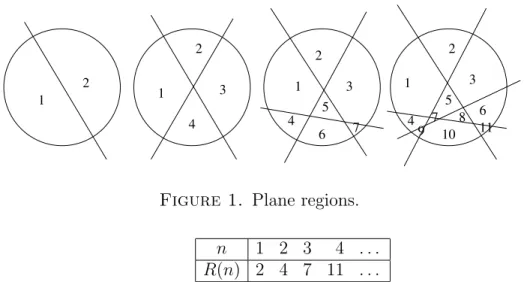
1.6. By experimentation we easily find: 1 2 1 2 3 4 1 2 3 4 5 6 7 1 2 3 4 5 6 7 8 9 10 11
Figure 1. Plane regions.
n 1 2 3 4 . . .
R(n) 2 4 7 11 . . .
A formula that fits the first few cases is R(n) = (n2+n+ 2)/2. We will prove by induction that it works for alln ≥1. Forn = 1 we haveR(1) = 2 = (12+ 1 + 2)/2, which is correct. Next assume that the property is true for some positive integer n, i.e.:
R(n) = n
2+n+ 2
2 .
We must prove that it is also true forn+ 1, i.e.,
R(n+ 1) = (n+ 1)
2+ (n+ 1) + 2
2 =
n2+ 3n+ 4
2 .
So lets look at what happens when we introduce the (n+ 1)th straight line. In general this line will intersect the other n lines in n different intersection points, and it will be divided into n + 1 segments by those intersection points. Each of those n+ 1 segments divides a previous region into two regions, so the number of regions increases by n+ 1. Hence:
R(n+ 1) =S(n) +n+ 1.
But by induction hypothesis, R(n) = (n2+n+ 2)/2, hence:
R(n+ 1) = n 2+n+ 2 2 +n+ 1 = n2+ 3n+ 4 2 . QED.
1.7. We prove it by induction in the number n of lines. For n = 1 we will have two regions, and we can color them with just two colors, say one in red and the other one in blue. Next assume that the regions obtained after dividing the plane with
n lines can always be colored with two colors, red and blue, so that no two regions that share a boundary have the same color. We need to prove that such kind of coloring is also possible after dividing the plane withn+ 1 lines. So assume that the plane divided byn lines has been colored in the desired way. After we introduce the
(n+ 1)th line we need to recolor the plane to make sure that the new coloring still verifies that no two regions that share a boundary have the same color. We do it in the following way. The (n+ 1)th line divides the plane into two half-planes. We keep intact the colors in all the regions that lie in one half-plane, and reverse the colors (change red to blue and blue to red) in all the regions of the other half-plane. So if two regions share a boundary and both lie in the same half-plane, they will still have different colors. Otherwise, if they share a boundary but are in opposite half-planes, then they are separated by the (n+ 1)th line; which means they were part of the same region, so had the same color, and must have acquired different colors after recoloring.
1.8. The answer is f(n) = n2 −n+ 2. The proof is by induction. For n = 1 we get
f(1) = 2, which is indeed correct. Then we must prove that if f(n) = n2 −n+ 2 then f(n+ 1) = (n+ 1)2 −(n + 1) + 2. In fact, the (n+ 1)th great circle meets each of the other great circles in two points each, so 2n points in total, which divide the circle into 2n arcs. Each of these arcs divides a region into two, so the number of regions grow by 2n after introducing the (n+ 1)th circle. Consequently
f(n+ 1) =n2−n+ 2 + 2n =n2+n+ 2 = (n+ 1)2−(n+ 1) + 2, QED.
1.9. We proceed by induction. For the basis step, i.e. n= 44, we can use four 5/c stamps and two 12/c stamps, so that 5·4 + 12·2 = 44. Next, for the induction step, assume that for a given n≥44 the task is possible by usingx 5/c stamps andy12/c stamps, i.e, n = 5x+ 12y. We must now prove that we can find some combination of x0 5/c stamps andy0 12/c stamps so thatn+ 1 = 5x0+ 12y0. First note that either x≥7 or
y≥2 — otherwise we would havex≤6 andy≤1, hencen≤5·6+12·1 = 42<44, contradicting the hypothesis that n≥44. So we consider the two cases:
1. Ifx≥7, then we can accomplish the goal by setting x0 =x−7 and y0 =y+ 6: 5x0+ 12y0 = 5(x−7) + 12(y+ 6) = 5x+ 12y+ 1 =n+ 1.
2. On the other hand, if y ≥ 2 then, we can do it by setting x0 = x+ 5 and
y0 =y−2:
5x0+ 12y0 = 5(x+ 5) + 12(y−2) = 5x+ 12y+ 1 =n+ 1.
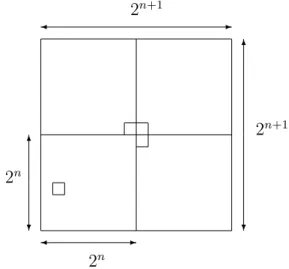
1.10. We prove it by induction on n. For n = 1 the defective chessboard consists of just a single L and the tiling is trivial. Next, for the inductive step, assume that a 2n ×2n defective chessboard can be tiled with L’s. Now, given a 2n+1 × 2n+1 defective chessboard, we can divide it into four 2n×2n chessboards as shown in the figure. One of them will have a square missing and will be defective, so it can be tiled with L’s. Then we place an L covering exactly one corner of each of the other 2n×2n chessboards (see figure). The remaining part of each of those chessboards is like a defective chessboard and can be tiled in the desired way too. So the whole 2n+1×2n+1 defective chessboard can be tiled with L’s.
1.11. We use induction on the number n of piles. For n = 1 we have only one pile, and since each player must take at least one chip from that pile, the number of tokes in
2n+1 6 ? 2n+1 6 ? 2n 2n
Figure 2. A 2n+1×2n+1 defective chessboard.
it will decrease at each move until it is empty. Next, for the induction step, assume that the game withnpiles must end eventually. We will prove that the same is true for n+ 1 piles. First note that the players cannot keep taking chips only from the first n piles, since by induction hypothesis the game with n piles eventually ends. So sooner or later one player must take a chip from the (n+ 1)th pile. It does not matter how many tokes he or she adds to the other n piles after that, it is still true that the players cannot keep taking chips only from the firstn piles forever, so eventually someone will take another chip from the (n+ 1)th pile. Consequently, the number of chips in that pile will continue decreasing until it is empty. After that we will have only n piles left, and by induction hypothesis the game will end in finitely many steps after that.1
1.12. The numbers 8 and 9 are a pair of consecutive square-fulls. Next, ifn andn+ 1 are square-full, so are 4n(n+ 1) and 4n(n+ 1) + 1 = (2n+ 1)2.
1.13. Forn = 2,3,4,5,6 we have: (1 +x+x2)2 = 1 + 2x+ 3x2+ 2x3+x4 (1 +x+x2)3 = 1 + 3x+ 6x2+ 7x3+· · · (1 +x+x2)4 = 1 + 4x+ 10x2+ 16x3+· · · (1 +x+x2)5 = 1 + 5x+ 15x2+ 30x3+· · · (1 +x+x2)6 = 1 + 6x+ 21x2+ 50x3+· · ·
1An alternate proof based on properties of ordinal numbers is as follows (requires some advanced
set-theoretical knowledge.) Here ω = first infinite ordinal number, i.e., the first ordinal after the sequence of natural numbers 0,1,2,3, . . .. Let the ordinal number α = a0+a1ω+a2ω2+· · ·+an−1ωn−1 represent
a configuration of n piles with a0, a1, . . . , an−1 chips respectively (read from left to right.) After a move
the ordinal number representing the configuration of chips always decreases. Every decreasing sequence of ordinals numbers is finite. Hence the result.
In general, if (1 +x+x2)n=a+bx+cx2+dx3+· · ·, then
(1 +x+x2)n+1 =a+ (a+b)x+ (a+b+c)x2+ (b+c+d)x3+· · · ,
hence the first four coefficients of (1 +x+x2)n+1 depend only on the first four coefficients of (1 +x+x2)n. The same is true is we write the coefficients modulo 2, i.e., as “0” if they are even, or “1” if they are odd. So, if we callqn(x) = (1+x+x2)n with the coefficients written modulo 2, we have
q1(x) = 1 + 1x+ 1x2 q2(x) = 1 + 0x+ 1x2+ 0x3+ 1x4 q3(x) = 1 + 1x+ 0x2+ 1x3+· · · q4(x) = 1 + 0x+ 0x2+ 0x3+· · · q5(x) = 1 + 1x+ 1x2+ 0x3+· · · q6(x) = 1 + 0x+ 1x2+ 0x3+· · ·
We notice that the first four coefficients of q6(x) coincide with those of q2(x), and since these first four coefficients determine the first four coefficients of each sub-sequent polynomial of the sequence, they will repeat periodically so that those of
qn(x) will always coincide with those of qn+4. Since for n = 2,3,4,5 at least one of the first four coefficients of qn(x) is 0 (equivalently, at least one of the first four coefficients of (1 +x+x2)n is even), the same will hold for all subsequent values of
n.
1.14. Let Um = {u1, u2, . . . , um} (m ≥ 2) be the first m Ulam numbers (written in increasing order). LetSm be the set of integers greater thanum that can be written uniquely as the sum of two different Ulam numbers from Um. The next Ulam numberum+1 is precisely the minimum element ofSm, unless Sm is empty, but it is not because um−1+um ∈Sm.
1.15. By induction. For the base casen = 2 the inequality is (1 +x)2 >1 + 2x, obviously true because (1 +x)2−(1 + 2x) =x2 >0. For the induction step, assume that the inequality is true for n, i.e., (1 +x)n >1 +nx. Then, for n+ 1 we have
(1 +x)n+1 = (1 +x)n(1 +x)>(1 +nx)(1 +x) =
1 + (n+ 1)x+x2 >1 + (n+ 1)x ,
and the inequality is also true forn+ 1.
1.16. This can be proved easily by induction. Base case: F1 = 1 and F2 = 1 are in fact relatively prime. Induction Step: we must prove that if Fn and Fn+1 are relatively prime then so are Fn+1 and Fn+2. But this follows from the recursive definition of the Fibonacci sequence: Fn+Fn+1 = Fn+2; any common factor of Fn+1 and Fn+2 would be also a factor of Fn, and consequently it would be a common factor of Fn and Fn+1 (which by induction hypothesis are relatively prime.)
1.17. Note that an can be defined recursively like this: a1 = √ 2, and an+1 = √ 2 +an for n≥1. We proceed by induction. Forn = 1 we have in fact a1 =
√
2, and 2 cosπ4 = 2· √1 2 =
√
2. Next, assuming the result is true for some n≥1, we have
an+1 = √ 2 +an = r 2 + 2 cos π 2n+1 = r 2 + 2 cos 2 π 2n+2 = r 2 + 2(2 cos2 π 2n+2 −1) = r 4 cos2 π 2n+2 = 2 cos π 2n+2 ,
2.1. Using the Arithmetic Mean-Geometric Mean Inequality on each factor of the LHS we get a2b+b2c+c2a 3 ab2+bc2+ca2 3 ≥√3a3b3c3 √3 a3b3c3=a2b2c2. Multiplying by 9 we get the desired inequality.
Another solution consists of using the Cauchy-Schwarz inequality: (a2b+b2c+c2a)(ab2 +bc2+ca2) = (a √ b)2+ (b√c)2+ (c√a)2 ( √ b c)2+ (√c a)2+ (√a b)2
≥(abc+abc+abc)2 = 9a2b2c2.
2.2. This result is the Arithmetic Mean-Geometric Mean applied to the set of numbers 1,2, . . . , n: n √ 1·2· · · · ·n < 1 + 2 +· · ·+n n = n(n+1) 2 n = n+ 1 2 .
Raising both sides to the nth power we get the desired result.
2.3. The simplest solution consists of using the weighted power means inequality to the (weighted) arithmetic and quadratic means of x and y with weights p+qp and p+qq :
p p+qx+ q p+qy≤ r p p+qx 2+ q p+qy 2, hence (px+qy)2 ≤(p+q)(px2+qy2).