MetaAugment: Sample-Aware Data Augmentation Policy Learning
Fengwei Zhou
*, Jiawei Li
*, Chuanlong Xie
*, Fei Chen, Lanqing Hong, Rui Sun, Zhenguo Li
†Huawei Noah’s Ark Lab
{zhoufengwei, li.jiawei, xie.chuanlong, chen.f, honglanqing, sun.rui3, li.zhenguo}@huawei.com
Abstract
Automated data augmentation has shown superior perfor-mance in image recognition. Existing works search for dataset-level augmentation policies without considering individual sample variations, which are likely to be sub-optimal. On the other hand, learning different policies for different samples naively could greatly increase the computing cost. In this paper, we learn a sample-aware data augmentation policy efficiently by formulating it as a sample reweighting problem. Specifi-cally, an augmentation policy network takes a transformation and the corresponding augmented image as inputs, and outputs a weight to adjust the augmented image loss computed by a task network. At training stage, the task network minimizes the weighted losses of augmented training images, while the policy network minimizes the loss of the task network on a validation set via meta-learning. We theoretically prove the convergence of the training procedure and further derive the exact convergence rate. Superior performance is achieved on widely-used benchmarks including CIFAR-10/100, Omniglot, and ImageNet.
Introduction
Data augmentation is widely used to increase the diver-sity of training data in order to improve model generaliza-tion (Krizhevsky, Sutskever, and Hinton 2012; Srivastava, Greff, and Schmidhuber 2015; Han, Kim, and Kim 2017; DeVries and Taylor 2017; Zhang et al. 2017; Yun et al. 2019). Automated data augmentation that searches for data-driven augmentation policies improves the performance of deep models in image recognition compared with the manually designed ones. A data augmentation policy is a distribution of transformations, according to which training samples are aug-mented. Reinforcement learning (Cubuk et al. 2019a; Zhang et al. 2020), population-based training (Ho et al. 2019), and Bayesian optimization (Lim et al. 2019) have been employed to learn augmentation policies from target datasets. Despite the difference of search algorithms, these approaches search for policies at the dataset level, i.e., all samples in the dataset are augmented with the same policy. For an image recogni-tion task, left translarecogni-tion may be suitable for the image where
*Equal Contribution †Corresponding Author
Copyright © 2021, Association for the Advancement of Artificial Intelligence (www.aaai.org). All rights reserved.
the target object is on the right, but may not be suitable for the image where the target object is on the left (see Figure 4). According to this observation, dataset-level polices may give rise to various noises such as noisy labels, misalignment, or image distortion, since different samples vary greatly in object scale, position, color, illumination, etc.
To increase data diversity while avoiding noises, it is ap-pealing to learn a sample-aware data augmentation policy, i.e., learning different distributions of transformations for different samples. However, it is time-consuming to evaluate a large number of distributions and non-trivial to determine the relation among the distributions. Augmenting training samples with the corresponding policies, we consider the augmented sample loss as a random variable and train a task network to minimize the expectation of the augmented sample loss. From this perspective, learning a sample-aware policy can be regarded as reweighting the augmented sample losses and the computing cost can be greatly reduced.
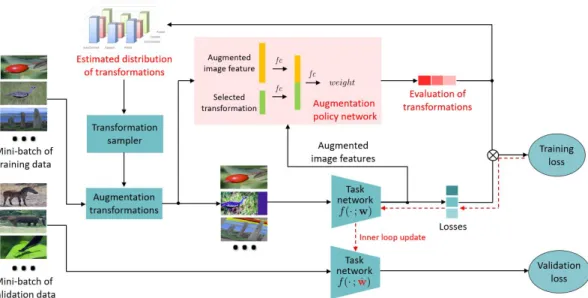
In this paper, we propose an efficient method, called MetaAugment, to learn a sample-aware data augmentation policy by formulating it as a sample reweighting problem. An overview of the proposed method is illustrated in Figure 1. Given a transformation and the corresponding augmented image feature, extracted by a task network, an augmenta-tion policy network outputs the weight of the augmented image loss. The task network is optimized by minimizing the weighted training loss, while the goal of the policy network is to improve the performance of the task network on a val-idation set via adjusting the weights of the losses. This is a bilevel optimization problem (Colson, Marcotte, and Savard 2007) which is hard to be optimized. We leverage the mech-anism of meta-learning (Finn, Abbeel, and Levine 2017; Li et al. 2017; Ren et al. 2018; Wu et al. 2018; Liu, Simonyan, and Yang 2019; Shu et al. 2019) to solve this problem. The motivation is based on the ability of meta-learning to extract useful knowledge from related tasks. During training, clas-sification for each batch of samples is treated as a task. The policy network acts as a meta-learner to adapt the task net-work with the augmented samples such that it can perform well on a batch of validation samples. Instead of learning an initialization for fast adaptation in downstream tasks, the policy network learns to augment while guiding the actual training process of the task network. We also propose a novel transformation sampler that samples transformations
Figure 1: An overview of the proposed MetaAugment. The augmentation policy network outputs the weights of the augmented image losses and is learned to evaluate the effectiveness of different transformations for different training images via meta-learning, while the task network is trained to minimize the weighted training loss alternately with the updating of the policy network. For higher training efficiency, the transformation sampler samples transformations according to a distribution refined with the training process of the policy network.
ing to a distribution estimated by the outputs of the policy network. In principle, the distribution reflects the overall ef-fectiveness of the transformations for the whole dataset and the transformation sampler can avoid invalid ones to improve the training efficiency. Furthermore, we theoretically show the convergence guarantee of our algorithm.
Our main contributions can be summarized as follows: 1) We propose MetaAugment to learn a sample-aware augmentation policy network that captures the variability of training samples and evaluates the effectiveness of transfor-mations for different samples.
2) We systematically investigate the convergence proper-ties under two cases: (i) the policy network has its own feature extractor; (ii) the policy network depends on the parameters of the task network. We also point out the exact convergence rate and the optimization bias of our algorithm.
3) Extensive experimental results show that our method consistently improves the performance of various deep net-works and outperforms previous automated data augmenta-tion methods on CIFAR-10/100, Omniglot, and ImageNet.
Related Work
Automated Data Augmentation.There are rich studies on data augmentation in the past few decades, while automated data augmentation is a relatively new topic. Inspired by neu-ral architecture search, AutoAugment (Cubuk et al. 2019a) adopts reinforcement learning to train a controller to gener-ate augmentation policies such that a task network trained along with the policies may have the highest validation ac-curacy. Adversarial AutoAugment (Zhang et al. 2020) trains a controller to generate adversarial augmentation policies that increase the training loss of a task network. Inspired by hyper-parameter optimization, PBA (Ho et al. 2019) learns
an epoch-aware augmentation schedule instead of a fixed policy for all training epochs. Following Bayesian optimiza-tion, FAA (Lim et al. 2019) searches for policies that match the distribution of augmented data with that of unaugmented data. DADA (Li et al. 2020) proposes to relax the discrete se-lection of augmentation policies to be differentiable and uses gradient-based optimization to do policy search. These meth-ods overlook the variability of training samples and adopt the same policy for all samples. RandAugment (Cubuk et al. 2019b) shows that hyper-parameters in such policies do not affect the results a lot. Our method learns a sample-aware pol-icy network that associates different pairs of transformations and augmented samples with different weights.
Sample Reweighting. There are many studies on sample reweighting for specific issues, e.g., class imbalance (John-son and Khoshgoftaar 2019) and label noise (Zhang and Sabuncu 2018). Among them, there are mainly two types of weighting functions. The first one, suitable for class imbal-ance, is to increase the weights of hard samples (Freund and Schapire 1995; Johnson and Khoshgoftaar 2019; Malisiewicz, Gupta, and Efros 2011; Lin et al. 2017), while the second one, suitable for noise label, is to increase the weights of easy sam-ples (Kumar, Packer, and Koller 2010; Jiang et al. 2014a,b; Zhang and Sabuncu 2018). Instead of manually designing the weight functions, Ren et al. (2018) propose an online reweighting method that learns sample weights directly from data via meta-learning. Meta-Weight-Net (Shu et al. 2019) adopts a neural network to learn the mapping from sample loss to sample weight, which stabilize the weighting behavior. Wang et al. (2019) train a scorer network to up-weight train-ing data that have similar loss gradients with validation data via reinforcement learning. Different from these works, our policy network aims to evaluate different transformations for different samples and assign weights to augmented samples.
Methodology
Sample-Aware Data Augmentation
Consider an image recognition task with the training set
Dtr ={(x i, yi)}N
tr
i=1, whereyiis the label of the imagexi,
andNtris the sample size. Training samples are augmented
by various transformations. Each transformation consists of two image processing functions, such as rotation, translation, coloring, etc., to be applied in sequence. Each function is associated with a magnitude that is rescaled to and sampled uniformly from[0,10]. GivenKimage processing functions in order, letTm1,m2
j,k (xi)be a transformation applied on an
imagexiwithj-th andk-th functions in order and the mag-nitudes arem1andm2, respectively.
Intuitively, not all of the augmented samples may help to improve the performance of a task network, and thus, an augmentation policy network is proposed to learn the effec-tiveness of different transformations for different training samples. Letf(xi;w)be the task network with parameters
w. By abuse of notation, the deep feature ofxiextracted by the task network is also denoted byf(xi;w). For each pair of augmented sample featuref(Tm1,m2
j,k (xi);w)and the
em-bedding of the applied transformatione(Tm1,m2
j,k ), the policy
networkP(·,·;θ)with parametersθtakes the pair as input and outputs a weight that is imposed on the augmented sam-ple lossLi,j,k(m1, m2;w) =`(f(Tj,km1,m2(xi);w), yi). The
task network is trained to minimize the following weighted training loss: Ltr(w,θ) = 1 Ntr Ntr X i=1 1 K2 K X j,k=1 Em1,m2∼U(0,10) h Pi,j,k(m1, m2;w,θ)Li,j,k(m1, m2;w) i , where Pi,j,k(m1, m2;w,θ) =P(f(Tj,km1,m2(xi);w), e(Tj,km1,m2);θ) andU(0,10)denotes the uniform distribution over[0,10]. The objective of the policy network is to output the accu-rate sample weights such that the task network has the best performance on a validation setDval={(xval
i0 , yival0 )}N
val i0=1 via minimizingLtr(w,θ). Mathematically, we formulate the
following optimization problem:
min θ L val (w∗(θ)) = 1 Nval Nval X i0=1 Lvali0 (w∗(θ))
subject to w∗(θ) = arg min
w
Ltr(w,θ),
(1)
where Lval
i0 (w∗(θ)) = `(f(xvali0 ;w∗(θ)), yvali0 ). This is a bilevel optimization problem (Colson, Marcotte, and Savard 2007), which is hard to solve since as the updating ofθ, the parameters of the task network are required to be optimized accordingly. Recent works (Ren et al. 2018; Wu et al. 2018; Liu, Simonyan, and Yang 2019; Shu et al. 2019) use meta-learning techniques to get approximate optimal solutions for such bilevel optimization problems. We also leverage meta-learning and employ the updating rules proposed in (Shu et al. 2019; Li et al. 2017; Antoniou, Edwards, and Storkey 2019) to solve problem (1).
Proposed MetaAugment Algorithm
The policy and task networks are trained alternately. For each iteration, a mini-batch of training dataDtr
mi={(xi, yi)}n tr i=1 with batch sizentris sampled and for eachxi, a transforma-tionTm1,m2
ji,ki is sampled to augmentxi. For notation
simplic-ity, let Pi(w,θ) = P(f(T m1,m2 ji,ki (xi);w), e(T m1,m2 ji,ki );θ) andLi(w) =`(f(Tm1,m2
ji,ki (xi);w), yi). Then the inner loop
update ofwin iterationt+ 1is ˆ w(t)(θ, α) =w(t)−α 1 ntr ntr X i=1 Pi(w(t),θ)∇wLi(w(t)), (2)
where αis a learnable learning rate (Li et al. 2017; An-toniou, Edwards, and Storkey 2019) and ∇wLi(w(t)) = ∇wLi(w)
w(t). We adopt a learnableαbecause it is unclear how to set the learning rate schedule manually for this inner loop update and proper schedules may vary for different train-ing datasets. We regardPi(w,θ)as a function ofθand do
not take derivative ofPi(w,θ)with respect towin Eq. (2). This is becausePi(w,θ)shall be fixed when updating w
and the weighted training loss shall not be minimized via minimizingPi(w,θ). It can also avoid a second-order
deriva-tive when updating the policy network, which otherwise will substantially increase the computational complexity.
The formulationwˆ(t)(θ, α)is regarded as a function ofθ andα, and thenθandαcan be updated via the validation loss computed bywˆ(t)(θ, α)on a mini-batch of validation samplesDval
mi ={(xvali0 , yival0 )}n
val
i0=1with batch sizenval. The outer loop updates ofθandαare formulated by
(θ(t+1), α(t+1)) = (θ(t), α(t)) −β 1 nval nval X i0=1 ∇(θ,α)L val i0 ( ˆw(t)(θ(t), α(t))), (3)
whereβis a learning rate and∇(θ,α)Lvali0 ( ˆw(t)(θ(t), α(t)))
=∇(θ,α)Lvali0 ( ˆw(t)(θ, α))
(θ(t),α(t)). The third step in itera-tiont+ 1is the outer loop update ofw(t)with the updated θ(t+1): w(t+1)=w(t)−γ 1 ntr ntr X i=1 Pi(w(t),θ(t+1))∇wLi(w(t)), (4)
whereγis a learning rate. With these updating rules, the two networks can be trained efficiently.
Although the policy network outputs the weights that eval-uate the importance of the augmented samples, sampling invalid transformations constantly may lead to poor training efficiency. We propose a novel transformation sampler that sample transformations according to a probability distribution estimated by the outputs of the policy network and refined with the training process of the policy network. Specifically, let{P(f(Tm1,m2 ji,ki (xi);w), e(T m1,m2 ji,ki );θ)} r·ntr i=1 denote the collection of the policy network outputs in the lastr itera-tions. Then the average value of the outputs corresponding to the transformation withj-th andk-th functions in order (without magnitude) is estimated by
vj,k= 1 cj,k r·ntr X i=1 X ji=j,ki=k P(f(Tm1,m2 ji,ki (xi);w), e(T m1,m2 ji,ki );θ),
Algorithm 1MetaAugment: Sample-Aware Data Augmenta-tion Policy Learning
Input: Training dataDtr
, validation dataDval
,Kimage process-ing functions, batch sizesntr,nval, learning rateβ,γ, sampler hyper-parametersr,s,, iteration numberT
Output: w(T),θ(T),{pj,k}Kj,k=1 1: Initializew(0),θ(0),α(0),{p j,k=K12} K j,k=1; 2: for0≤t≤T−1do
3: Sample a mini-batch of training samplesDtr
miwith batch
sizentr;
4: For each sample in the mini-batch, sample a transforma-tion according topj,k and the corresponding magnitudes
uniformly from[0,10];
5: Augment the batch data with the sampled transformations; 6: Sample a mini-batch of validation samplesDval
mi with batch
sizenval;
7: Computewˆ(t)(θ, α)according to Eq. (2); 8: Update(θ(t+1), α(t+1))according to Eq. (3); 9: Updatew(t+1)according to Eq. (4);
10: if(t+ 1) mods= 0then
11: Updatepj,kaccording to Eq. (5) with the policy network
outputs in the lastmin(t+ 1, r)iterations; 12: end if
13: end for
wherecj,kis the number of terms in the summation. In our implementation, the output of the policy network is with the Sigmoid function to ensure the output is positive. To balance exploration and exploitation, and to avoid the biases caused by underfitting of the policy network, the sampler samples each transformation according to the following distribution:
pj,k= (1−)· vj,k PK l,m=1vl,m +· 1 K2, (5)
whereis a hyper-parameter, and the corresponding mag-nitudes are sampled uniformly from[0,10]. The probability
pj,kis updated everysiterations. This estimated distribution reflects the overall effectiveness of the transformations for the whole dataset and evolves synergistically with the pol-icy network. Dataset-level and sample-level augmentation policies are combined together by these two modules. The MetaAugment algorithm is summarized in Algorithm 1.
In each iteration, MetaAugment requires three forward and backward passes of the task network, which makes it take3×
training time than a standard training scheme. However, once trained, the policy network, together with the task network and the estimated distribution{pj,k}K
j,k=1can be transferred to train different networks on the same dataset efficiently. More details are provided in Appendix.
Convergence Analysis
Motivated by Meta-Weight-Net (Shu et al. 2019), we analyze the convergence of the proposed algorithm. In technical de-tails, we release the assumptions of Meta-Weight-Net, e.g.
P∞
t=1βt ≤ ∞and P
∞
t=1β 2
t ≤ ∞, which are invalid in
many cases. We find a proper trade-off between the training and validation convergence and exactly point out the con-vergence rate and the optimization bias. Furthermore, we
systematically investigate two situations: (i) the policy net-work has its own feature extractor; (ii) the policy netnet-work depends on the feature extractor of the task network. For the case (i), the convergence is guaranteed on both validation and training data, while for the case (ii), the conclusion on the validation data still holds, but the convergence is not ensured on the training data. However, if the policy network is also a deep network, it will take nearly4.5×training time than a standard training scheme. Also, with limited validation data, it may overfit and thus make the task network overfit the vali-dation data. Hence, we choose the latter case in our algorithm. We assumeαis fixed during training and postpone the proof into Appendix.
Theorem 1. Suppose that the loss function`hasρ1-bounded gradients with respect towunder both (augmented) training data and validation data,`is Lipschitz smooth with constant ρ2, the policy networkP is differential with aδ1-bounded gradient and twice differential with its Hessian bounded by δ2with respect toθ, and the absolute values ofPand`are bounded above byC1andC2, respectively. Furthermore, for any iteration0≤t≤T−1, the variance of the weighted training loss (validation loss) gradient on a mini-batch of training (validation) samples is bounded above. Let
α= clogT T , β= r c0log logT T , γ= c00logT T ,
for some positive constantsc, c0 andc00. The number of iterations T is sufficiently large such that αβρ21(αδ21ρ2+ δ2)<1andγC1ρ2 <1.If the policy network has its own feature extractor, we have
1 T T−1 X t=0 E h ∇θL val ( ˆw(t)(θ(t))) 2i ≤O(√ logT Tlog logT), (6) lim T→∞ 1 T T−1 X t=0 E h k∇wLtr(w(t),θ(t+1))k2 i = 0. (7)
If the policy network uses the feature extractor of the task network, the weights in the training loss will change whenw
updates. Since we regardPas a fixed weight when updating
w, the weighted training loss at the end of the last iteration is different from the weighted training loss at the beginning of the current iteration. The discontinuity leads to a bias term in the convergence of the weighted training loss.
Theorem 2. Suppose the assumptions of Theorem 1 hold. Further assume that the policy networkP depends onwand is differential with aδ˜1-bounded gradient with respect tow. Then we have that (6) still holds and
1 T T−1 X t=0 E h k∇wLtr(w(t),θ(t+1))k2 i −2ρ1δ˜1C1C2≤o(1). (8)
According to the proof of Theorem 2, one can find that under certain conditions, (7) can still hold even if the policy network depends on the feature extractor of the task network.
Experimental Results
In this section, we evaluate MetaAugment for image recogni-tion tasks on CIFAR-10/100 (Krizhevsky and Hinton 2009), Omniglot (Lake et al. 2011), and ImageNet (Deng et al. 2009).
Table 1: Top-1 test accuracy (%) on CIFAR-10 and CIFAR-100.
Dataset Model Baseline AA FAA PBA DADA RA AdvAA MetaAugment
CIFAR-10 WRN-28-10 96.1 97.4 97.3 97.42 97.3 97.3 98.10 97.76±0.04 WRN-40-2 94.7 96.3 96.4 - 96.4 - - 96.79±0.06 Shake-Shake (26 2x96d) 97.1 98.0 98.0 97.97 98.0 98.0 98.15 98.29±0.03 Shake-Shake (26 2x112d) 97.2 98.1 98.1 97.97 98.0 - 98.22 98.28±0.01 PyramidNet+ShakeDrop 97.3 98.5 98.3 98.54 98.3 98.5 98.64 98.57±0.02 CIFAR-100 WRN-28-10 81.2 82.9 82.8 83.27 82.5 83.3 84.51 83.79±0.11 WRN-40-2 74.0 79.3 79.4 - 79.1 - - 80.60±0.16 Shake-Shake (26 2x96d) 82.9 85.7 85.4 84.69 84.7 - 85.90 85.97±0.09 PyramidNet+ShakeDrop 86.0 89.3 88.3 89.06 88.8 - 89.58 89.46±0.11
Table 2: Top-1 test accuracy (%) on CIFAR using Multiple Transformations (MT) for each sample in a mini-batch.
Dataset Model AdvAA MetaAugment+MT CIFAR-10 WRN-28-10 98.10 98.26±0.02
CIFAR-100 WRN-28-10 84.51 85.21±0.09
We show the effectiveness of MetaAugment with different task network architectures and visualize the learned augmen-tation policies to illustrate the necessity of sample-aware data augmentation.
In our implementation, we useK= 14image processing functions: AutoContrast, Equalize, Rotate, Posterize, Solar-ize, Color, Contrast, Brightness, Sharpness, ShearX/Y, Trans-lateX/Y, Identity (Cubuk et al. 2019b,a; Ho et al. 2019; Lim et al. 2019; Zhang et al. 2020). The embedding of a particu-lar transformationTm1,m2
j,k is a28-dimensional vector with m1+ 1in(2j−1)-th position,m2+ 1in(2k)-th position, and0elsewhere. For AutoContrast, Equalize, and Identity that do not use magnitude, we let11be in their positions. The augmentation policy network is an MLP that takes the embed-ding of the transformation and the corresponembed-ding augmented image feature as inputs, each followed by a fully-connected layer of size 100 with ReLU nonlinearities. The two inter-mediate features are then concatenated together, followed by a fully-connected output layer of size 1. The Sigmoid func-tion is applied to the output. We also normalize the output weights of training samples in each mini-batch, i.e., each weight is divided by the sum of all weights in the mini-batch. More implementation details and the hyper-parameters we used are provided in Appendix. All of the reported results are averaged over five runs with different random seeds.
Results on CIFAR, Omniglot, and ImageNet
CIFAR.CIFAR-10 and CIFAR-100 consist of 50,000 im-ages for training and 10,000 imim-ages for testing. For our method, we hold out 1,000 training images as the valida-tion data. We compare MetaAugment with Baseline, Au-toAugment (AA) (Cubuk et al. 2019a), FAA (Lim et al. 2019), PBA (Ho et al. 2019), DADA (Li et al. 2020), RandAugment (RA) (Cubuk et al. 2019b), and Adversar-ial AutoAugment (AdvAA) (Zhang et al. 2020) on Wide-ResNet (WRN) (Zagoruyko and Komodakis 2016),
Shake-(a) CIFAR-10 (b) CIFAR-100
(c) Omniglot (d) ImageNet
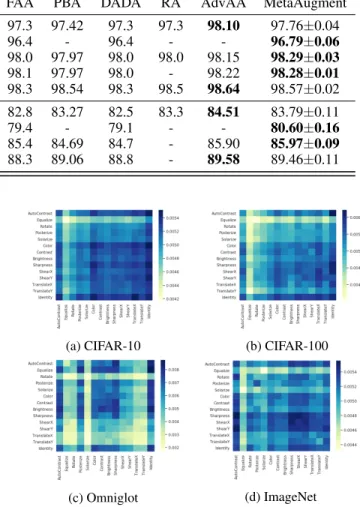
Figure 2: Estimated distributions of transformations on (a) CIFAR-10, (b) CIFAR-100, (c) Omniglot, and (d) ImageNet. Shake (Gastaldi 2017), and PyramidNet+ShakeDrop (Han, Kim, and Kim 2017; Yamada et al. 2018). The Baseline adopts the standard data augmentation: horizontal flipping with 50% probability, zero-padding and random cropping. For MetaAugment, the transformation is applied after hori-zontal flipping, and then Cutout (DeVries and Taylor 2017) with16×16pixels is applied.
The mean test accuracy and Standard Deviation (Std Dev) of MetaAugment, together with the results of other com-petitors, are reported in Table 1. On both of CIFAR-10 and CIFAR-100, our method outperforms AA, FAA, PBA, DADA, and RA on all of the models. Compared with AdvAA, MetaAugment shows slightly worse results on WRN-28-10 and PyramidNet+ShakeDrop, and better results on Shake-Shake. However, AdvAA trains a task network with a large batch consisting of samples augmented by 8 augmentation policies. The Multiple-Transformation-per-sample (MT) trick leads to better performance but8×more computing cost than the regular training. We also compare MetaAugment with Ad-vAA in the MT setting. Each training sample in a mini-batch is augmented by 4 transformations and all the augmented samples are used to train the task network. The results are
Table 3: Top-1 test accuracy (%) on Omniglot.
Model Baseline FAA PBA RA MetaAugment
WRN-28-10 87.89 89.24 89.25 87.86 89.61±0.05
WRN-40-2 85.86 88.72 88.30 88.10 89.12±0.10
illustrated in Table 2. It can be seen that MetaAugment out-performs AdvAA in this setting. Moreover, AdvAA assumes all transformations do not change the labels of data, which may not be valid in challenging cases. More details can be found in Figure 3. We visualize the estimated distributions of transformations in Figure 2. The difference in probability val-ues is greater on CIFAR-100 than that on CIFAR-10, which shows the effectiveness of different transformations varies more on CIFAR-100.
We train the policy network to assign proper weights to the augmented samples and use all of them to train the task network instead of rejecting the augmented samples with low weights. We also conduct experiment on the case that the policy network rejects the augmented samples with weights less than the mean of all the weights in a mini-batch. The results on CIFAR-100 with task networks WRN-28-10 and WRN-40-2 are 82.57% and 79.01% respectively, which are worse than the original case. It implies that samples with small weights are still useful. Ideally, the policy network can automatically assign very small weights to augmented samples that hurt the validation accuracy and we need no additional zeroing. Intuitively, rejecting augmented samples using a carefully selected threshold number may be helpful, but it is a bit far from the main idea of this paper.
Omniglot.To investigate the universality of our method, we conduct experiments on Omniglot which contains images of 1,623 characters instead of natural objects. For each charac-ter, we select 15, 2, and 3 images as training, validation, and test data. We compare MetaAugment with Baseline, FAA, PBA, and RA on WRN. The Baseline models are trained without data augmentation. For MetaAugment, transforma-tions are applied to training samples directly with no Cutout added. For FAA and PBA, we do experiments with their open-source codes. For RA, we use our own implementation that randomly samples transformations and adopts the same weight for augmented samples. Implementation details are provided in Appendix.
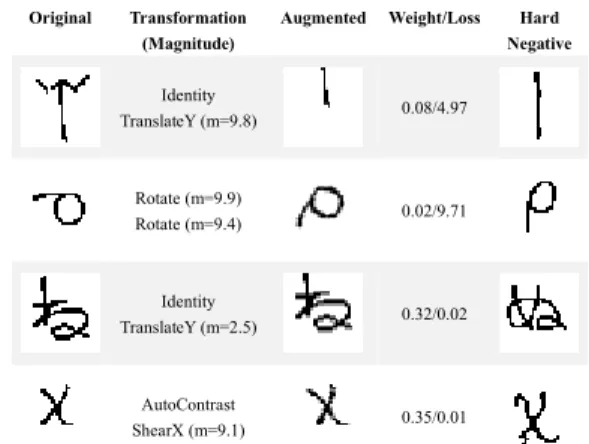
The results are reported in Table 3. It can be seen that MetaAugment outperforms the Baseline and RA by a wide margin and still achieves better results than FAA and PBA. We also visualize the estimated distribution in Figure 2. Dif-ferent from CIFAR, geometric transformations have low prob-ability values. This is because the geometric structure is the key feature of characters and should not be changed a lot as shown in Figure 3. In contrast, natural images in CIFAR contain rich texture and color information and less depend on geometric structure. The results indicate the robustness of our policy network when dealing with bad transformations. To compare with adversarial strategy in AdvAA, we visualize samples selected by adversarial strategy and our strategy, i.e., samples with high losses but low weights and those with low losses but high weights, in Figure 3. In the first two rows, we observe that geometric transformations with large
mag-Original Transformation (Magnitude)
Augmented Weight/Loss Hard Negative Identity TranslateY (m=9.8) 0.08/4.97 Rotate (m=9.9) Rotate (m=9.4) 0.02/9.71 Identity TranslateY (m=2.5) 0.32/0.02 AutoContrast ShearX (m=9.1) 0.35/0.01
Figure 3: Examples of augmented samples on Omniglot. Here, hard negative means a validation sample w.r.t. sim-ilar feature map but different label.
nitudes may not preserve the labels and make the characters look like samples of different classes (the hard negatives). In this case, AdvAA that prefers the transformations lead-ing to large sample losses may harm the performance. In the last two rows, we observe that our method prefers the transformations that preserve the labels and key features of the augmented samples. Our method is more robust when many bad augmentation transformations are introduced in the search space.
ImageNet.ImageNet consists of colored images in 1,000 classes, with about 1.2 million images for training. For each class, we hold out 2% of training images for validation. We compare MetaAugment with Baseline, AA, FAA, DADA, RA, and AdvAA on 50 (He et al. 2016a) and ResNet-200 (He et al. 2016b). The Baseline models are trained with the standard Inception-style pre-processing (Szegedy et al. 2015). For MetaAugment, the transformation is applied af-ter random cropping, resizing to224×224, and horizontal flipping with 50% probability.
The results are presented in Table 4. MetaAugment outperforms all the other automated data augmentation methods. The model ResNet-50 is trained with Multiple-Transformation-per-sample trick, i.e., each training sample in a mini-batch is augmented by 4 transformations. By assign-ing proper weights to the augmented samples, MetaAugment achieves superior performance. The estimated distribution of transformations is visualized in Figure 2. Transformations with Sharpness, ShearX, and ShearY have high probability values, while transformations with Equalize, Solarize, and Posterize have low probability values. To illustrate the neces-sity of sample-aware data augmentation, we display some augmented samples with high and low learned weights in Figure 4. Similar transformations may have very different effects on different images. The policy network imposes high weights on the augmented images with elephant and duck that increase the diversity of training data, and imposes low weights on the augmented images with cock and scorpion that lose semantic information caused by the translation. Even for transformations with Equalize, Solarize, and Posterize
Table 4: Top-1 / Top-5 test accuracy (%) on ImageNet.
Model Baseline AA FAA DADA RA AdvAA MetaAugment
ResNet-50 76.3 / 93.1 77.6 / 93.8 77.6 / 93.7 77.5 / 93.5 77.6 / 93.8 79.40 / 94.47 79.74±0.08 / 94.64±0.03
ResNet-200 78.5 / 94.2 80.0 / 95.0 80.6 / 95.3 - - 81.32 / 95.30 81.43±0.08 / 95.52±0.04
(a) Augmented samples with high weights
(b) Augmented samples with low weights
Figure 4: Examples of augmented samples with (a) high and (b) low weights on ImageNet.
that have low priority at the dataset level, the policy net-work is learned to assign high weights to informative images augmented by such transformations, as shown in Figure 4(a).
Ablation Studies
Transformation Sampler. In the transformation sampler module, the hyper-parameter in Eq. (5) determines the probability of random sampling transformations. To investi-gate the influence of, we conduct experiments on Omniglot with task network WRN-28-10. The mean test accuracy and Std Dev over five runs with different values ofare depicted in Figure 5. As expected, sampling transformations accord-ing to the estimated distribution with a certain randomness (= 0.1) outperforms random sampling (= 1.0).
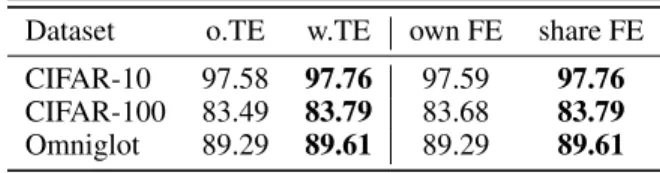
Augmentation Policy Network.To demonstration the con-tributions of all the components in the policy network, we compare different designs of the policy network. We conduct experiments on the cases that the policy network does not take the transformation embedding as input and the policy network has its own feature extractor. The comparison results of WRN-28-10 trained on CIFAR and Omniglot are shown in Table 5.
First, we observe that the policy network with Transfor-mation Embedding (w.TE) as input achieves0.3%higher accuracy than that without TE (o.TE) in average. That means TE contains additional information beyond the images. For example, both the augmented sample and the hard negative
0.0 0.1 0.3 0.5 0.7 0.9 1.0
²
89.2 89.3 89.4 89.5 89.6 89.7 89.8Test Accuracy (%)
Mean Accuracy with Std Dev
Figure 5: Test accuracy (averaged over five runs) of WRN-28-10 trained on Omniglot with different values of.
in the first row of Figure 3 look like vertical lines, but can be generated by different transformations (TranslateY and Identity, respectively) and have different labels. With TE as input, the policy network is learned to impose different weights on them. On the other hand, the dimension of TE (28 in our setting) is much lower than that of the image feature (640 in WRN-28-10), so the TE branch hardly increases the computing cost.
Secondly, we evaluate the performance of the policy net-work with its own feature extractor (own FE) and that shared a common one with the task network (share FE). The latter one performs consistently better than the former one. Also, the former one takes more training time (1.2×more real running-time) since the feature extraction is repeated twice for the policy network and the task network, respectively. Table 5: Top-1 test accuracy (%) of WRN-28-10 with differ-ent designs of the policy network.
Dataset o.TE w.TE own FE share FE
CIFAR-10 97.58 97.76 97.59 97.76 CIFAR-100 83.49 83.79 83.68 83.79 Omniglot 89.29 89.61 89.29 89.61
Conclusions
In this paper, a sample-aware augmentation policy network is proposed to reweight augmented samples. We leverage the mechanism of meta-learning and use gradient-based op-timization instead of non-differentiable approaches or rein-forcement learning, which can balance the learning efficiency and model performance. As expected, the learned policy net-work can distinguish informative augmented images from the junks and thus greatly reduce the noises caused by intensive data augmentation. Extensive experiments demonstrate the superiority of the proposed method to the existing methods using dataset-level augmentation policies.
References
Antoniou, A.; Edwards, H.; and Storkey, A. 2019. How to train your MAML. InInternational Conference on Learn-ing Representations. URL https://openreview.net/forum?id= HJGven05Y7.
Colson, B.; Marcotte, P.; and Savard, G. 2007. An overview of bilevel optimization.Annals of operations research153(1): 235–256.
Cubuk, E. D.; Zoph, B.; Mane, D.; Vasudevan, V.; and Le, Q. V. 2019a. AutoAugment: Learning augmentation strate-gies from data. InProceedings of the IEEE conference on computer vision and pattern recognition, 113–123.
Cubuk, E. D.; Zoph, B.; Shlens, J.; and Le, Q. V. 2019b. RandAugment: Practical data augmentation with no separate search.arXiv preprint arXiv:1909.13719.
Deng, J.; Dong, W.; Socher, R.; Li, L.-J.; Li, K.; and Fei-Fei, L. 2009. Imagenet: A large-scale hierarchical image database. In2009 IEEE conference on computer vision and pattern recognition, 248–255. Ieee.
DeVries, T.; and Taylor, G. W. 2017. Improved regularization of convolutional neural networks with cutout. arXiv preprint arXiv:1708.04552.
Finn, C.; Abbeel, P.; and Levine, S. 2017. Model-agnostic meta-learning for fast adaptation of deep networks. In Inter-national Conference on Machine Learning, 1126–1135. Freund, Y.; and Schapire, R. E. 1995. A desicion-theoretic generalization of on-line learning and an application to boost-ing. In European conference on computational learning theory, 23–37. Springer.
Gastaldi, X. 2017. Shake-shake regularization.arXiv preprint arXiv:1705.07485.
Han, D.; Kim, J.; and Kim, J. 2017. Deep pyramidal resid-ual networks. InProceedings of the IEEE conference on computer vision and pattern recognition, 5927–5935. He, K.; Zhang, X.; Ren, S.; and Sun, J. 2016a. Deep residual learning for image recognition. InProceedings of the IEEE conference on computer vision and pattern recognition, 770– 778.
He, K.; Zhang, X.; Ren, S.; and Sun, J. 2016b. Identity mappings in deep residual networks. InEuropean Conference on Computer Vision, 630–645. Springer.
Ho, D.; Liang, E.; Chen, X.; Stoica, I.; and Abbeel, P. 2019. Population Based Augmentation: Efficient Learning of Aug-mentation Policy Schedules. InInternational Conference on Machine Learning, 2731–2741.
Jiang, L.; Meng, D.; Mitamura, T.; and Hauptmann, A. G. 2014a. Easy samples first: Self-paced reranking for zero-example multimedia search. InProceedings of the 22nd ACM international conference on Multimedia, 547–556. Jiang, L.; Meng, D.; Yu, S.-I.; Lan, Z.; Shan, S.; and Haupt-mann, A. 2014b. Self-paced learning with diversity. In
Advances in Neural Information Processing Systems, 2078– 2086.
Johnson, J. M.; and Khoshgoftaar, T. M. 2019. Survey on deep learning with class imbalance.Journal of Big Data6(1): 27.
Krizhevsky, A.; and Hinton, G. 2009. Learning multiple lay-ers of features from tiny images. Technical report, Citeseer. Krizhevsky, A.; Sutskever, I.; and Hinton, G. E. 2012. Ima-genet classification with deep convolutional neural networks. InAdvances in Neural Information Processing Systems, 1097– 1105.
Kumar, M. P.; Packer, B.; and Koller, D. 2010. Self-paced learning for latent variable models. InAdvances in Neural Information Processing Systems, 1189–1197.
Lake, B. M.; Salakhutdinov, R.; Gross, J.; and Tenenbaum, J. B. 2011. One shot learning of simple visual concepts. In
CogSci.
Li, Y.; Hu, G.; Wang, Y.; Hospedales, T.; Robertson, N. M.; and Yang, Y. 2020. DADA: Differentiable Automatic Data Augmentation. InEuropean Conference on Computer Vision. Li, Z.; Zhou, F.; Chen, F.; and Li, H. 2017. Meta-SGD: Learn-ing to learn quickly for few-shot learnLearn-ing. arXiv preprint arXiv:1707.09835.
Lim, S.; Kim, I.; Kim, T.; Kim, C.; and Kim, S. 2019. Fast AutoAugment. InAdvances in Neural Information Process-ing Systems, 6662–6672.
Lin, T.-Y.; Goyal, P.; Girshick, R.; He, K.; and Doll´ar, P. 2017. Focal loss for dense object detection. InProceedings of the IEEE international conference on computer vision, 2980–2988.
Liu, H.; Simonyan, K.; and Yang, Y. 2019. DARTS: Differ-entiable Architecture Search. InInternational Conference on Learning Representations. URL https://openreview.net/ forum?id=S1eYHoC5FX.
Malisiewicz, T.; Gupta, A.; and Efros, A. A. 2011. Ensemble of exemplar-svms for object detection and beyond. In2011 International conference on computer vision, 89–96. IEEE. Ren, M.; Zeng, W.; Yang, B.; and Urtasun, R. 2018. Learn-ing to Reweight Examples for Robust Deep LearnLearn-ing. In
International Conference on Machine Learning, 4334–4343. Shu, J.; Xie, Q.; Yi, L.; Zhao, Q.; Zhou, S.; Xu, Z.; and Meng, D. 2019. Meta-Weight-Net: Learning an explicit mapping for sample weighting. InAdvances in Neural Information Processing Systems, 1917–1928.
Srivastava, R. K.; Greff, K.; and Schmidhuber, J. 2015. Train-ing very deep networks. InAdvances in Neural Information Processing Systems, 2377–2385.
Szegedy, C.; Liu, W.; Jia, Y.; Sermanet, P.; Reed, S.; Anguelov, D.; Erhan, D.; Vanhoucke, V.; and Rabinovich, A. 2015. Going deeper with convolutions. InProceedings of the IEEE conference on computer vision and pattern recogni-tion, 1–9.
Wang, X.; Pham, H.; Michel, P.; Anastasopoulos, A.; Neubig, G.; and Carbonell, J. 2019. Optimizing Data Usage via Differentiable Rewards.arXiv preprint arXiv:1911.10088.
Wu, L.; Tian, F.; Xia, Y.; Fan, Y.; Qin, T.; Jian-Huang, L.; and Liu, T.-Y. 2018. Learning to teach with dynamic loss functions. InAdvances in Neural Information Processing Systems, 6466–6477.
Yamada, Y.; Iwamura, M.; Akiba, T.; and Kise, K. 2018. Shakedrop regularization for deep residual learning. arXiv preprint arXiv:1802.02375.
Yun, S.; Han, D.; Oh, S. J.; Chun, S.; Choe, J.; and Yoo, Y. 2019. Cutmix: Regularization strategy to train strong classifiers with localizable features. InProceedings of the IEEE International Conference on Computer Vision, 6023– 6032.
Zagoruyko, S.; and Komodakis, N. 2016. Wide residual networks. arXiv preprint arXiv:1605.07146.
Zhang, H.; Cisse, M.; Dauphin, Y. N.; and Lopez-Paz, D. 2017. mixup: Beyond empirical risk minimization. arXiv preprint arXiv:1710.09412.
Zhang, X.; Wang, Q.; Zhang, J.; and Zhong, Z. 2020. Adver-sarial AutoAugment. InInternational Conference on Learn-ing Representations. URL https://openreview.net/forum?id= ByxdUySKvS.
Zhang, Z.; and Sabuncu, M. 2018. Generalized cross entropy loss for training deep neural networks with noisy labels. In
Advances in Neural Information Processing Systems, 8778– 8788.
MetaAugment: Sample-Aware Data Augmentation Policy Learning
Appendix
A
Transferability of MetaAugment
According to the updating rules, MetaAugment requires three forward and backward passes of the task network in each iteration, which makes it take3×training time than a standard training of a task network. However, once trained, the policy network
P(·,·;θ(T)), together with the task networkf(·;w(T))and the estimated distribution{pj,k}K
j,k=1can be transferred to train different networks with data augmentation on the same dataset. The transfer training of MetaAugment takes almost the same computing cost as the regular training and thus is3×less computing cost than MetaAugment with joint training. Specifically, letg(·;v)be a new task network with parametersv. For each iteration, a mini-batch of training data{(xi, yi)}n
tr
i=1is sampled. Also, a mini-batch of transformations{Tm1,m2
ji,ki } ntr
i=1is sampled according to{pj,k}Kj,k=1and the batch data are augmented by the transformations. Then the update ofvin iterationt+ 1is
v(t+1)=v(t)−γ 1 ntr ntr X i=1 Pi(w(T),θ(T))∇vLi(v) v(t), where Pi(w(T),θ(T)) = P(f(Tm1,m2 ji,ki (xi);w (T)), e(Tm1,m2 ji,ki );θ (T)) and Li(v) = `(g(Tm1,m2
ji,ki (xi);v), yi). Different
from (Cubuk et al. 2019a; Ho et al. 2019; Lim et al. 2019; Zhang et al. 2020), in which the transferred policies are com-binations of image processing functions with fixed magnitudes, MetaAugment can sample transformations with all possible magnitudes and evaluate the effectiveness of different transformations for different samples when training a new network.
Table 6: Top-1 test accuracy (%) of WRN-40-2 on CIFAR.
Dataset MetaAugment (joint) MetaAugment (transfer)
CIFAR-10 96.79±0.06 96.82±0.10
CIFAR-100 80.60±0.16 80.15±0.09
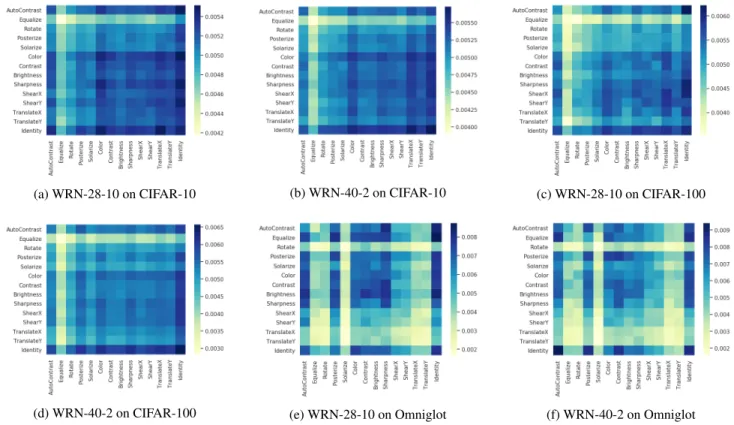
To demonstrate that the learned augmentation policies can be transferred across different task networks, we visualize the distributions of transformations learned with WRN-28-10 and WRN-40-2 on CIFAR-10, CIFAR-100, and Omniglot in Fig-ure 6. It can be seen that the learned policies are not sensitive to network architectures. We also compare the results of joint training with the results of transfer training using WRN-40-2 as
the task network in Table 6. For the transfer training setting, the transferred policy network is jointly trained with WRN-28-10. Compared with joint training, MetaAugment with transfer training shows similar result on CIFAR-10 and slightly worse result on CIFAR-100. Considering the efficiency of transfer training, we regard it as a good alternative to MetaAugment with joint training. In our experiments, Shake-Shake and PyramidNet+ShakeDrop in Table 1 are trained with the transferred policy network jointly learned with WRN-28-10 and ResNet-200 in Table 4 is trained with the transferred policy network jointly learned with ResNet-50. The results show the strong transferability of MetaAugment.
B
Implementation Details of MetaAugment
CIFAR-10.On CIFAR-10, WRN-28-10 and WRN-40-2 are jointly trained with the policy network. Both of them are trained for 600 epochs by SGD with a momentum 0.9, weight decay of5×10−4, batch size of 128, initial learning rate of 0.1, and cosine learning rate decay. The policy network is trained for the same number of iterations as the task network by SGD with a momentum 0.9, weight decay of5×10−4, batch size of 128, and a fixed learning rate1×10−3. The distribution of transformations is updated every one epoch with the outputs of the policy network in the last 50 epochs. The hyper-parameterthat determines the probability of random sampling transformations is set to 0.1. We adopt the transfer training of MetaAugment for Shake-Shake (26 2x96d), Shake-Shake (26 2x112d), and PyramidNet+ShakeDrop. Shake-Shake (26 2x96d) and Shake-Shake (26 2x112d) are trained for 1,800 epochs by SGD with a momentum 0.9, weight decay of1×10−3, batch size of 128, initial learning rate of 0.01, and cosine learning rate decay. PyramidNet+ShakeDrop is trained for 1,800 epochs by SGD with a momentum 0.9, weight decay of1×10−4, batch size of 128, initial learning rate of 0.1, and cosine learning rate decay.
CIFAR-100.On CIFAR-100, WRN-28-10 and WRN-40-2 are also jointly trained with the policy network. They are trained with the same hyper-parameters as those used on CIFAR-10 except that WRN-28-10 is trained for 200 epochs and the corresponding distribution of transformations is updated with the outputs of the policy network in the last 20 epochs. For the transfer training of MetaAugment, Shake-Shake (26 2x96d) is trained for 1,800 epochs by SGD with a momentum 0.9, weight decay of2.5×10−3, batch size of 128, initial learning rate of 0.01, and cosine learning rate decay. PyramidNet+ShakeDrop is trained for 1,800 epochs by SGD with a momentum 0.9, weight decay of5×10−4, batch size of 128, initial learning rate of 0.05, and cosine learning rate decay.
Omniglot.For MetaAugment, WRN-28-10 and WRN-40-2 are trained for 200 epochs and the distribution of transformations is updated with the outputs of the policy network in the last 20 epochs. Other hyper-parameters are the same as those used for WRN-28-10 and WRN-40-2 on CIFAR-10. For RA, we use the same implementation as MetaAugment except that we randomly
(a) WRN-28-10 on CIFAR-10 (b) WRN-40-2 on CIFAR-10 (c) WRN-28-10 on CIFAR-100
(d) WRN-40-2 on CIFAR-100 (e) WRN-28-10 on Omniglot (f) WRN-40-2 on Omniglot
Figure 6: Distributions of transformations learned with WRN-28-10 and WRN-40-2 on CIFAR-10, CIFAR-100, and Omniglot.
sample transformations and adopt the same weight for augmented samples. For FAA, we follow the setting that the augmentation policy is searched directly on the full dataset (without the test data) given the task network. We use the same image processing functions as MetaAugment and follow the hyper-parameter setting in FAA when searching for the policy. For PBA, we follow the setting that the augmentation schedules are searched on a reduced Omniglot of 3,246 training images, two images for each character. We also use the same image processing functions as MetaAugment and run 16 trials on WRN-40-2 to generate the augmentation schedules. When using the searched policies to finally train WRN-28-10 and WRN-40-2, we adopt the same hyper-parameters as those used by MetaAugment for FAA and PBA.
ImageNet.On ImageNet, ResNet-50 is jointly trained with the policy network. It is trained for 120 epochs by SGD with a momentum 0.9, weight decay of1×10−4, batch size of1024·4(each training sample in a mini-batch is augmented by 4 transformations), initial learning rate of 0.4, and cosine learning rate decay. We also use a gradual warmup strategy that increases the learning rate from 0.08 to 0.4 linearly in the first 5 epochs, label smoothing with magnitude 0.1, and gradient clipping with magnitude 5. Since ImageNet is a very challenging dataset, we first train ResNet-50 with random data augmentation for 40 epochs to get a pre-trained feature extractor and then train it with the policy network jointly for 40 epochs. Finally, we fix the policy network and train ResNet-50 as the transfer training of MetaAugment for 40 epochs. The policy network is trained by SGD with a momentum 0.9, weight decay of5×10−4, batch size of 2048, a fixed learning rate4×10−3, and gradient clipping with magnitude 5. The distribution of transformations is updated every one epoch with the outputs of the policy network in the last 20 epochs. The hyper-parameteris set to 0.1. For the transfer training of MetaAugment, ResNet-200 is trained with the same setting as that of ResNet-50 except that it is trained for 150 epochs with batch size of 512 and initial learning rate of 0.2.
C
Convergence Tendency of Loss Curve
To illustrate the convergence properties of our algorithm, we plot the weighted training and validation loss curves of WRN-28-10 and WRN-40-2 trained on CIFAR-10, CIFAR-100, and Omniglot in Figure 7. It can be seen that the validation loss curves converge in all cases, which is consistent with our theorem. In addition, the training loss curves of WRN-28-10 and WRN-40-2 trained on CIFAR-10 and CIFAR-100 also converge, while the training loss curves fluctuate on Omniglot. As stated in Theorem 2, the convergence of the training loss is not ensured since the policy network depends on the feature extractor of the task network. These empirical results further confirm the theoretical results.
0 100 200 300 400 500 600
Epoch Number
0.25 0.50 0.75 1.00 1.25 1.50 1.75Loss
Weighted Training Loss
Validation Loss
(a) WRN-28-10 on CIFAR-10 0 100 200 300 400 500 600Epoch Number
0.25 0.50 0.75 1.00 1.25 1.50 1.75Loss
Weighted Training Loss
Validation Loss
(b) WRN-40-2 on CIFAR-10 0 25 50 75 100 125 150 175 200Epoch Number
0.5 1.0 1.5 2.0 2.5 3.0 3.5 4.0 4.5Loss
Weighted Training Loss
Validation Loss
(c) WRN-28-10 on CIFAR-100 0 100 200 300 400 500 600Epoch Number
0.5 1.0 1.5 2.0 2.5 3.0 3.5 4.0 4.5Loss
Weighted Training Loss
Validation Loss
(d) WRN-40-2 on CIFAR-100 0 25 50 75 100 125 150 175 200Epoch Number
1 2 3 4 5 6 7Loss
Weighted Training Loss
Validation Loss
(e) WRN-28-10 on Omniglot 0 25 50 75 100 125 150 175 200Epoch Number
1 2 3 4 5 6 7Loss
Weighted Training Loss
Validation Loss
(f) WRN-40-2 on Omniglot
Figure 7: Weighted training and validation loss curves of WRN-28-10 and WRN-40-2 trained on CIFAR-10, CIFAR-100, and Omniglot.
D
More Examples of Augmented Samples
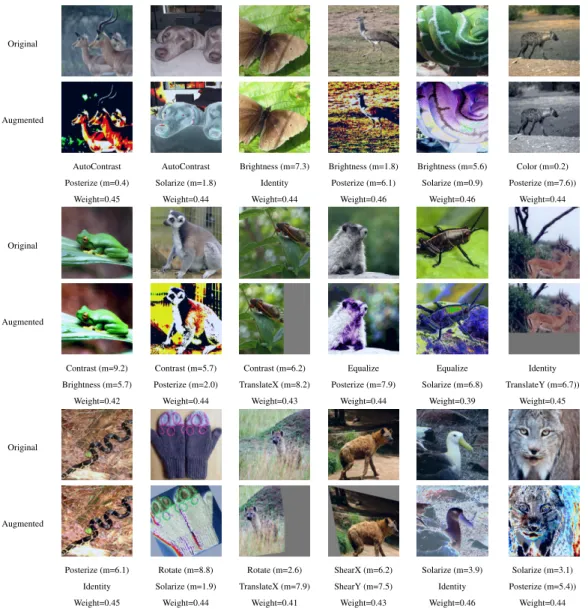
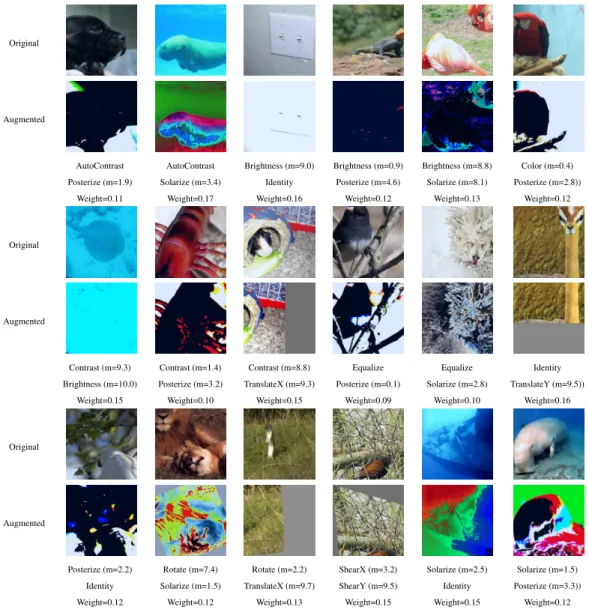
We display more augmented samples with high and low learned weights in Figure 8 and in Figure 9, respectively. These images further illustrate the necessity and effectiveness of the learned policy network.
E
Analysis on MetaAugment
In this section, we reformulate the problem of sample-aware data augmentation into a general form and investigate the theoretical properties of the general MetaAugment algorithm.
E.1
Problem
Consider an image recognition task with the training setDtr={(xi, yi)}Ntr
i=1, wherexidenotes thei-th image,yi ∈ {0,1} cis
the label vector overcclasses, andNtris the sample size. Letopj(x;ξk),1≤j≤M,be an augmentation operator applied on
an imagex, whereξk∼Qjis the tuning parameter of the operatoropjandQjis a distribution ofξk.Hereopj(x;ξk)represents
the transformationTm1,m2
j,k (x)in Section Methodology. Letf(·;w)be the task network with parameterswandP(·,·;θ)be
the policy network with parametersθ. Let`(f(x;w), y)denote the loss function. The task network is trained to getw∗by minimizing the following weighted training loss:
Ltr(w,θ) = 1 Ntr Ntr X i=1 1 M M X j=1 Eξk∼Qj h Pijk(θ)Lijk(w) i , where
Pijk(θ) =P h(opj(xi;ξk)), e(opj(·;ξk));θ and
Lijk(w) =` f(opj(xi;ξk);w), yi
.
Herehis the feature extractor of the policy network ande(opj(·;ξk))is the embedding of the augmentation operatoropj(·;ξk). In Section E.6, we will further investigate the convergence of our algorithm whenh(opj(xi;ξk)) =f(opj(xi;ξk);w), i.e.,
Original
Augmented
AutoContrast AutoContrast Brightness (m=7.3) Brightness (m=1.8) Brightness (m=5.6) Color (m=0.2) Posterize (m=0.4) Solarize (m=1.8) Identity Posterize (m=6.1) Solarize (m=0.9) Posterize (m=7.6))
Weight=0.45 Weight=0.44 Weight=0.44 Weight=0.46 Weight=0.46 Weight=0.44
Original
Augmented
Contrast (m=9.2) Contrast (m=5.7) Contrast (m=6.2) Equalize Equalize Identity
Brightness (m=5.7) Posterize (m=2.0) TranslateX (m=8.2) Posterize (m=7.9) Solarize (m=6.8) TranslateY (m=6.7))
Weight=0.42 Weight=0.44 Weight=0.43 Weight=0.44 Weight=0.39 Weight=0.45
Original
Augmented
Posterize (m=6.1) Rotate (m=8.8) Rotate (m=2.6) ShearX (m=6.2) Solarize (m=3.9) Solarize (m=3.1) Identity Solarize (m=1.9) TranslateX (m=7.9) ShearY (m=7.5) Identity Posterize (m=5.4))
Weight=0.45 Weight=0.44 Weight=0.41 Weight=0.43 Weight=0.46 Weight=0.44
Figure 8: Examples of augmented samples with high weights.
arg minwLtr(w,θ).Assume that we have a validation setDval={(xvali0 , yvali0 )}N
val
i0=1, whereNvalis the sample size of the validation data. The objective of the policy network is to minimize the following validation loss:
Lval(w∗(θ)) = 1 Nval Nval X i0=1 Lvali0 (w∗(θ)), whereLval i0 (w∗(θ)) =`(f(xvali0 ;w∗(θ)), yival0 ).
E.2
MetaAugment Algorithm
The policy network and the task network are trained alternately. For each iteration, a mini-batch of training samplesDtr mi= {(xi, yi)}n
tr
i=1with batch sizentrand a mini-batch of augmentation operators{opj(·;ξk)|1≤j≤mop, 1≤k≤mξ}with
batch sizemop·mξare sampled. Then the inner loop update ofwin iterationt+ 1is
ˆ w(t)(θ) =w(t)−α 1 ntr ntr X i=1 1 mop mop X j=1 1 mξ mξ X k=1 Pijk(θ)∇wLijk(w(t)), (9)
whereαis the learning rate and∇wLijk(w(t)) = ∇wLijk(w)
w(t).The formulation wˆ
(t)(θ)is regarded as a function of θ, and thenθ can be updated via the validation loss computed bywˆ(t)(θ)on a mini-batch of validation samples Dval
Original
Augmented
AutoContrast AutoContrast Brightness (m=9.0) Brightness (m=0.9) Brightness (m=8.8) Color (m=0.4) Posterize (m=1.9) Solarize (m=3.4) Identity Posterize (m=4.6) Solarize (m=8.1) Posterize (m=2.8))
Weight=0.11 Weight=0.17 Weight=0.16 Weight=0.12 Weight=0.13 Weight=0.12
Original
Augmented
Contrast (m=9.3) Contrast (m=1.4) Contrast (m=8.8) Equalize Equalize Identity
Brightness (m=10.0) Posterize (m=3.2) TranslateX (m=9.3) Posterize (m=0.1) Solarize (m=2.8) TranslateY (m=9.5))
Weight=0.15 Weight=0.10 Weight=0.15 Weight=0.09 Weight=0.10 Weight=0.16
Original
Augmented
Posterize (m=2.2) Rotate (m=7.4) Rotate (m=2.2) ShearX (m=3.2) Solarize (m=2.5) Solarize (m=1.5) Identity Solarize (m=1.5) TranslateX (m=9.7) ShearY (m=9.5) Identity Posterize (m=3.3))
Weight=0.12 Weight=0.12 Weight=0.13 Weight=0.15 Weight=0.15 Weight=0.12
Figure 9: Examples of augmented samples with low weights.
{(xval
i0 , yival0 )}n
val
i0=1with batch sizenval. The outer loop update ofθis formulated by
θ(t+1)=θ(t)−β 1 nval nval X i0=1 ∇θLvali0 ( ˆw(t)(θ(t))), (10)
whereβis the learning rate and∇θLvali0 ( ˆw(t)(θ(t))) =∇θLvali0 ( ˆw(t)(θ))
θ(t).The third step in iterationt+ 1is the outer loop update ofw(t)with the updatedθ(t+1):
w(t+1)=w(t)−γ 1 ntr ntr X i=1 1 mop mop X j=1 1 mξ mξ X k=1 Pijk(θ(t+1))∇wLijk(w(t)), (11)
E.3
Analysis on Augmentation Policy Network
According to the chain rule, the update ofθin Eq. (10) can be rewritten as:
θ(t+1) = θ(t)+αβ 1 ntr ntr X i=1 1 mop mop X j=1 (12) × 1 mξ mξ X k=1 1 nval nval X i0=1 Rii0(opj, ξk) ∇θPijk(θ(t)), whereRii0(opj, ξk) =∇wLijk(w(t))T∇wˆLvali0 ( ˆw(t))and∇θPijk(θ(t)) = ∇θPijk(θ)
θ(t).Notice that the update vector of
θ(t)is a weighted sum of the gradient ofP
ijk(θ(t))with respect toθ(t).What’s more, the update direction is the gradient ascend
direction of the weighted sum ofPijk(θ(t)).The weight of∇θPijk(θ(t))is formulated by 1 nval nval X i0=1 Rii0(opj, ξk) = 1 nval nval X i0=1 ∇wLijk(w(t))T∇wˆLvali0 ( ˆw(t)) = D∇wLijk(w(t)), 1 nval nval X i0=1 ∇wˆLvali0 ( ˆw(t)) E .
The inner product measures the similarity between the gradient of an augmented sample loss and the average gradient of the losses computed on a mini-batch of validation data. If the gradient of an augmented sample loss is similar to that of the validation loss, this augmented sample is likely to improve the performance of the task network on the validation data and its weight will be increased after the update of the policy network.
E.4
Useful Lemma
Lemma 1.Suppose that:
(A1) The loss function`haveρ1-bounded gradients with respect towunder both (augmented) training data and validation data, and the loss function`is Lipschitz smooth with constantρ2;
(A2) The policy networkPis differential with aδ1-bounded gradient and twice differential with its Hessian bounded byδ2with respect toθ.
Then the validation loss hasρ01-bounded gradients with respect toθand is Lipschitz continuous withρ02, whereρ01=αρ2 1δ1 andρ02=αρ2
1(αδ21ρ2+δ2).
Proof. The gradient of the validation lossLval
i0 ( ˆw(t)(θ(t)))with respectθcan be written as:
∇θLvali0 ( ˆw(t)(θ(t))) = −α 1 ntr ntr X i=1 1 mop mop X j=1 1 mξ mξ X k=1
∇θPijk(θ(t))∇wLijk(w(t))T∇wˆLvali0 ( ˆw(t))
= −α 1 ntr ntr X i=1 1 mop mop X j=1 1 mξ mξ X k=1 ∇θPijk(θ(t))Rii0(opj, ξk). By the assumptions(A1)and(A2),
∇θLvali0 ( ˆw(t)(θ(t))) ≤ α 1 ntr ntr X i=1 1 mop mop X j=1 1 mξ mξ X k=1 ∇θPijk(θ(t)) ∇wLijk(w(t)) ∇wˆLvali0 ( ˆw(t)) ≤ αρ21δ1=ρ01.
Further the Hessian of the validation lossLvali0 ( ˆw(t)(θ(t)))with respectθis
∇2 θL val i0 ( ˆw(t)(θ(t))) =−α 1 ntr ntr X i=1 1 mop mop X j=1 1 mξ mξ X k=1 (I1,i0ijk+I2,i0ijk),
where
I1,i0ijk = ∇θPijk(θ(t))∇θRii0(opj, ξk)T,
I2,i0ijk = ∇2θPijk(θ(t))Rii0(opj, ξk). According to the assumption(A2),
kI1,i0ijkk ≤ k∇θPijk(θ(t))kk∇θRii0(opj, ξk)k
≤ δ1k∇θRii0(opj, ξk)k. Furthermore, k∇θRii0(opj, ξk)k = ∇wˆ ∇θLvali0 wˆ(t)(θ(t)) wˆ(t)∇wLijk(w (t) ) = ∇wˆ −α 1 ntr ntr X i=1 1 mop mop X j=1 1 mξ mξ X k=1 ∇θPijk(θ(t))∇wLijk(w(t))T ×∇wˆLvali0 ( ˆw) wˆ(t)∇wLijk(w (t)) = −α 1 ntr ntr X i=1 1 mop mop X j=1 1 mξ mξ X k=1 ∇θPijk(θ(t))∇wLijk(w(t))T ×∇2 ˆ wL val i0 ( ˆw(t))∇wLijk(w(t)) , where∇2 ˆ wL val i0 ( ˆw(t)) =∇w2ˆLvali0 ( ˆw)
wˆ(t).By the assumptions(A1)and(A2),
kI1,i0ijkk ≤ δ1k∇θRii0(opj, ξk)k ≤αδ12ρ21ρ2. For the second termI2,i0ijk, we have
kI2,i0ijkk = k∇2θPijk(θ(t))k|Rii0(opj, ξk)|
≤ δ2k∇wLijk(w(t))kk∇wˆLvali0 ( ˆw(t))k ≤δ2ρ21,
where the first inequality holds by the assumption(A2)and the second inequality holds by the assumption(A1). Combining the upper bound ofkI1,i0ijkkandkI2,i0ijkk, we have
k∇2θL val i0 ( ˆw(t)(θ(t)))k ≤ α ntr ntr X i=1 1 mop mop X j=1 1 mξ mξ X k=1 kI1,i0ijkk+kI2,i0ijkk ≤ αρ21(αδ12ρ2+δ2). By Lagrange mean value theorem,
k∇θLval( ˆw(t)(θ1))− ∇θLval( ˆw(t)(θ2))k ≤ρ02kθ1−θ2k for allθ1andθ2.
E.5
Proof of Theorem 1
Theorem 1. Suppose the following assumptions hold:
(A1) The loss function`haveρ1-bounded gradients with respect towunder both (augmented) training data and validation data, and the loss function`is Lipschitz smooth with constantρ2;
(A2) The policy networkPis differential with aδ1-bounded gradient and twice differential with its Hessian bounded byδ2with respect toθ;
(A3) The absolute values of the policy networkP and the loss function`are bounded above byC1andC2, respectively; (A4) For any iteration0≤t≤T−1, the variance of the weighted training loss (validation loss) gradient on a mini-batch of training (validation) samples is bounded above;
(A5) Let α=clogT T , β= r c0log logT T , γ= c00logT T ,
for some positive constantsc,c0andc00;
(A6) The number of iterationsTis sufficiently large such thatαβρ2
1(αδ12ρ2+δ2)<1andγC1ρ2<1. If the policy network has its own feature extractor, we have
1 T T−1 X t=0 E h ∇θLval( ˆw(t)(θ(t))) 2i ≤O(√ logT Tlog logT), lim T→∞ 1 T T−1 X t=0 E h k∇wLtr(w(t),θ(t+1))k2 i = 0.
Proof. We start withLval( ˆw(t+1)(θ(t+1)))− Lval( ˆw(t)(θ(t))).Decompose it intoI
1+I2, where I1 = Lval( ˆw(t+1)(θ(t+1)))− Lval( ˆw(t)(θ(t+1))), I2 = Lval( ˆw(t)(θ(t+1)))− Lval( ˆw(t)(θ(t))). By the assumption(A1), I1 ≤ ∇wˆLval( ˆw(t)(θ(t+1))) wˆ(t+1)(θ(t+1))−wˆ(t)(θ(t+1)) +ρ2 2 wˆ(t+1)(θ(t+1))−wˆ(t)(θ(t+1)) 2 .
To proceed further, denote
∇wLtrt (w,θ)) = 1 ntr ntr X i=1 1 mop mop X j=1 1 mξ mξ X k=1 Pijk(θ)∇wLijk(w),
where the batches of training samples and augmentation operators are sampled at timet.Note that
ˆ w(t+1)(θ(t+1))−wˆ(t)(θ(t+1)) = (w(t+1)−α∇wLtrt+1(w (t+1),θ(t+1)))−(w(t)−α∇ wLtrt (w (t),θ(t+1))) = (w(t+1)−w(t))−α∇wLtrt+1(w (t+1),θ(t+1)) +α∇ wLtrt (w (t),θ(t+1)) = (α−γ)∇wLtrt (w (t),θ(t+1))−α∇ wLtrt+1(w (t+1),θ(t+1)). Thus, by the assumptions(A1)and(A3),
kwˆ(t+1)(θ(t+1))−wˆ(t)(θ(t+1))k ≤ |γ−α|k∇wLtrt (w (t) ,θ(t+1))k+αk∇wLtrt+1(w (t+1) ,θ(t+1))k ≤ |γ−α|ρ1C1+αρ1C1≤2 max{γ, α}ρ1C1.
According to the assumption(A5), we rewrite2 max{γ, α}ρ1C1asγρ1C˜1.Then the upper bound of|I1|can be written as |I1| ≤γρ21C˜1+ 1 2γ 2ρ2 1ρ2C˜12=γρ 2 1C˜1(1 + 1 2γρ2 ˜ C1). Next we deal withI2.ByLemma 1, we have
I2≤ ∇θLval( ˆw(t)(θ(t)))T(θ(t+1)−θ(t)) + ρ02 2 kθ (t+1)−θ(t)k2. Note that θ(t+1)−θ(t)=−β 1 nval nval X i0=1 ∇θLvali0 ( ˆw(t)(θ(t))), where{(xval i0 , yvali0 )}n val
i0=1is a mini-batch randomly sampled from all validation data. To proceed further, we denote
∇θLvalt ( ˆw (t)(θ(t))) = 1 nval nval X i0=1 ∇θLvali0 ( ˆw(t)(θ(t)))
andε(t)=∇θLvalt ( ˆw(t)(θ(t)))− ∇θLval( ˆw(t)(θ(t))).By the assumption(A4),E[kε(t)k2]≤σ21for some positive scalarσ1. Rewrite the update vector ofθas∇θLval( ˆw(t)(θ(t))) +ε(t), and plug it into the upper bound ofI2. Then
I2 ≤ −β∇θLval( ˆw(t)(θ(t)))T ∇θLval( ˆw(t)(θ(t))) +ε(t) +ρ 0 2β 2 2 ∇θLval( ˆw(t)(θ(t))) +ε(t) 2 = −(β−ρ 0 2β2 2 ) ∇θLval( ˆw(t)(θ(t))) 2 +ρ 0 2β2 2 kε (t)k2 −(β−ρ02β2)∇θLval( ˆw(t)(θ(t)))Tε(t).
Combining the upper bound ofI1andI2, we have
Lval( ˆw(t+1)(θ(t+1)))− Lval( ˆw(t)(θ(t))) ≤ γρ21C˜1(1 + 1 2γρ2 ˜ C1)−(β− ρ02β2 2 ) ∇θLval( ˆw(t)(θ(t))) 2 +ρ 0 2β2 2 kε (t)k2−(β−ρ0 2β 2)∇ θLval( ˆw(t)(θ(t)))Tε(t). Rearranging the terms, we can obtain that
(β−ρ 0 2β2 2 ) ∇θLval( ˆw(t)(θ(t))) 2 ≤ γρ21C˜1(1 + 1 2γρ2 ˜ C1) +Lval( ˆw(t)(θ(t)))− Lval( ˆw(t+1)(θ(t+1))) +ρ 0 2β2 2 kε (t)k2−(β−ρ0 2β 2)∇ θLval( ˆw(t)(θ(t)))Tε(t).
By taking the mean oftfrom0toT−1and taking the expectation with respect to the mini-batch of samples,
1 T T−1 X t=0 (β−ρ 0 2β2 2 )E h ∇θLval( ˆw(t)(θ(t))) 2i ≤ γρ21C˜1(1 + 1 2γρ2 ˜ C1) + 1 TE h Lval( ˆw(0)(θ(0)))− Lval( ˆw(T)(θ(T)))i +1 T T−1 X t=0 ρ02β2 2 E h kε(t)k2i ≤ γρ21C˜1(1 + 1 2γρ2 ˜ C1) + 1 T∆ val L + ρ02σ2 1 2 β 2,
where∆valL = supwLval(w)−infwLval(w).Furthermore, we have
1 T T−1 X t=0 E h ∇θLval( ˆw(t)(θ(t))) 2i ≤ γρ 2 1C˜1(2 +γρ2C˜1) + 2∆valL /T+αβ2ρ21σ21(αδ12ρ2+δ2) 2β−ρ02β2 .
Note that(β−ρ02β2)>0.Thus, 1 T T−1 X t=0 E h ∇θLval( ˆw(t)(θ(t))) 2i ≤ γρ 2 1C˜1(2 +γρ2C˜1) β + 2∆val L T β + 1 2αβρ 2 1σ12(αδ21ρ2+δ2) = O(√ logT Tlog logT) +O( 1 √ Tlog logT) +O( r
(logT)2log logT T3 ).
Hence, 1 T T−1 X t=0 E h ∇θLval( ˆw(t)(θ(t))) 2i ≤O(√ logT Tlog logT).
Next we prove the convergence of the training loss. We start with the decomposition that
Ltr(w(t+1),θ(t+2))− Ltr(w(t),θ(t+1)) =I 3+I4, where
I3 = Ltr(w(t+1),θ(t+2))− Ltr(w(t+1),θ(t+1)), I4 = Ltr(w(t+1),θ(t+1))− Ltr(w(t),θ(t+1)). For the termI3, we have
I3= 1 Ntr Ntr X i=1 1 M M X j=1 Ej n
Pijk(θ(t+2))−Pijk(θ(t+1))Lijk(w(t+1))o,
whereEjstands forEξk∼Qj.According to the assumption(A2), Pijk(θ(t+2))−Pijk(θ(t+1)) ≤ ∇θPijk(θ(t+1))T(θ(t+2)−θ(t+1)) + δ2 2kθ (t+2)−θ(t+1)k2. Notice that θ(t+2)−θ(t+1) = −β∇θLvalt+1( ˆw (t+1)(θ(t+1))) = −β ∇θLval( ˆw(t+1)(θ(t+1))) +ε(t+1) . Thus we have Pijk(θ(t+2))−Pijk(θ(t+1)) ≤ −β∇θPijk(θ(t+1))T ∇θLval( ˆw(t+1)(θ(t+1))) +ε(t+1) +δ2β 2 2 ∇θLval( ˆw(t+1)(θ(t+1))) +ε(t+1) 2
≤ −β∇θPijk(θ(t+1))T∇θLval( ˆw(t+1)(θ(t+1)))−β∇θPijk(θ(t+1))Tε(t+1) +δ2β 2 2 ∇θLval( ˆw(t+1)(θ(t+1))) 2 +δ2β 2 2 kε (t+1)k2 +δ2β2∇θLval( ˆw(t+1)(θ(t+1)))Tε(t+1).
Then the upper bound ofI3can be written as I3 ≤ −β 1 Ntr Ntr X i=1 1 M M X j=1 Ej n ∇θPijk(θ(t+1))T∇θLval( ˆw(t+1)(θ(t+1))) ×Lijk(w(t+1))o −β 1 Ntr Ntr X i=1 1 M M X j=1 Ej n ∇θPijk(θ(t+1))Tε(t+1)Lijk(w(t+1)) o +nδ2β 2 2 ∇θLval( ˆw(t+1)(θ(t+1))) 2 +δ2β 2 2 kε (t+1)k2 +δ2β2∇θLval( ˆw(t+1)(θ(t+1)))Tε(t+1) o Ltr0(w (t+1) ) = −β∇θLtr(w(t+1),θ(t+1))T∇θLval( ˆw(t+1)(θ(t+1))) −β∇θLtr(w(t+1),θ(t+1))Tε(t+1) +nδ2β 2 2 ∇θLval( ˆw(t+1)(θ(t+1))) 2 +δ2β 2 2 kε (t+1)k2 +δ2β2∇θLval( ˆw(t+1)(θ(t+1)))Tε(t+1) o Ltr0(w (t+1)),
where Ltr 0(w (t+1)) = 1 Ntr Ntr X i=1 1 M M X j=1 Ej Lijk(w(t+1)).
Next we considerI4.According to the assumptions(A1)and(A3), I4≤ ∇wLtr(w(t),θ(t+1))T(w(t+1)−w(t)) +
C1ρ2 2 kw
(t+1)−w(t)k2. To proceed further, we denoteη(t)=∇
wLtrt (w(t),θ(t+1))− ∇wLtr(w(t),θ(t+1)).By the assumption(A4),E[kη(t)k2]≤σ22 for some positive scalarσ2.Note that
w(t+1)−w(t) = −γ∇wLtrt (w(t),θ(t+1)) = −γ ∇wLtr(w(t),θ(t+1)) +η(t)
.
Then the upper bound ofI4can be written as
I4 ≤ −(γ− γ2C 1ρ2 2 )k∇wL tr(w(t),θ(t+1))k2 −(γ−γ2C1ρ2)∇wLtr(w(t),θ(t+1))Tη(t)+ γ2C1ρ2 2 kη (t)k2. Combining the results ofI3andI4, we can obtain that
(γ−γ 2C 1ρ2 2 )k∇wL tr(w(t),θ(t+1))k2 ≤ Ltr(w(t),θ(t+1))− Ltr(w(t+1),θ(t+2)) −β∇θLtr(w(t+1),θ(t+1))T∇θLval( ˆw(t+1)(θ(t+1))) −β∇θLtr(w(t+1),θ(t+1))Tε(t+1) +nδ2β 2 2 ∇θLval( ˆw(t+1)(θ(t+1))) 2 +δ2β 2 2 kε (t+1)k2 +δ2β2∇θLval( ˆw(t+1)(θ(t+1)))Tε(t+1) o Ltr 0(w (t+1)) −(γ−γ2C1ρ2)∇wLtr(w(t),θ(t+1))Tη(t)+ γ2C 1ρ2 2 kη (t)k2.
By taking the mean oftfrom0toT−1and taking the expectation with respect to the mini-batch of samples, we have
1 T T−1 X t=0 (γ−γ 2C 1ρ2 2 )E k∇wLtr(w(t),θ(t+1))k2 ≤ 1 TE Ltr(w(0),θ(1))− Ltr(w(T),θ(T+1)) +1 T T−1 X t=0 βEk∇θLtr(w(t+1),θ(t+1))kk∇θLval( ˆw(t+1)(θ(t+1)))k +1 T T−1 X t=0 δ2β2 2 E k∇θLval( ˆw(t+1)(θ(t+1)))k2Ltr0 (w (t+1)) +1 T T−1 X t=0 δ2β2 2 E kε(t+1)k2Ltr 0(w (t+1)) + 1 T T−1 X t=0 γ2C 1ρ2 2 E kη(t)k2 ≤ 1 T∆ tr L +βδ1C2ρ01+ 1 2δ2β 2ρ0 1C2+ 1 2δ2β 2σ2 1C2+ 1 2γ 2C 1ρ2σ22,
where∆trL = sup(w,θ)Ltr(w,θ)−inf(w,θ)Ltr(w,θ).Sinceγ−γ2C1ρ2>0, 1 T T−1 X t=0 Ek∇wLtr(w(t),θ(t+1))k2 ≤ 2∆ tr L/T + 2βδ1C2ρ01+δ2β2ρ01C2+δ2β2σ12C2+γ2C1ρ2σ22 2γ−γ2C 1ρ2 ≤ 2∆ tr L T γ + 2βδ1C2ρ01 γ + δ2β2ρ01C2 γ + δ2β2σ21C2 γ +γC1ρ2σ 2 2 = O( 1 T γ) +O( αβ γ ) +O( αβ2 γ ) +O( β2 γ ) +O(γ) = O(β 2 γ ) =O( log logT logT ). Hence, lim T→∞ 1 T T−1 X t=0 Ek∇wLtr(w(t),θ(t+1))k2 = 0.
E.6
Proof of Theorem 2
Theorem 2. Suppose the following assumptions hold:
(A1) The loss function`haveρ1-bounded gradients with respect towunder both (augmented) training data and validation data, and the loss function`is Lipschitz smooth with constantρ2;
(A2) The policy networkPis differential with aδ1-bounded gradient and twice differential with its Hessian bounded byδ2with respect toθ;
(A2’) Further assume that the policy networkP depends onwand is differential with aδ˜1-bounded gradient with respect tow; (A3) The absolute values of the policy networkP and the loss function`are bounded above byC1andC2, respectively; (A4) For any iteration0≤t≤T−1, the variance of the weighted training loss (validation loss) gradient on a mini-batch of training (validation) samples is bounded above;
(A5) Let α=clogT T , β= r c0log logT T , γ= c00logT T , for some positive constantsc,c0andc00;
(A6) The number of iterationsTis sufficiently large such thatαβρ21(αδ12ρ2+δ2)<1andγC1ρ2<1. Then we have 1 T T−1 X t=0 E h ∇θLval( ˆw(t)(θ(t))) 2i ≤O(√ logT Tlog logT), 1 T T−1 X t=0 E h k∇wLtr(w(t),θ(t+1))k2 i −2ρ1˜δ1C1C2≤o(1). Proof. we denote
Pijk(w,θ) =P f(opj(xi;ξk);w), e(opj(·;ξk));θ
,
wheref(·;w)is the feature extractor of the task network ande(opj(·;ξk))is the embedding of the augmentation operator
opj(·;ξk). To proceed further, we let
Ltr(w,(w0,θ)) = 1 Ntr Ntr X i=1 1 M M X j=1 Ej h Pijk(w0,θ)Lijk(w)i, Ltr t (w,(w 0,θ)) = 1 ntr ntr X i=1 1 mop mop X j=1 1 mξ mξ X k=1 Pijk(w0,θ)Lijk(w).
For the case thatP depends onw, the arguments aboutI1,I2, andI3are similar to those of Theorem 1. We decompose the term I4intoI41+I42, where
I41 = Ltr(w(t+1),(w(t+1),θ(t+1)))− Ltr(w(t+1),(w(t),θ(t+1))), I42 = Ltr(w(t+1),(w(t),θ(t+1)))− Ltr(w(t),(w(t),θ(t+1))).
The argument aboutI42is similar to that ofI4in Theorem 1. We only deal with the termI41, which represents the discontinuous change of the training loss between two iterations. Plugging the expression ofLtr(w,(w0,θ))intoI
41, we have I41= 1 Ntr Ntr X i=1 1 M M X j=1 Ej h
(Pijk(w(t+1),θ(t+1))−Pijk(w(t),θ(t+1)))Lijk(w(t+1))
i
.
To proceed further, we denote
∇wLtr(w(t),(w(t),θ(t+1))) = ∇wLtr(w,(w(t),θ(t+1))) w=w(t), ∇w0Ltr(w(t),(w(t),θ(t+1))) = ∇wLtr(w(t),(w,θ(t+1))) w=w(t). By the mean value theorem, there existsw(t)∗=w(t)+c(w(t+1)−w(t))with0<