Open Access Articles
Open Access Publications by UMMS Authors
2019-11-21
Statistical analysis of variability in TnSeq data across conditions
Statistical analysis of variability in TnSeq data across conditions
using zero-inflated negative binomial regression
using zero-inflated negative binomial regression
Siddharth Subramaniyam
Texas A&M Univeristy Et al.
Let us know how access to this document benefits you.
Follow this and additional works at: https://escholarship.umassmed.edu/oapubs
Part of the Bacterial Infections and Mycoses Commons, Bioinformatics Commons, Computational
Biology Commons, and the Microbiology Commons
Repository Citation
Repository Citation
Subramaniyam S, DeJesus MA, Zaveri A, Smith CM, Baker RE, Ehrt S, Schnappinger D, Sassetti CM, Ioerger TR. (2019). Statistical analysis of variability in TnSeq data across conditions using zero-inflated negative
binomial regression. Open Access Articles. https://doi.org/10.1186/s12859-019-3156-z. Retrieved from
https://escholarship.umassmed.edu/oapubs/4042 Creative Commons License
This work is licensed under a Creative Commons Attribution 4.0 License.
This material is brought to you by eScholarship@UMMS. It has been accepted for inclusion in Open Access Articles by an authorized administrator of eScholarship@UMMS. For more information, please contact
M E T H O D O L O G Y A R T I C L E
Open Access
Statistical analysis of variability in TnSeq
data across conditions using zero-inflated
negative binomial regression
Siddharth Subramaniyam
1, Michael A. DeJesus
2, Anisha Zaveri
3, Clare M. Smith
4, Richard E. Baker
4,
Sabine Ehrt
3, Dirk Schnappinger
3, Christopher M. Sassetti
4and Thomas R. Ioerger
1*Abstract
Background: Deep sequencing of transposon mutant libraries (or TnSeq) is a powerful method for probing essentiality of genomic loci under different environmental conditions. Various analytical methods have been described for identifying conditionally essential genes whose tolerance for insertions varies between two conditions. However, for large-scale experiments involving many conditions, a method is needed for identifying genes that exhibit significant variability in insertions across multiple conditions.
Results: In this paper, we introduce a novel statistical method for identifying genes with significant variability of insertion counts across multiple conditions based on Zero-Inflated Negative Binomial (ZINB) regression. Using likelihood ratio tests, we show that the ZINB distribution fits TnSeq data better than either ANOVA or a Negative Binomial (in a generalized linear model). We use ZINB regression to identify genes required for infection ofM. tuberculosisH37Rv in C57BL/6 mice. We also use ZINB to perform a analysis of genes conditionally essential in H37Rv cultures exposed to multiple antibiotics.
Conclusions: Our results show that, not only does ZINB generally identify most of the genes found by pairwise resampling (and vastly out-performs ANOVA), but it also identifies additional genes where variability is detectable only when the magnitudes of insertion counts are treated separately from local differences in saturation, as in the ZINB model.
Keywords: TnSeq, Transposon insertion library, Essentiality, Zero-inflated negative binomial distribution, Mycobacterium tuberculosis
Background
Deep sequencing of transposon mutant libraries (or TnSeq) is a powerful method for probing the essentiality of genomic loci under different environmental conditions [1]. In a transposon (Tn) mutant library made with a transposon in themarinerfamily, like Himar1, insertions generally occur at approximately random locations throughout the genome, restricted to TA dinucleotides [2]. The absence of insertions in a locus is used to infer conditional essentiality, reflecting depletion of those clones from the population due to inability to survive
*Correspondence:[email protected]
1Department of Computer Science & Engineering, Texas A&M Univeristy,
College Station, TX, USA
Full list of author information is available at the end of the article
the loss of function in such conditions. If loss of func-tion leads to a significant growth impairment, these genes are typically referred to as ‘growth-defect’ genes instead. While the abundance of clones with insertions at different sites can be profiled efficiently through deep sequenc-ing [3], there are a number of sources of noise that induce a high degree of variability in insertion counts at each site, including: variations in mutant abundance dur-ing library construction [4], stochastic differences among replicates [5], biases due to sample preparation protocol and sequencing technology [6], and other effects. Previous statistical methods have been developed for quantitative assessment of essential genes in single conditions, as well as pairwise comparisons of conditional essentiality. Sta-tistical methods for characterizing essential regions in a © The Author(s). 2019Open AccessThis article is distributed under the terms of the Creative Commons Attribution 4.0 International License (http://creativecommons.org/licenses/by/4.0/), which permits unrestricted use, distribution, and reproduction in any medium, provided you give appropriate credit to the original author(s) and the source, provide a link to the Creative Commons license, and indicate if changes were made. The Creative Commons Public Domain Dedication waiver (http://creativecommons.org/publicdomain/zero/1.0/) applies to the data made available in this article, unless otherwise stated.
genome include those based on tests of sums of inser-tion counts in genes [7], gaps [8], bimodality of empiri-cal distributions [9], non-parametric tests of counts [10], Poisson distributions [11], and Hidden Markov Models [12, 13]. Statistical methods for evaluating conditional
essentiality between two conditions include: estimation of fitness differences [14], permutation tests on distribution of counts at individual TA sites (resampling in TRANSIT [15]), Mann-Whitney U-test [16], and linear modeling of condition-specific effects (i.e. log-fold-changes in inser-tion counts) at individual sites, followed by combining site-level confidence distributions on the parameters into gene-level confidence distributions (TnseqDiff [17]).
Recently, more complex TnSeq experiments are being conducted involving larger collections of conditions (such as assessment of a library under multiple nutrient sources, exposure to different stresses like a panel of antibiotics, or passaging through multiple animal models with dif-ferent genetic backgrounds) [18–21]. Yang et al. [22] has also looked at temporal patterns of changes in insertion counts over a time-course. A fundamental question in such large-scale experiments is to determine which genes exhibit statistically significant variability across the panel of conditions. A candidate approach might be to perform an ANOVA analysis of the insertion counts to deter-mine whether there is a condition-dependent effect on the means. However, ANOVA analyses rely on the assump-tion of normality [23], and Tn insertion counts are clearly not Normally distributed. First, read-counts are non-negative integers; second, there are frequently sporadic sites with high counts that influence the means; third, most Tn libraries are sub-saturated, with a high fraction of TA sites not being represented, even in non-essential regions. This creates an excess of zeros in the data (sites were no insertion was observed), and this makes it ambiguous whether sites with a count of 0 are biologi-cally essential (i.e. depleted during growth/selection) or simply missing from the library. Monte Carlo simulations show that applying ANOVA to data with non-normally distributed residuals can result in an increased risk of type I or type II errors, depending on degree and type of non-normality [23]. An alternative method for assess-ing variability might be to use a non-parametric test of the differences between means by permuting the counts and generating a null distribution (as in the “resampling test” in TRANSIT [15]). However, this is limited to pair-wise comparisons, and attempting to run resampling for all pairwise comparisons between conditions to identify genes that show some variation does not scale up well as the number of conditions grows.
In this paper, we introduce a new statistical method for identifying genes with significant variability of inser-tion counts across multiple condiinser-tions based on Zero-Inflated Negative Binomial (ZINB) regression. The ZINB
distribution is a mixture model of a Negative Binomial distribution (for the magnitudes of insertion counts at sites with insertions) combined with a “zero” component (for representing the proportion of sites without inser-tions). ZINB regression fits a model for each gene that can be used to test whether there is a condition-dependent effect on the magnitudes of insertion counts or on the local level of saturation in each gene. Separating these factors increases the statistical power that ZINB regres-sion has over resampling for identifying varying genes (since resampling just tests the differences in the means between conditions - zeros included). Importantly, our model includes terms to accommodate differences in sat-uration among the datasets to prevent detecting false positives due to differences between libraries.
Another advantage of the ZINB regression framework is that it allows incorporation of additional factors as covari-ates in analyzing variability across multiple conditions, to account for effects dependent on relationships among the conditions, such as similar treatments, time-points, host genotypes, etc.
Using several TnSeq datasets from M. tuberculosis
H37Rv, we show that, in pairwise tests (between two conditions), the genes detected by ZINB regression are typically a superset of those detected by resampling and hence is more sensitive. More importantly, ZINB regres-sion can be used to identify varying genes across multiple (≥3) conditions, which contains most of the genes identi-fied by pairwise resampling between all pairs (and is more convenient and scalable). Furthermore, ZINB regression vastly out-performs ANOVA, which often identifies only around half as many genes with significant variability in insertion counts.
Methods ZINB model
Essential genes are likely to have no insertions or very few counts (because mutants with transposon insertions in those regions are not viable), while non-essential genes are likely to have counts near the global average for the dataset. Insertion counts at TA sites in non-essential regions are typically expected to approximate a Poisson distribution. This expectation is based on a null model in which the expected fraction of insertions at a site is deter-mined by the relative abundance of those clones in the library, and the observed counts in a sequencing exper-iment come from a stochastic sampling process. This process is expected to follow a multinomial distribution [24], which is approximated by the Poisson for sufficiently large numbers of reads (total dataset size) [25].
Let Y = {yg,c,i,j} represent the set of observed read
counts for each gene g, in conditionc ∈ {c1..cn}, at TA
site i = 1..Ng, for replicate j = 1..Rc. We are inter-ested in modeling the gene- and condition-specific effects
on the counts, p(y|g,c,i,j). We treat the observations at individual TA sites and in different replicates as indepen-dent iindepen-dentically-distributed (i.i.d.), samples drawn from the distribution for the gene and condition:
p(y|g,c,i,j)=p(y|g,c)
Read-count data is often modeled using the Negative Binomial (NB) distribution [25]. The NB distribution can be thought of as a Poisson distribution with over-dispersion, resulting from an extra degree of freedom:
NB(y|p,r)= y+r−1 y py(1−p)r (1) y|g,c∼NB(pg,c,rg,c)
wherepis a success probability (i.e. of a mutant getting a transposon insertion at a particular site), andr, often called a size parameter, represents the dispersion. Unlike the Poisson distribution, which has a single parameterλ= 1/p, and for which the variance is restricted to equal the mean, the extra parameter in NB allows for fitting counts with a variance greater or less than expected (i.e. differ-ent from the mean). The NB distribution converges to a Poisson asr → ∞[26]. A common re-parameterization of the NB distribution is to specify the distribution based on the mean, μ, and the dispersion parameter,r, which then determines the success probability, p, through the following relationship:
p= μ
μ+r
In practice, TnSeq data often has an excess of empty sites (TA sites with counts of 0), exceeding those that would be expected under a typical NB distribution. Because essential genes typically constitute only 10−20% of the genome in most organisms, a library with transpo-son insertions at 50% of its sites (i.e. 50% saturation) would mean that even non-essential genes will have a large por-tion of sites missing (i.e. equal to zero). Thus, while the NB distribution may be sufficient to model counts in other domains, TnSeq requires more careful consideration.
One way to solve this problem is to model the read-counts for a genegand conditioncas coming from a Zero-Inflated Negative Binomial distribution (ZINB) instead:
y|g,c∼ZINB(πg,c,rg,c,μg,c) (2) where ZINB(y|π,r,μ)= π+(1−π)×NB(0|r,μ)y=0 (1−π)×NB(y|r,μ) y>0 Here theπ parameter represents the probability that a count of zero is extraneous (i.e. does not belong to the NB distribution), and can be interpreted as similar to the probability that an empty site is essential (i.e. empty due to fitness costs incurred through its disruption, rather than stochastic absences). In this way, both read-counts
(through therandμparameters of the NB distribution) and insertion density (through π) can be used to dif-ferentiate genes that are essential in one condition and non-essential in another.
Generalized linear model
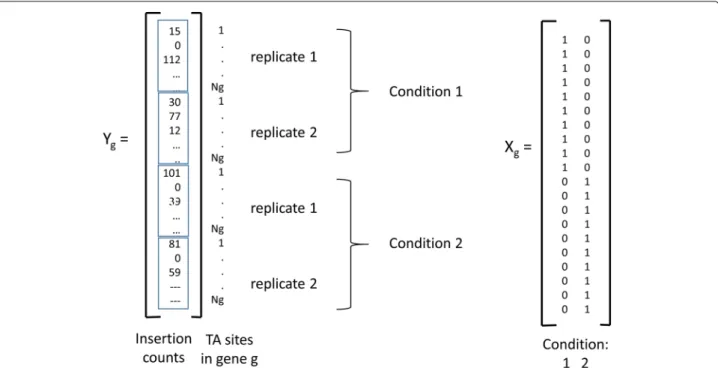
To capture the conditional dependence of the ZINB parameters (μ, r, π) on the experimental conditions, we adopt a linear regression (GLM) approach, using a log-link function. This is done independently for each geneg. We useYgto represent the subset of all observed counts in genegat any TA site, in any condition, in any replicate (Ygis illustrated as a column vector in Fig.1). The vector of expected meansμgof the ZINB distribution (non-zero component) for each observation in genegis expressed as:
lnμg=Xgαg (3)
whereXgis a binary design matrix (see Fig.1), indicating the experimental condition for each individual observa-tion (inserobserva-tion count at a TA site) in geneg, andαg is a vector of coefficients for each condition. Form observa-tions andnconditions, the size ofXgwill bem×nand the size ofαgwill ben×1. Hence, there will bencoefficients for each gene, one for estimating the mean non-zero count for each condition. The conditional expectations for the non-zero means for each condition can be recovered as: μg,c1, . . ., μg,cn =exp(αg).
If additional covariates distinguishing the samples are available, such as library, timepoint, or genotype, they may be conveniently incorporated in the linear model with an extra matrix of covariates,Wg(m×kforkcovariates), to which a vector ofkparametersβgwill be fit:
lnμg=Xgαg+Wgβg (4)
For the dispersion parameter of the NB, τ (or size parameterr=1/τ), we assume that each gene could have its own dispersion, but for simplicity, we assume that it does not differ among conditions. Hence, it is fitted by a common intercept:
ln rg =ρg
Finally, for the zero-inflated (Bernoulli) parameter, π, we fit a linear model depending on condition, with a logit link function a conventional choice for incorporating probabilistic variables bounded between 0 and 1 as terms in a linear model): logit(πg)= ln π g,c 1−πg,c c=1..n =Xgγg (5)
Thus each gene will have its own local estimate of inser-tion density in each condiinser-tion, πg,c = exp(γg,c)/(1 + exp(γg,c)). In the case of covariates, logit(πg) = Xgγg+Wgδg, where Wg are the covariates for each observation, andδgare the coefficients for them.
Fig. 1Illustration of the counts vectorYgand conditions matrixXgfor 4 datasets, consisting of 2 conditions, each with 2 replicates. The insertion
counts at theNgTA sites in genegfor all 4 replicates are concatentated into a column vectorYg. The matrixXgencodes the condition represented
by each observation. Other covariates could be appended as columns inXg
Putting these all together: p(y|g,c) = ZINB(μg,c,rg,πg,c)
= ZINB(exp(Xgαg+Wgβg),exp(ρg),logit(Xgγg+Wgδg)) (6) The parameters of the GLM can be solved by maximum-likelihood using iteratively re-weighted least squares (IWLS). In this work, we use thepsclpackage in R [27].
Correcting for saturation differences among TnSeq datasets
An important aspect of comparative analysis of TnSeq data is the normalization of datasets. Typically, read-counts are normalized such that the total number of reads is balanced across the datasets being compared. Assuming read-counts are distributed as a mixture of a Bernoulli dis-tribution (responsible for zeros) and another disdis-tribution,
g(x), responsible for non-zero counts i.e., f(x)=
θ×g(x) x>0
(1−θ)×Bern(x|p=0) x=0
then the expected value of this theoretical read-count distribution (with mixture coefficientθ) is given by:
Ef(x)=θ×Eg(x) (7)
The expected value of such a distribution can be nor-malized to match that of a another dataset,fr(x), (such as
reference condition, with saturationθr) by multiplying it by a factor,w, defined in the following way:
Efr(x) =w×Ef(x) θr×E gr(x) =w× θ×Eg(x) w= θr×E gr(x) θ×Eg(x) (8)
This guarantees that the expected value in read-counts is the same across all datasets. TTR normalization (i.e. total trimmed read count, the default in TRANSIT [15]) estimates Eg(x)in a robust manner (excluding the top 1% of sites with highest counts, to reduce the influence of outliers, which can affect normalization and lead to false positives).
While TTR works well for methods like resampling (which only depend on the expected counts being equiv-alent under the null-hypothesis), it does not work well for methods designed to simultaneously detect differences in both the local magnitudes of counts (non-zero mean) and the saturation (fraction of non-zero sites) such as ZINB. This is because TTR in effect inflates the counts at non-zero sites in datasets with low saturation, in order to compensate for the additional zeros (to make their expected values equivalent). This would cause genes to appear to have differences in (non-zero) mean count (μg,a vsμg,b), while also appearing to be less saturated (πg,avs πg,b), resulting in false positives.
To correct for differences in saturation, we incorporate
offsetsin the linear model as follows. First, assume there are d datasets (combining all replicates over all condi-tions). Let the statistics of each dataset be represented by ad×1 vector of non-zero means,M(genome-wide aver-ages of insertion counts at non-zero sites), and ad×1 vector of the fraction of sites with zeros in each dataset, Z. For themobservations (insertion counts at TA sites) in geneg, letDg be the binary design matrix of sizem×d indicating the dataset for each observation. Then the lin-ear equations above can be modified to incorporate these offsets (a specific offset for each observation depending on which dataset it comes from).
ln(μg)=Xgαg+Wgβg+ln(DgM) (9)
logit(πg)=Xgγg+Wgδg+logit(DgZ) (10)
Note thatMandZare just vectors of empirical constants in the linear equation, not parameters to be fit. Hence the fitted coefficients (αg,βg,γg,δg) are effectively
esti-mating thedeviations in the local insertion counts in a gene relative to the global mean and saturation for each dataset. For example, if observation Xg,c,i,j comes from datasetd(whereiandjare indexes of TA site and repli-cate), and the global non-zero mean of that dataset isMd, thenexp(Xgαg)estimates the ratio of the expected mean insertion count for gene g in condition c to the global mean for datasetd(ignoring covariates):
μg,c Md =
exp(αg,c)
Statistical significance
Once the ZINB model is fit to the counts for a gene, it is necessary to evaluate the significance of the fit. T-tests could be used to evaluate the significance of individual coefficients (i.e. whether they are significantly different from 0). However, for assessing whether there is an overall effect as a function of condition, we compare the fit of the dataYg(a set of observed counts for geneg) to a simpler model - ZINB without conditional dependence - and com-pute the difference of log-likelihoods (or log-likelihood ratio): −2{L0(Yg| 0)−L1(Yg| 1)} = −2ln L0(Yg| 0) L1(Yg| 1) (11) where the two models are given by:
M1: L1(Yg|Xg, 1)=ZINB(Yg|Xg,μg,rg,πg) lnμg=Xgαg, ln rg=ρg, logit(πg)=Xgγg M0: L1(Yg| 0)=ZINB(Yg|μg,rg,πg) lnμg=α0g, ln rg=ρg, logit(πg)=γg0 (12) where 1 = αg,ρg,γg and 0 = α0 g,ρg,γg0 are the collections of parameters for the two models, and where α0
g andγg0inM0are just scalars fitted to the grand mean
and saturation of the gene over all conditions.
The likelihood ratio statistic above is expected to be distributed asχ2with degrees of freedom equal to the dif-ference in the number of parameters (Wilks’ Theorem):
−2ln L0 Yg| 0 L1 Yg| 1 ∼χ2 df=df(M1)−df(M0) (13) For the condition-dependent ZINB model (M1), the
number of parameters is 2n+ 1 (for length of αg and γgplus ρg). For the condition-independent ZINB model (M0), there are only 3 scalar parameters
α0
g,ρg,γg0
used to model the counts pooled across all conditions. Hence
df = 2n+1−3 = 2(n−1). The point of the test is to determine whether the additional parameters, which should naturally improve the fit to the data, are justi-fied by the extent of increase in the likelihood of the fit. The cumulative of the χ2 distribution is used to calcu-latep-values from the log-likelihood ratio, which are then adjusted by the Benjamini-Hochberg procedure [28] to correct for multiple tests (to limit the false-discovery rate to 5% over all genes in the genome being tested in parallel). Importantly, if a gene is detected to be conditionally-essential (or have a conditional growth defect), it could be due to either a difference in the mean counts (at non-zero sites), or saturation, or both. Thus the ZINB regression method is capable of detecting genes that have insertions in approximately the same fraction of sites but with a systematically lower count (e.g. reduction by X%), possi-bly reflecting a fitness defect. Similarly, genes where most sites become depleted (exhibiting reduced saturation) but where the mean at the remaining sites (perhaps at the ter-mini) remains about the same would also be detectable as conditional-essentials.
Covariates and interactions
If the data include additional covariates, then theWterms will be included in the regressions for both models M1
andM0: M1: L1(Yg|Xg,Wg, 1)=ZINB(Yg|μg,rg,πg) lnμg=Xgαg+Wgβg, ln rg=ρg,logit(πg)=Xgγg+Wgδg M0: L1(Yg|Wg, 0)=ZINB(Yg|Xg,Wg,μg,rg,πg) lnμg=αg0+Wgβg,ln rg=ρg,logit(πg)=γg0+Wgδg (14) In this way, the covariates W will increase the like-lihoods of both models similarly, and the LRT will be evaluating only the improvement of the fits due to
the conditions of interest, X, i.e. the residual variance explained byXafter taking known factorsWinto account. Although the number of parameters in both models will increase, the difference in degrees of freedom will remain the same.
If the covariates represent attributes of the samples that could be considered to interact with the main condition, then one can account for interactions by including an additional term in the regression. An interaction between variables occurs when the dependence of the parame-ter estimates (mean counts or saturation) on the main condition variable is influenced by the value of another attribute (e.g. treatment of the samples), which can cause the coefficients for a condition to differ as a function of the interacting variable. For example, suppose we have sam-ples of two strains (e.g. knockout vs wildtype) that have been cultured over several time points (e.g. 1–3 weeks). Then we might naturally expect that there will be vari-ability across all 6 conditions (considered independently), e.g. due to differences between time points. In fact, some genes might exhibit a gradual increase or decrease in counts over time, which could expressed as a slope (i.e. as a regression coefficient for time, treated as a contin-uous attribute). For the purpose of addressing the main question, which is whether there is a systematic differ-ence in insertion counts between the strains, we want to discount (or adjust for) the effects of time. However, the difference between the strains could manifest itself as a difference in theslopes(time-dependent effect on the counts), which might be different for each strain. Treat-ing covariates as interactions allows us to capture and test for these effects by incorporating separate coefficients for each combination of values (i.e. independent slopes for each strain).
Interactions can be incorporated in the ZINB regression model by including theproductof the conditions with the interacting covariates in the regression forM1.
M1: lnμg = Xgαg+Wgβg+Xg⊗Wgλg logit πg = Xgγg+Wgδg+Xg⊗Wgηg M0: lnμg = αg0+Wgβg logit πg = γ0 g +Wgδg (15)
where Xg⊗Wg represents column-wise products for
each pair of columns inXgandWg(resulting in a matrix of dimensions m× (n·k) forn conditions andk inter-action variables). Thus, if there is a general trend in the counts for a gene over time, it will be captured by the coefficients ofWg (vectorsβg andδg), included in both models. However, if the variables Xg and Wg interact, then the coefficients of the product term λgandηg
will be non-zero, allowing the slopes to differ between the strains. Importantly, because the objective is to test
for the significance of the interaction, in the likelihood-ratio test, the additive term for the covariate is retained in the null model but not the product, thus assessing the specific impact of the interaction on reducing the like-lihood, while factoring out the information (i.e. general trend) attributable to the interaction variable on its own (independent of the main condition).
Treatment of mice
Mice were anesthetized with 5% isoflurane and sacrificed by cervical dislocation.
Results
Likelihood ratio tests for suitability of ZINB as a model for TnSeq data
To establish the suitability of ZINB as a model for TnSeq data, we compared it to ANOVA and Negative Binomial (without special treatment of zeros) using likelihood ratio tests. The data we used for these tests consisted of 2 repli-cates of an M. tuberculosis H37Rv TnSeq library grown on glycerol compared to 3 replicates grown on choles-terol [29]. This data was originally used to identity genes in the H37Rv genome that are necessary to catabolize cholesterol, a unique carbon source available within the restricted intracellular environment of macrophages, on which growth and survival of the bacilli depends [30]. The data (insertion counts at TA sites) were normalized by the TTR method [15].
First, we compared ZINB regression to simple ANOVA (based on a generalized linear model using Gaussian likelihood functions). Both models were used to fit the insertion-count observations at the TA sites in each gene, conditioned on the carbon source (glycerol vs. choles-terol). ZINB had higher likelihood than ANOVA for all genes (except five, for which they were nearly equal). Because ZINB and ANOVA are not nested models, we used the Vuong test [31] to evaluate statistical significance of the difference in likelihoods. Furthermore, we applied the Benjamini-Hochberg procedure to adjust thep-values for an overall false-discovery rate (FDR) of 5%. ZINB was found to produce a significantly better fit than ANOVA for 3185 out of 3282 genes (97%, usingpadj < 0.05 as a criterion).
Next, we performed a likelihood ratio test (LRT) of ZINB regression compared to regular NB (as a general-ized linear model). Because ZINB has more parameters (and these are nested models), the likelihood for ZINB was again higher than NB for nearly every gene. To eval-uate which differences were significant, correcting for the different number of parameters, we computed p-values of the log-likelihood ratio using theχ2distribution, with degrees of freedom equal to the difference in number of model parameters (df =5−3=2). After FDR-correction, ZINB fit the data significantly better than NB for 2796
genes out of 3282 (85%) genes evaluated. For the rest of the genes, the likelihoods of the two models were indis-tinguishable. This supports the hypothesis that modeling the fraction of sites with no insertions (“zeros”) separately from the magnitudes of counts at sites with insertions enables ZINB to fit TnSeq data better.
Pairwise comparisons of conditional essentiality using ZINB
We evaluated ZINB, resampling, and ANOVA on data from an M. tuberculosis TnSeq library grown in-vitro compared to infections in a mouse model. A high-saturation Himar1 Tn library generated in H37Rv was inoculated into six C57BL/6 mice (8–12 week old males, obtained from Jackson Laboratory, Bar Harbor, ME) via the intravenous route at a dose that deposits a represen-tative sample of the library (>100,000 CFU) in the spleen. After four weeks, the bacteria present in the spleen of each animal were recovered by plating on 7H10 agar (with kanamycin). As a control, the original library was replated in parallel. A total of 0.4-1.5 million reads was mapped to TA sites for each sample, and all samples had∼ 50% saturation (all but one were in the 42–58% range; see Table1; raw insertion counts provided in Additional file
3). The data was normalized using TTR (Trimmed Total Read-count) normalization [15], and the mean count of all datasets after normalization was uniform, around 100.
When ZINB regression method was run on the two conditions (in vitro vs. in mice), 237 conditional essen-tials were identified (Additional file 1). This included genes well-known to be essential in vivo [32], including the Mce4 cluster, biotin biosynthesis (bioABDF1), ESX-1, the NRPS (non-ribosomal peptide synthase) cluster (Rv0096-Rv0101), and cholesterol catabolism genes (e.g. FadE5,bpoC, hsaD). Some genes involved in mycobactin-dependent iron acquisition (irtAB, mmpL4/S4) were Table 1Statistics of TnSeq datasets
Dataset Condition Mapped reads Densitya NZmeanb
A1 in vitro 989413 0.55 23.9 A2 in vitro 1376613 0.58 31.9 A3 in vitro 1531598 0.58 35.3 A4 in vitro 547902 0.47 15.5 A5 in vitro 1450383 0.57 33.9 A6 in vitro 475126 0.55 11.6 B1 in vivo 1500646 0.47 42.5 B2 in vivo 601683 0.45 17.7 B3 in vivo 1245065 0.51 32.5 B4 in vivo 1472365 0.49 39.9 B5 in vivo 909394 0.42 29.3 B6 in vivo 409018 0.34 16.2
aFraction of TA sites with insertions
bMean count at TA sites with insertions before normalization
essential in vivo, though none of the 14 subunits of mycobactin synthase (Mbt) were. A possible explanation is that mutants with disruptions in Mbt genes are import-ing extracellular mycobactin produced by other mutants at the site of infection with insertions in genes other than Mbt synthase. In contrast to infections with a homoge-neous knockout mutant of genes likeMbtD, mycobactin synthase transposon mutants in the Tn library can survive in vivo because it is a heterogeneous pool. However, indi-vidual clones with defects in mycobactin secretion/uptake (e.g. Tn insertions inirtAB andmmpL4/S4) cannot sur-vive, despite the availablility of mycobactin in the environ-ment.
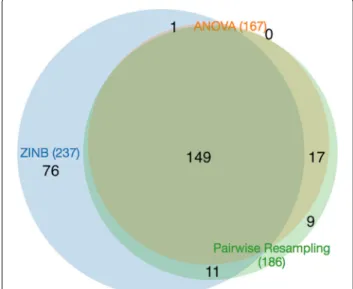
The results of ZINB can be compared to the permu-tation test (’resampling’ in TRANSIT), which is a non-parameteric comparison of the difference in mean counts for each gene between the two conditions. Resampling yielded 186 genes with significant differences between in-vitro and in-vivo. (P-values for all tests were corrected for a false-discovery rate of < 5% using the Benjamini-Hochberg procedure [28]). Almost all of these (160, 86%) were contained in the hits from ZINB (see Fig.2). Only 26 genes identified by resampling were not detected by ZINB. Many of these were marginal cases; 21 of 26 had ZINB adjustedp-values between 0.05 and 0.2.
ANOVA was also applied to the same data, and it only detected 167 genes with significant variability between the two conditions. The genes detected by ANOVA were almost entirely contained in the set of genes detected by resampling (166 out of 167), but resampling found 20 more varying genes. In comparison, ANOVA only finds 63% of the varying genes detected by ZINB (150 out of 237). We speculate that the lower sensitivity of ANOVA is due to the non-normality of insertion-count data, which is
Fig. 2Venn diagram of conditional essentials (qval<0.05) for three different methods: resampling, ANOVA, and ZINB
supported by simulation studies [23], whereas resampling, being a non-parametric test, does not require normality.
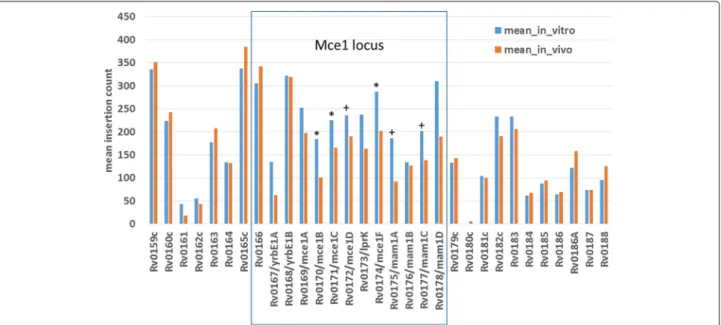
The advantage of ZINB is that it is capable of detect-ing more conditional essentials because it can take into account changes in either the local magnitude of counts or local insertion density. It detects 76 more condi-tional essentials and growth-defect genes than resam-pling, and 88 more than ANOVA. Among these are genes in the Mce1 cluster (specifically mce1B, mce1C, and mce1F, see Fig. 3). Mce1 (Mammalian Cell Entry 1) is a membrane transporter complex that has been shown to be essential for growth in vivo (e.g. knockout mutants are attenuated for survival in mice [32,33]). The Mce1 locus spans Rv0166-Rv0178 (as an operon), con-taining mce1A-mce1F, which are 5 subunits that form a membrane complex [34]; the rest of the proteins in the locus (yrb1AB, mam1ABCD) are also membrane-associated [35]. The Mce1 genes show a modest reduction in counts (∼ 25% reduction; mean log2
-fold-change=-0.2, range=-0.87..0.21), which was not sufficient to meet the adjustedp-value cutoff for resampling. However, the genes also exhibit a noticable reduction in local saturation in this locus (from∼ 88% saturation in-vitro to∼ 61% in-vivo on average), and the combination of these two depletion effects is sufficient to make them significant in the ZINB model. This is consistent with our under-standing of the biological role of Mce1, which acts as a transporter to enhance uptake of fatty acids as a carbon source from the host environment [36,37].
Similar examples include esxB, a secreted virulence factor, fcoT (thioesterase for non-ribosomal peptide synthase NRPS),lysX(lysinylation of cell-wall glycolipids
[38]), pitA (involved in phosphate transport [39]), and
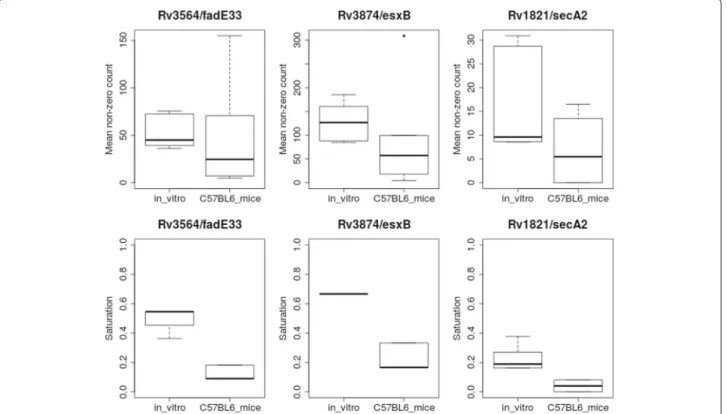
fadE33,hsaBandkshB, which are involved in cholesterol catabolism [29]. All of these genes have been previously shown to be essential for infection in an animal model, but did not meet the threshold for significance based on resampling. The reason that several of these genes (like fadE33 andesxB, shown in Fig.4) are detected by ZINB but not resampling is due primarily to changes in saturation; the non-zero mean (NZmean) changes only slightly, but the saturation drops significantly in each case; greater depletion of insertion mutants indicates reduced fitness. This highlights the value of treating the satura-tion parameter separately in the ZINB model. Another gene that exhibits this effect is SecA2. SecA2 is an alter-native ATPase component of the Secsecretion pathway and is thought to help secrete other virulence factors inside the macophage [40]. SecA2 mutants have a weak phenotype in vitro (“growth defect” gene; [41]), so that the mean counts and saturation are low compared to other genes in-vitro (e.g. only 20% saturation, compared to∼50% globally); however, it becomes almost completely devoid of insertions in-vivo (Fig.4). While SecA2 was not detected as significant by either resampling or ANOVA, it was identified as conditionally essential by ZINB.
Although ZINB identifies more genes (76) to be sta-tistically significant than resampling on this dataset, it is unlikely that this excess is attributable to a large number of false positives. To evaluate the susceptibility of ZINB to generate false positives, we performed a comparison between replicates from the same condition by dividing the 6 in-vitro datasets into 2 groups (3+3). In this case, we expect to find no hits because there are (presumably)
Fig. 3Reduction in mean insertion counts in-vivo (mice) for genes in the Mce1 locus. Genes that are detected as significant (q-value<0.05) by ZINB regression are marked with ‘*’. Genes with marginal q-values of 0.05-0.11 are marked with ’+’
Fig. 4Statistics for three genes detected to vary significantly in mice compared to in-vitro based on ZINB regression, but not by resampling. The upper panels are the Non-Zero Mean (among insertion counts at TA sites with counts>0), and the lower panels show the Saturation (percent of TA sites with counts>0). Each box represents a distribution over 6 replicates
no biological differences. ZINB analysis identified only 15 genes as significantly different (padj < 0.05), which sug-gests that the overall false positive rate for ZINB is quite low and probably reflects noise inherent in the data itself. Even resampling, when run on the same data (3 in-vitro vs. 3 in-vitro) for comparison, yielded 9 significant genes, which are presumably false positives.
Adjustment for differences in saturation among datasets
In real TnSeq experiments, it frequently happens that some datasets are less saturated than others. For example, there is often loss of diversity when passaging a Tn library through an animal model, possibly due to bottlenecking during infection or dissemination to target organs. TTR normalization was developed to reduce the sensitivity of the resampling method to differences in saturation lev-els of datasets. However, this type of normalization would be expected to exacerbate the detection of differences by ZINB. To compensate for this, we include offsets in the models that take into account the global level of saturation and non-zero mean for each dataset.
To evaluate the effect of the correction for saturation of datasets, we created artificially-depleted versions of some of the replicates analyzed in the previous Section (see Table 1). Specifically, for A1, A2, B1, and B2, we created “half-saturated” versions of each by randomly (and
independently) setting 50% of the sites to 0. Since each of the original datasets had around 50% saturation to begin with, the half-saturated version have a saturation of approximately 25%.
Initially, we compared the original versions of A1 and A2 to B1 and B2 (scenario 1), with their observed level of saturation. The number of hits detected by ZINB (73) is similar to resampling (64). Recall that resampling with all 12 datasets yielded 186 significant genes; the number of hits is lower overall in this experiment because only 2 replicates of each were used, instead of 6. Then we compared fully-saturated versions of A1 and A2 to half-saturated B1 and B2 (scenario 2). ZINB-SA+(with adjust-ment for saturation) identified nearly the same number of conditional essentials as resampling: 121 vs. 108. (see Table2). The results are similar when half-saturated ver-sion of datasets A1 and A2 are used (scenario 3). However, when saturation adjustment is turned off, ZINB-SA− pro-duces dramatically more hits in case of wide saturation differences (2668 and 1139, boldfaced in Table2). The rea-son for this is that, by artificially reducing the saturation of either datasets A1 and A2 or B1 and B2, it amplifies the apparent differences in local saturation for many genes, to which ZINB is sensitive. The number of significant hits (conditional essentials) detected when half-saturated ver-sions of all four datasets are used (scenario 4) is naturally
Table 2Comparison of ZINB regression with and without saturation adjustment, for artificially-depleted samples
Scenario Datasets compared Resampling ZINB (SA+) ZINB (SA−)
1 (A1,A2) vs (B1,B2) 64 73 162
2 (A1,A2) vs (B1[50%],B2[50%]) 108 121 2668
3 (A1[50%],A2[50%]) vs (B1,B2) 17 112 1139
4 (A1[50%],A2[50%]) vs (B1[50%],B2[50%]) 8 30 37
lower (8 and 30), because there is much less information (fewer observations) available, making it more challenging for many genes to achieve statistical significance. Inter-estingly, when half-saturated versions of all four datasets are used, ZINB-SA− works as expected, finding 37 hits (scenario 4), similar to resampling.
Application to datasets with multiple conditions
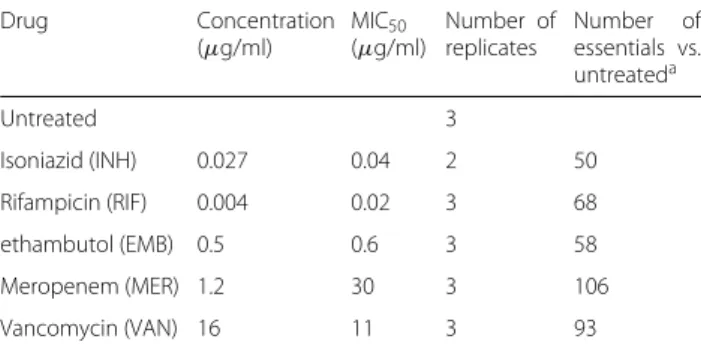
In a prior study [21], a Himar1 transposon-insertion library in H37Rv was treated with sub-inhibitory con-centrations of 5 different drugs: rifampicin (RIF), iso-niazid (INH), ethambutol (EMB), meropenem (MERO), and vancomycin (VAN), all grown in 7H9 liquid medium. Combined with the untreated control, this makes 6 con-ditions, for which there were 3 replicate TnSeq datasets each (except INH; see Table3). The TnSeq datasets had a high saturation of 60–65% (percent of TA sites with inser-tions). In the original analysis, each drug-treated sample was compared to the control using resampling [21]. Sev-eral conditionally essential genes were identified for each drug. Some genes were uniquely associated with certain drugs (for example, blaC, the beta-lactamase, was only required in the presence of meropenem), and other genes were shared hits (i.e. conditionally essential for more than one drug). Only one gene,fecB, was essential for all drugs, and its requirement for antibiotic stress tolerance was validated through phenotyping of a knock-out mutant.
The raw datasets in this experiment have a number of sporadic outliers, consisting of isolated TA sites with observed insertion counts in one sample that are > 10 times higher than the others (even in other replicates of the same condition). Outliers can cause the appearance Table 3TnSeq datasets in different antibiotic treatments Drug Concentration (μg/ml) MIC50 (μg/ml) Number of replicates Number of essentials vs. untreateda Untreated 3 Isoniazid (INH) 0.027 0.04 2 50 Rifampicin (RIF) 0.004 0.02 3 68 ethambutol (EMB) 0.5 0.6 3 58 Meropenem (MER) 1.2 30 3 106 Vancomycin (VAN) 16 11 3 93
MICs for H37Rv were obtained from [43]
aNumber of conditional essentials by comparison to the untreated condition using resampling
of artificial variability among conditions (inflating the mean count in one condition over the others in the ZINB model). Therefore, the raw datasets were normalized using the Beta-Geometric Correction (BGC) option in Transit, which is a non-linear transformation that reduces skew (extreme counts) in read-count distributions [42].
As a preliminary assessment, we did resampling of each drug condition against the untreated control, recapitu-lating the results in [21]. The number of conditional essentials is shown in Table 3. fecB was again observed to be the only hit in the intersection of all tests. We also observe other hits that can be rationalized, such as condi-tional essentiality ofblaC(beta-lactamase) in presence of meropenem.
Next, variability among all 6 conditions was analyzed using several different methods. First, a simplistic but practical approach was taken by performing pairwise analyses of conditional essentiality using resampling (the permutation test for significant differences per gene in TRANSIT). For six conditions, there are 15 pairwise com-parisons. Resampling was run independently on each pair of conditions, and the p-values were adjusted indepen-dently each time. By taking the union of conditionally-essential genes over all 15 pairwise comparisons, a total of 276 distinct genes was identified to have varying counts between at least one pair of conditions (Table4).
However, this straightforward approach is unfair because thep-values were adjusted independently. A more rigorous approach would be to perform resampling on all ∼4000 genes for all 15 pairs of conditions, and then apply thep-value adjustment once on the pool of all∼ 60, 000
p-values. When this is done, there are 267 significantly varying genes (using the lowest adjustedp-value for each gene). Thus, proper use of FDR correction results in a slightly more conservative list of hits.
Table 4Identification of genes with significant variability across six conditions in antibiotic treatment data
Method Number of varying genes
Union of hits from 15 pairwise resampling tests
276
Genes significant in any pairwise resampling after pooled adjustmentp-values
267
ANOVA 234
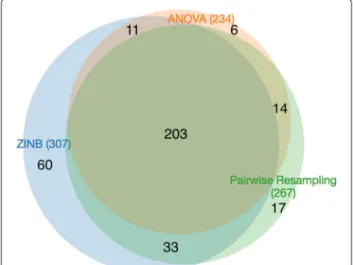
The main problem with this approach is that it requires resampling to be run separately for all pairs of conditions, which does not scale up well as the number of condi-tions increases. As an alternative, ANOVA can be used to compare the counts across all six conditions simul-taneously. When ANOVA is run (and the p-values are adjusted using the Benjamini-Hochberg procedure), only 234 significantly varying genes are identified. The 234 genes identified by ANOVA are almost completely con-tained in the set of those identified by pairwise resampling (267) (Fig. 5). Thus, ANOVA has lower sensitivity and under-reports genes with significant variability.
Finally, to identify genes that exhibit variability across all 6 conditions, we used ZINB regression (Additional file2). 307 genes were found to exhibit significant vari-ation by ZINB, including genes identified in the original study, such asfecB,blaC,pimE(mannosyltransferase), and
secA2 (protein translocase) [21]. Another example of a gene found by both ZINB and pairwise resampling iscinA
(Rv1901), which was specifically required for cultures exposed to sub-MIC concentrations of INH (Fig.6a).cinA
is thought to be an NAD-dependent enzyme that plays a role in nucleoside recycling [44,45], and thus it could con-fer tolerance to INH, e.g. through a mechanism involving maintaining the intracellular NADH/NAD+ratio [46].
Compared to ANOVA, ZINB finds significantly more varying genes (307 compared to 234, 31% more) (see Fig. 5). Put another way, ANOVA only identifies 76% of the genes with variability identified by ZINB. ZINB identified slightly more varying genes than pairwise resampling (71 additional genes). Many of these genes are on the margin and have adjustedp-values just slightly over the cutoff for resampling; 50% (36 out of 71 genes) have 0.05 < padj < 0.2 for resampling. Among the remaining
Fig. 5Venn diagram of genes with significant variability in different antibioitic treatments of transposon insertion counts evaluated by three different methods
genes, one interesting case detected uniquely by ZINB is
sigE(Fig.6b). While the mean insertion counts do not vary much for this gene (ranging between 17 and 27), the sat-uration level varies significantly among drug exposures, from nearly fully saturated in the control and INH con-ditions (88–97%), to highly depleted of insertions for RIF, MER and EMB (29–52%). This reduction suggests that
sigE is required for tolerance of certain drugs. Indeed, this recapitulates the growth defects observed in asigE
mutant when exposed to various drugs [47]. sigE is an alternative sigma factor that is thought to play a regula-tory role in response to various stresses. This effect was only observable with a model that treats variations in saturation separately from magnitiudes of insertions.
Discussion
TnSeq has proven to be an effective tool for genome-wide assessment of functional requirements and genetic inter-actions in a wide range of prokaryotes. It is now being expanded to larger-scale experiments, such as profiling growth in media supplemented with an array of carbon sources or nutrients, or exposure to a variety of antibi-otics/inhibitors, growth in a panel of different cell types, or infections in a collection of model-animals with dif-ferent genetic backgrounds. Indeed, recent methods like BarSeq make such experiments efficient through barcod-ing of libraries, enablbarcod-ing highly multiplexed sequencbarcod-ing [48]. ZINB regression offers a convenient way of assessing variability of insertion counts across multiple conditions. It is more efficient than pairwise resampling (or permu-tation tests). Resampling is designed for two-way com-parisons. Attempting to perform resampling between all pairs of conditions does not scale-up well, as the num-ber of comparisons increases quadratically with numnum-ber of conditions (for example,n = 20 conditions requires
n(n−1)/2 = 190 pairwise comparisons). In addition to the computational cost, there is a risk of loss of signifi-cance due to thep-value adjustment at the end, to control the overall false discovery rate.
ZINB regression also performs better than ANOVA, a classic statistical test for conditional-dependence among observations from multiple groups. Our experimental results show that ANOVA is generally less sensitive than ZINB, detecting only a subset of varying genes, possibly because ANOVA relies on an assumption of normality [23]. Because most datasets are not fully saturated (due to lack of diversity of the library, bottlenecking, etc), TnSeq data usually has an over-abundance of zeros that can-not be approximated well with simpler distributions like Poisson or Binomial. The ZINB distribution, being a mix-ture model of a Negative Binomial and a zero component, allows the variance of the read-counts to be independent of the mean (unlike the Poisson) and allows sites with a count of zero to be treated separately (not all zeros are
Fig. 6Significantly varying genes in cultures exposed to antibiotics.aMean insertion counts in CinA.bSaturation in SigE (percent of TA sites with one or more insertions)
counted toward the mean). We showed with a likelihood ratio test that ZINB is a much more suitable model for TnSeq data (insertion counts) than ANOVA or NB (even when taking into account differences in the number of parameters).
To capture the conditional dependence of the param-eters, the ZINB model is implemented as a regres-sion model (with a log-link function), with vectors of coefficients to represent how the insertion counts vary across conditions. Thus the zero-component captures the changes in the level of saturation of a gene across con-ditions, and the NB component captures how the mag-nitudes of counts vary across conditions. Because of the zero-component included in the ZINB model, there is a risk that comparisons among datasets with different lev-els of saturation could result in a systematic inflation of the number of false positives (i.e. genes that look like they vary because of differences in the fraction of TA sites hit in different libraries). In fact, depending on the normal-ization procedure used, there can be a similar bias in the magnitudes of read counts that also causes more false positives when comparing datasets with widely-varying saturation. To compensate for this, we include “offsets” in the regression for the overall saturation and non-zero mean count for each dataset. Thus the coefficients learned in the model actually represent deviations in count mag-nitudes and saturation (local to each gene) relative to the genome-wide averages for each dataset. We showed in a synthetic experiment that failing to adjust for saturation differences leads to a large increase in the false-positive rate when comparing datasets with unbalanced levels of saturation. Moreover, when comparing replicates of the same condition against each other (which should not have any biological differences), we showed that ZINB detects almost no significantly varying genes, as expected, suggesting that it does not have a propensity to generate false positives. A potential limitation of ZINB, is that it can
be sensitive to outliers. However, the impact of spurious high counts can be ameliorated by non-linear normaliza-tion methods like the Beta-Geometric correcnormaliza-tion [42], or other techniques like winsorization [49].
An important theoretical assumption made in the ZINB approach is that we model effects on the mean insertion counts at the gene-level, and treat differences among indi-vidual TA sites as random. Thus we pool counts at differ-ent TA sites within a gene, treating them as independdiffer-ent identically distributed (i.i.d.) samples. It is possible that different TA sites might have different propensities for insertion, for example, due to sequence-dependent biases. However, most Himar1 TnSeq studies to date have viewed the presence/abundance of insertions at TA sites as effec-tively random, resulting from stochastic processes dur-ing library construction (i.e. transfection), and no strong sequence biases have yet been identified. Early work on Himar1 transposon libraries inE. colisuggested that inser-tions were weakly influenced by local DNA bendability [50]. Subsequently, a small subset (< 9%) of TA sites in non-essential regions was found to be non-permissive for insertion, having the consensus (GC)GnTAnC(GC) [51]. But aside from these, no sequence bias has been found to explain differences in Himar1 insertions at different TA sites. In the future, if a sequence-dependent insertion bias were discovered, it is conceivable that the ZINB model could be modified to include conditional dependence on individual sites (or perhaps local sequence features). How-ever, estimating counts at individual sites is subject to noise and likely to have high uncertainty, because, in many experiments, there are only one or two replicates of each condition, and hence only 1-2 observations per site. In the current approach, we pool counts from different TA sites in a gene when estimating the non-zero mean for each gene. An advantage of this simplification is that larger genes with more TA sites benefit from higher statistical confidence due to larger numbers of observations.
The significance of variability in each gene is deter-mined by a likelihood ratio test, which identifies signifi-cantly variable genes based on the ability of using distinct parameters for each condition to increase the likelihood of the model, compared to a condition-independent null model (based on fitting parameters to the pooled counts, regardless of condition). A disadvantage of this approach is that the likelihood ratio test does not take into account certainty of the model parameter estimates. Therefore, Transit automatically filters out genes with insertions at only a single TA site (i.e. refuse to call them condition-ally variable), because the coefficients of the model are too easily fit in a way that makes the likelihood look arti-ficially high. By default our implementation requires at least 2 non-zero observations per condition to determine whether a gene exhibits significant variability across con-ditions. As with RNAseq, however, inclusion of multiple replicates increases the number of observations per gene, and this is a strongly recommended practice [25]. A more rigorous approach in Transit might be to apply a Wald test on the significance of the coefficients, which would also reveal cases where there are too few observations to be confident in the parameter estimates. More generally, a Bayesian approach might be better able to adjust (shrink) parameter estimates in cases of sparse data by combining them with prior distributions.
One advantage of the ZINB regression framework is that it can take into account additional information about sam-ples in the form of covariates and interactions. This is commonly done in RNA-seq for experiments with more complex design matrices [52]. Examples include rela-tionships among the conditions or treatments, such as class of drug, concentration, time of treatment/exposure, medium or nutrient supplementation, or genotype (for animal infections). By incorporating these in the model (with their own coefficients), it allows the model to factor out known (or anticipated) effects and focus on identify-ing genes with residual (or unexplained) variability. It can also be useful for eliminating nuisances like batch effects.
In theory, the ZINB regression method should work on TnSeq data from libraries generated with other trans-posons, such as Tn5 [1]. Tn5 insertions occur more-or-less randomly throughout the genome (like Himar1), but are not restricted to TA dinucleotides, though Tn5 appears to have a slight preference for insertions in A/T-rich regions [53]). Thus ZINB regression could be used to capture condition-dependent differences in magnitudes of counts or density of insertions in each gene. However, Tn5 datasets generally have much lower saturation (typ-ically< 10%), since every coordinate in the genome is a potential insertion site, and thus the assumptions under-lying the normalization procedure we use for Himar1 datasets (TTR) might not be satisfied for Tn5 datasets, requiring different normalization.
Of course, as with ANOVA, identifying genes that vary significantly across conditions is often just the first step and requires follow-up analyses to determine specific condition-dependent effects. For example, we observed that the NAD-dependent, nucleoside-recycling genecinA
was not just variable, but specifically required for toler-ance of isoniazid. One could employ methods such as Tukey’s range test [54] to drill down and identify signif-icantly different pairs of conditions. Another approach would be to use principle-component analysis (PCA) to uncover trends/patterns among TnSeq profiles and identify clusters of conditions producing similar effects genome-wide [55].
Our results establish the suitability of ZINB as a model for TnSeq data (insertion counts). Examples of genes where the phenotype is primarily observed in the satura-tion of the read-counts, such as SecA2 and SigE, highlight the advantage of modeling condition-dependent effects on both the magnitudes of counts in a gene and local level of saturation independently. Thus, ZINB regression is an effective tool for identifying genes whose insertion counts vary across multiple conditions in a statistically significant way.
Conclusions
We have presented a novel statistical method for identi-fying genes with significant variability of insertion counts across multiple conditions based on Zero-Inflated Nega-tive Binomial (ZINB) regression. The ZINB distribution was demonstrated to be appropriate for modeling trans-poson insertion counts because it captures differences in both the magnitudes of insertion counts (through a Negative Binomial) and the local saturation of each gene (through the proportion of TA sites with counts of 0). The method is implemented in the framework of a General-ized Linear Model, which allows multiple conditions to be compared simultaneously, and can incorporate additional covariates in the analysis. Thus it should make it a useful tool for screening for genes that exhibit significant vari-ation of insertion counts (and hence essentiality) across multiple experimental conditions.
Supplementary information
Supplementary informationaccompanies this paper at
https://doi.org/10.1186/s12859-019-3156-z.
Additional file 1:Supplemental Table 1 - ZINB output file (spreadsheet, tab-separated format) containing results from Section 3.2 on comparison of a TnSeq library forM. tuberculosisH37Rv grown in-vitro versus in C57BL/6 mice. For each ORF in the genome, an analysis of the mean, NZ-mean, and saturation in each condition is given, along withp-value and adjustedp-value. Significantly varying genes are those withpadj<0.05.
Additional file 2:Supplemental Table 2 - ZINB output file containing results for Section 3.4 on comparison of a TnSeq library forM. tuberculosis
H37Rv grown in presence of five antibiotics, isoniazid (INH), rifampicin (RIF), ethambutol (EMB), meropenem (MER), and vancomycin (VAN).
Additional file 3: Data from Mouse Infections, and ZINB Test Example (zip file) - Experimental data for the mouse experiment in Section 3.2 (.wig files with transposon insertion counts at TA sites), along with Instructions (README.docx) on how to do the ZINB analysis in TRANSIT (commands and output files).
Abbreviations
BGC: Beta-Geometric Correction; CFU: Colony Forming Units; FDR: False Discovery Rate; LRT: Likelihood Ratio Test; MIC: Minimum Inhibitory Concentration; NB: Negative Binomial; NZmean: Non-Zero mean; TnSeq: transposon insertion mutant library sequencing; TTR: Total Trimmed Read-count normalization; ZINB: Zero-Inflated Negative Binomial
Acknowledgements
Not applicable.
Authors’ contributions
SS implemented and tested the method described in this paper. MD and AS tested the method and editted the paper. CS performed the mouse infection experiment and reviewed the paper. RB, CMS, SE, and DS provided critical input and feedback on the method and design of the experiments, and also editted the paper. CS is Clare M. Smith and CMS is Christopher M. Sassetti. TI developed, implemented, and tested the method, and wrote the paper. All authors read and approved the final manuscript.
Funding
This work was supported by NIH grant U19 AI107774 (TRI, SE, DS, and CMS). The sponsor played no role in the design, interpretation, or writing of this manuscript.
Availability of data and materials
The methods described in this paper have been implemented in TRANSIT [15], which is publicly available on GitHub (https://github.com/mad-lab/transit) and can be installed as a python package (tnseq-transit) usingpip. The data from “Pairwise comparisons of conditional essentiality using ZINB” section (files with insertion counts from mouse infections), along with results files (spreadsheets with significant genes based on ZINB analysis), are provided in the Supplemental Material online.
Ethics approval and consent to participate
Treatment of mice used for experiementation in Section 3.2 was in accordance with the guidelines set forth by the Department of Animal Medicine of University of Massachusetts Medical School and Institutional Animal Care and Use Committee (IACUC; protocol #1649) and adhered to the laws of the United States and regulations of the Department of Agriculture. Mice were anesthetized with 5% isoflurane and sacrificed by cervical dislocation.
Consent for publication
Not applicable.
Competing interests
The authors declare that they have no competing interests.
Author details
1Department of Computer Science & Engineering, Texas A&M Univeristy,
College Station, TX, USA.2Rockefeller University, New York, NY, USA. 3Department of Microbiology & Immunology, Weill Cornell Medical College,
New York, NY, USA.4Department of Microbiology & Physiological Systems,
University of Massachusetts Medical School, Worchester, MA, USA.
Received: 20 May 2019 Accepted: 14 October 2019
References
1. van Opijnen T, Camilli A. Transposon insertion sequencing: a new tool for systems-level analysis of microorganisms. Nat Rev Microbiol. 2013;11(7): 435–42.
2. Lampe DJ, Churchill ME, Robertson HM. A purified mariner transposase is sufficient to mediate transposition in vitro. Eur Mol Biol Organ J. 1996;15(19):5470–9.
3. Gawronski JD, Wong SM, Giannoukos G, Ward DV, Akerley BJ. Tracking insertion mutants within libraries by deep sequencing and a
genome-wide screen for Haemophilus genes required in the lung. Proc Natl Acad Sci USA. 2009;106(38):16422–7.
4. Fu Y, Waldor MK, Mekalanos JJ. Tn-seq analysis of vibrio cholerae intestinal colonization reveals a role for t6ss-mediated antibacterial activity in the host. Cell Host Microbe. 2013;14(6):652–63. 5. Gallagher LA, Shendure J, Manoil C. Genome-scale identification of
resistance functions in pseudomonas aeruginosa using tn-seq. mBio. 2011;2(1):00315–10.
6. Long JE, DeJesus M, Ward D, Baker RE, Ioerger TR, Sassetti CM. Identifying essential genes inMycobacterium tuberculosisby global phenotypic profiling. In: Lu LJ, editor. Gene Essentiality. Methods in Molecular Biology. New York: Humana Press; 2015. p. 79–95. 7. Zomer A, Burghout P, Bootsma HJ, Hermans PW, van Hijum SA.
ESSENTIALS: software for rapid analysis of high throughput transposon insertion sequencing data. PLoS ONE. 2012;7(8):43012.
8. DeJesus MA, Zhang YJ, Sassetti CM, Rubin EJ, Sacchettini JC, Ioerger TR. Bayesian analysis of gene essentiality based on sequencing of transposon insertion libraries. Bioinformatics. 2013;29(6):695–703.
9. Solaimanpour S, Sarmiento F, Mrazek J. Tn-seq explorer: a tool for analysis of high-throughput sequencing data of transposon mutant libraries. PLoS ONE. 2015;10(5):0126070.
10. Zhang YJ, Ioerger TR, Huttenhower C, Long JE, Sassetti CM, Sacchettini JC, Rubin EJ. Global assessment of genomic regions required for growth in Mycobacterium tuberculosis. PLoS Pathog. 2012;8(9):1002946. 11. Deng J, Su S, Lin X, Hassett DJ, Lu LJ. A statistical framework for
improving genomic annotations of prokaryotic essential genes. PLoS ONE. 2013;8(3):58178.
12. DeJesus MA, Ioerger TR. A Hidden Markov Model for identifying essential and growth-defect regions in bacterial genomes from transposon insertion sequencing data. BMC Bioinformatics. 2013;14:303. 13. Pritchard JR, Chao MC, Abel S, Davis BM, Baranowski C, Zhang YJ,
Rubin EJ, Waldor MK. ARTIST: high-resolution genome-wide assessment of fitness using transposon-insertion sequencing. PLoS Genet. 2014;10(11):1004782.
14. van Opijnen T, Bodi KL, Camilli A. Tn-seq: high-throughput parallel sequencing for fitness and genetic interaction studies in microorganisms. Nat Methods. 2009;6(10):767–72.
15. DeJesus MA, Ambadipudi C, Baker R, Sassetti C, Ioerger TR. TRANSIT–A Software Tool for Himar1 TnSeq Analysis. PLoS Comput Biol. 2015;11(10): 1004401.
16. Santiago M, Matano LM, Moussa SH, Gilmore MS, Walker S, Meredith TC. A new platform for ultra-high density Staphylococcus aureus transposon libraries. BMC Genomics. 2015;16:252.
17. Zhao L, Anderson MT, Wu W, T Mobley HL, Bachman MA. TnseqDiff: identification of conditionally essential genes in transposon sequencing studies. BMC Bioinformatics. 2017;18(1):326.
18. Zhang YJ, Reddy MC, Ioerger TR, Rothchild AC, Dartois V, Schuster BM, Trauner A, Wallis D, Galaviz S, Huttenhower C, Sacchettini JC, Behar SM, Rubin EJ. Tryptophan biosynthesis protects mycobacteria from CD4 T-cell-mediated killing. Cell. 2013;155(6):1296–308.
19. Wetmore KM, Price MN, Waters RJ, Lamson JS, He J, Hoover CA, Blow MJ, Bristow J, Butland G, Arkin AP, Deutschbauer A. Rapid quantification of mutant fitness in diverse bacteria by sequencing randomly bar-coded transposons. mBio. 2015;6(3):00306–15.
20. DeJesus MA, Nambi S, Smith CM, Baker RE, Sassetti CM, Ioerger TR. Statistical analysis of genetic interactions in Tn-Seq data. Nucleic Acids Res. 2017;45(11):e93–e93.https://doi.org/10.1093/nar/gkx128. 21. Xu W, DeJesus M, Rücker N, Engelhart C, Wright M, Healy C, Lin K,
Wang R, Park S, Ioerger T, Schnappinger D, Ehrt S. Chemical genetic interaction profiling reveals determinants of intrinsic antibiotic resistance in mycobacterium tuberculosis. Antimicrob Agents Chemother. 2017;61(22):01334–17.
22. Yang G, Billings G, Hubbard T, Park J, Yin-Leung K, Liu Q, Davis B, Zhang Y, Wang Q, Waldor MK. Time-resolved transposon insertion sequencing reveals genome-wide fitness dynamics during infection. mBio. 2017;8(5):01581–17.
23. Lantz B. The impact of sample non-normality on anova and alternative methods. Br J Math Stat Psychol. 2013;66(2):224–44.
24. Blades NJ, Broman KW. Estimating the number of essential genes in a genome by random transposon mutagenesis. Technical Report