Cisco High-Density Analog And Digital Extension Module
for Voice and Fax
The Cisco
®High-Density Analog and Digital Extension Module for Voice and Fax
(EVM-HD) provides enterprises, managed service providers and service providers the ability to
directly connect public-switched telephone networks (PSTNs) and existing telephony
equipment to Cisco 2821, Cisco 2851, Cisco 3825, and Cisco 3845 integrated services
routers. With support for up to 24 total voice and fax sessions, the Cisco High-Density
Extension Module is ideal for networks with high analog (foreign exchange station [FXS],
direct inward dialing [DID], and foreign exchange office [FXO]) and digital (Basic Rate
Interface [BRI]) call-capacity requirements.
Product Overview
The Cisco High-Density Analog and Digital Extension Module for Voice and Fax (EVM-HD) is an
industry-leading voice and fax interface module for Cisco 2821, Cisco 2851, Cisco 3825, and
Cisco 3845 integrated services routers. It helps enable packet voice technologies with support for
voice over IP (VoIP), including H.323, Media Gateway Control Protocol (MGCP) and Session
Initiation Protocol (SIP); voice over Frame Relay (VoFR), and voice over ATM (VoATM), including
ATM Adaptation Layer 2 (AAL2) and AAL5. The Cisco High-Density Extension Module allows
Cisco 2821, Cisco 2851, Cisco 3825, and Cisco 3845 routers to connect directly to the PSTN and
existing telephony equipment (for example, private branch exchange (PBX), Key system, analog
telephones, and analog fax machines) through standard analog (FXS, DID, and FXO) and digital
(BRI) interfaces. The High-Density Extension Module supports telephony toll bypass, new packet
telephony applications, and full gateway integration within the Cisco AVVID (Architecture for Voice,
Video and Integrated Data) IP telephony design. With support for up to 24 total voice and fax
sessions, the Cisco High-Density Extension Module is ideal for networks with high analog and BRI
call-capacity requirements; refer to Figure 1.
The Cisco High-Density Extension Module includes the following components:
●
An 8-port extension module (part number EVM-HD-8FXS/DID)-Baseboard with 8 ports that
can be configured individually for FXS or DID signaling
●
Voice and fax expansion modules:
◦
A 4-port expansion module supporting BRI (NT and TE) (part number EM-4BRI-NT/TE)
◦
An 8-port expansion module supporting FXS (part number EM-HDA-8FXS)
◦
A 6-port expansion module supporting FXO (part number EM-HDA-6FXO)
◦
A 7-port expansion module with 3 FXS and 4 FXO ports (part number
EM-HDA-3FXS/4FXO)
Adding expansion modules to the Cisco High-Density Extension Module baseboard increases
voice and fax session capacity. The modular design of the Cisco High-Density Extension Module
provides maximum flexibility-plug in up to two expansion modules in any combination to build the
Cisco High-Density Extension Module best suited for specific packet telephony network locations.
The Cisco High-Density Extension Module provides gateway services for Cisco AVVID
(Architecture for Voice, Video and Integrated Data) using Cisco CallManager with Survivable
Remote Site Telephony (SRST) or Cisco CallManager Express (CME). Gateway services allow
users to deploy networks that take advantage of investments in existing legacy telephony
equipment while also deploying and integrating IP telephony. The network can operate at any point
on the voice, video and integrated data spectrum-with the ability to add connections for both
traditional telephony devices and IP telephony endpoints.
Cisco 2821 and Cisco 2851 Extension Voice Module Slot
The Cisco High-Density Extension Module operates in the Extension Voice Module (EVM) slot on
the Cisco 2821 and Cisco 2851 integrated services routers. The EVM slot supports additional
voice services and density without consuming the network module slot on the Cisco 2821 or Cisco
2851.
Cisco 3825 and Cisco 3845 Network Module Slot
The High-Density Extension Module operates in any network module or enhanced network module
(NME) slot on the Cisco 3825 and Cisco 3845 integrated services routers. The Cisco 3825
supports one Cisco High-Density Extension Module, and the Cisco 3845 supports one or two
high-density extension modules.
High-Density Extension Module Digital Signal Processor (DSP) Resources
Packet voice DSP modules (PVDM2s) are used in combination with the Cisco High-Density
Extension Module baseboard and its expansion modules. PVDM2s support multiple voice codecs,
fax, conferencing, and transcoding services. PVDM2s are purchased separately and installed in
the digital signal processor (DSP) module slots located inside the Cisco 2821, Cisco 2851, Cisco
3825, and Cisco 3845 integrated services routers. Initial orders for a Cisco 2821, Cisco 2851,
Cisco 3825, or Cisco 3845 router that include a Cisco High-Density Extension Module should also
include an appropriate number of PVDM2s.
Applications
Table 1 lists the Cisco High-Density Extension Module and expansion modules available and the
applications each supports.
Table 1.
Cisco High-Density Extension Module Baseboard and Expansion Modules
Product Number Description
EVM-HD-8FXS/DID The Cisco High-Density Extension Module for voice and fax has 8 FXS and DID ports. Individual ports on the baseboard module can be configured for FXS or DID signaling. Adjacent ports should share the same configuration to avoid impedance setting conflicts. A change to the impedance setting for one port, changes the setting on the adjacent port. Paired ports are: 0 and 1; 2 and 3; 4 and 5; 6 and 7.
An on-premises FXS interface connects directly to a standard telephone, fax machine, or similar device and supplies ring, voltage, and dial tone. Signaling support available in FXS mode includes loop-start and ground-start. DID trunks from the central office can be connected to the Cisco High-Density Extension Module baseboard for off-premises connections. Signaling support available in DID mode includes immediate, delay dial, and wink start.
Users plug in up to two expansion modules in any combination to increase the voice and fax capacity of the Cisco High-Density Extension Module baseboard.
EM-4BRI-NT/TE This 4-port BRI voice and fax expansion module has ports are that are configurable for NT or TE mode. This module allows connection to an ISDN S/T network by replicating either the network side or the terminal side. In NT mode the ports replicate the PSTN interface to a PBX that is compatible with European Telecommunications Standards Institute (ETSI) NET3 and QSIG switch types. In TE mode the ports support the same ISDN protocols as other Cisco Systems®
products to allow connection to ISDN S/T networks, or through an external NT1 to ISDN U-interfaces. This module provides four on-premises S/T BRI trunk connections to the ISDN PBX.
EM-HDA-8FXS This 8-port FXS voice and fax expansion module provides on-premises FXS signaling to connect directly to a standard telephone, fax machine, or similar device and supplies ring, voltage, and dial tone. Signaling support available in FXS mode includes loop-start and ground-start. Only FXS signaling is supported-there is no DID support. This expansion module also works with the Cisco High-Density Analog Voice and Fax Network Module (part number NM-HDA-4FXS).
EM-HDA-6FXO This 6-port FXO voice and fax expansion module provides off-premises connection to the central office. This module supports FXO power failover. If power to the router fails, this feature helps enable a direct metallic path between an FXO port and a special "red". It also supports analog Centralized Automated Message Accounting (CAMA) on any port. telephone to provide a direct line to the PSTN.
EM-HDA-3FXS/4FXO This 3-port FXS and 4-port FXO voice and fax expansion module provides on-premises FXS signaling to connect directly to a standard telephone, fax machine, or similar device and supplies ring, voltage, and dial tone. In addition, the FXO ports provide off-premises connection to the central office. FXS signaling support available includes loop-start and ground-start. There is no DID support. In addition, there is no FXO power failover support on the FXO ports. It also supports analog Centralized Automated Message Accounting (CAMA) on any port.
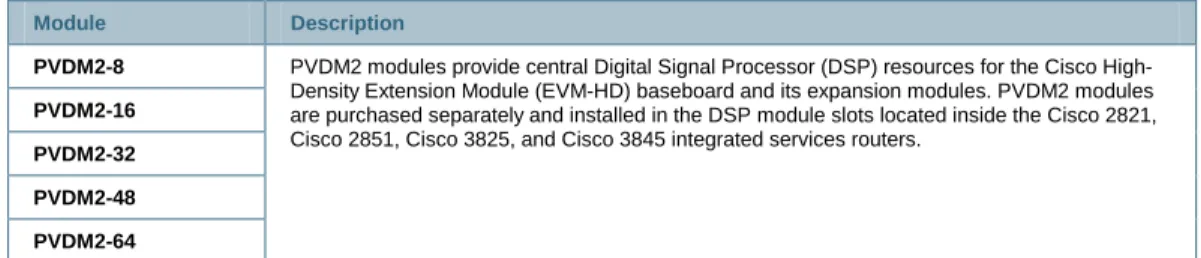
Table 2 gives the DSP resources for the Cisco High-Density Analog and Digital Extension Module
for Voice and Fax.
Table 2.
DSP Resources for the Cisco High-Density Extension Module
Module Description PVDM2-8 PVDM2-16 PVDM2-32 PVDM2-48 PVDM2-64
PVDM2 modules provide central Digital Signal Processor (DSP) resources for the Cisco High-Density Extension Module (EVM-HD) baseboard and its expansion modules. PVDM2 modules are purchased separately and installed in the DSP module slots located inside the Cisco 2821, Cisco 2851, Cisco 3825, and Cisco 3845 integrated services routers.
Refer to the PVDM2 DSP data sheet for more information: High-Density Packet Voice Digital
Signal Processor Module for Cisco IP Communications Solution. It can be found at:
http://www.cisco.com/en/US/products/hw/modules/ps3115/products_data_sheet0900aecd8016e84
5.html
Table 3 lists the call complexity and codecs supported with PVDM2s.
Table 3.
Call Complexity and Codecs Supported with PVDM2 DSP Modules
Call Complexity List of Standard Codecs Supported
High Complexity G.711 a-law and mu-law; G.726 @ 32k, 24k, and 16k; G.729, A, B and AB; G.723.1 @ 5.3k and 6.3k; G.728, GSMFR, GSMEFR, clear channel codec, and fax relay Medium Complexity G.711 a-law and mu-law; G.726 @ 32k, 24k, and 16k; G.729A and AB; clear channel
codec, and fax relay Flexible or Low Complexity G.711 a-law and mu-law
Primary Features and Benefits
Table 4 summarizes the features and benefits of the Cisco High-Density Analog and Digital
Extension Module for Voice and Fax.
Table 4.
High-Density Extension Module Features and Benefits Summary
Feature Benefit
Voice and Fax Over IP Voice and fax traffic is transport independent because IP traffic at Layer 3 can travel over any Layer 1 or Layer 2 media, including ISDN, leased lines, serial connections, Frame Relay, Ethernet, Token Ring, and ATM.
Voice and Fax Over Frame Relay
Applications requiring voice and fax traffic to be routed directly over Frame Relay networks will take advantage of FRF.11 and FRF.12 VoFR and fragmentation standards. This solution also uses features found only in Cisco IOS®
Software for maintaining voice quality. VoATM Voice is transported directly over ATM networks using AAL2 or AAL5 encapsulation to take
advantage of existing ATM networks as a direct transport method for voice. VoIP also can be transported over ATM.
Connection Trunk The connection trunk creates a tie-line replacement structure while only consuming bandwidth only during a call (digital-to-digital, digital-to-analog, or analog-to-analog capabilities).
Local Voice Busy-Out (LVBO)
Users can automatically busy-out any desired voice trunk line to a PBX or PSTN when a direct WAN or LAN connection to the router is down. This feature also allows busy-out of a far end trunk connection when configured for connection trunk.
Caller-ID Support The module offers per-port configurable caller ID to phones connected to analog FXS voice ports using per call unblocking if desired. It interoperates with analog phones, the PSTN, PBXs, Cisco CallManager, Cisco CallManager Express (CME) and H.323 terminals such as Microsoft NetMeeting and IP phones
Call Admission Control Using Response Time Reporter (RTR)
This product uses RTR to determine latency, delay and jitter and to provide real-time Impairment/Calculated Impairment Planning Factor (ICPIF) calculations before establishing a call across an IP infrastructure. RTR packets emulate voice packets receiving the same priority as voice throughout the network. This is a superior method to data and ping packets for determining congestion levels.
Voice and Fax Over the Same Port
Ports can be used for both voice and fax traffic; no dedicated ports are required.
Works with Existing Phones, Faxes, PBXs, and Key Systems
No user re-training is required.
Call Control Signaling The product supports H.323 Versions 1, 2, 3, and 4; MGCP Version 0.1 and 1.0, and SIP call control protocols. The Cisco High-Density Extension module interoperates with any Cisco CallManager release using the H.323 protocol. For MGCP, Cisco CallManager Release 3.3(5), Release 4.0(2), and Release 4.1 add support for the Cisco High-Density Extension Module. Support is also available with Cisco CallManager Express (CME) Release 3.1. Cisco voice and fax modules are interoperable with numerous emerging voice and videoconferencing applications.
High-Performance DSP Architecture
PVDM2 modules used in combination with the Cisco High-Density Extension Module baseboard and its expansion modules offer extremely low latency, which is essential for high-quality voice and fax services; the DSP architecture also helps enable all critical functions to be handled in software, allowing for simple code updates, scalability and new features. PVDM2s feature the latest DSP technology with support for conferencing and transcoding, higher call densities per DSP, and more flexibility in channel allocation per DSP. ITU Standard Codecs
such as G.729, G.729A/B, and G.711
These standards-based compression technologies allow transmission of voice across IP, Frame Relay, and ATM. G.711 is standard 64-kbps PCM modulation using either mu-law or a-law. For a complete list of codecs supported, refer to Table 3.
Feature Benefit Silence Suppression
and Voice Activity Detection
Bandwidth is used only when someone is speaking. During silent periods of a phone call (approximately 50 percent of the time), bandwidth is available for other traffic.
Comfort Noise Generation
To better simulate phone calls over voice networks, this feature reassures the phone user that the connection is being maintained, even when no voice packets are being transmitted. Dial-Plan Mapping Automatic mapping of dialed VoIP phone numbers to IP addresses simplifies configuration
and management. Dual Tone
Multifrequency (DTMF) Tone Processing
This feature helps enable access to voice mail and interactive-voice-response (IVR) systems.
Fax and Modem Pass-Through
This feature allows fax and modem traffic to pass through a voice port.
Fax Relay Fax relay provides a more robust protocol for fax transmission over packet networks. It includes support for T.38 and T.37 fax protocols.
Country-Specific Signaling
This feature transparently delivers customary phone signals to users, facilitating acceptance of new technology.
Autocalling and Private-Line Automatic Ring-Down (PLAR)
With this feature, a destination phone can be configured to automatically ring when the caller lifts the handset.
Hunt groups Calls can be forwarded automatically to the first available line. Battery Polarity
Reversal Detection and Initiation
Detection of disconnect supervision and far-end answer supervision through battery polarity reversal provides a robust method of providing supervisory disconnect, especially for loop-start signaling on FXS and FXO interfaces.
Supervisory Disconnect
Signaling protocols such as loop start do not provide means for quickly detecting when the call initiation is terminated prior to call connection. Supervisory disconnect quickly makes this determination and frees valuable resources for other calls.
Product Specifications
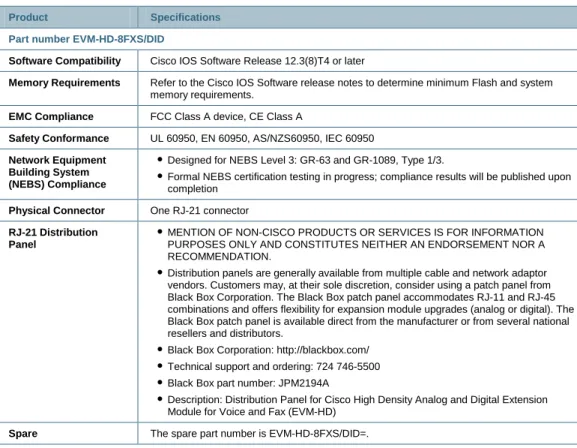
Table 5 gives specifications of the 8-port FXS and DID High-Density Extension Module baseboard.
Table 5.
Specifications of 8-Port FXS and DID Voice and Fax Extension Module Baseboard
Product Specifications
Part number EVM-HD-8FXS/DID
Software Compatibility Cisco IOS Software Release 12.3(8)T4 or later
Memory Requirements Refer to the Cisco IOS Software release notes to determine minimum Flash and system memory requirements.
EMC Compliance FCC Class A device, CE Class A
Safety Conformance UL 60950, EN 60950, AS/NZS60950, IEC 60950 Network Equipment
Building System (NEBS) Compliance
● Designed for NEBS Level 3: GR-63 and GR-1089, Type 1/3.
● Formal NEBS certification testing in progress; compliance results will be published upon completion
Physical Connector One RJ-21 connector RJ-21 Distribution
Panel
● MENTION OF NON-CISCO PRODUCTS OR SERVICES IS FOR INFORMATION PURPOSES ONLY AND CONSTITUTES NEITHER AN ENDORSEMENT NOR A RECOMMENDATION.
● Distribution panels are generally available from multiple cable and network adaptor vendors. Customers may, at their sole discretion, consider using a patch panel from Black Box Corporation. The Black Box patch panel accommodates RJ-11 and RJ-45 combinations and offers flexibility for expansion module upgrades (analog or digital). The Black Box patch panel is available direct from the manufacturer or from several national resellers and distributors.
● Black Box Corporation: http://blackbox.com/
● Technical support and ordering: 724 746-5500
● Black Box part number: JPM2194A
● Description: Distribution Panel for Cisco High Density Analog and Digital Extension Module for Voice and Fax (EVM-HD)
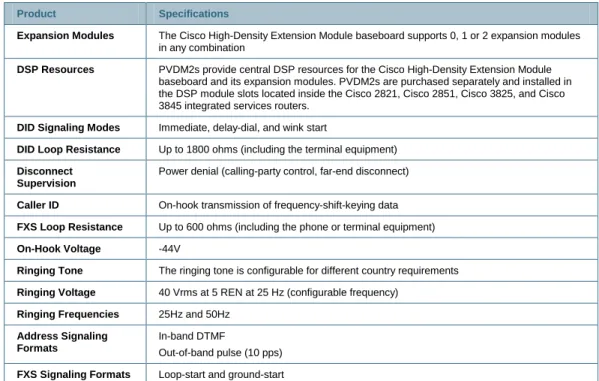
Product Specifications
Expansion Modules The Cisco High-Density Extension Module baseboard supports 0, 1 or 2 expansion modules in any combination
DSP Resources PVDM2s provide central DSP resources for the Cisco High-Density Extension Module baseboard and its expansion modules. PVDM2s are purchased separately and installed in the DSP module slots located inside the Cisco 2821, Cisco 2851, Cisco 3825, and Cisco 3845 integrated services routers.
DID Signaling Modes Immediate, delay-dial, and wink start
DID Loop Resistance Up to 1800 ohms (including the terminal equipment) Disconnect
Supervision
Power denial (calling-party control, far-end disconnect)
Caller ID On-hook transmission of frequency-shift-keying data FXS Loop Resistance Up to 600 ohms (including the phone or terminal equipment) On-Hook Voltage -44V
Ringing Tone The ringing tone is configurable for different country requirements Ringing Voltage 40 Vrms at 5 REN at 25 Hz (configurable frequency)
Ringing Frequencies 25Hz and 50Hz Address Signaling
Formats
In-band DTMF
Out-of-band pulse (10 pps) FXS Signaling Formats Loop-start and ground-start
Table 6.
Table 6. Cisco 8-Port FXS Voice and Fax Expansion Module Specifications
Product Specifications
Part number EM-HDA-8FXS
Software Compatibility Cisco IOS Software Release 12.3(8)T4 or later when used with the Cisco High-Density Extension Module baseboard
Memory Requirements Minimum Flash and system memory requirements available in the Cisco IOS Software release notes.
Interface Type FXS
EMC Compliance FCC Class A device, CE Class A
Safety Conformance UL60950, EN60950, AS/NZS60950, IEC 60950 NEBS Compliance NEBS Level 3: GR-63 and GR-1089, Type 2/4
Spare EM-HDA-8FXS=
FXS Loop Resistance Up to 600 Ohms (including the phone or terminal equipment) On-Hook Voltage -54V
Ringing Tone The ringing tone is configurable for different country requirements Ringing Voltage 40 Vrms at 5 REN at 25 Hz (configurable frequency)
Ringing Frequencies 25 Hz, 50 Hz Address Signaling
Formats
● In-band DTMF
● Out-of-band pulse (10 pps) Signaling Formats Loop-start and ground-start
Physical Connector None; ports are accessed through the RJ-21 connector on the Cisco High-Density Extension Module baseboard.
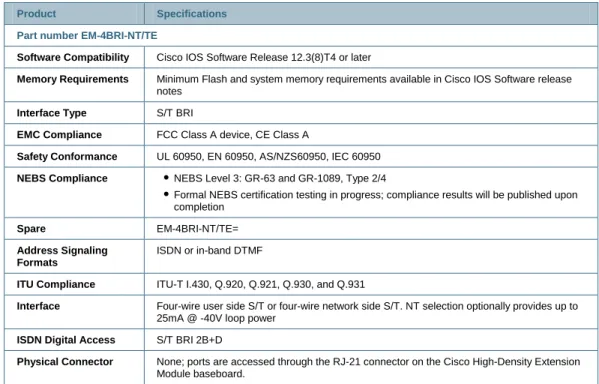
Table 7 gives specifications of the 4-port BRI expansion module.
Table 7.
Cisco 4-Port BRI Voice and Fax Expansion Module Specifications
Product Specifications
Part number EM-4BRI-NT/TE
Software Compatibility Cisco IOS Software Release 12.3(8)T4 or later
Memory Requirements Minimum Flash and system memory requirements available in Cisco IOS Software release notes
Interface Type S/T BRI
EMC Compliance FCC Class A device, CE Class A
Safety Conformance UL 60950, EN 60950, AS/NZS60950, IEC 60950 NEBS Compliance ● NEBS Level 3: GR-63 and GR-1089, Type 2/4
● Formal NEBS certification testing in progress; compliance results will be published upon completion
Spare EM-4BRI-NT/TE=
Address Signaling Formats
ISDN or in-band DTMF
ITU Compliance ITU-T I.430, Q.920, Q.921, Q.930, and Q.931
Interface Four-wire user side S/T or four-wire network side S/T. NT selection optionally provides up to 25mA @ -40V loop power
ISDN Digital Access S/T BRI 2B+D
Physical Connector None; ports are accessed through the RJ-21 connector on the Cisco High-Density Extension Module baseboard.
Table 8 gives specifications of the 6-port FXO expansion module.
Table 8.
Cisco 6-Port FXO Voice and Fax Expansion Module Specifications
Product Specifications
Part number EM-HDA-6FXO
Software Compatibility Cisco IOS Software Release 12.3(11)T or later
Memory Requirements Minimum Flash and system memory requirements available in Cisco IOS Software release notes
Interface Type FXO
EMC Compliance FCC Class A device, CE Class A
Safety Conformance UL 60950, EN 60950, AS/NZS60950, IEC 60950 NEBS Compliance ● NEBS Level 3: GR-63 and GR-1089, Type 2/4
● Formal NEBS certification testing in progress; compliance results will be published upon completion Spare EM-HDA-6FXO= Address Signaling Formats ● In-band DTMF ● Out-of-band Pulse (10 pps) Signaling Formats Loop start and ground start Tone Disconnect
Supervision
Call disconnect on progress tone of less than 600 Hz
Battery Polarity Reversal Detection
Detection of disconnect supervision and far-end answer supervision via battery polarity reversal
Power Interrupt Disconnect
Call disconnect on power interrupt of >600 ms
Physical Connector None; ports are accessed through the RJ-21 connector on the Cisco High-Density Extension Module baseboard
Table 9 gives specifications of the 3-port FXS and 4-port FXO expansion module.
Table 9.
Cisco 3-Port FXS and 4-Port FXO Voice and Fax Expansion Module Specifications
Product Specifications
Part number EM-HDA-3FXS/4FXO
Software Compatibility Cisco IOS Software Release 12.3(11)T or later
Memory Requirements Minimum Flash and system memory requirements are available in cisco IOS Software release notes
Interface Type FXS and FXO
EMC Compliance FCC Class A device, CE Class A
Safety Conformance UL 60950, EN 60950, AS/NZS60950, IEC 60950 NEBS Compliance ● NEBS Level 3: GR-63 and GR-1089, Type 2/4
● Formal NEBS certification testing in progress; compliance results will be published upon completion Spare EM-HDA-3FXS/4FXO= Address Signaling Formats ● In-band DTMF ● Out-of-band Pulse (10 pps) Signaling Formats Loop start and ground start
FXS Loop Resistance Up to 600 Ohms (including the phone or terminal equipment) FXS On-Hook Voltage -44V
FXS Ringing Tone The ringing tone is configurable for different country requirements FXS Ringing Voltage 40 Vrms at 5 REN at 25 Hz (configurable frequency)
FXS Ringing Frequencies
25 Hz, 50 Hz
Tone Disconnect Supervision
Call disconnect on progress tone of less than 600 Hz
Battery Polarity Reversal Detection
Detection of disconnect supervision and far-end answer supervision via battery polarity reversal
Power Interrupt Disconnect
Call disconnect on power interrupt of >600 ms
Table 10.
DSP Specifications-PVDM2-8, 16, 32, 48, and 64 DSP Modules for Cisco High-Density Extension
Module
Software compatibility Cisco IOS Software Release 12.3(8)T4 or later EMC Compliance FCC Class A device, CE Class A
Spare ● PVDM2-8=
● PVDM2-16=
● PVDM2-32=
● PVDM2-48=
● PVDM2-64=
Number of DSPs ● PVDM2-8 (1 DSP with less density)
● PVDM2-16 (1 DSP) ● PVDM2-32 (2 DSPs) ● PVDM2-48 (3 DSPs) ● PVDM2-64 (4 DSPs) Number of High-Complexity Calls 6 per DSP Number of Medium-Complexity Calls 8 per DSP Number of Flex-Complexity Calls 16 per DSP
Physical Connector PVDM2s are purchased separately and installed in the DSP module slots located inside the Cisco 2821, Cisco 2851, Cisco 3825, and Cisco 3845 routers
Homologation
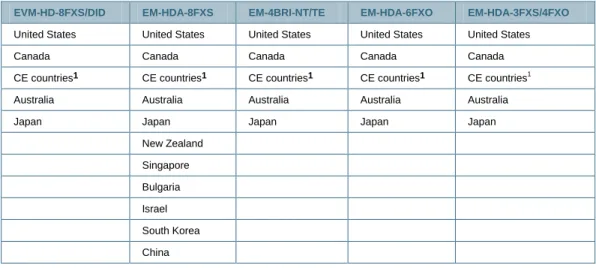
The High-Density Analog and Digital Extension Module for Voice and Fax is approved for the
countries listed in Table 11 for off-premises (DID and FXO) and on-premises (FXS and BRI)
connections. Approval for other countries is in progress. Refer to the following Cisco Telecom
Approvals Website for approval progress for other countries:
http://tools.cisco.com/cse/prdapp/jsp/externalsearch.do?action=externalsearch&page=EXTERNAL
_SEARCH
Table 11.
Telecom Approvals-(approvals in progress for other countries)
EVM-HD-8FXS/DID EM-HDA-8FXS EM-4BRI-NT/TE EM-HDA-6FXO EM-HDA-3FXS/4FXO
United States United States United States United States United States
Canada Canada Canada Canada Canada
CE countries CE countries CE countries CE countries CE countries1
Australia Australia Australia Australia Australia
Japan Japan Japan Japan Japan
New Zealand Singapore Bulgaria Israel South Korea China
Ordering Information
To place an order, visit the Cisco Ordering Home Page. Table 12 gives ordering information for the
Cisco High-Density Extension Module.
Table 12.
Ordering Information
Product Number Description
EVM-HD-8FXS/DID High density voice/fax extension module-8 FXS/DID EM-HDA-8FXS 8-port voice/fax expansion module-FXS
EM-4BRI-NT/TE 4-port voice/fax expansion module-BRI (NT and TE) EM-HDA-6FXO 6-port voice/fax expansion module-FXO
EM-HDA-3FXS/4FXO 7-port voice/fax expansion module-3FXS/4FXO
Service and Support
Cisco offers a wide range of services programs to accelerate customer success. These innovative
services programs are delivered through a unique combination of people, processes, tools, and
partners, resulting in high levels of customer satisfaction. Cisco services help you protect your
network investment, optimize network operations, and prepare your network for new applications
to extend network intelligence and the power of your business. For more information about Cisco
Services, refer to Cisco Technical Support Services or Cisco Advanced Services.
1
The CE mark is recognized in the following countries: Austria, Belgium, Cyprus, Czech Republic, Denmark,
Estonia, Finland, France, Germany, Gibraltar, Greece, Hungary, Iceland, Ireland, Italy, Latvia, Liechtenstein,
Lithuania, Luxemburg, Malta, Monaco, Netherlands, Norway, Poland, Portugal, Slovakia, Slovenia, Spain,
1 1
1 1