New England Radiological Health Compact Tabletop
Exercise
October 23, 2012
FINAL
A
FTER
A
CTION
R
EPORT
/
I
MPROVEMENT
P
LAN
A
DMINISTRATIVE
H
ANDLING
I
NSTRUCTIONS
1. The title of this document is New England Radiological Health Compact Tabletop After Action Report.
2. The information gathered in this AAR/IP is classified as For Official Use Only (FOUO) and should be handled as sensitive information not to be disclosed. This document should be safeguarded, handled, transmitted, and stored in accordance with appropriate security directives. Reproduction of this document, in whole or in part, without prior approval from the New England Radiological Health Committee or Vermont Homeland Security is
prohibited.
3. At a minimum, the attached materials will be disseminated only on a need-to-know basis and when unattended, will be stored in a locked container or area offering sufficient protection against theft, compromise, inadvertent access, and unauthorized disclosure.
4. Points of Contact:
NERHC:
William Irwin, Sc.D., CHP
Radiological and Toxicological Sciences Program Chief Vermont Department of Health
108 Cherry Street, Burlington, VT 05402
D: 802-863-7238; M: 802-316-0119; P: 802-250-3592 [email protected]
Exercise Director:
Andrea Young
Southern Exercise Planner Vermont Homeland Security 103 South Main Street Waterbury, VT 05671 802-241-5097
C
ONTENTS
Administrative Handling Instructions ...1
Contents ...2
Executive Summary ...3
Section 1: Exercise Overview ...5
Exercise Details ... 5
Exercise Planning Team Leadership ... 5
Participating Organizations ... 7
Section 2: Exercise Design Summary ...9
Exercise Purpose and Design ... 9
Capabilities and Activities Identified for Discussion ... 9
Scenario Summary ... 9
Section 3: Analysis of Capabilites by Table ... 10
Health Operations Center ... 10
On Scene Responders ... 37
State Emergency Operations Center ... 43
Federal Support Agencies ... 51
Joint Information Center ... 61
Section 4: Conclusion ... 65
Appendix A: Improvement Plan ... 67
Appendix B: Action Items and Hotwash ... 107
Appendix C: Communications Articles Reference ... 111
E
XECUTIVE
S
UMMARY
The New England Radiological Health Compact Tabletop Exercise was developed to evaluate the New England Compact Emergency Response Implementing Procedures and the New England Compact. The exercise planning team was composed of representatives from New England state’s Radiation Control Program Directors, Vermont Emergency Management, Vermont Department of Health, the EPA, state of Vermont HAZMAT team, the town of
Hartford and Vermont Homeland Security. The exercise planning team discussed their previous real world emergencies and the desire to build upon the trainings and exercises conducted in the months leading up to the Tabletop Exercise. Utilizing the Homeland Security Exercise and Evaluation Program, this exercise worked to reinforce the relationships built during the annual New England Radiological Health Conference. An area of key concern for the planning
committee is the understanding and implementation of the Incident Command System when New England Compact Resources are integrated with a host state during a critical incident.
Based on the exercise planning team’s deliberations, the following objectives were developed for the New England Radiological Health Compact Tabletop:
Communications
Evaluate the plans in place regarding notification of the New England Compact in response to a non-nuclear power plant event.
Evaluate the plans in place regarding the activation and mobilization of the New England Compact resources in response to a non-nuclear power plant event.
Discuss the communications capabilities of all responding agencies and the ability to integrate communications systems.
Emergency Public Information and Warning
Discuss the ability of the Joint Information System to provide accurate and timely information to the public during a radiological event.
On-Site Incident Management
Discuss the integration of New England Compact resources responding to a regional radiological incident within the host state’s Incident Command System structure and State Emergency Operations Center.
The purpose of this report is to analyze exercise results, identify strengths to be maintained and built upon, identify potential areas for further improvement and support development of
Major Strengths
The major strengths identified during this exercise are as follows:
• Radiological staff utilized for VY response can effectively be applied to non-VY
radiological emergency.
• On Scene Incident Command showed exceptional coordination with all on scene
agencies and liaison with SEOC.
• There is a radiological emergency plan for non-VY emergencies.
Primary Areas for Improvement
Throughout the exercise, several opportunities for improvement in the participating agencies’ ability to respond to the incident were identified. The primary areas for improvement, including recommendations, are as follows:
The relationships between the State Emergency Operations Center and other operations centers, including the Healthy Operations Center, and local operations centers needs clarification
• Establishment of the Working Group
Methods to ensure common operating pictures among all agencies need to be developed.
• Establishment of the Working Group
This Tabletop should be considered a success as participants are more aware and prepared as a result of exercising.
S
ECTION
1:
E
XERCISE
O
VERVIEW
Exercise Details
Exercise Name
New England Radiological Health Compact Tabletop Exercise
Type of Exercise
Tabletop
Exercise Start Date
October 23, 2012
Exercise End Date
October 23, 2012 Duration 6 hours Location Hilton, Burlington, VT Sponsor
Vermont Homeland Security
Program
FY2010 Homeland Security Grant Program
Mission
Response
Capabilities
Communications, Emergency Public Information and Warning, On Site Incident Management
Scenario Type
Radiological
Exercise Planning Team Leadership
Dr. William Irwin, VDHLinda Boccuzzo, VDH Nancy Erickson, VDH Erica Bornemann, VEM Anthony Honnellio, EPA Bill Dundulis, RI
Bob Gallaghar, MA Dr. Rick D’Alarcao, NH
Chief Steve Locke, Hartford Fire Department
Captain Chris Reinfurt, Vermont Homeland Security Andrea Young, Vermont Homeland Security
Participating Organizations (those invited)
New England Radiological Health Committeei. State Radiation Control Programs 1. Vermont 2. Massachusetts 3. Maine 4. New Hampshire 5. Rhode Island 6. Connecticut ii. EPA iii. FDA
Vermont HazMat Response Team Chief and Crew Chiefs Vermont Sampling Team Directors
Vermont Department of Health, Health Operations Center i. Command and General Staff
ii. Public Information Officer iii. Radiological Health iv. Laboratory
State Emergency Operations Center i. Vermont Emergency Management ii. State Support Functions
1. Vermont State Police 2. HazMat
3. Transportation 4. Military Support
5. Agency of Natural Resources/Agriculture 6. Vermont 2-1-1
Local Response Agencies i. Hartford Fire
ii. Mt. Ascutney Hospital
iii. White River Junction District Office/Health Department Federal Agencies
i. Federal Bureau of Investigation ii. Department of Energy
iii. Department of Homeland Security
iv. Federal Emergency Management Agency v. Centers for Disease Control and Prevention vi. Department of Health and Human Services vii. Environmental Protection Agency
viii. Food and Drug Administration ix. Department of Defense
x. Army Corps of Engineers xi. Department of Transportation
Number of Participants
The total number of participants was 103. By role, they were:
• Players – 65 • Evaluators – 9 • Facilitators – 6 • Observers – 23
S
ECTION
2:
E
XERCISE
D
ESIGN
S
UMMARY
Exercise Purpose and Design
This tabletop is designed to bring together key personnel with the goal of understanding, coordinating, and improving the operational response to a critical incident that necessitates the activation of the New England Compact. The New England Compact tabletop exercise planning committee identified the purpose of this exercise as a method of discussing Emergency Response Implementing Procedures and the New England Compact, in addition to examining strengths and identifying areas for improvements in the target capabilities identified during the planning
process. An area of key concern for the planning committee is the understanding and
implementation of the Incident Command System when New England Compact Resources are integrated with a host state during a critical incident.
Exercise Objectives, Capabilities, and Activities
Capabilities-based planning allows for exercise planning teams to develop exercise objectives and observe exercise outcomes through a framework of specific action items that were derived from the Target Capabilities List (TCL). The capabilities listed below form the foundation for the organization of all objectives and observations in this exercise. Additionally, each capability is linked to several corresponding activities and tasks to provide additional detail.
Based upon the identified exercise objectives below, the exercise planning team has decided to demonstrate the following capabilities during this exercise:
Communications
Evaluate the plans in place regarding notification of the New England Compact in response to a non-nuclear power plant event.
Evaluate the plans in place regarding the activation and mobilization of the New England Compact resources in response to a non-nuclear power plant event.
Discuss the communications capabilities of all responding agencies and the ability to integrate communications systems.
Emergency Public Information and Warning
Discuss the ability of the Joint Information System to provide accurate and timely information to the public during a radiological event.
On-Site Incident Management
Discuss the integration of New England Compact resources responding to a regional radiological incident within the host state’s Incident Command System structure and State Emergency Operations Center.
Participants were presented with an automobile accident creating an explosion and release of Cobalt-60. For full details, please see the Situation Manual.
S
ECTION
3:
A
NALYSIS OF
C
APABILITIES
This section of the report reviews the performance of the exercised capabilities, activities, and tasks. In this section, observations are organized by Table Groups. Each observation is linked to a Capability and is followed by related references, analysis, and recommendations.
Table 1:
Health Operations Center
Capability 1:
Communications
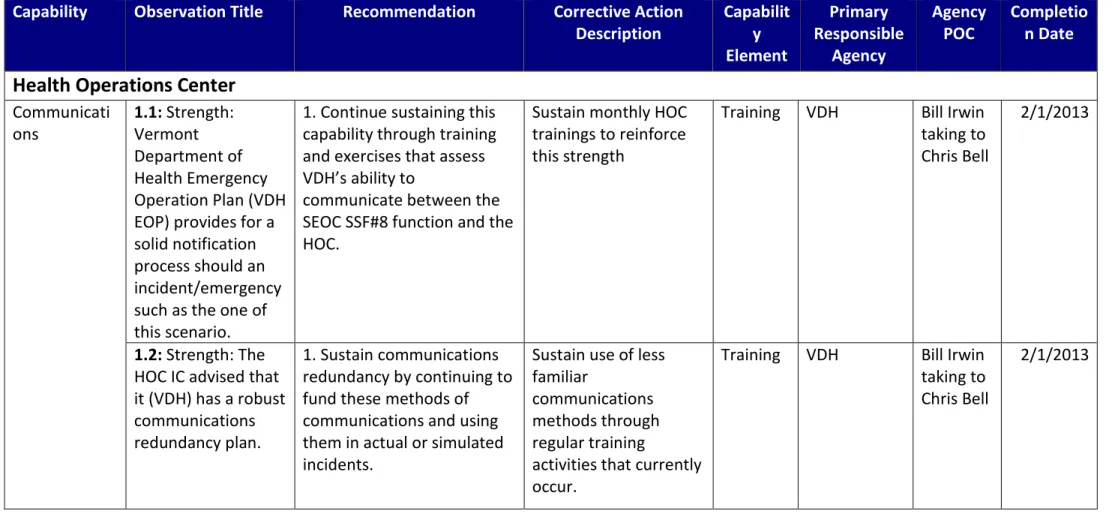
Observation 1.1: Strength: Vermont Department of Health Emergency Operation Plan (VDH EOP) provides for a solid notification process should an incident/emergency such as the one of this scenario.
References: CPG-101 VDH EOP
SEOP (Radiological Annex) Capability Element: Planning
Analysis: The group discussed how the VDH would be notified of this incident (traffic collision involving radioactive release) in this scenario. The senior representative of the HOC table was very familiar with the VDH EOP and advised the table that the plan has specific procedures on how notifications are made. Specifically he cited that VDH duty officer would be alerted to this incident by Vermont State Police Dispatch via Emergency Management staff or by local VDH personnel in the area of Hartford. It was also discussed that informal processes exist where notification could also be made especially something of this magnitude. Once notified a
decision would be made as to the opening of the HOC by the Health Department Commissioner and further notification of internal staff would be made through the Health Alert Network. Upon reviewing the VDH EOP it was noted that it contains very detailed information on how VDH would be notified to include VSP Dispatch. The plan is comprehensive and contains specific instructions on VDH notifications at every level of activation for the emergency. This level of detail in alert/notification and the communications of an emergency to personnel are vital to early initiation of resources to prevent further deaths, destruction and containment of the incident. This level of planning is imperative to a successful outcome.
Recommendations:
1. Continue sustaining this capability through training and exercises that assess VDH’s ability to communicate between the SEOC SSF#8 function and the HOC.
Observation 1.2: Strength: The HOC IC advised that it (VDH) has a robust communications redundancy plan. References: VDH EOP NIMS
Capability Element: Resource (Equipment)
Analysis: During Module 3 discussions the HOC IC advised that it has multiple ways to
communicate during an incident. He advised that they have cell phones and landlines as the primary communications mode. During emergencies their landline phones have GETS capability and their cell phones have Wireless Priority Service (WPS) which gives their phones priority in case cell carriers are overwhelmed by calls from customers. Further he advised their cells have text capability. Further they have Satellite phones at each of the district offices and at VDH HOC. He advised that through their computers they would also have access to e-mails and Disaster-LAN for communications purposes. Finally, RACES is assigned to VDH during an emergency.
Effective emergency management and incident response activities rely on redundant flexible communications and information systems that provide a common operating picture to emergency management and response personnel. Establishing and maintaining a common operating picture is a principal goal of NIMS. Properly planned and implemented
communication plans enable the dissemination of information among command and support elements and, as appropriate, cooperating agencies and organizations. In summary good communications equates to good support and coordination with the incident commander in the field.
Recommendations:
1. Sustain communications redundancy by continuing to fund these methods of communications and using them in actual or simulated incidents.
Observation 1.3: Area for Improvement: VDH HOC does not have a written communications plan within the VDH EOP.
References: VDH EOP SEOP NIMS CPG 101
Capability Element: Planning
Analysis: VDH HOC does not have a written communications plan that outlines how it will communicate during an emergency. This plan must be concise, simple to read and provide enough information for an outside resource to understand. Good communications plans identify the type of equipment that is primary, secondary etc.
Effective communication planning provides emergency management and incident response personnel with vital information to create a common operating picture. A common operating picture is established and maintained by gathering, assessing, and disseminating incident information to all appropriate parties. Achieving a common operating picture allows on-scene and off-scene personnel—such as those at the Incident Command Post, Emergency Operations Center to have the same information.
Recommendations:
1. Establish a Communication Annex within the VDH EOP that identifies all of the
communications methods utilized as identifying primary and alternate communications modes.
Capability 2:
On Site Incident Management
Observation 1.4: Strength: The Dose Assessment Team advised they could provide initial
assessments of the scene for first responders once they received the data needed from the HOC.
References: VDH EOP
State Emergency Operations Plan, Radiological Annex Capability Element: Planning, Training
Analysis: During module 1 discussion the Dose Assessment Team advised they could provide initial assessments of radiation for First Responders in minutes upon receiving the data while at the HOC. The team plans to reside at the HOC during this type of incident as it provides them with a location close to their offices. This type of fast assessment is paramount to the safety of citizens and first responders in a radiological emergency. Having this information quickly allows the incident commander to make vital decisions that can save lives and minimize exposure. Recommendations:
1. Sustain this activity by consistently training and exercising this function at the HOC.
Observation 1.5: Area for Improvement: The HOC discussed establishing an Incident Safety Plan but there was no discussion with the Incident Command Table.
References: NIMS
Capability Element: Planning
Analysis: The participants at the HOC table had a discussion about establishing a safety plan for the incident. While it must be assumed that VDH will have input on the overall content of the safety plan this responsibility resides with the Incident Commander in the field. We observed no interaction between the HOC and the IC table. There cannot be two safety plans within one incident. Input to a safety plan that impacts first responders in the field must be developed at the incident command post not at the HOC. Radiation contamination is not a common threat encountered by first responders therefore the IC will be looking for technical advice during a complex and dynamic incident like this scenario. This will ensure that the ICs and the appointed safety officers have the necessary information to safeguard the first responders from the
effects of radiation as well as plans to safeguard the affected public. Without this information risk will be taken and the potential of injury and death could occur. The roles of the incident commander and the supporting coordinating elements can be better understood through ICS
training and exercises. Further detailing major responsibilities for each entity in a plan will elevate any questions as to who is responsible.
Recommendations:
1. Establish roles and responsibilities for the HOC and document them within the VDH EOP relative to coordinating with the build out of the safety plan.
2. Roles can be better understood by completing ICS training up to the 300 levels and the G-191 ICP and EOC Interface.
3. Further, VDH should consider deploying technical specialist for the planning sections in the ICP and in some cases an incident commander to the field for unity of effort.
Observation 1.6: Area for Improvement: The Dose Assessment Team was unclear about where
they should operate and what organization they should directly support. References:
Vermont Department of Health Emergency Operations Plan, June 1, 2006, 64 pages.
Vermont Department of Health Radiological Emergency Plan, Rev. 0, April 30, 2008, 30 pages. Health Services Coordinator Radiological Emergency Response Implementing Procedure, Rev. 4, February, 2011, 16 pages.
Radiological Health Advisor Radiological Emergency Response Implementing Procedure, Rev. 4, February, 2011, 30 pages.
VDH Dose Assessment Team Radiological Emergency Response Implementing Procedure, Rev. 8, February, 2011, 38 pages.
Vermont Department of Health Laboratory Radiological Emergency Response Implementing Procedure, Rev. 3, February 2011, 4 pages.
Capability Element: Planning
Analysis: It was not clear why the Dose Assessment Team was assigned to the HOC table. Their main function is radiological dose assessment and typically they go to the SEOC.
The Dose Assessment Team Leader pointed out that although her team is assigned to go to the SEOC in a Vermont Yankee incident, her team is able to operate to some level of effectiveness anywhere. In her mind that could be the SEOC, HOC, the Incident Command Post, at home, etc. In a Vermont Yankee incident the Dose Assessment Team goes to the SEOC and performs tasks in addition to just running a computer model of the plume. They provide support to the Radiological Health Advisor, the Health Services Coordinator and to communicate with the Plume Tracking Teams and the Sampling Teams. Part of the communications with the plume and sampling teams is to obtain data being collected by the teams and part is to request
the Radiological Health Advisor who can be overwhelmed with tasks as he has no staff assigned. Team members interact with SEOC IT and GIS personnel to provide visual displays useful in making decisions.
There was concern expressed by the participants about whether the Radiological Health Advisor would remain at the SEOC or go to the Incident Command Post (ICP). If he went to the Incident Command Post, should the Dose Assessment Team go with him to the ICP? It was not clear to the team what communications capabilities or facilities they would have at the ICP if they went there? It was also not apparent to the Dose assessment Team whether they were to exclusively support the Radiological Health Advisor and the Health Services Coordinator or whether they were also to support the State EOC with data and visuals.
This uncertainty could impact the timeliness and effectiveness of the Dose Assessment Team in this less common scenario or others like it.
Recommendations:
1. The VDH Office of Public Health Preparedness (OPHP) and Vermont Emergency Management should jointly review and analyze radiological incidents other than Vermont Yankee to determine where the Dose Assessment Team should be assigned. Is it the HOC, the SEOC, an ICP or some other location?
2. Inherent in the above review and analysis is the determination of who the Dose Assessment Team is supposed to directly support.
3. This join review should also ensure that the Health Services Coordinator and the Radiological Health Advisor are properly supported with technically trained and experienced staff no matter where they are located.
4. If the decision is locate the Dose Assessment Team somewhere other than the SEOC, there must be an effective and timely way to display data and provide decision makers recommendations.
Observation 1.7: Strength: The Dose Assessment Team was fully trained, experienced and prepared to provide support.
References:
Vermont Department of Health Emergency Operations Plan, June 1, 2006, 64 pages.
Vermont Department of Health Radiological Emergency Plan, Rev. 0, April 30, 2008, 30 pages. Health Services Coordinator Radiological Emergency Response Implementing Procedure, Rev. 4, February, 2011, 16 pages.
Radiological Health Advisor Radiological Emergency Response Implementing Procedure, Rev. 4, February, 2011, 30 pages.
VDH Dose Assessment Team Radiological Emergency Response Implementing Procedure, Rev. 8, February, 2011, 38 pages.
Vermont Department of Health Laboratory Radiological Emergency Response Implementing Procedure, Rev. 3, February 2011, 4 pages.
Capability Element: Training
Analysis: Over a period of at least fifteen years the Dose Assessment team has improved and matured in their procedures, training and resources in a response to an incident at Vermont Yankee Nuclear Power Station in southern Vermont. This has occurred through numerous improvement projects and in multiple exercises and drills involving the Radiological Health Advisor, the Plume Tracking and Sampling Teams, the SEOC, the VDH Lab and others. This has provided team members with opportunities to work with many of the moving parts in a radiological incident response. They have both the micro and the macro view of such an incident. They are experienced in using and coordinating with federal resources and resources from other states.
The Dose Assessment Team had several members present in this exercise and they expressed their confidence in their technical abilities. They were able to confer with participants from other states and the federal government with positive results.
This training and experience increases the preparedness level and capability of the Vermont Department of Health (VDH) in radiological incidents other than Vermont Yankee Nuclear Power Station
Recommendations:
1. The Dose Assessment Team should continue to train and participate in applicable drills and exercises.
2. The VDH Office of Public Health Preparedness (OPHP) should recognize the need to continue supporting the Dose Assessment Team and ensure that new personnel are being recruited and trained to ensure continuity of performance when team members leave or retire.
Observation 1.8: Area for Improvement: There was uncertainty at the HOC table about who was ultimately in charge of the incident and how that affected VDH resources and operations.
References:
Vermont Department of Health Emergency Operations Plan, June 1, 2006, 64 pages.
Vermont Department of Health Radiological Emergency Plan, Rev. 0, April 30, 2008, 30 pages. Health Services Coordinator Radiological Emergency Response Implementing Procedure, Rev. 4, February, 2011, 16 pages.
Radiological Health Advisor Radiological Emergency Response Implementing Procedure, Rev. 4, February, 2011, 30 pages.
VDH Dose Assessment Team Radiological Emergency Response Implementing Procedure, Rev. 8, February, 2011, 38 pages.
Vermont Department of Health Laboratory Radiological Emergency Response Implementing Procedure, Rev. 3, February 2011, 4 pages.
Capability Element: Planning
Analysis: A significant challenge presented and discussed by participants at many, if not all, of the tables was the issue of overall command of this type of incident. It was stated by the Vermont Emergency Management Deputy Director in module 3 that all incidents are local and therefore the Hartford Fire Department Incident Commander was in charge until he or she requested to be relieved of that responsibility.
The problem with that, in the minds of some HOC participants, was that no local fire department in Vermont, even one of the largest paid full time departments, is staffed and equipped to handle a fast moving and long term incident that covers a significant portion of the state. Although many fire departments and towns are experienced at handling common events such as floods and fires, very few have experience or training in radiological incidents. Very few, if any, local emergency operations centers are staffed and equipped to support their fire departments in a long term incident of this magnitude for an area much larger than their own jurisdiction. Additionally the normal fire department emergency workload would probably continue in addition to this incident. Even with mutual aid this could overwhelm a local fire department.
If this issue was fully resolved between the SEOC and the Hartford Fire Department, that information did not filter down to the HOC. At some point the Governor of the State of Vermont would have been compelled by public pressure to have the state take a more active role in this incident. There has been a lot of discussion by experienced responders about whether NIMS properly addresses the State and Local Interface in this type of large scale incident. When do States and / or the Federal Government assume some kind of coordinating or decision making authority over an incident that crosses multiple jurisdictional boundaries? The Federal Government, many States and local jurisdictions practice this in Nuclear Power Station exercises but outside of those Emergency Planning Zones (EPZs) this is rarely discussed. This exercise may have been one of the first in Vermont to have a scenario to pose this
question so clearly. Few if any local responders in Vermont outside of the Vermont Yankee EPZ are equipped and trained to respond to this type of incident and even in the EPZ the responders are limited in their response capability.
HOC participants (specifically the Dose Assessment Team members) were using their
Radiological Emergency Response Plan procedures from Vermont Yankee which relies on the Governor or his designee to be making the major decisions after he declares a state of Emergency. The exercise scenario in Module 3 had the Governor declaring a state of
emergency for five towns sometime between 2215 hours 10-23-12 and 0800 on 10-24-12 (6.25 to 16 hours after the incident occurred.) It is reasonable to presume that the Governor of Vermont would want some decision making role in a scenario that affected nearly a quarter of the state.
This situation left the HOC participants unsure of how to respond and what channels of communications would be used. It was unclear to them how the coordination and communications would flow. Would every town affected by the plume have an Incident Command Post (ICP) or would the Town of Hartford set up some type of unified command that included all of those towns? Would the SEOC communicate directly with each affected town and how would the HOC support this effort?
Recommendations:
1. Vermont Emergency Management should convene a facilitated discussion with state and local response leaders including VDH officials to determine a protocol to manage situations with multiple jurisdictions, particularly with technical incidents.
2. Vermont Emergency Management should reduce the findings of this facilitated discussion into additions to and revisions of the State Emergency Operations Plan. 3. Vermont Emergency Management should provide training on this protocol and the
resulting changes to the Emergency Operations Plan to state and local response agencies.
4. The VDH Office of Public Health Preparedness (OPHP) should review and revise the VDH Radiological Emergency Plan and any applicable Job Action Sheets (JAS) to reflect these changes.
5. Incident Command System (ICS) courses taught in Vermont should reflect the decisions made above.
Capability 3:
Emergency Public Information and Warning
Observation 1.9: Strength: HOC personnel discussed how and when New Hampshire would be alerted to a possible release of radioactive material near the border of Vermont.
References:
State Emergency Operations Plan NIMS
Capability Element: Culture
Analysis: Personnel at the HOC table discussed how and when New Hampshire would be notified of the traffic crash involving a fire and potential release of radioactive material. The players felt that this was a very important issue to resolve immediately as it was not clear to the participants who was responsible for alerting a bordering state. A message was sent directly to the IC table to clarify this question. This was great initiative by the participants at the HOC table. Something this important cannot be overlooked. VDH personnel should be very cautious when communicating beyond the SEOC. In this scenario communicating directly with the Incident Command System structure on the ground could lead to confusion. The roles of the HOC are not defined or well known in the first responder community and in this scenario the HOC is functioning as a Department Operations Center in support of the SEOC SSF#8 function. A question such as alerts and notifications may better be answered by the SSF#8 position. Recommendations:
1. Sustain good communications between the HOC and IC structures and establish a communication procedure within VDH EOP to help define roles and avoids confusion.
Capability 4:
Emergency Operations Center Management
Observation 1.10: Area for Improvement: The Vermont Department of Health (VDH) does not define the roles and responsibilities of the Health Operations Center (HOC) and its staff during an emergency response clearly within the VDH Emergency Operations Plan which led to confusion during the exercise.
References:
Vermont Department of Health Emergency Operations Plan National Incident Management System
CPG 101
Capability Element: Planning
Analysis: It was noted during the exercise that the executive manager of the Health Operations Center (HOC) was identified as the Incident Commander and this is not appropriate for this scenario. NIMS defines an Incident Commander as that person(s) who is (are) in the field at the Incident Command Post and has overall responsibility to manage the incident, develop incident objectives, create an incident action plan and implement the strategies developed to carry out the objectives. If this is the role of the executive within the HOC and the HOC is the Incident Command Post (ICP) then it’s a proper title. If the HOC is not the ICP and is operating as a Department Operations Center in support of the SSF#8 Function at the State Emergency Operations Center (SEOC) then this is an inappropriate title. There can only be one Incident Commander per incident unless in Unified Command. The titling of Incident Commander by all entities within one incident (ICP, local or state emergency operations center, or various
department operations center such as the HOC will lead to confusion of role responsibilities.
Also during the entire exercise some of the participants used the terms Incident Command Post (ICP) and HOC interchangeable, which led to confusion of roles and responsibilities. Some players appeared to think the HOC was the ICP for this incident and the use of the title Incident Commander for the chief executive at the HOC added to the confusion. The National Incident Management System is very clear in that the entity in the field, in this case “I-91 Hartford Command”, was the Incident Command Post. This is where the incident action plans; its objectives and strategies are developed. All other entities are in support of the incident
command post in the field. The HOC is a department operations center which in this scenario is a location where VDH brings staff together to support the SSF#8 Function at the State
Emergency Operations Center. This confusion can lead to conflicts with the management of incident and its tactics, strategies, priorities, resource management (ordering, deploying, utilizing, demobilizing, tracking), communications, alerts, and emergency public information. All of these elements of good management (NIMS) must be coordinated thoroughly with the ICP and EOCs to ensure everyone is on the same common operating picture. While reviewing
the VDH Emergency Operations Plan there was no clear explanation of responsibilities for the HOC. Emergency responders and supporting personnel within an ICS structure (ICP, EOCs, Department Operations Centers) must understand the roles of each entity to avoid confusion. Having this defined in a plan and exercising the plan goes a long way in preventing confusion. In reviewing the Department of Health’s Emergency Operations Plan it was noted that the plan lacked clear guidance as to what the roles and responsibilities will be for the Health Operations Center and its staff members during an emergency response or pre-planned event. In
reviewing the plan on pages 25 through 27 it defines roles and responsibilities for other ICS structures such as Incident Command, various Emergency Operations Centers and other
functions that may be found in support of an emergency response or pre-planned event but not for the HOC. The plan defines how the HOC will be established at the various alert levels, under the principles of ICS and each of the five functions of ICS (Planning, Operations, Logistics,
Command, Finance) but not why it will be established.
Defining of roles for the HOC and memorializing it within the Department of Health’s Emergency Operations Plan is critically important during a response to an incident or preplanning for an event, as it provides clarity to what staff member’s responsibilities are. Defining roles within a plan provides the framework for effective communications between the elements, support and coordination of resources, efficient information flow and an overall understanding by everyone what functions the HOC serves. If roles are not defined it can led to confusion as to who is responsible for both the command and control at the incident as well as who are the support and coordination elements. This confusion can lead to resource
mismanagement, poor situational awareness, lack of clear messaging and alerts to the public. Planning is a key element to preparedness and an efficient response. With proper planning role responsibilities are defined and conflicts can be identified prior to an emergency.
Recommendations:
1. It is recommended that VDH examine what roles the HOC played in recent incidents, pre-planned events or exercises and its chief executive and document these roles within the emergency operations plan, training to it and exercise the plan
Observation 1.11: Area for Improvement: The HOC participants were unclear about their role and responsibilities in this type of scenario.
References:
Vermont Department of Health Emergency Operations Plan, June 1, 2006, 64 pages.
Vermont Department of Health Radiological Emergency Plan, Rev. 0, April 30, 2008, 30 pages. Health Services Coordinator Radiological Emergency Response Implementing Procedure, Rev. 4,
February, 2011, 16 pages.
February, 2011, 30 pages.
VDH Dose Assessment Team Radiological Emergency Response Implementing Procedure, Rev. 8, February, 2011, 38 pages.
Vermont Department of Health Laboratory Radiological Emergency Response Implementing Procedure, Rev. 3, February 2011, 4 pages.
Capability Element: Planning
Analysis: There was a sense by the HOC participants from the Dose Assessment Team that this scenario was primarily a health related incident and therefore the HOC was in charge of the state response and that the SEOC was in more of a support role. Therefore they began to make decisions and deploy resources without involving the SEOC. They indicated that they would respond to instruction from VDH authorities such as the Health Services Coordinator and the Radiological Health Chief but were not as likely to confer with SEOC staff. It was not clear to what extent the SEOC was clued into what the HOC was doing or planning to do. HOC members may have been focused on Paragraph 6 on page 3 of the VDH Radiological Emergency Plan (below).
“The VDH will activate its Health Operations Center (HOC) for command and control of the radiological event response from the public health perspective using its VDH Emergency Operations Plan. HOC activation levels will vary depending on the scale of the radiological emergency. Command and general staff at the HOC will use principles of the Incident Command System (ICS) to manage its emergency response activities.”
Contrast that with the statement on page 8 of the VDH Emergency Operations Plan:
“HOC Level IV activation occurs when the SEOC is activated. At this point, the SEOC assumes a leadership role relative to radiological emergency response.”
Although several members of the HOC and Dose Assessment Team had copies of plans and procedures with them they spent very little, if any, time referring to them. It was not clear to the participants at the HOC table just how the chain of command connected the HOC, the SEOC, the ICP and other states and the Federal Government. Several important issues which would have involved coordination with multiple jurisdictions described in the VDH Radiological Emergency Plan on pages 3, 4 and 6 did not come up in discussion including the SEOC such as activation of Reception Centers for the public, emergency worker monitoring and
decontamination for an expanding number of responders, the Patient Coordination Unit in the event of hospital evacuation, the Office of the Chief Medical Examiner and the use of an incident Field Office.
It was not clear to participants whether they should be using the VDH Radiological Emergency Plan or the Radiological Emergency Response Plan for Vermont Yankee. In discussion Dose
Assessment Team staff were more apt to refer to the Radiological Emergency Response Plan implementing procedures for Vermont Yankee. There are Job Action Sheets referred to on page 62 of the VDH Emergency Operations Plan but participants who mentioned guidance documents most often mentioned Radiological Emergency Response Plan implementing procedures for Vermont Yankee. Because the JAS were not accessible it is not known if they would have helped in this scenario or not.
On page 28 of the Vermont Department of Health Radiological Emergency Plan it is made clear that incidents that are not at a fixed nuclear power station are covered by this plan and not the Radiological Emergency Response Plan. There is a multipage table defining the roles and responsibilities of various organizations in this type of radiological incident. This table is fine as far as it goes but the plan does not have radiological specific implementing procedures or an instruction recommending use of the Radiological Emergency Response Plan implementing procedures. Many participants felt most comfortable with a position specific checklist and were inclined to use the only one they had.
These conflicting views of the chain of command and guidance documents would have required clarification from some higher authority or the lack of communication and coordination with the SEOC would have caused serious problems.
Reviewer Note: “In discussion Dose Assessment Team staff were more apt to refer to the Radiological Emergency Response Plan implementing procedures for Vermont Yankee.” This may be due to their lack of familiarity working within the HOC structure as the Dose
Assessment Team typically works in the SEOC during a Vermont Yankee event Recommendations:
1. The VDH Office of Public Health Preparedness (OPHP) and Vermont Emergency (VEM) should jointly review the various plans, Implementing Procedures (IPs) and Job Action Sheets (JAS) to determine if there needs to be a separate set of radiological specific checklists to support the Vermont Department of Health Radiological Emergency Plan or if the existing Radiological Emergency Response Plan implementing procedures can be modified or annotated for use in all radiological emergencies.
2. OPHP and VEM should jointly either write radiological specific checklists to support the Vermont Department of Health Radiological Emergency Plan or modify or annotate the existing Radiological Emergency Response Plan implementing procedures to cover all radiological emergencies.
3. The VDH Office of Public Health Preparedness (OPHP) should conduct training to include drills and exercises to prepare staff to use whichever checklists that OPHP and VEM decide to write.
4. HOC training, including drills and exercises, should include the escalation of HOC activation levels and coordination with the SEOC. Vermont Emergency Management
should either participate in these drills and exercises or provide a control cell to give HOC staff more realistic experience and training.
5. HOC training, including drills and exercises, should include a variety of scenarios, some of them common emergencies for VDH and some not so common such as the scenario in this exercise.
Observation 1.12: Area for Improvement: The VDH EOP does not appear to contain clear
information regarding how HOC personnel would be kept informed of an evolving incident so they can continue to support and coordinate with emergency personnel.
References: SEOP VDH EOP NIMS Capability Element: Planning, Training
Analysis: During module 1 several discussions occurred with participants at the HOC table relative to gaining information to understand what was occurring at the incident. Specifically participants stated that the Radiological Health Advisor along with VTRANS would have firsthand knowledge about what was in the vehicle since the vehicle transporting the
radioactive material was inspected by state personnel hours before the crash. The participants questioned who and how this information would be shared. There was further discussion about a formal communications link between the ICP at the scene to the SEOC SSF#8 Function and how this information gained by this direct link would be communicated to the HOC. Finally there was a discussion about how the State Hazardous Material Team would be speaking directly to the SSF#8 at the SEOC and the Dose Assessment Unit, which would be residing at the HOC.
In reviewing the VDH EOP and the SEOC Annex for SSF#8 there did not appear to be specific language as to who would be responsible for keeping the HOC informed of an emerging
incident. It is vitally important that all supporting and coordinating elements be kept informed of incidents by a formal process that is written within an emergency operations plan. By designating this responsibility and memorializing it into a plan it leaves no doubt whose
responsibility it is to keep the HOC informed. The HOC is operating as a department operations center and providing key information about dose assessment and safety precautions to the field. It is not enough for the HOC to receive information through these informal channels such as direct discussions with the HAZMAT Team. Much more information exists that is relevant to supporting the mission of the personnel at the HOC. By keeping all elements within an ICS structure informed it provides for a single common operating picture. This consistent “picture”
provides situational awareness that is vital in making sound decisions and prompts forward thinking decision makers to ask relevant questions. Decisions could include alerts and warnings to the public, consistent communications to the public of the incident, requesting of the right resources and the appropriate time, safety of the public and first responders and many other elements of managing an incident.
Further, VDH should examine how it can assign personnel to the incident command structure in the field during significant incidents that have a profound impact on the health and safety of people that would help improve communications between the entities. In this scenario it makes sense for VDH to assign personnel to the IC structure. These positions include technical specialist in the planning section who can provide the incident commander with technical information. Further a VDH staff member could also be assigned as an agency representative who has the authority to make decisions for their agency. This agency representative provides that direct link from the field to the SSF#8 Function for total situational awareness. Finally, VDH should consider assigning a qualified staff member within Unified command once the situation becomes stabilized and the transition period from response to recovery begins.
Recommendations:
1. It is recommended that specific language be inserted into the VDH EOP and SSF#8 Annex to the SEOC as to the process for obtaining and communicating information internal to the response and recovery of the incident as well as examine how VDH can assign key personnel to the incident command structure.
Observation 1.13: Strength: Executive Manager for the HOC fully knowledgeable of the emergency plans that govern the HOC.
References: VDH EOP SEOP NIMS
Capability Element: Planning
Analysis: Throughout the exercise the HOC Incident Commander understood the VDH EOP and how to implement it within this scenario. He took charge and discussed how they would determine the incident management team in the HOC, how they would be notified/alerted and how the staff within the HOC would coordinate health department resources during this emergency. This experience is crucial to an effective response.
1. Sustain this experience by continuing to train personnel and participate in exercises.
Observation 1.14: Area for Improvement: VDH lacks depth in trained personnel to sustain operations in the HOC and other support locations for a significant period of time.
References: VDH EOP
SEOP (COOP and COG Annex) NIMS
Capability Element: Resource (Personnel)
Analysis: During discussions at the HOC table one participant stated that VDH would be “spread thin” during this type of scenario and it would be difficult to staff the HOC and other operations for a long period of time. This type of disaster would have the potential for far reaching health consequences over a large area thus draining qualified personnel in any department not just VDH. Specific technical assistance in a radiological disaster requires qualified personnel over a long period of time and would likely contribute to the drain of resources locally and regionally. Discussion during the exercise did include regional resources being obtained through the NERH Compact. The consequences of not having adequate staff for a long duration are a significant issue. This type of scenario would likely drain the pool of available trained personnel almost immediate and regional personnel thereafter. This type of scenario will leave staff exhausted, stressed and at risk of making poor decisions. Finding qualified personnel to staff the HOC, SEOC and potentially field deployment will be difficult but not impossible. Per the VDH EOP it is the responsibility of the Emergency Preparedness Unit to develop COOP plans for VDH. While initial COOP plans exist more extensive planning must be done to ensure that all ideas of obtaining qualified personnel are explored.
Reviewer comment: “Per the VDH EOP it is the responsibility of the Emergency Preparedness Unit to develop COOP plans for VDH” should read “It is the responsibility of the VDH Business Operations Unit (within the Commissioner’s Office) to develop COOP plans for VDH.”
Recommendations:
1. It is recommended that the EPU conduct a workshop with other relevant partners to assess where internal and external resources from the state as well as outside the state may be obtained to supplement VDH staff. This information should be memorialized into the VDH EOP and VDH COOP Plans.
Observation 1.15: Area for Improvement: Vermont does not have a sufficient depth of trained staff to support emergency operations for an extended period of time.
References:
Vermont Department of Health Emergency Operations Plan, June 1, 2006, 64 pages.
Vermont Department of Health Radiological Emergency Plan, Rev. 0, April 30, 2008, 30 pages. Health Services Coordinator Radiological Emergency Response Implementing Procedure, Rev. 4, February, 2011, 16 pages.
Radiological Health Advisor Radiological Emergency Response Implementing Procedure, Rev. 4, February, 2011, 30 pages.
VDH Dose Assessment Team Radiological Emergency Response Implementing Procedure, Rev. 8, February, 2011, 38 pages.
Vermont Department of Health Laboratory Radiological Emergency Response Implementing Procedure, Rev. 3, February 2011, 4 pages.
Capability Element: Resources- Personnel Analysis:
HOC participants were very clear that in past incidents, such as Tropical Storm Irene, that they had difficulty operating even one full and one light shift for ten days. It was clear to them that they would need additional trained staff early on to maintain continuous operations. Although Tropical Storm Irene was serious, it may not have presented as much of a challenge as this exercise scenario. The Tritium incident at Vermont Yankee lasted much longer but was not nearly as intense. The state was monitoring events at Vermont Yankee but did not have to manage the event itself. Much of the HOC staffing occurred during normal business hours and allowed for staff to do at least some of their normal jobs. The type of scenario in this exercise would be much more demanding.
Not only does the state and VDH have a shortage of highly technical people such as the Radiological Health Advisor, discussed in a previous observation, but it also has a shortage of trained and experienced people to staff the HOC, the SEOC and other response and recovery positions with 24/7 coverage. If VDH sends more people to the SEOC to support the Health Services Coordinator and the Radiological Health Advisor, they have fewer personnel to staff the HOC and reinforce district offices in the response and recovery area.
This is not a recently discovered problem. As more state agencies form their own operations centers, their ability to send personnel to the SEOC to provide additional staff is reduced. The SEOC has a long history of having difficulty in recruiting and training staff. VDH has a similar problem. Additionally if state personnel are needed to staff Incident Command Posts (ICPs), area commands, etc. the shortage only becomes worse. It is difficult to understand how with a state of Vermont workforce of approximately 8,000 full time employees that sufficient staff cannot be trained and used in the various operations centers. This shortage will affect the timeliness and performance of the State and the Department of Health in future intense and extended response and recovery periods.
Recommendations:
1. The Department of Public Safety (DPS) and the Vermont Department of Health (VDH) should jointly convene a facilitated discussion with key members of the administration to include the Department of Human Resources and other critical departments to determine how to provide qualified and trained personnel in the event of an emergency.
2. DPS and VDH should jointly review and revise appropriate plans to accommodate the additional staffing provided in the above discussion.
3. DPS and VDH should each provide appropriate training to the additional staff provided to include experience in various drills and exercises.
4. Drills and exercises, where possible, should include at least one shift change to ensure that the staff can properly conduct a shift change and to provide second shift personnel training and experience. It does no good to have a large bench if only the first shift gets to participate in a meaningful way.
Observation 1.16: Area for Improvement: Some staff members at the HOC table do not understand the processes of ordering resources during an emergency that has a fully expanded ICS structure (ICP, EOCs, DOCs).
References: NIMS
SEOP (Incident Annex X) VDH EOP
New England Compact Interstate Radiation Assistance Plan Capability Element:
Planning, Training
Analysis: During play in module 1-3 many participants at the HOC table expressed concern about the management of resources. Specifically, they did not know what the criteria would be for ordering and tracking resources. During Module 1, participants questioned what the
“triggers” were to request resources from the New England Radiological Health Compact and how they would be deployed and managed. During modules 2 and 3 participants questioned how “resources would be ordered, deployed and accounted for” at the HOC.
Emergency management and incident response activities require carefully managed resources (personnel, teams, facilities, equipment, and/or supplies) to meet incident needs. Utilization of the standardized resource management concepts such as typing, inventorying, organizing, and tracking will facilitate the dispatch, deployment, and recovery of resources before, during, and after an incident. Efficient and effective deployment of resources requires that resource
management concepts and principles be used in all phases of emergency management and incident response. Resource management during an incident is an extremely difficult task but it will be problematic and lead to resource mismanagement if entities involved in the support and coordination efforts don’t understand what the process is for managing resources. Failure to understand will lead to inefficient use of resources, failure to track and account for resources, injury, deaths as well as the inability to reimburse for the resources. Further, in a scenario such as this all resources requested would be managed by the SEOC once the ICP exhaust all of its resources to include local mutual aid. The SEOP designates the Planning Section of the SEOC as the entity that would identify the resource request, order and deploy it to the requesting Incident Command, re-deploy resources from the various IC structures if relevant, demobilize and reimburse the entity.
All resource requests must first be generated and approved by the Incident Commander in support of the Incident Action Plan or the State Emergency Operations Center in support of the incident. Late in Module 2 play a representative of the Federal table (CDC) came to the HOC table and requested to know if a certain type of resource was needed to which the VDH participant replied yes. These two discussed the request in private and nothing was reported out. This occurred after a fully functional ICS system was in operation and local and state EOCs were functioning. Once a fully functional ICS structure is in place there is only one single resource ordering system established. This means that resource requests are approved by the incident commander and are channeled through either a local or state emergency operations center. If the local EOC does not have the resource then the request is moved up to the SEOC where the responsible SSF Function is tasked to find the resource. In this case the SSF #8 Function has the ability to reach back to the HOC to request resources or contact federal entities directly depending upon the SEOP and VDH EOP. Any bifurcation of this system will cause confusion and inefficient use of resources. All department operations centers must act in concert with the ICP and it is incumbent upon all entities to communicate with the Incident Command Post through the state emergency operations center if they assess that a certain resource is needed to complete a new objective. These clear communications helps foster good resource efficiency and helps avoid the many missteps that have occurred throughout the history of response to emergencies. The VDH EOP must identify roles and responsibilities of the HOC.
Recommendations:
1. Coordinated planning, training to a common plan, and relevant exercises provide a foundation for the coordinated resource management process for this scenario. Jurisdictions should work together in advance of a disaster to develop plans for
identifying, ordering, managing, and employing resources. The planning process should include identifying resource needs based on past experiences of the jurisdiction and develop alternative strategies to obtain the needed resources. Finally, the resource management process that exists in the SEOP should be referenced in the VDH EOP.
2. The VDH should update their EOP to define the process for ordering resources if the HOC is the ICP or reference the SEOP Resource ordering process while the HOC is a support and coordination entity for SSF #8 Function of the SEOC.
Observation 1.17: Strength: Representative from the New England Radiological Health Compact understood how resources from the Compact are obtained in an emergency.
References: VDH EOP
Radiological Annex to SEOP Title 18 VSA 1601
Capability Element: Training
Analysis: During module 2 participants at the HOC table received information from the NERHC representative as to how radiological resources would be obtained from the participating states. He explained in detail that the designated representative from each state (for Vermont it’s the commissioner of VDH) would contact the “Secretary” of the Compact (Connecticut) and request the resources needed. The secretary would then send out the requests to the
participating states. The representative explained what information he would need to make the requests for the resources such as what type of resources, type of incident, where they would report, etc. The representative of NERHC gave a clear understanding of the process. Recommendations:
Sustain
Observation 1.18: Area for Improvement: The HOC participants discussed having no plan for the disposition of contaminated waste that would result from this disaster.
References: VDH EOP SEOP
National Response Framework Capability Element: Planning
Analysis: The HOC participants discussed the issue of contaminated debris that would result from this scenario (disaster) and that there was no ability within Vermont to deal with radioactive debris. The participants are to be commended for thinking ahead during a potentially complex problem. In this scenario all participants agreed that there would be a
significant amount of radioactive debris that would not be able to be disposed of with internal resources.
In planning for a contingency as complex as the disposal of radioactive material, experts would need to be consulted ahead of time to ensure proper planning and execution of the disposal of this energized debris. The disposal of large amounts of radioactive debris as a result of an incident would be necessary to safeguard the general public for generations. Having a
framework of how to dispose of such debris is worth discussing and memorializing (in general outline) in the State Emergency Operations Plan with references to this annex in the VDH EOP. While the SEOP does have an annex for debris removal it does not have specific information about radioactive material. Vermont has a nuclear power plant within its borders. Radioactive material is transported across our highways on a consistent basis. The potential for a small footprint of radioactive contamination is a realistic scenario and by having a general outline of how to manage such a monumental task would alleviate the anxiety that would be present in such an incident.
Recommendations:
1. Conduct a small workshop with relevant stakeholders to outline the process that would be needed to decide what the proper disposal would be for a large amount of
radioactive contaminated debris.
2. This information should be memorialized within the management of debris annex of the SEOP and referenced in the VDH EOP.
Observation 1.19: Strength: The Health Operations Center (HOC) has had significant experience in certain kinds of emergencies which increases their preparedness for future emergencies.
References:
Vermont Department of Health Emergency Operations Plan, June 1, 2006, 64 pages.
Vermont Department of Health Radiological Emergency Plan, Rev. 0, April 30, 2008, 30 pages. Health Services Coordinator Radiological Emergency Response Implementing Procedure, Rev. 4,
February, 2011, 16 pages.
Radiological Health Advisor Radiological Emergency Response Implementing Procedure, Rev. 4, February, 2011, 30 pages.
VDH Dose Assessment Team Radiological Emergency Response Implementing Procedure, Rev. 8, February, 2011, 38 pages.
Vermont Department of Health Laboratory Radiological Emergency Response Implementing Procedure, Rev. 3, February 2011, 4 pages.
Capability Element: Training Analysis:
The Vermont Health Department (VDH) Health Operations Center (HOC) has been activated several times in the last few years for extended periods of time. The Tritium incident at the Vermont Yankee Nuclear Power Stations and the H1N1 flu incident are but just two such incidents. The HOC has been activated to some level for many incidents that were resolved quickly or never reached their potential seriousness.
This frequent activation has provided various VDH staff members opportunities to play a variety of roles in the HOC structure and to work out many potential issues in their response. They also participate in Vermont Yankee exercises. These activations provide VDH with a skilled and experienced workforce in the event of an emergency. The discussion by participants included examples of different activations of the HOC where certain challenges were avoided or overcome. Tropical Storm Irene was certainly a benchmark for many of the participants even though there was nothing radiological about it.
Discussions by the participants demonstrated a certain level of confidence that they could work together to achieve tasks assigned based on past success. Participants had copies of
procedures and plans that they would normally use in other types of incidents. They seemed familiar with those plans and procedures and were planning to use them.
Participants were used to working with each other in various roles and were able to focus on the problem at hand with a minimum of “jockeying for position”. Participants welcomed participants from other states and their ideas into the discussion with a minimum of resistance. HOC staff members are at a high level of preparedness for the types of emergencies that they have experienced or trained for in the past and are better prepared for the unexpected than they would be without this training and experience.
Recommendations:
1. The HOC should continue to activate as frequently as required to maintain their readiness and experience. This has a twofold benefit:
a) Early activation puts the department and the State of Vermont in a higher level of preparedness if the incident escalates into something greater.
b) Staff members get realistic training about their roles and opportunities to explore better ways to accomplish their tasks.
2. Activations should be made with selected members assuming different roles to provide them with more and different skills. This will also provide the HOC and the department with additional depth on the bench.
3. There should be periodic training where the experiences of recent and older activations are compared and analyzed to determine trends and challenges for the future.
Observation 1.20: Area for Improvement: There was a lack of direction from the Vermont State Emergency Operations Center (SEOC) about how the HOC, Dose Assessment and other VDH
resources should be deployed and the proper chain of command to be used which was not clarified by the HOC.
References:
Vermont Department of Health Emergency Operations Plan, June 1, 2006, 64 pages.
Vermont Department of Health Radiological Emergency Plan, Rev. 0, April 30, 2008, 30 pages. Health Services Coordinator Radiological Emergency Response Implementing Procedure, Rev. 4,
February, 2011, 16 pages.
Radiological Health Advisor Radiological Emergency Response Implementing Procedure, Rev. 4, February, 2011, 30 pages.
VDH Dose Assessment Team Radiological Emergency Response Implementing Procedure, Rev. 8, February, 2011, 38 pages.
Vermont Department of Health Laboratory Radiological Emergency Response Implementing Procedure, Rev. 3, February 2011, 4 pages.
Capability Element: Planning
Analysis: It may be the nature of Table Top Exercises with multiple tables that inter table communication is often limited. It took repeated urging by the facilitator to get participants to go to the SEOC table and for them to get answers to questions. Because plans and procedures did not appear to provide clear direction to either the SEOC or the HOC participants for this type of scenario, participants tended to react to the situation in a “seat of the pants” fashion. The HOC participants viewed their role to be somewhat independent of the SEOC because they were not receiving guidance, requests and data from the SEOC or the ICP in Hartford.
There were a number of questions about New England Compact, Federal agencies, the Poison Center, and resources from other states. These questions included how and when to request them and how to integrate them. It was not clear whether the SEOC was in charge of this or the HOC.
There was a representative from New Hampshire at the HOC table. It was not clear if
communication and coordination between New Hampshire and Vermont operations were to be done at the SEOC, the HOC or at the ICP in Hartford. There was willingness by all to cooperate fully since New Hampshire had a share of the affected area but it was not clear how to go about this. In a Vermont Yankee incident this is commonly initially handled between SEOCs by
conference calls with agreed upon specified interaction at the field level. Participants were unsure of how it should occur in this scenario.
There seemed to be a sense by participants that the HOC could request some additional support such laboratory support but it was not made clear how that information would be provided to the SEOC either as a decision already made or as a request for authorization. Reading the table of responsibilities on page 28 – 31 of the VDH Radiological Emergency Plan does not reveal any requests to interstate or federal resources. It is reasonable to assume that the State Emergency Operations Plan may cover this and require that such requests be
channeled through the SEOC to ensure fiscal control and ensure that nothing slides between the cracks or is double ordered.
Communication and coordination between the SEOC and other agency operations centers and Incident Command Posts is vital to a successful response and recovery effort. Valuable time can be wasted trying to figure this out while Rome burns.
Recommendations:
1. VDH and VEM should jointly review and revise the State Emergency Operations Plan and the VDH Radiological Emergency Plan to ensure that there are no gaps or overlaps of responsibility.
2. VDH and VEM should jointly provide periodic training on the various plans to key personnel in the SEOC and the HOC to ensure that these plans are fully understood. This training should include discussion periods to discover and resolve issues.
Observation 1.21: Area for Improvement: There were some information and decision making choke points between key Vermont Department of Health (VDH) personnel.
References:
Vermont Department of Health Emergency Operations Plan, June 1, 2006, 64 pages.
Vermont Department of Health Radiological Emergency Plan, Rev. 0, April 30, 2008, 30 pages. Health Services Coordinator Radiological Emergency Response Implementing Procedure, Rev. 4,
February, 2011, 16 pages.
Radiological Health Advisor Radiological Emergency Response Implementing Procedure, Rev. 4, February, 2011, 30 pages.
VDH Dose Assessment Team Radiological Emergency Response Implementing Procedure, Rev. 8, February, 2011, 38 pages.
Vermont Department of Health Laboratory Radiological Emergency Response Implementing Procedure, Rev. 3, February 2011, 4 pages.