Document downloaded from:
This paper must be cited as:
The final publication is available at
Copyright
http://dx.doi.org/10.1016/j.energy.2013.12.016 http://hdl.handle.net/10251/40495
Elsevier
Aragonés Beltrán, P.; Chaparro González, FV.; Pastor Ferrando, JP.; Pla Rubio, A. (2014). An AHP (Analytic Hierarchy Process)/ANP (Analytic Network Process)-based multi- criteria decision approach for the selection of solar-thermal power plant investment projects.
1 2 3 4 5 6 7 8 9 10 11 12 13 14 15 16 17 18 19 20 21 22 23 24 25 26 27 28 29 30 31 32 33 34 35 36 37 38 39 40 41 42 43 44 45 46 47 48 49 50 51 52 53 54 55 56 57 58 59 60 61 62 63 64 65 1
Title: An AHP/ANP-based multi-criteria decision approach for the selection of solar thermal power plant investment projects
Authors: Pablo Aragonés-Beltrána , Fidel Chaparro-Gonzálezb, Juan-Pascual Pastor-Ferrandoc, * and Andrea Plá-Rubioc
a
INGENIO (CSIC-UPV), Universitat Politècnica de València. Camino de Vera s/n. 46022 Valencia. Spain
b
Department of Business , Universitat Politècnica de València. Camino de Vera s/n, 46022 Valencia, Spain.
c
Department of Engineering Projects, Universitat Politècnica de València. Camino de Vera s/n, 46022 Valencia, Spain.
*Corresponding author. Tel.: +34 96 387 9860; Fax: +34 96 387 98 69.
E-mail addresses: [email protected] (P. Aragonés-Beltrán) [email protected] (F. Chaparro-González) [email protected] (J.P. Pastor-Ferrando) [email protected] (A. Plá-Rubio)
*Manuscript
1 2 3 4 5 6 7 8 9 10 11 12 13 14 15 16 17 18 19 20 21 22 23 24 25 26 27 28 29 30 31 32 33 34 35 36 37 38 39 40 41 42 43 44 45 46 47 48 49 50 51 52 53 54 55 56 57 58 59 60 61 62 63 64 65 2
Title: An AHP/ANP-based multi-criteria decision approach for the selection of solar thermal power plant investment projects
Abstract
In this paper the Analytic Hierarchy Process and the Analytic Network Process are applied to help the managing board of an important Spanish solar power investment company to decide whether to invest in a particular solar thermal power plant project and, if so, to determine the order of priority of the projects in the company’s portfolio.
Project management goes through a long process, from obtaining the required construction permits and authorizations, negotiating with different stakeholders, complying with complex legal regulations, to solving the technical problems associated with plant construction and distribution of the energy generated. The whole process involves high engineering costs. The decision approach proposed in this paper consists of three phases. In the first two phases, the managing board must decide whether to accept or reject a project according to a set of criteria previously identified by the technical team. The third phase consists of establishing a priority order among the projects that have proven to be economically profitable based on project risk levels and execution time delays.
This work analyzes the criteria that should be taken into account to accept or reject proposals for investment, as well as the risks used to prioritize some projects over others.
Keywords: Analytic Hierarchy Process, Analytic Network Process, Solar thermal power projects.
1 2 3 4 5 6 7 8 9 10 11 12 13 14 15 16 17 18 19 20 21 22 23 24 25 26 27 28 29 30 31 32 33 34 35 36 37 38 39 40 41 42 43 44 45 46 47 48 49 50 51 52 53 54 55 56 57 58 59 60 61 62 63 64 65 3 1. Introduction
Solar thermal power plants have undergone considerable technological and industrial development in recent years. These power plants use the sun's radiation to heat fluids and produce electricity. This is done using a device that concentrates direct solar radiation onto a receiver. Depending on the sunlight concentration system used the main four technologies available on the market can be classified as [1-3] a) parabolic trough collector, b) linear Fresnel collector, c) central receiver system with dish collector, and d) solar power tower receiver system with heliostats. A fifth system is the solar updraft tower, also called solar chimney plants, but this technology is under research and development and therefore it has not been considered in the present work [4,5]. Since solar radiation is intermittent, this kind of plant requires a thermal energy storage system [6]. [7] and [8] review the state of the art on high temperature thermal energy storage systems for power generation. Despite the fact that solar thermal power technology is at a stage of development, its potential future cost decline and advances make it an attractive opportunity for investment companies [9].
Spain, along with the U.S. and MENA (Middle East and North Africa) countries, are allocating more technical and economic resources to this new technology. According to the Institute for Energy Diversification and Saving (IDAE)[10], a public organization dependent on the Spanish Ministry of Industry, Tourism and Commerce, by the end of 2010 Spain had an installed solar generating capacity of 632 MW (60% of the world‟s total solar power capacity), 1000 MW were under construction (approximately 86% of the world‟s total solar power under construction) and an additional capacity of 8475 MW was planned for in the form of projects. At present, the majority of solar thermal electricity generation in Spain is provided by parabolic trough power plants, each with an output of 50 MW [10].
The European legislation through Directive 2009/28/EC promotes the use of energy from renewable sources. This Directive has set up a target of 20% for all energy generated in Europe to come from renewable energy sources by 2020. In Spain, the Electric Power Act 54/1997 deregulated the generation and sale of electricity, but set the market rates. Act 54/1997 also established a special economic regime to govern the generation of electricity from renewable sources. In the years following the publication of this law, the government approved significant incentives for the development of renewable energies, particularly solar photovoltaic plants and wind power. However, as specified in Royal Decree 9/2013, during the last decade the Spanish electricity system has generated a very high tariff deficit. Between the years 2004-2012 the revenues of the electric system rose by 122%, while costs increased by 197%. The incentives for renewables have greatly contributed to this situation [11]. The current Spanish government has agreed to deep cuts in production incentives for renewable energy, which will hit green power producers hard, especially small companies. Additionally, the economic crisis does not allow sharp increases in electric tariffs to consumers. This situation does not affect existing thermal solar power plants already in operation, but will negatively affect the construction of new plants. The legal uncertainty, perceived in this work as a major risk, is affecting investments in the renewable energy sector in Spain. The
Government is currently studying new proposals that will promote the sector as well as help control the imbalance between revenues and costs.
Institutional support for solar-thermal power technology has fostered the growth of a strong Spanish electrical industry that includes companies with power projects that have been
awarded or are under construction as well as new manufacturing companies that produce solar thermal-related components (parabolic reflectors, heliostats, tower receivers, absorber tubes,
1 2 3 4 5 6 7 8 9 10 11 12 13 14 15 16 17 18 19 20 21 22 23 24 25 26 27 28 29 30 31 32 33 34 35 36 37 38 39 40 41 42 43 44 45 46 47 48 49 50 51 52 53 54 55 56 57 58 59 60 61 62 63 64 65 4
among others). These companies have received requests for the installation of solar thermal systems not only in Spain but also in other countries. And this trend to open up to
international markets has increased due to the economic crisis.
According to [12] and [10] the investment cost of a 50 MW parabolic trough power plant can range from 5.08 to 6.93 MEUR/MW, depending on whether the solar plant includes a storage system or not. The investment cost of a 17 MW solar tower power plant is about 150 million euros, considering current technology and depending on the characteristics of the plant. Engineering and contingency costs represent between 10% and 8% of the total investment cost, respectively. Therefore, when a company dedicated to the construction and operation of solar thermal plants receives a proposal to invest in a new plant, project feasibility is carefully analyzed before deciding whether to implement the project. This is because the data required to conduct preliminary studies, particularly if the plant is to be built in a foreign country, is difficult to obtain and the cost of project feasibility studies is very high; additionally it is highly likely that many of these projects will be rejected.
The present paper analyzes the problem for the managing board of an important solar power investment company to establish a priority order among different solar thermal power plant projects. The company in this case study is a medium-size company traditionally devoted to the installation and maintenance of power systems for power supply companies, but which has recently entered the market of power generation through the development, maintenance, and operation of renewable energy power plants.
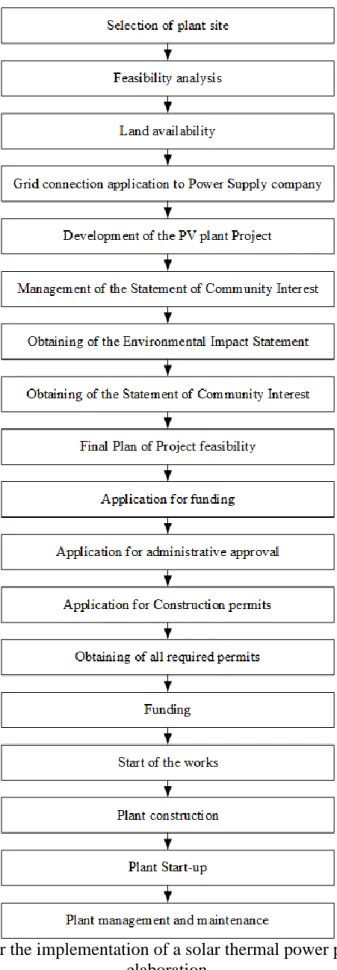
The development of a solar thermal power plant project, from the very first stage of selecting the plant site and land survey, to the last stage of implementation and starting-up of the plant, follows a long process which includes obtaining the required construction permits and
authorizations (Figure 1), negotiating with the different stakeholders (land owners, local and government authorities, power supply companies), complying with complex legal regulations, as well as solving the technical problems related to the construction of the plant and the distribution of the energy generated. This management process to obtain the required plant construction and execution permits and project execution makes projects that can be highly profitable at the exploitation stage also be very risky due to unexpected project execution delays or even project cancellation.
Figure 1-Phases for the implementation of a solar thermal power plant. Source: own elaboration
This paper presents a decision-making approach based on the Analytic Hierarchy Process (AHP) and the Analytic Network Process (ANP) [13,14], which may help the managing board of an electric power company to decide whether to invest in a particular solar thermal power plant project and, if so, to determine a priority order among a portfolio of feasible projects. AHP and ANP are multiple criteria decision making (MCDM) techniques. MCDM is a set of concepts, methods and techniques developed to help decision makers to make complex decisions in a systematic and structured way. There are two categories of MCDM problems: multiple criteria discrete alternative problems and multiple criteria optimization problems. There are several proposed methods for solving discrete alternative problems. Among the better known models are those based on Multiple Attribute Utility Theory (MAUT) [15], Analytic Hierarchy Process (AHP) [13,16] and Analytic Network Process (ANP) [14,17], Outranking Methods such as ELECTRE [18] or PROMETHEE [19] or the Technique for
1 2 3 4 5 6 7 8 9 10 11 12 13 14 15 16 17 18 19 20 21 22 23 24 25 26 27 28 29 30 31 32 33 34 35 36 37 38 39 40 41 42 43 44 45 46 47 48 49 50 51 52 53 54 55 56 57 58 59 60 61 62 63 64 65 5
Order Preference by Similarity to Ideal Solution (TOPSIS) [20]. A more detailed description of these methods can be found in [21-23]. [24] made a thorough bibliometric analysis on the development of MCDM techniques for the period 1992-2007, which is an update of a similar previous analysis. These authors concluded that the MCDM field has made great progress in both theoretical and practical applications. The growth of publications related to AHP stands out from the other techniques mentioned. Selection of the mathematical model based on discrete MCDM is not easy. According to [25] there is no best model. All MCDM techniques have their advantages and drawbacks, as summarized in [26]. Their use depends on the context.
The reasons for using an AHP/ANP-based decision analysis approach in the present work are: (i) they allow decision makers to analyze complex decision-making problems using a
systematic approach that breaks down the main problem into simpler and affordable subproblems, (ii) if there are interdependencies among groups of elements (criteria and alternatives) ANP should be used, (iii) the detailed analysis of priorities and
interdependencies between clusters‟ elements forces the DM to carefully reflect on his/her project priority approach and on the decision-making problem itself, which results in a better knowledge of the problem and a more reliable final decision.
In this work, the proposed process consists of three phases: in the first phase, the managing board will decide whether to accept or reject a given investment project based on a set of general criteria, which are relatively easy to assess and inexpensive to obtain. The projects that pass the first phase go through a second phase in which the projects are accepted or rejected using a second set of criteria that require a greater level of information and are more expensive to obtain. Project feasibility and risk analysis are performed in this phase. The economically unfeasible projects are rejected and the projects, which are economically profitable, are assessed using risk analysis. In this phase, only projects with acceptable
feasibility and risk values are accepted. The accepted projects form the project portfolio of the company. In the third phase, the company has a portfolio of solar thermal power plant
projects that are economically feasible. The objective of this phase is to solve the following decision-making problem: “Given a number of solar thermal power investment projects that are known to be profitable for the company, establish project priority based on project risk levels and execution time delays.”
The rest of the paper is organized as follows. Section 2 introduces the Analytic Hierarchy Process and the Analytic Network Process. Section 3 describes the decision-making process and Section 4 presents the main conclusions derived from this research and future works.
2. Overview of AHP and ANP.
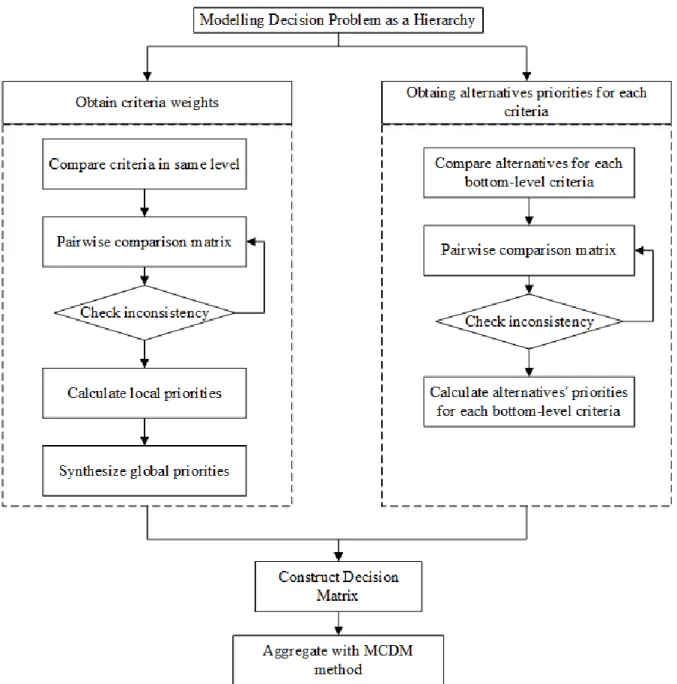
The Analytic Hierarchy Process (AHP) and the Analytic Network Process (ANP) are theories of relative measurement of intangible criteria [27] proposed by Saaty [13,14,16,17]. Saaty proposes the use of ratio scales to rate the decision maker‟s preferences, known as Saaty‟s Fundamental Scale (Table 1, from [16]) . The main steps to solve an MCDM problem using AHP are the following (see scheme in Figure 2):
Table 1.- Saaty‟s fundamental scale. Figure 2.- AHP method scheme
1 2 3 4 5 6 7 8 9 10 11 12 13 14 15 16 17 18 19 20 21 22 23 24 25 26 27 28 29 30 31 32 33 34 35 36 37 38 39 40 41 42 43 44 45 46 47 48 49 50 51 52 53 54 55 56 57 58 59 60 61 62 63 64 65 6
1) The decision-making problem is structured as a hierarchy and is broken down into several levels. The top level of the hierarchy is the main goal of the decision problem. The lower levels are the tangible and/or intangible criteria and subcriteria that contribute to the goal. The bottom level is formed by the alternatives to evaluate in terms of the criteria.
2) The criteria weights are obtained.
2.1) The n criteria in the same level are compared using Saaty‟s 1-to-9 scale. For each level a pairwise comparison matrix A is obtained based on the decision maker‟s judgements .
, where (1)
2.2) The Consistency Ratio (CR) of matrix A is used to check judgement inconsistencies. CR=CI/RI, where CI=
and is the maximal eigenvalue of A.
The Random Index (RI) is an experimental value which depends of n. Table 2 from [16] shows the RI values. If CR is less than a threshold value then the matrix can be considered as having an acceptable consistency, and the derived priorities from the comparison matrix are meaningful. In [16] the following thresholds values are proposed: 0.05, 0.08 and 0.1 for n=3, n=4 and n ≥ 5 respectively. If CR exceeds the threshold value then the judgments in matrix A should be reviewed.
Table 2.- RI values
2.3) The local priorities vector is obtained from the pairwise comparison matrix A. There are several methods to calculate the priorities (see [28] for a review), but the original Saaty„s proposal suggested to calculate the principal right eigenvector of the pairwise matrix A (equation 1). These priorities are local priorities because they are the priorities of elements in the same level of the hierarchy.
2.4) The local priorities are synthesized across all criteria in order to determine the global priority of all criteria, , where is the number of criteria and subcriteria in the hierarchy, multiplying its local priority by the global priority of the element. The local and global priority of the main goal is 1. The sum of the global priorities of all bottom-level criteria is 1.
3) The assessment of alternatives for each criterion is obtained. There are several ways of obtaining a value depending on the nature and number of alternatives. If the number of alternatives is large (greater than 9) Ratings are generally used. If the number of alternatives is small (like in this work) Saaty proposes the use of pairwise comparisons, like the procedure used for criteria prioritization, obtaining a matrix A for each lower level criterion, and calculating the priorities of the alternatives for each criterion.
4) The decision matrix is built using the priorities of the bottom-level criteria and alternatives. 5) The alternative priorities and criteria priorities are aggregated using a MCDM method. The weighted sum model is most widely approach in AHP.
1 2 3 4 5 6 7 8 9 10 11 12 13 14 15 16 17 18 19 20 21 22 23 24 25 26 27 28 29 30 31 32 33 34 35 36 37 38 39 40 41 42 43 44 45 46 47 48 49 50 51 52 53 54 55 56 57 58 59 60 61 62 63 64 65 7
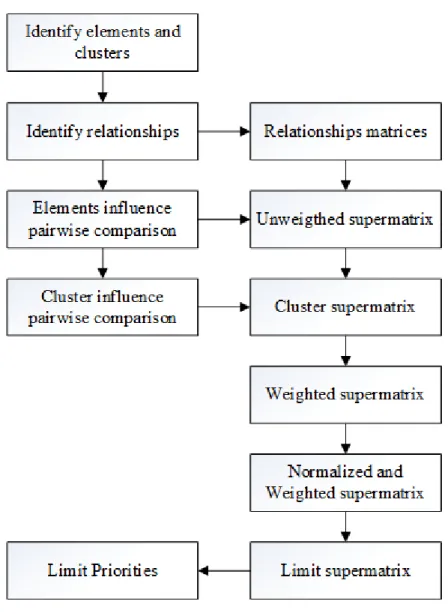
AHP is conceptually easy to use; however, its strict hierarchical structure cannot handle the complexities of many real world problems. As a solution, Saaty proposed the ANP model, a general form of AHP. ANP represents a decision-making problem as a network of criteria and alternatives (all called elements), grouped into clusters. All the elements in the network can be related in any possible way, i.e. a network can incorporate feedback and interdependence relationships within and between clusters. This provides a more accurate modeling of complex settings. The influence of the elements in the network on other elements in that network can be represented in a supermatrix. This new concept consists of a two-dimensional element-by-element matrix which adjusts the relative importance weights in individual pairwise comparison matrices to build a new overall supermatrix with the eigenvectors of the adjusted relative importance weights. According to Saaty [14], the ANP model comprises the steps shown in Figure 3.
Figure 3.- ANP steps scheme.
1) Given a decision problem with elements, the first step consists of building a model grouping the elements into clusters.
Let the element of the model, which belongs to cluster , with ,
.
Let the elements of cluster , . Let the number of elements of cluster .
2) Identify the elements‟ relationships, ask the DM, and obtain the (NxN) Elements‟ Relationships matrix, . where and
:
indicates that the element has no influence on the element , and in the graphical model there isn‟t an edge between and .
indicates that the element has some influence on the element , and in the graphical model there is an arc from to .
3) Obtain the (GxG) Clusters‟ Relationships matrix, . where
:
indicates that any element of cluster has influence on any element of cluster .
indicates that some element of cluster has influence on some (at least
one) elements of cluster .
4) Use usual AHP pairwise matrices (Eq. 1) to compare the influence of the elements belonging to each cluster on any element, and derive a priority vector, and obtain the (NxN) Unweigthed Supermatrix, , with and
, where is the influence of element i, which belongs to cluster , on element j, which belong to cluster .
indicates that element which belongs to cluster has no influence on element which belongs to cluster .
1 2 3 4 5 6 7 8 9 10 11 12 13 14 15 16 17 18 19 20 21 22 23 24 25 26 27 28 29 30 31 32 33 34 35 36 37 38 39 40 41 42 43 44 45 46 47 48 49 50 51 52 53 54 55 56 57 58 59 60 61 62 63 64 65 8
indicates that element which belongs to cluster is the unique element of cluster which has influence on element which belongs to cluster .
Given a cluster, , and an element j that belongs to cluster , , the sum of the unweighted values of the elements which belong to , that have influence on is 1. If any element of has influence on then the sum is 0.
Given
Columns sum, , indicates how many clusters have influence on the column element. Identify the components and elements of the network and their relationships. 5) Conduct pairwise comparisons on the clusters, obtaining the (GxG) Cluster
Weights matrix, with where is the influence of cluster on cluster .
, shows that any element of cluster has influence on any element of cluster
.
.
6) Calculate the (NxN) Weigthed Supermatrix , with
and , where .
is the weighted influence of element i, which belongs to cluster , on element j, which belongs to cluster .
7) Calculate the (NxN) Normalized and Weigthed Supermatrix, with
and , where
.
is the normalized weighted influence of element i, which belongs to cluster , on element j, which belongs to cluster .
. is a left-stochastic matrix
8) Raise the weighted supermatrix to limiting powers until the weights converge and remain stable (limit supermatrix), . is the final priority of element . If is an
1 2 3 4 5 6 7 8 9 10 11 12 13 14 15 16 17 18 19 20 21 22 23 24 25 26 27 28 29 30 31 32 33 34 35 36 37 38 39 40 41 42 43 44 45 46 47 48 49 50 51 52 53 54 55 56 57 58 59 60 61 62 63 64 65 9
alternative, is the rating of the alternative. If is a criterion, is the weight of the criterion.
Different authors apply AHP/ANP to energy decision making problems. AHP has been applied to evaluate bioenergy developments regarding their regional sustainability in Scotland [29]; to evaluate the competing solar thermal collection technologies applicable to electricity generation in India [3]; to prioritize barriers to energy efficiency in the small scale industry clusters in India [30]; to evaluate the renewable energy policy goals in Taiwan [31]. ANP has been used for the determination of the appropriate energy policy and evaluations of power plants in Turkey [32-34]. for evaluating alternative technologies for generating electricity from municipal solid waste in India [35]. Other authors use AHP combined with other methods. [36] use AHP combined with geographical information systems (GIS) to evaluate land suitability for wind farm sitting.. (28) Use fuzzy ANP to select a suitable location for developing a wind farm [37]. [26] use fuzzy AHP-TOPSIS for evaluation and selection of thermal power plant location. [38] use AHP for the selection of space heating systems for an industrial building.[39] use AHP to determine the weights of the criteria in order to assess the different portfolios of electricity generation technologies according to multiple stakeholder perspectives. These authors combine AHP with goal programming (GP) and technology forecasting of hydropower generation and storage technologies. [40] makes a comparative analysis between Axiomatic Design and fuzzy AHP applied to the selection of renewable energy alternative for Turkey. [41] use an integrated fuzzy VIKOR and AHP approach to determine the best renewable energy alternative for Istambul.
3. The decision making process and the AHP/ANP modeling approach
A model was developed based on the AHP/ANP multicriteria techniques (Analytic Hierarchy Process/ Analytic Network Process), proposed by Thomas Saaty, University of Pittsburgh, and described in the previous section. The decision-making process used in [42] and [43] has been adapted to our case study.
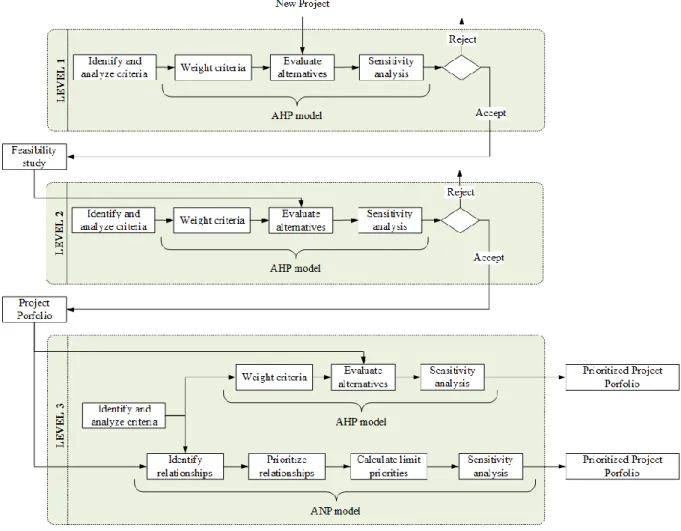
The goal of the decision problem is "Selecting Solar Thermal Power Plant projects from the project portfolio of the company." Due to the high engineering cost of this type of projects, the DM expressed the need for using a decision-making support tool which allowed him to reject an unfeasible project before having invested heavily in it. After several meetings with the DM we concluded that the selection should exclude technically and economically unfeasible projects, and establish a priority order among feasible projects based on risk minimization. The decision process was structured into three levels (Figure 4).
Figure 4.- Decision process proposed
These three levels can be briefly described as:
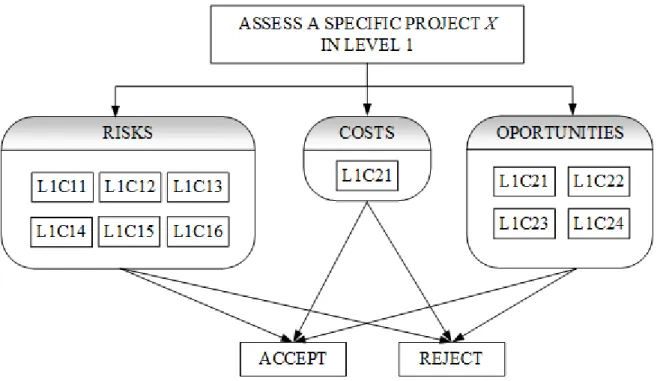
Level 1. Each new proposal submitted to the company is analyzed using a set of criteria called Level 1 criteria. Level 1 criteria only require the DM to have a basic knowledge of the project and this level involves relatively low engineering cost. In this level a hierarchy model (AHP) can be used for project Acceptance or Rejection.
Level 2. The proposals that have been accepted in Level 1 are analyzed using a new set of criteria, called Level 2 criteria. These new criteria require the DM to have a broader and deeper knowledge of the project as they are used to conduct project feasibility analysis. Again the alternatives of the decision problem are project Acceptance or Rejection.
1 2 3 4 5 6 7 8 9 10 11 12 13 14 15 16 17 18 19 20 21 22 23 24 25 26 27 28 29 30 31 32 33 34 35 36 37 38 39 40 41 42 43 44 45 46 47 48 49 50 51 52 53 54 55 56 57 58 59 60 61 62 63 64 65 10
Level 3. Accepted projects pass to Level 3, which means investing money in project execution. In this level, each project is compared with the other Level-2 accepted projects of the company‟s project portfolio. In this level, all projects are economically profitable for the company and the DM has to determine their priority order to minimize project investment risks. In Level 3 the alternatives are the different projects that were accepted in Level 2 and still have not passed Level 3. In this level, each proposal is analyzed in more detail and the projects are compared using another set of criteria called Level 3 criteria. For this level we propose the use of two decision models: an AHP-based hierarchy model and an ANP-AHP-based network model. Like in the other two levels the decision process will take into consideration the DM preferences, based on the data available and the DM‟s experience.
3.1.- Decision model: Level 1
In this level an AHP-based hierarchy model was used to decide if it is worth analyzing a solar thermal power plant project, i.e. if it is profitable to invest in a preliminary study of the project.
After several meetings with the MD we identified the following set of criteria, grouped as Risks, Costs and Opportunities.
L1-1 RISKS
- L1C11. Country risk. It assesses the risk of political and economic instability and level of corruption in the country.
- L1C12. Changes in energy policy. It assesses the risk of changes in the national energy policy that may affect the reliability of the economic feasibility of a project.
- L1C13. Changes in policy premiums. Many countries have premiums and tax benefits that encourage investment in renewable energy. Premium changes can jeopardize project investment profitability when compared to forecasts. This criterion assesses the risk of changes in premium policies which may cause premium reductions during the useful life of the plant.
- L1C14. Water supply. Water is essential for the operation of the plant. Water supply is a complex issue and factors such as specific regulations, water supply conditions and water flow rate in the area where the plant is to be built should be known in advance.
- L1C15. Financing. Funding is an essential factor. This criterion takes into consideration any funding or additional financial support of the project, such as state aid for investment or additional financial guarantees and the risks of not having any financial support. - L1C16. Effective solar radiation. Solar radiation is a fundamental parameter for an efficient performance of the plant. Essential data include the amount and stability of solar radiation in the area. This criterion assesses the risk of inacceptable deviations in
estimated average solar radiation due to external factors, such as random climate variations or pollution.
L1-2 COSTS
- L1C21 Investment. Cost estimates for the feasibility analysis of the project in the following levels.
1 2 3 4 5 6 7 8 9 10 11 12 13 14 15 16 17 18 19 20 21 22 23 24 25 26 27 28 29 30 31 32 33 34 35 36 37 38 39 40 41 42 43 44 45 46 47 48 49 50 51 52 53 54 55 56 57 58 59 60 61 62 63 64 65 11
- L1C31 Experience and degree of knowledge. Available previous reports, either from your own company or from other enterprises, about similar projects executed in the country or by the same promoter.
- L1C32 Market diversification. Potential opportunity to enter a new market so that investments are not only made in a single country.
- L1C33 Future synergies. Opportunities for development of future projects as a result of this project.
- L1C34 Hampering competition. Opportunity to stop, outperform or overtake competitors.
Figure 5 shows the resulting hierarchy model.
Figure 5.- Hierarchy model used in Level 1. 3.2.- Decision model: Level 2
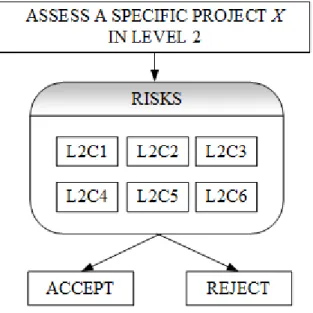
The projects accepted in Level 1 are those in which it is worth spending more resources for further analysis, according to the DM. However, as the engineering costs are high, the DM decided to include an intermediate step before investing a large amount of money in a project that might not be feasible. Therefore, a new set of criteria was used to analyze each project in more detail and decide whether to continue investing in the project or to reject it. Again the decision alternatives are "Accept" or "Reject" the project.
After two further meetings the DM proposed the following criteria:
L2-1 RISKS
- L2C1. Proximity to power line. To maximize plant efficiency and minimize implementation risks proximity to the electric substation is a positive factor.
- L2C2. Natural gas supply. In these plants natural gas consumption is about 10%, therefore it is necessary to secure natural gas supply in the plant site.
- L2C3. Land price. This type of plants requires a large area. Thus land prices have a significant impact on investment. This criterion assesses land prices in the area where the plant will be built.
- L2C4. Technology availability. As the market for the supply of essential plant components is small it may be necessary to purchase or order such equipment before signing the contract.
- L2C5. Intensity of natural disasters. The construction of plants in sites with high risk of natural disasters can increase investment and operational costs. The plant must be installed in safe places with low risk of natural disasters.
- L2C6. Easy access. This criterion assesses the existence of roads for an easy and safe access to the facilities.
Figure 6 shows the resulting hierarchy model.
Figure 6.- Hierarchy model used in Level 2
1 2 3 4 5 6 7 8 9 10 11 12 13 14 15 16 17 18 19 20 21 22 23 24 25 26 27 28 29 30 31 32 33 34 35 36 37 38 39 40 41 42 43 44 45 46 47 48 49 50 51 52 53 54 55 56 57 58 59 60 61 62 63 64 65 12
The projects that passed Level 2 constitute the project portfolio of the company. In Level 3 the problem formulated by the DM is "to establish a priority order among those projects that have proved to be technically and economically feasible." In this level, new criteria are identified for the assessment of project risks. The decision alternatives are the different projects of the portfolio.
After several working meetings, the DM identified the following risk criteria based on his experience.
L301 POLITICAL Risks
- L3C11. Licenses and permits. Depending on the country, the competent bodies shall grant administrative authorization. This criterion assesses the risks of refusal or delays in the administrative licensing process.
- L3C12. Changes in energy policy. Risks of changes in legislation may affect tax premiums.
L302 MACROECONOMIC Risks
- L3C21. Energy price variations. Risk of variations in energy prices throughout the life of the plant.
- L3C22. Changes in the price of money. Influence of inflation rates on the cash-flow obtained in the project over the useful life of the plant.
- L3C23. Changes in power demand. Risk of changes in energy demand that can affect the estimates of plant operation.
- L3C24. Bank financing. Risk of having to implement the phases of the project without the required funding.
L303 TIME DELAY Risks
- L3C31. Delays in plant operation. The power supply company must verify that the
conditions for grid connection are met. Demands for project changes, and the time it can take the investment company to obtain the permits, may cause delays in the execution of the project.
- L3C32. Delays in grid connection. Risk of delay in connecting the cable to the supply point provided by the power supply company. If the cable passes through properties belonging to third parties appropriate authorization is required and this may cause project delays.
L304 TECHNICAL Risks
- L3C41. Effective solar radiation. The impacts of all the other climatic parameters on the project can be calculated on the basis of the amount of effective solar radiation falling in the area. The parameters affecting solar radiation are: temperature, wind speed, humidity, vapor pressure, rainfall, etc. Solar radiation is calculated considering quantity, quality and hours of sunlight. This criterion assesses the risk of deviations in the estimates of solar radiation provided in the economic study.
- L3C42. Quantity of available water. It is essential to ensure supply of water needed for plant operation. This criterion assesses the risk of unstable water supply with respect to the
estimates given in the economic analysis.
L305 ECONOMIC Risks
- L3C51. Commissioning. Risk of higher grid connection cost and installation of an interconnection line. It is necessary to sign agreements with neighboring land owners. - L3C52. Remediation. Risk of higher remediation cost due to floods, earthquakes or other geotechnical problems.
1 2 3 4 5 6 7 8 9 10 11 12 13 14 15 16 17 18 19 20 21 22 23 24 25 26 27 28 29 30 31 32 33 34 35 36 37 38 39 40 41 42 43 44 45 46 47 48 49 50 51 52 53 54 55 56 57 58 59 60 61 62 63 64 65 13
Initially, as in the previous levels, we suggested the use of a hierarchy model (AHP). However, when the DM began to answer the questions for project prioritization, he considered that the influences between elements of the problem (criteria and alternatives) were evident. Thus the model evolved into a network model (ANP). In the following section both models are described to allow for comparison of results.
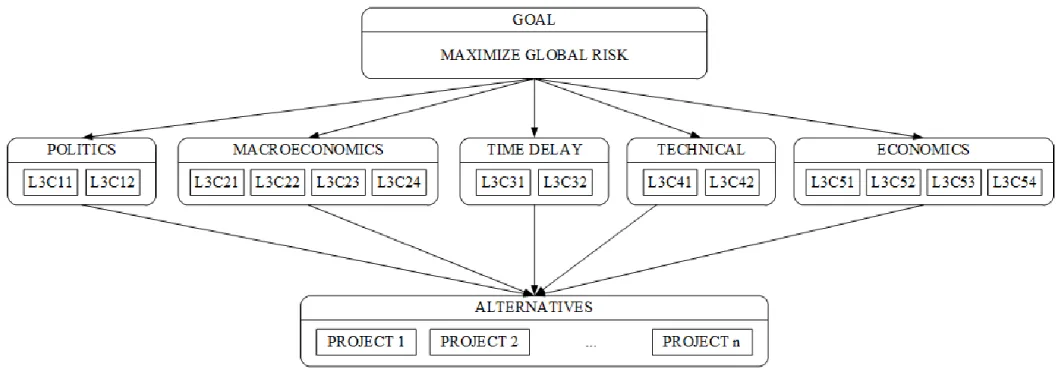
3.3.1.- The hierarchy model (AHP)
At the top of the hierarchy lies the goal of the decision problem. In this case, the goal is “Establishing a priority order among the solar thermal power plant projects of a company‟s portfolio based on project risk analysis." Because of the method used to establish priorities among the elements of the problem (criteria and alternatives), the goal was “Maximizing risks" because it was more intuitive for the DM to answer the questions about prioritization worded as follows: Which risk is more important? Which alternative has a higher risk? At the end of the process the project alternative with “the lowest" priority will be the best option, as it means the least risky project, which is the real goal of the decision process.
The criteria/risks have been structured in two levels and grouped by type of risk into Political, Technical, Economic, Time Delay and Macroeconomic. The last level of the hierarchy is formed by the project alternatives, i.e. the potential projects on which the expert makes the decision. (Figure 7)
Figure 7.- Hierarchy Model used in Level 3 3.3.2.- The Network model (ANP)
The ANP technique builds a network model of the problem structured into clusters containing elements that are related to/influence each other. The DM determines the influence
relationships between model elements based on his knowledge of the problem. This is one of the most critical stages of the ANP approach because of the difficulty in identifying the criteria that will influence others and the relative intensity of influence. The DM experts were asked about the influence of every criterion on the other criteria. They considered that in this ANP model all criteria exert some influence on the alternatives and vice versa.
In order to obtain the relationships among criteria the DM completed a questionnaire like the questionnaire shown in Table 3.
Table 3.- Questions of the Questionnaire that identify relative influences among criteria
The ANP relationships are shown in Table 4: Influence matrix. Thus, 1 in position in the
matrix means that the element in row i has influence on the element of column j (see ANP step 2 in Section 2).
Table 4.- Influence Matrix.
The next step of the ANP model consists of establishing influence intensity among the elements of the network model. To do this, it must be taken into account that the DM experts have considered that the criteria exert some influence on the alternatives and vice versa. This fact influences the results because if some alternatives changed, all the influences in which these alternatives participate would change.
1 2 3 4 5 6 7 8 9 10 11 12 13 14 15 16 17 18 19 20 21 22 23 24 25 26 27 28 29 30 31 32 33 34 35 36 37 38 39 40 41 42 43 44 45 46 47 48 49 50 51 52 53 54 55 56 57 58 59 60 61 62 63 64 65 14 4.- Case study
4.1.- Application of the Level 1 model
After building the hierarchy model, a questionnaire is developed as illustrated in Table 5 for the prioritization of the criteria and assessment of the alternatives. The questionnaire was used to analyze four projects. The weights obtained are shown in Table 6 and the scores of the alternatives for each project are shown in Table 7. The questionnaire was designed with the help of Superdecisons-Q software (http://sdq.webs.upv.es) to capture the model generated in Superdecisions.
Table 5.- Illustration of the questionnaire used in Level 1. Table 6.- Level 1 Criteria Weights.
Table 7.- Scores of the alternatives for four projects in Level 1
The more important criteria for the DM are L1C11 (Country risk) and L1C15 (Financing Risk), with a total weight of nearly half of the total weight. According to the DM, it is essential for a project that the country has a stable economic and political situation to go on with the study; otherwise, the other conditions have to be excellent in order to accept the project. On the other hand, Financing is a key point for project success; therefore, a project with financing risks is very likely to be rejected.
Criteria L1C21 (Investment) and L1C13 (Changes in policy premiums) occupy the third and fourth place in importance. Note that the DM gives more weight to risks than to opportunities and a project with high risks will be rejected in this first level of the decision process.
Although these four criteria account for most of the importance, there may be a
"compensating" effect by which apparently less important criteria greatly affect the final decision.
The four projects analyzed passed Level 1 because the alternative “Accept” was far better rated than the alternative “Reject”. The DM considered that a specific project should be accepted only if the priority of the alternative "Accept" is greater than 70%
4.2.- Application of the model of Level 2
The model of Level 2 was applied to four projects using questionnaires similar to those of Level 1. The weights and ratings are shown in Tables 8 and 9. Again the four projects analyzed passed this level because their priority is greater than 70%
Table 8.- Level 2 criteria weights.
Table 9.- Alternative Values for Level 2 projects
L2C5 (Intensity of natural disasters) is the most important risk, with almost half of the total weight. In this level, it is important to carefully study the characteristics of the site where the plant is to be built. Therefore, you must visit the site, obtain all available data on the risk of experiencing natural disasters (earthquakes, floods, wind ...) and quantify the likelihood of experiencing natural disasters over the useful life of the plant.
Criterion L2C4 (Technology availability) is the second most important criterion for the DM. Before starting the construction of the plant you should have all the equipment and
1 2 3 4 5 6 7 8 9 10 11 12 13 14 15 16 17 18 19 20 21 22 23 24 25 26 27 28 29 30 31 32 33 34 35 36 37 38 39 40 41 42 43 44 45 46 47 48 49 50 51 52 53 54 55 56 57 58 59 60 61 62 63 64 65 15
components needed for the construction of the plant. Certain components are scarce in the market and require a long manufacturing process, like the turbomachine for energy
transformation, therefore, delivery times for non-standard components should be agreed upon with the manufacturer.
The risk of not being close to the electricity or natural gas supply system has a small weight, and can be solved by increasing investment. If the site is far from the power evacuation line, the installation cost will be higher than estimated. The other criteria have less relative importance and their risk can be offset by increasing investment.
4.3.- Application of the Level 3 model. The hierarchy model
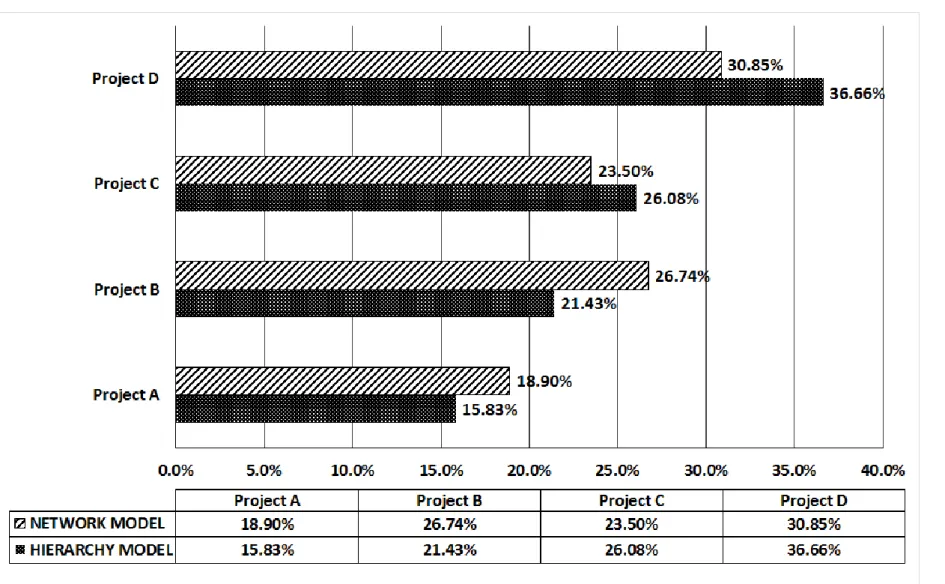
Using a questionnaire similar to those used in Levels 1 and 2, the priorities listed in Table 10 and Figure 8 were obtained.
Table 10.- Level 3 criteria priorities . AHP Model.
The best project is the least risky project; in our case study is Project A as weight values indicate the level of risk of a project.
4.4.- Application of the Level 3 model. The network model.
In this model, the DM sets the intensities of the influences identified above. The first step consists of assigning priorities to related elements in order to build the unweighted
supermatrix. To this end, each criterion is analyzed in terms of which other criteria exert some kind of influence upon it; then the corresponding pairwise comparison matrices of each
criteria group are generated in order to obtain the corresponding eigenvectors.
Following notation given in Section 2 the procedure is: let‟s suppose that some or all the elements (criteria or alternatives) of cluster influence one element of cluster . To determine which elements (among those that have some kind of influence) of have more influence on element , a reciprocal pairwise comparison matrix is built with the elements of . In order to fill in each component of the matrix n(n-1)/2 questions (n being the number of elements of that influence ) have to be answered. This procedure is repeated for each cluster whose elements exert some influence on element . In this way, for each column of the elements of the unweighted supermatrix we can identify blocks
corresponding to each of the clusters that exert some kind of influence on that element and whose values form the eigenvector that represents the relative influence of the elements of each cluster on element .
For this end an extensive questionnaire was developed using SuperDecisions-Q, with questions like those illustrated in Table 11.
Although the questionnaire contains many questions, they are easily answered by a DM with experience and knowledge of the decision problem. Additionally, some of the information already provided by the DM to fill the AHP model is used again here, more specifically, the priority order among the five sets of Level-1 hierarchy criteria, called "clusters" in ANP (Political, Technical, Economic, Time Delay and Macroeconomic) and prioritization of the alternatives (A, B, C and D) for each criterion.
1 2 3 4 5 6 7 8 9 10 11 12 13 14 15 16 17 18 19 20 21 22 23 24 25 26 27 28 29 30 31 32 33 34 35 36 37 38 39 40 41 42 43 44 45 46 47 48 49 50 51 52 53 54 55 56 57 58 59 60 61 62 63 64 65 16
Table 11.- Illustration of the Questionnaire used in Level 3 for the ANP model.
The data were processed with SuperDecisions software obtaining the Unweighted supermatrix (Tables 12).
Table 12.- Unweighted supermatrix. ANP Model.
Due to the fact that in the case study different elements from different clusters have influences on one element the unweighted matrix is non-stochastic by columns. Thus, according to [14], all clusters that exert any kind of influence upon each group have to be prioritized using the corresponding cluster pairwise comparison matrices. The value corresponding to the priority associated with a certain cluster weights the priorities of the elements of the cluster on which it acts (in the unweighted supermatrix), and thus the weighted supermatrix can be generated. Table 13 shows the Cluster Weights Matrix.
Table 13.- Cluster Weights matrix. ANP Model.
By raising the weighted supermatrix to successive powers the limit matrix is obtained. The results of the model are shown in Table 14 and Figure 8.
Table 14.- Criteria influence in the ANP Model.
Therefore, according to the ANP model, Alternative A should be the first option because it has the lowest risk. On the other hand, the analysis of the criteria shows that “Water supply” and “Licenses and Permits” have the highest scores, consequently they have the highest risk level.
4.5.- Comparison of results in Level 3.
Figure 8.- Comparison of outcomes in Level 3
The results (Figure 8) show that the project with the lowest risk, according to the DM, is Project A. However the order of projects B and C differs in the hierarchy and network
models. Since the DM identified influence relationships that appear in the network model but do not appear in the hierarchy model, the DM selected the solution obtained in the ANP model.
The weights of the criteria in the Hierarchy (AHP) and Network (ANP) models are compared in Table 15:
Table 15.– Comparison of Weights in AHP and ANP.
In AHP criteria priority is directly assigned by the decision maker, regardless of the projects to be evaluated, while in ANP criteria priority is adjusted based on the influences between the different elements as perceived by the DM. For example, in this case study, the decision maker considers Risk L3C12 Changes in energy policy to be extremely important. In the AHP model, the decision maker rated this risk as second in importance with a weight of 21.82%. However, in the ANP model, this risk presents similar rating values in the four projects.
1 2 3 4 5 6 7 8 9 10 11 12 13 14 15 16 17 18 19 20 21 22 23 24 25 26 27 28 29 30 31 32 33 34 35 36 37 38 39 40 41 42 43 44 45 46 47 48 49 50 51 52 53 54 55 56 57 58 59 60 61 62 63 64 65 17
Therefore in this particular example this criterion loses influence and moves down to the sixth place with a value of 6.23%.
The comparison analysis of the two models allowed the DM to reflect on the application of the model to future project portfolios. Initially, the DM believed that, once identified, the same decision criteria (risks) and weights could be applied to the analysis of future portfolios, having only to assess the new projects for each criterion. However, the analysis of this case study has shown that the only aspect that can be used for the analysis of future portfolios is the relative influence among criteria. Therefore, in each decision problem the DM will have to prioritize the influences of the criteria-alternatives and alternatives-criteria.
4.6.- Sensitivity Analysis
4.6.1 Sensitivity Analysis: Levels 1 and 2
In AHP, the most common sensitivity analysis consists of successively changing the weight of each criterion and observing how each of these changes affects the aggregate priority of the alternatives.
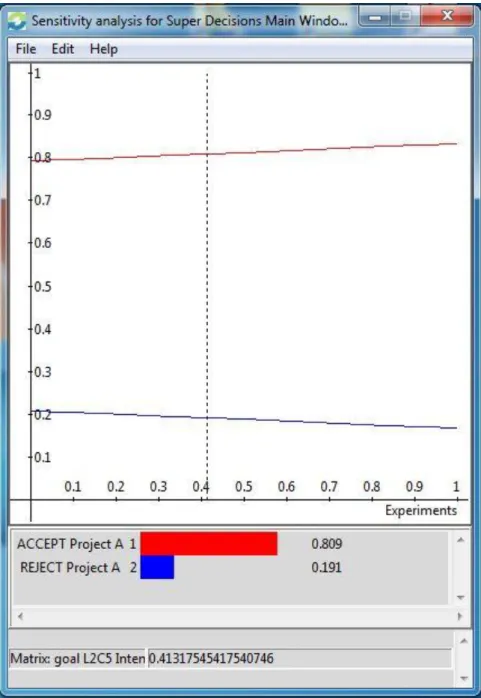
In the case study we used this type of sensitivity analysis and the results did not change significantly. All alternatives are stable for changes up to 10%. As an illustration, Figure 9 shows the result of modifying the weight of the Level-2 criterion with the highest weight (L2C5) when it is changed from 0 to 1 in 6 steps. Superdecisions software has been used to help with the calculus. X-axis shows the weight of the criterion and Y-axis shows the
priorities of the alternatives. The vertical dotted line on the X-axis indicates the position of the weight calculated from the DM judgments. In that position, the abscissa indicates the priority of the two alternatives. The two lines of the graph show how the priorities of the alternatives "Accept" and "Reject" vary when changing the weight of the criterion. It can be observed that the priorities do not intersect, which indicates that they are stable to changes in the weight of the criterion
The outcomes are logical given the large difference in the evaluations obtained by the alternative Accept against Reject project A.
Figure 9.- Sensitivity analysis of L2C5 Intensity of natural disasters for Project A
4.6.2. - Sensitivity Analysis: Level 3 Hierarchy Model
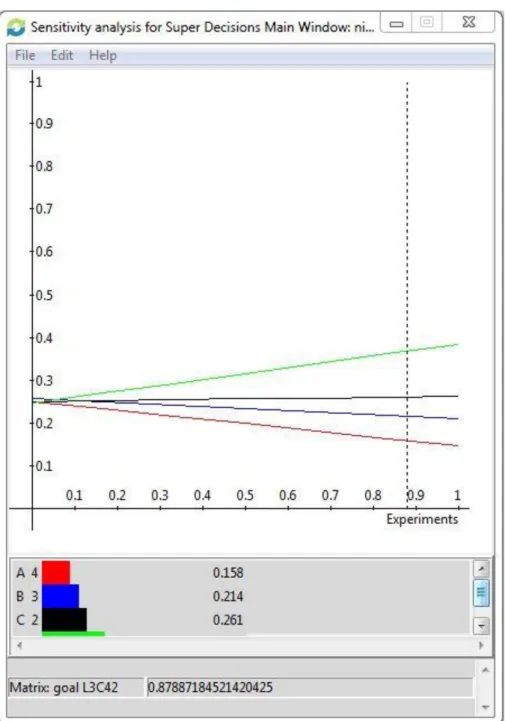
The sensitivity analysis used in the AHP model is similar to the analysis used in levels 1 and 2 because it is also a hierarchy model. As an illustration, the analysis of the most important criterion, L3C42 (Quantity of available water), is shown in Figure 10, where alternative A is represented in red, B in blue, C in black and D in green. The dotted line indicates the weight of the criterion. Varying the position of the dotted line by 10% compared to its initial position does not alter the result. The other criteria did not show significant variations.
Figure 10.- Sensitivity analysis of L3C42 (Quantity of available water) with SuperDecisions
4.6.3. - Sensitivity Analysis: Level 3 Network Model
The procedure was as follows: first we identified the criterion with the highest weight and then we observed on one hand, the elements that have most influence on it and, on the other
1 2 3 4 5 6 7 8 9 10 11 12 13 14 15 16 17 18 19 20 21 22 23 24 25 26 27 28 29 30 31 32 33 34 35 36 37 38 39 40 41 42 43 44 45 46 47 48 49 50 51 52 53 54 55 56 57 58 59 60 61 62 63 64 65 18
hand, those criteria on which this criterion exerts some influence. The following paragraphs describe the behavior of the network model when increasing or decreasing the weight of the elements that influence or are influenced by this criterion.
In the case study, this sensitivity analysis was performed on the criteria with the highest weights. By way of example, we explain all the steps followed on criterion L3C42 (Figure 11). In the weighted matrix the column corresponding to this criterion shows the elements that have most influence on it, namely Alternatives and Criteria L3C53 and L3C54. In the row of criterion L3C42 are the criteria influenced by this criterion. Criterion L3C42 has influence on the alternatives and criteria L3C31 and L3C54.
Figure 11.- Influence analysis of criterion L3C42 (Quantity of available water) in the weighted supermatrix. ANP Model
First, we analyzed the behavior of the elements (criteria and alternatives) that influence L3C42. As an illustration, Figure 12 shows how the priority of the alternatives changes when we modify the influence of Alternative A on criterion L3C42 (Position A-L3C42 in the weighted supermatrix) from 0-1 in 6 steps. The X-axis shows the value of the influence and the Y-axis shows the priorities of the alternatives. The vertical dotted line on the X-axis indicates the position of the influence calculated from the DM judgments (value 0.025 in the weighted supermatrix). In that position, the abscissa shows the priority of the four alternatives. In this figure, we can observe that when the influence of A on L3C42 is 0.3 (approximately) the priorities of the first ranked alternative change. Something similar happens for the other influences of the alternatives on the criterion. Figure 13 shows how the priority of the alternatives changes when we change the influence of criterion L3C53 on criterion L3C42 (Position L3C53-L3C42 in the weighted supermatrix). We can see that the lines of the graph do not intersect. This means that the ranking of the alternatives does not change when the influence value of criterion L3 changes from 0 to 1.
Figure 12.- Sensitivity analysis: A influences L3C42 with SuperDecisions
Figure 13.- Sensitivity analysis: L3C53 influences L3C42 with SuperDecisions
Secondly, we analyzed the behavior of the elements (criteria and alternatives) influenced by L3C42. As an illustration, Figure 14 shows how the priority of the alternatives changes when we modify the influence of criterion L3C42 on Alternative A (position L3C42-A in the weighted supermatrix) from 0-1 in 6 steps. The vertical dotted line on the X-axis indicates the position of the influence calculated from the DM judgments (value 0.457 in the weighted supermatrix). In that position, the abscissa shows the priority of the four alternatives. In this figure, we can observe that the priorities of the alternatives do not intersect. Something similar happens for the other influences of the criterion on the other elements.
Figure 14.- Sensitivity analysis: L3C42 influences A with SuperDecisions
Thus, according to this sensitivity analysis, we can say that criterion L3C42 is stable and the prioritization of the alternatives does not depend on small variations (± 10%) in the influences calculated in the weighted supermatrix.
1 2 3 4 5 6 7 8 9 10 11 12 13 14 15 16 17 18 19 20 21 22 23 24 25 26 27 28 29 30 31 32 33 34 35 36 37 38 39 40 41 42 43 44 45 46 47 48 49 50 51 52 53 54 55 56 57 58 59 60 61 62 63 64 65 19 5.- Conclusions
This work has reviewed the current state of the art of solar thermal power plant projects. Project analysis was performed for an investment company that has a portfolio of thermal power plant projects. Due to the high engineering cost of project analysis from the early stages of development we proposed a decision analysis divided in three levels. In this way, the Managing Board can reject unfeasible projects before investing heavily in them. The decision models proposed are based on the Analytic Hierarchy Process (AHP) and the Analytic Network Process (ANP). The models have been applied to a case study. Sensitivity analysis was performed to assess the robustness of model outcomes to changes in parameter values. In levels 1 and 2 the projects are analyzed individually and the alternatives are “Accept” or “Reject” a project. In level 3, the feasible projects of the portfolio are prioritized based on risk criteria. In this level we used a hierarchy model and a network model, and finally recommended the network model.
The use of ANP better reflects the complexity of the problem. The DM has been able to compare the outcomes of the different models and evaluate their advantages and
disadvantages. In our study, projects B and C can be considered of similar priority. The DM then should compare these results with the economic profitability analysis of the projects to finally decide whether to select project B or C, provided the company can invest only in two projects and not in three.
The decision maker found these techniques very useful because they helped him to make a deep reflection on the problem, as well as determine the criteria influencing the projects, analyze the influences among criteria and set priorities using the models proposed here. The DM had to answer some questionnaires that, though at first seemed difficult, were relatively simple and easy to answer. This procedure improves the current decision making process, providing more rigor and scientific robustness.
The method proposed in this work contributes conceptually and methodologically to better understand the complex process of decision making. The technicians who perform these studies have a tool which helps them to make their decision traceable, so that they can analyze different scenarios by changing the weights of the criteria. AHP and ANP do not replace the Decision Maker's preferences, but help to manage them and help the decision-maker reflect on them and analyze the outcomes.
The use of this technique takes no longer than the time currently employed by the technicians of the Company. However, it involves a change in the way of facing the whole process, as it necessarily requires some training and adaptation
Acknowledgements : The translation of this paper has been funded by the Universitat Politècnica de València
1 2 3 4 5 6 7 8 9 10 11 12 13 14 15 16 17 18 19 20 21 22 23 24 25 26 27 28 29 30 31 32 33 34 35 36 37 38 39 40 41 42 43 44 45 46 47 48 49 50 51 52 53 54 55 56 57 58 59 60 61 62 63 64 65 20 6.- References
[1] Fernández-García A, Zarza E, Valenzuela L, Pérez M. Parabolic-trough solar collectors and their applications. Renewable and Sustainable Energy Reviews 2010;14:1695-721. [2] Poullikkas A. Economic analysis of power generation from parabolic trough solar thermal plants for the Mediterranean region-A case study for the island of Cyprus. Renewable and Sustainable Energy Reviews 2009;13:2474-84.
[3] Nixon JD, Dey PK, Davies PA. Which is the best solar thermal collection technology for electricity generation in north-west India? Evaluation of options using the analytical
hierarchy process. Energy 2010;35:5230-40.
[4] Zhou X, Yang J, Wang F, Xiao B. Economic analysis of power generation from floating solar chimney power plant. Renewable and Sustainable Energy Reviews 2009;13:736-49. [5] Larbi S, Bouhdjar A, Chergui T. Performance analysis of a solar chimney power plant in the southwestern region of Algeria. Renewable and Sustainable Energy Reviews
2010;14:470-7.
[6] Schnatbaum L. Solar thermal power plants. European Physical Journal: Special Topics 2009;176:127-40.
[7] Gil A, Medrano M, Martorell I, Lázaro A, Dolado P, Zalba B et al. State of the art on high temperature thermal energy storage for power generation. Part 1-Concepts, materials and modellization. Renewable and Sustainable Energy Reviews 2010;14:31-55.
[8] Medrano M, Gil A, Martorell I, Potau X, Cabeza LF. State of the art on high-temperature thermal energy storage for power generation. Part 2-Case studies. Renewable and Sustainable Energy Reviews 2010;14:56-72.
[9] Caldés N, Varela M, Santamaría M, Sáez R. Economic impact of solar thermal electricity deployment in Spain. Energy Policy 2009;37:1628-36.
[10] IDAE Institute for Energy Diversification and Saving. Plan de Energías Renovables 2011-2020. Madrid: IDAE, 2011.
[11] Kingdom of Spain. Real Decreto-ley 9/2013, de 12 de julio, por el que se adoptan medidas urgentes para garantizar la estabilidad financiera del sistema eléctrico. BOE 2013;167, July 13th.
[12] Sharma A. A comprehensive study of solar power in India and World. Renewable and Sustainable Energy Reviews 2011;15:1767-76.
[13] Saaty TL. The Analytic Hierarchy Process. Planning, priority setting, resource allocation. New York: McGraw-Hill, 1980.
1 2 3 4 5 6 7 8 9 10 11 12 13 14 15 16 17 18 19 20 21 22 23 24 25 26 27 28 29 30 31 32 33 34 35 36 37 38 39 40 41 42 43 44 45 46 47 48 49 50 51 52 53 54 55 56 57 58 59 60 61 62 63 64 65 21
[14] Saaty TL. Decision making with dependence and feedback. The Analytic Network Process. The organization and prioritization of complexity. Second Edition. Second Edition ed. Pittsburgh: RWS Publications, 2001.
[15] Keeney R, Raiffa H. Decisions with multiple objectives: Preferences and value tradeoffs. New York: John Wiley & Sons, 1976.
[16] Saaty TL. Fundamentals of Decision Making and Priority Theory with the Analytic Hierarchy Process. First Edition ed. : RWS Publications, 1994.
[17] Saaty TL. Theory and applications of the Analytic Network Process. Decision making with Benefits, Opportunities, Costs and Risks. Pittsburgh: RWS Publications, 2005.
[18] Roy B. The outranking approach and the foundations of ELECTRE methods. Theory Decis 1991;31:49-73.
[19] Brans J, Vincke P, Mareschal B. How to select and how to rank projects: The PROMETHEE method. Eur J Oper Res 1986;24:228-38.
[20] Hwang C, Yoon K. Multiple attribute decision making: Methods and applications. New York: Springer-Verlag, 1981.
[21] Pomerol J, Barba-Romero S. Multicriterion decision in management: principles and practice. Boston HArdbound: Kluwer Academic Publishers, Norwell, 2000.
[22] Belton V, Stewart TJ. Multiple criteria decision analysis: An integrated aproach. London: Kluwer Academics Publishers, 2002.
[23] Figueira J, Greco S, Ehrgott M. Multiple Criteria Decision Analysis: State of the art surveys. New York: Springer, 2005.
[24] Wallenius J, Dyer JS, Fishburn PC, Steuer RE, Zionts S, Deb K. Multiple criteria decision making, multiattribute utility theory: Recent accomplishments and what lies ahead. Manage Sci 2008;54:1336-49.
[25] Bouyssou D, Marchant T, Pirlot M, Perny P, Tsoukias A, Vincke P. Evaluation and Decision Models: A critical perspective. Dordrecht: Kluwer Academic Publishers, 2000. [26] Choudhary D, Shankar R. An STEEP-fuzzy AHP-TOPSIS framework for evaluation and selection of thermal power plant location: A case study from India. Energy 2012;42:510-21. [27] Saaty TL. The Analytic Hierarchy and Analytic Network Processes for the measurement of intangible criteria and for decision making. In: Figueira J, Greco S, Ehrgott M, editors. Multiple Criteria Decision Analysis: State of the art surveys, New York: Springer; 2005, p. 345-407.
[28] Ishizaka A, Labib A. Review of the main developments in the analytic hierarchy process. Expert Systems with Applications 2011;38:14336-45.
1 2 3 4 5 6 7 8 9 10 11 12 13 14 15 16 17 18 19 20 21 22 23 24 25 26 27 28 29 30 31 32 33 34 35 36 37 38 39 40 41 42 43 44 45 46 47 48 49 50 51 52 53 54 55 56 57 58 59 60 61 62 63 64 65 22
[29] Kurka T. Application of the analytic hierarchy process to evaluate the regional sustainability of bioenergy developments. Energy 2013;62:393-402.
[30] Naghesa N, Balachandra P. Barriers to energy efficiency in small industry clusters: Multi-criteria-based prioritization using the analytic hierarchy process. Energy 2006;31:1969-83.
[31] Shen Y, Chou CJ, Lin GTR. The portfolio of renewable energy sources for achieving the three E policy goals. Energy 2011;36:2589-98.
[32] Ulutas BH. Determination of the appropriate energy policy for Turkey. Energy 2005;30:1146-61.
[33] Dagdeviren M, Eraslan E. Priority determination in strategic energy policies in Turkey using analytic network process (ANP) with group decision making. Int J Energy Res 2008;32:1047-57.
[34] Atmaca E, Burak Basar H. Evaluation of power plants in Turkey using Analytic Network Process (ANP). Energy 2012;44:555-63.
[35] Nixon JD, Dey PK, Ghosh SK, Davies PA. Evaluation of options for energy recovery from municipal solid waste in India using the hierarchical analytical network process. Energy 2013;59:215-23.
[36] Tegou L, Polatidis H, Haralambopoulos DA. Environmental management framework for wind farm siting: Methodology and case study. J Environ Manage 2010;91:2134-47.
[37] Kang H, Hung M, Pearn WL, Lee AHI, Kang M. An Integrated Multi-Criteria Decision Making Model for Evaluating Wind Farm Performance. Energies 2011;4:2002-26.
[38] Chinese D, Nardin G, Saro O. Multi-criteria analysis for the selection of space heating systems in an industrial building. Energy 2011;36:556-65.
[39] Cowan K, Tugrul D, Anderson T. Exploring the impact of technology development and adoption for sustainable hydroelectric power and storage technologies in the Pacific
Northwest United States. Energy 2010;35:4771-9.
[40] Kahraman C, Kaya I, Cebi S. A comparative analysis for multiattribute selection among renewable energy alternatives using fuzzy axiomatic design and fuzzy analytic hierarchy process. Energy 2009;34:1603-16.
[41] Kaya T, Kahraman C. Multicriteria renewable energy planning using an integrated fuzzy VIKOR & AHP methodology: The case of Istanbul. Energy 2010;35:2517-27.
[42] Aragonés-Beltrán P, Chaparro-González F, Pastor-Ferrando JP, Rodríguez-Pozo F. An ANP-based approach for the selection of photovoltaic solar power plant investment projects. Renewable and Sustainable Energy Reviews 2010;14:249-64.
1 2 3 4 5 6 7 8 9 10 11 12 13 14 15 16 17 18 19 20 21 22 23 24 25 26 27 28 29 30 31 32 33 34 35 36 37 38 39 40 41 42 43 44 45 46 47 48 49 50 51 52 53 54 55 56 57 58 59 60 61 62 63 64 65 23
[43] Aragonés-Beltrán P, Pastor-Ferrando JP, García-García F, Pascual-Agulló A. An Analytic Network Process approach for siting a municipal solid waste plant in the Metropolitan Area of Valencia (Spain). J Environ Manage 2010;91:1071-86.
1
Title: An AHP/ANP-based multi-criteria decision approach for the selection of solar thermal power plant investment projects
Authors: Pablo Aragonés-Beltrána , Fidel Chaparro-Gonzálezb, Juan-Pascual Pastor-Ferrandoc, * and Andrea Plá-Rubioc
a
INGENIO (CSIC-UPV), Universitat Politècnica de València. Camino de Vera s/n. 46022 Valencia. Spain
b
Department of Business , Universitat Politècnica de València. Camino de Vera s/n, 46022 Valencia, Spain.
c
Department of Engineering Projects, Universitat Politècnica de València. Camino de Vera s/n, 46022 Valencia, Spain.
*Corresponding author. Tel.: +34 96 387 9860; Fax: +34 96 387 98 69.
E-mail addresses: [email protected] (P. Aragonés-Beltrán) [email protected] (F. Chaparro-González) [email protected] (J.P. Pastor-Ferrando) [email protected] (A. Plá-Rubio)
*Marked Manuscript (*THIS VERSION WILL NOT BE TYPESET) Click here to view linked References
2
Title: An AHP/ANP-based multi-criteria decision approach for the selection of solar thermal power plant investment projects
Abstract
In this paper the Analytic Hierarchy Process and the Analytic Network Process are applied to help the managing board of an important Spanish solar power investment company to decide whether to invest in a particular solar thermal power plant project and, if so, to determine the order of priority of the projects in the company’s portfolio.
Project management goes through a long process, from obtaining the required construction permits and authorizations, negotiating with different stakeholders, complying with complex legal regulations, to solving the technical problems associated with plant construction and distribution of the energy generated. The whole process involves high engineering costs. The decision approach proposed in this paper consists of three phases. In the first two phases, the managing board must decide whether to accept or reject a project according to a set of criteria previously identified by the technical team. The third phase consists of establishing a priority order among the projects that have proven to be economically profitable based on project risk levels and execution time delays.
This work analyzes the criteria that should be taken into account to accept or reject proposals for investment, as well as the risks used to prioritize some projects over others.
Keywords: Analytic Hierarchy Process, Analytic Network Process, Solar thermal power projects.