A flat tax for the UK?
The implications of simplification
Richard Murphy BSc FCA Director, Tax Research LLP
ABOUT THE AUTHOR
Richard Murphy is a chartered accountant. Following graduation in Economics and Accountancy from Southampton University, he was articled to Peat Marwick Mitchell & Co in London. He specialised in tax before setting up his own firm in 1985. In 1989 this became Murphy Deeks Nolan, Chartered and Certified Accountants of which he was senior partner until he and his partners sold the then 800 client firm in 2000.
In parallel with his practice career Richard has been chairman, chief executive or finance director of more than ten SMEs. Richard has written widely on taxation and accounting, including for the Observer and many professional journals. He is a contributing editor of accountingweb.co.uk and has appeared in BBC radio and television documentaries on taxation issues.
Since 2000, Richard has been increasingly involved in taxation policy issues. He is a founder of the Tax Justice Network and director of Tax Research LLP, which undertakes work on taxation policy for a wide range of clients, including governments, government agencies, commercial organisations, aid agencies and pressure groups in the UK and abroad. Richard is a visiting fellow at the Centre for Global Political Economy at the University of Sussex.
Contents
Executive summary ... 5
Section A: The theory of flat taxes
1. What is flat tax? ... 92. Flat tax and the US ... 17
3. Countries that have flat tax systems ... 20
4. Testing the benefits of flat taxes ... 28
Section B: UK implementation
5. The impact on UK taxpayers ... 426. The impact on the public purse ... 53
Section C: Flat tax and the UK – the implications of simplification
7. The role of the state and its government ... 648. Flat tax and simplification ... 66
9. Other consequences of a flat tax ... 70
10. Flat tax rates ... 74
Appendix 1: The interviewees ... 76
Executive summary
As policymakers seek to assess the viability of flat taxes, this report from ACCA discusses:
1. what flat taxes are
2. what benefits are claimed for them
3. what evidence there is to support the claims 4. what issues a flat tax might raise in the UK. WHAT ARE FLAT TAXES?
According to the UK Treasury (2005), flat taxes are ‘tax structures that have a single positive marginal tax rate’. Technically this could cover income tax, corporation tax on company profits or VAT and some are even
suggesting such an arrangement should include national insurance. Most of the time though the taxes remain distinct and the term flat tax refers to a replacement for the existing income tax rules incorporating two key features:
1. an increased personal allowance 2. a single tax rate.
In some cases it is proposed that the same rate that is used for the flat income tax is also used for corporation tax, which is charged on the profits of companies. In practice, this is uncommon.
IS A FLAT TAX JUST A MATTER OF HAVING ONE TAX RATE?
Those who suggest flat taxes also suggest that all tax laws should be re-written at the same time. Such changes would change significantly the tax base on which tax is charged. Whereas in the existing income and corporation taxes it is all income (less expenses) that is charged to tax, under a flat tax regime only two
sorts of income are taxed, namely wages and the cash surpluses of businesses. The rest of income is untaxed. As a result flat taxes are technically consumption taxes and not income taxes. This is because their tax base is in practice much closer to that of a VAT than it is to income taxes. In a flat tax system all income from capital (whether of gains or income derived from it such as dividends and interest) is tax free. WHAT BENEFITS ARE CLAIMED FOR FLAT TAX SYSTEMS?
The main benefits that are claimed for flat tax systems are that they:
1. simplify the tax code
2. reduce the burdens on individuals who have to file tax returns
3. simplify business administration 4. cut the number of state employees who
administer tax
5. reduce the number of taxpayers 6. reduce the tax rate
7. reduce the incentive for tax evasion, and cut or eliminate tax avoidance
8. increase the fairness of the tax system 9. stimulate the economy
10. provide increased incentives to work.
Whether these benefits have been found in practice is hard to answer as no country has adopted a ‘proper’ or truly flat tax system. According to the UK Treasury (2005), ‘in all discussions on flat tax structures it must be remembered that the debate is in part so fierce because so little hard evidence exists to support the pro-flat tax claims’.
Flat taxes were rarely heard of in the UK before the mid 2000’s. During the summer of 2005 they became an important subject for debate. Emerging for some as the panacea for tax simplification, while viewed by others as unfair, flat taxes are the subject of a complex debate in the UK as well as internationally. With a new proposal for a flat tax for the UK published in February 2006 (Heath 2006) the issue continues to be significant.
WHAT IS THE COST?
Flat tax systems in Eastern Europe have generally increased the tax take of the governments who have introduced them, although it should not be presumed that this is the consequence of the use of flat taxes. Most of the countries in question have undertaken so many changes that a cause for increased tax revenues cannot be identified with certainty. In addition, other economic factors, such as Russia having also enjoyed the benefit of a booming oil economy, have to be taken into account. Indeed, in some states such as Romania and Slovakia the increases in tax following creation of a flat tax system were from national insurance and VAT and not from flat taxes.
In Western countries like the UK it is generally agreed, even by flat tax proponents, that a flat tax will cut government revenues. That is in fact the intention of some who propose flat taxes, such as Alvin Rabushka, who co-invented the idea. The loss that has been estimated for the UK varies between £35 billion and £59 billion (Teather 2005).
The latest proposal for a flat tax for the UK considers that 40% of the loss it suggests likely (of the highest figure, of £59 billion) could be recovered by economic growth stimulated by a flat tax (Heath 2006). The rest would have to be covered by cuts in public spending. THE ISSUES
A recent survey among SMEs in the UK suggests that the complexity of the UK tax system and the frequent changes that occur within it have helped create interest in flat taxes among this group (Tenon Group 2005). In the accompanying press release, however, it is warned: ‘No one knows yet exactly what a flat rate tax system will look like…there are a number of dangers [and]… flat rate tax could quickly become as complicated as the current system…’ (Tenon Group 2005).
The theory of flat taxes suggests significant simplification of the tax system; the assessment of
those systems undertaken for this report suggests they may be as complicated for small businesses and individuals and require as much or more form filling as the current UK tax system. In addition, flat tax systems appear likely to impose costs on government and to redistribute incomes in ways that require political judgement to be exercised, an issue beyond the scope of this report.
In consequence, introducing a flat tax would not be a simple issue. The complex issues are discussed in detail in this report, which pinpoints key questions such as:
• What is the role of the state and of government in taxation and the management of the economy? How does opinion on this affect the design of a flat tax system?
• Should tax be charged on income or consumption in a flat tax system? If on income, should that from overseas and that from savings be taxed? • The UK has complex rules on both residence and
domicile. The latter is relatively unusual and believed by the UK to provide it with competitive advantage. Would this advantage be lost under a flat tax system?
• Most countries, including the UK, have many international double tax treaties and other
obligations. To what extent should any tax reform be designed to meet such international obligations along with the needs of the domestic market? • Should small business be treated differently from
large business?
• How will trusts be taxed in a flat tax system? • What is the future of inheritance tax? Can a flat tax
replace it?
• What anti-avoidance measures are needed – and how should they be used in a flat tax system? • Is it necessary to have only one tax rate to achieve
simplicity? Executive summary (continued)
Section A: The theory of flat taxes
1. What is flat tax? ... 9
THE PEOPLE BEHIND FLAT TAX THEORY ... 9
THE DIFFERENT KINDS OF FLAT TAX ... 9
WHAT THE FLAT TAX REPLACES ... 14
SUMMARISING THE DIFFERENCES ... 14
THE BENEFITS OF A FLAT TAX ... 15
2. Flat tax and the US ... 17
WHY THE US TAX SYSTEM CREATES A DEMAND FOR CHANGE ... 17
WHAT THE FLAT TAX LOBBY SAY ABOUT THE US TAX SYSTEM ... 19
OTHER FLAT TAX PROPOSALS ... 19
3. Countries that have flat tax systems ... 20
ARE THESE FLAT TAXES? ... 21
THE EVIDENCE FOR SIMPLIFICATION ... 23
NATIONAL INSURANCE ... 25
WEIGHING UP THE EVIDENCE ... 27
4. Testing the benefits of flat taxes ... 28
TAX RATES ... 28
SIMPLIFICATION OF TAX ADMINISTRATION ... 28
Flat taxes were rarely heard of in the UK before the mid 2000’s. During the summer of 2005 they became an important subject for debate. With a new proposal for a flat tax for the UK published in February 2006 (Heath 2006) the issue continues to be significant. The following issues are explored in this section:
1. the theory of flat taxes
2. the claims made by those who propose flat taxes
3. the key changes in taxation that flat taxes would create
4. which countries use flat taxes and how their flat tax systems fit into their overall fiscal policy 5. what those who criticise flat taxes have to say on these issues.
THE PEOPLE BEHIND FLAT TAX THEORY
Two names dominate the theory of flat taxes: Robert E. Hall1 and Alvin Rabushka.2 Both are academics at the
Hoover Institution at Stanford University, who first proposed a flat tax in an article for the Wall Street Journal in December 1981. More detail is given in their book, The Flat Tax (Hall and Rabushka 1995). The system of taxation that Hall and Rabushka propose has been given indefatigable support by Steve Forbes,3
editor-in-chief of the business magazine, Forbes. He was a Republican candidate in the US Presidential primaries in 1996 and 2000, the flat tax being the main plank of his campaign(Forbes 2005:xvii). He continues to be the public figure most associated with the subject, most recently publishing a book, Flat Tax Revolution (Forbes 2005).
THE DIFFERENT KINDS OF FLAT TAX
In principle, a flat tax is a charge levied at a single percentage rate on those transactions liable to the tax. Examples might be:
• a tax on all income levied at just one rate, possibly with an exemption for income below an agreed annual limit
• a tax levied on some parts of a person’s income, again possibly with exemption for an annual set limit
• a tax levied on the purchase (or consumption) of goods or services within an economy.
Each of these contains the essential element of a flat tax. This essential element is that the flat tax charge has fixed proportionality with regard to the tax base. The resulting taxes are, however, different.
• The first description is of a tax on income, and might be called a single-rate income tax.4
• The second is the tax usually described as a flat tax, and broadly describes the Hall and Rabushka proposals, analysed in more detail below. In most cases such taxes are properly considered
consumption taxes (Hall and Rabushka 1995: 40), although Hall has described the tax he and Rabushka invented as an ‘American VAT’ (Hall 2004).
• The third description is of a European-style Value Added Tax system.
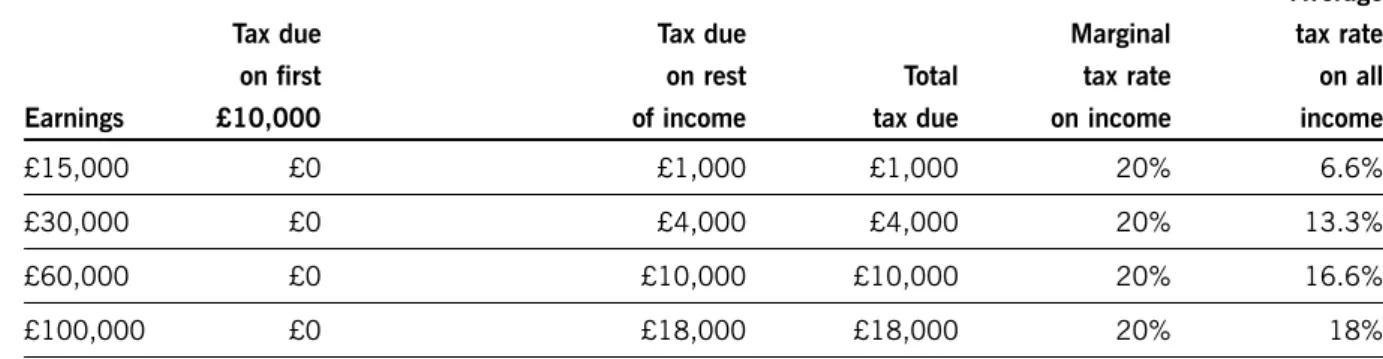
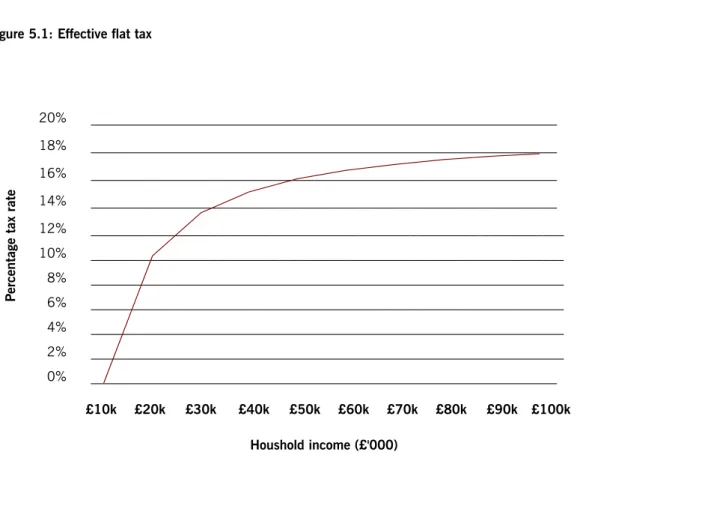
It must be stressed that although a flat tax has a single tax rate this does not mean, at least in the first two cases noted above, that the taxpayer has a fixed average tax rate. It means that there is a fixed marginal tax rate on income above an agreed limit. The
difference is important and is demonstrated in the following pages.
1 <http://www.stanford.edu/~rehall/>. 2 <http://www.stanford.edu/~rabushka/>. 3 <http://en.wikipedia.org/wiki/Steve_Forbes> and
<http://www.chooseflattax.com/about.asp>.
4 The author thinks this term helpful, and uses it to
differentiate income tax systems having just one tax rate from income tax systems that are otherwise similar but have multiple tax rates in use, as the UK does. The term is not, however, in widespread use.
Average
Tax due Tax due Marginal tax rate
on first on rest Total tax rate on all
Earnings £10,000 of income tax due on income income
£15,000 £0 £1,000 £1,000 20% 6.6%
£30,000 £0 £4,000 £4,000 20% 13.3%
£60,000 £0 £10,000 £10,000 20% 16.6%
£100,000 £0 £18,000 £18,000 20% 18%
Table 1.1: Comparison of marginal and average tax rates under flat tax
Tax due Average
Tax due on income Tax due Marginal tax rate
on first up to on rest Total tax rate on all
Earnings £10,000 £50,000 of income tax due on income income
£15,000 £0 £1,000 £0 £1,000 20% 6.6%
£30,000 £0 £4,000 £0 £4,000 20% 13.3%
£60,000 £0 £8,000 £4,000 £12,000 40% 20%
£100,000 £0 £8,000 £20,000 £28,000 40% 28%
Table 1.2: Comparison of the impact of marginal and average tax rates on progressive tax rates 1. What is flat tax? (continued)
Assume that in a tax system each individual has an annual exempt income level of £10,000, the flat tax rate is 20% and there are four individuals with earnings of £15,000, £30,000, £60,000 and £100,000 respectively. Their marginal and average tax rates will be as shown in Table 1.2.
It will be noted that the effective average tax rate of a person on £30,000 is double of that of a person on £15,000 in this example, whereas the increase in tax rate between an income of £60,000 and one of £100,000 is small. This is a feature of flat taxes. It means that they are progressive at lower rates of tax, but become close to proportional once the impact of the exempt amount becomes small in relation to total income.
If a higher rate of tax, at say 40%, were introduced for income above £50,000 then the results would be as in Table 1.2. The higher rate of tax has no impact on the two people with income below the limits at which it applies. The effect of the higher rate of tax is: • to increase the average tax rates of those on higher
earnings
• to maintain a progression in the average tax rate • to prevent there being a fixed marginal tax rate,
which is the key identifying element of a flat tax. Much of the debate about flat taxes on income is about whether progression in average tax rates is desirable, but it should be noted that in neither example does a person pay the top headline rate of tax, whether it be 20% or 40%.
The Hall and Rabushka / Forbes Flat Tax
Hall and Rabushka’s proposal (1995) for a flat tax applies to both individuals and companies. The details do, of course, differ between the two. The key
characteristics, almost all of which coincide with the proposals made by Forbes (2005), are as follows. 1. A single rate of tax for both individuals and
companies.
Forbes suggests a rate of 17%, compared with Hall and Rabushka’s 19%. No doubt the difference reflects general downward trends in taxation rates in the intervening years.5 Teather
(2005) suggests a rate of 22% for the UK while Allister Heath (2006) suggests 28% for all but pensioners, but with the rate to include national insurance contributions.
2. Significant exemptions for adults and children. Forbes suggests an allowance for each adult that is 66% higher than that available under the US tax code in 2005, with an additional allowance for each child. Under the UK tax system, tax allowances are no longer given for dependent children and married people are not taxed as a family unit. Teather (2005) suggests as an alternative a standard tax-free allowance for each individual of £12,000 per annum, a substantial increase from the (2006/07) £5,035 basic personal allowance.6 Heath (2006) suggests an
individual allowance of £9,000. 3. Changing the basis of taxation.
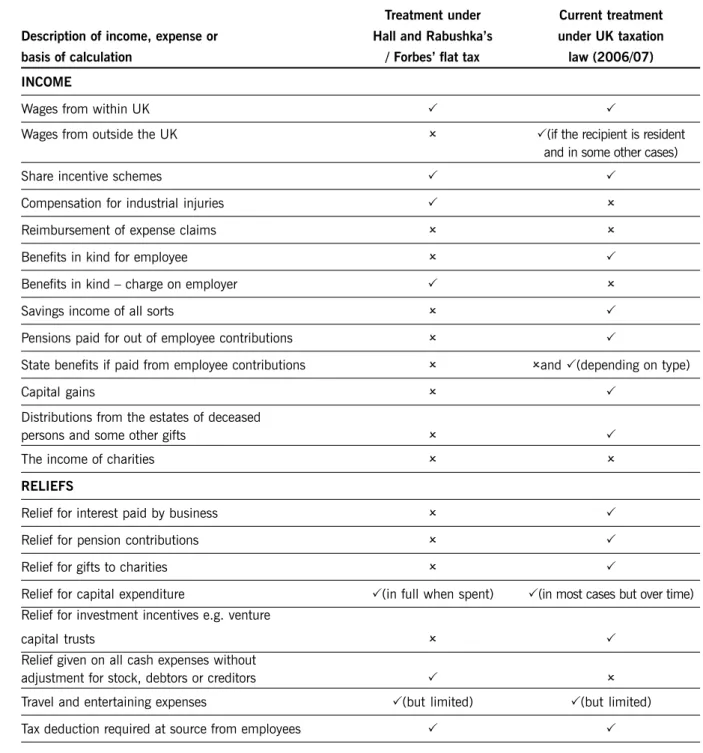
The main characteristics of a flat tax when compared with the current UK tax system is shown in Table 1.3 on page 12.
5 See, for example, KPMG’s survey of international tax rates at
<http://www.kpmg.co.uk/pubs/taxrates_04.pdf>.
6 Note: UK tax rates and allowances used in this report are
unless otherwise specified those for 2006/07 and are all based on data available from the website of HM Revenue & Customs <http://www.hmrc.gov.uk>.
Table 1.3: Comparison of flat tax with current UK tax system
Treatment under Current treatment Description of income, expense or Hall and Rabushka’s under UK taxation
basis of calculation / Forbes’ flat tax law (2006/07)
INCOME
Wages from within UK 3 3
Wages from outside the UK 2 3(if the recipient is resident
and in some other cases)
Share incentive schemes 3 3
Compensation for industrial injuries 3 2
Reimbursement of expense claims 2 2
Benefits in kind for employee 2 3
Benefits in kind – charge on employer 3 2
Savings income of all sorts 2 3
Pensions paid for out of employee contributions 2 3
State benefits if paid from employee contributions 2 2and 3(depending on type)
Capital gains 2 3
Distributions from the estates of deceased
persons and some other gifts 2 3
The income of charities 2 2
RELIEFS
Relief for interest paid by business 2 3
Relief for pension contributions 2 3
Relief for gifts to charities 2 3
Relief for capital expenditure 3(in full when spent) 3(in most cases but over time) Relief for investment incentives e.g. venture
capital trusts 2 3
Relief given on all cash expenses without
adjustment for stock, debtors or creditors 3 2
Travel and entertaining expenses 3(but limited) 3(but limited)
Tax deduction required at source from employees 3 3
Sources: Hall and Rabushka (1995: 142–145), Forbes (2005) and UK tax legislation 2006/7. 1. What is flat tax? (continued)
In the Hall and Rabushka system, tax relief is not provided for interest paid by businesses, since interest is not taxable when received by an individual in a flat tax system. The net effect is similar to an arrangement where tax is deducted at source from all payments of interest. This logic works only within national boundaries; it ignores the possibility that investment income can be derived from outside the country in which a person resides and might not have been taxed at source, so that by placing funds outside their country of residence a person might escape any taxation of interest income. The arrangement also increases the cost of borrowing for domestic firms if overseas competitors continue to enjoy tax relief on the interest they pay.
Key features
The key features shown in Table 1.3 opposite may be summarised as:
• one rate of tax for the income of individuals and companies
• no tax on foreign earnings • no tax on income from savings • no tax on capital gains • no tax on inheritances
• no relief for pension contributions or other savings incentives
• no relief for interest paid • charities not taxable • no relief for gifts to charities
• business taxed on cash flow, not profits.
As the contrast between ticks and crosses makes clear, this is very different from the existing UK tax system. According to Alvin Rabushka, when interviewed for this report, this is the most important benefit of a flat tax system. His main claim for flat taxes is that they ‘remove the tax code from the economy’. He added:
The degree to which it will be achieved will depend upon the rate which is selected – at a 10% rate it will achieve a whole lot more than at a 30% rate.
[Flat tax] removes the tax code from the economy in the sense that no particular activity is favoured over another.
If the rate is higher then the people will begin to think about avoidance and evasion and if the rate is lower the less they will think about that.
I like flat tax regimes below 20%; I don’t like flat tax regimes very much above 20%.
WHAT THE FLAT TAX REPLACES
The flat tax proposed by Hall and Rabushka (1995) and Forbes (2005) would abolish the following taxes: 1. income tax (Forbes 2005: 59)
2. corporation tax (Forbes 2005: 59)
3. capital gains taxes(Hall and Rabushka 1995: 117)
4. inheritance tax (Forbes 2005: 64).
It must, however, be stressed that their proposed flat tax does not eliminate any other tax, so the following taxes would remain:
1. national insurance (Forbes 2005: 60) 2. sales taxes such as VAT and excise duties7
3. local authority taxes (Forbes 2005: 60). That said, this is still a significant proposal for change, not least because it would leave just one tax in the UK assessed on income (national insurance) with all others being charged on consumption.
SUMMARISING THE DIFFERENCES The essential difference between the Hall and Rabushka flat tax and the current UK income and corporation tax systems is that flat taxes are a tax on consumption whereas the UK’s income and corporation taxes are taxes on income.
As Hall and Rabushka say, ‘a consumption tax is a tax on spending rather than income’ (1995: 40). The UK’s VAT is a consumption tax because it is charged on purchases by end consumers, but this is not of the sort of consumption tax envisaged by Hall and Rabushka.
The difference is substantially in the method of tax collection. For many people, the concept of VAT being collected by direct tax assessment may be hard to comprehend, but Hall and Rabushka (1995: 55) are quite clear about this point. They say ‘[h]ere is the logic of our system, stripped to the basics: we want to tax consumption’.
The Congressional Research Service of the Library of Congress in the US say they do this by creating a tax with two parts (Congress 2005):‘a wage tax and a cash-flow tax on businesses. (A wage tax is a tax only on salaries and wages; a cash-flow tax is generally a tax on gross receipts minus all outlays.)’
Their report goes on to say, somewhat more
technically: ‘It is essentially a modified VAT, with wages and pensions subtracted from the VAT base and taxed at the individual level’.
Another way of looking at this is to recognise that all a person can do with their income is either to spend it on consumption or to save it. Since income from savings is not taxed in the Hall and Rabushka model, and putting cash into savings is also not taxed, then it must follow that savings as a whole are not taxed in this system. Hence the only thing that must be taxed in a Hall and Rabushka flat tax is consumption. The logic may be convoluted, but the economic reality is as Hall and Rabushka say; their flat tax is a charge on consumption, and not income.
This difference is important for two reasons. First, as will be discussed in more detail below, no country has actually adopted Hall and Rabushka’s flat tax because none has opted to tax only consumption; all have continued to tax income. This is likely to be because all the countries that have so far adopted flat taxes do already have value added taxes, which are a tax on consumption. If they adopted the Hall and Rabushka flat tax they would in effect tax this source twice.
7 This is deduced from the fact that Forbes (2005) says that
all local and state taxes survive and in the US this is the level at which these taxes are charged. In Forbes (2005: 101) the use of a VAT by Slovakia is endorsed. The US does not have a VAT and as a result the question of its replacement does not arise in a US context.
Secondly, tax systems are most effective at tackling tax avoidance and evasion when there are the fewest possible boundaries between taxes. Hall and Rabushka (1995: 14) suggest their flat tax eliminates such possibilities for avoidance, and the elimination of allowances and reliefs that they propose clearly assists this objective, but their flat tax does open other opportunities for tax planning, particularly the following.
• If income can be shifted offshore in their system it becomes non-taxable. This is often a relatively easy thing to do. For example, a person in a flat tax state that used the Hall and Rabushka scheme could supply their personal services from an offshore company they owned, located in a country where no tax on profit was charged (as is commonly the case in offshore financial centres). If all the owner’s income from that company were taken as dividends then, because the income was from abroad and because it had been re-categorised as investment income (rather than income from the supply of labour), no tax would be due and the person supplying the services would escape all tax charges on this source of income.
• If income can be recategorised as gains, for example by the sale of future rights to earnings from a royalty stream, then a tax charge could be avoided. In addition, and as will be discussed later (see Chapter 2), because investment income and capital gains tend to be earned by the most affluent, the exempting of these sources of income from tax means that the argument that a flat tax is progressive because all income above a threshold is charged to a constant rate of tax does not hold; the argument applies only to earnings from employment. This affects the assessment of the effective rates of tax charged.
THE BENEFITS OF A FLAT TAX
Having identified what a flat tax is, we now look at the benefits claimed for it. The following is a summary of the claims made for a flat tax by Forbes (2005) and Hall and Rabushka (1995).
• Flat tax will simplify life by – simplifying the tax code
– reducing the burdens on individuals who have to file tax returns
– simplifying business administration – cutting the number of state employees who
administer tax
– reducing the number of taxpayers.
• Flat tax will enhance the credibility of the tax system by
– reducing the tax rate
– reducing the incentives for tax evasion – cutting or eliminating tax avoidance – closing all loopholes used for tax abuse – increasing the fairness of the tax system. • Flat tax will boost the economy by
– stimulating the economy – reducing inflationary pressure – reducing interest rates – encouraging saving – stimulating investment
– encouraging international competition – improving corporate transparency. • Flat tax will increase social well-being by
– providing increased incentives to work – protecting wealth
– supporting the family
– enhancing the status of government.
Grecu (2004) makes a different case for the introduction of a flat tax in the UK. He argues that ‘countries all over the world have understood that in order to be competitive in the global economy, they have to make their economic environments as friendly as possible to international businesses’.
He suggests that flat tax systems are the logical response to the demand for an environment that suits international business and that the ten main benefits of a flat tax system would be:
1. elimination of double taxation on savings and investments
2. increase in government revenue
3. considerable reduction in the time and cost of completing tax forms
4. the end of special interest lobbying, which is responsible for the growing complexity of the tax regime
5. exemption of the poor from paying any tax by means of a generous tax-free allowance
6. more control by individuals over their money and reduction of government infringements on privacy 7. reduction of interest rates because interest would
be tax-free
8. reduction of tax evasion by lowering the benefit from avoiding taxes
9. the British fiscal system would be more attractive to foreign investment
10. simplicity, economic efficiency, and fairness. 1. What is flat tax? (continued)
WHY THE US TAX SYSTEM CREATES A DEMAND FOR CHANGE
Hall and Rabushka’s flat tax was designed for use in the US. The US tax system is in some ways very different from that of the UK, as the examples below show. 1. The US does not have a national sales tax.8 The
UK has had a value added tax (VAT) since 1973. 2. The US charges income tax on both individuals
and corporations at a federal level as well as, in most cases, at state level. The UK charges income and corporation taxes only at the national level.
3. The US tax code depends heavily upon filing of individual tax returns and there is a limited culture of withholding tax at source: 131 million individual tax returns and over 6 million corporate tax returns were filed in the US in 2004.9 That is, 44% of the total population filed
a tax return.10 In contrast, 9.8 million tax returns
were issued in the UK in 2005,11 covering 16%
of the UK population.12 In Estonia 84% of
taxpayers submit a tax return.13 Many UK
persons in paid employment will never complete a tax return as their earnings from employment are taxed at source, as is their investment income. In addition, many of the reliefs to which they are entitled, eg on pension contributions and
charitable donations, are paid directly to the recipient organisation.
4. The US tax code is significantly more
complicated than the UK tax code. A US citizen can, for example, obtain tax relief on their tax return if they buy certain forms of hybrid fuel cars (Forbes 2005: 11). The relief is intended to promote a clean environment but is indicative of an enormous range of reliefs available to
individual US tax payers that are unimaginable to UK tax payers.
5. So complex is the US tax system that at least 70% of US taxpayers elect not to claim all the deductions and reliefs to which they might be entitled and do, instead, claim standard deductions.14 This is not an option in the UK tax
system because it is one that is not needed. 6. Because the US tax system creates so many
reliefs and deductions, a person’s tax rate can fall to what is considered an unacceptably low level by the US Tax Code. At that point another tax is used and the taxpayer’s tax liability is calculated under the rules of the Alternative Minimum Tax.15
This cancels the reliefs that would otherwise be available. Some have suggested that this is, in fact, a form of flat tax at either 26% or 28% (depending upon circumstances),16 but others
contest this.
8 The US does have local sales taxes using a wide variety of
rates and methods of calculation varying from state to state and county to county, but no national tax. See the web site of the American Institute of Certified Public Accountants <http:// www.aicpa.org/yellow/yptstax.htm>.
9 Document 6292 downloaded from <http://www.irs.gov/
taxstats/article/0,,id=97308,00.html> on 2/1/06.
10 Population data from <http://www.cia.gov/cia/publications/
factbook/geos/us.html> on 2/1/06.
11 <http://www.gnn.gov.uk/content/detail.asp?ReleaseID=
182746&NewsAreaID=2&NavigatedFromSearch=True>, accessed 2/1/06.
12 Population data from the Office of National Statistics
<http://www.statistics.gov.uk/CCI/nugget.asp?ID=6>, accessed 2/1/06.
13 Information supplied by Ivo Vanasaun, Head of Direct Taxes
Division, Estonian Ministry of Finance, during an interview undertaken for the purposes of this report 16 February 2006.
14 Estimates of Taxpayers Who May Have Overpaid Federal
Taxes by Not Itemizing: United States General Accounting Office, April 12, 2001 downloaded from <http://www.gao.gov/ cgi-bin/getrpt?GAO-01-529>, accessed January 2006.
15 See the website of the US Internal Revenue Service <http://
www.irs.gov/newsroom/article/0,,id=107843,00.html>.
Because of these characteristics of the US tax system, US taxpayers may be:
• more aware of their actual levels of income than are the many UK taxpayers who do not have to prepare a tax return
• more aware of the tax that they pay, for the same reason
• generally bear a greater administrative burden with regard to tax than is usual in the UK, this being particularly true of employees.
Anecdotal evidence from a wide range of US websites suggests that this is the case.17
It is curious that, despite his belief that flat taxes reduce the administrative burdens on individuals, Alvin Rabushka thinks that everyone should be compelled to complete a tax return, something that is alien to the UK tax environment. When interviewed for this report he said:
I would have everyone fill in a tax return because a) I want every citizen to do individual accounting each year with his government [and] b) I believe that if
16 For example, see <http://www.newsmax.com/archives/
articles/2005/12/25/210345.shtml>.
17 See, for example, the list of civil society groups concerned
with tax at <http://www.taxsites.com/policy.html>. In the UK this concern tends to be limited to professional institutes and trade bodies, eg ACCA and the Forum of Private Business.
everybody each year had to fill out their own individual tax return they’d be a little bit more demanding politically about how their money is spent. In the case of the income tax for those who don’t have to file because it is done by the business for them they’re not really very conscious of value for money in public services but I’m willing to offer a compromise to this. I would be happy with a slight modification in which all of those British nationals who don’t have to file a return because pay as you go covers it: that is that at the end of the year the company sends out a form which shows how much tax was paid in duplicate and you have to sign the form and return one copy and keep the other, that would be the equivalent of having to file a tax return so that you’re told at the end of each year, by golly this is what you paid and I think that anything that brings home to the average taxpayer each year the absolute amount paid in tax and you have to stare it in the face, I think that’s a more effective political vehicle for raising questions about the efficiency and value of public expenditure. He made it clear that in this way he wants a flat tax in the UK to help to create the awareness of tax that exists in the US system.
WHAT THE FLAT TAX LOBBY SAY ABOUT THE US TAX SYSTEM
Closely reflecting the opinions of Hall and Rabushka (1995), Forbes (2005) makes the following comments on the US tax system.
1. Americans pay too much tax (2005: 4). In making this claim Forbes does, however, cover a broad range of taxes such as federal income taxes, state income taxes, social security charges and sales taxes.
2. The tax code is too complex (2005: 5). Forbes notes that it contains more than 9 million words and compares this with the Bible’s 773,000 words. 3. Tax breeds corruption (2005: 8). He criticises
much tax avoidance and the lobbying that creates these opportunities. He describes this as ‘useless economic activity’. He also suggests that the complex tax code encourages tax evasion. 4. The tax code is unfair (2005: 10). Many
deductions available under the US tax code are claimed only by the affluent and it tends to be middle-income earners who are caught by the Alternative Minimum Tax. He suggests as a result that middle-income earners are suffering under the existing system.
5. Tax discourages economic growth (2005: 11) because, he argues, ‘taxes are the price the government charges us to work’. He suggests that if the price of work were reduced more work would be done. He also suggests that there would be more saving.
6. The tax code undermines trust in the government (2005: 15). Because the tax code allows people on the same income to pay different amounts of tax depending upon their circumstances and the choices they make about their expenditure, he argues that people are not confident that the government is treating them equally and that this undermines the social contract.
OTHER FLAT TAX PROPOSALS
It should be noted that the flat tax promoted by Hall and Rabushka is not the only proposal for reform of the US federal tax code. Other options that have been proposed (Congress 2005) include the following. 1. A European-style VAT; the US has no such tax. 2. A retail sales tax. This tax differs from a VAT by
being charged only to consumers. The difficulty is that it is very hard to identify who consumers are in many cases.
3. Consumed income tax. This is, in effect, an income tax except that any transfers to designated savings accounts (which may well share many of the characteristics of a personal pension fund) would be considered deductions from income. Although flat taxes are the most talked about of the proposals before Congress (largely because tax systems bearing this title are in use in a number of East European countries), Steve Forbes thinks that a national retail sales tax is the most likely challenger to his flat tax proposal. He dedicates a whole chapter of his book to suggesting why it would not work as a replacement for the federal income tax(Forbes 2005: Chapter 5). It is claimed that 600,000 Americans have joined organisations that support a retail sales tax.18
The proposals for such a tax before Congress are said to have the strongest legislative support of any proposal for tax reform before the House.19 Because
VAT is universal in Europe there is no equivalent political move in either the UK or continental Europe.
18
<http://fairtaxreform.blogspot.com/2005/04/geter-done-economists-nationwide.html>, accessed 4 January 2006.
19 Ibid.
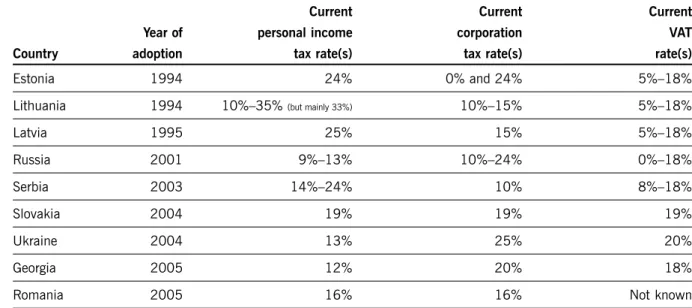
Table 3.1shows the countries which are considered to have flat taxes (HM Treasury 2005a). In each case their year of introduction and their current personal income tax, corporation tax and VAT rates are shown in Table 3.1.
Several issues can be identified from Table 3.1. • Three countries have more than one income tax
rate, even if in each case one is used predominantly. For example, Russia charges 9% on dividend income as opposed to 13% for all other income. • Three countries also have more than one corporation
tax rate, although in Estonia this is because the tax rate depends on whether the profit is distributed or not. In that country the effective corporation tax rate is 24% when distributions are made, but 0% on retained profit.
Table 3.1: Countries with flat tax systems
Current Current Current
Year of personal income corporation VAT
Country adoption tax rate(s) tax rate(s) rate(s)
Estonia 1994 24% 0% and 24% 5%–18%
Lithuania 1994 10%–35% (but mainly 33%) 10%–15% 5%–18%
Latvia 1995 25% 15% 5%–18% Russia 2001 9%–13% 10%–24% 0%–18% Serbia 2003 14%–24% 10% 8%–18% Slovakia 2004 19% 19% 19% Ukraine 2004 13% 25% 20% Georgia 2005 12% 20% 18%
Romania 2005 16% 16% Not known
Source data on tax rates: see footnote 21.
• Reliable data are hard to secure in some cases, eg in Romania. Many of the tax systems of countries that have recently adopted flat taxes are subject to frequent change at the time of writing.
Some trends are also apparent.
• Early adopters generally have higher tax rates than more recent adopters.
• Early adopters tend to be the countries with more variations in rates.
• Early adopters have income tax rates higher than corporation tax rates. This trend has been reversed among recent adopters, with Slovakia (the only country to have a consistent income tax, corporation tax and VAT rate) apparently the pivotal country in this case.
In all cases where a flat tax has been adopted, previous, higher rates of tax were lowered. For example, the flat tax in Romania replaced personal progressive tax brackets ranging from 18% to 40% and a corporate tax rate of 25% (Ernst & Young 2005). It should be noted, however, that in almost every case one of the principle motivations for change was the need to recover tax where the previous system had failed to do so. For example, the CIA Factbook says that Georgia ‘suffered from a chronic failure to collect tax revenues, however, the new government is making progress in reforming the tax code, enforcing taxes, and cracking down on corruption’ (CIA 2006). For the same reason, Ivo Vanasaun, Head of Direct Taxes Policy Department in the Ministry of Finance of Estonia, admitted in February 2006 that Estonia cannot compare its achievement in using a flat tax with its previous economic record because those records are too unreliable.20 This is a theme returned to later in
this report (see Chapter 6, ‘The impact on the public purse’).
ARE THESE FLAT TAXES?
The countries shown in Table 3.1 are now assumed to have flat taxes, even though some have multiple tax rates for either income or corporation taxes. This is because they do predominantly operate single rate tax systems. As already noted, however, the use of a single tax rate is only one indication of the existence of a flat tax system on the Hall and Rabushka model. The others are:
• one rate of tax for the income of individuals and companies
• no tax on foreign earnings
• no tax on income from savings, including pensions • charities are not taxable
• no tax on capital gains • no tax on inheritances
• no relief for pension contributions or other savings • no relief for interest paid
• no relief for gifts to charities • no other allowances and reliefs
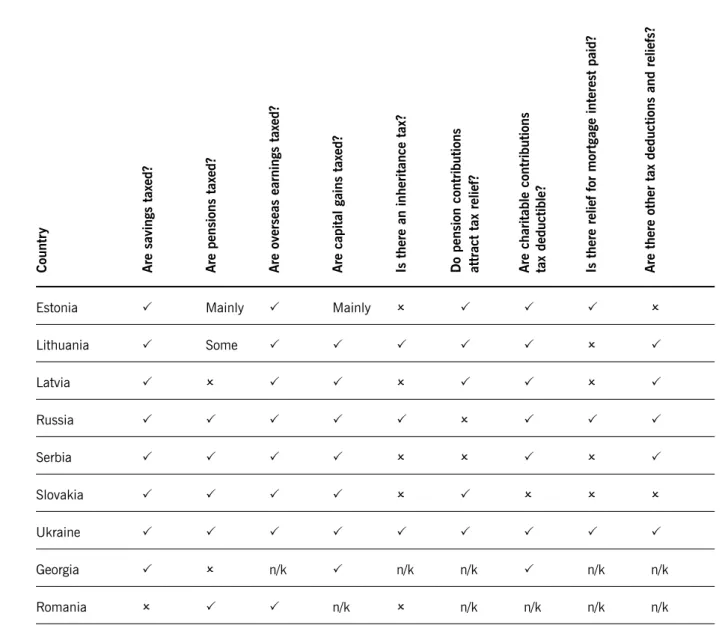
• business taxed on cash flow, not profits. Table 3.1 shows that all countries bar Slovakia and Georgia fail the first test. It is important to review whether the others also apply. Table 3.2 (see p. 22) explores these and other related issues.21
20 Speaking at the International Academic Forum on Flat Tax
Rate, Bled, Slovenia, 3 February 2006.
21 Extensive research was required to produce this table.
Sources include country taxation guides published by PricewaterhouseCoopers and KPMG (in the main), Deloittes and Ernst & Young. Additional information came from worldwide-tax.com and the American Chamber of Commerce in Georgia. Wherever possible multiple sources have been used to ensure the latest data are reported. Despite this, in some cases information could not be found. In no case should the information in this table be used as the basis of an investment decision. It is provided for illustrative purposes only. All data were accessed in January and February 2006.
Country Are Are Are Are Is there Do Are Is there Are savings pensions overseas capital an pension charitable relief for other taxed? taxed? earnings gains inheritance contrib contrib mortgage tax
taxed? taxed? tax? -utions -utions interest deductions
attract tax paid? and
tax relief? deductible? reliefs?
Estonia 3 Mainly 3 Mainly 2 3 3 3 2
Lithuania 3 Some 3 3 3 3 3 2 3 Latvia 3 2 3 3 2 3 3 2 3 Russia 3 3 3 3 3 2 3 3 3 Serbia 3 3 3 3 2 2 3 2 3 Slovakia 3 3 3 3 2 3 2 2 2 Ukraine 3 3 3 3 3 3 3 3 3 Georgia 3 2 n/k 3 n/k n/k 3 n/k n/k Romania 2 3 3 n/k 2 n/k n/k n/k n/k Notes
3= yes; 2= no; n/k = not known.
Where a comment is made this is a value judgement based on available information. Source: see footnote 21, p. 21.
Countr
y
Are savings tax
ed?
Are pensions tax
ed?
Are overseas earnings tax
ed?
Are capital gains tax
ed?
Is there an inheritance tax? Do pension
contributions
attract tax relief? Are charitable contributions tax deductible? Is there relief for mor
tgage interest paid?
Are there other tax deductions and reliefs?
Table 3.2: Taxable income in flat-tax countries 3. Countries that have flat tax systems (continued)
Other tax deductions include relief for the cost of commuting in three cases and relief for the cost of education in all five cases noted. Other reliefs, eg for trade union subscriptions and professional fees also appear to be available in some instances.
In addition, testing was done to see whether business taxation was assessed on a cash flow basis and whether 100% capital allowances were provided. There was no case where a cash flow basis was used and likewise no case where 100% first year allowance for capital expenditure was allowed for anything but the very smallest of companies.
If pure flat taxes were in operation the answer to all the questions in Table 3.2 should have been ‘no’. That means (taking the additional points on the basis of tax preparation and the treatment of capital expenditure into consideration) that there should have been a total of 99 ‘no’ answers. Data could not be found for ten questions. In the three cases where a comment has been made the answer is taken to be ‘yes’ since in every case at least some of the income described is taxed. On that basis, on the remaining 89 tests only 16 ‘no’ answers can be given (18%). This leaves 73 positive answers (82%). Slovakia has the purest flat tax, with four negative answers. The Ukraine had no negative answers.
When interviewed, Alvin Rabushka said of these systems:
I would say that all of these countries are flat tax regimes in the sense that there’s only one marginal rate of tax above the threshold. None of them meet 100% of the criterion of the HR framework … but in every case they are better than what they replaced … and are a whole lot better than most of everything in the rest of the world.
It is, however, interesting to note that he was not aware of all their characteristics. He said:
You know almost every country in the world has a territorial tax system. Very few have a global tax system and this is true despite the fact that you have relatively easy movement of capital and open borders. By territorial I mean income earned in the country is taxable, income earned abroad is not.
When the evidence noted above that all the flat tax systems use what he calls a global tax system was presented to him he was surprised and sought reassurance that this was indeed the case. THE EVIDENCE FOR SIMPLIFICATION
Alvin Rabushka argues that simplification is the most important component of the flat tax. He said, when interviewed,‘the whole purpose of a flat tax is really to simplify the system and produce a more efficient economy’. We need to consider the value business owners put on simplicity and then whether
simplification has actually happened in the countries in Table 3.2.
Those in business who favour flat taxes appear to do so because they wish for a simplification of the tax system. The Tenon Group (a stock-exchange-listed UK firm of accountants) published the results of a survey of opinion on flat taxes among UK businesses in December 2005. Key findings (Tenon Group 2005) were as follows.
• 78% of those surveyed thought the UK tax system too complicated.
• 73% were in favour of a flat tax scheme. • Those in favour of flat taxes thought they were
better because they would: – save them time (98%) – be simpler (97%) – save them money (78%).
• Those who disapproved of a flat tax system gave the following reasons:
– they were happy with the existing system (4%) – flat tax would be more time consuming (13%) – flat tax would be more difficult to administer
(24%)
– flat tax would cost them more (20%). Those who prepared the report added the following observations.
• The bigger the business the less likely it was to be in favour of flat taxes.
• A flat rate tax was particularly popular with retail, leisure and utility companies, of whom 84% were in favour of the change.
• There was a strong feeling that a lack of understanding about how a flat rate tax scheme would operate meant it was being positioned erroneously as a panacea.
• Some questioned how long the new system would remain ‘simple’ and pointed out that in reality companies often benefit from the current system’s complexities in the form of grants, exemptions and allowances for small and medium-sized businesses. Despite the doubts expressed by Tenon, it is clear that those they surveyed have a strong desire for simplicity. In that context, the review of rates and allowances in Table 3.2 was extended to note whether complexity was removed within the flat tax systems of Estonia, Latvia, Lithuania, Russia and Slovakia, which are the most developed of the flat tax nations and are therefore likely to provide the best evidence of how the system might work in practice.
Evidence on complexity
The potential complexity of business taxation in a flat tax state is shown by the following lists of partly disallowable and wholly disallowable expenses that might be incurred by a business in Lithuania.22
Partly allowed expenses, which may be tax-deductible subject to certain requirements, include the following:
· depreciation and amortisation of fixed assets; · maintenance, repair and reconstruction of fixed
assets (except for cases when such
maintenance, repair or reconstruction prolongs period of duty of fixed assets);
· business trips;
· advertising and entertainment; · ordinary loss of inventories; · taxes;
· bad debts;
· payments to the benefit of employees; · provisions of credit institutions and insurance
companies;
· granted support;
· membership fees;
· tax losses.
The main types of non-deductible expenses are as follows:
· penalties and default interest;
· interest and other payments related to the obligations of related parties;
· expenses paid to the related parties due to damaged or wrongly produced production exceeding the earned income;
· charity and support (except for the deductible part of support);
· payments to foreign entities, which are not taxed by withholding tax;
· compensations for damages;
· dividends and other appropriations;
· expenses of purchased goods (services) from tax haven entities, if these goods (services) are not paid for after more than 18 months;
22 Reproduced from pages 62 and 63 of Investment in the
Baltic States: A Comparative Guide (KPMG 2005).
· payments to tax haven entities if a Lithuanian entity does not prove that these payments are related to ordinary activities of tax haven entities. The quotation is lengthy, but the point is important. This list suggests that there is a complex system in operation. What is clear from the survey undertaken to prepare Table 3.2 is that broadly similar lists could be produced for the other flat tax states that were reviewed. There are other issues and complexities within the Lithuanian tax system. For example, companies in Lithuania must use ‘official’ rates of straight-line depreciation if that charge is to be allowed for tax. There are 12 categories of asset, varying from ships and trains to goodwill and capitalised interest. Five groups have a 33.3% allowed rate. The remaining groups use asset lives that vary between 4 and 20 years. It is immediately apparent that such a large range of differing asset categories and tax relief rates will produce problems in allocating assets to appropriate categories and in calculating available tax reliefs. Others
Lithuania is far from alone in having such complications. For example, Russia has ten asset groups for tax depreciation purposes while Latvia has seven and Slovakia has four groupings covering periods from 4 to 20 years.23 Estonia appears more liberal,
allowing accounting depreciation charges, but this is within the context of its quite different system where corporate profits are taxed only on distributions made.24
The only evidence of simplicity comes from those countries that allow some reliefs for smaller
enterprises. For example, Russia allows the cash basis to be used by some very small businesses.25 Slovakia
goes further: taxpayers who are not VAT-payers can choose to claim deductions equal to a fixed percentage of income without a need to substantiate the costs with documentation. The fixed percentage of expenses is 25 to 60 percent of income, depending on the type of business.26 With these notable and interesting
exceptions, evidence of simplicity was hard to find.
NATIONAL INSURANCE
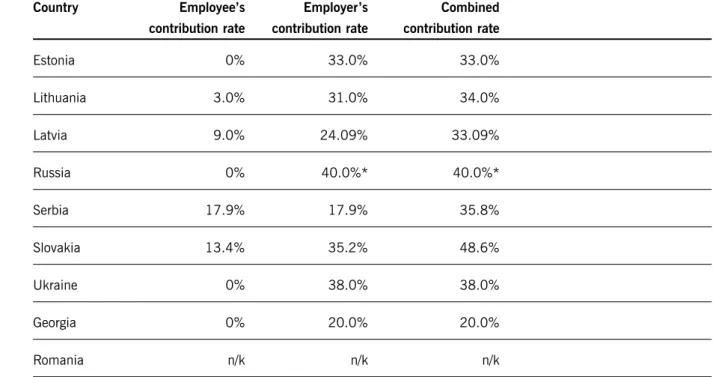
The above considerations relate to business taxation and VAT. A further tax to consider is the charge for social security contributions, comparable to national insurance in the UK. Rates for this are shown in Table 3.3 (see p. 26).
These rates contrast quite significantly with those in the UK, where the equivalent employee rate is 11.0% and that for employers is 12.8%, giving a combined total of 23.8% of gross wage cost. This contrast is reflected in the respective importance of social security contributions in the total taxation revenues of the flat tax countries. For example, the contributions to the total tax take of personal income tax, corporation tax, VAT and social security contributions in 2003 for Slovakia, Estonia and the UK are as shown in Table 3.4 (see p. 26).27
It is apparent that Slovakia, which generates just 20.2% of its total taxation revenue from direct taxes, can take many more risks with regard to that source of income than can the UK with 36.4% coming from the same sources. Any flat tax proposal for the UK has to take this into account.
23 Information from <http://www.wordwide-tax.com>. 24 <http://www.investinestonia.com/index.php?option=display
page&Itemid=73&op=page&SubMenu=>, accessed February 2006.
25 KPMG (2005), Russia Tax Overview.
26 PricewaterhouseCoopers ‘Information Guide to Slovakia’,
2004, p. 90.
27 Data from Eurostat ‘Structures of the taxation systems in
the European Union: Data 1995–2003’, 2005 available from <http://epp.eurostat.cec.eu.int/portal/page?_pageid= 1073,46587259&_dad=portal&_schema=PORTAL& p_product_code=KS-DU-05-001>.
Table 3.3: Social security contributions
Country Employee’s Employer’s Combined
contribution rate contribution rate contribution rate
Estonia 0% 33.0% 33.0% Lithuania 3.0% 31.0% 34.0% Latvia 9.0% 24.09% 33.09% Russia 0% 40.0%* 40.0%* Serbia 17.9% 17.9% 35.8% Slovakia 13.4% 35.2% 48.6% Ukraine 0% 38.0% 38.0% Georgia 0% 20.0% 20.0% Romania n/k n/k n/k
Source: see footnote 21, p. 21.
Notes: n/k = not known * = approximate average, a range of rates are in use.
Country Personal Corporation VAT Social
income tax tax security
Slovakia 10.9% 9.3% 22.3% 40.2%
Estonia 19.4% 9.3% 17.7% 35.8%
UK 28.8% 7.6% 19.8% 18.0%
Table 3.4: Contribution to total tax take
3. Countries that have flat tax systems (continued)
Source: Eurostat (2005), ‘Structures of the taxation systems in the European Union: Data 1995–2003’, available from <http://epp.eurostat.cec.eu.int/portal/page?_pageid=1073,46587259&_dad=portal&_schema=PORTAL& p_product_code=KS-DU-05-001>.
28 See <http://www.gov.je/TreasuryResources/IncomeTax/
Bulletin+Board/roposals+for+Introducing+20+Means+20/ default.htm>, accessed 7 February 2006.
WEIGHING UP THE EVIDENCE
The evidence from these data suggests that within the countries surveyed there are no flat taxes in operation of the sort Hall and Rabushka describe.
• Savings income is taxed in all states bar Romania, where the situation is not clear.
• Corporation tax and personal income tax rates are coordinated in only two states.
• Overseas earnings are taxed in all states where data can be ascertained.
• Capital gains are taxed in most states. • A considerable range of deductions and reliefs
remain available within these countries, with many of these deductions being more complex than those currently available in the UK.
• Business is not taxed on a cash flow basis in any country with a flat tax.
• A wide range of rules for the deduction of business expenses are in operation. These rules for business expenses do not appear to correspond to the simple precepts laid down in Hall and Rabushka (1995). • In no case are 100% capital allowances available on expenditure on capital equipment; instead, rules of some complexity apparently operate.
• social security payments of business in flat tax countries are much higher than in the UK.
In summary, and within the context of the flat tax proposed by Hall and Rabushka:
• no country in Eastern Europe is operating a consumption tax of the sort Hall and Rabushka call a flat tax
• the countries in question do instead appear to be operating tax systems that either are, or are close to, single rate income tax systems.
This is a significant conclusion. It means that the shift towards ‘flat taxes’ seen in Eastern Europe has not been one towards simplicity, as the flat tax model implies, but is instead a shift towards single rates of income tax.
It should be noted that this situation is also reflected in many of the other states and territories that proponents of flat taxes claim operate them (Teather 2005). For example, Jersey and Guernsey, which have both had 20% tax rates for considerable periods of time (66 years in the case of Jersey), have also offered
considerable exemptions and reliefs. So prevalent have these reliefs been that Jersey is now planning reform of its tax laws and one slogan it is using in connection with this is ‘20% means 20%’.28
In this case reasonable questions arise as to whether ‘flat taxes’ do offer simplicity or whether any benefits they give rise to result purely from lower tax rates. David Martin, writing for the Centre for Policy Studies (2005), argues: ‘The question of whether simplifying tax and reducing tax rates are connected, or whether they are independent objectives, needs to be properly analysed, as this impacts on the discussion of possible ways forward’.
It is to these issues that this report turns next.
If flat tax theory is right, the two consequences that follow from the introduction of flat taxes are: 1. tax rates fall
2. all aspects of tax administration are simplified. Each needs to be considered in turn, building upon the evidence already found.
TAX RATES
It has already been noted that tax rates have fallen in the states that have introduced ‘flat taxes’. All moved from multiple tax rates to what are (with minor exceptions in some cases) single-rate tax systems, albeit with different rates for individuals and corporations in most countries.
SIMPLIFICATION OF TAX ADMINISTRATION
The main benefits claimed for single taxation rates are: • it is easier to calculate tax due – Steve Forbes
suggests that this results in ‘postcard’ tax returns (Forbes 2005: 73)
• it is easier to understand tax due (Teather 2005) • it is easier to collect tax due (Hall and Rabushka
1995: 12–19)
• low tax rates encourage effort and entrepreneurship (Teather 2005)
• tax avoidance and evasion are discouraged (Hall and Rabushka 1995: 12–19)
• total taxation revenues increase (Grecu 2004).
These claims will be tested in turn. Ease of calculation
This claim appears incontrovertible. If an agreed figure for income has to be multiplied by only one tax rate instead of being split into parts to be multiplied by a variety of rates, the calculation of tax due must be simpler than it is in a multiple tax rate system. Steve Forbes has heavily promoted this simplicity by suggesting that using his flat tax system would allow a ‘a postcard [tax return] to abolish the IRS’,29 which is
the subtitle of his book (Forbes 2005). This idea originated in Hall and Rabushka (1995: 52ff). This advantage might not, however, be as substantial as is claimed. It is normally the case that computing a tax liability upon a known income is a much smaller task than deciding what the income should be taxed, and as has been noted in chapter 3, the accounting rules for calculating income and the rules for
calculating allowances and reliefs within countries with flat taxes appear at least as complex as those in the UK in most cases. In that case the benefit obtained from ease of calculation appears of little overall consequence in itself.
Ease of understanding tax due
There is no doubt that tax is confusing to many people. This sentiment appears implicit in the findings of the Tenon Group (Tenon 2005). It is unlikely that 78% of their respondents would suggest the tax system was too complex if they could understand it.
4. Testing the benefits of flat taxes
29 The IRS is the Internal Revenue Service of the US, the
As Table 1.2 (see p. 10) of sample tax rates for a range of individuals shows, there can be no doubt that multiple tax rates complicate the calculation of tax due. Alvin Rabushka goes further with his aim of
simplification in this area, saying in interview for this study that corporate and personal tax rates,‘have to be exactly the same rate. It’s critical’.
Those who support a flat tax claim that the marginal rate of tax causes complications in understanding tax due, and acts as a disincentive to effort. (Forbes 2005). This does, however, assume that taxpayers: • know their income
• understand how tax is calculated on that income, including all the tax brackets involved
• know the tax rates that apply to their top rate of income.
Such assumptions depend in turn on assumptions that: • the tax system is comprehensible, or
• people assume they pay tax at the highest marginal rate.
If the first applies then the argument of those who promote flat taxes is not true. If the second applies it cannot be acceptable to propose a change in taxation because taxpayers have not acquainted themselves with their own situation. It seems, as David Martin suggests for the Centre for Policy Studies (2005): Two rates for individuals (a basic and a higher rate) and one or two rates for companies would not result in particular complexity. Moving from that possibility to a single low rate would have to be justified on other economic or political grounds, rather than simply the objective of simplicity.
As Dominic Maxwell of the Institute for Public Policy Research also points out, complexity is not created only by tax rates (2006): ‘In reality, most of the complexity would remain with the rules designed to prevent tax avoidance and much of what is removed would have to be recreated in the benefits system’. In a note that strikes a chord with the comments of the Centre for Policy Studies, Maxwell adds: ‘Simplicity is an important goal – but not at any price’.
It may be that a flat tax would make it easier for people to understand their own tax liability, but the price of achieving that understanding may be too high. As Mark Nicholson, writing for the Conservative Bow Group in January 2006 (Nicholson 2006) argues: ‘It is my view that a direct move to a flat tax system would cause too much upheaval to the tax system and too great a change to the distribution of the burden of taxation to achieve the necessary degree of popular acceptance’. Ease of collection
This argument is closely related to the claim discussed on p. 36 that under flat tax systems the total tax take can rise. The ease of collection argument assumes that in a simple tax system with low costs of taxpayer compliance and easily calculated liabilities, fewer tax officials can collect more taxes while making fewer mistakes.
The latter point seems pertinent. In February 2006 the House of Commons Public Accounts Committee reported that ‘around 30% of completed tax returns contain errors and around £2.8 billion of revenue may be lost through inaccurate returns’ (House of Commons Public Accounts Committee 2006).
The evidence to support this claim for flat tax is hard to assess, as is commonplace in anything to do with flat tax when empirical data are sought. Indeed, as the UK Treasury points out (HM Treasury 2005a):‘in all discussions on flat tax structures it must be remembered that the debate is in part so fierce
because so little hard evidence exists to support the pro-flat tax claims. The lack of raw data to support and substantiate proponents’ claims is evident’.
There is, however, circumstantial evidence to support the claims. For example, the Government of Romania National Commission of Economic Forecasting has suggested that the introduction of a flat tax has led to ‘a reduction of bureaucracy and an increase in the transparency of tax collection’. It is suggested that this has resulted in increased voluntary compliance with the tax code and from recovery of long-outstanding taxes due (Videanu 2006).
These changes are no doubt welcome, but note that that Romania is one of the three recent Eastern European transition economies that have adopted flat taxes against a background of internal chaos, the others being Georgia and Ukraine. According to PricewaterhouseCoopers ‘Ukraine is no tax paradise. However there is no arbitrariness on the part of tax authorities, as there was five years ago’.30 In Romania
the IMF said in a press release31 in 2004 ‘the
authorities are confronting the long-standing issues of tax arrears’.
Against this background of previous substantial non-compliance with tax legislation, any further reduction in tax collection would have been surprising. Additional evidence does, however, suggest that this increase in tax collection may not be just because of the
introduction of the new flat tax system. According to KPMG ‘On account of the adoption of reduced tax rates, both for juridical persons from 25% to 16%, as well as the adoption of the unique income tax rate of 16% for physical persons, the fiscal authority in Romania pays an increasing attention to the administration and collection measures of the state incomes’.
The flat tax was introduced to Romania on 1 January 2005. Official statistics on Romanian tax collection in 2005 compared with those in 2004 are shown in Figure 4.1 (Videanu 2006).
What is apparent is that although the new system resulted in substantial increases in revenues from some taxes, such as VAT (up 36%) and social security (up 18.7%), income tax revenues fell by 5.3% and taxes on profits increased by less than 1%. The evidence that flat taxes, by themselves, increase tax revenues is hard to find in Romania – rather the evidence suggets that it is good tax collection regimes that result in increased tax revenues.
The same may be true of Russia. A combined study by scholars from the Institute for Fiscal Studies in the UK, the International Monetary Fund and University College London was published in July 2005 (Ivanova et al. 2005). As background to the study the authors noted: ‘In 2001, Russia dramatically reduced its higher rates of personal income tax (PIT), establishing a single marginal rate at the low level of 13%. In the following year, real revenue from the PIT increased by about 26%’. In their research, the authors sought to determine whether the increase in tax revenue was itself a consequence of this reform. They conclude that: ‘there is no evidence of a strong supply side effect of the reform. Compliance, however, does appear to have improved quite substantially – by about one third, according to our estimates – though it remains unclear whether this was due to the parametric tax reform or to accompanying changes in enforcement’.
30 <www.pwcglobal.com/extweb/pwcpublications.nsf/docid/
48144A6A0952EFAB80256FAC005280DA>, accessed February 2006
31 <http://www.imf.org/external/np/sec/pr/2004/
pr04137.htm>, accessed February 2006
32 KPMG Romania ‘Tax Audit’ June 2005 available from
<http://www.kpmg.ro/index.thtml/en/about/news/index.html? cid=52616e646f6d4956f96c94868ca868b888c2e903bc204e5c, accessed February 2006.
As a result the authors state ‘it is hard to attribute the very strong performance of PIT revenues after the reform to tax reform itself’ (Ivanova et al. 2005: 432). When read in conjunction with the evidence from Romania it appears that enforcement procedures might have the most significant effect in increased tax revenues in both cases. The evidence from Russia suggests that Romania is following a trend because, just as Romania saw substantial increases in its
revenue from taxes such as VAT following the introduction of a flat tax, so did Russia in 2001. In that year, while income tax revenues in Russia increased in real terms by about 26%, those from indirect and trade taxes increased by almost the same amount.33 As Ivanova et al. note, this suggests a
common underlying cause. They suggest that the common cause was growth in the Russian economy (Ivanova et al. 2005: 433).
33 Ibid.
Other indirect tax Customs duties Excises Other direct tax VAT Social security Income tax Profit tax 0 5 10 15 20 25 30 2005 2004 Billions Ron.
Figure 4.1: Total tax revenues in Romania
4. Testing the benefits of flat taxes (continued)