ASHESI UNIVERSITY COLLEGE
MARKETING PLAN FOR RAMADA RESORT, ACCRA
APPLIED PROJECT
BY
ESTHER ADJEI-BAAH
Applied Project Report submitted to the Department of Business Administration, Ashesi University College in partial fulfilment of the requirement for the award of Bachelor of
Science degree in Business Administration
DECLARATION
I hereby declare that this Applied Project Report is the result of my own work and that no
part of it has been presented for another degree in this university or elsewhere.
Candidate’s Signature: ……… Candidate’s Name: Esther Adjei-Baah
Date: ………
I hereby declare that the preparation and presentation of the Applied Project Report
were supervised in accordance with the guidelines on supervision of applied projects
laid down by Ashesi University College.
Supervisor’s Signature: ………..
Supervisor’s Name: Dr. Gordon Adomdza
ACKNOWLEDGEMENT
I would like to express my deepest appreciation to everyone who contributed to the
completion of this project. First of all, I am thankful to God for seeing me through this
project and giving me life till its completion.
I would also like to thank my supervisor, Dr. Gordon Adomdza, for his direction and
ardent probing that challenged me to constantly refine my work to produce this final
report.
My sincerest appreciation also goes to the management and staff of Ramada Resort,
Accra for giving me the necessary information required to successfully complete this
project.
A special thanks to my family and friends for their constant encouragement and interest
in my project that kept me focused on producing this final report to the best of my
EXECUTIVE SUMMARY
Ghana’s hospitality and political stability over the years has made it an attractive
destination for tourism and foreign investment. This produces numerous opportunities for
companies in the hospitality industry such as hotels and tourist companies to expand their
services and reach a larger market. Ramada Resort, Accra, a beachside resort located at
Teshie-Nungua in the capital city of Ghana-Accra, has however been subject to a
constant decline in customer base which forms the basis for this project. After conducting
an external environment and industry review as well as an internal firm analysis, a
marketing plan was developed for the firm to tackle this problem using the SOSTAC
model, which involves determining the current Situation of the problem, stating the
desired future Objectives or goal, determining the Strategy, Tactics and Actions to take
and finally instituting Control measures to check the success of the strategy implemented.
The marketing plan was also infused with a strategy to develop the firm’s organizational
culture as a high level of organizational culture increases employee dedication and
efficiency in their work. Thus, with the implementation of the organizational culture as
well as the marketing plan which focuses on market penetration, Ramada Resort, Accra
will be able to attract and retain new and current customers for a boost in its income
Table of Contents
DECLARATION ... ii
ACKNOWLEDGEMENT ... iii
EXECUTIVE SUMMARY ... iv
CHAPTER 1: INTRODUCTION ... 1
1.1 Overview of the External Environment ... 1
1.1.1 Political Factors ... 1 1.1.2 Economic Factors ... 1 1.1.3 Social Factors ... 2 1.1.4 Technological Factors ... 2 1.1.5 Legal Factors ... 3 1.1.6 Environmental Factors ... 3
1.1.7 Implication of the Review of Ghana’s External Environment ... 4
1.2 Ghana’s Hospitality Industry Overview ... 4
1.2.1 Porter’s Five Forces ... 5
1.2.2 Implication of Industrial Review ... 7
1.3 Company Profile – Ramada Resort, Accra ... 8
1.4 Rationale for selection ... 8
1.5 SWOT Analysis for Ramada Resort Accra... 9
1.6 Implication of Industrial and External Environment Review on Ramada Resort, Accra .... 11
CHAPTER 2: PROJECT NEEDS ANALYSIS ... 12
2.1 Methodology ... 12
2.1.1 Semi-structured Interviews ... 12
2.1.2 Diagrams Showing Interviewed Employees’ Statistics ... 14
2.1.3 Observations ... 17
CHAPTER 3: MASTERY OF SUBJECT MATTER ... 19
3.1 Marketing ... 19
3.2 Marketing Mix (4 P’s and 7 P’s) ... 20
3.3 Organizational Culture and Marketing ... 21
3.4 Schein’s Model ... 22
3.5 The Cultural Dynamics Model ... 23
CHAPTER 4: SOLUTION AND IMPLEMENTATION PLAN ... 27
4.1 Situation ... 27
4.1.1 Internal Capabilities and Resources ... 27
4.1.2 5S Performance Model... 30 4.1.3 Customer Insights ... 31 4.1.4 Market Trends ... 32 4.1.5 Competitor Analysis ... 32 4.2 Objectives ... 35 4.3 Strategies ... 38 4.4 Tactics ... 39 4.5 Actions ... 48 4.6 Control ... 50
CHAPTER 5: CONCLUSION AND RECOMMENDATIONS ... 52
5.1 Conclusion ... 52
5.2 Project Limitations ... 52
5.3 Recommendation ... 53
REFERENCES ... 54
CHAPTER 1: INTRODUCTION
This chapter highlights an overview of the hospitality industry and external environment
in Ghana, the profile of the company under review and an evaluation of the company’s
strengths, weaknesses, opportunities and threats (SWOT).
1.1 Overview of the External Environment
The external environment has various factors that can affect how companies in the
hospitality industry operate. Thus, the PESTLE (Political, Economic, Social,
Technological, Legal, and Environmental) analysis tool which provides a framework for
investigating and analyzing the external environment for an organization will be used
(Cadle, Paul, & Turner, 2010).
1.1.1 Political Factors
Ghana’s political environment is considered as one of the most stable in West Africa
since its transition to the multi-party democratic style of governance in 1992 (BBC News,
2017). The peaceful state of the country coupled with the hospitality of its residents
makes the country attractive to investors and tourists, and this creates a large market for
the hospitality industry. The political environment of the country is therefore conducive
for the hospitality industry as it attracts more people into the country who will need
products and services such as accommodation and food provided by Ramada Resort,
Accra.
1.1.2 Economic Factors
The economic environment in Ghana has been characterized by inconsistency over the
past years. Ghana’s economic growth slowed from 4.0% in 2014 to 3.7% in 2015
(African Economic Outlook, 2016). However, the economy grew to 4.9% in the first
2016 which was attributed to production problems in the oil sector (World Bank, 2016).
In December 2016, Ghana recorded its lowest inflation rate of 15.4% since July 2014
with upward pressure coming from the increase in the prices of some goods and services
including food, beverage and hotels (Neves, 2017). The increase in prices however
increases competition in the hospitality industry as companies adopt competitive pricing
strategies to retain customers.
1.1.3 Social Factors
The social environment consists of the immediate physical surroundings, social
relationships, and cultural settings within which defined groups of people function and
interact (Barnett & Casper, 2001). These factors have a bearing on how people use the
services in the hospitality industry because it affects their behavior and spending pattern.
For instance, the Ga tribe located in Accra where Ramada Resort, Accra resides, has an annual ban on noise making during their Homowo festival that restricts the resort’s
program lineup (Taylor, 2016). Also, because of the current drive towards a healthier way
of life where consumers are more concerned with establishing long-term healthy
lifestyles (Bhagat, 2016), resorts and hotels need to have gyms and include healthy or
vegan food choices in their menu to appeal to a wider market base.
1.1.4 Technological Factors
The hospitality industry continues to embrace electronic forms of doing business such as
online purchasing of goods and services while tradition-bound attitudes are also changing
because of technological enhancements (Cline & Warner, 2001). It is estimated that local
hotels in Accra and other regions in the country are losing 30% of their conceivable
profits as a result of the non-employability of Internet Technology in their operations
communicate with clients all over the world while hardware and software systems are
used to manage resources, capital and clients effectively and efficiently for revenue yield
and labour productivity.
1.1.5 Legal Factors
There are various legislations that govern business operations in Ghana. These
legislations include the Company Act, 1963, The Labour Act, 2003, The Foreign
Exchange Act, 2006 and The Environmental Conservation Act (Ghana Investment
Promotion Centre [GIPC], 2017). Ghana also subscribes to some international
conventions on individual and intellectual property from which business laws must
conform to (GIPC, 2017). Firms operating in the hospitality industry are therefore
required by law to enforce the laws in their firms be it a labour law regarding their
employees or a law regarding their operations and transaction with clients. Thus, Ramada
Resort, Accra’s purchase of the Wyndham franchise is in adherence to the laws.
1.1.6 Environmental Factors
Sustainability is key for the success of any business and this involves instituting measures
that protect the environment. In 2010, Ghana revised its Environmental Sanitation Policy
to aid in improving the health and the quality of life in Ghana (Chibeze, 2013). Globally,
there is a drive to sustain the environment and in Ghana, the body responsible for
enforcing environmental laws and regulations is the Environmental Protection Agency
(EPA). For the hospitality industry, companies that ensure environmental sustainability
by putting waste reduction measures in place are likely to attract more people who are
concerned about environmental degradation and this would help put the firm in good
1.1.7 Implication of the Review of Ghana’s External Environment
The political stability in the country provides a conducive environment for resorts
because stability attracts investors and tourists who will need resort services in the
country. Advancement in technology also gives Ramada Resort, Accra the opportunity to
inculcate e-marketing, modern software programs and technological devices in their
operations to help improve operational performance and attract a larger customer base.
Despite these pros, Ramada Resort, Accra has to enforce all applicable laws of the state
to its business and face competitive pricing as prices of goods and services keep
increasing and resulting in an increased cost of running the firm.
1.2 Ghana’s Hospitality Industry Overview
Ghana’s economy is the second largest in the Economic Community of West African
States (ECOWAS) with tourism representing 7.8 per cent (%) of its GDP as at 2014
(Jovago Ghana, 2016). Tourism, plays a major role in the hospitality industry by bringing
in numerous opportunities for the industry to harness. The hospitality industry is made up
of businesses that provide lodging, food and other services to travelers and its main
components are hotels, motels, inns, resorts and restaurants (Alhassan & Sakara, 2014).
Out of these segments, it was stated in the Jovago Hospitality Report for Ghana (2016)
that the hotel sector is the largest and most dynamic in the industry and consists of 1,775
hotels with 28,028 rooms and 872 licensed star hotels as at 2013. The benefits of this
industry are immense and range from generating countless job opportunities to providing
revenue to the government through payment of taxes as well as promoting and preserving
1.2.1 Porter’s Five Forces
Porter’s Five Forces is a framework developed in 1979 by Michael E Porter for assessing
and analyzing the competitive strength and position of a business organization (Chapman,
2013). This model will help evaluate the current players in the hospitality industry and
highlight areas that Ramada Resort, Accra can improve its services in. The forces in this
model include competitive rivalry, bargaining power of suppliers, bargaining power of
customers, threat of new entrants and threat of substitute products and services (Arline,
2015).
Competitive Rivalry
Ghana is populated with a lot of hotels making competition in the industry strong. People
can now easily research for hotel ratings due to improved online and mobile technology
and this causes hotels to reduce prices which increases competitiveness (Schieber, 2014).
Some rivals of Ramada Resort, Accra based on the 3-star rating are Holiday Inn Accra
Hotel, Oak Plaza Hotel, African Regent Hotel and Alisa Hotel (Ghanahotels, 2017).
Bargaining Power of Suppliers
The bargaining power of suppliers in the hospitality is moderate as it is service-oriented
making it more labour intensive (Chouhan, 2014). Hotels will therefore have to mainly
deal with staff costs as other suppliers who provide capital inputs do not contribute to
their services as much as labour. Also, some hotels integrate backwards and handle their
own real estate services and interior design which helps in cutting down cost (Chouhan,
2014).
Bargaining power of customers
The bargaining power of customers is high because customers are highly informed about
hotel’s pricing, promotions and advertisements are therefore critical in attracting and
informing customers about the value they offer since services are not highly
differentiated in the industry
Threat of new entrants
In 2014, several international hotel brands including InterContinental Hotels Group
announced their intention to enter the African market at the Africa Hotel Investment
Forum (AHIF) which took place in Ethiopia (Kuuskler, 2014). This makes the threat of
entrance into the market by international hotels high as they have economies of scale that
will be difficult to override and compete with. However, for local brands, entering this
industry is difficult due to high operational costs such as electricity, water and labour
costs.
Threat of substitute products and services
Accommodation in Ghana includes apartments, hotels, hostels, one-room housing units
and detached, semi-detached or self-contained houses (Agyei, 2016). Hotel substitutes
would therefore involve rentals which are not cheap because of the present housing deficit and the rent act that allows landlords to charge up to six months’ rent advance
(Agyekum & Kusorgbor, 2016). In effect, substitutes to hotels are costly, making the
1.2.2 Implication of Industrial Review
Figure 1: Porter's Five Forces
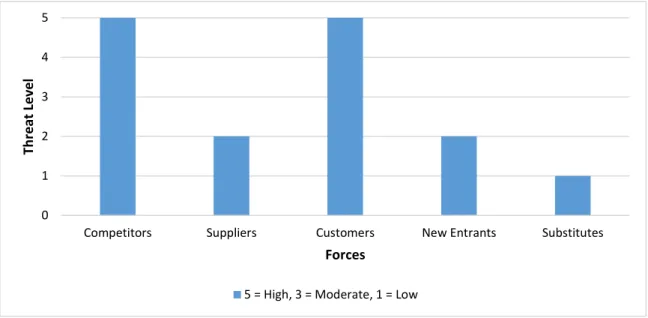
The threat level shown in the Figure 1 is based on the analysis above. It can be deduced
from Figure 1 that rivalry and customer bargaining power is high in the hospitality
industry. This means that Ramada Resort, Accra’s services need a value that their rivals
do not provide in order to beat competition. Once you enter the market however, there are
few substitutes and low threats from suppliers and new entrants and this gives Ramada
Resort, Accra the opportunity to maintain its customer base once it achieves a sustainable
competitive advantage. Also, since the industry is more labour intensive, it provides
Ramada Resort, Accra with the opportunity to introduce human capital development
programs that will increase the capabilities and intellectual capacities of its workforce for
a unique strategy. The industry is therefore lucrative if the above is achieved.
With the industry and external environment review done, identifying the internal
strengths and weaknesses of the company as well as its external opportunities and threats will help establish the resort’s current position in the industry.
0 1 2 3 4 5
Competitors Suppliers Customers New Entrants Substitutes
Th
re
at
Level
Forces
1.3 Company Profile – Ramada Resort, Accra
Ramada Resort, Accra is a beachside resort located at Teshie-Nungua in the capital city
of Ghana-Accra. Ramada Resort, Accra started as a sole proprietorship under the name ‘The New Coco Beach Resort'. It was established in 1999 when Coco Beach Hotel, an
already existing 12-room hotel with a restaurant located at Teshie-Nungua was bought
and had its name changed to The New Coco Beach Resort. The New Coco Beach Resort
targeted expatriates who wanted relaxation and had its trademark being the numerous
coconut trees found all around and along its beachside.
Over the years, the resort expanded its infrastructure and services to have a total of
seventy-five rooms, three conference rooms, two restaurants, a children’s playground, a
bar, a spa, a salon, a gym, a swimming pool and ninety-one employees who contribute
towards the ever-present serene aura of relaxation for its guests. Six years ago, the resort
bought a franchise from Wyndham Hotels Group in order to operate under one of its internationally recognized brand names ‘Ramada Resorts’ and has been operating as
Ramada Resort, Accra since then. Ramada Resort, Accra is currently a 3-star hotel
offering hotel, conference and restaurant services to its clients and guests.
The resort’s slogan is ‘stay close to nature’ portraying its mission to provide guests with
a serene atmosphere for relaxation and provide western services with the best of
Ghanaian hospitality. The resort seeks to attract Meetings, Incentives, Conferences and
Events (MICEs) and targets business travelers for stay in their rooms.
1.4 Rationale for selection
Ramada Resort, Accra’s vision to be the leading resort in Ghana has led to it rising from
a 12-room hotel to an internationally recognized brand. Despite the increase in its
still staggering when it comes to attracting and retaining its customers when juxtaposed
to competitors who have been in existence for the same time frame. Based on this and the
knowledge acquired from studying marketing and competitive advantage, Ramada
Resort, Accra was selected in order to propose a solution that will position their services
in a way to attract new and retain existing customers.
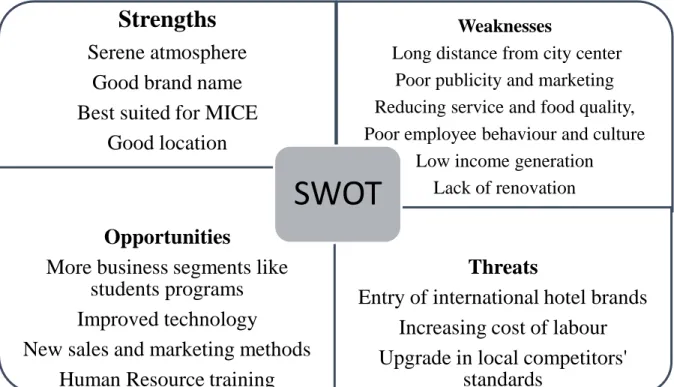
1.5 SWOT Analysis for Ramada Resort Accra
A SWOT analysis is a strategic planning tool used to analyze the internal strengths and
weaknesses, and the external opportunities and threats facing an enterprise (Chartered
Global Management Accountant, 2017). Apart from secondary data retrieved from the company’s documents, semi-structured interviews with the employees of Ramada Resort,
Accra were also used to gather as much information as possible for the internal analysis.
Figure 2: SWOT Analysis Chart
Strengths
Serene atmosphere
Good brand name
Best suited for MICE
Good location
Weaknesses
Long distance from city center Poor publicity and marketing Reducing service and food quality, Poor employee behaviour and culture
Low income generation Lack of renovation
Opportunities
More business segments like
students programs
Improved technology
New sales and marketing methods
Human Resource training
Threats
Entry of international hotel brands
Increasing cost of labour
Upgrade in local competitors'
standards
Strengths - Ramada Resort, Accra is located at a prime location along the beach and
capitalizes on the sea breeze which is a plus for relaxation of guests. The brand name of
Wyndham Hotel Group also makes its credibility known to customers as it is
internationally recognized as a well-known brand and considered to be one of the best
suited resorts for MICE business.
Weaknesses - The resort’s main weakness is its far distance from the city center and
airport which sometimes results in guests being in traffic congestions. Others are low
publicity, low income generation, poor organizational culture, the reducing quality of
service and food over the last two years due to poor employee behavior and lack of
renovation of its buildings and surroundings
Opportunities - In improving its operations and services, more emphasis would have to be
placed on improving the quality of food and services for guests which could be achieved
by training personnel. New sales and marketing methods and technology can also be
introduced to increase publicity and attract more customers as well as provide an
improved system for feedback from customers.
Threats - Despite the resort’s strengths, the increase in the number of international hotel
brands poses a threat to the company. This, coupled with increasing cost of labour and
continuous upgrades by competitors if not paid attention to, could cause a reduction in
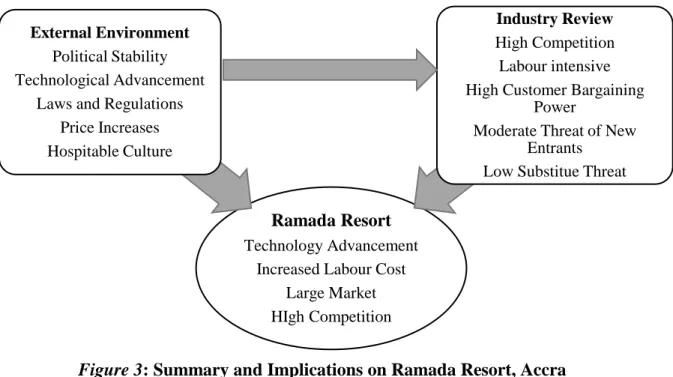
1.6 Implication of Industrial and External Environment Review on Ramada Resort, Accra
Figure 3: Summary and Implications on Ramada Resort, Accra
Ramada Resort Technology Advancement
Increased Labour Cost Large Market HIgh Competition External Environment
Political Stability Technological Advancement
Laws and Regulations Price Increases Hospitable Culture
Industry Review High Competition Labour intensive High Customer Bargaining
Power
Moderate Threat of New Entrants
CHAPTER 2: PROJECT NEEDS ANALYSIS
This chapter focuses on identifying the need of Ramada Resort, Accra. A needs
assessment is a systematic exploration of the way things are and the way they should be
(Rouda & Kusy, 1996). In determining the gap, the firm’s current situation needed to be
identified and compared to the desired situation. The methodology and processes used in
gathering the data are discussed below.
2.1 Methodology
Information for the needs analysis was gathered through conducting semi-structured
interviews with management and employees and observing the work environment. In
order to validate and find out the impact of the gap on the firm’s services, a survey was
conducted on current customers and potential customers by interviewing them on
Ramada Resort, Accra’s offerings and ratings of its services.
2.1.1 Semi-structured Interviews
Semi-structured interviews refers to a context in which the interviewer has a series of
questions that is generally an interview guide from which further questions can be
derived based on the interviewee’s responses (Bryman & Bell, 2011). This method of
interview was selected because it encourages interviewees to give in depth answers and
patterns that are established from the responses of the various interviewees would
validate the existing problem in the firm. Based on availability, the following people
were interviewed; a partner, the general manager, the human resource manager, two
marketing personnel and 28 out of 91 employees of the resort. The interview guide is
Insights from Management
From the interviews with management, it was established that the firm was experiencing
a decrease in the number of guests who utilized their room services as well as their
restaurant services. Even though sales were expected to increase after the purchase of the
franchise from Wyndham Hotel Group, the resort experienced a short period of increased
patronization from customers which transitioned into a decline and a poor inflow of
revenue. Another interviewee also expressed how the resort’s low publicity could be one
of the major contributing factors to the declining customer base as competition keeps
increasing. Further probing revealed that the main method for retaining customers for
Meetings, Incentives, Conferences and Events which is one of their targets is through
physical meetings with existing clients. This however limits the company’s reach to
customers as focus is only on existing relationships with clients who usually have
conferences at the resort. Thus, if the existing clients do not have events, the resort will
then rely solely on revenue from walk-in customers for the restaurant which is usually
just a handful of people.
Other issues raised by management included the poor attitude of employees to work
which was attributed to the lack of motivation and non-existent organizational culture.
No training programs had been implemented for employees which meant employees were
not improving their skills and capabilities. This could cause a hindrance to the services
provided as customers may adjust to changing trends in the industry that the employees
cannot offer. Since revenue streams are low as already established, acquisition of modern
equipment or items to run the company effectively and efficiently was a concern as it
established a trend of low revenue streams as the resort customer base was gradually
dwindling due to poor marketing techniques, poor attitude of employees to work and
most importantly, the non-existent company culture.
Insights from Employees
Employees of Ramada Resort, Accra were also engaged in interviews to gain more insight into the resort’s current work environment. Currently, there are ninety-one
employees at Ramada Resort but only twenty-eight employees could be interviewed due
to the shift system employed at the hotel. Thus, the survey covered thirty percent of the
working population of Ramada Resort, Accra. Responses were received from all
departments including the restaurant, front desk, security, housekeeping and accounts
departments.
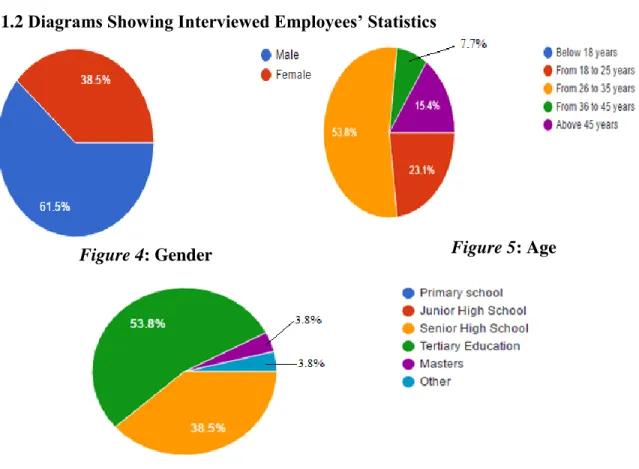
2.1.2 Diagrams Showing Interviewed Employees’ Statistics
Figure 4: Gender
Figure 5: Age
From the responses of employees, the information received from management about low
revenue streams was confirmed as the employees also complained of not receiving funds
on time to purchase items for running their departments. Also, 53.8% of the employees
(shown in Figure 7) had not received any form of hospitality training before being
employed at Ramada Resort, Accra and 73.1% of the respondents responded yes (shown
in Figure 8) to wanting some form of training for their current positions. This was
confirmation that employees needed training on current trends and skills that would
improve interaction with customers. On the whole, the main complaints of the employees
centered on not having enough income to run operations of their departments due to the firm’s low revenue inflow and the inability to receive their salaries on time which is also
as a result of poor revenue inflows.
Did you have Prior Training in the Hospitality Industry? (Figure 7)
Would you require any training for your current position? (Figure 8)
Insights from Customers
Customers comprising of walk-in customers and a guest staying at the hotel were also
interviewed. Responses from the interviews conducted with the customers indicated that
most of them heard of Ramada Resort, Accra through family and friends. This was an
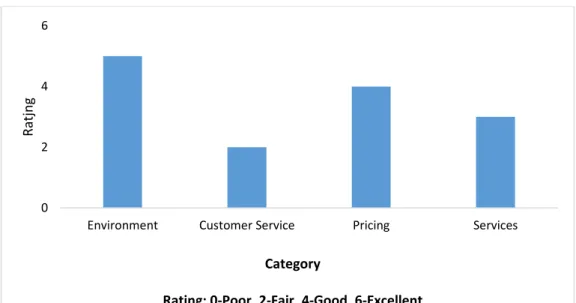
The customers, on average, rated the services of the resort as good with a 3-star rating.
One customer who has been visiting the resort since its establishment reaffirmed
information gathered from management and employees as he stated that despite the
serene environment which draws him back to the resort, its standard has been falling over
the years with the waiters becoming tardy in the execution of their services. Most
customers however did not have any problem with the taste of the food and stated their
appreciation of the serene environment and sea breeze which draws them to the resort.
Figure 9: Customer Insights
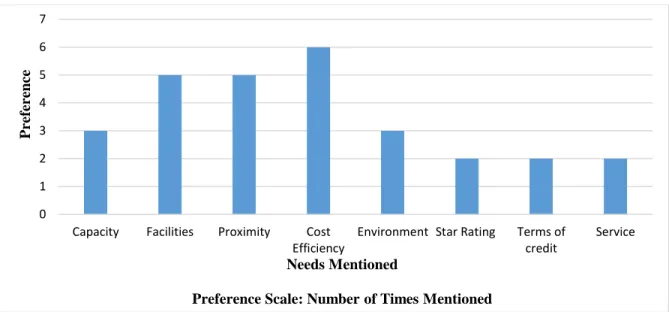
For gathering data on what could influence Ramada Resort, Accra’s offerings, ten
companies were also interviewed for their input as meetings and conferences were also
targets of Ramada Resort, Accra. Almost all the companies interviewed rated modern
facilities and services as a major factor for selecting a venue for events and conferences.
Cost efficiency was however the most mentioned factor that was considered. Ramada
Resort, Accra would therefore have to consider all these suggestions in planning for
events and conferences. 0
2 4 6
Environment Customer Service Pricing Services
Rat
jn
g
Category
Figure 10: MICE Potential Customers' Needs
2.1.3 Observations
Participant observation was another method used to gather information on the current
state of the firm. “Participant observation entails the relatively prolonged immersion of
the observer in a social setting in which he or she seeks to observe the behavior of
members of that setting and to elicit the meanings they attribute to their environment and
behavior” (Rukwaru, 2015).
The resort’s proceedings were observed for two days to find out how employees
interacted with clients. It was observed that the waiters delayed in the execution of their
task such as approaching customers to ask for their orders and revisiting their tables to
ask for any additional services the guest might require. The preparation of food also took
a long time which irritated some guests. The resort already has the infrastructure capable
of serving the customers but needs a lot of maintenance as some leaking pipes were
noticed and some huts were deteriorating. The front desk personnel however carried out
their duties well and were very welcoming and receptive to guests who walked in to 0 1 2 3 4 5 6 7
Capacity Facilities Proximity Cost Efficiency
Environment Star Rating Terms of credit Service P re fer ence Needs Mentioned
make enquiries about the resort’s prices and services. The atmosphere in the resort is very
relaxing because of its location near the sea which attracts most of their customers.
Deducing from both the interviews and observation of the hotel’s services, it can be
concluded that the resort needs a marketing plan that would not only help in making the resort known to more customers but would strategically improve the resort’s internal
services to meet the incoming customer pool that will be attracted to Ramada Resort,
CHAPTER 3: MASTERY OF SUBJECT MATTER
This chapter introduces work done in academia that tackles the gap existing in Ramada
Resort, Accra. Insights will be drawn from the industry and theories or frameworks
relevant for providing a solution for Ramada Resort, Accra's. From the project needs
analysis, it has been identified that Ramada Resort, Accra’s main challenge is with
revenue generation which introduces the gap in attracting and retaining customers. As
such, theories targeted at providing the ideal solution for the firm are explored below.
3.1 Marketing
Marketing is a business function which is continually growing with various definitions to
its meaning supplied by practitioners in its sector. According to Philip Kotler, American
marketing consultant and professor, marketing is defined as ‘a social and managerial
process by which individuals and groups obtain what they need and want through creating and exchanging products and value with others’ (Blythe, 2009). This definition
highlights the concept of value creation to satisfy the needs and wants of customers. The
Chartered Institute of Marketing (CIM) defines marketing as the ‘management process
which identifies, anticipates and supplies customer requirements efficiently and profitably’ while the American Marketing Association defines it as ‘the process of
planning and executing the conception, pricing, promotion, and distribution of ideas, goods and services to create exchange and satisfy individual and organizational
objectives’ (Blythe, 2009). Both definitions introduce the management process aspect of
marketing coupled with identifying requirements that will help satisfy customer and
organizational needs. It can therefore be deduced that marketing is geared towards
satisfying customer needs just as Peter Drucker proposed as the function of marketing
3.2 Marketing Mix (4 P’s and 7 P’s)
In 1960, a concept known as the ‘marketing mix’ was developed by E. Jerome McCarthy
who defined it in terms of product, price, place and promotion (the 4 P’s) (Blythe, 2009). Thus, it was established with the 4 P’s that in meeting customer needs, organizations had
to make decisions that will take into consideration the product, its pricing, place of sale
and the promotion of the product. This concept however mostly favored goods and not
service-based industries and as such the 7 P’s model, also known as the services
marketing mix by Bernard Booms and Mary Bitner was developed (Vliet, 2013). The 7 P’s model goes beyond the traditional 4 P’s marketing mix model and highlights unique
characteristics such as intangibility and heterogeneity existing in the service industry (Vliet, 2013). The additional P’s of the 7 P’s model are people, process and physical
evidence which highlight the importance of the staff or employees (people), the processes
involved in delivering the services to customers (process) and the appearance and
interaction between customers and the surroundings of the place where the service is
offered (physical evidence).
The service industry consists of finance, communication, health care, transportation, hotel
and other service-providing companies. Characteristics of the service industry include
intangibility, inseparability of production and consumption, heterogeneity, and
perishability (Zeithaml, Parasuraman, & Berry, 1985). The 7 P’s, namely product, price,
promotion, place, people, process and physical evidence will therefore be an applicable
mix for use in developing a marketing plan for Ramada Resort, Accra which is in the
In 2014, a case study was conducted using ten international hotels in Jordan to test the impact of the 7 P’s Marketing Mix in gaining competitive advantage. This case study,
conducted by Hameed Abdulnabi Al-Debi and Ashraf Mustafa tested if a relationship
existed between each of the seven marketing mix elements and its competitive advantage. After testing the hypotheses for each of the 7 P’s, the results revealed that there is a
relationship between each element and the competitive advantage in the industry which
shows how important it is for firms to improve these elements in carrying out their
businesses (Al-Debi & Mustafa, 2014). Some conclusions reached from the study also
included a significant interest in safety and security from guests, guests considering
international chain trademarks as very important, interest in hotel and payment process
and furniture and equipment attracting guests more than green environment (Al-Debi &
Mustafa, 2014). Parallels can therefore be drawn from the results of this case study as
Ramada Resort, Accra is also an internationally recognized hotel chain.
3.3 Organizational Culture and Marketing
Another important aspect of an organization’s success is its organizational culture. In the
article Organizational Culture and Marketing: Defining the Research Agenda, the
authors, Deshpande & Webster (1989) investigated the link between organizational
culture and marketing and its importance. It was identified in the article that marketing
scholars who seek to develop organizational culture concepts and apply them to
marketing face two problems; the first being the difficulty in choosing and understanding
the rapidly developing literature on organizational culture and the second being the
development of the theoretical structure that relate carefully defined cultural variables to
the marketing phenomena they are trying to understand (Deshpande & Webster, 1989).
organizational culture in order to understand why things happen the way they do even
with marketing.
In 2009, Tripathi & Tripathi conducted a study to investigate how culture affects the
relationship between downward influence strategies and organizational success. Two
types of culture, named Participative Culture and Manipulative Culture were identified
and tested to find out which of these cultures promote success in organization. From the
research, Participative Culture, which believes in a constructive approach to work where
employees make collective efforts to realize the shared goals of high productivity was
found to be ideal and contributed to success in contrast to manipulative culture which
recommends the use of rational rewards and little use of assertiveness whenever needed
(Tripathi & Tripathi, 2009).
In 2013, a study revealed that there is a significant causal relationship between learning
orientation, organizational learning, and service quality (Cho, Kim, Park & Cho, 2013).
Organizational learning occurs when the organization’s knowledge is changed based on
its experiences. Thus, in a service company such as Ramada Resort, Accra, experiences
and interactions with customers will shape the organization’s knowledge of customer
needs and eventually affect the quality of their services if the knowledge gained is used to
improve their services.
3.4 Schein’s Model
In developing a cultural framework for organizational culture, Schein’s 1985 model
(shown in Figure 11) highlighted three levels of culture which are artifacts on the surface,
assumptions are the beliefs about reality and human nature which are taken for granted
while values represent social principles and standards with intrinsic worth (Hatch, 1993).
Figure 11: Schein’s 1985 Model
3.5 The Cultural Dynamics Model
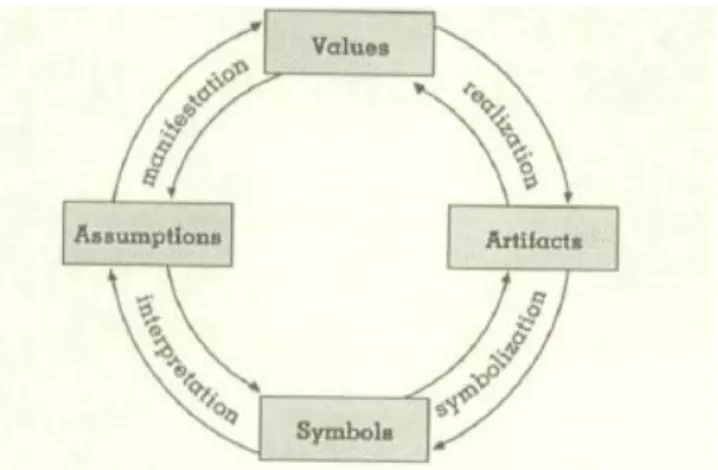
In 1993, Schein’s model was developed further by Mary Jo Hatch to include the fourth element ‘symbol’. The new model, called ‘The Cultural Dynamics Model’ (shown in
Figure 12) permits the model to accommodate the influences of both Schein's theory and
symbolic-interpretive perspectives and makes the elements of culture (assumptions,
values, artifacts, and symbols) less central so that the relationships linking them become
focal (Hatch, 1993).
The processes; manifestation, realization, symbolization and interpretation, shown in the
model above occur in a continuous manner. Manifestation translates intangible
assumptions to recognizable values and can occur through processes that proactively
influence values or through the retroactive effects of value recognition on assumptions
(Hatch, 1993). The realization process occurs when values are transformed to artifacts or
when values are transformed when artifacts reaffirm or challenge values. Symbolization
combines an artifact with meaning that reaches beyond or surrounds it whereas
interpretation provides meaning to the symbolization process (Hatch, 1993). This model therefore did not only bridge the gap in Schein’s model but developed a model which
highlights the dynamic conceptions of culture through its processes.
3.6 SOSTAC Model
In developing a marketing plan for Ramada Resort, Accra, both culture and the best of
marketing techniques will play a vital role for its success. Another marketing plan
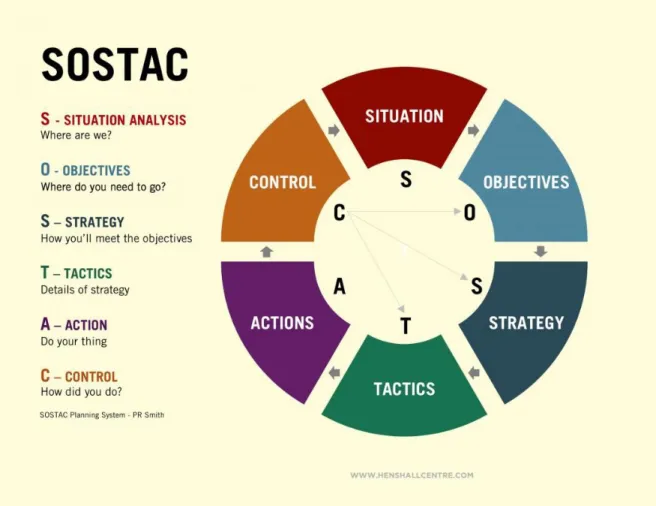
framework is the SOSTAC model (shown in Figure 13). The SOSTAC model was
invented by Paul Smith in the 1990s to help with marketing planning and stands for
Figure 13: SOSTAC Model
The elements of the SOSTAC model are all essential when developing a marketing plan.
Situation assesses the current state of the firm and answers the question ‘Where are we
now?’, Objectives addresses the goals of the firm and answer the question ‘Where do we
want to get to?’, Strategy provides the plan to achieve the goals and answers the question
‘How are we going to get there?, Tactics breaks down the strategy into details and also
answers the question ‘How are we going to get there?, Actions assign responsibility and
deadlines and answers the question ‘Who is going to do what and when?’ and Control
offers a way to track the progress and answers the question ‘How can we control,
In 2012, Saroj Bhandari, conducted a case study on the firm E.Luhta Oy Ltd and
developed a new effective e-marketing plan by using the SOSTAC model. After going
through all elements of the SOSTAC model, the firm transitioned from just a physical
retailer of goods to a firm with a website for e-marketing which attracted more customers
(Bhandari, 2012).
The SOSTAC model thus addresses the needed elements for a successful plan for
Ramada Resort, Accra and is a framework worthy of emulation by Ramada Resort, Accra
as the organizational culture elements previously discussed can also be addressed right
CHAPTER 4: SOLUTION AND IMPLEMENTATION PLAN In this chapter, a solution for Ramada Resort, Accra is developed using the SOSTAC
model with inputs drawn from the marketing mix and the Cultural Dynamics Model. The
SOSTAC model was chosen because of its simplicity and its adaptability to any kind of
unique problem existing in any organization. The model is developed below in the
following order as put across by the model name; Situation, Objectives, Strategies,
Tactics, Actions and Control.
4.1 Situation
This element focuses on identifying the current state of affairs in an organization and should answer the question ‘Where are we now?’ The current position of Ramada Resort,
Accra is discussed below.
4.1.1 Internal Capabilities and Resources
Ramada Resort, Accra currently has seventy-five rooms consisting of single chalets,
double chalets, executive chalets, single standard rooms, double standard rooms, twin
rooms and family rooms. Two of the chalets are however out of service and needs
refurbishment. The hotel is also in need of thorough maintenance checks as some of the
infrastructure and furniture in use are faulty and looks outdated. In addition to the hotel
and restaurant services, Ramada Resort, Accra also provides a gym, spa, salon, pizza hut,
pool, wedding ceremony area and three conference rooms for its guests. The conference
rooms have seating capacities of 100, 200 and 300 people depending on the arrangement
required from the client.
Ramada Resort, Accra also has online presence which is a great way to reach more
(http://www.ramadaresortaccra.com/) is currently available and can be used for booking
rooms as shown in Figure 14. Even though booking slots for the rooms are functioning on
the website, there are some pages that are inaccessible on the website which could deter
potential customers from choosing Ramada Resort, Accra as a place to stay due to
inadequate information found on the website.
Figure 14: Ramada Resort Accra Website Homepage
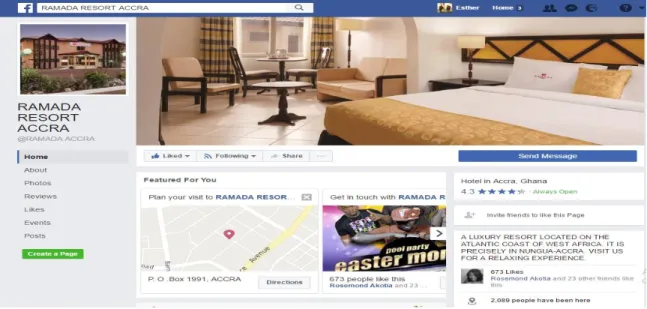
Ramada Resort, Accra can also be found on social media platforms including Facebook
and Twitter. The Facebook account (shown in Figure 15) currently has 677 followers and
however very dormant with no tweets at all and only three followers. Further searches
revealed no accounts on other social media platforms such as Instagram and YouTube.
The use of social media is therefore limited and is a great opportunity for Ramada, Accra
to reach a larger market.
Figure 15: Facebook Account of Ramada Resort, Accra
Currently, Ramada Resort Accra’s occupancy rate is low and tied to festive seasons such
as Christmas, Valentine’s Day and Easter. The resort targets expatriates, business
executives and families who want a place to relax. The conference rooms are used for
meetings and conferences which are secured through face-to-face meetings with the
companies. Having face-to-face meetings is the marketing department’s main method of
attracting clients for the conference room usage. Programs are usually advertised through
flyers, social media accounts, word of mouth and sometimes for special programs
through radio broadcasts and on their billboard at Teshie-Nungua.
4.1.2 5S Performance Model
The 5S Performance Model is used for organizing work areas for efficiency and
effectiveness in carrying out work activities. The 5S’s are Sorting, Straightening out,
Sweeping or Shining, Standardizing and Sustaining. For Ramada Resort, Accra, the
departments that needs organizing through these methods are the Household, Purchasing,
Kitchen and Accounts departments.
These departments either have faulty machines or a layout that makes the room stuffy due
to the badly arranged items in the departments. First, the items and machines will be
sorted into what is needed and not needed. The unwanted materials would then be taken
out and the useful items remaining will be re-arranged for easy access which is the
straightening out step. Sweeping or Shining will then be performed by fixing the faulty
machines or items that are still needed. The room will then be re-organized so daily
activities can be done faster and efficiently and items can be identified easily. For
maintained. For instance, the purchasing department can ensure standardization of their
restocking procedures by having the following routine for their daily use.
Figure 17: Purchasing Department Restocking Routine Sample
This routine (shown in Figure 17) would therefore ensure standardization for restocking
of items in the purchasing department. For sustaining this, routines can be made visual in
the workplace by pasting it at the entrance of all departments and circulating it to all
employees so every employee is aware and reminded of it once he or she enters the
department office.
4.1.3 Customer Insights
From the interviews conducted with customers, it was obvious that the customers liked
the venue and enjoyed the serene atmosphere of the resort. However, one main problem
identified was the tardiness of the employees especially with the waiters and waitresses.
Pricing of the goods and services were described as moderate and the hotel had an
average rating of 3-stars which is its current rating. The uncleanliness of the pool and the
tables and chairs at the restaurant was also brought up and customers wanted some
entertainment mostly in the form of a live band or constant music at the poolside. Purchasing Department Restocking Routine
1. Employee restocking items records the date, his/her name and
arrival time in Purchases Record Book
2. List items to be restocked and its quantities in Record Book
3. Go to sections for various goods identified and restock items on
shelves or allocated areas
4. Record new total number of items restocked in Records Book
4.1.4 Market Trends
The hotel industry is currently characterized by a lot of competition from international
brands setting up branches in the country and local brands revamping their goods and
services. The use of technology and the bid to achieve modernity is now a paramount
need of all hotels as it aids in reaching a larger market and attracts more customers. From
the industry analysis performed in Chapter Two using Porter’s Five Forces, it was
established that rivalry and customer bargaining power is high in the hospitality industry
but once you enter the market, there are few substitutes and low threats from suppliers
and new entrants which gives Ramada Resort, Accra the opportunity to maintain its
customer base once it achieves a sustainable competitive advantage.
4.1.5 Competitor Analysis
Ramada Resort, Accra’s current competitors as gathered from the interviews and its
location include Next Door Hotel, African Royal Beach Hotel, Savannah Beach Guest
House and Diplomat Beach Resort which are all found in Nungua. The main competitor
was however identified as African Royal Beach Hotel due to its similarity in services to
those of Ramada Resort, Accra. As shown below, all the competitors are located along
Figure 18: Competitors
For further comparison, more information was gathered on the pricing of their rooms, the
different types of rooms and the number of rooms available in each hotel. Number of
rooms was used as the metric for market share as more rooms gives the hotel more access
to a larger market. The data gathered for the number of rooms is shown below.
Table 1
Competitor Market Share
Hotel Number of Rooms Market Share (%)
Next Door Beach Resort 5 3.07
Savannah Beach Guesthouse 5 3.07
Ramada Beach Resort 75 46.01
Diplomat Beach Resort 12 7.36
African Royal Beach Hotel 66 40.49
Total 163 100
Source: Author’s own research
The types of rooms and their prices (per night) at the various hotels are also shown
Table 2
Rooms and Prices
Hotel Type of Room Prices (GH¢)
Next Door Beach Resort Standard 80
Savannah Beach Guesthouse Peacock (private) Bamboo (shared) Mahogany (shared) Sunset (private) Shrimps (shared) 50 40 50 40 30 Ramada Resort, Accra Standard (single)
Standard (double) Chalet (single) Chalet (double) Executive Chalet Family Room 645 731 688 800 860 903 Diplomat Beach Resort 2 bedroom with shared hall
1 bedroom with shared hall
435 348 African Royal Beach
Hotel Standard (single) Standard (double) Deluxe (single) Deluxe (double) Family (single) Family (double) Seaside Suite Royal Suite (Single) Royal Suite (Double) Presidential Suite 775 883 947 1,076 1,119 1,249 1,119 2,368 2,368 5,381
Source: Author’s own research
From Table 2 above, it can be seen that both Ramada Resort, Accra and African Royal
Beach Resort have similar room types but varied prices. Using the price, room variety
and the number of rooms as market share, a strategic group map was created as shown
Figure 19: Strategic Group Map
From the chart above, it can be seen clearly that African Royal Beach Hotel is the market
leader since its high prices and variety will gain more income than Ramada Resort,
Accra’s larger market size with lower prices.
4.2 Objectives
This element focuses on identifying the goals of Ramada Resort, Accra and ultimately
seeks to answer the question ‘Where Do We Want Be?’ as an organization. Since the gap
identified for the firm is the attraction and retention of customers, the objectives will be centered on the various elements of the marketing mix which includes the 7 P’s namely
Product, Price, Promotion, Place, People, Process and Physical evidence.
Product
Product includes the services provided to guests and includes the restaurant, gym, salon
and spa, pool, conference rooms and hotel rooms. The focus of this project will be to Next Door Beach
Resort
Diplomat Beach Resort
Savannah Beach Guesthouse
Ramada Beach Resort
African Royal Beach Hotel 0 200 400 600 800 1000 1200 0 2 4 6 8 10 12 Pr ic e Room Variety
Competitor Position
41% 46% 7% 3% 3%increase patronage of the hotel rooms by 20% by adding an additional room choice for
customers.
Price
From the interviews, Ramada Resort, Accra’s pricing was rated as moderate. It can
however be seen that in comparison with the market leader, Ramada Resort, Accra’s
prices could still increase but can only be done if accompanied with the necessary
changes in the services provided. Pricing of goods and services will therefore be
increased by 10% to reflect the market changes in pricing.
Promotion
Promotion involves communicating the benefits and values of our services to customers.
Advertisements will be revamped especially with the use of social media as some of their
accounts are inactive. Twitter posts and Facebook adverts will be utilized and new
accounts will be created on Instagram and YouTube to increase customer base by 20% by
the end of the year 2017.
Place
Ramada Resort Accra’s location by the beach is great as it provides a serene atmosphere
for its clients. The major problem identified is the refurbishment of the place which will
be carried out in six months so guests who walk in will be attracted to revisit the place.
There will also be constant music to keep the place lively for guests.
People
Customer service needs a drastic change as the success of the service industry depends on
the interaction between customers and employees. Discipline will have to be instilled in
improved through training programs. For a change of attitude, organizational culture
plays a very big role and as such a culture of discipline and serviceability will be created
using the Cultural Dynamics Model in order for employees’ productivity to increase by
20% by the end of the year.
From speaking with management, it was clear that no clearly defined organizational
culture existed which makes the adherence to values difficult. Low culture ultimately
affects the firm’s services and thus by improving organizational culture, the employees’
efficiency of will also be improve. The newly desired position is shown in the diagram
below
Figure 20: Organizational Culture and Efficiency Matrix
Process
In enhancing the delivery of services, the processes and systems used will have to be
evaluated and enhanced. The online system of booking is already functioning but the
inaccessible pages on the website will be fixed and the internal processes reviewed and
Physical evidence
Fortunately, Ramada Resort is an international brand which makes its recognition outside
the country known. In Ghana, the name ‘Coco Beach Resort’ which was Ramada Resort, Accra’s old name still resonates with a lot of people. Efforts will therefore be put into
making Ramada Resort, Accra become as well-known as Coco Beach Resort by the end
of July 2017 since the location has not changed.
Efforts in all the P’s of the marketing mix will therefore be geared toward moving
Ramada Resort, Accra from its current position to the desired position shown on the
strategic group map below.
Figure 21: New Desired Position
In summary, the objective is to increase Ramada Resort, Accra’s publicity and market
share by providing cost effective and quality service to its clients.
4.3 Strategies
In order to reach the desired position depicted in Figure 21, the proposed strategy for
business growth through selling existing products in existing markets and as such is a low
risk strategy, as the firm is not risking developing new products or venturing into new
markets (Chartered Institute of Management Accountants, 2014). Market penetration
involves selling more of your product to existing customers, putting in measures to attract
customers from your competitors with new and improved features, having a lower price,
or increasing your service (eCornell, 2013). Thus, with the market penetration strategy,
Ramada Resort, Accra will be able to expand its market share with minimal risk by
improving its current services to customers. The target market will still be business
travelers and Meetings, Incentives, Conferences, Events (MICE) as well as clients who
just want to have access to a serene atmosphere for relaxation
4.4 Tactics
This section involves the various measures that need to be implemented to carry out the
market penetration strategy. The procedures will be broken down under the 7 P’s of the
marketing mix
Promotion
Social media will be the main communication tool that will be used to disseminate
information to potential clients. Since Facebook already has 677 followers, it will be a
great place to start advertising new programs and services. More people can be drawn to
the page by running a competition where the person who shares Ramada posts with the
most friends tagged and gets the most likes wins a prize. This will not only get the
followers engaged but create awareness as the post keeps being shared. Facebook ads
(adverts), which cost $1 - $5 a day can also be used. Facebook ads are based on the client’s specifications and a selected budget for the ads running. With these options,
Ramada Resort, Accra can schedule to run more ads prior and during the peak periods
such as Christmas or Easter seasons. Since market penetration succeeds on the basis of
having lower prices as compared to competitors, a minimum of $100.00 equivalent to
GH¢ 430.00 is therefore allocated to Facebook ads.
For Twitter, Ramada Resort, Accra has to start tweeting about current services and
promotions as that is the only way to trend and get noticed. As more people retweet and
like the posts, more people will be drawn to the page which showcases the products and
services. Since the account on Twitter still needs to build its follower base, there will be
no paid ads on Twitter till the follower number increases. Posts with tags like
#RamadaFun or #RamadaPromo can be created and shared on the page however to help
spread the word about Ramada Resort, Accra.
Instagram and YouTube are other social media platforms that can be utilized for
advertisements. New accounts will be created on these platforms so photos and videos of
the place and programs can be broadcasted on these platforms. In addition to these social
media platforms, Ramada Resort, Accra can still run the occasional radio adverts and
flyers in advertising special programs.
Lastly, Ramada Resort, Accra can undertake activations around the airport which will
attract incoming potential guests. Setting up stands around the airport will help create
awareness to guests arriving who may not even have a place to stay yet and even attract
those who do.
Product
To increase variety, there can be some renaming of the rooms with some special or
‘Beach Front Chalet’ can be introduced so all the chalets are not showcased with the
same qualities. The chalets closest and overlooking the beach can be given this name so
guests who want the view of the sea will opt for this chalet at a higher price.
Conference packages can also be created so firms who frequently patronize the
conference rooms will get loyalty packages and get discounts for choosing to use the
rooms as well. The pool area will also have constant music from a Disc Jockey to
entertain guests.
Place
The venue already has an ambiance for relaxation which can be capitalized upon. The
buildings and infrastructure however needs major refurbishment as it has not undergone
any major maintenance checks in years. This includes acquiring modern furniture,
plumbing and sewage checks, general décor upgrade and other maintenance checks for
the whole establishment. More pool lounge chairs and umbrellas will also be acquired for
the pool area. According to management, the total estimated cost for the refurbishment is
$10,000,000. However, the budget slated for refurbishing the resort is $5,500,000 which
is equivalent to GH¢ 22,872,581.
In order to manage the cost of the refurbishment, the process can be divided into phases
so the cost can be spread over a period of time. The first department to be refurbished
will be the kitchen as complaints from the customers has its cause rooted in the
inefficiencies at the kitchen. After the kitchen, the rooms will be done followed by the
restaurant and pool areas and finally general maintenance of other departments will be
Price
The pricing of the rooms after the refurbishment will be increased by 10% each as shown
below. This increase however still falls below that of its main competitor’s prices as a strategy to attract the competitor’s customers to Ramada Resort, Accra
Table 3
Proposed Prices
Room Old Price (¢) Proposed Price (¢)
Standard (single) 645 710
Standard (double) 731 804
Chalet (single) 688 757
Chalet (double) 800 880
Executive Chalet 860 946
Beach Front Chalet - 1,100
Family Room 903 993
The conference rooms will have their prices maintained with extra services such as
provision of snacks and projectors rather being at an extra cost to the client. Prices of
conferences and other services shown in Appendix 2 will therefore remain constant. The
pool prices will be reviewed from ¢20 and ¢15 to ¢30 and ¢20 for adults and children
respectively due to the increase in operational cost and restocking of the pool area
materials and equipment.
People
The first change for the employees will be the improvement in their skills. Training
programs need to be implemented as the interviews revealed that more than 50% of the
current employees were not trained in the hospitality industry before being employed.
Employees can be made to take free online courses that will broaden their knowledge and
online courses that can be used are the Hotel Management short courses offered by
Oxford Home Study College and Brentwood Open Learning College. These short courses
will introduce employees to hotel management and the primary duties of key hotel
departments and how to carry them out efficiently
For improving organizational culture, the Cultural Dynamics Model will be used. The
first step is to transform assumptions into values for the company. After speaking to one
of the partners, it was established that Ramada Resort, Accra’s aim is to provide a serene
environment and the best hospitality service where guests can relax. With this, some
values that the organizational culture can be built upon are;
Service – we serve our guests with the best hospitable treatment in a relaxing atmosphere
Diversity – we respect the different cultures of our guests and employees
Integrity – our foundation is rooted in doing the right thing at all times
Excellence – we strive for the best in all we do by providing quality services to guests
Teamwork – we believe in teamwork and the capabilities of each employee as a route to success
After establishing the values of the company, the next step is to realize these values and
show them in the artifacts in the hotel. This could be portrayed in the paintings, décor,
furniture, upholstery and even clothing. Since diversity is one of the values, the artifacts
can portray the rich culture of Ghana as well as those of other countries. This is depicted
Figure 22: Hotel Artifacts
Also, colours that depict serenity can be inculcated to create the desired relaxing atmosphere. Samples of these colours are shown below.
Figure 23: Serene Colour Representations
With the environment depicting the resort’s values, both guests and employees will
constantly be reminded of them. The last step of promoting organizational culture is the
symbolization process. Apart from artifacts, Ramada Resort, Accra can also institute
some symbols that represent the firm such as a slogan, logo or company colour.
can be emphasized on more and already has a logo with the colour red which is an
international logo for the Ramada Resort brand as shown below.
Figure 24: Company Logo
Going through the whole process of establishing the organizational culture will help
make the employees more dedicated to their work once the culture is instilled into their
everyday processes. Eventually, a high level of culture will result in higher efficiency as
the employees will understand the purpose of the firm and be more committed to their
duties.
Process
Figure 25 below shows the online interface for booking a room at Ramada Resort, Accra.
The online booking process is functioning and can be used for guests located both
nationally and internationally.
Figure 25: Online Booking Interface
For the employees, the following process flow chart should be instituted to check
employee punctuality to work. This process flow chart will be made visual by pasting
Figure 26: Employee Arrival and Departure Work Process Flow Chart
Physical evidence
Physical evidence consists of the ambiance and surroundings of the resort. Since the cool
breeze from the sea already provides a relaxing atmosphere for guests, the hotel just
needs an upgrade in its infrastructure which will make guest experience enjoyable. Also,
the organizational culture established above already inculcates some artifacts and
Pool area
Chalets
Lawn area Huts by the beach
Rooms Gym
Figure 27: Ramada Resort Pictures
4.5 Actions
This section provides the details on how the tactics will be carried out. This includes the
personnel in-charge of the activity, the duration and the cost involved.
Table 4
Action Plan
Personnel In-Charge
Activity Duration Cost
(GH¢) Marketing
Manager
Social media engagement and promotions
-Facebook -Twitter -Instagram -YouTube
All year long with focus on more adverts during
Easter, Valentine and Christmas Seasons
Management and Department Heads Organizational Culture Implementation 4 months (1st month – assumptions 2nd month – Values 3rd month – Artifacts 4th month- Symbols) 400 Human Resource Manager
Online Hotel Management Training
Hotel Management (short course) – Oxford Home Study College
Hotel Management Couse- Brentwood Open Learning College 80 hours 20 hours N/A N/A Department Heads Internal Department Record Checks 1 week N/A General Manager Refurbishment Phase 1: Kitchen 2: Rooms 3: Restaurant and pool 4: General fixtures and fittings 6 months 22,871,751 TOTAL 22,872,581
The first activity is the social media marketing campaign as that is the simplest to set up
and control. Free accounts can easily be created and promotions can be run during the
festive seasons to attract more customers. The cost attached is that of running Facebook
adverts for a year as Ramada Resort, Accra’s existing account already has over 600
followers which can be increased with more exposure of the resort. The implementation
of the social media marketing campaign and organizational culture process can be done
simultaneously as these two activities will be handled by different managers and are not
dependent on each other. The GH¢ 400 allocated to the culture sessions is for the