Carnegie Mellon University
Research Showcase @ CMU
Institute for Software Research
School of Computer Science
2005
TCP Connections for P2P Apps: A Software
Approach to Solving the NAT Problem
Jeffrey L. Eppinger
Carnegie Mellon University
Follow this and additional works at:
http://repository.cmu.edu/isr
This Article is brought to you for free and open access by the School of Computer Science at Research Showcase @ CMU. It has been accepted for inclusion in Institute for Software Research by an authorized administrator of Research Showcase @ CMU. For more information, please contact [email protected].
TCP Connections for P2P Apps:
A Software Approach to Solving the NAT Problem
Jeffrey L. Eppinger January 2005 CMU-ISRI-05-104
Institute for Software Research International School of Computer Science
Carnegie Mellon University 5000 Forbes Avenue Pittsburgh, PA 15213
Abstract
Many P2P applications need to connect to each other via TCP, but are increasingly stymied by NAT boxes. Some popular P2P applications do not address NAT traversal or do so poorly. A few newer ones route com-munications between NATed peers through relay servers or through non-NATed peers, or they ask users to reconfigure their NAT boxes. Some emerging solutions suggest using SIP to set up tunneling over UDP, us-ing UPnP, or even deployus-ing IPv6. This paper argues that the above approaches suffer from scalability prob-lems, do not address mobility issues, require deploying new network infrastructure, or require using non-standard communications interfaces, non-non-standard communication stacks, and non-non-standard security proto-cols. We advocate direct TCP connections between peers. We present NatTrav, our NAT Traversal Java package that makes TCP connections between NATed peers and addresses all of the above concerns. We then compare NatTrav with some of the other current and emerging solutions.
3
1. The Problem
We are building some really cool peer-to-peer (P2P) applications. If you’re reading this paper, we’ll bet you are, too. Among the first problems we encoun-tered was how to connect our P2P applications to-gether. We want TCP connections between instances of our application running on mobile (or even desk-top) machines that (i) connect to the Internet from various places so they don’t have a fixed network ad-dress, and (ii) often connect to the Internet via a Net-work Address Translation (NAT) box. We must solve problem (ii) in light of problem (i). Here’s a scenario: our applications run on notebook computers and PDAs that are sporadically connected to the Internet from a home network, the office, “free high-speed Internet” in a hotel room, or WiFi in a coffee shop. In most if not all of these scenarios, our application re-quires TCP connections between two machines that are both behind NAT boxes. The problem is that computers attached to the Internet via NAT boxes can make outbound connections to non-NATed computers, but typically cannot receive inbound connections.
NAT boxes allow several computers to share one public IP address [1]. The computers get private IP addresses and must send their communication to the public Internet through the NAT box. The NAT box uses port translation in order to determine which com-puter should receive the responses [2]. For example, when the NAT box receives communication from a private IP address and port, say A:X, it sends the communication out via its public IP address on a proxy port, say NA:Y. The NAT maintains a table of mappings. When responses come back to the NAT on
NA:Y it forwards them back to A:X. Also, when A:X
sends additional communication the NAT can (de-pending on the destination and the NAT’s implemen-tation) use the same proxy port Y.
Using the classifications in [3], there are four dif-ferent ways NAT boxes implement the mapping be-tween A:X and its proxy port NA:Y which we sum-marize below. Assume we initiate communication from A:X to a non-NATed computer at IP address and port B:J via NA:Y:
1) With a Full Cone mapping, NA:Y will handle communications between A:X and any other com-puter. Specifically, a computer C, knowing or guess-ing NA:Y would be able to communicate with A:X.
2) With a Restricted Cone mapping,
communi-cation sent from a computer C to NA:Y would only be forwarded to A:X if A had previously sent communi-cation from port X to computer C.
3) With a Port Restricted Cone mapping, com-munication sent from a computer C using port M to
NA:Y would only forward to A:X if A had previously sent communication from port X to C:M.
4) With a Symmetric mapping, the NAT allo-cates a different proxy port for each IP address and port with which A:X communicates. For example, if
A:X subsequently communicates with B:Q, another NAT proxy port would be used, such as Z.
In the first three cases, which we call cone-type mappings, the NAT uses NA:Y for all future commu-nications from A:X until the mapping is removed from the its internal tables. Mappings are only re-moved after a period of inactivity on NA:Y.
2. Current Approaches
Popular P2P applications have addressed the NAT Traversal Problem in different ways. Below we enu-merate our concerns about how these applications ad-dress NAT Traversal:
1) If only one peer is NATed, have the NATed peer set up the connections (e.g., Kazaa [4], LimeWire [5]). This is only a partial solution: in a majority of the scenarios in which our applications run both peers will be NATed.
2) Recommend users configure their NAT boxes to forward incoming requests on specific ports to one computer behind the NAT (e.g., BitTorrent [6]). This is unacceptable because (a) several computers behind the NAT may need to run this application and (b) us-ers may not have the technical capability or adminis-trative access to configure the NAT.
3) Route P2P communication through central re-lay servers (e.g., Groove [7]). This approach is too expensive. As our application scales, we cannot af-ford to provide the CPU and network bandwidth.
4) Route TCP connections through instances of the application that happen to be running on open, non-NATed computers (e.g., Skype [8]). We believe users who happen to be running our applications on non-NATed machines will not want to bare the CPU and network costs either. Moreover most machines running our applications will be NATed so there may be shortage of non-NATed machines to help out.
5) Use a proprietary session initiation protocol to exchange UDP ports between the peers and then
tun-4 nel TCP over UDP (e.g., Newrong [9]). We want to use a standard TCP stack with standard TCP stacks and interfaces so that we can capitalize on the benefits of the years of work optimizing TCP and building ap-plication packages for it. Also many networks do not allow UDP.
Finally, we have a security concern: our applica-tion requires the peers authenticate each other. We want to use SSL. Approaches 3, 4, & 5 require some sort of custom-made authentication scheme.
In Section 7, we discuss emerging solutions in-cluding UPnP, IPv6, and SIP.
3. Solution Requirements
Summarizing our concerns described above, our NAT Traversal solution should permit applications to talk to each other with:
a) Scalability – We want to incur minimal (if not zero) cost as the number of instances of our applica-tions grows.
b) Standard Interfaces – For ease of develop-ment, we want to use standard interfaces for network communication, e.g., Sockets. This is more familiar to developers and allows many existing software packages/libraries to be used without modification.
c) Standard Stacks – Many years and tears have gone into optimizing TCP. We don’t want to reinvent and/or debug this. Furthermore, many networks do not allow the use of UDP.
d) Security – We want to use SSL with standard interfaces and X.509 certificates. We don’t want to have to re-invent this complex wheel, either.
e) Mobility – We want peers to communicate with each other even though they move from network to network. Often these networks are not controlled by the user who cannot reconfigure the NAT to add port mappings, allow UDP, or turn on UPnP.
4. Our Approach
Our approach is called NatTrav. In NatTrav, “recipi-ent” peers willing to receive connections from “initia-tor” peers register with an intermediate connection broker by providing a network address and a URI – a Universal Resource Indicator to identify uniquely the recipient peer.
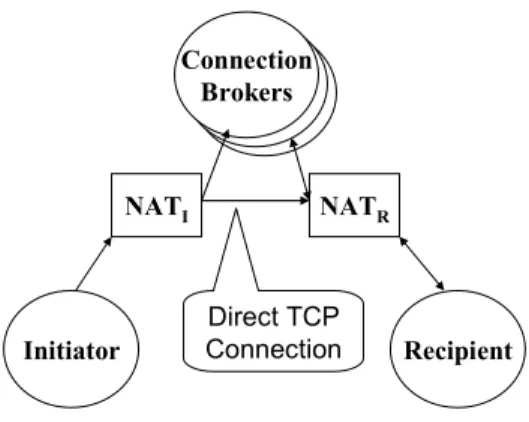
Connection brokers facilitate connections to recip-ients by (i) providing the current network address for the recipient and (ii) facilitating NAT Traversal if the recipient is NATed. Connection brokers are replica-ted for availability and scalability. See Figure 1.
Connection Brokers Initiator NATI Recipient NATR
Figure 1: NatTrav Architecture
Direct TCP Connection
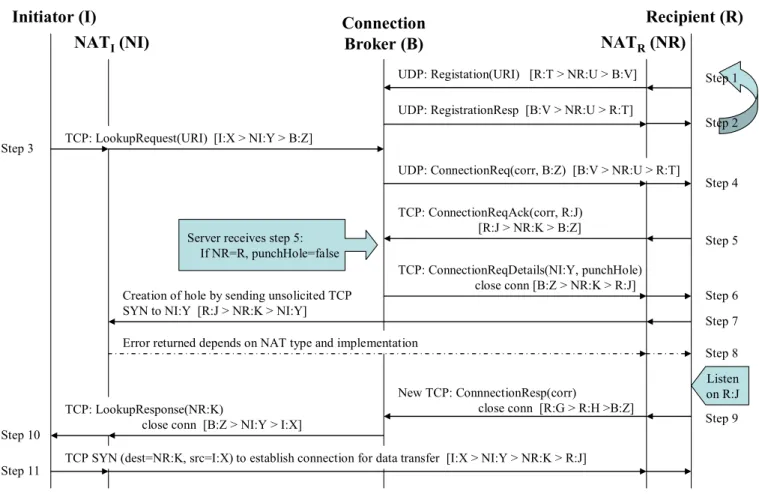
The NAT Traversal Protocol for cone-type map-pings is shown in Figure 2. It may be possible to use port prediction to extend our solution to symmetric mappings as described by [16] in Section 7, but recent studies show that NAT boxes in the retail market place rarely use symmetric mappings [10].† Since
Internet phones also do not work well on NAT boxes that create symmetric mappings, we believe that the industry is moving away from this approach.
Recipient Registration – InSteps 1 & 2, a recipi-ent peer registers with a connection broker providing its URI name. It can either use UDP or TCP for regis-tering. Using UDP (as shown in Figure 2) permits large numbers of recipients to register with each con-nection broker, however recipients must regularly send these Registration messages to the connection broker so that the connection broker can subsequently be able to send Connection Request messages to the Recipient through its NAT (Step 4). Using TCP for registration would normally require connection bro-kers maintain large numbers of open TCP sessions. Not shown in the figure, we can deputize UDP-capable recipients to act as proxies. (In true P2P fash-ion, each TCP-only recipient uses NatTrav as an ini-tiator to set up TCP connections to proxies.)
† Of the 42 different versions of NAT boxes in the
study, 4 do not follow the IETF Specification for NATs [2] and 1 always uses symmetric mappings. Of the remaining 37, including those dominant by retail market share, most use cone-type mappings all the time. A few use cone-type mappings unless the port number is already in use by another computer behind the NAT in which case they revert to creating a sym-metric mapping. In this scenario, NatTrav fails to connect, but our when applications retry, NatTrav uses different ports and likely succeeds.
5 Listen on R:J TCP: ConnectionReqAck(corr, R:J) [R:J > NR:K > B:Z] TCP: ConnectionReqDetails(NI:Y, punchHole) close conn [B:Z > NR:K > R:J] UDP: RegistrationResp [B:V > NR:U > R:T] UDP: Registation(URI) [R:T > NR:U > B:V]
New TCP: ConnnectionResp(corr)
close conn [R:G > R:H >B:Z] TCP: LookupRequest(URI) [I:X > NI:Y > B:Z]
TCP: LookupResponse(NR:K)
close conn [B:Z > NI:Y > I:X]
Connection Broker (B)
UDP: ConnectionReq(corr, B:Z) [B:V > NR:U > R:T]
TCP SYN (dest=NR:K, src=I:X) to establish connection for data transfer [I:X > NI:Y > NR:K > R:J] Step 3
Step 1
Step 2
Step 4
Step 5
Creation of hole by sending unsolicited TCP SYN to NI:Y [R:J > NR:K > NI:Y]
Step 7 Step 8 Error returned depends on NAT type and implementation
Step 9 Step 10
Step 11
NATI(NI)
Initiator (I) Recipient (R)
Step 6 Server receives step 5:
If NR=R, punchHole=false
Figure 2: NAT Traversal Protocol
NATR(NR)
Note: The IP addresses and ports used for communication are shown in square brackets. For example: [I:X > NI:Y > B:Z] denotes communica-tion from the Initator’s IP address I and port X to the conneccommunica-tion broker’s IP address B on port Z via NATI’s public address NI and public port Y.
Lookup – In Step 3, when an initiator peer wants to make a TCP connection to a recipient peer, it sends a Lookup Request to a connection broker. The con-nection broker eventually replies (Step 10) with a public IP address and port that the initiator can use (in Step 11) for a direct TCP connection from initia-tor to recipient (via their NAT boxes) as shown in Figure 1.
The connection broker checks to see if there is an active registration for the recipient. The connection broker may need to contact other connection brokers to determine this. If so, it sends a Connection Re-quest to the recipient on the UDP address and port the recipient (or its proxy) used to register (Step 4). The Connection Request contains a correlator (corr)
to track which Lookup Request subsequent steps are working on and the IP address and port of the con-nection broker that the recipient should use for the subsequent steps.
Punching the Hole – In Steps 5 & 6 the recipient uses TCP to exchange network address information with the connection broker specified in the Connec-tion Request. The connecConnec-tion broker compares the recipient’s private IP address (R) and its public IP address (NR). If they match, the recipient is not NATed. If they do not match, the recipient is NATed and the recipient is told to punch a hole in its NAT for messages coming from the initiator’s public IP address and port (NI:Y).
6 The trick here is that we use the same IP ad-dresses and ports for TCP communication with the connection broker and for the direct TCP connection between initiator and recipient. Because we are punching holes in cone-type NATs, we know that the NATs will use the same proxy ports for communica-tion with the conneccommunica-tion broker and the peers. In the example shown in Figure 2, the initiator uses port X
when communicating with the connection broker (Step 3), but the connection broker sees it coming from NATI’s port Y. Similarly, the recipient uses
port J (Step 5) and the connection broker sees NATR’s port K. To punch the hole, the recipient
closes its TCP connection with the connection broker used in Steps 5 & 6 and in Step 7 uses port J to at-tempt to open a TCP connection to NI:Y. Depend-ing on the type and implementation of NATI, Step 8
may be a timeout, a TCP reset response, or (if NATI
is a full-cone NAT) a port-in-use error (because NATI forwarded the TCP SYN on to I:X). In any
case, the TCP connection will not succeed but the attempt enables NATR to forward communication
from NI:Y sent to NR:K on to R:J.
Between Steps 8 & 9, we set up a Server-Socket to listen on R:J. Then we send a Connec-tion Response message to the connecConnec-tion broker (Step 9). In Step 10, the connection broker tells the initiator that it can now set up a direct TCP
connec-tion to the recipient (via the NAT boxes) by using
NR:K. In Step 11, the TCP connection is set up. Our P2P applications use a Java package called
nattrav. The nattrav package contains classes that parallel the style of the standard Java class librar-ies for setting up TCP Sockets between applications. Not only this, but the objects returned by the nat-trav package are instances of the standard Java
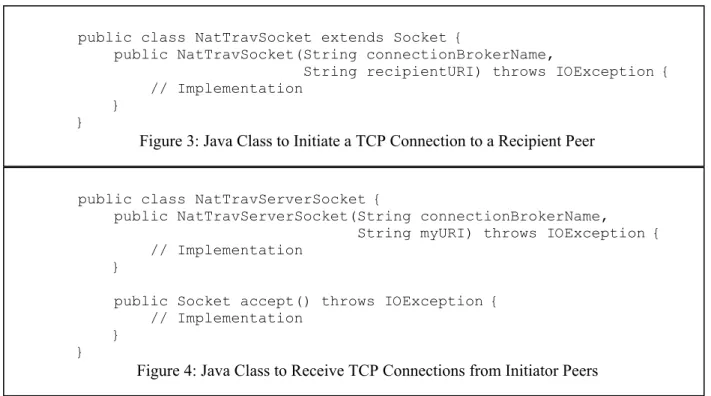
Socket class directly connecting the initiator and recipient peers. Figures 3 & 4 are code excerpts showing the interfaces for the most basic methods.
5. Security Extensions
In many cases, we want our P2P applications to use SSL connections between the peers. This is for pri-vacy of the communication and to authenticate the peers. We use our own certification authority (CA) to sign X.509 certificates for connection brokers and the peers. The CA’s signing certificate is pre-installed into our applications’ key stores. We can then use the signed X.509 certificates to make SSL connections in Figure 2, Step 11.
The interesting security problem for our NAT Traversal Protocol as shown in Figure 2 is that noth-ing prevents a rogue peer from registernoth-ing as a recipi-ent thereby redirecting Connection Requests to itself. To guard against this, we also have developed a se-cure registration protocol that uses the X.509 certifi-cates (and the corresponding private keys) to
public class NatTravServerSocket {
public NatTravServerSocket(String connectionBrokerName,
String myURI) throws IOException { // Implementation
}
public Socket accept() throws IOException { // Implementation
} }
Figure 4: Java Class to Receive TCP Connections from Initiator Peers
public class NatTravSocket extends Socket {
public NatTravSocket(String connectionBrokerName,
String recipientURI) throws IOException { // Implementation
} }
7 ment a simple challenge/response to authenticate connection brokers and recipients during registration.
6. Evaluation
To date, we have built two P2P applications using NatTrav: (1) a Remote Desktop Proxy that allows Remote Desktop Connections to Windows machines located by URI, and (2) a replicated, incremental backup service. At the time of this writing, these ap-plications are in limited deployment.
In these deployments, the observed elapsed time to setup a TCP connection from an initiator to a re-cipient using NatTrav ranges from 1.1 to 21.2 sec-onds depending on many factors, including the speed of the network between the computers and the behav-ior of NATI in Step 8 of the protocol. The initial
con-nection time was no problem for the more often used backup application as the replication occurs in the background.
Upon further investigation, we added a configur-able timeout when setting up the TCP connection in Step 7. We currently run with this timeout set to 2 seconds and have now seen connection times under 5 seconds in all cases observed.
We note that in both applications, the ability to have direct TCP connections between the peers is very important. We are using standard Java Socket (and SSL) classes for easy development and efficient network performance.
A test of a connection broker running on an 800 MHz laptop driven by simulated client loads proc-essed over 5,000 UDP Registrations (Steps 1 & 2) per second. UDP recipients re-register every minute, so a connection broker should support about 300,000 recipients. This does not measure the cost of replica-tion or occasional Lookup Requests and Connecreplica-tion Requests. We believe these costs to be minimal. Since connection brokers provide an application spe-cific service, running connection brokers to support instances of our applications is not a significant cost.
7. Other Emerging Solutions
UPnP is a new standard to support the ability to plug devices into a home network [11]. An application could use UPnP to configure a NAT box to forward to it incoming requests received on specific ports (thereby achieving NAT Traversal). Unfortunately, early UPnP implementations had highly publicized security issues and many NAT boxes that support UPnP ship with it turned off by default. Furthermore, UPnP enables any application on the LAN to create
port mappings. Many savvy consumers continue to have security concerns. Anecdotally, we have found that WiFi hotspots tend not to enable UPnP. Users should not have to reconfigure their NAT boxes to turn on UPnP as they may not be technically capable, might not have administrative access, or their NAT might not support UPnP.
Nevertheless, UPnP support can be easily added to NatTrav. When available, recipients would use UPnP to configure port mappings on the NAT. The recipient would register the NAT’s public IP address and a mapped port with a connection broker. Lookup Requests would still be used to find these recipients.
IPv6 is a new standard that specifies 128 bit IP addresses [12]. It is possible that the new, longer IPv6 addresses will reduce the need for NAT boxes; however we are skeptical. NAT boxes abound as IPv6 adoption has been slow and there is an expecta-tion that protocol translating NAT boxes (NAT-PT) will be used to bridge between IPv4 and IPv6 net-works. Other projects such as [13] are working on general solutions for NAT Traversal without any ap-plication changes, but they require deployment of significant additional network infrastructure.
SIP is a new IETF Session Initiation Protocol that can be used to initiate UDP connections for te-lephony and multimedia applications [14]. Except for security and NAT Traversal, it standardizes the communication formats for functions similar to our connection brokers. We chose not to use SIP be-cause: (i) it has a tremendous amount of mechanism we do not need for our application, (ii) it does not provide NAT Traversal, and (iii) beyond standardiz-ing how user ids and passwords are sent, it does not address our security concerns. Even if we were to include all the above capabilities in a SIP implemen-tation, whether or not we use SIP internally in our applications is transparent to our users.
NUTSS is a new research project at Cornell [15]. As its acronym suggests, it proposes to combine NAT Traversal, URIs, Tunnelling over UDP, SIP, and
STUN. STUN [3] is a UDP-based Protocol that an application can use to talk with intermediate STUN servers to determine if it is NATed and if so, via what type of NAT. Again, we have several concerns about tunneling over UDP. Recently, the NUTSS research-ers have proposed a TCP based approach [16] con-sisting of (i) STUNT: TCP extensions to STUN, and (ii) a TCP hole punching protocol. Their hole punch-ing protocol is much more complex than ours requir-ing use of port prediction, STUNT, spoofrequir-ing, and
8 sending TCP SYNs with low TTLs. However, they are attempting to traverse symmetric NATs.
8. Conclusions
Our P2P applications require direct TCP connections between peers. By using a NAT Traversal solution, such as NatTrav, we are able to directly connect our peers across cone-type NATs: (i) using standard TCP Socket and SSL packages, (ii) with minimal cost per new peer, (iii) without routing through non-NATed peers, (iv) without requiring users to reconfigure their NATs, and (v) locating specific peers wherever they are connected to the Internet.
While we could not afford to wait for prevalent UPnP utilization and IPv6 deployment (which may never happen) or the future standardization activities initiated by NUTSS, we look forward to their future successes. Should support for symmetric NATs be-come important to our applications, NUTSS may be very important to us. As NAT box makers start sup-porting UPnP and enabling it by default, it may be useful to add UPnP support to our arsenal.
A final note: our NAT Traversal solution is ap-plication specific. So is Skype’s approach of routing calls through non-NATed peers. Their approach works well because it’s a low bandwidth application (less than 16 kbps during a call with custom encryp-tion) [17]. But they likely will need to use direct TCP connections when they add video.
9. Acknowledgements
Special thanks to Mukund Gopalan and Kamal Sau-rabh who, with the author, created algorithms and their implementation for NAT Traversal described herein.
References
[1] K. Egevang & P. Francis. The IP Network Ad-dress Translator (NAT). IETF RFC 1631. [2] P. Srisuresh & K. Egevang. Traditional IP
Net-work Address Translator. IETF RFC 3022. [3] J. Rosenberg, et al. STUN - Simple Traversal of
User Datagram Protocol Through Network Ad-dress Translators. IETF RFC 3489.
[4] T. Jessup. How Kazaa Works. Utah Education Network Summit, Oct 2003.
(http://www.ndnn.org/blog/downloads/summit/ UENSummit_Peer_2_Peer.ppt)
[5] Lime Wire LLC. Frequently Asked Questions.
(http://www.limewire.com/english/content/faq.shtml)
[6] BitTorrent. FAQ. (http://bittorrent.com/FAQ.html)
[7] Groove Networks. Groove Web Services. Nov 2002.
(http://www.groove.net/pdf/wp-groove_web_services.pdf)
[8] Skype Technologies S.A. Skype Explained.
(http://www.skype.com/products/explained.html)
[9] Newrong Inc. NAT Traversal SDK.
(http://www.newrong.com/en/product/index.html)
[10] C. Jennings. NAT Classification Results using STUN. IETF Internet Draft. Oct 2004. (http://www.ietf.org/internet-drafts/draft-jennings-midcom-stun-results-02.txt)
[11] T. Fout. Universal Plug and Play in Windows XP. Microsoft Corporation.
[12] S. Deering & R. Hinden. Internet Protocol, Ver-sion 6 (IPv6) Specification. IETF RFC 2460. Dec 1998.
[13] T.S. Ng, et al. A Waypoint Service Approach to Connect Heterogeneous Internet Address Spaces. USENIX Annual Technical Confer-ence, Boston, MA, Jun 2001.
[14] J. Rosenberg, et al. SIP: Session Initiation Pro-tocol. IETF RFC 3261. Jun 2002.
[15] P. Francis. Is the Internet Going NUTSS? IEEE Computing, Nov-Dec 2003.
[16] S. Guha, et al. NUTSS: A SIP-based Approach to UDP and TCP Network Connectivity. SIGCOMM'04 Workshops, Aug 2004. [17] Skype Technologies S.A. Skype Technical