Osaka, Japan
i
CONFERENCE
PROCEEDINGS
BOOK OF ABSTRACTS
BESSH-2018
International Conference on“Business Economic, Social Science & Humanities” (BESSH-2018), Osaka, Japan
ii
Book of Abstracts Proceeding
International Conference on
“Business Economic, Social Science & Humanities” (BESSH-2018)
Osaka, Japan
Office Address:
M2-17-01 Tower 2, Level 17 8trium
Bandar Sri Damansara
52200 Kuala Lumpur, Malaysia
Contact: (+6) 03 6735 6566
Email: [email protected]
iii All rights reserved. No part of this publication maybe reproduced, stored in a retrieval system, or transmitted in any form or by any means, electronic, mechanical, photocopying, recording or otherwise, without the prior written permission of the publisher. Applications for the copyright holder’s written permission to produce any part of this publication should be addressed to the publisher.
Proceedings of the International Conference on
“Business Economic, Social Science & Humanities (BESSH-2018)”
ISBN: 978-969-683-923-1
Disclaimer
Every reasonable effort has been made to ensure that the material in this book is true, correct, complete, and appropriate at the time of writing. Nevertheless the publishers, the editors, and the authors do not accept responsibility for any omission or error, or for any injury, damage, lose, or financial consequences arising from the use of the book. The views expressed by the contributors do not necessarily reflect those of the Academic Fora.
iv
TABLE OF CONTENTS
ORGANIZING COMMITTEE ... V CONFERENCE CHAIR MESSAGE ... VI CONFERENCE SCHEDULE ... VII LIST OF CONFERENCE ATTENDEES ... X TRACK A: BUSINESS, ECONOMICS, SOCIAL SCIENCE & HUMANITIES ... 12 1. INDETERMINACY IN A SMALL OPEN ECONOMY WITH
INCOME EFFECT ON LEISURE DEMAND ... 13 2. ENCOURAGING ESL LEARNERS TO SPEAK ENGLISH IN
LARGE CLASSES TOWARDS THE COMBINING
ARRANGEMENT ACTIVITIES ... 14 3. BRAND COMMUNICATION AND ITS EFFECT ON BRAND
EQUITY ON INSTAGRAM ... 15 4. COMPARING FOOD AND AGRICULTURAL EDUCATION
PROGRAMS AT URBAN AND RURAL ELEMENTARY
SCHOOLS ... 16 5. THE ROLE OF EXPECTATION ON EXCHANGE RATE
DETERMINATIONS IN INDONESIA ... 17 TRACK B: ENGINEERING, TECHONOLGY, COMPUTER AND APPLIED SCIENCES ... 18 6. EVALUATION OF PROCESS CHARACTERISTICS FOR HOT
FORMING QUENCHING INTEGRATED PROCESS WITH AL6061 SHEET ... 19 7. FSI-BASED INVESTIGATION ON THE EFFECTS OF
TURBULENT FLOW ON THE MICROALGAE CELLS
STRUCTURES ... 20 8. IMPROVING THE EXTRACTION OF ARA H 1 (A PEANUT
ALLERGEN) FROM A PEANUT-BASED FOOD MATRIX FOR SWCNT-BASED BIOSENSOR DETECTION ... 21 FUTURE EVENTS ... 22
v
International Conference on
“Business Economics, Social Science & Humanities” Osaka, Japan
Venue: Osaka International Convention Center
ORGANIZING COMMITTEE 1. Ms. Ani Wahyu Conference Coordinator Email: [email protected] 2. Mr. Metha Shahi Conference Coordinator Email: [email protected] 3. Ms. Grace Ooi Conference Coordinator Email: [email protected] 4. Mr. Metin Gurani Conference Coordinator Email: [email protected]
vi
CONFERENCE CHAIR MESSAGE
Dr. Malika Ait Nasser
International Conference on “Business Economic, Social Science & Humanities” serves as platform that aims to help the scholarly community across nations to explore the critical role of multidisciplinary innovations for sustainability and growth of human societies. This conference provides opportunity to the academicians, practitioners, scientists, and scholars from across various disciplines to discuss avenues for interdisciplinary innovations and identify effective ways to address the challenges faced by our societies globally. The research ideas and studies that we received for this conference are very promising, unique, and impactful. I believe these studies have the potential to address key challenges in various sub-domains of social sciences and applied sciences.
I am really thankful to our honorable scientific and review committee for spending much of their time in reviewing the papers for this event. I am also thankful to all the participants for being here with us to create an environment of knowledge sharing and learning. We the scholars of this world belong to the elite educated class of this society and we owe a lot to return back to this society. Let’s break all the discriminating barriers and get free from all minor affiliations. Let’s contribute even a little or single step for betterment of society and welfare of humanity to bring prosperity, peace and harmony in this world. Stay blessed.
Thank you.
Dr. Malika Ait Nasser
Conference Chair
Email: [email protected] BESSH-2018
vii DAY 01 Tuesday (June 26, 2018)
Venue: Osaka International Convention Center
09:00 am – 09:30 am Registration & Kit Distribution 09:30 am – 09:40 am Introduction of Participants
09:40 am – 09:50 am Opening Ceremony
09:50am – 10.00 am Grand Networking Session
10.00 am- 10:30 am Tea Break
viii DAY 01 Tuesday (June 26, 2018)
Session I (10:30 am – 12:00 pm) Venue: Room 1
Session Chair: Mr. Leon Yap
Track A: Engineering & Technology, Computer, Basic & Applied Sciences
EEAS-JUNE-107 Evaluation of Process Characteristics for Hot Forming Quenching
Integrated Process with Al6061 Sheet Dr. Chanjoo Lee
EEAS-JUNE-108C FSI-Based Investigation On The Effects Of Turbulent Flow On The
Microalgae Cells Structures Haider Ali
EEAS-JUNE-110 A Study on Flow Control of Rear Flange Parts for 34ton-class Composite
Driving Device Mincheol Park
EEAS-JUNE-111 A Study on Precision Drilling of CFRP For BEAM & HAT Parts Yunhyeok Lee
EEAS-JUNE-112 A Study on the Relationship between Hardness and Strain of Cold Forged
Parts Park Seok Hyeon
EEAS-JUNE-109 Improving the Extraction of Ara H 1 (A Peanut Allergen) from a
Peanut-Based Food Matrix for SWCNT-Peanut-Based Biosensor Detection Jinyoung Lee
ix DAY 01 Tuesday (June 26, 2018)
Session II (1:00 pm – 2:00 pm) Session Chair: Leon Yap
Track B: Business, Economics, Social Sciences & Humanities
IRBEMSH-068-ANI105 Brand Communication and Its Effect on Brand Equity on Instagram Dr. Jeanne Ellyawati
IRBEMSH-068-ANI106 Comparing Food and Agricultural Education Programs at Urban and
Rural Elementary Schools Chien-Chi, Lin
IRBEMSH-068-ANI108 The Role of Expectation on Exchange Rate Determinations in
Indonesia
Rogatianus Maryatmo
OSA-468-102B Indeterminacy in a Small Open Economy with Income Effect on
Leisure Demand Yu Shan Hsu
OSA-468-103B Encouraging ESL Learners to Speak English in Large Classes
towards the Combining Arrangement Activities
Chomkate Ngamkaiwan
x
List of Conference Attendees
The following Scholars/ practitioners/educationist who don’t have any paper presentation, however they will attend the conference as delegates & observers.
Sr. No
Official ID Name Affiliation Details Country
1.
EEAS-JUNE-108 Cheol Woo Park
Kyungpook National University South Korea
2.
OSA-468-104BA Woo-Yeul Baek
Department of Sport Management, Kyonggi University
Korea
3.
xi
City Tour and Shopping Day
All respective guests are free to conduct their own
sightseeing and tour. The second day of the event is
12
TRACK A: BUSINESS, ECONOMICS, SOCIAL SCIENCE & HUMANITIES
15
Brand Communication and Its Effect on Brand Equity on Instagram
Dr. Jeanne Ellyawati*
Abstract This study aims to investigate the effect of brand communication on brand equity on media Instagram. The dimension of brand communication is measured using firm-created and user-generated content variables. Data were collected by using cross-sectional survey design with paper and pencil test. The research subject is customer of Jogja Food Truck (JFT) Community and follows their Instagram. Samples of 300 respondents were collected using purposive sampling method. Multiple linear regression statistic methods are employed to analyze data. The result shows that the dimensions of firm-created content (FCC) communication in online social media has a positive effect on brand equity. While user-generated content (UGC) discussion in online social media partially effects on brand equity.
Keywords: Brand Communication, Brand Awareness, Brand Loyalty, Perceived Quality
Atma Jaya Yogyakarta University, Indonesia *E-mail: [email protected]
22
23
You can find the Details regarding our future events by following below:
Business, Economics, Social Science & Humanities (BESSH) Conferences:
http://academicfora.com/buisness-conference-home/
Engineering & Technology, Computer, Basic & Applied Science
http://academicfora.com/engineering-conference-home/
Medical, Medicine & Health Science
http://academicfora.com/medical-conference-home/
For paper publication:
Jeanne Ellyawati
Universitas Atma Jaya Yogyakarta Corresponding author: [email protected]
Abstract.
This study aims to investigate the effect of brand communication on brand equity on media Instagram. The dimension of brand communication is measured using firm-created and user-generated content variables. Data was collected by using a cross-sectional survey design with a paper and pencil test. The research subject is a customer of Jogja Food Truck (JFT) Community and follows their Instagram. Samples of 300 respondents were collected using the purposive sampling method. Multiple linear regression statistic method is employed to analyze data. The result shows that the dimensions of firm-created content (FCC) communication in online social media has a positive effect on brand equity. While user-generated content (UGC) communication in online social media partially affects brand equity.
Keywords: brand communication, brand awareness, brand loyalty, perceived quality, brand equity, Instagram. 1. Introduction
Online social media is one of the popular media and is often used by internet users at this time to share information, pictures, video, or just seeking friendship. The Internet has developed from time to time and created new value propositions, particularly in the field of marketing. Rapid technological developments, especially web 2.0, encourage companies to start using online social networking websites to promote and share information about their products (Schivinski & Dabrowski, 2015). Companies are professionally utilizing online social media to get closer to their customers and to prevent negative viral about the brands (Rochman & Iskandar, 2015).
Companies can also use internet users as a source of information for customers and
potential customers. Sources of information from internet users have known as electronic word of mouth (e-WOM). Customers' experience and testimony in using certain products distributed through online social media are considered more reliable in providing information than from the company. Previous studies have shown that marketing communication generated from a user in online social media is a more reliable source than from companies (Schivinski & Dabrowski, 2015).
Instagram is one of the online social media application systems used to share information about daily life to friends promptly and for fun through text, pictures, and video (Instagram, 2015). For companies, Instagram is one of the media that can be used to communicate products or brands to the netizens, especially for their followers. According to Internet World Stats (Internet-World Stats, 2016), 54.4% of the world's population is internet users. In January 2018, Indonesian Instagram active user is 53 million users, or about 17 percent
Instagram is an online social media that is often used as a marketing communication. Currently, Instagram is one of the most popular online social media especially among young adults, therefore it can maximize online business marketing fast. The ease of use system, as well as various supported services, has made Instagram more popular among online social media users.
With the development of internet technology for marketing, the culinary business also develops significantly. Culinary is a necessary primary need at all times. Currently food truck business in the world is growing so fast and popular, as well as in Indonesia (Lazone.ID, 2015). Because of the characteristics of a food truck that need a no place to sell products, portable and easy to be moved for seeking customers cause food truck easy to implement. Furthermore, conducting promotions in online social media, especially Instagram which is certainly more efficient and cheaper, causes food trucks to increasingly popular with consumers.
This study tries to analyze the influence of marketing communication on brand equity
through Instagram media by using Jogja Food Truck Community (JFT) as a research object. Marketing communications are measured by online firm-created content (FCC) and online user-generated content (UGC). Brand equity is measured by brand awareness variables, brand loyalty, and perceived quality.
2. Theoretical background and hypothesis development
The definition of communication media in this modern era is more directed to a tool or channel used by individuals and organizations to disseminate news, information, entertainment, promotional messages, or other activities (Strauss & Frost, 2014:331).
2.1. The influence of brand communication on brand awareness.
Marketing communications are media that are organized by companies to introduce, inform, persuade, remind consumers about the products and brands they offer to customers and prospective customers (Kotler & Keller, 2016: 580). With the development of internet technology, consumers in finding information sources of a product not only based on marketers' information, but also from internet users who are consumers of these products. From customers’ product experience, then interactive conversations between netizens are openly channeled through the internet media. Sources of information from netizens are called user-generated content (UGC). In other words, UGC is another way for companies to access and gather communication from consumers to consumers (Schivinski & Dabrowski, 2015). Thus from the source of content view, brand communication in online social media can be classified as firm-created and consumer-generated content. Brand awareness is a consumer’s ability to recognize or remind of a product or brand (Schivinski & Dabrowski, 2015). Previous studies have suggested that online social media communications have a positive effect on brand awareness, as long as the messages delivered through online social communication media satisfy consumers (Yoo & Donthu, 2001). Based on the argument of the study, then the hypothesis is:
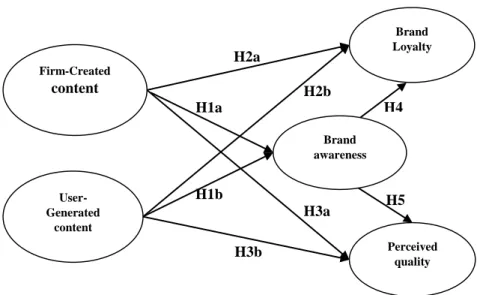
H1a: FCC brand communication in Instagram influence on brand awareness. H1b: UGC about brand communication in Instagram influence on brand awareness.
2.2. The influence of brand communication on brand loyalty.
Brand loyalty is a measure of how often consumers buy certain brands, and how much the level of customer commitment to buy brands regularly (Schiffman & Wisenblit, 2019: 168). Online social media communication is considered to have a positive impact on brand loyalty. When users like or follow an online social media account, they are considered to approve any form
2007).
H2a: FCC of brand communication in the Instagram effect on brand loyalty. H2b: UGC of brand communication in the Instagram effect on brand loyalty.
2.3. The influence of brand communication on perceived quality.
Perceived quality is a consumer's perception concerning product or service quality, both intrinsically and extrinsically (Schiffman & Wisenblit, 2019: 132-133). In traditional media, communications stated that the quality of a brand can be seen from the quality level of brand advertising (Yoo et al., 2000). However, at the moment the role of online social media communication is started to be considered important when assessing a brand quality, user-generated role makes consumers more aware of the quality of a brand (Chen et al., 2012). H3a: FCC of brand communication in the Instagram effect on perceived quality.
H3b: UGC of brand communication in the Instagram effect on perceived quality.
2.4. The influence of brand awareness on brand loyalty and perceived quality.
The process of building brand equity begins by creating and increasing consumer awareness of the brand in the consumer's mind. After consumer brand awareness is affected, then the consumers being contacted continuously. Therefore, it is expected that will affect the perceived quality and customer loyalty as well (Yoo & Donthu, 2001). Based on these arguments, the proposed hypothesis is:
H4: Brand awareness influence brand loyalty.
H5: Brand awareness influence on perceived quality
2.5. Research model
This study adopts a research model conducted by Schivinski & Dabrowski (2015) and uses a research setting in Yogyakarta city, Indonesia.
Figure 1. Research Model
3. Methodology
3.1. Data collection.
The research Object in this study is the Jogja food truck (JFT) community, which promotes culinary products through online social media Instagram. JFT consists of 20 food trucks serving a variety of foods and beverages. JFT is always moving from one place to place or from event to event. Through Instagram, they can provide information on where JFC is located.
H2a H3b H1a H1b H3a H5 H4 H2b Firm-Created content User-Generated content Brand Loyalty Brand awareness Perceived quality
buy their products directly. A total of 300 respondents were recruited as research samples with the purposes sampling method. The criteria of respondents selected are people who use Instagram and have the experience to buy JFT Community products. The data were collected by a survey method with a questionnaire.
3.2. Measurement.
Questionnaires were distributed by an online and offline survey. Data were measured using five points Likert scale, from 5 scores (Strongly Agree) to 1 score (strongly disagree). A pretest was held to ensure that the research questionnaire is valid and reliable. Some 30 questionnaires were distributed to respondents to test the validity and reliability of research instruments. We used corrected items to total correlation to test the validity of the research instruments, while for reliability test we used Cronbach's alpha coefficient method.
SPSS version 20 was employed to test the validity and reliability of the research instruments. An instrument is stated to be valid when the r-value is greater than the r-table. While an instrument is stated to be reliable when Cronbach's alpha coefficient value falls between 5 and 7 (Hair et al., 2014: 777). With a 95% confidence level, it is found that all of the research instruments above 0.6. It means that all of the research instruments are valid. Reliability test resulted that all of the research instruments have Cronbach's alpha coefficient more than 0.6. When the Cronbach alpha's coefficient closer to value 1 then the research instrument is said to be more reliable
4. Analysis and Discussion
4.1. Respondent profile.
The study found that most of JFT community consumers are male (67%), the majority of customers are between 21 and 30 years old (70%) and have an educational background as undergraduate students (63.1%). The majority of respondents earned between 2,500,001 and 3,500,000 IDR (Indonesia Rupiah). The majority of them do daily access on Instagram (62.7%), follow the JFT Community Instagram account (73.7%) and the majority have experience in buying JFT products (67.7%).
4.2. Hypothesis testing.
The regression analysis stated that partially the FCC online social media communication variable positively and significantly affects brand awareness (β = 0.329; p-value <0.05). Similarly, UGC social media communication variables positively and significantly influence brand awareness (β = 0.283; p-value <0.05). This shows that there is a tendency when online social media communication variable firm-created content and the user-generated content online social media communication increased then brand awareness will also increase. Thus, the hypotheses H1a and H1b are supported.
Regression analysis proved that the FCC online social media communication variable
had a positive and significant effect on brand loyalty (β = 0,296; p-value <0.05). While social media communication variable UGC positively and significantly influence on brand loyalty (β = 0,288; p-value <0.05). This suggests that there is a tendency that when online social media communication variables FCC and UGC increase then brand loyalty will also increase. Thus, the hypotheses H2a and H2b are supported.
The study found that FCC online social media communication variable positively and significantly affects the perceived quality (β = 0,458; p-value <0.05). While the social media communication variables online UGC has no effect on perceived quality (β = 0.046, p-value> 0.05). This shows that if the online social media communication FCC variables increase, then there is a tendency perceived quality will also increase. Hence, the hypothesis of H3a is
consumers does not affect customer perceived quality. Thus, the hypothesis H3b is rejected. From regression analysis found that brand awareness variables significantly and positively affect brand loyalty (β = 0,542; value <0.05) and perceived quality (β = 0,372; p-value <0.05). This indicates that there is a tendency when the brand awareness variable increases then brand loyalty and perceived quality will also increase. Thus, the hypothesis H4 and H5 are supported.
5. Limitation and Future Research
This study focused only on social media. We predict in the future Web 2.0 will continue to develop. Therefore, many other social media will emerge and more sophisticated. For future research, we suggest developing research settings on other online social media. Besides, it is suggested to use different research objects and add other variables, such as satisfaction and trust.
References
Chen, S. C., Yen, D. C., & Hwang, M. I. (2012). Factors influencing the continuance intention to the usage of Web 2.0: An empirical study. Computers in Human Behavior, 28(3), 933– 941. https://doi.org/10.1016/j.chb.2011.12.014
Ganesha, A. (2017). Instagram Has 45 Million Users in Indonesia, the largest in the Asia Pacific. Jakarta Globe. https://jakartaglobe.id/news/instagram-45-million-users-indonesia-largest-asia-pacific/
Hair, J. F. J., Black, W. C., Babin, B. J., & Anderson, R. E. (2014). Multivariate Data Analysis
(7th ed.). Pearson Education Limited. www.pearsonedco.uk Instagram. (2015). Instagram Annual Report. In Instagram. Instagram.
Internet-World Stats. (2016). World Internet Users Statistics Usage and Populations Stats. Miniwatts Marketing Group. http://www.internetworldstats.com/stats.htm
Kotler, P., & Keller, K. L. (2016). Marketing Management (15e ed.). Pearson Education Limited. www.pearsonglobaleditions.com
Lazone.ID. (2015). Making Profits Amid the Rise of Food Trucks (in Bahasa). Lazone.ID. https://www.lazone.id/lifestyle/style/meraup-untung-di-tengah-maraknya-food-truck Muñiz, A. M., & Schau, H. J. (2007). Vigilante marketing and consumer-created
communications. Journal of Advertising, 36(3), 35–50. https://doi.org/10.2753/JOA0091-3367360303
Rochman, E. A., & Iskandar, B. P. (2015). Users’ Engagement Toward The Brand Accounts In INSTAGRAM Based On The AISAS Model. An Empirical Study Among College Students In North Bandung. Journal of Business and Management, 4(8), 890–900. Schiffman, L. G., & Wisenblit, J. (2019). Consumer Behavior (12th ed.). Pearson Education
Limited.
Schivinski, B., & Dabrowski, D. (2015). The impact of brand communication on brand equity through Facebook. Journal of Research in Interactive Marketing, 9(1), 31–53. https://doi.org/10.1108/JRIM-02-2014-0007
Strauss, J., & Frost, R. (2014). E-Marketing (Seventh). Pearson Education Limited.
Yoo, B., & Donthu, N. (2001). Developing and validating a multidimensional consumer-based brand equity scale. Journal of Business Research, 52(1), 1–14. https://doi.org/10.1016/S0148-2963(99)00098-3
Yoo, B., Donthu, N., & Lee, S. (2000). An Examination of Selected Marketing Mix Elements and Brand Equity. Journal of the Academy of Marketing Science, 28(2), 195–211. https://doi.org/10.1177/0092070300282002