Time to Dropout from College: A Hazard Model with Endogenous Waiting*
Dennis A. Ahlburg, Brian P. McCall,
In-gang Na
Industrial Relations Center University of Minnesota
revised April 2002
* We thank Steve DesJardins, Audrey Light and seminar participants at New York University, University of Chicago, University of Kentucky, University of M elbourne, HRRI Working Paper 01-02
Industrial Relations Center University of Minnesota
and University of New South Wales for helpful comments and the M innesota Supercomputer Institute for support in the form of a resource grant.
Abstract
Using data from the 1979 National Longitudinal Survey of Youth (NLSY79), we
investigate the college attendance, dropout and graduate behavior of high school graduates. Bivariate duration models, which allow the unobserved determinants of spell durations to be correlated across spells, are developed and used to study the impact of the waiting time from high school graduation until college enrollment on college dropout and graduation rates. We find that delaying college entry after graduating high school significantly increases the chances of college dropout and reduces the probability of attaining a four year degree. Among those who first enroll in four-year institutions, delaying college entry by one year after high school graduation reduces the probability of graduating with a four-year degree by up to 32 percent in models that account for the endogeneity of delaying enrollment. There is also empirical evidence that the negative impact of delayed enrollment on graduation probabilities varies by Armed Forces
Qualifying Test (AFQT) score with the largest estimated impact of delaying occurring for those with low AFQT scores.
1. Introduction
A recent story in the New York Times discussed a “small but apparently growing
number of high achieving, well-off students [who] are stepping off the fast educational
track, at least for a short stroll” (New York Times 2001:A1. A17). The story reported
that guidance counselors and college admissions officers along with a flourishing industry
of consultants are promoting the notion that “higher education works best for those who
wait” (New York Times 2001:A17). Although some individuals may benefit from
delaying entry to college is this true for students in general? Before rushing to advise
students to take a year off before attending college, we need to know what impact this
will have on their chances of graduating.
Delaying entry to college is not a new phenomenon. Among the high school
graduating classes of 1972, 1980, and 1982 about one-quarter of those who entered
post-secondary education within four years of graduating from high school delayed entry.
One-third of those who delayed entry delayed by more than two years. Fourteen years
after high school graduation, 68 percent of the class of 1972 had enrolled in some form of
post-secondary education and almost one-third had delayed entry (Eagle and Carroll
1988). An analysis of the high school graduating class of 1980 revealed that 53 percent of
those who started a bachelor’s degree “on-track” subsequently obtained a degree. In
comparison, only 21 percent of those who delayed entry graduated. The effects of delay
1A similar conclusion can be drawn from the recent analysis of the High School and Beyond/Sophomore
1982 cohort. Fully 51 percent of those who did not delay entry to college earned a bachelor’ s degree while only 20 percent of those who delayed seven to 18 months and ten percent of those who delayed more than 18 months earned a bachelor’ s degree (Adelman 1999:45).
entry, 34 percent eventually graduate whereas only 8 percent of low socioeconomic
status students who delayed graduated. These findings led the Department of Education
researchers to conclude:” knowing that a decision to delay entry…can mean the chances
of getting a bachelor’s degree are five times lower than they would be if the student
started on track should result in better decisions by high school seniors.” (US Department
of Education 1989:29).1
The data from the Department of Education suggests caution before
recommending a year off before college. An additional reason for institutions to be
concerned about students delaying entry is that there is a growing use of institutional
graduation rates as a measure of accountability and a tendency to blame colleges for the
failure of students to graduate or to graduate in a timely manner (Adelman 1999).
The college wage premium rose to an unprecedented level in the 1980’s (Bound
and Johnson, 1989; M urphy and Welch, 1993; Brewer, Eide, and Ehrenberg, 1999).
College graduates have twice the earnings and two and one- half times the wealth of high
school graduates.(Diaz-Gimenz, Quadrini, and Rios-Rull, 1997). Thus, to the extent that
post-secondary schooling a high school graduate receives, delay can be costly in terms of
reduced future earnings.
This paper investigates the determinants of college completion and dropout and,
in particular, the impact of delayed entry on college completion and dropout. It expands
upon the existing research tradition by specifying the duration of college attendance until
exit as influenced by an endogenous waiting duration until college enrollment (the delay
between first college enrollment and high school graduation), family background, personal
characteristics, and local labor market conditions. The aim of this paper is to identify the
effect of these covariates on college duration, that is, time to graduation and dropout.
To estimate the determinants of the duration of college attendance, while
accounting for the effect of the (possibly) endogenous waiting time until enrollment, two
bivariate discrete-time hazard models with competing risks are estimated. In the first, we
jointly model the duration until college enrollment and the duration of college attendance
until exit. For the duration until college enrollment, no distinction is made between those
who enroll in a two-year versus four year institutions, since some of those who initially
enroll in a two-year institution may ultimately attain a four-year degree. Thus, the
standard discrete-time hazard approach is used to model this duration (Kiefer, 1988, Han
and Hausman, 1990; M eyer, 1990). In the empirical model we allow college exit to occur
modeled using a discrete-time competing risks approach (see M cCall, 1996, for example).
To allow for the possible endogeneity of the waiting time until college enrollment, the
unobservable determinants of the waiting duration until enrollment are allowed to be
correlated with the unobservable determinants of the dropout and graduation risks.
In the second model, we explicitly distinguish between those who first enroll in a
two-year institution and those who first enroll in a four-year institution using a
competing risks approach. Thus, we model both durations as competing risks. M oreover,
when analyzing the enrollment duration we estimate separate competing risks models for
those who enter two-year institutions and for those who enter four-year institutions.
Again, to account for the possibility of endogeneity of waiting time until enrollment, the
unobservable determinants of the risks are allowed to be correlated both within and across
the waiting time and college attendance durations.
After a brief (and selective) review of previous research findings in Section 2,
Section 3 describes the empirical methods employed in this paper. The 1979 National
Longitudinal Survey of Youth data are described in Section 4. Section 5 presents the
empirical findings. Even after controlling for potential endogeneity, waiting time until
college enrollment is found to be an important determinant of college completion. For
example, we find that those who delay enrollment into a four-year institution by one year
M oreover, we find evidence that suggests that delayed enrollment leads to a larger
reduction in the probability of college graduation for those who score lower on the Armed
Forces Qualifying Test (AFQT). The final section contains a summary and conclusions.
2. Studies of Educational Attainment
Family background variables such as educational attainment and occupations of
parents, family income, and number of siblings are commonly used as control variables in
the study of educational attainment. These family background variables, which appear in
the educational attainment literature, are primarily intended to capture the financial
resources available to students (Light, 1995b). Higher family income is assumed to
increase the likelihood of college enrollment and college graduation, or decrease the
likelihood of college dropout, other things being equal. The number of siblings also affects
educational attainment in the sense that the presence of siblings represents a competing
use of family resources. The educational levels and occupations of parents capture not
only the effect of family resources but also the positive correlations in educational
attainment across generations. These correlations across generations may result from
correlations between educational attainment and family income or from the effect of
educational levels and occupations of parents on youths’ aspirations and the degree of
Empirical studies have found strong positive effects of family background
variables on educational attainment. Family socioeconomic status, operationalized by
educational levels or occupation of parents, family income, or some combinations of these
is found to increase (decrease) the likelihood of college enrollment and college graduation
(college dropout) (M anski and Wise, 1983; M anski, 1989; M cLanahan, 1985; NCES,
1989; Kane, 1994). These findings demonstrate the significant influence of family
backgrounds in determining youths’ educational attainment.
Unlike in the study of high school dropout, there is relatively little of empirical
study on the effect of local labor market conditions on college enrollment and college
dropout. In one of the few studies, Kane (1994) found that unemployment rates were not
related to individual enrollment decisions for blacks or whites.
The decision whether or not to attend college is made with imperfect information
(see M anski, 1989; Altonji, 1993). Thus, individuals may dropout of college if they
subsequently learn after enrolling that the “costs” of schooling are higher than they
expected. Also, individuals who do not enroll in college immediately after high school
graduation may subsequently enroll if the subsequently learn they are ill-suited to
occupations that require only a high school education (see Miller, 1984; M cCall, 1990;
2 See Chapter 2 in Tinto (1993) for more detailed definitions.
In the classic research on college degree attainment, three categories of college
students were distinguished (Tinto, 1988, 1993; NCES, 1989): persisters, stopouts, and
dropouts. Persisters were defined as students who continued toward their degree goals;
stopouts withdrew and subsequently returned; and dropouts withdrew and never
returned.2
However, there are several reasons for expanding upon these definitions. First,
students may not only stop out and drop out, they may delay entry, enroll part-time,
and transfer between institutions (see Adelman, 1999). These behaviors require a more
complete set of behavioral definitions. Second, definitions of stopouts and dropouts are
directly related to the survey follow-up periods. For example, the National Center for
Education Statistics (NCES, 1989) defined dropouts as those who never return to
complete bachelor’s degree by the last survey year. For the class of 1980, it was by
February of 1986. Thus, the classification of a dropout or stopout can depend on the
length of follow-up periods. Third, another issue related to dropout is the need to
distinguish between dropout from a specific institution and that from the higher education
system as a whole. From the perspective of an institution, it can be reasonably argued
that all students who leave can be classified as dropouts regardless of their reasons. From
3 In case of high school dropout, five different definitions of dropout are used in the various studies. see
Kominski (1990).
student who leaves one institution but enrolls in another institution is an
institutional-dropout but not a system-institutional-dropout. Consequently, there is no universally accepted
definition of dropout or stopout.3
In this paper, the following definition of dropout is used: a “dropout” is a student
who left college and did not return to any institution in the higher education system by
the end of the survey period (Fall 1990 in the NLSY 79 data). Under this definition, there
are two reasons for exit from college: graduation or dropout. The graduation group is
defined as those who graduated with a 4-year college degree. Some of them may have
experienced stopout periods during their college career.
3. A Competing Risks Model with Endogenous Waiting time
We consider the case where an individual experiences two distinct durations. The
first duration is the delay time between high school graduation and college enrollment.
The second duration is the duration of college attendance, which may depend on the delay
time between high school graduation and enrollment. Since educational duration data in the
NLSY are measured in years, a discrete-time hazard approach is taken (see Kiefer, 1988;
college attendance duration can end either because the individual drops out of college or
because they graduate from college. Thus, for the second duration we take a competing
risks approach (see Katz, 1986, Hausman and Han, 1990; Anderson, 1992; Sueyoshi,
1992; and M cCall, 1996, for example).
Let Tf be the waiting time between high school graduation and college enrollment.
Let Tg be the duration of college attendance until graduation (graduation duration) and let
Td be the duration of college attendance until dropout (dropout duration). Further, let Ts
= min(Tg, Td).
To incorporate the waiting duration into the statistical model, the survival
function conditional on the unobserved variable θf and the vector of observed predictor
variables z is assumed to have the following form
S k z P T k z z f f f f f f f rf r k rf f ( , ) ( , ) exp[ exp( ( ) )] θ θ θ γ β = > = − + ′ =
∑
1 (1)where the parameters γf
r are the baseline hazard parameters and the vector βfr measures the
4For simplicity of notation, the regressors are assumed to be time-constant. The model is easily extended
to the case of time-varying regressors although the notation is cumbersome.
S k k x T x T x T g d g d f g rg rg rg f r k d r d r d r d f r k g d ( , , , , ) exp[ exp( ( ) ) exp( ( ) )] θ θ θ γ β α θ γ β α = − + ′ + − + ′ + = =
∑
∑
1 1 (2)r= 1, 2, 3,
þ
.4 Further, it is assumed that θf is distributed independently of the vector ofpredictor variables z.
In the competing risks model, the joint survivor function for college completion
and college dropout, conditional on the two unobserved variables θg and θd, the vector of
predictor variables, x, and the waiting time until enrollment Tf is assumed to have the
following form:
where the parameters γs
r are the baseline hazard parameters and the vector βsr measures
the (possibly time-varying) effects of the regressors, and αs
r measures the (possibly
time-varying) effect of the waiting time until college enrollment, s = g, d, r=1, 2, 3,
þ
. Further, it is assumed that θg and θd are distributed independently of the observed predictorvariables. The joint distribution of θf, θg, θd is denoted by G( θf, θg, θd). If θf is correlated
with θg and/or θd, then Tf will be correlated with θg and/or θd. However, we will jointly
pn n N =
∑
= 1 1for the possibility of endogeneity. It is assumed that G has a point-mass structure. In
particular, we assume that there are N triplets of “location” parameters (θf, θg, θd) in the
population where each triplet (θf, θg, θd)
n occurs with proportion pn:
Controlling for unobserved heterogeneity is important in models of educational
attainment to mitigate potential selection bias (Willis and Rosen, 1979; Cameron and
Heckman,1998). The likelihood function associated with this duration - competing risks
(DCR) model is derived in the appendix.
High school graduates attending college may enroll in either two-year or four-year
institutions. Some individuals who complete a two-year degree may then continue on to
get a four-year degree. In equation (2) above, one predictor variable that included in the
specifications will indicate whether the individual first entered a two-year versus a
four-year institution. M oreover, we allow for the coefficient associated with this predictor
variable to be time-varying in both the college completion and dropout risks.
Alternatively, we model the duration until college enrollment as ending because
of two reasons: entry into a two-year institution or entry into a four-year institution.
5The likelihood function for the CR2 model can be derived in a manner similar to that for the DCR model
(see Appendix B). For the sake of brevity, however, we omit its derivation in this paper.
S k k z z z y y y y y ry r y r k ry r y r k y y ( , , , ) exp[ exp( ( ) ) exp( ( ) )] 2 4 2 4 2 2 2 1 4 4 1 2 4 θ θ θ γ β γ β = − + ′ − + ′ = =
∑
∑
(1') pn n N =∑
= 1 1.denote the waiting time until first entry into a two-year and four-year institutions,
respectively. In this case equation (1) above is replaced by
where the parameters in (1
N
) have interpretations analogous to those described above. Now, however, we have a quadruplet of location parameters (θ2y, θ4y, θg, θd) withdistribution function G( θ2y,θ4y, θg, θd). Again, we assume a mass point structure where
each of the N quadruplets occurs in the population with proportion pn:
When focusing on those first entering four-year (two-year) institutions, those first
entering two-year (four-year) institutions will subsequently be censored in the likelihood
function.5
6Source of state tuition data is State Comparisons of Education Statistics: 1969-70 to 1996-97, National
Center for Education Statistics.
The data for this study come from the 1979 National Longitudinal Survey of
Youth (NLSY79), an ongoing study of 12,686 young individuals who were aged 14 to 21
as of January 1, 1979. The NLSY79 includes information on college attendance, type of
college (two-year versus four-year college) as well as personal characteristics such as age,
sex, race, number of siblings, Armed Forces Qualifying Test (AFQT) score, and
information on the education levels and occupations of parents.
We apply some restrictions to the NLSY79 data set to construct the sample for
our analysis. The sample in this study covers only those who were less than eighteen
years old as of January 1, 1979 and excludes the military sub-sample. We also drop any
observations that contain inconsistent responses over the survey years. Data on average
in-state tuition levels for public four-year institutions for 1986-87 was merged to the
individual NLSY79 data based on state of residence in 1979. This tuition data is from
approximately the midpoint of the observation period.6 Although individuals may attend
out of state universities or private universities, the in-state tuition level could be thought
of as the lower bound on the cost of college enrollment.
Since the accuracy of the schooling information is critical for our analysis, it is
7For inconsistency in NLSY79, see Light (1995a) for further details.
8While individuals may decide to return to school in the future, as of 1998 over 97 percent of those who we
designate as dropping out from college during the 1979-1990 period had not completed a bachelor’ s degree. college enrollment and college duration are not artifacts of reporting error. To get the time
periods for waiting duration and college duration, the following are needed: the year of
high school graduation, the year of first college entrance, the year of last college
attendance, and the year of college graduation. To identify the year of high school
graduation, we used information on high school graduation year and type of diploma. The
accuracy of this report is confirmed by inspecting data on highest grade attended, highest
grade completed, and current enrollment status. We used all reported schooling
information. Observations with marked inconsistencies were eliminated.7 Based on the
year of high school graduation, first entrance year in college is identified by college related
information: college enrollment status, current enrollment status, other grade related
information.
The year of college dropout was created by first looking at college enrollment
status and highest completed grade in 1990. If a high school graduate was not currently
enrolled in college in 1990 and the highest grade completed exceeded 12 but was less than
16 years, we determined the last college enrollment year and designated this as the year of
college dropout.8 The year of college graduation was created in a similar fashion. For an
9The exact year of college graduation is reported for some students. This information is used for confirming
the created year of college graduation.
years, the year in which 16 years of completed schooling is first reported was determined
and this year was designated as the year of graduation.9 Those who were enrolled in
college in 1990 (with less than 16 years of completed education) were treated as
right-censored .
After imposing the sample selection criteria described above, the final sample is
composed of 4,944 students who are high school graduates. Among them, 2943
individuals have entered college by Fall 1990. The empirical conditional probabilities
(hazard) for two-year and four- year enrollment by years since high school graduation are
presented in Figure 1. As can be seen from this figure, the majority of those who enter
two- or four-year institutions, do so immediately after graduating high school. Among
those enrolling immediately after graduating high school, the majority enter four-year
institutions while among those who delay enrollment by at least one-year, the majority
enter two-year institutions. Additional descriptive statistics and definitions of predictor
10As can be seen from Figure 1, delayers are more likely to enter two-year institutions than non-delayers.
Thus, some of the delay impact on earnings may come from the difference in the type of institution first entered (see Kane and Rouse, 1995). To examine the extent of this impact, a predictor variable indicating whether an individual first entered a two-year as opposed to a four-year institution was added to the regression. The estimated impact of enrollment delay on hourly wages, while reduced slightly in magnitude, remained statistically significant when this variable was included.
5. Results
Before turning to estimates of the impact of enrollment delay on college dropout
and completion behavior, some evidence that enrollment delay may impact future wages
is presented in Table 2. This table presents the results of log hourly wage regressions for
those in our sample who enter college between 1979 and 1990. Wages are from the job
held in the week before the 1994 interview. Only those with reported hourly wages in
1994 are included in the regression. Column (1) of the table presents estimates which
include controls for gender, race, age, AFQT score, marital status, residence in SM SA, and
dummies for 1994 state of residence. In addition, an indicator variable is included which
indicates whether the individual delayed college enrollment after graduating high school.
Among college entrants, those who delay entry have hourly wages in 1994 that are, on
average, 9.2 percent less than those who enter college immediately after high school
graduation.10
To see whether the wage impact of delay arises through reduced educational
attainment for delayers as compared to non-delayers, column (2) adds years of completed
11 In these simulations we calculate the probability of gradation for each individual and then average
probabilities across individuals.
regression, the estimated impact of enrollment delay on hourly wages drops to 1.7
percent and is no longer statistically significant. Thus, it appears that the wage impact of
enrollment delay arises because delayers attain less education than non-delayers. We
investigate the schooling impact of delay in more detail below.
Table 3 presents estimates of the DCR model described by equations (1) and (2)
above in the case where the coefficients of all predictor variables are restricted to be
time-constant and the unobserved heterogeneity distribution is assumed to have two mass
points. As can be seen from the estimates in Table 3, the waiting duration until college
enrollment has a significantly negative effect on the graduation hazard rate and a
significantly positive effect on the dropout hazard rate. The longer an individual delays
college enrollment, the more likely he/she is to drop out and the less likely he/she is to
graduate with a four-year degree.
To assess the magnitude of this effect, simulations were performed in which a high
school graduate’s delay until college enrollment was alternatively set to 0 (enrollment
immediately after high school) and 1 (enrollment after delaying one year ).11 The college
dropout and completion hazards from these simulations are presented in Figures 2 and 3,
12 This does not mean that the actual enrollment rate of minorities is higher than that of white youths.
Since black and Hispanic youths have lower levels of AFQT scores, parental income and parental education, overall minorities are less likely to attend college than white students.
respectively, when conditioning on entry into a two-year institution. From the hazard
estimates in Figures 2 and 3, one can show that the estimated probability of obtaining a
four-year degree, conditional on first entering a four-year institution, declines from 0.43
to 0.34 (or by 21 percent) when an individual delays college enrollment by one year after
graduating high school. Conditional on first entering a two-year institution the
probability of attaining a four-year degree drops from 0.24 to 0.17 (or by 29 percent )
when an individual delays college enrollment by one year.
The estimates in Table 3 also show that a higher Armed Forces Qualifying Test
(AFQT) score significantly increases the probability of college enrollment and the chances
of graduation while significantly reduces the risk of dropout. Female high school
graduates have significantly higher college enrollment hazards than males. African
American and Hispanic high school graduates are significantly more likely to enroll in
college and significantly less likely to drop out than their white counterparts. However,
the estimated graduation hazard rates are significantly lower for Hispanics. Others (see
Cameron and Heckman (2000) and National Center for Education Statistics(2001)) have
also found that once educational achievement is controlled for using test scores like
have suggested that a higher rate of college enrollment among non-white high school
graduates may be explained by the effects of Affirmative Action.
Some family background characteristics are also related to education behavior. The
estimates in Table 2 imply that an increase in father’s education significantly increases
the enrollment hazard rate and significantly decreases the dropout hazard rate. While an
increase in mother’s education significantly increases the enrollment hazard. High school
graduates with father’s who worked in white-collar occupations have both significantly
higher college enrollment and graduation hazard rates and significantly lower college
dropout hazard rates than those with fathers who did not work in white-collar
occupations.
Having more siblings affects college-going behavior by significantly decreasing the
enrollment hazard. However, the number of siblings has no statistically significant impact
on either the dropout or graduation hazard.
Individuals who have a Graduate Equivalency Diploma (G.E.D.) are less likely to
enter college than individuals with a high school diploma. M oreover, among those entering
college, those with a G.E.D. have a significantly lower graduation hazard than those with
a high school diploma. Thus, those with exam certified high school equivalents have lower
educational attainment than those with high school diplomas (See Cameron and Heckman,
High school graduates who first enter two-year institutions have both significantly higher
dropout rates and lower graduation rates than those who first enter four-year institutions.
Since graduation and dropout are measured with respect to four-year degrees, this may
simply reflect the fact that high school graduates who enter two-year institutions may
leave college after attaining a two-year degree.
The state of the labor market has long been thought to affect educational behavior.
The estimated impact of an increase in the local unemployment rate on the enrollment
hazard was positive, although the impact was only statistically significant at the 10
percent level. An increase in the local unemployment rate was found to have a
statistically significant negative impact on the graduation hazard.
In-state public tuition levels were found to impact educational attainment
primarily through college dropout behavior. While the estimated impact of increased
in-state public tuition levels on the college enrollment rate was negative, the estimated
impact was imprecise and not statistically significant at conventional significance levels.
However, increased in-state public tuition levels has a significantly positive impact on
dropout with some weak evidence that the impact is moderated by family income.
To check the robustness of our estimated impact of delayed entry, Table 4
presents the estimated impact of delaying college enrollment by one year for several
13The model was estimated twice. In the first estimation, those who first enter four-year institutions are
censored in the enrollment duration and in the second estimation, those who first enter two-year institutions are censored in the enrollment duration. In small samples, the two sets of estimates obtained for the coefficients in (1') are not necessarily equal. For our data, the two sets of coefficients estimates for (1') do not qualitatively differ. Thus, Tables 4 and 5 present the coefficient estimates for (1') only in the case where those who enter two-year institutions are censored in the enrollment duration.
impacts based on the DCR model with time-constant coefficients when the unobserved
heterogeneity distribution has one, two and three mass points, respectively. Rows 4
through 6 present the estimated impacts based on the DCR model when the coefficient of
the duration until enrollment variable is allowed to vary over time according to a
third-order polynomial and the unobserved heterogeneity distribution has one, two and three
mass points, respectively. Comparing the one mass point estimates to the two and three
mass point estimates indicates that the estimated impact of delay does not change
substantially when the potential endogeneity of delay is accounted for. Comparing rows 1
through 3 with rows 4 through 6 shows that the estimated impacts of enrollment delay
are somewhat larger in models that allow the coefficient of the duration until enrollment
variable to be time-varying.
To account for potential selectivity into two-year versus four-year institutions
due to the unobserved determinants of the two-year, four-year choice being correlated
with the unobservable determinants of completing a four-year degree, Tables 5 reports
estimates derived from the CR2 model described by equations (1') and (2) above.13 The
predictor variables are restricted to be time-constant and the unobserved heterogeneity
distribution is assumed to be characterized by two mass points.
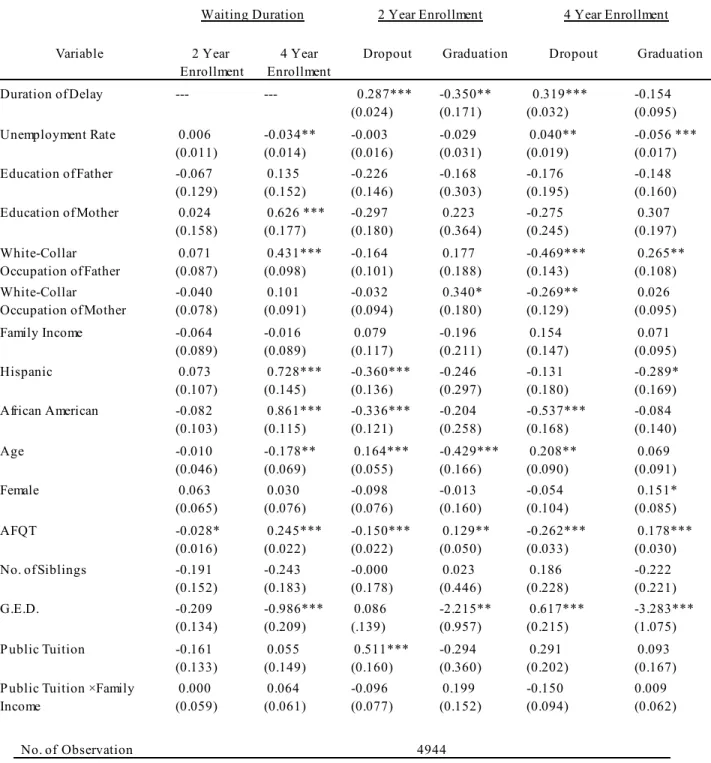
As can be seen in Table 5 an increase in the delay between high school graduation
and college enrollment significantly raises the dropout hazard for both those first entering
two-year institutions and those first entering four-year institutions. The impact of an
increase in enrollment delay on the graduation hazard, while negative both for individuals
first entering two-year and for individuals first entering four-year institutions is
statistically significant only for those first entering two-year institutions.
To assess the magnitude of the effect of delaying enrollment on the probability of
four-year college completion both for those who first enter a two-year institution and for
those who first enter a four-year institution, simulations were performed in which an
individual’s enrollment delay was alternatively set to 0 (enrollment immediately after high
school) and 1 (enrollment after delaying one year ). The college dropout and completion
hazards from these simulations are presented in Figures 6 and 7, respectively, for those
who first enter a four-year institution and Figures 8 and 9, respectively, for those who
first enter a two-year institution. From these hazard estimates, one can show that the
estimated probability of obtaining a four-year degree when the delay until college
enrollment increases from 0 to 1 year declines by 27.7 percent and 25.4 percent for those
14The estimated impact of four-year tuition levels on attaining a four-year degree for those first entering
two-year institutions did not change when a control for two-year in-state public tuition levels was included in the estimations. Thus, the estimated impact of four-year in-state tuition levels is not due to its
correlation with two-year in-state tuition levels.
To check the robustness of our estimated impact of delayed entry, Table 6
presents the estimated impact of delaying college entry by one year for several alternative
model specifications. The estimated impacts of delaying enrollment by one year on
graduating from a four-year college range from 14.1 to 40.0 percent for individuals first
entering two-year institutions and 11.3 to 32.7 percent for individuals first entering
four-year institutions with the largest estimated impacts coming from those models which
ignore any possible endogeneity of delay.
One result for the other predictor variables that was not evident in the DCR model
estimates has to do with the impact of in-state public tuition levels on four-year college
completion rates. The results from Table 5 show that an increase in public tuition levels
for four-year institutions significantly increases the four-year college dropout rate, but
only among high school graduates who enter two-year institutions. Thus, it appears that
in states with high four-year public tuition levels, individuals who enter two-year
institutions are less likely to transfer to four-year institutions after completing their
15Other possible moderators of the impact of delay that were investigated were family income and gender
but only the AFQT score- delay duration interaction achieved statistical significance.
Finally, there is some empirical evidence that AFQT scores moderate the impact
of enrollment delay on college graduation.15 Table 7 presents estimates of the impact of
delaying college enrollment by one year for individuals in different AFQT percentile score
categories when AFQT score - duration of enrollment delay interaction variable is
included in the DCR model. As can be seen from the table, the adverse impact of
enrollment delay on the probability of graduation from four-year college is concentrated
primarily among those in the lower AFQT score categories. For example, among those
first entering a four-year institution, the estimated decline in the probability of attaining a
four-year degree by delaying enrollment by one year is 7.6 percent for those with AFQT
percentile scores in the 75-99 range. The estimated decline in the probability of attaining
a four-year degree by delaying enrollment one year increases to 32.9 percent for those
with AFQT percentile scores in the 25-49 range and 52.5 percent for those with AFQT
percentile scores in the 0-24 range.
6.Summary and Concluding Remarks
The main findings of the paper are: First, the delay between high school
longer a young person takes to enroll in college, the higher the chance is that they do not
graduate.
Second, higher ability individuals, as measured by AFQT scores, are more likely
to enter college, and, among those entering, more likely to finish . M oreover, delaying
enrollment is less costly in terms of reducing the probability of graduating college, for
those with higher AFQT scores.
Third, family background, measured by white-collar occupation and education
levels of parents, family income, and the number of sibling affect college-going behavior. It
is hypothesized that these variables capture the financial resources available to family
and, at the same time, the effect of parents on youths’ aspirations and the degree of
family encouragement.
Fourth, nonwhite high school graduates were found to be more likely than whites
to enter college. Specifically, the competing risks estimates suggest that nonwhites are
more likely to first enter four-year institutions than are whites.
Fifth, an increase in tuition levels for public four-year institutions appears to
reduce the chances that an individual first entering a two-year institution will transfer to a
four-year institution and obtain a four-year degree. There was no evidence that family
income moderated this impact. Also, tuition levels did not appear to affect the college
16 Despite this limitation, Dynarski (1999) was able to use the NLSY to examine the impact of financial aid
on college attendance. She constructed a variable for whether or not a respondents father died before they were 18 years of age. She used this variable to proxy for eligibility for Social Security Student Benefits and found that eligibility for the program raised the probability of attendance by about twenty percentage points and that a $1,000 increase in aid increased the probability of attendance by four percentage points.
Finally, higher unemployment rates appears to reduce the probability of entering a
four-year institution, increase the risk of dropout and decrease the rate of college
graduation. These results are consistent with the notion that the unemployment rate
reflects financial constraints on college-going behavior.
There are some limitations of the study. First, the NLSY79 does not include
detailed information on financial aid which has been found to affect college behavior
(Cabera, 1992; Edlin, 1993; Fischer, 1992; M cPherson and Schapiro2 1998; DesJardins,
Ahlburg and M cCall, 2002).16 Second, measures of employment opportunities rather than
the unemployment rate have not been investigated. Third, information on the
characteristics of the colleges considered or attended and the GPA attained by individuals
while at a particular institution were not available. This latter information may give one
indication of the student-institution match. Finally, a limitation of this study was that
only one year of average in-state tuition data was used to measure the tuition costs facing
an individual. M ore detailed data on public and private, two-year and four-year
institution tuition may give better estimates of the impact of relative tuition rates on
One policy implication suggested by the findings of this paper is that high school
guidance counselors may wish to caution students against delaying college enrollment,
especially students with low test scores. Such a delay may lead to lower post-secondary
educational attainment and, in turn, lower future earnings for these students. Colleges may
also wish to develop and target programs towards delayed enrollees that will increase
Appendix
In this appendix we derive the likelihood function for the empirical model described by equations (1) and (2) in the text. For simplicity of notation, we drop from the notation the dependence of functions on the predictor variables z and x and, where appropriate, Tf. Let Pf(kf|θf)denote the probability of enrolling in
college at time kf conditional on θf and Pfc(kf|θf) equal the probability of the spell lasting longer than kf.
Then,
Pf( kf | θf ) = Sf( kf | θf ) - Sf(kf+1| θf ), (A1)
Pfc( kf | θ
f ) = Sf( kf | θf ). (A2)
In a manner similar to McCall (1996, p. 679), let Pg (ks | θg, θd), Pd(ks | θg, θd) and Psc(ks |θg, θd) be the
probability of graduation after ks years of enrollment; dropping out after ks years of enrollment; and right
censored after ks years of enrollment, respectively. Thus,
Pg( ks | θg, θd ) = S( ks ,ks| θg, θd )-S( ks+1,ks| θg, θd )-.5 [S( ks ,ks| θg, θd )+S( ks +1,ks+1| θg, θd) -S( ks ,ks+1| θg, θd )-S( ks+1,ks| θg, θd )], (A3) Pd( ks | θg, θd ) = S( ks ,ks| θg, θd )-S( ks ,ks+1| θg, θd )-.5 [S( ks ,ks| θg, θd )+S( ks +1,ks+1| θg, θd) -S( ks ,ks+1| θg, θd )-S( ks+1,ks| θg, θd )], (A4) and Psc( ks | θg, θd ) = S( ks ,ks| θg, θd ) (A5)
logL qiwlog(B k kw( , )) i f i s w W i M = ∈ =
∑
∑
1 .5 [S( ks ,ks| θg, θd )+S( ks +1,ks+1| θg, θd) -S( ks ,ks+1| θg, θd )-S( ks+1,ks| θg, θd )]is an adjustment for the fact that the data are discrete time. Let Bw be defined as
Bw (kf, ks |θf ,θg,θd,) = Pf ( kf | θf ) Pw( ks | θg,θd ), for w=g, d, and sc,
Bw( kf, ks| θf,θg,θd ) = Pf ( kf | θf ), for w = fc,
where kf denotes the waiting duration to first college enrollment and ks denotes the duration of college
enrollment.
Summing over the N different triplets of location parameters (θf ,θg, θd) , the unconditional
probabilities can be written as follows.
B kw f ks p B k k n w f s f g d n N ( , )= ( , , , ), =
∑
θ θ θ 1 where pn n N =∑
= 1 1. Let qfci be an indicator variable which equals one if individual i did not enroll in any college by the end of
survey year; qg
i is an indicator variable that equals one if this individual graduates, and qdi is an indicator
variable that equals one if individual i drops out from the higher education system, and qfc
i is an indicator
variable that equals one if individual i enrolled but the enrollment spell is incomplete or right-censored, i= 1, þ, M.
The log-likelihood function is then given by
References
Adelman, Clifford. (1999), Answers in the Tool Box: Academic Intensity, Attendance Patterns, and Bachelor’s Degree Attainment. Jessup, M D: U.S. Department of Education.
Altonji, Joseph G. (1993), “The Demand for and Return to Education when Education Outcomes are Uncertain,” Journal of Labor Economics, 11, 48-83.
Anderson, Patricia M . (1992), “Time-varying Effects of Recall Expectation, a Reemployment Bonus, and Job Counseling on Unemployment Durations,” Journal of Labor Economics, 10-1, 99-115.
Blakemore, Arthur and Stuart Low (1984), "The High School Dropout Decision and Its Wage Consequences,” Economics of Education Review, 3-2, 111-119.
Blanchfield, William (1972), "College Dropout Identification: An Economic Analysis,”
Journal of Human Resources, 7-4, 540-544.
Bound, John and George Johnson (1989), “Changes in the Structure of Wages During the 1980s: An Evaluation of Alternative Explanations,” Working Paper no. 2983,
NBER.
Brewer, Dominic J., Eric R. Eide, and Ronald G. Ehrenberg (1999), “Does it Pay to Attend an Elite Private College?” Journal of Human Resources, 24: 105-123.
Cabera, A.F. et al. (1992), “The Role of Finances in the Persistence Process: A Structure M odel,” Research in Higher Education, 33-5, 571-593.
Cameron, Stephen V. and James J. Heckman (1993), “The Nonequivalence of High School Equivalents” Journal of Labor Economics, 11, 1-47.
Cameron, Stephen V. and James J. Heckman (1998), “Life Cycle Schooling and Dynamic Selection Bias: M odels and Evidence for Five Cohorts of American M ales,”
Cameron, Stephen V. and James J. Heckman (2000), “The Dynamics of Educational Attainment for Black, Hispanic, and White M ales,” mimeo, University of Chicago.
DesJardins, Stephan L; Dennis A. Ahlburg and Brian P. M cCall (2002), “Simulating the Longitudinal Effects of Changes in Financial Aid on Student Departure from College,” Journal of Human Resources, 37-3.
Diaz-Jiminez, J., V. Quadrini, and J-V Rios-Rull (1997), “Dimensions of Inequality: Facts on the U.S. Distribution of Earnings, Income and Wealth,” Federal Reserve Bank of Minneapolis Quarterly Review Spring: 3-21.
Dynarski, Susan .M . (1999), “Does Aid M atter? M easuring the Effect of Student Aid on College Attendance and Completion,” Working Paper no. 7422. NBER.
Eagle, Eva and C. Dennis Carroll (1988), Postsecondary Enrollment, Persistence, and Attainment for 1972, 1980, and 1982 High School Graduates” US Department of Education, National Center for Educational Statistics, Office of Research and Improvement. Survey Report High School and Beyond National Longitudinal Study Data Series DR-NLS/HSB: 72-86.
Edlin, Aaron (1993), "Is College Financial Aid Equitable and Efficient?,” Journal of Economic Perspectives, 7-2, 143-158.
Fischer, F. (1992), “Graduation-Contingent Aid,” Change, 40-47.
Han, Aaron and Jerry Hausman (1990), “Flexible Parametric Estimation of Duration and Competing Risks M odels,” Journal of Applied Econometrics, 5-1, 1-28.
Kane, John (1994), “College Entry by Blacks since 1970: The Role of College Costs, Family Background, and the Returns to Education,” Journal of Political Economy,
102-5, 878-911.
Kane, John and Cecilia E. Rouse (1995), “Labor-M arket Returns to Two- and Four-year College,” American Economic Review, 85-3, 600-614.
Kane, John and Lawrence M . Spizman (1994), “Race, Financial Aid Awards and College Attendance: Parents and Geography M atter,” American Journal of Economics and Sociology, 53-1, 85-97.
Katz, Lawrence F. (1986), “Layoffs, Recalls and the Duration of Unemployment,” NBER Working Paper No. 1825.
Kiefer, Nicholas (1988), “Economic Duration Data and Hazard Function,” Journal of Economic Literature, 26, 646-679.
Kominski, Robert (1990), “Estimating the National High School Dropout Rate,”
Demography, 27-2, 303-311.
Light, Audrey (1995a), “The Effect of Interrupted Schooling on Wages,” The Journal of Human Resources, 30-3, 473-502.
Light, Audrey (1995b), “Hazard M odel Estimates of the Decision to Reenroll in School,”
Labour Economics, 2, 381-406.
M cCall, Brian P. (1990), “Occupational M atching: A Test of Sorts,” Journal of Political Economy, 98, 45-69.
M cCall, Brian P. (1996), “Unemployment Insurance Rules, Joblessness, and Part-Time Work,” Econometrica, 64-3, 647-682.
M cLanahan, Sara (1985), “Family Structure and the Reproduction of Poverty,” American Journal of Sociology, 90-4, 873-901.
M cPherson, M ichael S. and M orton O. Schapiro. (1998) The Student Aid Game
(Princeton, NJ: Princeton University Press).
M anski, Charles F. (1989), “Schooling as Experimentation: A Reappraisal of the
Postsecondary Dropout Phenomenon,” Economics of Education Review, 8-4, 305-312.
M anski, Charles F. and David Wise (1983), College Choice in America, ( M ass.:Harvard University Press)
M eyer, Bruce D. (1990), “Unemployment Insurance and Unemployment Spells,”
Econometrica, 58-4, 757-782.
M iller, Robert A. (1984), “Job M atching and Occupational Choice,” Journal of Political Economy, 92, 1086-1120.
M urphy, Kevin and Finis Welch (1993), Inequality and Relative Wages,” American Economic Review, (83,2) M ay: 104-109.
National Center for Education Statistics (2001), "Educational Achievement and Black-White Inequality,” Statistical Analysis Report NCES 2001-061.
National Center for Education Statistics (1989), "College Persistence and Degree Attainment for 1980 High School Graduates: Hazards for Transfers, Stopouts, and Part-timers," Survey Report, CS89-302.
Narendranathan, S.W. and M . B. Stewart (1990), “An Examination of the Robustness of M odels of the Probability of Finding a Job for the Unemployed,” in J. Hartog, G. Ridder and J. Theuwes (eds.), Panel Data and Labor Market Studies, (New York: North-Holland), 135-155.
Neal, Derek (1999), “The Complexity of Job M obility among Young M en,” Journal of Labor Economics, 17, 237-261.
Sueyoshi, Glenn (1992), “Semiparametric Proportional Hazards Estimation of Competing Risks M odels with Time-Varying Covariates,” Journal of Econometrics, 51, 25-58.
Tinto, Vincent (1988), “Stages of Student Departure: Reflections on the Longitudinal Character of Student Leaving,” Journal of Higher Education, 59-4, 483-455.
Tinto, Vincent (1993), Leaving College, (Chicago: University of Chicago Press).
U.S. Department of Education, Digest of Education Statistics, various issues.
U.S. Department of Education, (1989), College Persistence and Degree Attainment for 1980 High school Graduates: Hazards for Transfers, Stopouts, and Part-timers, US Department of Education, National Center for Educational Statistics, Office of Educational Research and Improvement. Survey Report. Data Series 80/86.
Willis, Robert J. and Sherwin Rosen (1979), “Education and Self-Selection,” Journal of Political Economy, 87, S7-S36.
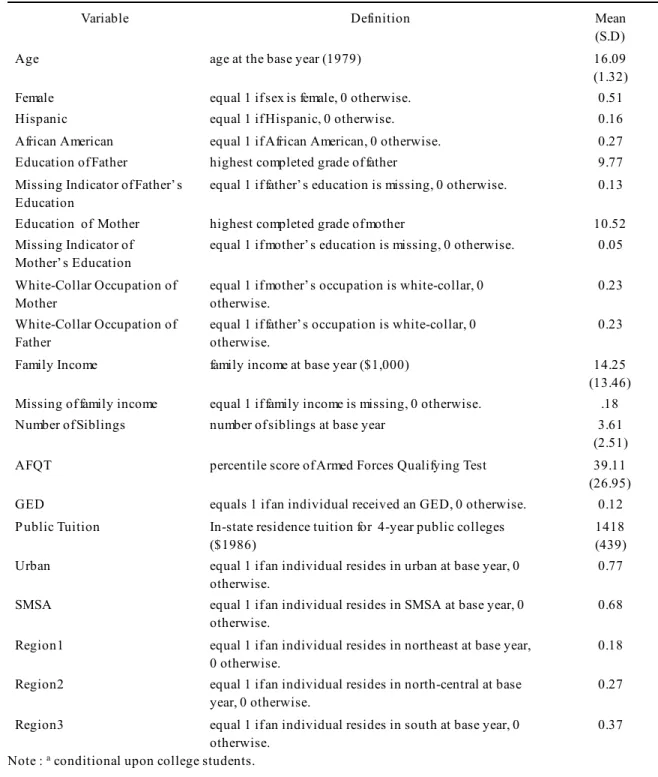
Table 1. Sample Means and Standard Deviations
(n=4944)
Variable Definition Mean
(S.D)
Age age at the base year (1979) 16.09
(1.32)
Female equal 1 if sex is female, 0 otherwise. 0.51
Hispanic equal 1 if Hispanic, 0 otherwise. 0.16
African American equal 1 if African American, 0 otherwise. 0.27
Education of Father highest completed grade of father 9.77
Missing Indicator of Father’ s Education
equal 1 if father’ s education is missing, 0 otherwise. 0.13 Education of Mother highest completed grade of mother 10.52 Missing Indicator of
Mother’ s Education
equal 1 if mother’ s education is missing, 0 otherwise. 0.05 White-Collar Occupation of
Mother
equal 1 if mother’ s occupation is white-collar, 0 otherwise.
0.23 White-Collar Occupation of
Father
equal 1 if father’ s occupation is white-collar, 0 otherwise.
0.23
Family Income family income at base year ($1,000) 14.25
(13.46) Missing of family income equal 1 if family income is missing, 0 otherwise. .18
Number of Siblings number of siblings at base year 3.61
(2.51)
AFQT percentile score of Armed Forces Qualifying Test 39.11
(26.95) GED equals 1 if an individual received an GED, 0 otherwise. 0.12 Public Tuition In-state residence tuition for 4-year public colleges
($1986)
1418 (439) Urban equal 1 if an individual resides in urban at base year, 0
otherwise.
0.77 SMSA equal 1 if an individual resides in SMSA at base year, 0
otherwise.
0.68 Region1 equal 1 if an individual resides in northeast at base year,
0 otherwise.
0.18 Region2 equal 1 if an individual resides in north-central at base
year, 0 otherwise.
0.27 Region3 equal 1 if an individual resides in south at base year, 0
otherwise.
0.37 Note : a conditional upon college students.
Table 2
Estimated Impact of Delayed Enrollment on Log Wages in 1994
Variable (1) (2) Female -0.156*** (0.024) -0.166*** (0.024) African-American -0.075** (0.036) -0.093*** (0.035) Hispanic -0.066* (0.039) -0.054 (0.039) Years of Education - 0.054*** (0.007) Age 0.014 (0.009) 0.018* (0.009) Reside in SMSA 0.025* (0.014) 0.016 (0.014) Married 0.069*** (0.025) 0.065*** (0.025) AFQT(÷100) 0.543*** (0.055) 0.359*** (0.059) Delayed College Enrollment -0.092***
(0.027)
-0.017 (0.028)
Notes: Dependent and independent variables measured as of the 1994 interview. Sample includes only those who attended some college by 1990 interview. All log wage regressions estimates include controls for state fixed-effects. Sample size equals 1791.
Table 3
Waiting Duration -Competing Risks Estimates
Time-Constant Coefficients, Two Mass-point U.H. Distribution 1 , 2
Waiting Duration College Duration
Variable College Enrollment Dropout Graduation from
4 year College Duration of Delay --- 0.297 *** (0.025) -0.356*** (0.084) Unemployment Rate 0.015* (0.008) 0.015 (0.012) -0.048*** (0.015) Education of Father 0.208** (0.089) -0.262** (0.118) -0.185 (0.143) Education of Mother 0.298*** (0.106) -0.192 (0.143) 0.261 (0.173) White-Collar Occupation of Father 0.256 *** (0.055) -0.237*** (0.084) 0.234*** (0.091) White-Collar Occupation of Mother 0.048 (0.051) -0.108 (0.078) 0.070 (0.083) Family Income -0.050** (0.057) 0.101 (0.093) 0.055 (0.088) Age -0.096*** (0.034) 0.132*** (0.049) -0.158** (0.079) Female 0.116*** (0.043) -0.088 (0.063) 0.124 (0.076) Hispanic 0.481*** (0.071) -0.251** (0.108) -0.325** (0.145) African American 0.405*** (0.066) -0.354*** (0.098) -0.237* (0.122) AFQT 0.128*** (0.011) -0.191*** (0.018) 0.147 *** (0.023) No. of Siblings -0.254** (0.106) 0.070 (0.145) -0.236 (0.200) G.E.D. -0.553*** (0.102) 0.209 (0.125) -2.459*** (0.633) Public Tuition -0.139 (0.086) 0.521*** (0.130) 0.102 (0.152) Public Tuition ×Family
Income 0.039 (0.037) -0.113* (0.062) 0.014 (0.057) First Enroll in 2-Year College --- 0.580*** (0.069) -0.902*** (0.107) Log-Likelihood -11,130.09 No. of Observations 4944 Note :
2 SMSA, Urban, high school cohort and three regional dummies as well as missing value indicators for
education levels and occupations of parent are also included in the estimations.
Table 4
Estimated Probability of Attaining 4-year degree for High School Graduates Duration - Competing Risk model
Model First Enter 2-year College First Enter 4-year College
Immediate Entry Delay Entry 1-year Immediate Entry Delay Entry 1-year
Time Constant Coefficient
1. One Mass point U.H. Dist. 0.217 0.159 0.450 0.327
2. Two Mass point U.H. Dist. 0.237 0.167 0.431 0.340
3. Three Mass point U.H. Dist.
0.231 0.174 0.411 0.334
Time-Varying Coefficient
4. One Mass-point U.H. Dist. 0.260 0.159 0.449 0.313
5. Two Mass-point U.H. Dist. 0.260 0.158 0.454 0.318
6. Three Mass-point U.H. Dist.
Table 5
Bivariate Competing Risks Estimates
Time-Constant Coefficients, Two-Mass Point U.H. Distribution 1 , 2
Waiting Duration 2 Year Enrollment 4 Year Enrollment
Variable 2 Year
Enrollment
4 Year Enrollment
Dropout Graduation Dropout Graduation
Duration of Delay --- --- 0.287*** (0.024) -0.350** (0.171) 0.319*** (0.032) -0.154 (0.095) Unemployment Rate 0.006 (0.011) -0.034** (0.014) -0.003 (0.016) -0.029 (0.031) 0.040** (0.019) -0.056 *** (0.017) Education of Father -0.067 (0.129) 0.135 (0.152) -0.226 (0.146) -0.168 (0.303) -0.176 (0.195) -0.148 (0.160) Education of Mother 0.024 (0.158) 0.626 *** (0.177) -0.297 (0.180) 0.223 (0.364) -0.275 (0.245) 0.307 (0.197) White-Collar Occupation of Father 0.071 (0.087) 0.431*** (0.098) -0.164 (0.101) 0.177 (0.188) -0.469*** (0.143) 0.265** (0.108) White-Collar Occupation of Mother -0.040 (0.078) 0.101 (0.091) -0.032 (0.094) 0.340* (0.180) -0.269** (0.129) 0.026 (0.095) Family Income -0.064 (0.089) -0.016 (0.089) 0.079 (0.117) -0.196 (0.211) 0.154 (0.147) 0.071 (0.095) Hispanic 0.073 (0.107) 0.728*** (0.145) -0.360*** (0.136) -0.246 (0.297) -0.131 (0.180) -0.289* (0.169) African American -0.082 (0.103) 0.861*** (0.115) -0.336*** (0.121) -0.204 (0.258) -0.537*** (0.168) -0.084 (0.140) Age -0.010 (0.046) -0.178** (0.069) 0.164*** (0.055) -0.429*** (0.166) 0.208** (0.090) 0.069 (0.091) Female 0.063 (0.065) 0.030 (0.076) -0.098 (0.076) -0.013 (0.160) -0.054 (0.104) 0.151* (0.085) AFQT -0.028* (0.016) 0.245*** (0.022) -0.150*** (0.022) 0.129** (0.050) -0.262*** (0.033) 0.178*** (0.030) No. of Siblings -0.191 (0.152) -0.243 (0.183) -0.000 (0.178) 0.023 (0.446) 0.186 (0.228) -0.222 (0.221) G.E.D. -0.209 (0.134) -0.986*** (0.209) 0.086 (.139) -2.215** (0.957) 0.617*** (0.215) -3.283*** (1.075) Public Tuition -0.161 (0.133) 0.055 (0.149) 0.511*** (0.160) -0.294 (0.360) 0.291 (0.202) 0.093 (0.167) Public Tuition ×Family
Income 0.000 (0.059) 0.064 (0.061) -0.096 (0.077) 0.199 (0.152) -0.150 (0.094) 0.009 (0.062) No. of Observation 4944
Table 6
Estimated Probability of Attaining 4-year degree for High School Graduates Duration - Competing Risk model
Model First Enter 2-year College First Enter 4-year College
Immediate Entry Delay Entry 1-year Immediate Entry Delay Entry 1-year
Time Constant Coefficient
1. One Mass point U.H. Dist. 0.238 0.143 0.447 0.327
2. Two Mass point U.H. Dist. 0.327 0.244 0.343 0.248
3. Three Mass point U.H. Dist.
0.361 0.280 0.301 0.267
Time-Varying Coefficient
4. One Mass-point U.H. Dist. 0.241 0.146 0.453 0.305
5. Two Mass-point U.H. Dist. 0.342 0.259 0.366 0.258
6. Three Mass-point U.H. Dist.
Table 7
Estimated Probability of Attaining 4-year degree for High School Graduates by AFQT scores Duration - Competing Risk, AFQT- Waiting Time interaction model with time-constant coefficients and
Two mass-point U.H. distribution
First Enter 2-year College First Enter 4-year College Immediate Entry Delay Entry 1-year Immediate Entry Delay Entry 1-year
AFQT Score
0-24 0.203 0.096 0.139 0.066
25-49 0.350 0.212 0.313 0.210
50-74 0.524 0.383 0.559 0.460
Figure 1
Four-Year and Two-Ye ar Institution Enrollme nt Hazards
0.000 0.020 0.040 0.060 0.080 0.100 0.120 0.140 0.160 0.180 0.200 0.220 0.240 0.260 0 1 2 3 4 5 6 7 8 9
Years afte r High School Graduation
Figure 2
Colle ge Dropout Hazard Estimates: First Ente r Four-year Institution Duration-Compe ting Risks Model with
Time-Constant Coe fficients , Two Mass Point Unobse rve d Heterogeneity Distribution
0 0.05 0.1 0.15 0.2 0.25 0.3 0.35 0.4 1 2 3 4 5 6 7 8 9 10 Years
Figure 3
Colle ge Graduation Hazard Estimate s: First Ente r Four-year Institution Duration-Compe ting Risk Mode ls with
Time-Constant Coe fficients , Two Mass Point Unobse rve d Heterogeneity Distribution
0 0.05 0.1 0.15 0.2 0.25 0.3 0.35 0.4 1 2 3 4 5 6 7 8 9 1 0 Years
Figure 4
Colle ge Dropout Hazard: First Enter Two-Y ear Institution Duration-Competing Risk Mode ls with
Time -Constant Coefficients , Two M ass Point Unobse rv ed Hete rogeneity Distribution
0 0.05 0.1 0.15 0.2 0.25 0.3 0.35 0.4 1 2 3 4 5 6 7 8 9 10 Years
Figure 5
College Graduation Hazard Estimates: First Enter Two-ye ar Institution Duration-Compe ting Risk Mode ls with
Time-Constant Coe fficients , Two Mass Point Unobse rve d Heterogeneity Distribution
0 0.05 0.1 0.15 0.2 0.25 0.3 0.35 0.4 1 2 3 4 5 6 7 8 9 10 Years
Figure 6
College Dropout Hazard Estimates: First Enter Four-year Institution Biv ariate Competing Risks Mode l with
Time-Constant Coe fficie nts , Two Mass Point Unobserve d He te roge ne ity Distribution
0 0.05 0.1 0.15 0.2 0.25 0.3 0.35 0.4 1 2 3 4 5 6 7 8 9 10 Years
Figure 7
Colle ge Graduation Hazard Estimates: First Ente r Four-year Institution Bivariate Competing Risk M odels with
Time -Constant Coefficie nts , Two M ass Point Unobserv ed He te roge ne ity Distribution
0 0.05 0.1 0.15 0.2 0.25 0.3 0.35 0.4 1 2 3 4 5 6 7 8 9 10 Years
Figure 8
College Dropout Hazard Estimates: First Ente r Two-ye ar Institution Biv ariate Compe ting Risks Mode l with
Time -Constant Coefficie nts , Two M ass Point Unobserv ed He te roge ne ity Distribution
0 0.05 0.1 0.15 0.2 0.25 0.3 0.35 0.4 1 2 3 4 5 6 7 8 9 10 Years
Figure 9
College Graduation Hazard Estimate s: First Enter Two-year Institution Bivariate Compe ting Risk Mode ls with
Time-Constant Coe fficie nts , Two Mass Point Unobserve d He te roge ne ity Distribution
0 0.05 0.1 0.15 0.2 0.25 0.3 0.35 0.4 1 2 3 4 5 6 7 8 9 10 Years