TERESA H. BEDNARCZYK
Insurance development as a factor in long-term
economic growth
A substantial amount of theoretical and empirical literature suggests that, in addition to many other important factors, the long-term economic growth of a country is related to its level of financial de-velopment. According to theory, the channels through which financial development influences eco-nomic growth are the following: marginal productivity of capital, the saving-to-investment efficiency conversion, the saving rate, and technological innovation. The influence of economic growth is real-ized through the functions of financial intermediaries – the mobilization of savings, the reduction in the cost of capital through economies of scale and specialization, the provision of risk manage-ment and liquidity, the improvemanage-ment of resource allocation. Insurance companies play a major role in these functions and thus should also play a major role in economic growth, as they are the main risk management resource for companies and individuals. Through the issuing of insurance policies they collect funds which are then transferred to deficit economic units for the financing of real in-vestment. Therefore, according to the theory, the insurance sector is one of the factors contributing to economic growth.
This paper concerns the link between insurance development and economic growth theory, and discusses the possible contribution of insurance development to economic growth (using the theories of financial intermediation and endogenous growth as a basis). It also presents a review of empirical studies on the insurance-growth nexus. The research results show that insurance development, as a part of financial development, provides a positive effect on long-term economic growth.
Key words: financial intermediation, financial development, insurance development, long-term economic growth, finance-insurance-growth-nexus theory.
Introduction
Economic growth is one of the most important economic categories. It determines the condition, and the tempo of change, of an economy. Economic growth and growth in productivity within an economy provide a number of economic benefits. They also provide the initial conditions for
social benefits, including improvements in the standard of living and social welfare. Understanding the mechanisms and sources of long-term economic growth is therefore very important from both the macro- and microeconomic point of view. Searching for long-term growth factors is one of the fundamental research problems related to contemporary economies. Many, sometimes very contrasting, concepts have emerged in the course of research in this field – one of them is financial (insurance) development as a factor in economic growth.
In economic literature there is an ongoing dispute over the importance of money and finance in the process of economic growth. This dispute arises from two opposing positions – the classi-cal, which emphasizes the neutrality of money, and the Keynesian, which speaks of the active role of finance in economic growth. Both views have an important influence on the search and determination of the conditions that provide balanced economic growth, and on factors of long-term economic growth (on eliminating cyclical fluctuations).
At present, finance is developing very rapidly, not only as a scientific discipline but also in business practice. This has been due to many factors, including, in particular, globalization, deregulation of legislation, and the rapid development of the Internet and financial innovations. Currently, the more important dispute seems to concern how finance affects the economy, rather than whether it does so or not; the question here concerns to what extent it is an encouraging or disruptive factor within economic growth and development.
Contemporary finance is firstly considered a factor that contributes to economic growth, despite the short periods in which it is a distorting factor (for example, in a financial crisis). Many theories, studies and much empirical evidence have shown that countries with better-developed financial systems enjoy faster, more stable long-term growth. Well-developed financial intermediaries and financial markets have a significant positive impact on total factor productivity, which translates into higher long-run growth. Financial development contributes to an increase in the efficiency of the use of savings through investments, which in turn favours economic growth. The idea that a well-functioning financial system plays an essential role in promoting economic development dates back to J. Schumpeter, who argued that the services provided by financial intermediaries – mobilizing savings, evaluating projects, managing risk, monitoring managers and facilitating trans-actions – are essential for technological innovation and economic development.1 R. Merton, using
the 1956 Solow’s model noted that “... in the absence of financial systems ... technical progress will not have significant and substantial impact on economic development and growth.”2 However, not
every researcher has shared this view. Several economists remained of the view that finance is a relatively unimportant factor in economic development. This position is well represented by Joan Robinson, who contended that financial development simply follows economic growth (“where en-terprise leads, finance follows”).3 R. Lukas believed that economists attach too much significance
to relations between financial factors and economic growth.4
1. R. King and R. Levine, ‘‘Finance and growth: Schumpeter might be right,’’ The Quarterly Journal of …conomics
8 (1993): 717.
2. P. Haiss and K. Sumegi, ‘‘The Relationship of Insurance and Economic Growth – A Theoretical and Empirical Analysis,’’ (paper presented at the 2006 EcoMod Conference, Hong Kong, June 28–30, 2006): 1.
3. J. Robinson, ‘‘The Generalization of the General Theory,’’ in The Rate of Interest and other …ssays, (London 1952), 86.
In today’s economy, finance is very expansive and cash-flows are very intense. Some finan-cial institutions and some segments of the finanfinan-cial market are not directly related to the funding of the real economy. They create a separate and constantly developing “world of finance,” which is increasingly used to generate pure speculative profits. This development of the financial system has now become dangerous. This is reflected by numerous crises, both on local and global levels, that both threaten the economic system, and, partially, the social system too. Thus, an examina-tion of the reliance between the processes occurring in the financial sphere and the real economy is still valid.
This study discusses possible contributions of insurance development to economic growth, based on the theories of financial intermediation and endogenous growth. The aim of the study is to present the scientific discussion – as it stands in current literature – concerning the interde-pendencies occurring between the development of finance and insurance, and economic growth (finance-insurance-growth nexus theory) as well as methods and results of empirical studies of this issue. The main research hypothesis is as follows: finance development and insurance development have a positive effect on long-term economic growth.
1. A theoretical approach to finance and economic growth
Economic growth is a measure of aggregate economic progress at a national level. It reflects the pro-cess of the year-to-year increase in the total value of goods and services produced in a domestic economy, as well as the income generated within it. The universal measure for the observation of the evolution of economic growth is the actual (real) Gross Domestic Product (GDP) per capita.5
Long-term economic growth is usually a gradual process in which the real GDP per capita grows at a rate of a few per cent per year.6 Economic growth is the result of various factors, the roles
of which have changed. Historically, there are two main approaches to the typology of growth factors: • classical and neo-classical theory (supply-side factors – long-term analysis);
• Keynesian theory (demand factors – an analysis of growth in the business cycle – short- and medium-term analysis).
The assumption of the relative isolation of the markets, according to which what happens to the money market does not influence the goods market, derives from the classical idea of an economy. According to classical theory, finance is neutral to the real economy. Money is merely a “voile” (veil) over the real economy. Finance is treated as secondary (as a “handmaid”) in relation to the real sphere of economy. According to Walras’ theory of general equilibrium, finan-cial intermediaries can neither contribute to the acceleration nor to the slowdown of the growth-rate of an economy. There is no need for functioned intermediation in hypothetical ideal environments such as those in the models of Arrow and Debreu.7
5. Actual GDP eliminates the changes in the amount of the produced goods and services connected with price change (inflation results). Actual GDP per capita eliminates the effects connected with the change in population. 6. Between 1980 and 2007 the actual GDP per capita in the US increased on average by 2 per cent per year,
in France by 1.5 per cent, in India and Ireland by 4.1 per cent, and in China by 8.7 per cent per year. P. Krug-man, R. Wells, “Makroekonomia,” (Warszawa: PWN, 2012), 131.
Neither Keynesian nor neoclassical growth models analyse finance and the financial sector as an economic growth factor, though such researchers as: J. Schumpeter, G. Gurley, S. Shaw, Mc Kin-non, W. Goldsmitch, and J. Hicks have substantiated the importance of an effective financial system to economic growth and development. R.I. McKinnon and E.S. Shaw, who adopted the Keynesian point of view, came to the conclusion that investments could not be realised if a sufficient amount of savings has not been previously accumulated in the form of bank deposits. This peculiar comple-mentary relationship between financial capital and physical capital is only possible due to the func-tioning of financial intermediaries and shows the positive role played by finance in the process of economic growth. Finance promotes real investments and influences economic growth.8
In the 1980s, following P Romer’s model of 1986, a “new growth theory” came into being. This theory enabled the integration of finance with economic growth models. In Romer’s model, income per capita in different countries may increase without limit, as the abilities of human innova-tion are unlimited and technology based on knowledge, as opposed to real capital, is not subject to the law of diminishing returns9. The endogenous nature of the model is based on the fact that
the growth of human capital is due to investment in this capital – increasing a knowledge base re-sults in the increased productivity of work and capital. According to Romer, technology (technical progress) is produced in the economy and determined by the intentional actions of both private and public sectors.
Endogenous growth models show that economic growth performance is related to financial development, technology and income distribution. Greenwood and Jovanowic (1990) argued that income per capita helps determine membership in an information-processing intermediary that in turn improves investment decisions and economic growth. They incorporated the role of financial factors in models of endogenous growth to formalise the interactions between financial markets and economic growth. Due to advances in the literature on endogenous growth, recent models have tried to identify the mechanism through which financial markets influence economic growth.10
According to the theory of financial intermediation, financial markets and financial intermedi-aries exist mainly because of the two types of market friction: transaction costs and asymmetric information. Economic theory suggests that markets and financial intermediaries promote eco-nomic growth as they help to overcome market frictions (fig. 1).
The reduction in transaction costs, as the main function of financial intermediaries, was first introduced by J.G. Gurley and E.S. Shaw. In their early studies they underlined the fact that financial intermediaries had an advantage over direct financing in economies of scale that resulted from shared costs.11 Intermediaries collect funds and more efficiently transform them into investments
than individual economic units do.
An alternative argument for the existence of financial intermediaries is that of information asymmetry, as was first suggested by Leland and Pyle in 1977. According to their theory, finan-cial intermediaries are information collectors of borrowers’ finanfinan-cial prospects ex ante and ad-8. R.I. McKinnon, “Money and Capital in Economic Development,” (Washington D.C., 1973).
9. P.M. Romer, ‘‘Increasing Returns and Long-Run Growth,’’ Journal of Political …conomy 94 (1986).
10. G.M. Coparale, P.G.A. Howells and A.M. Soliman, ‘‘Endogenous growth models and stock market development: Evidence from four countries,’’ vol. 9 of Review of Development …conomics 2 (2005): 166–176.
11. J.G. Gurley and E.S. Shaw, ‘‘Financial Intermediaries and the Saving-Investment Process,’’ The Journal of Finance
dress the problem of adverse selection.12 Diamond suggests that financial intermediaries act as
delegated monitors to overcome the problem of ex-post asymmetric information, and in this way they reduce the problem of moral hazard.13 According to Allen and Santomero, the traditional theory
of financial intermediation should also take into account the risk management activities of finan-cial intermediaries and the reduction of participation costs.14 Recent literature emphasizes the role
of financial intermediaries in improving the allocation of resources. Authors like Greenwood and Jovanovic, and also King and Levine, have developed financial models in which financial sector services contribute to economic growth.15 However, doubts have been raised with regard to this
approach in the environments of less developed countries16.
According to the theory, the markets and financial institutions, including insurance companies, may contribute to economic growth in at least two ways: firstly, by supporting the accumulation of capital, which is a necessary condition in economic growth; and, secondly, through participation in increasing the technological innovations that lead to changes in the total productivity of produc-tive factors. In developed countries, the financial markets and intermediaries have a direct effect on economic growth, mainly through their effect on capital allocation (the rate of investment) and on technological innovation. In endogenous models of economic growth, among them the models 12. H.E. Leland and D.H. Pyle, ‘‘Informational Asymmetries, Financial Structure and Financial Intermediation,’’
vol. 32 of The Journal of Finance 2 (1977).
13. D. Diamond, ‘‘Financial Intermediation and Delegated Monitoring,’’ Reviewof…conomic Studies, 51(3), http:// faculty.chicagobooth.edu.
14. F. Allen and A. Santomero, ‘‘The theory of financial intermediation,’’ vol. 21 of Journal of Banking and Finance
11-12 (1998): 1461–1485.
15. J.F. Outreville, ‘‘Financial development, human capital and political stability,’’ UNCTAD Discussion Papers 142 (1999): 2.
16. R.E. Lucas, ‘‘Why doesn’t capital flow from rich to poor countries?,’’ vol. 80 of American …conomic Review 2 (1990): 92–96.
Figure 1. A theoretical approach to finance and growth
Market frictions
– information costs – transaction costs
↓
Financial markets and intermediaries
↓
Financial functions:
– mobilize savings – allocate resources – exert corporate control – facilitate risk management – ease trading of goods, services, contracts
↓ Channels of growth: – capital accumulation – technical innovation ↓ Economic growth
Source: R. Levine, “Financial Development and Economic Growth: Views and Agenda,” Journal of …conomic Literature, no. 35(2), 1997. 691.
by P. Romer,17 and P. Aghion and P. Howitt,18 there is an emphasis on the importance of implementing
new technologies and pursuing a policy aimed at the development of industries based on knowl-edge and technology. The financial system is treated as one of the factors that favour the spread of technical knowledge and innovation. In countries with medium or low levels of development - where economic growth is still determined by work productivity and the rate of its growth - the fi-nancial system affects economic growth indirectly. Firstly, it influences capital accumulation and facilitates the inflow of foreign investment, especially direct foreign investment, which translates into the promotion of technological innovations and long-term economic growth.
Among financial intermediaries, insurance companies play an important role in the function-ing of financial systems. They are the main risk management tool for companies and individuals. Through the issuing of insurance policies, they collect funds and transfer them to deficit economic units in order to finance real investment. Since insurance companies act as financial intermediaries, the same channels connect their function with economic growth. Therefore, according to the theory, the insurance sector is one of the factors contributing to the long-term economic growth.
The importance of the insurance industry in the economics of a country was already acknowl-edged as early as in 1964, at the first UNCTAD conference: “a robustly national insurance and reinsurance sector represents an essential feature of a proper economic system, contributing to economic growth and fostering high employment19”. In an integrated economic area such as
the European Union, the contribution of member countries’ insurance sectors to economic growth can be even more crucial. A low and uneven development of insurance, especially in the non-life insurance lines of business, increases the level of risk in the economic decisions taken by individu-als and firms, hampering, in turn, economic activity. If insurance did not exist, a large proportion of the rest of the economy would not exist either. Without a reliable mechanism for mutualisation, pooling and transferring risk, a large portion of economic activity would simply not take place.20
2. Insurance development and economic growth
Insurance development may be considered in at least two aspects. On the one hand it is seen as one of the main components of financial development, which is a part of economic growth (the concept resulting from J. Schumpeter’s entrepreneur and innovation theory). On the other hand, because of the strong link between the insurance sector and other sectors of the economy, it is seen as one of the factors in long-term economic growth. At this point we will discuss financial development as a theoretical category – a broader concept than simply insurance development. Financial development often appears in literature but it is seldom defined directly. According to the Polish dictionary the word “development” means the process of metamorphosis, changes in various areas consisting of the transition to a state or form more complex or in some respects 17. P.M. Romer, ‘‘Endogenous Technological Change,’’ vol. 98 of The Journal of Political …conomy 5 (1990). 18. P. Aghion and P. Howitt, “Endogenous Growth Theory,” (The MIT Press. Cambridge Mass, 1999).
19. M. Kugler and R. Ofoghi, ‘‘Does Insurance Promote Economic Growth? Evidence form the UK,’’ (2005): 1, www. repec.org.
20. CEA, The Contribution of the Insurance Sector to …conomic Growth and …mployment In the U… (Brussels: CEA, 2006), www.cea.assur.org.
more perfect.21 Financial development, understood much more narrowly, is equated with the
re-duction of transaction costs connected with the conversion of non-liquid financial assets into liq-uid assets. As a result of the reduction of transaction costs, benefits are achieved by both units of capital surplus and units with a deficiency of capital. The volume of financial transactions also increases.22 According to another definition, transaction costs are a kind of loss in financial
re-sources connected with the process of the transformation of savings into investments. Financial intermediaries and markets absorb a part of savings as cover for the costs of its current activities. The higher these costs are, the lower the efficiency of a financial system. This system develops only when it achieves economies of scale and can reduce the costs per saving unit. Thus, it con-tributes to the growth of the savings and investment rate.23
According to Z. Bodie and R. Merton, finance effects economic growth through the functions of financial intermediaries. Financial development occurs when intermediaries and financial mar-kets improve the implementation of five key functions:24
• mobilising savings efficiently;
• allocating savings and resources to the appropriate investment projects; • monitoring managers and promoting corporate control and governance;
• facilitating trading, hedging, pooling of risk, diversification and risk management; providing insurance services;
• facilitating the exchange of goods and services.
It can be said that the higher the level of financial development of a country, the more effec-tive and efficient its financial intermediation and financial markets are. Firstly, greater finan-cial development leads to the greater mobilization of savings and the allocation of these funds to the investment projects offering the highest return. The increased accumulation of capital enhances economic growth. Secondly, by appropriately allocating capital to the right invest-ment projects and promoting sound corporate governinvest-ment, financial developinvest-ment increases the rate of technological innovation and productivity growth – this further enhances economic growth and welfare.
Insurance development is a part of financial development. It can be said that insurance de-velopment is a collection of terms.25 While assessing the development of the insurance market,
various changes, mostly historical in nature, that occur in this area are analysed.26 In this study
we accept the definition of insurance development (as analogous to financial development) as a long-term process of growth and improvement of the insurance market, institutions and instru-ments (qualitative changes), oriented to increase the effectiveness of their operations and increase 21. M. Szymczak, ed., “Słownik języka polskiego,” (Warszawa: PWN, 1993), 123.
22. N. Roubini and X. Sala-i-Martin, ‘‘Financial Development, the Trade Regime, and Economic Growth,’’ NB…R Work-ing Paper 3876 (1991).
23. M. Pagano, ‘‘Financial Markets and the Macroeconomy. Financial Markets and Growth. An Overview,’’ …uropean …conomic Review 37 (1993): 615.
24. R.C. Merton and Z. Bodie, ‘‘A Conceptual Framework for Analyzing the Financial Environment,’’ in D. B.Crane et al., The Global Financial System. A Functional Perspective (Boston: Harvard Business School Press, 1995). 25. M. Osak, ‘‘O metodzie badania rozwoju prywatnych ubezpieczeń zdrowotnych,’’ Wiadomości Ubezpieczeniowe 1
(2009): 113–117.
26. J. Handschke, ‘‘Polskie doświadczenie w formowaniu i rozwoju rynku ubezpieczeń – wybrane aspekty,’’
the volume of insurance transactions (quantitative changes).27 In practice, insurance development
should occur through an increase in the number of insurance products, an improvement in their availability, and an increase in insurance premiums obtained by insurers.
Despite the prominence of financial and insurance development in discussions on economic growth, there is still surprisingly little agreement on how to measure this development. Financial development is generally identified with the growth of the real size of the financial sector and in relation to GDP, i.e. financial deepening. The traditional measures of financial development and deepening are quantity indicators based on monetary and credit aggregates. The simplest indica-tor is the money/GDP ratio, which measures the degree of monetization in the economy. The ratio M2/GDP measures the overall size of the financial intermediary sector and is strongly correlated with both the level and the rate of change of the real GDP per capita.28
R. King and R. Levine constructed several indicators of financial development designed to ure the services provided by financial intermediaries. The first such indicator is the traditional meas-ure of financial depth, which equals the overall size of the formal financial intermediary system, i.e., the ratio of liquid liabilities to GDP. The second indicator is the importance of deposit banks relative to the central bank in allocating domestic credit. The third indicator is credit issued to nonfinancial private firms divided by total credit and credit issued to nonfinancial private firms divided by GDP.29
T. Beck, A. Demirgüç-Kunt and R. Levine used the following indicators, among others: ratio of financial institutions› assets to total assets of financial system, and ratio of financial institutions assets to GDP.30
One of the simplest indicators of financial development, the most commonly used in practice, is the ratio percentage of loans and credit granted by the banking sector to GDP. However, the assess-ment of financial developassess-ment only on the basis of this factor is currently not sufficient, since this indicator does not account for the development of out of bank financial institutions, nor does it say anything about the quality of financial services, the efficiency of the financial sector, or its stability. In 2008 the World Economic Forum undertook a research initiative aimed at providing busi-ness leaders and policymakers with a common framework to identify and discuss the key factors in the development of the global financial systems and markets31. For the purposes of the Financial
Development Index (FDI), financial development was defined as the factors, policies and institu-tions that lead to effective financial intermediation in markets, and deep and broad access to capital and financial services. Financial development is measured by factors such as size, depth, access, efficiency and the stability of a financial system, including its markets, intermediaries, range of as-sets, institutions and regulations.32 One of the components of this index is insurance development,
measured by the following indicators: (1) Life and Non-life insurance penetration – insurance premium per capita, which measures the activity of insurers as financial intermediaries; (2) Real 27. J. Kulawik, ‘‘Rozwój finansowy a wzrost i rozwój ekonomiczny,’’ Bank i Kredyt 1–2 (1998): 31–32. 28. J. F. Outreville, ‘‘Financial development,” 1–2.
29. King R. and R. Levine, “Finance and growth: Schumpeter might be right”, The Quarterly Journal of …conomics
8 (1993): 718.
30. T. Beck, A. Demirgüç-Kunt and R. Levine, ‘‘A New Database on Financial Development and Structure,’’ Financial Sector Discussion Paper 2 (The World Bank, 1999).
31. The World Economic Forum has issued four editions of a report on the financial growth of about 60 countries around the world, The Financial Development Report 2008, 2009, 2010, 2011, 2012.
growth of direct insurance premiums, (3) Life and Non-life insurance density – relative insurance premiums to GDP, which measures the relative meaning of the insurance sector in an economy (4) Relative value added by insurance to GDP, which measures the contribution of the insurance sector in the development of GDP.
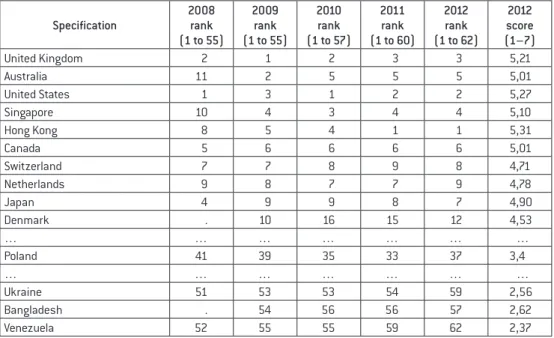
Table 1. Selected data from the ranking of countries in terms of financial development between 2008–2012
Specification 2008rank (1 to 55) 2009 rank (1 to 55) 2010 rank (1 to 57) 2011 rank (1 to 60) 2012 rank (1 to 62) 2012 score (1–7) United Kingdom 2 1 2 3 3 5,21 Australia 11 2 5 5 5 5,01 United States 1 3 1 2 2 5,27 Singapore 10 4 3 4 4 5,10 Hong Kong 8 5 4 1 1 5,31 Canada 5 6 6 6 6 5,01 Switzerland 7 7 8 9 8 4,71 Netherlands 9 8 7 7 9 4,78 Japan 4 9 9 8 7 4,90 Denmark . 10 16 15 12 4,53 … … … … Poland 41 39 35 33 37 3,4 … … … … Ukraine 51 53 53 54 59 2,56 Bangladesh . 54 56 56 57 2,62 Venezuela 52 55 55 59 62 2,37
Source: own study based on: The Financial Development Report 2008, 2009, 2010, 2011, 2012, World …conomic
Forum, Geneva, Switzerland.
Table 2. Polish ranking of insurance development factors, 2009–2012
Specification 2008rank (1 to 55) 2009 rank (1 to 55) 2010 rank (1 to 57) 2011 rank (1 to 60) 2012 rank (1 to 62)
Non-banking financial services
Insurance 4327 4329 2721 3621 2039
Insurance premiums direct 26 27 . . .
Life insurance coverage . . 20 20 .
Non-life insurance coverage . 25 26 .
Insurance density 27 28 . . .
Insurance penetration 26 27 . . .
Life insurance penetration . . . . 31
Non-life insurance penetration . . . . 30
Real growth of direct insurance premiums 5 16 2 32 33
Life insurance density . . 29 30 23
Non-life insurance density . . 32 30 27
Relative value-added of insurance to GDP 45 21 29 36 37
Source: own study based on: The Financial Development Report 2008, 2009, 2010, 2011, 2012, World …conomic
The analysis of the financial development summarized in Table 1 allows some conclusions to be drawn. First of all, the US economy was the most financially developed only in the years 2008 and 2010. In 2009 the USA lost its leading position to the United Kingdom, and, for the years 2011–2012, to Hong Kong. Secondly, Poland, in terms of financial development, moved from place 41 in 2008 to place 33 in 2011, then dropped to place 37 in 2012. Thirdly, the worst developed financial systems are in the economies of Ukraine, Bangladesh and Venezuela. These countries were at the bottom of the rankings throughout the examined period. Lastly, between 2008–2010 Poland was ranked much higher in terms of insurance development than financial development (Tables 1 and 2). The recent crisis has, however, raised concerns that some countries may have financial sys-tems that are “too large” compared to the size of their domestic economy. It is noteworthy that over the last three decades the US financial sector grew six times faster than nominal GDP.33 This
has led to a situation in which finances, “instead of being a servant” of the economy, have be-come the “economy’s master.”34 This process is called financialization, and reflects the fact that
the finan cial markets, financial institutions, and financial elites gain greater influence over eco-nomic policy and ecoeco-nomic outcomes.35 It may be asked whether it is correct that there is such
a clear domination of financial markets over the traditional industrial economy. Where are the safe limits of financial development?
The idea that there may be a threshold above which financial development hits negative social returns is hardly new. As early as the 1970s, Minsky and Kindleberger emphasised the relation-ship between finance and macroeconomic volatility. H. Minsky wrote extensively about financial instability and financial manias.36 Contemporary discussions suggest that the danger of
finan-cial development is that the presence of a large and complicated finanfinan-cial system has increased the likelihood of a “catastrophic meltdown” and some financial innovations can increase financial fragility, even in the absence of leverage.37 When they wrote this, financial markets were much
smaller than nowadays – the finance and insurance sectors made only 7.5 per cent profit after tax, whereas recently this figure has been between 30 and 80 per cent. So, what are the limits of financial development? Many results show that the marginal effect of financial development on output growth becomes negative when credit to the private sector surpasses 110 per cent of GDP.38 On the basis of the World Bank’s publications it can be concluded that in 18 countries (out
of the 200 examined) this rate is higher than 110 per cent (cf. Table 3), and the rates of France and Germany are just under this threshold, at 109.1 per cent.
We conclude that the size of the financial sector played an important role in amplifying the ef-fects of the global recession that followed the collapse of Lehman Brothers in September 2008. While most of the recent discussion on the negative effects of financial development concentrates 33. R.G. Rajan, ‘‘Has financial development made the world riskier?,’’ Working Paper 11728 (2005), accessed
October 21, 2013, www.nber.org/papers/w11728.pdf
34. J.L. Arcand, E. Berkes and U. Panizza, ‘‘Too much finance?,’’ (2011), accessed October 21, 2013, www.voxeu.org/ article/has-finance-gone-too-far.
35. T. I. Palley, ‘‘Financialization: What It Is and Why It Matters,’’ Working Paper 525 (2007): 2. 36. H.P. Minsky, ‘‘The financial Instability Hypothesis,’’ Working Paper 74 (1992): 2.
37. N. Roubini and S. Mihm, “Ekonomia kryzysu,” (Warszawa: Wydawnictwo Oficyna a Wolters Kluwer Business, 2011), 73–74.
on advanced economies, during the recent crisis the amplifying role of the financial sector was also important for developing countries.
Empirical studies on new factors of economic growth were intensified only in the 1990s. At that time, the pioneering studies by J. Schumpeter were more often referred to. With reference to mod-els of endogenous growth, a number of attempts were made to study how economic growth was influenced not only by financial development but also by many other non-conventional factors of growth.39 Empirical studies were carried out using econometric regression models with a panel
(cross-country, time series) dataset.
Table 3. Countries and their private credit to GDP (%), averages, 2008–2010
Countries Private credit to GDP (%) Countries Private credit to GDP (%) Countries Private credit to GDP (%)
Australia Austria Canada Cyprus Denmark Hong-Kong 124,4 120,5 126,6 265,6 208,1 152,9 Iceland Ireland Luxembourg Malta Netherlands New Zealand 137,5 228,2 184,0 127,6 201,9 145,0 Portugal San Marino Spain Sweden Switzerland United Kingdom 179,0 361,7 203,7 124,3 169,6 205,3 Source: own study based on: Global Financial Development Report 2013, Rethinking the Role of the State in Finance (Washington, D.C.: The World Bank), 161–166.
The role of the financial sector in economic growth has become a major topic of empirical re-search in the last two decades, and the seminal work of R. King and R. Levine has been greatly elaborated. On the basis of empirical studies (using data on 80 countries over the 1960–1989 period) R. King and R. Levine have found that the predetermined component of financial develop-ment is a good predictor of long-run growth over the next 10 to 30 years. These results suggest an important link between financial development and long-run growth, as suggested by Schum-peter 80 years ago.40 Some further evidence in this direction has been provided e.g., by the work
of Wachtel and Rousseau. With the use of the Granger causality test41 for a number of time series,
Wachtel and Rousseau confirmed the reliance which exists between financial development and economic growth. An impressive number of empirical studies relying on large country samples from the 1960s to the 1980s show that financial development can have an economically important im-pact on growth.42 Many studies concern the relationship between the development of the banking
sector and capital market, and economic growth. The role of insurance companies, although growing in importance in financial intermediation, has received less attention than bank and stock market.. 39. M. Próchniak, ‘‘Czynniki wzrostu gospodarczego – wyniki z badań empirycznych,’’ …konomista 3 (2006): 305–339. 40. R. King and R. Levine, ‘‘Finance and growth: Schumpeter might be right,’’ The Quarterly Journal of …conomics
8 (1993): 719.
41. The Granger causality test is a statistical hypothesis test for determining whether one time series is useful in forecasting another, cf. C.W.J. Granger, “Investigating Causal Relations by Econometric Models and Cross-spectral Methods,” …conometrica, no. 37(3) (1969). Ordinarily, regressions reflect “mere” correlations, but C. Granger argued that causality in economics could be reflected by measuring the ability of predicting the fu-ture values of a time series using past values of another time series. Since the question of causality is deeply philosophical, econometricians assert that the Granger test finds only “predictive causality.”
Analogously to other financial sectors, the link between insurance development and the real sector can be classified in terms of causality, with respect to five possible hypotheses. The first – no causal relation. The second – demand-following, e.g., economic growth leads to the rise in demand for insurance (the faster the economic growth, the higher the demand for insurance services and insurance development). The third – supply-leading, e.g., growth in insurance smoothes short-term economic volatility and thus induces economic growth in the long short-term; also, an increase in investment by insurance companies induces economic growth. The fourth – a negative causal link from insurance to growth, e.g., increasing insurance causes more reckless behaviour (“moral hazard”), which results in a less efficient and more volatile economy. The fifth – interdepend-ence.43 Empirical evidence in the literature on the subject suggests that developing countries have
a rather supply-leading causality pattern of development, and less of a demand-following pattern44.
Empirical studies suggest that non-life insurance contributes to growth in countries at many dif-ferent levels of development. Life insurance makes a substantial contribution to growth mostly in wealthier countries, since life insurance is typically a smaller part of the total insurance market in low-income countries.45
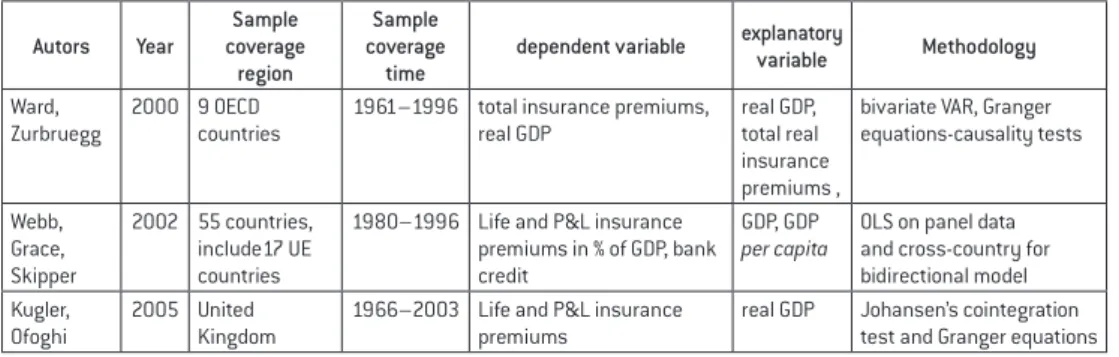
Empirical studies concerning the connection between insurance development and economic growth are mainly carried out on the basis of time-cross-sectional data derived from developed and developing countries. Only a few studies have been conducted on the basis of time series of single countries (these include: the United Kingdom, Sweden, Singapore, Malaysia and Poland). The results of this research are presented in Table 4. The methods used in this research can be di-vided into three groups: correlation and regression analysis; analysis of time series co-integration; and causality tests. The cognitive studies which examined the cause-and-effect relationships be-tween the variables (usually the values of premiums and GDP) are of particular importance. One of the methods for determining the direction of these relationships is the Granger causality test. A summary of the empirical studies on the relationship between insurance growth and economic growth is made below.
Table 4. Empirical research on the relationship between insurance growth and economic growth in 2000–2010 Autors Year Sample coverage region Sample coverage
time dependent variable
explanatory variable Methodology Ward, Zurbruegg 2000 9 OECD countries
1961–1996 total insurance premiums, real GDP
real GDP, total real insurance premiums ,
bivariate VAR, Granger equations-causality tests Webb, Grace, Skipper 2002 55 countries, include17 UE countries
1980–1996 Life and P&L insurance premiums in % of GDP, bank credit
GDP, GDP
per capita OLS on panel data and cross-country for bidirectional model Kugler,
Ofoghi
2005 United Kingdom
1966–2003 Life and P&L insurance premiums
real GDP Johansen’s cointegration test and Granger equations
43. Ibidem, 4–5.
44. J.F. Outreville, ‘‘Financial development,” 2.
45. L. Brainard and B.L. Schwartz, “What is the role of insurance in economic development?,” (Zurich: Zurich Government and Industry Affairs, 2008), http://www.zurich.com/internet/main/sitecollectiondocuments/ insight/what_is_the_role_of_economic_developement.pdf.
Autors Year coverage Sample region
Sample coverage
time
dependent variable explanatory variable Methodology
Arena 2006 56 countries 1976–2004 Life and P&L insurance
premiums to GDP real GDP per capita GMM dynamic panel estimations Haiss,
Sümegi
2006 29 European – mainly EU – countries
1992–2004 written insurance premium real GDP per employed
OLS for panel data, test for Granger causality Haiss, Sümegi 2008 29 European – mainly EU – countries 1992–2005 insurance premiums, investment of insurance companies real GDP, GDP per employed
OLS, Granger causality test, modified Cobb- Douglas production function Ćurak, Lončar, Poposki 2009 10 countries
new to the EU 1992–2007 Life and P&L insurance premiums to GDP GDP capitaper OLS and 2SLS estimations for panel data Njegomir,
Stojić 2010 Countriesof the ex-Yugoslavia Region
2004–2008 gross premium written per
capita, technical reserves real GDP per capita OLS for panel data
Han, Li, Mo-shirian, Tian 2010 77 countries – global insurance sector 1994–2005 insurance premiums
per capita real GDP per capita GMM dynamic panel estimations for panel data Ortyński 2010 Poland 1994–2008 real total premiums, real
premium of life insurance, real premium of non-life insurance
real GDP GLS
Bednarczyk 2012 Poland 1995–2009 total, life and non-life insurance premiums
per capita
real GDP
per capita OLS,VAR, Johansen’s cointegration test, test for Granger causality
GMM – Generalized Method of Moments, GLS – Generalized Least Square, OLS – Ordinary Least Square, 2SLS – Two Stage Least Squares
Source: T.H. Bednarczyk, “Działalność sektora ubezpieczeniowego a wzrost gospodarczy,” in Ubezpieczenia wobec wyzwań XXI wieku (Prace Naukowe Uniwersytetu Ekonomicznego we Wrocławiu, no. 228, 2011), 26.
Work by D. Ward and R. Zurbruegg is considered the first study to examine the potential rela-tionship between the growth in insurance activity and economic growth for nine OECD countries. They used the total number of written insurance premiums as the definition of insurance activities. The results were varied. Causality tests from vector autoregressions in levels show that insurance activity leads economic growth only in Canada and Japan. In Italy there is a bidirectional relation-ship. For all other countries, including the United Kingdom, the USA, Austria and Switzerland, there is no evidence of the interaction. Ward and Zurbruegg conclude that the causal relationships be-tween insurance and economic growth might well vary across countries. This is due to the influ-ence of different country-specific factors, including cultural, regulatory and legal ones.46
Conclu-sions regarding the causality relationships are as follows: there is a reliance of a supply-leading type in some countries, while there are no significant causality links in others.
M. Kugler and R. Ofoghi examine the long-term relationship between the size of the insurance market and economic growth in the United Kingdom. Insurance development was measured by dis-46. D. Ward and R. Zurbruegg, ‘‘Does Insurance Promote Economic Growth? Evidence from OECD. Countries,’’
aggregated insurance premiums for different classes of property insurance (marine-aviation in-surance, transport insurance and reinsurance). Using Johansen’s cointegration tests, M. Kugler and R. Ofoghi find a long-term relationship between the development in the size of an insurance market and the economic growth for all components of insurance markets. The results show that for most cases there is a bilateral long-term relationship between the development of the size of an insurance market and economic growth, rather than a cyclical effect.47 Conclusions
regard-ing a causality link: causality runs in both directions.
M. Arena provides a systematic assessment of the impact of insurance market activity (life and non-life insurance) on economic growth. M. Arena found robust evidence of a causal relationship be-tween insurance market activity and economic growth. Both life and non-life insurance premiums have a positive and significant causal effect on economic growth, but life insurance is, according to Granger, the cause of economic growth in high-income countries only, and, while the impact of the development of non-life insurance has been confirmed in both developing and developed countries, it is greater in developed countries than in developing ones.48 Conclusions regarding a causality link:
supply-leading, both in life and non-life sectors. Life insurance is more important for high-income countries. P. Haiss and K. Sumegi examine in their work whether, and how, insurance influences economic growth. They analyse the various channels of influence of the insurance sector vis-a-vis economic growth: risk transfer, substitute savings, investment, and possible sources of contagion and reper-cussions to the economy. They note that the transfer of risk to the insurer stabilizes income streams of business entities, dampens volatility and enhances economic activity. Both increasing the value, and also expanding the area of financial investment and also deepening capital markets have a posi-tive effect on economic growth. In empirical studies P. Haiss and K. Sumegi developed a modified production function to empirically investigate the endogenous insurance-growth model. The research by P. Haiss and K. Sumegi produced mixed results. Their results show no evidence of a correlation between aggregate insurance premium income and GDP growth. A rather weak correlation between the growth in the banking sector, the capital market, and economic growth has been defined. How-ever, strong evidence of the impact of life insurance on economic growth has been found.49
In another study, P. Haiss and K. Sumegi investigate both the impact of insurance investments and premiums life and non-life segments on GDP growth in Europe. Using premium income and insurance investment they provided evidence of a correlation between investments and GDP growth for EU-15 countries along with Norway, Switzerland and Iceland, (with mature financial markets) and a short-term connection between expenditure on non-live insurance and the GDP for the emerging-market-type countries (new EU member states from Central and Eastern Europe). Furthermore, their findings emphasise the impact of the real interest rate and the level of economic development for the insurance-growth-nexus. They argue that the insurance sector needs to be paid more attention in financial sector analysis and macroeconomic policy.50 Conclusions
regard-47. M. Kugler and R. Ofoghi, ‘‘Does Insurance Promote.”
48. Marco Arena, Does “Insurance Market Activity Promote economic Growth? A Cross-Country Study for Indus-trialized and Developing Countries,” (The World Bank 2006).
49. P. Haiss and K. Sumegi, “The Relationship of Insurance and Economic Growth – A Theoretical and Empirical Analysis,” (paper presented at the EcoMod conference, Hong Kong, 2006).
50. P. Haiss and K. Sumegi, “The Relationship Between Insurance and Economic Growth in Europe – A Theoretical and Empirical Analysis,” vol. 35 of …mpirica 4 (2008).
ing a causality link: supply-leading. Life insurance is more important for high-income countries and non-life is more important for emerging EU countries.
Webb, Grace and Skipper examine banks, life and non-life insurers. In particular, they examine how banks and insurers, individually and together, contribute to economic growth by increasing effective capital allocation. They use a Solow-Swan model for this purpose. Their findings indicate that financial intermediaries are significant. It turns out that a synergy exists between banks and insurers. Furthermore, results show that a combination of banking and one insurance type has the strongest impact on growth.51 Conclusions regarding a causality link: supply-leading and
in-creased productivity over the period. Also, finding a synergy between banks and insurers would involve adding together their individual contributions. Additionally, economic development was found here.
When analysing the results of empirical studies, it should be emphasised that most of them concern highly-developed or developing economies. There is incredibly little research concern-ing transformconcern-ing countries. The results of the little research that has been conducted there have shown that the development of insurance has a statistically crucial impact on economic growth in those countries. It is worth noting the studies carried out by V. Njegomir and D. Stojic concern the countries of the former Yugoslavia,52 and studies by K. Ortyński and T. H. Bednarczyk concern
Poland. The results of Ortyński show that there is a positive and statistically important relationship between the development of the insurance market and economic growth in Poland. A particularly strong relationship was observed between the development of the non-life insurance market and the value of the real GDP.53 Conclusions regarding a causality link: Granger causality has not been
investigated.
The author of this paper, T. H. Bednarczyk, examined in her previous work the long-term rela-tionship between insurance development and economic growth in Poland. Empirical studies used secondary data for the years 1995–2009, on a quarterly basis. Insurance development is measured by the growth-rate of insurance density (quarterly insurance premiums per capita); and the eco-nomic growth by the growth-rate of the quarterly GDP per capita. Three different insurance vari-ables were used – life insurance premium per capita, non-life insurance premium per capita, and total insurance premium per capita. Econometrics tests were used for cointegration and Granger causality. The estimation method used the Ordinary Least Square (OLS) for time series, with data on a quarterly basis. Using Johansen’s cointegration tests and the Engle-Granger procedure, the author finds a long-term relationship between insurance development and economic growth. Both methods gave similar results. There was no causality proven by the Granger causality test.54
Conclusions regarding a causality link: no significant causality links in Poland.
51. I. Webb, M. F Grace and H. Skipper, “The Effect of Banking and Insurance on the Growth of Capital and Output,”
Center for Risk Management and Insurance Working Paper 02–1 (2002).
52. V. Njegomir and D. Stojić, “Does Insurance Promote Economic Growth: The Evidence from Ex-Yugoslavia Region,”
…konomska, Misao iPraksa 1 (Dubrownik, 2010): 31–48.
53. K. Ortyński, “Ubezpieczenia a wzrost gospodarczy w Polsce,” in Globalizcja i integracja regionalna a wzrost gospodarczy, ed. S. I. Bukowski, (Warszawa: CeDeWu, 2010), 174.
54. T. H. Bednarczyk, “Wpływ działalności sektora ubezpieczeniowego na wzrost gospodarczy,” (Lublin: Wydawnict-wo UMCS, 2012).
Conclusions
The main intention of this study was to examine the link between financial development, insur-ance development and economic growth (the insurinsur-ance-fininsur-ance-growth nexus), which is an im-portant issue that has only relatively recently become the subject of wider interest. Previously, the dominant opinions were that there was a neutral role played by money and the financial system in the economy, or that economic growth had a stronger impact on financial development. Today, it is believed that a well-developed financial system increases the efficiency of financial decisions, and improves the allocation of resources in the economy, which thus promotes economic growth. The review of literature, mainly in English, leads to the conclusion that financial development encourages long-term economic growth, despite the fact that in the short-term it can bring about economic recession due to financial crises. The literature describes a large amount of empirical research that shows that financial development has a positive influence on economic growth. As far as insurance is concerned, it should be noted that in recent decades its importance has grown in economies, mainly due to the liberalization of financial systems, globalization and the conglom-eration of financial markets. The role of the insurance sector and its contribution to economic growth is appreciated not only by scientific communities, but also by major international organizations such as UNCTAD, the World Bank, and the International Monetary Fund.
A large part of the theoretical literature emphasises many benefits of insurance to the economy and society. Insurance activity enhances the financial stability of families and businesses; it also facilitates competitiveness and the development of trade and commerce by enhancing creditwor-thiness and lowering the total necessary amount and cost of capital, and also by reducing total risk - this enables enterprises to enter new business ventures and take additional risk. Insurance activity substitutes and complements public sector expenditure on security programmes, facili-tates loss prevention either directly by investing in loss prevention programmes such as medical research, fire prevention or highway safety, or indirectly by tying premiums to loss experience. Insurers, in addition to primary functions, i.e. providers of risk transfer and indemnification, serve the same types of functions as other financial intermediaries. The development of insurance con-tributes to economic growth in several ways: by increasing liquidity and the availability of total capital stock in an economy, as well as the efficiency of capital allocation. In addition, empirical evidence from developed economies shows that insurers are among the major employers and investors. Thus, they may have a positive impact on important factors of economic growth, such as: private savings rates, the percentage of savings directed towards investments, the marginal productivity of investment. Their activity, like that of banks, may create growth in the economy. The channels of impact of the development of insurance on economic growth are as follows: in-creasing the total productivity of productive factors (this is more typical for developed countries than for developing ones) and capital accumulation, and also facilitating the inflow of foreign in-vestment that promotes the development of technical innovation. This channel is more frequently used in countries with low and medium levels of prosperity.
It is possible to conclude that there is good theoretical justification for insurance development influencing economic growth (and vice-versa). While there are strong theoretical explanations for the positive impact of insurance on economic growth, empirical evidence is rather scarce – only a few studies devoted empirical research to the insurance-growth nexus. The predominant
methodology for searching for correlation and cointegration to calculate dependency factors is to implement an ordinary least square model on a cross-sectional data set and to test causality (Granger causality test). The results of empirical research carried out to date are mixed. There are differences between less developed countries and countries with mature financial markets. Gener-ally, we can say that the results of empirical studies have provided evidence proving that the de-velopment of insurance plays a positive role in optimizing the allocation of physical resources and thus indirectly affects economic growth, although not equally so in all the countries studied. Given the huge body of research on the relationship between bank/capital market – finance and economic growth, there is definitely a need for more empirical work on the insurance-growth nexus.
References
Aghion P., and Howitt P., “Endogenous Growth Theory,” The MIT Press. Cambridge Mass, 1999. Allen F., and Santomero A., “The theory of financial intermediation,” Vol. 21 of Journal of Banking
and Finance 11–12 (1998).
Arcand J. L., Berkes E., and Panizza U., “Too much finance?,” Accessed October 21, 2013. www. voxeu.org/article/has-finance-gone-too-far.
Arena, Marco, “Does Insurance Market Activity Promote Economic Growth? A Cross-Country Study for Industrialized and Developing Countries,” The World Bank, 2006.
Beck T., Demirgüç-Kunt A. and Levine R., “A New Database on Financial Development and Structure,” Financial Sector Discussion Paper 2 (1999).
Bednarczyk T. H., “Wpływ działalności sektora ubezpieczeniowego na wzrost gospodarczy,” Lublin: Wydawnictwo UMCS, 2012.
Bednarczyk T. H., “Działalność sektora ubezpieczeniowego a wzrost gospodarczy,” in Ubezpiecze-nia wobec wyzwań XXI wieku, edited by W. Ronka-Chmielowiec, Prace Naukowe Uniwersytetu …konomicznego we Wrocławiu 228 (2011).
Brainard, L., and Schwartz B. L., “What is the role of insurance in economic development?,” Zurich: Zurich Government and Industry Affairs, 2008. http://www.zurich.com/internet/main/sitecol-lectiondocuments/insight/what_is_the_role_of_economic_developement.pdf
Coparale G. M., Howells P. G. A. and Soliman A. M., “Endogenous growth models and stock market de-velopment: Evidence from four countries,” Vol. 9 of Review of Development …conomics 2 (2005). Diamond D., “Financial Intermediation and Delegated Monitoring,” Vol. 51 of Review of …conomic
Studies 3 (1984).
The World Bank, “Global Financial Development Report 2013 Rethinking the Role of the State in Fi-nance”, Washington, D.C.: The World Bank, 2013.
Granger, C. W. J., “Investigating Causal Relations by Econometric Models and Cross-spectral Meth-ods,” …conometrica 37(3) (1969).
Gurley, J. G., and Shaw E. S., “Financial Intermediaries and the Saving-Investment Process,” The Jour-nal of Finance 11 (1956).
Haiss P., and Sumegi K., “The Relationship of Insurance and Economic Growth – A Theoretical and Empirical Analysis,” Paper presented at the EcoMod Conference, Hong Kong, June 28–30, 2006. Haiss P., and Sumegi K., “The Relationship Between Insurance and Economic Growth in Europe –
Handschke J. “Polskie doświadczenie w formowaniu i rozwoju rynku ubezpieczeń – wybrane as-pekty,” Wiadomości Ubezpieczeniowe 3 (2009).
Hester D.D., “On the theory of financial intermediation,” De …conomist 142(2) (1994).
King R., and Levine R., “Finance and growth: Schumpeter might be right,” The Quarterly Journal of …conomics 8 (1993).
Krugman, P., and Wells R., “Makroekonomia,” Warszawa: PWN, 2012.
Kugler M., and Ofoghi R., “Does Insurance Promote Economic Growth? Evidence form the UK,” (2005). www.repec.org.
Kulawik J., “Rozwój finansowy a wzrost i rozwój ekonomiczny,” Bank i Kredyt 1–2 (1998). Leland H. E., and Pyle D. H., “Informational Asymmetries, Financial Structure and Financial
Inter-mediation,” Vol. 32 of The Journal of Finance, 2 (1977).
Levine R. “Financial Development and Economic Growth: Views and Agenda,” Journal of …conomic Literature 35(2) (1997): 691.
Lucas R. E. “Why doesn’t capital flow from rich to poor countries?,” Vol. 80 of American …conomic Review 2 (1990).
Lucas, R. E., “Wykłady z teorii wzrostu gospodarczego,” Warszawa: Wydawnictwo C. H. Beck, 2010. McKinnon R. I., “Money and Capital in Economic Development,” Washington D.C.: The Brookings
Institution, 1973.
Merton R. C., and Bodie Z., “A Conceptual Framework for Analyzing the Financial Environment,” in Crane D.B., Froot K.A., Mason S.P., Perold A.F., Merton R.C., Bodie Z., Sirri E.R., and Tufano P., The Glob-al FinanciGlob-al System. A FunctionGlob-al Perspective. Boston: Harvard Business School Press, 1995. Minsky H. P., “The financial Instability Hypothesis.” Working Paper 74 (1992).
Njegomir V., and Stojić D., “Does Insurance Promote Economic Growth: The Evidence from Ex-Yugo-slavia Region,” …konomska, Misao i Praksa 1 (2010).
Ortyński K., “Ubezpieczenia a wzrost gospodarczy w Polsce,” in Globalizcja i integracja regionalna a wzrost gospodarczy, edited by S. I. Bukowski, Warszawa: CeDeWu, 2010.
Osak M., “O metodzie badania rozwoju prywatnych ubezpieczeń zdrowotnych,” Wiadomości Ubez-pieczeniowe 1 (2009).
Outreville J. F. “Financial development, human capital and political stability,” UNCTAD Discussion Papers 142 (1999).
Pagano M., “Financial Markets and the Macroeconomy. Financial Markets and Growth. An Overview,” …uropean …conomic Review 37 (1993).
Palley T. I., “Financialization: What It Is and Why It Matters,” Working Paper 525 (2007).
Próchniak, M., “Czynniki wzrostu gospodarczego – wyniki z badań empirycznych,” …konomista 3 (2006). Rajan R. G., ‘‘Has financial development made the world riskier?,’’ Working Paper 11728 (2005).
Accessed October 21, 2013, www.nber.org/papers/w11728.pdf.
Robinson J., “The Generalization of the General Theory,” in The Rate of Interest and other …ssays. London: Macmillan, 1952.
Romer P. M., “Endogenous Technological Change,” Vol. 98 of The Journal of Political …conomy 5 (1990). Romer P. M., “Increasing Returns and Long-Run Growth,” Journal of Political …conomy 94 (1986). Roubini N., and Mihm S., “Ekonomia kryzysu,” Warszawa: Wydawnictwo Oficyna a Wolters Kluwer
Business, 2011.
Roubini N., and Sala-i-Martin X., “Financial Development, the Trade Regime, and Economic Growth,” NB…R Working Paper 3876 (1991).
Szymczak M., ed., “Słownik języka polskiego,” Warszawa: PWN, 1993.
CEA, “The Contribution of the Insurance Sector to Economic Growth and Employment In the UE,” Brussels: CEA, 2006. www.cea.assur.org
World Economic Forum, Geneva, Switzerland. The Financial Development Report 2008, 2009, 2010, 2011, 2012. New York: World Economic Forum USA Inc, 2008–2012.
Ward, D., and Zurbruegg R., “Does Insurance Promote Economic Growth? Evidence from OECD. Countries.” The Journal of Risk and Insurance 4 (2000).
Webb I., Grace M. F., and Skipper H., “The Effect of Banking and Insurance on the Growth of Capital and Output,” Center for Risk Management and Insurance Working Paper, 02–1, (2002).
Rozwój ubezpieczeń jako czynnik długookresowego wzrostu
gospodarczego
Nauki ekonomiczne od lat poszukują czynników długookresowego wzrostu gospodarczego. Jednym z nich jest stopień rozwoju finansowego. Zgodnie z teorią, zarówno rynki finansowe, jak i pośrednicy finansowi są potrzebni w gospodarce, ponieważ pomagają pokonywać problemy niedoskonałości rynku w postaci asymetrii informacyjnej oraz kosztów transakcyjnych. Wpływ pośredników finan-sowych na wzrost gospodarczy jest realizowany poprzez pełnione funkcje, takie jak: mobilizowanie oszczędności oraz ich transformacja w finansowanie projektów inwestycyjnych, ocena projektów in-westycyjnych oraz monitorowanie menedżerów, zarządzanie ryzykiem i ułatwianie transakcji handlo-wych. Funkcje te są niezbędne dla powstawania innowacji technologicznych i rozwoju gospodarczego. Ponieważ ubezpieczyciele pełnią większość z tych funkcji, to powinni odgrywać również istotną rolę we wzroście gospodarczym.
W ostatnich dekadach zarówno na świecie, jak i w Polsce obserwuje się relatywnie szybki rozwój ubezpieczeń, natomiast stosunkowo rzadko bada się ich wpływ na wzrost gospodarczy. Opracowanie to dotyczy współzależności zachodzących między rozwojem ubezpieczeń oraz wzrostem gospodar-czym (insurance-growth nexus theory). W artykule omówiono kierunki wpływu rozwoju finansowego i rozwoju ubezpieczeń na wzrost gospodarczy, wynikające z teorii pośrednictwa finansowego i teorii en-dogenicznego wzrostu. Przedstawiono również przegląd badań empirycznych dotyczących tych relacji. W opracowaniu pozytywnie zweryfikowano główną hipotezę badawczą, że rozwój ubezpieczeń, który jest integralną częścią rozwoju finansowego, pozytywnie wpływa na długookresowy wzrost gospodarczy. Słowa kluczowe: pośrednictwo finansowe; rozwój finansowy; rozwój ubezpieczeń długookresowy wzrost gospodarczy; współzależności między rozwojem finansowym – rozwojem ubezpieczeń – wzrostem gospodarczym.
TERESA H. BEDNARCZYK, Ph.D. – assistant professor at the Faculty of Economics of the Maria Curie-Sklodowska University in Lublin.