Forschungsberichte
der Fakultät IV – Elektrotechnik und Informatik
C
UJO
: Efficient Detection and Prevention of
Drive-by-Download Attacks
Konrad Rieck, Tammo Krueger, and Andreas Dewald
Bericht-Nr. 2010-10 ISSN 1436-9915
Cujo:
Efficient Detection and Prevention of
Drive-by-Download Attacks
Konrad Rieck1, Tammo Krueger1, and Andreas Dewald2 1Berlin Institute of Technology, Germany
2University of Mannheim, Germany
Abstract
The JavaScript language is a core component of active and dynamic web content in the Internet today. Besides its great success in enhancing web applications, however, JavaScript provides the basis for drive-by downloads—attacks exploiting vulnerabilities in web browsers and their extensions for unnoticeably downloading malicious software. Due to the diversity and frequent use of obfuscation in these JavaScript attacks, static code inspection proves ineffective in practice. While dynamic analysis and honeypots provide means to identify drive-by-download attacks, current approaches induce a sig-nificant overhead which renders immediate prevention of attacks intractable.
In this paper, we presentCujo, a system for automatic detection and prevention of
drive-by-download attacks. Embedded in a web proxy,Cujotransparently inspects web
pages and blocks delivery of malicious JavaScript code. Static and dynamic code features are extracted on-the-fly and analysed for malicious patterns using efficient techniques of machine learning. We demonstrate the efficacy ofCujoin different experiments, where
it detects 95% of the drive-by downloads with few false alarms and a median run-time of 500 ms per web page—a quality that, to the best of our knowledge, has not been attained in previous work on detection of drive-by-download attacks.
1
Introduction
The JavaScript language is a ubiquitous tool for providing active and dynamic content in the Internet. The vast majority of web sites, including large social networks, such as Facebook and Twitter, makes heavy use of JavaScript for enhancing the appearance and functionality of their services. In contrast to server-based scripting languages, JavaScript code is executed in the web browser of the client and thus provides means for directly interacting with the user and the browser environment. Although the execution of JavaScript code at the client is restricted by several security policies, the interaction with the browser and its extensions alone gives rise to a severe security threat.
JavaScript is increasingly used as basis for so-calleddrive-by downloads, attacks exploiting vulnerabilities in web browsers and their extensions for unnoticeably downloading malicious software [see 15, 16]. These attacks take advantage of the tight integration of JavaScript with
the browser environment to exploit different types of vulnerabilities and eventually assume control of the web client. Due to the complexity of browsers and their extensions, there exist numerous of these vulnerabilities, ranging from insecure interfaces of third-party extensions to buffer overflows and memory corruptions [5, 7, 12]. Four of the top five most attacked vulnerabilities observed by Symantec in 2009 have been such client-side vulnerabilities and involved in drive-by-download attacks [2].
As a consequence, detection of drive-by downloads has gained a focus in security research. Two classes of defense measures have been proposed to counteract this threat: First, several security vendors have equipped their products with rules and heuristics for identifying mali-cious code directly at the client. This static code inspection, however, is largely obstructed by the frequent use of obfuscation in drive-by downloads. A second strain of research has thus studied detection of drive-by downloads using dynamic code analysis, for example using code emulation [8, 17], sandboxing [4, 6, 16] and client honeypots [14, 16, 19]. Although effective in detecting attacks, these approaches suffer from either of two shortcomings: Some are limited to specific attack types, such as heap spraying [e.g., 8, 17], whereas the more general [e.g., 4, 14] induce an overhead prohibitive for preventing attacks at the client.
As a remedy, we presentCujo1, a system for detection and prevention of drive-by-download
attacks, which combines advantages of static and dynamic analysis concepts. Embedded in a web proxy,Cujotransparently inspects web pages and blocks delivery of malicious JavaScript
code to the client. The analysis and detection methodology implemented in this system rests on the following contributions of this paper:
• Lightweight JavaScript analysis. We devise efficient techniques for static and dynamic analysis of JavaScript code contained in web pages, which provide expressive analysis results with very small run-time overhead.
• Generic feature extraction. For generic detection of attacks, we introduce a mapping from analysis reports to a vector space that is spanned by short analysis patterns and independent of particular attack characteristics.
• Learning-based detection. We apply techniques of machine learning for generating de-tection models for static and dynamic analysis, which spares us from manually crafting and updating detection rules as in current security products.
An empirical evaluation with 200,000 web pages and 600 real drive-by-download attacks demonstrates the efficacy of this approach:Cujodetects 95% of the attacks with a false-positive
rate of 0.004%, corresponding to 4 false alarms in 100,000 visited web sites, and thus is almost on par with offline analysis systems, such asJsand[4]. In terms of run-time, however,Cujo
significantly surpasses these systems. With caching enabled, Cujoprovides a median
run-time of 500 ms per web page, including downloading of web page content and full analysis of JavaScript code. To the best of our knowledge,Cujois the first system capable to effectively
and efficiently block drive-by-download attacks in practice.
The rest of this paper is organized as follows: Cujoand its detection methodology are
introduced in Section 2 including JavaScript analysis, feature extraction and learning-based
1
detection. Experiments and comparisons to related techniques are presented in Section 3. Re-lated work is discussed in Section 4 and Section 5 concludes.
2
Methodology
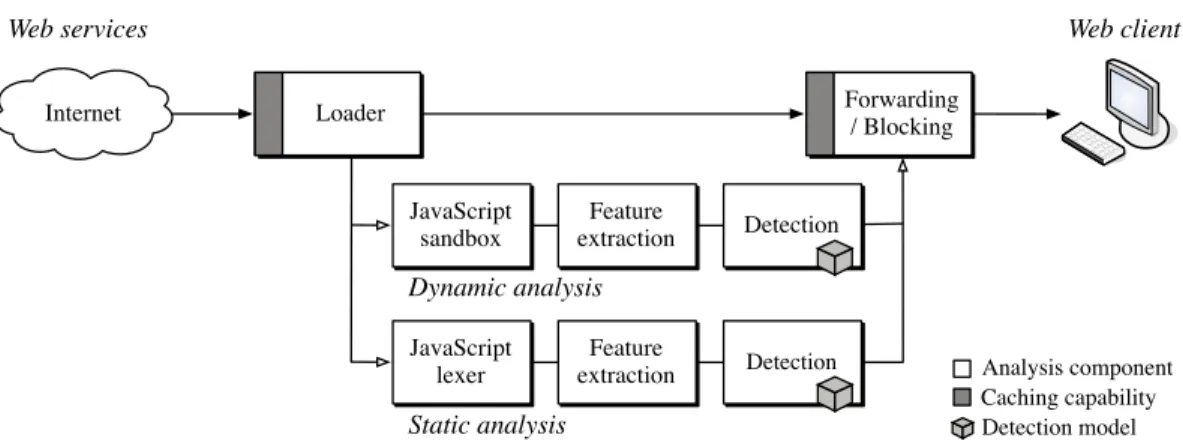
Drive-by-download attacks can take almost arbitrary structure and form, depending on the exploited vulnerabilities as well as the use of obfuscation. Efficient analysis and detection of these attacks resembles a challenging problem, which requires careful balancing of detection and run-time performance. We address this problem by applying lightweight static and dy-namic code analysis, thereby providing two complementary views on JavaScript code. To avoid manually crafting detection rules for each of these views, we employ techniques of machine learning, which enable generalizing from known attacks and allow to automatically construct detection models. A schematic depiction of the resulting system is presented in Figure 1.
Analysis component Caching capability Detection model Detection Detection Forwarding / Blocking Loader Internet Dynamic analysis Static analysis Web client Web services JavaScript sandbox Feature extraction JavaScript lexer Feature extraction
Figure 1: Schematic depiction of Cujo. Incoming web data is processed using static and
dy-namic analysis of JavaScript code. Depending on individual analysis results, the data is either forwarded to the Web client or blocked.
Cujois embedded in a web proxy and transparently inspects communication between a
web client and a web service. Prior to delivery of web page data from the service to the client,
Cujoperforms a series of analysis steps and depending on their results blocks pages likely
containing malicious JavaScript code. To improve processing performance, two analysis caches are employed: First, all incoming web data is cached to reduce loading times and, second, analysis results are cached, if all embedded and external code associated with a web page has not changed within a limited period of time.
2.1 JavaScript Analysis
As first analysis step, we aim at efficiently getting a comprehensive view on JavaScript code. To this end, we inspect all HTML and XML documents passing our system for occurrences of JavaScript. For each requested document, we extract all code blocks embedded using the HTML tagscriptand contained in HTML event handlers, such asonloadandonmouseover.
Moreover, we recursively pre-load all external code referenced in the document, including scripts, frames and iframes, to obtain the complete code base of the web page. All code blocks of a requested document are then merged for further static and dynamic analysis.
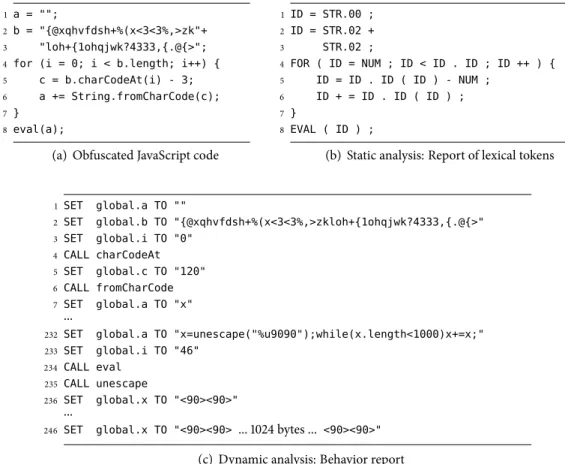
As an example running the following sections, we consider the JavaScript code shown in Figure 2(a). The code is obfuscated using a simple substitution cipher and contains a routine for constructing a NOP sled, an array of NOP instructions common in most memory corruption attacks. Analysis reports for the static and dynamic analysis of this code snippet are shown in Figure 2(b) and 2(c), respectively.
1 a = "";
2 b = "{@xqhvfdsh+%(x<3<3%,>zk"+
3 "loh+{1ohqjwk?4333,{.@{>";
4 for (i = 0; i < b.length; i++) {
5 c = b.charCodeAt(i) - 3;
6 a += String.fromCharCode(c);
7 }
8 eval(a);
(a) Obfuscated JavaScript code
1 ID = STR.00 ; 2ID = STR.02 + 3 STR.02 ; 4 FOR ( ID = NUM ; ID < ID . ID ; ID ++ ) { 5 ID = ID . ID ( ID ) - NUM ; 6 ID + = ID . ID ( ID ) ; 7} 8EVAL ( ID ) ;
(b) Static analysis: Report of lexical tokens
1 SET global.a TO ""
2SET global.b TO "{@xqhvfdsh+%(x<3<3%,>zkloh+{1ohqjwk?4333,{.@{>"
3 SET global.i TO "0" 4CALL charCodeAt 5 SET global.c TO "120" 6CALL fromCharCode 7SET global.a TO "x" ...
232 SET global.a TO "x=unescape("%u9090");while(x.length<1000)x+=x;"
233 SET global.i TO "46"
234 CALL eval
235 CALL unescape
236 SET global.x TO "<90><90>"
...
246 SET global.x TO "<90><90> ... 1024 bytes ... <90><90>"
(c) Dynamic analysis: Behavior report
Figure 2: Example of static and dynamic JavaScript analysis: (a) Obfuscated code snippet of a NOP sled generation, (b) lexical tokens extracted using static analysis, (c) a behavior report generated using dynamic analysis. The deobfuscated code is visible in line 232.
Static analysis. Our static analysis relies on basic principles of compiler design [3]: Before the source code of a program can be interpreted or compiled, it needs to be decomposed into lexical tokens, which are then fed to the actual parser. The static analysis component inCujo
takes advantage of this process and efficiently extracts lexical tokens from the JavaScript code of a web page using a customizedYaccgrammar.
This lexical analysis closely follows the language specification of JavaScript [1], where source code is sequentially decomposed into keywords, punctuators, identifiers and literals. As the actual names of identifiers do not contribute to the structure of code, we replace them by the generic tokenID. Similarly, we encode numerical literals byNUMand string literals bySTR. An example of this basic decomposition is illustrated in the following
x = foo(y) + "bar"; Ð→ ID = ID ( ID ) + STR ;
where keywords and punctuators are represented by individual tokens, while identifiers and strings are subsumed by the generic tokensIDandSTR, respectively.
To further strengthen our static analysis for detection of drive-by-download attacks, we make two refinements to the lexical analysis. First, we additionally encode the length of string literals as decimal logarithm. That is,STR.01refers to a string with up to 101characters,STR.02
to a string with up to 102characters and so on. Second, we addEVALas a new keyword to the lexical analysis. Both refinements target common constructs of drive-by-download attacks, which frequently involve string operations and calls to theeval()function.
Although obfuscation techniques may hide code from this static analysis, several program-ming constructs and structures can be distinguished in terms of lexical tokens. As an example, Figure 2(b) shows an analysis report of lexical tokens. While the code for generating a NOP sled is hidden in the encrypted string (line 2–3), several patterns indicative for obfuscation, such as the decryption loop (line 4–6) and the call toEVAL(line 8), are accessible to means of detection techniques
Dynamic analysis. For dynamic analysis, we adopt an enhanced version ofADSandbox, a
lightweight JavaScript sandbox developed by Dewald et al. [6]. The sandbox takes the code associated with a web page and executes it within the JavaScript interpreterSpiderMonkey2.
The interpreter operates in a virtual browser environment and reports all operations changing the state of this environment. Additionally, we invoke all event handlers of the code to trigger functionality dependent on external events. As result of this analysis, the sandbox provides a report containing all monitored operations, as shown in Figure 2(c).
To emphasize behavior related to drive-by-download attacks, we extend the dynamic code analysis withabstract operations, which represent patterns of common attack activity. These ab-stract operations are encoded as regular expressions and matched on-the-fly during the moni-toring of a JavaScript code. Currently,Cujosupports two of these operations: First, we indicate
typical behavior of heap spraying attacks, such as excessive allocation of memory chunks by appending the operationHEAP SPRAYINGand, second, we mark the use of browser functions inducing a re-evaluation of strings by the interpreter using the operationPSEUDO-EVAL. While both abstract operations are indicative for particular attacks, they are not sufficient for detec-tion alone and a full inspecdetec-tion of behavior reports is required.
Although this lightweight analysis provides only a coarse view on the behavior of JavaScript code in comparison to offline analysis [e.g., 4, 14, 19], it enables accurate detection of drive-by downloads with a median run-time of less than 400 ms per web page, as demonstrated in
Section 3.3. As an example, Figure 2(c) shows a behavior report for the code snippet given in Figure 2(a). The first lines of the report cover the decryption of the obfuscated string, which is finally revealed in line 232. Starting with the call to eval, this string is evaluated by the interpreter and results in the construction of a NOP sled with 1024 bytes in line 246.
2.2 Feature Extraction
In the second analysis step ofCujo, we extract features from the analysis reports of static and
dynamic analysis, suitable for application of detection methods. In contrast to previous work, we propose a generic feature extraction, which is independent of particular attack characteris-tics and allows to jointly process reports of static and dynamic analysis.
Q-grams features. Our feature extraction builds on the concept ofq-grams, which has been widely studied in the field of intrusion detection [e.g., 11, 20]. To unify the representation of static and dynamic analysis, we first partition each report into a sequence of words using white-space characters. We then move a fixed-length window over each report and extract subsequences ofqwords at each position, so-calledq-grams. The following example shows the extraction ofq-grams for two snippets of analysis reports withq=3,
ID = ID + NUM Ð→ { (ID = ID),(= ID +),(ID + NUM) }
SET global.a to "x" Ð→ { (SET global.a to),(global.a to "x") }.
As a result, each report is represented by a set ofq-grams, which reflect short analysis patterns and provide the basis for mapping analysis reports to a vector space.
Intuitively, we are interested in constructing a vector space, where analysis reports sharing severalq-grams lie close to each other, while reports with dissimilar content are separated by large distances. To establish such a mapping, we associate eachq-gram with one particular dimension in the vector space. Formally, this vector space is defined using the set S of all possibleq-grams, where a corresponding mapping function for a reportxis given by
ϕ∶xÐ→(ϕs(x))
s∈S with ϕs(x)= ⎧⎪⎪ ⎨⎪⎪ ⎩
1 ifxcontains theq-grams, 0 otherwise.
The function ϕmaps a reportxto the vector spaceR∣S∣such that all dimensions associated
with q-grams contained in x are set to one and all other dimensions are zero. To avoid an implicit bias on the length of reports, we normalizeϕ(x)to one, that is, we set∣∣ϕ(x)∣∣ = 1. This procedure ensures that patterns contained in a report x contribute to the vector ϕ(x)
only according to their relative length inx.
Efficient computation. At the first glance, this mapping seems intractable and inappropriate for efficient analysis: the setScovers all possibleq-grams of words and thus induces a vector space of arbitrarily large dimension. However, the number ofq-grams contained in a report is linear in its length. That is, a reportxcontainingmwords comprises at most(m−q)different q-grams. Consequently, only(m−q)dimensions are non-zero in the vectorϕ(x)—irrespective
of the dimension of the vector space. It thus suffices to only store theq-grams contained in each reportxfor sparsely representing the vectorϕ(x), for example, using efficient data structures such as Tries [10] or Bloom filters [20]. As demonstrated in Section 3.3, this sparse represen-tation of feature vectors provides the basis for very efficient feature extraction with median run-times below 1 ms per analysis report.
2.3 Learning-based Detection
As final analysis step of Cujo, we present a learning-based detection of drive-by-download
attacks, which builds on the vectorial representation of analysis reports. The application of machine learning spares us from manually constructing and updating detection rules for static and dynamic code analysis, and limits the delay to detection of novel drive-by downloads.
w
φ(x) +
−
Figure 3:Hyperplane with maximal margin. Support Vector Machines. For automatically generating
de-tection models from the reports of attacks and benign code, we apply the technique ofSupport Vector Machines(SVM) [see 18]. Given vectors of two classes as training data, an SVM determines an hyperplane that separates both classes with maximal margin. In our setting, one of these classes is associated with analysis re-ports of drive-by downloads, whereas the other class corresponds to reports of benign web pages. An unknown report is classified by mapping it to the vector space and checking if it falls on the malicious (+) or benign (-) side of the hyperplane.
Formally, the detection model of an SVM corresponds to a vectorwand biasb, specifying the direction and offset of the hyperplane. The corresponding detection function fis given by
f(x)=⟨ϕ(x),w⟩+b=∑
s∈S
ϕs(x)⋅ws+b.
and returns the orientation ofϕ(x)with respect to the hyperplane. That is, f(x)>0 indicates malicious activity in the reportxand f(x)≤0 corresponds to benign data.
In contrast to many other learning techniques, SVMs possess the ability to compensate a certain amount of noise in the labels of the training data—a crucial property for practical application ofCujo. This ability renders the learning process robust to a minor amount of
un-known attacks in the benign portion of the training data and enables generating accurate detec-tion models, even if some of the web pages labeled as benign data contain drive-by-download attacks. Theory and further details on this ability are provided in [18].
Efficient computation. For efficiently computing f, we again exploit the sparse representa-tion of vectors induced byϕ. Given a reportx, we know that onlyq-grams contained inxhave non-zero entries inϕ(x), that is, all other dimensions inϕ(x)are zero and do not contribute to the computation of f(x). Hence, we can simplify the detection function fas follows
f(x)=∑
s∈S
ϕs(x)⋅ws+b= ∑
sinx
where we determine f(x)by simply looking up the valueswsfor eachq-gram contained inx.
As a consequence, the classification of a report can be carried out with linear time complexity and a median run-time below 0.2 ms per report (cf. Section 3.3). For learning the detection model of the SVM we employLibLinear[9], a fast SVM library which enables us to train
detection models from 100,000 reports in 120 seconds for dynamic analysis and in 50 seconds for static analysis.
Explanation. In practice, a detection systems must not only flag malicious events but also provide insights into the detection process, such that attack patterns and exploited vulnerabil-ities can be inspected during operation. Fortunately, we can adapt the detection function for explaining the decision process of the SVM. During computation of f, we additionally store the individual contributionϕs(x)⋅wsof eachq-gram to the final detection score f(x). If an
explanation is requested, we output theq-grams with largest contribution and thereby present those analysis patterns that shifted the analysis reportxto the positive side of the hyperplane. We illustrate this concept in Section 3.2, where we present explanations for detections of drive-by-download attacks using dynamic analysis reports.
The learning-based detection completes the design of our systemCujo. As illustrated in
Figure 1,Cujouses two independent processing chains for static and dynamic code analysis,
where an alert is reported if one of the detection models indicates a drive-by download. This combined detection renders evasion of our system difficult, as it requires the attacker to cloak his attacks from both, static and dynamic analysis. While static analysis alone can be thwarted through massive obfuscation, the hidden code needs to be decrypted during run-time which in turn can be tracked by dynamic analysis. Similarly, if fewer obfuscation is used and the attacker tries to spoil the sandbox emulation, patterns of the respective code might be visible to static analysis. Although this argumentation does not rule out evasion in general, it clearly shows the effort necessary for evading our system.
3
Evaluation
After presenting the detection methodology of Cujo, we turn to an empirical evaluation of
its performance. In particular, we conduct experiments to study the detection and run-time performance in detail. Before presenting these experiments, we introduce our data sets of drive-by-download attacks and benign web pages.
Data sets. We consider two data sets containing URLs of benign web pages,Alexa-200kand
Surfing, which are listed in Table 1(a). The Alexa-200kdata set corresponds to the 200,000 most visited web pages in Internet as listed by Alexa3and thus covers a wide range of JavaScript code, including several search engines, social networks and on-line shops. TheSurfingdata set comprises 20,283 URLs of web pages visited during usual web surfing at our institute. The data has been recorded over a period of 10 days and contains individual sessions of five users. Both data sets have been sanitized by scanning the web pages for drive-by downloads using common
attack strings and theGoogleSafeBrowsingservice. While very few unknown attacks might
still be present in the data, we rely on the ability of the SVM learning algorithm to compensate this inconsistency effectively.
(a) Benign data sets
Data set # URLs
Alexa-200k 200,000 Surfing 20,283
(b) Attack data sets
Data set # attacks
Spam Trap 256
SQL Injection 22 Malware Forum 201
Data set # attacks
Wepawet-new 46 Obfuscated 84
Table 1:Description of benign and attack data sets. The attack data sets have been mainly taken from Cova et al. [4] and adapted to contain valid HTML documents.
The attack data sets are listed in Table 1(b) and have been mainly taken from Cova et al. [4]. In total, the attack data sets comprise 609 HTML documents containing several types of drive-by-download attacks collected over a period of two years. The attacks are organized according to their origin: theSpam Trapset comprises attacks extracted from URLs in spam messages, theSQL Injectionset contains drive-by downloads injected into benign web sites, theMalware Forumset covers attacks published in Internet forums, and theWepawet-newset contains ma-licious JavaScript code submitted to the Wepawet service4. A detailed description of these classes is provided in [4]. Moreover, we provide theObfuscatedset which contains 28 attacks from the other sets additionally obfuscated using a popular JavaScript packer5.
3.1 Detection Performance
In our first experiment, we study the detection performance ofCujoin terms of true-positive
rate (ratio of detected attacks) and false-positive rate (ratio of misclassified benign web pages). As the learning-based detection implemented inCujorequires a set of known attacks and
benign data for constructing detection models, we conduct the following experimental proce-dure: We randomly split all data sets into aknownand anunknownpartition. The detection models and respective parameters, such as the best length ofq-grams, are determined on the known partition, whereas the unknown partition is only used for measuring the final detection performance. We repeat this procedure 10 times and average results. The partitioning ensures that reported results only refer to attacks unknown during the learning phase ofCujo.
For comparing the performance of Cujowith state-of-the-art methods, we also consider
static detection methods, namely the anti-virus scannerClamAv6and the web proxy of the
security suiteAntiVir7. AsClamAvdoes not provide any proxy capabilities, we manually
feed the downloaded web pages and respective JavaScript code to the scanner. Moreover, we add results presented by Cova et al. [4] for the offline analysis systemJsandto our evaluation.
4Wepawet Service –http://wepawet.cs.ucsb.edu
5JavaScript Packer by Dean Edward –http://dean.edwards.name/packer 6Clam AntiVirus –http://www.clamav.net/
Attack data sets Cujo ClamAv AntiVir Jsand
static dynamic combined
Spam Trap 96.5% 98.8% 99.4% 41.0% 58.2% 99.7% SQL Injection 91.4% 86.7% 99.2% 18.2% 95.5% 100.0% Malware Forum 77.1% 79.4% 86.7% 45.3% 83.1% 99.6% Wepawet-new 87.0% 86.1% 95.6% 19.6% 93.5% — Wepawet-old — — — — — 100.0% Obfuscated 100.0% 93.3% 100.0% 4.8% 54.8% — Total 89.7% 90.2% 95.0% 35.0% 70.0% 99.8%
Table 2:Comparison of true-positive rates on attack data sets. Results forCujohave been av-eraged over 10 independent runs. Results forJsandhave been taken from Cova et al. [4]. The Wepawet-new data set is a recent version of Wepawet-old.
True-positive rates. Table 2 lists the detection performance in terms of true-positive rates forCujo and the other detection methods. The static and dynamic code analysis of Cujo
alone attain a true-positive rate of 89.7% and 90.2%, respectively. The combination of both, however, allows to identify 95% of the attacks, demonstrating the advantage of two comple-mentary views on JavaScript code. A better performance is achieved byJsandwhich is able
to almost perfectly detect all attacks. However,Jsandgenerally operates offline and spends
considerably more time for analysis of JavaScript code. The anti-virus tools,ClamAvand An-tiVir, achieve lower detection rates of 35% and 70%, respectively, although both have been
equipped with up-to-date signatures. These results clearly confirm the need for alternative detection techniques, as provided byCujoandJsand, for successfully defending against the
threat of drive-by-download attacks.
False-positive rates. Table 3 shows the false-positive rates on the benign data sets for all detection methods. Except forAntiVirall methods attain reasonably low false-positive rates.
The combined analysis ofCujo, for example, yields a false-positive rate of 0.004%,
correspond-ing to 4 false alarms in 100.000 visited web sites, on the Alexa-200k data set.
Benign data sets Cujo ClamAv AntiVir Jsand
static dynamic combined
Alexa-200k 0.003% 0.001% 0.004% 0.000% 0.087% — Surfing 0.000% 0.000% 0.000% 0.000% 0.000% —
Cova et al. [4] — — — — — 0.013%
Table 3: Comparison of false-positive rates on benign data sets. Results forCujohave been averaged over 10 independent runs. Results forJsandhave been taken from Cova et al. [4].
The high false-positive rate of AntiVir with 0.087% is mainly due to over generic
de-tection rules. The majority of false alarms shows the labelHTML/Redirector.X, indicating a potential redirect, where the remaining alerts have generic labels, such asHTML/Crypted.Gen
andHTML/Downloader.Gen. We verified each of these alerts using a client-based honeypot [19], but could not determine any malicious activity.
in the Alexa-200k data set contain fully encrypted JavaScript code with no plain-text opera-tions except forunescapeandeval. This drastic form of obfuscation induces the false alarms of our static analysis. The 0.001% false positives of the dynamic analysis result from web pages redirecting error messages of JavaScript to customized functions. Though applied in a benign context in these 0.001% cases, such redirection is frequently used in drive-by downloads to hide errors during exploitation of vulnerabilities.
Overall, this experiment demonstrates the excellent detection performance ofCujowhich
identifies the vast majority of drive-by downloads with very few false alarms—although all attacks have been unknown to the system. Cujothereby significantly outperforms current
anti-virus tools and is almost on par with the offline analysis systemJsand. 3.2 Explanations
After studying the detection performance of Cujo, we explore its ability to equip alerts with
appropriate explanations, which provides a valuable instrument for further analysis of detected attacks in practice. Due space constraints, we herein focus on explanations of dynamic analysis, though similar results can also be generated for static analysis ofCujo.
Figure 4(a) shows the top five features (3-grams) with largest contribution to detection of a heap spraying attack, as described in Section 2.3. The attack type is clearly manifested in all five features. The first feature corresponds to the abstract operationHEAP SPRAYING DETECTED
which is triggered by our sandbox and indicates unusual memory activity. The remaining fea-tures reflect typical patterns of a shellcode construction, including the unescaping of an en-coded string along with a corresponding NOP sled.
ϕs(x)⋅ws Features(3-grams)
0.190 HEAP SPRAYING DETECTED
0.121 CALL unescape SET
0.053 SET global.shellcode TO
0.053 unescape SET global.shellcode
0.036 TO "%90%90%90%90%90%90%90...
(a) Dynamic features of a heap spraying attack
ϕs(x)⋅ws Features(3-grams)
0.036 CALL unescape CALL
0.030 CALL fromCharCode CALL
0.025 CALL eval CONVERT
0.024 parseInt CALL fromCharCode
0.024 CALL createElement ("object")
(b) Dynamic features of an obfuscated attack
Figure 4:Examples for explanation of dynamic detection. The five features with highest contri-bution to the dynamic detection are presented for two drive-by-download attacks.
A second example for explanations of a detection is presented in Figure 4(b), which shows the top five features of a drive-by-download attack with strong obfuscation. Several calls to functions typical for obfuscation and corresponding substitution ciphers are visible, including
evalandunescapeas well as the conversion functionsparseIntandfromCharCodeused dur-ing decryption of the attack. The last feature reflects the instantiation of an object likely related to a vulnerability in a browser extension, though the actual details of this exploitation are not covered by the first five features.
It is important to note that the explanations of Cujoare specific to the detection of
par-ticular attacks and must not be interpreted as stand-alone detection rules. While we have only shown the top five features for explanations, the underlying detection model ofCujoinvolves
8 million features for dynamic analysis and thus realizes a complex decision function, hard to explain in a general manner.
3.3 Run-time Performance
Given the accurate detection of drive-by downloads, it remains to show thatCujoprovides
sufficient run-time performance for practical application. Hence, we first examine the indi-vidual run-time of each system component indiindi-vidually and then study the overall processing time in a real application setting with multiple users. All run-time experiments are conducted on a system with an Intel Core 2 Duo 3 GHz processor and 4 Gigabytes of memory.
Run-time of components. For the first analysis, we split the total run-time of Cujoto the
contributions of individual components as depicted in Figure 1. For this, we add extra timing information to the JavaScript analysis, the feature extraction and learning-based detection. We then measure the exact contributions to the total run-time on a sample of 10,000 URLs from the Alexa-200k data set.
1697 ms 681 ms 372 ms Loading Pre−Loading Analysis
(a) Median run-time per URL
LX FE DE SE FE DE 10−2 10−1 100 101 102 103 Static Dynamic
Run−time per URL (ms)
(b) Statistical breakdown of run-time
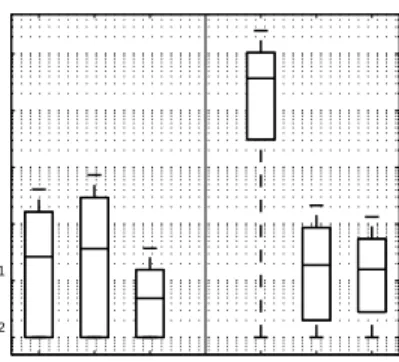
Figure 5:Run-time performance ofCujo. Loading and analysis times have been measured on
a sample of 10.000 URLs from Alexa-200k data set. Analysis time divides into lexing JavaScript (LX), sandbox emulation (SE), feature extraction (FE) and detection (DE).
Figure 5(a) shows the median run-time per URL in milliseconds, including loading of a web page, pre-loading of external JavaScript code and the actual analysis ofCujo. Surprisingly,
most of the time is spent for loading and pre-loading of content, whereas only 14% is devoted to the analysis part ofCujo. As we will see in the following section, we can greatly benefit from
this imbalance by employing regular caching techniques.
A detailed statistical breakdown of the analysis run-time is presented in Figure 5(b), where the distributions of run-time per URL are plotted for the static and dynamic analysis separately.
Each distribution is displayed as a boxplot, in which the box itself represents 50% of the data and the lower and upper markers the minimum and maximum run-time per URL. Addition-ally, the median is given as a middle line in each box. Except for the sandbox emulation, all components induce a very small run-time overhead ranging between 0.01 and 10 ms per URL. The sandbox analysis requires a median run-time of 370 ms per URL which is costly but still significantly faster then related sandbox approaches.
Operating run-time. In this experiment, we empirically evaluate the total run-time ofCujo
in a real application setting. In particular, we deployCujoas a web proxy and measure the time
required per delivery of a web page. To obtain reproducible measurements, we use the URLs in the Surfing data set as basis for this experiment, as it contains multiple surfing sessions of five individual users. For comparison, we also employ a regular web proxy, which just forwards data to the users. As most of the total run-time is spent for the loading and pre-loading of resources, we enable all caching capabilities inCujoand the web proxy.
0 500 1000 1500 2000 2500 3000 3500 4000 4500 Run−time per URL (ms)
Probability density
50% 75% 90% Regular proxy Cujo proxy
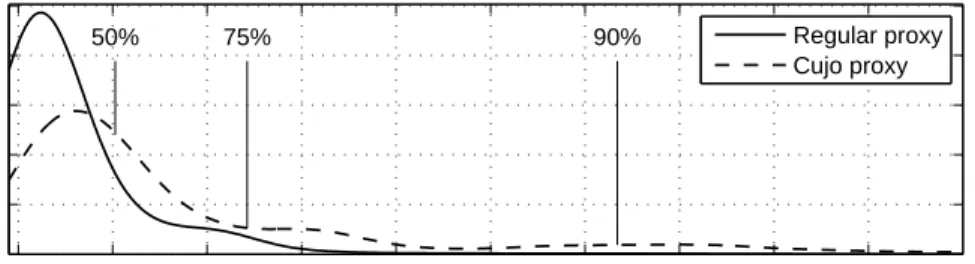
Figure 6:Operating run-time ofCujoand regular web proxy. The run-time has been measured
on 20.000 URLs from Surfing data set. The URLs have been processed in their original order to take advantage of caching capabilities.
Results for this experiment are shown in Figure 6, where the distribution of run-time per URL is presented as a density plot. As expected the regular proxy proxy ranges in the front part of the plot with a median processing speed of roughly 150 ms per request. The run-time of Cujois slightly shifted to the right in comparison with the regular proxy, yet its median
lies around 500 ms per web page, thus inducing only a minimal delay at the web client. The run-time distribution of Cujoshows an elongated tail, where few web pages require more
than 3,000 ms for processing due to excessive analysis of JavaScript code. We are currently experimenting with stopping the dynamic code analysis after 1,000 ms in these cases, though the limited analysis may negatively impact detection accuracy.
Overall, this experiment demonstrates thatCujostrongly benefits from caching
capabili-ties, such that a median run-time of 500 ms can be attained. Although minor run-time peaks still exists,Cujois actively used as secure web proxy in our institute for protecting (voluntary)
4
Related Work
Since the first discovery of drive-by downloads, analysis and detection of this threat has been a vital topic in security research. One of the first studies on these attacks and respective defenses has been conducted by Provos et al. [15, 16]. The authors inspect web pages by monitoring a web browser for anomalous activity in a virtual machine. This setup allows for detecting a broad range of attacks. However, the analysis requires prohibitive run-time for on-line application, as the virtual machine needs to be restored and run for each web page individually.
A similar approach for identification of drive-by downloads is realized by client-based hon-eypots, such asCapture-HPC[19] andPhoneyC[14]. WhileCapture-HPCalso relies on
monitoring state changes in a virtual machine,PhoneyCemulates known vulnerabilities to
capture attacks in a lightweight manner. Although effective in identifying web pages with ma-licious content, client-based honeypots are designed for offline analysis and thus suffer from considerable run-time overhead.
In contrast to these generic techniques, other approaches focus on identifying particular attacks types, namely heap spraying attacks. For example, the systemNozzleproposed by
Ratanaworabhan et al. [17] intercepts the memory management of a browser for detecting valid x86 code in heap objects. Similarly, Egele et al. [8] instrumentSpiderMonkeyfor scanning
JavaScript strings for the presence of executable x86 code. Both systems provide an accurate and efficient detection of heap spraying attacks, yet they fail to identify other common types of drive-by downloads, for example, using insecure third-party extensions for infections.
Closest to our work is the analysis systemJsanddeveloped by Cova et al. [4] as part of
theWepawetservice. Jsandanalyses JavaScript using the frameworkHtmlUnitand
inter-preterRhinowhich enable emulating an entire browser environment and monitoring
sophis-ticated interaction with the DOM tree. The recorded behavior is then analysed using 10 features specific to drive-by-download attacks for anomalous activity. Due to its public web interface,
Jsandis frequently used by security researchers to study novel attacks and has proven to be
a valuable analysis instrument. However, its broad analysis of JavaScript code is costly and induces a prohibitive average run-time of about 25 seconds per web page.
Finally, the systemNoxesdevised by Kirda et al. [13] implements a web proxy for
prevent-ing cross-site scriptprevent-ing attacks. Although not directly related to this work,Noxesis a good
example of how a proxy system can transparently protect users from malicious web content. Obviously, this approach targets only cross-site scripting attacks and does not protect from other threats, such as drive-by downloads.
5
Conclusions
In this paper, we have presentedCujo, a system for effective and efficient prevention of
drive-by downloads. As an extension to a web proxy,Cujotransparently inspects web pages using
static and dynamic detection models and allows for blocking malicious code prior to delivery to the client. In an empirical evaluation with 200,000 web pages and 600 drive-by-download attacks, a prototype of this system significantly outperforms current anti-virus products and
enables detecting 95% of the drive-by downloads with few false alarms and a median run-time of 500 ms per web page—a delay hardly perceived at the web client
While the proposed system does not generally eliminate the threat of drive-by downloads, it considerably raises the bar for adversaries to infect client systems. To further harden this defense, we currently investigate combiningCujowith offline analysis and honeypot systems.
For example, malicious code detected using honeypots might be directly added to the training data of Cujo for keeping detection models up-to-date. Similarly, offline analysis might be
applied for inspecting and explaining detected attacks in practice.
References
[1] Standard ECMA-262: ECMAScript Language Specification (JavaScript). 3rd Edition, ECMA In-ternational, 1999.
[2] Symantec Global Internet Security Threat Report: Trends for 2009. Vol. XIV, Symantec, Inc., 2010. [3] A. Aho, R. Sethi, and J. Ullman.Compilers Principles, Techniques, and Tools. Addison-Wesley, 1985. [4] M. Cova, C. Kruegel, and G. Vigna. Detection and analysis of drive-by-download attacks and malicious JavaScript code. InProc. of the International World Wide Web Conference (WWW), 2010.
[5] M. Daniel, J. Honoroff, and C. Miller. Engineering heap overflow exploits with JavaScript. InProc. of USENIX Workshop on Offensive Technologies (WOOT), 2008.
[6] A. Dewald, T. Holz, and F. Freiling. Adsandbox: Sandboxing JavaScript to fight malicious websites. InProc. of ACM Symposium on Applied Computing (SAC), 2010.
[7] M. Egele, E. Kirda, and C. Kruegel. Mitigating drive-by download attacks: Challenges and open problems. InProc. of Open Research Problems in Network Security Workshop (iNetSec), 2009. [8] M. Egele, P. Wurzinger, C. Kruegel, and E. Kirda. Defending browsers against drive-by
down-loads: Mitigating heap-spraying code injection attacks. InDetection of Intrusions and Malware & Vulnerability Assessment (DIMVA), 2009.
[9] R.-E. Fan, K.-W. Chang, C.-J. Hsieh, X.-R. Wang, and C.-J. Lin. LIBLINEAR: A library for large linear classification.Journal of Machine Learning Research, 9:1871–1874, 2008.
[10] P. Fogla and W. Lee. q-gram matching using tree models. IEEE Transactions on Knowledge and Data Engineering, 18(4):433–447, 2006.
[11] S. Forrest, S. Hofmeyr, A. Somayaji, and T. Longstaff. A sense of self for unix processes. InProc. of IEEE Symposium on Security and Privacy, pages 120–128, Oakland, CA, USA, 1996.
[12] M. Johns. On JavaScript malware and related threats – Web page based attacks revisited. Journal in Computer Virology, 4(3):161–178, 2008.
[13] E. Kirda, C. Kruegel, G. Vigna, , and N. Jovanovic. Noxes: A client-side solution for mitigating cross site scripting attacks. InProc. of ACM Symposium on Applied Computing (SAC), 2006. [14] J. Nazario. A virtual client honeypot. InProc. of USENIX Workshop on Large-Scale Exploits and
Emergent Threats (LEET), 2009.
[15] N. Provos, P. Mavrommatis, M. Rajab, and F. Monrose. All youriframespoint to us. InProc. of USENIX Security Symposium, 2008.
Analysis of web-based malware. InProc. of USENIX Workshop on Hot Topics in Understanding Botnets (HotBots), 2007.
[17] P. Ratanaworabhan, B. Livshits, and B. Zorn. Nozzle: A defense against heap-spraying code injec-tion attacks. Technical Report MSR-TR-2008-176, Microsoft Research, 2008.
[18] B. Schölkopf and A. Smola.Learning with Kernels. MIT Press, Cambridge, MA, 2002.
[19] C. Seifert and R. Steenson. Capture – honeypot client (Capture-HPC). Victoria University of Wellington, NZ, https://projects.honeynet.org/capture-hpc, 2006.
[20] K. Wang, J. Parekh, and S. Stolfo. Anagram: A content anomaly detector resistant to mimicry attack. InRecent Adances in Intrusion Detection (RAID), pages 226–248, 2006.