The Challenges of Basel III
for Romanian Banking System
Anca Elena NUCU “Alexandru Ioan Cuza” University, Iaşi [email protected] Abstract. Basel III represents a fundamental review of the regulatory and supervision framework of the banking industry in the future, the aim being to strengthen the stability of the financial system. The purpose of this paper is to analyze the impact of Basel III introduction upon the banking system at European level, respectively, upon the Romanian banking system. If at European level it is estimated a substantial deficit in capital and liquidity, with major impact on profitability indicators, the impact of Basel III upon banking system in Romania is considered to be limited. The measures which credit institutions could take to mitigate the impact of alignment with the new standards are business model adjustment and balance sheet restructuring.
Keywords: financial stability; banking system; Basel III; systemic risk; Romania.
JEL Codes: G21, G32. REL Codes: 11C, 14K.
1. Introduction
Basel III represents a fundamental review of the regulatory and supervision framework of the banking industry in the future, the aim being to strengthen the stability of the financial system. Structured on two parts, in this article we analyze the impact of Basel III introduction upon the banking system at European level, respectively, upon the Romanian banking system.
The motivation of Basel III introduction is based on the following reasons (Walter, 2011, pp. 1-2):
negative effects of banking crises. Economic literature shows that the banking crisis results materialize in loss of economic production equal to about 60% of GDP in the pre-crisis period.
the frequency of banking crises. Since 1985, there were over 30 banking crises in the Member States of the Basel Committee, which corresponds to a probability of 5% as a Member State to face a crisis in a given year.
Basel III benefits exceed implementation costs, because a stable banking system is the cornerstone of sustainable development with beneficial effects on long-term.
The new Basel III aims to strengthen the banking system stability by applying stringent standards designed to improve the capacity of shocks absorption from economic and financial sector and to reduce the risk of contagion from the financial sector towards real economy (Walter, 2010). The new standards take into consideration the improvement of risk management, increasing transparency and publication requirements of credit institutions, and the problems of systemically important banks. The measures require higher standards for banks regarding capital adequacy, liquidity and leverage effect, the main goal being reducing the negative effects of financial crises.
The major difference from the previous agreements consists in more extensive coverage, the measures being both micro prudential (target individual bank risks) and macro-prudential (target the whole banking system). At micro-prudential level, measures consist in (BNR, 2011, p. 124):
consolidation the capital base by increasing the minimum requirement of equity (ordinary shares, financial results reported and reserves) and the minimum requirement for Tier 1 (equity and hybrid instruments), and by reconsidering the eligibility criteria for instruments considered when determining Tier 1;
increased requirements for covering risks, major emphasis is placed on those risks highlighted during the crisis: the trading book exposures (trading book), counter-party credit risk (CCR), securitized exposures;
limit the leverage effect as additional measures to capital requirements calculated according to risk;
introduction of international liquidity standards, which provide short-term (30 days) resistance to shock/crisis of liquidity and on long-short-term (one year) a solid profile of structural liquidity.
At macro-prudential level, the measures have anti-cyclical character and consist in (BNR, 2011, pp. 124):
introduction of an countercyclical capital buffer in order to protect the financial system against systemic risks associated with unsustainable credit growth (represents 2.5 percent over the minimum capital-Tier 1 composed of common stock, retained earnings and reserves), as well as a capital conservation buffer in order to cover losses if the bank faces financial problems (varies within a interval which reaches maximum value at 2,5 percent depending by the phase of economic cycle). Anti-cyclical capital buffer is directly proportional to systemic risk and is calculated according to credit/GDP indicator;
computing a leverage effect, the purpose being to limit debt levels in the banking system in times of boom;
systemically important banks, concerns being orientated to reducing the probability and impact of their bankruptcy, reducing public sector intervention and the imposition of a level playing field by reducing the competitive advantage that these banks hold in financing.
The Committee also envisages the additional requirements in order to absorb losses and the possible introduction of additional capital charge (capital surcharges) for these banks.
Full implementation worldwide, with strict deadlines, of Basel III is essential for strengthening the financial system. The responsibility of implementation falls not only in the task of regulators, but extend the expert sphere towards managers of banks and, default, towards audit, which has a key role in independent and disciplined reviewing of management efforts. The challenge is represented by the fact that the implementation takes place during a post-crisis unequal and insecure recovery of countries. Growth prospects have weakened and sovereign debts emphasize the fragility of financial systems in some euro area countries.
2. The impact of Basel III upon European banking system
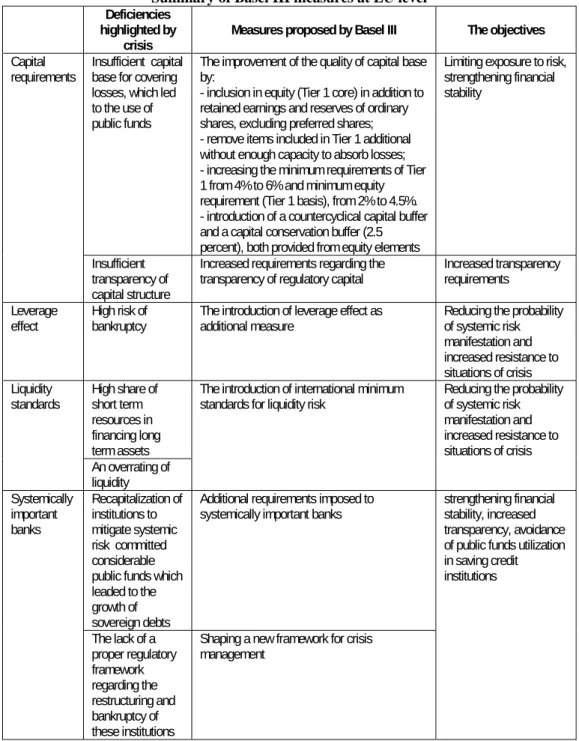
The purpose of Basel III is to strengthen the banking system stability by eliminating deficiencies highlighted by the current crisis. Improving the quality of capital base and new standards in liquidity management are intended to tighten banks ability to absorb shocks, avoiding use of public funds for recapitalization, the beneficial effects heading towards consumers, investors and governments.
Table 1
Summary of Basel III measures at EU level
Deficiencies highlighted by
crisis Measures proposed by Basel III The objectives
Insufficient capital base for covering losses, which led to the use of public funds
The improvement of the quality of capital base by:
- inclusion in equity (Tier 1 core) in addition to retained earnings and reserves of ordinary shares, excluding preferred shares; - remove items included in Tier 1 additional without enough capacity to absorb losses; - increasing the minimum requirements of Tier 1 from 4% to 6% and minimum equity requirement (Tier 1 basis), from 2% to 4.5%. - introduction of a countercyclical capital buffer and a capital conservation buffer (2.5 percent), both provided from equity elements
Limiting exposure to risk, strengthening financial stability Capital requirements Insufficient transparency of capital structure
Increased requirements regarding the
transparency of regulatory capital Increased transparency requirements Leverage
effect High risk of bankruptcy The introduction of leverage effect as additional measure Reducing the probability of systemic risk manifestation and increased resistance to situations of crisis High share of short term resources in financing long term assets Liquidity standards An overrating of liquidity
The introduction of international minimum standards for liquidity risk
Reducing the probability of systemic risk manifestation and increased resistance to situations of crisis Recapitalization of institutions to mitigate systemic risk committed considerable public funds which leaded to the growth of sovereign debts
Additional requirements imposed to systemically important banks Systemically important banks The lack of a proper regulatory framework regarding the restructuring and bankruptcy of these institutions
Shaping a new framework for crisis management
strengthening financial stability, increased transparency, avoidance of public funds utilization in saving credit institutions
The impact of new rules is significant, because without any mitigation actions it is estimated a deficit of capital of 1,050 billion € for Europe and 600 billion € for the US (Härle et al., 2010, p. 3).
Capital and liquidity deficit for Europe and USA will be significant. Long-term funding will partially alleviate liquidity shortages.
Figure 1. Capital and liquidity shortfalls for Europe and USA, static perspective, 2019 (€ billion)
Source: Härle, Philipp et al. – “Basel III and European banking: Its impact, how banks might respond, and the challenges of implementation”-November 2010, EMEA Banking, p. 3.
Assuming full implementation by 2019 of all the measures and before any mitigation actions the pretax ROE for European banks would fall by between with 3.7 and 4.3 percentage points from the pre-crisis level of 15 percent (Härle et al., 2010, p. 4). The effects will be felt gradually. Analyzing different transitional period it is estimated that ROE will decline 0.3 percentage points by 2013 and 2.1 percentage points by 2016. ROE decline appears due to new requirements regarding the quality of capital base, introducing leverage effect and minimum global liquidity standards. The task of credit institutions is also extremely difficult, because banks face a significant challenge to achieve technical compliance with the new standards, at the same time with orientation towards success.
The impact of Basel III on the main business segments: retail banking, corporate and investment banking is different. Both retail and corporate banking activity are mainly affected by those requirements of Basel III which affect the entire bank, in particular higher capital and liquidity standards. Some retail institutions will also be affected by measures concerning the quality of capital
base (the deductions of silent participations in Germany). If Basel III’ effects upon retail products are less relevant, new requirements will affect many of standard banking products for corporate segment by increasing financing costs. Products with relatively high risk weight (structured finance or unsecured loans) will be substantially affected. Of the three segments, the investment banking and in particular capital markets supports most changes, under the impact of new capital ratios. The activity of OTC derivatives market will be affected by the fact that banks should hold a higher level of capital to cover market risk and counterparty credit risk.
Table 2
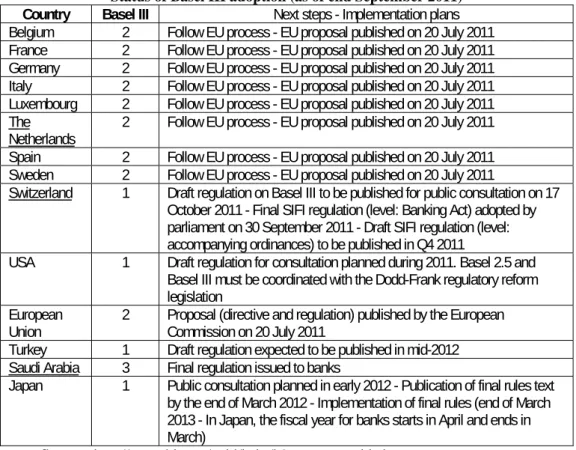
Status of Basel III adoption (as of end September 2011) Country Basel III Next steps - Implementation plans Belgium 2 Follow EU process - EU proposal published on 20 July 2011 France 2 Follow EU process - EU proposal published on 20 July 2011 Germany 2 Follow EU process - EU proposal published on 20 July 2011 Italy 2 Follow EU process - EU proposal published on 20 July 2011 Luxembourg 2 Follow EU process - EU proposal published on 20 July 2011 The
Netherlands 2 Follow EU process - EU proposal published on 20 July 2011 Spain 2 Follow EU process - EU proposal published on 20 July 2011 Sweden 2 Follow EU process - EU proposal published on 20 July 2011
Switzerland 1 Draft regulation on Basel III to be published for public consultation on 17 October 2011 - Final SIFI regulation (level: Banking Act) adopted by parliament on 30 September 2011 - Draft SIFI regulation (level: accompanying ordinances) to be published in Q4 2011
USA 1 Draft regulation for consultation planned during 2011. Basel 2.5 and Basel III must be coordinated with the Dodd-Frank regulatory reform legislation
European
Union 2 Proposal (directive and regulation) published by the European Commission on 20 July 2011 Turkey 1 Draft regulation expected to be published in mid-2012 Saudi Arabia 3 Final regulation issued to banks
Japan 1 Public consultation planned in early 2012 - Publication of final rules text by the end of March 2012 - Implementation of final rules (end of March 2013 - In Japan, the fiscal year for banks starts in April and ends in March)
Source: http://www.bis.org/publ/bcbs/b3prog_rep_table.htm.
In terms of Basel III adoption stage, at the end of September this year, most European countries it stands in the second stage, ie the draft regulation was published, the US it stands in the first stage, ie the draft regulation has not yet been published, the most advanced stage of adoption being registered by Saudi Arabia, which stands in the third stage, ie the final regulation was
published and sent to eligible participants. Basel III was developed specifically to reduce the frequency and the intensity of financial crises and a lot of studies indicate that the agreement will reduce the significant costs of crises. Such benefits will not materialize without a consistent implementation of new standards. Any weakening or delay in the implementation will worsen the fragility of confidence in the financial system.
At first analyze, impact on US banks appear to be similar, although slightly attenuated, because the American banking sector, measured by asset value, is lower compared with the European one. It is estimated a deficit of Tier 1 of about € 600 billion and a long-term financing gap for the United States of 2,200 billion €. These shortcomings will affect the profitability of American banking system, reflected by a reduction of ROE indicator of about 3 percentage points. The leverage effect included in Basel III does not represent a major constraint. However, we remark some key differences. Regarding capital, deducting mortgage rights play an important role in the US compared with Europe, while minority interests are less relevant. The impact of measures regarding risk-weighted assets is not directly comparable between Europe and the United States as a result of very different starting position of the two industries. Given the fact that many US banks have not implemented yet Basel II, the capital indicators of these institutions may be more affected by the simultaneous transition towards Basel II and respectively III (Härle et al., 2010, p. 6).
3. The implications of Basel III upon banking system in Romania
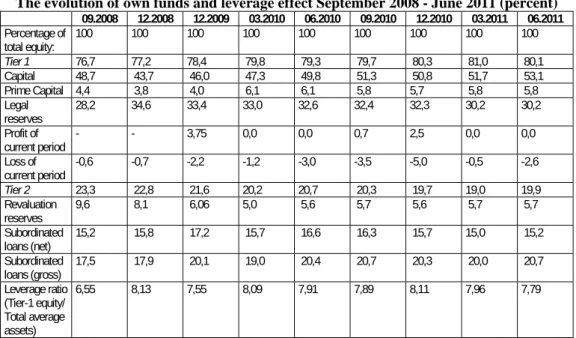
The impact of new Basel III capital requirements upon Romanian banking system is considered to be limited. At the middle of 2011, the Romanian banking system level, Tier 1 owns about 80% of total equity and hybrid capital instruments are missing (BNR, 2011, p. 126). This structure of own funds mitigates the potential impact of implementing Basel III capital requirements. The leverage effect at the aggregate level registered a value of 6%, therefore the impact of introducing new requirements will not substantially affect the Romanian banking system. Also, the analysis of equity (total and Tier 1) highlights that banks fall under the new Basel III’ standards on capital adequacy. The value of total equity represents 14.2 percent of total risk-weighted assets and the value at system level of Tier 1 in total risk-risk-weighted assets is 13.6 percent at end of June 2011.
Table 3
The evolution of own funds and leverage effect September 2008 - June 2011 (percent) 09.2008 12.2008 12.2009 03.2010 06.2010 09.2010 12.2010 03.2011 06.2011 Percentage of total equity: 100 100 100 100 100 100 100 100 100 Tier 1 76,7 77,2 78,4 79,8 79,3 79,7 80,3 81,0 80,1 Capital 48,7 43,7 46,0 47,3 49,8 51,3 50,8 51,7 53,1 Prime Capital 4,4 3,8 4,0 6,1 6,1 5,8 5,7 5,8 5,8 Legal reserves 28,2 34,6 33,4 33,0 32,6 32,4 32,3 30,2 30,2 Profit of current period - - 3,75 0,0 0,0 0,7 2,5 0,0 0,0 Loss of current period -0,6 -0,7 -2,2 -1,2 -3,0 -3,5 -5,0 -0,5 -2,6 Tier 2 23,3 22,8 21,6 20,2 20,7 20,3 19,7 19,0 19,9 Revaluation reserves 9,6 8,1 6,06 5,0 5,6 5,7 5,6 5,7 5,7 Subordinated loans (net) 15,2 15,8 17,2 15,7 16,6 16,3 15,7 15,0 15,2 Subordinated loans (gross) 17,5 17,9 20,1 19,0 20,4 20,7 20,3 20,0 20,7 Leverage ratio (Tier-1 equity/ Total average assets) 6,55 8,13 7,55 8,09 7,91 7,89 8,11 7,96 7,79
Source: NBR Financial Stability Report 2011 and Monthly Bulletins, www.bnro.ro. For reasons of financial stability, NBR decided that liquidity supervision of branches falls in tasks of the competent authority from host Member State and to have applied the standards of liquidity and the individual level, even if they are met at the consolidated level. Credit institutions will react differently to the new standards, depending on the transition period necessary to meet the requirements. If the transition period is shorter, banks may prefer to reduce the credit supply to increase capital levels, changing the structure of assets. Gradual implementation of new standards may mitigate the impact, the banks being able to adapt, by capitalization of profits, equity, changing the structure of liabilities.
Even if the impact of Basel III upon Romanian banking system is considered to be limited, we propose a series of measures which credit institutions could take to mitigate the impact of alignment with the new standards:
1) business model adjustment. Banks will review the profitability indicators in the context of a superior regulatory environment. Also, some business segments will be evaluated on the basis of “accessibility”, given the deficit of financing and capital in the future. Credit institutions will redesign their products and services to ensure that they continue to meet customer needs and, in the same time, with optimization of capital and bank liquidity. The adjustment of products mix can be achieved in several ways:
banks can orient towards products which satisfy customer needs but undertake lower capital requirements;
launching packages of products that combines financing with savings, banks being able to attract deposits from population, respectively, small and medium enterprises;
banks can increase the share of short-term loans to reduce financing costs (eg orientation towards revolving loans in detriment of mortgages).
Banks should strive to improve their ability to transfer risks. One way is closer cooperation between the lending organization and product development, so both teams are committed to increasing the volume of credits that can be securitized or syndicated. Another way to transfer risk is the extension of partnerships regarding syndication and securitization issues, both geographically and by industry.
2) balance sheet restructuring. Basel III is based on integrated management of assets, capital, and funding and credit institutions have not the possibility of optimization the assets and liabilities independently. For many banks, a significant impact of Basel III comes from capital deductions. The new rules regarding capital quality depart from Basel II and offers limited space of maneuver, because banks must deduct:
the capital of their insurance subsidiaries, which exceed a threshold of 10 percent, thereby reducing the ability to use this capital in the activity of the consolidated entity;
the value of any defined-benefit pension fund asset;
the investments in unconsolidated financial institutions over the 10 percent threshold.
Given the objective of improving capital quality, banks have a large range of options, in order to mitigate the impact of Basel III adoption. Thus, credit institutions (Härle et al., 2010, p. 16):
can optimize the scope of consolidated capital by purchasing the minority shares or by reducing the excess capital of banking subsidiaries;
can optimize their holdings in financial institutions by reducing unconsolidated investments below the thresholds defined by the capital deductions;
can review contracts and determine the exact value of pension assets that can be readily withdrawn from the fund, and thus become eligible for recognition in regulatory capital.
Beyond the unique effort to align the balance sheet to the new capital requirements, banks have to invest permanently in its management capacity.
Many banks have only a corporative image of the balance sheet and a less precise diagnosis in terms of business lines. Banks face significant challenges: a chronology well defined, significant results after implementation, an unprecedented complexity of measures and interdependence. The implementation complexity requires experts for each credit institution. Depending on the fulfillment degree of Basel III requirements and their ambitions to build some of the most sophisticated risk processes, some institutions will navigate the complexity of the implementation easier than others. The challenge comes from three main areas: design, data quality and reporting complexity:
Design complexity. Based on deficiencies of previous Accords, Basel III
rears the standards to an unprecedented level for banking industry. The complexity resides especially from the key elements of the new regulation (the introduction of countercyclical capital buffer and capital conservation buffer) and the additional requirements to Basel II, materialized in:
− building an integrated vision of credit risk and default for trading book, unlike Basel II, where regulatory capital for credit risk has been addressed only in the banking book;
− the development of methodologies for calculating VaR and incremental risk charge, none of which were required under Basel II;
− the extension of securitization charge from banking book to the trading book.
Data quality and reporting complexity. High quality data are essential
for efficient functioning of the bank's risk processes.
Operational complexity.
The efficiency of banking corporative governance, depending on business model and risk profile, is the first step towards successful implementation of Basel III. Also, internal auditors play an important role because they have to critically analyze operations and to recommend improvements for internal control framework.
Conclusions
Basel III is more than a regulation for financial institutions in a post-crisis world and it will fundamentally affect the profitability of the banking industry. The reforms target micro-level, in order to increase the resistance of individual banks to stress periods, respectively, macro-prudential level, in order to reduce the frequency of financial crises. The new standards are intended to improve the
capacity of the banking sector to absorb shocks, through a better management of risks under the coordinates of strengthened corporative governance and high transparency conditions.
The impact of Basel III upon European banking system is significantly. Assuming full implementation by 2019 of all the measures and before any mitigation actions the pretax ROE for European banks would fall by between with 3.7 and 4.3 percentage points from the pre-crisis level of 15 percent. The impact of Basel III on the main business segments: retail banking, corporate and investment banking is different. Both retail and corporate banking activity are mainly affected by those requirements of Basel III which affect the entire bank, in particular, higher capital and liquidity standards. Of the three segments, the investment banking and in particular capital markets supports most changes, under the impact of new capital ratios. The activity of OTC derivatives market will be affected by the fact that banks should hold a higher level of capital to cover market risk and counterparty credit risk.
The impact on US banks appear to be similar, although slightly attenuated, because the American banking sector, measured by asset value, is lower compared with the European one. However, we remark some key differences. Regarding capital, deducting mortgage rights play an important role in the US compared with Europe, while minority interests are less relevant. The impact of measures regarding risk-weighted assets is not directly comparable between Europe and the United States as a result of very different starting position of the two industries. Given the fact that many US banks have not implemented yet Basel II, the capital indicators of these institutions may be more affected by the simultaneous transition towards Basel II and, respectively, III.
The impact of new Basel III capital requirements upon Romanian banking system is considered to be limited. At the middle of 2011, the Romanian banking system level, Tier 1 owns about 80% of total equity and hybrid capital instruments are missing. This structure of own funds mitigates the potential impact of implementing Basel III capital requirements. The leverage effect at the aggregate level registered a value of 6%, therefore the impact of introducing new requirements will not substantially affect the Romanian banking system.
For banks, the challenge comes from three main areas: design, data quality and reporting complexity. The measures which credit institutions could take to mitigate the impact of alignment with the new standards are business model adjustment and balance sheet restructuring. The efficiency of banking corporative governance, depending on business model and risk profile, is essential for successful implementation of Basel III.
Acknowledgements
This work was supported by the the European Social Fund in Romania, under the responsibility of the Managing Authority for the Sectoral Operational Programme for Human Resources Development 2007-2013 [grant POSDRU/107/1.5/S/78342].
References
Basel Committee on Banking Supervision (2011). “Basel III: A global regulatory framework for more resilient banks and banking systems” Bank for International Settlements, http://www.bis.org/publ/bcbs189.pdf
National Bank of Romania. Financial stability Report 2011 and Monthly Bulletin 06/2011, 09/2008
Philipp, H. et al. (2010). Basel III and European banking: Its impact, how banks might respond, and the challenges of implementation, EMEA Banking
Walter, S., „Basel III and Financial Stability”, Speech at the 5th Biennial Conference on Risk
Management and Supervision, Financial Stability Institute, Bank for International Settlements, Basel, 2010, http://www.bis.org/speeches/sp101109a.htm
Walter, S., „Basel III: Stronger Banks and a More Resilient Financial System”, Conference on Basel III, Financial Stability Institute, Basel, 2011