Technological University Dublin Technological University Dublin
ARROW@TU Dublin
ARROW@TU Dublin
Conference papers School of Computing
2018
The Terror Network Industrial Complex: A Measurement and
The Terror Network Industrial Complex: A Measurement and
Analysis of Terrorist Networks and War Stocks
Analysis of Terrorist Networks and War Stocks
James UsherTechnological University Dublin Pierpaolo Dondio
Technological University Dublin, [email protected]
Follow this and additional works at: https://arrow.tudublin.ie/scschcomcon Part of the Computer Sciences Commons
Recommended Citation Recommended Citation
Usher, J. & Dondio, P. (2018). The Terror Network Industrial Complex: A Measurement and Analysis of Terrorist Networks and War Stocks. Webist 2018, 14th International Conference on Web Information Systems and Technologies, Seville, Spain, 18-20 September 2018.
This Conference Paper is brought to you for free and open access by the School of Computing at ARROW@TU Dublin. It has been accepted for inclusion in Conference papers by an authorized administrator of ARROW@TU Dublin. For more information, please contact
[email protected], [email protected], [email protected].
This work is licensed under a Creative Commons Attribution-Noncommercial-Share Alike 3.0 License
The Terror Network Industrial Complex: A Measurement and
Analysis of Terrorist Networks and War Stocks
James Usher and Pierpaolo Dondio
DIT School of Computing, Kevin Street, Dublin 8, Ireland [email protected], [email protected]
Keywords: Social Networks and Organizational Culture, Social Web Intelligence, WEB 2.0 and Social Networks. Abstract: This paper presents a measurement study and analysis of the structure of multiple Islamic terrorist networks
to determine if similar characteristics exist between those networks. We examine data gathered from four terrorist groups: Al-Qaeda, ISIS, Lashkar-e-Taiba (LeT) and Jemaah Islamiyah (JI) consisting of six terror networks. Our study contains 471 terrorists’ nodes and 2078 links. Each terror network is compared in terms efficiency, communication and composition of network metrics. The paper examines the effects these terrorist attacks had on US aerospace and defence stocks (herein War stocks). We found that the Islamic terror groups increase recruitment during the planned attacks, communication increases during and after the attacks between the subordinate terrorists and low density is a common feature of Islamic terrorist groups. The Al-Qaeda organisation structure was the most complex and superior in terms of secrecy, diameter, clustering, modularity and density. Jemaah Islamiyah followed a similar structure but not as superior. The ISIS and LeT organisational structures were more concerned with the efficiency of the operation rather than secrecy. We found that war stocks prices and the S+P 500 were lower the day after the attacks, however, the war stocks slightly outperformed the S+P 500 the day after the attacks. Further, we found that war stock prices were significantly lower one month after the terrorist attacks but the S+P 500 rebounded one month later.
1 INTRODUCTION
The tragic and catastrophic events of 9/11 and the Paris terrorist attacks in 2001 and 2015 have propelled the intelligence communities’ use of social network analysis. Terror networks are designed in their structure to maximise secrecy, efficiency, resilience and remain as clandestine communities (Krebs, 2002) Social network analysis allows us to visualise the network structures and determine insights from these networks. This knowledge discovery or intelligence from terrorist networks is of vital importance for combatting the war on terrorism. In recent years, there has a been a surge in geopolitically motivated terrorist attacks. A common factor to all terrorist networks is the need or wish to remain secret; although what is to be kept secret and from whom differs, and indeed is rarely specified (Crossley et al, 2010) A terrorist network may form from the consequence of pre-existing ties, i.e. kinship or friendship, and of people’s political motivations that incite individuals or a collective group to act cooperatively regardless of previous relations. (Crossley et al, 2010; Krebs, 2002; Everton, 2011)
provide terrorist network theory on co-participation in events and co-membership in groups to explain network tendencies i.e. hierarchical/non-hierarchical structure, vulnerability, efficiency, and decentralisation over time. Whilst (Baker and Faulkner, 1993; Natarajan, 2000; Koschade, 2006; Morselli, 2007; Demiroz and Kapucu, 2012; Enders and Su, 2007) examine communication, and analyse structure and formation to focus on security and efficiency trade-off, core-periphery structure, centralisation/decentralisation, and resilience. An in-depth understanding of the graph structure of terrorist networks is necessary to evaluate the networks to understand the hierarchical structure of the networks. The importance of efficiency and secrecy in terrorist networks clearly emerges when terrorists need to carry out an attack. This is when the group members emerge from the shadows in the aftermath and we can then see which element is more important to the terrorist groups in terms of the planned and executed attack. In this paper, we present 471 terrorists and 2078 links belonging to four terrorist groups and six terror networks. Data gathered from multiple sources enables us to identify common structural properties of
these terror networks. The paper is organised as follows firstly we describe the terror groups and the attacks. Section 2 we use graph theory to graph all of the terror network data, relationships and data processing. Section 3, we analyse the S+P500 volatility, war stock and S+P 500 market performance. We analyse the terror networks in addition to comparing the network metrics for each terror network attack in terms of efficiency, communication and compositional network metrics. Section 4 evaluates the results; section 5 contains related literature and finally, in section 6, we conclude with discussing our findings.
1.1
Terrorist Groups and Terrorist
Attacks
In this section, we give a brief description of the terrorist group and their related attacks that form part thereof this study
1.1.1 Al-Qaeda
Al-Qaeda is a global Islamic terrorist organisation founded by Palestinian terrorist operative Abdullah Azzam in 1988. Al-Qaeda originated in Afghanistan as an underground movement that operated against the Soviet occupation. Al-Qaeda has become a global Islamic terrorist organisation operating in many arenas around the world. Ideologically, Al-Qaeda relies on the Salafi school of Islam, viewing jihad as the personal duty of every Muslim. Al-Qaeda was behind a series of showcase attacks against the United States, the most prominent of which was the attack on the World Trade Center in New York on September 11, 2001 (Terrorism-info, 2018) and the Madrid bombings 2004. The attacks resulted in over 3,000 deaths and over 8000 casualties collectively
1.1.2 ISIS
ISIS is a powerful Islamic terrorist militant group that has seized control of large areas of the Middle East. The group is responsible for a series of European terror attacks in Paris and Brussels that claimed the lives of 162 people and 713 casualties.
1.1.3 Lashkar-e-Taiba (LeT)
Lashkar-e-Taiba (LeT) is an Islamic militant organisation based in Pakistan with links to Al-Qaeda and ISIS. The group is responsible for the Mumbai attacks in 2008. The attacks commenced on November 26th and ended on November 29th after an intense operation lasting over sixty hours. The attacks
were carried out by 10 militants armed with advanced weapons at five prime locations in Mumbai, India’s financial capital. Nearly 260 persons, from ten countries, were killed in the attack.
1.1.4 Jemaah Islamiyah (Ji)
Jemaah Islamiyah (JI) is a militant Islamist group active in several Southeast Asian countries that seeks to establish a pan-Islamic state across much of the region. JI is alleged to have attacked or plotted against U.S. and Western targets in Indonesia, Singapore, and the Philippines. Herein, we analyse the attacks on the Australian Embassy in 2004 which had 11 fatalities and 150 causalities in addition to examining the Bali attacks in 2005 which claimed the lives of 20 people and had 120 causalities.
2 DATASET(S)
2.1
Dataset
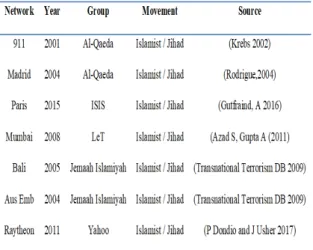
The six terrorist networks datasets can be accessed within the public domain from the authors listed in figure 1.
Figure 1: Dataset sources.
We have also included a non-terrorist network i.e. the Raytheon online financial community in order to understand if terrorist networks have distinct properties compared to a non-terrorist networks.
2.2
Nodes
Nodes on the terrorist networks are a representation from the following characteristics.
(i) Attackers: Those involved in the planned terrorist attacks. This included operational leadership and operational personnel. Relations derived from interactions, including participation in political or military events, political meetings, training in Afghanistan, Iraq, or Libya, combats, negotiations for hostage releases, or involvements with a killing, an abduction, or a bombing.
(ii) Those known to have been involved in organising terror attacks but may not have carried out an attack. (iii) Family members who were known to play a role or be associated with terror network, this included In-laws, cousins, siblings, parent/child, spouse, grandparents and significant others.
(iv) Users from the online financial community. We collected data about users’ activities on Yahoo! Finance Message Boards from 2001 until 2014 for the war stock “Raytheon”. Yahoo! Finance keeps a message board for each stock quoted on the US market. Each message board is a stream of threads opened by registered users. Each thread is a stream of messages posted by users. A user can decide to add a new message to a thread, answer to an existing message or open a new thread. We gathered the list of threads, the list of messages for each thread, the content of each message, time of the message, users and the citations between users (i.e. if a user replied to another user). There were approximately 3,754 messages regarding the Raytheon stock examined, written in about 3,419 threads by about 533 users. We then extracted data four months before the Syrian uprising in 2011 and the period after until December 2011.
2.3
Aerospace and Defence Industry
The U.S. aerospace and defence industry is the world’s leading innovator and producer of technologically advanced aircraft, space and defence systems and supports one of the largest high-skill and high-wage workforces in the U.S.A. There is both a commercial side and military side to the industry. Some of the firms are involved in building commercial aircraft and from the military standpoint the U.S. government is the principal customer. The industry boasts of heavy investment in research and development with the U.S. government funding a high percentage of these costs. The U.S. government also exerts huge influence over the industry through a tender process for contract procurement to each of the aerospace and defence firms. These contracts are issued by the US Department of Defence and defined by military branch such as U.S. Marine corps, U.S. Navy, U.S. Army and U.S. Air Force.
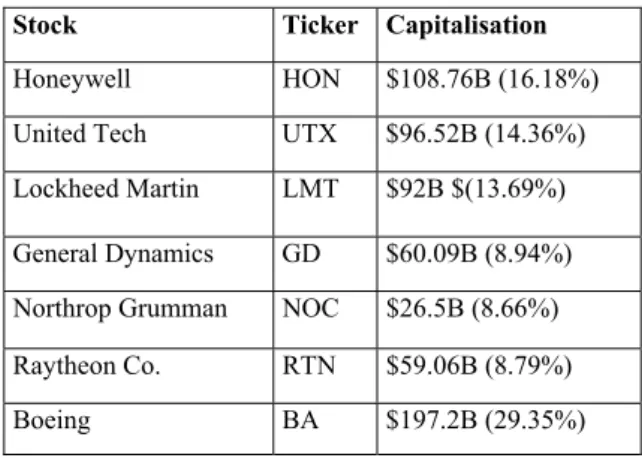
We used a set of seven aerospace and defence sector stocks known as “war stocks” to establish if there were any significance prices changes after the attacks within the US aerospace and defence sector. The war stocks listed in table 1 are medium and large capitalisation US manufacturing companies that manufacture military equipment. The column capitalisation is the market capitalisation of each stock in billions of dollars, while the figure in parentheses is the relative size of each stock over the capitalisation of all seven stocks for May 2018. The war stocks have a total capitalisation of $671.91B which represents about 2.6% of the capitalisation of the S+P 500 index.
Table 1: War stocks considered in the study.
Stock Ticker Capitalisation
Honeywell HON $108.76B (16.18%)
United Tech UTX $96.52B (14.36%) Lockheed Martin LMT $92B $(13.69%) General Dynamics GD $60.09B (8.94%) Northrop Grumman NOC $26.5B (8.66%) Raytheon Co. RTN $59.06B (8.79%)
Boeing BA $197.2B (29.35%)
2.4
Network Metrics
To describe and illustrate each network the following metrics were used
(i) Number of nodes N: The number of nodes represents the number of terrorists active in the period of observation. For the online financial network, the number of nodes represents the number of users active in the period of observation.
(ii) Number of edges : There is an edge from terrorist a to terrorist b if terrorist a communicated with terrorist b. The number of edges is a measure of the interactions between terrorists. For the online financial network similarly, there is an edge from user a to user b if a replied to b (at least once). The number of edges is a measure of the interactions between users.
(iii) Clustering Co-efficient CC: To understand how the network behaves it is necessary to segregate the nodes into cliques. A clique is simply a subgraph where all nodes are more loosely tied to one another than they are to nodes that are not part of the graph. It depicts closeness of the groups within the terrorist
and online networks. Thus, the clustering coefficient of a graph ranges between 0 and 1, with higher values representing a higher degree of “cliquishness”
between the nodes. In particular, a graph with clustering coefficient of 0 contains no “triangles” of connected nodes, whereas a graph with clustering coefficient of 1 is a perfect clique. (Watts and Strogatz, 1998) found that high clustering and short characteristic chain length are the distinctive properties of many small-world networks.
(iv) Average Shortest path ASP:There is a constant dynamic between keeping the network hidden and actively using it to accomplish objectives (Baker and Faulkner, 1993). Contextually we use the average shortest path to indicate a level of secrecy and observe the information flow of the networks. It’s a measure of the average distance between each distant member of both the terrorist and online networks. The measurement shows the diffusion of information sharing on the networks. This is desirable for a network in terms of secrecy because in a clustering topology less individual members are exposed to information and communication (Ozgul and Erdem, 2015)
(v) The Modularity measurement defined herein as
M, is the calculation of edges in the communities minus the expected number of edges in terror and online networks. That fact that modularity helps define if groups are working closely knit conveys useful information in regards to the group’s behaviour and communication flow both in terms of efficiency and secrecy.
(vi) Density herein as Den (n). Network density represents the number of ties in a network as a ratio of the total number of maximum ties that are possible with all the nodes in a network. A fully connected terrorist and online network has value of 1, which indicates all nodes are connected to each other. A network with a density of near 0 indicates that the terror and online networks are sparsely knit. Density is a measure of the networks cohesiveness.
(vii) Diameter herein as D( n), represents how far nodes are away from each in the network
(viii) E, Efficiency (harmonicclosnesscentrality) refers to the networks ability to carry out terrorist operations as computed from the mean to mean person distances. The metric is used here to calculate if one terrorist was removed from their network could the network still carry out its tasks? Using (0,1) with 1 being the highest.
(ix) AD, Average Degree is used herein to calculate the average links per node on each of the networks
2.5
Representation of Terror Networks
and Online Financial Community
The notation for the terrorist networks is ℵ and ℵ .ℵ represents the network of terrorists before the terrorist attack , while ℵ the network of terrorist after the event. The notation for the online financial community network is the following. We call ℵ ( )
and ℵ ( ) the networks of online users for the stock built considering all the messages about stock posted at day ± where is the timestamp of event and is the number of days. ℵ ( ) represents the network of investors before the geopolitical, military or terrorist event , while
ℵ ( ) the network after the event. The geopolitical event here is the commencement of the Syrian uprising in March 2011. The stock is Raytheon. To build out the networks we used Gephi. It is a modular and extensible open-source network visualisation platform. It focuses on visualisation and manipulation, simplicity and extensibility (Bastian et al, 2009). Gephi is commonly known as graph database software. We converted the terrorist public domain datasets in the Gephi format and uploaded same into the database and ran the graph simulation function to create the network. We then performed the social network analysis using the Gephi functions. For the “Raytheon” stock online financial community we used a python parser to web scape the messages from Yahoo finance. We formatted the findings and used Gephi to create the network and perform social network analysis.
2.6
War Stock Price Methodology
To compute the war stock price returns we need to identify a methodology to classify the daily returns, so given a stock and a terrorist event ∈ ℰ, we use the following notation: ( ) is the price of stock on the day , while ±( ) is the closing price of stock on t+1 . The return of each stock (also called the gain of a stock) is denoted by G. For instance,
± ( ) is the gain of the stock after + 1 days
from the previous day for event . By definition it is:
3
ANALYSES
3.1
SNA Metrics Analysis
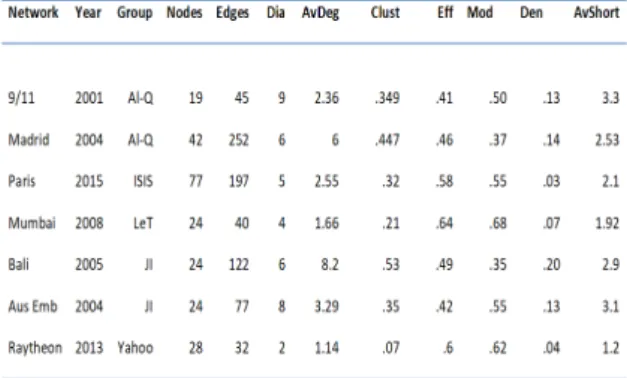
Figures 2 and 3 illustrate the SNA metrics per terrorist group per attack one year before and the day after the attacks respectively inclusive of the Raytheon online Yahoo! financial community. The before and after
dates taken for the Raytheon network represents the four months period before the Syrian uprising of March 2011 and the after period right up until December 2011. We use the Raytheon online financial network for comparability only. The before and after networks show the following metrics about the terrorist groups and attacks.
Figure 2: One year before terror attacks.
Figure 3: Network after the terror attacks.
(i) Diameter: Al-Qaeda and Jemaah Islamiyah ensure that the ability to get from one side of the network to the other with information or just in terms of communication before the attacks is difficult. This is evident during the 911 and Australian embassy campaigns. In the after networks Al-Qaeda and ISIS maintained large diameter infrastructures, theoretically to avoid penetration. This is important because it tells us how quickly information will spread through the network and also how integrated different components within the network are likely to
be. Making a connection within a network or traveling from one node to another incurs a cost. Regarding terrorist groups that cost is usually the risk of identification of its members. It typically costs some resource, whether this is the risk of losing a member, to the identification of a core or subordinate member of the network. The further a terrorist has to travel along a network to get from node a to node b the more it will cost and the less likely it will occur, with the result being a lower level of integration from the group leaders and a layer of secrecy. In comparison to the terrorist networks the online financial network exhibits the smallest diameter thus confirming a network that is not of a clandestine nature.
(ii) Average Degree: Al-Qaeda and JI are the most connected networks before and after the attacks. The average number of links per nodes were highest in the Bali, Madrid and the Australian embassy attacks. We can use the average degree as a measurement of cooperative behaviour amongst the terrorists. On average each terrorist had on average between 6 and 8 connections. The Raytheon network is not a highly connected network as nodes have average degree of 1, demonstrating the contrary, a low level of connectivity in the network.
(iii) Clustering: In general, a clustering method attempts to reorganise some entities into relatively homogeneous groups. These groups have a purpose moreover based around function. According to (Raab and Milward, 2003) these microstructures are prevalent amongst terrorist groups. On the contrary (Helfstein and Wright, 2011) argued that clustering does not exist in terrorist networks as it minimises secrecy. Our study shows that Al-Qaeda and JI demonstrate a higher-level degree of “cliquishness” for the Bali, Madrid and Australian embassy attacks. In an overall context all of the Islamic terrorist groups displayed a high level of “cliquishness” amongst their organisation structure.
(iv) Efficiency: For the ease of communication or resilience of the network or indeed the capacity of the network to function in the face of adversity or disruption (Krebs, 2002). As we know none of the networks were incapacitated, all attacks were carried out with devastating consequences. Therefore, if intelligence communities did capture some of the suspects before the attacks, we now know none of the networks were encumbered. If the network structure is defined by the network aim (Morselli,2007) conventional wisdom would suggest that a terrorist network would aim to reduce any risk associated with revealing its members and its core aim. Looking at
efficiency and its inverse value secrecy we see that LeT and ISIS were prepared to risk members of the groups in terms of efficiency during the Mumbai and Paris attacks. On the contrary, Al-Qaeda valued secrecy more than efficiency in terms of their organisational structure.
(v) Modularity: The ability to detect community structures in terrorist groups is of significant practical importance. It provides a mechanism to identify what functions of the sub sections of the terrorist groups are actually performing. Alternatively, modularity may expose the fact that no communities exist at all. (Krebs 2002) highlighted the importance of modularity in addition to the importance of secrecy. This was a feature of the Al-Qaeda 911 organisational structure where Osama Bin Laden ensured that no single module within the 911 network knew another module. Considering the networks are preferential connected networks our analyses shows that a high level of modularity exists within these groups. LeT, ISIS and Al-Qaeda display high modularity in the before and after attacks. Interestingly, the Raytheon network shares the same characteristic as the terrorist networks where you have a high level of communities working separately where nodes are connected "more densely" to each other than to the nodes in other communities.
(vi) Density: Refers to the portion of a network that are connected. In theory, according to (Krebs 2002, Natarajan 2000, Raab, and Milward 2003) terrorist networks are sparse and show low density. In evaluating the hypothesis that these networks need to remain clandestine, we can conclude that our findings reveal that the low density does exist. ISIS and Al-Qaeda show lower density in the before and after attacks suggesting a higher degree of intelligence in terms tradecraft and education (Helfstein and Wright, 2011). This bears true in the fact that the ISIS and Al-Qaeda operatives were trained by the CIA.
(vii) Average Shortest Path: The shortest path between two nodes with the minimum number of edges. It can be seen as a measurement of the efficiency of information on the network. Where vital intelligence needs to be distributed across the network, clearly it will reach nodes quicker if there are only 4 steps from any other node than if it is a hundred steps from any node. ISIS and LeT are prominent in efficient flows of intelligence on their before networks whilst the Al-Qaeda structure before and after the attacks are more concerned with making it difficult to penetrate their networks relying a more veiled approach. In terms of comparability we can see that Raytheon’s network consists of the shortest
average path, which would make sense in terms of reciprocal communication within the online community.
3.1.1 Average Nodes Before and After
We performed a collective averaged terrorist attack analysis of the SNA metrics using the averages of nodes, edges diameter, average degree, clustering, efficiency, modularity and the average shortest path. Table 2 illustrates each SNA metric and time interval, the value of the before and after network along with the augmentation (in percentage) if any and the output of the statistical test for the terrorist networks only. We computed a Wilcoxon signed rank test to calculate the results. The after-network edges indicate there was increased communication between the terrorists during and after the attacks. ++ indicates the values of the after network are greater than the values of the network at .95% confidence level. + indicates a 90% confidence level. Where WT = then no significant difference in after network. The absolute value of each indicator is important in order to understand not only if the difference is significant for the averaged terrorist attack, but also if the absolute value of the indicator suggests a significant statistical difference in these attacks.
Table 2: SNA indicators for before and after networks. Metric After Bf % Diff Z WT ( ) 43.5 35 .242 .172 = ( ) 225.8 120.5 .874 .046 ++ Dia(N) 5.16 6.33 -0.184 .109 = Aver (D) 5.35 3.40 0.573 .028 ++ ( ) 0.49 0.37 0.324 .046 ++ ( ) 0.57 .50 0.139 .116 = ( ) 0.44 .50 -0.12 .463 = ( ) 2.26 2.66 -.150 .116 = ( ) 0.17 .12 .416 .173 =
There are notably three statistical differences such that the edges, average degree metric and the clustering coefficient increased in the after networks. This alludes to the fact that communication increased during and after the attacks which is reflective of the increase of edges in the after networks. The average degree per terrorist also increased indicating increased communication amongst the terrorist
groups during and after the attacks. The clustering coefficient refers to the cliquishness of nodes within the networks suggests that terrorists who undertook the attacks actually knew each other and worked in homogeneous groups during and after the attacks.
3.1.2 Terrorist Leadership Analysis
We analysed the role of leadership within the various terror attacks by computing the average in degree communication for directed networks for each of the attacks before and after and aimed to understand how communication was managed. In-Degree centrality of observed nodes is the number of direct links to other nodes. A superior value of in-degree centrality often considers the node as the most prominent individual in the network. Nodes were determined as leaders in the first three instances for each attack with the highest in-degree centrality. The WT statistical test results show that communication from the terrorist group leaders didn’t change before and during the attacks however communication increased significantly during the attacks from the other members of the terrorist groups.
Table 3: The average In -Degree of terrorist group leader and their subordinates before and during the attacks.
After Before %Diff Z WT Terrorist
leader
14.99 10.72 .398 .104 = After Before Diff Z WT Terrorists 4.11 2.81 .462 .046 ++ 3.1.3 Strong and Weak Communities
Structures
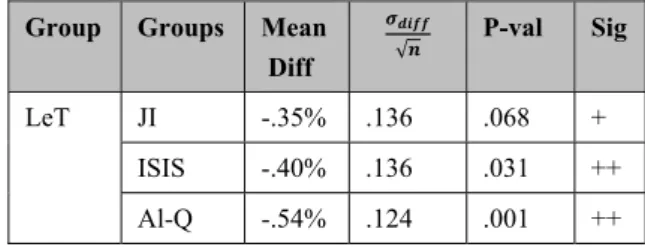
Strong communities have more links within their own community than with the rest of the network. Such that ( ) ( ) where of the node i is the number of links that connect i to the rest of the network. c is the cluster. The external degree is number of links that connect i to the rest of the network. To detect weak and strong communities per group, we examined the modularity at a more granular level. We computed using an overall percentile ranking approach inclusive of all terrorist groups to detect the weak community modules within each network. We then computed an analysis of variance per group to test if there were any statistical differences. We found that LeT group has the weakest communities within their organisational structure where 5 of their 6 communities were ranked under a
30% percentile. Whilst Al-Qaeda had the strongest communities such that the lowest ranked community ranked at the 50% percentile rate for the 911 attacks whilst one community ranked at a 10% percentile for the Madrid attack.
Table 4: LeT Analysis of variance for weak community structures.
Group Groups Mean Diff √
P-val Sig
LeT JI -.35% .136 .068 +
ISIS -.40% .136 .031 ++
Al-Q -.54% .124 .001 ++
3.2
VIX and Abnormal Returns
Historical prices for the war stocks and the S+P500 adjusted for splits and dividends were collected from Yahoo! Finance. To understand if the terror attacks were associated in periods of high volatility and abnormal returns, we measured the market variance using the VIX index calculated with a 50-day moving average. This is a market indicator for the measurement of uncertainly.
Figure 4: Before VIX SP500 Index with adjusted close and Net % Change.
Figure 4 shows the implied volatility the day before the terror attacks, a 90-percentile level, a 10-percentile level, the average and the median computed over the periods of observation. The computation indicates that only two of the events were in a period of high volatility (above 80 percentile level), that being the Paris and Madrid attacks. The Australian and Bali attacks were positioned within average volatility whilst the 911 and Mumbai attacks happened in lower level percentile of 20%. We can conclude that these terrorist attacks happened in periods of mixed volatility. Abnormal S+P500 returns were also characterised in a mixed return period with Paris and Madrid attacks aligned to the 80-percentile level, Bali
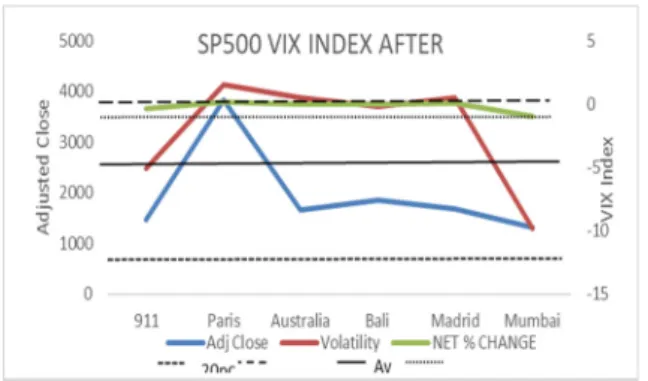
and the Australian embassy attacks showing average S+P500 returns for the period and 911 and Mumbai presenting below the 20-percentile level. A T-Paired test concluded that there was no significant difference between the before and after VIX model. The after VIX is shown in figure 5.
Figure 5: VIX SP500 Index with adjusted close and Net % Change.
To conclude, we can state that apart from the Paris and Madrid attacks which both showed high volatility and higher abnormal returns, the terrorist events can be categorised as normal.
3.2.1 War Stocks and S+P500 Price Reaction to Attacks
We tested using a T-paired test to establish if the price of the war stocks differs significantly after the terrorist events from the price before the said terrorist attacks. We did likewise with the S+P 500 prices in addition to comparing the prices of the war stocks to the S+P 500 price changes. We wanted to understand if the war stocks behave the same way as the market after terrorist attacks. To compare price changes of the war stocks against the S+P 500, we computed an aggerated price index for the war stocks in the same way the S+P 500 is calculated. The results from Table 5 show that whilst the aerospace and defence stock prices and the S+P 500 are lower after the attacks, there is no significant statistical difference. However, the aerospace and defence stocks outperformed the S+ P500 one day after the terrorist attacks with a confidence level of 0.95 and t value of -5.41. We measured the aerospace and defence stock price difference one month before and after the terrorist attacks and found that prices were statistically significantly lower after the terrorist attack with a confidence level of 0.95 and t value of 2.62, however, the market did recover significantly after a month with a confidence level of 0.95 and t value of 3.8.
Table 5: Comparisons between war stocks, S+P 500 and war stocks V S+P 500 before and after terrorist attacks.
Indicators Mean
Diff √ t-value Sig
. .07% 2.81 .177 = . 4.41% 50.24 .215 = . -.19% 878 -5.41 ++ . 1.40% 3.48 2.62 ++ . 22.89 14.7 3.8 ++
4
RESULTS
We find that Islamic terrorist groups and terrorist attacks share similar characteristics. Little similarity exists between the terrorist networks and the online financial community network.
(i) We can see that the Islamic terrorist groups increase recruitment over a period a year period leading into the attacks. This is evidenced by the increase in the number of nodes joining the terrorist networks.
(ii) Communication increases within the terrorist groups with notable higher interaction during and after the attacks again evidenced with the increases in edges on the networks. Furthermore, the average communication between each terrorist increases during and after the attacks as noted with the increases in the average degree.
(iii) Terrorist group leader’s communication frequency didn’t change before and during the attacks however communication increased significantly during the attacks from other members of the terrorist groups.
(iv) A high level of “cliquishness” exists within the networks indicating that each clique or sub group performs a particular role or function supporting the attack.
(v) Low density is a common feature of the Islamic terrorist groups and is a mechanism deployed to protect identity and objectives.
From an individual terrorist group perspective, we found the following:
(vi) The Al-Qaeda organisational structures demonstrate superior formation in terms of diameter, clustering, modularity and density. The principle aim of the group is to protect its members and retain a veil of secrecy from inception of the attack to the completion of the mission. The Al-Qaeda
organisation structure consists of large diameters to avoid penetration, low efficiency making it harder to contact various group members. Low density ensuring that only certain cliques on the networks are connected and others are not. A high average shortest path metric essentially confirms that trading efficiency for secrecy is of vital importance to the group. Much of these structures would correlate to clandestine organisational structures deployed by the CIA when training Mujahideen operatives during the Soviet Afghan war in the late 70’s early 80’s. Jemaah Islamiyah share similar characteristics but not as superior. Al-Qaeda also inherit stronger community structures within their organisation.
(vii) Remarkably, the ISIS organisation structure tends to trade secrecy for efficiency as deliberated by the social network metrics. Whilst an effort is made to reduce density in their network, it is boosted by a high metric for efficiency and low average shortest path metric. Similarly LeT also appear to more concerned with efficiency rather than allowing members to be captured or identified.
The aerospace and defence sector analysis in this study found that:
(viii) War stocks and the S+P 500 are lower the day after terrorist’s attacks in this study, however the war stocks outperformed the S+ P500 one day after for the aforementioned attacks. Findings indicated that war stocks were significantly lower one month after the attacks but the S+P 500 rebounded one month after the attacks.
5
RELATED WORKS
Krebs uncloaked terrorists in his paper (Krebs 2002). He demonstrated the superiority of social network analysis in identifying terrorists. His paper focused on newspaper articles in the media about the 911 terrorists. He highlighted the fact that terrorist networks are structured to protect their members and protect objectives and secrecy. (Raab and Milward, 2003) and (Helfstein and Wright, 2011) support and concur with Krebs hypothesis. Whilst this is evident in our analysis for Al-Qaeda, it is not evident for other groups such as LeT and ISIS. (Morselli, 2007) argued that various exogenous and endogenous factors may come into play. (Baker and Faulkner, 1993) stated that terrorist networks can be structured in simple or complex fashion based on information requirements depending on your rank or requirement for receiving data regarding the group or attack activity. Interestingly, (Choudhary et al, 2016) used an analytical hierarchical model combined with
centrality measurement to rank key players, identify centrality and rank terrorists. To this end some find that terrorist networks are decentralised (Helfstein and Wright, 2011) or centralised (Baker and Faulkner, 1993). (Morselli, 2007) in his paper looks at the network characteristics in terms of efficiency whilst (Krebs 2002) and (Raab and Milward, 2003) state efficiency as the resilience of the network. Conventional wisdom would suggest that any network that has not been disrupted and has the ability to carry out its functions and successfully complete the attack would be both efficient and resilient. However, that does not appear to be the case, considering one group may trade efficiency for secrecy whilst still carrying out a successful attack. (Krebs, 2002) stated that successful networks work off decentralised structures with a central node structure as characterised by his identification of central node and mastermind Mohammad Atta in his paper. Networks can or cannot contain internal working communities. (Gill and Freeman,2013) identified that clustering exists within terrorist networks and is a prominent feature, on the contrary, (Helfstein and Wright, 2011) found that terrorist networks in some cases do not display a high level of clustering. Interestingly, our study shows the clustering coefficient is evident for all groups in our study. Density is closely associated with secrecy (Morselli 2007, Helfstein and Wright, 2011) and again this is a noticeable feature in our study and concurs with the said authors.
6
CONCLUSION
This study analysed multiple Islamic terror networks in terms of their efficiency, communication and composition of network metrics. The study found that Islamic terrorist groups deploy similar characteristics. Our study showed Islamic terrorist groups increase recruitment during the planned attacks, communica-tion increases during and after the attacks between subordinate terrorists, and low density is a common feature of Islamic terrorist groups. The Al-Qaeda organisation structure was the most complex and superior in terms of secrecy, diameter, clustering, strong community modularity and density followed by Jemaah Islamiyah. The ISIS and LeT organisational structures were concerned with efficiency rather than secrecy and therefore, were more prone to penetration from the intelligenza communities. War stocks decreased after terrorist events and outperformed the S+P 500 the day after
the attacks but were lower one month after the attacks whilst the market rebounded one month later. Future studies will include analysis of terrorist networks with prediction models using Twitter-based communities during terrorist attacks and their effects on the aerospace and defence sector.
REFERENCES
Crossley N, Stevenson R, Edwards G, and Harries E. (2010). Covert Social Movement Networks: A Report for the British Home Office.
Krebs VE. (2002). Mapping terrorist networks.
Connections 24 (3): 43-52.
Everton SF. (2011). Network Topography, Key Players and Terrorist Networks. Connections 32 (1): 12
Baker WE, and Faulkner RR. (1993). The social organization of conspiracy: Illegal networks in the heavy electrical equipment industry. American sociological review: 837-860
Natarajan M. (2000). Understanding the structure of a drug trafficking organization: a conversational analysis.
Crime Prevention Studies 11: 273-298.
Koschade S. (2006). A social network analysis of Jemaah Islamiyah: The applications to counterterrorism and intelligence. Studies in Conflict & Terrorism 29 (6): 559-575.
Morselli C, Giguire C, and Petit K. (2007). The efficiency/security trade-off in criminal networks.
Social Networks 29 (1): 143-153.
Demiroz F, and Kapucu N. (2012). Anatomy of a dark network: the case of the Turkish Ergenekon terrorist organization. Trends in organized crime 15 (4): 271-295.
Enders W, and Su X. (2007). Rational Terrorists and Optimal Network Structure. The Journal of Conflict Resolution 51 (1): 33-57
http://www.terrorism-info.org.il/en/c/al-qaeda/ [ONLINE] Available at: http://www.terrorism-info.org. [Accessed 15 Feb 2018].
Watts and Strogatz (1998) D. J. Watts, and S. H. Strogatz, "Collective dynamics of 'smallworld' networks",
Nature, 393, (1998), 440-442
Ozgul F., Erdem Z. (2015) Resilience of Criminal Networks. In: Agarwal N., Xu K., Osgood N. (eds) Social Computing, Behavioral-Cultural Modeling, and Prediction.
Bastian M., Heymann S., Jacomy M. (2009). Gephi: an open source software for exploring and manipulating networks.
Raab J, and Milward HB. (2003). Dark Networks as Problems. Journal of Public Administration, Research and Theory: J-PART 13 (4): 413-439.
Helfstein S, and Wright D. (2011). Covert or Convenient? Evolution of Terror Attack Networks. Journal of Conflict Resolution 55 (5): 785-813.
Gill J, and Freeman JR. (2013). Dynamic elicited priors for updating covert networks. Network Science 1 (01): 68-94.
Choudhary, Pankaj & Singh, Upasna. (2016). Ranking Terrorist Nodes of 9/11 Network using Analytical Hierarchy Process with Social Network Analysis. Josep A. Rodríguez and José A. Rodríguez and José A.
Rodríguez, The March 11th Terrorist Network: In its weakness lies its strength.
Gutfraind, A., & Genkin, M. (2016). A graph database framework for covert network analysis: An application to the Islamic State network in Europe. Social Networks. DOI: 10.1016/j.socnet.2016.10.004
Azad S, Gupta A (2011). A quantitative assessment on 26/11 Mumbai attack using social network analysis.
J Terror Res 2(2):4–14
Transnational Terrorism database. 2018. http://doitapps. jjay.cuny.edu/jjatt/data.php. [ONLINE] Available at: http://doitapps.jjay.cuny.edu/jjatt/data.php. [Accessed 12 Jan 2018].
Pierpaolo Dondio and James Usher. (2017). Analysing the behaviour of online investors in times of geopolitical distress: a case study on war stocks. In Proceedings of the International Conference on Web Intelligence (WI '17). ACM, New York, NY, USA, 275-283.