arXiv:1112.2187v2 [cs.SI] 15 Dec 2011
Chinese Restaurant Game - Part II:
Applications to Wireless Networking, Cloud
Computing, and Online Social Networking
Chih-Yu Wang1,2, Yan Chen1, and K. J. Ray Liu1
1Department of Electrical and Computer Engineering, University of Maryland, College Park, MD 20742 USA
2Graduate Institute of Communication Engineering, National Taiwan University, Taipei, Taiwan
Abstract
In Part I of this two-part paper [1], we proposed a new game, called Chinese restaurant game, to analyze the social learning problem with negative network externality. The best responses of agents in the Chinese restaurant game with imperfect signals are constructed through a recursive method, and the influence of both learning and network externality on the utilities of agents is studied. In Part II of this two-part paper, we illustrate three applications of Chinese restaurant game in wireless networking, cloud computing, and online social networking. For each application, we formulate the corresponding problem as a Chinese restaurant game and analyze how agents learn and make strategic decisions in the problem. The proposed method is compared with four common-sense methods in terms of agents’ utilities and the overall system performance through simulations. We find that the proposed Chinese restaurant game theoretic approach indeed helps agents make better decisions and improves the overall system performance. Furthermore, agents with different decision orders have different advantages in terms of their utilities, which also verifies the conclusions drawn in Part I of this two-part paper.
I. INTRODUCTION
The network externality, which describes the mutual influence among agents, plays an important role in numerous network-related applications. When the network externality is negative, i.e., the more agents make the same decision, the lower utilities they have in the network, agents tend to avoid making the same decision with others in order to maximize their utilities. This phenomenon has been observed in many applications in various research areas, such as dynamic spectrum accessing in cognitive radio networking, service selection in cloud computing, and deal selection on Groupon. Moreover, agents may not know the exact state of the network, such as the primary user’s activity in the spectrum, the infrastructure of service platform, and qualities of products provided in deals. Therefore, they tend to learn such unknown information from some signals through measurements or actions from others in the network, which is called social learning. How these two effects, negative network externality and social learning, affect the decisions of agents in different network-related applications, is the main objective of this paper. Chinese Restaurant Game, proposed in Part I of this two-part paper [1], provides a general framework for modeling strategic learning and decision processes in the social learning problem with negative network externality. Here, we briefly describe the proposed Chinese restaurant game. We consider a Chinese restaurant with K tables numbered1,2, ..., K andN customers labeled with1,2, ..., N. Each table has infinite seats, but
may be in different size. We model the table sizes of a restaurant with two components: the restaurant state θ and the table size functions {R1(θ), R2(θ), ..., RK(θ)}. The restaurant stateθ is unknown to the
customers. However, each customerihas received a signalsi following a commonly known distribution
f(s|θ). Therefore, customers may learn the state from the signals they collected. In the Chinese restaurant game, each customer sequentially requests for the table following the same order as their numbering. After customerimade his request, he reveals both his decision and the signal he received. Letxi be the
table requested by customeri. Then, customeri’s payoff is determined by a utility functionui(Rxi, nxi), where nxi is the number of customers choosing table xi.
The best responses of rational customers that maximize their expected utilities can be recursively derived in Chinese restaurant game [1]. We denote n = {n1, n2, ..., nK} as the numbers of customers
on the K tables, i.e., the grouping of customers in the restaurant at the end of the game. Let ni =
{s1, s2, ..., si−1} be the history of revealed signals before customer i. The best response of customer
ican be written as
xi =BEi(ni,hi, si) = arg max
j E[ui(Rj(θ), nj)|ni,hi, si]. (1)
Customers in the Chinese restaurant game need to estimate the current state θ with the signals they
collected in order to make the right decisions. Let the prior probability of the state be g0 ={g0,l|g0,l =
P r(θ =l), ∀l ∈Θ}. We denote customer i’s estimate on the current state as the belief being defined as gi ={gi,l|gi,l =P r(θ =l|hi, si, g0, f), ∀l ∈Θ} ∀i∈N. Then, customer i can construct his belief
according to the Bayesian rule as follows: gi,l= P r(hi, si|θ=l)P r(θ=l) PL w=1P rob(hi, si|θ=w)P r(θ=w) = PLgi−1,lf(si|θ=l) w=1gi−1,wf(si|θ=w) . (2)
Besides the estimate on the state θ, customer i also needs to predict the decisions of subsequent
customers due to the negative network externality effect. Let mi,j be the number of customers choosing
table j after customer i, including customeri himself. As shown in [1], we have
P r(mi,j =X|ni,hi, si, xi, θ=l) = P r(mi+1,j=X−1|ni,hi, si, xi, θ=l), xi =j, P r(mi+1,j=X|ni,hi, si, xi, θ=l), xi 6=j, (3) = P 0≤u≤K R
s∈Si+1,u(ni+1,hi+1)P r(mi+1,j =X−1|ni+1,hi+1, si+1 =s, xi+1=u, θ =l)f(s|θ=l)ds, xi =j,
P
0≤u≤K
R
s∈Si+1,u(ni+1,hi+1)P r(mi+1,j =X|ni+1,hi+1, si+1 =s, xi+1 =u, θ =l)f(s|θ=l)ds, xi 6=j, where hi+1 and ni+1 can be obtained using
hi+1={hi, si} and ni+1 ={ni+1,1, ..., ni+1,K}, (4)
with ni+1,k = ni,k+ 1, if xi=k, ni,k, otherwise. (5)
Based on (3), P r(mi,j =X|ni,hi, si, xi, θ=l) can be recursively calculated. Then, we can compute
the expected utility E[ui(Rj(θ), nj)|ni,hi, si] and derive the best response function of customerias
BEi(ni,hi, si) = arg max j X l∈Θ N−i+1 X x=0
With the recursive form, the best response function of all customers can be obtained using backward induction. In Part I of this two-part paper [1], we generally discussed how customers make decisions in the Chinese restaurant game under different signal qualities and table size ratios. In Part II of this two-part paper, we would like to illustrate how Chinese restaurant game can be used in specific applications in different research areas. In Section II, we first describe four strategies that we will compare our method with. Then, we will show the improvement from the proposed best response strategy on both the individual utility and the overall system efficiency in three applications: dynamic spectrum access in cognitive radio networking, storage service selection in cloud computing, and deal selection on Groupon in online social networking in Section III, IV, and V, respectively. For each application, we first formulate the problem using the Chinese restaurant game. Then, we compare the proposed best response strategy with other strategies in terms of agents’ utilities and the overall system performance through simulations. Finally, we draw our conclusions in Section VI.
II. STRATEGIES FORCOMPARISONS
We will compare our best response strategy with the following four strategies: random, signal, learning, and myopic strategies. In the random strategy, customers choose their strategies randomly and uniformly, i.e., all K tables have equal probability of K1 to be chosen under the random strategy. In the signal strategy, customers make their decisions purely based on their own signal regardless all information from other customers, including the revealed signals and their choices on tables. The objective of signal strategy is to choose the largest expected table size conditioning on his signal given by
xsignali = arg max x
X
l∈Θ
P r(si|θ=l)Rx(l). (7)
The learning strategy is an extension of the signal strategy. Under this strategy, the customer learns the system state not only by his own signal but also by the signals revealed by the previous customers. Therefore, the learning strategy can be obtained as
xlearni = arg max x
X
l∈Θ
gi,lRx(l), (8)
Finally, the myopic strategy simulates the behavior of a myopic player. The objective of a customer un-der myopic strategy is maximizing his current utility, i.e., the customer makes the decision according to his own signal, all signals revealed by previous customers, and the current groupingni={ni,1, ni,2, ..., ni,K}
as follows,
xmyopici = arg max x
X
l∈Θ
gi,lui(Rx(l), ni,x+ 1). (9)
From (9), we can see that the myopic strategy is similar to the proposed best response strategy except the Bayesian prediction of the subsequent customers’ decisions. The performance of all these four strategies will be evaluated in all simulations in the following applications. They will be treated as the baseline of the system performance without fully rational behaviors of customers.
III. WIRELESS NETWORKING: DYNAMICSPECTRUM ACCESS INCOGNITIVERADIONETWORK
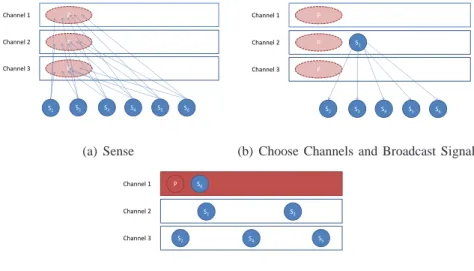
Traditional dynamic spectrum access methods focus on identifying available spectrum through spectrum sensing. Cooperative spectrum sensing is a potential scheme to enhance the accuracy and efficiency of detecting available spectrum [2]–[4]. In cooperative spectrum sensing, the sensing results from the secondary users are shared by all members within the same or neighboring networks. These secondary users then use the collected results to make spectrum access decision collaboratively or individually. If the sensing results are independent from each other, the cooperative spectrum sensing can significantly increase the accuracy of detecting the primary user’s activity. Secondary users can learn from others’ sensing results to improve their knowledge on the primary user’s activity. After the available spectrum is detected, secondary users need to share the spectrum following some predetermined access policy. In general, the more secondary users access the same channel, the less available access time for each of them, i.e., a negative network externality exists in this problem. Therefore, before making decision on spectrum access, a secondary user should estimate both the primary user’s activity based on the collected sensing results and the possible number of secondary users accessing the same spectrum.
A. System Model
We consider a cognitive radio system with K channels,N secondary users, and one primary user. We
S1 S2 S3 S4 S5 P Channel 1 Channel 2 Channel 3 S6 P P (a) Sense S1 S2 S3 S4 S5 P Channel 1 Channel 2 Channel 3 S6 P P
(b) Choose Channels and Broadcast Signals
S1 S2 S3 S4 S5 P Channel 1 Channel 2 Channel 3 S6 (c) Transmission Fig. 1. Sequential Cooperative Spectrum Sensing and Accessing
that the primary user is always active and transmitting some data on one of the channels. In addition, the primary user’s access time is slotted. At each time slot, each channel has equal probability of 1/K
to be selected by the primary user for transmission. The secondary users’ activities are shown in Fig. 1. At the beginning of each time slot, secondary users individually perform sensing on all channels1∼K. Then, they follow a predefined order to sequentially determine which channel they are going to access in this time slot. Without loss of generality, we assume they follow the same order as their indices. When making a decision, a secondary user i reports his decision and the sensing result to the access
point. At the same time, all secondary users also receive this report by overhearing. After all secondary users have made their decisions, the access point announces the access policy of each channel: secondary users choosing the same channel equally share the slot time. However, if the channel is occupied by the primary user, their transmission will fail due to the interference from primary user’s transmission.
Such a cognitive radio system can be modeled as a Chinese restaurant game. LetHj be the hypothesis
that channel j is occupied by the primary user. Then, let the sensing results of secondary user i ∈ {1,2, ..., N} on channel j ∈ {1,2, ..., K} be si,j. We use a simple binary model on the sensing result
in this example, where si,j = 1 if the secondary user detected some activity on channel j and si,j = 0
si = {si,1, si,2, ..., si,K}. In addition, the results he collected from the reports of previous users are
denoted ashi={s1,s2, ...si−1}.
We define the belief of a secondary user ion the occupation of channels as gi={gi,1, gi,2, ..., gi,K},
wheregi,j =P r(Hj|hi,si). Let the probability of false alarm and miss detection of the sensing technique
on a single channel as pf andpm, respectively. The probability of si conditioning on Hj is given by
P r(si|Hj) =pm1−si,j(1−pm)si,j Y k∈{1,2,...,K}\{j} psi,k f (1−pf) 1−si,k. (10) Thus, we have the following belief updating rule
gi,j = P r(hi,si|Hj)P r(Hj) PK k=1P r(hi,si|Hk)P r(Hk) = PKgi−1,jP r(si|Hj) k=1gi−1,kP r(si|Hk) . (11)
With this rule, the belief of secondary user i is updated when a new sensing result is reported to the
access point. The available access time of a channelj within a slot is its slot time, which is denoted as
T. However, if the channel occupied by primary user, its access time becomes 0. Thus, we define the
access time of channelj as
Rj(Hk) = 0, j=k. T, otherwise. (12)
Then, let xi be secondary useri’s choice on the channels, and nj be the number of secondary users
choosing channelj. We define the utility of a secondary user ias
ui(xi) =
QxiRxi nxi
, (13)
where Qxi is the channel quality of channel xi. If the channel has higher quality, the secondary users choosing the channel have higher data rates, and thus higher utility. Then, the best response of secondary useriis as follows, BEi(ni,hi,si) = arg max x X k∈{1,2,...,K}\{x} gi,kE QxT nx |ni,hi,si, Hk . (14)
This best response function can be solved recursively through the recursive equations in (3) and (6).
B. Simulation Results
We simulate a cognitive radio network with 3 channels,1 primary user, and7secondary users. When the channel is not occupied by the primary user, the available access time for secondary users in one time
slot is 100ms. Secondary users sense the primary user’s activity in all three channels at the beginning
of the time slot. We assume that the primary user has equal probability to occupy one of three channels. Conditioning on the primary user’s occupation of the channel, the probabilities of miss detection (if occupied) and false alarm (if not occupied) in sensing one channel are0.1. The channel quality factor of
channel1 isQ1 = 1, while channel2and3 are1−dand 1−2d. Thedis the degraded factor, which is
controlled within [5%,50%] in the simulations. We compare the proposed best response strategy in (6)
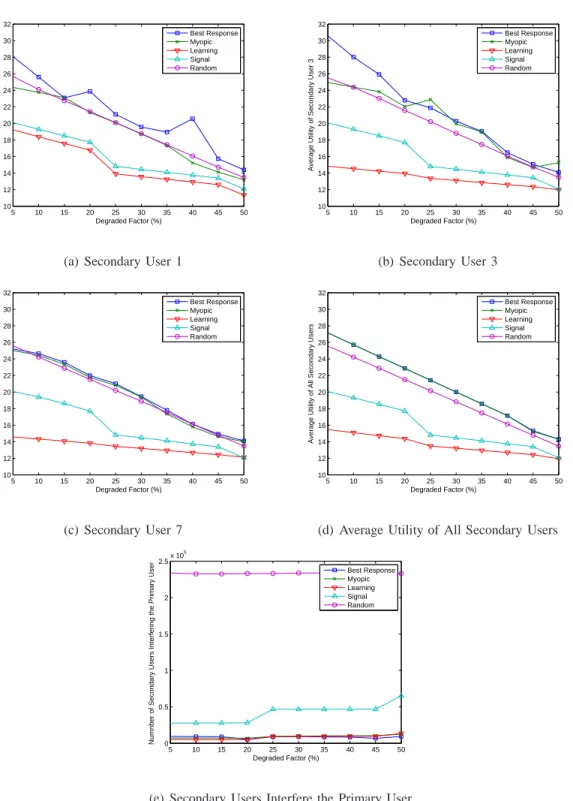
with other four strategy scheme: random, signal, learning, and myopic strategies. The simulation results are shown in Fig. 2.
From Fig. 2(a), 2(b), and 2(c), we can see that secondary users have different utilities under different orders and schemes. For both the myopic and the proposed best response schemes, secondary user 3
has a larger utility than secondary user 1 when the degraded factor is low. This is because secondary user3 has the advantages in collecting more signals than secondary1 to identify the channel occupied by the primary user. Moreover, the loadings of the other two channels are still far from their expected equilibrium loadings since only two secondary users have made choices. Therefore, secondary user3has a larger utility than secondary user 1. Nevertheless, when the degraded factor is high, we can see that the utility of secondary user1is larger than that of secondary user3. This is because when the degraded factor increases, the quality difference among channels increases. In such a case, even secondary user 3
can successfully identify the occupied channel, the channel that offers a higher utility in the equilibrium is usually the one with fewer number of secondary users. The expected number of secondary users accessing such a channel is generally2 or even 1 depending on the degraded factor, and secondary user3 can no longer freely choose those channels. For secondary user 7, who has the best knowledge on the primary user’s activity, he usually has no choice since there are six secondary users making decisions before him. Therefore, he has the smallest utility.
Generally, the myopic scheme provides an equal or lower utility than the best response scheme for secondary users making decisions early, such as secondary user 1, since secondary users in the myopic scheme do not predict the decisions of subsequent users. However, some secondary users eventually benefit from the mistakes made by early secondary users. We can see from Fig. 2(b) that for the cases that d= 20% and d = 50%, customer 3 has a higher utility under the myopic scheme than under the
5 10 15 20 25 30 35 40 45 50 10 12 14 16 18 20 22 24 26 28 30 32 Degraded Factor (%)
Average Utility of Secondary User 1
Best Response Myopic Learning Signal Random
(a) Secondary User 1
5 10 15 20 25 30 35 40 45 50 10 12 14 16 18 20 22 24 26 28 30 32 Degraded Factor (%)
Average Utility of Secondary User 3
Best Response Myopic Learning Signal Random (b) Secondary User 3 5 10 15 20 25 30 35 40 45 50 10 12 14 16 18 20 22 24 26 28 30 32 Degraded Factor (%)
Average Utility of Secondary User 7
Best Response Myopic Learning Signal Random (c) Secondary User 7 5 10 15 20 25 30 35 40 45 50 10 12 14 16 18 20 22 24 26 28 30 32 Degraded Factor (%)
Average Utility of All Secondary Users
Best Response Myopic Learning Signal Random
(d) Average Utility of All Secondary Users
5 10 15 20 25 30 35 40 45 50 0 0.5 1 1.5 2 2.5x 10 5 Degraded Factor (%)
Numnber of Secondary Users Interfering the Primary User
Best Response Myopic Learning Signal Random
(e) Secondary Users Interfere the Primary User Fig. 2. Spectrum Accessing in Cognitive Radio Network under Different Schemes
best response scheme due to the mistakes made by customer 1 and 2. We can also see from Fig. 2(d) that both best response and myopic schemes provides the same average utilities of all secondary users. In such a case, the utility loss of some secondary users in the myopic scheme will lead to the utility increase of some other secondary users.
For random and signal schemes, there is no difference among the average utilities of secondary user
1, 3, and 7 since secondary users do not learn from other agents’ actions and signals under these two schemes. For the learning scheme, we can see that secondary user1has a significantly larger utility than secondary user3 and7. This is because in the learning scheme, secondary users do not take the negative network externality into account when making decisions on the channel selection. Since secondary users who made decisions later are more likely to identify the primary user’s activity, they are more likely to choose the same channels and share with each other, and their utilities are degraded due to the negative network externality.
Let us take a deeper look at the average utility of all secondary users shown in Fig. 2(d). On one hand, we can see that both best response and myopic schemes achieve highest average utilities of all secondary users. The network externality effects in spectrum access force strategic secondary users to access different channels instead of accessing the same high quality channels. On the other hand, learning and signal schemes lead to poor average utilities since they do not consider the network externality in their decision processes. All secondary users tend to access the same available high quality channel, and therefore the spectrum resource in other available channels is wasted. This also explains the phenomenon that learning scheme leads to poorer performance than signal scheme. Under the learning scheme, secondary users are more likely to reach a consensus on the primary user’s activity and make the same choice on the channels, which degrades the overall system performance.
Finally, we show the number of secondary users causing interference to the primary user in Fig. 2(e). We can see that those schemes involving learning, which are best response, myopic, and learning schemes, can significantly reduce the interference to the primary user. Secondary users who learn from others’ signals efficiently avoid the channel occupied by the primary user.
Platform A Platform B S1 S2 S3 S4 S5 S6 Forum …… … ….. …… ……… … …… .. .. … …… ….
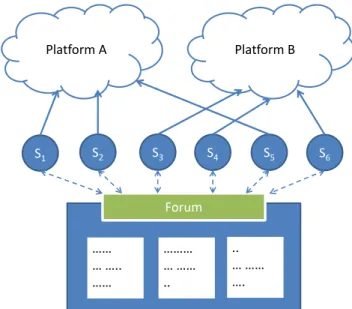
Fig. 3. Platform Selection in Cloud Computing
IV. CLOUDCOMPUTING: CLOUDSTORAGESERVICE SELECTION
In the second application, we consider the storage service selection in cloud computing. Reliability and availability are the major concerns of potential cloud subscribers in choosing the cloud storage platform. These two features may be enhanced by the cloud computing platform through optimizing configuration, upgrading the software architecture, and hardware infrastructure [5]. However, reliability and availability are also affected by the number of subscribers. For instance, when overwhelming number of subscribers access the storage service, these subscribers may experience unacceptable waiting time, service blocking, or even data loss in transmission due to network congestion and capacity overloading. The reliability of the platform may be decreased to an unacceptable level even with upgraded infrastructure [6]. In general, for a fixed software architecture and hardware infrastructure, the more subscribers using the same platform, the lower the service quality of the cloud storage platform. Thus, before choosing the cloud service, a potential subscriber should consider both the infrastructure of the platform and the potential growth of the subscription numbers of the platform.
A. System Model
Let us consider two cloud storage platforms with N potential subscribers. These two platforms, say
A and B, offer the same storage plan. A storage plan contains two items: maximum storage space and
pricing. These plans require long-term contracts, which means that a subscriber cannot change from one platform to another in a short period. Since both platforms provide the same plan, a subscriber may not choose one of them due to the price or the storage size. Suppose that the service qualities of these two platforms are different. One of the platforms has upgraded their infrastructure and can provide higher availability. Let us consider a binary model on the infrastructure, i.e., Hh and Hl are
high-reliable infrastructure and low-reliable infrastructure, respectively. When high-reliable infrastructure Hh is used in the platform, the probability that one subscriber causing the service to fatal crash is ph.
If the crash happens, the platform becomes unavailable to all subscribers at a certain time. When low-reliable infrastructureHl is used, the probability of a fatal crash per subscriber ispl, wherepl > ph. We
assume that there is no third-party to tell the subscribers what exactly the infrastructure the platforms are using. Thus, both platform may claim that they have upgraded the infrastructure, and the subscribers may not be able to verify it before choosing their services. However, they all know the prior probability g0 that platform A is the one that upgrades the infrastructure. They also have collected some rumors
about the true state of each platform, and have formed their own believes on the infrastructure of each platform.
We assume these subscribers make their choices sequentially. When a subscriber imakes his choice,
as shown in Fig. 3, he announces his decision and posts the rumors he received on a public discussion forum. Thus, all subscribers know his decision and get the rumor he received. We assume the decision process is relatively short comparing with the required long-term contracts for using the storage service. Thus, we ignore the transition state and focus on the service availability of the final state, i.e, the time after all subscribers have made their decisions. The service availability experienced by one subscriber is determined by two factors, which are the number of subscribers at the end of the decision process and the infrastructure used by the platform.
Let the rumor received by subscriber i be a random variable si ∈ {A, B} conditioning on the
A, otherwise the rumor favors platform B. Let HA and HB be the infrastructure using by platform A
and B, respectively. The probability distribution f(si|H) is defined as follows:
f(si =x|Hx) = p, Hx =Hh, 1−p, otherwise, (15)
where x ∈ {A, B} and p is the conditional probability that the rumor is true. Note that since only one platform upgrades the infrastructure, if HA=Hh, then HB =Hl, and vice versa. The belief of a
subscriber i is defined as gi = P r(HA =Hh|hi, si), where hi ={s1, s2, ..., si−1} is the collection of
the posted rumors on the public discussion forum. The belief updating rule is given as follows: gi = P r(hi, si|HA=Hh)P r(HA=Hh) P r(hi, si|HA=Hh)P r(HA=Hh) +P r(hi, si|HA=Hl)P r(HA=Hl) = gi−1f(si|HA=Hh) gi−1f(si|HA=Hh) + (1−gi−1)f(si|HA=Hl) . (16)
The utility function of a subscriber i choosing the platform x∈ {A, B} is given by
ui(x) = (1−px)nx, (17)
where px is the probability of service fatal crash caused by one subscriber and nx is the number of
subscribers using platform x. The utility functionui(x) describes the probability that the cloud storage service is available, given the number of subscribers and the reliability of infrastructure.
Finally, let ni,xbe the number of subscribers choosing platformx before subscriberi, we haveni,A=
i−1−ni,B. Then, the best choice of a subscriberi is
BEi(ni,A,hi, si) = A, E[(1−pA)nA|n i,A,hi, si]> E[(1−pB)nB|ni,A,hi, si]. B, otherwise. (18)
This best response function can be solved recursively through the recursive equations in (3) and (6).
B. Simulation Results
We simulate a system with two storage service platforms and 10 subscribers. There are two types of infrastructures, which are high-reliable and low-reliable infrastructure. The high-reliable infrastructureHh
offers a service with the probability of failure per userph= 0.0001. For the low-reliable infrastructure,
0.55 0.6 0.65 0.7 0.75 0.8 0.85 0.9 0.95 0.98 0.982 0.984 0.986 0.988 0.99 0.992 0.994 0.996
Accuracy of the collected Rumor
Average Utility of Subscriber 1
Best Response Myopic Learning Signal Random (a) Subscriber 1 0.55 0.6 0.65 0.7 0.75 0.8 0.85 0.9 0.95 0.98 0.982 0.984 0.986 0.988 0.99 0.992 0.994
Accuracy of the collected Rumor
Average Utility of Subscriber 10
Best Response Myopic Learning Signal Random (b) Subscriber 10 Fig. 4. Storage Platform Selection in Cloud Computing vs. Accuracy of Rumors
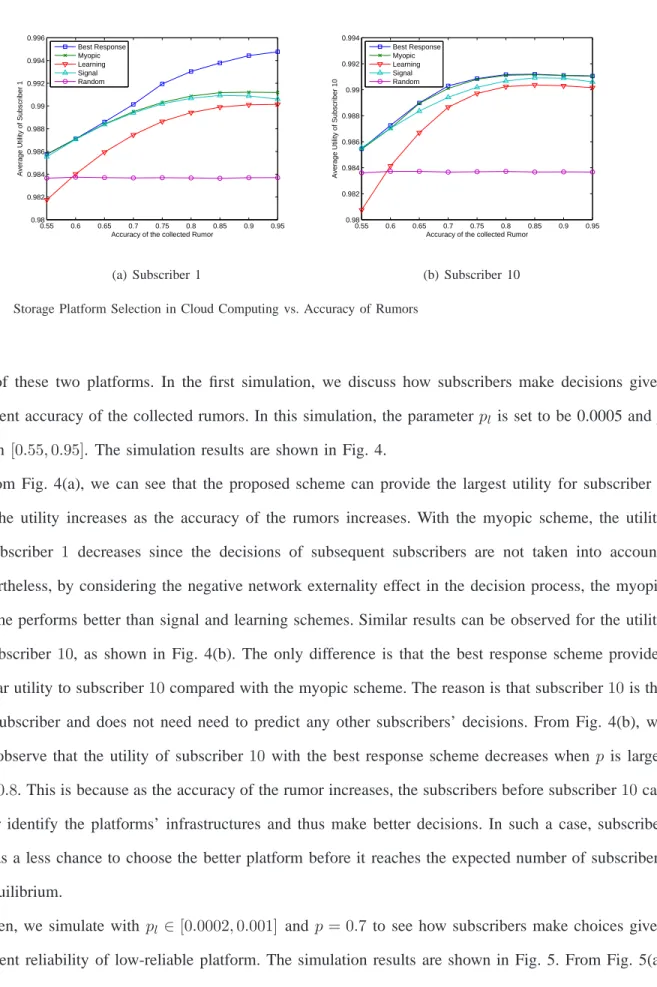
one of these two platforms. In the first simulation, we discuss how subscribers make decisions given different accuracy of the collected rumors. In this simulation, the parameter pl is set to be 0.0005 and p
lies in [0.55,0.95]. The simulation results are shown in Fig. 4.
From Fig. 4(a), we can see that the proposed scheme can provide the largest utility for subscriber 1
and the utility increases as the accuracy of the rumors increases. With the myopic scheme, the utility of subscriber 1 decreases since the decisions of subsequent subscribers are not taken into account. Nevertheless, by considering the negative network externality effect in the decision process, the myopic scheme performs better than signal and learning schemes. Similar results can be observed for the utility of subscriber 10, as shown in Fig. 4(b). The only difference is that the best response scheme provides similar utility to subscriber10compared with the myopic scheme. The reason is that subscriber10is the last subscriber and does not need need to predict any other subscribers’ decisions. From Fig. 4(b), we also observe that the utility of subscriber 10 with the best response scheme decreases when p is larger
than0.8. This is because as the accuracy of the rumor increases, the subscribers before subscriber10can
better identify the platforms’ infrastructures and thus make better decisions. In such a case, subscriber
10 has a less chance to choose the better platform before it reaches the expected number of subscribers in equilibrium.
Then, we simulate with pl ∈[0.0002,0.001] and p= 0.7 to see how subscribers make choices given
2 3 4 5 6 7 8 9 10 x 10−3 0.97 0.975 0.98 0.985 0.99 0.995
Probability of Crash with Low−Reliable Architecture (pl)
Average Utility of Subscriber 1 Best Response Myopic Learning Signal Random (a) Subscriber 1 2 3 4 5 6 7 8 9 10 x 10−3 0.97 0.975 0.98 0.985 0.99 0.995
Probability of Crash with Low−Reliable Architecture (pl)
Average Utility of Subscriber 10 Best Response Myopic Learning Signal Random (b) Subscriber 10 2 3 4 5 6 7 8 9 10 x 10−3 0.97 0.975 0.98 0.985 0.99 0.995
Probability of Crash with Low−Reliable Architecture (pl)
Average Utility of All Subscribers Best Response Myopic Learning Signal Random
(c) Average Utility of All Subscribers
2 3 4 5 6 7 8 9 10 x 10−3 0.97 0.975 0.98 0.985 0.99 0.995 1
Probability of Crash with Low−Reliable Architecture (pl)
Average Reliability of Each Platform
High − Best Response Low − Best Response High − Myopic Low − Myopic High − Learning Low − Learning High − Signal Low − Signal
(d) Reliability under High- and Low-reliable Platforms Fig. 5. Storage Platform Selection in Cloud Computing vs. Reliability of Platforms
and 5(b), we observe that best response scheme gives both subscriber 1 and subscriber 10 the largest utilities among all schemes. Moreover, subscriber1has a larger utility than subscriber10 whenpl is low,
but has a smaller utility when pl is high. This is because whenpl is low and close to ph, the network
externality effect dominates the reliability of the platform. Subscriber 1has the advantage to choose the one offering the higher reliability in equilibrium before it is over-crowded. However, when pl is high,
the difference in infrastructure dominates the reliability of the platform. Subscribers would prefer the platform with the high-reliable infrastructure even other subscribers already choose the same platform. In such a case, subscriber10 has the advantage to identify the platform with the high-reliable infrastructure with the collected rumors.
of subsequent subscribers. For subscriber 10, however, there is almost no difference between these two schemes. This is because subscriber 10, as the last subscriber, does not have to predict the decisions of other subscribers. For signal and learning schemes, subscribers have lower utilities since they do not take the network externality into account. In most cases, the signal scheme provides a larger utility to subscribers than the learning scheme since subscribers achieve some kind of load balance between these two platforms according to the signal distribution f(s|θ). Note that when pl is high, the utility of
subscriber10under the learning scheme is larger than that under the signal scheme. This is because when pl is high, the platform with high-reliable infrastructure provides higher reliability even it serves more
subscribers. In such a case, a subscriber should try to identify and choose the high-reliable platform, which is exactly what the learning strategy does. The average utility of all subscribers under different schemes are shown in Fig. 5(c). We can see that both best response and myopic schemes provide the highest average utility and the signal scheme performs better than the learning scheme due to the load-balancing from the signal distribution f(s|θ).
In Fig. 5(d), we evaluate the average reliability of each platform under different schemes. Note that in Fig. 5(d) if the platform is not chosen by any subscriber in the simulation, we assume the reliability of that platform is 1. For the platform with the high-reliable infrastructure, we can see that it has the highest reliability under the signal scheme and the lowest reliability under the learning scheme. On the contrary, the low-reliable infrastructure has the highest reliability under the learning scheme and the lowest reliability under the signal scheme. We can see that both best response and myopic schemes provides a better load balance between these two platforms. The reliability of the low-reliable platform is significantly improved without much loss on the high-reliable platform.
V. ONLINE SOCIALNETWORKING: DEALSELECTION ONGROUPON
Finally, we consider the effect of negative network externality on online social networking such as Groupon. Recently, a new social network called Groupon shows a new possibility of e-commerce business model [7]. As shown in Fig. 6, it offers small businesses, especially local restaurants, a platform to promote their products with significant discounted deals. These deals are mostly effective only in a limited time or even in a limited amount for advertising purpose. Customers who purchase deals on Groupon may also
Significant Discount
Limited Offers
Social Network Tools
Fig. 6. Deals on Groupon
promote the deal to other social networks like Facebook or Twitter through the built-in tools provided by Groupon. However, it has been observed that when one product or service has been successfully promoted through deals, it is likely to receive negative responses and low reputation due to degraded qualities of services or over-expectation on the products [8]. For example, a local restaurant may provide a 50%-off deal for advertising purpose. However, this deal may be sold in thousands, which means that the restaurant needs to serve a huge number of customers in months with little profit. In such a case, the quality of meal and service will be degraded, otherwise the restaurant may not be able to survive [9]. Thus, a negative network externality exists in this problem. The customer should take into account the possibility of degraded service quality when choosing the deals on Groupon.
A. System Model
Let us considerK deal sites, each of them offering a deal from a restaurant. These restaurants are of
the same kind and in the same area, which means that they share the same group of potential customers. We assume there are N potential customers for these restaurants. The deals these restaurants provide
have the similar time limitation, i.e., in general one customer will purchase only one of them. The price of the deal provided by restaurant j, cj, is known by all customers. On the contrary, the quality of
meals in the restaurantj,Qj, is unknown since these customers have not visited the restaurant. However,
Qj ∈ {Qh, Ql}whereQhandQldenote high and low quality, respectively. We also assume the quality of
restaurants are uncorrelated. TheN customers purchase deals sequentially. After one customer purchases
a deal, his purchase along with the review he found will be posted on some public social networks that can be seen by all customers. Finally, after all purchases have been made, each customer visits the restaurant according to the deal he purchased for a meal.
The review customer i found on one restaurantj, denoted as si,j, may be positive sp or negative sn
in probability. Conditioning on the quality of the restaurant Qj, the probability distribution is described
as follows: f(si,j|Qj) = p, si,j =sp, Qj =Qh or si,j =sn, Qj =Ql, 1−p, otherwise, (19)
where theprepresents the quality of reviews. We denotesi={si,1, si,2, ..., si,K}as the reviews customeri
collected for all restaurants and denotehi ={s1,s2, ...,si−1}as the reviews shared by previous customers 1∼i−1. Then, the belief of a customerion restaurant j’s quality is given as follows:
gi,j = P r(hi,si|Qj =Qh)P r(Qj =Qh) P r(hi,si|Qj =Qh)P r(Qj =Qh) +P r(hi,si|Qj =Ql)P r(Qj =Ql) = gi−1,jf(si,j|Qj =Qh) gi−1,jf(si,j|Qj =Qh) + (1−gi−1,j)f(si,j|Qj =Ql) . (20)
Note that since the quality of restaurants are uncorrelated, the belief on one restaurant is only determined by the reviews related to it.
Finally, letnj be the number of customers purchasing restaurantj’s deal, xi be the choice of customer
i, then the utility function of customeri can be defined as
ui(Qxi, nxi, cxi) =R(Qxi)−dnxi−cxi, (21)
where R(Q) is the value function of a customer on the quality of the meal anddis the crowd discount
factor. Here, we assume the degradation of restaurant quality is linear to the number of customers. According to the utility function, we have
B. Simplification with Linear Utility Function
With the linear utility function in (22), we can significantly simplify the original recursive solution. Due to the linearity of the utility function, the expected utility is determined by the expected value of R(Qj) and the expected number of customers choosingj. The expected value ofR(Qj) can be derived
directly through current belief of the customer ias
E[R(Qj)|hi,si] =gi,jR(Qh) + (1−gi,j)R(Ql). (23)
For the expected number of customers choosing j, we first define mi,j as the number of customers
choosingj after customeri (including customeri himself). Then, we have
E[nj|ni,hi,si] =ni,j+E[mi,j|ni,hi,si]. (24)
According to (22), (23), and (24), the best response function of customer iis given by
BEi(ni,hi,si) = arg max
j {gi,jR(Qh) + (1−gi,j)R(Ql)−dni,j−cj−dE[mi,j|ni,hi,si, xi=j]}. (25)
In (25), the only unknown term is E[mi,j|niA,hi,si, xi = j], which can be calculated recursively.
Suppose that we have the best response function of customeri+ 1. The best response of customeri+ 1
is xi+1 =j if and only if si+1 ∈Si+1,j(ni+1,hi+1).
Conditioning on the current belief gi, the probability distribution of reviewsf(s|gi) is given as
f(s|gi) = K Y j=1 gi,jf(sj|Qj =Qh) gi,jf(sj|Qj =Qh) + (1−gi,j)f(sj|Qj =Ql) (26) Then, the recursive form to compute E[mi,j|ni,hi,si, xi]is given as follows:
E[mi,j|ni,hi,si, xi] = 1 +E[mi+1,j|ni,hi,si, xi], xi =j, E[mi+1,j|ni,hi,si, xi], xi 6=j, = 1 +P u∈K R s∈Si+1,u(ni+1,hi+1)E[mi+1,j|ni+1,hi+1,s, xi+1 =u]f(s|gi)ds, xi =j, P u∈K R s∈Si+1,u(ni+1,hi+1)E[mi+1,j|ni+1,hi+1,s, xi+1 =u]f(s|gi)ds, xi 6=j, (27)
C. Simulation Results
We simulate a deal-offering website with two deals from two different restaurants and 9 customers. These two deals offer similar meals and have the same price of5. We assume that there are two types of restaurant, which are the high quality restaurant with Qh = 30 and the low quality restaurant with
Ql ∈ [10,28]. Let the crowd discounting factor d in the utility function be 2. The probability that one
restaurant’s quality is high or low are equal. Moreover, a restaurant’s quality is independent from the other restaurant’s quality. Conditioning on the restaurant’s quality, a customer receives a positive review on the restaurant with a probability of0.7 if the restaurant’s quality is high. Similarly , if the restaurant’s
quality is low, the probability that a customer receives a negative review on the restaurant is also 0.7.
Each customer receives a review at the beginning of the simulation. Then, they choose the deals and reveal their collected reviews to other customers sequentially. We compare the best response strategy in (6) with other four strategies: random, signal, learning, and myopic strategies. The simulation results are shown in Fig. 7.
As shown in Fig. 7(a) and 7(b), we can see that customers with different orders have different average utilities except the random scheme. For the best response scheme, when Ql is low, customer 1 has the
smaller average utility than customer 9. This is because the restaurant quality difference between high and low is more significant when Ql is low, and the major factor that determines the utility in this case
is the quality of the restaurant. Since customer 9 has the advantage to collect more reviews and know the quality of restaurants with a stronger belief, he can choose more wisely on the deals and thus larger utility. On the contrary, when Ql is high, the difference between the restaurant quality is small, and the
network externality becomes the major factor in determining the utility of the customers. In such a case, early customer, such as customer1, have the advantage to choose the restaurant that has a lower number of customers at the equilibrium.
The myopic scheme provides a smaller utility for customer1 than the best response scheme since the expected decisions of subsequent customers are not taken into account under this scheme. For customer
9, who is the last customer in the simulation, the utility difference becomes indistinguishable between myopic and best response scheme. We can also see that customers have the lowest utility under the learning scheme. This is because all customers are likely to choose the same deal without considering
10 12 14 16 18 20 22 24 26 28 −2 0 2 4 6 8 10 12 14 16
Lower Restaurant Quality (Ql)
Average Utility of Customer 1
Best Response Myopic Learning Signal Random (a) Customer 1 10 12 14 16 18 20 22 24 26 28 −2 0 2 4 6 8 10 12 14 16
Lower Restaurant Quality (Ql)
Average Utility of Customer 9
Best Response Myopic Learning Signal Random (b) Customer 9 10 12 14 16 18 20 22 24 26 28 −2 0 2 4 6 8 10 12 14 16
Lower Restaurant Quality (Ql)
Total Utility Best Response Myopic Learning Signal Random
(c) Average Utility of All Customers Fig. 7. Deal Selection in Groupon under Different Schemes
the network externality effect under the learning scheme, which significantly reduces the quality of the meals and thus smaller utilities. This in some sense also reflects the phenomenon we previously mentioned that the combination of traditional social learning and deal promotion on Groupon may eventually reduce the quality of the products if the customers make decisions from learning without considering the network externality effect [8], [9]. Customers with the signal scheme have higher utilities than with the learning scheme since some customers may receive different signals and thus make different decisions. The random scheme performs better than signal and learning schemes in the simulations since it equally separates the crowd in probability and therefore prevents the severe quality degradation from the negative network externality. However, it does not perform better than myopic and best response scheme since both of these schemes jointly consider the network externality and the social learning.
D. Deal Pricing
Finally, we would like to study how a new restaurant should price their deals to promote himself and maximize the revenue given other existing restaurants through the Chinese restaurant game. Let us consider a new restaurant who tries to enter the market. The owner would like to promote his restaurant through putting a new deal on the Groupon with a discounted price. The restaurant’s quality is not known by the customers before opening, but the restaurant may do some advertisements or invite reviewers to give reviews on the restaurant’s quality. These become signals to potential customers about the quality of the restaurant. Note that both methods can be controlled by the restaurant, i.e, the signal quality can be controlled by the new restaurant. Therefore, the owner need to not only determine the deal price but also control the signal quality. Depending on the true quality of this new restaurant, the optimal deal price and the signal quality can be determined through the Chinese restaurant game.
Here, we provide a numerical analysis on how a restaurant should determine the deal price and the signal quality. We consider a deal-offering website with two deals, one from an existing restaurants A,
and one from a new restaurantB. We assume that there are two types of restaurant, which are the high
quality restaurant withQh = 25and the low quality restaurant withQl= 10. The quality of restaurantA
isQh, which is already known by all customers. Nevertheless, the new restaurant’s quality is unknown to
all customers. The probabilities that this new restaurant’s quality is high or low are equal. Conditioning on the new restaurant’s quality, a customer receives a positive review on the restaurant with a probability of p if the restaurant’s quality is high. Similarly, if the restaurant’s quality is low, the probability that
a customer receives a negative review on the restaurant is also p. Note that p is controlled by the new
restaurant as we discussed before. Suppose that the price of the deal offered by the existing restaurant is
10. For the deal offered by the new restaurant, its price is denoted asc. All other settings are the same as
previous simulations. We examine the expected revenue of the new restaurant through simulations. Let p∈[0,0.5]and c∈[1,20], the expected number of customers and revenue given the quality of the new restaurant are shown in Fig. 8.
From Fig. 8(a) and 8(b), we can see that the number of customers choosing the new restaurant always increases as the deal price is lower, which is intuitive since a lower price means a higher utility to all customers regardless the restaurant’s quality. The signal quality, on the other hand, has a contradictory
0 5 10 15 20 0.5 0.6 0.7 0.8 0.9 1 0 2 4 6 Deal Price (c) Signal Quality (p)
Low−Quality Restaurant’s Customers
(a) Customers choosing New Restaurant with Low Qual-ity 0 5 10 15 20 0.5 0.6 0.7 0.8 0.9 1 0 2 4 6 8 Deal Price (c) Signal Quality (p)
High−Quality Restaurant’s Customers
(b) Customers choosing New Restaurant with High Quality 0 5 10 15 20 0.5 0.6 0.7 0.8 0.9 1 0 10 20 30 40 Signal Quality (p) Deal Price (c)
Low−Quality Restaurant’s Revenue
(c) Revenue of New Restaurant with Low Quality
0 5 10 15 20 0.5 0.6 0.7 0.8 0.9 1 0 20 40 60 80 Signal Quality (p) Deal Price (c)
High−Quality Restaurant’s Revenue
(d) Revenue of New Restaurant with High Quality Fig. 8. Influence of Deal Price and Signal Quality on the Number of Customers and Revenue of New Restaurant
effect on the restaurant. We can see that when the signal quality increases, the number of customers choosing the new restaurant increases if and only if it is high-quality. Otherwise, the number of customers decreases when the signal quality increases. This is because when the signal quality is high, customers are more likely to identify the true quality of the restaurants. If the restaurant is high-quality, they are more willing to choose the new deal. However, if the restaurant is low-quality, they would rather avoid it. This suggests that if the restaurant is high-quality, the owner should try to increase the signal quality as much as possible by advertising or providing reviews. On the other hand, if the restaurant is low-quality, the owner may provide no information about the quality of this new restaurant.
different for low- and high-quality restaurants. From the simulations, we can see that the optimal price for the high-quality restaurant is higher than the low-quality restaurant. This is because even the deal price is higher, customers who identify the true quality of the restaurant are still willing to choose this restaurant for higher quality of meals. We also observe that a higher signal quality increases the revenue of the high-quality restaurant but decreases the revenue of the low-quality restaurant. Therefore, a high-quality new restaurant should try to improve the signal quality in order to make potential customers identify its true quality. On the contrary, a low-quality new restaurant may try to hide his information and provide a lower deal price in order to attract more customers and thus lead to a higher revenue.
VI. CONCLUSION
In Part I of this two-part paper [1], we had proposed a new game, called Chinese restaurant game, to analyze the social learning problem with negative network externality. In Part II of this two-part paper, we illustrate three specific applications of Chinese restaurant game in wireless networking, cloud computing, and online social networking. In the spectrum access problem in wireless networking, we show that the overall channel utilization can be improved by taking the negative network externality into account in secondary users’ decision process. The interference from secondary users to the primary user can also be reduced through learning from the sensing results of other users. In the storage platform selection problem in cloud computing, we show that customers automatically balance the loading of two platforms according to their knowledge on the platforms’ infrastructures. The average loading is optimized under the best response strategies derived in Chinese restaurant game. In the deal selection on Groupon in online social networking, we show that the phenomenon of severe quality degradation of over-promotion through deals exists under the traditional social learning strategy, but not in the proposed Chinese restaurant game where customers can find a balance among several deals by taking the negative network externality into account. Moreover, we study how a new restaurant should strategically determine its deal price and advertising effort in order to maximize the revenue. When the restaurant’s quality is high, he should try to advertise his restaurant as much as possible to convince customers to come for the high quality meals, while if the restaurant’s quality is low, he should avoid advertising and provide a lower deal price for attracting those customers with little knowledge on the restaurant.
REFERENCES
[1] C.Y Wang, Y. Chen, and K. J. R. Liu. Chinese Restaurant Game - Part I: Theory of Learning with Negative Network Externality. Arxiv preprint arXiv:1112.2188, 2011.
[2] S.M. Mishra, A. Sahai, and R.W. Brodersen. Cooperative sensing among cognitive radios. In IEEE International Conference
on Communications, volume 4, pages 1658–1663, 2006.
[3] B. Wang, K.J.R. Liu, and T.C. Clancy. Evolutionary cooperative spectrum sensing game: how to collaborate? IEEE Transactions on Communications, 58(3):890–900, 2010.
[4] K.J.R. Liu and B. Wang. Cognitive Radio Networking and Security: A Game-theoretic View. Cambridge University Press, 2010.
[5] David Oppenheimer, Archana Ganapathi, and David A. Patterson. Why do Internet services fail, and what can be done about it? In Proceedings of the 4th conference on USENIX Symposium on Internet Technologies and Systems - Volume 4, USITS’03, Berkeley, CA, USA, 2003. USENIX Association.
[6] Kundan Singh and Henning Schulzrinne. Failover, load sharing and server architecture in SIP telephony. Computer Communications, 30(5):927 – 942, 2007.
[7] U.M. Dholakia. How effective are groupon promotions for businesses? Technical report, Mimeo, Rice University, 2010. [8] J.W. Byers, M. Mitzenmacher, and G. Zervas. Daily deals: Prediction, social diffusion, and reputational ramifications. Arxiv
preprint arXiv:1109.1530, 2011.
[9] Tomoko A.H. Groupon CEO Apologizes to Japanese Customers. Associated Press, Jan. 2011. http://abcnews.go.com/Technology/wireStory?id=12630377.