A MODEL TO AUGMENT CRITICAL THINKING AND CREATE KNOWLEDGE THROUGH WRITING IN THE SOCIAL SCIENCES OF
AGRICULTURE
A Dissertation by
HOLLI RANAE LEGGETTE
Submitted to the Office of Graduate Studies of Texas A&M University
in partial fulfillment of the requirements for the degree of DOCTOR OF PHILOSOPHY
Chair of Committee, Tracy Rutherford Co-Chair of Committee, Deborah Dunsford Committee Members, Gary Wingenbach
Leo Lombardini Head of Department, Jack Elliot
August 2013
Major Subject: Agricultural Leadership, Education, and Communications
ii ABSTRACT
The purpose of this study was to develop a model to augment critical thinking and create knowledge through writing in the social sciences of agriculture. Without a conceptual model or a blue-print of writing in the social sciences of agriculture, teaching writing is hard. This study was divided into three phases, and each phase was reported and analyzed using independent research methods. Not only were the data reported as separate sets of findings, but also the data from each phase of the study were synthesized and reported as a mixed-methods study, which was a model to augment critical thinking and create knowledge through writing in the social sciences of agriculture. Five
methods were used to collect the data: qualitative theory evaluation, qualitative interviews, qualitative focus groups, Q-sort interviews, and modeling methods.
Using the qualitative theory evaluation, the researcher found three prominent theories and seven conceptual models of writing. Each writing theory and conceptual model brought a unique perspective to writing research. In conclusion, the social cognitive theory of writing was the most complete writing theory and the writing proficiency as a complex integrated skill conceptual model was the most complete.
Qualitative interviews with eight faculty members in social sciences of agriculture revealed the writing factors that augment critical thinking and create
knowledge. The researcher concluded that the ability to present and defend a topic to a variety of public audiences; opportunities for writing repetition; and rich, timely feedback were the writing factors faculty members believed augment critical thinking
iii and create knowledge.
The focus group interviews with 15 students in social sciences of agriculture revealed the characteristics of strong writers. The researcher concluded that adapting prose to fit the audience, applying writing to real-world scenarios, developing a strong argument, having a specific voice, and understanding grammar and mechanics should be used to help students develop writing skills.
The data from the review of literature, the qualitative interviews, and the qualitative focus groups were used to develop the Q-sort interview statements. Q-sort interviews with four students, three faculty members, and three administrators revealed three factors that define writing in the social sciences of agriculture. The researcher concluded that writing in college courses can be categorized into three categories: writing as a process, writing as an application and a development of thought, and writing as an advanced skill guided by complex reasoning.
The data from the first four studies were collapsed to identify the writing factors that augment critical thinking and create knowledge in the social sciences of agriculture. From this data, the researcher developed the model to augment critical thinking and create knowledge through writing in the social sciences of agriculture. Additionally, the researcher concluded there are 12 writing factors that augment critical thinking and create knowledge in the social sciences of agriculture (e.g., using real-world scenarios; researching and understanding how ideas are connected; and presenting and defending agricultural topics to a variety of public audiences).
iv
DEDICATION
The time has come for me to dedicate my dissertation, which, to me, is the hardest part of writing it. I cannot believe that three years have come and gone and the time spent pursuing my Ph.D. is almost over.
First, I dedicate my dissertation to my loving parents, Tom and Linda Leggette. From the very thought of getting a Ph.D., my parents have stood with loving hearts, open arms, kind words, and twinkling eyes. They have made countless trips to College Station and have accepted that my trips home would be limited. They are the reason I have been able to follow my heart and pursue my dreams.
Second, I would like to dedicate this piece to Dr. Sara Jane Richter. I will never forget the day I stood in her office and, with tears in her eyes, she told me that one day she would hold my dissertation in her hands. Today, she will! Dr. Richter never stopped believing in me and my abilities. Many thanks to Dr. Richter because every day I could hear those words as if she were in my presence.
Lastly, I would like to dedicate my dissertation to my dear friends at Western Technology Center. I can remember sitting in Mr. Orsack’s office and telling him I was resigning to pursue my Ph.D. He smiled and said “Go for it, kid.” With love and support, but not without tears, they sent me on my way. Eleanor Roosevelt once said “Many people will walk in and out of your life, but only true friends will leave footprints in your heart.” Thanks to Western Oklahoma for being a place I will always call home and for leaving footprints on my heart.
v
ACKNOWLEDGEMENTS
A Ph.D. and three years seemed like eternity when I stepped on the Texas A&M University campus the first time. Now, I am typing the last sentence of my dissertation and analyzing its last piece of data. My academic career has been a great journey. It has had periods of laughter, tears, and anger, but in the end, it has been worth the sacrifice. At times, I had to remind myself that, if it were easy, everyone would do it. Dolly Parton in The Sacrifice resonated my feelings of my Ph.D. program—“Well, I’ve sacrificed time with family and friends. Gave up vacations for work without end. 24/7, 365. But I was willing to make the sacrifice.” This song has often played in my office as I spent countless nights sitting in AGLS 271. I am thankful for the continuous strength from my Lord and Savior, and I owe it all to His faithfulness. To God be the glory!
I have not earned this Ph.D. without the help of some very special people. First, thank you to my wonderful parents. I know you had to get tired of continuously being told “no” and being asked “can it wait until tomorrow?,” but you understood because you have always been supportive of my adventures and journeys. I knew I could call home mad, glad, excited, exhausted, or frustrated, and you would always have the right words. I am proud to be your daughter and to be Dr. Leggette. Love you, both!
Second, to my committee, I could not have chosen a better group of people to guide me through a long and intense process. You each served a unique role in my life just as each of you brought your expertise to my committee. Dr. Rutherford, thank you for serving as my advisor and giving me the freedom to pursue my dreams. I appreciate
vi
the opportunities you have given me to spread my wings, and I have enjoyed being on the seminal research team for Second Life®. Dr. Deb, you were the kind and gentle spirit who always seemed to have the answer. From not only me but also from the special ladies whom I call my officemates—thank you for being one we could always count on. Dr. Wingenbach, thank you for always pushing me to my limits. At times I got frustrated, but then I would remember you were only pushing me to be my best. Dr. Lombardini, I am thankful our paths crossed in Edmonton and for your willingness to serve on my committee. You brought a unique perspective because of your experience teaching writing intensive courses, and I thank you for your time and commitment to my project. Because of these four people, I believe I have received the best education any girl from the wheat fields of western Kansas could receive.
Third, I would like to thank two very special ladies in my life—Abigail Martin and Holly Jarvis. No matter how stressful my week was I could always count on seeing smiles and hearing words of encouragement from you—I constantly felt the sincerity of our friendship. Whether it was a text in the morning, a two-hour break at Spoons
Yogurt®, or an afternoon of retail therapy at Dillard’s®, I always knew I could count on you for a fun time. Thank you! I will miss you both.
Fourth, Dr. Billy McKim has been a friend and colleague since I came to Texas A&M in 2010. Thank you for giving me opportunities to be involved in large research projects and for being willing to collaborate on projects in my line of inquiry. I look forward to collaborating on future projects, and if you ever need advice on where to put a comma, just let me know.
vii
Fifth, my Oklahoma friends and family have been tremendous supporters during my doctoral program. I am not going to list all of you because you know who you are. Thank you for always being an inspiration and making Oklahoma my second home. Although I may never settle on the open ranges of western Oklahoma, I am thankful for the time the Lord gave me there and I am excited about future trips to the open land. Also, thank you to my friends of the Oklahoma Highway Patrol. I have enjoyed working with you, and I look forward to many more years of being a part of such a great
organization. God bless you all.
Sixth, a special thanks to my fellow agricultural communications graduate students who have shared the journey with me. Thank you to my current and former officemates for a time well spent. Day in and day out we worked to make Texas A&M University and the agricultural communications program better. Yes, sometimes we got frustrated at each other and the small office was not near big enough for us, but I am thankful I had the opportunity to have y’all along for the adventure of graduate school. Each one of you has a special place in my life, and I am thankful for the chance to work with you. Shannon and Carol Lawrence and family, thank you for always being an inspiration and loving as Christ loved. You are a great exemplar of the Lord’s beauty, and I am fortunate to call you friends. To the ALEC graduate students, we made it out alive. Best wishes to you as you embark on the next chapter in life. In addition, some days the only way I had the energy to get out of bed and come to AGLS was because of the great undergraduate students who filled my classes every semester. Thank you for
viii
always having a warm smile and being not only students but also colleagues and friends. Best of luck to every student I had the pleasure to teach and mentor.
There is one last person I would like to acknowledge—Justin. You came into my life late in the process of writing and collecting data, but in that short time, you were a constant supporter and encourager. You were always willing to listen to what I had to say about school and my dissertation, and you never looked at me like “who cares … I don’t really want to hear about this anyway.” I thank you for being a positive person and one who always had a listening ear and a caring heart. I am thankful that the Lord brought us together and has given us a chance to share our lives with each other. I am blessed beyond belief to have you in my life.
I believe this sums up my experience at Texas A&M University. As I look back on the last three years, I cannot help but think about the many people who have had a hand in helping me accomplish a dream. I have had the opportunity to interact with some of the profession’s best educators and researchers and be a part of great research
projects. I am thankful for the opportunities that awaited me every morning and the challenges that I faced along with them. To the Department of Agricultural Leadership, Education, and Communications, thank you for allowing me to be a part of such a great group of people. I will always look back on my time here with a smile.
Another thanks to my parents for always believing in me and giving me the freedom to spread my wings and fly. I love you more than words could ever express. My days as a current student at Texas A&M University are about over, but I am, and will always be, an Aggie and a member of the 12th man. Gig ‘em, Aggies!
ix TABLE OF CONTENTS Page ABSTRACT ...ii DEDICATION ... iv ACKNOWLEDGEMENTS ... v TABLE OF CONTENTS ... ix
LIST OF FIGURES ... xiii
LIST OF TABLES ... xiv
CHAPTER I INTRODUCTION ... 1
CHAPTER II LITERATURE REVIEW ... 11
Writing Models and Theories ... 11
Need for College Writing Instruction ... 16
Writing and Critical Thinking ... 23
Writing Across the Curriculum ... 31
Writing Instruction in Agriculture ... 34
Writing Instruction at Texas A&M University ... 40
Faculty Members’ Perspectives of Writing... 42
Students’ Perspectives of Writing ... 47
Writing Instruction Factors ... 50
Conceptual Frameworks ... 61
Theory and Model Evaluation ... 61
Education and Identity ... 64
Models and Model Development ... 69
Problem Statement ... 73
Purpose/Objectives ... 74
Scope of the Study ... 75
Assumptions of the Study ... 75
Limitations of the Study ... 76
Significance of the Study ... 76
x
Institutional Review Board ... 79
Research Question 1: What are the Prominent Theories and Conceptual Models of Writing? ... 79
Research Question 2: What are the Writing Factors that Augment Critical Thinking and Create Knowledge? ... 86
Context of Study ... 88
Research Objective 2.1: Determine Faculty Members’ Perspectives about the Writing Factors that Augment Critical Thinking and Create Knowledge Using Semi-structured Interviews ... 89
Research Objective 2.2: Determine Students’ Perspectives about the Writing Factors that Augment Critical Thinking and Create Knowledge Using Focus Groups ... 93
Research Objective 2.3: Determine Faculty Members’, Students’, and Administrators’ Perspectives about the Writing Factors that Augment Critical Thinking and Create Knowledge Using Q-sort Interviews ... 99
Research Question 3: What are the Writing Factors Identified in the Literature and Through Stakeholder Interviews that Contribute to a Model to Augment Critical Thinking and Create Knowledge Through Writing in the Social Sciences of Agriculture? ... 117
CHAPTER IV FINDINGS ... 125
Research Question 1: What are the Prominent Theories and Conceptual Models of Writing? ... 125
Cognitive Process Theory of Writing (Flower & Hayes, 1981) ... 126
Sociocultural Theory of Writing ... 146
Social Cognitive Theory of Writing ... 153
Summary of the Prominent Theories and Conceptual Model of Writing .... 164
Research Question 2: What are the Writing Factors that Augment Critical Thinking and Create Knowledge? ... 165
Research Objective 2.1: Determine Faculty Members’ Perspectives about the Writing Factors that Augment Critical Thinking and Create Knowledge Using Semi-structured Interviews ... 165
Research Objective 2.2: Determine Students’ Perspectives about the Writing Factors that Augment Critical Thinking and Create Knowledge Using Focus Groups ... 180
Research Objective 2.3: Determine Faculty Members’, Students’, and Administrators’ Perspectives about the Writing Factors that Augment Critical Thinking and Create Knowledge Using Q-sort Interviews ... 196
Research Question 3: What are the Writing Factors Identified in the Literature and Through Stakeholder Interviews that Contribute to a Model to Augment Critical Thinking and Create Knowledge Through Writing in the Social Sciences of Agriculture? ... 210
xi
A Conceptual Model to Augment Critical Thinking and Create
Knowledge Through Writing in the Social Sciences of Agriculture... 211
CHAPTER V CONCLUSIONS, RECOMMENDATIONS, AND IMPLICATIONS .. 223
Research Question 1: What are the Prominent Theories and Conceptual Models of Writing? ... 223
Research Question 2: What are the Writing Factors that Augment Critical Thinking and Create Knowledge? ... 229
Research Objective 2.1: Determine Faculty Members’ Perspectives about the Writing Factors that Augment Critical Thinking and Create Knowledge Using Semi-structured Interviews ... 229
Research Objective 2.2: Determine Students’ Perspectives about the Writing Factors that Augment Critical Thinking and Create Knowledge Using Focus Groups ... 237
Research Objective 2.3: Determine Faculty Members’, Students’, and Administrators’ Perspectives about the Writing Factors that Augment Critical Thinking and Create Knowledge Using Q-sort Interviews ... 245
Research Question 3: What are the Writing Factors Identified in the Literature and Through Stakeholder Interviews that Contribute to a Model to Augment Critical Thinking and Create Knowledge Through Writing in the Social Sciences of Agriculture? ... 251
REFERENCES ... 258 APPENDIX A ... 279 APPENDIX B ... 282 APPENDIX C ... 283 APPENDIX D ... 286 APPENDIX E ... 287 APPENDIX F ... 288 APPENDIX G ... 291 APPENDIX H ... 293 APPENDIX I ... 296 APPENDIX J ... 299 APPENDIX K ... 300
xii APPENDIX L ... 301 APPENDIX M ... 302 APPENDIX N ... 303 APPENDIX O ... 304 APPENDIX P ... 305 APPENDIX Q ... 306 APPENDIX R ... 307
xiii
LIST OF FIGURES
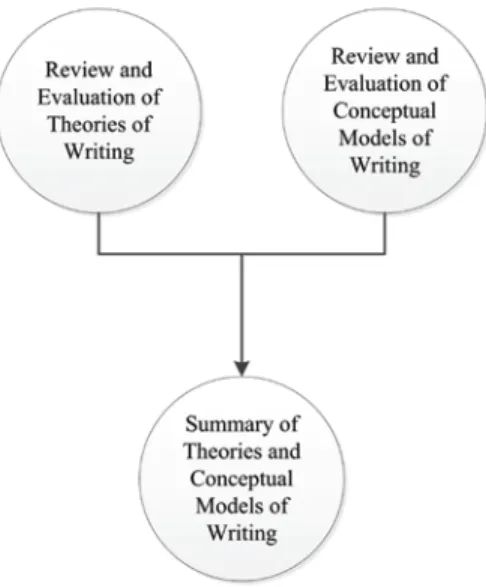
Page Figure 1. Procedural model of the research methods used to address Research
Question 1 ... 80 Figure 2. Procedural model of the research methods used to address Research
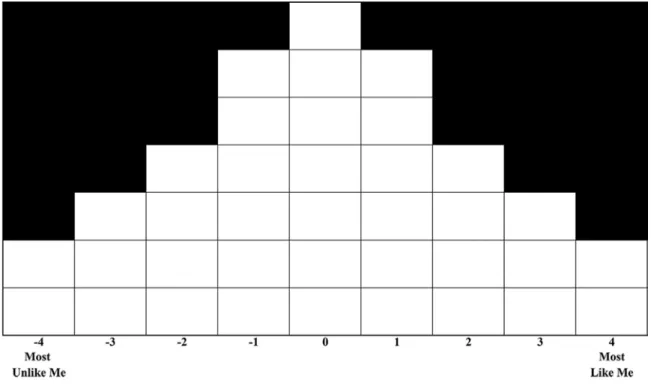
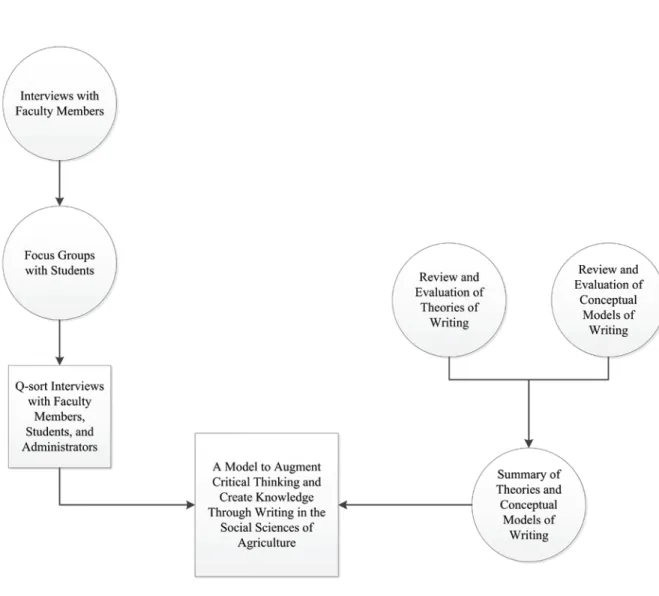
Question 2 ... 87 Figure 3. Q sort Form Board ... 112 Figure 4. Procedural model of the research methods used to address Research
Question 3 ... 118 Figure 5. Conceptual model to augment critical thinking and create knowledge
through writing in the social sciences of agriculture. ... 212 Figure 6. Social context element of the conceptual model to augment critical
thinking and create knowledge through writing in the social sciences of
agriculture. ... 213 Figure 7. Discourse knowledge element of the conceptual model to augment critical
thinking and create knowledge through writing in the social sciences of
agriculture. ... 214 Figure 8. Content/subject matter knowledge, cognitive processes, and confidence
elements of the conceptual model to augment critical thinking and create knowledge through writing in the social sciences of agriculture. ... 217 Figure 9. Demonstration of critical thinking through writing element of the
conceptual model to augment critical thinking and create knowledge
through writing in the social sciences of agriculture. ... 219 Figure 10. Layering process of writing for the conceptual model to augment critical
thinking and create knowledge through writing in the social sciences of
xiv
LIST OF TABLES
Page
Table 1. Defintions of Theory Evaluation Criteria ... 65
Table 2. Descriptions, Inclusion and Exclusion Evaluation Criteria, and Typical Exemplars for each of Dudley-Brown's (1997) Criterion... 81
Table 3. Q-set Statements ... 108
Table 4. Summary of the Review and Evaluation of the Prominent Writing Theories and Conceptual Models ... 166
Table 5. Student Demographics and Writing Intensive Courses Taken ... 180
Table 6. Correlations Between Factors ... 197
Table 7. Factor Solution ... 198
Table 8. Factor 1: Writing as Process ... 201
Table 9. Factor 2: Writing as an Application and a Development of Thought ... 204
Table 10. Factor 3: Writing as an Advanced Skill Guided by Complex Reasoning ... 207
1 CHAPTER I INTRODUCTION
The written word is powerful (Foster, 1983; MacArthur, Graham, & Fitzgerald, 2006). “Writing is not just a skill with which one can present or analyze knowledge. It is essential to the very existence of certain kinds of knowledge” (Rose, 1985, p. 348). Using the written word, one can “gather, preserve, and transmit information widely, with great detail and accuracy” (MacArthur et al., 2006, p. 1); “[It] is an important medium for self-expression, for communication, and for the discovery of meaning….” (Foster, 1983, p. 159). Writing has many functions and can serve a variety of purposes in different disciplines. A single document may perform several actions at once (e.g., develop an argument to convince its readers, clarify thoughts, create new ideas, discover and present facts; Deane et al., 2008). From the written directions on the back of a microwave dinner to laws written by governments around the world to personal expression of feelings, beliefs, and emotions, writing has become an integrated part of everyday society (MacArthur et al., 2006; National Council of Teachers of English, 2009).
Proficiency in written and oral communication has become an essential outcome of a quality education (Strachan, 2008) because it is a valuable workplace tool (Kastman & Booker, 1998). In 2004, the National Commission on Writing proclaimed that writing and writing education needed to be transformed, and during the mid-2000s, it published a series of reports to address the writing problem in America. “American education will
2
never realize its potential as an engine of opportunity and economic growth until a writing revolution puts language and communication in their proper place in the classroom” (National Commission on Writing, 2003, p. 3).
As early as 1963, Kitzhaber argued universities and colleges should demand strong writing abilities and skills because poor writing skills are a sign of unintelligence. “Good writing is[,] therefore[,] a prerequisite to graduation” (Kitzhaber, 1963, p. 152). If graduates aspire to be managers and leaders in the profession, they should find writing to be an essential piece of their education (Jackson, 1972). Faculty members, also, must take interest in, accountability for, and responsibility for how writing is taught and assessed (Reynolds, 2010). However, most faculty members in science and social science disciplines are not writing experts (Reynolds, 2010).
Nothing is more essential to academic life than the use of written language, as a means to the ends of communication and the construction of knowledge. What we [writing instructors] teach, therefore, is fundamentally powerful and important, even if we are not . . . . written language is not subordinate to anything. (Hjortshoj, 1995, p. 499)
According to the National Commission on Writing (2004), educators need to “understand writing as an activity calling for extended preparation across subject matters—from kindergarten through college” (p. 20) if graduates are to become successful business writers. Every instructor, every program, every department, every college, and every university is responsible for the writing education of its graduates (Bok, 2006). Decisions about writing instruction and program effectiveness are made
3
without faculty members understanding writing assignments and assessments (Witte & Faigley, 1983), which could result in poor student performance.
In 2005, the Association of American Colleges and Universities established an initiative to enhance the quality of college student learning, which includes written communication skills (National Leadership Council, 2007). In an employer survey done by the Association of American Colleges and Universities in cooperation with Hart Research Associates (2010), 89% of employers stated educators should place greater emphasis on teaching students how to communicate more effectively. Even though digital media and electronics have shaped the way society communicates and shares information, the need for accurate, clear writing is as important today as it was in ancient history (Bridwell-Bowles, 2004).
Doerfert (2011) in the American Association for Agricultural Education’s National Research Agenda 2011-2015 stated the need for agricultural educators, both broadly and narrowly defined, to produce career-ready graduates who have the skills and abilities to meet the demands of the 21st century workforce. Ghaith (2010) argued writing skills are a basis of literacy that have increased in importance because most professions now require new employees to have strong written and oral communication skills.
Professionals in and out of academia now use writing to manipulate texts as objects, to be silently studied, critiqued, compared, appreciated, and evaluated. …Writing became central to organizing production and creating new knowledge.
4
Writing was now embedded in…complex…social practices carried on without face-to-face communications. (Russell, 1991, p. 4)
The National Council of Teachers in English (2009) demanded a call to improve student writing abilities and to conduct writing research that will improve writing instruction; students should “compose often [and] compose well…to become the citizen writers of our country, the citizen writers of our world, and the writers of our future” (p. 1). Although writing is a necessary component of an undergraduate education (Strachan, 2008), universities have been plagued by the question of how to teach writing for
retention and transferability since the writing process movement began. To plan the future of writing instruction, it is important to take a look back at where writing
instruction has been and what needs to change to accomplish and carry out effective and efficient writing instruction (National Council of Teachers of English, 2009).
Writing instruction pre-1970s was focused on improving student errors—the mechanics of writing—and was largely explicit to English and the humanities genre (Foster, 1983; Nystrand, 2006; Rose, 1985). However, since that time, writing has become a stimulus of thought with a direct connection to the writer’s thought process— “an activity of the mind” (Foster, 1983, p. 24). Educational psychologists eventually conceptualized that the memorization of writing and grammar rules did not constitute an expert writer (Kitzhaber, 1963; Rose, 1985). Rather, writing and grammar rules need to be applied to situations, activities, and examples if individuals are to become proficient in writing (Rose, 1985). Rose (1985) believed writing is habitual, and as claimed by
5
Emig (1977), writing is a learned behavior. “The more practice, the more linguistic habit will take hold” (Rose, 1985, p. 344).
Perceptions of 20th century writing instruction had five themes and two trends. Writing, in the past, has taken a second seat to reading because reading gives society control of its citizens and writing gives citizens control of society; reading is intimate and writing is unpleasant and leads to ambivalence; writing is labor intensive and was predominantly taught as grammar and handwriting; writing has deep roots in testing; and, without curriculum planning and research, writing was considered an undeveloped skill that was used only for testing (National Council of Teachers of English, 2009). Science and progressivism inspired the two trends that effected 20th century writing instruction. The plague of early composition, primarily instruction of grammar and handwriting and writing’s use as an assessment tool, continued to darken writing instruction (Foster, 1983; National Council of Teachers of English, 2009). “Writing became a vehicle for any interest one had in mind and was not used as a knowledge-making activity or understood as a cultural artifact, a process, or an object” (National Council of Teachers of English, 2009, p. 3). Writing was an action that had potential to be used as a method of creating knowledge (National Council of Teachers of English, 2009), yet the educational system failed, in many aspects, to use writing beyond testing.
The National Council of Teachers of English (2009) called for a movement to develop a new composing agenda and respond to the 21st century changes in the
composing process. To do this, it proposed three tasks for literacy educators: “articulate the new models of composing developing right in front of our eyes…[,] design a new
6
model of a writing curriculum…[, and] create new models for teaching” (National Council of Teachers of English, 2009, pp. 7-8). It is important for writing instructors and researchers to realize writing’s role beyond testing and assessment and to define that role. Also, the National Council of Teachers of English (2009) claimed that audience’s role in writing should be included in writing models and writing instruction. All too often, educators have taught writing as an independent process instead of a subject, which separates it as simply an activity instead of a way to create new knowledge and understand old knowledge. Understanding writing as a window to knowledge will help develop a well-articulated research base that can be used to guide further inquiry, construct and create new theories, and guide curriculum development. Likewise, it is important to see research’s role in teaching writing (National Council of Teachers of English, 2009).
Writing research in the 1930s and 1940s still lacked theory and the research to establish theory (National Council of Teachers of English, 2009). Many of the early writing researchers (e.g., James Britton and Nancy Martin) were English education professionals with few advanced degrees (Nystrand, 2006). At the Dartmouth Seminar in 1966, a group of academics and researchers from a wide range of disciplines met to critique writing instruction. They agreed that writing instruction was not about the teaching of writing but rather about the process and the learning involved with writing (National Council of Teachers of English, 2009; Nystrand, 2006). The writing process included invention, drafting, peer review, reflection, revising and rewriting, and
7
Revolution, which was about the same time as the Dartmouth Seminar, researchers began researching language, writing rules, and literacy (Nystrand, 2006). Although funded writing research was ignited by the Dartmouth Seminar and the Cambridge Cognitive Revolution, various researchers had conducted earlier research studies (Nystrand, 2006).
Mina Shaughnessy put writing research on the forefront when she began
conducting research on student errors in the 1970s (Nystrand, 2006). Two popular press articles published in the mid-1970s (Bonehead English and Why Johnny Can’t Write) stated that the public schools’ lack of emphasis on writing, the forgotten skill, was to blame for unprepared college students and the need for remedial writing courses (Nystrand, 2006). In the late 1970s, the National Institute of Education launched a research program that focused on writing instruction based on empirical research instead of traditional rhetoric, which was spawned by a discussion about scientific research methods as a means to investigate writing (Nystrand, 2006). Eventually, the work of the early researchers would lead to a writing research movement in the 1970s and 1980s, and the culmination of these early research agendas would soon influence theory and model development in writing (Nystrand, 2006).
Initial writing research was designed to “understand the nature of writing as a prerequisite to improving instruction” (Nystrand, 2006, p. 21). However, now writing research has become more about topics like writing issues, evidence, audience, conclusion, principles, and discourse. The increased number of advanced degrees awarded in composition spawned research of writing as more of a social activity and
8
process, which sparked writing research in programs beyond English (Nystrand, 2006). As part of the research trend, research was conducted on Writing Across Curriculum programs, writing intensive courses, and writing centers and facilities (Nystrand, 2006).
Wallace, Jackson, and Wallace (2000) argued that too many writing theories exist and not enough empirical evidence exists that informs the teaching writing profession. Many things have changed about writing since the first writing model was developed by Hayes and Flower in 1980; however, writing models have not changed to reflect the change in writing and communication mediums. Therefore, writing is being taught using age-old models if a model is being used at all (National Council of Teachers of English, 2009). Although much research has been done on writing and the best ways to facilitate writing instruction, “the chilling truth is that we are no closer to knowing how to teach writing than we were at the beginning of the process movement” (Wallace et al., 2000, p. 93).
According to the National Council of Teachers of English (2009), new models need to be developed and implemented into course material. Hayes (2001) claimed that vigorous writing research must be conducted to modify the current models or develop new, more specific models. In a world where writing is used like never before,
educational institutions have three challenges: “developing new models of writing; designing a new curriculum supporting those models; and creating models for teaching that curriculum” (National Council of Teachers of English, 2009, p. 1). New models of writing need to include visual components as well as audience and social awareness (National Council of Teachers of English, 2009).
9
Because of the need for students’ to become better writers and the lack of consistent instruction, universities including Texas A&M University have adopted and implemented writing intensive courses. In 2004, Texas A&M Faculty Senate decided students needed more writing instruction directly related to their disciplines because students cannot learn to write or perfect their writing skills in basic English courses (University Writing Center, 2013b). According to the Texas A&M University Office of Undergraduate Studies (2011), students “will have acquired the knowledge and skills necessary to . . . communicate effectively, including the ability to . . . demonstrate effective writing skills” (para. 1),
To combat the problem of insufficient writing skills, Texas A&M University established writing and communication (W or C) intensive courses with three goals in mind: Students will write and speak proficiently, students will master writing and speaking most often used in the students’ profession, and students will understand that writing and speaking takes time and requires practice (Strachan, 2008; University Writing Center, 2013c). In 2013, almost 10 years after the beginning of the writing intensive course program, writing intensive courses are still a major part of the course curriculum at Texas A&M University. However, many unknowns still exist about teaching writing to 21st century students in the social sciences in the College of Agriculture and Life Sciences.
This dissertation research is embedded in Gorman’s (1986; p. 37) conceptual model of writing across the curriculum and focuses on the pedagogical writing research concept. Writing across the curriculum is a broad subject that includes students, faculty,
10
administration, pedagogy, and resources. Conducting research on each piece within the conceptual framework is a lifetime of research dedicated to the further development of research on writing across the curriculum and writing intensive courses. Understanding and conducting pedagogical research will not only build on the writing research base, but it will also provide a foundation for the direction of how to teach writing in the social sciences of agriculture. Providing practical implications on how to teach writing for retention and transferability will lay the foundation for teaching practices that could lead to a stronger, more-structured writing intensive course program in not only the College of Agriculture and Life Sciences at Texas A&M University but also colleges of
11 CHAPTER II LITERATURE REVIEW
Students lack the ability to write well (Epstein, 1999; Howard et al., 2006; National Commission of Writing, 2003). Even though colleges, universities, and education organizations have advocated for higher writing standards in education (National Commission on Writing, 2003, 2004, 2005, 2006; National Leadership Council, 2007), some would argue that students still do not receive the instruction they need to be proficient in writing. Fifty years later, Kitzhaber’s (1963) quote is still relevant to the educational system:
Though a real cure [for students’ poor writing skills] seems out of the question, it would be a great error for people whose business is education and who recognize the crucial importance of using language responsibly to sit idly by and do nothing to arrest tendencies that they know to be, in the strictest sense, anti-intellectual. (p. 130)
To improve the education of students in all college majors, faculty members and
researchers must go back to the basics to what is known about writing, its development, and the way people learn to write as well as conduct writing research using new methods and tools (MacArthur et al., 2006).
Writing Models and Theories
Controversy surrounds the theoretical and philosophical underpinnings of writing. Early empirical writing research was believed to be a precursor to improving
12
writing instruction (Nystrand, 2006). Writing research was once focused on the required writing abilities, but it has shifted to more writing as a knowledge creation and
development tool. Writing, at a complex level, is not knowledge telling; it is knowledge transforming (Bereiter & Scardamalia, 1987).
Since 1980, writing researchers have worked to define the writing process by developing writing models (Becker, 2006). The history of writing models has four prominent time periods: Hayes and Flower circulated the general model of text writing in 1980; Bereiter and Scardamalia, in 1987, presented the first model of developmental writing; Levelt offered a model of speaking activity in 1989, which is not discussed in this work because it is not a model of writing but did have an impact on writing and writing research; and, in 1996, Hayes modified the original Hayes and Flower model and Kellogg published a model showing the relationship of text writing and working
memory (Alamargot & Chanquoy, 2001). Simply stated, Hayes and Flower (1980a) and Hayes (1996) defined writing expertise, Bereiter and Scardmalia (1987) modeled the development of writing expertise, and Hayes (1996) and Kellogg (1996) integrated working memory into the already existing writing process models. Hayes and Flower received some criticism for their early writing process model. However, their original intention was not to be the only model of writing but rather to begin to define the processes and knowledge involved with writing (Alamargot & Chanquoy, 2001).
Writing is a process skill because it is not completed in a step-by-step instructional approach and different ways exist to complete the process (Marzano, Pickering, & Pollock, 2001). It is complex and requires combining and implementing
13
mental activities (Alamargot & Chanquoy, 2001). Writing is a robust process (Marzano et al., 2001) where the stages continuously interact (Foster, 1983). Although each of the models integrate various steps and activities into the writing process, they all,
essentially, have three major processes: “(1) to plan the content, (2) to translate this content into a linguistic trace[,] and (3) to revise or to correct this content or this trace” (Alamargot & Chanquoy, 2001, p. 21).
Foster (1983) contended the writing process has three parts: “the preparatory or conceptual stage, the developmental or incubation stage, and the production stage” (p. 25). Within those three parts are activities and exercises that help writers build and construct written work: invention, drafting, peer review, reflection, revising and rewriting, and publishing (National Council of Teachers in English, 2009). Although writing is still a process approach guided by strategies and steps, instructional strategies (e.g., self-regulation, searching prior knowledge, and goal setting) for writing have changed and developed (Pritchard & Honeycutt, 2006). In the 1990s, research moved away from defining writing to investigating “writing in all its situated contexts, especially beyond school” (Nystrand, 2006, p. 22)—from workplace to other non-academic settings (Nystrand, 2006).
Raimes (1991) proposed that the theories and practices of teaching writing could be classified according to four elements that can guide both instruction and research: “the form…linguistic and rhetorical conventions of the text; the writer…writer’s ideas, experiences, feelings, and composing processes; the content or subject matter; and the reader, specifically the expectations of the academic audience” (pp. 238-239). Writers
14
need to understand their audience and its expectations and characteristics, so they can determine what and how to write (Alamargot & Chanquoy, 2001). They must constantly control text production so only the pertinent and necessary information is generated and conveyed (Alamargot & Chanquoy, 2001). Based on the elements of writing (form, writer, content, and reader), as defined by Raimes (1991), she proposed four approaches to writing: form-focused approach, writer-focused approach, content-focused approach, and reader-focused approach.
Teaching writing using a form-focused approach was the focus of writing in the 1960s and 1970s. During this time, the teaching of writing was centered on composition and formal features, including rhetorical form and accurate grammar, of writing— basically writing to a mold (Raimes, 1991). Raimes (1991) referred to a situation that places more emphasis on the form-focused approach as a copyeditor’s stance because it focused more on the formal features of writing instead of looking at writing as a
relationship among the reader, writer, and content.
Writing research in the 1970s influenced the writer-focused approach, which is writers’ actions and behaviors during the writing process. Students were given more time to complete multiple drafts and revisions and receive feedback from their peers and teachers with more focus on the relationship of the writer and reader. Teachers began requiring students “to think through issues by means of writing about them, to practice generating and revising ideas through the act of writing, and to read, discuss, and
interpret texts, including each other’s” (Raimes, 1991, p. 241). Raimes (1991) called this approach the therapist’s stance because it is the “extreme position of valuing the writer’s
15
voice, openness, sincerity, and originality in a framework of personal writing above any notions of audience, context, of [sic] content, or accuracy” (p. 241). The writing process approach described by multiple researchers (e.g., Hayes and Flower, 1980a) is a writer-focused approach (Raimes, 1991), which can sometimes lead to an inaccurate picture of college-level writing and an incomplete theory of writing.
The content-focused approach was considered the new process approach; it focused more on the subject matter or the content of the work than on the features of writing or the writer (Raimes, 1991). Raimes (1991) situated this approach as a butler’s approach because the subject matter of outside disciplines is valued more than the content of language courses. Therefore, language courses have no value as standalone courses; rather language courses are service courses to other subject matter areas (Raimes, 1991).
Last, Raimes (1991) proposed the reader-focused approach, which overvalued the reader, audience, or discourse community; Raimes noted it as the sergeant major’s stance on writing. In the reader-focused approach, “academic tasks and texts are seen as fixed, stable, and determinate” (Raimes, 1991, p. 244). The reader and content are accentuated, and the writer and his/her expertise gets lost in the process. The discourse community should not set the pace for writing; rather it should be used with the other three elements to develop written prose (Raimes, 1991). Writers’ main goal should be to maintain a balanced stance between all elements of writing (Booth, 1963). Placing more emphasis on one element over the other creates an unbalanced stance, which Raimes (1991) argued leads to warped instruction.
16
“A balanced approach [of writing] recognizes that the four elements…are not discrete entities to be emphasized and reduced to prescriptions…they are fluid,
interdependent, and interactive” (Raimes, 1991, p. 246). Writers become readers, readers become writers, content and subject matter are not independent, and form is the product of the reader, writer, and content (Raimes, 1991).
When evaluating and considering the vast amount of knowledge that exists in the world, it is possible to wonder if the only reason the knowledge exists is because of people’s ability to write and document findings—essentially to disseminate information (Rose, 1985).
Writing seems central to the shaping and directing of certain modes of cognition, is integrally involved in learning, is a means of defining the self and defining reality, is a means of representing and contextualizing information (which has enormous political as well as conceptual and archival importance), and is an activity that develops over one’s lifetime. (Rose, 1985, p. 348)
Learning how to write and compose should be an activity that it is developed and perfected throughout a lifetime—from the toddler learning to talk and construct words and sentences to an elderly person learning to use new communication mediums (National Council of Teachers of English, 2009).
Need for College Writing Instruction
The economical, global, and environmental shift in the United States has changed the way educators educate, students study, and workers work (National Leadership
17
Council for Liberal Education, 2007). During the first decade of the 21st century, writing was recognized by the National Commission on Writing (2003, 2004, 2005, 2006) as an essential life skill that is “central to educational and professional success in our
globalized society” (Reynolds, 2010, p. 3). Each National Commission on Writing report (2003, 2004, 2005, 2006) documented the need for writing in different sectors of
society—United States’ schools and colleges, business and industry, and government. Effective writing is paramount to students’ success in their personal and professional lives (Motavalli, Patton, Logan, & Frey, 2003; Reynolds, 2010; Strachan, 2008; Zhu, 2004). Writing has become a common, yet overlooked, qualification on position descriptions and job announcements in virtually every professional position. “The need for writing in modern literate societies—societies marked by pervasive print media—is much more extensive than is generally realized” (Grabe & Kaplan, 1996, p. 3). People write forms, letters, contracts, emails, memos, professional articles, etc. (Grabe & Kaplan, 1996); yet, research (Ingram, 2007) has shown students are not prepared for the writing demands that exist within professional positions. Bok (2006) claimed “freshmen have never arrived at college with impressive writing skills” (p. 82). Whereas, Gottschalk and Hjortshoj (2004) argued “composition teachers could never fully prepare students to write effectively in their academic concentrations or career disciplines” (p. v) even in the days of less specialization.
Students become better writers through “deepening engagement and
commitments, in lively association with other students and teachers, in fields of study they want to write about” (Gottschalk & Hjortshoj, 2004. p. v). Davies and Birbili
18
(2000) claimed people need two types of knowledge to transfer and adapt basic literacy skills, like writing, to different contexts: “metacognitive knowledge about the best ways of solving the problems of writing [and] conceptual knowledge about the nature of writing” (p. 441). Formal education should set the foundation for students to gain the two types of knowledge, and the workplace should help employees cultivate and develop the two types of knowledge (Davies & Birbili, 2000). However, “if colleges do little to encourage good writing beyond the required, introductory course, large numbers of students will continue to graduate without being able to write much better than they did when they arrived at college” (Bok, 2006, p. 96).
Writing was originally used in the classroom as a method of testing (National Council of Teachers of English, 2009). However, in addition to testing, it is now a method of learning, understanding, and retaining information (Foster, 1983; Strachan, 2008). Teaching writing is difficult because of the lack of a clear right and wrong and a standard, measurable outcome at the end of instruction (Foster, 1983). Rose (1985) argued that labeling writing as a skill, however, is downplaying the complex
intricateness that it “is continually developing as one engages in new tasks with new materials for new audiences” (p. 348). “Writing, speaking, and listening[, as defined by Moje (1996), are] tools for engaging in and making sense of social practices” (p. 175). Students often overlook the importance of informal writing as a means to more elaborate prose. With informal writing, students have something to say and they begin the thought process that leads to more formalized writing (Vilardi, 1986). However, writing is often
19
“learned initially only with the aid of formal and systematic instruction” (Emig, 1977, p. 122).
Writing education has two sides: technical, factual information and the skills and abilities to continue the learning process long after the confinements of the traditional classroom (Orr, 1996). Land-grant institutions were founded on providing the common man with an education in technical and basic liberal arts skills (Benjamin, 1962; Burnett & Tucker, 2001; McDowell, 2002; McDowell, 2003). “A renewed emphasis on the original land-grant mission, manifested through continued protection and advancement of a more liberal experience for undergraduates, can only serve to strengthen the future of agriculture in the United States” (Grant, Field, Green, & Rollin, 2000, p. 1688). According to Grant et al. (2000), land-grant institutions struggle with finding a balance between fulfilling the obligations of the land-grant mission established in 1862 and providing students with the technical information they need to succeed. However, Orr (1996) provided a more defined purpose of an education: “. . . connections, the setting of the fact in its context, the pulling together of disparate knowledge and understanding into larger, more integrative concepts . . . what the students have left after they have forgotten everything they have learned” (p. 2828). Successful integration of liberal arts curriculum into a technical education provides students with a whole education, lacking nothing (Orr, 1996).
In professions like agricultural sciences that require interaction and
communication with people, communication skills are a must. However, Harder (2006) labeled writing as the neglected life skill and argued that 4-H should include more
20
writing opportunities for its members and that agricultural youth organizations should begin incorporating writing into their programs. In business, writing impacts career success—from making the sale to clearly and concisely evaluating a current program (Reynolds, 2010; Zhu, 2004). Emphasizing communication skills will create a more broadly educated group of new professionals (Zhu, 2004), and students can increase their job prospects by developing strong writing skills in their disciplines and gaining an understanding of their disciplines’ style and format (National Commission on Writing, 2004).
Higher education has characterized writing and English as skills that students learn at a young age instead of skills that are continuously improved through practice and development of text (Russell, 1991). Types of writing vary between disciplines, and students often learn how to write in English courses, which can be troubling because one course is teaching every student how to write (Bridwell-Bowles, 2004). Bridwell-Bowles (2004) explained that, if engineering students enroll in writing courses in the English department, faculty members and students believed that the writing courses are detached from the engineering discipline and do not provide students with industry examples. “The apparent split between ‘writing’ and ‘content’ is not merely false, it’s counter-productive” (Runciman, 1998, p. 48). Although the finishing point of a freshman English course has, in the past, marked the end of formal writing education, Brumback (1985) argued it should not stop there. Students need to be guided by experts in their
professions. Learning how to write in a discipline-specific context provides students with a prolonged and sustained immersion in the writing process as it specifically relates
21
to their discipline (Texas A&M University Writing Center, 2013). “Writing in a relevant context promotes discovery of linkages among existing ideas, the reshaping and
reorganization of old ideas, and the creation of new ones” (Ryan & Campa, 2000, p. 175).
Freshman English courses serve as a refresher for the material (e.g., grammar, punctuation, mechanics) students learn in high school, but they do very little to help students learn how to write for the professional workplace (Fullenkamp, 2001) because content, context, audience, writer’s interest, and time spent writing are irrelevant in freshman English (Runciman, 1998). Students can take English and speech classes, but much of what the students will use in the industry is taught in their discipline
(Brumback, 1985). At the freshman level, students need to gain a foundation of skills and experiences (i.e., understand writing process, understand variation of contexts, understand writing situation, practice peer review, use technology, and conduct research) that writing in the disciplines instructors can build on (Maimon, 2012; University
Writing Center, 2013c). Maimon (2012) stated members of the United States educational system are realizing that students will not learn everything they need to know about writing in high school and that they need writing education beyond the freshman year. Thus, it has taken 20 years for higher education and the American educational system to realize writing’s place in each discipline.
Writing intensive courses offer students not only the opportunity to improve their writing skills but also their understanding of how knowledge is organized and created in their specific discipline (Strachan, 2008). The integrated approach of writing across the
22
curriculum affords students the opportunity to transfer writing skills from the specified course content to the workplace (Schneider & Andre, 2005). Although discipline-specific writing and writing intensive courses are both common curriculum changes designed to enhance college students’ education, they are not the only types of programs that foster learning (Fulwiler & Young, 1990). Some colleges and universities have implemented programs like first-year composition courses, writing assessments, and upper-division writing courses to promote the development of students’ writing abilities (Fulwiler & Young, 1990). Grabe and Kaplan (1996) argued that writing can be taught at three levels: beginning, intermediate, and advanced, and post-secondary students should fall into the advanced level of writing education. College-level writing assignments should “encourage assimilations of and response to diverse ideas and perspectives” (Wilson, 1986, p. 67).
Schneider and Andre (2005) stated institutions of higher education play a major role in not only providing students with writing instruction but also with research and analytical skills. “. . . [T]hey [higher education institutions] must facilitate students’ acquisition of the kind of procedural knowledge—including research and analytical skills—that underlies competence in workplace genres” (p. 210). The question is not if students need to learn how to write, but how the academy helps students improve as writers and thinkers? (Strachan, 2008). Further, what is hindering students from reaping the “cognitive benefits of writing”? (Bereiter & Scardamalia, 1987, p. 359)
23
Writing and Critical Thinking
Aristotle once said “to write well, express yourself like the common people, but think like a wise man.” Thinking is an essential piece of the writing process because without adequate thinking the written prose is often unclear and unorganized
(Fullenkamp, 2001). Critical thinking skills, which can be accomplished through writing assignments that promote the use of students’ logical thought processes and problem solving skills, are among the key outcomes of an undergraduate education (Hayes & Devitt, 2008; Schmidt, Parmer, & Javenkoski, 2002; Strachan, 2008; Tapper, 2004). The objective of critical thinking is “to assess the truth of statements, the validity of an argument, or the soundness of a proposal, and come to a judgment” (Henderson, 1972, p. 46). Tapper (2004) believed that good thinking often leads to good writing. Key terms of critical thinking are “questioning, evaluation, analysis, reflection, inference, and
judgment” (Tapper, 2004, p. 201).
Critical thinking, as defined by Tsui (2002), is “students’ abilities to identify issues and assumptions, recognise [sic] important relationships, make correct inferences, evaluate evidence or authority, and deduce conclusions” (p. 743). Problem solving is a key component of critical thinking (Tapper, 2004). Students, too, have varying
definitions of critical thinking: “involving support for claims and positions taken in argument in written assignments” (Tapper, 2004, p. 212), “support, argument, developing an argument, criticism, and comparison” (p. 214), and “related to the adaptability and the practicalities of action and problem solving” (p. 215). Critical thinking is not just knowing the facts but knowing how to “back up a position on an
24
issue, evaluate sources, and state pros and cons” (Tapper, 2004, p. 214). Critical thinking is forming a logical opinion with valid information (Anson, 2006; Tapper, 2004).
Educators who teach students how to think critically should do so by
incorporating a few teaching practices: focus on what they want their students to learn, work to awaken curiosity in their students, help students overcome common
misconceptions and interferences that keep students from thinking, use writing
assignments and tests to evaluate students, help students improve their ability to reason, and have high expectations for their students (Bok, 2006). Critical thinking skills involve creativity, common sense, logical reasoning, and resourcefulness (Hartel, 2001), and it is achieved through application (Bean, 2011; Henderson, 1972); “Only through writing, perhaps through the condensation and analysis of classroom notes or through the writing of drafts of papers that required them to integrate theory with evidence, did they achieve the insights that moved them to complex reasoning about the topic under consideration” (Sternglass, 1997, p. 295). When students define a problem, ask questions, research the problem, and state their findings in writing, they are using writing to complete a task, which should increase their critical thinking ability (Bean, 2011; Henderson, 1972).
Henderson (1972) said that to think critically is to become a reflective thinker. Irani and Telg (2005) found, in a study about critical thinking in agricultural
communications, that students lack critical thinking skills because of “an inability to read critically or to read well, a lack of analytical skills, and a lack of curiosity” (p. 13). Students’ intellectual competence goes beyond the passive consumption of information to “construct[ing] meaning, using words, images, and theories” (p. 63) and developing
25
inquiry based questions about the course material (Chickering & Reisser, 1993). If students are to move from passive consumers of information to active explorers of information, they must be able to think critically and master communication skills (e.g., writing; Orr, 1996). “Unquestionably, college writing courses ought to foster critical thinking” (Carpenter & Krest, 2001, p. 46) because writing and thinking act as partners in education (Kitzhaber, 1983).
Writing, as postulated by Bean (2011), is a process of critical thinking. It is the “process[ing of] information in a physical, tangible form” (Reaves, Flowers, & Jewell, 1993, p. 34). If separated from thinking and creating, writing can be learned (Bean, 2011). Writing alone is like writing encyclopedia information, but writing and critical thinking are like writing an argument or analysis with conceptual understanding (Bean, 2011; Rutherford & Ahlgren, 1989). Writing is a method of learning (Emig, 1977; Foster, 1983; Applebee, Langer, & Mullis, 1987) and a mode of inquiry (Strachan, 2008). “Writing through its inherent re-inforcing [sic] cycle involving hand, eye, and brain marks a uniquely powerful multi-representational mode for learning” (Emig, 1977, pp. 124-125). According to Gottschalk and Hjortshoj (2004) and Grauerholz (1999), writing enhances students’ ability to think critically, be creative, retain technical information, develop imaginations, and advance their communication abilities. Writing engages both hemispheres, therefore, using the brain to its full potential (Emig, 1977). “Writing serves learning uniquely because writing as process-and-product possesses a cluster of attributes that correspond uniquely to certain powerful learning strategies” (Emig, 1977, p. 122).
26
Bean (2011) characterized writing as the box and the wrapping paper serves as a container for the ideas or content. It “involves intellectual and often emotional struggle” (Bean, 2011, p. 23). Writing promotes a deep understanding of the subject matter because it engages people to deal with actuality through enactive (dominated by the hand), iconic (dominated by the eye), and representational or symbolic (dominated by the brain) activities (Emig, 1977). Trapper (2004) found college helped students view topics or subject matter from a more unbiased view, having a more balanced view of the situation and not just regurgitating facts.
“Clear writing makes for clear thinking, just as clear thinking makes for clear writing” (Deane et al., 2008, p. 22), which was also noted by Applebee et al. (1987). According to Emig (1977), clear writing is “that writing which signals without ambiguity the nature of conceptual relationships, whether they be coordinate,
subordinate, superordinate, casual, or something other” (p. 126). A critical thinker can communicate with others to find answers to complex problems (Deane et al., 2008; Paul & Elder, 2009). Writing, coupled with critical thinking, expands information and not merely transmits information (Applebee et al., 1987; Elbow, 1973).
Writing courses are an opportunity for students to compose their written word based on their thoughts as well as interpret and analyze research (Geiger, 1986). “Reasoning and analysis are always communicative acts…it is wrong to divorce analytical thinking from its communicative acts” (Allen, 1997, p. vii). Writing is a connective process that brings together the past, present, and future to develop ideas and generate dialogue (Emig, 1977). Elbow (1973) stated
27
Writing is a way to end up thinking something you couldn’t have started out thinking. Writing is, in fact, a transaction with words[,] whereby[,] you free yourself from what you presently think, feel, and perceive. You make available to yourself something better than what you’d be stuck with if you’d actually succeeded in making your meaning clear from the start. (p. 15)
Perhaps students’ inability to write well is their lack of ability to think critically; therefore, the problem may lie in teaching and guiding students how to think (Vilardi, 1986). Students concern themselves with achieving the instructors’ criteria instead of using writing to explore, discover, and identify new information (Vilardi, 1986). Can critical thinking skills be taught in the disciplines, or should they be taught in an explicit critical thinking course and transferred across disciplines? McPeck (1992) argued “disciplinary knowledge already contains the major portion of what most people understand by ‘critical thinking’” (p. 34). Maimon (2012) said having separate courses for topics like critical thinking, civics, and ethics as unnecessary because such topics are more effective when implemented into current course curricula. Students must be able to see how skills (e.g., writing, critical thinking) transfer across disciplines, but the concern is that students have not learned how to transfer critical thinking skills they learn in the classroom to non-academic settings including the workplace (Tapper, 2004). Thus, teaching critical thinking in the disciplines could be much like teaching writing in the disciplines—discipline-specific courses have more examples and explanations.
Many syllabi and course outcomes include a statement about students’ ability to think critically; however, critical thinking is not taught or measured (Tapper, 2004).
28
Tapper 2004 stated that it is assumed students gain critical thinking skills through osmosis and critical thinking is assessed through writing (Tapper, 2004). Therefore, the questions lie in how students develop critical thinking skills and how critical thinking is integrated into the course material (Tapper, 2004). If a course requires students to actively seek out information and engage with the course material and not passively consume a lecture, then communication, listening, critical thinking, and reflecting activities can be incorporated into the course (Chickering & Reisser, 1993).
Irani and Telg (2005) found that the four best ways to integrate critical thinking into coursework were “using real-world projects and situations, emphasizing research, demanding more and richer writing assignments, and exposing students to differing viewpoints” (p. 13). Discussion accompanied by feedback-rich writing assignments can improve students’ ability to think critically (Hayes & Devitt, 2008), and writing
instructors do not encourage writing education without criticizing and addressing writing problems (Boice, 1990). Huang (2010) argued “courses that integrate skills, such as reading-based writing, that develop both critical reading skills and writing skills deserve consideration for inclusion in the curriculum” (p. 532).
Essentially, educators have two views of critical thinking: problem solving and application of principles of logic (Henderson, 1972). Educators should not be students’ main source of information; educators should be guides to finding assessing, integrating, and applying information (Maimon, 2012). To teach critical thinking as problem solving, educators assign students a problem to define and solve. The problem can be solved through students’ hunch or data collection (Henderson, 1972). Whereas, to teach critical
29
thinking using application, educators should use principles of logic and show their relationship to specific contexts (Henderson, 1972).
A more specific view of teaching critical thinking is to include knowledge and skills in “discussing controversial social issues, engaging in literary criticism, criticizing expository discourse, analyzing and evaluating proofs, and judging the soundness of scientific experiments” (Henderson, 1972, p. 51) as it relates to the context of the curriculum. In science, critical thinking should be taught as adequate explanations and sound experiments (Henderson, 1972). Argumentative and persuasive writing
assignments are more likely to increase students’ critical thinking skills than other writing assignments (e.g., descriptive, narrative, and expository writing; Wilson, 1986). “[T]eaching critical thinking involves helping students develop standards or criteria for judgment and developing their skill in employing these in assessing the worth of the object of criticism” (Henderson, 1972, p. 46). At the basics of critical thinking, students must determine the logic of sentence structure and linguistics.
According to Schneider and Andre (2005), the management students they interviewed as part of a satisfaction of writing instruction study were satisfied with the writing instruction they received because of the research and analytical skills they gained. Students in communications disciplines did not feel satisfied with the writing instruction they received. They expected to be prepared in all areas of communications but were only prepared in the theoretical underpinnings of communications and select practical areas (Schneider & Andre, 2005). Because of the opportunities for writing assignments to closely align with practicality of the workplace, management students
30
were able to apply theory to practice in many of their writing assignments. This real-world application is important because students are able to gain experience producing the kinds of technical documents that require critical thinking and problem solving (Schneider & Andre, 2005).
In an Australian study, students believed the university had an obligation to teach them how to think critically, approach problems, and perform tasks. Students also
matured in their ability to think critically during their four years in the undergraduate agriculture program (Tapper, 2004). Zimmerman (1991) stated that, in a study about the use of journals in a technical writing classroom, one student said “It has given me a reason to write down my thoughts. It has given me a reason to think and write at the same time. It has made me have to write” (as cited in Zimmerman; p. 26).
Tapper, in a 2004 study, found that students believed they think critically when they write, which they defined two ways: (a) taking a position and leaning toward that side but presenting both sides and rebutting the opposite position; or (b) taking a position, researching both sides, and perhaps, changing that opinion based on evidence in the literature. Additionally, a third-year agriculture student believed that critical thinking came automatic with writing (Tapper, 2004).
Although this may help define how students think critically while writing, how do they apply critical thinking skills? Tapper (2004) found students believed researchers and extension professionals apply critical thinking in different ways. “Researchers assessed and criticized whether a particular area of research is worthwhile, and extension agriculturalists needs to choose appropriate information for the people they work with”
31
(p. 216). By the fourth year of college, students begin to add to the body of knowledge with their own research and work (Tapper, 2004), which is what distinguishes writers from the Bereiter and Scardamalia (1987) knowledge telling strategy model and the knowledge transforming strategy model.
Writing Across the Curriculum
Changes in writing curriculum began with the Writing Across the Curriculum program in the mid-1970s (McLeod, 1992b). WAC programs were intended to reinforce students’ writing abilities between freshman writing courses and graduation and improve student writing within their discipline (Farris & Smith, 1992). “The WAC movement as well as many advances in our understanding of the cognitive and social processes of writing all stem from a recognition that writing is not a single, rudimentary a