MoBros and MoSistas on Social Media: A Content Analysis of Twitter Conversations during the 2013 Movember Canada Campaign
by Caroline Bravo
A thesis
presented to the University of Waterloo in fulfillment of the
thesis requirements for the degree of Master of Science
in
Health Studies and Gerontology
Waterloo, Ontario, Canada, 2015 © Caroline Bravo 2015
ii
Authors Declaration
This thesis consists of material all of which I authored or co-authored: see Statement of Contributions included in the thesis. This is a true copy of the thesis, including any required final revisions, as accepted by my examiners.
iii
Statement of Contributions
I would like to acknowledge Dr. Laurie Hoffman-Goetz as the co-author who contributed to the research described in Chapters 4 and 5 of this thesis. Dr. Laurie Hoffman-Goetz was involved in the research design, data analysis, and authoring of the research in Chapters 4 and 5.
iv
Abstract
Introduction: Health communication campaigns are an important tool for disseminating health information and influencing the salience of health issues on the public agenda. Social media sites are popular platforms for health information seeking and sharing in the digital age. This thesis uses the 2013 Movember Canada campaign as a case study to examine whether the campaign objective of creating conversations about prostate and testicular cancers aligns with conversations on the Twitter social networking site and to discuss what themes were present in Movember-related conversations.
Methods: The Twitter search engine (https://Twitter.com/search-home) was used to collect historical data on Twitter. Search criteria for this study included tweets with the hashtag ‘#Movember’, published for November 2013 inclusive, and available in English. Geographical location information was collected from the user profile in order to identify Canadian tweets. In study #1, the Movember 2013 website content was collected from an online web archive (Wayback Machine; https://archive.org/web/). Content of the Movember Canada 2013 website was categorized by page tabs and topic headings and informed the preliminary codebook. 4222 publically-available Canadian tweets were analyzed using a quantitative content analysis methodology. In study #2, a qualitative content analysis methodology was used to analyze 2400 tweets. Tweets were read and coded for overt and latent themes in an iterative fashion until saturation of themes occurred.
Results: Study #1. There were significantly fewer health-related (n = 673) than non-health-related (n= 3549) tweets (p < 0.05). Few tweets (0.6% of all tweets) referenced
v
prostate or testicular cancers. Community engagement activities as well as moustache and grooming references were the most frequent topics in the health-related (10.49% and 1.97% of 4222 tweets) and non-health-related (32.83% and 32.76% of 4222 tweets) categories, which were significantly different by topic (p<0.05). Study #2. The major themes identified in the tweets were: fundraising as priority (34% of 2400 tweets), making a change to men’s health (18% of 2400 tweets), the campaign as a moustache contest rather than a charity (26% of 2400 tweets), the use of masculine metaphors/imagery (9% of 2400 tweets), and the role of women as moustache supporters (4% of 2400 tweets).
Conclusion: Health information about prostate and testicular cancers was limited in Twitter messages about the 2013 Movember Canada campaign. Findings from this thesis highlight the importance for health campaign coordinators to communicate a philanthropic narrative that explicitly associates campaign activities, such as fundraising and raising awareness, with the dedicated health issue so that the general public will view the health issue as an important issue. Future research that considers methodological approaches such as surveys or interviews will be necessary to collect data about the impact of discussing social media health campaigns and their related health issues on health behaviour change (e.g., health knowledge, attitudes, behaviours).
vi
Acknowledgments
First and foremost, I would like to express my gratitude to my supervisor, Dr. Laurie Hoffman-Goetz, who nurtured this thesis from the beginning with care, compassion, and unfailing dedication. I am very grateful that I have had such a wonderful role model to learn from during my time at the University of Waterloo. Thank you for sharing your mentorship and words of wisdom about research, career choices, and the vicissitudes of life. Most of all, thank you for sharing your passion for health communication and health literacy.
Thank you to my committee members, Dr. John Garcia and Dr. Nancy Pearce. Dr. Garcia, thank you for dedicating time to share your expertise in qualitative methods in the early stages of my thesis, and your kind words of encouragement each time our paths crossed. Dr. Pearce, thank you for kindly stepping in as a committee member and dedicating time to review my thesis research. I would also like to thank Dr. Jose Arocha for his thoughtful questions and feedback during my thesis proposal and Joslin Goh for her assistance with statistical analyses.
Thank you to Jennifer McWhirter for your kindness and support during my thesis.
Thank you to Samuel for your unwavering support, encouragement, patience, and love.
Finally, thank you to Dad and Mom for your love and for everything you do to help me accomplish my goals. You taught me the value of hard work and education and it is because of your support and guidance that I am where I am today. To Michael, thank you for always being available for a chat (no matter what time it was in Ireland) and being an awesome big brother. To Laura and Grace, thank you for getting me away from the computer on the weekends and for being amazing sisters and friends.
vii
Table of Contents
Authors Declaration ... ii
Statement of Contributions ... iii
Abstract ... iv
Acknowledgments ... vi
Table of Contents ... vii
List of Figures ... ix
List of Tables ... x
Introduction ... 1
Chapter 1: Literature Review ... 6
1.1 Men’s Reproductive Cancers: Prostate and Testicular Cancer ... 6
1.2 Coverage of Prostate and Testicular Cancers in Traditional Mass Media ... 10
1.3 The Movember Campaign ... 12
1.4 Social Media and Health Communication ... 15
1.5 Media Theory: Agenda Setting as a Theoretical Framework ... 19
Chapter 2: Research Gaps, Objectives, and Rationale ... 25
2.1 Study #1 ... 28
2.2 Study #2 ... 29
Chapter 3: Methods ... 32
3.1 Data Collection ... 32
3.1.1 2013 Movember Canada Website Content: Wayback Machine ... 32
3.1.2 2013 Movember Canada Conversations: Twitter Search Engine ... 32
3.2 Data Analysis ... 35
Chapter 4: Do Twitter Conversations and the 2013 Movember Canada Campaign Objectives Align? ... 38
4.1 Introduction ... 38
4.2 Methods ... 40
4.3 Results ... 49
4.4 Discussion ... 55
Chapter 5: What are individuals saying in their discussions about the 2013 Movember Canada campaign? ... 59
5.1 Introduction ... 59
5.2 Methods ... 62
5.3 Results ... 63
5.4 Discussion ... 75
Chapter 6: General Discussion ... 80
6.1 Key Findings ... 80
6.1.1 Wealth Before Health ... 80
viii
6.1.3 Commodification of the Moustache and Movember Campaign ... 85
6.2 Summary of Key Findings ... 88
6.3 Implications of Findings for Public Health Communication ... 90
6.3.1 Setting the Public Agenda ... 90
6.3.2 Communicating about Prostate and Testicular Cancers on Social Media .... 91
6.3.3 Integrating Social Media into Public Health Practice: A Social Marketing Perspective ... 92 6.4 Limitations ... 94 6.5 Future Research ... 98 6.6 Conclusions ... 100 Copyright Permission ... 102 References ... 108 Appendices ... 132 Appendix A Infographic of the Impact and Results of the Global 2013 Movember Campaign Released in March 2014 by the Movember Foundation ... 133
Appendix B Representative Snapshot of the 2013 Movember Canada Campaign Website Taken from Internet Archive: Wayback Machine ... 134
Appendix C Representative Output from the Twitter Search Engine using the Search Operators: “#movember lang:en until: 2013-11-02” ... 135
Appendix D Identifying Geolocation of Tweeter Using Twitter Profile ... 136
Appendix E Testing Sample Size of Twitter Data For Online Activity of Canadian Users ... 137
Appendix F Snapshot of Excel Spreadsheet for Organizing Twitter Content ... 139
Appendix G Representative NVivo (v.10) Coding ... 140
Appendix H Representative Statistical Output from SPSS (v.22) Data Analysis for Study #1 ... 141
Appendix I Preliminary Codebook of 2013 Movember Canada Website Content ... 142
Appendix J Distribution of Tweets Across Canadian Provinces ... 146
Appendix K Preliminary Findings of Canadian vs. Non-Canadian Tweets ... 147
ix
List of Figures
Figure 1. Modified from, “The Relationship of the Three Main Components in the Agenda-Setting Process” as it is depicted in Rogers and Dearing, 1988, p. 557 in J. A. Anderson (Ed.), Communication yearbook 11 (p. 557), Newbury Park, CA: Sage. ... 24 Figure 2. Brief Description of Each Study and their Relation to the Overall Research
Question ... 27 Figure 3. Key Findings Summary ... 89
x
List of Tables
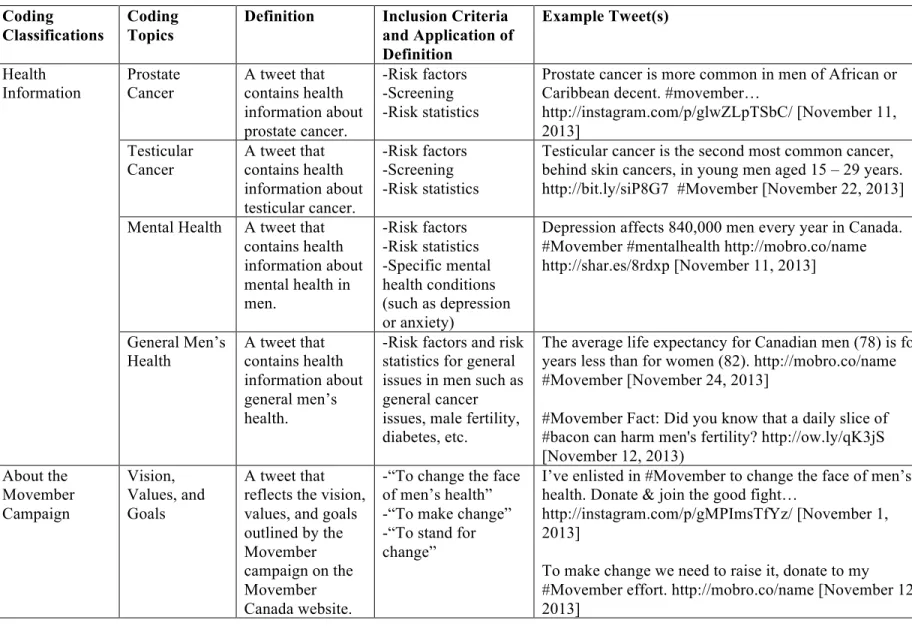
Table 1. Coding scheme for analysis of Movember 2013 tweets on the Twitter social networking site ... 45 Table 2. Comparison of theme counts and percentages between health-related and
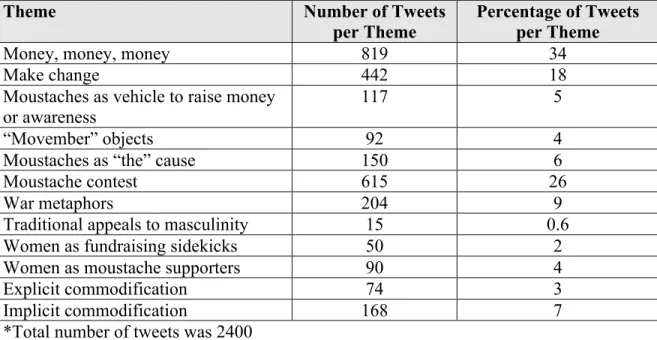
non-health-related tweets. ... 54 Table 3. Themes present in conversations about the 2013 Movember Canada campaign
and the percentage of tweets per theme* ... 70 Table 4. Themes present in conversations about the 2013 Movember Canada campaign
and representative tweets ... 71 Table 5. The number of tweets collected each day of November 2013 ... 137 Table 6. The number of Canadian and Non-Canadian tweets for November 1st,
November 15th, and November 30th 2013 ... 138 Table 7. Chi-Square Test. Ho: no significant difference in the code for location (0=
Non-Canadian; 1= Canadian) between Group A and Group B ; Ha: there is a significant difference in the code for location (0= Non-Canadian; 1= Canadian) between Group A and Group B. alpha = 0.05 ... 138 Table 8. 2013 Movember Canada website codebook ... 142 Table 9. Total number of tweets and percentage of tweets for each province ... 146 Table 10. The number of health-related and non-health-related tweets in the Canadian
1
Introduction
A communication campaign is a) purposive with the intent to encourage specific changes to human behaviour; b) aimed a large target audience; c) conducted within a specific time frame, and d) an organized set of communication activities (Rogers, & Storey, 1987). Among notable and well-documented mass media health communication campaigns have been the Stanford Heart Disease Prevention Program (Noar, 2006; Wang, Cubbin, Ahn, & Winlkeby, 2008), Breast Cancer Awareness Month (Jacobsen & Jacobsen, 2011; Thackeray, Burton, Giraud-Carrier, Rollins, & Draper, 2013), and ParticipACTION (Craig, Bauman, & Reger-Nash, 2010). The introduction of the Movember campaign offered a unique communication strategy that capitalized on new communication technologies, such as social media sites, and required “embodied participation” (Robert, 2013) in the form of moustache growing and grooming.
In 2003, four Australian friends embraced an opportunity for health education following the success of a moustache growing contest within their social networks (30 young adults); this contest was affectionately termed Movember since it focused on moustache growing in the month of November (Movember, 2013c). Inspired by the women’s health movement, the Movember contest was seen as a platform for raising awareness about and research funds for men’s health issues (Jeffcott, Cagiannos, & Zorn, 2012). In 2004, the moustache growing contest was paired with raising awareness about men’s health generally and prostate cancer specifically (Robert, 2013). Hence, the creators of the Movember campaign devised a novel campaign strategy of pairing body modification (facial hair) with health awareness.
2
The Movember campaign challenged men to become ambassadors of their own health by growing a moustache and collecting pledges for the maintenance of their facial hair (Movember, 2013b). As the popularity of the campaign grew, so did the number of participating countries. In 2007, the Movember campaign was established in Canada and tied to a specific focus on prostate cancer (Movember, 2015b). This scope was broadened in the 2013 Movember Canada campaign to include efforts towards raising awareness about testicular cancer, the most common cancer among young men aged 15 to 29 years (Canadian Cancer Society, 2014c).
Among the stated goals of the campaign was that as moustaches emerge above men’s lips in November, discussions would be triggered about men’s health (Movember, 2013b). In March 2014, the Movember team announced that the 2013 campaign stimulated 1.7 billion conversations about men’s health worldwide (Movember Canada, 2014). An infographic about the impact of the 2013 Movember campaign can be found in Appendix A. One popular mechanism through which individuals participate in conversations and share various user-generated content, such as news, thoughts, and images, is through social media (Khang, Ki, & Ye, 2012).
Social media refers to a group of Internet-based applications that allow users to create and share content with one another (Kaplan & Haenlein, 2010; Thackeray, Neiger, & Keller, 2012). Categories of applications include content and video sharing, bookmarking, games, and social networking (Thackeray et al., 2012). One increasingly popular social media network site is Twitter—a web-based service that allows users to create profiles, make connections with other users, and view content of those with whom they have connected (twitter.com). Popular social network sites such as Twitter promote
3
rapid dissemination of information via the Internet (Eysenbach, 2008). The popularity of social media, and the resulting spread of user-generated content provides an opportunity for the public to play a significant role in information generation, filtering, and amplification (Chew & Eysenbach, 2010). Such public engagement through social media can encompass a variety of movements and concerns including political, social, and health topics. For example, Twitter was used to coordinate efforts and share news information regarding a demonstration outside Moldovan government offices in reaction to what some believed were fraudulent results of the 2009 parliamentary election (Mungui-Pippidi & Munteanu, 2009). Similarly, Twitter played a pivotal role as a medium for communication and activism regarding the 2009 Iranian presidential elections, even in particular areas where the government routinely censored its citizens (Solow-Niederman, 2010). In the health domain, Twitter has facilitated the monitoring and surveillance of disease levels and public concern online during pandemics, such as during the 2009 H1N1 outbreak (Chew & Eysenbach, 2010; Signorini, Segre, & Polgreen, 2011).
Social media has changed the way people, learn, think, and communicate about health information. In many cases, the public does not automatically accept the advice of traditional experts, such as doctors or public health institutions, and instead look to what peers are saying about the health topic (Ratzan, 2011). This is especially the case among well-educated young adults (Percheski & Hargittai, 2011). Consequently, it is timely and important to examine the content of online public conversations through social media channels to identify whether the Movember campaign objectives of creating conversation about prostate and testicular cancers align with Movember-related conversations on
4
Twitter. Examining conversations on social media such as Twitter provide insight into what messages are taken from the campaign by individuals and then disseminated to others on social networking sites. The content of these messages can influence the knowledge, behaviours, or attitudes by the public about men’s health and men’s reproductive cancers.
Media theory informs how mass media and social marketing campaigns influence health knowledge, opinions and behaviours. One of the first and best validated media theories is that of agenda setting theory, which describes how the public interprets the importance of an issue depending on the emphasis that the mass media places on the issue (McCombs & Shaw, 1972). In 2013, the Movember Canada team set the agenda of men’s health, prostate cancer, and testicular cancer on the campaign website. The impact or capacity of a mass media/social marketing campaign such as Movember to set the public agenda can be examined by investigating conversations on social media (Twitter). Hence, the agenda that is set by the Movember campaign should be reflected in discussions on Twitter. Analyzing Twitter conversations can help to determine whether the 2013 Movember campaign successfully achieved the goal of creating conversations about “real issues” (e.g., men’s health, prostate cancer, testicular cancer) (Movember Canada, 2015f) rather that un-related or non-health related issues (e.g., moustache growing). Agenda setting theory has also informed research on media coverage about skin cancer (Dixon, Warne, Scully, Dobbinson, & Wakefield, 2014), breast cancer screening (Jones, Denham, & Springston, 2006), and smoking policy (Sato, 2003).
This M.Sc. thesis research investigated conversations on social media, and specifically on Twitter, during the 2013 Movember Canada campaign. The specific
5
elements examined were: 1) the topics of discussion in conversations, 2) the frequency of topics, and 3) the overt and latent themes regarding the Movember campaign, prostate and testicular cancers, and men’s health in general. The 2013 Movember Canada campaign was used as a case study to illustrate the impact of a national mass media campaign about facial hair and men’s reproductive cancers on social networking responses to that campaign. Improving our understanding of the “official” campaign agenda setting of men’s reproductive cancers on social media discussions can help improve the design and messaging of mass media health communication and social marketing campaigns, including those that use body modification as a primary communication strategy.
6
Chapter 1: Literature Review
This section presents an overview of relevant literature related to the main concepts of this thesis: men’s reproductive cancers, the portrayal of men’s health in traditional media, the Movember campaign, social media in health communication studies, and agenda-setting theory.
1.1
Men’s Reproductive Cancers: Prostate and Testicular Cancer
Prostate cancer has been the main focus for the Movember campaign since its inception in 2007. Prostate cancer is the second most frequently diagnosed cancer in men worldwide (World Health Organization, 2015), with an estimated global incidence of 1.1 million cases in 2012 (Ferlay et al., 2013). This accounts for 15% of all cancers diagnosed in men excluding non-melanoma skin cancer (Ferlay et al., 2013). With an estimated 307, 000 deaths worldwide in 2012 (6.6% of total cancer-related male deaths), prostate cancer is the fifth leading cause of cancer death (Ferlay et al., 2013).
Prostate cancer is the leading cancer in Canadian men (again, excluding non-melanoma skin cancer) and it is estimated that 1 in 8 Canadian males will be diagnosed with prostate cancer in his lifetime (Canadian Cancer Society’s Advisory Committee on Cancer Statistics, 2014). Prostate cancer accounts for approximately 24% of new cases of cancer in Canadian men (Canadian Cancer Society’s Advisory Committee on Cancer Statistics, 2014). However, prostate cancer does not affect all men equally and the risk increases with age (Canadian Cancer Society, 2014b). Men aged 60-69 represent 40% of
7
newly diagnosed cases of prostate cancer (Canadian Cancer Society’s Advisory Committee on Cancer Statistics, 2014). Prostate cancer is the third most common cause of cancer death in Canadian men (Canadian Cancer Society’s Advisory Committee on Cancer Statistics, 2014). Most prostate cancer deaths occur in males aged 80 years and older (Canadian Cancer Society’s Advisory Committee on Cancer Statistics, 2014). The high incidence-to-mortality ratio of this disease indicates that a large percentage of men clinically diagnosed with prostate cancer will eventually die of causes other than prostate cancer (Penson, Rossignol, Sartor, Scardino, & Abenhalm, 2008). This has led to the public perception that many men die with prostate cancer rather than because of prostate cancer.
The prostate-specific antigen (PSA) test for prostate cancer screening is not currently recommended in Canada as a population-based screening program due to the high potential for false-positive results (Bell et al., 2014). Instead, patients are advised to speak to their primary care provider and discuss if the PSA test is right for them. Between 2001 and 2009 the mortality rate declined significantly in Canada from 26.7 per 100,000 to 19.4 per 100,000 (Canadian Cancer Society’s Advisory Committee on Cancer Statistics, 2014). The decline is described as a possible reflection of improvement in treatment options (Canadian Cancer Society’s Advisory Committee on Cancer Statistics, 2014). Alternatively, Bouchardy et al. (2008) explain the drop in mortality as a result of increased focus and awareness on surveillance (e.g., rectal digital exams) and control of prostate cancer (e.g., watchful waiting monitoring).
Upon a prostate cancer diagnosis, the concern of physicians and patients is life expectancy and quality of life after treatment (Penson et al., 2008). Early detection of
8
prostate cancer increases the chance of diagnosis and early treatment while the cancer is still a low-risk localized neoplasm. Treatment options for patients with low-risk prostate cancer include radical prostatectomy, radiation therapy, and active surveillance (O’Brien et al., 2011). A delay of even 6 months for radical prostatectomy can significantly worsen the pathological outcomes and lower the chance for bio-chemical recurrence-free survival (the absence of serum PSA of 0.2 ng/mL or greater) (O’Brien et al., 2011). Bio-chemical recurrence is a criterion used to evaluate success of prostate cancer treatment and is an indication of residual prostate cancer or disease progression (Uchio, Aslan, Wells, Calderone, & Concato, 2010). Thus, early detection of prostate cancer is important for increasing the odds of positive treatment outcomes and reducing the probability of death from prostate cancer (Charvat et al., 2013). Though previous studies have shown a diminished quality of life in the areas of sexual, urinary, and bowel function after treatment (Penson et al., 2008), recent studies indicate that for many patients, recovery to near-baseline functional levels following treatment is expected (Corbin, Kunnavakkam, Eggener, & Liauw, 2013).
In 2013, the organizers of the Movember Canada campaign decided to incorporate a second reproductive male cancer into the campaign platform, namely, testicular cancer (Movember, 2015b). Along with non-Hodgkin lymphoma, testicular cancer is the most commonly diagnosed cancer in young men ages 15-29 years (Canadian Cancer Society’s Advisory Committee on Cancer Statistics, 2014). Testicular germ cell tumours are classified as seminomas and non-seminomas (Verhoeven et al., 2013). Seminomas grow more slowly than non-seminomas and can sometimes be detected by the presence of human chorionic gonadotropin (a protein commonly associated with pregnancy) in the
9
blood (American Cancer Society, 2015c). Spermatocytic seminomas, which are more common among men over 40 years, progress slowly and have a better prognosis than non-seminoma tumours (Stang et al., 2013). Non-seminomas, which make up approximately 50% of all germ cell tumours (Canadian Cancer Society, 2015a), occur more frequently in young men aged 15 to 30 years and are classified into four different types of tumours: embryonal carcinoma, yolk sac carcinoma, choriocarcinoma, and teratoma (American Cancer Society, 2015c). For 2012, the global incidence of testicular cancer was estimated to be 55,266 cases with an estimated 10,351 deaths (Ferlay et al., 2013). In Canada, approximately 1000 men will be diagnosed with testicular cancer and 29 will die from the disease in 2014 (Canadian Cancer Society, 2015b).
The mortality rate for testicular cancer is low and the 5-year survival proportion (96%) is the second highest cancer survival among young Canadian adults (De et al., 2011). The low mortality rates and high survival rates are a reflection of the potential for cure if treatment and care before cancer metastasis has been instituted (Verhoeven et al., 2012). Treatment options include orchiectomy (surgical removal of the testicle), radiation therapy, and chemotherapy (Shabbir & Morgan, 2004; Torpy, Lynm, & Glass, 2008). Despite the high survival rate, testicular cancer survivors often deal with long-term morbidity. For example, both testicular cancer and its treatment have been associated with second malignant neoplasms, cardiovascular disease, decreased fertility, and psychosocial disorders (Travis et al., 2010; van den Belt-Dusebout et al., 2007). Moreover, treatments such as radiotherapy and chemotherapy increase the risk of premature death due to second malignant neoplasms and cardiovascular disease in testicular cancer survivors (van den Belt-Dusebout et al., 2007). Testicular cancer is often
10
painless in its early stages and can be detected early by regular self-examination or physical examination by a physician (Torpy et al., 2008). Although testicular cancer may be rare, if not detected and treated in its early stages, it can progress, metastasize, and eventually lead to premature death in young men (Shanmugalingam, Soultati, Chowdhury, Rudman, & Van Hemelrijck, 2013).
1.2
Coverage of Prostate and Testicular Cancers in Traditional Mass Media
In traditional print media, such as newspapers and magazines, the coverage of prostate and testicular cancer has been far less than that of breast and female reproductive cancers. For example, Clarke (2004) found that there was a significantly smaller number of North American magazine articles published between 1996 and 2001 dedicated to the two male cancers (11 articles on testicular; 19 articles on prostate cancer) than to breast cancer (174 articles). Breast cancer stories also were covered more frequently in an analysis of 2003 ethnic and mainstream newspapers in the United States, despite a lower incidence of breast cancer in comparison to prostate cancer (Stryker, Emmons, & Viswanath, 2007). Indeed, media reporting of breast cancer far exceeds the coverage of other women’s cancers with significantly higher mortality (Gerlach, Marino, & Hoffman-Goetz, 1997).High media coverage of breast cancer may be attributed to campaigns and awareness efforts such as Breast Cancer Awareness Month (BCAM) in October, which have been running in the United States, Canada, and Britain for over two decades. BCAM has been successful at increasing awareness about breast cancer, educating women about risk factors, raising funds for breast cancer research, and promoting early
11
detection through screening and self-examination (Thackeray et al., 2013). In contrast, prostate and testicular cancer campaigns have not achieved the same success in raising public awareness and research funds as Breast Cancer Awareness Month. For example, a surge of online search activity relating to breast cancer occurred throughout each October compared to other months between 2004 and 2009 (Glynn, Kelly, Coffey, Sweeney, & Kerin, 2011). In contrast, there was no significant difference for online search activity related to prostate cancer between September, prostate cancer awareness month, and other months (Glynn et al., 2011). The Movember campaign may present an opportunity for increasing public awareness and education about prostate and testicular cancers, which would parallel the success of Breast Cancer Awareness month.
The most dominant theme in mass media coverage of prostate and testicular cancer articles between 1996 and 2001 was discussions about medical treatment (Clarke, 2004). Closely related was the theme of early detection. This finding was not surprising since the debate about the benefits and risks of prostate-specific antigen (PSA) testing has been controversial ever since the U.S. Food and Drug Administration approved the test for early detection of prostate cancer in 1994 (MacKenzie, Chapman, Holding, & McGeechan, 2007; Stark, Mucci, Rothman, & Adami, 2009). Indeed, the research literature about the coverage of prostate cancer in the media suggests that the main focus is often with the topic of population wide screening with the PSA test- its cost, benefits and efficacy (Lawrentschuk, Daljeet, Trottier, Crawley, & Fleshner, 2011; MacKenzie, Chapman, Barratt, & Holding, 2007; MacKenzie et al., 2007).
Dominant stereotypes of masculinity are frequently cited in articles about prostate cancer. In North American magazines, between 1996-2011, treatments for prostate cancer
12
were described using characteristics such as aggression, determination, and dominance (Clarke, 2004). Additionally, the testicles were equated with manhood and masculinity and frequently associated with sexuality and fertility. Treatment and other complications of prostate cancer are often constructed as a threat to sexual function and war metaphors are used to construct the patient as a warrior who has to fight and battle the disease (Miele, & Clarke, 2014). Dominant stereotypes of masculinity were also frequently featured in prostate cancer articles in Canadian newspapers from 2001-2006 (Halpin, Phillips, & Oliffe, 2009). For example, men with prostate cancer were described as stoic and courageous, particularly when the case was a male in the sports and entertainment industries (Halpin et al., 2009).
1.3
The Movember Campaign
The Movember campaign began as a moustache growing contest in November 2003. The four co-founders-Travis Garone, Adam Garone, Luke Slattery, Justin Coughlin- named the contest, “Movember”, which played on the Australian slang ‘mo’ for moustache and the eleventh month in which the contest would take place. After seeing how popular the contest was among friends, the co-founders decided to pair the contest with fund-raising for men’s health issues, and specifically, for prostate cancer (Jeffcott et al., 2012). In the last ten years, the organizers of the Movember campaign have worked towards the goals of raising awareness about men’s health issues and stimulating conversations about men’s health on a global level (Movember, 2015b).
In 2007, the Movember Foundation partnered with Prostate Cancer Cancer and launched the campaign into Canada. The success in fundraising has been remarkable. In
13
2012, Canada was the top fundraising country internationally (raising over $42 million CAD) and in 2013, Canada took second place to the U. K. after raising over $34 million CAD (Movember, 2015e). This is in comparison to fundraising in other English-speaking countries where Movember has been rolled out (e.g., for 2013: the U.K.- $35 million CAD; Australia- $25 million CAD; the United States-$24 million CAD). The Movember campaign has grown globally to include twenty-one participating countries. The success of the campaign in Canada has been attributed to adopting a grassroots approach and the use of social media to share messages (Jeffcott et al., 2012).
Though the campaign started with a focus on prostate cancer, opinion leaders such as men’s health consultant, Peter Baker in the United Kingdom, urged the campaign leaders to incorporate a range of men’s health issues apart from prostate cancer and broaden the list of beneficiaries of the funding (McCartney, 2012). The evolution of campaign health topics is documented in the annual Movember reports. In the 2009-2010 Canadian Country Movember Report, the focus of the campaign was men’s health with an emphasis on prostate cancer (Movember Canada, 2015d). The Movember team launched a Global Action Plan, with a goal to foster collaboration amongst members of the global prostate cancer community (Movember, 2015b). Following the lead of Movember Australia and Movember New Zealand, Movember Canada added men’s mental health, particularly depression, as a focus to the 2012 Canadian campaign. Mental health is an important topic for men’s health since the suicide rate for men is higher than for women; for example, in 2011 the rate for individuals aged 50-54 years (the age range with the highest rate of suicide for both sexes) was 24.2 per 100,000 in men compared to 9.1 per 100,000 in women (Statistics Canada, 2014). In 2013, the Movember Global
14
Action Plan for cancer research was expanded to support testicular cancer research and awareness, again re-emphasizing a focus on men’s reproductive cancers (Movember, 2015f).
The Movember campaign presents the act of growing a moustache as a powerful tool for raising awareness about men’s health issues. The Movember marketing team plays on people’s desire to participate in altruistic action (Robert, 2013) by pairing messages such as “donate” and “fight the good fight” with “changing the face of men’s health” (Movember, 2013b). Growing a moustache is associated with “real men” and is referred to as a “catalyst” for creating conversations with messages such as “real men growing real moustaches, talking about real issues” (Movember, 2015f). These real issues are implicitly aligned with “Knowledge is power, moustache is king” and frames health education as a powerful message for social change. Accordingly, knowledge and conversation are presented as the solutions to changing the way men think about their health, including men’s cancers.
Creating conversations about men’s health is one of the main goals of the Movember campaign. In March 2014, the Movember team announced that the previous year’s Movember campaign prompted 1.7 billion conversations worldwide on social media and email (Movember Canada, 2014). As a result of these conversations, the Movember campaign leaders claim that participants became more aware of their cancer risks, encouraged others to take action to improve their health, and sought medical advice to improve their health (Movember, 2014). Mark Hedstrom, the Movember director for the U.S.A chapter, was quoted saying that, “each moustache generates more than 2,400 conversations about men’s health” (Drell, 2014). Popular platforms for such
15
conversations are social networking sites, such as Twitter and Facebook. According to the Movember Foundation Annual Report for 2013/2014, there were over 1.6 million Movember mentions on Twitter during the 2013 Movember campaign (Movember, 2015c). Social media sites allow participant users to connect with one another, share stories of participation, and ask supporters for pledges (Robert, 2013).
1.4
Social Media and Health Communication
Social media is broadly defined as a group of web-based applications that allow users to modify content in a participatory and collaborative fashion resulting in the creation and exchange of user generated content (Kaplan, & Haenlein, 2010). With the rapid increase in the use of social media over the last decade, the dissemination of messages about health is not restricted to traditional media outlets such as print, radio, and television. One of the core principles of social media that makes it different from other forms of media is the ability to share content such as personal opinion, links, images, and audio or video files (Osterrieder, 2013). Social media sites provide an online platform for individuals to take up and share such content (Lee & Ma, 2012; Lyles, López, Pasick, & Sarkark, 2013).
In 2010, the Canadian Internet Use Survey found that more than half (58%) of survey participants used social networking sites, with most users under the age of thirty-five (Statistics Canada, 2010). Of these users, female users (62%) were more likely to use social networking sites than their male counterparts (54%) (Statistics Canada, 2010). Women were described as more engaging users of MySpace because they were more open to sharing positive emotions with peers on social networking sites than men
16
(Thelwall, Wilkinson, & Uppal, 2010). The average age of Canadian social media networkers (i.e., individuals who visit two or more social media websites in a month) was thirty-three years (Print Measurement Bureau [PMB], 2009). Moreover, 60% of Canadians in the highest quintile for traditional media use (e.g., magazines and television) were also more likely to be social media networkers (PMB, 2009). Thus, it seems reasonable to infer that high consumers of traditional media successfully make the transition to online media and social networking environments.
Social media use is increasingly a popular recreational activity in Canada. According to the Media Technology Monitor, there was an increase of 6% of individuals who reported regular social media use (logging in at least once a month) from 2011 to 2013 (Oliveira, 2013). Among the factors that motivated usage included information seeking, socializing, entertainment, and status seeking (Lee & Ma, 2012). The popularity of social media sites has created a great opportunity to leverage these new communication tools for effective health awareness and education purposes (Ratzan, 2011).
Though the number of social media platforms is still limited, the possibilities and applications for public health communication are vast. Researchers have explored YouTube as a source of health information for a range of health topics including prostate cancer (Steinberg et al., 2010), retinitis pigmentosa (Guthrie, Davies, Fleming, & Browning, 2014), and pediatric adenotonsillectomy and ear tube surgery (Sorensen, Pusz, & Brietzke, 2014). For example, Sorensen et al. (2014) assessed videos based on the categories of educational, testimonial, and news program as well as criteria such as quality of the video, accuracy of information, and ratio of “likes” to “dislikes.” Patients
17
seeking information on YouTube about pediatric adenotonsillectomy and ear tube surgery were most likely to find a testimonial video with low quality information during their search (Sorensen et al., 2014). Although YouTube may be a promising source of visual content for health education purposes, researchers have also demonstrated that the general public does not typically engage with videos that are highly educational or of superior scientific suitability on this social media platform. The reason for the apparent lack of public engagement with YouTube videos is likely because credible organizations produced few highly educational and engaging medical videos (Desai et al., 2013).
Social network sites, an important category of social media, enable users to create a profile and interact with their social network online (Boyd & Ellison, 2008) and have become important platforms for investigating the role of social media in health education and communication. For example, Facebook has been studied as a source of health information (Zhang, He, & Sang, 2013). Additionally, Facebook has been identified as a potential instrument for communication in health promotion intervention designs (Byron, Albury, & Evers, 2013; Valle, Tate, Mayer, Allicock, & Cai, 2013). Some Facebook interventions have proven more successful than others. Thus, while Facebook interventions for diabetes groups have provided information and social support to the users (Zhang et al., 2013), others, such as the sharing of sexual health messages to youth, have been less effective (Byron et al., 2013). The reason for differences in the success of interventions may be because of topic sensitivity (e.g., stigma attached to sexual health problems), privacy concerns (e.g., record of personal information online), and age demographic (e.g., self presentation concerns among youth) (Byron et al., 2013). Nonetheless, Facebook has the potential to foster relationships and trust amongst patients
18
and health care providers and may be a useful vehicle for health care information sharing. For example, medical practitioners can interact with patients and offer medical advice via Facebook (Hawn, 2009). More recently, the social media site, Twitter, has been explored as a tool for communicating health information and creating social networks.
Twitter is a social network platform in which users sign up for an account, create a profile, and share messages, or “tweets”, which are restricted to 140 characters maximum (Twitter.com). Twitter allows the user (tweeter) to connect with others, express himself through text or visuals, and become informed by reading tweets about global events and local trends (Twitter.com). Because each message is restricted to 140 characters, users communicate via “hash tags” to identify tweets with particular themes or topics. This Twitter syntax is particularly useful for researchers because it allows them to search for themes or topics that have been previously identified by the user. Twitter has many applications to health research, such as infoveillance and infoepidemiology (i.e., tracking levels of disease by monitoring key terms such as symptoms and matching it with the geolocation of tweets) (Eysenbach, 2009), health communication (e.g., health professionals tweeting information about dementia) (Robillard, Johnson, Hennessey, Beattie, & Illes, 2013), and health interventions (e.g., tweeting research protocol and providing social support to participants of a weight loss intervention) (Turner-McGrievy, & Tate, 2011). Twitter messages have been studied as a modality to share information and education about such diverse health topics as concussions (Sullivan et al., 2013), cervical and breast cancer screening (Lyles et al., 2013), antibiotics (Scanfeld, Scanfeld, & Larson, 2010), and glaucoma (McGregor et al., 2014). To date, there have been no
19
published analyses of Twitter information sharing among users about prostate or testicular cancer awareness.
Characteristics of social media sites, including the large volume of users reporting their current activity, thoughts, and location, allow capture of specific health issues and health behaviours of interest to researchers (Yoon, Elhadad, & Bakken, 2013). Tweets are a source of real-time, real-world data that can be mined (imported and organized using software) and analyzed to gain insights about the content of messages and the public’s attitude (measured by sentiment) about important health topics (Yoon et al., 2013). Moreover, since users interact in a naturalistic fashion in the social media environment, candid feelings and attitudes among users about a specific issue can be identified (Burton, Tanner, Giraud-Carrier, West, & Barnes, 2012).
1.5
Media Theory: Agenda Setting as a Theoretical Framework
Agenda setting theory describes how the public interprets the importance of an issue depending on the emphasis that the media places on the issue (McCombs & Shaw, 1972). It has been argued that what the general public knows initially about an issue is a reflection of what they have learned through the media (Beyers, & Kerremans, 2007; Wallack, Woodruff, Dorfman, & Diaz, 1999). Consequently, agenda setting theory asserts that the “the news media can set the agenda for public thought and discussion” (McCombs & Reynolds, 2002, p.1).
McCombs and Shaw (1972) first explored the agenda setting capacity of the mass media when they conducted a content analysis of newspapers, magazines, and news broadcasts on television in order to investigate the media’s influence on the public in a
20
1968 presidential election campaign in Chapel Hill, North Carolina. McCombs and Shaw (1972) found that the ranking of issues (e.g., foreign policy, law and order, fiscal policy, public welfare, civil rights) in the media agenda correlated with the ranking in the public agenda. They concluded from this research that the media has an influence on what issues are interpreted as important to the public (McCombs & Shaw, 1972). The introduction of agenda setting theory resulted in several studies in the 1980s that aimed to describe the agenda setting process and its three main components.
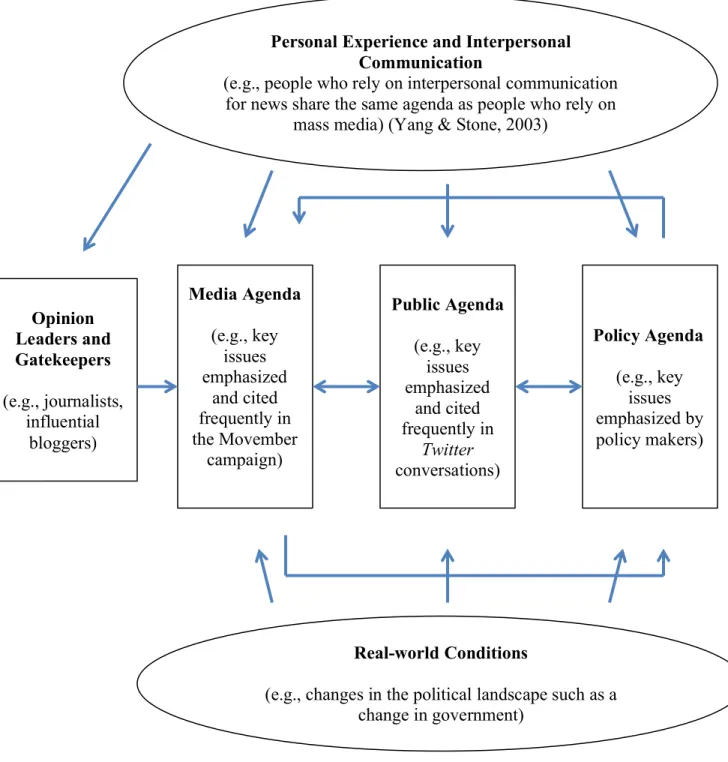
The three main components of the agenda-setting process include the media agenda, the public agenda, and the policy agenda (Rogers, & Dearing, 1988). The relationship between these three components is depicted in Figure 1. Gatekeepers (such as journalists, publishers, purveyors of knowledge) and influential media (such as newspapers, magazines, radio, etc.) create the media agenda by deliberately covering certain issues or events and not covering others, and framing these issues as events that should be important to the public and policy makers. Furthermore, there is a feedback effect whereby the public concern inspires news coverage (Behr, & Iyengar, 1985). The public agenda is concerned with the content and order of importance of topics to the public (Rogers, Dearing, & Bregman, 1993). Sources other than the media can also influence each of the three dependent variables (media agenda, public agenda, policy agenda) such as personal experiences, and real-world conditions (e.g., economic conditions, energy crisis, etc.) (Behr, & Iyengar, 1985). Once the agenda-setting process had been described, researchers turned to answer the following question: “What are the cognitive processes involved in the agenda-setting process at the individual level?” (Rogers, 1993).
21
The concepts of priming and framing have been explored as cognitive mechanisms to describe the process of agenda setting. Priming has been described as “making certain issues or attributes more salient and more likely to be accessed in forming opinions” (Weaver, 2007, p. 145). Thus, the more frequently a person hears about a topic, the easier it is to access that topic in memory. According to Hornik, priming occurs “when repeated exposure to a message affects the weight given to the message in deciding to engage in a behaviour” (p.34). While priming is more concerned with the accessibility of information on attitudes and beliefs, framing assumes that how an issue is characterized can influence the audiences understanding of the issue (Scheufele, & Tewksbury, 2007). Framing has been defined as “to select some aspects of a perceived reality and make them more salient in a communicating text, in such a way as to promote a particular problem definition, causal interpretation, moral evaluation, and/or treatment recommendation for the item described” (Entman, 1993, p. 52). Frames function to define problems, diagnose causes, make moral judgments, and suggest remedies (Entman, 1993). Frames emphasize certain “bits of information about an item…making a piece of information more noticeable, meaningful, or memorable to audiences” (Entman, 1993, p.53).
Lefebvre (2008) described agenda setting theory as an “under appreciated aspect of communication theory that supports marketing, and especially the creation of markets” since it considers to the role of the audience as a producer, rather than passive recipient, of health information. While most research that addresses agenda setting theory has focused on the impact of the media on issues surrounding politics and voters’ opinions and attitudes (Jones et al., 2006), health education researchers have applied the agenda-setting function of the media to health behaviours and health policy. For example, Gollust
22
and Lantz (2009) used agenda setting theory and framing to describe how news media (newspaper articles) frame type 2 diabetes as an individualized behaviour, which presented implications for the public’s likelihood of supporting policies that emphasize population health. Jones et al. (2006) studied the effects of mass media and interpersonal communication on breast cancer screening among college and middle-aged female participants. The researchers found that middle-aged women were influenced by exposure to mass-mediated information more than college-aged women (Jones et al., 2006). Sato (2003) also drew on agenda setting theory and coded newspaper articles to observe the relationship between the media agenda and the Diet agenda (Japan’s legislative parliament) on smoking control policy (Sato, 2003).
Despite extensive documentation that media can influence priorities of issues in audiences, explanations for how agenda setting occurs have been debated (Weaver, 2007). For example, while some researchers have proposed that accessibility-based mechanisms can describe how agenda setting works (Scheufele, & Tewksbury, 2007), other researchers believe that trust of media is a more important moderator to explain the effects of media on the audience’s prioritization of an issue (Miller, & Krosnick, 2000). For example, audience members who trust the media to be accurate and informative may be more inclined to believe that the news coverage of an issue is associated with the importance of the issue (Miller, & Krosnick, 2000). More research is needed to understand the mechanism by which the public agenda is set. Nevertheless, it is difficult to demonstrate relationships and prove causality when researchers are rarely able to control the independent variable (e.g., the media agenda) (Rogers & Dearing, 1988).
23
This thesis research is concerned with the public agenda, and is focused on the relative importance of prostate and testicular cancers compared to other topics in publically available Movember-related conversations. Investigating conversations on social media (e.g., Twitter) can help identify whether prostate and testicular cancers were important topics in the public agenda as it relates to the Movember campaign. Moreover, understanding what is communicated on social media during cancer awareness campaigns will reveal which aspects of the campaign (e.g., fund-raising, growing a moustache, sharing information about risks of prostate cancer) were emphasized and discussed more frequently in conversations generated by social media users and which ones were ignored.
24
Figure 1. Modified from, “The Relationship of the Three Main Components in the Agenda-Setting Process” as it is depicted in Rogers and Dearing, 1988, p. 557 in J. A. Anderson (Ed.),
Communication yearbook 11 (p. 557), Newbury Park, CA: Sage. Real-world Conditions
(e.g., changes in the political landscape such as a change in government) Opinion Leaders and Gatekeepers (e.g., journalists, influential bloggers) Media Agenda (e.g., key issues emphasized and cited frequently in the Movember campaign) Public Agenda (e.g., key issues emphasized and cited frequently in Twitter conversations) Policy Agenda (e.g., key issues emphasized by policy makers) Personal Experience and Interpersonal
Communication
(e.g., people who rely on interpersonal communication for news share the same agenda as people who rely on
25
Chapter 2: Research Gaps, Objectives, and Rationale
Although there is an abundance of research on mass media campaigns and social networking sites (Noar, 2006), existing research on the Movember campaign is sparse despite receiving significant media attention. Analyzing conversations on social media can illuminate the influence of the Movember campaign on the public and the role of social media during awareness-related events. Given the influence of mass media campaigns on public agenda setting, understanding potential differences in campaign and audience values may improve the design and communication leading to more effective and impactful mass media campaigns in the future.
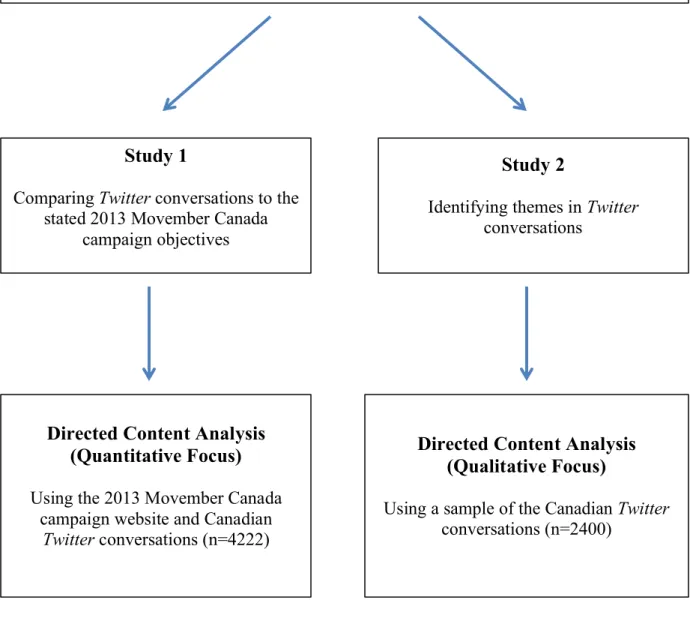
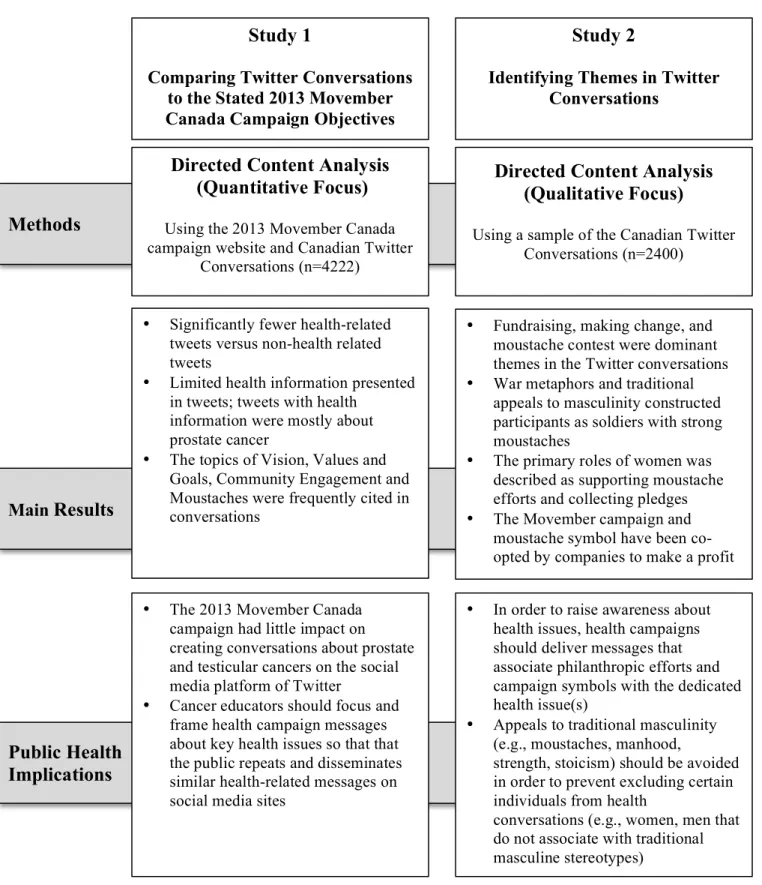
This research was composed of two studies, each with a set of specific research questions and testable hypotheses. The overall objective of this research was to describe the content of conversations about the 2013 Movember Canada campaign that occurred in the social media channel of Twitter. Underlying this overall aim was to determine whether the 2013 Movember Canada campaign accomplished the stated goal of creating conversations about men’s health and about the dedicated health issues of prostate and testicular cancers. The relationship between each study and the overall objective of this research is depicted in Figure 2.
As a case study, the 2013 Movember Canada website and a sample of Canadian Movember-related Twitter conversations were analyzed in order to describe topics of discussion surrounding the Movember campaign, the frequency of topics, and the overt and latent themes that were present in Twitter messages. The following section details the
26
research gaps, research questions, and hypotheses from each of the two studies of this thesis.
27
Figure 2. Brief Description of Each Study and their Relation to the Overall Research Question
4222 Canadian tweets were collected using the Twitter search engine
The 2013 Movember Canada website content was retrieved via Wayback Machine
Objective: To describe the content of Twitter conversations related to the 2013 Movember Canada campaign and examine whether the 2013 Movember Canada campaign objectivesof creating conversations about men’s health, and prostate and testicular cancers specifically, align with the issues being discussed in conversations on Twitter.
Study 1
Comparing Twitter conversations to the stated 2013 Movember Canada
campaign objectives
Directed Content Analysis
(Quantitative Focus)
Using the 2013 Movember Canadacampaign website and Canadian Twitter conversations (n=4222)
Directed Content Analysis
(Qualitative Focus)
Using a sample of the Canadian Twitter conversations (n=2400)
Study 2
Identifying themes in Twitter conversations
28
2.1
Study #1
Movember has been described as a “phenomenon” that is “hard not to hear or see something about” (Jeffcott et al., 2012). Men are encouraged to grow moustaches while collecting pledges and sharing messages on social media sites. While fundraising for health programs is a major component of the Movember campaign, Adam Garone, Movember CEO and Co-Founder said, “what is equally important are the conversations and awareness about men’s health created by the simple act of growing a moustache” (Movember, 2015b). In 2013, the Movember Canada campaign objectives included, “creating conversations about men’s health that lead to awareness and understanding of the health risks men face, and men taking action to remain well” (Movember Canada, 2013d). Additionally, their stated vision included, “to have an everlasting impact on the face of men’s health by supporting prostate and testicular cancer and mental health. We focus our efforts on: awareness and education, staying mentally healthy, living with and beyond cancer, living with and beyond mental illness, and research” (Movember, 2013d). In 2014, the Movember Foundation announced that the 2013 Movember campaign had prompted 1.7 billion conversations worldwide on social media and email (Movember Canada, 2014). To date, no academic analysis of the content of these conversations has been conducted. Therefore, there is limited knowledge of how social media is used to increase awareness and education of prostate and testicular cancers in the public during the 2013 Movember campaign.
The first study of this research focused on determining whether the conversations about Movember that occurred in social media reflected the stated focus and objectives of the 2013 Movember Canada campaign. Comparing social media discussions against
29
campaign objectives could help to inform cancer educators and health campaign creators of the impact of mass media campaigns on the public’s knowledge and values, the role of social media as a platform for public engagement, and the success of the Movember campaign specifically in raising awareness for the beneficiaries of the campaign (e.g., Prostate Cancer Canada). The specific research question that directed this study was:
Did the 2013 Movember Canada campaign meet the objective of creating conversations (on Twitter) about men’s health, and prostate and testicular cancers for the month of November (2013)?
Prostate and testicular cancers have been identified as health problems that require advocacy and awareness (Blanchet, 2011; Siemens, 2011). Both of these chronic diseases are identified as the main thrust of recent Movember campaigns. It is reasonable to expect that the public will also adopt the idea that prostate and testicular cancers are significant health issues for men. Additionally, agenda setting theory suggests the public will adopt the popular and relevant themes of the 2013 Movember campaign.
The hypothesis for this study was:
Agendas and themes identified in the 2013 Movember Canada campaign would be evident in the conversations on social media (Twitter) for the month of November (2013).
2.2
Study #2
The focus of study #2 was to describe the overt and latent themes that were present in the conversations related to the 2013 Movember Canada campaign in order to understand what ideas and concepts were prioritized in conversations about Movember. A qualitative content analysis methodology was used to identify overt and latent themes.
30
This study was informed by themes that were present in the 2013 Movember Canada website content as well as themes that were present in traditional media sources about prostate cancer and testicular cancers. Overt themes refer to the surface-level meanings of the message. The researcher does not look for meanings beyond what the participant is saying (Braun & Clarke, 2006). In contrast, latent themes examine the underlying assumptions and ideas of the data (Braun & Clarke, 2006). Latent content includes absence of themes and the deeper or unintended meanings (Clarke, Friedman, & Hoffman-Goetz, 2005).
Prostate and testicular cancers have been associated with the themes of sport, competition, war, and money in traditional mass media print outlets (North American magazine articles) published between 1996 and 2001; machismo was used to describe why men did not engage in early screening for prostate and testicular cancers (Clarke, 2004). Moreover, testicles were presented as representing manhood, masculinity, and sexuality and testicular cancer was frequently cited in contexts of sexuality, fertility and relationships with women. The use of euphemisms and humour was frequently used, suggesting embarrassment about testicular cancer (Clarke, 2004). Dominant stereotypes about masculinity and prostate cancer also frequently occurred in articles printed in the National Post and The Globe and Mail between 2001-2006 (Halpin et al., 2009). Characteristics such as competition and stoicism were associated with prostate cancer patients and survivors (Halpin et al., 2009). War metaphors that are common in cancer discourse were pervasive throughout prostate cancer articles with descriptions of the prostate cancer patient as needing strength to “fight” against cancer (Miele & Clarke, 2014).
31
Movember campaigns use similar appeals to masculinity strategies, by emphasizing the relationship between facial hair for a cause and entering a stage of manhood (Robert, 2013). The research question that directed this study was:
What are the overt and latent themes related to men’s reproductive cancers appearing in social media (Twitter) during the 2013 Movember campaign?
The hypotheses for this study were:
1) Social media conversations appearing in Twitter during the 2013 Movember Canada campaign would reflect the cultural themes evident in other traditional media
2) The theme of hegemonic masculinity (dominant stereotypes of masculinity such as strength, courage, war, toughness) would appear in conversations in social media (Twitter) in relation to prostate and testicular cancers during the 2013 Movember Canada campaign.
32
Chapter 3: Methods
This research did not require ethics approval since it used website content and publically available archived Twitter content for analysis. The section below describes the general methods used in the studies. Additional methodological details are given in Chapters 4 and 5 where the results are described.
3.1
Data Collection
3.1.1 2013 Movember Canada Website Content: Wayback Machine
The Internet Archive: Wayback Machine (http://archive.org/web/) was used to collect captures of the Movember Canada website as it appeared during November in 2013. Wayback Machine allows users to search for the website of interest (e.g., ca.november.com) and view archived versions of the web pages. Appendix B shows the snapshot provided by Wayback Machine of the men’s health web page on the Movember Canada website as it appeared on November 7, 2013. Evernote, a notetaking and archiving software (https://evernote.com/), was used to capture the screen for each web page of the Movember Canada website so that a PDF version of each web page could be imported into NVivo (v.10) for analysis.
3.1.2 2013 Movember Canada Conversations: Twitter Search Engine
Twitter has a dedicated search query called Twitter Search (twitter.com/search-home) which allows the user to conduct manual searches for keywords in tweets. One of
33
the key features of the Twitter advanced search engine is the ability for the user to search for tweets with specific parameters such as hashtags, language, and date range. The specific parameters for this research included: the “#movember” hash tag, English language, and posted between of November 1, 2013 to November 30, 2013 (inclusive). An example of the output generated by the Twitter search engine using the search operators: “#movember lang:en until: 2013-11-02” can be found in Appendix C.
Since the Movember Canada website has specific content and dedicated health issues that differ from other participating countries, it was important to identify tweeters who were from Canada in order to make comparisons between the Canadian Movember website and Twitter conversations. To classify tweets from Canada, the geographic location of the user was determined using the methodology for Twitter research described by Sullivan et al. (2013). Briefly, the geographic location was manually determined by clicking on the user profile and identifying where the Twitter account was registered; this information was dependent on whether the user shared this data. Users could choose to provide geographic identifiers and did not have to do so to tweet. Appendix D shows an example of where the geographic location appears on a user profile.
The Twitter search engine did not indicate how many tweets met the search criteria (#movember, English, November 1, 2013 to November 30, 2013, registered Canadian tweeter). Thus, it was not possible to calculate the total number of publically available Twitter messages that met the search criteria. Given the number of tweets, it was not reasonable to manually copy and paste all tweets that met the search criteria. Nevertheless, to address potential sampling issues, 1500 tweets were collected for 3 specific dates: November 1, November 15, and November 30. The first 1500 tweets were
34
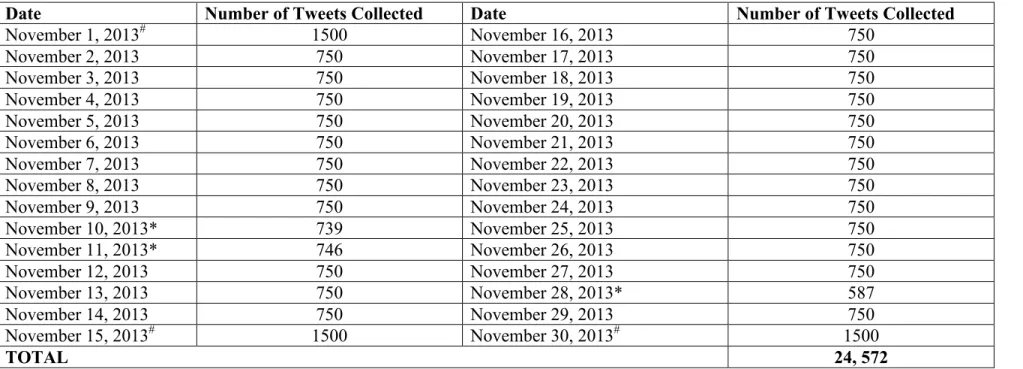
divided into two sets of 750 tweets to determine if the groups were similar in the number of Canadians participating in the conversation. Appendix E shows justification for the sample size (e.g., number of tweets collected). Since there was no significant difference between the number of Canadian tweets in the two sets of data, 750 tweets were collected for all remaining days in November with the exception of November 10 (n =739 tweets), November 11 (n= 747 tweets), and November 28 (n= 587) due to technical difficulties with the Twitter search on these days. A total of 24,573 tweets that met the search criteria were imported into Excel for data organization. Appendix F shows how Twitter data was organized in an Excel spreadsheet. The following information was collected about each tweet: date of retrieval, date posted by user, content of tweet, location of user, code for location of user (where 0=not Canadian, 1 = Canadian, and 2 = not available), number of followers, presence of image (where 0 = no, 1 = yes), and code for organization/company/group (where 0= no, 1 = yes).
Only original tweets, rather than retweets, were analyzed. A retweet is a re-posting of someone else’s tweet (Twitter.com). Retweets have been used as one of the criteria for determining influence of a tweet or tweeter (Xiao, Zhang, Zeng, & Wu, 2013). However, retweets do not represent original thoughts, attitudes, or opinions of the user. Thus, content that had been retweeted (indicated by “RT@username:”) were removed. Additionally, duplicates of tweets from the sample user were removed in an effort to capture as many original tweets and themes as possible.
After retweets and duplicates were removed, 4,222 Canadian tweets were extracted from the data sample and imported into NVivo (v.10) for analysis in study #1. Analysis for study #1 is detailed in Chapter 4. Approximately 50% (n= 2400; 80 tweets per day for
35
each day of November) of this sample was analyzed for study #2. A 50% sample (n= 2400) of the total number of Canadian tweets collected (i.e., n = 4222) was chosen for qualitative analysis because tweets were short, and it was necessary to have a sufficient sample to reach saturation of themes. An initial analysis of approximately 25% of the total Canadian tweets (n= 1200 tweets; a random sample of 40 tweets per day for each day of November) failed to reach saturation by two researchers and hence the increase in sample was undertaken Again, a random sample of a further 40 tweets per day was obtained for the analysis. At 2400 tweets, theme saturation was achieved. Data saturation is used to determine appropriate sample size in qualitative research and refers to the point in data collection when no new data or themes emerge and concepts or categories are well developed (Francis et al., 2010). Analysis for study #2 is detailed in Chapter 5. Appendix G shows a snapshot of NVivo (v.10) coding for each study.
3.2
Data Analysis
Both studies in this research used a content analysis methodology to analyze Twitter content. Content analysis is a widely used research method “for making replicable and valid inferences from text (or other meaningful matter) to the contexts of their use” (Krippendorff, 2004, p.18) Content analysis can consist of transforming qualitative content into a quantitative form by establishing coding categories and counting the number of data units (e.g., phrases, messages, responses) that fall into each coding category (Wilkinson, 2000). However, content analysis goes beyond just counting words to examining language for categories that represent similar meanings and overt or inferred communication (Hsieh, & Shannon, 2005).
36
Content analysis has been applied extensively to health research on diverse topics and content.